
What this is
- This research examines how acute exercise affects immune responses in older adults, focusing on differences between moderate and intense exercise.
- The study includes 33 healthy older individuals who performed either moderate or intense cycling exercises.
- Key outcomes measured include immune cell activation, cytokine levels, and the release of ().
Essence
- Acute exercise alters immune responses in older adults, with distinct effects based on exercise intensity and sex. Moderate exercise enhances specific immune markers in females, while intense exercise leads to broader immune activation and increased EV release.
Key takeaways
- Moderate exercise increased activation of classical monocytes in females, evidenced by elevated CD86 levels and decreased CX3CR1 expression. This suggests a sex-specific immune response to moderate physical activity.
- Intense exercise resulted in significant increases in classical and nonclassical monocytes, and NK cells, with sustained TNFα levels observed 24 hours post-exercise. This indicates a robust immune activation following high-intensity exercise.
- () were significantly elevated 24 hours after intense exercise, particularly markers like CD63 and CD81. This suggests that intense physical activity may enhance intercellular communication through EV release.
Caveats
- The sample size was small, particularly for sex-stratified analyses, limiting the power to detect subtle effects. This should be considered when interpreting the results.
- Findings regarding EV release were only observed after high-intensity exercise, which may restrict the generalizability of these results to moderate exercise contexts.
- The study's cohort consisted of healthy, active older adults, which may not reflect responses in sedentary individuals or those with chronic diseases.
Definitions
- immunosenescence: Age-related decline in immune function, increasing susceptibility to infections and diseases.
- extracellular vesicles (EVs): Small membrane-bound particles released from cells that facilitate intercellular communication and transport bioactive molecules.
Simplified
Highlights
Background
Aging is characterized by a progressive decline in physiological function and increased susceptibility to chronic diseases such as cardiovascular (e.g., heart failure, chronic coronary syndrome), metabolic (e.g., Diabetes Mellitus 2) and neurodegenerative (e.g., dementia) diseases, as well as cancer (1 –6). Age-related immune changes, or immunosenescence, contribute to heightened disease vulnerability and impaired infection response (7 –9). Chronic low-grade inflammation, or inflammaging, is a hallmark of aging and contributes to the pathogenesis of age-related diseases (10, 11). As the global population ages, understanding the complex interplay between exercise, immune function, inflammation, and aging is essential to promote healthy aging and reduce the burden of age-related diseases (12, 13).
Physical activity confers numerous health benefits and is essential for promoting healthy aging. While evidence supports that exercise positively impacts outcomes and prognoses across numerous diseases in the elderly (14, 15), the underlying mechanisms of exercise-induced release, uptake, and communication of bioactive factors in older adults remain incompletely understood. This is especially true regarding sex-specific responses as males and females may exhibit distinct immune adaptations to exercise. Regular exercise modulates immune function by reducing systemic inflammation markers and attenuates age-related increases in proinflammatory cytokine levels, making it a powerful approach for mitigating inflammaging and mitigate chronic disease risk in older adults (10, 13, 16 –19). Importantly, sex-specific differences in immune function suggest that personalized exercise regimens could optimize immune responses and overall health outcomes, highlighting the need for targeted approaches in exercise prescriptions for aging populations (20, 21).
Age-related immune changes include alterations in immune cell composition and function, dysregulation of cytokine signaling, and impaired immune surveillance (22 –26). While the benefits of physical exercise on immune function are well-documented, the precise mechanisms driving these effects, particularly in the older adult population, remain incompletely understood.
In recent years, extracellular vesicles (EVs), particularly those released in response to exercise (ExerVs), have emerged as a subject of significant interest due to their role in facilitating intercellular communication. By transporting proteins, lipids, and microRNAs to distant organs, EVs act as carriers of bioactive molecules potentially mediating exercise-induced benefits across the organism. Evidence suggests that exercise modulates EV release into circulation pointing toward a pathway through which physical activity may influence immune responses in aging populations (27 –32).
Despite growing recognition of the importance of physical exercise in healthy aging, major gaps remain in our understanding of the mechanisms underlying its effects on immune function, inflammation, and aging, along with sex-related discrepancies (10, 18, 33). While most studies emphasize long-term training adaptations, acute exercise represents the fundamental unit of physical activity. Acute exercise has long been recognized as a potent stimulus for immune surveillance, mobilizing NK cells, T cells, and neutrophils into circulation (34). Moderate bouts enhance immunosurveillance and anti-inflammatory signaling, whereas prolonged strenuous exercise may transiently suppress immune function (35). Acute immune and EV responses are thought to accumulate over time, shaping the trajectory of healthy aging and adaptation.
Thus, our research aimed to investigate these gaps by examining the effects of acute continuous moderate and intense exercise interventions on immune responses, cytokine levels, and the release of EVs in older adults. Exercise intensity is a key determinant of these effects: moderate activity is well tolerated and clinically recommended for older adults, whereas intense bouts may trigger more pronounced but potentially less sustainable immune responses. Direct comparison allows us to assess how intensity shapes immune and EV responses, informing exercise prescriptions for older adults. We selected 30 min and 24 h after exercise as sampling points to capture early post-exercise changes and subsequent recovery. Although additional intermediate measures (e.g., at peak or 3–4 h) might reveal further dynamics, these timepoints balanced mechanistic insight with practical considerations in older adults, including participant burden and study logistics. Furthermore, we aimed to explore the relevance of sex-specific responses, focusing on how tailored exercise interventions may promote immune resilience and health in aging populations. Together, these factors guided our investigation of how acute exercise intensity shapes immune and EV responses in older adults.
Methods
Study population
A cohort of 33 healthy older individuals (subproject 1: 14 participants, 54–79 years; 60% VO2max, 30 minutes; subproject 2: 19 participants, 61–85 years; incremental cardiopulmonary exercise test (CPET) to exhaustion), recruited through the University Hospital Magdeburg, participated in this study. The inclusion criteria were age > 55 years and the ability to move freely. Participants with a history of cardiovascular, endocrinological, neurological, neoplastic, or psychiatric disorders were excluded. While the term 'older adults' is used throughout this manuscript, we acknowledge that this is a relative term; in our study, it refers to individuals aged 55 years and above.
Intervention
Subproject 1
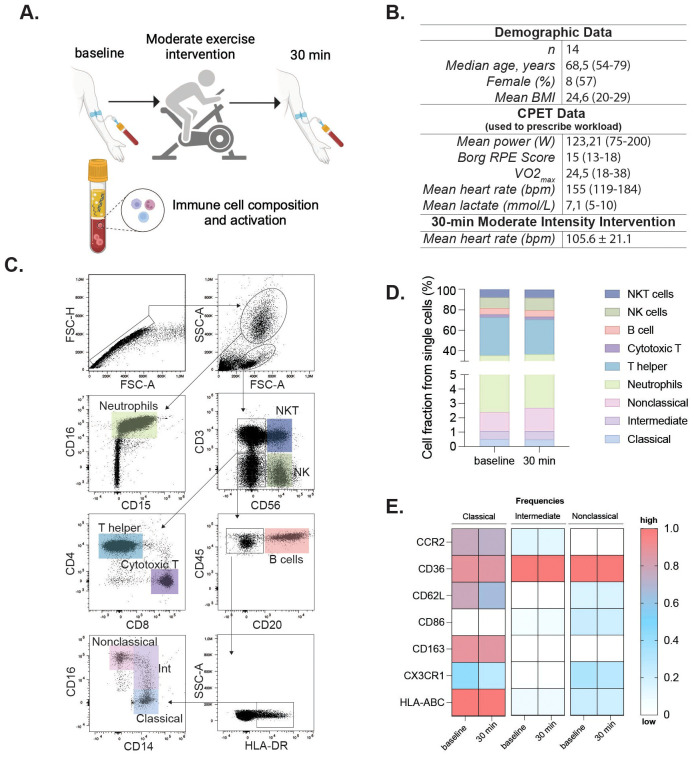
Fourteen healthy adults (median age: 68 years, 57% female) underwent a moderate acute continuous exercise intervention on a bicycle ergometer (30 minutes, 60% VO2max). Individual cardiorespiratory fitness was assessed at least two weeks earlier using a cardiopulmonary exercise test (CPET) to exhaustion, and the workload for the intervention was calculated as 60% of each participant's measured VO2max. The mean Vo2max of participants in this group was 24.5 mL/kg/min (range 18–38) (Figures 1A, B). Blood was collected before and 30 minutes after the intervention (Figure 1A).

Moderate exercise alters immune activation in older adults. Clinical and experimental study design and analytical processes for the moderate exercise intervention. Participants completed a cycling cardiopulmonary exercise testing (CPET) for 30 minutes; peripheral blood was assessed at baseline and 30 min after the intervention. Demographic and exercise data for participants in the moderate intervention. VOmax and performance parameters (mean power, RPE, peak heart rate, and peak lactate) were obtained during the cardiopulmonary exercise test (CPET) used to prescribe the 60% VOmax workload for the 30-min cycling intervention. Mean heart rate (105.6 ± 21.1 bpm) reflects values recorded during the 30-min moderate-intensity intervention itself.. Flow cytometry gating identified single cells, granulocytes, and mononuclear cells via FSC/SSC. Neutrophils were further gated by co-expression of CD16/CD15. Mononuclear cells were gated on CD3 and CD56 to define NKT (CD3CD56) and NK (CD3CD56) cells. CD3CD56cells were assessed for CD20 (B cells), and CD20cells further gated by CD14 and CD16 for classical (CD14CD16), intermediate (CD14CD16low), and nonclassical (CD14lowCD16) monocytes. Immune cell fractions are shown in bar charts. Heatmaps showing frequencies of activation marker-positive cells within classical, intermediate, and nonclassical monocyte subsets at baseline and 30min post-exercise. Rows represent markers, columns represent timepoints and subsets. Colors indicate relative frequency (red = higher, blue = lower). Statistical significance was assessed using non-parametric tests. Panelwas created in BioRender (Garza, AP. 2024,). (A) (B) (C) (D) (E) (A) 2 2 + + - + - - - + - + ++ https://BioRender.com/o96f904
Subproject 2
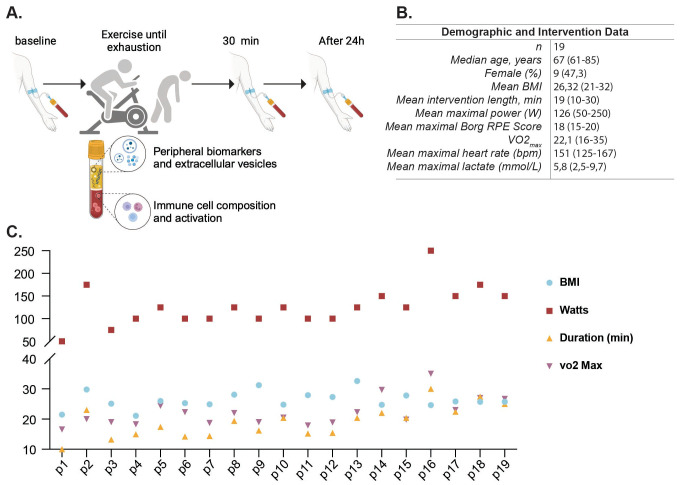
Nineteen healthy adults (median age: 67 years, 47% female) performed a cardiopulmonary exercise test until exhaustion on a bicycle ergometer. The incremental step test included a three-minute unloaded pedaling at 0 W, following the resistance increased by 25 W every three minutes. During the incremental cycling test, breath-by-breath pulmonary gas-exchange data (MetaSoft, Studio: Cortex Biophysik GmbH Leipzig, Germany), heart rate (Custo med 100, custo med GmbH, Ottobrunn, Germany) and lactate levels (Lactate Scout 4, EKF Diagnostic, Barleben, Germany) were assessed. Perceived exertion was assessed at the end of each step using Borg-Scale (Borg, 1970). The CPET concluded when (i) the respiratory exchange ratio was above 1.10, (ii) a plateau in VO2 occurred (despite increasing workload) or (iii) the rating of perceived exertion was 18 or higher on the Borg Scale. Safety criteria for premature termination of CPET were in the case of major electrocardiographic abnormalities, excessive blood pressure increase (≥ 230 mmHg systolic and/or ≥ 110 mmHg diastolic), or individual request (30). The mean VO2max in this group was 22.1 mL/kg/min (range 16–35) (Figures 2B, C for individual values). Blood samples were collected at baseline, 30 min and 24 hours post-intervention (Figure 2A).

Study design and participant characteristics for intense exercise intervention. Clinical and experimental study design and analytical processes for the intense exercise intervention. Participants completed an incremental cycling cardiopulmonary exercise testing (CPET) to volitional exhaustion; peripheral blood was assessed at baseline, 30 min, and 24 h after the intervention. Demographic and intervention metrics for the cohort (sex distribution, age, body mass index (BMI), intervention duration, peak power (W), VOmax, Borg RPE score, maximal heart rate and lactate). Individual participant data for BMI, Watts reached, duration of the intervention in minutes, and VOmax.. Panel A was created in BioRender (Garza, AP. 2024,). (A) (B) (C) 2 2 https://BioRender.com/c87a107
Blood collection and processing
Whole blood was obtained from the antecubital area via venipuncture using a 21G butterfly needle in sterile BD Vacutainer blood collection tubes containing 1 mL Acid Citrate Dextrose/Glucose (ACD). Samples were processed within 1 h of collection. Whole blood (100 µL) was lysed using 1X Red Blood Cell Lysis Buffer (BioLegend, 10X) following the manufacturer's instructions. After lysis, cells were centrifuged at 400 × g for 5 min at room temperature. The supernatant was discarded, and two washing steps were performed using PBS. Cells were resuspended in 300 µL of FACS buffer (1X PBS, 2% FBS, 2 mM EDTA, and 2 mM NaN3), and 100 µL was added to a 5 mL round-bottom polystyrene tube. Samples were incubated in 5 µL of Human TruStain FcX (BioLegend) for 10 min to avoid nonspecific antibody binding. Each sample was stained with the following antibodies: anti-human CD16 (FITC), anti-human HLA-DR (Peridinin chlorophyll protein-Cyanine5.5), anti-human CD86 (Allophycocyanin), anti-human CD3 (Alexa Fluor 700), anti-human CD66b (Alexa Fluor 700), anti-human CD19 (Alexa Fluor 700), anti-human CD56 (Alexa Fluor 700), anti-human CD36 (Allophycocyanin-Cyanine 7), anti-human CD163 (Brilliant Violet 421), anti-human CD15 (Brilliant Violet 510), anti-human HLA-ABC (Brilliant Violet 605), anti-human CCR2 (Phycoerythrin), anti-human CD62L (Phycoerythrin -Dazzle 594), anti-human CD15 (Phycoerythrin-Cyanine5), anti-human CX3CR1 (Phycoerythrin-Cy7), anti-human CD4 (Allophycocyanin-Cyanine 7), anti-human CD3 (Brilliant Violet 510), anti-human CD16 (Brilliant Violet711), anti-human CD45 (FITC), anti-human CD56 (Phycoerythrin), anti-human CD8 (Phycoerythrin-Dazzle 594) and anti-human CD20 (Peridinin chlorophyll protein-Cyanine5.5). After an incubation period of 30 min, the samples were washed twice and resuspended in 210 µL of FACS buffer. Samples were acquired using an Attune NxT flow cytometer (Thermo Fisher Scientific).
Gating strategy
Data were first gated on singlets (FSC-H vs FSC-A) and on size/complexity (FSC-A vs SSC-A) to exclude doublets and debris. Within this population, neutrophils were identified as CD15+CD16+ cells in the high-SSC gate. From the lower SSC/FSC region, lymphocyte populations were further defined: NK cells as CD3–CD56+, NKT cells as CD3+CD56+, and T cells as CD3+ events subdivided into CD4+ helper and CD8+ cytotoxic subsets. B cells were identified as CD3–CD56–CD20+. Monocytes were gated as CD20–CD45+ cells, followed by selection for HLA-DR+ events, and then classified by CD14/CD16 expression into classical (CD14+CD16–), intermediate (CD14+CD16low), and nonclassical (CD14lowCD16++) subsets. Fluorescence Minus One controls (FMOs) were used to define gates, and single-stained compensation beads were used to calculate compensation. Data were analyzed using FlowJo (v10.10.0).
Cytokine assay
Plasma was separated from whole blood by centrifugation at 1,500 g for 10 min. Plasma (1 mL) was transferred to clean Eppendorf tubes and centrifuged at 400 × g for 10 min at 4 °C to remove debris. The panel included cytokines, chemokines, and soluble factors with established relevance for aging, inflammation, and exercise immunology, encompassing pro-inflammatory (e.g., TNF-α, IL-6), anti-inflammatory (e.g., IL-10, IL-33), vascular and neurotrophic mediators (e.g., VEGF, BDNF, β-NGF, VILIP-1), and soluble immune receptors (e.g., sRAGE, sTREM1, sTREM2). Analytes were assessed using the Human LEGENDplex Multiplex Assay (BioLegend) including TNF-α, IL-6, VEGF, BDNF, IL-23, IL-1β, sRAGE, IL-12p70, IL-18, IL-10, IFN-α2, sTREM2, IFN-γ, β-NGF, CX3CL1, IL-33, VILIP-1, IL-17A, MCP-1, IL-8, and sTREM1; following the manufacturer's instructions. The assay utilizes allophycocyanin-coated beads conjugated with surface antibodies that allow the specific binding of the analyte of interest. After incubation of the capture beads with the plasma sample, biotinylated detection antibodies were added to create a bead-analyte-detection antibody sandwich, which was further stained with streptavidin-phycoerythrin. Samples were measured using an Attune NxT flow cytometer and analyzed using the LEGENDplex Data Analysis Online Software Suit. Half of the limit of detection (LOD) was used as a constant value when the predicted concentrations were below the LOD.
Extracellular vesicles
ACD blood samples from the intense exercise intervention group were centrifuged twice at 2,500 g for 20 min at RT, followed by 2 centrifugation cycles of 14,000 g for 70 min at 4 °C. The supernatant was carefully removed, and the pellet was resuspended in 200 µL 0.22 m filtered phosphate-buffered saline (PBS) without Ca2+ and Mg2+ and vortexed. Thirty-seven EV surface epitopes were studied using the MACSPlex Human Exosome Kit (Miltenyi) following the manufacturer's instructions, as previously described (36, 37). In short, this assay employs phycoerythrin and fluorescein isothiocyanate-labeled polystyrene capture beads that capture plasma EVs during overnight incubation. Subsequently, allophycocyanin-labeled anti-CD9, anti-CD63, and anti-CD81 antibodies were added to positively select for EVs. This results in the formation of a structure encompassing capture beads, EVs, and detection antibodies, facilitating event detection and identification of surface epitopes. For each sample, raw bead-associated signal (MFI) for every epitope was background-corrected by subtracting the corresponding blank/isotype signal. To account for between-sample differences in total EV capture, per-sample normalization was performed by scaling each epitope's MFI to the tetraspanin signal measured in the same well, as commonly applied in bead-based EV assays. Samples were measured using an Attune NxT flow cytometer, normalized values were further analyzed using FlowJo (v10.10.0).
Nanoparticle tracking analysis
NanoSight Pro instrument (Malvern, Worcestershire, UK) was used to determine the size distribution and concentration of the EVs. All the EVs samples were diluted in fPBS (1:1000) and then injected into the sample-carrier cell. The particles were automatically tracked and sized using Brownian motion to record five videos of 30 s. The parameters were set at 25 °C, 5 µL/min flow rate, 39 frame rate and exposure of 25 ms. The cell was cleaned with fPBS followed by ethanol between samples. The video images were analyzed by the Nanosight Pro 1.2.0.3 software (Malvern Panalytical Inc.) The size mode (nm) and concentration (particle number/mL) of the EVs were calculated by combining the data from the five records. To effectively represent the distribution of particle sizes, we utilized a Kernel Density Estimation (KDE) approach with a shaded deviation region to highlight variability.
Statistical analyses
Statistical analyses were performed using GraphPad Prism 10 (v10.1.1(270)). Data distribution was assessed with D'Agostino & Pearson and Shapiro-Wilk tests. Differences between two timepoints were assessed using the Wilcoxon matched pairs signed rank test. Mixed-effects analysis, with Geisser-Greenhouse correction and Tukey's multiple comparison test was performed for the comparison of three time points. Sex-specific analyses were conducted to determine whether the changes observed in the overall population were also present when analyzed separately by sex. Graphical data representations were created using GraphPad Prism 9, BioRender and Phyton. An alpha value of p < 0.05 was used for all statistical tests. Statistical significance was set at p < 0.05 and marked with asterisks as follows: * p < 0.05, ** p < 0.001, and *** p < 0.0001. Data are presented as the arithmetic mean and corresponding standard error of the mean (SEM).
Results
Subproject 1
Acute moderate continuous exercise intervention affects monocyte activation 30 min post exercise in older adults
To investigate the acute effect of moderate exercise, 14 participants completed a 30 min cycling intervention at 60% VO2max, prescribed on the basis of CPET performed at least 2 weeks earlier (Figures 1A, B). During the intervention, participants reached a mean heart rate of 105.6 ± 21.1 bpm. Flow cytometric analysis of whole blood revealed no significant alterations in cell composition or frequency of adaptive or innate immune populations following acute continuous moderate-intensity exercise (Figures 1C, D, Table 1). However, specific changes were observed in the monocyte subsets. Classical monocytes exhibited increased frequency of CD86 (pre, 20.12 ± 2.83%; post, 26.97 ± 2.70%, p = 0.010) and decreased CX3CR1 expression post-intervention (pre, 54.27 ± 2.37%; post, 46.81 ± 3.30%, p = 0.034). Intermediate monocytes displayed decreased CX3CR1 expression (pre, 80.12 ± 3.11%; post, 73.40 ± 4.52%, p = 0.034) and reduced HLA-ABC levels (pre, 100 ± 0.11%; post, 99.36 ± 0.19%, p = 0.021). No discernible changes in the nonclassical subset were observed (Figure 1E). Inflammatory cytokines showed no significant differences between baseline and post-intervention groups (Supplementary Figure 1).
| n | Baseline | 30 min | T-test |
|---|---|---|---|
| 14 | 14 | ||
| Mean of events per ul (SEM) | P-value | ||
| NKT cells | 33.25 (4.5) | 34.03 (5.4) | 0.9598 |
| NK cells | 46.74 (5.2) | 53.4 (6.9) | 0.4879 |
| B cells | 27.2 (3.4) | 26.0 (3.0) | 0.8036 |
| Cytotoxic T cells | 12.1 (1.5) | 11.7 (5.3) | 0.9189 |
| T helper cells | 163.7 (23.8) | 145.9 (17.3) | 0.6027 |
| Neutrophils | 146.9 (15.4) | 146.6 (8.6) | 0.338 |
| Classical Monocytes | 2.3 (0.2) | 2.14 (0.2) | 0.4542 |
| Intermediate Monocytes | 2.51 (0.3) | 2.59 (0.3) | 0.83 |
| Nonclassical Monocytes | 5.71 (0.4) | 6.87 (0.7) | 0.3064 |
Sex specific activation of monocyte subsets and IL-6 post exercise response
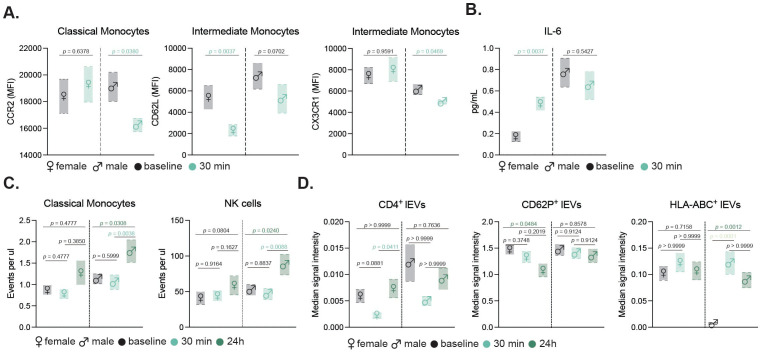
Due to the scarcity of sex-disaggregated data on exercise interventions in healthy older adult populations, we aimed to investigate potential sex-specific differences in the immune response. Given the limited number of participants per group, these analyses are underpowered and should be considered exploratory. While overall immune cell counts between male and female participants did not differ significantly, when examining the activation of monocyte subsets, our results showed sex-specific variations following moderate exercise (Figure 3A). Male participants exhibited a notable decrease in CCR2 expression in classical monocytes and a significant increase in CXC3CR1 levels in intermediate monocytes. In contrast, female participants displayed reduced CD62L expression in intermediate monocytes. Additionally, only female participants exhibited an increase in circulating IL-6 levels post-exercise indicating a sex-specific inflammatory response to moderate exercise (Figure 3B).

Sex-specific immune and EV responses to exercise in older adults. Floating bar charts showing sex-disaggregated mean ± SEM for monocyte activation markersand IL-6 levelsbefore and 30 min after moderate exercise. Sex-specific counts of classical monocytes and NK cells, and median signal intensity of CD4, CD62P, and HLA-ABCEVs at baseline, 30 min, and 24 h post-intense exercise. Female and male data are shown with respective symbols (♀ left, ♂ right). Statistical tests included non-parametric t-tests (moderate, n=14) and mixed-effects analysis with Geisser-Greenhouse correction and Tukey's test (intense, n=19). p values are indicated in the figure. (A) (B) (C) (D) + + +
Subproject 2
Acute high-intensity exercise intervention affects monocyte, NK cell and neutrophil changes 24 h post exercise in older adults
To evaluate the effects of an acute high intensity exercise session, 19 healthy participants, with a median age of 67 years and a near-equal distribution of sex (47.3% females), underwent a maximum-intensity cardiopulmonary exercise test (CPET). The acute high-intensive exercise intervention was designed to push participants to their physical limits, enabling the assessment of immune responses and extracellular vesicle release under maximal stress conditions (Figure 2A). Participants exhibited a mean BMI of 24.6 and a mean power output of 126 Watts (ranging from 50-250W) during the intervention, which displayed substantial inter-individual variability (Figure 2B). The exercise duration and VO2max displayed notable similarities among participants, revealing the diverse fitness levels within the cohort (Figure 2C). All participants performed the same CPET protocol.
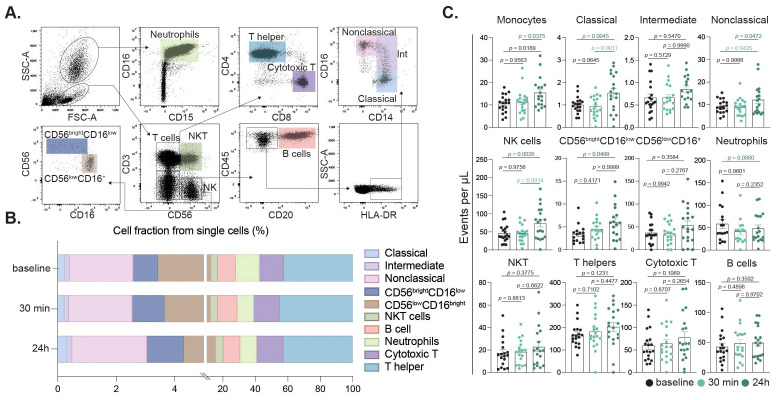
To evaluate the impact of intense exercise on immune cell populations, we conducted flow cytometric analysis was performed on blood samples collected at baseline, 30 minutes post-intervention and 24 h post-exercise (Figure 2A). This gating strategy allowed for detailed examination of neutrophils, T helper cells, cytotoxic T cells, NK cells, B cells, and monocyte subsets (Figure 4A). Our results revealed significant changes in the cellular fractions at the different time points, with the most prominent difference observed at 24 h post-intervention (Figure 4B). Specifically, our findings indicated a significant increase in classical and nonclassical monocytes, along with a rise in NK cells driven by CD56bright and CD16low NK cells contributing to the increase (Figure 4C). In contrast, neutrophil counts declined 24 h after the intervention, while components of the adaptive immunity remained unchanged (Figure 4C). Further sex-disaggregated analysis revealed that the increase in classical monocytes and NK cells was predominantly driven by the male participants, whereas no significant changes were observed in the female subgroup (Figure 3C).

Peripheral immune cell subset alterations induced by intense exercise. Flow cytometry gating identified singlets, granulocytes, and mononuclear cells based on SSC/FSC. Neutrophils were gated by CD16/CD15 expression. Mononuclear cells were defined by CD3/CD56 to distinguish NKT (CD3CD56) and NK (CD3CD56) cells. NK cells were further subdivided into CD56CD16/CD56CD16subsets. CD3CD56cells were assessed for CD20 (B cells); CD20cells were gated on CD14/CD16 for classical (CD14CD16), intermediate (CD14CD16), and nonclassical (CD14CD16) monocytes. Immune cell fractions relative to total single cells at baseline, 30 min, and 24 h post-exercise are shown. Bar charts showing cell fractions of immune cell populations at baseline (black), 30 min (turquoise) and 24 h (dark green) after the intervention. + + - + bright low low + - - - + - + low low ++ (A) (B) (C)
Monocyte and neutrophil activation after acute intense exercise
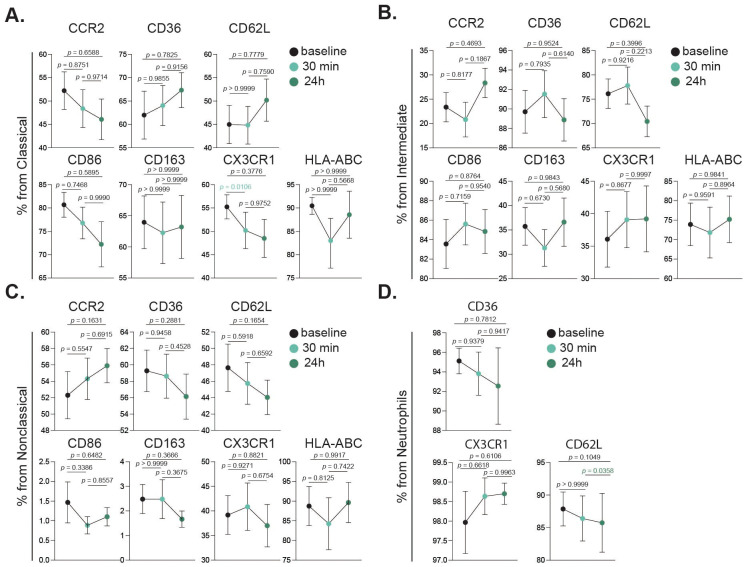
Monocyte and neutrophil activation after acute intense exercise was investigated to determine if their activation status was influenced by the intervention. The expression levels of key activation markers including CCR2, CD36, CD62L, CD86, CD163, CX3CR1, and HLA-ABC were evaluated across each monocyte subset. In classical monocytes (Figure 5A), CX3CR1 expression was significantly reduced 30 min post intervention. In contrast, intermediate (Figure 5B) and nonclassical (Figure 5C) monocytes did not exhibit significant changes in the studied markers. For neutrophils, a significant decrease in CD62L expression was observed between the 30 min and 24 h time points (Figure 5D).

Activation dynamics of innate immune cell subsets following intense exercise. Bar charts showing cell fractions of all investigated activation markers in classical monocytes, intermediate monocytes, nonclassical monocytesand neutrophils, at baseline (black), 30 min (turquoise) and 24 h (dark green) after the intervention. Statistical tests analyzed using a mixed-effects analysis, with Geisser-Greenhouse correction and Tukey's multiple comparison test.values are shown in figure. (A) (B) (C) (D) p
Elevated proinflammatory cytokine levels following acute high intensity exercise
Aging is linked to elevated levels of inflammatory cytokines, creating an environment conducive to age-related diseases (38). Additionally, it has been shown that intense acute exercise in young individuals typically triggers a surge in canonical proinflammatory cytokines (39), and we aimed to determine if similar responses occur in an older adult cohort. Therefore, to assess the inflammatory impact of high-intensity exercise, we measured various cytokines and regulatory biomolecules at baseline, 30 minutes and 24 hours post-intervention (Table 2). Our study revealed that high-intensity exercise significantly increased peripheral TNFα levels immediately post-exercise (5.32 pg/mL) compared to baseline (2.68 pg/mL, p = 0.047), and remained elevated 24 h post-intervention (4.23 pg/mL), evidencing a sustained inflammatory response (Table 2). IL-6 levels did not show significant changes across time points, although a slight decrease was observed at 24 h post-intervention. Similarly, markers associated with vascular and brain health, such as sRAGE, sTREM2, and β-NGF, did not exhibit significant changes. However, a separate analysis showed a significant correlation of BDNF levels with age 24 h after the continuous acute intense exercise intervention (Figure 6). Anti-inflammatory cytokine IL-10 showed a transient non-significant decrease immediately post-intervention returning to baseline levels by 24 h. Other proinflammatory cytokines (IL-1β, IL-12p70, IL-18, IL-23, IL-17A, IFN-γ) and chemokines (MCP-1, IL-8, CX3CL1) showed no significant changes across timepoints. Likewise, anti-inflammatory mediators (IL-10, IL-33) and soluble receptors (sTREM1, sTREM2, sRAGE) remained stable. Neurotrophic and vascular markers (VEGF, β-NGF, VILIP-1) also did not differ significantly between timepoints (Table 2).

Peripheral BDNF correlates with age after intense exercise. Scatter plots including linear regression lines displaying peripheral levels of brain-derived neurotrophic factor (BDNF), tumor necrosis factor-alpha (TNF-α), and interleukin-6 (IL-6) in relation to age across the three studied time points: baseline (black), 30 min post-exercise (turquoise), and 24 h post-exercise (dark green). Data points represent individual participants, with black, turquoise and dark green colors indicating different time points as specified. rand p values are shown in plot; statistical analysis was performed using simple linear regression. 2
| n | Baseline | 30 min | 24 h | ANOVA |
|---|---|---|---|---|
| 19 | 19 | 19 | ||
| pg/mL (m, IQR) | p-value | |||
| TNFa | 2.68 (0.23) | 5.32 (43.14) | 4.23 (11.57) | 0.047 |
| IL-6 | 4.96 (6.74) | 4.63 (8.42) | 2.64 (3.5) | 0.0927 |
| VEGF | 3.79 (11.53) | 4.16 (10.69) | 8.1 (26.13) | 0.1154 |
| BDNF | 252.8 (392) | 325.7 (499.6) | 276.7 (244) | 0.1322 |
| IL-23 | 3.95 (6.18) | 9.66 (18.68) | 7.00 (11.59) | 0.1694 |
| IL-1b | 0.33 (3.79) | 0 (0.79) | 0 (0.17) | 0.1881 |
| sRAGE | 2536 (4082.3) | 1988 (2140) | 2414 (3240) | 0.2236 |
| IL-12p70 | 4.72 (4.52) | 5.87 (10.80) | 3.77 (7.27) | 0.2349 |
| IL-18 | 191.7 (76.7) | 199.5 (154.9) | 202.4 (122) | 0.3974 |
| IL-10 | 5.90 (16.69) | 3.23 (6.57) | 4.49 (6.43) | 0.4509 |
| IFN-a2 | 3.08 (5.36) | 4.45 (9.17) | 4.24 (7.14) | 0.5177 |
| sTREM2 | 3736 (3489) | 4484 (3133) | 4450 (3890) | 0.539 |
| IFN-y | 0.74 (1.88) | 0.65 (1.14) | 0.97 (2.77) | 0.6022 |
| β-NGF | 2.25 (6.73) | 1.25 (1.19) | 2.67 (4.30) | 0.6374 |
| CX3CL1 | 731.9 (965.6) | 836 (1331.5) | 1121 (1135.6) | 0.7603 |
| IL-33 | 100.8 (89.1) | 109 (143.9) | 95.65 (171) | 0.7603 |
| VILIP-1 | 27.05 (212.32) | 20.95 (46.35) | 88.65 (157.37) | 0.8102 |
| IL-17A | 0.93 (1.34) | 0.75 (1.49) | 1.02 (1.23) | 0.8487 |
| MCP-1 | 24.7 (22.83) | 25.57 (24.11) | 27.22 (25.6) | 0.9071 |
| IL-8 | 8.34 (44.18) | 6.54 (30.36) | 0.50 (49.81) | 0.9081 |
| sTREM1 | 44.6 (90.76) | 29.29 (51.62) | 46.17 (118.55) | 0.9161 |
Increased extracellular vesicle release is a key response to intense exercise
Following the evaluation of immune cell populations, their activation status, and peripheral cytokine levels, we examined the impact of high-intensity exercise on the release of EVs. Plasma-derived EVs were quantified at baseline, 30 minutes and 24 h post-intervention. Nano-particle tracking analysis (NTA) showed an increased concentration of EVs after intense exercise at both studied timepoints (Figures 7A–C). Flow cytometric analysis demonstrated a general increase in the concentration of plasma-derived EVs after 24 hours, as indicated by increased levels of tetraspanin markers CD9, CD63, and CD81 (Figures 7D, E). Notably, CD63 and CD81 displayed significant increases in median fluorescence intensity (MFI) at 24 h compared to 30 minutes post-intervention, while CD9 levels remained unchanged. Since our EV profile was limited to surface epitope analysis, the findings should be interpreted as descriptive, and future studies should address functional properties and cargo composition.
A detailed examination of 37 exosomal surface epitopes revealed a significant increase in surface CD69 expression after 24 h post-intervention (Figure 7F). This increase in CD69, a marker of cellular activation, was accompanied by a significant reduction in CD62P, CD42a, and CD29 markers on EVs at 24 h post-intervention. Other markers including CD8, CD56, and CD105, did not show significant changes across the time points (Figure 7G). Sex-specific differences were also observed in EV profiles. While the total circulating EV count did not differ between sexes, females exhibited a significant increase in CD4+ EVs and a decrease in CD62P+ EVs 24 hours post-exercise. In contrast, male participants showed a marked increase in HLA-ABC+ EVs following the intense exercise intervention (Figure 3D).

Extracellular vesicles release in response to acute continuous intensive exercise. Plasma-derived EV concentrations were quantified by nanoparticle tracking analysis (NTA) across all timepoints. Representative EV imagingand size distribution histogram are shown. Bead-based flow cytometry assessed 37 EV surface markers, with representative gating and fluorescence profiles. Tetraspanin expression (CD9, CD63, CD81) is presented as mean ± SEM and individual values. Heatmap showing normalized mean fluorescence intensity (MFI) of 34 differentially expressed markers scaled to tetraspanin expression (CD9, CD63 and CD81). Rows represent timepoints (pre-, 30 min, and 24 h post-exercise); columns represent markers. Colors indicate relative expression (dark green = higher, light green/white = lower). Asterisks denote significant changes between timepoints. Signal intensities of selected immune, endothelial, and platelet-derived markers (CD8, HLA, CD56, CD105, CD62P, CD42a, CD29, CD69) are shown. Statistical analysis used mixed-effects modeling with Geisser-Greenhouse correction and Tukey's test. p values are indicated in the figure. (A) (B) (C) (D) (E) (F) (G)
Discussion
In recent years, the Exercise as Medicine approach has been increasingly recognized for its multifaceted benefits beyond disease prevention (40). Exercise acts as a modulator of immune function and inflammation, key elements in aging and disease processes (33, 41, 42). Training adaptations are ultimately built on repeated acute bouts of exercise. Characterizing immune and EV responses to a single session would provide a mechanistic insight into how physical activity contributes to healthy aging over time. Therefore, our study aimed to explore the interplay between exercise and the immune response, revealing alterations in immune cell populations and cytokine levels following both acute continuous moderate and intense exercise interventions in older individuals. Furthermore, we examined exercise induced release and selective surface marker modulation of EVs as potential mediators of systemic immune response, contributing to a growing body of evidence that exercise plays a vital role in promoting healthy aging and preventing age-related diseases. Additionally, sex-stratified responses were explored. These findings, while intriguing, are based on small subgroup sizes and should be viewed as exploratory until confirmed in larger cohorts.
Monocyte subsets activation after moderate exercise
We examined the impact of a single session of acute continuous moderate exercise on the peripheral innate immune system of older adults. Although overall cell numbers and distributions were unchanged, activation patterns of monocyte subsets differed. Prior work shows that monocyte responses depend on exercise intensity (43). Our findings align with this, as classical (CD14+CD16–) monocytes, representing an early differentiation stage are recruited during moderate aerobic exercise (in our study acute continuous moderate exercise: 30 minutes, 60% VO2max, subproject 1). In contrast, mature subtypes (non-classical and intermediate monocytes, CD14+CD16+) increase predominantly after high-intensity exercise (CPET to exhaustion, subproject 2). Since aging is associated with chronic innate immune activation and expansion of CD16+ monocytes, these observations highlight exercise as a potential intervention target for healthy aging (44).
Classical monocytes, which are key to phagocytosis and leukocyte recruitment, displayed increased CD86 and decreased CX3CR1 expression. CD86, a co-stimulatory molecule rapidly mobilized from intracellular stores, supports enhanced T cell co-stimulation (45). Reduced CX3CR1, a chemokine receptor regulating monocyte differentiation and migration, mirrors prior findings that its ligand CX3CL1 rises in skeletal muscle after exercise to promote a regenerative microenvironment (46). Intermediate monocytes also showed decreased CX3CR1, consistent with peripheral differentiation, accompanied by an overall increase in intermediate and nonclassical monocytes (47). Furthermore, we observed a significant reduction in CCR2 on classical monocytes, restricted to older males. CCR2, a key chemokine receptor for monocyte recruitment, has shown sex-specific patterns in younger adults, with females generally expressing higher levels post-exercise (48, 49). In our cohort, older females exhibited higher baseline CCR2 than males, but only males showed a post-exercise reduction. This suggests sex-dependent modulation of monocyte trafficking, potentially shaped by hormonal influences, and highlights the value of considering sex in personalized exercise prescriptions for immune health in aging.
Intermediate monocytes also showed reduced HLA-ABC expression, a class I MHC antigen involved in antigen presentation. While microglial HLA-ABC expression increases with age and may contribute to vulnerability to structural brain changes (50, 51), its reduction in circulating monocytes could indicate a transient state of altered immune surveillance. In addition, we observed a decrease in CD62L, an adhesion molecule required for monocyte rolling and endothelial transmigration (52, 53). Prior studies report higher CD62L expression in older adults compared to younger cohorts (54). Interestingly, in our study, this reduction was specific to females, suggesting enhanced adhesion and transmigration capacity post-exercise. In contrast, the relatively stable CD62L levels observed in males may reflect less efficient monocyte trafficking, potentially contribute to higher chronic inflammation and the greater risk of cardiovascular disease in men.
Circulating pro-inflammatory cytokines after one moderate session of exercise in older adults
Prior studies report increases in IL-6 and TNF-α after moderate exercise (39, 55, 56), but we observed no cytokine changes 30 min post-exercise. The broader cytokine and biomarker panel also remained stable, suggesting that moderate exercise did not elicit a systemic inflammatory response in this cohort. Participants reported an average Borg RPE of 15 (range 13-18), indicating effort levels theoretically sufficient to provoke cytokine release (57). The absence of detectable increases may reflect sampling time or participants regular engagement in physical activity. Notably, IL-6 was increased selectively in females. Prior work links sex hormones to IL-6 dynamics, with women often exhibiting higher IL-6 than men under stress or ischemic conditions (58). In older adults, IL-6 also correlates with sarcopenia in a sex-dependent manner (59). Our data therefore suggests that moderate aerobic exercise may elicit distinct inflammatory responses in older women versus men, underscoring the need to consider sex when evaluating exercise-induced immune effects in aging populations. While these sex-specific effects are intriguing, they should be interpreted with caution given the small subgroup sizes, and future studies with larger cohorts are needed to confirm them.
Intense exercise modifies the innate immune response
Exercise-induced leukocyte mobilization is well documented, and is partly attributed to cortisol-mediated release from the bone marrow (60, 61). We hypothesized that an intense exercise would exert stronger effects than moderate exercise, and indeed observed enhanced innate responses, particularly in NK cells and monocytes 24h post-intervention. In line with previous work identifying NK cells as the most responsive subset (39, 62 –65), increases were mainly driven by CD56bright and CD16low NK cells. Intense exercise also induced a sustained rise in TNFα, likely reflecting cytokine production from activated NK cells (66, 67).
In contrast, other cytokines including IL-6, IL-10, IL-23, IL-12p70, IL-18, chemokines (MCP-1, IL-8, CX3CL1), and neurotrophic/vascular factors such as BDNF, VEGF, β-NGF, and soluble receptors (sRAGE, sTREM1, sTREM2), remained largely unchanged suggesting that the cytokine signature of intense exercise in older adults is relatively restricted. Further studies with larger cohorts are needed to fully elucidate the broader immunological impact of intense physical activity in older individuals.
Classical and nonclassical monocytes also increased at 24h, accompanied by reduced CX3CR1 expression, consistent with a shift toward a proinflammatory phenotype. Neutrophils count declined at 24h, likely reflecting recruitment to damaged muscle tissue, as reported in animal models (68, 69). This aligns with previous findings by Nunes-Silva et al. who reported that exhaustive treadmill exercise in mice induced rolling, adhesion, and transmigration of neutrophils into muscle tissue (70). Supporting this, neutrophils in our cohort exhibited increased CX3CR1 expression, a mechanism shown to facilitate muscle infiltration during exercise (71).
BDNF, a neurotrophic factor consistently elevated by acute and long-term exercise (72 –74) showed a transient increase 30 min post-intervention, returning toward baseline at 24h. Notably, BDNF correlated positively with age at 24h, suggesting that older individuals exhibit a more prolonged response. This may represent an age-related adaptation in BDNF sensitivity or a compensatory neuroprotective mechanism. Whether this delayed response translates into functional benefits such as improved recovery or neuroplasticity warrants further study.
Extracellular vesicle release after exercise in older adults
EVs mediate many of the beneficial effects of physical activity by transporting proteins, lipids, and nucleic acids that shape intercellular communication and metabolism (75 –78). Prior work in younger athletes showed exercise-induced EV release primarily from lymphocytes, monocytes, platelets, endothelial cells, and MHC-II+ cells (79). In our older cohort, both sexes exhibited increases in EVs derived from lymphocytes and leukocytes (CD8, CD14, HLA, CD86), platelets (CD62P, CD42a, CD41b), and endothelial cells (CD105, CD31), consistent with these earlier findings (30, 79). We also observed increased CD69 expression on EVs 24h post-exercise, reflecting leukocyte activation in parallel with NK cell and monocyte mobilization (80). Platelet markers (CD62P, CD42a) were increased at 30 min but declined by 24h suggesting transient platelet activation that may contribute to recovery processes in aging individuals.
Although total numbers did not differ by sex, distinct patterns emerged. Females showed an increase in CD4+ T cell-derived EVs, whereas males exhibited higher HLA-ABC+ EVs 24h after exercise. These findings suggest sex-dependent adaptive immune modulation not apparent at the cellular level, potentially influenced by hormonal factors such as estrogen, which enhances CD4+ T cell activity, or testosterone, which promotes antigen presentation (81). Physiological adaptations may also contribute, with females exhibiting stronger immune modulation and males favoring recovery and resolution pathways. While the mechanisms remain speculative, our data indicate that exercise-induced EV responses may vary in a sex-dependent manner, underscoring the need for future research. Importantly, as our EV analyses relied on surface epitope profiling, functional properties and cargo composition should be addressed in future studies.
Conclusions and limitations
Physical exercise impacts several physiological systems beyond solely skeletal muscle, with growing recognition on its role in promoting healthy aging (13, 82). In our study, acute moderate and intense exercise in older adults altered immune cell subsets, cytokine production and EV release. These findings support the concept that tailored exercise prescriptions, accounting for individual and sex-specific responses, may optimize immune resilience and health outcomes in aging populations. EV responses, however, were only observed following high-intensity exercise, and thus our conclusions regarding exercise intensity and EV modulation should be interpreted with caution. The observed modulation of EV surface markers highlights their potential as biomarkers and possible mediators of exercise-induced immune effects, warranting further investigation into their functional roles.
At the same time, these results should be viewed as exploratory. The sample size was relatively small, particularly for sex-stratified analyses, limiting power to detect subtle effects. The parallel-group design, rather than a crossover, prevented within-subject comparisons across intensities. Participants were healthy, active older adults of predominantly European background, which may not generalize to sedentary individuals, those with chronic disease, or more diverse populations. Although VO2max values were comparable between groups, we cannot exclude the influence of baseline cardiorespiratory fitness on the immune responses observed. In addition, although the moderate bout was prescribed at 60% VO2max, relative intensity defined by VO2max may not always correspond to traditional heart rate or lactate thresholds. This divergence has been noted previously in adults, including older cohorts, where VO2max-based and threshold-based measures of intensity show only modest concordance and substantial interindividual variability in older populations (83, 84). Blood was collected at three timepoints, but additional sampling could provide a more complete temporal profile of immune and EV dynamics. Finally, EV profiling was restricted to surface epitope analysis, and potential confounders such as diet, sleep or hormonal status were not systematically controlled.
Taken together, our findings indicate that both moderate and intense exercise induce measurable changes in immune cell activation in older adults. In addition, EV release was assessed in the high-intensity intervention, where significant changes were observed. Preliminary evidence suggests potential sex-specific differences. While limited in scope, these results underscore the value of integrating exercise into healthy aging strategies and highlight the need for larger, more diverse, and mechanistically focused studies to fully define the therapeutic potential of exercise as medicine.