
What this is
- This prospective cohort study investigates the impact of on the development of () after SARS-CoV-2 infection.
- It examines adults who tested positive for COVID-19 and assesses their chronic stress levels prior to infection.
- The study aims to inform public health strategies and personalized interventions for managing long COVID.
Essence
- Higher levels of prior to SARS-CoV-2 infection increase the likelihood of developing by 8% for each additional point on the Perceived Stress Scale (PSS-10).
Key takeaways
- is a significant predictor for . Participants with higher stress levels before infection were more likely to experience persistent symptoms after COVID-19 onset.
- The study found that 72.9% of participants were categorized as having , highlighting the substantial burden of long COVID.
- No significant predictive role was found for hair cortisol concentration or the number of stressful life events, suggesting that subjective stress perception may be more relevant in predicting long COVID outcomes.
Caveats
- The study's findings may not be generalizable to patients with severe COVID-19 requiring hospitalization, as they were not included in the cohort.
- Multicollinearity issues led to the exclusion of depressive symptoms and anxiety from the regression analysis, which may limit the understanding of their roles in predicting long COVID.
Definitions
- Ongoing symptomatic COVID-19 (OSC): A condition where COVID-19-related symptoms persist for 4–12 weeks post-infection.
- Perceived chronic stress: An individual's assessment of the stress they have experienced over a specified period, measured by the Perceived Stress Scale.
Simplified
Introduction
As defined by the National Institute for Health and Care Excellence (NICE) guidelines, the early stage of post-infection syndrome following SARS-CoV-2 infection – widely known as long COVID – is termed ongoing symptomatic COVID-19 (OSC) [1]. The diagnosis of OSC requires signs and symptoms consistent with COVID-19 that persist for 4–12 weeks beyond the onset of COVID-19. Prevalence rates for OSC were reported to range from 14% to 87% with a mean of 59% across studies from different continents [2]. A substantial proportion of patients with OSC continue to be symptomatic beyond 12 weeks, thus entering the chronic phase of long COVID, termed post-COVID-19 syndrome in the NICE guidelines.
Several risk factors for developing long COVID have been detected, including sex, severity of COVID-19, vaccination status, and medical comorbidities. However, these factors do not fully explain its high clinical variability [3, 4]. Specific psychosocial factors such as perceived chronic stress could contribute to disease progression by allostatic load and increased inflammation [5, 6]. Perceived chronic stress is a known risk factor for the onset and symptom duration in other viral diseases, particularly in upper respiratory infections, potentially mediated by impaired immune regulation [7 –10]. In addition, in infections with other coronaviruses (SARS and MERS), perceived chronic stress was reported to be linked to long-term respiratory, musculoskeletal, and neuropsychiatric sequelae [11 –13]. We, therefore, aimed to investigate if perceived chronic stress prior to SARS-CoV-2 infection predicted disease progression to OSC.
Methods
Study Design
This was a longitudinal, prospective, single-center, observational cohort study named "StressLoC." Chronic stress prior to SARS-CoV-2 infection was assessed using psychological and biological parameters, including perceived chronic stress, the number of threatening experiences, and hair cortisol concentration (HCC). The primary hypothesis posited that higher levels of pre-existing perceived chronic stress would predict a greater likelihood of symptom persistence at month 1 in individuals with COVID-19, after controlling for potential confounders. Data were collected online via virtual questionnaires (VQs) using LimeSurvey. Hair strands were obtained during the study visit at month 2 after inclusion (online suppl. Fig. S1; for all online suppl. material, see https://doi.org/10.1159/000547858↗). "StressLoc" was pre-registered on clinicaltrials.gov/study/NCT05652634. The study protocol adhered to Good Clinical and Laboratory Practice (GCP/GLP) guidelines, the Declaration of Helsinki, and methodological recommendations for observational studies on long COVID [14]. Ethical approval was obtained from the Ethics Committee of the Medical University of Graz (33-231 ex 20/21). The reporting of results followed the TRIPOD statement and STROBE guidelines [15, 16].
Study Participants
Adults (≥18 years) who just tested positive for SARS-CoV-2, were invited to participate through health authorities, care providers, and media channels. Inclusion criteria required a positive qPCR test for SARS-CoV-2 within the past 7 days, the presence of at least one typical COVID-19 symptom, and feasibility of study participation. Exclusion criteria included insufficient knowledge of the German language, insufficient hair length of less than 2 cm at the rear vertex, current pregnancy or postpartum status of less than 3 months, or refusal to provide written informed consent in the first VQ (VQ0). Participant enrollment was conducted via phone between February 2023 and December 2023.
Variables
Primary Outcome
The Long COVID Symptom and Impact Tools (LC-ST, LC-IT) [17] were used twice, at inclusion and at month 1 after inclusion, to assess the primary outcome. The primary outcome was defined as the presence of any new and impactful COVID-19-related symptom at month 1 after inclusion. Symptoms were classified as new if they had not been present in the month before SARS-CoV-2 infection, as measured at inclusion. For this purpose, participants were asked to report symptoms experienced in the month prior to the onset of COVID-19. New symptoms were considered impactful if they received an LC-IT rating of >0 at month 1 after inclusion.
Thus, participants reporting any new and impactful COVID-19-related symptoms experienced in the last 3 days at month 1 after inclusion were allocated to the ongoing symptomatic COVID-19 group (OSC-G). Remaining participants were categorized as control group (CG).
The LC-ST comprises a list of 53 long COVID symptoms categorized into 10 domains: general symptoms and symptoms related to nine organ systems (thorax, neurological, digestive, ear/nose/throat, eyes, musculoskeletal, blood and lymph circulation, skin and hair, and urinary and gynecological systems). The LC-IT assesses the impact of symptoms across six dimensions of patients' lives.
Predictive Measures
Perceived chronic stress (primary predictor) was measured using the 10-item Perceived Stress Scale (PSS-10) [18, 19]. After inclusion, participants were asked to rate their perceived stress levels during the month before the onset of their current COVID-19-related symptoms. The PSS-10 is a widely used instrument for assessing perceived chronic stress, with individual scores ranging from 0 to 40 points. It demonstrates strong internal consistency (Cronbach's α = 0.84) and maintains stable test-retest reliability across various time spans and populations. In a healthy German population, the mean sum score ranges between 12 and 14, with a standard deviation of 6.1–6.7 points. Higher values indicate higher perceived chronic stress [19].
As a secondary psychological predictor of pre-existing chronic stress, the List of Threatening Experiences questionnaire (LTE) was used [20, 21]. The LTE is a concise measure of stressful life events (Cronbach's α = 0.44). Participants were asked to indicate which of 12 adverse events had occurred in the 12 months prior to the onset of their current COVID-19-related symptoms.
In addition, HCC was analyzed as a secondary biological predictor and measure of chronic stress. Thus, HCC measurement corresponded to the 2 months prior to the current SARS-CoV-2 infection. Since hair typically grows at a rate of 1 cm per month at the rear vertex region and hair samples were collected 2 months after inclusion, the hair segment 2–4 cm distal to the scalp was analyzed for this purpose. Hair samples were taken from the posterior vertex region, cut as close to the scalp as possible, washed with acetone and distilled water, and then snipped. The samples were extracted in methanol for 4 h in an ultrasonic bath. A fully automated supported liquid extraction was performed using a Biotage® Extrahera (Uppsala, Sweden). HCC levels were quantified using a validated liquid chromatography-tandem mass spectrometry method, with concentrations calculated in pg/mg using Sciex® OS software (version 3.3, Sciex, Germany) [22]. Values exceeding three standard deviations were excluded from analysis [23]. Previous studies employing the same method reported median HCC values in healthy adults ranging from 5.65 to 5.8 pg/mg [24, 25].
Potential Confounding Variables
The following sociodemographic, lifestyle-related, and medical variables as well as psychological risk and protective variables were included as potential confounders: Sociodemographic variables encompassed age, sex, professional background, income, education, situation of living, marital status, and ethnicity. Lifestyle-related variables consisted of cigarette smoking, alcohol consumption, physical activity, and body mass index. Medical variables included the number of pre-existing symptoms, corticosteroid medication, and SARS-CoV-2 vaccination status. Finally, psychological variables covered acute stress, anxiety, depressive symptoms, social support, and resilience.
Additional Variables
Two novel instruments were included for exploratory purposes. The Psychosomatic Assessment Health Disc (PAHD) was used as a new multidimensional measure for exploring satisfaction with subjective health in the month before the onset of COVID-19 [26]. The Psychosomatic Competence Inventory (PSCI) served for assessing perceived physical self-regulation competence and was rated at week 2 after inclusion [27]. Further details on the questionnaires used are provided in online supplementary material Methods.
Statistical Analysis
To calculate group differences between OSC-G and CG, the t test or Mann-Whitney U test was applied, depending on the distribution of metric data. For other levels of measurement, the chi-squared test was used. Two-sided exact significance levels were set at p < 0.05 for these analyses. Multivariate logistic regression analyses were conducted to separately investigate measures of pre-existing chronic stress as potential predictors for allocation to OSC-G, while controlling for potential confounders. For this reason, if necessary, answers were summarized in groups to achieve group sizes larger than n = 25 and a maximum of 4 groups (online suppl. Table S1). Then these analyses were divided into three models: Model A for perceived chronic stress (primary predictor), Model B for LTE, and Model C for HCC.
In all three models, the first step involved univariate analyses of the specific predictor and potential confounding factors for OSC. All factors with a p value <0.2 were considered potential variables for the multivariate model. Next, multicollinearity was assessed by calculating variance inflation factors (VIF). Variables were ranked in advance (specific predictive measure for chronic stress according to model, sex, SARS-CoV-2 vaccination status, pre-existing symptoms, acute stress, anxiety, physical activity, social support, depressive symptoms, resilience, income, and corticosteroid medication) and were eliminated step by step if the VIF exceeded the predefined threshold of 2.
For the final multivariate logistic regression model, the backward stepwise (likelihood ratio) method was used, with an entry probability of 0.05 and removal probability of 0.051. Results were presented as odds ratios (OR) and their 95% confidence intervals (CI). For further details, see online supplementary material Methods: Statistical Analysis.
Results
Sample Characteristics
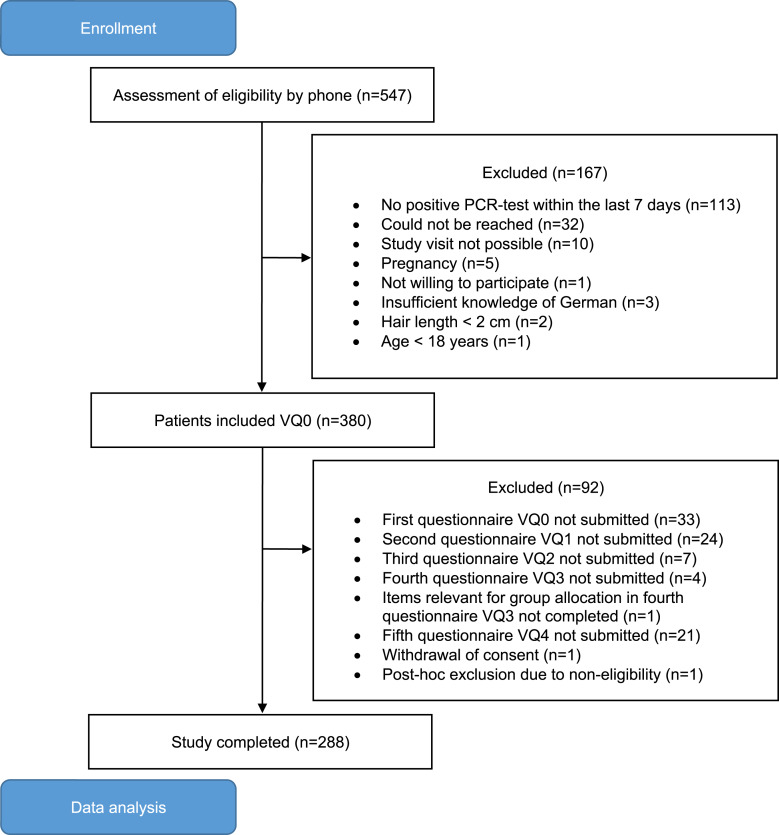
Data from 288 study participants were included in the final analysis (shown in Fig. 1). The median age of participants was 46 years (IQR 35–56). Most participants were female (73.3%) (shown in Table 1; see online suppl. material Table 2 for additional sociodemographic and lifestyle characteristics). Medical variables are presented in Table 2, and all psychological variables assessed at inclusion (VQ0) are shown in Table 3.

Flow chart.
| | Total sample | OSC-G1 | CG2 | valuep |
|---|---|---|---|---|
| = 288n | = 210n | = 78n | ||
| Sociodemographic variables | ||||
| Age, median (IQR), years | 46 (35–56) | 46 (34–57) | 46.5 (35–55) | 0.89 |
| Sex,(%)n | | | | 0.04 |
| Male | 77 (26.7) | 49 (23.3) | 28 (35.9) | |
| Female | 211 (73.3) | 161 (76.7) | 50 (64.1) | |
| Professional background,(%)n | | | | 0.45 |
| Employed | 217 (75.3) | 155 (73.8) | 62 (79.5) | |
| Retired | 37 (12.8) | 30 (14.3) | 7 (9.0) | |
| Other | 27 (9.4) | 21 (10.0) | 6 (7.7) | |
| Missing | 7 (2.4) | 4 (1.9) | 3 (3.8) | |
| Monthly net income,(%)n | | | | 0.008 |
| <EUR 1,600 | 59 (20.5) | 48 (22.9) | 11 (14.1) | |
| EUR 1,600–2,400 | 101 (35.1) | 79 (37.6) | 22 (28.2) | |
| EUR 2,400–3,200 | 74 (25.7) | 52 (24.8) | 22 (28.2) | |
| EUR >3,200 | 46 (16.0) | 25 (11.9) | 21 (26.9) | |
| Missing | 8 (2.8) | 6 (2.9) | 2 (2.6) | |
| Education,(%)n | | | | 0.68 |
| Secondary (without A-levels) | 64 (22.2) | 49 (23.3) | 15 (19.2) | |
| Secondary 2nd stage/A-levels | 69 (24.0) | 48 (22.9) | 21 (26.9) | |
| Higher education (university) | 148 (51.4) | 109 (51.9) | 39 (50.0) | |
| Missing | 7 (2.4) | 4 (1.9) | 3 (3.8) | |
| Lifestyle-related variables | ||||
| Cigarette smoking,(%)n | | | | 0.89 |
| Smoker | 49 (17.0) | 37 (17.6) | 12 (15.4) | |
| Former smoker | 47 (16.3) | 35 (16.7) | 12 (15.4) | |
| Non-smoker | 190 (66.0) | 137 (65.2) | 53 (67.9) | |
| Missing | 2 (0.7) | 1 (0.5) | 1 (1.3) | |
| Hazardous drinking,(%)3n | | | | 0.67 |
| Yes | 114 (39.6) | 80 (38.1) | 34 (43.6) | |
| Missing | 36 (12.5) | 29 (13.8) | 7 (9.0) | |
| Physical activity (min/week),(%)n | | | | 0.08 |
| <50 | 67 (23.3) | 55 (26.2) | 12 (15.4) | |
| 50–149 | 111 (38.5) | 74 (35.2) | 37 (47.4) | |
| 150–300 | 57 (19.8) | 45 (21.4) | 12 (15.4) | |
| >300 | 47 (16.3) | 32 (15.2) | 15 (19.2) | |
| Missing | 6 (2.1) | 4 (1.9) | 2 (2.6) | |
| BMI, median (IQR), kg/m2 | 24.7 (22.1–28.1) | 24.7 (22–28.1) | 25 (22.3–28.3) | 0.81 |
| Missing,(%)n | 4 (1.4) | 3 (1.4) | 1 (1.3) | |
| | Total sample | OSC-G1 | CG2 | valuep |
|---|---|---|---|---|
| = 288n | = 210n | = 78n | ||
| HCC during 2 months prior to infection, median (IQR), pg/mg | 3.3 (1.5–7.4) | 3.2 (1.5–6.4) | 3.7 (1.4–12.1) | 0.21 |
| Missing,(%)n | 44 (15.3) | 30 (14.3) | 14 (17.9) | |
| HCC during 2 months after infection, median (IQR), pg/mg | 3.5 (1.9–6.5) | 3.3 (1.8–6.2) | 3.8 (2.0–8.4) | 0.28 |
| Missing,(%)n | 34 (11.8) | 25 (11.9) | 9 (11.5) | |
| Number of pre-existing symptoms, median (IQR) | 11 (7–18) | 13 (8–19.3) | 7 (4–11) | <0.001 |
| Medication with corticosteroids,(%)n | 32 (11.1) | 27 (12.9) | 5 (6.4) | 0.14 |
| Missing | 18 (6.3) | 14 (6.7) | 4 (5.1) | |
| SARS-CoV-2 vaccination status,(%)n | | | | 0.03 |
| Not vaccinated3 | 8 (2.8) | 8 (3.8) | 0 | |
| Yes, once3 | 2 (0.7) | 2 (1.0) | 0 | |
| Yes, twice | 31 (10.8) | 21 (10.0) | 10 (12.8) | |
| Yes, three times | 123 (42.7) | 97 (46.2) | 26 (33.3) | |
| Yes, four times | 121 (42.0) | 80 (38.1) | 41 (52.6) | |
| Missing | 3 (1.0) | 2 (1.0) | 1 (1.3) | |
| | Total sample | OSC-G1 | CG2 | valuep |
|---|---|---|---|---|
| = 288n | = 210n | = 78n | ||
| mean (SD) | mean (SD) | mean (SD) | ||
| Perceived chronic stress (PSS-10) | 17.4 (6.9) | 18.8 (6.7) | 13.8 (5.9) | <0.001 |
Group Differences between OSC-G and CG
Most participants (n = 210; 72.9%) were allocated to OSC-G, while 78 participants (27.1%) were assigned to the CG. Pre-existing differences between these groups were identified in sociodemographic, medical, and psychological variables (Tables 1–3).
Notably, the OSC-G included a higher proportion of female participants, and more individuals with lower income compared to the CG (Table 1). Additionally, the OSC-G reported more pre-existing symptoms in the last 30 days before COVID-19 onset, with a median of 13 symptoms, compared to 7 symptoms in the CG (Table 2). These differences were observed in 9 out of 10 symptom domains of the LC-ST, with the exception of "ear/nose/throat" symptoms (online suppl. material Table 3). At inclusion, the OSC-G also differed significantly from the CG in all investigated psychological variables, except for resilience. Specifically, participants in the OSC-G reported higher levels of perceived chronic stress, acute stress, anxiety and depressive symptoms, a greater number of stressful life events, lower levels of perceived social support, and lower satisfaction across all six dimensions of subjective health (Table 3). Furthermore, at week 2 after inclusion, psychosomatic competence was rated lower in the OSC-G compared to the CG (online suppl. material Table 4). Correlations between investigated psychological variables can be found in online supplementary material Table 5.
Measures of Chronic Stress as Predictors of Allocation to OSC-G
In Model A, with pre-existing perceived chronic stress used as predictor, variables with a univariate regression p value of < 0.2 (see online suppl. Material Table 6) were included in the further analysis and tested for multicollinearity. Variables with a VIF greater than 2 were removed sequentially, specifically depressive symptoms, anxiety and acute stress. Thus, following factors were included for the multivariate logistic regression analysis: pre-existing perceived chronic stress (PSS-10), sex, number of pre-existing somatic symptoms (LC-ST), physical activity, social support (F-SozU K-6), income, medication with corticosteroids (Table 4). Backward stepwise regression identified two factors predicting allocation to OSC-G, with a Nagelkerke R2 value of 0.19 in Model A: pre-existing chronic stress (OR: 1.08, 95% CI: 1.03–1.14; p = 0.002) and the number of pre-existing somatic symptoms (OR: 1.08, 95% CI: 1.03–1.13; p = 0.001) (Table 4).
In the analysis of Model B, with LTE as predictor, acute stress did not exhibit a VIF greater than 2, unlike in Model A, and was, therefore, included in the multivariate logistic regression analysis. In this model, acute stress, but not LTE, was the only remaining variable in the logistic regression equation (OR: 1.11, 95% CI: 1.07–1.15, p < 0.001), yielding a Nagelkerke R2 of 0.25 for Model B (see online suppl. material Results).
The secondary biological predictor, HCC, did not reach significance (p = 0.78) in the univariate analysis. Therefore, Model C, with HCC as a predictor, could not be calculated. Thus, in contrast to results from Model A, where perceived chronic stress remained a significant predictor while controlling for potential confounders, neither LTE nor HCC predicted allocation to OSC-G.
| Variables | Univariate analysis1 | Multivariate backward2 | ||||
|---|---|---|---|---|---|---|
| = 288n | = 261n | |||||
| OR | 95% CI | valuep | OR | 95% CI | valuep | |
| PSS-10 | 1.13 | 1.08–1.18 | < 0.001 | 1.08 | 1.03–1.14 | 0.002 |
| Sex | ||||||
| Male | 1 [reference] | | | | | |
| Female | 1.84 | 1.05–3.23 | 0.03 | | | |
| Number of pre-existing symptoms | 1.11 | 1.06–1.16 | < 0.001 | 1.08 | 1.03–1.13 | 0.001 |
| Physical activity3 | | | 0.09 | | | |
| 50–149 min/week | 1 [reference] | | | | | |
| <50 min/week | 2.29 | 1.10–4.80 | 0.03 | | | |
| 150–300 min/week | 1.88 | 0.89–3.97 | 0.1 | | | |
| >300 min/week | 1.07 | 0.51–2.21 | 0.86 | | | |
| F-SozU K-6 | 0.9 | 0.84–0.97 | 0.003 | | | |
| Monthly net income4 | | | 0.01 | | | |
| EUR >3,200/month | 1 [reference] | | | | | |
| EUR 2,400/month to EUR 3,200/month | 1.99 | 0.92–4.27 | 0.08 | | | |
| EUR 1,600/month to EUR 2,400/month | 3.02 | 1.43–6.37 | 0.004 | | | |
| EUR <1,600/month | 3.67 | 1.53–8.79 | 0.004 | | | |
| Medication with corticosteroids5 | ||||||
| yes | 2.17 | 0.80–5.88 | 0.13 | | | |
Discussion
This study aimed to investigate the predictive role of chronic stress prior to SARS-CoV-2 infection in disease progression toward OSC. This is the first study that specifically investigated perceived chronic stress in the month prior to infection as a predictor for early manifestation of long COVID in verified SARS-CoV-2 infections by PCR. Our main finding revealed that higher levels of pre-existing perceived chronic stress increased the likelihood of developing OSC by 8% for each additional point on the PSS-10.
This finding is supported by results from other studies indicating that pre-existing perceived chronic stress is a predictor of long COVID development [29 –31]. Wang et al. [29] found that pre-existing perceived stress, as well as probable depression, probable anxiety, loneliness, and worry about COVID-19, were all prospectively associated with an increased risk of post-COVID-19 conditions. Similarly, Milde et al. [30] reported that perceived chronic stress, fear of COVID-related health consequences, and depression predicted higher odds and severity of post-COVID symptoms. With regard to additional psychological variables beyond perceived chronic stress, our results also revealed several pre-existing group differences between the OSC-G and controls, including symptoms of anxiety, depression, and acute stress. In summary, the OSC-G reported a substantially higher pre-existing psychological, somatic, and economic burden, as well as lower values in protective factors, compared to controls. Notably, the OSC-G reported nearly twice the number of pre-existing symptoms as the CG.
However, no group difference in HCC was detected. Accordingly, in contrast to perceived chronic stress and despite a clear theoretical link, HCC did not predict disease progression to OSC. Although the number of stressful life events within the last year differed between the OSC-G and CG, and despite reported correlations between LTE and PSS in other studies [32, 33], life events did not remain as a significant predictor for allocation to OSC-G in multivariate regression analysis. While stressful life events and hair cortisol offer valuable objective indices, they may not capture the subjective psychological load or its biological consequences with the same sensitivity as perceived chronic stress. Perceived chronic stress likely reflects an individual's appraisal and internalization of ongoing stressors, which may more directly engage affective, cognitive, social, and physiological pathways relevant to immune and inflammatory processes implicated in long COVID. In this context, the lack of a group difference in HCC appears to be surprising, yet, is in line with prior literature reporting low or inconsistent associations between HCC and self-reported stress, particularly outside of highly constrained or acute stress paradigms [23, 34 –36]. A recently published systematic review described findings on the association between self-reported stress and HCC as "inconclusive" [37], while others suggested that alterations in HCC may be restricted to specific conditions, such as high-performance pressure or social conflict [23, 36]. Additionally, HCC measurements may not necessarily reflect differences in serum cortisol levels [38], which are considered a possible distinguishing feature between patients with long COVID and healthy controls [39]. Furthermore, HCC may not sufficiently capture differences in the cortisol awakening response as reported in a study on chronic fatigue syndrome among female patients [40]. However, in order to assess pre-existing chronic stress by psychological as well as by biological measures, we applied the measurement of HCC in this study as a means to retrospectively analyze cortisol concentrations over a similar period of time, namely, during 2 month prior to infection, as compared to the 1 month measurement before infection by the PSS.
There are multiple hypotheses regarding the pathogenesis of long COVID, including chronic inflammation, autoimmunity, persistent viral remnants, latent viral reactivation, dysbiosis, and persistent tissue damage. Several of these mechanisms could be influenced by chronically elevated levels of perceived stress via its systemic effects on neuroendocrine, autonomic, immune, and metabolic mediators [41]. These effects can evoke increased low-grade inflammation, autoimmunity, and immunosuppression [42 –44]. In line with these previous hypotheses, yet, as a relevant extension, findings of this study point to a broad range of group differences that had existed before SARS-CoV-2 infection in those who later on developed an early manifestation of long COVID as compared to those who did not. These pre-existing differences included a substantially higher number of somatic symptoms as well as higher levels of perceived chronic stress, more stressful life events within the last year before SARS-CoV-2 infection, more acute stress, higher levels of anxiety and depressive symptoms, lower perceived social support, lower satisfaction with subjective health, and lower monthly income. This may suggest a higher biological and psychosocial pre-existing burden before SARS-CoV-2 infection in those who later on developed OSC. This could be interpreted as a biopsychosocial pre-load that may imply a higher allostatic load, which could influence the immunological, autonomic, and neuroendocrine response during COVID-19 and its post-acute sequelae [5]. This pre-load hypothesis for OSC seems to be supported by a higher symptom burden during the acute phase of disease in the OSC-G as compared to the CG which was accompanied by continuously lower values in satisfaction with subjective health, as shown in online supplementary Table 7 and Figures 2, 3. Furthermore, from a coping and chronic stress perspective, a more severe course of COVID-19 which is an established risk factor for long COVID on its own [45] could add additional biopsychosocial burden in those with a higher pre-load and might additionally impair biological pathways to recovery. In this respect, it should be noticed that we also found significantly lower pre-existing sleep satisfaction in individuals who developed OSC compared to controls. Lower quality of sleep may persist over the course of COVID-19, and further on, and additionally impact recovery [46, 47].
In accordance with many previous studies, a higher proportion of study participants were females (73%), and a higher percentage of females (76% vs. 64% males) reported OSC [45, 48]. However, in multivariate regression analysis, female sex was no remaining predictive variable. Increasing evidence suggests that explanations for sex disparities related to long COVID should also take gender-related sociocultural factors into account, in addition to sex-specific and sex-related biological mechanisms [48 –50]. According to a study investigating the impact of sex and gender on post-acute sequelae of SARS-CoV-2 infection, perceived higher stress in women outperformed biological sex as predictor of long COVID [49].
Specific strengths of this prospective study include its focus on pre-existing chronic stress using both, psychological and physiological measures, the confirmation of SARS-CoV-2 infection by PCR, its comprehensive biopsychosocial exploration of the month preceding SARS-CoV-2 infection, including the assessment of pre-existing protective factors. The strict criteria for group allocation to the OSC-G, which required the presence of new and impactful symptoms in the last 3 days at month one after inclusion as measured by the LC-ST and LC-IT, represent a further strength of this study.
Nevertheless, it cannot be ruled out that some participants were assigned to the OSC-G due to symptoms unrelated to COVID-19. In addition, following limitations should be considered when interpreting the results. As we applied a low VIF with a predefined threshold of 2 to assess chronic stress as an independent predictor, depressive symptoms and anxiety had to be excluded from logistic regression analyses in Models A and B due to multicollinearity. Therefore, further research is needed to examine the potential predictive role of pre-existing depressive symptoms and anxiety as reported by other studies [29, 30]. Chronic stress and mental health burden due to anxiety and depressive symptoms are known to be correlated and previous work suggested a potential role of pre-existing impaired mental health on the development to long COVID [29 –31]. Thus, additional studies focusing on pre-existing mental health burden, particularly on anxiety and depressive symptoms and its medical treatment, are required for a further clarification of the longitudinal relationship between perceived chronic stress and mental health and its impact on disease development, as these factors may jointly contribute to the risk for developing OSC.
Furthermore, it needs to be acknowledged that patients with severe COVID-19 requiring hospitalization and intensive care – who often experience more severe manifestations of OSC – did not contact the study team [51]. Thus, the generalizability of our findings may be limited to patients with a less severe course of OSC. As a result, our study cohort may not fully represent the entire clinical spectrum of OSC patients. Finally, a selection bias toward study participants who experienced higher levels of stress than the general population could be assumed as those participants could have been attracted by the study title "StressLoC." However, the mean value on the PSS-10 related to the month prior to infection in this sample resembles the reported mean value on the PSS-10 in other studies in the general population that tend to be higher as compared to pre-COVID-19 pandemic values [19, 52, 53].
Conclusions and Future Long COVID Research
This study identified perceived chronic stress in the month before SARS-CoV-2 infection as a predictor of disease progression to early manifestations of long COVID. This finding substantiates results from previous studies on this topic. Additionally, we observed a higher and broad overall burden in individuals who later developed OSC. This could be considered a biopsychosocial pre-load which may aggravate COVID-19 and further contribute to disease progression. In order to better understand the long-term implications of pre-existing chronic stress and the observed pre-load on the course of long COVID, prospective studies with a follow-up of study participants beyond OSC are required. Such studies should include additional physiological markers of stress such as serum cortisol, or heart rate variability, and other stress-related biomarkers that allow calculating the allostatic load index as a comprehensive measure of cumulative strain [5].
As perceived chronic stress is a modifiable factor, elevated psychological stress levels could be addressed by both remote and on-site psychological interventions [54, 55]. Therefore, future research should also explore stress reduction interventions in individuals with high levels of chronic stress prior to SARS-CoV-2 infection as a novel preventive strategy for long COVID.
Acknowledgments
The authors want to express their gratitude to Marko Stijic, Julian Wenninger, Eva Nagele, Barbara Hadolt, Tanja Jamnig, Janika Saretzki, Werner Fitz, René Pilz, Michael Kriwetz, Theresia Weiermair, Harald Kojzar, Peter Pferschy, Eva Novak, Caren Sourij, Florian Pokorny, Gunter Vogrinec, Anita Eberl, Christoph Magnes, Reingard Raml, and Andreas Rössler for their support in implementing this work. Furthermore, they want to thank the City of Graz, the Provincial Government of Styria, and the Chamber of Pharmacists Styria for their support in recruitment of study participants. Finally, they are grateful to Joanneum Research Health, Bioanalysis and Metabolomics, and Schuhfried GmbH for their support in conducting "StressLoC."
Statement of Ethics
The study protocol was reviewed and approved by the Ethics Committee of the Medical University of Graz (Protocol No. 33-231 ex 20/21). All participants provided a written informed consent.
Conflict of Interest Statement
The authors have no conflicts of interest to declare.
Funding Sources
This research was funded by the Austrian Science Fund FWF (Grant No. KLI 1100-B). The funder had no role in the design, data collection, data analysis, and reporting of this study.
Author Contributions
Julia Lodron, Marc Rijksen, Alexander Wittmann, Harald Sourij, Tina Maria Binz, Clarissa Daniela Vögel, Harald H. Kessler, and Evelyn Stelzl contributed to the acquisition, analysis, or interpretation of data. Karin Schmid-Zalaudek provided administrative and technical support. Marc Rijksen, Julia Lodron, Franziska Matzer, and Christian Fazekas drafted the manuscript. Christian Fazekas, Nandu Goswami, Barbara Hanfstingl, Voyko Kavcic, Franziska Matzer, Alexander Avian, Stefan Pilz, and Andrea Groselj-Strele conceptualized and supervised the study. All authors reviewed and edited the draft and approved the final version of the manuscript.