
What this is
- This research investigates the impact of on mood vulnerability in both non-shift and shift workers.
- occurs when the body's internal clock is out of sync with the external environment, often seen in night shift work.
- The study uses a randomized crossover design to assess mood and well-being across different sleep conditions.
- Findings indicate that negatively affects emotional state, highlighting its role in mood disorders related to shift work.
Essence
- significantly decreases mood and well-being in both non-shift and shift workers. This misalignment, common in night shift work, is linked to increased mood vulnerability.
Key takeaways
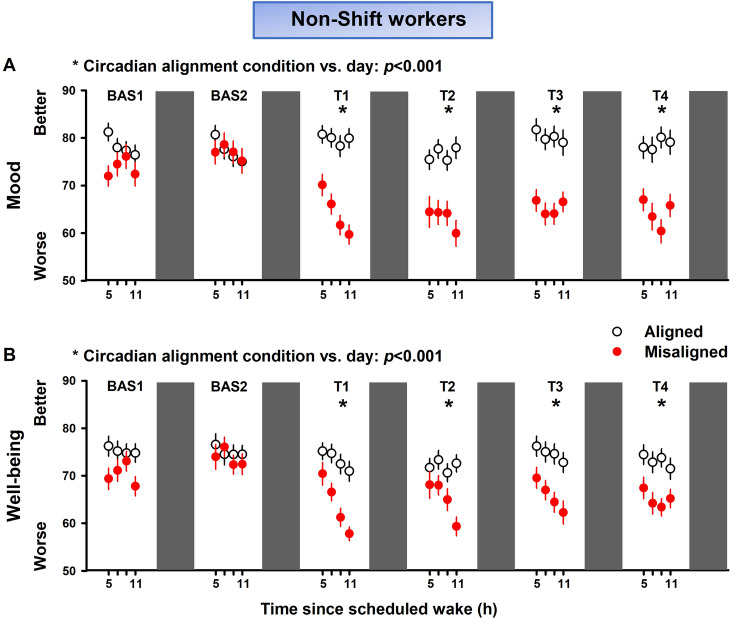
- reduces mood and well-being levels significantly in non-shift workers. During four days of misalignment, mood levels were notably lower compared to aligned conditions.
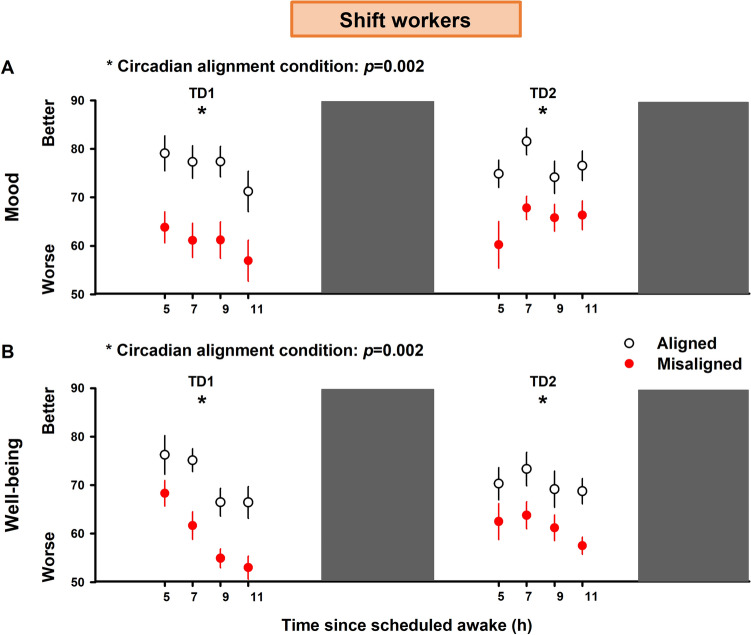
- Shift workers also experienced significant reductions in mood and well-being during . This effect persisted despite their longer exposure to shift work.
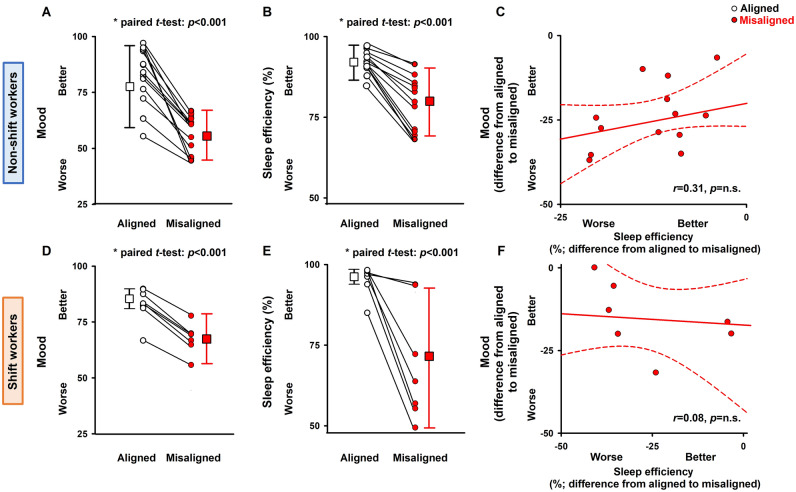
- Sleep efficiency did not correlate with mood levels during in either group. This suggests that the adverse mood effects are not solely due to sleep quality.
Caveats
- The study's sample size was limited, which may affect the generalizability of the findings. Larger studies are needed to confirm the effects of on mood.
- Individual differences in circadian phase were not accounted for, potentially influencing mood outcomes. Future research should explore these variations.
Definitions
- Circadian misalignment: A discrepancy between the body's internal clock and external environmental cues, often resulting from irregular sleep/wake schedules.
Simplified
Introduction
Circadian factors play a critical role in mood disorders, such that phase-shifts of circadian rhythms relative to the sleep/wake cycle are central to the pathophysiology of depression16–19, and conceptual frameworks have linked disruption of circadian rhythms to the genesis of or maintenance of depression in shift workers20. While previous studies have reported associations between varying degrees of disrupted circadian phase and the severity of depression16,21–24, there is very limited experimental evidence that circadian misalignment per se plays a causal role in disrupting emotional state in either non-shift workers or shift workers. Currently, a single study has identified a potential role of circadian entrainment in mood levels, such that better circadian adaptation to night shift work (i.e., peak melatonin occurred during daytime sleep following 1 week of actual night shift work) associated with better mood levels25. Thus, it remains to be established whether circadian misalignment has adverse mood consequences in these individuals. Here, we used randomized, crossover, stringently controlled simulated shift work paradigms to identify whether circadian misalignment affects emotional state, as indexed by subjective levels of mood and well-being, the latter being a construct of mood, stress and physical exhaustion26. Two separate experiments were performed with non-shift workers and shift workers. In the first experiment, we tested the prediction that circadian misalignment increases mood vulnerability and hinders well-being, as compared to normally entrained circadian conditions, in non-shift workers. In the second experiment, we investigated whether the adverse mood effects of circadian misalignment also occur in shift workers. Our main prediction was that similar circadian misalignment effects impinge on mood and well-being levels in individuals who engage in shift work, despite years of exposure to this work schedule. Because night shift workers often experience shorter sleep duration, decreased sleep efficiency and greater variability of sleep–wake times27 with ramifications for mood and quality of life, we also tested whether the ability to sleep (e.g., sleep efficiency) was associated with mood and well-being during circadian misalignment. Our two experimental predictions allow establishing whether circadian misalignment is an important biological contributor to mood vulnerability in shift work settings.

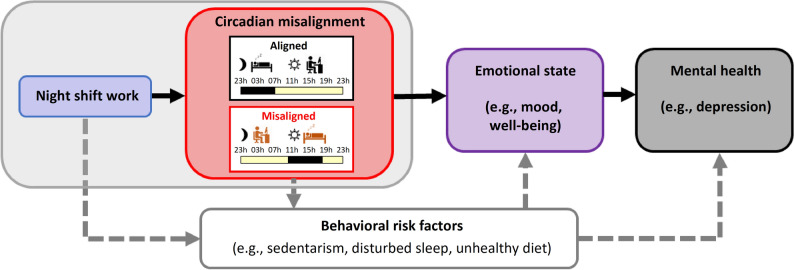
Linking shift work to mood vulnerability. Night shift work may affect emotional state and thereby mental health through circadian misalignment (black solid lines: potential direct effects). Here, circadian misalignment is illustrated by a large ~ 12-h inversion of the sleep/wake cycle and light–dark cycle (red box; aligned: top panel, misaligned: bottom panel), as can occur in night shift work. Shift work also indirectly affects emotional state and mental health through behavioral risk factors (indicated by grey dashed lines).
Methods
Human subjects
The protocol was approved by the institutional review board at the Partners Human Research Committee, performed in accordance with the principles of the Declaration of Helsinki, and participants provided written informed consent. Twenty-three male and female participants between the ages of 18 and 45 years completed the study. These individuals were divided into two groups: 14 non-shift workers (mean age ± SD [range]: 28 ± 9 years [20–49 years]; BMI: 25.4 ± 2.6 kg/m2 [21–29.5 kg/m2]; six women, eight men)(Experiment 1) and nine shift workers (34 ± 8 years [24–48 years]; BMI: 24.2 ± 3.4 kg/m2 [19.3–29.3 kg/m2]; six women, three men) (Experiment 2). All participants were free from any acute, chronic or debilitating medical condition. Non-shift workers were matched to shift workers who completed the protocol for (1) sex; (2) age (± 5 years); (3) BMI (± 3 kg/m2); and (4) sedentary vs. habitually active lifestyle. In Experiment 1, we included a participant removed from a previous cognitive-related publication on the same experiment28. This participant was included after assessing whether or not they were an outlier for any of the outcomes reported here. As the inclusion/exclusion of this single participant did not alter any of the mood-related results presented here, they were included in the current study sample. In Experiment 2, we only enrolled shift workers who had permanent night shifts, rotating shifts, or irregular schedules. All participants in Experiment 2 were currently employed shift workers, a minimum of 12 months of consecutive shift work, at least five night shifts/month (night shift here defined as 6 h of work scheduled between 10 p.m. and 8 a.m.), and no shift duration > 12 h. Because the duration of their consecutive shift work experience was longer than 1 year, we deemed participants as chronically exposed to shift work. Two participants' dim light melatonin onset (DLMOn) showed a phase difference > 4 h between the circadian alignment and misalignment conditions 29–31. Thus, we excluded data from these two participants from all mood and well-being analysis due to the unstable timing of their central circadian clock. The demographics for the remaining seven participants are as follows: age 37 ± 7 years old (30–48 years old); sex, three men and four women; and BMI 24.4 ± 3.1 kg/m2 (21.0–29.3 kg/m2). Furthermore, the remaining seven participants had night work frequency of 12 ± 4 night shifts/month (6–18 night shifts/month), consecutive shift work experience of 5.3 ± 8.8 years (1.3–25.1 years), and lifetime cumulative shift work experience of 6.3 ± 8.5 years (1.5–25.1 years).
Other aspects of these two studies, which were designed to test separate, independent hypotheses, involving metabolic, cardiovascular, energy balance and cognitive function outcomes, have previously been published28–37.
Experiment 1

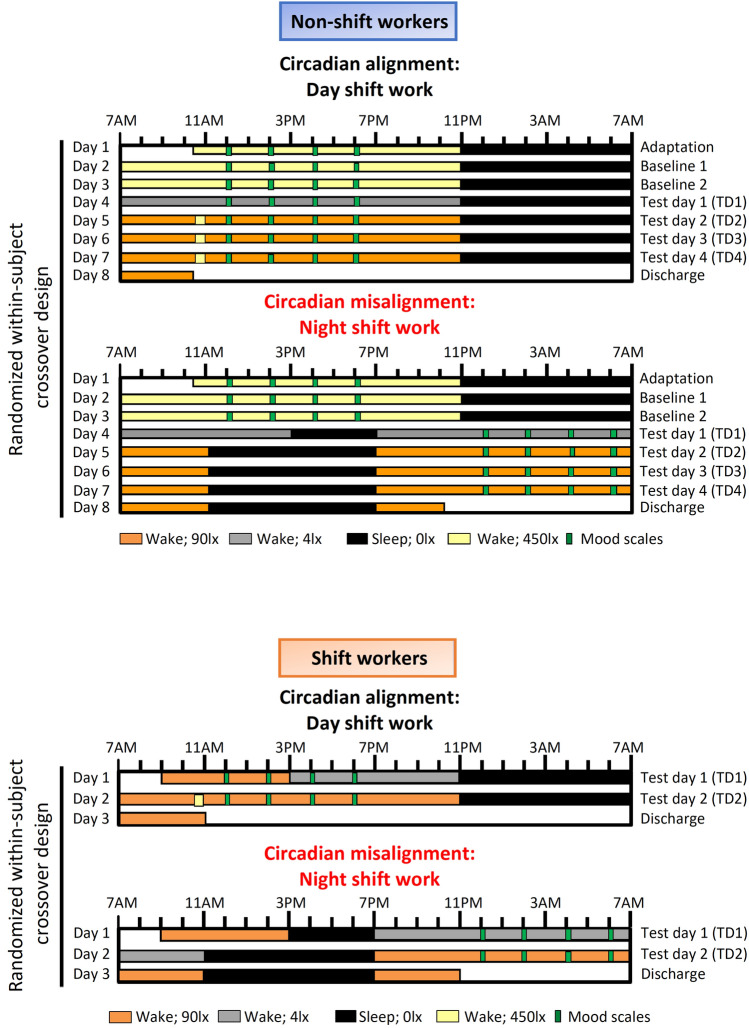
Within-subject, randomized, crossover study design.Non-shift workers underwent circadian alignment and misalignment. For alignment condition, scheduled sleep times remained 11 p.m. to 7 a.m. across all days, whereas for the misalignment these timings were inverted by 12 h after Baseline 2 (Day 3). T1–T4 corresponds to test days 1–4. During baseline days for both aligned and misaligned conditions, computerized mood scales were conducted at 12 p.m., 2 p.m., 4 p.m. and 6 p.m. These timings are: (1) outside of the window of sleep inertia effects following awakening; and (2) hours before participant's scheduled sleep, when they are expected to be alert. While these times were the same throughout the aligned condition, in the misaligned condition the times were inverted by 12 h for T1–T4 relative to clock time, while maintaining the same time relative to the sleep/wake cycle.Shift workers underwent circadian alignment and misalignment conditions that were conceptually similar to Experiment 1, such that scheduled sleep times were maintained between 11 p.m. to 7 a.m. in the alignment condition, whereas the times were inverted by 12 h in the misaligned condition. Both experiments had the same computerized mood scales. Upper panel: Bottom panel:
Experiment 2
For ~14 days before each laboratory protocol, participants wore an Actiwatch Spectrum, recorded their bedtimes, wake times and work schedules in a sleep diary, and reported the information to a time-stamped voicemail system. As for Experiment 1, participants were instructed to sleep between 11 p.m. and 7 a.m. on the night preceding each laboratory protocol to reduce possible sleep debt before commencing the study. Each participant underwent a within-subject, randomized crossover study that comprised two 3-day laboratory protocols31 (Fig. 2B). One protocol included a simulated day shift (circadian alignment) and the other a simulated night shift (circadian misalignment). The laboratory protocols were separated by 3–8 weeks (mean ± SD: 5 ± 2 weeks). Minimization was used to reduce imbalance, according to age, sex and BMI. Participants remained in a private laboratory room throughout each protocol to allow for strict control of environmental conditions. Participants were not permitted to exercise while in the laboratory. In the circadian alignment condition, participants' sleep opportunity occurred from 11 p.m. to 7 a.m. for days 1–3. In the circadian misalignment condition, on day 1 the participants' sleep/wake cycle was inverted by 12 h by including an 8-h wake episode (beginning at the scheduled time of awakening of 7AM on day 1) plus a 4-h sleep opportunity between 3 and 7 p.m. This 8 h of wake and 4 h of sleep allowed maintaining a 2:1 ratio between scheduled wakefulness and sleep opportunity (same sleep opportunity-to-wake ratio [1:2] in both circadian alignment and misalignment conditions). Participants then stayed awake for 16 h until their next 8-h sleep opportunity that occurred from 11 a.m. to 7 p.m. (maintained until the end of the protocol). Light levels were 90 lx to simulate typical room light intensity, 450 lx for 30-min periods to simulate the morning commute preceding the simulated day shift and following the simulated night shift, 4 lx to permit DLMO assessment, and < 0.02 lx during scheduled sleep. As for Experiment 1, the DLMO assessment allowed identifying whether participants had stable timing of their central circadian clock, whereby their DLMO would not drastically differ between the circadian alignment and misalignment conditions (< 4 h as per31). Experiment 2 was shorter in duration as compared to Experiment 1 to increase feasibility and to minimize potential dropouts of participants with shift work.
Outcome measures
In both experiments, mood was assessed during computerized test sessions, which were distributed in a time window occurring 5–11 h after scheduled wakefulness on all days, thus avoiding potential subjective impairment due to sleep inertia (typically up to 4-h after awakening)40. Key affective components (e.g., mood and well-being) were assessed during these computerized test sessions using a 100-mm bipolar visual analogue general health/well-being scale (VAS; from 0 to 100) to instantaneously detect participants perceived mood and well-being levels41. For the assessment of mood, we used the VAS question "happy/sad" (where sad = 0 and happy = 100). Participants had the following instruction presented on the computer screen "move the pointer to the place on the line that is most appropriate to the intensity of the stated symptom as you are experiencing it NOW". Participants were requested to place a vertical mark on the VAS ranging from 0 to 100 mm. Well-being was defined as a composite score averaged over three items: "happy/sad", "calm/stressed" (where calm = 0 and stressed = 100; scale was inverted for data analyses), and "energetic/physically exhausted" (where energetic = 0 and physically exhausted = 100; scale was inverted for data analyses). These VAS-derived emotional state measurements have been validated in previous laboratory studies25,26,42, and can be reliably used for sequential serial time measurements due to the absence of ceiling effects26,42. We did not use the PANAS or the POMS, which allow for the multidimensional assessment of mood (e.g., arousal and valence), because these affective scales cannot be used for sequential serial time measurements (single measurements are most typical when using these scales, for which they were originally designed). Because mood and well-being have been shown to fluctuate with time-of-day25,26,42, we therefore opted for using the VAS which is well-validated for such serial time measurements. Sleep was recorded using polysomnography (Vitaport; TEMEC Instruments, The Netherlands)—in accordance with the American Academy of Sleep Medicine recommendations43. In Experiment 1, sleep was recorded during sleep periods 1, 4, and 6 in the circadian alignment conditionand during sleep periods 1, 5, and 7 in the circadian misalignment condition. In Experiment 2, sleep was recorded during sleep opportunity 1 in the circadian alignment condition and during sleep opportunity 2 in the circadian misalignment condition. Sleep stages were scored visually per 30-s epochs, according to43, by a single experienced polysomnography technician, blind to the circadian alignment and misalignment conditions.
Statistical analysis
Statistical analyses were performed with SAS version 9.4 (SAS Institute, Cary, NC, USA). Statistical tests were conducted for each of the two experiments (non-shift workers vs. shift workers experiments) separately as they addressed different hypotheses. Because of this, the inherent study design differences between the non-shift workers and shift workers experiments (e.g., length of duration of each experiment) and a low number of shift workers (no participants in Experiment 1 were shift workers), we did not a create a single analytic model with shift work as a between-subjects fixed factor or covariate of interest. Analyses were carried out using mixed-model analyses of variance for repeated measures (PROC MIXED, SAS) with main factors "circadian alignment condition" (aligned vs. misaligned), "time since wake" (5 h, 7 h, 9 h and 11 h), "day", the two-way interaction of "circadian alignment condition" vs. "day", and the two-way interaction of "circadian alignment condition" vs. "time since wake". Participant was included as a random factor, and contrasts were assessed with the LSMEANS statement. Missing data were not included in the analyses. To control overall type I error in null hypothesis testing when conducting multiple comparisons, p-values were adjusted using False Discovery Rate (FDR)44 on all mood measures. Sleep was treated as a covariate of interest in these analyses, as disrupted sleep has been implicated with worsened mood27. Lastly, we applied linear regression models to test whether the ability to sleep (sleep efficiency) is associated with mood and well-being under both circadian conditions. For the analyses in Experiment 2, because of the limited sample size, we did not include years of consecutive shift work nor the work hours per week in our models for emotional state as potential covariates of interest. Unless specified, data are presented as mean ± SEM. Significance for all statistical tests was set as p < 0.05.
Results

Circadian misalignment affects emotional state in non-shift workers. Circadian misalignment (red circles) influences emotional state, as evidenced by the significantly lower () mood and () well-being profiles in non-shift workers (n = 14), as compared to when the same individuals were exposed to days of circadian alignment (black circles). Data correspond to mean and standard error of mean; * < 0.05 (interaction of "circadian alignment condition" vs. "day", following FDR adjustment; see "" for details). A B p Results

Circadian misalignment affects emotional state in shift workers. Circadian misalignment (red circles) negatively affects emotional state, as evidenced by the significantly lower () mood and () well-being profiles in shift workers (n = 7), as compared to when the same individuals were exposed to days of circadian alignment (black circles). Data correspond to mean and standard error of the mean; * < 0.05 (effect of "circadian alignment condition", following FDR adjustment; see "" for details). A B p Results
![Sleep efficiency does not predict mood and well-being impairment during circadian misalignment. (–) In non-shift workers (n = 14), mood levels () and sleep efficiency () were significantly reduced during circadian misalignment as compared to circadian alignment. () Linear regression models indicate that sleep efficiency did not predict mood levels in the circadian alignment or misalignment conditions. (–) In shift workers (n = 7), mood levels () and sleep efficiency () were significantly reduced during circadian misalignment. () Linear regression models indicate that sleep efficiency did not predict mood levels in either circadian conditions (difference from circadian alignment to misalignment). Data presented as circles indicate individuals, and connecting lines correspond to results from the same individual for circadian alignment and misalignment. Squares and whiskers correspond, respectively, to median and interquartile ranges (minimum and maximum quartiles [1.5 × interquartile range]) to illustrate data dispersion;-values: significance of the paired-tests for,, and and for the linear regression analyses shown in and . A C A B C D F D E F A B D E C F p t](https://europepmc.org/articles/PMC7596056/bin/41598_2020_75245_Fig5_HTML.jpg "Click to view full size")
Sleep efficiency does not predict mood and well-being impairment during circadian misalignment. (–) In non-shift workers (n = 14), mood levels () and sleep efficiency () were significantly reduced during circadian misalignment as compared to circadian alignment. () Linear regression models indicate that sleep efficiency did not predict mood levels in the circadian alignment or misalignment conditions. (–) In shift workers (n = 7), mood levels () and sleep efficiency () were significantly reduced during circadian misalignment. () Linear regression models indicate that sleep efficiency did not predict mood levels in either circadian conditions (difference from circadian alignment to misalignment). Data presented as circles indicate individuals, and connecting lines correspond to results from the same individual for circadian alignment and misalignment. Squares and whiskers correspond, respectively, to median and interquartile ranges (minimum and maximum quartiles [1.5 × interquartile range]) to illustrate data dispersion;-values: significance of the paired-tests for,, and and for the linear regression analyses shown in and . A C A B C D F D E F A B D E C F p t
Discussion
Our results indicate that circadian misalignment underpins mood vulnerability in shift work settings. Accumulating data suggest that the mechanisms underlying the association between shift work and worsened mood may include disruption of circadian rhythms and (at least in part consequential) sleep alterations4,7,25. The endogenous circadian system determines the appropriate timing for sleep and wakefulness, body temperature, heart rate, blood pressure, and hormone levels, such as cortisol and melatonin45. Importantly, previous stringently controlled circadian studies have shown that mood and brain activity that potentially underlies mood regulation are under circadian control both in healthy individuals26,46 and in patients with major depressive disorder47–49, which suggests that the circadian system is an important biological component of mood regulation16–19. Night shift work is at odds with our endogenous circadian system, which is biologically tuned to ensure optimal alertness and mood levels during the biological day and promote sleep during the biological night, even in individuals who engage in shift work for many years50. Therefore, shift workers often experience a misalignment between the endogenous circadian timing system and daily behavior/environmental cycles14. Chronobiological adaptation of the sleep–wake cycle in those who work night shifts is very frequently inadequate, and such misalignment between the circadian timing system and daily behaviors is a very likely explanation for the adverse health consequences associated with shift work. Prior Forced Desynchrony studies have found both circadian and time-since-wake components to mood, with a nadir in mood levels that corresponds to the nadir in the circadian core body temperature (during the biological night)51,52. Mood assessments during our simulated night shift work occurred during the biological night37 (in that study, which assessed glucose tolerance in the same two experiments, circadian phase was estimated by cortisol). Since the mood assessments very likely occurred close to the nadir of core body temperature, participants may have been exposed to the lowest levels of the circadian mood rhythm. Furthermore, in patients with delayed sleep phase disorder (DSPD), circadian misalignment may be associated with increased depressive symptoms and DSPD symptom severity24, consistent with an interrelationship between circadian misalignment and mood vulnerability. Importantly, our stringently controlled within-subject randomized crossover laboratory protocols with consecutive days of either simulated day work (circadian alignment) or simulated night work (circadian misalignment) allowed us to unveil the acute effects of circadian misalignment on perceived mood and well-being. Given such acute effects in both non-shift workers and chronic shift workers, one may speculate that chronic exposure to circadian misalignment may be one additional key factor leading to the onset of depression in shift workers.
Lastly, while we observed that circadian misalignment decreased sleep efficiency in both non-shift workers and shift workers, no significant associations occurred between sleep efficiency (and other sleep parameters) and mood in either groups, possibly due to the sample size. Chronic sleep disruption is associated with negative emotions53, and chronic poor sleep quality has also been shown to delay affective recovery from negative events54. It is now well-established that shift workers often experience shorter sleep duration, increased frequency of napping, and greater variability of their sleep times27,55. This can lead to disrupted sleep/wake stability, which in turn can cause long-term circadian misalignment with ramifications to mental health and disease.
Potential limitations to our studies include the limited sample size (despite the within-subject design in each experiment), which warrants future studies with larger sample sizes to determine the magnitude of circadian misalignment effects on emotional state in shift workers. Furthermore, our analyses did not account for potential group effect of circadian phase or individual differences in circadian phase as indexed by, e.g., DLMO. Analyses of DLMO were not performed due to the limited sample size in each experiment and because light levels were ~ 90 lx during circadian alignment and misalignment. Exposure to 90 lx can result in ~ 50% of the maximum phase shifting capacity and melatonin suppression56, and recent evidence shows that melatonin suppression can occur at much lower light levels39,57. Thus, the effects of circadian phase as well as individual differences in the adverse mood consequences of circadian misalignment remain to be established. For the former, the circadian misalignment effects on mood and well-being might reflect the effects of a system that may be slowly or minimally re-entraining. Moreover, it might be likely that participants had negative mood levels during the biological night irrespective of a circadian misalignment effect per se. Future studies would be required to test these possible biological underpinnings as the current study design precludes testing such effects.
Despite decades of research on the impact of shift work on mental health, it remains unclear how shift work—in its chronobiologically most marked form, i.e., night work—can increase the risk of developing or exacerbating mood disorders. Collectively, our findings help to establish circadian misalignment as an important—and previously unrecognized—biological contributor for mood vulnerability in shift work settings. By identifying the role of circadian misalignment on emotional state, we can ultimately develop simple, yet effective evidence-based sleep/circadian interventions (e.g. appropriate light exposure, sleep hygiene) to improve the quality of life—an essential requirement for optimal mood— of shift workers.