
What this is
- This research examines how and shift work demands affect sleep quality and depressive symptoms in shift-working nurses.
- It integrates objective data on work demands with self-reported measures of circadian types, sleep quality, and depression.
- The findings aim to inform individualized shift scheduling strategies and health interventions for nurses.
Essence
- and shift work demands significantly influence sleep quality and depressive symptoms among shift-working nurses, with distinct dose-response patterns identified.
Key takeaways
- , specifically greater languidness, correlate with poorer sleep quality and higher depression levels. Conversely, greater flexibility is linked to lower depression levels.
- Shift work hours directly impact sleep quality, with a notable threshold effect observed at approximately 24 hours of shift work in four weeks, beyond which sleep quality deteriorates.
- Dynamic simulations reveal that circadian adaptability influences how shift work demands affect sleep and mood, suggesting personalized scheduling could mitigate negative health outcomes.
Caveats
- The cross-sectional design limits causal inference, necessitating longitudinal studies to clarify relationships over time.
- The study's single-center recruitment and predominantly female sample may restrict generalizability to male shift workers.
- Self-reported measures for sleep and depressive symptoms may introduce bias, indicating a need for objective assessments in future research.
Definitions
- Circadian rhythm types: Individual variations in adaptability to shift work, characterized by stability (flexible–rigid) and amplitude (languid–vigorous).
- Job Demands-Resources (JD-R) theory: A framework explaining how job demands and resources interact to influence employee well-being and performance.
Simplified
Introduction
To meet the growing demands of globalisation and a 24-h society, atypical work schedules have become increasingly common, involving 14% ~ 38% of the global workforce (1–3). Shift work disrupts sleep–wake patterns and often results in chronic sleep deprivation, contributing to circadian rhythm disruption (4). Circadian rhythms regulate a wide range of physiological and behavioral processes (5), which undoubtedly contribute to an increased risk of various pathological conditions.
Given the increasing demand for medical services and the need of uninterrupted patient care, nurses are required to work around-the-clock shifts. The negative impacts of shift work on nurses have been well documented (6, 7). Studies show that nearly 20% of night-shift nurses suffer from shift work sleep disorders (8), and 41.2–60.4% experience poor sleep quality (9). Moreover, a multicenter study in China found that 58.82% of shift nurses exhibited depressive symptoms, and 62.08% of them experienced anxiety symptoms (10). Sleep and depression problems are prevalent among shift nurses. Moreover, workers with insufficient or poor-quality sleep, especially under shift work schedules, are at higher risk of depression (11). Evidence from a multicenter study shows that nurses with adequate sleep experience lower stress levels (12). Poor sleep not only impairs nurses' physical and mental health but also compromises job performance, with ripple effects on patient safety (13–15). However, the predictors and moderators of sleep and depression among shift nurses remain underexplored, posing a challenge for clinical nursing management.
The Job Demands-Resources (JD-R) theory provides a valuable framework for understanding how shift work demands influence the sleep and psychological well-being of shift nurses. As a job design theory, the JD-R model (16, 17) explains how job demands and resources interact to shape employee well-being and performance. Job demands refer to aspects of work that require sustained physical and mental effort and are associated with physiological and/or psychological costs as well as health impairment processes (17, 18). Shift nurses face sustained and intense work demands, such as repeatedly irregular night shifts and complex patient care, which can deplete physical and emotional resources, lead to sleep debt, and trigger adverse health outcomes. A nationwide cross-sectional study also demonstrated a strong interconnectedness between job demands, resources, and depressive symptoms in critical care nurses (19). Empirical studies also support that repeated high work demands are linked to increased risks of sleep disturbances, depression, and anxiety among shift nurses (10, 20–23). However, most existing studies have relied on self-reports. Objective and real-world assessments of shift work demands remain limited, yet they are crucial for clarifying health impacts and guiding effective interventions for shift nurses.
Job resources are the physical, psychological, social, or organizational aspects of work that help employees achieve goals and alleviate the health-damaging consequences (17, 18). The JD-R theory further posits a reciprocal relationship between job and personal resources (17), suggesting that individuals with higher levels of personal resources—such as resilience and adaptability—are better able to buffer the negative impact of shift work demands. With increasing recognition of individual endogenous differences, the concept of circadian rhythm types has been introduced as a form of personal resources, reflecting individual variations in adaptability and tolerance to shift work. Circadian rhythm types comprise two dimensions: stability (flexible–rigid) and amplitude (languid–vigorous) (24). These circadian traits have been shown to be associated with sleep-related outcomes and other health risks in shift workers (25–27). Research findings and expert consensus consistently suggest that individual circadian profiles should be taken into account when developing occupational health policies, interventions, and shift scheduling strategies (28–30). However, the independent and combined effects of circadian rhythm types and shift work demand on nurses' health outcomes remain insufficiently explored.
Taken together, this study aimed to integrate objective work demands data with self-reported circadian types: first, to identify key predictors and moderators of sleep quality and depressive symptoms; second, to examine their combined effects and potential dose–response relationships. The findings are expected to provide important evidence for developing individualized shift scheduling strategies and health promotion interventions for shift-working nurses.
Methods
Study design and participants
This cross-sectional study was conducted between May 1, 2024, and May 31, 2025, at a tertiary general teaching hospital in Guangxi, China. Shift-working nurses were recruited using convenience sampling during routine physical examinations at the hospital's health examination center. Written informed consent was obtained from all participants. Inclusion criteria were as follows: (1) age 20–45 years, chosen to minimize potential confounding from menopause-related hormonal changes in older female nurses and work schedule adjustments; (2) full-time registered nurses; (3) ≥6 months of clinical experience; and (4) having worked in a fixed ward and experienced at least one rotating shift per month over the past 6 months. Exclusion criteria included: (1) having experienced major illness (e.g., cancer, cardiovascular or cerebrovascular disease, diabetes), major surgical procedures, major psychiatric disorders (e.g., schizophrenia, bipolar disorder), sickness absence (≥3 days), or major family life events (e.g., bereavement or marital disruption) within the past 6 months; (2) pregnancy or breastfeeding within the past 6 months; (3) travel across time zones within the past month; or (4) a lack of available shift work data.
Measures
Eligible participants were invited to complete a paper-based self-report questionnaire designed to collect general information (including gender, age, ethnicity, marital status, number of children, education level, years of work experience, professional title, years of shift work experience, and shift model), and to assess circadian rhythm types, sleep quality, and depressive symptoms using the Circadian Type Inventory (CTI), the Pittsburgh Sleep Quality Index (PSQI), and the Patient Health Questionnaire-9 (PHQ-9), respectively. The principal investigators (ZH and QL) administered the questionnaires on-site and verified their completeness immediately upon collection.
Circadian rhythm types
The original CTI was developed by Folkard et al. (24) and subsequently revised by Di Milia et al. (31) to assess individual adaptability to shift work. The Chinese version CTI, translated and validated by Qi et al. (32), has demonstrated good psychometric properties (Cronbach's α = 0.80 for FR; 0.73 for LV). The CTI assesses the stability and amplitude of circadian rhythms across two dimensions: rhythm stability (flexible–rigid, FR; 5 items) and rhythm amplitude (languid–vigorous, LV; 6 items). Items are rated on a 5-point Likert scale (1 = "almost never" to 5 = "almost always"). Higher FR scores indicate greater flexibility in adapting sleep–wake patterns, while higher LV scores reflect greater languidness and greater vulnerability to drowsiness and sleep loss. In this study, the CTI showed acceptable internal consistency (Cronbach's α = 0.843 for FR; 0.719 for LV).
Sleep quality
The PSQI was originally developed by Buysse et al. (33) to assess sleep quality over the past month. The Chinese version of the PSQI also demonstrated good internal consistency with Cronbach's α ranging from 0.82 to 0.83 (34). A total PSQI score >7 has been validated as an effective cutoff to distinguish individuals with insomnia from the general population, with a sensitivity of 98.3% and a specificity of 90.2% (35). The PSQI includes 19 items covering seven components: subjective sleep quality, sleep latency, sleep duration, sleep efficiency, sleep disturbances, use of sleep medications, and daytime dysfunction. Each component is scored from 0 to 3, yielding a total score ranging from 0 to 21, with higher scores indicating poorer sleep quality and a cutoff score >7 indicating positive screening for insomnia. In this study, the PSQI showed acceptable internal consistency (Cronbach's α = 0.748).
Depressive symptoms
The PHQ-9, developed by Kroenke et al. (36), has been validated in Chinese populations by Zhang et al. (37), demonstrating good internal consistency (Cronbach's α = 0.854), and is a widely used self-report tool for assessing the severity of depressive symptoms. A cutoff score of ≥10 is widely recognized as the optimal threshold for probable depression, offering good sensitivity and specificity (both 0.85) (38). The PHQ-9 consists of 9 items rated on a 4-point Likert scale (0 = "not at all" to 3 = "nearly every day"), yielding a total score between 0 and 27. Higher scores reflect greater levels of depressive symptomatology, with a cutoff score ≥10 indicating a positive screen for depressive symptoms. In this study, the PHQ-9 was used to assess depressive symptoms over the past month and demonstrated good internal consistency (Cronbach's α = 0.871).
Work demands
Work demands over the past 4 weeks were assessed across two dimensions: work quantity and work intensity, based on data extracted from the hospital's nursing management system.
Statistical analysis
All data were analyzed using Python and relevant statistical packages. Due to missing inpatient and NPR data, participants from the emergency department (n = 7), anesthesiology department (n = 1), and hemodialysis unit (n = 2) were excluded from work intensity analysis. A two-tailed p-value <0.05 was considered statistically significant in this study.
Two simulation strategies were adopted:
Results
A total of 312 shift nurses were recruited
After excluding 24 participants (10 pregnant, 4 lactating, 2 with diabetes, 3 post-surgical, 2 with sickness absence >3 days and 3 without shift data), 288 nurses were included in the final analysis. Of these, 30 (10.42%) were male and 258 (89.58%) were female, with a median age of 33.5 years (range: 24–44). Regarding shift patterns, 188 nurses (65.28%) were engaged in day–night (DN) shifts, and 100 (34.72%) engaged in day-evening-night (APN) shifts. The median PSQI score was 8 (IQR: 4; range: 1–17), and the median PHQ-9 score was 7 (IQR: 5; range: 0–22). Based on classification criteria for insomnia and probable depression, 148 participants (51.39%) had insomnia, 70 (24.31%) had probable depression, and 58 (20.14%) had both conditions. Descriptive statistics of the variables are presented in. Supplementary Table S1
Univariate analysis
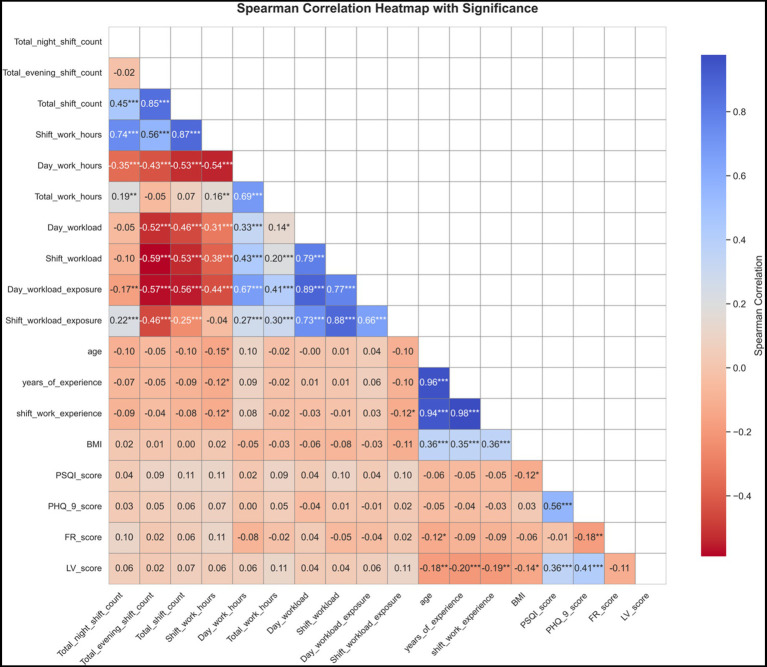
There were no statistically significant differences in sleep quality and depressive symptoms across sociodemographic groups (p > 0.05; Table 1). Spearman correlation analysis showed that poorer sleep quality (higher PSQI score) was positively correlated with depressive symptoms (ρ = 0.560, p < 0.001), greater languidness (ρ = 0.356, p < 0.001) and negatively correlated with body mass index (BMI) (ρ = −0.122, p = 0.038). Depressive symptoms were negatively correlated with greater flexibility (ρ = −0.179, p = 0.002) and positively correlated with greater languidness (ρ = 0.412, p < 0.001). Detailed results are shown in Figure 1 and Supplementary Tables S2a, S2b.

Heatmap of Spearman correlation coefficients among PSQI scores, PHQ-9 scores, FR scores, LV scores, and work demand related indicators. The color intensity in the figure reflects the strength of correlations between variables: darker blue indicates stronger positive correlations, while darker red indicates stronger negative correlations. PSQI, Pittsburgh Sleep Quality Index (Sleep quality); PHQ-9, Patient Health Questionnaire-9 (Depressive symptoms); FR, Flexible-rigid; LV, languid–Vigorous; BMI, Body Mass Index. Asterisks denote significance levels (*** < 0.001; ** < 0.01; * < 0.05). p p p
| Variables | (%)N | PSQI median (IQR) | U or H statistic/valuep | PHQ-9 median (IQR) | U or H statistic/valuep | FR median (IQR) | U or H statistic/valuep | LV median (IQR) | U or H statistic/valuep |
|---|---|---|---|---|---|---|---|---|---|
| Gender | |||||||||
| Male | 30 (10.4) | 6.5 (3.8) | 4437.0/0.188 | 8.0 (5.75) | 3893.5/0.957 | 13.5 (6.0) | 3438.0/0.316 | 17.5 (3.75) | 4801.5/0.030 |
| Female | 258 (89.6) | 8.0 (4.0) | 7.0 (5.0) | 12.0 (6.0) | 19.0 (6.0) | ||||
| Age range | |||||||||
| 20 ≤ years < 30 | 90 (31.3) | 7.5 (4.0) | 4.950/0.084 | 7.0 (4.0) | 1.247/0.536 | 13.0 (5.0) | 5.366/0.068 | 19.0 (6.75) | 10.735/0.005 |
| 30 ≤ years < 40 | 167 (58.0) | 8.0 (4.0) | 7.0 (5.0) | 12.0 (6.0) | 18.0 (6.0) | ||||
| Years ≥ 40 | 31 (10.7) | 6.0 (3.5) | 6.0 (6.5) | 13.5 (5.0) | 17.0 (5.5) | ||||
| BMI | |||||||||
| BMI < 18.5 | 18 (6.3) | 8.5 (3.5) | 4.697/0.195 | 7.0 (2.75) | 1.212/0.750 | 11.5 (5.75) | 1.881/0.598 | 18.5 (3.75) | 4.291/0.232 |
| 18.5 ≤ BMI < 24 | 218 (75.7) | 8.0 (4.0) | 7.0 (5.0) | 13.0 (6.0) | 19.0 (6.0) | ||||
| 24 ≤ BMI < 28 | 48 (16.7) | 7.0 (4.0) | 7.0 (5.25) | 12.0 (5.0) | 17.5 (7.0) | ||||
| BMI ≥ 28 | 4 (1.4) | 7.5 (4.5) | 10.0 (4.75) | 10.0 (3.5) | 17.0 (1.0) | ||||
| Ethnicity | |||||||||
| Han | 170 (59.0) | 8.0 (4.0) | 0.410/0.815 | 7.0 (5.75) | 0.248/0.883 | 12.0 (5.0) | 0.187/0.911 | 18.5 (6.0) | 0.177/0.915 |
| Zhuang minority | 104 (36.1) | 8.0 (4.0) | 7.0 (5.0) | 13.0 (6.0) | 19.0 (5.0) | ||||
| Other | 14 (4.9) | 7.5 (3.75) | 7.0 (5.5) | 13.5 (8.5) | 18.0 (4.25) | ||||
| Marital status | |||||||||
| Married | 186 (64.6) | 8.0 (4.0) | 1.264/0.532 | 7.0 (5.0) | 5.609/0.061 | 12.0 (5.75) | 1.567/0.457 | 18.0 (5.0) | 8.293/0.016 |
| Unmarried | 96 (33.3) | 8.0 (4.0) | 7.0 (4.0) | 12.5 (6.0) | 19.0 (6.25) | ||||
| Divorced | 6 (2.1) | 9.0 (2.75) | 10.0 (0.75) | 14.5 (4.0) | 20.5 (6.0) | ||||
| Education level | |||||||||
| Associate degree | 9 (3.1) | 9.0 (2.0) | 0.041/0.980 | 6.0 (4.0) | 0.424/0.809 | 11.0 (5.0) | 0.713/0.700 | 19.0 (5.0) | 1.135/0.567 |
| Bachelor's degree | 262 (91.0) | 8.0 (4.0) | 7.0 (5.0) | 13.0 (6.0) | 18.0 (6.0) | ||||
| Master's degree or higher | 17 (5.9) | 7.0 (4.0) | 6.0 (5.0) | 12.0 (8.0) | 20.0 (5.0) | ||||
| Work experience | |||||||||
| Years ≤ 5 | 71 (24.7) | 7.0 (4.0) | 3.645/0.456 | 7.0 (4.5) | 0.806/0.938 | 14.0 (6.0) | 3.668/0.453 | 19.0 (6.5) | 13.330/0.010 |
| 5 < years ≤ 10 | 69 (24.0) | 7.0 (4.0) | 7.0 (5.0) | 12.0 (6.0) | 19.0 (6.0) | ||||
| 10 < years ≤ 15 | 93 (32.3) | 9.0 (4.0) | 7.0 (4.0) | 12.0 (6.0) | 18.0 (5.0) | ||||
| 15 < years ≤20 | 46 (16.0) | 7.0 (3.75) | 6.0 (7.0) | 12.5 (4.5) | 18.0 (4.75) | ||||
| Years > 20 | 9 (3.1) | 6.0 (4.0) | 8.0 (4.0) | 15.0 (7.0) | 16.0 (4.0) | ||||
| Professional title | |||||||||
| Junior and below | 97 (33.7) | 7.0 (4.0) | 0.744/0.689 | 7.0 (4.0) | 0.691/0.708 | 13.0 (5.0) | 4.110/0.128 | 19.0 (7.0) | 9.102/0.011 |
| Intermediate grade | 187 (64.9) | 8.0 (4.0) | 7.0 (6.0) | 12.0 (6.0) | 18.0 (5.0) | ||||
| Senior | 4 (1.4) | 9.0 (5.0) | 6.0 (1.5) | 14.0 (4.5) | 14.0 (0.75) | ||||
| Number of children | |||||||||
| 0 | 117 (40.6) | 8.0 (4.0) | 1.787/0.618 | 7.0 (5.0) | 6.158/0.104 | 13.0 (6.0) | 1.802/0.615 | 19.0 (7.0) | 6.678/0.083 |
| 1 | 73 (25.3) | 8.0 (4.0) | 8.0 (5.0) | 13.0 (7.0) | 18.0 (5.0) | ||||
| 2 | 96 (33.3) | 7.0 (4.25) | 6.0 (5.0) | 12.0 (5.25) | 18.0 (4.5) | ||||
| 3 | 2 (0.7) | 6.0 (3.0) | 9.0 (3.0) | 11.0 (1.0) | 19.5 (5.5) | ||||
| Shift work experience | |||||||||
| Years ≤ 5 | 80 (27.8) | 7.0 (4.0) | 3.582/0.465 | 7.0 (4.25) | 0.927/0.921 | 13.5 (6.5) | 5.623/0.229 | 19.0 (6.0) | 14.614/0.006 |
| 5 < years ≤ 10 | 86 (29.9) | 8.0 (4.0) | 7.0 (5.0) | 12.0 (5.0) | 18.0 (6.0) | ||||
| 10 < years ≤ 15 | 76 (26.4) | 8.0 (4.0) | 7.0 (4.0) | 13.0 (5.25) | 19.0 (5.0) | ||||
| 15 < years ≤ 20 | 40 (13.9) | 7.0 (4.0) | 6.0 (7.25) | 13.0 (4.0) | 17.0 (5.25) | ||||
| Years > 20 | 6 (2.1) | 7.5 (3.25) | 8.0 (3.75) | 9.5 (6.25) | 15.0 (3.5) | ||||
| Shift model | |||||||||
| DN | 188 (65.3) | 8 (5) | 9315.5/0.900 | 7 (6) | 9586.0/0.782 | 13 (6) | 9722.0/0.632 | 19 (5.25) | 9592.0/0.775 |
| APN | 100 (34.7) | 8 (4) | 7 (5) | 12 (6) | 18 (6.0) | ||||
Predictors and moderators of sleep quality and depressive symptoms
All variables included in the GLMs had acceptable VIFs (range: 1.05–3.76, listed in), indicating no serious multicollinearity. Residual analysis (residuals vs. fitted plots, Q–Q plots,) did not show major violations of model assumptions. Supplementary Table S3 Supplementary Figure S1
Among the three candidate models, the one including shift work hours as a moderator provided the best fit, with the lowest AIC (1377.37) and BIC (1428.05) and the highest pseudo R2 (0.4403), and was selected as the optimal GLM for sleep quality. Significant predictors of sleep quality included depressive symptoms (β = 0.245, 95% CI: 0.195–0.295), shift work hours (β = 0.093, 95% CI: 0.004–0.182), greater languidness (β = 0.065, 95% CI: 0.014–0.116), and BMI (β = −0.056, 95% CI: −0.105 to −0.007). The results indicated that greater depression severity, longer shift work hours, and greater languidness were associated with poorer sleep quality, whereas higher BMI showed a modest association with better sleep quality. Notably, the interaction terms of depressive symptoms with languidness (p = 0.090) and with shift work hours (p = 0.082) demonstrated marginal significance in predicting sleep quality. Details are shown in Table 2.
Among the three candidate models, the one including shift work hours as a moderator provided the best fit, with the AIC (1657.89) and BIC (1712.20) and the highest pseudo R2 (0.4805), was selected as the optimal GLM for the depressive symptoms. Significant predictors of depressive symptoms included sleep quality (β = 0.314, 95% CI: 0.246–0.381), greater flexibility (β = −0.129, 95% CI: −0.190 to −0.069), greater languidness (β = 0.159, 95% CI: 0.090–0.227), and the interaction term of sleep quality with flexibility (β = 0.091, 95% CI: 0.035 ~ 0.146). The results indicated that poorer sleep quality and greater languidness were associated with more severe depressive symptoms, whereas greater flexibility was associated with lower depressive symptoms. The interaction between sleep quality and flexibility suggested that the protective association of flexibility was attenuated at higher levels of sleep disturbance. In addition, the interaction term of languidness with shift work hours showed marginal significance (p = 0.049). Details are shown in Table 2. Additional GLMs involving total night shift count and shift workload exposure as moderators are presented in Supplementary Table S4.
| Variables | β | Std err | z | -valuep | 95% CI |
|---|---|---|---|---|---|
| Sleep quality (PSQI score): | |||||
| Intercept | 2.114 | 0.083 | 25.606 | 0 | (1.953, 2.276) |
| Gender (female = 1) | −0.064 | 0.087 | −0.736 | 0.462 | (−0.234, 0.106) |
| PHQ-9 score | 0.245 | 0.025 | 9.637 | 0 | (0.195, 0.295) |
| Shift work hours | 0.093 | 0.046 | 2.047 | 0.041 | (0.004, 0.182) |
| PHQ-9 × shift work hours | −0.047 | 0.027 | −1.741 | 0.082 | (−0.101, 0.006) |
| LV score | 0.065 | 0.026 | 2.484 | 0.013 | (0.014, 0.116) |
| PHQ-9 × LV score | −0.035 | 0.021 | −1.696 | 0.09 | (−0.076, 0.005) |
| Shift work hours × LV score | 0.014 | 0.026 | 0.548 | 0.584 | (−0.036, 0.064) |
| Total night shift count | −0.050 | 0.039 | −1.267 | 0.205 | (−0.126, 0.027) |
| Shift workload exposure | 0.002 | 0.041 | 0.052 | 0.958 | (−0.078, 0.082) |
| Age | 0.022 | 0.025 | 0.9 | 0.368 | (−0.026, 0.071) |
| BMI | −0.056 | 0.025 | −2.237 | 0.025 | (−0.105, −0.007) |
| Daytime workload exposure | 0.062 | 0.044 | 1.396 | 0.163 | (−0.025, 0.148) |
| FR score | 0.042 | 0.023 | 1.871 | 0.061 | (−0.002, 0.086) |
| Depressive symptoms (PHQ-9 score): | |||||
| Intercept | 1.809 | 0.109 | 16.535 | 0 | (1.594, 2.023) |
| Gender (female = 1) | 0.075 | 0.115 | 0.653 | 0.514 | (−0.150, 0.300) |
| PSQI score | 0.314 | 0.034 | 9.122 | 0 | (0.246,0.381) |
| FR score | −0.129 | 0.031 | −4.171 | 0 | (−0.190, −0.069) |
| PSQI score × FR score | 0.091 | 0.028 | 3.212 | 0.001 | (0.035, 0.146) |
| LV score | 0.159 | 0.035 | 4.559 | 0 | (0.090, 0.227) |
| PSQI score × LV score | 0.004 | 0.03 | 0.139 | 0.89 | (−0.054, 0.062) |
| Shift work hours | −0.054 | 0.063 | −0.848 | 0.396 | (−0.178, 0.070) |
| PSQI score × shift work hours | −0.008 | 0.033 | −0.230 | 0.818 | (−0.072, 0.057) |
| FR score × shift work hours | −0.020 | 0.033 | −0.599 | 0.549 | (−0.084, 0.045) |
| LV score × shift work hours | 0.069 | 0.035 | 1.973 | 0.049 | (0.000, 0.138) |
| Age | 0.009 | 0.032 | 0.268 | 0.789 | (−0.054, 0.072) |
| Total night shift count | 0.028 | 0.054 | 0.52 | 0.603 | (−0.078, 0.135) |
| Shift workload exposure | 0.008 | 0.057 | 0.133 | 0.894 | (−0.104, 0.119) |
| Day workload exposure | −0.083 | 0.061 | −1.347 | 0.178 | (−0.203, 0.038) |
Nonlinear associations of shift work demand variables with sleep quality and depressive symptoms
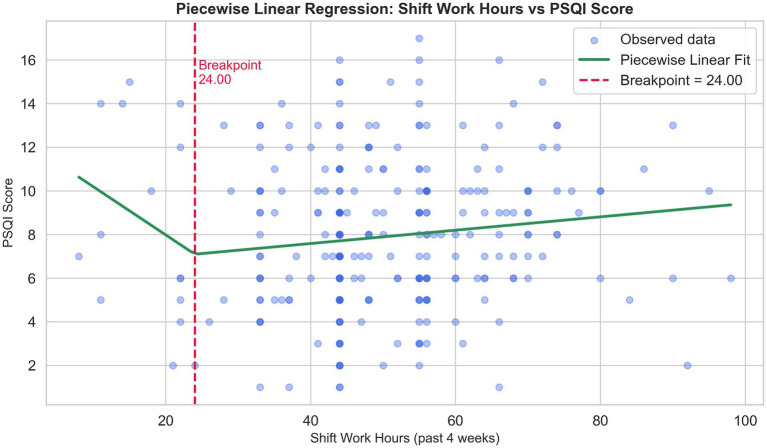
The GAM for sleep quality explained 40.5% of the variance (pseudo R2 = 0.405; GCV = 7.74; EDoF = 14.23). Among shift work demand variables, shift work hours showed a significant nonlinear association with sleep quality (EDoF = 1.6, p = 0.010), whereas night shift count (EDoF = 1.1, p = 0.189) and shift workload exposure (EDoF = 1.2, p = 0.623) did not. The GAM for depressive symptoms explained 44.1% of the variance (pseudo R2 = 0.441; GCV = 11.04; EDoF = 14.10), with no evidence of nonlinear effects for shift work hours (EDoF = 1.5, p = 0.691), night shift count (EDoF = 1.1, p = 0.548), or shift workload exposure (EDoF = 1.1, p = 0.830). Piecewise regression revealed a breakpoint at approximately 24 shift work hours per 4 weeks (Figure 2): below this threshold, no significant association with depressive symptoms (β = −0.221, p = 0.051) was observed, whereas above it, longer shift hours were significantly associated with poorer sleep quality (β = 0.031, p = 0.039).

Piecewise linear relationship between shift work hours and sleep quality. A breakpoint was identified at approximately 24 shift work hours. Below this breakpoint, shift work hours were marginally negatively correlated with sleep quality ( = −0.221, = 0.051), whereas above it, a significant positive correlation was observed ( = 0.031, = 0.039). Green curves indicate the fitted segmented regression lines. PSQI, Pittsburgh Sleep Quality Index; Higher PSQI score indicates poorer sleep quality. β p β p
Combined effects of circadian types and shift work demands
Sensitivity analyses showed that increasing the smoothing factor (α = 0.2 to 0.4) accelerated trajectories without altering overall dose–response patterns (Supplementary Figure S2), indicating robustness to smoothing assumptions, whereas sleep quality and depressive symptoms exhibited differential changes under varied shift work demands, reflecting sensitivity to shift work conditions.
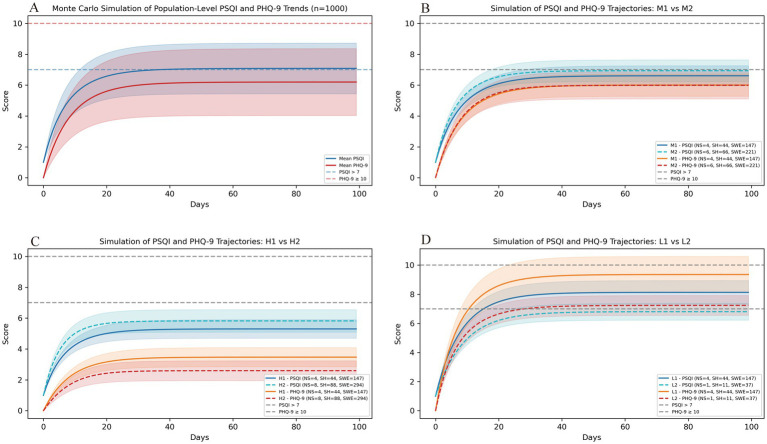
The simulation suggested that the overall study population reached the clinical threshold for insomnia at approximately day 30, while maintaining a relatively good psychological status (Figure 3A). Under a typical 4-week shift work demand condition (total night shifts = 4, shift work hours = 44, shift workload exposure = 147), Individuals with moderate circadian adaptation could maintain healthy sleep quality and mental status. However, when the shift work demands increased by 50%, their sleep quality gradually declined and reached the clinical insomnia threshold (Figure 3B). Individuals with high circadian adaptability maintained favorable sleep quality and mental health even when shift work demands were doubled (Figure 3C). In contrast, individuals with low circadian adaptation showed a rapid deterioration in sleep quality and depressive symptoms under the typical shift work demand condition, surpassing the insomnia threshold by the second week. Their trajectories indicated that good sleep quality could only be maintained when shift work demands were reduced by approximately 75% (Figure 3D).

Monte Carlo simulation of sleep quality and depressive symptoms trajectories among shift nurses.Simulated sleep quality and depressive symptoms trajectories over 100 days for 1,000 virtual nurses generated via bootstrap sampling from the study sample. Curves represent population-level mean trends and variability in sleep quality and depressive symptoms.Simulated trajectories across three circadian rhythm adaptability profiles—moderate (M1/M2), high (H1/H2), and low (L1/L2)—under varying 4-week shift work demand conditions. In the moderate adaptability group, simulated trajectories indicated that exceeding roughly six night-shifts per 4 weeks could lead to a deterioration in sleep quality approaching the insomnia threshold. Nurses with high adaptability maintained relatively favorable sleep and mood status even when shift work demands were doubled. In contrast, those with low adaptability showed rapid deterioration in sleep quality and depressive symptoms under typical shift work conditions. Good sleep quality was maintained when shift work demands were reduced by approximately 75%. PSQI, Pittsburgh Sleep Quality Index (Sleep quality); PHQ-9, Patient Health Questionnaire-9 (Depressive symptoms); FR, Flexible–Rigid; LV, languid–Vigorous. (A) (B–D) (B) (C) (D)
Discussion
This study, drawing on real-world shift work data and self-reported measures, explored the complex interrelationships among circadian rhythm types, shift work demands, sleep quality, and depressive symptoms in rotating-shift nurses. We found circadian rhythm types (FR/LV) and shift work hours exerted significant direct and/or moderating effects on sleep quality and depressive symptoms among shift-working nurses. Moreover, nonlinear associations and structural breakpoints were identified between sleep quality and shift work hours. Notably, nurses with different circadian rhythm types exhibited distinct dose–response patterns of sleep quality and depressive symptoms in response to shift work demands. These findings deepen our understanding of how circadian rhythm types (FR/LV) and shift work demands combine to influence sleep and depression in shift-working nurses. They also provide preliminary evidence to support personalized scheduling strategies and targeted health interventions.
In this study, we observed a bidirectional positive feedback relationship between sleep quality and depression: higher depression levels predicted poorer sleep quality (β = 0.245), and vice versa (β = 0.314). Although this reciprocal link has been well-established in prior research (42, 43), our findings notably suggest that the impact of poor sleep on depression is stronger than the reverse. This aligns with recent studies, such as Okechukwu et al., who identified poor sleep quality and quantity as key contributors to the mental health effects of night-shift work (44), and Brown et al. (45), who suggested that pronounced sleep disturbances often underlie the mental health consequences of shift work. Moreover, a prospective cohort study also demonstrated that insufficient or poor-quality sleep among shift workers is associated with a higher risk of depression (11), whereas a multicenter study found that adequate sleep is linked to lower stress levels (12). Together, these results underscore the foundational role of sleep disturbances in the development of depressive symptoms and support the prioritization of early sleep assessment and intervention in mental health strategies for shift-working nurses.
Circadian rhythm types emerged as significant predictors and moderators of poor sleep and depression. Greater languidness were associated with worse sleep quality (β = 0.065) and elevated depression levels (β = 0.159), while greater flexibility predicted lower depression levels (β = −0.129). Dynamic simulations further revealed distinct dose–response patterns across circadian profiles under shift work demands. These findings align with prior studies showing that greater languidness increases shift work disorder (SWD) risk (25, 27, 46). These associations may reflect that individuals with a languid trait have greater difficulty resisting drowsiness and require longer recovery from sleep loss, making them more vulnerable to sleep debt, poor sleep quality, and SWD after shift work. Conversely, greater circadian flexibility has been linked to better sleep (47) and lower SWD risk (46) among healthcare shift workers, although we did not observe a direct association between flexibility and sleep quality, which is consistent with previous reports (25, 27). This may reflect adaptive responses to chronic shift work or differences in sample characteristics. Overall, our results highlight the importance of circadian typology in identifying at-risk individuals and tailoring preventive interventions.
Research on the link between circadian rhythm types and depression remains limited, though some studies suggest associations between chronotype alterations and depressive symptom severity (48). Another study (49) also found that circadian rhythm types significantly moderated the relationship between perceived stress and sleep quality. To the best of our knowledge, this study is among the first to integrate objective shift workload data and demonstrate that circadian rhythm types directly predict depression levels and that flexibility moderates the impact of poor sleep quality on depression. Greater flexibility were linked to a protective effect, with lower depression levels, however, the PSQI × FR interaction showed that this protective link became weaker as sleep quality worsened. This may reflect that greater flexibility, although facilitating adaptation to irregular schedules, may not fully counteract the adverse consequences of circadian misalignment and melatonin disruption when sleep quality deteriorates, thereby intensifying the emotional impact of poor sleep. Collectively, these findings suggest that circadian traits may play an important role in shaping sleep–emotion dynamics and indicate the need for further investigation into their complex interactions.
Shift work demands were a primary focus of this study. We found that shift work hours had a direct impact on sleep quality (β = 0.093) and positively moderated the association between LV and depression (β = 0.069). These findings are consistent with a recent 4.5-year prospective cohort study that identified a dose–response pattern between shift work and sleep disorders and recommended that night shifts should not exceed 50 within a six-month period (50). However, we did not observe a significant association between total night shift count and sleep or depression. By contrast, a study of Korean shift nurses also reported a positive correlation between monthly night shift frequency and insomnia risk (52). Similarly, a prospective cohort study based on the UK Biobank (53) found that shift workers with more than eight night-shifts per month had an increased risk of depression (HR = 1.40). This discrepancy may reflect the complex relationship between total night shifts and health outcomes, underscoring the need for threshold-based or dose–response modeling.
We further observed dose–response relationships between shift work hours and sleep quality using nonlinear modeling and breakpoint analysis. Notably, when shift work hours exceeded about 24 h within a four-week period, sleep quality appeared to deteriorate progressively with increasing shift hours. These findings align with previous studies reporting that longer working hours and more working days are associated with greater sleep disturbances and poorer sleep quality among shift nurses (21, 51). Taken together, our findings suggest that shift work hours may represent meaningful "exposure doses" of shift burden. These cumulative doses, specifically when shift work hours exceed 24 in 4 weeks, warrant close attention from nursing administrators. Dynamic simulation further revealed distinct dose–response patterns across circadian adaptability profiles. Nurses with moderate adaptability tolerated typical shift work demands, whereas those with low adaptability showed more rapid deterioration in sleep and mood. For individuals with low adaptability, the simulations suggested that a workload of about one night shift per month might be tolerable; however, this requires confirmation in controlled trials. These scenario-based findings imply that the importance of considering both shift work demands and individual circadian traits when developing personalized scheduling strategies and targeted health interventions for nurses.
Conclusion
This study highlights the significant direct and moderating effects of circadian rhythm types and shift work hours on sleep quality and depressive symptoms among shift-working nurses. Importantly, a potential threshold effect was observed, with the risk of poor sleep quality appearing to increase when cumulative shift hours exceeded approximately 24 h within a four-week period. The combined effects of circadian rhythm types and shift work demands corresponded to distinct dose–response patterns in sleep quality and depressive symptoms. These findings deepen our understanding of the mechanisms underlying sleep and mental health in shift-working nurses and offer preliminary evidence to support personalized scheduling strategies and targeted health interventions.
Limitations
Several limitations should be noted. First, the cross-sectional design limits causal inference; longitudinal or cohort studies are needed to clarify the directionality of associations. Second, due to constraints in accessing objective work demand data, participants were recruited from a single center and were predominantly female (89.58%), which may limit generalizability, particularly to male shift workers. Third, a baseline health check was not conducted prior to the study, which may have introduced bias, as some pre-existing depressive symptoms could have been overlooked, although participants with major psychiatric disorders were excluded. Fourth, work demands were assessed over a four-week period; future studies should extend the observation window (e.g., 12–24 weeks) to capture longer-term effects. Moreover, simulations were based on relatively stable shift patterns and did not account for daily scheduling variations, limiting their ability to model the dynamic accumulation and recovery processes. Finally, sleep and depressive symptoms were measured using self-reports, which may be subject to recall or reporting bias. Incorporating objective assessments in future research is warranted to improve measurement precision.