
What this is
- This research investigates how circadian rhythms relate to Alzheimer's disease biomarkers in older adults with early cognitive impairment.
- Using accelerometer data, the study assesses the timing and fragmentation of circadian rhythms and their associations with amyloid-β (Aβ), tau, and cognitive performance.
- Findings suggest that earlier circadian timing correlates with higher levels of Aβ and tau, as well as poorer cognitive outcomes.
Essence
- Earlier circadian rhythm timing is linked to higher amyloid-β and tau levels, and poorer cognitive performance in older adults with early cognitive impairment.
Key takeaways
- Earlier correlates with higher Aβ levels, particularly stronger in carriers of the APOE4 gene variant. This indicates that circadian timing may influence Alzheimer's pathology.
- Higher () is associated with increased tau levels in later Braak regions, suggesting that circadian fragmentation may contribute to tau pathology.
- Circadian timing impacts cognitive performance; earlier timing is linked to worse verbal memory, while later timing correlates with poorer attention and processing speed.
Caveats
- The study's modest sample size limits the generalizability of findings and the strength of associations. Most participants were self-reported White and highly educated.
- Cross-sectional data restrict interpretations of causality and longitudinal changes, making it difficult to determine the direction of relationships.
Definitions
- Acrotime: The average time of day of peak activity, indicating circadian rhythm timing.
- Intradaily variability (IV): A measure of circadian rhythm fragmentation, reflecting the regularity of activity and rest periods within a day.
Simplified
Introduction
Circadian rhythms are evolutionarily conserved adaptations of physiological, mental, and behavioural changes entrained to the 24-h light–dark cycle of Earth's rotation. These rhythms are primarily entrained by light signalling, which in turn regulates the release of melatonin to promote drowsiness and sleep onset,1,2 as well as cortisol to initiate an awakening response,3 among several other hormones. Circadian rhythms exert influence over many systems that are affected in Alzheimer's disease, and numerous studies identify circadian changes across disease progression. For example, reduced levels of melatonin and melatonin receptor expression,4-10 as well as elevated cortisol,11 have been reported in mild cognitive impairment (MCI) and Alzheimer's populations. Moreover, disrupted circadian rhythms are widely observed in Alzheimer's patients. These include fragmented sleep–wake cycles,12-15 reduced day-to-day rhythm stability,12-14,16,17 decreased rhythm amplitude,13,14,18 delayed circadian phase,13,17-19 irregular body temperature rhythms,13,17,19-21 and sundowning,17,20,22 which is the chronobiological worsening of neuropsychiatric and behavioural symptoms in the late afternoon and evening.
Despite the abundant research linking symptoms of disrupted circadian rhythms and Alzheimer's disease, their role as a modifiable risk factor for preventing MCI and Alzheimer's disease remains poorly understood. Evidence from studies investigating circadian rhythms in early Alzheimer's stages supports the idea that circadian dysfunction may occur before the onset of overt cognitive symptoms,23-30 suggesting that circadian changes may be an early risk factor for developing MCI and dementia. Despite these findings, very little is known about how circadian rhythm timing and fragmentation are associated with the pathological biomarkers of Alzheimer's disease, amyloid-β (Aβ) and tau, in older adults, and how these relationships map onto cognition.
The present study sought to address this gap in the literature using data from wrist-worn accelerometers, which provide continuous, non-invasive, objective, high-resolution quantification of 24-h activity data. Cross-sectional baseline accelerometry data from the Lifestyle Enriching Activities for Research in Neuroscience Intervention Trial were examined in 68 sedentary older adults with objective early cognitive impairment, defined as performance on cognitive testing measuring at least 1 SD below the age-matched normative values. These participants represent a cognitively vulnerable population with subtle, subclinical cognitive decline that may precede clinical MCI. Circadian rhythm timing was assessed with acrotime, a common measure for the average time of day of peak activity. Circadian fragmentation was measured with intradaily variability (IV) (the average circadian rhythm fragmentation within a day). We investigated the relationships between circadian rhythms and the outcome measures of Aβ PET, tau PET, and cognition (verbal memory and attention/processing speed). We also explored how these relationships varied by age, sex, and apolipoprotein E4 (APOE4) carrier status. Mediation models were used to investigate Aβ and tau pathology as mechanistic mediators through which circadian rhythms may impact cognition. We hypothesized that higher circadian fragmentation and variable circadian timing would be associated with higher Aβ and tau burden, as well as lower cognitive scores. We further hypothesized that pathology levels would mediate the relationships between circadian rhythms and cognition.
Materials and methods
Study participant details
Cross-sectional baseline data from the Lifestyle Enriching Activities for Research in Neuroscience Intervention Trial (LEARNit), collected between August 2016 and July 2022, were used for this study (https://www.clinicaltrials.gov/study/NCT02726906↗). The current study sample included 68 sedentary older adults (ages 55–80) with objective early cognitive impairment, characterized by screening performance measuring at least 1 SD below the age-matched normative values on tests of attention, executive function, or memory. Participants did not have a clinical diagnosis of cognitive impairment. At baseline, participants completed tests of cognition, Aβ and tau PET, and APOE4 phenotyping. All participants who completed baseline actigraphy, brain imaging, and cognitive testing prior to randomization were included in the study (n = 68). Participants were recruited from the Greater Los Angeles Area and had no current or prior history of any major psychiatric illness, organ failure, epilepsy, or hydrocephalus. LEARNit participant characteristics are located in Table 1.
| Characteristic | = 68n |
|---|---|
| Age at accelerometry collection (mean, SD) | 66.8 (6.6) |
| Women (%) | 63.2 |
| carrier status (%)APOE4 | 26.5 |
| Years of education (mean, SD) | 16.8 (2.5) |
| Montreal Cognitive Assessment Score (mean, SD) | 26.1 (2.7) |
| Ethnicity, Hispanic/Latino (%) | 13.2 |
| Race (%) | |
| White | 76.5 |
| African American | 13.2 |
| Asian | 4.4 |
| American Indian or Alaska Native | 1.5 |
| Other | 4.4 |
| More than one race | 4.4 |
| Circadian rhythms (mean, SD) | |
| IV | 0.91 (0.20) |
| Acrotime (hour of day) | 14.26 (1.53) |
| Aβ PET composite SUVR (mean, SD) | 1.00 (0.17) |
| Tau PET SUVR (= 67) (mean, SD)n | |
| Braak ROIs I/II | 1.20 (0.13) |
| Braak ROIs III/IV | 1.15 (0.098) |
| Cognition (mean, SD) | |
| CVLT short delay free recall total score | 10.4 (3.4) |
| WAIS Digit Symbol Substitution score | 60.9 (15.1) |
Actigraphy
Processing of raw accelerometer data
All processing of accelerometer data was conducted in R version 4.3.1 (June 2023).31 Participants wore their GENEActiv (Activinsights Ltd)32 accelerometers for ∼1 month (average: 31.8 ± 4.2 days, range: 21–45 days) prior to brain imaging and cognitive testing. Initial processing of raw data was conducted with GGIR: Raw Accelerometer Data Analysis (version 3.0-1).33,34 The summary measure of dynamic acceleration produced by GGIR is the Euclidean Norm Minus One (ENMO)35 at a sampling rate of 1/5 Hz (one ENMO value recorded every 5 s).
Adjusting for daylight saving time
For the participants whose accelerometer collection periods spanned daylight saving time starting or ending (n = 15), 1 week of accelerometry data was removed starting on the day of their time change.36
Circadian rhythm variables from accelerometry
The two circadian rhythm measures included in this study are acrotime and IV. Acrotime is extracted from Extended Cosinor Analysis,37-39 and IV is derived using non-parametric methods.40
The R package ActCR: Extract Circadian Rhythms Metrics from Actigraphy Data (version 0.3.0)41,42 was used to extract acrophase, which measures the average time over 24 h of high values recurring in each cycle, measured in units of radians. Acrotime is the acrophase measured in hours (military time). This measure is considered the average time of day of peak activity. A lower acrotime is indicative of an earlier average peak activity time, whereas a higher acrotime is indicative of a later average peak activity time.
The R package nparACT: Non-Parametric Measures of Actigraphy (version 0.8)43,44 was used to extract IV, which has been widely used in several studies as a measure of circadian rhythm fragmentation and sleep–wake cycle disturbance.12,16,45-48 IV quantifies transitions between rest-activity periods. Low IV is characterized by long stretches of activity in daytime and rest in nighttime. High IV consists of rhythms that fluctuate between low and high activity within a day and may signify the presence of daytime napping and/or nighttime activity. IV is measured on a scale of 0–2, where zero is indicative of a nearly perfect sinusoidal wave and two is Gaussian noise.47
Preparing accelerometry data for circadian rhythm variable extraction
GGIR-processed accelerometer data were checked for missing ENMO samples over the collection period using the R package padr: Quickly Get Datetime Data Ready for Analysis (version 0.6.2).49
The ActCR's ActExtendCosinor function requires that the time series data are divisible by 1440 (60-s epochs over 24 h). As such, accelerometer data were downsampled with padr into averaged minute-level data (sampling rate of 1/60 Hz). ActExtendCosinor also requires an input vector of ENMO acceleration values with no corresponding date–time values. To correctly compute acrotime, it is thus necessary that the first ENMO value corresponds to midnight on the first full day of collection. To address this requirement, downsampled accelerometer data were sliced to start at 00:00:00 on the first full day of collection and end at 23:59:00 on the last full day of collection.
Each participant's time series data were then plotted and manually inspected for visual abnormalities. Some participants had extra days beyond their collection period that consisted of nearly perfect sinusoidal activity. This abnormality was likely due to participant non-wear time after their ∼30-day collection period had ended, which GGIR misinterpreted as part of the collection period and then imputed. All participants' data were checked for unnaturally sinusoidal data, and these days were removed.
Following these modifications, the ActExtendCosinor function was used to extract acrotime for the 68 LEARNit participants using 'window = 1' (each epoch was in a 1-min window), and the nparACT_base function was used to calculate IV using 'SR = 1/60' (sampling rate in Hz = one sample every 60 s).
Imaging
Aβ PET data were available for 68 LEARNit participants, and tau PET data were available for 67 participants. Neuroimaging acquisition for the LEARNit study has been described previously.50
MRI acquisition
Structural T1-weighted (T1w) MRI was obtained with a Siemens 3T Prisma scanner under the following parameters: repetition time/echo time, 2400/2.2 ms; field of view, 176 × 240 × 256 mm; and resolution, 1.0 mm3 isotropic.
PET image acquisition
For Aβ PET image acquisition, participants received 8.22 ± 0.54 millicurie (mCi) of intravenous injection of the tracer Neuraceq [florbetaben F 18 (FBB)]. After 90 min post-injection of FBB, 4 × 5-min frames were acquired. For tau PET, 11.84 ± 10.75 mCi of [18F]flortaucipir (FTP) tracer was given to participants through intravenous injection. After 75 min post-injection of FTP, 6 × 5-min frames were acquired. All injections occurred outside the scanner room.
Neuroimaging data processing
Data processing for Aβ and tau consisted of an in-house PET processing pipeline that has been previously detailed50-52 and is summarized below.
A cohort-specific group template was created using T1w scans of all participants with MRI data available using tools from the Advanced Normalization Tools (ANTs) package.53,54 Specifically, the ANTs cortical thickness pipeline was utilized to create a LEARNit-study-specific group template by moving each of the participants' T1w images from their baseline visit into the same group space. The resulting normalized single-subject T1w image was then used as a reference for the participant's subsequent MRI/PET image registration and generation of regions of interest (ROIs). One participant with PET data available was unable to complete the MRI; therefore, an age- and gender-matched MRI was assigned to this participant and utilized as a template for subsequent PET registration. After each subject's T1 image was normalized to the group template, it was further processed using FreeSurfer (version 6.0.0).55
Motion correction was performed on the dynamic FBB and FTP PET images by aligning each frame to an average image. These motion-corrected PET frames were then averaged and assessed for residual motion. Subsequently, images were co-registered to the T1w image template space using ANTs tools, and smoothed with an 8 mm Gaussian kernel.
For the FBB tracer measuring Aβ, the whole cerebellum was used as a reference region.56 The cerebellum or a portion of the cerebellum is generally used as the reference for Aβ and tau PET imaging because this brain area is not impacted by pathology until the late stages of Alzheimer's disease.57
Bilateral grey and white matter labels in the cerebellum from FreeSurfer were combined, eroded by one voxel to reduce partial volume effects (PVE)—the loss of activity in small regions due to limited resolution—and then moved into the FBB PET space.
For the FTP tracer measuring tau, the reference region used was the inferior cerebellar grey matter with dorsal regions removed, as suggested by prior work.56 The dorsal regions were removed from the cerebellar ROI by performing cerebellar segmentation with a spatially unbiased atlas template of the cerebellum and brainstem (SUIT),58-61 and subsequently excluding dorsal regions. The dorsal cerebellar SUIT ROI was then masked by the FreeSurfer cerebellar grey matter mask, eroded by one voxel to reduce PVE, and moved into the FTP PET space. The average PET signal was then extracted from reference ROIs in native PET space for both FBB and FTP.
To generate standardized uptake value ratio (SUVR) images that quantify Aβ and tau, the PET signal in each voxel was divided by the average signal in the respective reference region. These images were corrected for PVE. To characterize levels of PET binding, composite ROIs were created for Aβ and tau. In this study, composite Aβ was used, which consists of FBB scores across the frontal, parietal, lateral temporal, and cingulate cortices.62 For tau as measured by FTP, ROIs were created using FreeSurfer labels that correspond to Braak staging.56,63 Weighted composite SUVRs were collected from two ROIs that correspond to traditional anatomical Braak staging of tau pathology: ROIs I/II (transentorhinal) and ROIs III/IV (limbic).64 Tau Braak ROIs I/II and III/IV were used as separate measures in the analyses for this study. Tau Braak ROIs V/VI (neocortical) were not examined in this study, as later Braak stage tau accumulation is unlikely to be observed in participants with only objective early cognitive impairment.
Cognitive assessments
The cognitive domains used in the current study were verbal memory and attention/processing speed. Verbal memory was assessed with the California Verbal Learning Test (CVLT), Second Edition, short delay free recall total score.65 Attention/processing speed was measured using the Wechsler Adult Intelligence Scale (WAIS) Digit Symbol Substitution Test.66
Statistical analysis
LEARNit participant data were de-identified prior to analysis to achieve blinding and reduce bias. All quantitative data were analysed as continuous variables. All statistical analyses were conducted in R version 4.3.1 (June 2023)31 and a 95% confidence interval (CI) for the size of each effect was used.
For each variable, participants with absolute values >3 SD were considered outliers and were excluded from analyses. No outliers were identified for IV or cognition (n = 68). Acrotime (n = 67) and both tau variables (n = 66) had one outlier removed. Composite Aβ had two outliers removed (n = 66). Statistical tests were conducted with all available data, so the sample size varied slightly between models due to differences in outlier removals, and one participant was missing tau PET.
Two-tailed Pearson's correlation analysis was conducted to test for associations between age and circadian rhythms. Two-tailed Wilcoxon rank-sum tests were performed to determine whether circadian rhythms differed by sex or APOE4 carrier status. A P-value < 0.05 was used as a threshold for statistical significance.
Multivariable linear regression models were conducted to test for associations between the circadian rhythm (exposure) variables and the outcome variables of Aβ, tau, and cognition. All regression models were adjusted for potential confounders of age, sex, and APOE4 carrier status. Models that included a cognitive measure were further adjusted for years of education. Regression diagnostics were performed through visual inspection to confirm that the assumptions of linear regression analyses were met. Multivariable linear regression P-values were False Discovery Rate (FDR)-corrected for multiple comparisons across all models tested within each outcome domain. Outcome domains consisted of Aβ (composite Aβ SUVR), tau (tau SUVR in Braak ROIs I/II and III/IV), and cognition (short delay free recall total score and Digit Symbol Substitution score). An FDR-corrected P-value < 0.05 was used as a threshold for statistical significance.
To assess the moderating effects of age, sex, and APOE4 carrier status, interaction terms of these covariates with circadian rhythm variables were added to the above regression models. A P-value < 0.05 was used as a threshold for statistical significance. Interactions with P-value < 0.10 were reported and subsequently probed with stratified analyses.
To investigate mechanistic pathways through which circadian rhythms may impact cognition, exploratory mediation analyses were conducted post hoc. Specifically, we explored the potential mediating roles of Aβ and tau pathology in the associations of circadian rhythms with cognition; we investigated mediation for associations in which we noted statistically significant main effects before FDR correction. Mediation was conducted using the R package mediation: Causal Mediation Analysis (version 4.5.0).67 Mediation models were adjusted for age, sex, APOE4 carrier status, and years of education. CIs in mediation models were calculated via bootstrapping with 5000 simulations. A P-value < 0.05 was used as a threshold for statistical significance. Mediation models with significant indirect effects were conducted again with the independent variable and mediator swapped to assess reverse causality.
Results
Participant characteristics
The study consisted of 68 sedentary older adult participants (mean age = 66.8 ± 6.6 years, 63.2% female, 26.5% APOE4 carriers, mean education = 16.8 ± 2.5 years). One participant was missing tau PET data. Table 1 summarizes participant characteristics. Supplementary Table 1 summarizes averages for each variable by sex and APOE4 carrier status.
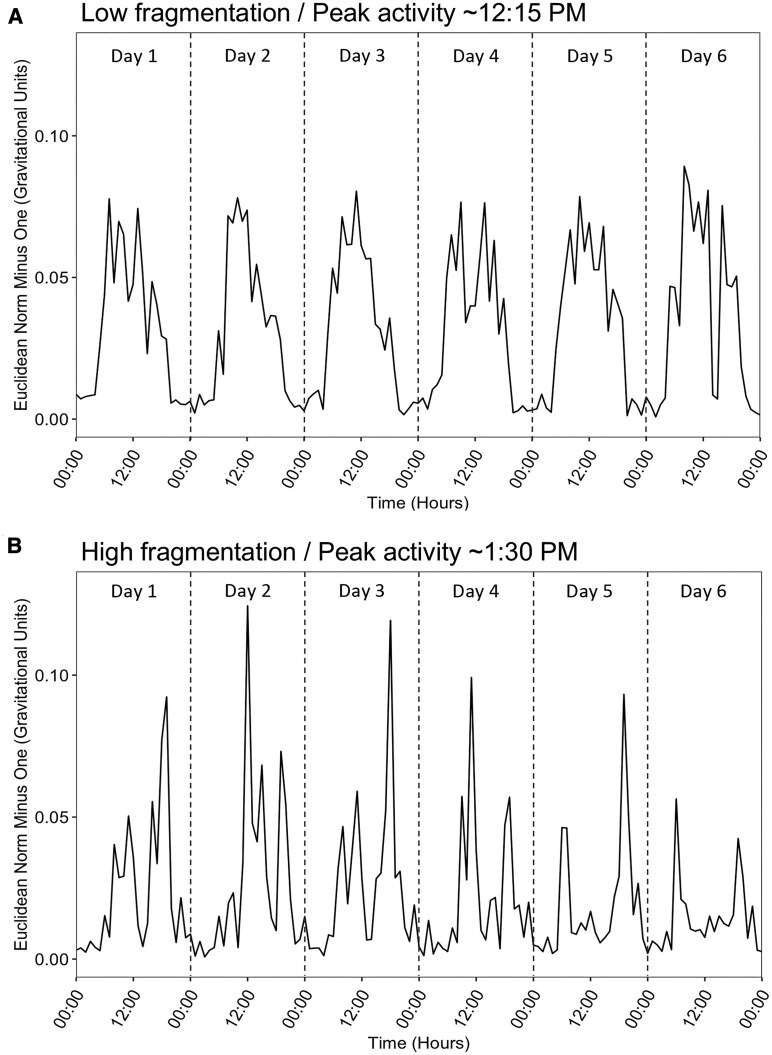
Figure 1 demonstrates representative activity plots over 6 days from the study sample with varying magnitudes of acrotime and IV. Acrotime is demonstrated by the location of the peak of activity along the x-axis. Low IV in Fig. 1A is seen as a consistent sinusoidal rise of activity during daytime and a fall of activity during nighttime. High IV in Fig. 1B is demonstrated by a fragmented circadian sleep–wake cycle void of consistent rhythmicity, with fluctuations between activity and rest throughout each 24-h period. Histogram distributions for acrotime and IV are shown in Supplementary Fig. 1.

() A 63-year-old woman with a low IV of 0.52 and an acrotime of 12.28 (12:17 P.M.). () A 55-year-old man with a high IV of 1.16 and an acrotime of 13.62 (1:37 P.M.). Activity data for 6 days are shown for each participant. IV and acrotime are derived from the 6 days shown. 00:00 = Midnight (12 A.M.). 12:00 = Noon (12 P.M.). Vertical dashed lines separate days. Data were downsampled into averaged hourly measurements with a sampling rate of 1 ENMO (summary measure of dynamic acceleration) per hour. See also. Activity plot examples. A B Supplementary Fig. 1
Age is correlated with circadian timing
Age was negatively correlated with acrotime [r = −0.25, 95% CI: (−0.46, −0.011), P = 0.041, n = 67], suggesting that older age was associated with lower acrotime (earlier average peak activity time). IV and age were not correlated. Acrotime and IV did not differ by sex. Acrotime and IV also did not differ by APOE4 carrier status.
Circadian timing is associated with Aβ burden
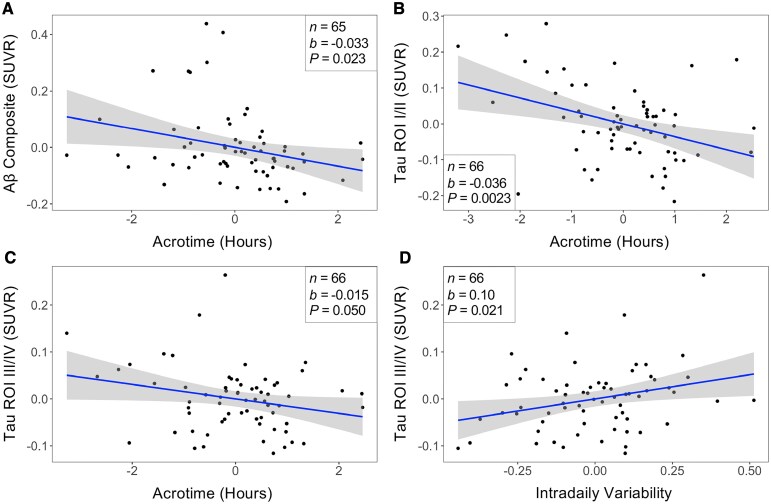
Acrotime was negatively associated with composite Aβ SUVR [b = −0.033, 95% CI: (−0.062, −0.0047), P = 0.023, FDR-adjusted P = 0.046, n = 65, Fig. 2A], indicating that an earlier peak activity time was associated with higher Aβ burden. IV and Aβ were not related.

Added variable plots for the associations between () acrotime and composite Aβ, () acrotime and tau Braak ROIs I/II, () acrotime and tau Braak ROIs III/IV, and () IV and tau Braak ROIs III/IV. Each individual data point represents one participant. Lines represent the estimated change in the outcome for every unit change of the predictor. Shaded regions represent the 95% CI for these estimates. Beta coefficient () and unadjusted-value () obtained from linear regression analysis adjusted for age, sex, andcarrier status. Covariates were regressed out in the added variable plot. Acrotime is not translatable to military time due to regressing out the covariates. For reference, the mean and SD of acrotime are 14.26 (2:16 P.M.) and 1.53 (1 h and 32 min). Circadian rhythms are associated with Aβ and tau burden. A B C D b P P APOE4
carrier status modifies the association between circadian timing and Aβ burden APOE4
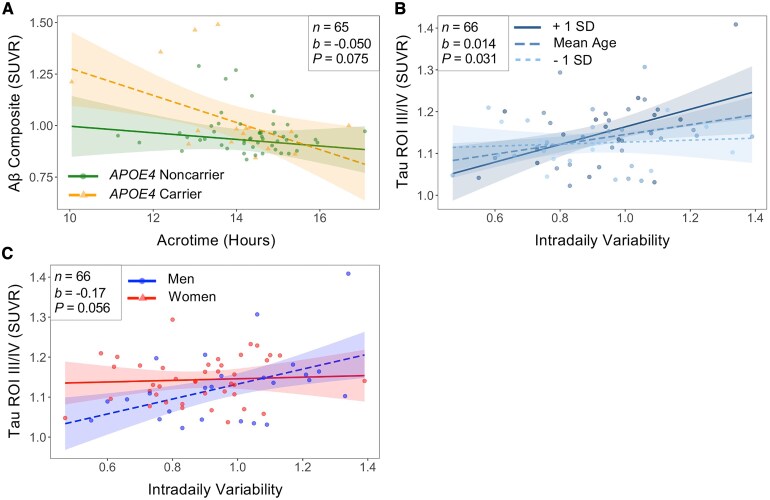
An interaction was observed between acrotime and APOE4 carrier status in the relationship between acrotime and composite Aβ [interaction b = −0.050, 95% CI: (−0.10, 0.0052), P = 0.075, n = 65, Fig. 3A]. When the sample was subsequently stratified by APOE4 carrier status, the b-coefficient between acrotime and composite Aβ had a higher magnitude in APOE4 carriers [b = −0.055, 95% CI: (−0.15, 0.042), P = 0.24, n = 16] compared to non-carriers [b = −0.018, 95% CI: (−0.044, 0.0080), P = 0.17, n = 49], demonstrating that this relationship in the total sample was largely driven by APOE4 carriers.

Interaction plots for the associations between () acrotime and composite Aβ with an interaction term forcarrier status, () IV and tau Braak ROIs III/IV with an interaction term for age, and () IV and tau Braak ROIs III/IV with an interaction term for sex. Each individual data point represents one participant. For categorical interactors shown inand, lines represent the estimated change in the outcome for every unit change of the predictor at specified levels of the categorical interactor (non-carrier versuscarrier; men versus women). For the continuous interactor shown in, the lines represent the estimated change in the outcome for every unit change of the predictor for the mean age, 1 SD above the mean age, and 1 SD below the mean age. Shaded regions represent the 95% CI for these estimates. In interaction models involving composite Aβ, beta coefficient () and-value () obtained from the interaction term between acrotime andcarrier status moderator in linear regression analysis adjusted for age, sex, andcarrier status for a sample size of= 65 (49non-carriers/16carriers). In interaction models involving tau,, andobtained from interaction terms between IV and age or sex moderator in linear regression analysis adjusted for age, sex, andcarrier status for a sample size of= 66 (25 men/41 women). carrier status, age, and sex modify the associations between circadian rhythms and Aβ and tau burden. APOE4 A B C A C B APOE4 APOE4 APOE4 b P P APOE4 APOE4 n APOE4 APOE4 b P APOE4 n
Circadian timing and fragmentation are associated with tau burden
Negative associations were observed between acrotime and tau in Braak ROIs I/II [b = −0.036, 95% CI: (−0.059, −0.013), P = 0.0023, FDR-adjusted P = 0.0090, n = 66, Fig. 2B] and III/IV [b = −0.015, 95% CI: (−0.031, −0.0000015), P = 0.050, FDR-adjusted P = 0.067, n = 66, Fig. 2C]. These results indicate that an earlier peak activity time was associated with higher tau burden. IV was positively associated with tau in Braak ROIs III/IV [b = 0.10, 95% CI: (0.016, 0.19), P = 0.021, FDR-adjusted P = 0.041, n = 66, Fig. 2D], indicating that higher circadian fragmentation was significantly associated with higher tau pathology. IV and tau in Braak ROIs I/II were not associated.
Age and sex modify the association between circadian fragmentation and tau burden in ROIs III/IV
A significant interaction was observed between IV and age in the relationship between IV and tau in Braak ROIs III/IV [interaction b = 0.014, 95% CI: (0.0013, 0.027), P = 0.031, n = 66, Fig. 3B]. These results indicate that the slope estimate of the association between IV and tau in Braak ROIs III/IV was 0.014 higher for each additional year increase in age. An interaction between IV and sex was also observed in the relationship between IV and tau in Braak ROIs III/IV [interaction b = −0.17, 95% CI: (−0.34, 0.0047), P = 0.056, n = 66, Fig. 3C]. When the sample was subsequently stratified by sex, the association between IV and tau in Braak ROIs III/IV persisted in men [b = 0.19, 95% CI: (0.042, 0.34), P = 0.014, n = 25], but not in women [b = 0.020, 95% CI: (−0.083, 0.12), P = 0.69, n = 41].
Circadian timing is associated with verbal memory and attention/processing speed
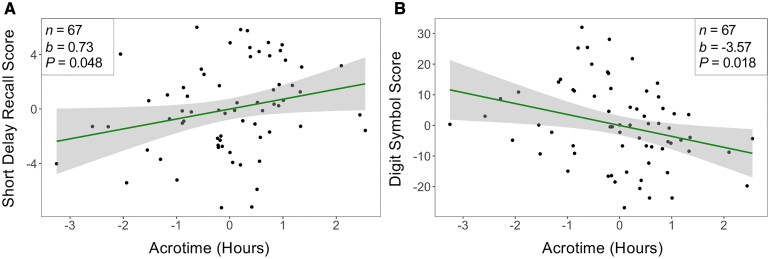
There was a positive association between acrotime and the CVLT short delay free recall total score [b = 0.73, 95% CI: (0.0059, 1.45), P = 0.048, FDR-adjusted P = 0.096, n = 67, Fig. 4A]. Additionally, there was a negative association between acrotime and the WAIS Digit Symbol Substitution score [b = −3.57, 95% CI: (−6.51, −0.64), P = 0.018, FDR-adjusted P = 0.072, n = 67, Fig. 4B]. These results indicate that an earlier peak activity time was associated with worse performance in verbal memory, but a later peak activity time was associated with worse performance in the Digit Symbol Substitution, a measure of attention/processing speed. IV was not associated with the CVLT short delay free recall total score or the WAIS Digit Symbol Substitution score.

Added variable plots for the associations between () acrotime and short delay free recall total score and ()crotime and digit symbol score. Each individual data point represents one participant. Lines represent the estimated change in the outcome for every unit change of the predictor. Shaded regions represent the 95% CI for these estimates. Beta coefficient () and unadjusted-value () obtained from linear regression analysis adjusted for age, sex,carrier status, and years of education. Covariates were regressed out in the added variable plot. Acrotime is not translatable to military time due to regressing out the covariates. For reference, the mean and SD of acrotime are 14.26 (2:16 P.M.) and 1.53 (1 h and 32 min). Circadian timing is associated with verbal memory and attention/processing speed. A B a b P P APOE4
Tau mediates the association between acrotime and short delay verbal memory
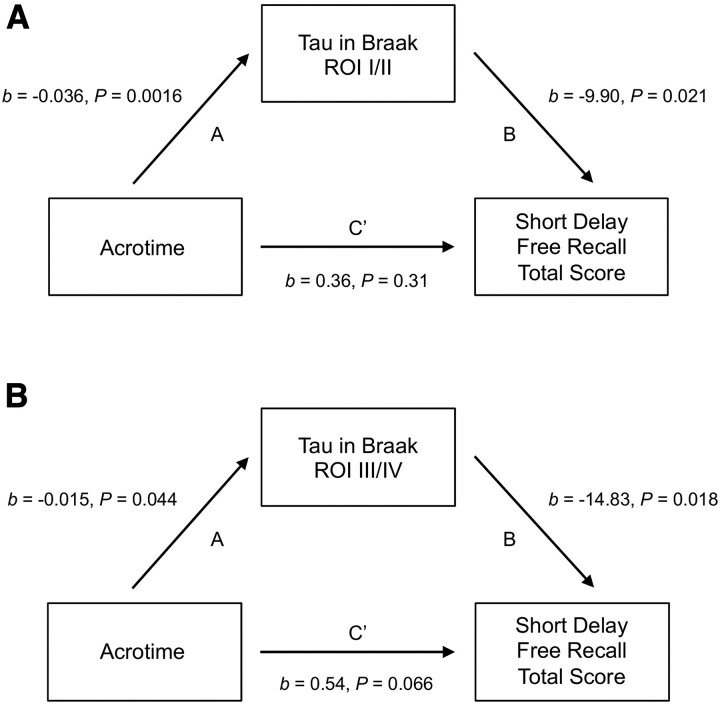
Exploratory mediation analysis (Table 2) identified two mediators in the relationship between acrotime and short delay verbal memory (Fig. 4A). We found statistically significant indirect effects of acrotime on short delay verbal memory via tau in Braak ROIs I/II [Total Indirect Effect (TIE) = 0.36, 95% CI: (0.014, 0.86), P = 0.040, n = 66, Fig. 5A] and III/IV [TIE = 0.23, 95% CI: (0.0064, 0.55), P = 0.044, n = 66, Fig. 5B]. These results indicate that the relationship between acrotime and short delay verbal memory was mediated by tau burden in ROIs I–IV. When the independent variable (acrotime) was swapped with the mediator (tau), acrotime did not exhibit any indirect mediating effects in the associations between tau in Braak ROIs I/II and short delay verbal memory, nor tau in Braak ROIs III/IV and short delay verbal memory.
Tau in Braak ROIs I/II and III/IV was not a mediator in the relationship between acrotime and attention/processing speed. Composite Aβ was not a mediator in the relationship between acrotime and short delay verbal memory, nor between acrotime and attention/processing speed.

Mediation model diagrams for the associations between acrotime and short delay free recall total score mediated by () tau in Braak ROIs I/II and () tau in Braak ROIs III/IV. Beta coefficients () and-values () obtained from mediation analysis. All models were adjusted for age, sex,status, and years of education for a sample size of= 66. Tau mediates the association between acrotime and short delay verbal memory. A B b P P APOE4 n
| Mediations | Estimate | 95% CI | P |
|---|---|---|---|
| Mediator: Tau in Braak ROIs I/II | |||
| Total effect | 0.72 | (0.077, 1.37) | 0.029 |
| Total direct effect | 0.36 | (−0.34, 1.09) | 0.31 |
| TIE | 0.36 | (0.014, 0.86) | 0.04 |
| Proportion mediated | 0.5 | (−0.044, 2.08) | 0.064 |
| Mediator: Tau in Braak ROIs III/IV | |||
| Total effect | 0.76 | (0.11, 1.42) | 0.018 |
| Total direct effect | 0.54 | (−0.032, 1.16) | 0.066 |
| TIE | 0.23 | (0.0064, 0.55) | 0.044 |
| Proportion mediated | 0.3 | (−0.012, 0.99) | 0.054 |
Discussion
This study reports associations between circadian rhythms, Alzheimer's disease pathological biomarkers, and the cognitive domains of verbal memory and attention/processing speed in an older adult population with objective early cognitive impairment. Earlier circadian rhythm timing was associated with higher levels of Aβ, and this relationship was stronger in APOE4 carriers compared with non-carriers. Earlier circadian rhythm timing and higher rhythm fragmentation were associated with higher levels of tau. The relationship between circadian rhythm fragmentation and tau strengthened with age and disproportionately affected men more than women. Earlier circadian rhythm timing was associated with worse verbal memory, whereas later circadian rhythm timing was associated with worse attention and processing speed. The relationship between circadian rhythm timing and verbal memory was mediated by tau levels.
Few studies have investigated circadian rhythms with respect to Aβ and tau neuropathology in early Alzheimer's states, such as preclinical and MCI populations.25,68-70 To our knowledge, this is the first study to investigate the associations between circadian rhythms and pathological hallmarks (Aβ and tau) as well as cognition in older adults with objective early cognitive impairment. Moreover, it is the first to identify an Alzheimer's pathological protein, tau, as a mediator in the relationship between circadian rhythms and cognition.
Circadian rhythms and factors of age, sex, andcarrier status APOE4
The correlation observed between older age and earlier circadian timing is in agreement with existing literature, as circadian phase advances are commonly observed with increasing age.71 The mechanisms underlying this shift are not fully understood, although one genome-wide transcriptomic study identified 1000 genes in the prefrontal cortex that exhibit age-dependent alterations in circadian rhythmicity and phase.72 Although our study did not observe a relationship between age and IV, two studies have reported this link in older adults that included participants aged 45 years and over.25,73 This discrepancy may be due to our more restricted age range of 55–80 years and smaller study sample size. Alternatively, our finding of a correlation between age and acrotime, but not age and IV, may indicate that changes to circadian timing occur earlier in the ageing process, prior to the emergence of changes in circadian fragmentation.
Similar to our findings, a recent 2021 study did not observe sex differences in circadian timing, but interaction analysis revealed that the association between an earlier circadian phase and age was stronger in men, indicating that men may be more prone to age-associated advanced circadian rhythms.74 Their study did, however, identify sex differences in circadian robustness, with men exhibiting higher IV than women. In agreement with our findings, another study did not observe differences between APOE4 carriers and non-carriers in any circadian rhythm measures, including acrophase (analogous to acrotime) and IV.25
Circadian rhythms and Aβ
Our finding that earlier circadian timing was associated with higher Aβ pathology is aligned with a separate study, which found that Aβ+ participants had higher levels of activity in the early morning through late afternoon compared to Aβ− individuals.69 Interestingly, these findings of an association between an advanced circadian phase and higher levels of Alzheimer's pathology contrast with what is seen in patients with Alzheimer's disease and dementia. Patients with Alzheimer's disease typically present with delayed circadian phases, where activity is shifted towards the evening.13,17-19 However, studies in preclinical and MCI populations report mixed outcomes relating to both earlier and later circadian timing in association with MCI and/or risk of developing MCI and dementia.23,28,30,75,76 These variable findings signify that changes in circadian phase in either direction may increase the risk of developing MCI and Alzheimer's disease.
Our observation that IV and composite Aβ were not associated is aligned with a separate study that reported no differences between Aβ+ and Aβ− preclinical older adults using standard sleep parameters, such as IV and acrophase.69 However, they did identify circadian variability differences between Aβ+ and Aβ− individuals that depended on the timing of the day when they used a unique measure of circadian variability calculated with a non-parametric technique called function-on-scalar regression. Another study similarly reported that preclinical older adult participants who were Aβ+ had significantly higher IV than Aβ− participants.25 The discrepancies between our results and these two studies may be due to differences in Aβ quantification, as we did not classify our participants into Aβ+ and Aβ− groups, but rather assessed Aβ SUVR continuously.
Mechanisms
There is strong mechanistic evidence that links circadian rhythms and Aβ in animal studies. A mouse model identified a circadian diurnal variation of interstitial fluid Aβ, where levels were highest during the wake phase and lowest during the sleep phase.77 Chronic sleep restriction of the mice accelerated Aβ plaque burden, whereas enhancing sleep by blocking orexin signalling (a regulator of wakefulness) inhibited Aβ accumulation. A different mouse study demonstrated that the targeted deletion of the circadian core clock gene Bmal1 disrupted Aβ circadian oscillations in hippocampal interstitial fluid, and in turn accelerated the accumulation of Aβ plaques.78 These findings may be due to the clearance of metabolites and waste, including Aβ, that occurs in the brain during sleep.79
Similar findings exist in humans, who have exhibited diurnal oscillations of CSF Aβ, in which Aβ linearly increases throughout a day. These dynamics, however, were attenuated in those with greater Aβ deposition,80 which further supports an association between circadian disruption and Aβ pathology. Although evidence points to circadian dysfunction directly leading to Aβ dysregulation,77-79,81 it is possible that the resulting accumulation of Aβ would contribute to neuronal damage, which would in turn damage brain areas involved in the circadian system and further disrupt natural rhythms in a feed-forward loop.82
The specific mechanism supporting our findings may involve circadian regulation of immune cells that are responsible for Aβ waste clearance. A recent study reported that Aβ42 phagocytosis by macrophages in mice occurred on a daily rhythmic oscillation.81 This oscillation was due to the circadian regulation of cell surface molecules called heparan sulphate proteoglycans, which are molecules important to Aβ42 clearance. Ablating the heparan sulphate proteoglycans from macrophages caused the circadian oscillation of Aβ42 phagocytosis to disappear. This finding implicates the immune response as a central mechanism in the relationship between circadian disruption and Aβ accumulation in Alzheimer's disease. Other proposed mechanisms that may explain circadian control of Aβ include circadian oscillations in neural activity, changes in slow wave sleep, and glymphatic system waste clearance of Aβ.82 These mechanisms may underlie the association we observed between earlier circadian timing and higher Aβ levels.
Interaction withcarrier status APOE4
Little information is available on how circadian rhythms are involved with the APOE gene, but evidence exists that links APOE4 carriers to sleep disruptions compared with non-carriers.50,83,84 Moreover, a mouse study found that deletion of the core clock gene Bmal1 resulted in increased expression of the APOE gene.78 As APOE4 has been shown to promote fibrillar Aβ plaque deposition,85-87 and Aβ deposition is more abundant in APOE4 carriers than in non-carriers,88 increased APOE expression caused by circadian dysregulation could exacerbate Aβ pathology and explain the interaction observed in our study.
Circadian rhythms and tau
The relationship we observed between lower acrotime and higher tau was strongest and remained significant after FDR correction only in the earliest Braak ROIs I/II, where tau pathology begins in the transentorhinal cortex. In contrast to these findings, a separate similar study did not observe a relationship between acrophase and tau,25 possibly due to tau quantification differences, as they utilized the ratio of CSF phosphorylated tau181 to Aβ42 as a marker of Alzheimer's-related neurodegeneration. The association between IV and tau in later Braak ROIs III/IV (limbic) remained significant after FDR correction, indicating that higher circadian fragmentation was significantly associated with higher tau pathological burden. This result aligns with a separate study that also identified a relationship between higher IV and a higher ratio of CSF phosphorylated tau181 to Aβ42.25
An advantage of our study is the use of PET imaging to quantify tau. As neurofibrillary tangles directly correlate with the presence and severity of dementia in Alzheimer's disease,89 tau PET in adults with early cognitive impairment allows the assessment of early pathological changes that may be predictive of future cognitive decline into MCI or Alzheimer's disease. Indeed, tau PET has been shown to predict cognitive decline in individuals who are cognitively normal90,91 and follows a topographic, Braak staging that informs on pathological tau spread across distinct anatomical brain areas, reflecting clinical manifestations. The successive stages of Braak staging are described elsewhere,92 but the stages that were analysed in the present study can be summarized as transentorhinal (I/II) and limbic (III/IV). Our findings reveal that acrotime was most strongly associated with tau in the earliest Braak ROIs I/II, whereas IV was associated with tau only in later Braak ROIs III/IV. Together, these results may suggest that circadian phase advances contribute to tau accumulation in brain areas that are affected in the earliest stages of typical tau progression in Alzheimer's disease, whereas circadian fragmentation contributes to tau accumulation in brain areas that are affected in later stages. As such, circadian phase shifting earlier may be the earliest circadian indicator of tau pathological spreading, and circadian fragmentation may appear later in the disease trajectory. Older adults with an earlier circadian phase may be at risk for tau spread and cognitive decline, and may benefit from circadian therapies to regulate circadian phase.
Mechanisms
Tau phosphorylation in mice has been demonstrated to follow a circadian rhythm that depends on body temperature, with tau being hyperphosphorylated during sleep.93 In a transgenic mouse model of Alzheimer's disease, irregular sleep–wake cycles induced by sleep deprivation resulted in dysfunctional tau metabolism.94 One study identified a mechanistic link between altered circadian function and tau aggravation. Using a tau transgenic mouse model, they found that circadian regulation by the core clock gene Bmal1 modulated the oscillation of a chaperone protein called Hsp70, which plays a crucial role in tau metabolism.95 A different study using a mouse model of Alzheimer's disease demonstrated that melatonin administration reduced expression levels of phosphorylated tau,96 introducing circadian therapy as a viable possibility for the attenuation of Alzheimer's-related tau neuropathology. Evidence supports a bi-directional relationship in which tau accumulation can also damage circadian rhythms. A study found that the Tg4510 mouse model of tauopathy exhibited a longer circadian period, tauopathy in the suprachiasmatic nucleus, and disrupted circadian cyclical expression of core clock genes in the hypothalamus and hippocampus.97 Together, these mouse studies help explain the relationship we observed between circadian timing/fragmentation and tau pathological burden.
Interactions with age and sex
IV has been shown to be associated with older age,25,45,73 and ageing is the most prominent risk factor for Alzheimer's disease, which together may explain the age modification effect we observed in the relationships between IV and tau.
The relationships between IV and tau were largely driven by men. In another study in older adults, participants with low circadian amplitude (lower circadian strength) had an increased risk of developing Alzheimer's, and this association was stronger in men than in women,76 similar to our sex-specific findings. A mechanistic explanation for these sex differences could be discrepancies in hormone production between men and women. Numerous studies have identified reductions in melatonin in Alzheimer's disease,4-10 and melatonin has been shown to efficiently attenuate tau hyperphosphorylation.98 As women exhibit significantly higher melatonin amplitudes than men,99 lower melatonin levels in men may impact circadian rhythms and exacerbate tau neuropathology.
Circadian rhythms and cognition
Across the literature, variable findings between circadian timing and cognition are observed in older adults. Using various actigraphy measures of circadian timing and cognitive assessments, studies report that both circadian rhythm phase advances24,75 and delays26,70,100 are associated with worse performance across numerous cognitive domains. Evidently, changes in circadian phase in either direction away from normal are related to different aspects of poorer cognitive performance, similar to how both phase advances and delays are seen in MCI and Alzheimer's disease. Circadian advances and delays may differentially impact Alzheimer's pathological processes and, in turn, affect separate cognitive domains.
Although our study did not observe a relationship between IV and cognition, other studies have found that a number of circadian measures quantifying lower rhythm robustness were associated with worse cognition in preclinical and MCI older adult populations.24,27-29,101 As our study's participants were experiencing very early cognitive changes, our observation of a link between circadian timing and cognition, but not between circadian fragmentation and cognition, may further support the idea that a change in timing is the earliest circadian indicator of Alzheimer's disease pathological progression and a predictor of future cognitive decline.
Mediations
The relationship between acrotime and short delay verbal memory was mediated by tau pathological burden in Braak ROIs I–IV. This study is, to our knowledge, the first to identify a mechanistic mediation between circadian rhythms, a pathological hallmark of Alzheimer's disease (tau), and cognition. A related study identified a metabolic link, showing that cerebral glucose metabolism mediated the relationship between acrotime and global cognition using the Mini-Mental State Examination.70
Mechanisms
The relationships observed between acrotime and cognition are likely mediated by underlying molecular and cellular pathological processes that contribute to neuronal degeneration in the brain, which eventually leads to cognitive impairment. Our work identified tau accumulation in the transentorhinal and limbic cortices as two such mediators. Several papers provide mechanistic explanations for circadian regulation of tau metabolism and aggregation,93-96 which could in turn exacerbate neurodegeneration and eventually lead to cognitive decline. As circadian rhythms exert oscillatory control over a significant number of processes in all organs and tissues throughout the body, there are likely numerous other mediators through which circadian dysfunction leads to reduced cognition. Hypothesized mechanisms include Aβ aggregation and metabolism, cholinergic disturbances, loss of retinal ganglion cells, melatonin loss, neuronal homeostasis, oxidative stress, inflammatory processes, vascular dysfunction, metabolic dysfunction, and glymphatic clearance.102-105
Limitations
The relatively modest sample size of this study produced marginally significant interaction findings and associations between circadian rhythms and cognition. As such, these findings are exploratory and hypothesis-generating, providing information on the directionality of trends that should guide future research in larger older adult cohorts. The majority of our study sample consisted of self-reported White, highly educated individuals, which limits generalizability to other populations. The small number of APOE4 carriers (n = 18) further limits the interpretation of findings involving APOE4 carrier status. Moreover, our study used cross-sectional data, limiting interpretations of longitudinal change and causality. Although this work focuses on circadian rhythms as the predictor, we cannot exclude the possibility that Aβ and tau pathological processes damage brain areas involved in circadian regulation, which would also explain our findings. However, as our mediation analyses did not identify indirect effects when the independent variables and mediators were swapped, our findings suggest that circadian rhythms are at the forefront of these relationships and Alzheimer's disease-related pathological progression. This interpretation is supported by substantial evidence in animal models that circadian rhythms regulate Aβ77,78,81 and tau,93-96 further supporting the view that circadian dysfunction is an early indicator and potential contributor to neuropathology, rather than a consequence.
Future directions
In order to determine the cause-and-effect relationship between circadian rhythms and Alzheimer's biomarkers, future longitudinal studies should confirm our findings in a larger cohort of preclinical older adults prior to the onset of neuropathology. This work would evaluate whether circadian dysfunction precedes Aβ and tau buildup, as well as cognitive decline. Moreover, studies should assess other possible mediators of the relationships between circadian rhythms and cognition. Randomized controlled trials should utilize circadian-based interventions (timed melatonin administration, bright light therapy, physical therapy, proper sleep hygiene, regulation of feeding, and exercise schedule) in patients with objective early cognitive impairment or other Alzheimer's risk factors to assess the potential of circadian therapy in attenuating Alzheimer's-related outcomes.
Conclusion
This study revealed that circadian rhythm timing and fragmentation were associated with Aβ, tau, and cognition in older adults with early cognitive impairment. As one of the only studies investigating these relationships in this population, we provide evidence for tau as a biological mediator in the relationship between circadian timing and cognition. Older adults with variable circadian phases and more fragmented rhythms may be at higher risk for developing Alzheimer's pathological hallmarks and cognitive impairment. This risk appears to increase with age and disproportionately affect men and APOE4 carriers. This study identified circadian rhythms as potential modifiable risk factors that could be targeted with circadian-based therapies to attenuate pathological progression of Aβ and tau in the brain, and in turn prevent or slow the transition into MCI and dementia for at-risk older adults.
 Circadian Biology