
What this is
- This research focuses on engineering the K using to enhance its diagnostic capabilities.
- The engineered phage K:: can detect viable Staphylococcus aureus cells, including antibiotic-resistant strains.
- This study demonstrates a novel method for modifying large phage genomes, which has implications for phage therapy and diagnostics.
Essence
- The study presents a -based engineering platform for the K, enabling the creation of a bioluminescent reporter phage (K::) that can detect viable Staphylococcus aureus cells in complex biological matrices.
Key takeaways
- The engineered phage K:: successfully identified 100% of tested clinical isolates of Staphylococcus aureus, regardless of their antibiotic resistance profiles, demonstrating its potential as a diagnostic tool.
- K:: showed effective detection capabilities in complex matrices such as human whole blood and bovine raw milk, with detection limits of 2,151 CFU/mL for PSK and 136 CFU/mL for LI6 in blood.
- This engineering approach opens avenues for developing therapeutic phages to combat drug-resistant strains, addressing the growing challenge of antimicrobial resistance.
Caveats
- The engineering method is currently limited to phages that can infect restriction-deficient strains, which may restrict broader applications.
- Detection kinetics in complex biological environments like blood may differ from laboratory conditions, necessitating tailored assays for specific applications.
Definitions
- bacteriophage: A virus that infects and replicates within bacteria, potentially used for therapeutic purposes.
- CRISPR-Cas9: A genome editing technology that allows for precise modifications of DNA sequences.
- bioluminescence: The production and emission of light by living organisms, used here as a signal for detecting bacterial cells.
Simplified
INTRODUCTION
The prevalence of multi-drug-resistant (MDR) pathogens among the human population has been steadily increasing in recent decades (1–4). The WHO speculates that deaths associated with these MDR organisms might even surpass cancer-related fatalities by 2050 (5). While small-molecule antibiotics have been pivotal in treating widespread diseases, their easy accessibility, over-prescription, and extensive use in medical and agricultural fields have fueled the emergence of resistant strains (1, 6, 7). Bacteriophages and phage-encoded proteins such as endolysins (enzymes that degrade the bacterial cell wall) present promising alternatives to conventional antibiotic treatment. They are being postulated as a significant force in combating the antibiotic resistance crisis in the coming years (8, 9).
Past case reports demonstrated the successful application of phages to treat MDR infections (10, 11). Rapid advances in synthetic biology and genetic engineering have allowed for the design, development, and application of genetically altered phage variants with enhanced clinical potential. Furthermore, novel methods for genetically modifying phages to achieve enhanced functionality are constantly being developed. These innovations in phage therapy are evidenced by recent studies and technological advancements, which are summarized in references 12–15.
Through the strategic selection and engineering of the phage backbone, we can fine-tune crucial characteristics, such as host specificity, to cater to specific clinical applications. These methods have been employed to transition phages to entirely new hosts (16–19), modify the infection cycle for clinical suitability (20), and deliver antimicrobial payload genes directly to the infection site (21). The field of synthetic biology-based engineering is also expanding, and it now encompasses a variety of sophisticated DNA manipulation techniques. These include the isothermal Gibson assembly (22), yeast-based recombineering (23), and whole-genome synthesis, all of which can be utilized for phage genome modification.
Staphylococcus aureus, a prevalent opportunistic pathogen, colonizes up to 50% of humans and can result in severe diseases such as pneumonia, respiratory, surgical, and cardiovascular infections, as well as nosocomial bacteremia (24). Bacteremia alone has an estimated annual incidence of up to 50 cases per 100,000, with 10–30% of these patients died as a direct result of the infection (25). Furthermore, resistance emergence in S. aureus isolates against a number of different antibiotics has been reported. Methicillin-resistant S. aureus (MRSA) and vancomycin-resistant S. aureus (VRSA) are two of the variants of greatest concern. According to the CDC's 2019 report, there were more than 323,700 cases of MRSA and 10,600 attributed deaths in 2017 in the United States alone, although the incidence has been decreasing over the years (26).
Bacteriophages from the Twortvirinae subfamily, like the model phage K and its close relatives, are ideal candidates for phage therapy. They have a strictly lytic life cycle and a broad host range across Staphylococci (27). Staphylococcus bacteriophage genomes can be intentionally activated for engineering purposes through a couple of methods: transformation of L-form bacteria (28, 29) or using non-electroporation Staphylococcus transformation (30). These techniques enable the engineering of smaller phage genomes. However, like all synthetic methods, engineering becomes challenging when dealing with larger phage genomes that require assembly from numerous long DNA fragments. In addition, the transformation of S. aureus hosts is notoriously inefficient due to restriction-modification barriers, which prevent genome rebooting in more tractable heterologous systems such as Escherichia coli. Taken together, these factors currently preclude the use of synthetic biology-based strategies—such as whole-genome synthesis or yeast-based phage assembly—for large S. aureus phages. We therefore chose a homologous recombination (HR)-based approach, which has been successfully used for engineering larger phage genomes (19, 31–36), and included a downstream CRISPR-Cas-assisted counterselection (CS) step, which allowed us to rapidly obtain recombinant phages. Our goal was to adapt and validate this established approach for the first time in a strictly lytic S. aureus phage belonging to the Twortvirinae subfamily.
To demonstrate the functionality and applicability of this approach, we engineered a phage K-based reporter phage that enables the detection of viable S. aureus cells. Reporter phages are engineered to carry a heterologous reporter gene, such as a luciferase, which is expressed during infection. The expression of this gene generates a detectable signal, indicating the presence of viable host cells (37–39). Reporter phages offer significant advantages for bacterial detection, combining the speed and simplicity of PCR-based methods with the ability to detect viable cells. This contrasts with traditional culture-based methods, which, while reliable for detecting viable cells, are time-consuming and often require several days to yield results (40, 41).
Prior research has demonstrated the successful engineering of strictly lytic, S. aureus-infecting reporter bacteriophages through the use of HR (42). Notably, this work resulted in the positive identification of 97.7% of 390 clinical MRSA isolates at low bacterial concentrations. Recognizing the potential difficulties in the engineering process, our study aimed to devise a strategy that enables the generation of recombinant phages, even those that cannot be isolated through dilution enrichment due to the absence of a detectable reporter protein. This approach is particularly useful for systems characterized by low recombination rates, where traditional methods may prove labor-intensive and time-consuming. To address this, our engineering pipeline incorporates a CRISPR-Cas-based CS system, facilitating the isolation of recombinant phages following HR. The efficacy of this approach has been validated by its successful application in other phage-host systems (21, 43, 44, 44–50).
Our engineered reporter phage K::nluc was subjected to a comprehensive evaluation involving a diverse panel of 71 S. aureus strains, including clinical isolates with varying degrees of vancomycin resistance. Intriguingly, through the use of bioluminescence detection following treatment with K::nluc, our approach allowed for the identification of strains that displayed no signs of productive infection when analyzed using conventional plaque assays. Furthermore, we demonstrated the functionality of K::nluc in complex matrices, such as bovine raw milk and human whole blood. These findings underscore the potential of K::nluc for the rapid detection of S. aureus strains and suggest promising avenues for future research in diagnostic settings.
RESULTS
CRISPR-Cas9-assisted engineering ofreporter phage K Staphylococcus
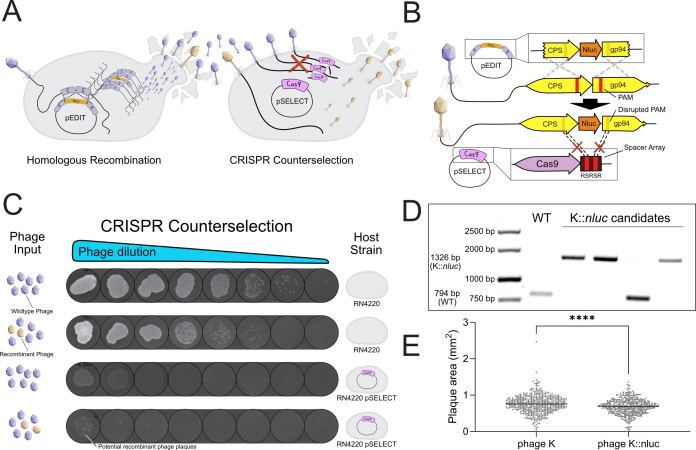
We established a two-step protocol that includes HR and subsequent CS, as illustrated in Fig. 1A. In order to circumvent the pervasive restriction barriers often found in many S. aureus isolates, we opted to use S. aureus RN4220. This laboratory strain, obtained through extensive chemical mutagenesis of strain 8325-4, has had its resident prophages and restriction-modification systems removed. This modification allows for the transformation of RN4220 with E. coli-derived plasmid DNA (51).
Phage K, characterized by its broad host range, was selected as our engineering scaffold. Its host range primarily includes S. aureus and extends to other Staphylococcus species (52), making it a versatile candidate for both diagnostic and therapeutic purposes. This potential is evidenced by successful applications of Twortvirinae phages in therapeutic contexts, which have demonstrated their efficacy against a variety of clinically relevant bacterial strains (53–60).
As a proof of concept for our engineering pipeline, we constructed a bioluminescent reporter phage, K::nluc, by inserting the nanoluciferase (nluc) gene into the genome of phage K. Utilizing existing data on genome structure and transcriptomic profiles, we identified a region associated with the major capsid protein (cps) as a favorable locus for payload insertion. This region has been shown to be highly expressed in phage K (61) and has also served as a common integration site for payload insertions in other phages (21, 31, 42). To mediate expression from a strong, endogenous promoter, we integrated nluc—along with a ribosomal binding site—immediately downstream of the cps coding sequence. Nanoluciferase (NLuc), a bioluminescent luciferase derived from Oplophorus gracilirostris (NanoLuc, Promega), has been used successfully in prior phage engineering studies and enables sensitive detection due to its small size (516 bp) and strong luminescent output (42, 62).
The first step of the pipeline involves propagating phage K in the presence of the homology donor plasmid (pEDITnluc). This plasmid carries the payload gene, along with up- and downstream flanking homology arms, which guide the sequence-specific integration of the payload.
The lysate of phage K, produced on RN4220 pEDITnluc, comprises a heterogeneous population, predominantly of wild-type phages, interspersed with a minority of recombinants. This mixed lysate was subsequently propagated on another RN4220 host, one equipped with a CS plasmid (pSELECTCPS). This plasmid encodes an episomal CRISPR-Cas system, serving as the principal mechanism of selection to isolate the desired recombinant phages.
The pSELECTCPS plasmid encodes the S. pyogenes cas9 gene, along with tracrRNA and crRNA elements. The crRNA element carries a repeat-spacer1-repeat-spacer2-repeat (RS1RS2R) sequence, with each spacer targeting one homology arm flanking the nluc integration site. We designed the protospacer-adjacent motifs (PAMs) in the editing template (pEDITnluc) to contain silent PAM mutations. This design enables K::nluc replication in the presence of pSELECTCPS (Fig. 1B). Infection of RN4220 pSELECTCPS with wild-type phage K resulted in complete phage restriction (Fig. 1C). When the same host strain was infected with a lysate containing a mixed population of recombinant and wild-type phages following HR, escape mutants were obtained at a frequency of approximately 10−4 (Fig. 1C). We then performed PCR amplification of the insertion site and found that three out of four plaques we picked yielded PCR products of the expected size (1,326 bp, Fig. 1D), indicating successful payload integration. Further confirmation was obtained through Sanger sequencing of the PCR products with the correct band size, which revealed a correct insertion of the payload at the intended locus.

Construction of reporter phage K::using a homologous recombination-based and CRISPR-Cas9-assisted phage engineering platform. () We employ two.bacterial host strains in our process. The first is the recombination donor, RN4220 pEDIT(RN4220 transformed with the HR donor plasmid pEDIT), and the second is the counterselection strain, RN4220 pSELECT. By sequentially infecting these host strains, we can generate (homologous recombination) and enrich (counterselection) the engineered phage. () The design of pEDITand pSELECTfacilitates selective amplification of phage particles that have undergone homologous recombination. This is made possible through two synonymous, single-nucleotide polymorphisms in the protospacer adjacent motifs (PAMs) of the donor template. The Cas9-mediated restriction of wild-type phage DNA is guided by two spacer sequences on pSELECT, flanked by repeat regions (RS1RS2R), which target each homology arm on the target phage genome. () The efficiency of the CRISPR-Cas9 counterselection system is demonstrated. Wild-type lysate or recombination lysate was serially diluted and spotted on wild-type RN4220 (top two rows) or on the counterselection strain (bottom two rows). While wild-type phages were completely restricted (row three, limit of detection: 100 PFU/mL), visible plaques at the lowest dilutions in row four indicate the presence of phage variants that have escaped CRISPR-Cas9 restriction. () Individual plaques were selected, and the presence of an insertion of the intended size was validated using PCR. Positive PCR products were then Sanger sequenced to determine the correct genotype at the insertion site. () Quantitative analysis of plaque sizes for phage K and K::onPSK. Plaques were analyzed from scanned assay plates using ImageJ. A small but statistically significant reduction in plaque area was observed for K::compared to wild-type phage K (Δ = −0.06985 mm;= 489 and 448 plaques, respectively; unpaired-test,< 0.0001). nluc S aureus nluc S. aureus nluc n t P A B C D E nluc nluc CPS nluc CPS CPS 2
Characterization of K::infectivity and bioluminescence kinetics across clinically relevantstrains nluc S. aureus
To assess whether reporter integration affected plaque morphology, we quantitatively compared plaque sizes of K::nluc and wild-type phage K on PSK using ImageJ-based analysis of plaque assay plates. This revealed a small but statistically significant reduction in plaque diameter for K::nluc (Fig. 1E). We then proceeded to assess the infectivity of K::nluc across a diverse set of 71 different S. aureus strains using efficiency of plaquing (EOP) assays (Fig. S1). This set included the phage propagation host PSK, common laboratory strains, and clinical isolates with varying degrees of vancomycin resistance. Out of 71 strains tested, 51 showed plaque formation (limit of detection: 100 PFU/mL) when treated with K::nluc, indicating successful infection by the phage. This assessment is crucial as it provides insight into the potential range of application for K::nluc in detecting different S. aureus strains.
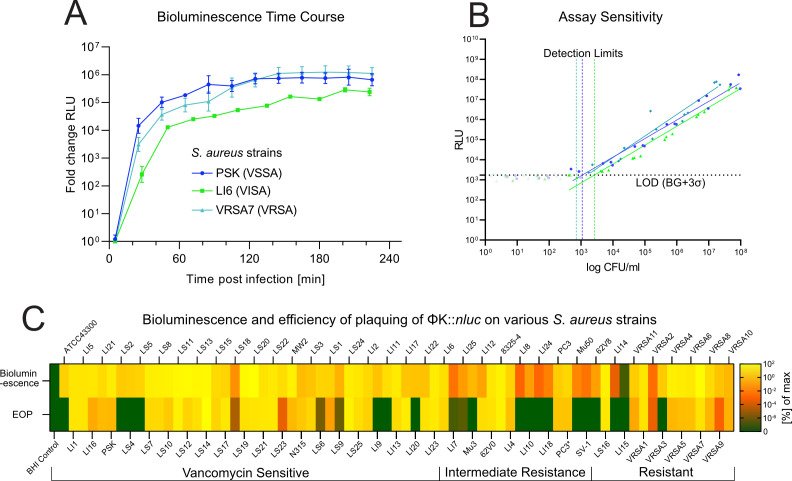
Next, we established the minimum inhibitory concentration (MIC) of vancomycin for all strains, utilizing the cutoffs as defined by reference 63: vancomycin-susceptible (VSSA) strains exhibited an MIC ≤ 2 µg mL−1, vancomycin intermediate-resistant (VISA) strains showed an MIC between 4 and 8 µg mL−1, and vancomycin-resistant (VRSA) strains had an MIC ≥ 16 µg mL−1 (Fig. S2). We selected one phage K-susceptible isolate from each category (PSK [VSSA], LI6 [VISA], and VRSA7 [VRSA]), and investigated the kinetics of phage K::nluc-induced bioluminescence emission.
In all three K::nluc infections (PSK, LI6, and VRSA7), we observed similar signal intensities and kinetics of bioluminescence generation. There was a swift and consistent increase until it reached a plateau, with a peak fold-change of approximately 1 × 10⁶ relative light units (RLU) above the background luminescence, achieved roughly after 3 h (Fig. 2A).
To further assess the sensitivity of our reporter phage system, we examined the minimum dose response of bioluminescence emitted by PSK, LI6, and VRSA7 upon infection with a fixed concentration of K::nluc (5 × 10⁷ PFU/mL) (Fig. 2B). Although the minimum dose response of LI6 (2,617 CFU/mL) was higher than that of PSK (1,093 CFU/mL) and VRSA7 (707 CFU/mL), all values fall within the same order of magnitude. These results are in line with detection thresholds reported for other reporter phage systems (42, 62, 64).
Subsequently, we quantified the range of bioluminescence detection of K::nluc across all 71 S. aureus strains and compared it with the previously determined EOP (Fig. 2C). We successfully detected bioluminescence above background levels in all tested strains (71/71), encompassing even those 20 strains that had previously exhibited no evident plaque formation. To further assess the specificity of K::nluc, we also tested its activity against 17 non-Staphylococcus species and observed no bioluminescent signal indicative of active infection (Fig. S4).

() Bioluminescence time course measurements forstrains PSK, LI6, and VRSA7. Fold-change in relative light units (RLU) was calculated by subtracting background luminescence (K::in BHI alone) and normalizing to the signal from wild-type phage K infection of the same strain. Experiments were performed at a bacterial density of OD= 0.01 and a phage titer of 5 × 10PFU/mL. Data represent the mean ± standard deviation of biological replicates (= 3). () Minimal dose response of PSK, LI6, and VRSA7 to K::was determined by measuring the RLU after 3 h of infection for varying bacterial concentrations. The detection limits (vertical dotted lines) were calculated as the minimum cell number required to produce a signal that is higher than three standard deviations () above the background luminescence (horizontal dotted lines). Measurements below this cutoff were excluded from linear regression. () Bioluminescence and efficiency of plaquing (EOP) for 71.isolates. Bioluminescence for each strain is represented as the mean measured bioluminescence 3 h post-infection (= 3). Values were background-corrected by subtracting luminescence from K::in BHI alone. EOP is given by the mean number of plaque-forming units (PFU) after infection of a specific strain with K::(three to six replicates per strain). Values are normalized to the host with the highest measurement (LS20 for bioluminescence, LS14 for EOP). A B C S. aureus nluc n nluc S aureus n nluc nluc 600 7 σ
K::detection of VSSA, VRSA, and VISA in human whole blood and bovine raw milk nluc
Staphylococcus bacteremia accounts for a significant proportion of bloodstream infections (65, 66). Considering the complexity of blood as a biological matrix compared to standard laboratory culture conditions, we tested our reporter phage's functionality in whole human blood. It is essential to evaluate this, as the in vitro infection kinetics of K::nluc with pathogenic bacterial strains might differ in more complex biological settings (67–69). We optimized the assay conditions using whole human blood spiked with the PSK strain, as depicted in Fig. S3. The most rapid and robust signal response was achieved under the following conditions: the spiked blood was diluted fivefold in growth medium, and the cells were incubated at 37°C for 1 h to stimulate host cell metabolism before reporter phage infection. We observed higher bioluminescent signals when using a citrate-based anticoagulant (Na3-citrate, citric acid, glucose, and potassium sorbate) compared to Li-Heparin, both of which are common storage solutions in clinical practice.
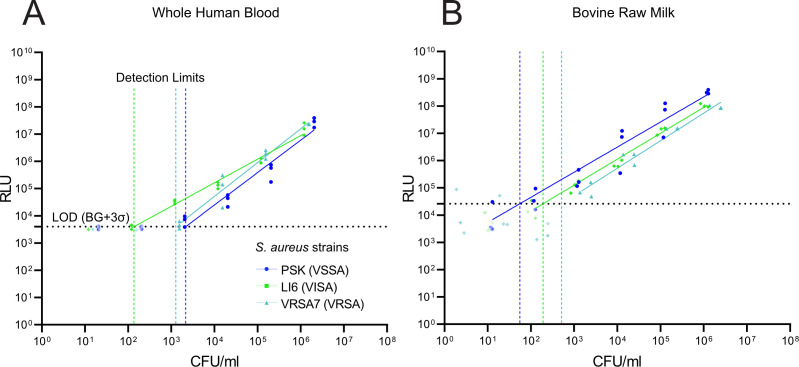
Leveraging these optimized conditions, we determined the detection limits using the previously selected S. aureus strains PSK, LI6, and VRSA7 (Fig. 3A). These strains were detectable at concentrations as low as 2,151 CFU/mL (PSK), 136 CFU/mL (LI6), and 1,270 CFU/mL (VRSA7). While there are minor differences in the detection thresholds across media, these values remain within 1 order of magnitude of those obtained in growth medium (Fig. 2B) and demonstrate robust detection in a clinically relevant matrix.
Bovine raw milk, another complex matrix, has also been reported to negatively impact bacteriophage proliferation (70–72). To investigate this, we conducted a similar experiment, replacing blood with unpasteurized, raw bovine milk. Contrary to expectations, treating bovine raw milk infected with S. aureus strains PSK, LI6, and VRSA7 with K::nluc resulted in bioluminescence detectable at minimal dose responses of 55 CFU/mL (PSK), 191 CFU/mL (LI6), and 514 CFU/mL (VRSA7). These results indicate that our assay performs reliably even in a matrix previously shown to inhibit phage activity, suggesting that the optimized protocol is robust to environmental complexity.
![Detection of vancomycin-resistantin whole human blood and bovine raw milk. Minimal dose response of PSK, LI6, and VRSA7 to K::in whole human blood () and bovine raw milk () was determined by measuring the RLU after 3 h of infection for varying bacterial concentrations. Values below the determined limit of detection, set at 3 standard deviations of the mean background luminescence, were excluded. The detection limits (vertical dotted lines) were calculated as the minimum cell number required to produce a reliable signal (3 standard deviations []) above the mean background luminescence (horizontal dotted line). S. aureus nluc A B σ](https://europepmc.org/articles/PMC12442396/bin/aem.02014-24.f003.jpg "Click to view full size")
Detection of vancomycin-resistantin whole human blood and bovine raw milk. Minimal dose response of PSK, LI6, and VRSA7 to K::in whole human blood () and bovine raw milk () was determined by measuring the RLU after 3 h of infection for varying bacterial concentrations. Values below the determined limit of detection, set at 3 standard deviations of the mean background luminescence, were excluded. The detection limits (vertical dotted lines) were calculated as the minimum cell number required to produce a reliable signal (3 standard deviations []) above the mean background luminescence (horizontal dotted line). S. aureus nluc A B σ
DISCUSSION
In the face of rising antimicrobial resistance, bacteriophage therapy has garnered increasing attention as a potential alternative to traditional antibiotics (73). The engineering of bacteriophages has opened up new possibilities for diagnostic applications and enhancing clinical efficacy (12, 37). While there are numerous examples of engineered bacteriophages, the engineering of large, strictly lytic, S. aureus-infecting bacteriophages has been less explored. A previous study has successfully incorporated nluc into two S. aureus-infecting phages, ISP and MP115 (42). ISP and MP115 have been utilized in applications such as phage therapy and Food and Drug Administration (FDA)-approved KeyPath MRSA/methicillin-susceptible S. aureus assays, respectively (42, 74, 75). Our study made use of phage K, a member of the Kayvirus subfamily within the Twortvirinae, which is recognized for its well-characterized biology, including a transcriptional landscape analysis (61, 76). We developed a CRISPR-Cas-assisted engineering system for the rapid and reliable generation of genetically altered variants of phage K. As proof of concept, we utilized this pipeline to engineer a phage K mutant containing a bioluminescent nluc reporter gene, K::nluc.
Given the transformation barriers encountered with clinical S. aureus isolates, our current pipeline is constrained to phages capable of infecting restriction-deficient Staphylococcus strains. To engineer other phages, a host compatible with the transformation of pEDIT and pSELECT vectors is necessary. For bacteriophages that do not infect RN4220, our approach would necessitate finding a suitable, transformable host, potentially requiring additional steps to remove restriction-modification systems and resident prophages, akin to the modifications made to RN4220 (51, 77). An alternative approach is the cloning in dcm-E. coli strains that carry artificial modification systems (78). By acknowledging these challenges and implementing effective workarounds, we hope to broaden the applicability of our engineering strategy in the future.
Our engineering workflow was validated through the construction of K::nluc, a reporter gene-coding phage K variant for viable S. aureus detection. The bioluminescent nanoluciferase, NanoLuc, has been utilized in prior reporter phage development studies (42, 62, 79–81). Unlike antimicrobial payloads that disrupt key metabolic pathways and alter bacterium-phage dynamics, intracellular expression of NanoLuc is less likely to impose significant fitness costs on the phage or host bacterium. Thus, using nluc as a payload offered a simple benchmark for our engineering pipeline that was unlikely to affect the fitness of phage K. Given its large genome size (148 kb) and terminal redundancy, phage K tolerates the integration of the relatively small (516 bp) nluc payload without inducing genome packaging defects. We postulate that the integration of even larger payloads could be feasible, expanding the scope of potential applications, although a systematic analysis of such scenarios was not conducted in our study.
In standard spot-on-lawn infection screens, 20 out of 71 bacterial strains did not exhibit plaque formation of K::nluc, yet bioluminescence was detected in all strains. This observation suggests that phage binding, DNA delivery, and gene expression are still occurring, even in the absence of visible plaque formation. In such scenarios, it is likely that the infection cycle is interrupted—possibly by the cell undergoing abortive infection—before the completion of lysis and the release of progeny phage particles. For diagnostic applications, this implies that partially phage-resistant strains can be detected successfully as well, albeit with somewhat reduced sensitivity. At the same time, our data demonstrate that a single Kayvirus scaffold could be used to deliver therapeutic effector genes to most S. aureus isolates. The observed reduction in plaque size suggests a minor fitness cost associated with the insertion of the nluc reporter, which did, however, not affect the suitability of the reporter phage as a diagnostic tool.
The composition of blood can influence phage infection kinetics. At the same time, bacteriophages may be inactivated by innate or adaptive immune responses (67–69). Given these factors, it is imperative to acknowledge that the in vitro infection kinetics observed may not directly correlate to more complex biological environments. Thus, each reporter phage assay needs to be tailored to the specific matrix or application where a diagnostic need is identified. Within the scope of S. aureus, our focus is on bacteremia and bovine mastitis, representing pertinent diseases in humans and animals, respectively. For phage K, it has been previously demonstrated that the presence of whey proteins in bovine raw milk can competitively inhibit the phage's attachment to the cell surface, consequently significantly diminishing infection efficiency (70, 72). Notably, in our experiments, there was no difference in observed detection limits. This may be attributed to matrix dilution, to the added 1 h activation step, or potentially to a low baseline concentration of whey proteins present in our milk sample.
While the potential of engineered bacteriophages in the treatment and diagnostics of S. aureus infections is well-acknowledged, their immediate implementation is hampered by several challenges. For instance, the swift progression of severe symptoms in cases of bacteremia, leading to sepsis, often mandates immediate intervention with broad-spectrum antibiotics, without preliminary identification of the causative pathogen. Nonetheless, the growing inclination toward patient-specific treatments and precision medicine is paving the way for the application of engineered phages. Specifically, our pipeline could facilitate the engineering of S. aureus phages to express antimicrobial effector genes, presenting a promising avenue for the future treatment of chronic infections such as wounds, pulmonary conditions, and implant infections, or as a last resort for bacteremia treatment when antibiotics are ineffective. In addition to therapeutic applications, engineered reporter phages such as K::nluc may also support diagnostic workflows. Given their ability to rapidly quantify viable bacterial cells, the use of K::nluc for antibiotic susceptibility testing (AST) represents an interesting avenue for future research, as has been demonstrated for Klebsiella pneumoniae (82).
Additionally, the broad infectivity of K::nluc provides significant advantages by enabling the detection of a wide range of strains. However, it also brings forth challenges that need thoughtful consideration, particularly the risk of false positive detections of other Staphylococcus species. Staphylococcus epidermidis, commonly found in human skin microbiota (83), serves as a prime example. Several strains of S. epidermidis have shown susceptibility to phage K infection, underscoring the importance of careful interpretation of detection results across diverse biological samples (52).
Finally, while the interaction of bacteriophages with dormant bacterial cells is complex and not fully understood, the potential for reporter phages to interact with such cells presents an intriguing area for future investigation. For E. coli and P. aeruginosa, there are instances where phages have been observed to adsorb to dormant hosts and deliver their genome, albeit subsequently entering a state of hibernation or pseudolysogeny, respectively (84, 85). Recent studies have also reported the phage infection and lysis of P. aeruginosa dormant persister cells (86). Therefore, future studies could explore the potential of K::nluc to interact with and potentially detect dormant S. aureus cells, contributing to a more comprehensive understanding of bacteriophage-host dynamics.
In summary, our study presents a novel and validated engineering pipeline for the generation of genetically altered phage K variants, offering promising avenues for S. aureus detection and treatment. While challenges remain in translating these findings to complex biological settings, the insights gained here lay the groundwork for further exploration and optimization, potentially contributing to the growing arsenal of tools in the fight against antimicrobial resistance.
MATERIALS AND METHODS
Vancomycin MIC of selectedstrains S. aureus
The MIC of the 71 S. aureus strains used in this study was determined under the standard culture conditions as outlined in reference 63. Briefly, 96-well plates were prepared, each well containing 250 µL of Miller-Hinton broth supplemented with a range of vancomycin concentrations (from 0.0625 to 64 µg/mL, with a twofold increase between subsequent concentrations). Each well was inoculated with 2 µL of 1:1,000 diluted bacterial cultures (grown overnight at 37°C) for each of the 71 strains. After an incubation period of 18 h at 37°C, turbidity was measured photometrically (OD600). Wells with an OD600 > 0.1 were considered turbid. The strains were then classified as VSSA (MIC ≤ 2 µg/mL), VISA (MIC = 4 to 8 µg/mL), or VRSA (MIC ≥ 16 µg/mL) based on the MIC values.
Bacterial strains and culture conditions
S. aureus PSK (ATCC 19685) was used as propagation and S. aureus RN4220 (DSM 26309) as the engineering host of K and K::nluc. E. coli XL1-blue MRF' (Stratagene) was used for plasmid amplification prior to RN4220 transformation. RN4220 and XL1-blue cultures were grown overnight (O/N) at 37°C in brain heart infusion (BHI) broth (Biolife Italiana) and Luria-Bertani/lysogeny broth (LB) medium (3 M sodium chloride, 10 g/L tryptone, and 5 g/L yeast extract, pH 7.2), respectively. The selection of 71 laboratory strains and clinical isolates (Fig. S2) were grown on BHI Broth with corresponding antibiotic supplements.
Bacteriophage propagation
Phage K was propagated on S. aureus PSK using the soft-agar overlay method with BHI as bottom agar and LC agar (LB supplemented with 10 mM CaCl2, 10 mM MgSO4, and 10 g/L glucose) as top agar. Overlays were incubated O/N at 37°C and phages extracted from plates with semi-confluent lysis using 5 mL SM buffer (4°C, 2 h, constant agitation). Lysates were sterile-filtered (0.22 µm pores). Phage particles were precipitated O/N at 4°C using polyethylene glycol (7% PEG8000 and 1 M NaCl) and purified using stepped CsCl gradient ultracentrifugation. The obtained phage suspension was dialyzed twice against 1,000× excess of SM buffer. Purified samples were then stored long-term at 4°C. The titer was determined using the soft-agar overlay method.
Electroporation of bacterial strains
XL1-blue electrocompetent cells were electroporated at 2.5 kV, 200 Ω, 25 µF, incubated for 1 h with SOC recovery medium ( 2% [wt/vol] Tryptone, 0.5% [wt/vol] yeast extract, 10 mM NaCl, 2.5 mM KCl, 10 mM MgCl2, and 20 mM glucose) at 37°C, and plated on selective agar to isolate successful transformants. RN4220 electrocompetent cells were electroporated at 1.8 kV, 600 Ω, 10 µF with500 to 1,000 ng of amplified plasmid DNA, incubated for 1 h at 37°C in B2 recovery medium (10 g/L casein hydrolysate, 5 g/L d-glucose, 1 g/L potassium phosphate dibasic, 25 g/L NaCl, and 25 g/L yeast extract) and plated on selective medium to isolate successful transformants.
Plasmid design
The plasmid pLEB579 (kindly gifted by T. Takala, University of Helsinki, Finland) is a shuttle vector shown to have high transformation efficiencies in both E. coli and S. aureus and was therefore used as a backbone for both the editing template (pEDITnluc) and the CRISPR-Cas9-counterselection system (pSELECTCPS). We used a previously reported, Streptococcus pyogenes-derived Cas9 (SpyCas9)-based CRISPR system (21) and exchanged the two spacers in the repeat-spacer1-repeat-spacer2-repeat (RS1RS2R) region. This was done to allow targeted restriction of wildtype phage K at two distinct loci (8,304 and 148 bp up- and downstream of the intended insertion site, respectively) designed to contain a PAM-disrupting synonymous mutation in the successful recombinants. pEDITnluc was constructed by integrating an nluc gene (optimized for S. aureus codon usage, avoidance of Rho-independent termination, and an added upstream ribosome binding site: GAGGAGGTAAATATAT), flanked by 400 bp (upstream) and 300 bp (downstream) homology arms, corresponding to the intended K insertion site, into the linearized pLEB579 backbone. Two silent point mutations were included to disrupt the two PAMs adjacent to the target DNA (Fig. 1B). All synthetic sequences were acquired as GeneArt String DNA Fragments (Thermo Fisher), albeit the RS1RS2R sequences, which were ordered as GeneArt Gene Synthesis (Thermo Fisher) (Table S2). Assembly of all constructs was performed using isothermal Gibson Assembly (22) (NEBuilder HiFi DNA Assembly Master Mix) and subsequently transformed into E. coli XL1-blue MRF' for plasmid amplification. Plasmids and primers are listed in (Table S1).
CRISPR-Cas9-assisted engineering of K:: nluc
pEDITnluc and pSELECTCPS were transformed into S. aureus RN4220 to acquire the strains required for recombination and counterselection, respectively. RN4220 pEDITnluc was infected with K via soft-agar overlay and a high titer lysate obtained as described previously (see Bacteriophage propagation section). Plates showing semi-confluent lysis were washed with SM buffer and 10-fold dilutions of the resulting lysate were used to perform soft-agar overlays on RN4220 pSELECTCPS. Individual plaques were picked from the plates showing the fewest (non-zero) plaques, resuspended in SM buffer, and clonally isolated by three rounds of plaque-purification. PCR amplification using primers flanking the insert site (Table S1) was performed and products showing a size indicative of the intended insertion were purified and Sanger sequenced (Microsynth AG, Balgach, Switzerland) to validate the correct genomic sequence. Validated phage lysates were purified using ultracentrifugation on a cesium-chloride gradient and subsequent dialysis as described in Bacteriophage propagation section.
Soft-agar overlay
BHI soft agar (5 mL) was melted and cooled to 47°C. The molten soft-agar was inoculated with 200 µL bacterial culture of adequate turbidity (OD600> 1) and 10 µL of phage suspension, briefly mixed by agitation, and spread evenly onto BHI agar plates with. Plates were let dry for 15 min at room temperature (RT) and subsequently inverted and incubated at 37°C for 12–18 h.
Spot-on-lawn assay
BHI soft agar (5 mL) was melted and cooled to 47°C. The molten soft-agar was inoculated with 200 µL of bacterial culture, briefly mixed by vortexing, and spread evenly on BHI agar plates. Plates were dried at RT for 15 min; droplets of phage suspension were then placed carefully on the dried soft agar. Plates were dried for 15 min, inverted, and incubated at 37°C for 16 h.
Determination of EOP
EOP of bacteriophage suspensions was determined by performing spot-on-lawn assays on bacterial strains of interest. Tenfold dilutions of the phage suspension were prepared up to a maximum dilution of 1 × 10⁻⁸. Spot-on-lawn assays were performed as described in the previous section using the series of bacteriophage dilutions and O/N cultures of the corresponding host strains. The EOP is given by the number of plaque-forming units (PFU) after infection of a specific strain with K::nluc. Values are relative to the host with the highest measurement (LS20 for bioluminescence, LS14 for EOP).
Plaque size quantification
To assess whether reporter gene insertion affected phage fitness, we compared plaque sizes between wild-type phage K and K::nluc. Both phages were plated at similar titers on three independent S. aureus PSK cultures using 1/2 BHI agar plates and LC soft agar. Plates were incubated overnight at 37°C and scanned at 1,000 dpi. Image analysis was performed in Fiji/ImageJ using a custom macro. All images were processed with identical brightness settings and subjected to automatic thresholding. Plaques with an area larger than 10 pixels and circularity above 0.75 were included. Manual cleanup was used to remove overlapping or irregular plaques. Mean plaque areas were compared using an unpaired two-tailed t-test in GraphPad Prism.
Bioluminescence time course assay
Stationary phase bacterial cultures were diluted to OD600 = 0.01, inoculated with 5 × 10⁷ PFU/mL K::nluc, and incubated at 37°C (180 rpm agitation). Bioluminescence measurements were taken by combining 25 µL of the sample solution with an equal volume of prepared buffer-reconstituted nluc substrate as detailed by the manufacturer (NanoGlo Luciferase Assay System; Promega). Measurements were taken every 20 min (225 min total) in Nunc F96 MicroWell 446 plates using a GloMax navigator luminometer (Promega) with 5 s integration time and 2 s delay. To account for background luminescence from residual Nanoluciferase in the purified phage preparation, all K::nluc infection measurements were first background corrected by subtracting the signal obtained from a phage-only control (K::nluc in BHI medium). To calculate fold-change values, background-corrected RLU values were subsequently divided by the corresponding RLU values obtained from a wild-type phage K control infection on the same strain. This approach yields a background-corrected fold-change of RLU.
Minimal dose-response
To determine the minimum concentration of cells giving a significant bioluminescence signal above the background, stationary phase bacterial cultures were diluted to a range of concentrations in ten-fold increments (OD600 = 10−1 to 10−10). Measurements were taken 3 h post-infection (5 × 10⁷ PFU/mL). The minimum concentration of cells that could be detected was established as the smallest measurement exceeding a signal threshold, defined as the mean plus three times the standard deviation of the background signal. The theoretical minimal concentration was ascertained at the point where the established signal threshold intersects with a linear regression of the data, considering only RLU values surpassing the threshold.
Determination of bioluminescence for the 71strains used in the study S. aureus
Stationary phase bacterial cultures were diluted to OD600 = 0.01, inoculated with 5 × 10⁷ PFU/mL K::nluc, and incubated at 37°C with 180 rpm agitation. Bioluminescence was measured at 3 h post-infection and background corrected by subtracting the signal obtained from K::nluc incubated in BHI alone. For each strain, the mean RLU value was determined from three biological replicates. Background-corrected RLU values were then normalized to the highest measured response (strain LS20) to allow for comparison across strains.
K::-based detection ofin patient blood and bovine raw milk nluc S. aureus
Minimal dose response of K::nluc infection on one representative each of VSSA, VISA, and VRSA was conducted in triplicate as done with regular growth medium described above, albeit with some modifications. First, spiked whole human blood or bovine raw milk was mixed 1:5 with BHI growth medium and incubated for 1 h at 37°C with agitation (180 rpm) prior to infection with 5 × 10⁷ PFU/mL K::nluc. Bioluminescence was measured after 3 h. The whole human blood samples were stored in anticoagulant solutions containing either 1.89 mg/mL Na3-citrate, 0.69 mg/mL citric acid, 2.1 mg/mL glucose, and 0.03 mg/mL potassium sorbate (BD Vacutainer (REF 367756), Becton, Dickinson and Company, NJ, USA) or Li-Heparin (17 IU/mL) (BD Vacutainer (REF 368886), Becton, Dickinson and Company).
Software
CLC Genomics Workbench version 20.0.4 was used for sequence analyses such as primer and string design as well as evaluation of Sanger sequencing results. Plotting was done using GraphPad Prism version 10.0.0 for Windows. OpenAI's ChatGPT 4 (87) was used as a tool to assist with formatting and editing the manuscript. This involved iterative refinements to ensure clarity and conciseness of the content presented.