
What this is
- The study investigates how dietary lipid content affects the survival of Caenorhabditis elegans with a wah-1/AIFM1 mutation, which disrupts mitochondrial function.
- High-lipid diets extend lifespan by enhancing mitochondrial network maintenance, while low-lipid diets shorten survival by increasing expression of proteins and .
- The findings suggest that nutritional interventions could potentially mitigate disease phenotypes related to mitochondrial dysfunction.
Essence
- Dietary lipids significantly influence the survival of C. elegans with mitochondrial dysfunction. High-lipid diets promote longevity by maintaining mitochondrial integrity, while low-lipid diets exacerbate survival issues through overactivation of specific proteins.
Key takeaways
- High-lipid diets extend lifespan in wah-1/AIFM1 mutant C. elegans by promoting mitochondrial network maintenance and lipid accumulation.
- Low-lipid diets shorten survival by increasing the expression of and , leading to mitochondrial fragmentation and excessive autophagy.
- Inhibiting can reduce expression, decrease mitochondrial fragmentation, and improve survival in low-lipid diet conditions.
Caveats
- The study primarily uses C. elegans, limiting direct applicability to human mitochondrial diseases. Further research is needed to confirm these findings in mammalian models.
- While the findings suggest potential nutritional interventions, the specific mechanisms by which lipids influence mitochondrial function require further investigation.
Definitions
- LRK-1: A protein kinase involved in mitochondrial dynamics and autophagy regulation.
- DRP-1: A protein that mediates mitochondrial fission, playing a role in mitochondrial network maintenance.
Simplified
Introduction
Eukaryotic cells are highly dependent on mitochondria for a variety of biosynthetic processes, including the aerobic conversion of carbon substrates into energy in the form of ATP molecules. The transfer of electrons from reduced coenzymes to molecular oxygen occurs via the electron transport chain (ETC), with the respiratory complexes generating an electrochemical gradient across the inner mitochondrial membrane (IMM). The flow of protons through the Complex V/ATP synthase sustains ATP production from inorganic phosphate and ADP1,2. Since mitochondrial activity shapes a variety of cellular processes, inherited or environmentally driven mitochondrial lesions may increase the vulnerability of energy-demanding cell types (e.g., neurons and muscle cells), thereby leading to a wide spectrum of conditions that span from frailty and physical disability to severe metabolic syndromes and progressive neurodegenerative disorders1,3–6. In this regard, rare pathogenic variants are known to cause clinically distinct disease subtypes or syndromes, complicating the development of effective treatments. One example of this complex scenario involves the gene encoding mitochondrial apoptosis-inducing factor 1 (AIFM1, hereinafter referred to as AIF).
AIF is a membrane-tethered NADH- and FAD-containing oxidoreductase primarily, although not exclusively, localized within the intermembrane space (IMS) of the mitochondria7,8. A large number of in vitro and in vivo studies demonstrated that AIF contributes to ETC biogenesis and oxidative phosphorylation (OXPHOS)9–15. Mechanistically, AIF binds coiled-coil-helix-coiled-coil-helix domain-containing protein 4 (CHCHD4)/MIA40 and stimulates the oxidative folding of IMS-imported polypeptides, some of which are ETC components16–23. Additional AIF interactors include cristae organizers (MICOS complex subunits) and adenylate kinase 2 (AK2), an enzyme that regulates ATP/ADP/AMP levels in the mitochondrial IMS24,25. Over the last fifteen years, several rare inherited forms of mitochondrial diseases have been traced back to AIFM1 mutations7,8. The first described genetic lesion within the AIFM1 gene was an in-frame trinucleotide deletion resulting in an AIF variant lacking the residue arginine 201 (p.Arg201del)26. The young infants carrying the AIFM1(p.Arg201del) mutation developed severe neurological symptoms and muscle wasting that were accompanied by clear metabolic signatures of aberrant mitochondrial OXPHOS26. Thus far, in vitro evidence of some AIF variants suggests that they are likely loss-of-function and structurally unstable proteins26–31. However, while the majority of patients carrying AIFM1 mutations exhibit clear signatures of impaired mitochondrial bioenergetics and other metabolic defects (e.g., lactic acidosis), clinical outcomes greatly vary among patients with regard to phenotypic expressivity and tissue specificity8. One explanation is that pathogenic traits may depend on variable penetrance of genetic modifiers and/or compensatory processes, as in other mitochondrial diseases6. However, while AIF's role in ETC biogenesis is certain, it is currently premature to rule out that the variable phenotypic outcomes associated with AIF deficiency may also depend on environmental cues. If so, environmental cues may represent an extra layer of challenges to mutation carriers at high risk of disease. Despite the obvious difficulties, a better understanding of genetic and environmental factors influencing the phenotypic features of disease variants would provide a unique opportunity to facilitate the development of effective interventions that are currently lacking3,5.
The bacterivore nematode Caenorhabditis elegans naturally grows and feeds on variable microbial communities that form its microbiome and provide the large majority of its nutrients. To standardize conditions and increase experimental reproducibility, C. elegans is usually grown and maintained on lawns of monoxenic cultures, such as Escherichia coli B-type strain OP5032 or BL21-derived HT115(DE3), the latter primarily used for RNAi experiments33. By growing wild-type (wt) C. elegans on E. coli HT115 strain, we previously showed that wah-1/AIFM1 downregulation inhibits mitochondrial respiration and shortens animal lifespan34. However, when we accidentally downregulated wah-1 using dsRNA-expressing OP50 instead of HT115 bacteria, we observed an increase in longevity, rather than a lifespan reduction, despite a similar impact on mitochondrial OXPHOS. Motivated by these initial observations, we reasoned that the nutritional status might shape pathological processes in a genetically tractable model organism carrying a pathogenic AIF variant, thereby defining the eventual relevance of diet-derived metabolites in disease etiology. Toward this end, we generated and characterized a C. elegans strain carrying a hypomorphic wah-1/AIFM1 mutation as an inherited genetic lesion causing phenotypic variability. We simplified the concept of different dietary regimes in the form of unique bacterial strains, since bacteria are the predominant source of biomolecules and micronutrients (e.g., vitamins) to the host. We herein report that diet-derived lipids modify the phenotypic outcomes of WAH-1/AIF deficiency, with lipid-rich dietary conditions stimulating C. elegans survival despite the defects in mitochondrial bioenergetics.
Results
Different bacterial strains influence the survival ofdeficient wah-1 C. elegans
Next, we carried out lifespan assays on OP50 and HT115 bacteria. Consistent with our RNAi data (Fig. 1B, C), wah-1(bon89) mutant nematodes lived significantly longer (approximately 2 days) than wt animals on OP50, whereas they had a shorter lifespan (approximately 4 days) than wt animals when grown on HT115 bacteria (Fig. 1H, I and Supplementary data 7). To test if different bacterial diets could impact WAH-1 stability and/or expression, we performed SureQuant-based targeted mass spectrometry using two validated WAH-1 unique peptides (FAPHLHINAIGK and YPAEDILPEHIAQK) corresponding to WAH-1 residues 602-613 and 447-460, respectively (Fig. 1J, K). WAH-1 protein levels were comparable between wt and wah-1(bon89) animals, with a trend, although not significant, toward a lower amount in wah-1 mutants fed with OP50 bacteria (Fig. 1J). Thus, changes in WAH-1 protein expression and/or stability are likely not the main molecular consequences of bacterial diets. Taken together, our data suggest that diet-derived nutrients may influence the phenotypic outcome of a pathogenic WAH-1/AIF variant.

WAH-1 deficiency inhibits Complex I and affectssurvival C. elegans . Heat map of detected lipids in-type strain OP50 and K-12 strain HT115(DE3). For each condition, 4 biological replicates (numbered from 1 to 4) were used and analyzed. Colors indicated logsignal (n.d.=not detected, as signal below the detection threshold). Representative survival curves of wt (N2) animals grown either onOP50 orHT115 strains expressing control (black lines) and(red lines) RNAi.AlphaFold2 (AF2) prediction and structure alignment of FAD-containing and C-terminal domains (Tyr242-Thr600) of wt (black) and mutated (red) WAH-1 variants (Uniprot ID/accession number of wt WAH-1 = Q9U229). The deleted sequence (Gly305-Glu313) is highlighted in green. At the bottom, the predicted WAH-1/AIF protein sequence lacking 9 amino acids (mut, in red) is based on DNA sequencing.Volcano plot of dysregulated proteins incompared to wt nematodes (OP50 bacteria). Two-tailed t-test was used for statistical analysis. Thresholds:-value- ≤ 0.05 and FC- ±1.25. Highlighted are some up- (red) and down- (green) regulated proteins involved in mitochondrial bioenergetics and carbon metabolism.Representative immunoblots of samples from wt andmutants using validated antibodies against NUO-2/NDUFS3 (CI), CTC-1/MT-CO1 (CIV), and tubulin. Densitometry is reported on the right ( = 4, Mean +/− SEM, two-tailed test, Mann-Whitney test).Representative Seahorse experiment of wt andmutant nematodes. Oxygen consumption rate (OCR) was measured over time and upon exposure to FCCP and NaN(Mean +/− SD, = 5) Representative survival curves of wt (N2) andmutant animals grown either on() OP50 orHT115.,SureQuant-based MS using two specific WAH-1 peptides (FAPHLHINAIGK and YPAEDILPEHIAQK) for spiking the samples. Graphs report light/heavy ratios (L/H) of WAH-1 expression in wt andmutant nematodes grown onOP50 and HT115 strains. In, comparison of WAH-1 protein expression in wtgrown either on OP50 or HT115 bacteria ( = 3; two-tailed t-test, Mann-Whitney test). A B C D E F G H I J K K E. coli E. coli wah-1 wah-1(bon89) p wah-1 n wah-1 n wah-1(bon89) E. coli wah-1 E. coli C. elegans n 10 3
Diets differentially regulate SKN-1 and mitochondrial network homeostasis
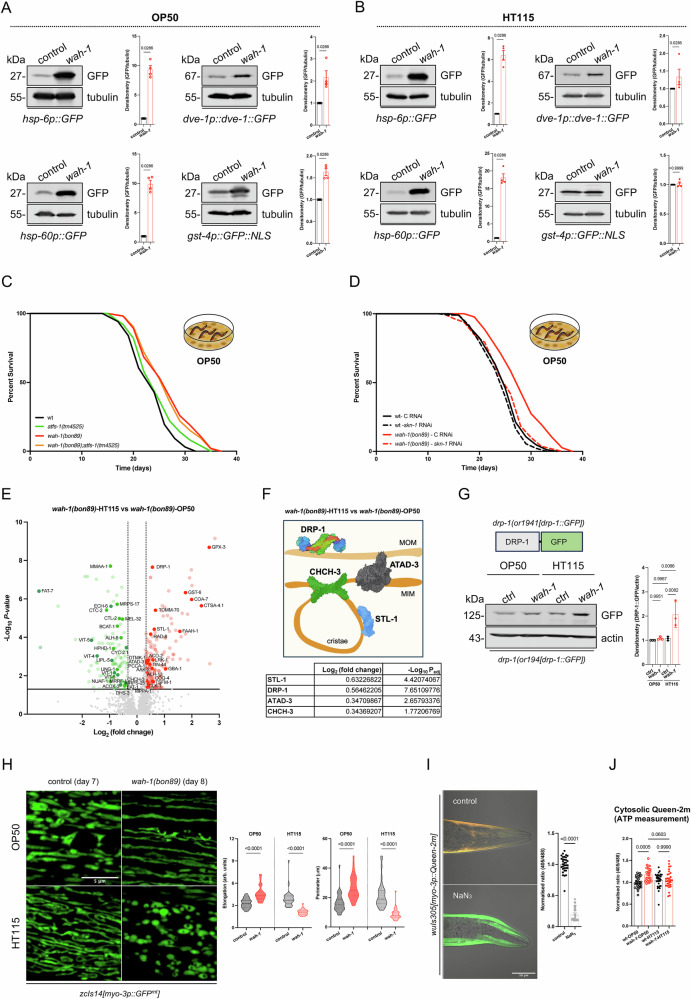
To gain further mechanistic insights, we analyzed the proteomic profiles of wah-1(bon89) mutant animals on HT115. Consistent with the previous signatures in animals grown on OP50 (Fig. 1E and Supplementary Fig. S1H), HT115-fed wah-1 mutants showed decreased expression levels of known AIF/CHCHD4-binding substrates (Supplementary Fig. S2C and Supplementary data 3). When we compared the proteomic changes of wah-1 mutants grown on the two different bacterial strains, we observed many differentially regulated mitochondrial proteins, including DRP-1, STL-1, CHCH-3, and ATAD-3, which are known regulators of mitochondrial membrane remodeling (Fig. 2E, F and Supplementary data 4). Using strains expressing drp-1 endogenously tagged with GFP, we confirmed DRP-1::GFP upregulation in wah-1(bon89) mutants on HT115 compared to OP50 bacteria (Fig. 2G). Consistently, body wall muscle cells expressing a mitochondrial matrix-targeted GFP exhibited a more fragmented mitochondrial network when wah-1(bon89) animals were grown on HT115 bacteria instead of the OP50 diet (Fig. 2H). Furthermore, wah-1 mutants tend to have higher mitochondrial DNA (mtDNA) contents as measured by MT-CO1 and MT-ND1 mRNA levels, indicating an increased mitochondrial mass (Supplementary Fig. S2D). We assessed the energy status of our animals by employing the ratiometric biosensor Queen-2m, a GFP-based indicator that undergoes conformational changes upon ATP binding, which enables the quantification of ATP dynamics in living cells45,46. On OP50 but not on HT115, wah-1(bon89) animals had higher Queen-2m signals compared to controls (Fig. 2I, J), likely as a result of higher cytosolic ATP levels. Finally, we assessed mitochondrial morphology in control and AIF KO HEK293T cells and found that oleic acid supplementation was sufficient to promote a more fused mitochondrial network (Supplementary Fig. S2E). Also, oleic acid could rescue the survival defects of glucose-deprived, galactose-fed AIF KO HEK293T cells (Supplementary Fig. S2F), further supporting the idea that lipids can ameliorate defects associated with AIF deficiency.

Bacterial strains differentially influence stress response inmutants. wah-1 GFP expression levels in controls andmutants expressing the indicated transgenes and grown either onOP50 orHT115. Densitometry is reported on the right of each representative immunoblots ( = 4, Mean +/− SEM, two-tailed t-test, Mann-Whitney test).Lifespan assay of wt (N2),,andmutants grown on OP50.Representative lifespan assay of wt andon control and1 RNAi (OP50).Volcano plot of dysregulated proteins inanimals on HT115 and compared tomutants on OP50 (two-tailed t-test, thresholds are:value- ≤0.05 and FC- ±1.25). Highlights are mitochondrial proteins and metabolic enzymes.Scheme reports the localization of DRP-1 (MOM= mitochondrial outer membrane), ATAD-3 (with domains that span across the two membranes), CHCH-3 (part of the MICOS complex), STL-1 (in the MIM, binding cardiolipin at the cristae). Created in BioRender. Bano, D. (2026). At the bottom, proteomic changes of the four proteins are reported (data from Fig. 2E).Representative immunoblots of control (ctrl) andmutant animals expressingand grown on either OP50 or HT115. Densitometry is reported on the right ( = 3, Mean +/− SEM, one-way ANOVA, Šídák's multiple comparisons test).Representative confocal images of the mitochondrial network in body wall muscle cells of control andanimals grown on OP50 or HT115 bacteria. On the right, quantification of mitochondrial elongation and perimeter ( = 30–35 animals/condition from 3 biological replicates, one-way ANOVA, Šídák's multiple comparisons test).Representative confocal images of Queen-2m in the body wall muscle cells. Red (emission at 405 nm) and green (emission at 488 nm) channels were merged onto bright-field images (superimposed color green: low ATP; yellow: high ATP). The plot represents relative signal changes (correlating with ATP availability) upon NaNtreatment ( = 33 (control) or 29 (NaN) animals/condition from 3 biological replicates, two-tailed t-test, Mann-Whitney test).Quantification of cytosolic Queen-2m fluorescence in wt andmutants grown on OP50 or HT115 ( = 30 or 27 (foron OP50) animals/condition from 3 biological replicates, one-way ANOVA, Šídák's multiple comparisons test). wah-1(bon89) n atfs-1(tm4525) wah-1(bon89) wah-1(bon89);atfs-1(tm4525) wah-1(bon89) skn- wah-1(bon89) wah-1(bon89) p wah-1 drp-1(or1941[drp-1::GFP]) n wah-1(bon89) n n wah-1 n wah-1 A B C D E F G H I J https://BioRender.com/xbjr3z5 3 3
Diets influence storage lipids and energy homeostasis inmutants wah-1

Bacterial strains differentially affect storage lipids inmutant nematodes. wah-1 Representative confocal images of control andanimals expressing DHS-3::GFP. Quantification of GFP signal is provided on the right ( = 30–36 animals/condition from 3 biological replicates, one-way ANOVA, Šídák's multiple comparisons test). Volcano plots of differentially regulated () triacylglycerols (TAGs) and () phosphatidylcholines (PCs) and phosphatidylethanolamines (PEs) inmutants grown on OP50 vs animals on HT115 (two-tailed t-test, thresholds are:value- ≤ 0.05 and logFC- ±1).Heat maps relative to the metabolomic analysis ofK-12 control andbacteria (BW25113 strain). For each condition, 4 biological replicates (indicated as 1 to 4) were analyzed. In the heatmap, (a) and (b) indicate lipid species with different chemical structure, but similar degrees of saturation. Data are reported in logsignal scale (n.d.= not detected, as signal below the detection threshold). Volcano plots of differentially regulated () TAGs and () PEs and PCs inmutants grown either onK-12or control (BW25113) (two-tailed t-test, thresholds are:value- ≤ 0.05 and logFC- ±1).Representative confocal images of DHS-3::GFP-positive lipid droplets in control andanimals grown onK-12 control or(BW25113). Quantification is provided on the right ( = 28–33 animals/conditions from 3 biological replicates, one-way ANOVA, Šídák's multiple comparisons test).Representative survival curves of wt (N2) andanimals grown onK-12 control and.Representative confocal images of mitochondrial morphology in animals grown onK-12 control and. Quantification reports elongation score and perimeter ( = 26-30 animals/condition from 3 biological replicates, one-way ANOVA, Šídák's multiple comparisons test).Representative immunoblots of samples frommutants expressinggrown on control andbacteria (BW25113 strain). Densitometry is reported on the right ( = 4, Mean +/− SEM, two-tailed t-test, Mann-Whitney test).Quantification of cytosolic Queen-2m fluorescence in wt andmutants grown onK-12 control and( = 30 animals/condition from 3 biological replicates, Mean +/− SEM, one-way ANOVA, Šídák's multiple comparisons test). A B C D E F G H I J K wah-1(bon89) n wah-1 p E. coli ΔdgkA wah-1 E. coli ΔdgkA p wah-1(bon89) E. coli ΔdgkA n wah-1(bon89) E. coli ΔdgkA E. coli ΔdgkA n wah-1 drp-1(or1941[drp-1::GFP]) ΔdgkA n wah-1 E. coli ΔdgkA n 2 10 2
LRK-1 and DRP-1 upregulation negatively affects the survival ofmutants wah-1
Parkinson's disease (PD)-related LRRK2 and its paralog LRRK1 are poorly characterized multifunctional protein kinases involved in endosomal trafficking, autophagy-lysosomal pathway, mitochondrial dynamics (through DRP1), and oxidative stress55. Since our proteomics showed clear lysosomal and autophagic signatures (Supplementary Fig. S4A), we quantified autolysosomes in C. elegans strains expressing the sqIs11[lgg-1p::mCherry::GFP::lgg-1] transgene56. Compared to wt animals, wah-1 mutants had more mCherry-positive autolysosomes when grown on HT115 (Fig. 4E). Interestingly, single RNAi against either drp-1 or lrk-1 inhibited autophagy in wah-1 mutant nematodes on HT115 (Fig. 4F). It is known that LRRK2 and DRP1 contribute to mitochondrial network maintenance via autophagy/mitophagy57–60. Although we could not quantify mitochondria-autophagosome co-localization in C. elegans due to technical limitations, we sought to test the contribution of PINK1/Parkin-dependent mitophagy61 (Fig. 4G). RNAi against pink-1 partially rescued the survival defects of wah-1 mutants on HT115 (Fig. 4H and Supplementary data 7), with pink-1-deficient animals showing a more fused mitochondrial network (Fig. 4I). These data suggest that enhanced autophagy and mitophagy may contribute to the lifespan reduction of hypomorphic wah-1 animals grown on low lipid-diets.
It is known that pathogenic LRRK2 mutations (G2019S and I2020T) alter the kinase activity of LRRK255. Since the kinase domain is relatively conserved between human LRRK2 and C. elegans LRK-1, we carried out gene editing and obtained two missense insertion mutations that resulted in truncated variants, likely loss of function (Fig. 5F). Lifespan assays showed that the two lrk-1 mutant strains lived as long as wt (Fig. 5G and Supplementary data 7). Consistent with our previous RNAi data (Fig. 4D), both lrk-1 mutations could promote lifespan extension of wah-1(bon89) animals on HT115, whereas drp-1 RNAi had no additional effect on the survival of lrk-1;wah-1 double mutants (Fig. 5H and Supplementary data 7). Both lrk-1 mutations had no effect on Complex I in wah-1 mutants (Fig. 5I). Together, these mechanistic data suggest that LRK-1 and DRP-1 act in the same pathway and their activity contributes to the phenotypic outcomes of hypomorphic wah-1 mutant animals grown on different diets (Fig. 5J).
![LRK-1 and DRP-1 regulate mitochondrial morphology and autophagy in hypomorphicmutants. wah-1 Schematic representation of the HT115 RNAi screening against upregulated metabolic enzymes and mitochondrial-associated proteins in.Median lifespan (relative to control) ofanimals grown on the indicated RNAi. Out of the 18 clones, 10 RNAi (red bars) increasesurvival by at least 20% ( = 1). As a counter-screening, the ten positive hits were tested in wt(N2) nematodes ( = 1).Representative confocal images of mitochondrial network in control andmutants grown on control,andRNAi (HT115 bacteria). Mitochondrial morphology is measured by elongation score and perimeter ( = 30-40 animals/condition from 3 biological replicates, one-way ANOVA; Dunnett' s multiple comparisons test).Representative survival curves of wt (N2) andanimals grown on control,andHT115 RNAi bacteria.Confocal images ofheads expressing+. Scheme depicts the fluorescence quenching of mCherry::GFP::LGG-1 fusion proteins within an autolysosome. Created in BioRender. Bano, D. (2026). The plot shows the quantification of mCherry-positive (right violin graph) and GFP-positive puncta (left violin graph) ( = 33–36 animals from 3 independent experiments, one-way ANOVA, Šídák's multiple comparisons test).Confocal image ofmutant expressing+. Analysis of GFP-positive (left violin graph) and mCherry-positive (right violin graph) puncta inanimals grown on control,and(as an inhibitor of autophagy) RNAi (HT115). Statistics of GFP/μmand mCherry-positive puncta are reported ( = 30-31 animals/condition from 3 biological replicates, one-way ANOVA, Dunnett's multiple comparisons).Schematic representation of mitophagy pathways. Created in BioRender. Bano, D. (2026).Representative lifespan assay of wt andanimals grown on control andRNAi (HT115). (I) Confocal images of control andmutants expressing. Animals were grown on control andRNAi (HT115) since hatching. Quantification of mitochondrial elongation and perimeter is shown on the right ( = 27-31 animals/condition from 3 biological replicates; one-way ANOVA, Šídák's multiple comparisons test). A B C D E F G H wah-1(bon89) wah-1(bon89) wah-1 n n wah-1 lrk-1 drp-1 n wah-1(bon89) lrk-1 drp-1 C. elegans sqIs11[[lgg-1p::mCherry::GFP::lgg-1 rol-6] n wah-1 sqIs11[[lgg-1p::mCherry::GFP::lgg-1 rol-6] wah-1(bon89) drp-1, lrk-1 bec-1 n wah-1(bon89) pink-1 wah-1 zcIs14[myo-3p::GFP(mt)] pink-1 n https://BioRender.com/xbjr3z5 https://BioRender.com/xbjr3z5 2](https://europepmc.org/articles/PMC12669733/bin/41467_2025_66900_Fig4_HTML.jpg "Click to view full size")
LRK-1 and DRP-1 regulate mitochondrial morphology and autophagy in hypomorphicmutants. wah-1 Schematic representation of the HT115 RNAi screening against upregulated metabolic enzymes and mitochondrial-associated proteins in.Median lifespan (relative to control) ofanimals grown on the indicated RNAi. Out of the 18 clones, 10 RNAi (red bars) increasesurvival by at least 20% ( = 1). As a counter-screening, the ten positive hits were tested in wt(N2) nematodes ( = 1).Representative confocal images of mitochondrial network in control andmutants grown on control,andRNAi (HT115 bacteria). Mitochondrial morphology is measured by elongation score and perimeter ( = 30-40 animals/condition from 3 biological replicates, one-way ANOVA; Dunnett' s multiple comparisons test).Representative survival curves of wt (N2) andanimals grown on control,andHT115 RNAi bacteria.Confocal images ofheads expressing+. Scheme depicts the fluorescence quenching of mCherry::GFP::LGG-1 fusion proteins within an autolysosome. Created in BioRender. Bano, D. (2026). The plot shows the quantification of mCherry-positive (right violin graph) and GFP-positive puncta (left violin graph) ( = 33–36 animals from 3 independent experiments, one-way ANOVA, Šídák's multiple comparisons test).Confocal image ofmutant expressing+. Analysis of GFP-positive (left violin graph) and mCherry-positive (right violin graph) puncta inanimals grown on control,and(as an inhibitor of autophagy) RNAi (HT115). Statistics of GFP/μmand mCherry-positive puncta are reported ( = 30-31 animals/condition from 3 biological replicates, one-way ANOVA, Dunnett's multiple comparisons).Schematic representation of mitophagy pathways. Created in BioRender. Bano, D. (2026).Representative lifespan assay of wt andanimals grown on control andRNAi (HT115). (I) Confocal images of control andmutants expressing. Animals were grown on control andRNAi (HT115) since hatching. Quantification of mitochondrial elongation and perimeter is shown on the right ( = 27-31 animals/condition from 3 biological replicates; one-way ANOVA, Šídák's multiple comparisons test). A B C D E F G H wah-1(bon89) wah-1(bon89) wah-1 n n wah-1 lrk-1 drp-1 n wah-1(bon89) lrk-1 drp-1 C. elegans sqIs11[[lgg-1p::mCherry::GFP::lgg-1 rol-6] n wah-1 sqIs11[[lgg-1p::mCherry::GFP::lgg-1 rol-6] wah-1(bon89) drp-1, lrk-1 bec-1 n wah-1(bon89) pink-1 wah-1 zcIs14[myo-3p::GFP(mt)] pink-1 n https://BioRender.com/xbjr3z5 https://BioRender.com/xbjr3z5 2

LRK-1 and DRP-1 act on the same pathway to regulatelifespan. wah-1 Lifespan assays of wt (N2),andanimals on HT115.Schematic representation of the wormScarlet-tagged DRP-1. The expression inpostmitotic cells is mediated by an extrachromosomal array. To maintain the extrachromosomal array, anrescue cassette was used in anbackground. Since1 andloci are relatively close, lifespan assays were performed with control andRNAi bacteria. Created in BioRender. Bano, D. (2026).Lifespan assays of wt and DRP-1 overexpressing (O/E) animals on control andRNAi bacteria (OP50).Representative survival curves of wt,andanimals on control andRNAi bacteria (HT115).Representative immunoblots of samples frommutants expressinggrown on control andRNAi bacteria (HT115). Actin was used as a loading control. Densitometry is reported on the right ( = 4, two-tailed t-test, Mann-Whitney test).Scheme reports the main domains of human LRRK2 andLRK-1. Red arrowheads indicate two pathogenic mutations in LRRK2 (G2019S and I2020T) and the corresponding residues in LRK-1 (G1876 and I1877). The two newly generatedalleles and the predicted amino acid sequences (based on DNA sequencing) are reported at the bottom.Representative survival assay of wt,andanimals on HTT15 bacteria.Representative survival curves of wt (N2),andanimals grown on control andRNAi bacteria (HT115).Representative immunoblots of NUO-2/NDUFS3 (CI) and tubulin (as a loading control) of samples are from animals grown on HT115 bacteria. Densitometry is reported on the right ( = 3, Mean +/− SEM, one-way ANOVA, Šídák's multiple comparisons test).Schematic summary of our findings. Low-lipid diets promote the expression of LRK-1 and DRP-1, which negatively impact mitochondrial network maintenance and survival. Created in BioRender. Bano, D. (2026). A B C D E F G H I J drp-1(tm1108), wah-1(bon89) wah-1(bon89);drp-1(tm1108) C. elegans unc-119(+) unc-119(ed3) wah- unc-119 wah-1 wah-1 drp-1(tm1108), wah-1(bon89) wah-1(bon89);drp-1(tm1108) lrk-1 wah-1 drp-1(or1941[drp-1::GFP]) lrk-1 n C. elegans lrk-1 lrk-1(bon150) lrk-1(bon151) lrk-1(bon150), lrk-1(bon151), lrk-1(bon150);wah-1(bon89) lrk-1(bon151);wah-1(bon89) drp-1 n https://BioRender.com/xbjr3z5 https://BioRender.com/xbjr3z5
Discussion
Over the last decade, a large number of inherited pathogenic mutations within the AIFM1 gene have been identified in patients8. As for other metabolic disorders associated with aberrant mitochondrial bioenergetics, pathogenic AIFM1 mutations cause a large spectrum of clinical outcomes, including fatal encephalomyopathy, ataxia, late-onset neuromyopathy, and mild deafness8. This range of clinical manifestations may result from varying degrees of structural and functional defects in AIF variants. Alternatively, disease-causing AIF variants may bind molecular partners differently compared to wild-type AIF, as recently shown for CHCHD4 and adenylate kinase 2 (AK2)24,25. Moreover, currently unknown genetic modifiers may ameliorate the metabolic defects due to AIFM1 loss of function mutations. While some of these molecular factors have been considered and thoroughly investigated in experimental models, less is known about the environmental cues that may contribute to the phenotypic outcomes linked to AIF deficiency.
To shed light on this, we sought to model AIF deficiency in isogenic populations of C. elegans hermaphrodites. Having obtained a viable C. elegans strain expressing a relatively stable WAH-1/AIF variant lacking 9 amino acids in the FAD-containing domain, we carried out functional assays as well as in-depth proteomic analyses. We found that the expression of hypomorphic wah-1(bon89) mutation negatively affects substrates of the AIF/CHCHD4 complex, resulting in aberrant Complex I biogenesis and impaired mitochondrial respiration, as previously shown in higher organisms12,20,21,23. By leveraging the genetic tractability of C. elegans, we studied whether environmental cues could modulate pathogenic traits linked to a wah-1/AIFM1 hypomorphic mutation. When we grew C. elegans on two standard bacterial types (OP50 and HT115) that are known to provide different nutrients to the host35–37, we found that the lifespan of hypomorphic wah-1 mutants varies significantly, while there was no effect on wild-type animals. We confirmed these observations with alternative bacterial strains and concluded that lipid-rich diets stimulate the accumulation of storage lipids (TAGs) and extend the lifespan of wah-1 mutants. Instead of a single fatty acid or a bacterially derived micronutrient (e.g., vitamin B12), our current data suggest that pathogenic phenotypes can be modulated when animals are exposed to diets rich in diverse lipids, which are subsequently used for energy production, biosynthetic processes, and membrane remodeling. As one of the main findings of our study, we were able to determine the molecular mechanisms by which diets can regulate the survival of animals expressing a hypomorphic WAH-1/AIF variant. Specifically, we found that low-lipid diets promote the expression of LRK-1 and DRP-1 to regulate mitochondrial network homeostasis in response to dietary conditions. By acting within the same pathway, inhibition of either DRP-1 or LRK-1 was sufficient to rescue several molecular signatures in wah-1 mutant animals grown on low-lipid diets, uncovering disease modifiers that are recruited in response to the environment. Taking a broader view, it is interesting to see how proteins often associated with PD are activated by OXPHOS deficiency to promote mitochondrial network maintenance. Since Complex I defects are usually observed in postmortem tissues from idiopathic PD patients62, we speculate that some of the cellular processes herein described might also contribute to the pathogenesis of PD.
As expected for an inherited pathogenic lesion, lipid-rich diets did not rescue Complex I defects and AIF/CHCHD4 dysfunction, suggesting that diet-derived lipids can stimulate stress response mechanisms that can compensate for the decreased mitochondrial respiration. In line with our previous studies63–65, mobilization of lipid deposits can transform short-lived mitochondrial mutants into long-lived nematodes by inducing cellular adaptations that buffer metabolic defects and partially restore homeostasis. Consistent with this model, we showed that SKN-1/Nrf, but not ATFS-1, contributes to the lifespan extension of wah-1 mutants on a lipid-rich bacterial diet. On the other hand, lower storage lipids in wah-1 mutants correlated with decreased cytosolic ATP levels and a more fragmented mitochondrial network associated with higher expression of proteins involved in mitochondrial dynamics, including DRP-1. These cellular and molecular signatures were accompanied by enhanced autophagy and PINK1/Parkin-dependent processes (e.g., mitophagy) that negatively affected the survival of hypomorphic wah-1 mutant animals on a low-lipid diet. Does it mean that autophagy and mitophagy are detrimental? Perturbations of the mitochondrial OXPHOS can induce transcriptional programs during development that have long-lasting effects on animal physiology. In experimental models such as C. elegans, loss of mitochondrial respiratory complexes triggers the production of reactive oxygen species (ROS), which can induce "mitohormesis" across tissues that enhances stress resilience and metabolic adaptations underlying longevity41. As cells grow during development, the expansion of the mitochondrial network supports the formation of contact sites between intracellular organelles, thereby facilitating the exchange of intermediate metabolites, ions, and lipids64,66. To buffer excessive ROS, the mitochondrial network undergoes continuous remodeling to ensure the degradation of damaged components (e.g., respiratory complexes, oxidized enzymes) via the formation of autophagosomes, for which mitochondria are the main suppliers of membranes67. However, in OXPHOS-deficient cells, the high turnover of mitochondria and the sustained flux of mitochondrial membranes toward other organelles may become increasingly difficult without an adequate dietary lipid intake to replenish those diverted to other cellular structures or used to generate ATP. Consequently, prolonged autophagy and mitophagy can undermine mitochondrial network homeostasis, potentially triggering vicious cycles of degradation and dysfunction that further impair the cell's bioenergetic capacity. Thus, while autophagy and mitophagy are essential homeostatic processes that protect cells from the accumulation of damaged cellular components, their excessive activation could be detrimental and causative of human diseases, as recently shown68.
Given the current knowledge in the field and the limited number of clinical cases worldwide, it is difficult to translate our findings into meaningful interventions for patients. We are aware of the limitations of our data, since they were mainly obtained in invertebrate models. Although more work is needed to draw definitive conclusions, our study provides robust proof-of-principle concepts of evolutionarily conserved molecular processes that likely may also be relevant in mammals. Furthermore, we believe that our findings increase the awareness of diets as disease modifiers, since complex nutrients may influence disease progression in an organism carrying a pathogenic mutation. In support of this claim, it was suggested that ketogenic diets might slow down mitochondrial myopathy progression in transgenic mice and improve muscle regeneration and strength in adult patients with progressive external ophthalmoplegia69,70. Similarly, a few clinical trials have been undertaken to investigate the impact of nutritional interventions for the treatment of progressive neurodegenerative diseases, such as amyotrophic lateral sclerosis (ALS), in which hypometabolism and aberrant mitochondrial bioenergetics play a causative role71–73. Consistent with a scenario applicable also to other metabolic disorders, there is a direct relationship between ALS risk and the levels of circulating lipids74,75, further emphasizing that lipid availability may also modify the disease trajectory in humans.
In conclusion, our study reveals that diet-genotype-phenotype correlations are overlooked aspects of pathogenic processes. In the context of rare metabolic disorders, non-genetic factors- including dietary interventions- may represent disease modifiers that influence the variable phenotypic outcomes of inherited pathogenic variants.
Methods
Antibodies
The following antibodies were used: mouse anti-MT-CO1 (Abcam, ab14705); mouse anti-tubulin (Sigma, T6074); mouse anti-NDUFS3 (Abcam, ab14711); mouse anti- α-tubulin (Sigma, T8203); mouse anti-GFP (Roche, 11814460001); mouse anti-actin (Sigma, A5316); anti-TOM20 (Proteintech, 11802-1-AP), goat anti-rabbit Alexa Fluor™ 568 (ThermoFisher scientific, A11011), anti-rabbit (LI-COR Biosciences, IRDye® 800CW), and anti-mouse (LI-COR Biosciences, IRDye® 680RD).
ATP measurements
Control and wah-1 mutants expressing wuIs305[myo-3p::Queen-2m] were imaged with a 40x oil immersion objective using Airyscan Zeiss LSM900 confocal microscopes. The measurement of cytosolic ATP level was obtained by a ratiometric analysis of Queen-2m excitation signals at 405 and 488 nm. As a positive control, animals were treated with 10% NaN3 for 5 min.
Caenorhabditis elegans strains and maintenance
Nematodes were grown on nematode growth media (NGM) plates previously seeded on a bacterial lawn of OP50 E. coli and maintained in a temperature-controlled incubator at 20 °C. The following strains were used in this study: wild type N2 (Bristol), BAN1 daf-2(e1370), BAN456 wah-1(bon89)III, BAN463 wah-1(bon89)III;zcIs14[myo-3p::GFP(mt)], BAN482 daf-2(e1370);wah-1(bon89), BAN524 idrIs1[dhs-3p::dhs-3::gfp], BAN526 wah-1(bon89)III, BAN532 bcIs39[lim-7p::ced-1::GFP+lin-15( + )], BAN528 wah-1(bon89);bcIs39[lim-7p::ced-1::GFP+lin-15( + )], BAN592 wah-1(bon89)III;idrIs1[dhs-3p::dhs-3::gfp], BAN744 wah-1(bon89);drp-1(tm1108), BAN774 wah-1(bon89);sqIs11[lgg-1p::mCherry::GFP::lgg-1+rol-6], BAN797 lrk-1(bon150), BAN798 lrk-1(bon151), BAN801 wah-1(bon89);drp-1(or1941[drp-1::GFP]), BAN811 lrk-1(bon150);wah-1(bon89), BAN812 lrk-1(bon151);wah-1(bon89), BAN 861 wah-1(bon89);zcls13[hsp-6p::GFP], BAN862 wah-1(bon89);zcls9[hsp-60p::GFP+lin-15( + )], BAN 863 wah-1(bon89);zcls39[dve-1p::dve-1::GFP], BAN864 wah-1(bon89);dvIs19[pAF15(gst-4p::GFP::NLS)], BAN880 wah-1(bon89);atfs-1(tm4525), BAN962 wah-1(bon89);wuIs305[myo-3p::Queen-2m], BAN966 unc-119(ed3);bonEx174[drp-1p::wrmScarlet::DRP-1::drp-1u+Cbr-unc-119( + )], BAN967 atfs-1(tm4525), CL2166 dvIs19[pAF15(gst-4::GFP::NLS)], CU6372 drp-1(tm1108), EU2917 drp-1(or1941[drp-1::GFP]), GA2001 wuIs305[myo-3p::Queen-2m], MAH215 sqIs11[lgg-1p::mCherry::GFP::lgg-1+rol-6], SJ4100 zcls13[hsp-6p::GFP], SJ4058 zcls9[hsp-60p::GFP+lin-15( + )], SJ4103 zcIs14[myo-3p::GFP(mt)], SJ4197 zcls39[dve-1p::dve-1::GFP]. Some strains were provided by the CGC, which is funded by the NIH Office of Research Infrastructure Programs (P40 OD010440). Newly developed C. elegans strains are fully available from the corresponding author upon request.
Cell culture
Wild-type (Abcam, ab255449) and AIF KO HEK293T cells (Abcam, ab266347) were cultured in DMEM (Gibco, 10567014) containing 10% FBS. For the cell viability assay, wild-type and AIF KO HEK293T cells were seeded in a PDL-coated 24-well plate with DMEM containing 10% FBS. After 48 h, cells were washed and the medium was replaced with glucose-free DMEM (Gibco, A14430-01) supplemented with 1 g/L galactose and 2 mM glutamine (ThermoFisher, 35050038), with or without 120 μM oleic acid (Sigma, O3008). The plate was then placed in the IncuCyte to monitor cell growth and viability over 72 h. For the assessment of mitochondrial morphology, cells were seeded onto PDL-coated glass coverslips. After 72 h, the medium was replaced with glucose-free DMEM supplemented with 1 g/L galactose and 2 mM glutamine, with or without 120 μM oleic acid for a duration of three hours. Subsequently, the cells were fixed with 4% PFA, mitochondria were stained with TOM20 antibody (dilution 1:100), and imaged using a 63x oil immersion objective at the LSM900 Airyscan joint-deconvolution microscope. Images were further visualized and analyzed in ImageJ2 software.
Confocal imaging of C. elegans
Mitochondrial morphology was assessed in GFP overexpressing animals using an Airyscan Zeiss LSM800 or LSM900 confocal microscopes equipped with a 63x oil immersion objective. In vivo quantification of lipid droplets was carried out in adult animals carrying the idrIs1[dhs-3p::dhs-3::gfp] transgene. CED-1::GFP positive engulfed cells were assessed in bcIs39[lim-7p::ced-1::GFP+lin-15(+)] expressing animals. Autophagy was quantified by using sqIs11[lgg-1p::mCherry::GFP::lgg-1 + rol-6]. Images were visualized and analyzed using ImageJ2.
Lifespan assays
Young adult gravid animals were bleached with a hypochlorite solution, and eggs were transferred to NGM plates previously seeded with bacteria. Animals were grown at 20 °C and transferred to freshly seeded bacteria every other day until all animals were dead. Control, aak-2, aco-2, alh-13, atad-3, chch-3, clk-1, coa-7, dtmk-1, gba-1, mppa-1, pcca-1, pink-1 rad-8, stl-1, tin-44, tomm-70, tsfm-1, drp-1, lrk-1, skn-1, wah-1 RNAi clones were in E. coli HT115 (Ahringer library, Source Bioscience LifeSciences) or OP50(xu363) and were prepared as previously described34. For the metabolite supplementation experiments, 10 g/L glucose, 200 nM vitamin B12, and 500 µM oleic acid (along with 0.1% NP40) were added on NGM plates.
Lipidomics
OP50, HT115, control, and ΔdgkA BW25113 E. coli were grown until OD600 = 0.3, followed by plating on NGM plates. After the plates were dried, they were incubated for 48 h at 20 °C before being collected for lipidomic analysis. For lipidomic analysis of wt and wah-1(bon89), young adult gravid animals were bleached, and eggs were transferred to NGM plates that were previously seeded with OP50, HT115, control,l and ΔdgkA BW25113 E. coli. Then, adult nematodes were collected and processed for lipidomic analysis. Raw data are available in the Supplementary tables. Samples were prepared according to MetaSysX standard procedure and a modified protocol76. Between 50 and 100 µl of E. coli or nematodes were used for lipid extraction. The samples were then analyzed with a Waters ACQUITY Reversed Phase Ultra Performance Liquid Chromatography (RP-UPLC) coupled to a Thermo-Fisher Exactive mass spectrometer. Chromatograms were acquired using dd-MS2 Top 3 mode (Data Dependent tandem mass spectrometry) with the following settings: Full Scan MS mode (mass range 300-1500) and NCE 25 (Normalized Collision Energy). Acyl composition of DAGs and TAGs was determined by detecting precursor ion [M + H]+ and neutral losses [Acyl+NH4]+ in positive ion mode with the further combinatorial calculation of the acyl composition. Acyl-composition of phosphoglycerolipids was concluded from the mass-to-charge ratio of [Acyl-H]- fragments of the corresponding precursors in negative ion mode. Acyl composition of sphingolipids was established from the fragmentation pattern of [M + H]+ precursor ion in positive ionization mode. The LC-MS data were obtained with the software PeakShaper (MetaSysX GmbH). After extraction from the chromatograms, the data is processed, aligned, and filtered for redundant peaks using in-house software. LC-MS lipophilic peaks were assigned according to the in-house MetaSysX database of chemical compounds. Pure compounds were used as references. The MetaSysX developed-R-based algorithm was used for lipid annotation. Lipid content was quantified using liquid chromatography-coupled to mass spectrometry (LC-MS), which enables comparison of relative abundances of the same lipid species across samples. Differences in lipid composition between the two genotypes were reflected in the intensities of lipid ions. Relative quantitation by mass spectrometry was sufficient to identify significantly altered lipids between samples. For statistical analysis, normalized intensities were log2-transformed, and values were median-centered prior to Principal Component Analysis (PCA). The statistical tests were performed using a two-tailed t-test assuming unequal variance, and the resulting p-values were further adjusted using the Benjamini-Hochberg (BH) method. In all comparative analyses, molecules that were below the detection limit in one sample, but detectable in the other, were indicated as "not detected (n.d.)".
Oxygen consumption rate measurements
OCR was measured using a Seahorse XFe24 Analyzer (Agilent). Nematodes were grown at 20 °C on OP50 plates until they reached the first day of adulthood. Then, adult animals were transferred to heat-killed OP50 plates for 3 h to purge their guts of any live bacteria. For each measurement, 50 animals were transferred to a well of an XFe24 plate containing 500 μL M9 buffer. Mitochondrial respiratory capacity was measured as a result of a sequential exposure to 20 μM FCCP and 20 mM sodium azide as described in some of our prior studies34,63–65.
SDS-PAGE and western blotting
Animals were washed and lysed in RIPA buffer (Abcam, ab206996) supplemented with protease inhibitor (Roche, 11836153001) and phosphatase inhibitor (Roche, 04906837001). An equal amount of protein samples was mixed with 4x loading buffer (250 mM Tris-HCl, pH 6.8, 8% SDS, 40% glycerol, 20% 2-Mercaptoethanol, 0.01% bromophenol blue) and boiled at 95 °C for 5 min. Following, the samples were loaded on polyacrylamide gels and subsequently transferred onto nitrocellulose membranes. The membrane was first incubated with blocking solution (5% dried skim milk in TBST: 50 mM Tris-HCl, 150 mM NaCl, 0.1% Tween20) and subsequently with primary antibody solution (dilution 1:1000) overnight at 4 °C. The membrane was then incubated with fluorescence-tagged secondary antibody (dilution 1:10000) and imaged with Odyssey Infrared Imaging System (Li-Cor Biosciences) and quantified using ImageStudioLite (Li-Cor Biosciences).
Quantitative real-time PCR
RNA extraction from adult animals was carried out using the RNeasy RNA extraction kit (Qiagen), and cDNAs were prepared using qScript cDNA Supermix (Quanta Biosciences). Further, quantitative RT-PCR was performed in a Step One Plus Real Time PCR System (Applied Biosystems) using Fast SYBR Green Master Mix (Applied Biosystems). β-actin was used for normalization. Fold changes of mRNA were analyzed using the comparative ΔΔCt method. The following oligonucleotides were used in this study: β-actin 5′-tgtgatgccagatcttctccat-3′ and 5′-gagcacggtatcgtcaccaa-3′; wah-1 5′- gctgatgctgtcgaggaga-3′ and 5′-tggtggtgttctcttctgtaga-3′; mt-nd1 5′-gtttatgctgctgtaagcgtg-3′ and 5′-ctgttaaagcaagtggacgag-3′; cox1/mt-co1 5′-tgggttgacaggtgttgtattatct-3′ and 5′-gtgtaacacccgtgaaaatcc-3′.
Sample preparation, LC-MS/MS measurements, and SureQuant proteomics
Approximately 800 wt (N2) and wah-1(bon89) adult nematodes were collected at days 4 and 5 after hatching, respectively. Animals were washed twice with water, and the pellets were kept at -80 °C. Samples were lysed in 200 μL Lysis buffer (50 mM HEPES (pH 7.4), 150 mM NaCl, 1 mM EDTA, 1.5 % SDS, 1 mM DTT; supplemented with 1× protease and phosphatase inhibitor cocktail (ThermoScientific)). Lysis was aided by repeated cycles of sonication in a water bath (6 cycles of 1 min sonication (35 kHz) intermitted by 2 min incubation on ice). At least 25 μg of C. elegans protein lysates were reduced and alkylated prior to processing by a modified filter-aided sample preparation (FASP) protocol as previously described77. Samples were digested with Trypsin (1:20; in 50 mM ammonium bicarbonate) directly on the filters, precipitated using an equal volume of 2 M KCl for depletion of residual detergents, then cleaned and desalted on C18 stage tips. Peptides for TMT-based MS analysis were re-suspended in 20 μL of 50 mM HEPES (pH 8.5). Then, wt (N2) and wah-1(bon89) C. elegans peptides were labeled with 25 μL of diluted (14.75 mM) 128 N, 128 C, 129 N and 129 C (clone 1), 130 N (clone7) TMT 10plex, respectively, for 1 h at RT. TMT signal was quenched by the addition of 2 μL of 5% hydroxylamine to the reaction, vortexing for 20 s and incubating for 15 min at 25 °C with shaking (1000 rpm). TMT-labeled peptides were acidified with 45% (vol/vol) of 10% FA in 10% ACN, prior to combining samples at equal amounts for drying in a concentrator. Dried peptides were re-suspended in 300 μL of 0.1% TFA for subsequent high pH reverse phase fractionation (Perce kit). 6 peptide fractions (10, 15, 20, 25, 50, and 80%) ACN were collected, concentrated, and re-suspended in 20 μL 5% FA for LC-MS analysis. MS runs were performed in triplicate. Peptides for label-free MS analysis were re-suspended in 20 µL 1% FA for LC-MS/MS analysis.
Tryptic peptides were analyzed on a Dionex Ultimate 3000 RSLC nanosystem coupled to an Orbitrap Exploris 480 MS (ThermoScientific). They were injected at starting conditions of 95% eluent A (0.1% FA in water) and 5% eluent B (0.1% FA in 80% ACN). Peptides were loaded onto a trap column cartridge (Acclaim PepMap C18 100 Å, 5 mm×300 μm i.d., #160454, Thermo Scientific) and separated by reversed-phase chromatography on an Acclaim PepMap C18, 100 Å, 75 µm X 50 cm (both columns from Thermo Scientific) using a 90 min linear increasing gradient from 8% to 25% of eluent B followed by a 30 min linear increase to 50% eluent B. The mass spectrometer was operated in data-dependent and positive ion mode with MS1 spectra recorded at a resolution of 120k with an automatic gain control (AGC) target value of 300% (3×10⁶) ions, maxIT set to Auto, and an intensity threshold of 1 × 10⁴, using a mass scan range of 350−1550. Precursor ions for MS/MS were selected using a top speed method with a cycle time of 2 ms and normalized collision energy (NCE) of 36% (High-energy Collision Dissociation (HCD)), to activate both the reporter and parent ions for fragmentation. MS2 spectra were acquired at 45k resolution using an AGC target value of 200% (2 × 10⁵), and maxIT set to 86 ms. Dynamic exclusion was enabled and set at 45 s. Isolation width was set at 0.7 m/,z and the fixed first mass was set to 110 m/z to ensure reporter ions were detected. Peptide match was set to off, and isotope exclusion was on. Charge-state exclusion rejected ions that had unassigned charge states, were singly charged, or had a charge state above 5. Full MS data were acquired in the profile mode with fragment spectra recorded in the centroid mode.
TMT-based MS raw data files were processed with Proteome Discoverer™ software (v2.4.0.305, Thermo Scientific) using SEQUEST® HT search engine against the Swiss-Prot® Caenorhabditis elegans database (v2020-08-24). Peptides were identified by specifying trypsin as the protease, with up to 2 missed cleavage sites allowed. Precursor mass tolerance was set to 10 ppm, and fragment mass tolerance to 0.02 Da MS2. Static modifications were set as carbamidomethylated cysteine and TMT6plex (229.163 Da; N-terminal, K), while dynamic modifications included methionine, oxidation, and N-terminal protein acetylation, for all searches. Resulting peptide hits were filtered for a maximum 1% FDR using the Percolator algorithm. The TMT10plex quantification method within Proteome Discoverer software was used to calculate the reporter ratios with mass tolerance ±10 ppm, and applying isotopic correction factors. Only peptide spectra containing all reporter ions were designated as "quantifiable spectra". Label-free MS raw data files were processed with Proteome Discoverer™ software (v3.0 SP1, Thermo Scientific) using SEQUEST® HT search engine against the Swiss-Prot® Caenorhabditis elegans database (v2023-06-28). Peptides were identified by specifying trypsin as the protease, with up to 2 missed cleavage sites allowed and restricting peptide length between 7 and 30 amino acids. Precursor mass tolerance was set to 10 ppm, and fragment mass tolerance to 0.02 Da MS2. Static modifications were set as carbamidomethylated cysteine, while dynamic modifications included methionine and N-terminal loss of methionine, for all searches. Peptide and protein FDR were set to 1% by the peptide and protein validator nodes in the Consensus workflow. Default settings of individual nodes were used if not otherwise specified. In the Spectrum Selector node, the Lowest Charge State = 2 and Highest Charge State = 6 were used. The INFERYS rescoring node was set to automatic mode, and the resulting peptide hits were filtered for a maximum 1% FDR using the Percolator algorithm in the Processing workflow. A second-stage search was activated to identify semi-tryptic peptides. Both unique and razor peptides were selected for protein quantification. Proteins identified by site, reverse, or potential contaminants were filtered out prior to analysis.
Targeted MS analysis was performed using synthetic PEPotec isotope-labeled -C-terminal lysine (K) or arginine (R) crude peptides (Thermo Scientific). An equimolar amount of each heavy peptide was mixed together at a final concentration of 1 pmol/μl in 0.1% FA to generate a pool of wah-1 SIL peptides for subsequent nanoLC-MS/MS analysis to determine their intensities. SureQuant analysis was performed as previously described78. Briefly, data acquisition was performed using a modified SureQuant template with 3 branches for the +2 (R, K), +3 (K) charge states of SIL lysine and arginine residues. Peak area ratios of endogenous light peptides and corresponding heavy IS peptides for the 6 selected product ions were exported from Skyline software v21.1.0.27879, and peptides were filtered according to the following criteria: First, only IS peptides with an AUC > 0 for n ≥ 5 product ions were considered. Second, peak area values of the 3 highest intensity product ions from both the light/heavy peptides were summed, and their light/heavy ratios were used to quantify peptide signals across samples. Quantitation was based on 3 selected product ions to balance specificity with the ability to retain lowly abundant targets. Data have been deposited into a publicly available repository80 (see Data Availability) and are also included as Supplementary table proteomics STP1-3.
Statistical analysis was performed in Proteome Discoverer (v2.4.0.305) for both TMT and LFQ datasets. Data were analyzed from four biological replicates. Protein abundances were log₂-transformed prior to testing. Since only two biological groups were compared, differential protein expression was evaluated using a two-sided Student's t-test. Multiple hypothesis testing was controlled using the Benjamini–Hochberg false discovery rate (FDR). Proteins were considered significantly changed at p < 0.05 and |log₂ fold-change | ≥ 0.33 thresholds. Targeted MS (SureQuant) data were processed in Skyline, light/heavy ratios derived from peptide peak areas were log₂-transformed and compared between groups using a two-sided t-test. No FDR correction was applied to the targeted MS data since very few peptides were analyzed. SQ analysis was done using three biological replicates.
Statistics and reproducibility
No statistical method was used to predetermine sample size. No data were excluded from the analyses. The Investigators were not blinded to allocation during experiments and outcome assessment. For statistical analysis, GraphPad Prism Software was used. Student's t-test was used to compare between two groups, and one-way ANOVA (with appropriate post hoc correction) was employed for three or more groups. The number of biological replicates is indicated in the figure legends.
Supplementary information
Supplementary information Description of Additional Supplementary File Supplementary data 1 Supplementary data 2 Supplementary data 3 Supplementary data 4 Supplementary data 5 Supplementary data 6 Supplementary data 7 Supplementary data 8 Transparent Peer Review file
Source data
Source data