
What this is
- This research investigates the relationship between nutrient composition and lifespan in yeast.
- Using response surface methodology, the study evaluates how varying levels of glucose, amino acids, and yeast nitrogen base affect yeast longevity.
- The findings suggest that nutrient composition is more critical than simple for extending lifespan.
Essence
- Nutrient composition, rather than just , significantly influences the lifespan of yeast. The study shows that different strains of yeast respond variably to specific nutrient combinations, indicating that optimizing nutrient balance can enhance longevity.
Key takeaways
- Lifespan extension in yeast depends on nutrient composition. The study found that varying glucose, amino acids, and yeast nitrogen base levels led to different lifespan outcomes across four yeast strains.
- Strain sch9Δ exhibited heightened sensitivity to nutrient changes, suggesting that the Sch9 pathway plays a crucial role in nutrient sensing and longevity regulation in yeast.
- The research indicates that simply buffering the pH of the media can significantly extend lifespan, emphasizing the importance of environmental factors in yeast aging.
Caveats
- The study's findings are based on specific yeast strains, which may not generalize to other organisms or strains. Further research is needed to validate these results across different models.
- Variability in experimental conditions, such as nutrient concentrations and media composition, could affect the reproducibility of lifespan outcomes.
Definitions
- Chronological lifespan (CLS): The duration of time that yeast cells remain viable under specific growth conditions.
- Dietary restriction (DR): A reduction in calorie intake without malnutrition, often used to study its effects on lifespan.
Simplified
Introduction
Calorie restriction (CR), the mere reduction of calorie intake without malnutrition [1], has become a gold standard method in aging studies, because CR was found to extend the average and maximum lifespan from yeast to primates and delay the onset of many aging-associated pathologies [2], [3]. The term CR is debated and it has been suggested that dietary restriction (DR) is a more appropriate term. Therefore, we use DR in referring to the restricted glucose level [4]. The traditional opinion on DR has been challenged in four model organisms, namely yeast [5], [6], worms [7], flies [8], [9], [10], [11], and mice [12], [13], because studies in these organisms have shown that changing the dietary components can increase their lifespans. In addition, different DR regimes extend lifespan via distinct genetic pathways [7], which suggests that nutrient balance, in addition to dietary reduction, also plays a pivotal role in regulation of longevity [14]. Although studies of yeast aging have had a significant impact on aging-related research, the new findings that nutrient composition can alter lifespan have not been systematically explored in a yeast model.
In yeast aging studies, glucose plays an important role in yeast lifespan. DR can be accomplished by only reducing the glucose concentration of growth media to extend chronological and replicative lifespan significantly, the glucose level in standard synthetic defined (SD) media could be from 2% (normal condition) to 0.5% (moderate DR) or 0.05% (severe DR) [15]. Recently, acidification of culture media was proposed to accelerate chronological and replicative aging in yeast [16], [17], [18]. Thus, it is suggested that lifespan extension by reducing the glucose level of the culture media from 2% to 0.5% or 0.05% is likely due to decreased production of organic acids and reduced media acidification [16].
Recent evidence has demonstrated that dietary amino acid compositions modulate lifespan of laboratory model organisms such as yeast [19], flies [9], and mice [13]. A report showed that reducing the amino acid concentration in the media could promote an increase in the mean and maximum replicate lifespan (RLS) of yeast [5]. Another study showed that removing preferred amino acids such as asparagine or glutamate while keeping the total amino acid concentration constant could significantly increase chronological lifespan (CLS) of yeast [6]. It is postulated that amino acids and glucose balance extends yeast lifespan and that individually reducing amino acids or glucose is a major factor in regulation of yeast longevity. It is expected that other nutrients such as minerals and vitamins may also be important in regulating yeast CLS. It would be important to know how critical these nutrients are to extending or reducing lifespan. In most aging studies, single-factorial design was employed in experiments with nutrients as the variant, resulting in an exclusive elucidation of effects of other nutrients on lifespan. By using multifactorial design, a few studies on flies have found that the nutrient balance, not DR, extends lifespan [8], [10], [20]. Multifactorial design in relation to nutrient change has not been applied in yeast aging studies to the best of our knowledge.
To uncover the relationship between nutrients and CLS, we chose a three-factor (glucose, yeast nitrogen base (YNB), amino acids)/three-level experimental design with 15 media using the SAS program (version 9.2) to arrange experiments on yeast CLS measurement (totally 240 treatments, 15 media ×16 repeats). The design was based on a classical response surface methodology (RSM) by Box–Behnken design to explore the relationships between nutrients and lifespan as well as biomass production in a wild type yeast strain [21]. We applied this design in three single gene deletion mutants (sch9Δ, tor1Δ and sir2Δ) to determine their changes of lifespan and biomass in response to the different nutrient compositions. Reported herein is our discovery.
Results
DR regime is dependent on nutrients in media
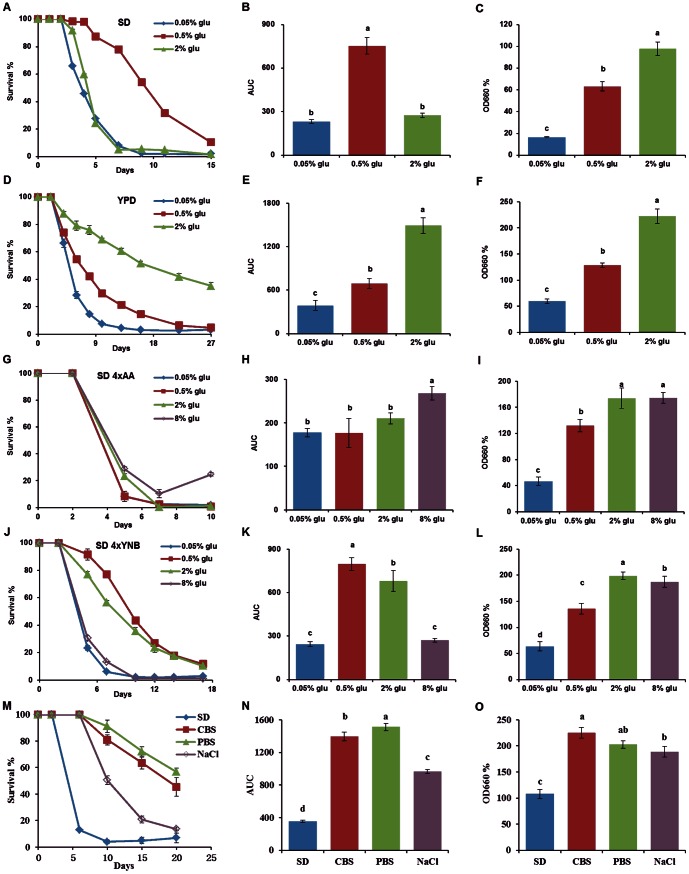
Recent studies on flies suggested that the traditional observation on DR-induced longevity was mainly due to nutrient balance [8], [14], [20]. This indicates that the imbalance between nutrients resulted in lifespan reduction. To test this new insight in a yeast CLS model, we chose four media with different glucose levels to examine CLS in a commonly used wild-type yeast strain BY4742. As shown in Figure1, the four media were standard SD (synthetic defined), YPD (1% yeast extract/2% peptone/2% dextrose), SD with four-fold excess of amino acids and SD with four-fold excess of YNB (Table S1). Consistent with our previous report [22], we found that DR (0.5% glucose) increased CLS and further DR (0.05% glucose) reduced CLS, which might be due to glucose deficiency (Figure1A, 1B). Moreover, DR optimized CLS but not biomass as shown in Figure1C, and the biomass production in the media containing 2% glucose was higher than that with 0.5% glucose. This result is similar to those observed in most higher eukaryotes in that starvation does not extend lifespan, and high food intake results in high reproduction and shorter lifespan [23]. The difference between our results and those observations that severe DR (0.05%) extended lifespan could arise from different culture conditions [24], [25], [26].
The YPD medium was also chosen for DR studies in yeast chronological aging model [27], [28]. To our surprise, we found that the yeast cultured in the YPD medium containing 0.5% glucose had a shorter lifespan than that grown in YPD with 2% glucose, and those grown in YPD with 0.05% glucose had lifespan further reduced, similar to the results in The SD medium (Figure1A, 1D, 1E). For biomass, the observation was also similar to the results in The SD medium that higher glucose concentrations produced higher biomass; however, the biomass at the same glucose level was significantly higher than that of The SD medium (Figure1C, 1F). The YPD medium was rich in nutrients, we propose that 2% glucose in the YPD medium could mimic DR condition of the 0.5% glucose in The SD medium to induce longevity of yeast, and that lifespan reduction in 0.5% and 0.05% glucose YPD would be due to glucose deficiency.
For the preliminary study of amino acids and YNB in our yeast aging model, four-fold of total amino acids were added into the The SD medium containing different glucose levels. As shown in Figure1G-I, the addition of total amino acids did not extend CLS, but increased biomass production, and the DR condition (0.5% glucose) did not produce a longer lifespan than the normal condition (2% glucose). Interestingly, our results showed that the addition of four-fold YNB (6.8 g/L) significantly extended CLS and increased biomass production than that of the The SD medium with 2% glucose (Figure1J–L). Yeasts in the high YNB media with 0.5% glucose had longer CLS than that with 2% glucose. Therefore, the results from high amino acids and YNB media suggested that the concentrations of both components played important roles in regulation of yeast CLS. Furthermore, it was observed that higher glucose levels produced more biomass from 0.05% to 2% glucose, but resulted in greatly different CLS. In contrast, 8% glucose could not further increase biomass in both high amino acids and YNB media. This may be due to shortages of YNB and amino acids relative to the high glucose content (Figure1I, 1L).
Previous studies propose that acetic acid induced cell death is the key mechanism of chronological aging in yeast in standard media, and environmental and genetic interventions via increasing cellular resistance to acetic acid can extend CLS [16], [17], [29]. In this study, our results are consistent with these reports, and show a high osmolarity media (0.3 M NaCl) and buffered media (pH 6.0) can significantly extend the CLS of yeast (Figure1M, 1N). Interestingly, the high osmolarity and buffered media produced more biomass than the standard The SD medium even though they had the same amounts of glucose and other nutrients (Figure 1O), and the buffered media induced higher biomass was also observed in a previous study [16].

DR regime is dependent on nutrients in media. (A, B and C) Influence of glucose levels in synthetic defined (SD) media on yeast CLS. Survival curve (A) of WT strain BY4742 was inoculated in The SD medium containing 2%, 0.5% and 0.05% glucose for 15 days (mean + SEM, n = 8). (B) Area under the survival curve (AUC) represents the survival integral. DR (0.5% glu) greatly extended yeast lifespan, but further DR (0.05%) did not extend lifespan due to glucose deficiency. (C) Effect of glucose concentration in The SD medium on yeast biomass production. Yeast grown in higher glucose media produced higher biomass, and DR optimized CLS but not biomass. (D, E and F) Influence of glucose levels in the YPD medium on yeast CLS. (D) Survival curve of yeast was cultured in YPD (1% yeast extract and 2% peptone) media with different glucose levels (mean + SEM, n = 8). (E) Moderate DR (0.5%) and severe DR (0.05%) did not extend lifespan compared to normal condition (2% glu). (F) DR did not optimize CLS and biomass. (G, H and I) Influence of glucose concentrations in The SD medium containing four fold amino acids on yeast CLS. (G) Survival curve (mean + SEM, n = 8) and AUC comparison (H) shown that different glucose levels had little effect on lifespan. (I) Yeast cultured in normal condition produced higher biomass than DR condition, but further addition of glucose did not increase biomass. (J, K and L) Influence of glucose levels in The SD medium with 4-fold YNB (6.8 g/L) on yeast CLS. (J and K) DR extend lifespan, but the difference was less than that in The SD medium as show in A and B, which, due to addition of YNB, increased lifespan in 2% glucose (mean + SEM, n = 8). (L) The biomass results were similar with the observation in The SD medium with four fold amino acids. Yeast grown in 8% glucose media did not produce higher biomass than that in 2% glucose media. (M, N and O) High osmolarity and buffered media extend CLS. Yeast were inoculated into SD, The SD medium supplemented with 0.3 M NaCl (high osmolarity), and The SD medium prepared with phosphate buffer solution at (PBS, NaHPOand NaHPO, pH 6.0) or citrate phosphate buffer solution (CBS, NaHPOand citric acid, pH 6.0). (M) Survival curve (mean + SEM, n = 6) and AUC comparison (N) shown that the three media significantly prolonged CLS, as well produced higher biomass than The SD medium (O). Biomass of each aging vial at one age-point was measured as the average reading of OD values at 660 nm from 10 to 30 min in outgrowth curve. The OD value of The SD medium at day 2 was defined to be 100 relative OD value. The variance of AUC (mean + SEM, n = 8) and relative OD600 values (mean + SD, n = 8) between the treatments was compared using the Duncan's multiple range test at<0.05, different letters (a–d) showing significant differences. 2 4 2 4 2 4 P
Development of statistical design of experiments for evaluation of nutrition, biomass and lifespan
To determine the relationships between nutrients and lifespan as well as biomass production of yeast, a 15-media experiment with three-factors (glucose, YNB, amino acids)/three-levels (–1, 0, 1) was selected according to the classical RSM Box–Behnken design (Table1). This design can explore the relationships between several explanatory variables (nutrients) and response variables (lifespan, biomass) under the design region by using a minimal number of experimental runs. The concentrations of three factors, i.e. glucose (0.5 to 5.5%), amino acids (0.5 to 3.5 ×) and YNB (0.85 to 9.35 g/L), were chosen to test conditions known to alter lifespan in a typical The SD medium (Table S1). The wild-type strain BY4742 and three single gene deletion strains (sch9Δ, tor1Δ, sir2Δ) were chosen because the three genes are highly conserved from yeast to mammals as well as play critical functions during aging regulation in a range of model organisms [23], [30], [31], [32]. Thus, this experiment contained a total of 1024 runs, including the standard The SD medium (4 strains ×16 media ×16 repetitions).
| Run | Factors & levels (coded) | pH | Biomass (OD660%) | Lifespan (AUC) | |||||||||||
|---|---|---|---|---|---|---|---|---|---|---|---|---|---|---|---|
| AAs (1×) | YNB (g/L) | Glucose (%) | Day 0 | WT day 2 | WT day 4 | Δ day 2sch9 | Δ day 4sch9 | WT | Δsch9 | WT | Δsch9 | ||||
| 1 | 0.5 | (–1) | 0.85 | (–1) | 3 | (0) | 4.73 | 3 | 3.09 | 3 | 3.12 | 11.7 | 36.5 | 594 | 413.8 |
| 2 | 0.5 | (–1) | 9.35 | (1) | 3 | (0) | 4.6 | 3.21 | 3.27 | 3.26 | 3.34 | 52.1 | 59.7 | 559.7 | 303.9 |
| 3 | 3.5 | (1) | 0.85 | (–1) | 3 | (0) | 4.75 | 3.65 | 3.6 | 3.88 | 4.04 | 50.9 | 47.6 | 344.4 | 2455.8 |
| 4 | 3.5 | (1) | 9.35 | (1) | 3 | (0) | 4.72 | 4.8 | 4.42 | 4.67 | 4.24 | 226.8 | 263.1 | 762 | 678.1 |
| 5 | 2 | (0) | 0.85 | (–1) | 0.5 | (–1) | 4.77 | 5.46 | 6.61 | 4.9 | 6.55 | 29.2 | 48.6 | 408.6 | 285.6 |
| 6 | 2 | (0) | 0.85 | (–1) | 5.5 | (1) | 4.72 | 3.17 | 3.36 | 3.25 | 3.37 | 45.2 | 55.9 | 898.2 | 2701.4 |
| 7 | 2 | (0) | 9.35 | (1) | 0.5 | (–1) | 4.71 | 5.88 | 5.93 | 5.88 | 5.93 | 53.1 | 69.5 | 688.9 | 770.2 |
| 8 | 2 | (0) | 9.35 | (1) | 5.5 | (1) | 4.71 | 3.54 | 3.56 | 3.67 | 3.49 | 105.9 | 191.3 | 443.5 | 780 |
| 9 | 0.5 | (–1) | 5.1 | (0) | 0.5 | (–1) | 4.71 | 3.82 | 3.94 | 3.63 | 3.78 | 30.9 | 45.3 | 894.6 | 318.2 |
| 10 | 3.5 | (1) | 5.1 | (0) | 0.5 | (–1) | 4.76 | 6.67 | 6.83 | 6.25 | 6.66 | 40.8 | 65.7 | 426.4 | 319.9 |
| 11 | 0.5 | (–1) | 5.1 | (0) | 5.5 | (1) | 4.68 | 2.73 | 2.81 | 2.79 | 2.82 | 55.6 | 57 | 308.6 | 504.1 |
| 12 | 3.5 | (1) | 5.1 | (0) | 5.5 | (1) | 4.73 | 3.89 | 3.84 | 4.16 | 4.58 | 245.3 | 284.9 | 831 | 2397.2 |
| 13 | 2 | (0) | 5.1 | (0) | 3 | (0) | 4.73 | 4.11 | 3.55 | 4.11 | 3.33 | 112.2 | 171 | 760.1 | 497.4 |
| 14 | 2 | (0) | 5.1 | (0) | 3 | (0) | 4.73 | 4.1 | 3.57 | 4.13 | 3.35 | 126.5 | 185 | 778 | 496.3 |
| 15 | 2 | (0) | 5.1 | (0) | 3 | (0) | 4.73 | 4.11 | 3.53 | 4.14 | 3.36 | 121.8 | 176.8 | 775.1 | 502.3 |
| SD | 1 | 1.7 | 2 | 4.72 | 3.45 | 3.52 | 108.4 | 356.4 | |||||||
| CBS | 1 | 1.7 | 2 | 6 | 5.92 | 5.89 | 225.1 | 1395.6 | |||||||
Nutrient composition is a key factor for longevity of yeast
To elucidate whether nutrient balance is an important factor for longevity of yeast, we did an analysis from the following aspects:
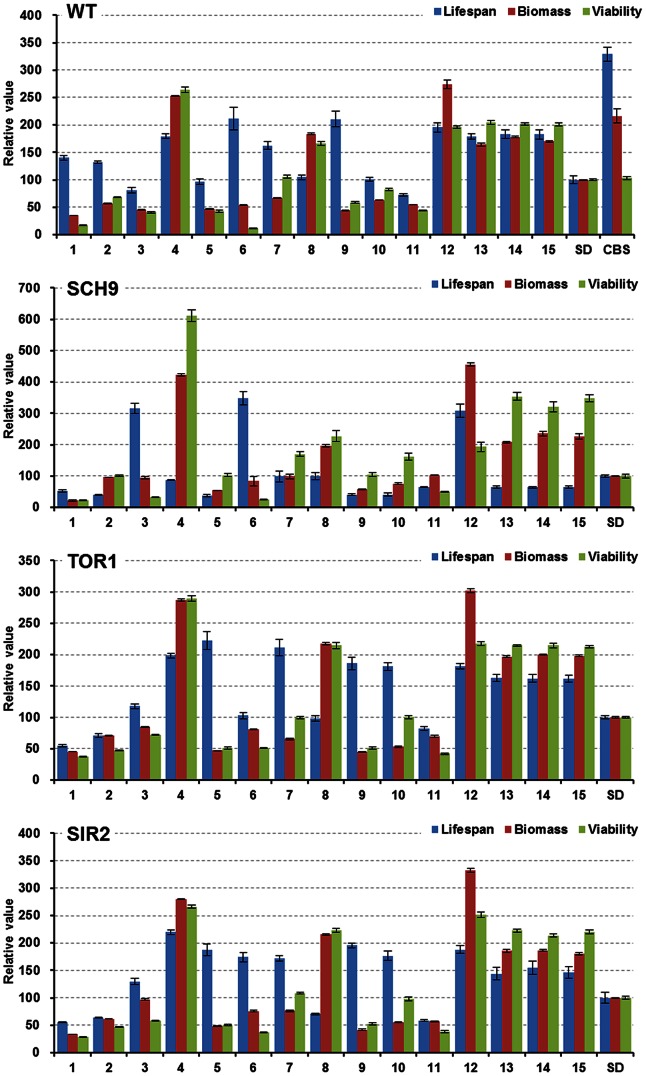
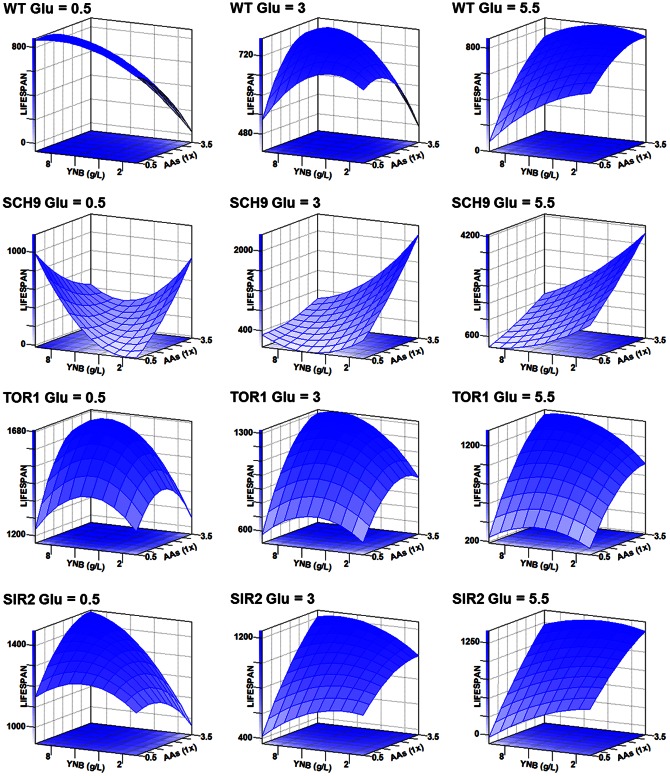
Firstly, the relative lifespan of the four strains (WT, sch9Δ, tor1Δ, and sir2Δ) is shown in Figure2, and the response surfaces for the lifespan of the four strains cultured at various concentrations of amino acids, glucose, and YNB are plotted in Figure3. For the WT, only the middle glucose level (3%) had an optimal lifespan within the testing concentration ranges of amino acids and YNB. However, the response surface plots of sch9Δ were greatly different from those of the WT at the three glucose levels. For the tor1Δ and sir2Δ, the trends of response surfaces bore some similarities, and this was consistent with the result that tor1Δ and sir2Δ had a good correlation in lifespan change (vide infra). Overall, these results clearly showed that yeasts cultured in media containing different ratios of three types of nutrients had diverse lifespans. The diverse change of lifespan in these media among the four strains tested suggested that nutrient composition, instead of glucose alone, played a more important role in regulation of lifespan.
Secondly, among the 15 media, the lifespan of WT and sch9Δ, respectively, had little correlation with that of the other strains, only tor1Δ and sir2Δ had a good correlation (r = 0.87, P<0.001) in lifespan change (Table2). This means that strains WT, sch9Δ and tor1Δ/sir2Δ cultured in the same media had different lifespans (Figure2). It is noticeable that, in some cases, sch9Δ, tor1Δ, and sir2Δ strains had shorter lifespans than the WT (FigureS1). Previous findings show that single deletion of any one of the three genes changed the lifespan (increased or reduced). Our results suggested that, on top of the DR regime, the changes in lifespan may also be dependent on the nutrient compositions of the media used in the experiment [14], [33].
Thirdly, the linear and the quadratic parameter estimates for the lifespan are presented in TableS2. The results showed that although not all terms had significant effects on the lifespan, the estimates of the same term had marked differences among the four strains, which was different from the biomass results (vide infra). It further suggests that nutrient composition is an important factor for longevity of budding yeast and the three nutrients and their interactions play different roles in the lifespan of different strains.
Lastly, a few media induced regrowth of yeast cells, especially media 6 (2× AAs, 0.85 g/L YNB and 5.5% glucose) (FigureS1). The regrowth is important for adaptation to starvation conditions, and many laboratory wild-type microorganisms have adaptive regrowth when usually 90–99% of the population dies. Longo et al. suggested that adaptive regrowth is correlated with increased mutation frequency, which allows mutants to re-enter the cell cycle under starvation conditions [29], [34]. Thus, they proposed to monitor chronological aging of yeast in water that can prevent any occurrence of adaptive regrowth, which might confound the explanation of survival data [35]. However, the observation in media 6 might be caused by an imbalance of the low YNB content. In addition, this media as well as a few others that produced longer lifespans in all four strains suggested that nutrient composition a key determinant for yeast longevity.

Comparison of relative lifespan, biomass and viability in the four yeast strains (WT,Δ,Δ, andΔ). sch9 tor1 sir2 AUC represents the survival integral for lifespan comparison, the AUC of yeast aging in The SD medium is defined as 100%, and error bars represent SEM within 16 replicates. Biomass production was measured as the average values at OD660 of each media from day 10 to day 22 (see), the biomass of The SD medium was defined as 100%, (mean + SEM, n = 16). Viability was the survival at day 2, and the survival of SD at day 2 was defined as 100%, (mean + SEM, n = 16). 0064448

Response surfaces for lifespan of the four yeast strains (WT,Δ,Δ, andΔ) cultured at various concentrations of amino acids (AAs), glucose (Glu), and yeast nitrogen base (YNB). sch9 tor1 sir2 For each strain, three AA/YNB-lifespan plots are shown at specific glucose levels 0.5% (low), 3% (media) and 5.5% (high) respectively. The AAs concentration ranged from 0.5× to 3.5× and YNB from 0.85 to 9.35 g/L. The surface-response inΔ was clearly different from that in WT,Δ andΔ, while these plots displayed similar trends inΔ andΔ. All these surface-response plots were generated automatically by SAS program, and those surface plots for biomass production are seen in. sch9 tor1 sir2 sir2 tor1 0064448
| WT | Δsch9 | Δtor1 | Δsir2 | ||||||||||
|---|---|---|---|---|---|---|---|---|---|---|---|---|---|
| Lifespan | Biomass | Viability | Lifespan | Biomass | Viability | Lifespan | Biomass | Viability | Lifespan | Biomass | Viability | ||
| Lifespan | 0.4 | 0.38 | 0.18 | 0.4 | 0.37 | 0.3 | 0.39 | 0.37 | 0.52 | 0.37 | 0.37 | ||
| WT | Biomass | 0.14 | 0.94 | 0.13 | 0.97 | 0.79 | 0.31 | 0.99 | 0.95 | 0.31 | 0.99 | 0.96 | |
| Viability | 0.16 | <.0001 | –0.11 | 0.88 | 0.92 | 0.42 | 0.92 | 0.98 | 0.34 | 0.89 | 0.98 | ||
| Lifespan | 0.52 | 0.64 | 0.71 | 0.24 | –0.26 | –0.12 | 0.2 | 0 | 0.2 | 0.28 | –0.01 | ||
| Δsch9 | Biomass | 0.14 | <.0001 | <.0001 | 0.39 | 0.75 | 0.33 | 0.96 | 0.87 | 0.37 | 0.97 | 0.88 | |
| Viability | 0.17 | 0 | <.0001 | 0.35 | 0 | 0.47 | 0.77 | 0.9 | 0.42 | 0.72 | 0.86 | ||
| Lifespan | 0.28 | 0.26 | 0.12 | 0.67 | 0.23 | 0.08 | 0.23 | 0.37 | 0.87 | 0.27 | 0.37 | ||
| Δtor1 | Biomass | 0.15 | <.0001 | <.0001 | 0.47 | <.0001 | 0 | 0.4 | 0.94 | 0.26 | 0.99 | 0.95 | |
| Viability | 0.18 | <.0001 | <.0001 | 0.99 | <.0001 | <.0001 | 0.18 | <.0001 | 0.33 | 0.92 | 0.99 | ||
| Lifespan | 0.04 | 0.27 | 0.22 | 0.48 | 0.17 | 0.12 | <.0001 | 0.35 | 0.23 | 0.3 | 0.31 | ||
| Δsir2 | Biomass | 0.17 | <.0001 | <.0001 | 0.32 | <.0001 | 0 | 0.32 | <.0001 | <.0001 | 0.28 | 0.93 | |
| Viability | 0.17 | <.0001 | <.0001 | 0.98 | <.0001 | <.0001 | 0.17 | <.0001 | <.0001 | 0.27 | <.0001 |
Biomass production of the four strains has similar changes in response to nutrient composition
During chronological aging, the total cell number in the media (defined as biomass production) had little change (FigureS2), but the number of living cells (survival %) had been reducing stage by stage. As listed in Table2, the biomass and viability had a good positive correlation among the four strains, which suggests that viability at day 2 may represent the biomass production of the media, and there was no need to measure the OD660 values of the media at each aging point as the biomass.
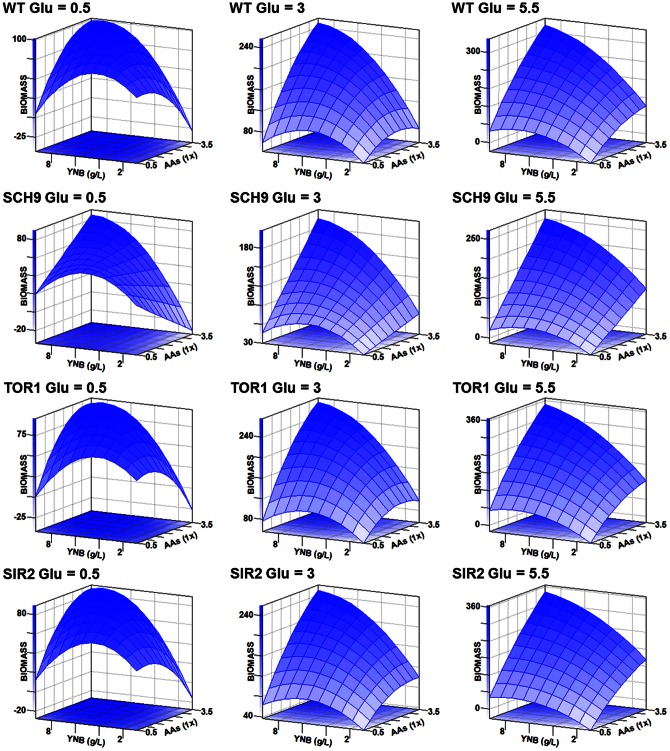
It is known that different strains had significant lifespan changes in various media; however, this result was not observed in biomass production. On the contrary, the biomass production of the four strains had similar change trends among the 15 media. Firstly, the Pearson coefficient (r) of WT with SCH9, TOR1, and SIR2 were 0.97 (P<0.0001), 0.99 (P<0.0001), and 0.99 (P<0.0001), respectively (Table2), but for lifespan, the corresponding r values were 0.18 (P = 0.52), 0.30 (P = 0.28) and 0.52 (P = 0.04). Secondly, all linear terms (AA, YNB and GLU) and all cross terms (AA*YNB, AA*GLU and YNB*GLU) had positive effects, and all quadratic terms (AA*AA, YNB*YNB, GLU*GLU) had negative effects on biomass production in the four strains and most estimates of these terms were significant (P<0.005). However, these results were clearly different from the data on lifespan (TableS2). Thirdly, the response surface plots illustrated that biomass production of the four strains cultured in various concentrations of amino acids, glucose and YNB had similar trends (Figure4), but the lifespan plot among the four strains showed diverse trends (Figure3).
For the optimal media for maximizing biomass production, as can be seen in Figure4, these response surface plots indicate that only the low level of glucose (0.5%) media had a maximal biomass from the coded concentration range of amino acids (0.5–3.5 ×) and YNB (0.85–9.35 g/L), while the media with middle or high levels of glucose had not, and it meant higher nutrient amounts in media produced higher biomass for all the four stains.

Response surfaces for biomass production of yeast cultured at various concentrations of amino acids (AAs), glucose (Glu), and yeast nitrogen base (YNB). For each strain, three AA/YNB-lifespan plots are shown at specific glucose levels 0.5% (low), 3% (media) and 5.5% (high) respectively. The AAs concentration ranged from 0.5× to 3.5× and YNB from 0.85 to 9.35 g/L. These surface-response plots displayed similar trends in the four strains. All these surface-response plots were generated automatically by SAS program, and those surface plots for lifespan are seen in. 0064448
SCH9 is more responsive in nutrient-sensing than the other three strains
To explore the responses of the four strains to various nutrient compositions, we studied cell growth in the 15 media, SD and the YPD medium. As shown in FigureS3, the yeast cells of WT, tor1Δ, and sir2Δ grew well, and biomass production was dependent on the available nutrients in the media. In contrast, growth of sch9Δ cell was greatly disturbed in some media, the cells cultured in media 1, 3, 5, 6, and SD did not grow better than the yeast in other media. Nevertheless, we found that sch9Δ grew well and the growth curves were similar to those of the other strains when cultured in a few media such as 7, 11 and YPD. Thus, this result could indicate that the growth of sch9Δ was more sensitive to nutrients than the other three strains.
We also observed that the phenotype of strain sch9Δ cells would gather together in several media (FigureS4). Moreover, these aggregative cells formed macroscopic agglomerates and settled to the bottom of sample vials. In addition, this aggregation phenomenon can be seen from the growth curve (FigureS3) that had a clear descending trend after the maximal OD660 value, such as 1, 2, 3, 6, 8, 12, 13, 14, 15 and SD. However, this phenomenon was not found in other strains (FigureS3, S4), and the aggregation did not relate to biomass production and lifespan (Figure2). Overall, these results suggest that Sch9 regulates cell growth was highly sensitive to the nutrient ratios.
Aging media pH is dependent on glucose concentration and has no apparent correlation with lifespan
In the yeast CLS model, acidification of the culture media accelerates chronological aging when cells are cultured in a SD liquid media [16], [17], [18]. The pH of a yeast aging culture is dependent on the media composition, especially glucose concentration. Yeast cells metabolize glucose and other substrates such as amino acids to produce some acids via glycolysis and citric acid cycle such as acetic, pyruvic and succinic acids that acidify the media. In this study, we examined pH changes in different media in wild-type and sch9Δ (Table 1) and analysed the correlations among pH, amino acid, YNB, glucose, lifespan and biomass (Table 3). We found that the pH of aging cultures ranged from 2.7 to 6.8 and pH at day 2 and day 4 had no significant difference, which was consistent with a previous study [16]. In addition, the pH of wild-type cultures had a similar trend instead with that of sch9Δ strain, which might indicate that pH changes of different media were independent of deletion of SCH9. Furthermore, the pH of the two strains at two age-points had a strong correlation with the glucose content in the media, but had no correlation with lifespan or biomass. This result suggested that nutrient composition could offset the effect of extracellular low pH to influence yeast CLS under the current experimental conditions, possibly due to intracellular buffering capacity [36]. The pH as one determinant of CLS was also observed only in a few cases in this study (media 7 versus media 8). It should be noted that simply buffering the pH of the standard The SD medium (CBS) could result in CLS that is greater than any of the 15 media compositions (Table 1) in WT strain. For unbuffered conditions, previous studies focused on glucose percentage in media and did not consider amino acids and YNB composition, thus it was concluded that low pH accelerates chronological aging and pH neutralization increases CLS in the standard The SD medium [17], [18]. In this study, we compared the lifespan of yeast in various media with changes in YNB and amino acids, which likely affected the chronological viability by alleviating the negative impact of media acidification and acetic acid toxicity.
| nutrient | WT | Δsch9 | ||||||||||
|---|---|---|---|---|---|---|---|---|---|---|---|---|
| AA | YNB | Glucose | pH day 2 | pH day 4 | Lifespan | Biomass | pH day 2 | pH day 4 | Lifespan | Biomass | ||
| AA | 0 | 0 | 0.53 | 0.42 | 0 | 0.54 | 0.6 | 0.5 | 0.48 | 0.57 | ||
| nutrient | YNB | 1 | 0 | 0.18 | 0.04 | 0.1 | 0.46 | 0.24 | –0.01 | –0.37 | 0.41 | |
| Glucose | 1 | 1 | –0.72 | –0.74 | 0.03 | 0.42 | –0.65 | –0.67 | 0.53 | 0.41 | ||
| pH day 2 | 0.06 | 0.55 | 0.01 | 0.96 | –0.07 | 0.04 | 0.99 | 0.93 | –0.27 | 0.03 | ||
| WT | pH day 4 | 0.15 | 0.9 | 0.0056 | <.0001 | –0.16 | –0.11 | 0.92 | 0.98 | –0.28 | –0.12 | |
| Lifespan | 0.99 | 0.74 | 0.92 | 0.83 | 0.6 | 0.35 | –0.04 | –0.17 | 0.25 | 0.36 | ||
| Biomass | 0.06 | 0.12 | 0.16 | 0.9 | 0.73 | 0.25 | 0.12 | –0.06 | 0.2 | 0.97 | ||
| pH day 2 | 0.03 | 0.44 | 0.02 | <.0001 | <.0001 | 0.9 | 0.7 | 0.91 | –0.17 | 0.11 | ||
| Δsch9 | pH day 4 | 0.08 | 0.98 | 0.01 | <.0001 | <.0001 | 0.59 | 0.85 | <.0001 | –0.14 | –0.05 | |
| Lifespan | 0.09 | 0.21 | 0.06 | 0.37 | 0.35 | 0.41 | 0.51 | 0.57 | 0.64 | 0.29 | ||
| Biomass | 0.04 | 0.16 | 0.16 | 0.93 | 0.7 | 0.22 | <.0001 | 0.73 | 0.88 | 0.33 | ||
The optimal The SD medium for yeast
Based on the four strains used in this study, the media 12 would be the best one for yeast since it produced the maximal biomass and lifespan (TableS3). However, it produced a shorter lifespan than the YPD and pH buffered The SD medium in the WT strain (Figure 2, Table 1). It has a slight influence on cell growth in sch9Δ (FigureS3, S4). In addition, our results showed the WT cultured in YPD (2% glucose) had a remarkable longevity (Figure1). The other three strains (data not shown) also showed lifespan extension. All four strains grew well in YPD and there was no aggregation in sch9Δ (FigureS3). However, not all the chemicals used in YPD are known, thus YPD was not an ideal media for investigating the effects of nutrient components on aging.
On the other hand, the standard The SD medium is better suited for yeast aging study, and we can conveniently modify amino acid compositions to identify optimal amino acid requirements of specific mutants. For yeast aging study, development of an ideal The SD medium mimicking YPD that can meet cell growth requirements and achieve longevity for most strains would be interesting but hard to achieve. In this study, we found that not only glucose and amino acids but also YNB played a significant role in regulating lifespan and biomass production of yeast strains, especially of sch9Δ. Thus, modification of amino acids and YNB composition was important for development of a better The SD medium for yeast aging study.
Discussion
In this study, we used a high throughput screening assay to comprehensively evaluate the relationships between nutrients (glucose, amino acids and YNB) and lifespan as well as biomass production in four yeast strains (wild-type BY4742, sch9Δ, tor1Δ, and sir2Δ). Experimental design based on the classical RSM with a total of 1024 treatments (4 strains ×16 media ×16 repeats) was applied to show that different strains cultured in various media had similar response surface trends in biomass production and viability at day 2, but very different trends in lifespan. All the three groups of nutrients and their interactions played different roles in regulation of lifespan of different strains. In addition, we propose that viability at day 2 might represent the biomass production of the media since it had a good correlation with measured biomass based on the OD660 values of the media. Furthermore, our findings indicate that lifespan extension by DR regime was dependent on nutrients in media and that nutrient composition was a key factor for longevity of yeast.
Recent studies have revealed that nutrition influences the biological aging process in different model organisms, especially the macronutrients including carbohydrates, fats, proteins, and water [8], [10], [11], [37]. This information is particularly important because of its potential for developing interventions to prevent age-related diseases and promote healthy aging.
The common media for yeast aging study is the SD medium containing a limited amount of nutrients, which mimics yeast survival in the wild [35]. The The SD medium contains glucose, YNB, ammonium sulphate, and an amino acid mixture. YNB contains salts, vitamins and trace elements (TableS1). For the standard The SD medium, it has been shown that DR (0.5% glucose) can extend yeast replicative and chronological lifespan in various strains, as compared to the normal condition (2% glucose). However, recent studies on flies also suggest that the traditional observation on DR-induced longevity was mainly due to nutrient balance. This indicates that the imbalance between dietary and other nutrients resulted in lifespan reduction under normal conditions [8], [14], [20]. In addition, DR in mammals is commonly defined as reduction in dietary intake without malnutrition by 10% to 50% of ad libitum[2], [23]. However, DR in yeast is modeled by glucose restriction and reducing the glucose level in the The SD medium from 2% (normal condition) to 0.5% (moderate DR) or to 0.05% (severe DR) can extend lifespan of different yeast stains [15].
Recent studies suggest that the low glucose induced longevity was partially due to decreased production of acetic acid and reduced media acidification for two possible reasons: (1) acetic acid was identified as an extracellular mediator of cell death during chronological aging, and it was demonstrated that environmental interventions by reducing or eliminating acetic acid increased CLS, such as via DR, using non-fermentable carbon source, or transferring cells to water [16]; (2) pH neutralization was demonstrated to protect against reduction in RLS and CLS in yeast [17], [18], [29], extracellular acidification of the culture media could cause intracellular damage that subsequently limited the cell replicative potential, and the reduced RLS and CLS could be extended by buffering the pH of media to 6.0 [18].
In this study, we also examined impact of DR, growth on a non-fermentable carbon source, transferring yeast to water (unpublished data), deletion of SCH9 and RAS2, and growth in high osmolarity or buffered media. Consistent with previous observations, we found that all these factors could extend yeast CLS. However, our results also showed that low glucose level media (low acetic acid content and high pH) resulted in CLS reduction (Fig. 1,2,3), and that the relatively high glucose media (high acetic acid content and low pH) extended CLS (media 6 versus media 5 or media 12 versus media 10). In addition, we measured the acetic acid contents of different cultures of wild-type and sch9Δ at day 2 and found the acetic acid concentration was relatively low (<10 mM) and could only be detected in a few high glucose media (unpublished data). This indicates that acetic acid might not always be the key determinant of CLS, which is supported by others [38]. It is likely that the effect of acetic acid on yeast survival is condition-dependent, such as media composition, nutrient composition, and buffering capacity of both extracellular and intracellular media [36].
Due to the complexity of the factors impacting yeast ageing, at present, it is still not clear why our observations differ from prior studies (low glucose, <0.5%). One possibility might be that our study focused on the effects of nutrients (not only glucose, but also YNB and amino acids) on CLS of yeast in the SD medium. YNB and the initial amino acid composition could alter the intracellular pH of the aging culture, affect the yeast cell survival, and negate acetic acid toxicity. Another possibility might be that our conditions were not optimized for CLS extension by low glucose (< 0.5%). It should be noted that the different results were also likely attributable to differences in the media composition and culture conditions. For example, we modified the amino acid composition of the SD medium (Table S1), which is different from prior studies. Although we followed similar composition of some amino acids such as L-arginine, L-methionine, L-serine, L-tryptophan, and L-tyrosine [22], [39], we used a shaker incubator with a high capacity of 600 aging culture vials (4 mL, 15×45 mm, with plastic caps) with a relatively small media volume of 1 mL, which is greatly different from other laboratories, where bigger culture containers with more liquid media, were used. This could result in different cell population, culture aeration and oxidative metabolism [38]. Furthermore, yeast CLS is influenced by additional factors, including strain auxotrophy, the way the cultures are aerated, the use of 96-well microplates, the use of spectrophotometric vs. CFU-based methods for quantifying viability. All these factors may have contributed to the different observations. The current work did not necessarily disprove previous findings of acetic acid/pH as one important factor for yeast aging, although cautions should be exercised in interpretation of data (e.g. experimental conditions applied). The findings from our laboratories need to be validated by different laboratories and further work is needed to understand the reasons for these different observations about the effect of pH on lifespan, for example, using buffered media with different nutrient composition.
YPD would be a good media for cell growth and longevity study since it contains yeast extract and peptone, which are rich in many types of nutrients. It has applications in diverse yeast strains [27], [28]. The YPD medium was chosen for the DR study in yeast chronological aging model mainly due to two factors. Firstly, it allows isolation of quiescent and non-quiescent cells from the stationary phase cultures grown in the YPD medium [28], [40]. Secondly, the shape of mortality curves for yeast grown in the nutrient-rich YPD medium was similar to the mortality patterns observed in multicellular eukaryotes [41]. Furthermore, yeast grown in the YPD medium containing 0.2% or 0.5% glucose lived significantly longer than that grown at 0.05%, 1% or 2% glucose [27], which suggests that the glucose level affects lifespan of yeast as observed in many higher eukaryotes.
It has been reported that amino acid balance plays a critical role in regulation of lifespan in rat, fly and yeast, independently of DR [9], [13], [19], [42], [43], [44]. Methionine restriction can decrease visceral fat mass, preserve insulin action, and prolong lifespan in rats independent of DR [43]. In Drosophila, adding methionine alone to DR condition increased fecundity as much as that under regular feeding and without reducing lifespan [9]. In Saccharomyces cerevisiae, a few studies have shown that reduction in methionine increased the replicative lifespan (RLS) [42] and removal of either asparagine or glutamate can significantly increase CLS [6]; furthermore, addition of isoleucine, threonine, valine, and leucine can extend CLS [19]. However, these studies focused only on amino acids and did not consider other nutrients present in the media; thus, the relationship between glucose and amino acids in regulation of lifespan was still not established.
In this study, we found that not only glucose and amino acids, but also YNB, played a significant role in regulation of yeast lifespan and biomass production; the three groups of nutrients and their interactions played different roles in regulation of lifespan of different strains. Our objective was not to produce an optimal media for yeast aging studies, but to demonstrate the fact that optimizing culture media by single nutrient variation is not sufficient to maximize the lifespan or biomass of yeast, although some studies have confirmed that glucose or a few amino acids are important for longevity of yeast and simple modification of one of these nutrients can greatly extend lifespan [6], [19]. With a suitable experimental design, we can obtain an optimal The SD medium to maximize the lifespan for a specific yeast strain.
For lifespan, strain sch9Δ seemed to be more sensitive to nutrients, since more terms had significant (P<0.001) effects on lifespan in sch9Δ than in the other strains (TableS2). The AGC kinase Sch9 is a substrate of multiprotein complex TORC1, and its function may be similar to the mammalian TORC1 substrate S6K1 [45]. In yeast, Sch9 regulates cell growth and cell size, the absence of Sch9 activity causes a small size phenotype and distinct growth defect, while increasing lifespan by seven-fold [46], [47], [48]. The Tor-Sch9 pathway was thought previously to be a nutrient-sensing pathway [23], [49].
In this study, we have confirmed and extended previous work by showing that deletion of TOR1 regulates yeast CLS subjected to amino acids and glucose concentrations (Table S2). It is remarkable that our data have shown that the sch9Δ strain is more responsive in nutrient-sensing than the other three strains. Sch9 protein kinase was proposed previously as a central coordinator of protein synthesis [50] in promoting ribosome biogenesis and ribosomal protein gene expression [51]. Thus, it is possible that Sch9 acts as a major nutrient-sensing factor to regulate cell growth, cell size, and stress resistance through control protein synthesis. However, further experiments on quantifying Sch9 activity in different media are warranted to delineate the role of SCH9 plays in our system.
In conclusion, our findings indicate that lifespan extension by DR may be partially dependent on nutrient composition and could be abolished by providing yeast with different nutrient compositions. Furthermore, our results show that sch9Δ is more nutrient-sensitive than the other three strains tested. Modification of amino acids and YNB compositions is an important factor to consider if one were to develop an optimal The SD medium that can meet the cell growth requirements and enable longevity of most strains for yeast aging studies and evaluation of anti-aging activity of small molecules. Our results also document that nutrient composition is an important factor for yeast CLS. Different yeast strains cultured in various media exhibited similar response surface trends in biomass production, but showed greatly different trends in lifespan. The three nutrients (glucose, amino acids and YNB) and their interactions played different roles in affecting lifespans of different strains. Taken together, our findings suggest that nutrient composition is an effective way to optimize lifespan and biomass production in yeast.
Materials and Methods
Materials
The wild-type strain Saccharomyces cerevisiae BY4742 (MATα his3Δ1 leu2Δ0 lys2Δ0 ura3Δ0) and single gene deletion mutant strains in the BY4742 genetic background were obtained from Thermo Scientific Open Biosystems (Huntsville, AL, USA). The culture of each yeast reference strain was aliquoted into 10 µL and stored at –80°C. All L-amino acids were from GL Biochem (Shanghai, China), yeast nitrogen base w/o amino acids (YNB), peptone, agar, yeast extract were from Amresco (Solon, OH, USA). YPD Broth and other chemicals were from Sigma-Aldrich Chemical Company (Singapore).
Experimental design and statistical analysis
The three experimental factors under study were glucose, amino acids, and YNB in synthetic defined (SD) media (TableS1). Values for these parameters were chosen to test conditions known to produce significant effects on lifespan from our previous study [21]. To test for the curvature of the responses, three levels of each nutritional parameter were required (Table 1). A Box-Behnken design based on response surface methodology (RSM) was chosen to estimate the responses of both the linear and the quadratic behavior over the design region to minimize the number of experiments [21]. This design was generated from the SAS program (version 9.2, SAS Institute Inc, Cary, NC, USA), and required a total of 15 runs, including three center points (run 13, 14 and 15).
Lifespan, biomass and yeast cell growth assay
The determination of chronological lifespan of yeast was carried out according to the method described previously [22], [39]. In brief, the yeast cells were prepared by transferring a streaked strain from frozen stocks onto YPD (1% yeast extract/2% peptone/2% dextrose) agar plates. After incubating the cells at 30°C for 2 days or until colonies appeared, a single colony was picked and inoculated into 1.0 mL YPD liquid media (Sigma YPD Broth, Louis, MO, USA) in a 4-mL glass vial and cultured at 30°C for 2 days in a flat incubator at 200 rpm. The 2-day YPD culture was diluted with autoclaved 18 mΩ milli-Q grade water (1:10) and stored in refrigerator at 4°C for at least 24 h. After one day incubation at 4°C, 5 µL (≈ 1×10⁴ cells) of the diluted culture was transferred to 1.0 mL of different aging media and maintained at 30°C, 200 rpm for the entire experiment. After 2 days of culture in aging media, the cells reached stationary phase and the first age-point was ready to be taken. Subsequent age-points were taken every 2–4 days. For each age-point, 5.0 µL of the mixed culture was pipetted into each well of 96-well microplate (Nunc, Rochester, NY, USA). One hundred microliter YPD medium was then added to each well. The cell population was monitored with a Synergy HT microplate reader (BioTek, Winooski, VT, USA) by recording OD660 every 5 min during 12–24 h. Biomass of each aging vial at one age-point was measured as the average reading of OD values at 660 nm from 10 to 30 min in outgrowth curves, and the total biomass production of each media was defined as the mean biomass from day 10 to day 22 (FigureS2).
After one day incubation of the diluted culture at 4°C, the cells were washed twice with water to remove other nutrients, 5.0 µL of the diluted cells was pipetted into each well of 96-well microplate. One hundredµL of different media was then added to each well. The cell population was monitored with a microplate reader by recording the OD every 5 min at 660 nm (). 0064448
Data analysis
The raw data from the microplate reader were exported to Excel (Microsoft, San Leandro, CA, USA). From the growth curves, the viability of the yeast can be obtained according to our previous report [22]. Survival integral (SI) of each aging culture was defined as the area under the survival curves (AUC) (FigureS1). For surface-response data analysis, the SAS program automatically provides tools that are appropriate for examining the linear and the quadratic effects, for estimating model parameters, for carrying out an analysis of variance (TableS2), for fitting models that can be used to find optimal factor settings, and for generating the surface-response plots (Figure3 and 4). Correlation among lifespan, biomass production and viability of day 2 was computed by using the SAS CORR procedure, which can provide Pearson correlation coefficients and associated probabilities (Table2). The analysis of variance for each set of biological replicates was carried out with the SAS statistical program, and differences between the means of SI for treatments were determined by Duncan's multiple range test at P<0.05.