
What this is
- This research identifies six genes that play causal roles in aging by analyzing gene expression data from various mammals.
- () were assessed across 25 datasets from humans, dogs, and rodents.
- A novel workflow combined gene expression analysis with lifespan studies in Caenorhabditis elegans to evaluate gene effects on longevity.
Essence
- Six genes with significant causal roles in aging were identified through a meta-analysis of gene expression data. The study found that knocking down both age-upregulated and age-downregulated genes can extend lifespan, challenging the notion that reversing age-related gene expression is always beneficial.
Key takeaways
- A total of six genes were pinpointed for their evolutionarily conserved roles in aging. These include both age-upregulated genes, like CASP1, and age-downregulated genes, such as SPARC and CA4, which were shown to significantly extend lifespan when knocked down in worms.
- The study employed a novel value-counting method to rank genes based on their differential expression across multiple datasets. This approach revealed that more genes were commonly upregulated with age, yet significant lifespan extensions were achieved by targeting both upregulated and downregulated genes.
Caveats
- The study's reliance on RNA interference (RNAi) limits its ability to detect positive effects of gene overexpression, potentially overlooking beneficial genes. Additionally, the evolutionary distance between humans and C. elegans may complicate interpretations of gene functions.
- The datasets used were not evenly distributed across tissue types, which may affect the generalizability of the findings. Future studies should aim to include a broader array of tissues to enhance the robustness of conclusions.
Definitions
- Differentially Expressed Genes (DEGs): Genes that show significant differences in expression levels between two or more conditions, such as young vs. old.
Simplified
Introduction
Advanced age is the primary risk factor for most chronic diseases, and as our population ages, the social and economic burden of chronic disease continues to grow year by year (Kennedy et al. 2014). The field of geroscience has emerged to study the mechanisms underlying aging itself and develop strategies to combat age‐related decline, or senescence, at the source. According to the widely accepted evolutionary theory of aging, senescence is pervasive because there is negligible selection pressure during the post‐reproductive period, a phenomenon known as the "selection shadow" (Kirkwood and Austad 2000; Austad and Kirkwood 2008). It is therefore crucial to study the role of genetic variants and gene expression changes in aging in order to uncover potentially advantageous adjustments that have been masked by the selection shadow.
Specialized approaches are needed to detect age‐related gene expression signals, which are often subtle and widespread rather than striking and targeted. Indeed, as noted in the Handbook of the Biology of Aging, differentially expressed genes (DEGs) with the largest fold changes are frequently found to be downstream targets rather than upstream regulators (Hou et al. 2016). Moreover, age‐related phenomena such as transcriptional drift create reproducible expression patterns that are nonetheless stochastic and unregulated, further obscuring meaningful signals (Perez‐Gomez et al. 2020; Bahar et al. 2006; Rangaraju et al. 2015). As stochastic signals are unlikely to replicate across species and tissues, and since frequency is more meaningful than fold change, drivers of aging may ideally be identified using a multi‐species, multi‐tissue meta‐analysis using the value‐counting method. This strategy, first pioneered by de Magalhães et al. (2009) and further developed by Palmer et al. (2021), has been used to catalog numerous individual DEGs as well as broader patterns in functional enrichment and pathway analysis. However, translation of such findings into actionable therapeutic strategies is challenging. Any upregulated gene presumed to be a driver of aging could just as easily be a compensatory geroprotective response or an unimportant downstream effect, often called a "passenger" to contrast with the aforementioned "driver" (Perez‐Gomez et al. 2020; de Magalhães and Toussaint 2004). In other words, as the age‐old adage warns, correlation does not necessarily equal causation.
Functionally evaluating genes related to aging also presents special challenges. Stable cell lines cannot be used to study aging in vitro because of the immortal nature of such lines. In vivo models are more useful, but require time and resources to age the animals and monitor them until their natural death. In mammals, this can entail years of labor, and this is surely one reason why the short‐lived nematode Caenorhabditis elegans has been such a popular model organism in geroscience for decades (Johnson 2008). Although nematodes are only distant relatives of humans, they share remarkably similar features of post‐reproductive senescence, including sarcopenia and reduced motility, deteriorated learning and memory, and weakened immunity (Wilkinson et al. 2012; Son et al. 2019; Chen et al. 2013). In contrast to humans or any mammal, these age‐dependent changes occur on a compressed timescale of days rather than years, with an average lifespan of only a few weeks. On a genetic level, orthologs of roughly half of all human genes have been identified, and tools have been developed to rapidly, easily, and inexpensively knock down those genes in C. elegans worms, making them an ideal choice for reverse genetic screens (Sutphin and Korstanje 2016). However, it is difficult to substantiate findings in C. elegans as relevant to human physiology without any means of contextualizing the results in mammalian systems.
Here, we introduce a workflow to unify two separate approaches, analysis of mammalian DEGs and genetic screening in C. elegans, leveraging the strengths of each to mitigate their respective weaknesses. We first performed a meta‐analysis comparing gene expression in young adults vs. older adults using publicly available datasets comprising samples of various tissues from healthy, untreated mammals (humans, dogs, and rodents). DEGs were ranked by the consistency of differential expression with age across the largest number of datasets. The highest ranking DEGs with known orthologs in C. elegans were then tested using post‐developmental RNA inactivation (RNAi) lifespan assays. Ultimately, we identified six genes with evolutionarily conserved, causal effects on aging that may be prioritized for future mechanistic studies. In addition, we have established a proof of principle for a unified approach for studying evolutionarily conserved mechanisms of aging.
Material and Methods
Meta‐Analysis Dataset Selection
This meta‐analysis was designed as a simple and scalable approach that is nonetheless highly capable of identifying a collection of genes consistently associated with mammalian aging. The intention was to extricate subtle but meaningful age‐related signals from a background of transcriptional drift and stochastic changes that are unlikely to replicate across species, tissues, and experimental platforms. Thus, as the inclusion criteria and exclusion criteria detailed in Table 1 show, any datasets comprising samples from mammals representative of typical individuals at both young adult and older adult time points were eligible for inclusion.
Gene expression data were obtained from publicly available datasets hosted on the National Center for Biotechnology Information (NCBI) Gene Expression Omnibus (GEO) repository (Edgar et al. 2002). The filters "organism: mammal" and "subset variable type: age" were used to identify roughly 200 curated datasets as candidates for the present study as of March 2021. These datasets were then manually inspected using the inclusion and exclusion criteria (Table 1) to identify 25 suitable datasets, which are listed in Table S1.
| Criteria | Included | Excluded |
|---|---|---|
| Data availability | Stored in NCBI GEO database, Includes "age" as subset variable | All other datasets |
| Species | Mammal (human, mouse, rat, dog) | Non‐Mammal (e.g., drosophila,…)C. elegans |
| Tissue type | All (heart, muscle, brain, liver, fat, immune cells…) | None |
| Age | Young adult and older adult in distinct groups | Early development, including embryonic stages as well as juveniles |
| Condition | Healthy, untreated | All diseases (e.g., lupus, tumor samples), All interventions including drugs as well as lifestyle interventions like diet and exercise |
| Genotype | Wild‐type, No genetic condition specified | Mutant, transgenic animals, Humans with specified genetic conditions |
| Sample size | Any (no specific minimum) | Datasets with low sample size became naturally excluded when they yielded no DEGs |
Identification of Differentially Expressed Genes () DEGs
The analysis of gene expression data was conducted using the R software environment version 3.2.3 (R Core Team 2015) and a series of packages from the Bioconductor project, including GEOquery version 2.40.0 (Davis and Meltzer 2007), limma version 3.26.8 (Ritchie et al. 2015), and BioBase version 2.30.0 (Huber et al. 2015). Briefly, by adapting scripts from GEO's own GEO2R tool (Barrett et al. 2013), the data was retrieved and translated to R‐compatible formats via GEOquery and analyzed for DEGs via limma. DEGs were calculated by comparing samples from young vs. old tissues for each individual dataset; individual samples were included or excluded from the analysis using the aforementioned inclusion and exclusion criteria (Table 1). To cast a wide net with high sensitivity to detect DEGs even in datasets with small sample sizes, candidate DEGs were identified in individual datasets using the permissive threshold of adjusted p value < 0.25, controlling for false discovery rates (FDR) using the Benjamini‐Hochberg method. Finally, to facilitate analysis across datasets, all DEGs from nonhuman datasets were converted to their human homologs using the homologene package version 1.4.68.19.3.27 (Mancarci, n.d.).
Value‐Counting Method for Ranking DEGs
The genes were then scored using a variation of the value‐counting method first established in the cancer field (Rhodes et al. 2004) and later applied to age‐dependent gene expression (de Magalhães et al. 2009). This approach enables the integration of gene expression data from diverse species, tissues, platforms, and experimental designs while remaining highly scalable and reproducible. In brief, genes are ranked by the number of datasets in which they are identified as a DEG according to a chosen threshold. Thus, the consistency of differential expression across a variety of datasets is prioritized, whereas individual effect sizes are discarded.
Here, a new variation of the value‐counting method was introduced to further prioritize consistency: ranking was determined based on the absolute value of the difference between upregulation and downregulation scores, where scores were determined by the number of datasets in which the DEG was significantly upregulated and downregulated with age, respectively. This is written formulaically below along with an example.
Let scoresandrepresent the number of datasets in which geneis significantly upregulated and downregulated with age, respectively. The total scoreand rankfor each geneis calculated as follows: S i Up S i Down i S i R i i S i S i Up S i Down = − R i = = S i S i Up S i Down −
For example, if a gene was significantly (adj. p < 0.25) upregulated in 2 datasets and downregulated in 8 datasets out of the total 25 datasets analyzed, this gene would have a rank of 2−8=6. It is important to highlight that a gene with a total score and rank of 0 does not necessarily indicate that the gene was differentially expressed in none of the datasets, as it could also be upregulated and downregulated in an equal number of datasets.
Based on the average number of DEGs identified per dataset in the previous step being 1816 genes out of an average over 30,000 probes per dataset, a binomial distribution with a success rate of 6% and 25 trials can be applied to estimate the final p value for high‐ranking genes. For DEGs of rank 6 or above, the cumulative probability PX≥6 yields a final p value of 0.003:PX≥6=∑j=6n25j0.06j1−0.0625−j
DEGs with a rank of at least 7 () were further analyzed for gene expression patterns across tissues by normalizing to the number of datasets from each tissue type that were analyzed. R i ≥ 7
This value‐counting analysis was conducted using the python software environment version 3.11.5 (van Rossum and Drake Jr 1995), and the data were visualized utilizing the pandas, matplotlib, and seaborn packages (McKinney 2010; Hunter 2007; Waskom 2021).
Pathway Analysis
DEGs with a rank of at least 6 (Ri≥6) were analyzed using pathway analysis in the R software environment to explore their known roles in key biological processes. Rank 6 was set as the cutoff to ensure that the gene would have < 1% chance of achieving this rank by chance alone (p = 0.003, per the binomial distribution above). The Bioconductor package clusterProfiler version 4.8.0 (Wu et al. 2021) was used to perform gene ontology (GO) enrichment analysis. DEGs were mapped to GO biological processes, cellular components, and molecular functions using standard settings (Benjamini‐Hochberg adjusted p < 0.05).
Identifying Worm Orthologs of DEGs
C. elegans orthologs of DEGs with a rank of at least 7 (Ri≥7) were identified using OrthoList 2, which is a compendium of worm genes with human orthologs compiled by a meta‐analysis of several orthology prediction methods (Kim et al. 2018). Where multiple orthologs were available for a given DEG, the highest confidence ortholog was chosen, as indicated by the number of orthology prediction methods supporting orthology. Where multiple orthologs and/or clones were available for a given gene without any discernible way to prioritize one over another, the first item listed in the results was chosen. The final list of orthologs along with the availability of corresponding RNAi clones is shown in Tables S2 and S3. In some cases, when a clone could not be cultured or verified by sequencing (as outlined in the next section below), experiments were conducted using the next clone on the list.
Worm Culture and Post‐Developmental RNAi
Wild‐type (N2) C. elegans worms were maintained on plates of solid nematode growth media (NGM) seeded with Escherichia coli OP50 bacteria at 20°C using standard protocols (Sutphin and Kaeberlein 2009). E. coli HT115 bacteria clones carrying RNAi constructs of interest were obtained from the Ahringer RNAi library (Kamath and Ahringer 2003) and seeded onto solid NGM plates containing Isopropyl β‐D‐1‐thiogalatopyranoside (IPTG) and ampicillin according to standard protocols for the RNAi feeding method (Wilkinson et al. 2012; Timmons and Fire 1998). Briefly, for each gene of interest, an individual colony of RNAi bacteria was cultured in liquid LB medium overnight and then seeded onto plates the following day. In parallel, to confirm the identity of the clones, DNA was isolated from the same culture using the QIAprep Spin Miniprep Kit (QIAGEN, Hilden, Germany), and the inserts were sequenced with an M13‐forward primer using standard Sanger sequencing services by Azenta Life Sciences (South Plainfield, NJ, USA). The seeded plates were incubated at room temperature for 2–3 days, during which time 2′ fluro‐5′ deoxyuridine (FUDR) was added to the plates 24–48 h before transferring worms. Worms were age‐synchronized using the bleaching method with L1 synchronization and allowed to develop to the late L4 stage on standard OP50 plates before being transferred to the plates seeded with the RNAi feeding bacteria, as described in previous post‐developmental RNAi screens (Curran and Ruvkun 2007; Chen et al. 2007).
Lifespan Extension Screen
Lifespan assays were conducted using standard protocols (Sutphin and Kaeberlein 2009). Briefly, worms were scored as alive or dead every 2–3 days by visual observation: apparently motionless worms were gently prodded with a platinum wire pick, and worms that failed to react were scored as dead and removed from the plate. Worms that left the plate surface and dried on the plate wall were censored. For the initial screening, the 19 candidate clones were tested against within‐batch GFP RNAi negative controls as well as the well‐known daf‐2 RNAi positive control (Dillin et al. 2002). For every clone tested, the initial screening included roughly 80–100 worms spread across multiple plates, with approximately 20 worms per plate. For the subsequent validation of the clones that significantly extended lifespan in the initial screening, each group included roughly 100–120 worms, with approximately 25 worms per plate, tested against GFR RNAi and empty L4440 vector negative controls as well as the daf‐2 RNAi positive control.
Lifespan Extension Analysis
Lifespan was defined as the number of days until death, starting from the first day of adulthood (3 days after L1 synchronization). The Online Application for Survival Analysis 2 (OASIS 2) tool was used to calculate mean, median, and maximum lifespans for each group as well as to compare test groups using the log‐rank test (Han et al. 2016). An RNAi clone was considered to have extended lifespan if the log‐rank test comparing that clone to the GFP RNAi negative control within the same batch was significant (p < 0.05 with Bonferroni multiple test correction) in both the initial screen and the subsequent validation screen. Survival data was then plotted as survival curves using GraphPad Prism version 10.2.3.403 for Windows.
Results
Meta‐Analysis Datasets Were Derived From a Variety of Mammalian Tissues
Twenty‐five publicly available gene expression datasets were selected from the NCBI GEO repository according to the inclusion and exclusion criteria outlined in Table 1, and their traits and NCBI identification numbers are listed in Table S1. The predominant species represented in this analysis was mouse, constituting roughly half the datasets (13), followed by human (6), then rat (5), then dog (1). Most datasets were derived from muscle (7) and brain (5) tissues, but also well represented were adipose tissues (3) as well as immune cells and their precursors (3), with smaller contributions from the heart, liver, trachea, cochlea, and reproductive tissues (Figure S1A). The number of DEGs extracted from each dataset varied widely, ranging from six genes to 3631 genes (median, 1509; interquartile range 466–3159). If each instance of a DEG being extracted is considered a data point, then the sum total of data points contributed by most tissues ranged from roughly 4000 to 11,000; however, cochlea, trachea, and reproductive tissues contributed strikingly fewer, with less than 1000 data points each (Figure S1B). These results reflect the wide variety of studies contributing to this analysis, with varying experimental methods as well as unequal availability of samples from different tissues, particularly from human subjects.
High‐Ranking Genes Were Consistently Differentially Expressed With Age Across Diverse Tissues
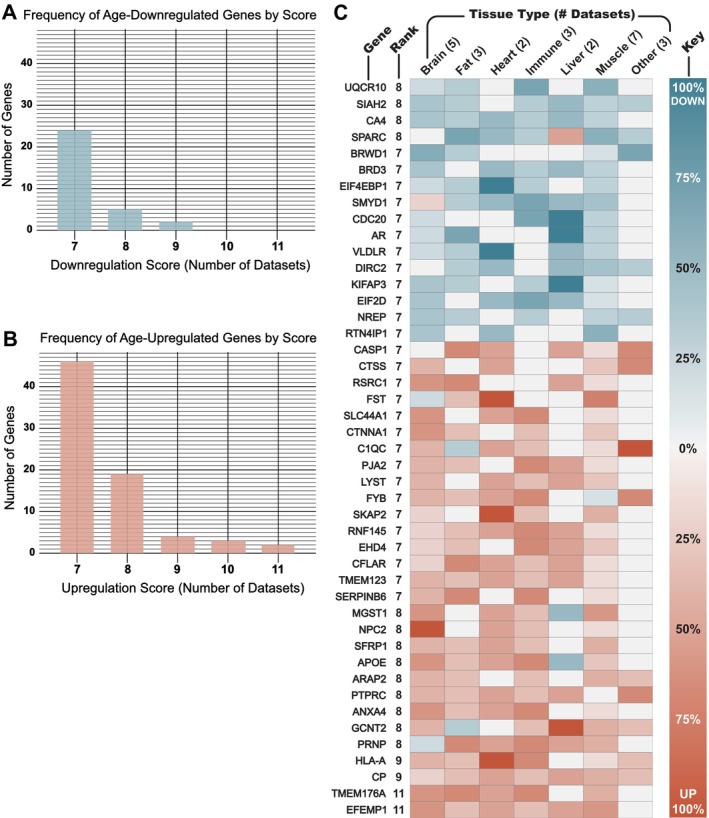
Using the value‐counting method, every gene was assigned upregulation and downregulation scores corresponding to the number of datasets in which that gene was significantly upregulated and downregulated with age, respectively (FDR‐adjusted p < 0.25). In general, more genes were commonly upregulated than downregulated with age. Out of a highest possible score of 25 (total number of datasets), the highest downregulation score was 9 (Figure 1A), and the highest upregulation score was 11 (Figure 1B). Similarly, only 31 genes achieved a downregulation score of 7 or more, whereas 74 genes reached an upregulation score of 7 or more.
To narrow the list of DEGs to those with the most consistent age‐related trends, genes were ranked according to the absolute value of the difference between their upregulation and downregulation scores. Thus, genes exhibiting opposing trends in different species or tissues were not ranked highly. Although there were 105 genes with a downregulation or upregulation score of at least 7, there were only 45 genes that ranked 7 or above after the opposing score was subtracted. The highest‐ranking age‐upregulated genes were EFEMP1 (Rank 11), TMEM176A (11), CP (9), and HLA‐A (9); the highest‐ranking age‐downregulated genes were CA4 (8), SIAH2 (8), SPARC (8), and UQCR10 (8). Ranks were used to select DEGs for further analyses and experiments: rank 6 was used as the cut‐off to select 130 DEGs for pathway analysis, and rank 7 was used as the cutoff to select 45 DEGs for in vivo testing in C. elegans. Although rank 6 was statistically sufficient per the binomial distribution described in the Methods section, the resource‐intensive nature of the in vivo experiments necessitated further narrowing of the list to fewer candidates with the most consistent gene expression patterns.
The 45 highest‐ranking DEGs, comprising 16 age‐downregulated and 29 age‐upregulated genes, are listed in Figure 1C with a heatmap displaying the tissues that contributed to each gene's rank. For example, EFEMP1, which was tied for the highest‐ranking gene, was significantly upregulated in datasets from mouse liver and hematopoietic stem cells, rat heart and adipose tissues, and both human and mouse brain and muscle tissues; EFEMP1 was not significantly downregulated in any of the 25 datasets analyzed. As illustrated in the heatmap, no gene was able to achieve this high rank without being consistently differentially expressed in datasets from at least three distinct tissue types, and often more. The genes CA4 and CP were notable for being consistently differentially expressed across all six major tissue types studied as well as being among the top four highest‐ranking downregulated and upregulated genes, respectively. The only gene differentially expressed in 100% of datasets from a major tissue type (3 or more datasets) was NPC2, which was age‐upregulated in all five datasets from the brain, as well as a handful of datasets from heart, muscle, and immune tissues. Collectively, these findings illustrate how the meta‐analysis ranking system was able to reveal genes with striking age‐related expression patterns.

Genes most consistently differentially expressed with age in mammalian tissues. Every gene had a downregulation scoreand an upregulation scorerepresenting the number of datasets in which the gene was significantly downregulated and upregulated with age, respectively (Benjamini‐Hochberg adjusted < 0.25). The rankof each gene was calculated as the absolute value of the difference between these two scores, the total score:. (A) There were 31 genes with, and the most consistently downregulated genes had a score of. (B) There were 74 genes with, and the most consistently upregulated genes had a score of. (C) The heatmap shows the gene symbol, rank, and normalized tissue‐specific expression trends for all 45 genes of rank, comprising 29 age‐upregulated genesand 16 age‐downregulated genes. Heatmap values range from 100% down to 100% up, representing as a percentage the fraction, or the total scoredivided by the number of datasetsderived from only the specified tissue type. S Down S Up R S R = = ∣ − ∣ S S Up S Down S Down ≥ 7 S Down = 9 S Up ≥ 7 S Up = 11 R R ≥ 7 S > 0 S < 0 ∣ / ∣ S tissue n tissue S n p
Gene Ontology Patterns Were Consistent With Previous Literature
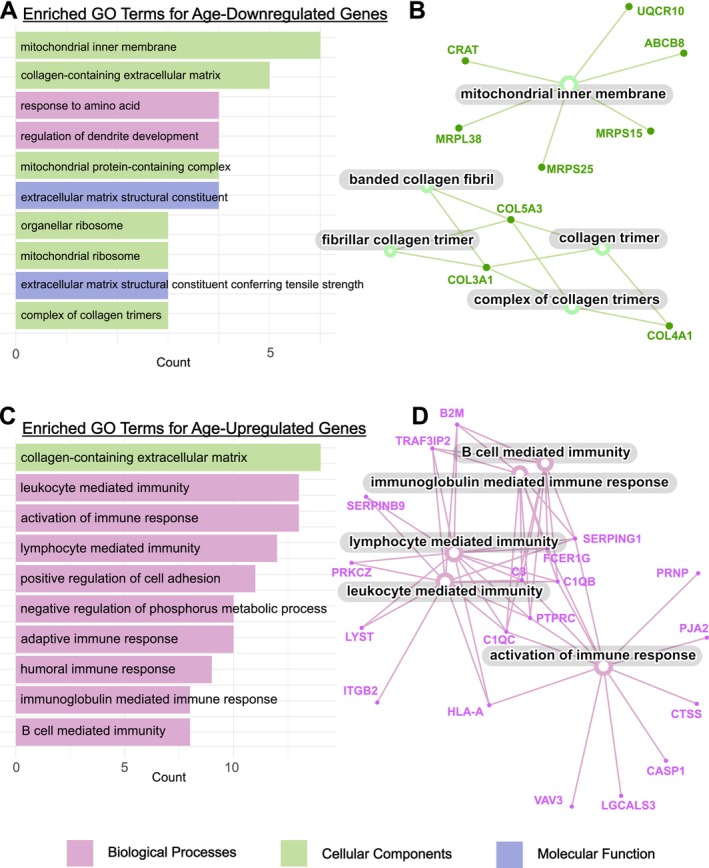
Gene ontology (GO) enrichment analysis was performed to assess how high‐ranking DEGs could be categorized into recognizable functional groups and pathways. For this analysis, the cutoff was relaxed to include DEGs of rank 6 and above, yielding a pool of 40 age‐downregulated and 90 age‐upregulated genes. The GO term matching the largest number of genes from the downregulated pool was the mitochondrial inner membrane, and several additional terms related to mitochondria were enriched as well (Figure 2A,B). Also strongly represented were both cellular components and molecular functions related to extracellular matrix (ECM) proteins, particularly collagens. Of note, collagen‐containing extracellular matrix is one of the largest, broadest GO terms, with nearly 400 member genes, and included both age‐downregulated and age‐upregulated genes in our analysis. Notable age‐upregulated genes in this group were enzymes involved in cleaving and cross‐linking ECM components, such as transglutaminase 2. The overwhelming majority of the GO terms enriched among age‐upregulated genes were biological processes related to immune activity, especially adaptive immunity (Figure 2C,D). The results of this pathway analysis largely aligned with expectations and patterns observed in previous studies, reinforcing the validity of the meta‐analysis design and execution.

Gene ontology (GO) enrichment analysis of the 130 genes ranked highly for consistent differential expression with age, including 40 age‐downregulated genes and 90 age‐upregulated genes. For each group, bar charts display the top ten GO terms, colored according to three major GO term categories shown in the key. (A) Among age‐downregulated genes, the most well‐represented GO category was Cellular Components (CC, green). (B) The CC category is displayed in more detail in the accompanying network diagram, highlighting the downregulation of collagen‐related and mitochondrial membrane‐related genes. (C) Among age‐upregulated genes, the major category was Biological Processes (BP, red). (D) The BP category is expanded to show the variety of immune response‐related genes upregulated with age. The data were analyzed and visualized in R using thepackage standard settings including Benjamini‐Hochberg adjusted < 0.05. clusterProfiler p
Knocking Down Orthologs of Several MammalianExtended Lifespan in DEGs C. elegans
To prepare for these in vivo experiments, C. elegans orthologs of the highest‐ranking mammalian DEGs were identified using OrthoList 2, and corresponding RNAi clones were cultured and verified by Sanger sequencing. Of the 16 age‐downregulated DEGs, 11 (69%) were conserved in C. elegans, and verified RNAi clones for 9 of these orthologs were successfully cultured (Table S2). Of the 29 age‐upregulated DEGs, 16 (55%) were conserved, and 10 clones were obtained (Table S3). In total, 19 RNAi clones were prepared for knock‐down experiments.
To examine the effect of each gene on organismal senescence regardless of any role in embryonic and juvenile development, bacteria carrying each of these 19 RNAi clones were fed to the worms post‐developmentally, and the impact on lifespan was recorded. Post‐developmental knockdown of five of the nine age‐downregulated genes significantly extended lifespan relative to negative controls during the initial screening experiments (≥ 5% lifespan extension, p < 0.05 by log‐rank test, n = 80–100, Table S2). Knockdown of C42C1.8, ortholog of DIRC2, produced the largest effect at 50% extension. Of the ten age‐upregulated genes tested, four significantly extended lifespan, with EFEMP1 exhibiting the largest effect at 45% extension (Table S3). All experiments yielding statistically significant results were later repeated in an independent validation experiment using a single freshly thawed colony of worms to mitigate genetic drift and inter‐batch variability (n = 100–150).
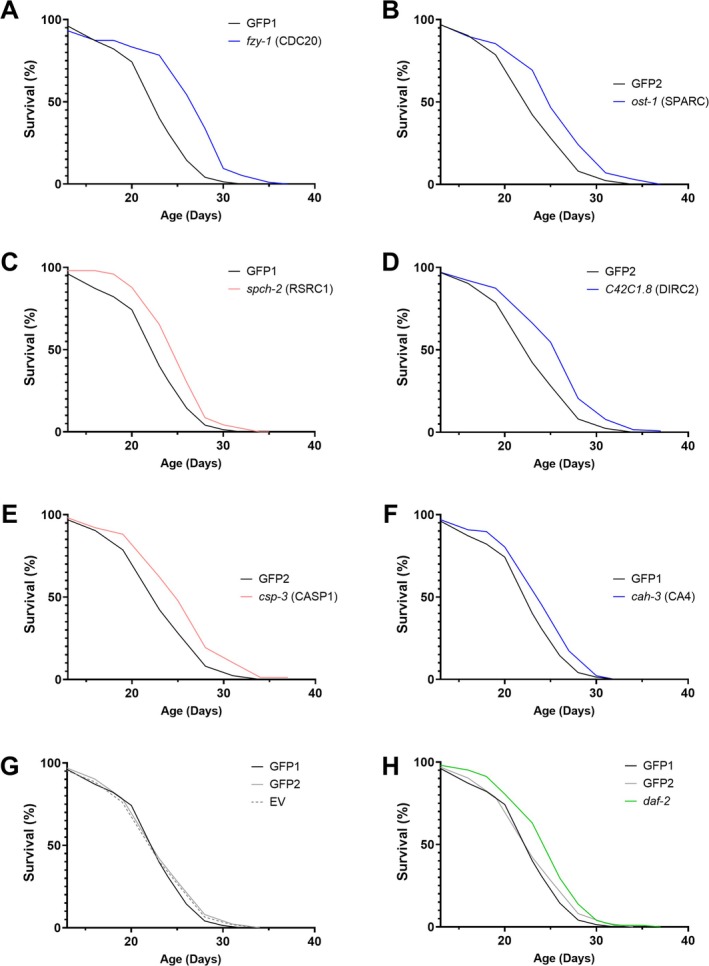
A total of six RNAi clones significantly extended lifespan in the validation experiments as well as in the initial screenings. In order from largest to smallest mean lifespan extension, these RNAi knockdowns targeted: fzy‐1 (ortholog of CDC20), ost‐1 (SPARC), spch‐2 (RSRC1), C42C1.8 (DIRC2/SLC49A4), csp‐3 (CASP1), and cah‐3 (CA4) (Figure 3A–F). The two age‐upregulated targets were spch‐2 (RSRC1) and csp‐3 (CASP1), whereas the other four targets were age‐downregulated. Mean lifespan extension ranged from 9% to 15%, median extension from 6% to 19%, and maximum lifespan from 4% to 15% relative to within‐batch GFP controls, which averaged a lifespan mean of 23.35, median 22.14, and maximum 27.29 days (Table 2). The validation experiments demonstrated minimal variability, evidenced by the overlapping survival curves of the three independent negative control groups (Figure 3G). The degree of lifespan extension was comparable to the positive control RNAi against daf‐2 (Figure 3H), which extended mean lifespan by 9%, median by 9%, and maximum by 7% (n = 103, log‐rank test, Bonferroni‐adjusted p < 0.01, Table 2).

survival curves for lifespan‐extending post‐developmental RNAi targeting orthologs of mammalian DEGs, including age‐downregulated (blue) and age‐upregulated (red) genes. Each RNAi clone significantly extended lifespan (A–F, log‐rank test, Bonferroni‐adjusted < 0.05) in two independent experiments, and the results of the second experiment are shown here ( ≈ 100–150 worms per group). This experiment was performed in two back‐to‐back batches with an internal GFP control group in each batch (GFP1 for batch 1, GFP2 for batch 2). (G) Negative control GFP groups performed very similarly to each other (solid lines) and to the alternative empty L4440 vector control (dotted lines). (H) The RNAi clone Ahringer III‐7G14 againstwas used a positive control (green). For detailed quantification, see Table . Caenorhabditis elegans p n daf‐2 2
| Human DEG | Worm Ortholog (Clone) | Number subjects | Mean lifespan ± Standard error (%Extension) | Median lifespan (%Extension) | Maximum lifespan (%Extension) | Correctedvaluep |
|---|---|---|---|---|---|---|
| CDC20 ↓ | (II‐4O16)fzy‐1 | 103 | 26.21 ± 0.56 (15%) | 26.41 (19%) | 29.96 (12%) | < 0.001 |
| SPARC ↓ | (IV‐9H03)ost‐1 | 143 | 26.38 ± 0.46 (11%) | 24.91 (12%) | 31.89 (15%) | < 0.001 |
| DIRC2 ↓ | (IV‐6D23)C42C1.8 | 151 | 26.09 ± 0.4 (10%) | 25.41 (15%) | 30.47 (10%) | < 0.001 |
| CA4 ↓ | (X‐7 M16)cah‐3 | 98 | 24.66 ± 0.44 (8%) | 23.48 (6%) | 28.45 (6%) | < 0.001 |
| RSRC1 ↑ | (I‐3C03)spch‐2 | 99 | 25.31 ± 0.38 (11%) | 24.31 (10%) | 27.87 (4%) | < 0.001 |
| CASP1 ↑ | (I‐5P02)csp‐3 | 101 | 25.93 ± 0.49 (9%) | 24.7 (12%) | 31.06 (12%) | < 0.01 |
| Positive Control | (III‐7G14)daf‐2 | 103 | 24.95 ± 0.42 (9%) | 24.17 (9%) | 28.77 (7%) | < 0.01 |
Knocking Down Orthologs of Several MammalianExtended Lifespan in DEGs C. elegans
Lastly, the expression patterns of the six genes that consistently extended lifespan in worms were re‐examined in our mammalian datasets (Figure ). CASP1 and RSCR1 were age‐upregulated in seven datasets each with no age‐downregulation. CA4, DIRC2, and CDC20 were age‐downregulated in seven or eight datasets each with no age‐upregulation. SPARC was age‐downregulated in nine datasets but also age‐upregulated in one dataset derived from mouse liver. All six were differentially expressed with age in multiple mouse tissues; all except CDC20 were also differentially expressed in human tissues; and all except CA4 also in rat tissues. All six genes were differentially expressed in at least one of the seven datasets from muscle, which is unsurprising, but also one of only two datasets from liver, which is a much higher rate. Expression patterns in adipose tissue were also prominent: CASP1, RSCR1, and SPARC were differentially expressed in two of three fat datasets, and CA4 and DIRC2 in one dataset each. Finally, RSCR1, CA4, and CDC20 were differentially expressed in certain brain tissues including human frontal cortex and mouse neocortex and striatum. In summary, the most striking pattern was that knockdown of age‐upregulated DEGs was not more likely than age‐downregulated DEGs to extend lifespan, and the prominent contributions from adipose and liver tissue were also notable. S2
Discussion
This study has established a geroscience‐specific workflow to channel large quantities of gene expression data into a streamlined list of actionable targets using accessible, scalable tools in computational biology and C. elegans research. The goal of this approach is to maximize the value of existing research by harnessing these readily available datasets and methods effectively to produce novel, valuable discoveries.
Over the past few decades, there have been copious studies comparing gene expression in tissues from older versus younger subjects in a variety of species (Zahn et al. 2007; de Magalhães et al. 2024), and these generally culminate in conclusions based on functional enrichment analysis. In general, advanced age has been associated with upregulation of immune and inflammatory pathways but downregulation of the electron transport chain and other mitochondrial activities as well as collagens and other structural ECM proteins (de Magalhães et al. 2009; Zahn et al. 2007; Peters et al. 2015), and our results were consistent with these established trends. However, therapeutic directions cannot be extrapolated from purely observational gene expression data, where drivers of aging cannot be distinguished from compensatory protective responses and irrelevant downstream effects. Moreover, there is no guarantee that functional groups reflect concerted biological activities; for example, the GO term collagen‐containing ECM is broad enough to encompass both age‐downregulated structural collagens, which are synthesized less effectively by aging cells, as well as age‐upregulated proteases and cross‐linking proteins such as transglutaminases, which classically drive fibrosis and stiffening in aging tissues (Park et al. 2023). Finally, functional enrichment analyses are biased in favor of well‐defined gene sets and by definition exclude novel, undiscovered functions from the results. It is important to consider these limitations and take a closer look at individual genes.
Two of our highest‐ranking individual genes, EFEMP1 (Rank 11) and CP (Rank 9), which were consistently age‐upregulated over all six major tissue types, have known associations with age‐related pathologies and have also been classified as age‐associated in previous similar meta‐analyses (de Magalhães et al. 2009; Palmer et al. 2021). EFEMP1, also known as fibulin‐3, is an ECM glycoprotein strongly associated with aging pathologies: overexpression contributes to age‐related macular degeneration, high plasma levels are associated with signs of brain aging and higher risk of dementia, and upregulation of this gene is associated with Werner syndrome, a premature aging condition (Cheng et al. 2020; McGrath et al. 2022). On the other hand, CP, or ceruloplasmin, is a copper‐binding glycoprotein involved in iron metabolism and defense against oxidative stress; decreased CP activity is associated with advanced age and age‐related diseases, such as Parkinson's and Alzheimer's disease (Semsei et al. 1993; Kristinsson et al. 2012; Wang and Wang 2019). From this context, we may infer that although both genes exhibit similar expression profiles, EFEMP1 likely plays a role driving age‐related pathology, whereas CP may be upregulated with age as a compensatory response to amplify its protective effects. However, even for well‐documented genes like these, such inferences still involve speculation, and there are many other DEGs that are much less clearly characterized without supplemental information.
We thus focused on funneling our DEGs into a C. elegans RNAi lifespan screen to gain insights on the role of each gene in aging and longevity. Two of the 10 tested age‐upregulated genes extended lifespan when knocked down in C. elegans: csp‐3, an ortholog of CASP1, and spch‐2, an ortholog of RSRC1.
Caspases are proteases involved in apoptosis and inflammation (Molla et al. 2020), and CASP‐1 is particularly well known as a major component of the NLRP3‐CASP1 inflammasome and a promising therapeutic target for Hutchinson‐Gilford progeria, another premature aging syndrome, and Alzheimer's disease (Heneka et al. 2013). Interestingly, CASP1 was not differentially expressed in any of the brain datasets we examined, which included samples from the human frontal cortex. However, there is evidence that CASP1 is overexpressed in the frontal cortex and hippocampus of patients with Alzheimer's disease (Heneka et al. 2013). The novel discovery that RNAi inhibition of an orthologous caspase extends lifespan in worms may suggest an evolutionarily conserved role for caspases in driving age‐related neurodegeneration beyond the canonical CASP1‐NLRP3 inflammasome, which is vertebrate‐specific. Supporting this hypothesis are studies in C. elegans demonstrating that suppressing caspase activity reduces age‐associated decline in neuronal signaling (Wirak et al. 2022). This may help explain the recent unexpected finding that pharmacological CASP‐1 inhibitors protect against cognitive decline in mouse models of Alzheimer dementia by altering neuronal function rather than modulating inflammation (Flores et al. 2020; Flores et al. 2022).
RSRC1, named for its structure, arginine and serine rich coiled‐coil 1, is a member of an evolutionarily conserved family of regulators of pre‐mRNA splicing. Recent advances in genetics have revealed RSRC1 mutations are associated with aberrant human brain development: RSRC1 polymorphism is associated with schizophrenia (Potkin et al. 2009), and patients homozygous for loss‐of‐function RSRC1 mutations exhibit developmental delay and intellectual disability (Perez et al. 2018; Scala et al. 2020). In our meta‐analysis, RSRC1 was age‐upregulated in three of the five datasets from brain tissue, and post‐developmental knockdown produced lifespan extension. These data suggest RSRC1 is involved in early brain development but functions aberrantly late in life as a driver of aging. This dichotomy is known as antagonistic pleiotropy, wherein natural selection favors alleles that confer an advantage early in life when selective pressure is strongest, even though they may produce deleterious effects late in life when selection is weakest (Austad and Kirkwood 2008; Williams 1957). The important role of alternative pre‐mRNA splicing in aging and longevity is well established and reviewed in detail elsewhere (Bhadra et al. 2020).
Four of the nine tested age‐downregulated genes we tested extended lifespan when knocked down in C. elegans, including orthologs of two of the four highest‐ranking (Rank 8) age‐downregulated DEGs: ost‐1, ortholog of SPARC; and cah‐3, an ortholog of CA4. Counteracting aging by further suppressing genes that were naturally downregulated with age is not intuitive. Instinct tells us that we must reverse age‐related changes in gene expression to preserve a healthy, youthful state. However, such changes are not necessarily deleterious. The classic example of a beneficial change is the rise in stress response genes such as APOD, further overexpression of which actually helps animals resist neurodegeneration and extend lifespan (Rassart et al. 2020; Muffat et al. 2008). There is less existing data on further suppressing age‐downregulated genes, but one example is the mitochondrial electron transport chain. Complex I components in particular decline with age across multiple species (de Magalhães et al. 2009; Zahn et al. 2007), yet further suppression of these components via RNAi extends lifespan in both flies (Copeland et al. 2009) and worms (Rea et al. 2007).
A possible explanation for this pattern is that natural downregulation of these genes may be seen as an adaptive response to aging, and further suppression is simply boosting this natural adaptation, a concept similar to the aforementioned APOD example. There is also the concept of hormesis, wherein provoking a minor stress can trigger a major compensatory response that nets a favorable result. For example, RNAi perturbations of the electron transport chain stimulate the expression of cell‐protective genes via a process called retrograde response (mitohormesis) (Ristow and Zarse 2010; Cristina et al. 2009). This underscores the importance of considering the function of each gene individually rather than assuming its role based on expression pattern alone.
The first age‐downregulated gene for our consideration is SPARC (Secreted protein acidic and rich in cysteine). Also known as osteonectin, SPARC is a highly conserved ECM glycoprotein that regulates collagen maturation and cell‐matrix interactions (Fitzgerald and Schwarzbauer 1998; Toba and Takai 2024). SPARC is expressed ubiquitously in mammalian tissues, particularly in adipocytes, and is involved in bone development and turnover and wound healing, especially in corneal tissue; SPARC KO mice have dysregulated collagen and suffer from osteopenia and cataracts (Rosset and Bradshaw 2016; Basu et al. 2001; Lin et al. 2023; Kos and Wilding 2010). However, recent studies have revealed pathologic roles for SPARC in adulthood, such as adipose fibrosis, age‐related inflammation, metabolic dysfunction, obesity, and diabetes and diabetic nephropathy and retinopathy (Kos and Wilding 2010; Xu et al. 2013; Ryu et al. 2022). Studies in worms too have shown that although SPARC is crucial for development (Fitzgerald and Schwarzbauer 1998), overexpression disrupts extracellular collagen trafficking and reduces incorporation of collagens into the basement membrane (Toba and Takai 2024) and that collagen dynamics are a key regulator of longevity (Teuscher et al. 2024). In our meta‐analysis, SPARC was downregulated with age in all major tissues studied except the brain and liver; the most pronounced pattern was in adipose tissue, where expression significantly decreased with age in two of the three datasets. We speculate that SPARC expression may be reduced with age when there is less need to mature new collagen fibrils and more risk of contributing to age‐related tissue fibrosis. Our finding that SPARC knockdown extends lifespan suggests that SPARC plays a predominantly detrimental role in the post‐developmental period by contributing to the stiffening of the ECM in both invertebrates and higher organisms, and thus augmenting the natural decline in SPARC expression is beneficial.
The next age‐downregulated gene is carbonic anhydrase 4 (CA4). Carbonic anhydrases are crucial for regulating pH, a fundamental biological process, and they are ubiquitous from microbes to mammals (Aspatwar et al. 2022). Carbonic anhydrase inhibitors, such as acetazolamide, have been pursued as potential treatments for many conditions including the age‐related diseases glaucoma, Alzheimer's dementia, and cancer (Aspatwar et al. 2022; Solesio et al. 2018). We found one member of this enzyme family, CA4, to be consistently downregulated with age across all six major tissue types studied, including human and mouse brain datasets. CA4 is predominantly expressed in the brain, colon, and lung (Aspatwar et al. 2022). This particular carbonic anhydrase has been studied for its role in extracellular buffering in the central nervous system, especially the hippocampus and retina, and mutations are known to cause retinitis pigmentosa in humans (Yang et al. 2005; Ghandour et al. 1992; Shah et al. 2005). In adulthood, however, increased CA4 expression has recently been linked to dystrophic calcification of the ECM resulting in stiffening of airway cartilage in chronic obstructive pulmonary disease (COPD) (Nava et al. 2022). The premise that carbonic anhydrase inhibition could reverse age‐related calcification was explored by administering acetazolamide to klotho‐hypomorphic mice, a model of accelerated aging, and treatment successfully ameliorated calcification and tripled lifespan (Leibrock et al. 2016). Consistent with this premise, we showed for the first time that post‐developmentally downregulating the CA4 ortholog, cah‐3, extended lifespan in C. elegans. In sum, CA4 is important for regulating pH during central nervous development but may contribute to pathological tissue stiffening in adulthood, especially in the lungs.
The largest lifespan extension achieved in our study was via RNAi knockdown of fzy‐1, ortholog of CDC20, which was age‐downregulated in our meta‐analysis. Cell division cycle 20 (CDC20) is an evolutionarily conserved, positive regulator of cell division essential for life in both worms and mammals (Kamath et al. 2003; Li et al. 2007). The activity of CDC20 must be tightly regulated, as hyperactivity is associated with aneuploidy, leading to premature aging and oncogenesis (Clarke et al. 2003; Fujita et al. 2020; Wang et al. 2015), whereas suppression has recently been linked to cellular senescence (Volonte et al. 2022). Out of the six lifespan‐extending RNAi interventions we identified in this study, fzy‐1 is the only one that was not novel, as this was previously demonstrated by Xue et al. (2007) in their study on network models of aging. The mechanism for fzy‐1 remains unknown, but post‐developmental inhibition of other cell cycle factors in C. elegans is thought to produce lifespan extension via well‐known longevity pathways (Dottermusch et al. 2016), namely the metabolic pathway via daf‐16 (ortholog of FOXO) (Zečić and Braeckman 2020) and the stress response pathway via skn‐1 (ortholog of NRF) (Blackwell et al. 2015). As C. elegans is a post‐mitotic organism, it is interesting to contemplate the implications of aberrant reentry into the cell cycle: in humans, neuronal cell cycle reentry is thought to be critical for development but contributes to brain aging and neurodegeneration in adulthood (Wu et al. 2024; Becker and Bonni 2004), and it is plausible that fzy‐1 RNAi could rescue C. elegans from a similar phenomenon. That said, these findings should be interpreted with caution, as it is also plausible that CDC20 downregulation could be maladaptive in humans by promoting cellular senescence.
Lastly, we found that post‐developmental knockdown of the DIRC2 ortholog C42C1.8 extends lifespan in C. elegans. Disrupted in renal carcinoma 2 (DIRC2), also known as solute carrier family 49 member 4 (SLC49A4), is an evolutionarily conserved putative transporter enriched in lysosomal membranes (Bodmer et al. 2002). Aside from its eponymous involvement in renal carcinogenesis, little was known about DIRC2 until 2023, when Akino et al. (2023) demonstrated that it is an H+‐driven lysosomal pyridoxine (vitamin B6) exporter. Downregulation of DIRC2 is expected to impair this lysosomal function, reducing the cytosolic availability of vitamin B6. This year, a GWAS study of long‐lived dogs found that DIRC2 was one of the nine genes associated with longevity (Korec et al. 2025). Our work demonstrates that DIRC2 is actually one of the most consistently age‐downregulated genes in mammals, with expression declining in both human and mouse muscle tissues and rodent fat, heart, liver, and trachea. Given that lysosomal activity and vitamin B6 availability are both generally considered pro‐longevity (Kato et al. 2024; Tan and Finkel 2023), we speculate that a decline in DIRC2 that disrupts these factors may drive age‐related dysfunction. In that case, our RNAi results could be explained by a hormesis phenomenon related to mitohormesis, wherein minor mitochondrial stresses promote longevity (Ristow and Zarse 2010); indeed, there is evidence that lysosomal signaling promotes longevity via adjustments in mitochondrial activity (Ramachandran et al. 2019). However, this is speculative at this stage. The example of DIRC2 epitomizes the power of our combined DEG meta‐analysis and functional C. elegans screen to identify promising, understudied targets for further investigation.
Caenorhabditis elegans has long been used to investigate the mechanisms of aging using well‐developed functional genomics tools. There were two genome‐wide RNAi longevity screens, by the Ruvkun (Hamilton et al. 2005) and Kenyon (Hansen et al. 2005) groups, each boasting 70%–80% coverage of all open reading frames. Due to very high false negative rates, they identified a combined total of 120 longevity genes, with only four genes in common (Petrascheck and Miller 2017). The Ruvkun group performed a follow‐up screen using post‐developmental instead of embryonic RNAi on 2700 genes essential for development (Curran and Ruvkun 2007), and similar smaller studies have been published by others since (Chen et al. 2007; Tacutu et al. 2012). The yield of lifespan‐extending gene activations out of total genes tested was < 1% for genome‐wide screens and 2.4% for the post‐developmental screen of essential genes, reflecting the importance of antagonistic pleiotropy in aging (Austad and Kirkwood 2008; Williams 1957). A more recent study achieved a yield of 44% when testing orthologs of genes differentially expressed with age in human blood, and this study also reported a background rate of 7% yield for randomly chosen genes (Sutphin et al. 2017). Yield is highly dependent on experimental methods such as the number of animals and time points as well as environmental factors like temperature; in this latter case, the authors also tested several of the genes under two different conditions (pre‐ and post‐developmentally), raising the yield. Here we reported a yield of 32%, suggesting that roughly one third of the candidates identified in our meta‐analysis are drivers of aging; the remaining two thirds may have negligible or protective effects, or they may also be drivers of aging but under conditions not tested in this experiment.
There are important limitations to our study, many of which pertain to the nature of RNAi screens and the challenges of modeling human physiology in worms. First, as there is not an equivalently resource‐light method for overexpression screens, we rely on RNAi knockdown only, and thus our study cannot detect positive effects of genes on longevity. Secondly, only some of the high‐ranking DEGs corresponded to verifiable worm orthologs and were able to be tested, and even those orthologs were selected with varying levels of confidence and specificity. This means that failure of a candidate gene to extend lifespan in our study does not indicate that the candidate is a poor subject for further research. Finally, the evolutionary distance between humans and worms warrants caution in our interpretations of the functional roles of each gene product, as molecules with similar structures can play different biological roles in such distinct species.
It should also be noted that the datasets included in our meta‐analysis were derived from neither a complete nor an even distribution of tissue types; for example, there were no datasets derived from the kidneys or intestines, whereas muscle was highly represented. As more datasets are made available, we expect this approach to provide increasing contributions to the geroscience literature. Consistent with this goal, the methods described herein are intended to be accessible and flexible enough for others to reproduce and expand our workflow in future studies. Only basic coding skills in R and Python are required to reproduce the meta‐analysis, and the GEO2R toolset at the core of our scripts has recently been updated to accept both microarray and RNAseq datasets.
In conclusion, the overall trends we observed in our meta‐analysis were consistent with previous literature, but our novel workflow identified six genes with evolutionarily conserved causal roles in the aging process. Of note, knocking down age‐upregulated genes was not more likely to produce life extension than interfering with age‐downregulated genes. Thus, our results do not support the commonly held assumption that reversing any changes in age‐related gene expression is beneficial, and future studies should further investigate this trend.
Author Contributions
Conceptualization and methodology: Ariella Coler‐Reilly, Zachary Pincus; Formal analysis and investigation: Ariella Coler‐Reilly, Erica L. Scheller, Roberto Civitelli; Writing – original draft preparation: Ariella Coler‐Reilly; Writing – review and editing: Zachary Pincus, Erica L. Scheller, Roberto Civitelli; Funding acquisition: Ariella Coler‐Reilly, Roberto Civitelli; Resources: Zachary Pincus, Roberto Civitelli; Supervision: Erica L. Scheller, Roberto Civitelli.
Conflicts of Interest
The authors declare no conflicts of interest.
 Longevity & Aging