
What this is
- This research investigates endogenous levels of () in humans.
- It examines how factors like circadian rhythm, sex, race, age, and disease status affect concentrations.
- The study analyzes data from 1175 measurements across 236 participants, including healthy adults and patients with metabolic disorders.
Essence
- Circadian rhythm significantly influences endogenous concentrations, with the lowest levels in the morning and highest at night. Differences in levels were observed based on sex and race, but not age.
Key takeaways
- Endogenous concentrations exhibit a circadian rhythm, peaking at 2.72 ng/mL between 19:00 and 22:59, and dropping to 2.06 ng/mL between 7:00 and 10:59.
- Asian participants have higher concentrations (2.33 ng/mL) compared to White (2.01 ng/mL) and Black or African American participants (2.07 ng/mL).
- Participants with phenylketonuria (PKU) show significantly elevated concentrations (9.63 ng/mL for those >2 years) compared to healthy adults (2.06 ng/mL).
Caveats
- The study's findings on sex and race differences in concentrations may lack clinical relevance due to inter-subject variability.
- Data on participants with primary deficiency (PBD) were limited, with all measurements below the limit of quantification.
Definitions
- Tetrahydrobiopterin (BH): A cofactor for enzymes involved in the metabolism of aromatic amino acids, crucial for neurotransmitter synthesis.
Simplified
Introduction
6R-L-erythro-5,6,7,8-tetrahydrobiopterin (BH4) is an essential cofactor and natural stabilizer for multiple aromatic amino acid hydroxylation enzymes, such as phenylalanine hydroxylase (PAH), tyrosine hydroxylase (TH), and tryptophan hydroxylase (TPH), alkylglycerol monooxygenase (AGMO), and nitric oxide synthase (NOS) (Thony et al., 2004; Thony et al., 2008; Komleva et al., 2025). Multiple inborn errors of metabolism are closely related to the biosynthesis and regeneration of BH4; therefore, it serves as an important drug target to treat metabolic disorders such as phenylketonuria (PKU), primary tetrahydrobiopterin deficiencies (PBD), and tyrosine hydroxylase deficiency (Werner-Felmayer et al., 2002; Werner et al., 2011; Werner, 2013; Fanet et al., 2021; Eichwald et al., 2023; Jung-Kc et al., 2024). Exogenously supplemented BH4 (sapropterin dihydrochloride) has been approved for the treatment of hyperphenylalaninemia (HPA) due to BH4-responsive PKU (Blau et al., 2010; Blau, 2013). Results from recent Phase 3 studies indicated that a broader population of patients with PKU could benefit from treatment with sepiapterin, a natural precursor of BH4 that was recently approved in the EU and US (Muntau et al., 2024; van Spronsen et al., 2025).
Despite the importance of BH4 in the pathology of BH4-dependent enzyme metabolic diseases, studies of natural fluctuation of endogenous BH4 in human were rarely reported. This could be due to the lability of BH4, which is subject to autoxidation under physiologic conditions (Mortensen and Lykkesfeldt, 2013; Telegina et al., 2018). BH4 represents 65%–80% of total biopterins in plasma, and large variations in biopterin concentration from 6.9 nmol/L to 23.6 nmol/L have been observed, which have been attributed to BH4 lability (Fukushima and Nixon, 1980; Fiege et al., 2004; Fekkes and Voskuilen-Kooijman, 2007). The lability of BH4 has been well recognized for >50 years, and it remains an active area of research today (Blair and Pearson, 1973; Buglak et al., 2021; Boulghobra et al., 2023).
Determining the plasma concentration of BH4 is not feasible without stabilization. Various antioxidants such as dithioerythritol (DTE), dithiothreitol (DTT), and ascorbic acid (Fiege et al., 2004; Fekkes and Voskuilen-Kooijman, 2007; Kaushik et al., 2024); acids to control pH, like meta-phosphoric acid, perchloric acid, and trichloroacetic acid (Mortensen and Lykkesfeldt, 2013); and chelating agents, such as ethylenediaminetetraacetic acid and diethylenetriaminepentaacetic acid, have been explored to stabilize BH4 in the biomatrix (Guibal et al., 2017). Depending on the procedures followed and the concentrations of reagents used, very different results were observed. However, it is generally agreed that lower pH reduces the rate of autoxidation, and the half-life of BH4 ranges from 15 min to 127 min, depending on the buffer and pH (Mortensen and Lykkesfeldt, 2013; Boulghobra et al., 2023). Accordingly, it is critical to stabilize BH4 in blood immediately after sample collection.
Additionally, the most widely used method to measure BH4 is the indirect method introduced by Fukushima and Nixon about half a century ago (Fukushima and Nixon, 1980). The method utilizes chemical oxidation under acidic conditions to convert both BH4 and 7,8-dihydrobiopterin (BH2) to biopterin, and oxidation under alkaline conditions to convert BH2 to biopterin and BH4 into pterin. Biopterin is quantified using high-performance liquid chromatography (HPLC) with fluorescence detection (FD). The difference in the amount of biopterin between the two HPLC-FD runs reflects the amount of BH4. The indirect method is not only tedious, but also subject to variations in oxidation conversion efficiency, which has been reported to be far less than complete, approximately 47% in human plasma (Zhao et al., 2009). Additionally, there is potential interference from the matrix and variability in multiple HPLC runs. The lower limit of quantitation (LLOQ) of the indirect method for plasma BH4 measurements is rarely reported, and it is generally assumed to lack adequate sensitivity for reliably measuring endogenous plasma BH4 concentration. Various adjustments have been made to improve the indirect method since its introduction, such as the direct measurement of BH4 with post-column coulometric oxidation by HPLC-FD (Hyland, 1985; Guibal et al., 2014) and HPLC mass spectrometry (HPLC-MS) (Fismen et al., 2012; Kim et al., 2012).
Recently, a highly selective and sensitive HPLC-MS method to quantify BH4 in human plasma has been developed and fully validated following Good Laboratory Practice guidance (Kaushik et al., 2024). Blood samples were placed in wet ice immediately after collection and stabilized within 10 min of collection with 10% ascorbic acid at a 100:11 (v:v) ratio to reach a final ascorbic acid concentration of 1%. Treated blood was centrifuged at 4 °C for 10 min at a centrifugal force of 2000-g within 30 min of blood sample collection. It was then stored at −80 °C and analyzed within the established stability period. During the process of blood sample collection, processing, and plasma sample analysis, samples were protected from light. The method has an LLOQ of 0.5 ng/mL for measuring BH4 concentrations in human plasma. The sensitivity and robustness of this HPLC-MS method were demonstrated during method validation, as well as by its application in multiple clinical studies, in which the accuracy and precision of every analytical run and incurred sample reanalysis were examined. The high specificity and sensitivity of this method made it feasible to investigate endogenous BH4 concentrations to detect small fluctuations in healthy volunteers and in patients with PKU or PBD.
In this study, data were pooled together from measurements of blood samples collected at predose or placebo treatment in healthy adults and patients of all ages with PKU or PBD from eight sepiapterin clinical studies. The aim of this study was to assess the impacts of circadian rhythm, sex, age, race, and disease status on endogenous BH4 concentrations to gain a better understanding of the molecule and its role in pharmacology.
Materials and methods
Data source and collection
Blood samples were collected from healthy volunteers, patients with PKU, and patients with PBD (due to 6-pyruvoyl-tetrahydrobiopterin synthase [6-PTPS] deficiency) from eight clinical studies and plasma BH4 concentrations were measured using a validated HPLC-MS method (Kaushik et al., 2024). The clinical studies included in this analysis are summarized in Supplementary Table S1. All clinical studies were conducted following Good Clinical Practice guidelines and in compliance with the principles of the Declaration of Helsinki. The protocols and informed consent forms were approved by local independent ethics committees or institutional review boards, and regulatory agencies, as required. Signed consent forms were provided by all participants prior to enrollment.
To reflect the endogenous BH4 concentrations, only data from samples collected prior to the first treatment or predose samples of each treatment period following a minimum washout of 4 days if there were multiple treatment periods, and samples following placebo treatments were included in the analysis.
Data analysis
Data were binned by hour following the 24-h clock period according to the actual sampling time. For example, data from samples collected from 7:00 to 7:59 would be binned for the 7-h period. If data from multiple samples collected from the same participant in the same hour period were available, the geometric mean would be calculated and used for the analysis. Hence, a subject had only one value in any specific hour period.
Following the hourly binned analysis, data were further binned by 4-h time blocks, including 7:00–10:00 (7:00 to 10:59), 11:00–14:00, 15:00–18:00, 19:00–22:00, except for the 23:00–06:00 time block. Since there were only two data points available in the 23:00–06:00 time block, it was not further divided. If multiple values were available from the same participant in the same time block, the geometric mean would be calculated and used for the analysis. Hence, a subject had only one value in any 4-h time block.
Descriptive statistics were used to summarize data by categories. Analysis of variance (ANOVA) was used to compare the differences between categories.
Sex, age, race, and disease status comparisons were conducted based on data collected during the 7-11 time block, as this time block contained the richest data; later analysis also suggested that endogenous BH4 concentrations were relatively stable during this period.
Software
This analysis was conducted using R (version 4.3.3; R Foundation for Statistical Computing, Vienna, Austria) with R Studio (version 2023.09.1, Posit Software, PBC, Boston, MA, United States of America).
Results
Demographic characteristics and data summary
Data from eight clinical studies in adult healthy volunteers and participants of all ages with PKU or PBD were included in this analysis (Supplementary Table S1). Designs and results from these clinical studies have been previously reported (Smith et al., 2019; Gao et al., 2024a; Gao et al., 2024b; Gao et al., 2024c; Muntau et al., 2024; van Spronsen et al., 2025).
A total of 236 participants provided 1175 BH4 measurements for this study (Table 1). Among them, 167 participants were healthy volunteers, with a median (minimum, maximum) age of 32.0 (18.0, 56.6) years; seven participants with PBD (all due to 6-PTPS deficiency), with a median of age 11.0 (6.00, 20.0) years; and 62 participants with PKU, with a median age of 16.0 (0.380, 61.0) years. Overall, approximately equal numbers of male (48.7%) and female participants (51.3%) were enrolled in the studies. In healthy volunteers, males and females represented 49.1% and 50.9% of the population, respectively; in participants with PKU, males and females represented 46.8% and 53.2% of the population, respectively; and in participants with PBD, males and females represented 57.1% and 42.9% of the population, respectively. The majority of participants were White (67.4%), followed by Asian (16.1%) and Black or African American (9.3%). Participants with unidentified race or identified with multiple races (parents of different races) were grouped as Other (5.9%).
All healthy participants (n = 167) were adults (≥18 years). In participants with PBD, there were three adult participants and four children aged ≥6 and <12 years. In participants with PKU, there were 28 adults (≥18 years), 9 subjects each from age groups ≥12 and <18 years, ≥6 and <12 years, ≥2 and <6 years, and 7 children of age <2 years (Table 1).
Predose BH4 measurements for participants with PBD were all reported below the limit of quantification (BLQ; Table 1). Thus, they were treated as zero during the analysis. It is believed that this reflects the true value in patients with PBD, as suggested by the coherence of the data. This is also expected because autosomal recessive 6-PTPS deficiency in patients with PBD essentially blocks de novo BH4 biosynthesis (Opladen et al., 2020).
Additionally, there were six BH4 measurements from healthy volunteers and five measurements from participants with PKU reported as BLQ. These represented 0.6% and 4.5% of the data from healthy volunteers and participants with PKU, respectively (Table 1); both were <5% of the total measurements of each population. These data were deemed as outliers and were excluded from the analysis. Since these BLQ data consisted of <5% of total measurements, exclusion of these data had a negligible impact on the reliability of the analysis (Xu et al., 2011).
| Characteristic | HV | PBD | PKU | Overall |
|---|---|---|---|---|
| Number of participants | 167 | 7 | 62 | 236 |
| Age group, n (%) | ||||
| ≥18 years | 167 (100) | 3 (42.9) | 28 (45.2) | 198 (83.9) |
| ≥12 and <18 years | 0 (0) | 0 (0) | 9 (14.5) | 9 (3.8) |
| ≥6 and <12 years | 0 (0) | 4 (57.1) | 9 (14.5) | 13 (5.5) |
| ≥2 and <6 years | 0 (0) | 0 (0) | 9 (14.5) | 9 (3.8) |
| <2 years | 0 (0) | 0 (0) | 7 (11.3) | 7 (3.0) |
| Age | ||||
| Mean (CV%) | 33.4 (28.5) | 13.0 (45.3) | 19.6 (81.2) | 29.2 (45.4) |
| Median (min, max) | 32.0 (18.0, 56.6) | 11.0 (6.0, 20.0) | 16.0 (0.4, 61.0) | 30.0 (0.4, 61.0) |
| Race, n (%) | ||||
| Native American or Alaska native | 1 (0.6) | 0 (0) | 2 (3.2) | 3 (1.3) |
| Asian | 25 (15.0) | 2 (28.6) | 11 (17.7) | 38 (16.1) |
| Black or African American | 22 (13.2) | 0 (0) | 0 (0) | 22 (9.3) |
| Other | 10 (6.0) | 0 (0) | 4 (6.5) | 14 (5.9) |
| White | 109 (65.3) | 5 (71.4) | 45 (72.6) | 159 (67.4) |
| Sex, n (%) | ||||
| Female | 85 (50.9) | 3 (42.9) | 33 (53.2) | 121 (51.3) |
| Male | 82 (49.1) | 4 (57.1) | 29 (46.8) | 115 (48.7) |
| Number of measurements | 1058 | 7 | 110 | 1175 |
| Age group, n (%) | ||||
| ≥18 years | 1058 (100) | 3 (42.9) | 56 (50.9) | 1117 (95.1) |
| ≥12 and <18 years | 0 (0) | 0 (0) | 25 (22.7) | 25 (2.1) |
| ≥6 and <12 years | 0 (0) | 4 (57.1) | 9 (8.2) | 13 (1.1) |
| ≥2 and <6 years | 0 (0) | 0 (0) | 13 (11.8) | 13 (1.1) |
| <2 years | 0 (0) | 0 (0) | 7 (6.4) | 7 (0.6) |
| Sex, n (%) | ||||
| Female | 567 (53.6) | 3 (42.9) | 45 (40.9) | 615 (52.3) |
| Male | 491 (46.4) | 4 (57.1) | 65 (59.1) | 560 (47.7) |
| BLQ, n (%) | ||||
| No | 1052 (99.4) | 0 (0) | 105 (95.5) | 1157 (98.5) |
| Yes | 6 (0.6) | 7 (100) | 5 (4.5) | 18 (1.5) |
Endogenous BHconcentrations in healthy adult volunteers 4
In total, 1058 BH4 measurements were obtained from 167 adult healthy volunteers (Table 1). After hourly binning, there were 651 BH4 observations from 167 healthy volunteers. Most BH4 data points were collected between 7:00 to 22:59. There was only one data point each at 23:00 and 01:00. The overall geometric mean of BH4 was 2.29 ng/mL with 2.5% and 97.5% percentile of distribution of 1.12 and 3.73 ng/mL, respectively.
Circadian rhythm
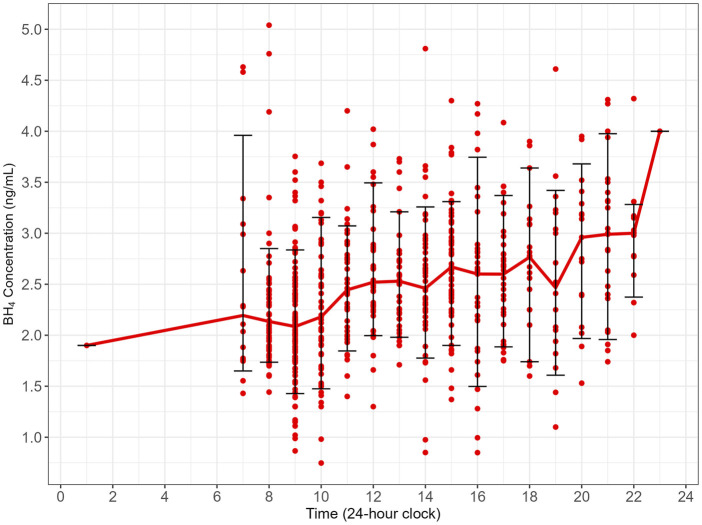
A descriptive summary with the mean (standard deviation [SD]), geometric mean (geometric coefficient of variation [GCV%]), median with 2.5% and 97.5% percentile of distribution for each period were calculated and are summarized in Supplementary Table S2. The observed data and the trend of median BH4 concentration with time is illustrated in Figure 1.
There was a relatively wide distribution of endogenous BH4; the GCV% was approximately 30% across the hours. Nevertheless, median BH4 still illustrated a clear trend with circadian rhythm. BH4 concentration was the lowest in the morning and relatively stable between 07:00 and 10:59, then gradually increased during the day until the highest concentration was attained between 21:00 and 22:59 (Figure 1). There were only two data points available between 23:00 and 01:59, and there were no data available between 02:00 and 06:59 (Supplementary Table S2).
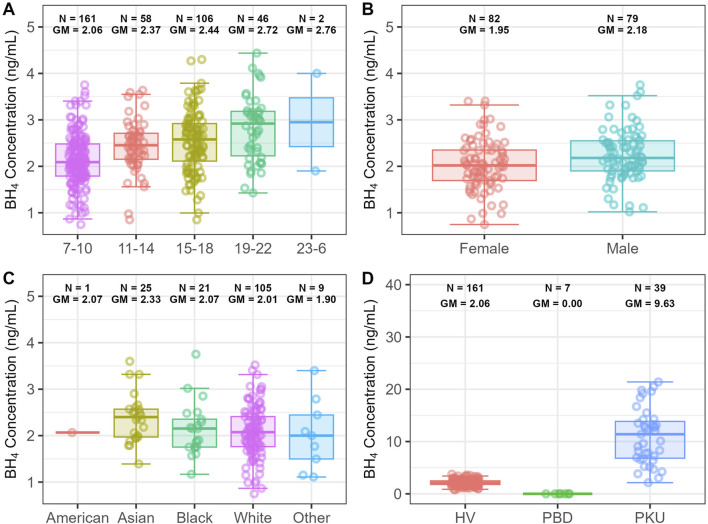
An ANOVA was conducted after data were binned into the 4-h period time blocks, except for data in the 23:00–06:00 time block (23:00–06:59), which had only two BH4 measurements and was considered to have insufficient data for the comparison (Table 2). In the 7:00–10:00 time block, the geometric mean BH4 concentration was 2.06 ng/mL and increased to peak concentrations of 2.72 ng/mL in the night between 19:00 and 22:00. Compared with the 7:00–10:00 time block, BH4 was significantly higher for the rest of day in the 11:00–14:00 and 15:00–18:00 time blocks. BH4 further increased in the evening in the 19:00–22:00 time block, and the increase was significant compared with the 11:00–14:00 and 15:00–18:00 time blocks (Table 2; Figure 2A).

Variations in endogenous BHconcentrations in healthy adult volunteers with time. Red dots: observed data; solid red line: median BHfor each hour; error bar: 10% and 90% of observed data. BH,-L-erythro-5,6,7,8-tetrahydrobiopterin. 4 4 4 6R

Box plots to compare endogenous BHconcentration.Between 4-h time blocks in healthy adult volunteers.Between male and female healthy adult volunteers.Between different races in healthy adult volunteers;between populations aged >2 years with different disease statuses. BH,-L-erythro-5,6,7,8-tetrahydrobiopterin; GM, geometric mean; HV, healthy volunteer; PBD, primary tetrahydrobiopterin deficiency; PKU, phenylketonuria; American, Native American or Alaska Native; Black, Black or African American. 4 4 (A) (B) (C) (D) 6R
| Endogenous BHconcentration, ng/mL4 | Time block (no. of measurements) | |||||
|---|---|---|---|---|---|---|
| 7:00–10:00 (= 161)n | 11:00–14:00 (= 58)n | 15:00–18:00 (= 106)n | 19:00–22:00 (= 46)n | 23:00–06:00(= 2) 1 n | Overall (= 373)N | |
| Mean (SD) | 2.14 (0.561) | 2.45 (0.553) | 2.53 (0.658) | 2.81 (0.704) | 2.95 (1.480) | 2.39 (0.654) |
| Geometric mean (GCV%) | 2.06 (28.7) | 2.37 (26.7) | 2.44 (28.9) | 2.72 (26.7) | 2.76 (56.5) | 2.29 (30.1) |
| Median (2.5%, 97.5%) | 2.09 (1.02, 3.40) | 2.45 (1.22, 3.57) | 2.58 (1.34, 3.71) | 2.92 (1.57, 4.10) | 2.95 (1.95, 3.95) | 2.35 (1.12, 3.73) |
| p-Value (ANOVA) | ||||||
| vs. 7:00–10:00 | 0.0004 | <0.0001 | <0.0001 | |||
| vs. 11:00–14:00 | 0.3888 | 0.0039 | ||||
| vs. 15:00–18:00 | 0.0211 | |||||
Sex and race
Data from the 7:00–10:00 time block were used to investigate the potential differences in endogenous BH4 between sexes and races. This period contained the richest data, and endogenous BH4 was relatively stable, which minimized potential interference from diurnal change. Data from 161 out of 167 healthy participants were available in this time block for the analysis.
There were approximately equal numbers of male (n = 79) and female (n = 82) adult healthy volunteers included in this comparison (Figure 2B). BH4 concentrations overlapped substantially between male and female healthy volunteers (Figure 2B), though the geometric mean concentration was significantly higher in male participants (geometric mean, 2.18 ng/mL) than in female participants (1.95 ng/mL; Table 3).
Although the majority of the 161 participants available for this comparison were White (n = 105), there were enough Asian (n = 25) and Black or African American (n = 21) healthy volunteers to enable comparison of endogenous BH4 between races (Figure 2C). Asian participants had significantly higher levels of endogenous BH4 compared to White (2.33 ng/mL, p-value 0.0169), whereas levels were comparable between White (2.01 ng/mL) and Black or African American participants (2.07 ng/mL) (Figure 2C; Table 4).
| Endogenous BHconcentration, ng/mL4 | Healthy volunteers | |||
|---|---|---|---|---|
| Female (= 82)n | Male (= 79)n | Overall (= 161)N | p-Value (ANOVA) | |
| Mean (SD) | 2.03 (0.554) | 2.25 (0.552) | 2.14 (0.561) | 0.0156 |
| Geometric mean (CV%) | 1.95 (30.1) | 2.18 (26.2) | 2.06 (28.7) | |
| Median (2.5%, 97.5%) | 2.02 (0.98, 3.31) | 2.18 (1.15, 3.53) | 2.09 (1.02, 3.40) | |
| Endogenous BHconcentration, ng/mL4 | Native American or Alaska native (= 1)n | Asian (= 25)n | Black or African American (= 21)n | White (= 105)n | Other (= 9)n |
|---|---|---|---|---|---|
| Mean (SD) | 2.38 (0.52) | 2.14 (0.57) | 2.09 (0.55) | 2.03 (0.76) | |
| Geometric mean (GCV%) | 2.33 (22.1) | 2.07 (26.1) | 2.01 (29.3) | 1.90 (39.6) | |
| Median (2.5%, 97.5%) | 2.07 (2.07, 2.07) | 2.40 (1.63, 3.43) | 2.15 (1.37, 3.39) | 2.07 (0.99, 3.16) | 2.00 (1.12, 3.28) |
| p-Value (ANOVA) | |||||
| vs. Asian | 0.1452 | 0.0169 | 0.1341 | ||
Age
The same data from the 161 available healthy volunteers in the 7:00–10:00 time block were utilized to explore the effect of age on BH4 concentrations, which included participants from ages 18–56.6 years, with a median age of 33.4 years.
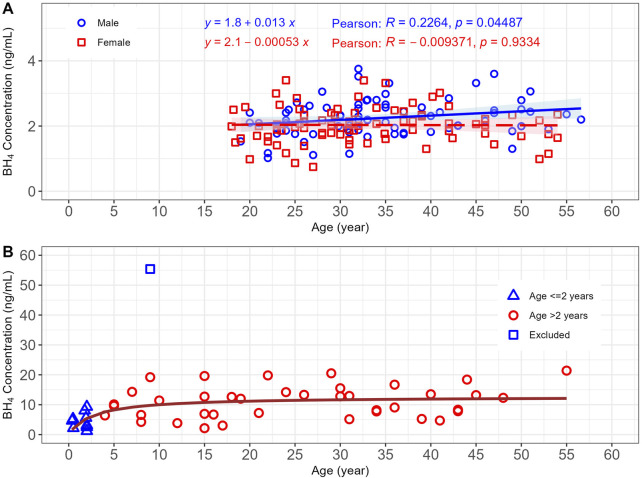
As illustrated in Figure 3A, there was essentially no change in endogenous BH4 concentration with age in both male and female participants. The slopes of linear regression for male and female healthy volunteers were within ±0.015 ng/mL per year of age. A Pearson correlation analysis was conducted to explore endogenous BH4 concentration with age. The correlation coefficients (r) for male and female participants were both within ±0.30, indicating the correlation was negligible between 18 and 57 years.

Change in endogenous BHconcentration with age:in healthy volunteers andin participants with PKU. Shaded ribbon: 95% CI. BH,-L-erythro-5,6,7,8-tetrahydrobiopterin; CI, confidence interval; PKU, phenylketonuria. 4 4 (A) (B) 6R
Endogenous BHconcentrations in participants with PBD and PKU 4
Predose and placebo treatment samples were collected from participants with PBD in a Phase 1b study and from participants with PKU in a placebo-controlled Phase 3 study and an open-label extension Phase 3 study (Supplementary Table S1). There were insufficient data across a wide enough time period to assess the circadian rhythm of BH4 concentrations in participants with either PBD or PKU. However, it was hypothesized that the pattern would resemble that observed in healthy volunteers. Thus, data collected in the 7:00–10:00 time block were utilized for the following analysis.
Participants with PBD
Data were available from a total of seven participants with PBD (all with 6-PTPS deficiency) with one BH4 measurement from each participant. As expected, the endogenous BH4 data were all BLQ (LLOQ 0.5 ng/mL; Table 1) because autosomal recessive 6-PTPS deficiency results in blocking of de novo BH4 biosynthesis (Opladen et al., 2020).
Participants with PKU
Predose and placebo treatment samples were collected from 62 participants with PKU (Table 1), and data in the 7:00–10:00 time block were available from 50 participants with PKU for the age and sex analysis. The graph in Figure 3B reveals that there is an obvious outlier, with a BH4 concentration of 55.4 ng/mL, which was significantly higher than the next highest observed BH4 concentration (21.4 ng/mL) and was therefore excluded from the analysis.
As there was a difference in endogenous BH4 concentration between male and female healthy volunteers, the sex difference was explored for participants with PKU. The analysis was limited to adult participants with PKU, as only this age group had an adequate number of participants (n = 24) for such analysis. No significant sex difference in endogenous BH4 concentration was observed for participants with PKU, and the ranges of observation highly overlapped, though the numeric value was slightly higher in male participants with PKU (Table 3).
Since endogenous BH4 concentrations were not distinguishable between male and female participants with PKU, and there were approximately equal numbers of male and female participants, the endogenous BH4 variations with age in participants with PKU were explored using combined male and female data (Figure 3B). Data collected from participants with PKU was not evenly distributed across ages. Considering the narrow age span, the age ≤2 years were over-represented (n = 3 for age <0.5 years and n = 7 for 1.5–2 years) compared with ages >2 years. There was a maximum of four participants for any 2-year span for those aged >2 years. BH4 concentrations in participants with PKU aged ≤2 years (n = 10) were significantly lower than in those aged >2 years. The geometric mean (95% CI) of endogenous BH4 for PKU patients of age ≤2 years and >2 years were 3.80 (1.40–9.02) and 9.63 (2.98–20.5), respectively (Supplementary Table S3). A simple Emax equation [Endogenous BH4 concentration = Emax*Age/(AM50+Age), where Emax was the maximum endogenous BH4 concentration, AM50 was the age that endogenous reached 50% of the maximum] best described the relationship between endogenous BH4 concentration and age (Figure 3B). The Emax and AM50 values were 12.69 ng/mL and 2.70 years, respectively. There was essentially no change in central trend of endogenous BH4 concentration in participants with PKU aged >2 years. This was confirmed with the Pearson correlation analysis for data in the group aged >2 years, which yielded a correlation coefficient (R) of 0.2265 and a p-value of 0.1656 (Supplementary Figure S1).
Hence, only data from participants with PKU aged >2 years (n = 39) were included to assess the population difference in those with different disease statuses (Figure 2D). The endogenous BH4 concentration was significantly higher in participants with PKU (9.63 ng/mL) than in healthy volunteers (2.06 ng/mL, p-value <0.0001) (Table 5). It was clear that there was no overlapping of participants with PBD with healthy volunteers or participants with PKU, and minimal overlapping of participants with PKU or healthy volunteers.
| Endogenous BHconcentration, ng/mL4 | HV (= 161)n | PBD (= 7)n | PKU (aged >2 years)(= 39)n | Overall (= 207)N |
|---|---|---|---|---|
| Mean (SD) | 2.14 (0.56) | 0 | 11.0 (5.27) | 3.74 (4.23) |
| Geometric mean (GCV%) | 2.06 (28.7) | 9.63 (60.7) | ||
| Median (2.5%, 97.5%) | 2.09 (1.02, 3.40) | 0 (0, 0) | 11.4 (2.98, 20.5) | 2.19 (0, 18.1) |
| p-Value (ANOVA) | ||||
| vs. HV | <0.0001 | <0.0001 | ||
Discussion
In healthy volunteers, a circadian rhythm of BH4 concentrations was identified. BH4 concentration was the lowest in the morning between 7:00 and 10:59 (geometric mean 2.06 ng/mL) and the highest late at night between 21:00 and 22:59 (2.72 ng/mL). However, this variation (0.66 ng/mL) was comparable to the inter-subject variability (0.561 ng/mL for the standard deviation in the 7:00–10:00 time block). Endogenous BH4 was relatively stable in the 7:00–10:00 time block, and this unique characteristic makes it a convenient period to evaluate endogenous BH4 concentrations according to different participant characteristics, including age, sex, race, and disease status.
In healthy adult volunteers, there was a significant difference in endogenous plasma BH4 concentration between male (2.18 ng/mL) and female participants (1.95 ng/mL). However, this difference lacks clinical relevance, as it falls below the inter-subject variability. Similarly, a significant difference between Asian (2.33 ng/mL) and White (2.01 ng/mL) was noted. Nevertheless, this difference does not translate into clinical significance owing to extensive inter-subject variability.
Endogenous BH4 concentrations were significantly elevated in participants with PKU (9.63 ng/mL for those aged >2 years) compared to healthy adults (2.06 ng/mL). Moreover, BH4 concentrations in both participants with PKU and healthy volunteers were substantially higher than the essentially zero concentration observed in participants with PBD.
In participants with PKU with age above 2 years, the majority of data were collected between 7:00 and 10:59 (n = 77, 70.0%) and the remaining were collected between 11:00 and 16:59 (n = 33, 30.0%). There was insufficient data for a thorough analysis to detect the diurnal variation in participants with PKU. However, an exploratory graphic analysis indicated that the diurnal variation would be negligible from 7:00 to 16:59 compared to the inter-subject variability, if there were any (Supplementary Figure S2). The difference in endogenous plasma BH4 between male and female participants with PKU was not significant; this was attributed to the inter-subject variability, which was even larger than that observed in healthy volunteers. Since endogenous BH4 concentrations were essentially zero in participants with PBD, no correlation with circadian rhythm or sex was expected.
All seven participants with PBD were affected by an autosomal recessive deficiency in 6-PTPS, and their endogenous BH4 concentrations were BLQ (LLOQ 0.5 ng/mL). PBD arises from variants in five genes encoding enzymes responsible for the biosynthesis and regeneration of BH4, including guanosine triphosphate cyclohydrolase I (GTPCH-I), sepiapterin reductase (SR), 6-PTPS, pterin-4-alpha-carbinolamine dehydratase (PCD), and dihydropteridine reductase (DHPR) (Opladen et al., 2020). GTPCH-I, 6-PTPS, and SR are important enzymes for de novo biosynthesis of BH4, while PCD and DHPR are key enzymes for BH4 regeneration (Werner et al., 2011). Reduced enzyme activity of 6-PTPS could hinder de novo biosynthesis of BH4, leading to significantly lower plasma BH4, which was essentially zero, as observed in this study.
It has long been understood that BH4 deficiency results from the aforementioned enzyme deficiencies. Most PBDs are routinely diagnosed by the presence of HPA during newborn screening and confirmed following pterin analysis (neopterin, biopterin, isoxanthopterin, and primapterin) in a dried blood spot or urine analysis. Additionally, patients with PBD exhibit significant reductions in neurotransmitters such as dopamine, serotonin, and norepinephrine. Plasma BH4 concentration has not been routinely used as a diagnostic tool. Results from this study indicate that plasma BH4 concentrations in participants with 6-PTPS deficiency can be distinctly differentiated from those in healthy volunteers and those with other HPA conditions, such as PKU.
PKU is a metabolic disorder caused by a defect or deficiency in PAH due to mutant variants in the corresponding PAH gene. By 2020, more than 950 PAH variants and 3,659 genotypes have been identified (Hillert et al., 2020). PAH catalyzes the hydroxylation of phenylalanine to form tyrosine. A deficiency in PAH results in elevated blood Phe concentration known as HPA (Kaufman, 1993; Blau et al., 2010; van Spronsen et al., 2021). Human PAH is a cytosolic enzyme that exists in solution as a pH-dependent equilibrium between functional tetramers and dimers (Martinez et al., 1995). Phe activates PAH by binding to the enzyme and shifts the configuration from dimer-dominant to tetramer-dominant (Martinez et al., 1995). BH4 acts as an essential cofactor for PAH (Bailey et al., 1993). BH4 binds to the catalytic site of PAH to block the conformation change and hence stabilize the enzyme (Kaufman, 1993; Pey et al., 2004; Heintz et al., 2013). During Phe hydroxylation, BH4 is oxidized, transferring two electrons to the enzyme complex before leaving the catalytic site as 4α-hydroxy-tetrahydrobiopterin (Werner et al., 2011). Higher blood Phe concentration necessitates higher BH4 concentration to sustain the PAH activity (Staudigl et al., 2011; Heintz et al., 2013). Consequently, it is unsurprising to observe higher endogenous BH4 concentrations in patients with PKU compared to healthy individuals. The elevated BH4 concentrations may serve to prevent degradation of mutant PAH and maintain PAH activity in the presence of higher Phe concentrations.
Beyond its role in PAH, BH4 acts as a cofactor for other aromatic amino acid hydroxylases, including TH, TPH, AGMO, and NOS. Abnormal endogenous BH4 concentration is associated with diseases involving these enzymatic pathways. BH4 is crucial for the coupling of endothelial NOS (eNOS), which stabilizes eNOS and regulates nitric oxide (NO) production. A decrease in BH4 could lead to eNOS dysfunction, a reduction in NO production, and an increase in reactive oxygen species, which are linked to various diseases, such as cardiovascular disease, diabetes, autism, and cancer (Kim and Han, 2020; Goncalves et al., 2021). Reduced BH4 in the brain could impair TH activity, the enzyme involved in dopamine synthesis, and has been associated with idiopathic Parkinson's disease (Eichwald et al., 2023). Furthermore, deficiency in BH4 bioavailability is linked to distinct diseases, such as Alzheimer's disease, Fabry disease, and certain mitochondrial diseases (Eichwald et al., 2023). Establishing a reference range for plasma BH4 concentrations across various diseases could greatly aid in diagnostic processes.
In healthy adult volunteers and participants with PKU >2 years of age, endogenous BH4 concentrations had no correlation with age. However, lower plasma BH4 concentrations were noted in participants with PKU aged ≤2 years. The connection between this observation and the pathology of PKU in this age group is not yet fully understood; further research is warranted to elucidate the underlying mechanisms.
In a recent publication, endogenous BH4 concentrations from heathy volunteers and patients were summarized (Wang et al., 2024). The mean BH4 concentration calculated as a weighted average [(n1*mean1 + n2*mean2 + …)/(n1+n2+ …), where n1 and mean1 referred to the number of subjects and mean BH4 reported in study 1, …] for adult healthy volunteers was 2.94 ng/mL from 11 studies cited in the report from 522 individuals which included 253 Chinese (Wang et al., 2024). The mean BH4 was 2.48 ng/mL after excluding Chinese healthy volunteers. One study involving 38 healthy Chinese aged 18–65 years reported a rapid reduction in plasma BH4 with age, from 6.80 ng/mL at 18 years to 0.66 ng/mL at 65 years with the mean (SD) BH4 3.09 (1.43) ng/mL (Yuan et al., 2018). In the study, blood samples were stabilized with 0.2% DTE (v:v) immediately after collection. BH4 was measured using HPLC-MS after derivatization with benzoyl chloride following acetonitrile protein precipitation to enhance the sensitivity (LLOQ 0.05 ng/mL). The extent of endogenous BH4 reduction with age in adults was steep (90% reduction across 47 years during adulthood from 18 to 65 years), which seems implausible considering the role of BH4 as a cofactor for multiple essential enzymes and the necessity of stable BH4 required for normal functionality. A study from the same laboratory used an improved HPLC-MS method, based on Yuan et al. (2018) with benzyl chloride derivatization followed by cold-induced phase separation for 5 min at −30 °C, to measure endogenous BH4 from 215 healthy Chinese aged 13 to 148 (it was suspected the top age was entered as a mistake, the highest age second to 148 was 91) (Wang et al., 2024). Compared to the first study reported from the lab (Yuan et al., 2018), mean (SD) plasma BH4 concentration from this recent study was higher at 3.51 (0.94) ng/mL. However, the trend of BH4 concentration reduction with age was much flatter. From age 22 to 91 (after excluding subjects of age 13 and 148, which were far away from rest of subjects), the mean BH4 from linear regression based on the reported data dropped from 4.06 to 2.68 ng/mL, a decrease of 34% for an age span of 69 years from 22 to 91. In our study, mean BH4 from adult healthy volunteers in the morning between 7:00 and 10:59 was (2.14 [0.56] ng/mL) and it was independent of age. This value is slightly lower than the mean value excluding Chinese from historical studies (2.48 ng/mL) and much lower than the values reported for Chinese (Yuan et al., 2018; Wang et al., 2024). The discrepancy can be multifactorial. First, results from this study indicated that BH4 concentrations were lower in the morning and higher in the afternoon and evening. It is unknown the time of day blood samples were collected in those historical studies. Second, there is an ethnic difference in endogenous BH4 with the mean concentration higher in Asian and lower in Whites. The ethnic factor should be considered when comparing endogenous BH4 between races. Third, there is no cross validation between methods and laboratories. As discussed in Wang et al. (2024) report that timely addition of anti-oxidation immediately post blood collection is critical for accurate measurement of plasma BH4. DTT, DTE, and ascorbic acid are frequently used reagents to stabilize BH4 (Fiege et al., 2004; Fekkes and Voskuilen-Kooijman, 2007; Kaushik et al., 2024). In this study, blood samples were stabilized with 1% ascorbic acid within 15 min of blood collection and the supernatant from centrifugation after protein precipitation (containing DTE, DETPC in acetonitrile/water) were dried under nitrogen in approximately 45 min at 40 °C (Kaushik et al., 2024). The variations in stabilizing reagents used, and timing of the anti-oxidation reagent addition, as well as the following sample processing procedures are not fully understood at this time. The bioanalytical method used in this study has been used in 10 clinical trials to measure plasma BH4 concentrations in over 6300 blood samples from over 600 individuals. All bioanalytical runs have consistently passed the rigorous validated criteria, and the 10% incurred sample reanalysis passed the acceptance criteria as well. The consistency of reliable performance of this validated bioanalytical method warranted the reliability of results from this study. Additionally, there were large intersubject variability for BH4. Sufficient sample size is required to obtain a true mean value from the population. This reflected in the two studies conducted in Chinese healthy volunteers. A steep age dependent BH4 decrease was observed from Yuan et al. (2018) study, which included 38 participants and 1 blood sample per subject. The age dependent trend was much flatter in the recent study reported by Wang et al. (2024), which included 215 participants. In this study, data were obtained from 167 participants and 1058 blood samples in the morning between 7:00 and 10:59. The comparable value from this study and mean value from previous studies in healthy volunteers and the consistency between this study and multiple prior reports involving patients with PKU across ages 0–50 years, combined with the abundancy of data from this study, suggest that our findings are reliable–BH4 concentration remains stable in healthy adults regardless of age. The geometric mean (95% percentile) endogenous BH4 concentration of healthy adults is 2.06 (1.02, 3.40) ng/mL.
Although endogenous BH4 concentrations in participants with PKU were not directly reported in previous studies, the value could be inferred from the baseline BH4 concentrations of population pharmacokinetic models. The baseline BH4 concentrations were 13.5 ng/mL for participants with PKU aged ≥8 years (n = 78) (Feillet et al., 2008), 12.6 ng/mL for participants with PKU aged <4 years (n = 52) (Muntau et al., 2017), and 16.6 ng/mL for participants with PKU aged 0–50 years (n = 156), wherein 80 participants were aged <8 years (Qi et al., 2015). These findings align with our observation of a mean (SD) BH4 concentration of 11.0 (5.27) ng/mL for participants with PKU aged >2 years (n = 39), and geometric mean (95% percentile) of 9.63 (2.98, 20.5) ng/mL.
In one report, a rapid decrease in BH4 concentration in cerebrospinal fluid (CSF) with age was reported for newborns (0–0.33 years, n = 12), followed by relatively stable concentrations from ages ≥0.34–20 years (n = 61) in participants with neurologic disease (Hyland et al., 1993). A similar pattern was reported for BH4 in CSF from 99 participants with various neurologic disorders ranging from 0 to 42 years old, in which BH4 concentrations were stable at least across ages 1.1–20 years (Guibal et al., 2014). In both studies, CSF samples were immediately frozen at −80 °C after collection without addition of any stabilizing reagent. The indirect chemical oxidation method coupled with HPLC-FD was used to determine BH4 concentrations. The stability of BH4 in CSF samples was not reported in either study.
Although lower than adult endogenous BH4 concentrations were noted in PKU patients with age ≤2 years in our study, it cannot be definitively concluded that this observation is not coincidental, given the small sample size of participants with PKU within this age range (n = 10).
Conclusion
A clear circadian rhythm of BH4 concentrations was observed in healthy adults, with the lowest concentration occurring in the morning (7:00–10:59) and gradually increasing throughout the day to the highest concentration in the late evening (21:00–22:59). Additionally, endogenous BH4 concentrations were higher in male than in female participants, and higher in Asians than in other races in healthy adults. However, the magnitude of all such fluctuations was small and comparable to inter-subject variability suggesting a lack of clinical relevance. No correlation was found between endogenous BH4 levels and age in healthy adults.
Endogenous plasma BH4 concentrations were found to be relatively stable between 7:00 and 10:00, providing a suitable time window for BH4 sample collection to minimize measurement variation due to diurnal effects.
Furthermore, endogenous plasma BH4 concentration ranges differ significantly between participants with PBD, participants with PKU, and healthy volunteers. This difference could be utilized as a diagnostic tool.