
What this is
- Age-related macular degeneration (AMD) is a major cause of vision loss, particularly the wet form driven by VEGFA overproduction.
- Engineered virus-like particles () are explored as a delivery method for Cas9 ribonucleoproteins targeting VEGFA.
- This study demonstrates the efficacy of in reducing in a mouse model of wet AMD.
Essence
- effectively deliver Cas9 ribonucleoproteins, achieving significant VEGFA downregulation and reduced choroidal in a mouse model of wet AMD.
Key takeaways
- Cas9- achieved 99% insertion and deletion frequency at the Vegfa target locus in vitro, indicating high editing efficiency.
- A single subretinal injection of Cas9- resulted in an average of 16.7%, effectively disrupting Vegfa expression.
- Treatment with Cas9- significantly reduced choroidal formation compared to control groups, with no observed retinal toxicity.
Caveats
- Variability in subretinal injection techniques may affect indel frequencies, highlighting the need for precise administration.
- High doses of can lead to retinal degeneration, necessitating careful optimization of delivery concentrations.
Definitions
- eVLPs: Engineered virus-like particles designed for efficient delivery of genome editing components.
- indel efficiency: The frequency of insertion and deletion mutations at a specific genomic target.
- neovascularization: The formation of new blood vessels, often associated with pathological conditions like wet AMD.
Simplified
Background
Age-related macular degeneration (AMD) is a disease that affects the macular region of the retina, causing progressive loss of central vision among the older people [1]. Approximately 196 million people are diagnosed with AMD, a number that is expected to increase to 288 million by 2040. Thus, AMD poses considerable human and economic burdens that urgently require solutions [2]. Clinically, AMD is classified into dry and wet forms [1, 3]. Dry AMD is characterized by the gradual accumulation of drusen deposits and progressive degeneration of the retinal pigment epithelium (RPE), ultimately leading to geographic atrophy [1, 3, 4]. Wet AMD, also known as neovascular AMD, is characterized by abnormal growth of choroidal neovascularization, primarily driven by the overexpression of vascular endothelial growth factor A (VEGFA) [5]. This understanding has led to the development of anti-VEGF therapies, such as monoclonal antibodies and fusion proteins, which effectively slow disease progression and improve visual outcomes [6 –8]. However, the treatment burden of frequent intravitreal injections, high costs, and the risk of treatment resistance or adverse effects highlight the need for innovative approaches that target VEGFA with greater sustainability [9 –11].
The advent of third-generation genome editing systems, namely the CRISPR/Cas9, has ushered in a new era of genomic medicine, offering transformative benefits to countless patients [12]. This technology enables the precise editing of DNA sequences and can help to tackle a broad spectrum of genetic diseases and acquired conditions. For example, in individuals without pathogenic mutations, the downregulation of specific genes is crucial for therapeutic intervention, and CRISPR/Cas9 can effectively downregulate a target gene to achieve a desired effect with a one-time treatment [13, 14]. In addition, base and prime editors can directly and precisely modify mutated DNA sequences in individuals with disease-causing mutations [15 –17]. To fully realize the promising potential of therapeutic genome editing tools and ensure the efficacy and safety of gene editing interventions, the precise delivery of gene editing enzymes to target sites must be ensured. At present, despite the widespread use of conventional viral and non-viral carriers for this purpose, both vector types face limitations.
Adeno-associated viruses (AAVs) are the leading viral vector to deliver gene editing cargo, owing to their widespread tissue tropism and state-of-the-art ability to overcome barriers in vivo [18]. Encouraging outcomes from preclinical and clinical investigations have underscored the efficacy of AAV-based genome editing, highlighting its potential for treating inherited as well as acquired conditions [19 –24]. However, the suitability of viral vectors for therapeutic applications is limited by the risk of their neutralization and adverse immunogenicity, including in the eye, which is known as an immune-privileged tissue [25]. In addition, the possibility that viral DNA integrated into specific integration sites on chromosomes can remain latent in the host genome is of concern [25]. Lipid nanoparticles (LNPs) are a prevalent and favored platform for delivering therapeutic gene-editing agents as non-viral vectors. The development of lipo-nanomedicine for CRISPR-mediated delivery has several advantages, namely it is relatively transient, allows for repeated dosing, and mitigates safety concerns [12]. However, LNPs are considered less proficient at loading macromolecular cargo. The delivery of ribonucleoproteins (RNPs) using LNPs is less effective than that of their nucleic acid-containing counterparts [26]. Achieving therapeutic gene editing in tissues outside the liver through LNPs delivery continues to pose considerable challenges, because ApoE binding to LNPs passively directs them to accumulate in the liver [27, 28]. In addition, the ionizable lipid remained detectable in the blood stream for up to 1 week [29]. Immunogenicity is primarily driven by the ionizable lipids themselves, which trigger cytokine release and subsequent inflammatory responses [30]. Overall, a new generalizable strategy for delivering genomic cargo is needed.
Virus-like particles (VLPs) are promising vehicles for delivering genome-editing components [31, 32]. VLPs are structurally and visually similar to live viruses but lack some or all of the viral genome [33]. They retain an internal cavity that can be used to deliver biological materials. VLPs are structurally variable, contributing to their range of functions, and can be categorized as enveloped types containing host cell membranes, non-enveloped forms made of capsid proteins alone, and engineered chimeric versions carrying additional antigens [33]. Initially, VLP-based approaches for delivering gene editing agents have achieved only moderate editing efficiencies, with limited in vivo validation of their therapeutic effectiveness [34 –36]. However, Banskota et al. discovered that engineered VLPs (eVLPs), a retroviral scaffold envelope supporting VLPs, effectively overcame specific molecular bottlenecks related to cargo packaging and release, showing promising results in delivering RNPs to the brain, liver, and retina in mice [37]. Thus, eVLPs have rapidly emerged as an attractive delivery platform.
The laser-induced choroidal neovascularization (LI-CNV) mouse model is widely used to study the pathogenesis of wet AMD, as it reflects key pathological features, including choroidal neovascularization and VEGFA overproduction [38, 39]. In the present study, we aimed to assess the efficacy of the eVLP system for delivering Cas9 RNPs in mouse RPE. After a single subretinal injection of Vegfa-targeting Cas9-eVLPs, we observed significant disrupted Vegfa expression and a reduction in the choroidal neovascularization. No anatomical or functional safety concerns were identified. These results highlight the potential of eVLPs as a robust and versatile RNP delivery system for therapeutic genome editing in retinal diseases.
Results
eVLP system demonstrates exceptional delivery performance in vitro

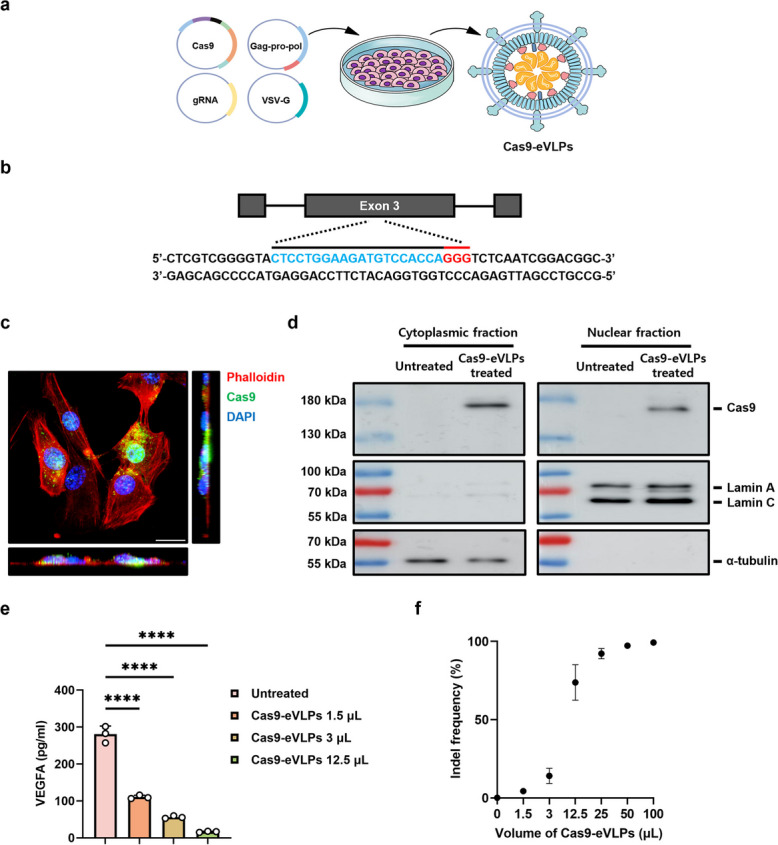
Cas9-eVLPs effectively suppressexpression in vitro.Packing system and the process for producing Cas9-eVLPs.Target sequence in thelocus. The PAM sequence and the sgRNA target sequence are shown in red and blue, respectively.Immunostaining of Cas9 in transduced NIH-3T3 cells 24-h post-transduction. DAPI (Blue), Cas9 (Green), Phalloidin (Red). Scale bar: 20 μm.Nuclear and cytoplasmic fractions were extracted from NIH/3T3 cells. Western blotting analysis of Cas9 in cytoplasmic and nuclear fractions after treatment with or without Cas9-eVLPs. Lamin A/C and α-tubulin were used as nuclear and cytoplasmic markers, respectively.VEGFA concentration in the culture supernatant of NIH/3T3 cells. Enzyme-linked immunosorbent assay of fresh culture media collected 3 days after Cas9-eVLPs transduction. Each microliter of solution contained 4.3 × 10Cas9-eVLPs ( = 5).Indel frequencies at the target site within thegene in HEK293T cells. Each microliter of solution contains 4.3 × 10Cas9-eVLPs ( = 3). Data are presented as mean ± SD. Statistical analyses were done using one-way ANOVA followed by Tukey's post hoc multiple comparison tests. **** < 0.0001 Vegfa Vegfa n VEGFA n p a b c d e f 10 10
In vivo knockout of Vegfa in RPE through subretinal injection of Cas9-eVLPs

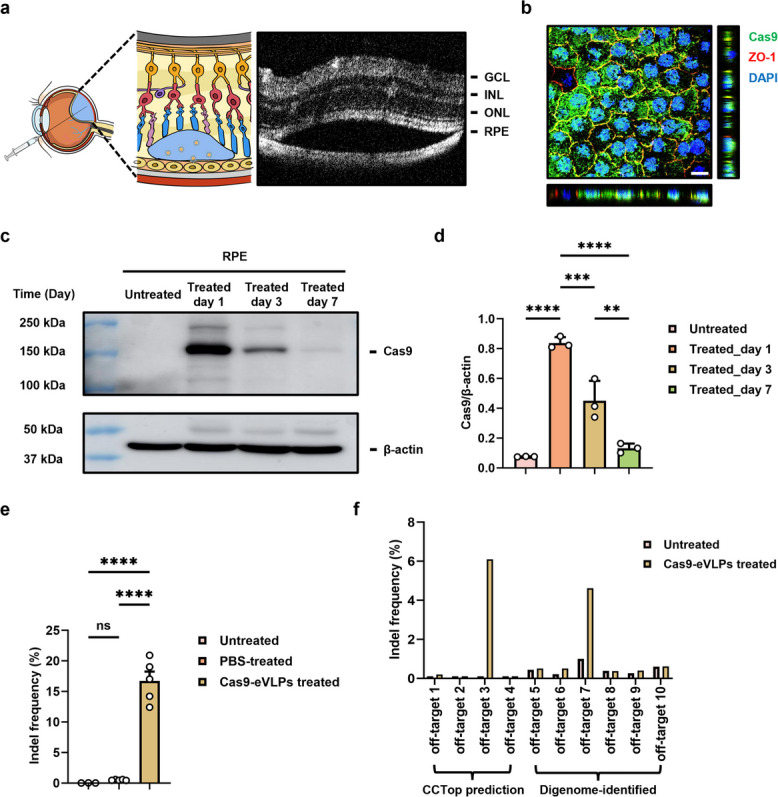
In vivo knockout offrom a subretinal injection of Cas9-eVLPs.Representative OCT images of the mouse retina after subretinal injection of Cas9-eVLPs.ganglion cell layer,inner nuclear layer,outer nuclear layer,retinal pigment epithelium.Representative image of RCS complexes whole-mount at 1 day post-injection of Cas9-eVLPs into the mouse subretinal space. DAPI (Blue), Cas9 (Green), ZO-1 (Red). Scale bar: 20 μm.Representative Western blotting analysis to measure the level of Cas9 protein in the mouse RPE tissue at 1, 3, and 7 days after Cas9-eVLPs transduction.Histogram showed the densitometric analysis of the levels of Cas9 to β-actin levels ( = 3).Following treatment with Cas9-eVLPs, indel frequencies at thetarget site were determined in genomic DNA harvested from selected mouse RPE tissue. Samples were collected 1 week after subretinal delivery. = 5 (Cas9-eVLPs-treated group), = 5 (PBS-treated group), or = 3 (untreated group).Indel frequencies at predicted off-target sites ofin pooled RPE tissue dissected from = 5 (Cas9-eVLPs-treated group) or = 3 (untreated group). Off-target 1–4 were predicted using CCTop, and off-target 5–10 were identified by Digenome-seq. Data are presented as mean ± SD. Statistical analyses were done using one-way ANOVA followed by Tukey's post hoc multiple comparison tests. ns, not significant. ** < 0.01, *** < 0.001, **** < 0.0001 Vegfa GCL INL ONL RPE n Vegfa n n n Vegfa n n p p p a b c d e f
Vegfa-targeting Cas9-eVLPs mitigate CNV formation in a mouse model of wet AMD

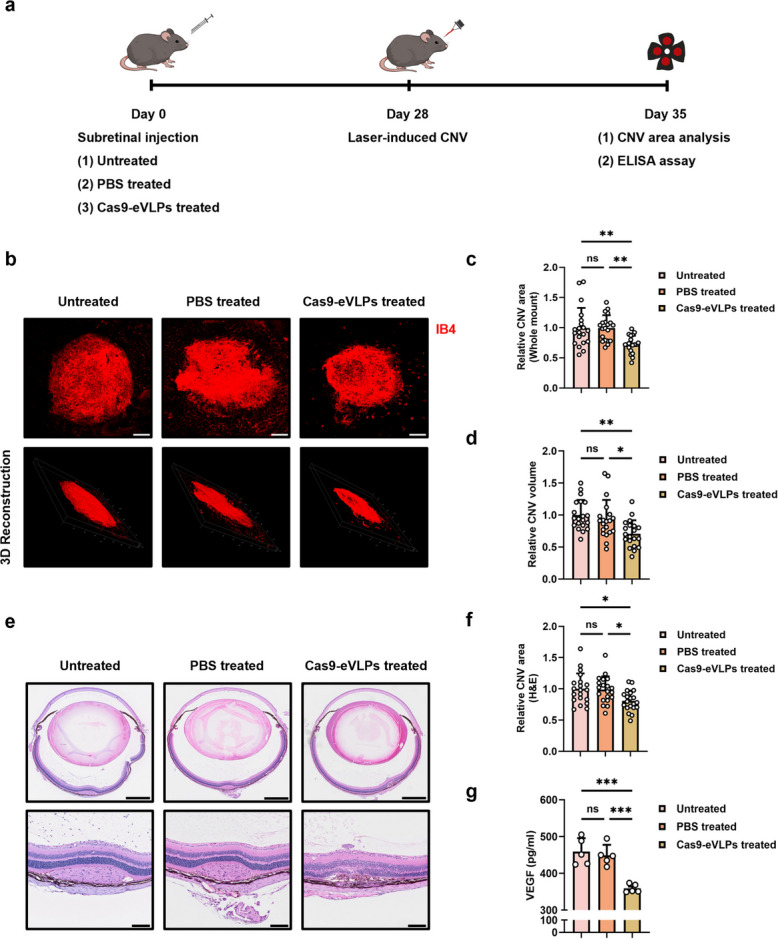
Effect of Cas9-eVLPs targetingagainst CNV lesion formation.Experimental workflow of LI-CNV mouse model induced 4 weeks after subretinal injection. Seven days following laser treatment, analysis of the CNV was performed to evaluate the extent of neovascularization and changes in VEGFA protein levels in RPE tissue.Representative laser-induced CNV areas in IB4-stained RCS complexes flat mounts of mouse eyes from untreated, PBS-treated, or Cas9-eVLPs-treated mice. Scale bar: 100 μm. Representative images of confocal microscopy generated 3D side views of CNV lesions in RCS complexes flat mounts from untreated, PBS-treated, or Cas9-eVLPs-treated mice.Quantification of CNV area from untreated, PBS-treated, or Cas9-eVLPs-treated mice ( = 20).Quantification of CNV volume from untreated, PBS-treated, or Cas9-eVLPs-treated mice ( = 20).H&E staining of retinal section image from untreated, PBS-treated, or Cas9-eVLPs-treated mice at day 7 post laser operation. CNV lesion with collagen visible and infiltrated cells in the sclera and within the lesion. Scale bars: 500 μm (top), 100 μm (bottom).Quantification of CNV lesion area from the H&E images from untreated, PBS-treated, or Cas9-eVLPs-treated mice ( = 20).Quantification ofprotein levels from RPE tissue of untreated, PBS-treated, or Cas9-eVLPs-treated mice using ELISA assay ( = 5). Data are presented as mean ± SD. Statistical analyses were done using one-way ANOVA followed by Tukey's post hoc multiple comparison tests. ns, not significant. * < 0.05, ** < 0.01, *** < 0.001 Vegfa n n n n p p p a b c d e f g VEGFA
Vegfa-targeting Cas9-eVLPs did not induce retinal anatomic and functional toxicity

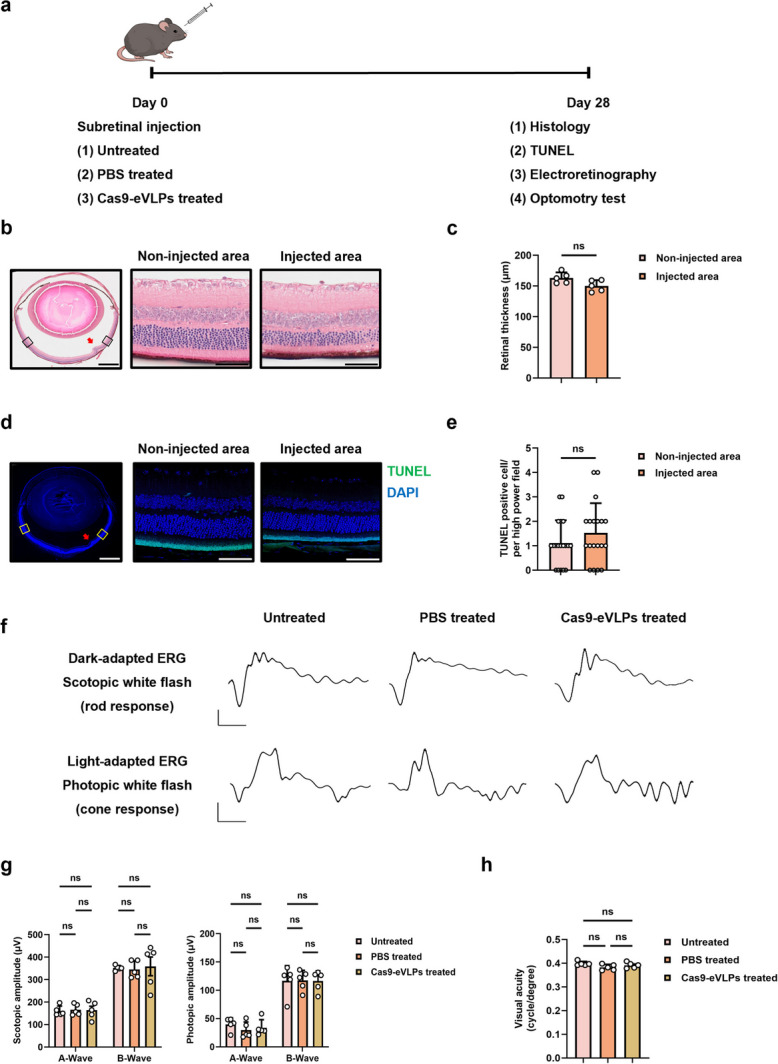
Cas9-eVLPs treatment did not induce anatomical or functional toxicity in the retina.Experimental workflow of retinal anatomical and functional test.Representative H&E staining images after 4 weeks of subretinal injection. Red arrows indicate subretinal injection site. The area within the black box was enlarged and is shown to the right. Scale bars: 500 μm (right), 50 μm (middle), 50 μm (left).Quantification of retinal thickness in proximity to the subretinal injection site and mirroring locations in the contralateral hemisphere of the eyeball ( = 5).Representative micrographs of retinal sections evaluated for apoptosis using the TUNEL assay. Red arrows indicate subretinal injection site. The area with the yellow box was enlarged and is shown to the right. Scale bars: 500 μm (right), 50 μm (middle), 50 μm (left).Quantification of TUNEL-positive cells in proximity to the subretinal injection site and mirroring locations in the contralateral hemisphere of the eyeball ( = 20).Representative scotopic and photopic ERG waveform from untreated, PBS-treated, or Cas9-eVLPs-treated mice. Scale bars: 30 ms (x-axis), 100 μV (y-axis, top), 50 μV (y-axis, bottom).Amplitudes of a- and b-waves of scotopic and photopic responses ( = 5).Optomotor response was quantified in untreated, PBS-treated, or Cas9-eVLPs-treated mice ( = 5). Data are presented as mean ± SD. Statistical analyses were done using Student's t test or one-way ANOVA followed by Tukey's post hoc multiple comparison tests.not significant a b c d e f g h n n n n ns
Discussion
Herein, we report a system that allows for Cas9 RNPs delivery through eVLPs for efficient "hit-and-run" genome editing without transferring viral vector genetic material. Using eVLPs to assemble Cas9 RNP complexes, we successfully demonstrated potent Vegfa knockout both in vitro and in vivo, showing reductions in the CNV formation in a mouse model of wet AMD. Crucially, our method produced indel frequencies in mouse RPE that were comparable to those reported previously [23, 40, 44, 45]. These results strongly support eVLPs as a delivery platform for genome editing to help treat retinal diseases.
Advancements in genome sequencing have improved its accuracy, speed, and cost-effectiveness, establishing genome editing as a cornerstone of precision medicine, which aims to maximize treatment efficacy while minimizing risks by tailoring interventions to the individual characteristics of each patient [46, 47]. To achieve tailored interventions through gene editing, the accurate delivery of CRISPR-based payloads to target organs or cells is essential. However, despite some progress, effective macromolecule delivery to the intended target tissue without off-target effects or unwanted immune responses remains challenging. Selecting an appropriate delivery system to facilitate the transport of gene-editing cargo to target tissues is a critical step in overcoming the remaining hurdles.
VLPs are non-replicating particles that are structurally similar to native viruses but lack viral genetic material. They are typically produced by expressing viral structural proteins, such as Gag, in host cells, where they assemble into nanoparticles that can encapsulate mRNA or RNP cargo. Because VLPs do not carry viral genomes, they cannot replicate, making them a safer alternative to viral vectors for therapeutic delivery. In particular, macromolecular gene editing cargo can be fused to the Gag polyprotein and encapsulated in pseudotyped VLPs, leading to transient genome editing [48, 49]. Compared to conventional AAV- and LNP-mediated genome editing strategies, eVLPs offer significant advantages as a virus-free alternative. They allow tissue targeting, prevent genomic integration, avoid long-term expression of the Cas9, and promote relatively high editing efficiencies for precise and tailored delivery [36, 48, 50].
Recently, eVLP for efficient delivery of prime editor RNPs in vivo was reported to achieve significant improvements in editing efficiency and demonstrate therapeutic potential in mouse models of genetic blindness [51]. Another study introduced the RIDE system, a customizable VLP for delivering CRISPR-Cas9 RNPs, which enabled efficient and cell-specific gene editing in a mouse model of ocular neovascularization and non-human primate model of Huntington's disease [52]. Structurally, RIDE and eVLP differ in their cargo incorporation strategies. RIDE uses MS2 stem-loop-mediated packaging for programmable cell targeting, whereas eVLPs employ optimized Gag–cargo fusion and linker designs to enhance protein loading and release. Functionally, RIDE enables cell-type-specific delivery for precise gene editing, whereas eVLPs offer broad tissue accessibility and transient expression [37, 52]. These findings collectively indicate that adapting the VLP platform evolution approach may be broadly useful for developing delivery vehicles that overcome existing limitations.
In this study, we initially demonstrated the potent editing capabilities of Cas9-eVLPs in cellular environments. As the dose of eVLPs increased, the indel frequencies concomitantly led to a reduction in VEGFA protein levels (Fig. 1). To evaluate in vivo performance, we used subretinal injections to deliver genome-editing payloads. However, analyzing the whole RPE resulted in initial indel frequencies that were lower than those reported previously [23, 40]. Immunofluorescence analysis revealed that the cargo delivered into the subretinal space was predominantly localized within the injected area (Additional file 1: Fig. S2), which is consistent with prior reports [40, 53, 54]. Notably, the size of the transduced area differed among mice, which was most likely due to variations in the injection site and angle [55, 56]. Next, analyzing genomic DNA from the selected RPE tissues showed that indels reached an average of 16.7%, with a maximum of 20.9% (Fig. 2). Subretinal injections require highly precise micro-procedures; however, they are inherently prone to variability between administrations. This variability primarily arises from uneven dispersion of the injected solution and occasional backflow into the vitreous body [55]. As a result, variations in indel frequency were anticipated. Although the off-target site OT3 showed a 6.1% indels, it is located within an intronic region. Encouraged by the in vitro editing efficiency, we increased the eVLP dose in an attempt to achieve higher indel frequencies at the target site, aiming to elicit a more pronounced phenotypic effect. However, this approach inadvertently led to retinal degeneration and failed to improve the indel frequency (Additional file 1: Fig. S5). High-dose or prolonged VSV-G expression causes high levels of cytotoxicity, including cell fusion and cell death. Moreover, direct delivery of Cas9 RNP enables genome editing in the retina but shows dose-dependent toxicity [42, 43, 57]. These findings indicate that optimizing the delivery concentration of gene-editing enzymes is a prerequisite for achieving therapeutic effects. Additionally, long-term suppression of VEGF is reportedly linked to changes in retinal tissues [58]. However, our results showed that appropriate doses of Cas9-eVLPs resulted in a notable absence of significant alterations in retinal anatomy or functionality (Fig. 4). Although the retinal thickness within the injected area was relatively thin, this could be attributed to the invasive nature of the subretinal space delivery route. Subsequent analyses confirmed that the subretinal injection of Cas9-eVLPs Vegfa-targeting effectively inhibited neovascularization in the LI-CNV mouse model (Fig. 3). Taken together, our results demonstrate the sustained suppression of VEGFA in a mouse model of wet AMD, with the benefits significantly outweighing any potential risks associated with the therapeutic approach. However, the indels in the RPE were slightly behind the strong delivery capacity of eVLPs. We believe that the inherent variability of subretinal injections requires a well-trained operator for optimal execution. Furthermore, the precise selection of successfully transduced RPE cells helps to obtain realistic editing results. Finally, determining the optimal concentrations for injections necessitates rigorous evaluation.
Current research data indicate that AAV-based gene therapies demonstrate a well-established safety profile, high biocompatibility, and efficient delivery of therapeutic payloads to diverse relevant tissues [12, 59]. AAV-based vectors have been utilized in over 200 active clinical trials, and drugs have been approved by the US Food and Drug Administration, demonstrating favorable safety outcomes and meaningful therapeutic benefits across a range of genetic disorders [60, 61]. Given the encouraging data from these studies, AAV-based gene therapy is emerging as an effective therapeutic strategy for correcting conditions with unmet medical needs. Nonetheless, the current efficiency of these tools is not sufficient for therapeutic use. Although a non-pathogenic vector can be applied to an immune-privileged site, such as the retina, AAV-mediated retinal gene therapy is still recognized by the immune system and elicits immune responses [25]. These responses can cause ocular inflammation, referred to as gene therapy-associated uveitis, and trigger the production of neutralizing antibodies that may reduce the efficiency of subsequent vector administrations, such as when treating the contralateral eye [62 –64]. Hence, there is a global effort to develop non-viral vectors aimed at delivering large cargo while eliminating viral components. In comparison to our previous studies, the development of the eVLP delivery system has been successful, particularly regarding indel efficiency, which was comparable to the results of AAV delivery in the same animal model [44]. Moving forward, studies should increasingly experiment with using eVLP as an alternative platform.
Conclusions
In conclusion, eVLP-mediated delivery of Cas9 RNPs enables efficient and targeted gene editing in the mouse RPE via subretinal injection while minimizing unintended editing in the retina. Moreover, Vegfa-targeting Cas9-eVLPs effectively attenuated choroidal neovascularization, underscoring the potential of this approach as a therapeutic strategy for wet AMD. These findings also highlight the importance of optimizing delivery concentration to achieve a balance between efficacy and safety. Taken together, our results support the potential of eVLPs as a delivery platform for the treatment of retinal diseases.
Methods
Cell culture
NIH/3T3 (CRL-1658) and HEK293T (CRL-3216) cells were obtained from ATCC. After thawing, the cells were verified to be mycoplasma negative before further culture. Cells were cultivated in Dulbecco's modified Eagle's medium (LM007-01; Welgene). The media contained 10% fetal bovine serum (16000044; Thermo Fisher Scientific) and 100 units/mL penicillin/streptomycin (15140–122; Thermo Fisher Scientific). The cells were maintained in a 5% CO2 incubator at 37 °C.
Construction of plasmid vectors
To construct Vegfa sgRNA plasmid, an sgRNA-expressing vector (104174; Addgene) was digested with BsaI. sgRNA oligomers were annealed, phosphorylated with T4 PNK, and Ligated with the Linearized vector. The oligomer sequences are shown in Additional file 2: Table S1. VSV-G plasmid (8454), MMLVgag-pol plasmid (35614), and MMLVgag-3xNES-Cas9 plasmid (181752) were obtained from Addgene.
eVLP production and purification
To produce Cas9-eVLPs, 1 × 10⁷ HEK293T cells were seeded on 150-mm cell culture dishes containing DMEM. After incubation for 16 h, DMEM was exchanged with fresh medium and a mixture of plasmids expressing VSV-G (400 ng), MMLVgag–pol (3375 ng), MMLVgag–3xNES–Cas9 (1125 ng), and an Vegfa sgRNA (4400 ng) were co-transfected per dish using polyethyleneimine. At 48 h after transduction, cell supernatant was harvested and centrifuged for 5 min at 500 g to remove cell debris. The clarified supernatant was filtered through a Millex-HV 0.45-μm low protein-binding membrane (Millipore). For Cas9-eVLPs that were used in cell culture, the filtered supernatant was concentrated 100-fold using PEG-it Virus Precipitation Solution (LV825A-1; System Biosciences) according to the manufacturer's protocols. For Cas9-eVLPs that were injected into mice, the filtered supernatant was concentrated 2000-fold via ultracentrifugation using a cushion of 20% (w/v) sucrose in PBS. Ultracentrifugation was performed at 26,000 rpm for 2 h (4 °C) using an SW28 rotor in an Optima XPN Ultracentrifuge (Beckman Coulter). Following ultracentrifugation, eVLP pellets were resuspended in cold PBS (pH 7.4) and centrifuged at 1000 g for 10 min to remove debris. eVLPs were frozen at a rate of − 1 °C/min and stored at − 80 °C.
Quantification of eVLP particles
The concentration of eVLPs (number of VLP particles per microliter) was measured by quantifying MuLV p30 protein with the MuLV Core Antigen ELISA kit (Cell Biolabs; VPK-156) following the manufacturer's protocol. Recombinant MuLV p30 standard included in the kit was used to generate the standard curve and the concentration of VLP-associated p30 protein was calculated with the assumption that 20% of the observed p30 in solution was associated with VLPs, as was previously reported [65].
Deep sequencing of target genomic loci
Genomic DNA was extracted either from cultured cells using the Wizard Genomic DNA Purification Kit (A2920; Promega) or from mouse RPE using the DNeasy Blood & Tissue Kit (69504; QIAGEN). Target sequences were PCR-amplified using Phusion® High-Fidelity DNA Polymerase (M0530S; NEB). The PCR primers used for targeted deep sequencing are listed in Additional File 2: Table S1. To evaluate indel frequencies in HEK293T cells, an initial PCR was performed using 200 ng of genomic DNA and primers containing Illumina adaptor sequences. Then, 2 µL of a 1:10 dilution of the PCR amplicon was subjected to a second PCR using primers with barcode sequences. After gel purification with the MEGAquick-spin Total Fragment DNA Purification Kit (17290; iNtRON Biotechnology), the amplicons were analyzed using the MiniSeq platform (Illumina). For evaluation of indel frequencies in mouse RPE, PCR was performed using 50 ng of genomic DNA, following the same protocol described above. After gel purification, the resulting amplicons were sequenced using both the MiniSeq and MiSeq platforms (Illumina).
Analysis of off-target editing
The top-four predicted off-target sites for Vegfa sgRNA were identified using the CCTop-CRISPR/Cas9 target online predictor [41]. Predicted off-target sites were amplified using 2 × Taq PCR smart mix (STD01-M50h; Solgent). An initial PCR was performed to amplify the target and potential off-target sites in a 30-µL reaction volume containing 30 ng of genomic DNA from the RPE. To attach Illumina index sequences, a second round of PCR was performed using 1 µL of the initial PCR product in a 30-µL reaction volume. The purified PCR products were pooled at equal molar ratios for sequencing on the MiniSeq platform (Illumina). Cas-analyzer was used to analyze indel frequencies at the off-target sites [66]. The sequences of the off-target sites and the primers used for deep sequencing are listed in Additional file 2: Table S2.
Digenome-seq
We conducted Digenome-seq as previously described [67, 68]. Genomic DNA was extracted using the DNeasy Tissue Kit (QIAGEN) following the manufacturer's protocol. In brief, recombinant Cas9 nuclease (100 nM) was pre-incubated with Vegfa sgRNA at room temperature for 10 min to generate Cas9-sgRNA complex. Next, the complex was mixed with 8 µg of mouse genomic DNA in a reaction buffer (100 mM NaCl, 50 mM Tris–HCl, 10 mM MgCl2, 100 µg mL−1 bovine serum albumin, at pH 7.9) and incubated for 8 h at 37 °C. Following digestion, the DNA was treated with RNase A and proteinase K, and then re-purified using the DNeasy Tissue Kit (QIAGEN). The digested DNA was subsequently fragmented using the Covaris system. The resulting DNA fragments were blunt-ended using End Repair Mix (illumina) and then ligated with sequencing adaptors for library preparation. Whole-genome sequencing (WGS) was performed on the Illumina HiSeq X Ten platform at a sequencing depth of 30 × . DNA cleavage scores were calculated with previously used source codes (https://github.com/chizksh/digenome-toolkit2↗) [67]. All sites captured by Digenome-seq are shown in Additional file 2: Table S3.
Immunocytochemistry
NIH/3T3 cells were seeded into 8-well culture slide (30508; SPL Life Sciences) at 3 × 10⁴ cells per well. One day after Cas9-eVLPs transduction, cells were fixed in 4% paraformaldehyde (PFA, P2031; Biosesang) for 15 min at room temperature and stained with the Cas9 mouse monoclonal antibody (1:200, 14697S; Cell Signaling Technology) overnight at 4 °C. On the following day, the cells were rinsed three times with PBS, then incubated in Alexa Fluor 488 Goat anti-Mouse IgG (H + L) Highly Cross-Adsorbed (1:250, A32723; Invitrogen) at room temperature for 2 h. After rinsed with PBS three times, cells were counterstained with Phalloidin Labeling Probes (1:400, A12381; Invitrogen) and DAPI (1:1000, D9542; Sigma-Aldrich) at room temperature, respectively. After rinsing three times, the culture slide was mounted with a sufficient amount of mounting solution. The imaging was performed using confocal microscopy (Leica Microsystems).
Western blotting
In vitro, NIH/3T3 cells were seeded into a 60-mm culture dish (20060; SPL Life Sciences) at 3 × 10⁵ cells per well. After Cas9-eVLPs transduction, cells were fractionated using Nuclear and Cytoplasmic Extraction Reagents (78833; ThermoFisher) according to the manufacturer's protocols. In vivo, the eye was harvested at 1, 3, and 7 days after Cas9-eVLPs treatment, and protein was extracted from the RPE tissue using a RIPA buffer (RC2002-050; Biosesang) containing protease inhibitor (p3100-001; GenDEPOT). The protein concentration of each sample was determined using the BCA Protein Quantitation Kit (23228; ThermoFisher). Protein samples were then separated via SDS-PAGE and transferred to polyvinylidene difluoride filter membranes. The membranes were blocked with 5% skim milk in TBST (Tris buffered saline containing 0.1% Tween) at room temperature for 1 h, and then incubated with primary antibodies overnight at 4 °C. The following primary antibodies were used: Lamin A/C (1:1000, 4777S; Cell Signaling Technology), α-Tubulin (1:1000, sc-23950; Santa Cruz Biotechnology), β-actin (1:10000, A1978; Sigma-Aldrich), and Cas9 (1:1000, 14697S; Cell Signaling Technology). On the following day, membranes were rinsed with TBST 3 times and incubated with horse anti-mouse IgG antibody (1:5000, 7076; Cell Signaling Technology) for 1 h at room temperature. The blots were treated with enhanced chemiluminescence reagent (34095; ThermoFisher) and detect bands using Chemi image system2 (GE Life Sciences). Gel band quantification using ImageJ software, following the steps, converting the gel image to 8-bit grayscale, inverting the image so that bands appear as peaks, and using the gel analysis tool to select regions of interest, according to the protein size (Cas9, 162 kDa; β-actin, 42 kDa). After plotting the lanes, the area under each peak (representing band intensity) is measured.
Enzyme-linked immunosorbent assay
According to the manufacturer's protocols, the Quantikine murine VEGF ELISA kit (MMV00; R&D Systems) was used to detect the levels of VEGFA released from NIH/3T3 cells and RPE tissues after Cas9-eVLPs transduction. In brief, collected sample, control, and standard sample were added to each well and mixed by gently tapping the plate frame for 1 min. Thereafter, wells were covered with an adhesive strip and incubate for 2 h at room temperature. Each well was aspirated and washed with Wash Buffer using an autowasher. Thereafter, 100 μL of Mouse VEGF Conjugate was added to each well, which was then covered with a new adhesive strip to incubate for 2 h at room temperature. The aspiration and wash process was then repeated, 100 μL of Substrate Solution were added to each well and incubate for 30 min without light stimulation. Finally, we added 100 μL of Stop Solution and determined the optical density using microplate reader (ELR08IFL; AID Reader Systems).
Animals
The C57BL/6 (000664) mice were purchased from the Jackson Laboratory. Eight-week-old male mice were employed in all experiments. All animal experiments in this study were approved by the Seoul National University Animal Care and Use Committee (Permit Number: SNU-230731–4-4) and conducted in strict accordance with the guidelines of the Association for Research in Vision and Ophthalmology Statement. Mice were kept under cyclic light (12-on/12-off) with ad libitum access to food and water in approved cages.
Subretinal injection
Mice were anesthetized with an intraperitoneal injection of tiletamine (25 mg/mL)/zolazepam (25 mg/mL) mixture. After anesthesia, mouse eyes were placed in the proper position, and pupils were dilated with an eye drop containing phenylephrine hydrochloride (5 mg/mL) and tropicamide (5 mg/mL). After opening the eyelid and protruding the eye to expose the equator for convenient injection, a small hole was punctured at the slight posterior of the limbus using a sterile 30-gauge needle. The 33-gauge blunt needle of a microliter syringe was placed through the pre-punctured hole. The needle was then inserted into the subretinal space until the point when mild resistance was felt. The solution was injected slowly with low pressure, and the retinal bleb was checked under the indirect ophthalmoscopy. Mice received a titer of 4.3 × 10¹⁰ or 2.15 × 10¹¹ Cas9-eVLPs into the subretinal space. Moreover, age-matched mice that were not injected served as the untreated group, and mice injected with PBS served as the vehicle group, respectively.
Laser-induced choroid neovascularization
Eight-week-old male mice were utilized to conduct LI-CNV following treatment with Cas9-eVLPs for 4 weeks. Upon anesthesia, their eyes were dilated using an eye drop solution containing phenylephrine hydrochloride (5 mg/mL) and tropicamide (5 mg/mL). Subsequently, a laser photocoagulator equipped with an indirect headset delivery system (Ilooda) was employed to visualize the retina. The laser parameters were as follows: wavelength: 810 nm; spot size: 200 μm; power: 1 W; exposure time: 100 ms. Adequate laser energy was applied to four locations per eye to induce rupture of Bruch's membrane. Only burns that resulted in a bubble formation without vitreous hemorrhage were considered for inclusion in the study. On the 7 days post-laser photocoagulation, the eyes were enucleated, fixed in 4% PFA, and prepared for whole-mounted RCS complex formation. Following the immunofluorescence staining procedure with Alexa Fluor 568-conjugated anti-IB4 antibody (1:250, I21413; Invitrogen), the CNV area of all the laser burn sites (four laser burn sites for each eye) was quantitatively analyzed using a built-in measuring tool, the LAS X systems (TCS SP8; Leica Microsystems). CNV volume quantitied using Imaris software (Oxford Instruments).
Ophthalmoscopy
Prior to checking, phenylephrine hydrochloride/tropicamide mixture were applied topically, and general anesthesia was induced in mice. The Vantage Plus head-worn binocular indirect ophthalmoscope (1205-P-1020; Keeler) with non-contact 78D slit lamp lens (Volk Optical) to retinal general diagnosis while maintaining corneal moisture. After subretinal injection or laser photocoagulation, when complications such as subvitreal hemorrhage were observed by ophthalmoscopy, the mice were discharged from the experiment.
Immunofluorescence staining
Pups from each group euthanized via CO2 inhalation. The ocular globe was enucleated and fixed in 4% PFA for 30 min at room temperature. The cornea and lens were removed, then the retina was dissociated from the RCS complex. The RCS complex was incubated in blocking solution (BP150; Biosolution) at room temperature for 2 h and stained with Cas9 mouse monoclonal antibody (1:200, 14697S; Cell Signaling Technology) overnight at 4 °C. On the following day, we rinsed the stained RCS complex three times and incubated with Alexa Fluor 488 Goat anti-Mouse IgG (H + L) Highly Cross-Adsorbed (1:250, A32723; Invitrogen) at room temperature for 2 h. We then rinsed three times and incubated with an Alexa Fluor 594-conjugated anti-ZO-1 antibody (1:250, 339194; Invitrogen) at room temperature for 2 h. The samples were counterstained with DAPI (1:1000, D9542; Sigma-Aldrich) at room temperature for 15 min. Afterward, the stained RCS complex was placed on a glass slide with the retinal pigment epithelial layer against the glass slide. An adequate amount of mounting solution was added, and a cover slide was placed. For detect activated retinal microglia, the paraffin ribbons followed deparaffinization and heat-induced epitope retrieval procedure. Then, anti-Iba1 antibody (1:50, EPR16588; Abcam) was incubated overnight at 4 °C. After rinsed with PBS 3 times and incubated with Alexa Fluor 488 Goat anti-Rabbit IgG (H + L) Highly Cross-Adsorbed (1:400, A32731; Invitrogen) at room temperature for 2 h. The nuclei were counterstained with DAPI and carry out sealing. Immunostained tissues were observed using a confocal microscope.
Histology
The mice were euthanized, and the globes were fixed in Hartman's fixative solution (H0290; Sigma-Aldrich) and 4% PFA for 20 h at room temperature, respectively. After fixation, "windows" were made on the eyeball at the location of the anterior and posterior chambers, as described previously [69]. Briefly, the eye was held in place with a forceps, and a slight incision with a 26-gauge needle was made into the anterior chamber. This step was repeated in the posterior part of the eyeball, which was in line with the window in the anterior chamber. The globes were embedded in paraffin. After 4-μm-thick paraffin sections were prepared, the sections were deparaffinized and hydrated via sequential immersion in graded ethyl alcohol solutions and xylene substitute (6764506; Epredia). H&E staining was performed for histological examination. The retinal thickness from the inner limiting membrane to the retinal pigment epithelial layer was measured using NIS-Elements Imaging Software (Nikon Instruments).
TUNEL assay
After deparaffinization and hydration of retinal paraffin sections via sequential immersion in graded ethyl alcohol solutions and xylene substitute, the deparaffinized slides were immersed in heated citrate buffer for 10 min. The slides were removed from the hot citrate buffer and cooled in ddH2O for 10 min. TUNEL staining was performed using an in situ cell death detection kit (11684809910; Sigma-Aldrich) according to the manufacturer's protocols, and the nuclei were counterstained with DAPI. Retinal TUNEL-positive cells were counted in randomly selected fields in each group under a confocal microscope.
Optical coherence tomography
OCT imaging was performed using a custom-built OCT machine developed by the Korea Research Institute of Standards and Science. Mice were anesthetized with an intraperitoneal injection of tiletamine (25 mg/mL)/zolazepam (25 mg/mL) mixture. After anesthesia, mouse eyes were placed in the proper position, and pupils were dilated with an eye drop containing phenylephrine hydrochloride (5 mg/mL) and tropicamide (5 mg/mL). The fully dilated pupil was directed toward the subjective lens. Eyes were kept moisturized with PBS solution during the entire procedure to ensure optimized images. The following OCT system specifications were used, axial resolution: 2.60 µm in tissue (n = 1.37), image depth: 1.45 mm in tissue, scan range: 3.0 mm (mouse eye), SLD: 850 nm ± 100 nm and optical power: 0.78 mW.
Electroretinography
After anesthesia and mydriasis, a recording electrode was placed on the corneal surface, and the reference needle electrode was subcutaneously inserted in the head, with an electrode in the tail serving as the ground. The ffERG was performed using the electrophysiologic system 3000 (UTAS E-3000; LKC Technologies). Mice were adapted in the dark for over 16 h. In the dark-adapted condition, the scotopic responses were recorded using a single dim flash of 0 dB using a notch filter at 60 Hz and a digital bandpass filter ranging from 0.3 to 500 Hz. After recording scotopic responses, the mice were exposed to light for a minimum of 15 min. In the light-adapted condition, photopic responses were recorded in response to a single flash of 0 dB, utilizing the same notch filter and digital bandpass filter settings. The amplitude of the a-wave was measured from the baseline to the lowest negative going voltage, whereas peak b-wave amplitudes were measured from the trough of the a-wave to the highest peak of the positive b-wave. The ERG waveforms were visualized using GraphPad PRISM 9 (GraphPad Software).
OptoMotry response test
A virtual optomotor system (OptoMotry apparatus; CerebralMechanics) was used to assess visual function. Briefly, the mice were placed on an elevated platform positioned in the middle of an arena created by four inward-facing display monitors. Spatial frequency thresholds were assessed using a video camera to monitor the elicitation of the optokinetic reflex through virtual stimuli projected with sine-wave gratings (100% contrast) on the computer monitors. Experimenters were blinded to the treatment and each animal's previously recorded thresholds.
Data analysis
Statistical significance was calculated using GraphPad Prism 9. All data were first assessed for normal distribution, an unpaired t test was used to identify significant differences. Considering the normal distribution and homogeneity of variance data, one-way ANOVA with Tukey's post hoc tests was used for multiple comparisons. The data sets are presented as mean ± standard deviations (SD). Differences were considered significant at the level of p < 0.05.
Supplementary Information
Additional file 1: Fig. S1. The full gels of Western blotting data in supplementary information. Fig. S2. Cas9-eVLPs delivered subretinally are localized to the injection site. Fig. S3. Indel frequencies from whole RPE tissue. Fig. S4. Indel frequencies from mouse retina. Fig. S5. Excessive delivery of Cas9-eVLPs induces retinal degeneration in mice. Fig. S6. Recovery process of artificially induced retinal detachment after subretinal injection. Fig. S7. Evaluate the toxicity of Cas9-eVLPs by comparing the retinal anatomical structures. Fig. S8. Detection of retinal apoptotic cells by TUNEL assay. Fig. S9. Detection of activation of immune cells in retina. Additional file 2: Table S1. Oligomers for sgRNA cloning and primers used to amplify the on-target site for NGS. Table S2. Primers used for amplification of off-target sites: Off-targets 1–4 (CCTop-predicted) and Off-targets 5–10 (Digenome-seq-identified with NGG PAM). Table S3. All cleavage sites identified by Digenome-seq and their corresponding DNA cleavage scores.