
What this is
- This analysis examines how changes in cardiovascular (CV) risk factors due to exenatide relate to cardiovascular outcomes in the EXSCEL trial.
- Exenatide, a GLP-1 receptor agonist, was tested for its effects on major adverse CV events and mortality over a median follow-up of 3.2 years.
- The study utilized simulations and mediation analyses to assess the impact of modifiable risk factors on observed CV outcomes.
Essence
- Modifications in conventional CV risk factors due to exenatide only modestly explain the observed cardiovascular outcomes in the EXSCEL trial, except for heart failure and myocardial infarction.
Key takeaways
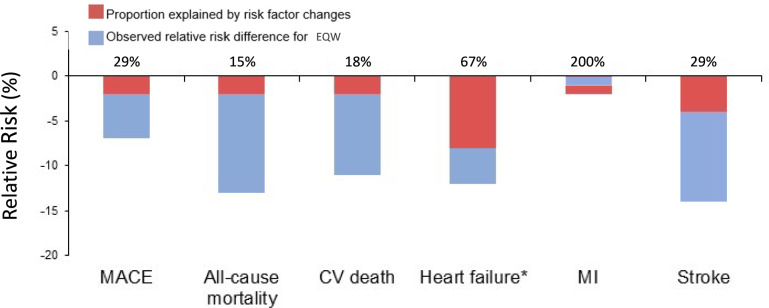
- Simulation analyses showed that changes in risk factors accounted for 67% of the observed risk reduction in hospitalization for heart failure and 200% for myocardial infarction, indicating a strong association.
- For major adverse cardiovascular events, all-cause mortality, cardiovascular death, and stroke, the explained proportions were much lower, at 29%, 15%, 18%, and 29%, respectively.
- Causal mediation analysis revealed that changes in common risk factors like HbA, blood pressure, and weight did not mediate the effect of exenatide on all-cause mortality.
Caveats
- The model used for simulations overestimated absolute event rates for all-cause mortality by more than 150%, indicating potential limitations in predictive accuracy.
- Missing data and the post-hoc nature of the analysis may introduce biases, limiting the ability to draw definitive conclusions about causation.
Simplified
Research insights
What is currently known about this topic?
Glucagon-like peptide-1 receptor agonists (GLP-1 RAs) affect cardiovascular (CV) outcomes via multiple mechanisms. GLP-1 RA therapies have been shown to have beneficial effects on CV disease, mortality, and kidney outcomes in people with type 2 diabetes.
What is the key research question?
To what degree do the observed changes in modifiable CV risk factors induced by once-weekly use of the GLP-1 RA exenatide explain observed differences in CV event rates between the drug and placebo arms of the Exenatide Study of Cardiovascular Event Lowering (EXSCEL)?
What is new?
Simulation and mediation analyses of EXSCEL both suggested observed changes in conventional CV risk factors induced by once-weekly exenatide explain only a modest proportion of the observed CV outcomes.
How might this study influence clinical practice?
The results of this study could be used to adjust risk estimates derived from prediction models in people with type 2 diabetes treated with GLP-1 RAs.
Introduction
Glucagon-like peptide-1 receptor agonists (GLP-1 RAs) have become established as blood glucose-lowering therapies that should be considered in people with type 2 diabetes if glycemic targets are not met with lifestyle measures and metformin [1], especially in those with, or at high risk of, cardiovascular (CV) disease [2]. GLP-1 RA treatment has been shown to have beneficial effects on CV disease, mortality, and kidney outcomes in people with type 2 diabetes [3, 4].
In people with type 2 diabetes, exenatide, a GLP-1 RA, reduces blood glucose levels and can lead to modest reductions in body weight, blood pressure, and lipid levels [5]. The Exenatide Study of Cardiovascular Event Lowering (EXSCEL) was a randomized event-driven trial of once-weekly exenatide (EQW) [6]. The study found that after a median 3.2 years of follow-up, participants randomized to EQW had a numerically lower incidence of major adverse CV events (MACE) and a nominally significant reduction in all-cause mortality (ACM) [7].
We sought to examine the degree to which EQW-induced changes in conventional CV risk factors might explain the observed differences in EQW and placebo event rates using model simulation and mediation analyses.
Methods
EXSCEL was a multinational, double-blind, placebo-controlled, randomized trial evaluating the impact of EQW on CV outcomes in patients with type 2 diabetes [6, 7]. EXSCEL enrolled participants with a broad range of CV risk at 687 sites in 35 countries between June 2010 and September 2015. Eligible participants were adults with type 2 diabetes (defined as a glycated hemoglobin [HbA1c] concentration of 6.5% to 10.0% [48 to 96 mmol/mol]) receiving up to three oral glucose-lowering agents or receiving insulin, either alone or in combination with up to two oral glucose-lowering agents. The study was designed to enroll approximately 70% of patients with a history of a major manifestation of coronary artery disease, cerebrovascular disease or peripheral arterial disease, and 30% without known CV disease. Exclusion criteria included end-stage kidney disease or an estimated glomerular filtration rate (eGFR) of less than 30 ml/min/1.73 m2, high risk for medullary thyroid carcinoma, previous use of GLP-1 RA, baseline calcitonin level of > 40 ng/L, or at least two severe hypoglycemic episodes within the preceding year.
EXSCEL evaluated the effect of EQW 2 mg versus placebo when added to usual care in 14,752 participants (73.1% with and 26.9% without previous CV disease). The trial protocol was approved by the ethics committee at each participating site, and all patients provided written informed consent.
Model simulation
We performed simulations for the primary 3-point MACE composite endpoint (CV death, nonfatal myocardial infarction [MI] or nonfatal stroke) and 5 secondary endpoints: ACM, CV death, first occurrence of a fatal or nonfatal MI, first occurrence of a fatal or nonfatal stroke, and first occurrence of hospitalization for heart failure (hHF) in individuals with no history of heart failure.
We used the United Kingdom Prospective Diabetes Study (UKPDS) Outcomes Model Version 2.1 (UKPDS-OM2) to simulate the impact of observed risk factor changes over time. UKPDS-OM2 is a second-generation lifetime-simulation model for people with type 2 diabetes that simulates single as well as composite endpoints using knowledge of previous clinical events and changes in risk factor values [8]. It predicts heart failure (based on adjudicated events) but not specifically hHF as recorded in the EXSCEL trial. UKPDS-OM2 was constructed using person-level data from the 20-year UKPDS trial and its 10-year observational follow-up. The model's equations are based on a median 17.6 years' follow-up with up to 89,760 person-years of data. It has been validated internally over a 25-year time horizon [8], evaluated externally [9 –13], and used to estimate the likely impact of observed changes in established CV risk factors induced by empagliflozin, a sodium-glucose cotransporter-2 inhibitor (SGLT2i), on key outcomes in the EMPA-REG OUTCOME trial [14]. Missing data at baseline for modifiable risk factors were assigned the population average. We calculated event rates separately for those participants assigned to EQW and to placebo, with the two simulated rates presented as relative risks.
Mediation analyses
The 85 participants who died prior to follow-up measurements (39 EQW, 46 placebo) were excluded from the mediation analysis, while those with missing data at baseline were assigned study population averages. Missing data at 6 and 12 months were calculated by linear interpolation (where data were available). A complete case sensitivity analysis was performed to evaluate the assumption that baseline data were missing at random.
We examined just ACM, as this was the only outcome with a statistically significant (p < 0.05) EQW risk reduction, compared with placebo (hazard ratio 0.86, 95% confidence interval 0.77 − 0.97) [7]. We used a causal mediation analysis (CMA) approach [15] to estimate the degree to which the effect of one or more of the CV risk factors affected by EQW could statistically account for its effect on ACM. A mediator is a variable that helps explain the relationship between a predictor and outcome variable. In other words, a predictor variable X could predict M, a mediator variable, which in turn predicts the outcome variable Y [16]. In a randomized trial, the key predictor, X, is the treatment to which an individual is randomized. Indirect effects work through mediators M1, M2, etc., whereas direct effects work through other mechanisms [17].
We performed CMA using Cox regression models, after testing proportional hazard assumptions, to evaluate potential ACM mediators using a counterfactual framework. CMA provides causal estimates of the total effect (TE) and the natural indirect effect (NIE). The TE is the overall difference between everyone being assigned EQW and the counterfactual of everyone being assigned placebo. The NIE is the estimate of the effect of the treatment via the mediator, and the proportion mediated can be calculated as the total excess risk / excess risk due to NIE. Risk factors considered included HbA1c, systolic blood pressure (SBP), diastolic blood pressure (DBP), heart rate, low-density lipoprotein cholesterol (LDL-C), high-density lipoprotein cholesterol (HDL-C), triglycerides, eGFR, body weight, and body mass index (BMI). We examined the effect of changes from baseline to 6 and to 12 months for all risk factors that differed by allocated treatment on ACM. We compared Cox regression models adjusted only for treatment allocation (intention-to-treat) with those adjusted for treatment allocation, baseline values, and changes in risk factor values from baseline to 6 and to 12 months. The presence of mediation was assessed as a proportion, with p < 0.05 considered statistically significant. All analyses were performed using SAS software v9.4.
Results
| Mean (SD) at baseline | Adjusted mean difference in change from baseline for EQW vs. placebo | ||||
|---|---|---|---|---|---|
| Variable | Exenatide (n = 7356) | Placebo (n = 7396) | Difference | 6 months | 12 months |
| HbA(%)1c | 8.1 (1.0) | 8.1 (1.0) | 0 | − 0.7, < 0.001p | − 0.4, < 0.001p |
| HbA(mmol/mol)1c | 65 (8) | 65 (8) | 0 | − 0.7, < 0.001p | − 0.4, < 0.001p |
| SBP (mmHg) | 136 (17) | 135 (17) | − 1.0 | − 1.2, < 0.001p | − 2.0, < 0.001p |
| DBP (mmHg) | 78 (10) | 78 (10) | 0 | 0.4, = 0.020p | 0.2, = 0.56p |
| Heart rate (bpm) | 73 (11) | 73 (10) | 0 | 3.0, < 0.001p | 2.3, < 0.001p |
| LDL-C (mmol/L) | 2.4 (0.9) | 2.4 (0.9) | 0 | − 0.05, < 0.001p | − 0.02, = 0.060p |
| HDL-C (mmol/L) | 1.13 (0.34) | 1.13 (0.34) | 0 | − 0.01, = 0.053p | 0.00, = 0.94p |
| Triglycerides (mmol/L)* | 1.73 (1.71, 1.75) | 1.74 (1.72, 1.76) | 0.01 | − 0.05, = 0.002p | 0.02, = 0.40p |
| eGFR (mL/min/1.73 m)2 | 78 (24) | 79 (24) | 1 | − 0.2, = 0.78p | 0.3, = 0.39p |
| Body weight (kg) | 92 (22) | 92 nn(21) | 0 | − 1.0, < 0.001p | − 1.4, < 0.001p |
| BMI (kg/m2) | 32.7 (6.5) | 32.6 (6.3) | − 0.1 | − 0.4, < 0.001p | − 0.5, < 0.001p |
Simulation analyses

Observed placebo-adjusted relative risks for 6 EXSCEL outcomes, and proportions explained by simulation for each outcome. EQW: once-weekly exenatide, MACE: major adverse cardiovascular event, CV: cardiovascular, MI: myocardial infarction. *Only observed/simulated in those with no prior heart failure (n = 6,194 and 6,168 for exenatide and placebo, respectively)
| Event | EQW events (n = 7356) | Placebo events (n = 7396) | Observed relative risk (95% CI) | Simulated relative risk (95% CI) | ||
|---|---|---|---|---|---|---|
| Observed | Simulated | Observed | Simulated | |||
| Major adverse cardiovascular event | 839 (11.4%) | 589 (8.0%) | 905 (12.2%) | 603 (8.2%) | 0.93 (0.83–1.03) | 0.98 (0.88–1.10) |
| All-cause mortality | 507 (6.9%) | 898 (12.2%) | 584 (7.9%) | 920 (12.4%) | 0.87 (0.75–1.00) | 0.98 (0.90–1.07) |
| Cardiovascular death | 340 (4.6%) | 437 (5.9%) | 383 (5.2%) | 448 (6.0%) | 0.89 (0.74–1.04) | 0.98 (0.86–1.11) |
| Myocardial infarction | 483 (6.6%) | 369 (5.0%) | 493 (6.7%) | 378 (5.1%) | 0.99 (0.86–1.11) | 0.98 (0.85–1.13) |
| Stroke | 187 (2.5%) | 177 (2.4%) | 218 (2.9%) | 185 (2.5%) | 0.86 (0.66–1.06) | 0.96 (0.78–1.18) |
| Heart failure* | 129 (1.0%) | 99 (1.3%) | 144 (1.2%) | 107 (1.3%) | 0.88 (0.70–1.12) | 0.92 (0.70–1.21) |
Mediation analyses
| Mediator 6-month change from baseline | Mediator 12-month change from baseline | |||||||
|---|---|---|---|---|---|---|---|---|
| HR (95% CI) total effects | Excess HR (95% CI) due to natural indirect effects | Percentage mediation | -valuep | HR (95% CI) total effects | Excess HR (95% CI) due to natural indirect effects | Percentage mediation | -valuep | |
| HbA1c | 0.87 (0.77–0.98) | − 0.01 (− 0.03–0.00) | 10.7 | 0.15 | 0.87 (0.75–0.98) | 0.00 (− 0.01–0.01) | 1.3 | 0.79 |
| SBP | 0.87 (0.76–0.98) | 0.00 (0.00–0.00) | − 0.6 | 0.63 | 0.86 (0.75–0.97) | 0.00 (0.00–0.01) | − 1.1 | 0.61 |
| DBP | 0.88 (0.77–0.99) | 0.00 (0.00–0.00) | − 0.5 | 0.45 | ||||
| Heart rate | 0.88 (0.77–0.99) | 0.00 (− 0.01–0.01) | 0.9 | 0.85 | 0.86 (0.75–0.98) | 0.00 (− 0.01–0.01) | 1.2 | 0.75 |
| LDL-C | 0.86 (0.75–0.98) | 0.00 (0.00–0.00) | − 1.4 | 0.4 | ||||
| Triglycerides | 0.87 (0.76–0.98) | 0.00 (0.00–0.00) | 1 | 0.44 | ||||
| Body weight | 0.87 (0.76–0.98) | 0.00 (0.00–0.00) | − 0.6 | 0.7 | 0.85 (0.74–0.97) | 0.01 (0.00–0.02) | − 5.9 | 0.16 |
| BMI | 0.87 (0.76–0.98) | 0.00 (0.00–0.00) | − 0.7 | 0.67 | 0.85 (0.74–0.97) | 0.01 (0.00–0.02) | − 6.7 | 0.15 |
Discussion
The EQW-associated changes in modifiable risk factors observed in the EXSCEL trial appear to explain the majority of the simulated differences seen for MI and heart failure, but contribute to less than a third of the observed risk reductions seen for MACE, ACM, CV death, and stroke events. Our findings suggest that EQW may have only a modest effect on atherosclerotic-mediated outcomes over a median 3.2 years' follow-up and that alternative mechanisms need to be explored that can further explain the magnitude of the observed risk changes in the EXSCEL trial. GLP-1 RA pleiotropic effects not captured by the conventional risk factors used in UKPDS-OM2 may include anti-inflammatory effects [18], improved endothelial function [19], and beneficial effects on cardiac structure or function [20, 21].
Causal mediation analysis did not identify any 6-month or 1-year changes in risk factors as mediators for the observed effect for ACM. Importantly, heart rate elevation did not mediate the effect of EQW on ACM, suggesting that potentially detrimental effects related to heart rate elevation are counter-balanced by an otherwise favorable metabolic profile with improved glycemia, body weight, and blood pressure. GLP-1 RA mediation analyses conducted by others have suggested HbA1c and urinary-albumin-to-creatinine ratio (UACR) partly mediate the beneficial effects of dulaglutide on MACE outcomes [22], and that HbA1c and SBP may moderately mediate the kidney benefits of liraglutide and semaglutide [23]. An exploratory mediation analysis of the LEADER (Liraglutide Effect and Action in Diabetes: Evaluation of Cardiovascular Outcome Results) trial identified HbA1c and, to a lesser extent, UACR as potential mediators of the CV effects of liraglutide [24]. In contrast, in patients with type 2 diabetes and established CV disease treated with the SGLT2i empagliflozin, changes in hematocrit and hemoglobin were the most important mediators for the reduction in hHF and death from heart failure [25].
The differences seen in the contribution of risk factors between our simulation modelling and mediation analyses may be explained by the UKPDS-OM2 death equations not including a direct measure of HbA1c as a risk factor. However, HbA1c is a risk factor for both MI and stroke in the model, which in turn increase the risk of death occurring in the same year.
Limitations of these analyses include the UKPDS-OM2 poor prediction of absolute ACM event rates, with simulated rates more than 150% of those observed, although relative ACM risk did reflect the difference seen between treatment groups. One possible explanation for this overestimation may be in the differences between the population used to develop the model and the EXSCEL trial. Model recalibration may be sufficient to address this, but it could contribute to the lower estimates for the primary endpoint with non-CV death as a competing risk. Some missing data are another limitation. Lastly this is a post-hoc analysis and the potential for unmeasured mediator-outcome confounding cannot be excluded.
Conclusions
Our simulation showed that the EXSCEL trial results can in part be attributed to EQW-induced changes in conventional CV risk factors. The observed greater benefits in outcomes may reflect more pleiotropic GLP-1 RA mechanisms, and to factors not measured in the EXSCEL study. The differences seen in the simulated and observed event rates in this study could be used to adjust risk estimates derived from prediction models, such as UKPDS-OM2, in people with type 2 diabetes treated with GLP-1 RAs.
Supplementary Information
Additional file 1