
What this is
- Prostate cancer (PCa) is the second leading cause of cancer-related death in men, heavily influenced by () signaling.
- This research investigates how different -targeted therapies, including -antagonists and (), affect the protein composition of released by PCa cells.
- The findings reveal that these treatments alter exosomal protein content, which may enhance the growth of neighboring cancer cells.
Essence
- -targeted therapies significantly change the protein content of secreted by prostate cancer cells, which in turn promotes the growth of neighboring cancer cells.
Key takeaways
- treatment increases the secretion of and enhances the levels of CD9, a marker for , indicating that signaling promotes exosome release.
- -antagonists like Enzalutamide reduce the secretion of angiogenin (ANG), a factor linked to tumor progression, suggesting that different -ligands distinctly regulate exosomal protein secretion.
- from -ligand treated cells contain proteins that promote growth and survival, indicating their potential role in tumor microenvironment communication and cancer progression.
Caveats
- The study primarily focuses on LNCaP cells, which may not fully represent the heterogeneity of prostate cancer in patients.
- While the findings suggest a link between exosomal protein content and cancer cell growth, the specific mechanisms by which these proteins influence neighboring cells require further investigation.
Definitions
- exosomes: Small extracellular vesicles that facilitate communication between cells and can carry proteins, lipids, and RNA.
- androgen receptor (AR): A type of nuclear receptor that is activated by binding to androgens, playing a crucial role in the development and progression of prostate cancer.
- supraphysiological androgen levels (SAL): Androgen levels that exceed normal physiological ranges, which can paradoxically suppress prostate cancer growth.
Simplified
Background
Prostate cancer (PCa) is the most prevalent form of solid cancer among men. In spite of the impressive endeavors in screening and diagnostic protocols, PCa remains the second leading cause of cancer-related death in male in Western countries [1]. PCa is under regulation of androgen through the androgen receptor (AR) signaling [2]. Consequently, the primary objective of initial therapeutic hormonal interventions is to impede AR signaling via androgen deprivation therapy (ADT) either alone or in combination with AR-antagonists, leading to an initial regression of the cancer. Eventually the cancer becomes resistant due to adaptive responses of AR-signaling and activation of other signaling mechanisms [3, 4]. Bicalutamide (Bic), as the first-generation of AR-antagonists, and the subsequent second-generation of AR-antagonists, Enzalutamide (Enz) and Darolutamide (Dar), are established clinical interventions employed to block AR activity in PCa [5]. Besides these AR-antagonists, Atraric acid (AA) is the first natural compound identified and characterized as an AR-antagonist, suppressing PCa cell growth in cell culture, 3D spheroids and in xenograft mice [6, 7].
In addition to AR-antagonists, androgen levels exert a significant influence on the growth of PCa [8]. Treatment of PCa cells or patients with testosterone concentrations equivalent to adult male physiological levels, promote cell proliferation and tumor progression. However, exposure to supraphysiological androgen levels (SAL) leads paradoxically also to growth suppression of PCa [9, 10]. This intriguing approach, known as bipolar androgen therapy (BAT), using ADT conditions with cycling administration of testosterone, leading to altering periods of very low androgen levels and SAL [10 –12]. BAT has been clinically investigated and shows promising results in clinical phase II trial [13].
Besides AR-antagonists, SAL induces cellular senescence in PCa cells as well as PCa samples derived from patients [14 –16]. Cellular senescence represents a durable cessation cell cycle arrest [17]. In general, senescent cells are metabolically active and can influence a tumor microenvironment (TME) by releasing factors that can either promote or suppress tumor development [18]. Within the TME, tumor cells engage in local and long-range signaling with various neighboring cells [19]. Senescent cells secreted factors known as senescence-associated secretory phenotype (SASP) including inflammatory cytokines, chemokines and growth factors as well as exosomes [16, 20, 21].
Exosomes are small extracellular vesicles surrounded by a lipid bilayer membrane and released by the majority of eukaryotic cells with exosome marker such as CD9 [22]. Exosomes facilitate intercellular communication and modulation of biological processes of target cells [22]. The specific biological function of exosomes depend on their cargo [23]. Tumor cells from different origins have been found to produce and release exosomes to promote tumor growth, making them an important issue for tumorigenesis, proliferation, survival, migration and drug resistance [22]. Emerging research highlights the significance of intercellular communication facilitated by exosomes in the progression and metastasis of PCa [24, 25]. Therefore, exosomes have the potential to serve as diagnostic and prognostic markers [22].
The hypothesis is that AR targeted therapies of PCa may influence exosome secretion and the composition of exosome cargo. Here, we addressed whether supraphysiological androgens or various AR-antagonists influence the protein content of exosomes. To the best of our understanding, no prior research analyzed the differentially presence of factors of PCa exosomes dependent on AR-ligands treatment. Here we isolated exosomes from LNCaP cells treated with AR-antagonists, including Enz, AA and Dar, as well as SAL. Subsequently, we employed MS-spec and bioinformatics predictions. The data suggest an enrichment of growth promotion, membrane activity and neural pathways. Functionally, we confirmed that exosomes lead to enhanced growth of naïve LNCaP cells.
Materials and methods
Cell culture and treatments
LNCaP cells [26], were cultured in RPMI-1640 medium (Gibco Life Technologies) supplemented with 5% fetal bovine serum (FBS), 25 mM HEPES pH 7.5, 100 U/ml penicillin, 100 μg/mL streptomycin, and 1% sodium pyruvate. LNCaP were seeded in cell culture plates and in a 5% CO2, humidified atmosphere at 37 °C. Following a 48 h incubation period, the cells were treated for 72 h with 1 nM R1881 (SAL), 1 μM Enzalutamide (Enz), 10 μM Darolutamide (Dar), 1 μM Bicalutamide (Bic), 100 μM Atraric Acid (AA) or 0.1% DMSO as a solvent control (C).
Senescence-associated β-galactosidase (SA β-gal) staining
For SA β-gal staining assay 35,000 LNCaP cells per well in 6-well plates were seeded. SA β-gal staining and detection were performed as described previously [15, 27].
Methanol precipitation of secreted proteins
500,000 LNCaP cells per 10 cm dish were seeded and treated for 72 h with DMSO, SAL, Enz, AA, Bic, or Dar. The conditioned medium was collected after 48 h of incubation with 0% FBS medium. To the collected conditioned medium, a nine-fold medium volume of cold 100% methanol was added, thoroughly mixed and incubated on ice and centrifuged at 3700 g for 20 min at 4 °C. The pellets were dissolved in cold 90% methanol and centrifuged at 15,000 g for 15 min at 4 °C. The pellet was dissolved in 100 μl Milli-Q H2O water.
Western blotting and antibodies
Protein samples were loaded and separated by SDS polyacrylamide gel. The membrane was incubated with specific primary antibodies against PSA (Cell Signaling, 24,755) and ANG (Boster, A00146). Horseradish peroxidase-conjugated anti-mouse IgG (Cell Signaling, 7076S) or anti-rabbit IgG (Cell Signaling, 7074S) were used as secondary antibodies. Finally, signals were detected by ImageQuant™ LAS 4000 (GE Healthcare Bio-Sciences AB) using ECL reagents (GE Healthcare). Quantification of bands were performed via the LabImage D1 program.
Immunofluorescence staining
15,000 LNCaP cells were seeded on coverslips in 24-well plates. After 48 h, cells were treated with DMSO, SAL or Enz. Following a 72 h of incubation, the cells were washed three times with 1x PBS and then fixed with 4% paraformaldehyde for 15 min at room temperature. Following a wash with 1x PBS, the cells were permeabilized using 0.25% Triton X. After two additional washes, the cells were blocked with 5% normal goat serum for 1 h at room temperature. Subsequently, the cells were incubated overnight at 4 °C with primary antibodies against CD9 (Invitrogen, 10626D) and TIMP2 (ABclonal, A1558). The next day, cells were washed and incubated with the secondary antibodies for 1 h at room temperature in a dark room. To visualize the nuclei, the cells were incubated with Hoechst (1:10,000, Invitrogen, H3569) for 5 min, followed by another wash with 1x PBS. The coverslips were transferred to glass slides using Fluoromount G (BIOZOL, SBA-0100-01). The slides were then dried, and pictures were captured with a Zeiss LSM 880 with Airyscan scanning fluorescence microscope equipped with a Plan-Apochromat 63x/1.4 oil DIC M27 objective at super resolution. Fiji software [28] was used for the quantification. The intracellular protein level was defined by the normalized total cell fluorescence (NTCF) set as relative to DMSO (Eq. 1). The secretion of exosomes was defined by Eq. 2 set as relative to DMSO.1\documentclass[12pt]{minimal} \usepackage{amsmath} \usepackage{wasysym} \usepackage{amsfonts} \usepackage{amssymb} \usepackage{amsbsy} \usepackage{mathrsfs} \usepackage{upgreek} \setlength{\oddsidemargin}{-69pt} \begin{document}$$NTCF= IntDen-\left( Area\ of\ selected\ cell\ast Mean\ fluorescence\ of\ BR/n\right)$$\end{document}NTCF=IntDen-Areaofselectedcell*MeanfluorescenceofBR/n
NTCF: normalized total cell fluorescence, IntDen: Integrated Density, BR: background readings 2 \documentclass[12pt]{minimal} \usepackage{amsmath} \usepackage{wasysym} \usepackage{amsfonts} \usepackage{amssymb} \usepackage{amsbsy} \usepackage{mathrsfs} \usepackage{upgreek} \setlength{\oddsidemargin}{-69pt} \begin{document}$$m ean\ secreted\ intensity/\mu m2= RInt\ total- RInt\ cells/ Area\ total- Area\ cells$$\end{document} m e a n s e c r e t e d i n t e n s i t y μ m R I n t t o t a l R I n t c e l l s A r e a t o t a l A r e a c e l l s / = - / - 2
RInt: Raw Intensity.
Exosome isolation from conditioned medium
500,000 LNCaP cells per 10 cm dish were seeded and subjected to treatment with DMSO, SAL, Enz, AA, or Dar for 72 h. Each treatment was performed in four dishes. The conditioned medium was collected after 48 h of incubation with 0% FBS medium. Exosomes were isolated from LNCaP conditioned medium using the differential centrifugation protocol. Briefly, conditioned medium was centrifuged at 380 g for 10 min at 4 °C to sediment cells and at 10,000 g for 10 min to eliminate cell debris. Consequently, the supernatant was centrifuged at 18,900 g for 30 min at 4 °C to remove microparticles and contaminating proteins. Exosomes were sedimented by two times ultracentrifugation at 100,000 g for 75 min at 4 °C and pellets were resuspended either in serum-free medium for growth assay or PBS for MS-spec.
Proteomics analysis by MS-spec
Exosomes were collected, proteins reduced, alkylated and precipitated with 8x volumes of cold acetone (Biosolve, #010306), as described elsewhere [29]. Precipitated proteins were resuspended in digestion buffer containing 1 M Guanidine HCl (Roth, 0035.1) in 100 mM HEPES (Sigma, H3375-100G) pH 8.0 and digested for 4 h at 37 °C using 1:100 (w/w) LysC (Wako Chemicals GmbH, #125–05061). Then, samples were diluted to 0.5 M Guanidine HCl with MilliQ water and digested with 1:100 (w/w) trypsin (Promega, #V5111) for 16 h at 37 °C. Digested peptide solutions were then acidified with 10% (v/v) trifluoroacetic acid and then desalted with Waters Oasis® HLB μElution Plate 30 μm (Waters, 186001828BA) in the presence of a slow vacuum, following manufacturer instructions. Eluates were dried with a speed vacuum centrifuge and dissolved in 5% (v/v) acetonitrile, 0.1% (v/v) formic acid to a peptide concentration of ~ 1 μg/μl, transferred to a MS vial and spiked with iRT peptides (Biognosys AG, Ki-3002) prior to analysis by LC-MS.
Approx. 1 μg of digested peptides were analyzed by Data Independent Acquisition (DIA) using the M class UPLC system (Waters) with a trapping (nanoAcquity Symmetry C18, 5 μm, 180 μm × 20 mm) and an analytical column (nanoAcquity BEH C18, 1.7 μm, 75 μm × 250 mm). Coupled to a Q exactive HF-X (Thermo Fisher Scientific) using the Proxeon nanospray source, as described elsewhere [30]. The raw files were processed by directDIA analysis using Spectronaut Professional+ v13.10 (Biognosys AG). Raw files were searched by directDIA search with Pulsar (Biognosys AG) against the human UniProt database (Homo sapiens, reviewed entries only, release 2016_01) with a list of common contaminants appended, using default settings. For quantification, default BGS factory settings were used, except: Proteotypicity Filter = Only Protein Group Specific; Major Group Quantity = Median peptide quantity; Major Group Top N = OFF; Minor Group Quantity = Median precursor quantity; Minor Group Top N = OFF; Data Filtering = Qvalue; Normalisation Strategy = Local normalisation; Row Selection = Automatic. The candidates and report tables were exported from Spectronaut and used for further analysis. Protein groups were considered as significantly affected if they displayed a Q value < 0.05.
Growth assays
A total of 13,000 LNCaP cells were seeded in each well of 6-well plates. After 48 h, the absorbance of crystal violet staining was measured on two wells from each treatment, representing day 0. The remaining wells were treated with isolated exosomes derived from 2,000,000 cells. Isolated exosomes were resuspended in serum-free medium and diluted 1:1 with fresh medium containing 10% FBS. Over the course of six days, the absorbance of crystal violet was measured every two days on two wells from each treatment, while the medium containing isolated exosomes was refreshed in the remaining wells. Subsequently, the actual absorbance was calculated relative to the absorbance of DMSO on day 0.
Bioinformatics analysis
Pathway analysis was conducted using pathfindR package [31, 32] with a significant threshold set at p < 0.05 to filter significant proteins. Protein sets were defined according to Reactome database and protein-protein interaction network was defined according to Biogird. Additionally, for certain aspects of pathway analysis, the Enrichr webtool was employed [33 –35].
Statistical analysis
Graph Pad Prism 8.0 software was utilized for statistical analysis. The data were expressed as the mean ± SD and were derived from a minimum of three independent experiments. Statistical significance for each experiment was determined using the appropriate method, either a two-tailed unpaired t-test or two-way analysis of variance (ANOVA).
Results
The level of secreted factors is dependent on AR ligands
Prostate specific antigen (PSA) is well known as a diagnostic marker for PCa, which is upregulated by androgens and secreted by LNCaP cells. To analyze the activity of AR-ligands, including the first-generation antagonist Bic, the second-generation AR-antagonists Enz and Dar, and the natural AR-antagonist AA, we analyzed the secretion of PSA in the supernatant cell culture medium by Western blotting (Supplementary Fig. S1). In contrast to dihydrotestosterone, which is rapidly metabolized and its metabolites may act as estrogen receptor beta agonists [36], the much less metabolizable synthetic androgen methyltrienolone (R1881) and thus more AR-specific androgen was used at 1 nM, defined previously as SAL [14, 15]. DMSO was used as solvent control. As expected, the data suggest upregulation of PSA secretion by SAL (Supplementary Fig. S1).
Angiogenin, ANG, is known to be secreted by human PCa and contributes to cancer progression through mediating tumor angiogenesis, cancer cell survival, and proliferation [40]. To confirm that AR-ligand induced senescent cells secrete ANG, the conditioned medium of treated cells was collected and ANG was detected by Western blotting (Supplementary Fig. S1). It is hypothesized here that the secretion of ANG is distinctly regulated dependent on the treating of a specific AR-ligands [41]. The secretion levels of ANG were upregulated upon SAL treatment, while AR-antagonists reduced ANG levels in the medium but in a distinct manner, with AA reducing only weakly, whereas Bic, Enz, and Dar repress the secreted ANG-level more potently. These findings suggest that AR-ligands influence the secretion of factors.

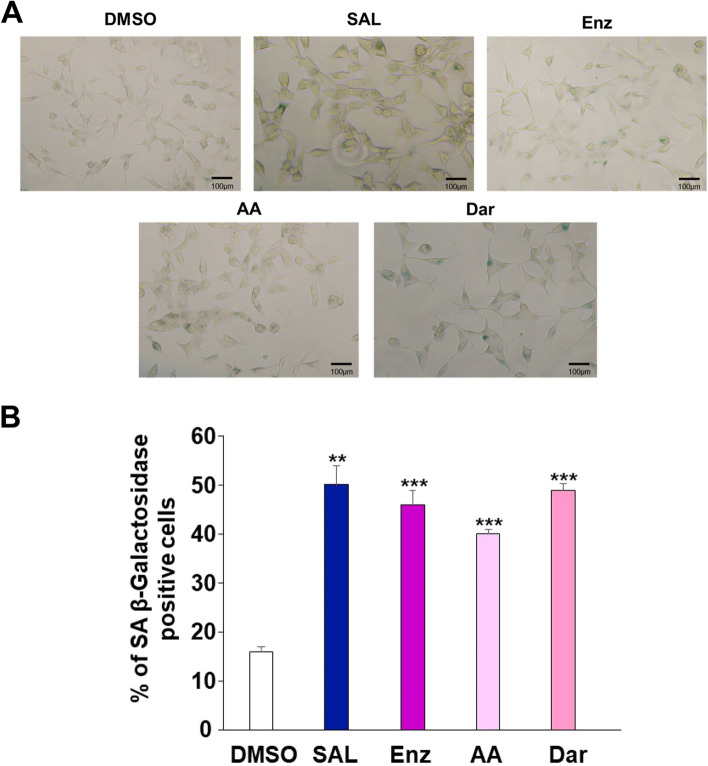
AR-antagonists induce cellular senescence in LNCaP cells. SA β-Gal activity staining of LNCaP cells were visualized under a light microscope (magnification 100 x). Bar chart indicates the percentage of SA β-Gal positive LNCaP cells. The mean ± SEM values were calculated from the three independent experiments ( = 3). A two-tailed unpaired Student's t-test was performed for statistical analysis (stars indicate a statistical significance with * < 0.05, ** < 0.01, *** < 0.001) A B n p p p
CD9 levels are regulated by SAL
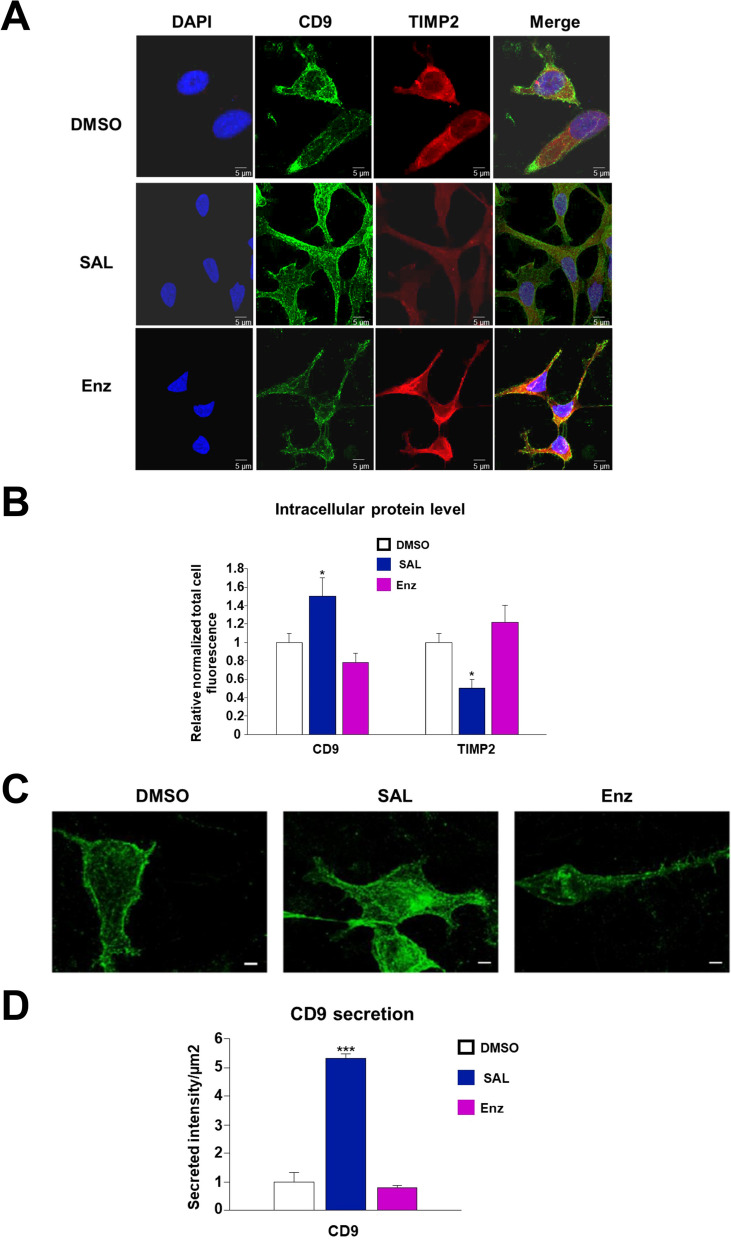
Further, we analyzed CD9 signals secreted from LNCaP cells. The secretion was analyzed upon AR-ligand treatments (Fig. 2 C and D). The data suggest that CD9 secretion significantly increased after SAL treatment, while no significant changes were observed following Enz treatment. These results indicate that androgen increased intracellular CD9 protein levels and enhanced the CD9 secretion, implying that exosome levels are controlled by AR-ligands in LNCaP cells.
Our findings suggest that SAL-activated AR enhances CD9 levels and indicate enhanced secretion of exosomes. Of note, the AR-antagonist Enz also induces cellular senescence (Fig. 1 A and B) but seem not to enhance CD9 levels.

Androgen treatment increases CD9 protein level and induces CD9 secretion. Fluorescent intensity measurement with the LSM. Nucleus (blue), CD9 (green), TIMP2 (red). Scale bars indicate 5 μm. The intracellular protein level was defined as the normalized total cell fluorescence set as relative to DMSO. The mean ± SEM values were calculated from the technical replicates ( = 15). A two-tailed unpaired Student's t-test was performed for statistical analysis (* < 0.05, ** < 0.01, *** < 0.001). The secretion of CD9 from the same cells using signals in (A) detected outside of cells was measured using the LSM. Scale bars indicate 5 μm. The secreted intensity of CD9 was determined. The mean ± SEM values were calculated from the technical replicates (n = 15). A two-tailed unpaired Student's t-test was performed for statistical analysis (* < 0.05, ** < 0.01, *** < 0.001). CD9 (cluster of differentiation 9), LSM (laser scanning microscope) A B C D n p p p p p p
SAL and Enz change the protein content of exosomes
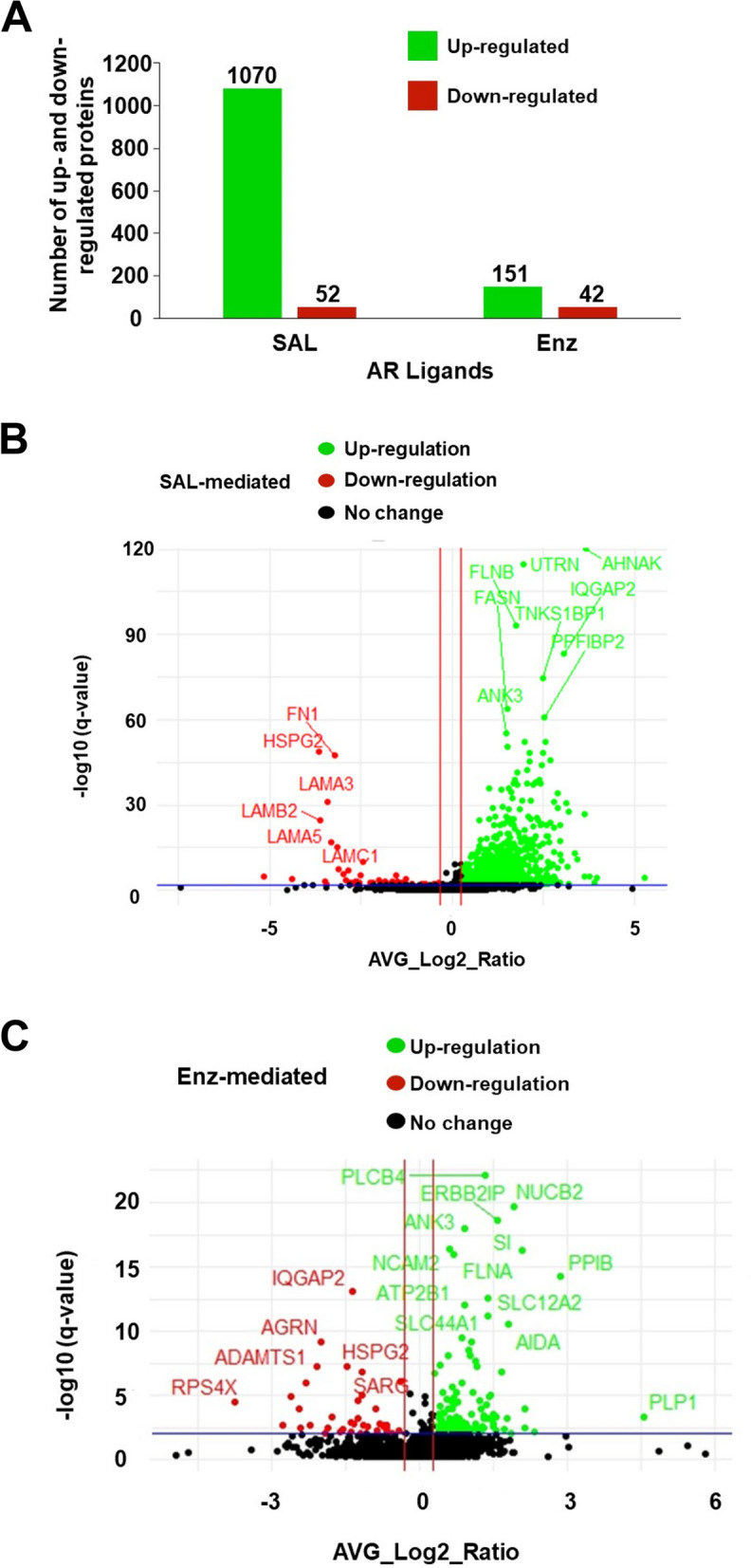
This data suggests that SAL and Enz treatment specifically change the protein content of exosomes and provide an insight into AR regulation of exosomal proteins.

Significant up- or downregulated exosomal proteins by SAL and Enz. Bar chart shows up and downregulated proteins ( = 4). Volcano plots show the differentially expressed exosomal proteins. Proteins that were not classified as up- or downregulated are represented in black color (B: SAL vs. DMSO; C: Enz vs. DMSO; < 0.05; = 4). Red vertical lines define fold change ≥0.2 A B-C n p n
Bioinformatic pathway analysis of exosomal proteins derived from SAL and Enz treatments predicts tumor promoting activity
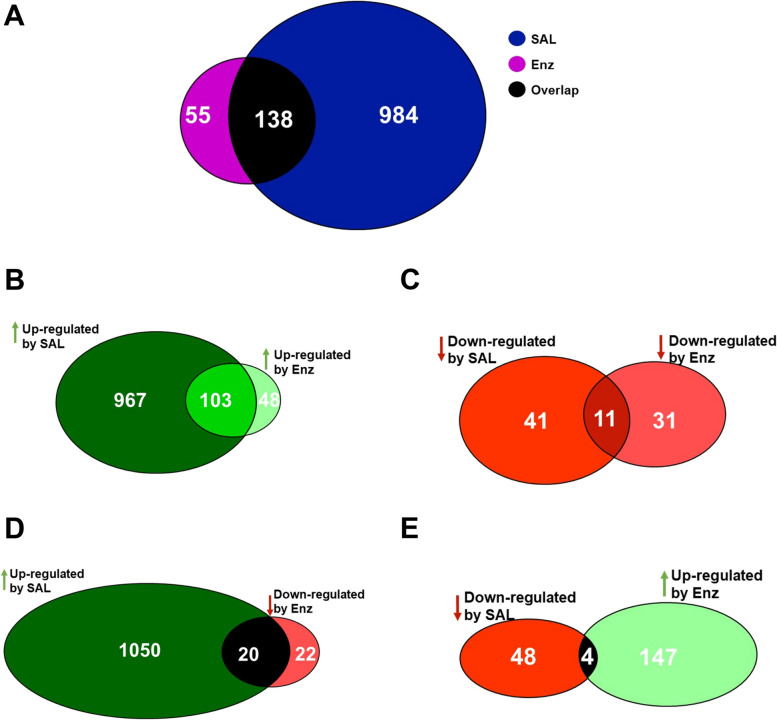
Collectively, these findings provide insights into the regulation of AR-ligand controlled exosome cargos derived from treated LNCaP PCa cells and predict tumor promoting activity.

138 common proteins were detected between SAL and Enz treated LNCaP cells in exosomes. Venn diagram shows overlapped proteins between SAL and Enz ( = 4). 103 common upregulated proteins between SAL and Enz. 11 common downregulated proteins between SAL and Enz.20 proteins upregulated by SAL and downregulated by Enz. 4 proteins downregulated by SAL and upregulated by Enz. ( = 4) A B C D E n n

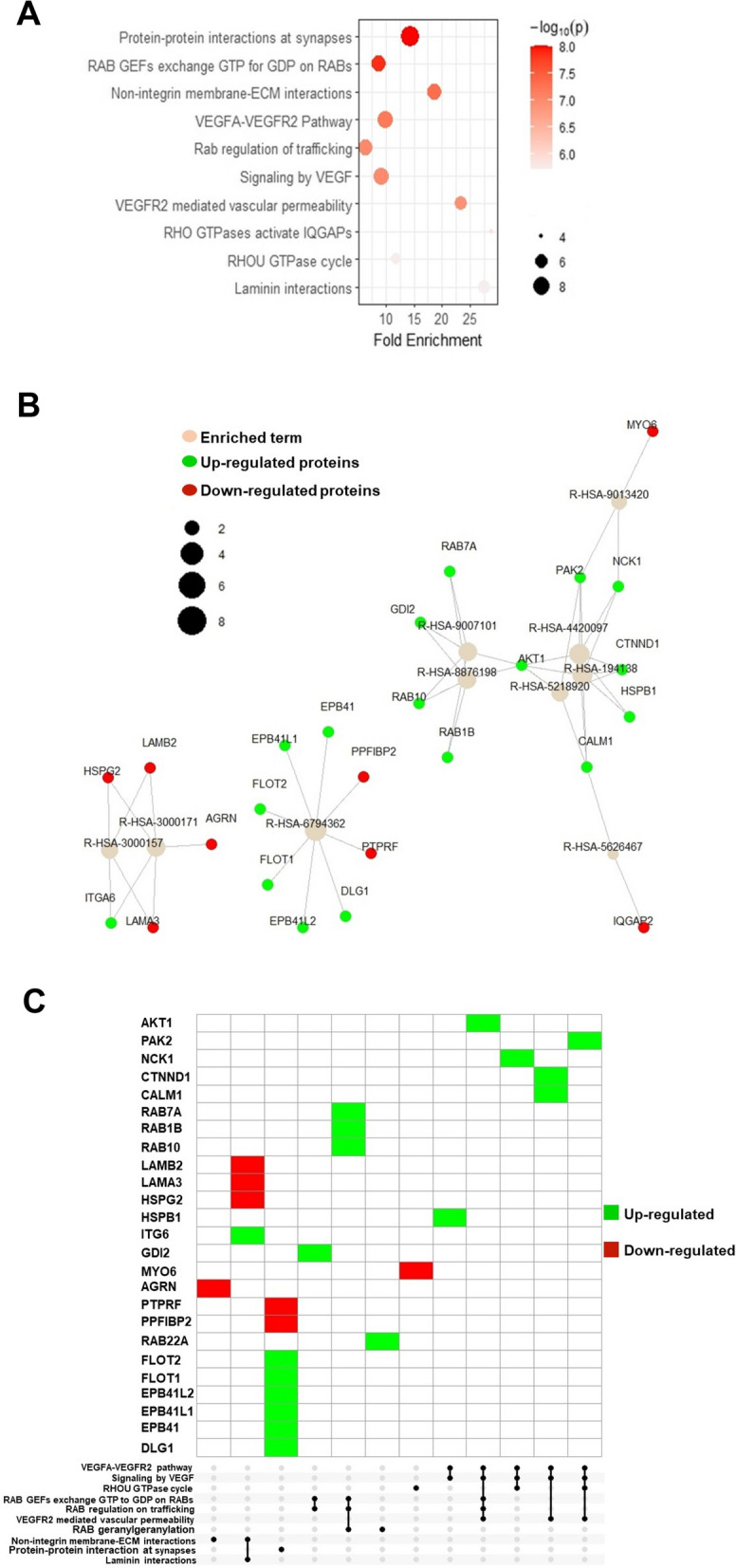
Pathway analysis of 138 common exosomal proteins suggest activation of pro-proliferative pathways. Highest enriched pathways according to the detected 138 common exosomal proteins between SAL and Enz. X-axis represents the fold enrichment of the expressed proteins enriched in the indicated pathway. Size of the dots indicates the number of significant proteins in the given enriched pathway. Color indicates -log10 (lowest-value). Network visualizes which proteins are involved in the enriched pathway and how the proteins are connected in different pathways. Pathways in the network are shown according to the reactome ID number. UpSet Plot shows a matrix of enriched pathways and the number of proteins at the corresponding intersections of enriched pathways. ( = 4) A B C p n

The content of exosomes from LNCaP cells treated with SAL and Enz, are mainly involved in growth promoting, membrane activity and neural pathways. Overall alteration (activated or repressed) pathways based on 103 common upregulated proteins between SAL () and Enz () (each = 4) A-B A B n
Identified hub-proteins and pathway analysis of exosomal proteins common among AR-ligands indicate activation of pro-proliferation pathways
![Enriched pathways of 83 common exosomal proteins among SAL, Enz, AA or Dar treatments. Hub-proteins network of top 10 common exosomal proteins among SAL, Enz, AA or Dar treatments. Network was drawn by cytoscape []. The colors represent the rank of proteins, with red indicating a higher rank and yellow indicating a lower rank. The network was calculated based on the Maximal Clique Centrality (MCC) score. The 10 most significantly enriched pathways according to Enrichr web tool ( = 4). The length of each bar represents the significance of that specific pathway. In addition, the brighter the color, the more significant that pathway is A B [50] n](https://europepmc.org/articles/PMC11000412/bin/12964_2024_1584_Fig7_HTML.jpg "Click to view full size")
Enriched pathways of 83 common exosomal proteins among SAL, Enz, AA or Dar treatments. Hub-proteins network of top 10 common exosomal proteins among SAL, Enz, AA or Dar treatments. Network was drawn by cytoscape []. The colors represent the rank of proteins, with red indicating a higher rank and yellow indicating a lower rank. The network was calculated based on the Maximal Clique Centrality (MCC) score. The 10 most significantly enriched pathways according to Enrichr web tool ( = 4). The length of each bar represents the significance of that specific pathway. In addition, the brighter the color, the more significant that pathway is A B [50] n
Growth promotion of LNCaP cells by treating with secreted exosomes regulated by AR-ligands

The secreted exosomes by AR-agonist and -antagonist lead to the enhanced PCa growth. Representative crystal violet staining pictures of cells after 6 days of treatment. Crystal violet absorbance (OD 590 nm) was normalized to the value of DMSO day 0. Bar graphs are shown as mean + SEM from total of six technical replicates of three independent experiments ( = 3). Statistical analysis was performed by using two-way ANOVA. (**** ≤ 0.0001) A B n p
Discussion
The interplay between prostate tumor cells and their microenvironment is widely recognized as a critical determinant of disease progression. This interaction influences various aspects of PCa including survival, growth, angiogenesis, metastasis, and drug-resistance [19, 51]. Exosomes have been demonstrated to mediate tumor microenvironment communication [18].
Several discoveries support the association between cellular senescence and exosomes [52], with an enhanced exosomes secretion in response to oxidative stress and irradiation-induced cellular senescence [53 –55]. However, not much is known about the therapeutically use of AR-ligands in changing exosome cargos. In light of these findings, we used AR-ligands to assess whether the AR regulates exosome protein content. Furthermore, we aimed to discern the functional consequences of the exosomes on growth. Our current data suggest a significant upregulation in the secretion of CD9, a well-established exosome marker, following SAL treatment. Conversely, Enz did not yield any discernible alterations in CD9 levels. This confirms the data published by Soekmadji et al. (2017) revealing that the secretion of extracellular vesicles upon Enz treatment is not inhibited [56]. Exosomes are known for transporting SASP factors [57]. Therefore, we analyzed TIMP2, a known SASP factor [47] in more detail. The MS-spec did not detect TIMP2 as an exosomal cargo, which is in line with the lack of co-localization with CD9. These combined results suggest that TIMP2 is not among the proteins secreted by exosomes originating from PCa cells.
In the present study, it was found that the protein expression profiles of exosomes released from AR-ligands treated cells were significantly altered. Since also AR-antagonists change the cargo of exosomes, it suggests that AR-antagonists do not solely neutralize the AR but rather activate a distinct AR signaling including the regulation of protein content of exosomes. All AR-antagonists and the use of androgens at supraphysiological level induce cellular senescence in PCa cell lines and in patient-derived prostatectomy samples shown for AA and SAL [7, 14, 20, 38]. It is possible that the AR-ligand mediated induced level of senescent cells within the cell population is one underlying mechanism of changed cargos in exosomes. Still, the different AR-ligands regulate a distinct composition of exosomal proteins. Similarly, findings by Takasugi et al. (2017) suggest that exosomes released by doxorubicin (DXR)-induced senescent RPE-1 cells (Retinal pigment epithelial cell line) resulting in a substantially altered protein composition of exosomes [52]. This suggests a possible way of how cells react under treatment by therapeutics, leading to changes in their exosomal protein content for communication within the tumor microenvironment. According to our data, an upregulation of proteins known to promote growth, including MFGE8, AKT1, AK1, CTNND1, ANXA6, CALM1, NCK1, ERBB2IP, FLOT1, FLOT2, HSPB1, PAK2, ITGA6 were detected. These proteins upregulate proliferation, migration, angiogenesis, and drug resistance [19, 58 –60].
Notably, an upregulation of Ras-associated binding (Rab) family proteins in isolated exosomes were identified. This finding aligns with a prior study that illustrated the transfer of oncogenic proteins via exosomes secreted from PCa [61]. However, the effects of AR-ligands on Rab family expression were previously unclear. Here, it is suggested that AR-ligands lead to the upregulation of levels of Rab family members in exosomes. Rab family proteins are known to be involved in pro-cancerogenic pathways and impose pro-proliferative effects, further illuminating the intricate interplay between AR signaling and exosome-mediated cellular communication.
It is worth emphasizing that resistance to both first- and second-generations of AR-antagonists can develop, and one possible mechanism behind this resistance might involve the induction of cellular senescence and subsequent exosome secretion. This process can impact neighboring cells, leading to the upregulation of growth of non-senescent cells. Treating LNCaP cells with isolated exosomes derived from cells treated with AR-antagonists or SAL led to an increase in growth of PCa cells. This finding provides confirmation that the upregulation of exosomal proteins expression mediates tumor promoting and membrane activity pathways. A similar growth promoting observations following treatment with exosomes secreted from DXR-induced senescent RPE-1 cells was observed for a human ovarian cancer cell line and an oesophageal cancer cell line [52]. Our findings suggest a significant contribution of exosomes secreted from PCa cells with pro-tumorigenic activities by AR-antagonists and SAL.
Conclusions
The evidence provided here indicates that exposure to AR-ligands induces a significant alteration in exosomal proteins released by PCa cells. These exosomes subsequently enhance the growth of LNCaP cells, highlighting a potential growth promoting activity in the tumor microenvironment. This study expands our understanding of AR controlled exosomes secretion by AR-ligands and their protein content mediating tumor growth.
Supplementary Information
Supplementary Material 1.Supplementary Material 2.Supplementary Material 3.