
What this is
- This research presents a novel method for genetic manipulation of Pneumocystis murina using ().
- The study successfully demonstrates stable transformation and -mediated gene editing in this obligate fungal pathogen.
- These advancements open new avenues for functional genomics and therapeutic strategies against pneumonia caused by P. murina.
Essence
- Engineered mouse lung were utilized to deliver plasmid DNA and components, achieving stable transformation and precise genome editing in Pneumocystis murina. This method enables long-term gene expression and facilitates the study of antifungal resistance mechanisms.
Key takeaways
- () were shown to effectively deliver genetic material to Pneumocystis murina, enabling stable transformation. This method allows for sustained expression of introduced genes over time.
- The system was successfully implemented for targeted genetic editing, achieving precise homologous recombination at the dhps locus. This demonstrated the potential for creating genetically modified strains for research and therapeutic applications.
Caveats
- The current system relies on prolonged infection cycles in mice, which limits scalability and throughput compared to traditional culture methods. Further optimization of culture systems for P. murina may enhance efficiency.
Definitions
- Extracellular vesicles (EVs): Membrane-bound particles released from cells that facilitate intercellular communication and can transfer genetic material.
- CRISPR/Cas9: A genome editing technology that allows for precise modifications of DNA sequences in living organisms.
Simplified
INTRODUCTION
Pneumocystis jirovecii pneumonia (PjP) remains a critical cause of morbidity and mortality in immunocompromised individuals, including those with HIV/AIDS, hematologic malignancies, or organ transplants receiving immunosuppressive therapy (1–4). Despite significant clinical relevance, critical aspects of the obligate fungal pathogen Pneumocystis remain poorly characterized. Key gaps, including its biology, pathogenesis, and antifolate drug resistance, remain primarily due to the persistent inability to culture these fungi in vitro (5). Unlike other fungi that readily grow in defined media, Pneumocystis species are obligate biotrophs, requiring a mammalian host to replicate (6). The lack of a long-term culture system severely limits functional genetic studies and the exploration of novel therapeutic targets.
A significant clinical challenge associated with Pneumocystis treatment is resistance to the antifolate drug combination trimethoprim-sulfamethoxazole (TMP-SMX), which remains the first-line therapeutic option (7, 8). Mutations in the dihydropteroate synthase (Dhps) gene, notably at codons 55 and 57, confer SMX resistance, complicating therapeutic management and necessitating novel methods to dissect resistance mechanisms and validate alternative therapeutic targets (9–13). These mutations result in an amino acid change from TRP (wild type) to ARS (SMX-resistant).
Furthermore, Pneumocystis genomes feature numerous major surface glycoprotein (Msg) genes arranged in tandem repeats near telomeric regions (14–16). These Msg genes are hypothesized to undergo frequent genetic recombination, enabling antigenic variation through differential expression of individual Msg variants (17, 18). The extensive and rapid genetic rearrangements observed in Pneumocystis imply a highly efficient DNA recombination system, suggesting that targeted genome editing via homologous recombination (HR) may be inherently feasible.
Recently, extracellular vesicles (EVs) have emerged as critical mediators of intercellular communication, transferring proteins, lipids, and nucleic acids between cells (19). Our prior work demonstrated that Pneumocystis organisms actively internalize host-derived EVs, presumably as a nutrient acquisition mechanism (20). We reasoned that this natural EV uptake pathway could be exploited to deliver genetic constructs, facilitating genetic manipulation of Pneumocystis in vivo.
CRISPR/Cas9-mediated genome editing technology has transformed genetic engineering, allowing targeted disruption, insertion, or modification of specific genomic loci (21, 22). Adapting this technology for Pneumocystis would significantly enhance our ability to probe gene function, dissect resistance mechanisms, and identify novel therapeutic targets.
In the present investigation, we aimed to develop a comprehensive methodology for genetic manipulation in Pneumocystis murina, encompassing two distinct, yet complementary approaches: stable plasmid-based transformation for gene overexpression and precise CRISPR/Cas9-mediated gene editing for targeted genomic modifications. We hypothesized that engineered mouse lung EVs could effectively deliver plasmid constructs to P. murina, enabling stable expression of foreign genes and facilitating targeted genomic modifications. Herein, we present compelling data demonstrating successful in vitro transformation, the establishment of in vivo persistence of transformed organisms, and the achievement of precise CRISPR/Cas9-mediated homologous recombination at the Dhps locus, a critical gene implicated in antifolate drug resistance. This work represents a significant leap forward in Pneumocystis research, providing essential tools that will facilitate future functional genomic studies, enable the creation of genetically modified strains, and ultimately contribute to the development of more effective therapeutic strategies against PjP.
RESULTS
EV uptake by P. murina
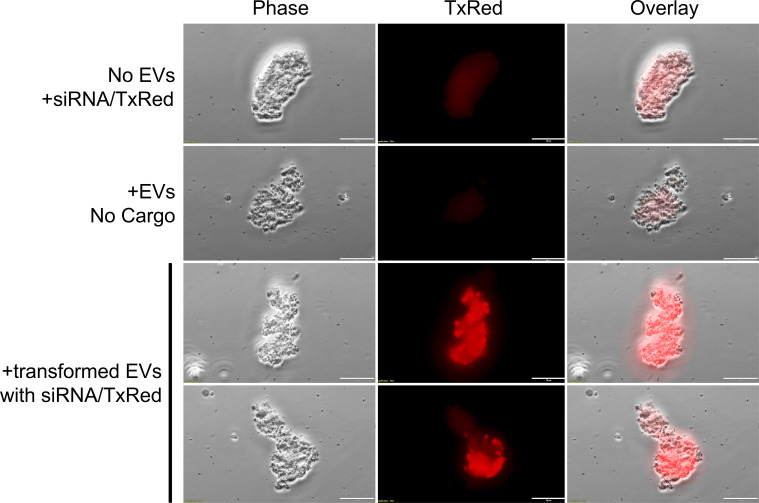
Our previous work demonstrated that Pneumocystis carinii actively uptakes native host lung EVs labeled with the lipophilic dye PKH26, suggesting a mechanism for nutrient acquisition from the host (20). Building on this, we conducted an initial feasibility study to determine if P. murina could internalize EVs containing exogenous nucleotides. EVs transformed with TxRed-labeled siRNA were co-cultured with P. murina for 24 h. Fluorescent microscopy analysis (Fig. 1) demonstrated clear uptake of the TxRed signal by P. murina organisms. In the control group, where P. murina was co-cultured with siRNA-TxRed but no EVs, no TxRed signal was observed within the organisms. Similarly, P. murina co-cultured with EVs containing no cargo also showed no TxRed signal. In contrast, P. murina co-cultured with EVs loaded with siRNA-TxRed exhibited distinct punctate TxRed fluorescence localized within the fungal cells, indicating successful internalization of the EV cargo. This confirms that P. murina can actively take up EVs and their contents, establishing a foundational step for EV-mediated genetic delivery.

uptake of BALF EVs containing exogenous nucleotides.was treated with TxRed-conjugated siRNA (top row), EVs alone (middle row), or EVs loaded with siRNA-TxRed (bottom rows) for 16 h. Scale bars, 20 µm. Pneumocystis murina P. murina
Successful EV-mediated gene delivery and expression in P. murina
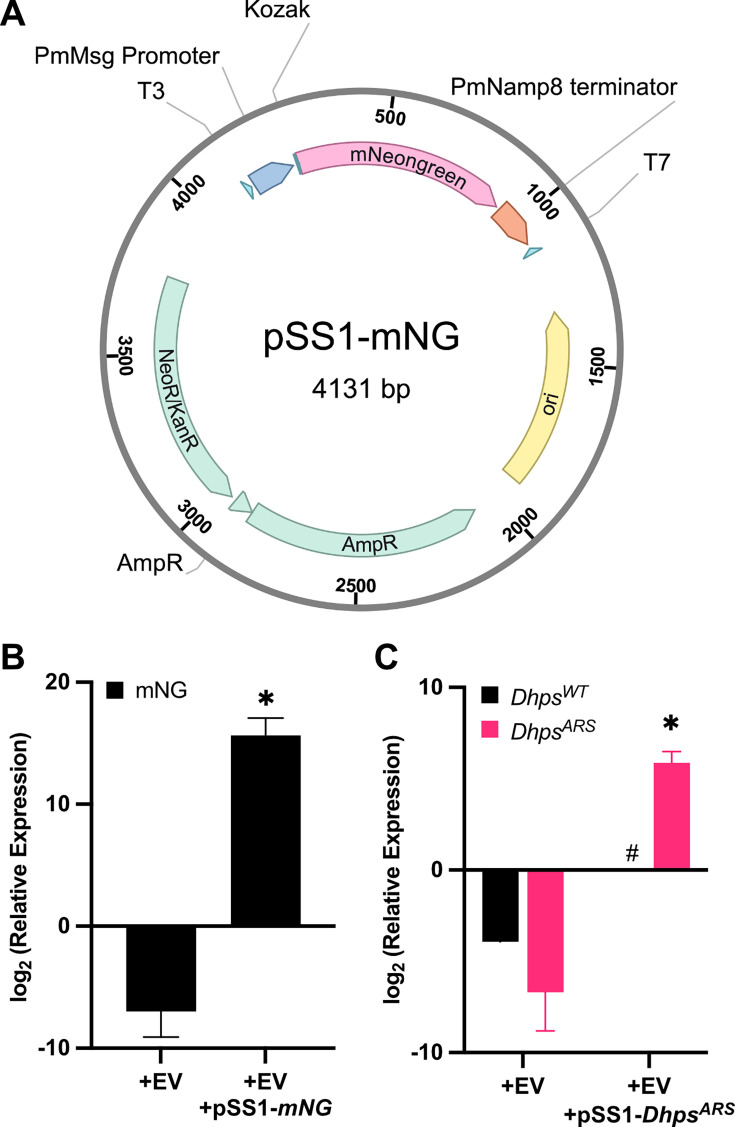
The initial pSS1 plasmid (Fig. 2A) was constructed, incorporating an expression cassette with a flanking P. murina Msg promoter and PmNamp8 terminator to ensure the expression of introduced genes within the fungal host. P. murina codon-optimized mNeonGreen or DhpsARS were cloned into the coding region.
P. murina organisms co-cultured with EVs containing either pSS1-mNeonGreen or pSS1-DhpsARS demonstrated successful gene delivery and subsequent transcriptional activity in vitro after 24 h. Relative to P. murina exposed to empty EVs (control), the mNeonGreen and DhpsARS groups showed strong transcriptional activity, with average 2−ΔCt values of 51,333 and 58.95, respectively. These correspond to log2-transformed values of approximately 15.7 and 5.9, confirming successful expression of the plasmid-delivered genes (Fig. 2B and C). Interestingly, endogenous DhpsWT transcription was not detected in pSS-DhpsARS transformed Pm, suggesting a feedback mechanism regulating gene expression. Western blot analysis did not detect mNeonGreen protein expression (data not shown), likely due to the lack of a long-term culture system. Under these conditions, P. murina is unable to maintain cellular homeostasis, thereby likely limiting its capacity for efficient protein translation.
This initial in vitro success established the feasibility of EV-mediated gene delivery for Pneumocystis and foundational proof of concept for the entire study. It demonstrates that EVs can indeed deliver genetic material to P. murina and, crucially, that this material is transcriptionally active within the fungal cells. Without this initial success in vitro, the more complex in vivo experiments and CRISPR applications would not be feasible.

culturedtranscribes plasmid-encoded genes following delivery by extracellular vesicles. () Plasmid map of pSS1-mNG, which encodesdriven by the Pmpromoter, and a Namp8 terminator.(1 × 10organisms) was treated with EVs (2 µg protein equivalent) loaded with either pSS1-(mNG) or pSS1-for 16 h. Total RNA was extracted from the cells and synthesized to cDNA. Reverse transcription quantitative PCR (RT-qPCR) was performed, and relative expression was calculated using the 2method, normalized to large subunit (LSU). Plasmid-transformed ()and ()groups (= 9) showed significant transcriptional activity, confirming successful expression of the plasmid-delivered genes. Nativewas notably absent in plasmid-transformed.-test; ∗,< 0.05 against control. #, unable to perform comparison due to the lack of detectable expression. Pneumocystis murina in vitro mNeonGreen Msg P. murina mNeonGreen Dhps mNeonGreen Dhps n Dhps P. murina t P A B C 6 ARS −ΔCt ARS WT
Development of a stabletransformation system in vivo
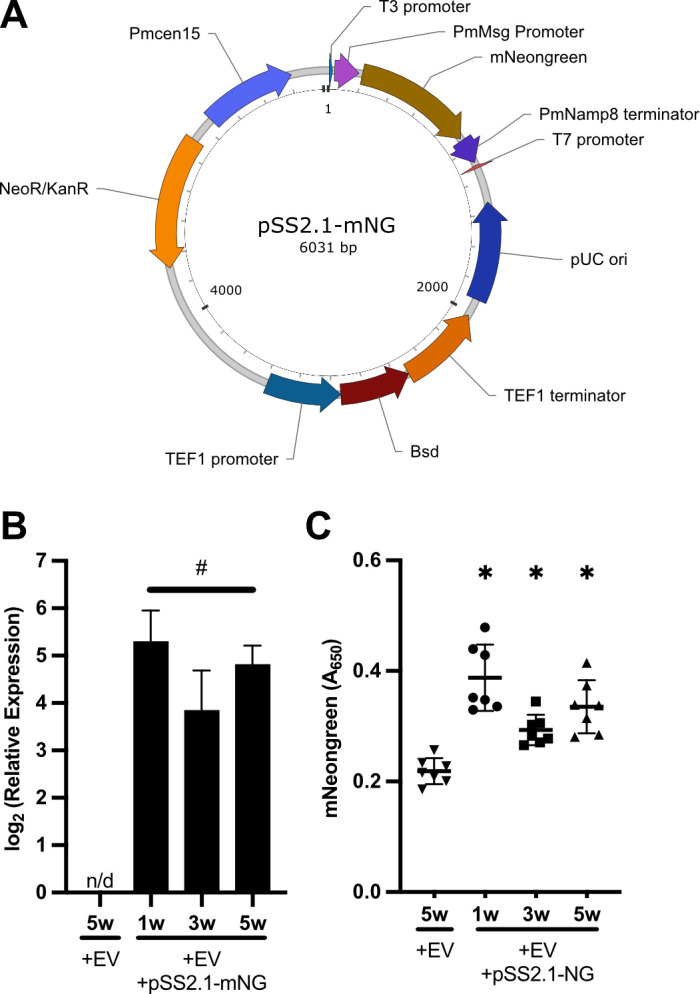
To enable stable and long-term gene expression within the host, the pSS2.1 plasmid (Fig. 3A) was engineered. This improved construct incorporates a blasticidin resistance (blasticidin S deaminase [Bsd]) gene for selective pressure and, critically, a truncated centromeric region, PmCen15 (23). This centromeric region was incorporated to ensure stable maintenance and accurate segregation of the plasmid within P. murina cells in vivo, mimicking chromosomal behavior and preventing plasmid loss, a common challenge with traditional episomal plasmids in eukaryotic systems in the absence of continuous selective pressure.
Following in vitro blasticidin selection of P. murina transformed with pSS2.1-mNeonGreen-containing EVs and subsequent infection of mice, mNeonGreen transcript expression was detected by reverse transcription quantitative PCR (RT-qPCR) and subsequent agarose gel electrophoresis (Fig. 3B). While mNeonGreen was indetectable by immunofluorescence, likely due to low expression, mNeongreen protein expression was successfully detected from Pm lysates using enzyme-linked immunosorbent assay (ELISA) (Fig. 3C). Both mNeonGreen mRNA and protein expression were sustained in lung samples collected at 1 week, 3 weeks, and 5 weeks post-infection. This sustained expression over an extended period clearly indicates successful long-term maintenance and active expression of the pSS2.1 plasmid within the P. murina population residing in the host lung environment.

expresses mNeonGreenfollowingextracellular vesicle-mediated gene delivery. () Plasmid map of pSS2.1-, which includes a second expression cassette encoding blasticidin S deaminase () and, a truncated centromeric sequence.(1 × 10⁶ organisms) was incubated for 16 h with extracellular vesicles (2 µg protein equivalent) either lacking cargo or loaded with pSS2.1-mNeonGreen (). Total RNA was extracted, synthesized to cDNA, and RT-qPCR was performed. Relative expression was calculated using the 2method, normalized to LSU. () Pm displayed sustained expression ofmRNA expression after 1 week, 3 weeks, and 5 weeks post-inoculation (= 3). () mNeonGreen protein was detected inlysates by enzyme-linked immunosorbent assay (ELISA) after 1 week, 3 weeks, and 5 weeks post-inoculation (= 3). Analysis of variance (ANOVA) followed by Sidak's multiple comparisonstest; n/d, no detectable expression; #, unable to perform comparison due to the lack of detectable expression; ∗,< 0.05 against control. Pneumocystis murina in vivo in vitro mNG Bsd PmCen15 P. murina mNG mNeonGreen n P. murina n post hoc P A B C −ΔCt
CRISPR/Cas9 system enables targeted genetic editing in P. murina
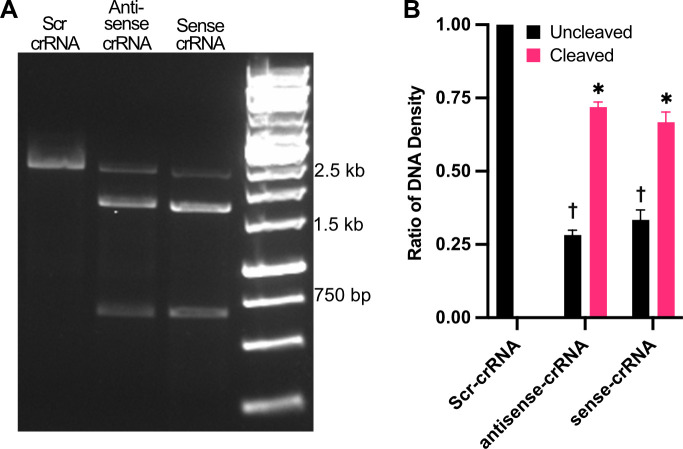
Two distinct sets of crRNAs designed to target the Dhps gene were validated through in vitro cleavage assays. Agarose gel electrophoresis and subsequent densitometry analysis (Fig. 4A and B) confirmed efficient cleavage of the Dhps target DNA, demonstrating the functionality of the designed crRNAs and the Cas9 enzyme in a cell-free system. This in vitro validation was a prerequisite for proceeding with in vivo applications.
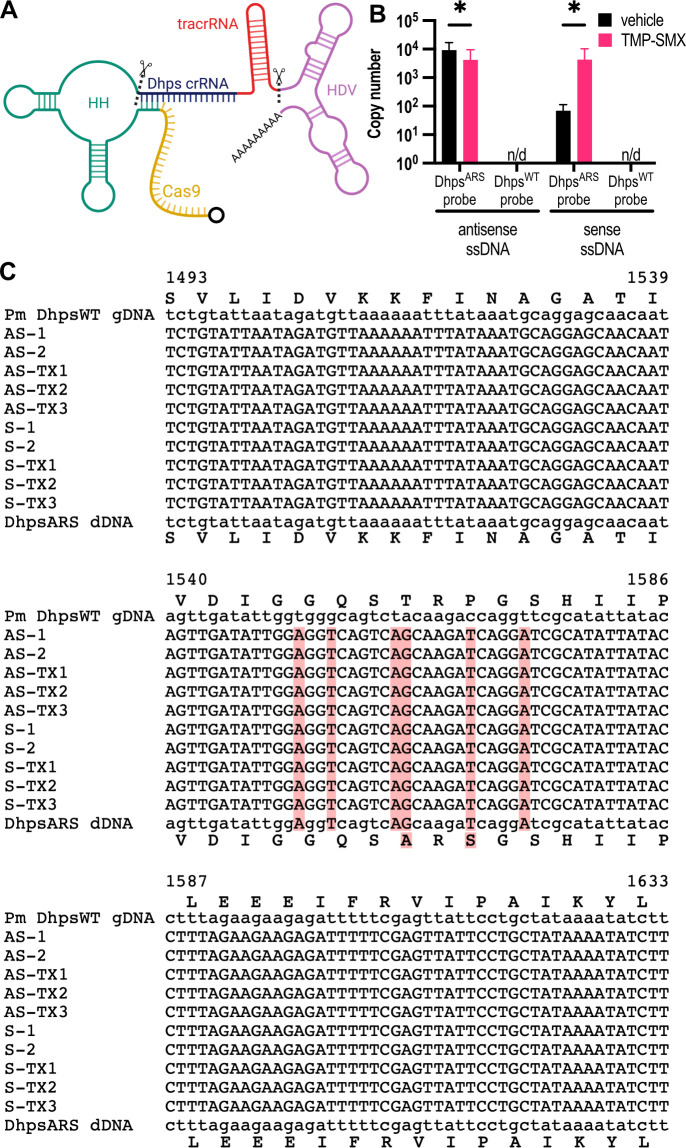
For in vivo Dhps editing, we engineered a Cas9 expression cassette encoding a guide RNA targeting the Dhps locus, flanked by a hammerhead (HH) ribozyme at the 5′ end and a hepatitis delta virus (HDV) ribozyme at the 3′ end (Fig. 5A). This ribozyme-flanked gRNA design was inserted into the CDS region of plasmid pSS2.1 and is based on a previously described self-processing architecture (24). In this system, the HH and HDV ribozymes mediate RNA self-cleavage (25, 26), resulting in the generation of mature Cas9 mRNA and Dhps-targeting gRNA. The resulting construct (pSS2.1-Cas9-HH-gRNADhps-HDV) was delivered to P. murina via EVs, along with either sense or antisense single-stranded DNA (ssDNA) donor templates encoding the DhpsARS mutation. Both orientations of the donor were tested to account for potential strand bias during homology-directed repair (HDR).
Following in vitro blasticidin selection to enrich for transformed organisms, mice were infected with the treated P. murina organisms. After 5 weeks post-inoculation, the animals were treated with TMP-SMX for 2 weeks. This treatment regimen applied strong selective pressure, first with blasticidin, for which resistance is encoded on the plasmid, and then with TMP-SMX, where only Pneumocystis organisms that had successfully incorporated the DhpsARS mutation were resistant to SMX exposure (9–13).
After 5 weeks of infection and 2 weeks of treatment, quantitative PCR revealed that DhpsARS copy number was detectable in both donor-treated groups compared to DhpsWT, which was not detected (Fig. 5B). These results suggest that delivery of either sense or antisense donor templates promoted maintenance or enrichment of the Dhps locus under selective pressure, consistent with successful in vivo editing and expansion of resistant organisms. However, treatment with TMP-SMX did not result in a significant decrease in fungal organisms. However, it is plausible that blasticidin selective pressure was sufficient in maintaining only P. murina organisms that successfully received pSS2.1 and the encoded Bsd resistance.
To confirm this hypothesis, Sanger sequencing was performed on amplified Dhps genomic DNA to provide definitive evidence of precise genetic editing. Primers were designed to amplify regions flanking the donor DNA, thereby eliminating the possibility of amplifying residual plasmid or unincorporated donor template. Alignment of the Dhps [1493–1633] region from untreated organisms (P. murina DhpsWT) was compared to sequences from P. murina organisms treated with EVs containing pSS2.1-Cas9-HH-gRNADhps-HDV and either antisense (AS) or sense (S) single-stranded DNA (ssDNA) donor templates. The alignment (Fig. 5C) revealed that 10 out of 10 treated animals harbored fungal organisms with successful HDR, displaying precise genomic integration of the DhpsARS mutant sequence. In addition to the TRP-to-ARS amino acid substitution, the edited sequences contained silent point mutations engineered into the donor DNA to permit specific quantitative PCR (qPCR) detection and reduce the likelihood of repeated Cas9 ribonucleoprotein (RNP) binding. Together, these findings provide evidence of accurate and durable editing of the P. murina genome in vivo.

CRISPR RNA (crRNA) sequences mediate efficient cleavage ofamplicons. A full-lengthamplicon was generated fromgenomic DNA. Annealed crRNA and tracrRNA were complexed withCas9 nuclease to form ribonucleoprotein (RNP) complexes, which were then incubated with theamplicons for 1 h. () Agarose gel electrophoresis showed cleavage ofby both sense and antisense RNPs, yielding two fragments of ~1,560 bp and ~660 bp, as predicted. Scramble (scr) RNPs did not induce cleavage. () Densitometric analysis confirmed significantly increased cleavage by sense and antisense RNPs compared to scr-RNPs (= 3). ANOVA followed by Sidak's multiple comparisonstest; †,< 0.05 vs uncleaved control; *,< 0.05 vs cleaved control. Dhps in vitro Dhps P. murina Streptococcus pyogenes Dhps Dhps n post hoc P P A B
![pSS2.1 effectively delivers Cas9 and gRNA for genetic editing of thelocus. () Schematic of the-gRNA expression cassette, which encodesand a guide RNA flanked by a hammerhead (HH) ribozyme and a hepatitis delta virus (HDV) ribozyme. Created in BioRender (S. Sayson, 2025,). () After 5 weeks of infection and 2 weeks of treatment, quantitative PCR detectsin DNA extracted fromin both antisense-ssDNA-treated and sense-ssDNA-treated groups (= 5). In the samepopulations,was not detected. ANOVA followed by Sidak's multiple comparisonstest; *,< 0.05 () Alignment of the[1493–1633] regions from untreated organisms (Pm DhpsWT gDNA) was compared toorganisms treated with EVs containing pSS2.1-Cas9-HH-gRNA-HDV and antisense (AS) or sense (S) ssDNA. Donor DNA for Dhpsis displayed in bottom row of alignment. Treated Pm organisms all display precise genetic editing to include the associated nucleotide changes for an amino acid change from TRP to ARS, as well as silent point mutations included on the donor DNA. TX, TMX-SMX groups are shown. Red indicates change in sequence from DHPSisolated from Pm. Dhps Cas9 Cas9 Dhps ARS P. murina n P. murina Dhps WT post hoc P Dhps P. murina Dhps A B C https://BioRender.com/dp0twrz ARS WT](https://europepmc.org/articles/PMC12607567/bin/mbio.01825-25.f005.jpg "Click to view full size")
pSS2.1 effectively delivers Cas9 and gRNA for genetic editing of thelocus. () Schematic of the-gRNA expression cassette, which encodesand a guide RNA flanked by a hammerhead (HH) ribozyme and a hepatitis delta virus (HDV) ribozyme. Created in BioRender (S. Sayson, 2025,). () After 5 weeks of infection and 2 weeks of treatment, quantitative PCR detectsin DNA extracted fromin both antisense-ssDNA-treated and sense-ssDNA-treated groups (= 5). In the samepopulations,was not detected. ANOVA followed by Sidak's multiple comparisonstest; *,< 0.05 () Alignment of the[1493–1633] regions from untreated organisms (Pm DhpsWT gDNA) was compared toorganisms treated with EVs containing pSS2.1-Cas9-HH-gRNA-HDV and antisense (AS) or sense (S) ssDNA. Donor DNA for Dhpsis displayed in bottom row of alignment. Treated Pm organisms all display precise genetic editing to include the associated nucleotide changes for an amino acid change from TRP to ARS, as well as silent point mutations included on the donor DNA. TX, TMX-SMX groups are shown. Red indicates change in sequence from DHPSisolated from Pm. Dhps Cas9 Cas9 Dhps ARS P. murina n P. murina Dhps WT post hoc P Dhps P. murina Dhps A B C https://BioRender.com/dp0twrz ARS WT
DISCUSSION
For decades, the inability to culture Pneumocystis species in vitro has been the principal obstacle to dissecting their biology, metabolism, and pathogenic mechanisms (5). While several studies have reported progress toward axenic or semi-axenic cultivation of Pneumocystis spp., including the use of differentiated CuFi-8 airway epithelial cells (27) or axenic media formulations (28, 29), these approaches have not been widely adopted, in part due to challenges in reproducibility across research groups. In addition, efforts to apply alternative gene delivery strategies, including lipid nanoparticles and electroporation, were unsuccessful in our hands, though these methods may warrant further optimization.
These major bottlenecks have severely limited the application of modern molecular genetics to this clinically important pathogen. Here, we report an EV-mediated system that bypasses these limitations and establishes the first robust in vivo method for genetic manipulation of Pneumocystis murina. Because the fungus appears to internalize host EVs naturally, potentially for nutrient acquisition (20), our strategy exploits an existing uptake pathway, which likely underlies the high transformation and transgene-expression efficiencies we observed.
We selected a P. murina-infected mouse model because the extensive availability of genetically engineered mouse strains allows for mechanistic host–pathogen studies that are not readily available in other systems. This genetic flexibility enables experimental designs that combine precise pathogen modifications with targeted host gene alterations. For example, a P. murina strain engineered to overexpress genes involved in β-glucan synthesis and deposition could be used to infect mice lacking the β-glucan receptor dectin-1, thereby allowing the hypothesis that host receptor deficiency attenuates β-glucan-driven inflammatory responses in vivo to be tested.
Our study introduces two distinct yet complementary genetic manipulation platforms. The first is a plasmid-based system designed for stable gene overexpression and complementation studies. To achieve sustained gene expression beyond transient delivery, the pSS2.1 plasmid carried a blasticidin-resistance cassette for initial enrichment and a truncated PmCen15 centromeric region designed to promote episomal maintenance. Consistent with this design, we detected transgene expression for at least 5 weeks in vivo. Although plasmid retention was not directly quantified, consistent mRNA and protein detection across multiple time points supports stable maintenance. These data suggest that inclusion of the centromeric element significantly reduced plasmid loss, thereby permitting longitudinal analyses of gene function and host–pathogen interactions under physiologically relevant conditions. As a plasmid-based expression system, pSS2.1 thus provides a rapid platform for gene overexpression or complementation experiments without permanent genomic modification, enabling researchers to study the effects of increased protein levels or restore gene function in mutant strains. This stable maintenance in vivo is a major methodological achievement, opening up new possibilities for conducting prolonged functional studies and investigating drug efficacy over time in a physiologically relevant setting.
Building on that stable plasmid platform, we developed and demonstrated a high-fidelity CRISPR/Cas9 system for precise HDR of the Dhps gene. This system utilized a Cas9 expression cassette with a guide RNA flanked by hammerhead and HDV ribozymes, following the self-processing gRNA architecture described by Gao and Zhao (24). The successful in vitro cleavage confirmed the functionality of our designed crRNAs and Cas9 enzyme. The subsequent in vivo application yielded remarkable results: all 10 P. murina populations, each derived from independently infected mice, carried the DhpsARS mutation, confirmed by Sanger sequencing. This high efficiency of precise HDR in vivo is a groundbreaking achievement for an obligate pathogen. The successful demonstration of HDR in all 10 P. murina populations is significant, particularly given the general challenges associated with HDR efficiency (30, 31) and the extreme difficulty of genetically manipulating Pneumocystis. This high efficiency of precise HDR is particularly notable, given that Pneumocystis appears to primarily rely on HR for DNA repair, potentially lacking non-homologous end-joining pathways (32). This suggests that our system successfully directed the organism's inherent HR machinery for precise genomic modification. This efficiency, coupled with the precision of HDR (30, 31), means that specific, predetermined genetic changes can now be reliably introduced into P. murina in vivo.
Blasticidin selection in vitro was sufficient to enrich for initial plasmid uptake, while subsequent in vivo trimethoprim/sulfamethoxazole treatment confirmed complete resistance in the edited fungi. This second drug pressure provided clear phenotypic validation of the rare, precise editing events, offering a reliable route to identify drug-resistant, site-specific mutants. The ability to precisely introduce the DhpsARS mutation, a clinically relevant resistance determinant in P. jirovecii (9–13), directly demonstrates the power of this CRISPR platform. This system complements the plasmid-based approach by enabling stable knock-in, knock-out, or point-mutation studies at native chromosomal loci, allowing for investigations into essential gene functions, protein localization, and the molecular mechanisms of drug resistance.
Together, the stable EV-mediated plasmid transformation for overexpression and the high-fidelity CRISPR editing for precise genome modification furnish complementary tools that finally open Pneumocystis research to sophisticated molecular genetics. Our in vivo DhpsARS model now enables direct, empirical testing of antifolate compounds previously assessed only in heterologous species (33, 34), allowing determination of resistance thresholds, binding efficacy, and pharmacodynamic performance in the natural pulmonary environment. This EV-based system can be readily adapted for functional genomic interventions. Investigators can now generate specific drug-resistant strains for in vivo drug screening, tag endogenous proteins for localization and interaction studies, or create conditional knockouts of essential genes. These approaches were previously inaccessible for this pathogen. These capabilities are vital for understanding Pneumocystis pathogenesis, identifying novel drug targets, and ultimately developing more effective therapies for PjP, especially in the face of emerging drug resistance.
However, the current system has limitations, including the relatively prolonged timeline required. Each genetically edited P. murina population necessitates an initial mouse infection lasting approximately 5–6 weeks to yield ~104 organisms, which then require further propagation in another mouse for an additional 5–6 weeks to achieve larger populations. Additionally, dependence on animal models inherently constrains throughput and scalability compared to traditional in vitro cultivation methods. Nonetheless, these limitations are expected to be addressed when a suitable in vitro culture system for Pneumocystis is developed, which would facilitate selection, scalability, and throughput.
Although the current system requires a prolonged in vivo propagation cycle and is constrained by dependence on animal models, its underlying principles are broadly adaptable. Beyond P. murina, this strategy holds promise for other genetically inaccessible pathogens. Mycobacterium leprae, the leprosy bacillus, remains unculturable in broth media and depends entirely on host tissues for replication (35, 36). Its close relative, Mycobacterium lepromatosis, shares this obligate dependency due to extensive genome reduction.
In addition, many human pathogens can enter a viable but non-culturable state, remaining metabolically active but unable to form colonies on standard media (37). These include Mycobacterium tuberculosis, Helicobacter pylori, Legionella pneumophila, Pseudomonas aeruginosa, and Vibrio vulnificus. For pathogens that naturally internalize host-derived EVs, our platform could offer a route to genetic manipulation where culture-based methods fail. Preliminary EV uptake assays, such as with fluorescently labeled EVs, would be an essential first step in identifying suitable candidates for adaptation of this technology.
This work delivers a groundbreaking genetic toolkit for P. murina, fundamentally transforming the Pneumocystis research landscape. These strategies are potentially applicable to other unculturable obligate pathogens facing similar genetic manipulation challenges. By overcoming the long-standing barriers of genetic intractability, this platform significantly advances our ability to investigate Pneumocystis biology and pathogenicity at an unprecedented level of molecular detail. By enabling both durable transgene expression and highly efficient HDR in vivo, this toolkit paves the way for comprehensive mechanistic studies, precise genetic engineering, and accelerated drug discovery, fundamentally enhancing our capacity to combat Pneumocystis pneumonia.
MATERIALS AND METHODS
Animals andcollection P. murina
BALB/c male mice (20–25 g, 5–6 weeks old) were immunosuppressed for the duration of the study with dexamethasone (4 mg/L) in drinking water, provided ad libitum. Mice were infected via intranasal inoculation with 106P. murina, cryopreserved from previously infected mice. The inoculum was administered under isoflurane anesthesia. Mice were euthanized humanely, and their lungs removed for isolation and quantification of fungal organisms (n = 5). To quantify fungal burden, lungs were homogenized in phosphate buffered saline (PBS) using gentleMACS (Miltenyi Biotec, Auburn, CA, USA). The lung homogenate was sequentially filtered through 70 µm then 30 µm filters. The resulting filtrate was then centrifuged at 300 × g for 10 min to pellet host cells. The supernatant was then pelleted at 3,500 × g for 10 min and resuspended in 10 mL. Samples were placed onto a slide, heat fixed, then stained with a modified Diff-Quik staining to visualize the nuclei for microscopic enumeration, as previously described in Cushion et al. (38).
EV isolation and characterization
The mouse lung EVs used in this study are those isolated in Sayson et al. (20). Briefly, BALF was collected from uninfected, immunocompetent BALB/c mice using cold PBS (1 mL × 3), and the cellular debris was removed by centrifugation at 3,400 × g for 15 min. Size exclusion chromatography was performed on BALF using qEV10 columns and the Automatic Fraction Collector (Izon Science, Medford, MA, USA) to isolate EVs from fractions 1–5. EVs were quantified using the Micro BCA Protein Assay Kit (Thermo Scientific, Rockford, IL, USA). Quality control measures were performed as previously described (20), which included nanoparticle tracking analysis for size distribution and concentration, electron microscopy for morphological assessment, and Western blot analysis for common EV markers (e.g., CD9, CD63, TSG101) and absence of cellular contaminants (data not shown; see reference 20).
maintenance cultures and isolation Pneumocystis murina
Cryopreserved P. murina organisms from infected mice were thawed briefly at 37°C, then resuspended in Roswell Park Memorial Institute (RPMI) 1640 medium. Organisms were pelleted at 300 × g for 10 min, and the resulting pellet was resuspended at a density of 2 × 10⁶ cells/mL using RPMI 1640 medium (Gibco, Grand Island, NY, USA) supplemented with 10% fetal bovine serum (Cytiva, Marlborough, MA, USA), 1,000 U/mL penicillin, 1,000 µg/mL streptomycin (Gibco, Grand Island, NY, USA), 1% minimum essential medium (MEM) vitamin solution (Gibco, Grand Island, NY, USA), and 1% MEM non-essential amino acid solution (Gibco, Grand Island, NY, USA) (39, 40). Short-term maintenance cultures were set up by distributing 106P. murina organisms in triplicate into 48-well polystyrene plates (Corning Costar, Glendale, AZ, USA) and incubated at 37°C in a 5% CO2 atmosphere for an initial 2 h before EV treatment, as described below.
Plasmid backbone construction
The initial pSS1 plasmid was designed and constructed from gene fragments. The pSS1 plasmid (Fig. 2A) was engineered for the transfer and expression of genetic material, encoding either DhpsARS or mNeonGreen. These genes were under the transcriptional control of a P. murina Msg promoter, which has been previously shown to exhibit strong transcriptional activity in heterologous systems, including Saccharomyces cerevisiae (41, 42). A 151 bp sequence downstream of the 3′ untranslated region of Namp8 (PNEG_1673) was selected and used as a transcriptional terminator.
Subsequent modifications and the generation of various derivative versions, including pSS2.1, were designed in-house and constructed by VectorBuilder (www.vectorbuilder.com↗). The pSS2.1 plasmid (Fig. 3A) was further enhanced by the incorporation of a blasticidin resistance gene, Bsd, for selection. This was under transcriptional control of a Tef1 (PNEG_01204) promoter (444 bp upstream of start codon) and terminator (500 bp downstream of stop codon). Additionally, a truncated PmCen15 centromeric region was added to ensure stable maintenance (23).
To promote efficient transgene expression, the coding sequences for Bsd, mNeonGreen, and Cas9 were codon-optimized for P. murina codon usage using the online codon optimization tool provided by NovoPro (https://www.novoprolabs.com/tools/codon-optimization↗).
EV transformation anddelivery to in vitro P. murina
Plasmids and siRNA were transformed into purified mouse lung EVs utilizing the Exo-Fect Exosome Transfection Kit, following the manufacturer's protocol (System Biosciences, Palo Alto, CA, USA). Transformation reactions were stopped, and EVs were purified using ExoQuick-TC (System Biosciences, Palo Alto, CA, USA) to remove residual nucleic acids, then resuspended in PBS. A 2 µg protein equivalent of loaded EVs or control EVs was introduced to 106P. murina and incubated at 37°C in a 5% CO2 atmosphere for a 24 h period, as described above.
Fluorescent microscopy
Cells were fixed in 3.7% formaldehyde prepared in PBS for 15 min following a PBS wash. After fixation, cells were transferred onto microscope slides using a CytoSpin 2 cytocentrifuge (Thermo Shandon, Kalamazoo, MI, USA) at 1,000 rpm for 10 min. Non-specific binding was blocked by incubating samples in 10% goat serum for 1 h. Cells were then stained with anti-Msg primary antibodies, followed by Alexa Fluor 488-conjugated anti-rabbit secondary antibodies, each applied for 1 h. Between antibody incubations, samples were washed three times for 15 min each with PBS containing 0.1% Tween-20. Imaging was performed on an Olympus IX83 inverted fluorescence microscope.
RNA and DNA isolation
Total RNA was extracted from P. murina cultures utilizing the ZymoResearch Direct-zol RNA Miniprep Kit (Zymo Research, Irvine, CA, USA) and treated with DNase I (Zymo Research, Irvine, CA, USA), according to the manufacturer's instructions. Genomic DNA was extracted from P. murina organisms isolated from lung samples using the ZymoResearch Quick-DNA Miniprep Kit (Zymo Research, Irvine, CA, USA).
RT-qPCR and qPCR
cDNA was synthesized from isolated RNA using SuperScript IV VILO Master Mix (Invitrogen, Carlsbad, CA, USA). RT-qPCR was performed on mNeonGreen expression normalized against large subunit (LSU) rRNA using PowerUp SYBR Green Master Mix (Applied Biosystems, Waltham, MA, USA). RT-qPCR was performed on DhpsWT or DhpsARS expression normalized against LSU using TaqMan Fast Advanced Master Mix (Applied Biosystems, Waltham, MA, USA). Real-time PCR assays were run on an Applied Biosciences 7500 Fast PCR system. Relative expression was calculated using the 2−ΔCt method, normalized to the endogenous housekeeping gene LSU.
For genomic DNA copy number analysis, qPCR was performed using TaqMan Fast Advanced Master Mix. A standard curve was generated using synthetic gene fragments (Azenta Life Sciences, South Plainfield, NJ, USA) of DhpsWT and DhpsARS to determine absolute copy numbers. Primer, probe, and gene fragment sequences are provided in Table S1.
ELISA
The presence of mNeonGreen in vivo was detected by ELISA. Lung homogenates were lysed in radioimmunoprecipitation assay buffer (RIPA) buffer (Alfa Aesar, Ward Hill, MA, USA). High-binding 96-well plates (Corning 2592; Kennebunk, ME, USA) were coated overnight with capture antibody, mNeonGreen VHH Recombinant Alpaca Monoclonal Antibody (ChromoTek CTK0203; Planegg-Martinsried, Germany), in 50 mM carbonate buffer, pH 9.4, at 4°C. Lung lysates were diluted 1:10 in PBS and then added to the plate for 1 h. After antigen capture, wells were washed three times with PBS with 0.1% Tween-20 (PBST), then detected using mNeonGreen polyclonal antibody (Proteintech 29523-1-AP, Planegg-Martinsried, Germany) and goat anti-rabbit IgG (H + L) secondary antibody, HRP (Invitrogen 31460, Waltham, MA, USA). After washing with PBST three times, detection was performed using 1-Step TMB ELISA Substrate Solutions (Thermo Scientific, Rockford, IL, USA), and absorbance at 650 nm was read using a Synergy HTX plate reader (BioTek, Winooski, VT, USA).
CRISPR reagents andcleavage assay in vitro
Two distinct sets of crRNA targeting the P. murina Dhps gene were designed using the CRISPR tool in Benchling (www.benchling.com↗). P. murina Dhps was amplified by PCR from gDNA and used for cleavage assays. CRISPR RNA (crRNA) was annealed to trans-activating CRISPR RNA (tracrRNA) (IDT, Coralville, IA, USA) at a 1:1 ratio to form a guide RNA (gRNA), then complexed with recombinant Alt-R S.p. Cas9 protein (IDT, Coralville, IA, USA). In vitro cleavage assays were conducted by incubating gRNA:Cas9 RNP complexes with DhpsWT DNA for 60 min at 37°C. After the digestion was completed, Proteinase K (1.81 mg; Zymo Research, Irvine, CA, USA) was added to stop the reaction. Cleavage products were resolved on a 1% agarose gel in TAE buffer, then stained with GelRed Nucleic Acid Gel Stain (Biotium, Fremont, CA, USA). Gels were visualized and analyzed on an iBright CL1500 imaging system (Invitrogen, Carlsbad, CA, USA). Densitometry analysis was performed employing the iBright software to quantify cleavage efficiency. The specific crRNA sequences and PCR primers are provided in Table S1.
experimental design In vivo
P. murina (1 × 10⁶) was co-cultured with either untreated EVs or transformed EVs, as described above. After 2 h of incubation, to allow expression of Bsd, blasticidin (100 µg/mL; Gibco, Grand Island, NY, USA) selection was applied in vitro for 24 h. P. murina was then washed three times in PBS and intranasally inoculated into mice. For pSS2.1-mNeonGreen experiments, lung samples were collected at 1 week, 3 weeks, and 5 weeks post-inoculation for subsequent analysis. For CRISPR/Cas9 experiments, mice were allowed to develop infection for 5 weeks, followed by oral gavage with Sulfamethoxazole and Trimethoprim Oral Suspension (125 mg/kg, 12.5 mg/kg; Aurobindo Pharma USA, East Windsor, NJ, USA) three times a week for 2 weeks (43). Lung samples were collected at the end of the 2-week treatment period.
Sanger sequencing
Genomic DNA was extracted from P. murina isolated from mouse lungs and amplified using primers positioned outside the donor DNA regions to ensure amplification of genomic DNA rather than residual donor DNA. The amplified products were submitted to Genewiz (www.genewiz.com↗) for Sanger sequencing. Sequencing primer is provided in Table S1. Sequence alignments were performed using Clustal Omega to confirm successful homologous recombination (44).
Statistical analysis
Statistical analysis was performed in GraphPad Prism version 10.4.2 (534) using unpaired t-tests or two-way analysis of variance followed by Sidak's multiple comparisons post hoc test to control groups. A P value <0.05 was considered statistically significant.