
What this is
- This research investigates the effects of ginsenoside Rg1 on intervertebral disc degeneration (IVDD), a condition affecting over 500 million people worldwide.
- The study employs both human samples and a rat model to explore the therapeutic potential of ginsenoside Rg1, particularly its role in inhibiting in nucleus pulposus cells.
- Findings suggest that ginsenoside Rg1 can mitigate IVDD by enhancing antioxidant defenses and promoting disc repair through the NRF2/GPX4 signaling pathway.
Essence
- Ginsenoside Rg1 mitigates intervertebral disc degeneration by inhibiting in nucleus pulposus cells, primarily through the NRF2/GPX4 pathway.
Key takeaways
- Significant was observed in nucleus pulposus tissue of IVDD patients, correlating with higher imaging grades. This highlights the critical role of in IVDD progression.
- Ginsenoside Rg1 significantly reduced malondialdehyde levels and restored antioxidant activity in IVDD rats, demonstrating its potential to promote intervertebral disc repair.
- Network pharmacology identified NRF2 as a key target of ginsenoside Rg1, with molecular docking showing strong binding affinities to -related proteins.
Caveats
- The small sample size of human tissues (n=9) limits the clinical relevance of the findings. Larger cohorts are needed for validation.
- The study's rat model may not fully replicate human IVDD, necessitating further research to confirm translational relevance.
- While ginsenoside Rg1's effects appear NRF2-dependent, contributions from other pathways remain possible and warrant further investigation.
Definitions
- ferroptosis: An iron-dependent form of programmed cell death characterized by lipid peroxidation and oxidative stress.
Simplified
Introduction
Intervertebral disc degeneration (IVDD) is a pathological process that leads to the deterioration of intervertebral discs [1]. As the primary cause of lower back pain and neuralgia, IVDD affects over 500 million people worldwide, posing a significant burden on public health and the global economy due to its high recurrence and disability rates [2, 3]. The intervertebral disc, a connective tissue between vertebrae, comprises three components: the nucleus pulposus (NP), annulus fibrosus, and cartilage endplates located both above and below the disc [4]. IVDD primarily results from an imbalance between the catabolism and anabolism of the extracellular matrix (ECM), and alterations in the intervertebral disc's microenvironment [5]. NP cells maintain ECM stability, which is essential for preserving intervertebral disc health [6]. Intervertebral disc cells secrete large amounts of pro-inflammatory factors, triggering pathological reactions that lead to autophagy, aging, and apoptosis, resulting in decreased synthesis of Collagen II and increased expression of matrix metalloproteinases (MMPs) [7]. Ferroptosis, characterized by lipid peroxidation and the Fenton reaction mediated by free iron plays a crucial role in IVDD [8]. Oxidative stress and NP cells death are critical factors in the progression of IVDD [9]. Current clinical treatments for IVDD primarily focus on pain relief and nerve health support, lacking effective drugs to reverse the underlying pathophysiological processes [10].
Regulated cell death, such as apoptosis, necrosis, and pyroptosis, plays a pivotal role in the pathogenesis of degenerative diseases [11]. Ferroptosis, an iron-dependent form of programmed cell death, is distinct from apoptosis and autophagy [12]. Recently, the role of ferroptosis in IVDD has garnered increasing attention from researchers and has been identified as a critical factor in the death of NP cells [13]. The primary mechanism of ferroptosis involves the catalysis of highly expressed unsaturated fatty acids on the cell membrane by divalent iron or ester oxygenase, leading to lipid peroxidation and subsequent cell death [14]. Extensive research indicates that ferroptosis results from the accumulation of ROS due to disrupted iron-dependent Fenton reactions, leading to membrane peroxidation and severe oxidative damage [8, 15, 16].
Ginsenoside Rg1 is the primary active component of Panax ginseng C.A.Mey. Modern medicine acknowledges the extensive pharmacological effects of Panax ginseng CA Mey. On various systems, including the central nervous, cardiovascular, digestive, and immune systems [17]. Although previous studies have demonstrated that ginsenoside Rg1 can suppress the apoptosis of NP cells and promote the synthesis of ECM, which is beneficial for the treatment of IVDD, the precise mechanism remains elusive [18, 19]. Research has indicated that ginsenoside Rg1 enhances the enzymatic antioxidant system and reduces oxidative stress [20]. Furthermore, ginsenoside Rg1 can inhibit the ferroptosis of neurons to ameliorate cognitive impairment and inhibit ferroptosis of renal tubular epithelial cells to ameliorate acute kidney injury [21, 22]. However, to date, there are no published studies investigating the regulation of IVDD by ginsenoside Rg1 in the context of ferroptosis.
This study investigates a potential treatment approach for IVDD by modulating ferroptosis in NP cells. The research employs network pharmacology and transcriptomics to identify key genes and subsequently evaluates the effects and underlying mechanisms of ginsenoside Rg1 on IVDD in rat NP cells through in vitro and in vivo experiments. This objective is to provide a novel therapeutic for the management of IVDD.
Materials and methods
Main reagents
Ginsenoside Rg1 (Selleck, S3923, Purity: 99.18%), CCK8 kit (SAB, CP002), Reactive oxygen detection kit (Beyotime, S0033), DCFH-DA (Beyotime, China), FerroOrange (Dojindo, Japan), Malondialdehyde (MDA), Superoxide Dismutase (SOD), Glutathione Peroxidase (GSH-Px) assay kit, (A003-1-2, A001-3-2, A006-2-1, Nanjing Jiancheng Technology Co., Ltd, China). RIPA lysis buffer (Thermo Scientific™, USA), The antibodies mentioned in the experiments included: Collagen II (abcam, ab34712), MMP-3 (abcam, ab52915), Nuclear factor erythroid 2-related factor 2 (NRF2, CST, 20733), Glutathione peroxidase 4 (GPX4, abcam, ab125066), Ferritin light chain 1 (FTL1, abcam, ab69090), Solute carrier family 7 member 11 (SLC7A11, abcam, ab175186), GAPDH (Proteintech, 60004-1-Ig), goat anti-rabbit IgG H&L (Beijing Zhong Shan-Golden Bridge Biological Technology Co.,Ltd, ZB-2301), goat anti-rat IgG H&L (Zhong Shan-Golden Bridge Biological Technology CO.,LTD, ZB-2305) ECL chemiluminescence reagent kit (Millipore, USA), NRF2 inhibitor ML385 (Selleck, S8790).
Collection of human samples
This study was conducted in accordance with ethical guidelines and received approval from the Medical Ethics Committee of the Qingpu Branch of Zhongshan Hospital affiliated with Fudan University (approval code: qingyi2024-62). All patients provided informed consent. Nucleus pulposus specimens were collected from 9 patients who underwent surgical procedures between 2023 and 2024. The cohort included 5 females and 4 males, aged between 50 and 80 years. Prior to surgery, all patients underwent T2-weighted MRI scans to assess the degree of disc degeneration using the Pfirrmann grading system. Table 1 provides detailed information about the specimens utilized in this study.
| Case | Gender | Age | Affected IVD | Pfirrmann grade |
|---|---|---|---|---|
| 1 | Male | 53 | L5/S1 | III |
| 2 | Female | 68 | L3/4 | IV |
| 3 | Female | 79 | L4/5 | V |
| 4 | Male | 70 | L3/4 | V |
| 5 | Male | 56 | L3/4 | IV |
| 6 | Female | 68 | L4/5 | IV |
| 7 | Male | 79 | L4/5 | III |
| 8 | Male | 65 | L4/5 | V |
| 9 | Male | 62 | L4/5 | III |
Establishment of a rat IVDD model by acupuncture
Forty-eight male Sprague-Dawley rats (8 week) were applied for in vivo evaluation of ginsenoside Rg1. All animal protocols were approved by the Department of Animal Welfare and Ethics, Experimental Animal Science, Fudan University (approval code: 20240124 S). The rats were randomly divided into four groups: the control group, the IVDD group (receiving saline solution daily), the IVDD + ginsenoside Rg1-L group (receiving 20 mg/kg/day of Rg1), the IVDD + ginsenoside Rg1-H group (receiving 40 mg/kg/day of Rg1), with 12 rats in each group. The 36 SD rats were anesthetized by intraperitoneal injection of phenobarbital sodium (5 mg/100 g). After disinfection with iodinated polyvinyl pyrrolidone, a dorsal longitudinal skin incision was made. The Co7/8 disc was identified as the target segment. After fixation and disinfection, a longitudinal skin incision was made, and a syringe needle was inserted vertically (4–5 mm depth), rotated 360°, held for 30s, then removed before wound closure. Control rats received no puncture. This model effectively mimics human IVDD progression, inducing sustained severe degeneration within an appropriate timeframe while replicating the human degenerative cascade [23].
Histopathology and Safranin O solid green staining
Intervertebral disc tissues were collected and stored in 10% neutral buffered formalin before being embedded in paraffin. Using a microtome, the paraffin-embedded specimens were sectioned into 5 μm slices. These sections were processed according to standard protocols and stained with hematoxylin and eosin (H&E) for histopathological analysis and safranin O solid green for the assessment of intervertebral disc morphology.
Quantitative real-time polymerase chain reaction (qRT-PCR)
Total RNA was extracted using the Solarbio RNA extraction kit, followed by cDNA synthesis with the TransGen Biotech reverse transcription kit. Gene mRNA levels were quantified via qRT-PCR (TOLOBIO SYBR Master Mix) using primers listed in Table S1 (BLAST-verified). Data were normalized to GAPDH and analyzed by the 2(−ΔΔCT) method.
Western blot analysis
Total proteins were extracted from intervertebral disc NP tissues using RIPA buffer, separated by SDS-PAGE, and transferred to PVDF membranes. After blocking with 5% skimmed milk, membranes were incubated overnight at 4 °C with primary antibody, followed by 1 h secondary antibody incubation at room temperature. Protein bands were detected using ECL and analyzed with Image J.
Immunohistochemical analysis
Immunofluorescence analysis was performed to investigate the localization and expression of target proteins in both cells (n = 3 per group) and IVDD tissue samples (n = 3 per group). NP tissue and cell sections were immunostained with Collagen II, MMP3, and NRF2 antibodies, incubated overnight at 4 °C, then treated with fluorescent secondary antibody (1 h, dark). After DAPI counterstaining, images were captured using a Nikon ECLIPSE Ni microscope. Images were captured and analyzed using image analysis software to quantify the fluorescence intensity. The relative expression levels and subcellular localization of the target proteins were compared between IVDD and control groups. Statistical analysis was performed to determine significant differences in protein expression and localization, with appropriate statistical tests employed to ensure rigor and reproducibility.
Enzyme-linked immunosorbent assay (ELISA)
Serum was collected from rat abdominal aorta blood, centrifuged (4 °C, 10 min), and analyzed for MDA, SOD, and GSH-Px levels using ELISA kits according to the manufacturer's protocol.
X-Ray film and magnetic resonance imaging (MRI) analysis
Under anesthesia, rat tail X-rays were acquired (RADspeed M, Japan; 250 mA, 50 kV, 20ms) in the sagittal plane. Intervertebral disc height was measured using ImageJ and normalized to adjacent vertebrae to calculate the disc height index (DHI). MRI (GE 1.5T) with T2-weighted imaging (TR 3500ms, TE 120ms) assessed NP hydration. NP contours were delineated based on high signal intensity and analyzed using ImageJ. Four blinded researchers classified the disc images into five grades using the Pfirrmann classification system.
Network pharmacological analysis
First, the target of Rg1 was found in PubChem database (https://pubchem.ncbi.nlm.nih.gov/↗) and the 2D structure was downloaded. The corresponding targets were retrieved from Swiss target prediction database (http://www.swisstargetprediction.ch/↗). GeneCards (https://www.genecards.org/↗) was selected as databases for disease target retrieval. Ferroptosis-related targets were screened from the FerrDB database (https://www.zhounan.org/ferrdb/↗). The retrieval results were combined and deduplicated. The overlapping genes of herbs and diseases were then used for the construction of the protein-protein interaction (PPI) network. Finally, import the PPI network into Cytoscape 3.7.2 software for visualization, and use CytoNCA plugin to analyze the preliminary network topology parameters to screen out core targets.
Transcriptomic analysis
Transcriptomic analysis was conducted by Wuhan Saiweier Biotechnology Co., Ltd. NP tissues were randomly selected from rats in the Control, IVDD and Rg1-H groups (n = 3). The process involved enriching mRNA with polyA structure in total RNA using Oligo (DT) magnetic beads. Subsequently, the first strand of cDNA was synthesized in the M-MuLV reverse transcriptase system. The double-stranded cDNA was purified, subjected to end repair, add A-tail addition, and sequencing adapter ligation. Following further purification, PCR amplification was performed. Differential gene expression analysis was conducted using DESeq, with differentially expressed genes identified based on the criteria of expression fold change (|log2FoldChange| >1) and statistical significance (p value < 0.05).
Molecular docking
The 2D structures of active compounds were obtained from PubChem (https://pubchem.ncbi.nlm.nih.gov/↗), while core targets (Homo sapiens) were retrieved from the PDB database (https://www.rcsb.org/↗), selecting high-resolution crystal structures with original ligands. Molecular docking was performed using Autodock, with results visualized and analyzed in PyMOL to generate interaction models.
Isolation of rat primary NP cells
NP tissues were isolated from caudal IVDs (Co1-Co6) of euthanized 8-week-old SD rats (pentobarbital sodium, 50 mg/kg). After collagenase II digestion (2 mg/ml, 37 °C, 2 h), cells were centrifuged, resuspended, and cultured in DMEM with 15% FBS.
Cell proliferation assay
Log-phase NP cells were trypsinized, counted (5 × 10⁴ cells/ml), and seeded in 96-well plates (5 × 10³ cells/well, triplicates). The plates were cultured at 37℃ overnight. Hydrogen peroxide (H2O2) can induce an IVDD model in human NP cells. H2O2 rapidly promoted ROS production and DNA damage in NP cells of human [24]. The screening drug concentrations for H2O2 were 10µM, 50µM, 100µM, 200µM, and 400µM. The screening drug concentrations for ginsenoside Rg1 were 10µM, 50µM, 100µM, 200µM, 400µM and 800µM. The plates were cultured for 48 h, after which a fresh culture medium containing a 10% Cell Counting Kit-8 (CCK-8) solution was added to the cells and incubated at 37℃ for 1 h. The optical density 450 nm was detected using a multimode microplate reader (Beijing Stawo Technology Co., Ltd, China).
Lipid ROS and ferroorang staining
To assess ferroptosis, log-phase NP cells (5 × 10⁵ cells/ml) were seeded in 6-well plates. After 24 h adhesion, cells were stained with 10 µM DCFH-DA or 5 µM C11 BODIPY (20 min, dark), then analyzed by flow cytometry (480/525 nm excitation/emission). ROS-positive cells showed FITC-channel fluorescence.
Immunofluorescence analysis
NP cells were immunostained for Collagen II, MMP3, and GPX4. After PBS washing and 4% formaldehyde fixation (30 min), cells were permeabilized (0.5% Triton X-100, 10 min), incubated with primary antibodies (4 °C, overnight) and fluorescent secondary antibodies (1 h, dark), then counterstained with DAPI. Images were captured using a Nikon ECLIPSE Ni microscope.
Transmission electron microscope (TEM)
To observe the morphology of mitochondria, the cells were rapidly fixed with an electron microscope fixative solution at 4 °C for 2 to 4 h. After washing with 0.1 M PBS, the cells were fixed with a 2.5% glutaraldehyde fixed solution at room temperature for 2 h. Following a gradient dehydration process, the cells were embedded, sectioned, and then stained with 3% uranyl acetate and lead citrate for 15 min. Transmission electron microscopy (Hitachi SU8100) was utilized for image acquisition and analysis.
Chromatin Immunoprecipitation (ChIP) assay
ChIP assay was undertaken using EZ ChIP Chromatin Immunoprecipitation Kit (Millipore, Billerica, MD, USA) following the manufacturer's protocols. Briefly, 2 × 10⁷ cells were used for each individual reaction. The rat NP cells were fixed by 1% formaldehyde and lysed. The genome was sonicated 200 ~ 1000 bp DNA fragments. Ten microgram antibodies specific for NRF2 (CST, #20733, USA) were added into the cell lysate for incubation at 4 ℃ overnight, than incubated with Protein A Agarose/Salmon Sperm DNA beads (50% Slurry). The input DNA and immunoprecipitated DNA was purified and detected by qPCR using the primer sequences (Supplementary materials 1).
Statistical analysis
All data were processed with Paragraph Prism 9.0.0 (GraphPad Software, La Jolla, CA) software. All data were represented as mean ± standard deviation (SD) and p < 0.05 was considered statistically different. Statistical analysis was performed by one-way analysis of variance (ANOVA) tests. Each experiment was repeated at least three times independently to confirm the consistency of the findings. The level of statistical significance was set at p < 0.05 for all analyses. Significance levels in the figures were denoted as follows: p < 0.05 (*), p < 0.01 (**), p < 0.001 (***), and p < 0.0001 (****). Non-significant results were denoted as "ns".
Results
Ferroptosis in degenerated human NP tissue
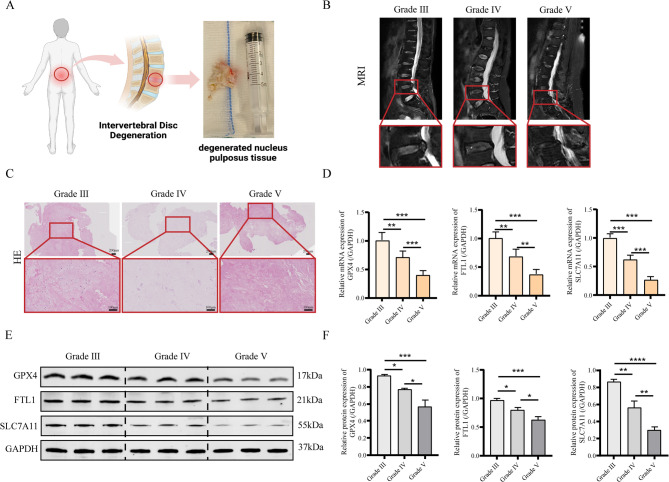
To investigate ferroptosis in IVDD, NP tissues from 9 patients across Pfirrmann grades were analyzed. MRI (Fig. 1A-B) and histopathology (Fig. 1C) revealed degenerative changes. qRT-PCR and WB showed progressive downregulation of GPX4, FTL1, and SLC7A11 with increasing degeneration (Fig. 1D-F), demonstrating ferroptosis' critical role in human IVDD progression.

Ferroptosis in degenerated human NP tissue. () Schematic illustration of sampling degenerated NP tissue and human degenerated NP tissue, illustration created using BioRender.com. () Magnetic resonance imaging of the human lumbar spine and Pfirrmann grading. () Histopathology of human degenerated NP tissue ( = 3, scale bar:100 μm and 200 μm). (mRNA and protein expression levels of FTL1, GPX4, and SLC7A11 in human degenerated NP tissue ( = 3; one-way ANOVA). Data are presented as mean ± SD. Statistical significance is denoted as follows: * < 0.05, ** < 0.01, *** < 0.001, **** < 0.0001 A B C D–F) n n p p p p
Ginsenoside Rg1 could effectively mitigate in rats with IVDD and promote intervertebral disc repair
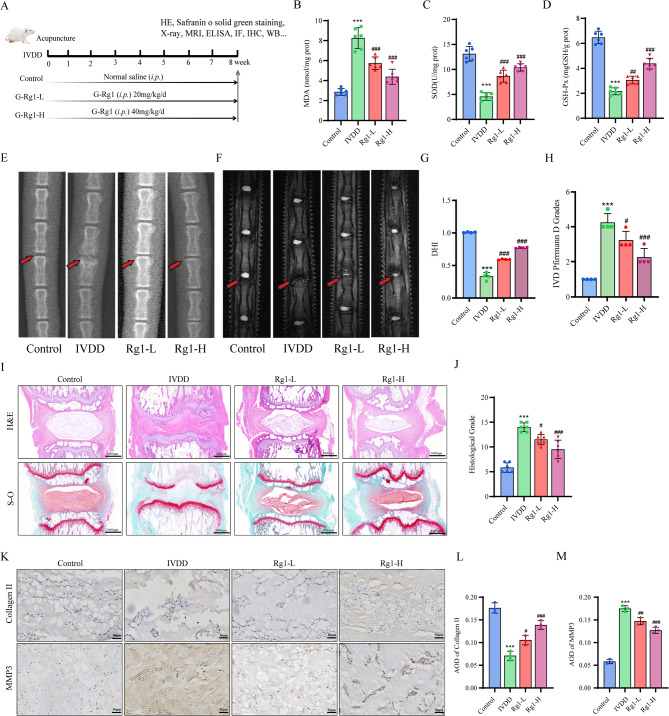
A detailed flowchart of the in vivo assays was shown in Fig. 2A. Ginsenoside Rg1 treatment significantly reduced MDA levels (Fig. 2B) and restored SOD/GSH activity (Fig. 2C, D) in IVDD rats. Calculation of the disc height index (DHI) showed that the degenerated intervertebral disc height of IVDD group decreased over 70%. Compared with the control group, and the ginsenoside Rg1 group had less disc height loss, restored the height to about 50% of the control group (Fig. 2E, G). The MRI results showed that the nucleus pulposus and endplates exhibited a black color in the IVDD group, while the Pfirrmann grade was elevated. In contrast to these findings, the Pfirrmann grade decreased in the ginsenoside Rg1-H and ginsenoside Rg1-L groups, the endplate gradually became white, and the signal gradually recovered (Fig. 2F, H). The results of HE staining and safranin O solid green staining revealed a significant reduction in the presence of NP tissue within the IVDD group, accompanied by a pronounced severity of fibrosis. However, the intervertebral disc nucleus pulposus in the ginsenoside Rg1 intervention group was relatively full (Fig. 2I, J). Immunohistochemistry demonstrated Rg1 upregulated Collagen II while downregulating MMP3 (Fig. 2K-M), confirming its protective effect against IVDD progression. Thus, ginsenoside Rg1 can inhibit IVDD progression in the rat tail puncture model.

Ginsenoside Rg1 could effectively ameliorate in rats with IVDD and promote intervertebral disc repair. () The diagram of animal experiments. () Content of MDA, SOD and GSH ( = 3; one-way ANOVA). (X-ray and MRI examination ( = 3; one-way ANOVA). () Histopathology and safranin O solid green staining pathological analysis ( = 6, scale bar:1000 μm) ( = 3; one-way ANOVA). (K-M) Immunohistochemical staining of Collagen II and MMP3 in rat intervertebral disc ( = 3; one-way ANOVA). Data are presented as mean ± SD. Statistical significance is denoted as follows: *** < 0.001 VS Control; # < 0.05, ## < 0.01, ### < 0.001 VS IVDD A B–D E–H) I, J n n n n n p p p p
The network Pharmacology and transcriptomics of ginsenoside Rg1 on alleviating IVDD
Through network pharmacology analysis, 107 potential Rg1 targets were identified (Fig. 3A), with 24 overlapping targets between IVDD, ferroptosis, and Rg1 (Fig. 3B). PPI network analysis (median Degree = 19, BC = 4.11, CC = 0.85) revealed 14 core targets including NRF2 (Fig. 3C). Transcriptome sequencing confirmed differential expression of ferroptosis-related genes (NRF2, GPX4, SLC7A11, FTL1) (Fig. 3D-F). GSEA showed ferroptosis genes were predominantly expressed in the IVDD group (Fig. 3G).
Integrated network pharmacology and transcriptomics identified NRF2 as the key target through which ginsenoside Rg1 may ameliorate IVDD by regulating ferroptosis. Molecular docking revealed strong binding affinities between Rg1 and ferroptosis-related proteins: NRF2 (− 7.4 kcal/mol), GPX4 (− 5.6 kcal/mol), SLC7A11 (− 9.1 kcal/mol), and FTL1 (− 8.5 kcal/mol) (Fig. 3H) (Table S2). PCR analysis demonstrated that Rg1 significantly upregulated NRF2 expression in IVDD rats (Fig. 3I) while reversing the IVDD-induced downregulation of GPX4, SLC7A11, and FTL1, suggesting its therapeutic potential through modulation of these critical ferroptosis pathway components.

The network pharmacology and transcriptomics of ginsenoside Rg1 on alleviating IVDD. () Ginsenoside Rg1 2D structure and Ginsenoside Rg1-target map. () Ginsenoside Rg1 IVDD and Ferroptosis venn diagram. () PPI network and core targets. () Transcriptome Control vs. IVDD vs. Rg1-H and heatmaps. () Transcriptome Control vs. IVDD volcano plots. () Transcriptome Rg1-H vs. IVDD volcano plots. () Gene set enrichment analysis of ferroptosis in the sequencing of human degenerative IVD. () Molecular docking. () mRNA and protein expression levels of FTL1, GPX4, and SLC7A11 ( = 3; one-way ANOVA). Data are presented as mean ± SD. Statistical significance is denoted as follows: ** < 0.01,*** < 0.001 A B C D E F G H I n p p
Ginsenoside Rg1 ameliorated rats with IVDD via inhibiting ferroptosis
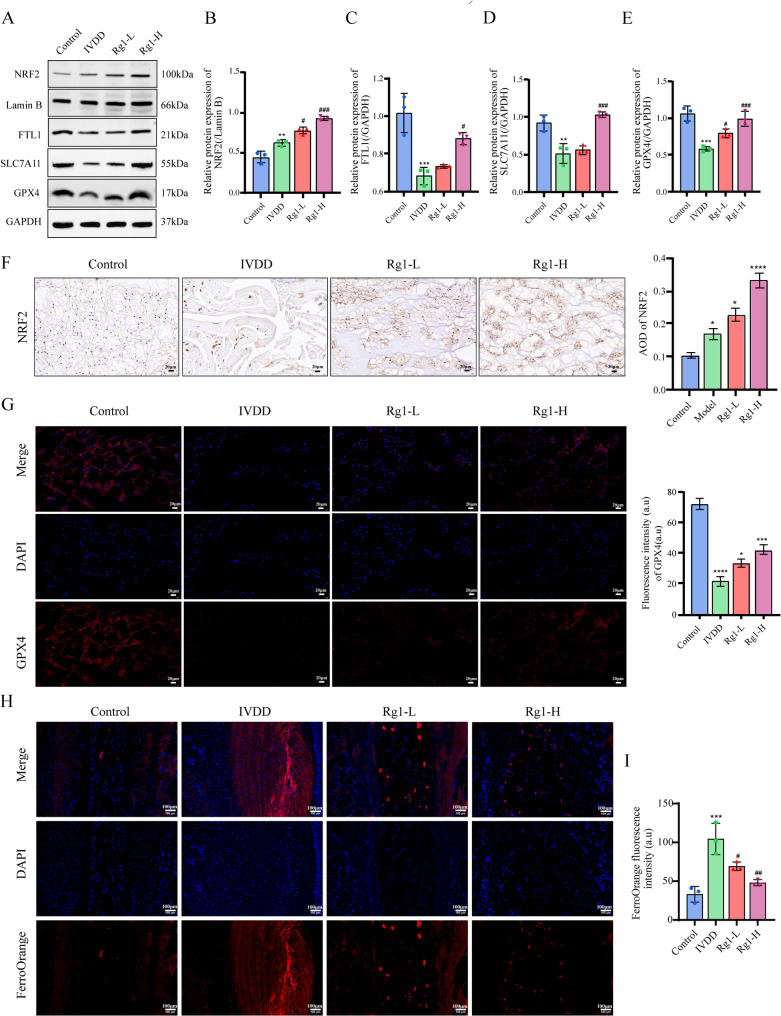
NRF2 is essential for the defense against ferroptosis. WB and immunohistochemistry confirmed ginsenoside Rg1 upregulated NRF2 expression in IVDD rats (Fig. 4A, B,F). As NRF2's downstream ferroptosis targets, GPX4, FTL1 and SLC7A11 protein levels were significantly restored by Rg1 treatment (Fig. 4A-E). Immunofluorescence demonstrated enhanced GPX4 expression (Fig. 4G), while FerroOrange assays showed Rg1 reduced Fe2+ accumulation (Fig. 4H, I), collectively indicating Rg1's anti-ferroptotic effect through NRF2 pathway activation.

Ginsenoside Rg1 ameliorated IVDD of the rats via inhibiting ferroptosis. () Western Blot detection of NRF2, GPX4, FTL1, and SLC7A11 protein levels ( = 3; one-way ANOVA). () Immunohistochemistry detection of NRF2 expression ( = 3, scale bar:20 μm) ( = 3; one-way ANOVA). () Immunofluorescence detection of GPX4 expression ( = 3, scale bar:20 μm) ( = 3; one-way ANOVA). () Observation of free Felevels in rats with IVDD using FerroOrange probe ( = 3, scale bar:100 μm). Data are presented as mean ± SD. Statistical significance is denoted as follows: ** < 0.01, *** < 0.001 VS Control; # < 0.05, ### < 0.001 VS IVDD A–E F G H, I n n n n n n p p p p 2+
Ginsenoside Rg1 ameliorated HO-induced NP cells degeneration 2 2
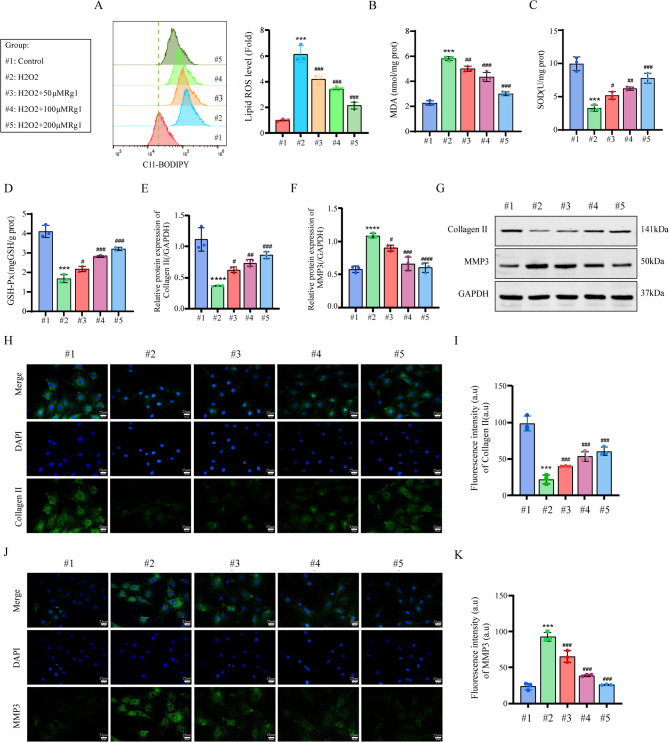
Integrated analyses identified ferroptosis as crucial in IVDD (Fig. 3). Treatment with 200 µM Rg1 effectively normalized Lipid-ROS levels (Fig. 5A), reduced MDA (Fig. 5B), and restored SOD/GSH-Px activity (Fig. 5C, D). WB and immunofluorescence demonstrated Rg1 reversed H2O2-induced ECM dysregulation by increasing Collagen II and decreasing MMP3 expression (Fig. 5E-K), confirming its protective role in NP cell homeostasis.

Ginsenoside Rg1 ameliorated HO-induced NP degeneration. () Flow cytometry detection of Lipid-ROS levels in NP cells ( = 3; one-way ANOVA). (Content of MDA, SOD and GSH ( = 3; one-way ANOVA). (Western Blot detection of Collagen II and MMP3 protein levels ( = 3; one-way ANOVA). () Immunofluorescence detection of protein levels of Collagen II and MMP3 ( = 3, scale bar:25 μm). Data are presented as mean ± SD. Statistical significance is denoted as follows: *** < 0.001, **** < 0.0001 VS Control; # < 0.05, ## < 0.01, ### < 0.001, #### < 0.0001 VS HO 2 2 2 2 A B–D) E–G) H–K n n n n p p p p p p
Ginsenoside Rg1 ameliorated HO-induced NP cells degeneration by suppressing ferroptosis 2 2
NRF2 and GPX4 are key oxidative stress sensors in NP cells and play pivotal roles in ferroptosis. Network pharmacology and transcriptome analysis identified FTL1 and SLC7A11 as additional ferroptosis-related targets. NRF2, a critical ferroptosis suppressor, mitigates ferroptosis by upregulating downstream targets. WB results revealed elevated NRF2 levels in IVDD NP cells, further increased by ginsenoside Rg1 treatment (Fig. 6A, B). GPX4, negatively regulating ferroptosis, prevents lipid peroxide accumulation; its decline in H2O2-induced NP cells was reversed by Rg1. Reduced FTL1 (causing Fe2+ overload) and decreased SLC7A11 (a ferroptosis inhibitor) in H2O2-treated cells were also restored by Rg1 (Fig. 6A-E). Fe2+ probe assays confirmed that 50/100/200µM Rg1 significantly reduced iron overload in H2O2-stimulated NP cells after 48 h (Fig. 6F, G).

Ginsenoside Rg1 ameliorated HO-induced NP cells degeneration by suppressing ferroptosis. () Western Blot detection of NRF2, GPX4, FTL1, and SLC7A11 protein levels ( = 3; one-way ANOVA). () Observation of free Fecontent in NP cells using FerroOrange probe ( = 3, scale bar:25 μm). Data are presented as mean ± SD. Statistical significance is denoted as follows: *** < 0.001, **** < 0.0001 VS Control; # < 0.05, ## < 0.01, ### < 0.001 VS HO 2 2 2 2 A–E F, G n n p p p p p 2+
Ginsenoside Rg1 ameliorated NP cells activity by activating NRF2/GPX4 signaling pathway
The NRF2 inhibitor ML385 reduced NP cell viability (Fig. 7A) and increased Lipid-ROS accumulation (Fig. 7B). Co-treatment with ginsenoside Rg1 + ML385 elevated MDA levels while suppressing SOD and GSH-Px activity (Fig. 7C-E). Although Rg1 alone upregulated Collagen II and downregulated MMP3 in H2O2-induced NP cells, ML385 reversed these effects (Fig. 7F-H). Immunofluorescence confirmed that ML385 counteracted Rg1's benefits, reducing Collagen II (Fig. 7I, J) and increasing MMP3 (Fig. 7K, L). These results demonstrate that ginsenoside Rg1's protective effects against H2O2-induced damage in NP cells are NRF2-dependent.

Ginsenoside Rg1 ameliorated NP cells activity by activating NRF2/GPX4 Signaling Pathway. NRF2 inhibitor ML385 pre-treatment of HO-induced NP cells. () CCK8 detection of cell activity ( = 3; one-way ANOVA). () Flow cytometry detection of Lipid-ROS levels in cells ( = 3; one-way ANOVA). (C-E) Detection of MDA, SOD, and GSH content in cells ( = 3; one-way ANOVA). () Western Blot detection of Collagen II and MMP3 protein levels ( = 3; one-way ANOVA). () Immunofluorescence detection of protein levels of Collagen II ( = 3, scale bar:25 μm). () Immunofluorescence detection of protein levels of MMP3 ( = 3; one-way ANOVA). Data are presented as mean ± SD. Statistical significance is denoted as follows: *** < 0.001 VS HO; # < 0.05, ## < 0.01, ### < 0.001 VS HO+Rg1 2 2 2 2 2 2 A B F–H I, J K, L n n n n n n p p p p
Ginsenoside Rg1 inhibited ferroptosis to ameliorate NP cells activity via activating NRF2
NRF2 inhibition by ML385 significantly decreased NRF2 protein levels (Fig. 8A, B) and downregulated ferroptosis-related proteins GPX4, FTL1, and SLC7A11 (Fig. 8C-F). Fe²⁺ probe analysis revealed elevated iron levels in the Rg1 + ML385 group compared to Rg1 alone, indicating ferroptosis reactivation (Fig. 8G, H). ChIP assays demonstrated that Rg1 enhanced NRF2's binding to GPX4 and FTL1 promoters, promoting their transcription (Fig. 8I-J). TEM analysis showed that Rg1 rescued H2O2-induced mitochondrial damage (shrinkage, cristae condensation, and membrane rupture), but ML385 abolished this protective effect (Fig. 8K), confirming NRF2's essential role in Rg1-mediated ferroptosis suppression and mitochondrial preservation.

Ginsenoside Rg1 inhibited ferroptosis to ameliorate NP cells activity via activating NRF2. NRF2 inhibitor ML385 pre-treatment of HO-induced NP cells. () Western Blot detection of protein levels of NRF2 in the nucleus ( = 3; one-way ANOVA). () Western Blot detection of protein levels of ferroptosis key genes GPX4, FTL1, and SLC7A11 ( = 3; one-way ANOVA). (Observation of free Felevels in NP cells using FerroOrange probe ( = 3, scale bar:25 μm). () Observation of the morphology of mitochondria in nucleus pulposus using a transmission electron microscope ( = 3, scale bar:500 nm). Data are presented as mean ± SD. Statistical significance is denoted as follows: * < 0.05, *** < 0.001, **** < 0.0001 VS HO; # < 0.05, ## < 0.01, ### < 0.001, #### < 0.0001 VS HO+Rg1 2 2 2 2 2 2 A, B C–F G–H) I n n n n p p p p p p p 2+
Discussion
Recent advances in medical research have led to gradual improvements in the treatment of intervertebral disc degeneration. Drug therapy and surgical treatments are effective in clinical practice, but they are often accompanied by high recurrence rates, major bleeding, and other complications. Therefore, alleviating IVDD remains a significant research focus.
This study observed significant ferroptosis in the NP tissue of patients with IVDD, with more pronounced ferroptosis in patients with higher imaging grades, indicating that ferroptosis plays a crucial role in IVDD progression. Panax ginseng C.A.Mey., a traditional Chinese medicine, has been widely used, and one of its main components, Ginsenoside Rg1, shows great potential in treating IVDD [11, 18]. To elucidate the mechanism of action of ginsenoside Rg1 in alleviating IVDD, network pharmacology and transcriptome sequencing were utilized to predict potential molecular targets [25]. Gene enrichment analysis revealed that ferroptosis is highly enriched in degenerative intervertebral disc tissue, including genes such as NRF2, indicating its critical role in IVDD. Ferroptosis can result from oxidative stress [26]. When the intracellular GSH antioxidant system fails to detoxify these species in a timely manner, it leads to lipid peroxidation and ferroptosis [27]. NRF2, a well-known transcription factor, plays a crucial role in antioxidant activity [28]. NRF2 can affect ferroptosis by regulating the gene expression of the GSH antioxidant system and iron (Fe) metabolism. Downstream targets of NRF2 include GPX4, GSH-transferase, and GSH reductase, among others [28]. Therefore, ferroptosis was tested in both in vitro and in vivo experiments.
Building upon previous research, we constructed a rat IVDD model using acupuncture to evaluate the therapeutic effect of ginsenoside Rg1 [29]. We induced IVDD using a 21-gauge needle puncture (5 mm depth, 30 s) at Co7/8, creating controlled annular injury that mimics early human IVDD through mechanical disruption, ECM catabolism, and oxidative stress [23, 30]. Untreated rats developed Pfirrmann grade III-V degeneration, matching human chronic IVDD specimens. Rg1 treatment effectively preserved NP matrix integrity during the acute phase and mitigated chronic disc degeneration, as evidenced by improved disc height index (DHI) on X-ray and enhanced hydration on T2-weighted MRI. Our study uniquely demonstrates Rg1's therapeutic potential across both acute and chronic IVDD phases. While these findings highlight Rg1's reparative capacity, future studies should incorporate more detailed temporal analyses to fully characterize its stage-dependent effects. We observed a significant reduction in the NP tissue within the IVDD group, associated with substantial fibrosis. The decrease in the nuclear matrix protein Collagen II and the increase in MMP3, a key gene for ECM synthesis and catabolism, suggest that IVDD in rats is challenging to repair. Elevated levels of lipid peroxide degradation products, such as MDA, and decreased activity of oxidative stress-related factors, including SOD and GSH, exacerbated the condition in rats. Additionally, X-ray and MRI results demonstrated high degeneration in IVDD rat discs, with the NP and endplates appearing black. Following ginsenoside Rg1 intervention, IVDD was alleviated and repaired. Using H2O2-induced NP cell degeneration, we evaluated the therapeutic efficacy of ginsenoside Rg1 in vitro [31]. In these cell experiments, ginsenoside Rg1 reduced ROS levels in rat NP cells, decreased MDA content, and increased SOD and GSH-Px activity, consistent with in vivo results.
Based on these findings, we further investigated the therapeutic mechanism of ginsenoside Rg1 in alleviating IVDD. Our studies confirmed that ginsenoside Rg1 increased the gene expression of NRF2 and upregulated GPX4, FTL1, and SLC7A11. Additionally, Fe2+ content accumulated in the nucleus tissue and cells of rats with IVDD, and ginsenoside Rg1 reduced this Fe2+ content as detected by FerroOrange probe fluorescence. When the NRF2 inhibitor ML385 was added to rat nucleus pulposus cells, the therapeutic effects of ginsenoside Rg1 were reversed. The NRF2 inhibitor group not only downregulated ferroptosis-related proteins (NRF2, GPX4, FTL1 and SLC7A11) but also promoted Fe2+ accumulation and lipid peroxidation in NP cells, increased MDA production, decreased SOD and GSH-Px activity under oxidative stress, damaged mitochondrial morphology and function, and aggravated IVDD. This demonstrated that ginsenoside Rg1 protected against IVDD by inhibiting ferroptosis in NP cells through the NRF2/GPX4 pathway.
Ginsenoside Rg1, a natural product extracted from Panax ginseng C.A.Mey., has demonstrated remarkable anti-inflammatory and antioxidant effects. Recent studies have elucidated that ginsenoside Rg1 mitigates acute ulcerative colitis by modulating gut microbiota and microbial tryptophan metabolism [32]. Furthermore, it ameliorates sepsis-induced acute kidney injury by inhibiting ferroptosis in renal tubular epithelial cells [22] and attenuates oxidative stress and inflammation in rats with spinal cord injury via the NRF2/HO-1 signaling pathway [33]. Additionally, ginsenoside Rg1 has been shown to inhibit IVDD progression by suppressing the activation of the YAP1/TAZ signaling pathway [11] and promoting ECM synthesis while inhibiting apoptosis in degenerative NP cells through the Wnt/β-catenin pathway [18]. This study provides novel insights into the preventive and therapeutic effects of ginsenoside Rg1 in alleviating IVDD and its inhibitory effect on ferroptosis in NP cells.
Emerging evidence implicates ferroptosis as a critical pathological mechanism in various bone-related disorders including osteoporosis, bone defects, osteoarthritis, and peri-implant bone loss [34 –36]. Our study demonstrates that this potential mechanism: Ginsenoside Rg1-mediated ferroptosis suppression mitigates IVDD. Based on the above literature studies, we speculate that ferroptosis regulation serve as a shared therapeutic strategy for bone-related disorders characterized by redox imbalance.We plan to conduct in-depth studies on these aspects in our future research. The NRF2/GPX4 axis emerges as a promising therapeutic target, which has been demonstrated in a variety of bone-related disorders. In bone marrow mesenchymal stem cells, NRF2/GPX4 activation enhances osteogenic capacity under oxidative stress [37], while in chondrocytes, SIRT1/NRF2/HO-1 signaling mitigates osteoarthritis progression by suppressing ferroptosis [36]. Our results align with prior evidence, indicating that Rg1-induced NRF2/GPX4 pathway activation exerts cytoprotective effects on nucleus pulposus cells, which implies a universal regulatory mechanism in bone-related disorders.
This study has several limitations. First, the small sample size of human NP tissues (n = 9) may limit clinical relevance, despite using randomized selection to minimize variability. future studies should include larger cohorts. Second, while the acupuncture-induced rat IVDD model effectively replicates key degenerative features [30, 38], its translational relevance requires validation through comparison with other models and clinical studies. Third, although ginsenoside Rg1's effect on ferroptosis appears NRF2-dependent, contributions from other pathways cannot be excluded. while pharmacological inhibition strongly suggests Nrf2 dependence, future studies using Nrf2 knockdown/knockout models would provide additional mechanistic confirmation. We are currently optimizing siRNA transfection protocols in primary NPCs for follow-up studies. While preclinical results are promising, clinical trials are needed to confirm ginsenoside Rg1's therapeutic efficacy in human IVDD.
Conclusion
This study demonstrates that ginsenoside Rg1 exerts a protective effect against IVDD by suppressing ferroptosis in NP cells through the activation of NRF2 and regulation of GPX4. (Fig. 9). By elucidating the molecular mechanism underlying ginsenoside Rg1's ability to inhibit ferroptosis in NP cells, this study provides valuable insights for the prevention and treatment of IVDD. These findings suggest that ginsenoside Rg1 may serve as a promising therapeutic agent for IVDD therapy by acting a ferroptosis inhibitor.

The molecular mechanism of ginsenoside Rg1 in alleviating IVDD
Electronic supplementary material
Below is the link to the electronic supplementary material. Supplementary Material 1 Supplementary Material 2 Supplementary Material 3 Supplementary Material 4 Supplementary Material 5