
What this is
- This systematic review and meta-analysis evaluates GLP-1 agonists for Parkinson's disease (PD) patients.
- It includes four randomized controlled trials (RCTs) with a total of 514 patients.
- The focus is on the efficacy and safety of GLP-1 agonists on motor and non-motor functions.
Essence
- GLP-1 agonists significantly improve motor function in PD patients during OFF-medication states, but do not enhance quality of life. Safety concerns include gastrointestinal issues.
Key takeaways
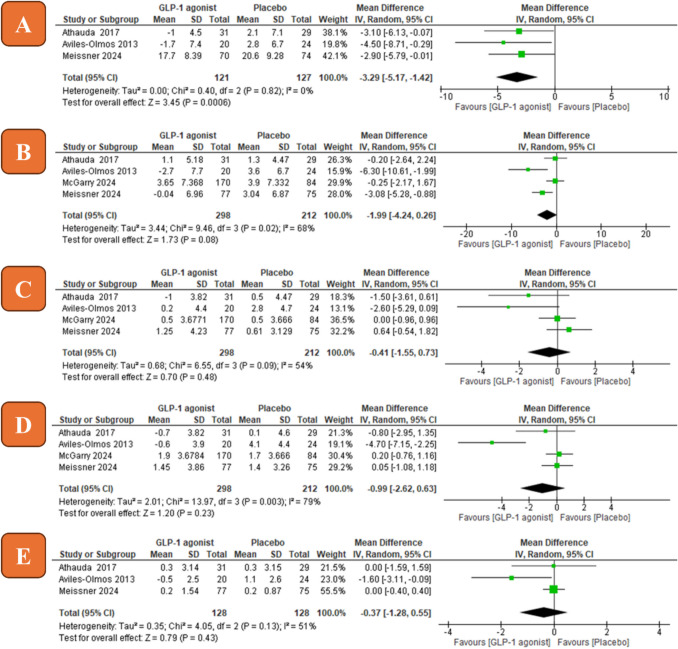
- GLP-1 agonists improved motor function in PD patients during OFF-medication states, with a mean difference of -3.29.
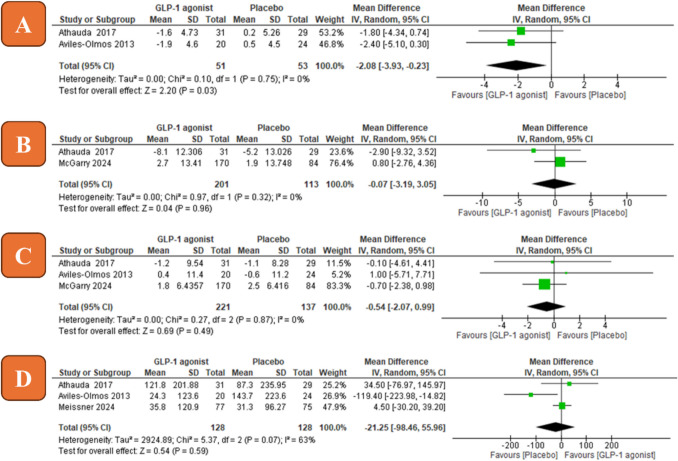
- No significant improvement in quality of life was observed, with a mean difference of -0.54 in scores.
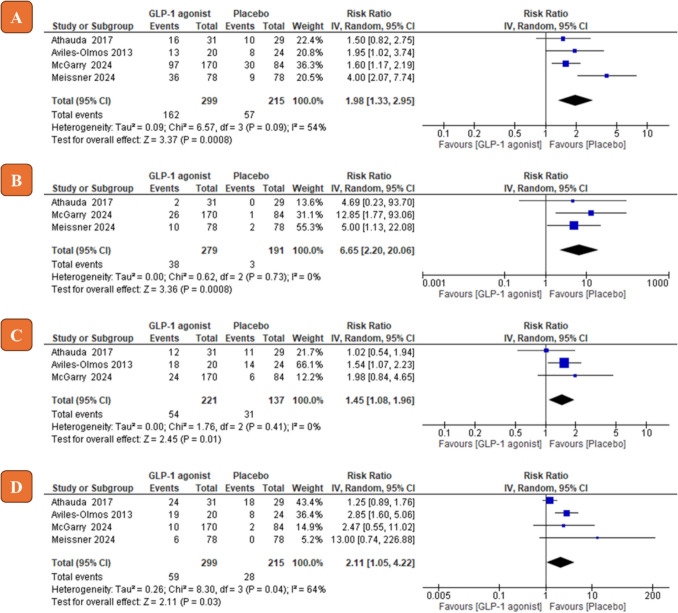
- Adverse effects were noted, including nausea (RR = 1.98), vomiting (RR = 6.65), constipation (RR = 1.45), and weight loss (RR = 2.11).
Caveats
- Significant heterogeneity was found in the results, which may limit the generalizability of the findings.
- The studies included varied in dosage and treatment protocols, which could affect outcome consistency.
- Further high-quality studies with larger sample sizes and standardized protocols are needed for conclusive evidence.
Definitions
- MDS-UPDRS: A scale measuring motor and non-motor symptoms in Parkinson's disease.
- PDQ-39: A questionnaire assessing quality of life in Parkinson's disease patients.
Simplified
Introduction
Parkinson's disease (PD) is the second most common progressive, age-related movement disorder worldwide (Mhyre et al. 2012; Zafar and Yaddanapudi 2023). It is estimated that by 2040, approximately 17 million people will be affected by PD (Dorsey et al. 2018). PD is characterized by motor and non-motor symptoms. Motor symptoms are the most important clinical features of PD; they are manifested by resting tremors, rigidity, and bradykinesia (Chang et al. 1995; Fritsch et al. 2012; Moustafa et al. 2016). Non-motor symptoms may appear in the earliest stages as weight loss, constipation, depression, anosmia, sleep problems, and orthostatic hypotension (Kim and Sung 2015; Löhle et al. 2009). The main cause of the disease is degeneration in the substantia nigra pars compacta neurons which are nerve cells responsible for producing dopamine (Dauer and Przedborski 2003).
Glucagon-like peptide-1 (GLP-1) is an incretin hormone secreted from the intestine as a result of meal ingestion (Vilsbøll et al. 2012). GLP-1 agonists are FDA-approved drugs used in the treatment of type 2 diabetes mellitus and obesity as they increase insulin release, decrease glucagon production, enhance proliferation of pancreatic beta cells, and delay gastric emptying (Collins and Costello 2024). GLP-1 agonists were found to have neuroprotective features because of the following: (1) They reduce the levels of amyloid precursor protein and amyloid-beta peptide, (2) GLP-1 agonists can enhance nerve growth factor-initiated differentiation, (3) They reduce ibotenic acid-induced exhaustion of choline acetyltransferase immunoreactivity in cholinergic neurons, (4) They modulate calcium responses to glutamate and membrane depolarization. These features nominated GLP-1 agonists as a promising candidate for the treatment of neurodegenerative diseases including PD (Gilman et al. 2003; Perry et al. 2003; Perry et al. 2002a, b; Perry et al. 2002a, b).
Results of preclinical studies using GLP-1 agonists for PD showed that they have a significant role in improving PD symptoms. In rats, they had anti-inflammatory neuronal effects, increased striatal dopamine, and decreased malondialdehyde and tumor necrosis factor alpha amount (Aksoy et al. 2017; Elbassuoni and Ahmed 2019). In another study on a mouse model, they had the ability to improve motor function and protect neurons against degeneration (Li et al. 2009).
Athauda et al. conducted a randomized controlled trial (RCT) testing exenatide, a GLP-1 agonist, on moderate PD patients by subcutaneous injection once weekly for 48 weeks, its findings showed improvement in the exenatide group over the placebo group in the motor function assessed by MDS-UPDRS III at OFF-medication state with adjusted mean difference of − 3.5 points (Athauda et al. 2017). Meissner et al. study, another RCT that experimented with subcutaneous Lixisenatide once a day for 12 months, found significant improvement in symptoms between Lixisenatide and placebo groups (Meissner et al. 2024). A previous systematic review conducted by Cochrane Collaboration reported low-certainty evidence that using exenatide improves the motor functions of PD patients (Mulvaney et al. 2020). More studies have been published since then with conflicting results regarding the progression of the motor disability of PD patients (McGarry et al. 2024; Meissner et al. 2024) and therefore an update systematic review and meta-analysis is needed.
This systematic review and meta-analysis aim to fill the gap in understanding the true effect of GLP-1 agonists on motor function in PD patients. In addition, we aim to evaluate the impact of these drugs on their mood and quality of life.
Methods
We followed the PRISMA guidelines for Systematic reviews and meta-analysis while reporting this manuscript (Page et al. 2021). We were adherent to the Cochrane Handbook of Systematic Reviews of Interventions version 6 while conducting this study (Higgins et al. 2019a, b, c, d). This study was prospectively registered on PROSPERO with the register number CRD42024619237.
Eligibility criteria
Studies satisfying the following inclusion criteria were included in the study: (1) RCTs comparing GLP-1 agonists with placebo or conventional treatment, (2) studies whose population is PD patients of any stage, (3) studies measuring at least one of the following outcomes: MDS-UPDRS Parts I – IV, MADRS, NMSS, LED, and PDQ-39. We excluded studies not written in English language, studies on animal models, study designs not a randomized controlled trial, conference abstracts, protocols, commentary articles, post-hoc analysis articles, and papers reporting other neurodegenerative diseases other than PD.
Literature search strategy
We conducted a computer literature search of PubMed, Scopus, Web of Science, OVID, Cochrane Central, and Google Scholar. We used the following query in our search: ((Glucagon-like peptide-1) OR (GLP-1)) AND (Parkinson's disease) AND ((Randomized Controlled Trial) OR (RCT)) and for sensitive search strategy we used MeSH database in the following query: ("Glucagon-Like Peptide-1 Receptor Agonists"[Mesh]) AND "Parkinson Disease"[Mesh]). The full search strategy we used in different databases is found in Table in the supplementary materials. 1
Selection process and data extraction
Eligibility screening was performed in two steps using Rayyan software (Ouzzani et al. 2016). The first step was the title and abstract screening of all retrieved papers. The second step was full-text screening for those that passed the first step of screening to assess the eligibility for meta-analysis. Five authors were responsible for this selection process.
Three authors extracted the data independently using an online extraction form. The extracted data includes the following: (1) characters of the study design, (2) characters of the study population, (3) risk of bias-2 domains, and (4) study outcomes: Mean change from baseline of the following: MDS-UPDRS I, MDS-UPDRS II, MDS-UPDRS III ON-medication, MDS-UPDRS III OFF-medication, MDS-UPDRS IV, MADRS, NMSS, LED, and PDQ-39.
Risk of bias assessment
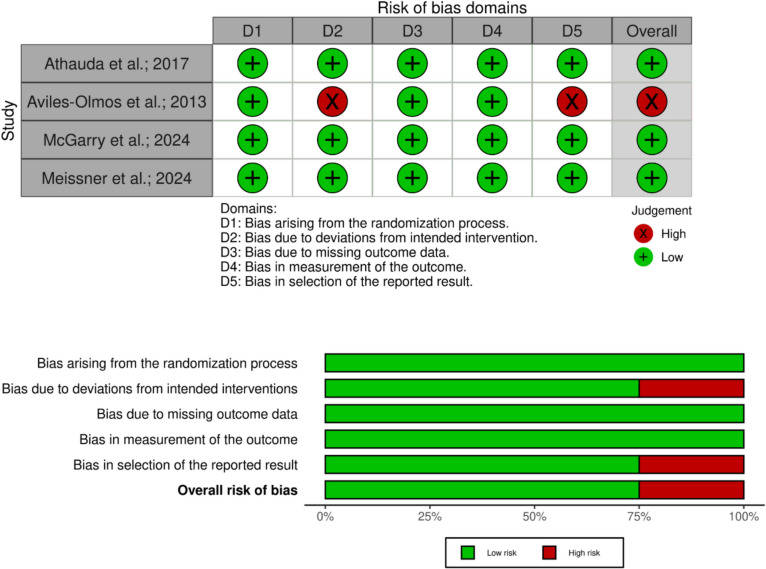
Eight authors evaluated the quality of the included studies independently according to the Cochrane Handbook of Systematic Reviews of Interventions version 6 (Higgins et al. 2019d). We used the Risk of Bias assessment tool-2 (RoB-2) mentioned in the same book chapter 8. The RoB-2 tool comprises five bias domains: (1) bias arising from the randomization process, (2) bias due to deviations from intended interventions, (3) bias due to missing outcome data, (4) bias in measurement of the outcome, (5) bias in selection of the reported results. For visualizing our risk of bias assessment, we used the robvis web app (McGuinness and Higgins 2021).
Measures of treatment effect of GLP-1 agonists and data synthesis
The four MDS-UPDRS subscales are the primary outcomes of our study. The MDS-UPDRS is composed of four parts: I (non-motor experiences of daily living), II (motor experiences of daily living), III (motor function), and IV (motor complications). It is a semi-objective scale as it depends on both clinician-based assessment and patient-reporting symptoms (Goetz et al. 2008). Our secondary outcomes were PDQ-39 for assessing quality of life, NMSS for assessing non-motor symptoms, MADRS for assessing depression, and L-dopa equivalent dose (Chaudhuri et al. 2007; Jenkinson et al. 1997; Montgomery and Asberg 1979). These scales, except LED, are subjective scales that depend on the patient to report the symptoms. Changes from baseline in MDS-UPDRS sub-scores, LED, MADRS, NMSS, and PDQ-39 were pooled as mean difference (MD) in a meta-analysis model. We used risk ratio to assess the effect estimate of the adverse events. To prevent unit-of-analysis error, we combined the two interventional groups of McGarry et al. (2024) to create a single pair-wise comparison as recommended by the Cochrane Handbook of Systematic Reviews of Interventions version 6 (Part 4, Chapter 23.3.4) (Higgins et al. 2019a) using the formula stated in part 2, chapter 6.5.2.10 of the same book (Higgins et al. 2019b). We used the calculator of Review Manager Version 5.4.1 for Windows. For adverse events, we combined the two interventional groups.
When the standard deviation of change in one of the outcomes was not provided, we calculated it from a 95% confidence interval or by imputing standard deviations for changes from baseline using correlation coefficient (r) = 0.85 suggested by Athauda et al. study (2017) or by calculating it from the standard error (SE). We used meta-analysis accelerator for performing the calculations (Abbas et al. 2024).\documentclass[12pt]{minimal} \usepackage{amsmath} \usepackage{wasysym} \usepackage{amsfonts} \usepackage{amssymb} \usepackage{amsbsy} \usepackage{mathrsfs} \usepackage{upgreek} \setlength{\oddsidemargin}{-69pt} \begin{document}$$\begin{array}{c}SD=SE\times \sqrt{N}\\ SD=\sqrt{N}\times \left(Upper\, limit-lower\, limit\right)/ 3.92\\ \begin{array}{c}{Mean}_{Change}={Mean}_{Final}-{Mean}_{Baseline}\\ {SD}_{Change}=\sqrt{{SD}_{Baseline}^{2}+{SD}_{Final}^{2}-\left(2\times r\times {SD}_{Baseline}\times {SD}_{Final}\right)}\end{array}\end{array}$$\end{document}SD=SE×NSD=N×Upperlimit-lowerlimit/3.92MeanChange=MeanFinal-MeanBaselineSDChange=SDBaseline2+SDFinal2-2×r×SDBaseline×SDFinal
Heterogeneity assessment
Heterogeneity was assessed by visual inspection of the I2 and Chi2 tests found in the forest plots. In case of significant heterogeneity (P-value < 0.1), sensitivity analysis was performed by exclusion of each study independently.
Publication bias
According to Egger and his colleague's paper (Egger et al. 1997), publication bias needs at least 10 papers in order to be performed. Therefore, in our study, we could not assess the publication bias using Egger's funnel plot asymmetry.
Results
Search results
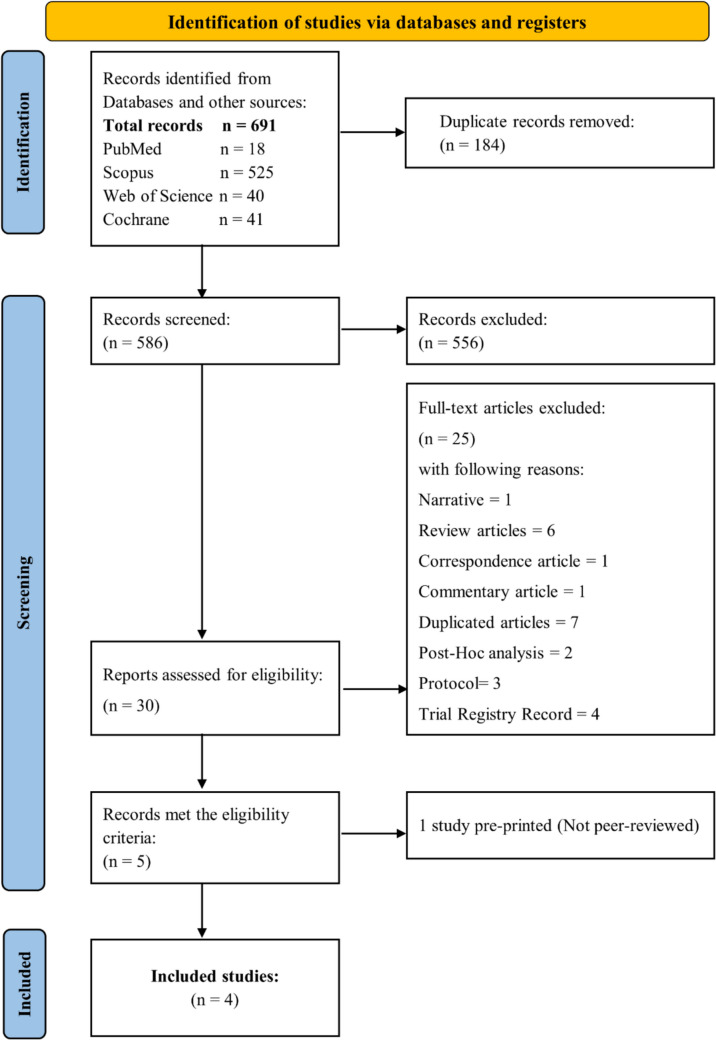
Our search retrieved 691 unique studies, 184 were duplicated studies and after resolving, 586 studies were subjected to title and abstract screening. Following the title and abstract screening, 556 studies were excluded and only 30 were retrieved and screened for eligibility.

PRISMA flow diagram of studies selection process
| Study ID | Study design | Dose & route of administration | Evaluation time points | Population | Intervention | Comparator | Key findings |
|---|---|---|---|---|---|---|---|
| Athauda et al.; [2017] | Randomized, double-blind, placebo-controlled, parallel-group, single-center trial | Subcutaneously, 2 mg | Baseline, 3, 6, 9, 12, and 15 months | 62 patients with idiopathic PD as measured by Queen Square Brain Bank criteria | Exenatide | Placebo | Exenatide had improved UPDRS part 3 off-medication by 1.0 points (95% CI –2.6 to 0.7). However, the long-lasting effect of the drug is uncertain |
| Aviles-Olmos et al.; [2013] | Phase 2, randomized, single-blind controlled trial design | Subcutaneously, 5 µg for 1 month then 10 µg for the rest of 12 months | Baseline, 6, 12, and 14 months | 45 moderate PD patients | Exenatide | Conventional treatment | Compared to the control group, the drug showed clinically relevant improvements in PD patients across motor and cognitive measures. However, weight loss is a common side effect |
| McGarry et al.; [2024] | Randomized, double-blind, placebo-controlled study | Subcutaneously, either 2.5 mg or 5.0 mg of NLY01 | Baseline and 9 months | 255 early untreated PD patients | NLY01 | Placebo | Compared to placebo, NLY01 did not show any significant improvement in motor and non-motor symptoms of PD patients. Further studies are needed |
| Meissner et al.; [2024] | Investigator-initiated, phase 2, multicenter, double-blind, parallel-group, randomized, placebo-controlled trial | Subcutaneously, an initial dose of 10 µg per day for 14 days, then 20 µg per day to the end of study | Baseline, 6, 12, and 14 months | 156 PD patients diagnosed in less than 3 years | Lixisenatide | Placebo | Compared to placebo, Lixisenatide showed positive results in motor disability at 12 months, but it was associated with some GI disorders. Longer trials with larger sample sizes are recommended to investigate its efficacy in PD treatment |
| Study ID | Group | Sample size | AgeMean (SD) | GenderMale (%) | MDS-UPDRS IMean (SD) | MDS-UPDRS IIMean (SD) | MDS-UPDRS IIIOff-medicationMean (SD) | MDS-UPDRS IIIOn-medicationMean (SD) | MDS-UPDRS IVMean (SD) | PDQ-39Mean (SD) | LEDMean (SD) | MADRSMean (SD) | NMSSMean (SD) |
|---|---|---|---|---|---|---|---|---|---|---|---|---|---|
| Athauda et al.; [2017] | Exenatide | 31 | 61.6 (8.2) | 22 (71%) | 9.8 (4.8) | 12.5 (6.7) | 32.8 (9.7) | 19.4 (8.4) | 4.7 (3.1) | 19.9 (13.7) | 773.9 (260.9) | 4.1 (3.7) | 24.6 (19.8) |
| Placebo | 29 | 57.8 (8.0) | 22 (76%) | 9.2 (3.8) | 10.7 (5.3) | 27.1 (10.3) | 14.4 (8.2) | 5.3 (3.0) | 21.1 (13.0) | 825.7 (215.0) | 3.7 (3.0) | 28.3 (24.7) | |
| Aviles-Olmos et al.; [2013] | Exenatide | 20 | 61.4 (6) | 15 (75%) | 10.4 (4.1) | 10.2 (5.2) | 31 (11.2) | 23.5 (6.3) | 6.3 (2.4) | 19.2 (13.5) | 973 (454) | 10.9 (5.1) | N/A |
| Placebo | 24 | 59.4 (8.4) | 20 (83%) | 11.6 (4.7) | 12.9 (6.2) | 34 (16.1) | 25.3 (10.7) | 6.3 (3.4) | 24.5 (12.8) | 977 (493) | 11 (5.4) | N/A | |
| McGarry et al.; [2024] | NLY01 (5 mg) | 85 | 60.6 (10.0) | 54 (64%) | 4.0 (3.7) | 5.0 (4.1) | N/A | 22 (8.2) | N/A | N/A | N/A | N/A | N/A |
| NLY01 (2.5 mg) | 85 | 62.1 (9.0) | 60 (71%) | 4.2 (3.1) | 4.8 (3.6) | N/A | 22.7 (8.1) | N/A | N/A | N/A | N/A | N/A | |
| Placebo | 84 | 61.8 (8.1) | 52 (62%) | 4.7 (4.2) | 4.9 (3.6) | N/A | 22.3 (9.1) | N/A | N/A | N/A | N/A | N/A | |
| Meissner et al.; [2024] | Lixisenatide | 78 | 59.5 (8.1) | 44 (56%) | 6.1 (4) | 5 (3.5) | N/A | 14.8 (7.3) | 0.3 (1.3) | 17.4 (10.9) | 317 (179) | N/A | N/A |
| Placebo | 78 | 59.9 (8.4) | 48 (62%) | 6.4 (4.2) | 5.4 (4.3) | N/A | 15.5 (7.8) | 0.2 (0.8) | 16.8 (13) | 355 (215) | N/A | N/A |
Quality assessment of the included studies

Risk of bias assessment summary
MDS-UPDRS III OFF-medication

Forest plots of mean difference () in efficacy measures (MDS-UPDRS III OFF-medication;MDS-UPDRS III ON-medication;MDS-UPDRS I;MDS-UPDRS II;MDS-UPDRS IV). IV, inverse variance; CI, confidence interval MD A B C D E
MDS-UPDRS III ON-medication (motor function)
Four studies were included with a total of 510 patients. The overall mean difference between the GLP-1 agonist and the control group did not favor either of them (MD = − 1.99, 95% CI [− 4.24 to 0.26], P = 0.08, Fig. 3B). Pooled studies were not homogenous (P = 0.02, I2 = 68%).
MDS-UPDRS I (non-motor experiences of daily living)
Four studies were included with a total of 510 patients. The overall mean difference between the GLP-1 agonist and the control group did not favor either of them (MD = − 0.41, 95% CI [− 1.55 to 0.73], P = 0.48, Fig. 3C). Pooled studies were not homogenous (P = 0.09, I2 = 54%).
MDS-UPDRS II (motor experiences of daily living )
Four studies were included with a total of 510 patients. The overall mean difference between the GLP-1 agonist and the control group did not favor either of them (MD = − 0.99, 95% CI [− 2.62 to 0.63], P = 0.23, Fig. 3D). Pooled studies were not homogenous (P = 0.003, I2 = 79%).
MDS-UPDRS IV (motor complications)
Three studies were included with a total of 256 patients. The overall mean difference between the GLP-1 agonist and the control group did not favor either of them (MD = − 0.37, 95% CI [− 1.28 to 0.55], P = 0.43, Fig. 3E). Pooled studies were homogenous (P = 0.13, I2 = 51%).
Montgomery–Asberg Depression Rating Scale (MADRS)

Forest plots of mean difference () in efficacy measures (MADRS;NMSS;PDQ-39;LED). IV, inverse variance; CI, confidence interval MD A B C D
Non-motor Symptoms Scale (NMSS) at 9 months
Two studies were included with a total of 314 patients. The overall mean difference between the GLP-1 agonist and control group did not favor either of them (MD = − 0.07, 95% CI [− 3.19 to 3.05], P = 0.96, Fig. 4B). Pooled studies were homogenous (P = 0.32, I2 = 0%).
Parkinson's Disease Questionnaire – 39 (PDQ-39)
Three studies were included with a total of 358 patients. The overall mean difference between the GLP-1 agonist and the control group did not favor either of them (MD = − 0.54, 95% CI [− 2.07 to 0.99], P = 0.49, Fig. 4C). Pooled studies were homogenous (P = 0.87, I2 = 0%).
L-dopa equivalent dose (LED)
Three studies were included with a total of 256 patients. The overall mean difference between the GLP-1 agonist and the control group did not favor either of them (MD = − 21.25, 95% CI [− 98.46 to 55.96], P = 0.59, Fig. 4D). Pooled studies were not homogenous (P = 0.07, I2 = 63%).
Safety of GLP-1 agonists on PD patients

Forest plots of risk ratio () of adverse events (nausea;vomiting;constipation;weight loss). IV, inverse variance; CI, confidence interval RR A B C D

Forest plots of risk ratio () of adverse events (fatigue;anxiety;diarrhea;UTI;headache;administration site disorder). IV, inverse variance; CI, confidence interval RR A B C D E F
| Adverse event | N of RCTs | N of patients | RR [95% CI] | Overall effect-valueP | Heterogeneity Chi-value and22PI |
|---|---|---|---|---|---|
| Nausea | 4 | 514 | 1.98 [1.33 to 2.95] | 0.0008 | = 0.09, = 54%PI2 |
| Vomiting | 3 | 470 | 6.65 [2.20 to 20.6] | 0.0008 | = 0.73, = 0%PI2 |
| Constipation | 3 | 358 | 1.45 [1.08 to 1.96] | 0.01 | = 0.41, = 0%PI2 |
| Weight loss | 4 | 514 | 2.11 [1.05 to 4.22] | 0.03 | = 0.04, = 64%PI2 |
| Fatigue | 2 | 410 | 1.83 [0.34 to 9.82] | 0.48 | = 0.11, = 61%PI2 |
| Anxiety | 3 | 358 | 1.94 [0.48 to 7.80] | 0.35 | = 0.49, = 0%PI2 |
| Diarrhea | 4 | 514 | 1.34 [0.83 to 2.15] | 0.23 | = 0.96, = 0%PI2 |
| UTI | 4 | 514 | 0.91 [0.22 to 3.78] | 0.89 | = 0.1, = 53%PI2 |
| Headache | 2 | 410 | 1.24 [0.75 to 2.05] | 0.4 | = 0.81, = 0%PI2 |
| Administration site disorder | 2 | 314 | 0.99 [0.84 to 1.16] | 0.9 | = 0.68, = 0%PI2 |
Sensitivity analysis
The sensitivity analysis was conducted for efficacy outcomes that showed a significant heterogeneity (MDS-UPRDS I, MDS-UPRDS II, MDS-UPRDS III ON-medication, LED) by the exclusion method. The study of Aviles-Olmos et al. was the primary source of heterogeneity. Another meta-analysis conducted after the exclusion of the study caused the heterogeneity resulting in a significant decrease in the heterogeneity of MDS-UPDRS I (P = 0.22, I2 = 34%), MDS-UPDRS II (P = 0.71, I2 = 0%), MDS-UPDRS III ON-medication (P = 0.11, I2 = 54%), LED (P = 0.61, I2 = 0%). The overall mean difference with 95% CI between the GLP-1 agonists group and control group after sensitivity analysis did not favor either of them (MDS-UPDRS I, MD = − 0.0, CI [− 0.92 to − 0.230.92], P = 1; MDS-UPDRS II, MD = 0.04, CI [− 0.65 to 0.73], P = 0.91; MDS-UPDRS III ON-medication, MD = − 1.17, CI [− 3.03 to 0.69], P = 0.22; LED, MD = 7.15, CI [− 25.98 to 40.28], P = 0.67).
Weight loss and nausea are the only two heterogeneous adverse events. A sensitivity analysis was performed by excluding each study independently from the meta-analysis. For weight loss, the heterogeneity was resolved by removing either Athauda et al. study (P = 0.58, I2 = 0%) or Aviles-Olmos et al. study (P = 0.20, I2 = 38%) with a more significant decrease in heterogeneity in the case of excluding Athauda et al. study. For nausea, the heterogeneity was significantly resolved by excluding Meissner et al. study (P = 0.83, I2 = 0%). Sensitivity analysis of all heterogeneous outcomes is shown in the supplementary materials.
A sensitivity analysis was conducted including a pre-printed study by Hogg et al. exploring the effect of adding it to the analysis which resulted in the meta-analysis of UPRDS-III OFF-medication to become insignificant (MD = − 2.19, 95% CI [− 4.77 to 0.38], P = 0.1) while all other analysis remained the same (see the forest plots from Fig. 8 to Fig.23 in the supplementary materials).
Discussion
We found that GLP-1 agonists significantly improve the motor functions of PD patients with no significant improvement in their mood or quality of life. In terms of safety, the analyzed data showed the risk of nausea, vomiting, constipation, and weight loss in the GLP-1 agonists group compared to the control group.
The studies included in our analysis employed different forms and doses of GLP-1 agonists which may contribute to the variability found among the pooled effect sizes reported by our study. Athauda et al. study used exenatide 2 mg administered as a once-weekly subcutaneous injection for 48 weeks then 12 weeks washout period (Athauda et al. 2017). Patients in the experimental group of Aviles-Olmos et al. study received exenatide 5 µg as a twice-daily injection during the first month followed by exenatide 10 µg twice-daily injection for the subsequent 11 months followed by 2 months of washout period (Aviles-Olmos et al. 2013). Meissner et al. utilized another form of GLP-1 agonist, Lixisenatide, which has a high affinity for GLP-1 receptors with an initial dose of 10 µg per day for 2 weeks, then the dose increased to 20 µg per day for the rest of the trial, which is 12 months followed by 2 months of washout period, administered via subcutaneous injection (Meissner et al. 2024). McGarry et al. study used NLY01, a longer-lasting version of exenatide, administered subcutaneously once a week at doses of either 2.5 mg or 5.0 mg for 36 weeks without subsequent washout period (McGarry et al. 2024). The preprinted study used a more potent GLP-1 agonist, liraglutide, administered as 1.2 or 1.8 mg one-daily; however, we did not include it in our main meta-analysis for fear of conflicting information between the preprinted form and the future published form of the paper (Brietzke et al. 2023; Hogg et al. 2022). Another recent study by Nelson et al. (2022) suggests that preprints can contribute to decision-making, so with all this evidence, we decided to conduct another meta-analysis that included the preprinted study (shown in supplementary material) without adding it to our main results or discussion.
In terms of MDS-UPDRS III ON-medication, data showed no statistically significant difference between the GLP-1 agonists group and the control group (MD = − 1.99, P = 0.08). In the case of OFF-medication state, however, the data is statistically higher in the GLP-1 agonists group compared to the control group (MD = − 3.29, P = 0.0006) with no significant heterogeneity (P = 0.82, I2 = 0%). The − 3.29 exceeds the minimal clinically important difference (MCID) for improvement in the motor impairment of − 3.25 calculated by Horváth et al. (2015). These findings are aligned with the adjusted data in the previously conducted systematic review by Mulvaney et al. (2020). In case of motor complications assessed by MDS-UPDRS IV, there is no significant difference between the GLP-1 agonists group and the control group, and the data were homogenous.
The mental and behavioral mood of PD patients was evaluated using MDS-UPDRS I. There was no statistically significant difference between the GLP-1 agonists group compared to the control group which aligned with the previous systematic review made by Mulvaney et al. (2020). There was a significant heterogeneity in this outcome which was resolved by excluding the Aviles-Olmos et al. study during the sensitivity analysis. The possible reason for this heterogeneity is Aviles-Olmos et al. study used a very small dose of exenatide compared to the other studies. Another reason could be the small sample size of the Aviles-Olmos et al. study as it is the least sample size of the four included RCTs or could be the difference in the stage of PD each study is dealing with. In most adverse events, there was no significant heterogeneity between studies; however, significant heterogeneity was observed in nausea and weight loss. Heterogeneity in nausea was resolved by excluding the Meissner et al. study as it experimented with Lixisenatide which had an association with less nausea compared to other GLP-1 agonists (Bettge et al. 2017). Heterogeneity in weight loss could be resolved by excluding Aviles-Olmos et al. study as its population was moderate Parkinson's patients where weight changes were associated with disease severity compared with other studies (Ghourchian et al. 2021).
GLP-1 agonists recently showed positive results as an antidepressant. A recent systematic review conducted on 2701 depressed patients showed a decrease in the depression rates of the group that received GLP-1 agonists compared to the control group (X. Chen et al. 2024). These findings aligned with our findings as PD patients receiving GLP-1 agonists showed a statistically significant improvement on MADRS scale compared to those in the control group. In terms of quality of life, there was no statistically significant difference between the GLP-1 agonists group and the control group. The mean difference of PDQ-39 (MD = − 0.54, P = 0.49) did not exceed the minimal clinically important difference (MCID) for improvement of quality of life of − 4.72 calculated by Horváth et al. (2015).
Both Athauda et al. and McGarry et al. studies assess the NMSS score at 6, 9, 12, and 15 months or 9 months only respectively, so we decided to evaluate NMSS at 9 months only aiming to decrease the heterogeneity. There was no statistically significant difference between the GLP-1 agonists group and the control group and there was no significant heterogeneity between the two studies. The high weight of the McGarry et al. study (76.4%) is due to the large sample size compared to the other included study due to the combination of the two intervention groups as we mentioned before.
Most studies investigating GLP-1 receptors, whether as a drug for type 2 diabetes or obesity, have shown that the most common adverse events were gastrointestinal (GI) events (Dungan et al. 2014; Pratley et al. 2014; Rosenstock et al. 2013), which is consistent with our findings. These events are due to the effect of GLP-1 agonists as they slow gastric emptying by activating the vagus nerve and activating central appetite suppression (Filippatos et al. 2014; Zheng et al. 2024). This may be a serious problem for Parkinson's patients as they already have GI problems (Skjærbæk et al. 2021). The prevalence of constipation in PD patients is approximately 50% (H. Chen et al. 2015). Some studies suggest that constipation begins 20 years before the onset of motor complications of PD (Savica et al. 2009). Our findings show that GLP-1 agonists have a high risk of constipation among PD patients taking GLP-1 agonists. Probiotics, another newly suggested treatment for PD, may help manage constipation in PD patients as they were evident to help with constipation (Xie et al. 2023; Zeng et al. 2023). However, a recent systematic review suggests that increasing the number of prescribed drugs for PD patients could aggravate their psychological problems (Bhagavathula et al. 2022). Our results also showed that GLP-1 agonists had a higher risk of weight loss compared to the control group, which is a serious problem that most Parkinson's patients suffer from (Ma et al. 2018). A previous study reported that the prevalence of weight loss among PD patients is about 48.6% (Cersosimo et al. 2018). This finding should be considered because weight loss can affect the quality of life of PD patients (Akbar et al. 2015). This may be one of the reasons why GLP-1 agonists did not significantly improve the quality of life of PD patients.
The GI side effects of GLP-1 receptors may lead to a significant placebo effect bias in the GLP-1 agonists group compared to the control group. GLP-1 agonists as medications for type 2 diabetes affect the GI system, leading PD to expect an improvement in their condition because they feel that the medication is working inside their body, in the form of GI symptoms. These expectations can psychologically influence Parkinson's patients, biasing subjective scores such as the NMSS, MADRS, and PDQ-39, as patients self-report their scores, making the results from these scales less reliable to consider; however, this can also occur in semi-objective scales such as the MDS-UPDRS, even though rely on clinician-rated assessment and patient-reported scores. A systematic review by Quattrone et al. showed that a placebo effect can lead to motor improvement in Parkinson's patients (Quattrone et al. 2018). This may be due to the strength of belief in improvement that can regulate dopamine release in PD from all areas of the striatum (Lidstone et al. 2010). All this could be due to a placebo effect induced by GI symptoms; however, this could be mitigated by future studies comparing GLP-1 agonists with other medications.
Limitations and recommendations
Despite all our included studies being RCTs, comparing GLP-1 agonists to placebo or conventional treatment, some limitations should be considered. There was a significant heterogeneity in terms of MDS-UPDRS I, II, III ON-medication and LED due to different reasons ranging from differences in the dosage treatment to the large variation found in the sample size of the four included RCTs. Another limitation is the lack of focus of the RCTs on a specific PD stage. These all limit the generalizability of our findings and identify which stage of PD would benefit the most from the medication. Thus, we recommend putting standardized protocols to facilitate future comparisons between studies. We also recommend further studies on other forms of GLP-1 agonists rather than exenatide and its forms to evaluate each drug individually and know its efficacy in each PD stage. We also recommend using objective rather than subjective measuring methods to decrease the placebo effect bias in the treatment group results from the GI symptoms of GLP-1 agonists.
By addressing these limitations and considering these recommendations, future research studies would be more beneficial and effective in evaluating the effect of different forms of GLP-1 agonists on specific categories of PD patients.
Conclusion
In conclusion, GLP-1 agonists could be efficient in improving the motor function of PD patients. However, current evidence is still insufficient to prove these findings as well as assess the mood and quality of life in PD patients. Therefore, further studies are needed with standardized protocols, a larger sample size, and a specific focus on a PD stage.
Supplementary Information
Below is the link to the electronic supplementary material. Supplementary file1 (DOCX 272 KB)