
What this is
- This research investigates the triagonist IUB447, which targets GLP-1, GIP, and GCG receptors to enhance insulin secretion.
- The study evaluates the mechanisms underlying insulin secretion in murine pancreatic islets.
- Findings reveal that the triagonist's effects are primarily mediated through the GLP-1 receptor and the -TRPM5 signaling pathway.
Essence
- IUB447 enhances glucose-stimulated insulin secretion () in mice primarily via GLP-1 receptor activation and signaling. The triagonist outperforms conventional mono-agonists in stimulating insulin secretion.
Key takeaways
- The triagonist IUB447 promotes more effectively than individual GLP-1, GIP, or GCG agonists. It induces an ~11-fold increase in insulin secretion compared to a ~fourfold increase with glucose alone.
- Inhibition of signaling significantly reduces triagonist-induced by up to 70%. This indicates that signaling is crucial for the triagonist's insulinotropic effects.
- The triagonist's efficacy is diminished in mice lacking TRPM5, highlighting its role in mediating insulin secretion and maintaining glucose homeostasis.
Caveats
- The study primarily uses murine models, which may not fully replicate human responses to the triagonist. Further research in human islets is necessary to confirm these findings.
- The effects of the triagonist under different dietary conditions were not extensively explored, which may influence its therapeutic potential.
Definitions
- GSIS: Glucose-stimulated insulin secretion, the process by which insulin is released from pancreatic beta cells in response to elevated glucose levels.
- Gαq: A G protein that mediates signaling pathways involved in various cellular responses, including insulin secretion.
Simplified
Introduction
Combinational pharmacotherapies provide a promising approach for the treatment of obesity and type 2 diabetes. Co-agonism, or tri-agonism, of separate therapeutic targets leverage strategic combinatorial synergism to amplify satiety, body-weight lowering and glucoregulatory benefits. Previous studies demonstrate that sequence hybridisation of glucagon-like peptide-1 (GLP-1), glucose-dependent insulinotropic polypeptide (GIP) and glucagon (GCG) into a unimolecular triple agonist (GLP-1/GIP/GCG) effectively enhances glycaemic management relative to conventional mono-agonist treatments in diet-induced obese mice [1, 2]. These desirable effects are prompting efforts to clarify the identity of signalling pathway mechanisms that mediate such responses in health and disease.
Long-acting GLP-1 receptor (GLP-1R) mono-agonists have been developed to engage in beta cell glucose-dependent insulinotropic effect, while also acting within key feeding regions of the central nervous system to influence satiety. GCG is primarily known for its essential role in maintaining glucose homeostasis through its activation of hepatic glycogenolysis and gluconeogenesis during periods of starvation [3]. However, long-acting GCG receptor (GCGR) agonists have also been shown to dose-dependently stimulate insulin secretion and enhance energy expenditure and fatty acid oxidation, leading to substantial weight loss in rodents [4, 5]. These findings led to the strategic development of a unimolecular GLP-1/GCG co-agonist that exploits the energy expenditure and lipolytic properties of GCG and the appetite-suppressing and insulinotropic properties of GLP-1 [6]. A cautionary note on GLP-1-based pharmacology is the limitation on dose escalation due to corresponding increases in gastrointestinal tolerability issues. To mitigate this drawback, the pharmacological administration of GIP, primarily known for its insulinotropic and mild appetite-suppressing properties [7], is also suggested to have an anti-emetic effect, potentially allowing GIP co-agonism to increase tolerability to the GLP-1 component [8].
The complementary nature of the desirable attributes in GLP-1, GIP and GCG led to the creation of a unimolecular hybridised triagonist with retained and balanced activity across the GLP-1R, GIP receptor (GIPR) and GCGR [1]. Despite definitive evidence suggesting that the triagonist offers a promising therapeutic option for the treatment of type 2 diabetes, the specific cellular mechanism by which the enhanced efficacy in glycaemic management is attained remains unclear.
The GLP-1R/GIPR/GCGR triagonist IUB447 enhances glycaemic management through concurrent activation of GLP-1R, GIPR and GCGR, and corresponds to the triagonist previously reported by Finan et al [1]. Recently, we found that triagonist-induced enhancement of insulin secretion exceeds levels observed with the loose co-administration of the three individual agonists in murine islets [9]. This difference raises the first question: does the superior triagonist effect stem from an additional mode of action beyond the activation of the three receptors?
Accumulating evidence suggests that GLP-1R activates both Gαq and Gαs signalling pathways, whereas GIPR and GCGR primarily couple to Gαs [10 –12]. Under diabetic conditions, persistent beta cell depolarisation shifts GLP-1R signalling toward Gαq dominance, preserving its insulinotropic effect [13]. This shift may account for why GLP-1R agonists remain a useful glucose-lowering therapy, whereas GIPR loses insulinotropic efficacy [13 –15]. Given the potential loss of effectiveness in Gαs signalling in diabetic conditions and that both GIP and GCG seem to primarily act through Gαs signalling, it raises a second question: is the effect of triagonist on glucose-stimulated insulin secretion (GSIS) mediated solely via GLP-1R?
In this study, we sought to unravel the mechanisms through which the triagonist enhances insulin secretion in murine islets.
Methods
The sources of reagents are listed in electronic supplementary material (ESM) Table. 1
Mouse strains
Gipr−/−, Gcgr−/− and Glp-1r (also known as Glp1r)/Gipr double-knockout (KO) mice were generated. sgRNAs against exons 4 and 5 of the Gipr, Glp-1r and Gcgr genes (ESM Table 2) were designed using CRISPOR tool (www.crispor.tefor.net↗), in vitro transcribed (E3322, NEB) and purified using the MEGAclear Kit. C57BL/6n female mice at 4 weeks of age were super ovulated and mated with C57BL/6n studs. Fertilised oocytes were electroporated (NEPA21) with a total concentration of 200 ng/μl sgRNAs and 200 ng/μl recombinant NLS-Cas9 protein. Electroporated zygotes were surgically implanted into recipient CD1 females. For genotyping, ear biopsies were lysed and genomic DNA was purified. Target genes were amplified using primers listed in ESM Table 3 and verified by Sanger sequencing to confirm CRISPR-induced deletions. Founders carrying the following deletion alleles were bred to generate single and double KO lines: a five-nucleotide (nt) deletion in exon 5 of Gipr; a 62-nt deletion in exon 4 of Gcgr; and a 495-nt deletion spanning exon 4, intron 4 and exon 5 of Glp-1r. CRISPR-Cas9-induced deletions result in a premature stop codon at the exon 5 (Gipr and Gcgr) and 6 (Glp-1r). To genotype the Gipr deletion, specific primers binding on the wild-type (WT) or deleted DNA region were designed and established (Gipr-9-nt forward and reverse, and Gipr WT reverse primers) (ESM Table 3). Gcgr and Glp-1r deletions were genotyped by PCR and resolved on agarose gel electrophoresis until double bands were obtained.
Transient receptor potential melastatin 5 (TRPM5) KO (B6;129-Trpm5tm1Csz/J) mice were obtained from Jackson Laboratory (https://www.jax.org/strain/013068↗). Heterozygous Trpm5+/− mice were bred to obtain age- and sex-matched homozygous wild-type (WT) and homozygous Trpm5−/− mice. Genotyping was performed using the One Step Mouse Genotyping Kit. Trpm5 transgene inheritance was confirmed by PCR (primers in ESM Table 3; protocol in ESM Table 4).
Mice were fed a normal chow diet (LFD) or a high-fat diet (HFD) (D12451 or D12331), with 45% and 58% energy from fat, respectively. After being fed the HFD for 16 weeks, mice were treated every other day with either vehicle or triagonist (3 nmol/kg) for 3 weeks. Mice were single- or group-housed under a 12 h light–dark cycle at 22°C with ad libitum access to food and water. Mice were randomly assigned to experimental groups using a random number generator. This ensured unbiased allocation and reduced potential confounding factors. Experimenters were masked to group assignments during outcome assessment to minimise bias. No animals, samples, or data points were excluded from the analysis. All experiments complied with the EU Animal Welfare Act and were approved by the District Government of Upper Bavaria, Germany (permit no. 55.2–2532. Vet_02-21-75).
Characterisation of glucose homeostasis
GTTs were performed as previously described [16]. Mice were fasted for 16 h and injected intraperitoneally with glucose (2 g/kg body weight). Blood glucose was measured using a glucometer (TheraSense FreeStyle) at 0, 15, 30, 60 and 120 min. Plasma was collected post-euthanasia, stored at −80°C, and analysed for insulin and GCG levels by ELISA.
Islet isolation and determination of insulin secretion
Islet isolation was performed as previously described [9]. In brief, the pancreas was perfused via the common bile duct with collagenase-P (0.3 mg/ml). Isolated islets were cultured for 48 h in RPMI 1640 before use in functional assays. For GSIS, islets were equilibrated for 1 h in KRB buffer (ESM Table 5) with 2.8 mmol/l glucose. Next, islets were incubated for 1 h in 20 mmol/l glucose supplemented with agonists in the presence or absence of blockers. Exendin-3 (GLP-1 blocker), LY2409021 (GCG blocker), YM-254890 (Gαq blocker), MDL-12330A (adenylate cyclase blocker), calphostin C (protein kinase C [PKC] blocker) and TPPO (TRPM5 blocker) were used as specific inhibitors. Insulin was quantified in the supernatant fraction using ELISA.
Cell culture
MIN6 cells were provided by P.-O. Berggren and B. Leibiger, Karolinska Institutet, Stockholm, Sweden. Cells were cultured at 37°C with 5% CO2 in DMEM supplemented with 10% FBS, 100 U/ml penicillin, 100 μg/ml streptomycin and 75 μmol/l β-mercaptoethanol. The cells were routinely tested and no mycoplasma contamination was detected. Authentication of the MIN6 cell line was performed based on morphology and functional characteristics.
Calcium imaging
Changes in intracellular Ca2+ concentration ([Ca2+]i) were recorded as previously described [17]. Confocal imaging was performed using a Zeiss LSM 510 Meta system with a 63×/NA1.2 water immersion objective. Regions of interest were selected using LSM software, and calcium dynamics were monitored via Fluo-4 fluorescence (excitation λ: 488 nm; emission λ: 500–550 nm). Images (8-bit, 512 × 512 pixels) were acquired every 5 s.
α Screen-based detection of intracellular cAMP
Islets were plated in clear-bottom 96-well plates with KRB containing 2.8 mmol/l glucose and stimulated for 20 min at 37°C with KRB (20 mmol/l glucose) plus IBMX (500 µmol/l), either alone or combined with forskolin (10 µmol/l), GLP-1 (1 nmol/l) or triagonist (1 nmol/l). Stimulation was terminated by adding lysis buffer containing acceptor beads and biotinylated cAMP. After 90 min, donor beads were added and incubated for 60 min. Acceptor bead emission (λ 570 ± 100 nm) was measured after donor bead excitation (λ 680 ± 40 nm) using a ClarioStar plate reader (BMG, Offenburg, Germany).
Morphological analysis
Islet morphology was assessed by H&E staining of 10 μm cryosections and whole-islet immunofluorescence. Antibodies are shown in ESM Table 6; antibody validation was carried out according to the manufacturers' specifications, and all relevant information, including recommended dilutions and buffer compositions, was provided by the manufacturers. Imaging was done using a MetaSystems scanner with a Zeiss Imager Z.2 microscope, and quantitative analysis with FIJI 2.16.0 [18].
Statistics
Data were expressed as mean ± SEM. A p value less than 0.05 was considered significant. Graphical presentations and statistics were obtained by Prism software (version 9.0.1; GraphPad). For comparison of two groups, p values were calculated by the unpaired two-tailed Student's t test for parametric distribution or Mann–Whitney test for non-parametric distribution. For three or more groups, one-way ANOVA with Bonferroni multiple comparison were used for parametrically distributed data. Glucose tolerance tests were compared using two-way ANOVA with Bonferroni multiple comparison.
Results
Triagonist effectively reverses glucose metabolism dysfunction induced by HFD in WT mice
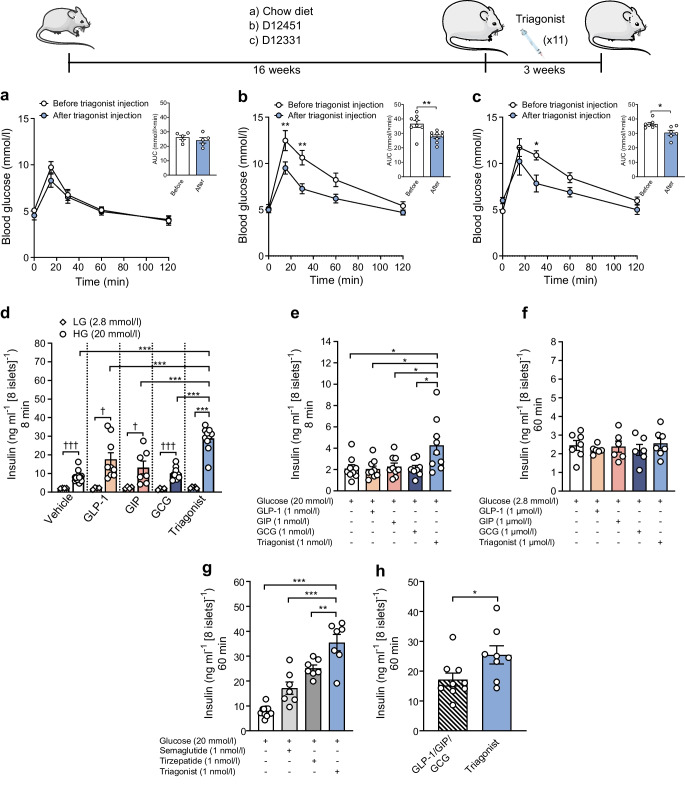
![Triagonist improves glucose metabolism and GSIS in mice. (–) Ten- to twelve-week-old WT C57BL/6 mice were divided into three groups and assigned to different diets. A GTT was performed before and after 3 weeks of treatment with 3 nmol/kg triagonist given by i.p. injection every other day. (–) One group was maintained on chow diet (LFD) (=7) (), while the other two groups were placed on different HFDs, either D12451 () or D12331 (), for 16 weeks (≥7 per group). For the GTT, mice were fasted overnight. Blood glucose levels (mmol/l) before and within 2 h after i.p. injection of glucose (2 g/kg body weight) are shown, together with the AUC for glucose (in mmol/l × min). (,) Insulin secretion (ng ml[8 islets]) was assessed in isolated islets from WT mice on LFD (≥3 mice, measured in duplicate). After 1 h pre-incubation in KRB with 2.8 mmol/l glucose, islets were stimulated with 2.8 mmol/l glucose (LG) or 20 mmol/l glucose (HG) supplemented with mono- or multi-agonist (1 nmol/l each). Insulin content was determined, by ELISA, in supernatant fractions collected at 60 min () or 8 min () after stimulation. () Insulin secretion was assessed following 1 h stimulation with a glucose concentration of 2.8 mmol/l, supplemented with mono- or multi-agonist (1 µmol/l each). () Insulin secretion was assessed following 1 h stimulation with glucose 20 mmol/l, supplemented with the glucose-lowering drugs semaglutide (1 nmol/l) or tirzepatide (1 nmol/l), in comparison with the response elicited by the triagonist (1 nmol/l). () Insulin secretion was assessed following 1 h stimulation with 20 mmol/l glucose, supplemented with either a triagonist or co-administration of mono-agonists (1 nmol/l each). Data show means ± SEM, and statistical differences were assessed by two-way ANOVA (–, blood glucose), unpaired two-tailed Student'stest (–, AUC for glucose;) or one-way ANOVA (–). Circles in bar graphs represent single values. *<0.05; **<0.01; ***<0.001 for indicated comparisons;<0.05,<0.001 for HG vs LG a c a c a b c d e d e f g h a c a c h d g n n n t p p p p p −1 −1 † †††](https://europepmc.org/articles/PMC12534261/bin/125_2025_6525_Fig1_HTML.jpg "Click to view full size")
Triagonist improves glucose metabolism and GSIS in mice. (–) Ten- to twelve-week-old WT C57BL/6 mice were divided into three groups and assigned to different diets. A GTT was performed before and after 3 weeks of treatment with 3 nmol/kg triagonist given by i.p. injection every other day. (–) One group was maintained on chow diet (LFD) (=7) (), while the other two groups were placed on different HFDs, either D12451 () or D12331 (), for 16 weeks (≥7 per group). For the GTT, mice were fasted overnight. Blood glucose levels (mmol/l) before and within 2 h after i.p. injection of glucose (2 g/kg body weight) are shown, together with the AUC for glucose (in mmol/l × min). (,) Insulin secretion (ng ml[8 islets]) was assessed in isolated islets from WT mice on LFD (≥3 mice, measured in duplicate). After 1 h pre-incubation in KRB with 2.8 mmol/l glucose, islets were stimulated with 2.8 mmol/l glucose (LG) or 20 mmol/l glucose (HG) supplemented with mono- or multi-agonist (1 nmol/l each). Insulin content was determined, by ELISA, in supernatant fractions collected at 60 min () or 8 min () after stimulation. () Insulin secretion was assessed following 1 h stimulation with a glucose concentration of 2.8 mmol/l, supplemented with mono- or multi-agonist (1 µmol/l each). () Insulin secretion was assessed following 1 h stimulation with glucose 20 mmol/l, supplemented with the glucose-lowering drugs semaglutide (1 nmol/l) or tirzepatide (1 nmol/l), in comparison with the response elicited by the triagonist (1 nmol/l). () Insulin secretion was assessed following 1 h stimulation with 20 mmol/l glucose, supplemented with either a triagonist or co-administration of mono-agonists (1 nmol/l each). Data show means ± SEM, and statistical differences were assessed by two-way ANOVA (–, blood glucose), unpaired two-tailed Student'stest (–, AUC for glucose;) or one-way ANOVA (–). Circles in bar graphs represent single values. *<0.05; **<0.01; ***<0.001 for indicated comparisons;<0.05,<0.001 for HG vs LG a c a c a b c d e d e f g h a c a c h d g n n n t p p p p p −1 −1 † †††
Triagonist increases GSIS in primary islets
To assess the effects of the triagonist and mono-agonists on GSIS, single islets from WT mice fed an LFD were exposed to a switch from low glucose (2.8 mmol/l) to high glucose (20 mmol/l), with or without agonists. Supernatant fractions were collected at 8 and 60 min. The glucose switch alone induced a ~fourfold increase in insulin secretion after 60 min; GLP-1, GIP and GCG (each at 1 nmol/l) enhanced GSIS by ~eightfold, ~fivefold and ~fourfold, respectively, whereas the triagonist (1 nmol/l) elicited an ~11-fold increase (Fig. 1d). Notably, after 8 min, only the triagonist significantly increased GSIS (~twofold), with the mono-agonists having no effect (Fig. 1e). Elevating the concentration of triagonist to 1 µmol/l had no effect on insulin secretion at a glucose concentration of 2.8 mmol/l (Fig. 1f), ruling out potential islet-derived hypoglycaemia and reinforces glucose-dependency as a mode of action. The triagonist similarly enhanced GSIS in MIN6 cells, excluding alpha cell-derived GCG as underlying mechanism of its superior effect (ESM Fig. 2a). The stimulatory effect of triagonist on GSIS surpassed that of the two glucose-lowering drugs, semaglutide and tirzepatide, in WT mouse islets (Fig. 1g). Triagonist-enhanced GSIS was up to 50% greater than that seen with semaglutide and 25% greater than that seen with tirzepatide. Surprisingly, the triagonist increased GSIS by up to 35% compared with loose co-administration of GLP-1, GIP and GCG, in both mouse islets and MIN6 cells (Fig. 1h and ESM Fig. 2b).
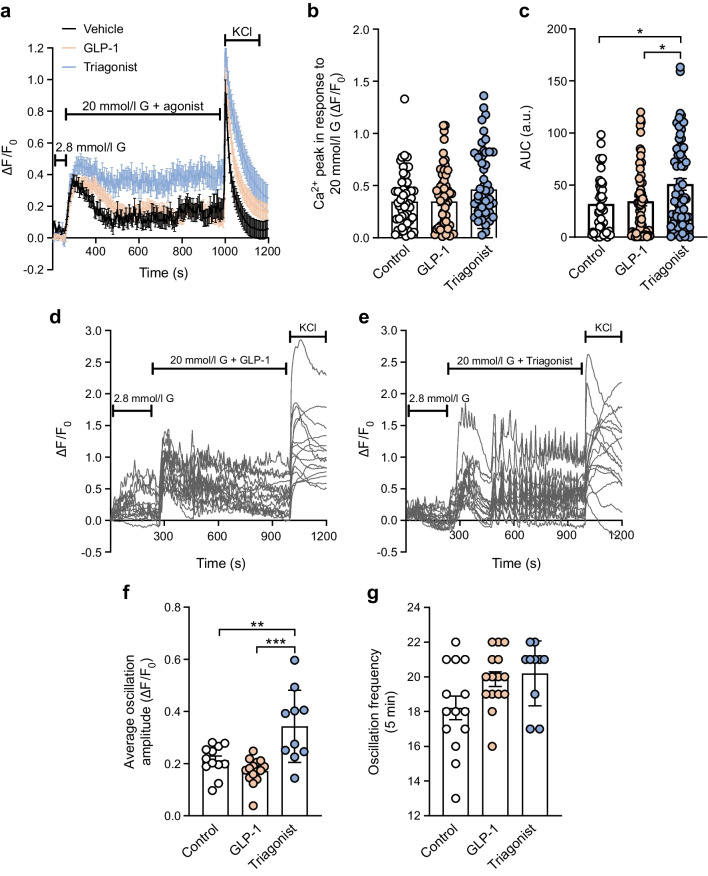
Triagonist enhances cytosolic Caresponses induced by high glucose 2+
![Triagonist increases cytoplasmic Caconcentration in beta cells. () Intact WT islets (≥50 islets per condition, isolated from at least ten mice) were loaded with 3 µmol/l Fluo-4-AM and alterations in [Ca]of individual cells were monitored by confocal microscopy after increasing the extracellular glucose concentration from 2.8 to 20 mmol/l in the presence of GLP-1 (1 nmol/l) or triagonist (1 nmol/l). KCl (30 mmol/l) was used as a positive control. Fwas calculated as the mean fluorescence intensity during the final 2 min prior to stimulation with glucose 20 mmol/l + agonist to minimise potential bias from differences in dye loading, photobleaching or probe stabilisation. (,) Average of Cainflux peaks assessed from baseline after glucose stimulation () and AUC (only during agonist application,). (,) Individual traces of Fluo-4 intensity of single islet cells in the presence of GLP-1 (1 nmol/l,) or triagonist (1 nmol/l,), elicited by excitation at λ 480 nm (indicative of [Ca]). () Average [Ca]oscillation amplitude calculated based on alteration in Fluo-4 intensity in single cells following an initial peak after 20 mmol/l glucose stimulation or in the presence of different agonists (≥10 cells). () Representative changes in frequency of [Ca]oscillations in 5 min following an initial peak after 20 mmol/l glucose stimulation or in the presence of different agonists (≥10 cells). The data are presented as means ± SEM (circles in bar graphs represent single values) and statistical differences were assessed by one-way ANOVA (,,,). *<0.05, **<0.01, ***<0.001. a.u., arbitrary units; G, glucose 2+ 2+ 2+ 2+ 2+ 2+ a b c b c d e d e f g b c f g n n n p p p i i i i](https://europepmc.org/articles/PMC12534261/bin/125_2025_6525_Fig2_HTML.jpg "Click to view full size")
Triagonist increases cytoplasmic Caconcentration in beta cells. () Intact WT islets (≥50 islets per condition, isolated from at least ten mice) were loaded with 3 µmol/l Fluo-4-AM and alterations in [Ca]of individual cells were monitored by confocal microscopy after increasing the extracellular glucose concentration from 2.8 to 20 mmol/l in the presence of GLP-1 (1 nmol/l) or triagonist (1 nmol/l). KCl (30 mmol/l) was used as a positive control. Fwas calculated as the mean fluorescence intensity during the final 2 min prior to stimulation with glucose 20 mmol/l + agonist to minimise potential bias from differences in dye loading, photobleaching or probe stabilisation. (,) Average of Cainflux peaks assessed from baseline after glucose stimulation () and AUC (only during agonist application,). (,) Individual traces of Fluo-4 intensity of single islet cells in the presence of GLP-1 (1 nmol/l,) or triagonist (1 nmol/l,), elicited by excitation at λ 480 nm (indicative of [Ca]). () Average [Ca]oscillation amplitude calculated based on alteration in Fluo-4 intensity in single cells following an initial peak after 20 mmol/l glucose stimulation or in the presence of different agonists (≥10 cells). () Representative changes in frequency of [Ca]oscillations in 5 min following an initial peak after 20 mmol/l glucose stimulation or in the presence of different agonists (≥10 cells). The data are presented as means ± SEM (circles in bar graphs represent single values) and statistical differences were assessed by one-way ANOVA (,,,). *<0.05, **<0.01, ***<0.001. a.u., arbitrary units; G, glucose 2+ 2+ 2+ 2+ 2+ 2+ a b c b c d e d e f g b c f g n n n p p p i i i i
Triagonist enhances GSIS mainly through GLP-1R activation
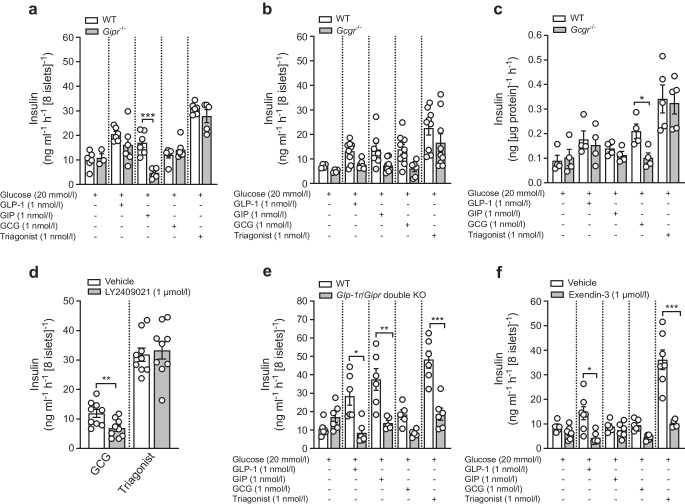
![Triagonist primarily enhances GSIS through activation of the GLP-1R. Insulin secretion was assessed after 1 h pre-incubation in KRB with 2.8 mmol/l glucose; islets were stimulated with 20 mmol/l glucose, supplemented with mono- or multi-agonist (1 nmol/l each). (,) Insulin secretion (ng mlh[8 islets]) in isolated islets from WT mice vs eithermice () ormice () on a chow diet (LFD) (≥3 mice per condition). () Insulin secretion normalised to protein content (ng [µg protein]h) in isolated islets from WT andmice on LFD (≥4 mice per condition). () Insulin secretion (ng mlh[8 islets]) in isolated islets from WT mice on LFD (≥5 mice per condition) after 1 h pre-incubation in KRB with 2.8 mmol/l glucose in the presence or absence of 1 µmol/l LY2409021. Islets were stimulated with 20 mmol/l glucose ± blocker, supplemented with GCG or triagonist (1 nmol/l each). () Insulin secretion (ng mlh[8 islets]) in isolated islets from WT,double KO mice on LFD (≥3 mice per condition). () Insulin secretion (ng mlh[8 islets]) in isolated islets from WT mice on LFD (≥5 mice per condition) after 1 h pre-incubation in KRB with 2.8 mmol/l glucose in the presence or absence of 1 µmol/l exendin-3. Islets were stimulated with 20 mmol/l glucose ± blocker, supplemented with mono- or multi-agonist (1 nmol/l each). Insulin content in supernatant fractions were collected 60 min after stimulation and ELISA was used to determine the insulin content in the fraction. The data are presented as means ± SEM (circles in bar graphs represent single values) and statistical differences were assessed by unpaired two-tailed Student'stest. *<0.05, **<0.01, ***<0.001 a b a b c d e f −1 −1 −1 −/− −/− −1 −1 −/− −1 −1 −1 −1 −1 −1 −1 −1 −1 Gipr Gcgr n Gcgr n n Glp-1r/Gipr n n t p p p](https://europepmc.org/articles/PMC12534261/bin/125_2025_6525_Fig3_HTML.jpg "Click to view full size")
Triagonist primarily enhances GSIS through activation of the GLP-1R. Insulin secretion was assessed after 1 h pre-incubation in KRB with 2.8 mmol/l glucose; islets were stimulated with 20 mmol/l glucose, supplemented with mono- or multi-agonist (1 nmol/l each). (,) Insulin secretion (ng mlh[8 islets]) in isolated islets from WT mice vs eithermice () ormice () on a chow diet (LFD) (≥3 mice per condition). () Insulin secretion normalised to protein content (ng [µg protein]h) in isolated islets from WT andmice on LFD (≥4 mice per condition). () Insulin secretion (ng mlh[8 islets]) in isolated islets from WT mice on LFD (≥5 mice per condition) after 1 h pre-incubation in KRB with 2.8 mmol/l glucose in the presence or absence of 1 µmol/l LY2409021. Islets were stimulated with 20 mmol/l glucose ± blocker, supplemented with GCG or triagonist (1 nmol/l each). () Insulin secretion (ng mlh[8 islets]) in isolated islets from WT,double KO mice on LFD (≥3 mice per condition). () Insulin secretion (ng mlh[8 islets]) in isolated islets from WT mice on LFD (≥5 mice per condition) after 1 h pre-incubation in KRB with 2.8 mmol/l glucose in the presence or absence of 1 µmol/l exendin-3. Islets were stimulated with 20 mmol/l glucose ± blocker, supplemented with mono- or multi-agonist (1 nmol/l each). Insulin content in supernatant fractions were collected 60 min after stimulation and ELISA was used to determine the insulin content in the fraction. The data are presented as means ± SEM (circles in bar graphs represent single values) and statistical differences were assessed by unpaired two-tailed Student'stest. *<0.05, **<0.01, ***<0.001 a b a b c d e f −1 −1 −1 −/− −/− −1 −1 −/− −1 −1 −1 −1 −1 −1 −1 −1 −1 Gipr Gcgr n Gcgr n n Glp-1r/Gipr n n t p p p
Triagonist enhances GSIS primarily through the Gαq–TRPM5 signalling pathway
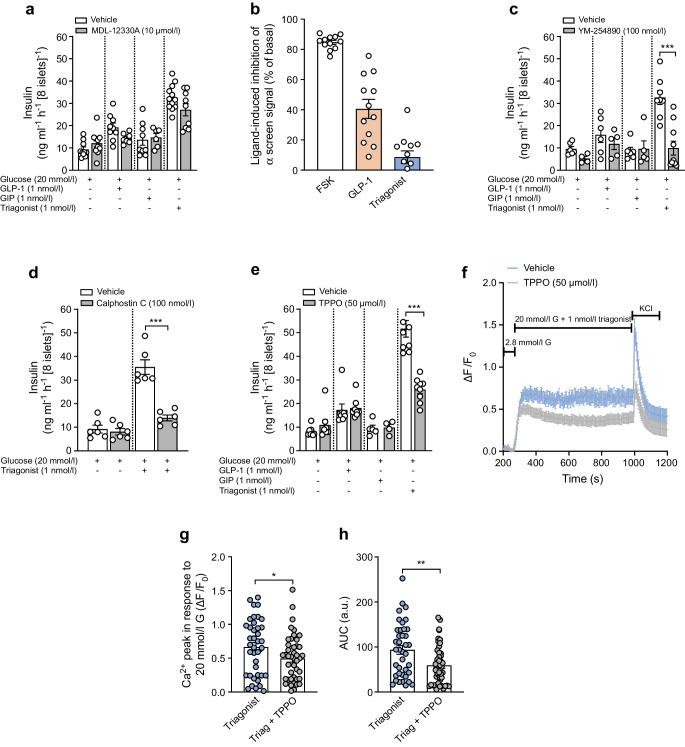
Next, we examined the role of Gαq signalling in triagonist-induced GSIS. Inhibition of Gαq with 100 nmol/l YM-254890 had no significant effect on GLP-1- or GIP-induced GSIS in islets from WT mice fed LFD (Fig. 4c). Notably, YM-254890 reduced triagonist-induced GSIS by up to 70% (Fig. 4c). It is worth noting that both GLP-1 and GIP elicited only modest insulin secretion, and the inhibitory effects of adenylate cyclase and Gαq blockers were not particularly pronounced. We believe these results are due to the nanomolar agonist concentrations applied, which were selected to simulate receptor activation levels similar to those that might occur physiologically, even if not precisely matching actual in vivo concentrations.
Given that PKC and TRPM5 are downstream effectors of Gαq signalling in beta cells, our next step involved determining whether the PKC inhibitor (calphostin C) and TRPM5 blocker (TPPO) suppress the triagonist-induced increase in GSIS. We demonstrated that 100 nmol/l calphostin C and 50 µmol/l TPPO each reduced the triagonist-induced GSIS increase by about 60% in primary islets (Fig. 4d, e). Next, we evaluated the impact of TPPO on triagonist-induced Ca2+ signalling in beta cells (Fig. 4f–h). TPPO significantly reduced the initial Ca2+ peaks induced by 20 mmol/l glucose in the presence of the triagonist and attenuated the sustained intracellular Ca2+ elevation in intact islets (Fig. 4g, h). Notably, the triagonist had no impact on [Ca2+] in the absence of extracellular Ca2+ (ESM Fig. 3). Nonetheless, Ca2+ release in response to the sarcoplasmic/endoplasmic reticulum (ER) calcium ATPase (SERCA) pump blocker cyclopiazonic acid demonstrated the sheer availability of ER calcium, ruling out the role of ER calcium in triagonist-induced Ca2+ signalling in beta cells.
![Triagonist improves GSIS in isolated islets through Gαq signalling and TRPM5 activation. () Insulin secretion (ng mlh[8 islets]) in isolated islets from WT mice on a chow diet (LFD) (≥5 mice per condition, measured in duplicate). After 1 h pre-incubation in KRB with 2.8 mmol/l glucose in the presence or absence of 10 µmol/l MDL-12330A, islets were stimulated with 20 mmol/l glucose ± blocker, supplemented with mono- or multi-agonist (1 nmol/l each). Insulin content was determined by ELISA in supernatant fractions collected 60 min after stimulation. () Inhibition of cAMP-dependent α screen signals is shown after stimulation of islets with 10 µmol/l forskolin, 1 nmol/l GLP-1 or 1 nmol/l triagonist for 20 min at 37°C. Data from four independent experiments performed in triplicate are presented as mean ± SEM of ligand-induced inhibition of the α screen signal as % of basal. (–) Insulin secretion (ng mlh[8 islets]) in isolated islets from WT mice on LFD (≥5 mice per condition, measured in duplicate) in the presence or absence of 100 nmol/l YM-254890, 100 nmol/l calphostin C or 50 µmol/l TPPO. () Intact islets from WT mice (≥38 cells per condition, isolated from at least eight mice) were loaded with 3 µmol/l Fluo-4-AM and alterations in [Ca]of individual cells were monitored by confocal microscopy after increasing the extracellular glucose concentration from 2.8 to 20 mmol/l in the presence of triagonist (1 nmol/l) with (grey) or without (blue) 50 µmol/l TPPO. KCl (30 mmol/l) was used as a positive control. Fwas calculated as the mean fluorescence intensity during the final 2 min prior to stimulation with 20 mmol/l glucose + agonist. (,) Average of Cainflux peaks assessed from baseline after glucose stimulation () and AUC (only during agonist application []). The data are presented as means ± SEM (circles in bar graphs represent single values) and statistical differences were assessed by unpaired two-tailed Student'stest (,,,,,). *<0.05, **<0.01, ***<0.001. a.u., arbitrary units; FSK, forskolin; G, glucose; Triag, triagonist a b c e f g h g h a c d e g h −1 −1 −1 −1 −1 −1 2+ 2+ n n n t p p p i](https://europepmc.org/articles/PMC12534261/bin/125_2025_6525_Fig4_HTML.jpg "Click to view full size")
Triagonist improves GSIS in isolated islets through Gαq signalling and TRPM5 activation. () Insulin secretion (ng mlh[8 islets]) in isolated islets from WT mice on a chow diet (LFD) (≥5 mice per condition, measured in duplicate). After 1 h pre-incubation in KRB with 2.8 mmol/l glucose in the presence or absence of 10 µmol/l MDL-12330A, islets were stimulated with 20 mmol/l glucose ± blocker, supplemented with mono- or multi-agonist (1 nmol/l each). Insulin content was determined by ELISA in supernatant fractions collected 60 min after stimulation. () Inhibition of cAMP-dependent α screen signals is shown after stimulation of islets with 10 µmol/l forskolin, 1 nmol/l GLP-1 or 1 nmol/l triagonist for 20 min at 37°C. Data from four independent experiments performed in triplicate are presented as mean ± SEM of ligand-induced inhibition of the α screen signal as % of basal. (–) Insulin secretion (ng mlh[8 islets]) in isolated islets from WT mice on LFD (≥5 mice per condition, measured in duplicate) in the presence or absence of 100 nmol/l YM-254890, 100 nmol/l calphostin C or 50 µmol/l TPPO. () Intact islets from WT mice (≥38 cells per condition, isolated from at least eight mice) were loaded with 3 µmol/l Fluo-4-AM and alterations in [Ca]of individual cells were monitored by confocal microscopy after increasing the extracellular glucose concentration from 2.8 to 20 mmol/l in the presence of triagonist (1 nmol/l) with (grey) or without (blue) 50 µmol/l TPPO. KCl (30 mmol/l) was used as a positive control. Fwas calculated as the mean fluorescence intensity during the final 2 min prior to stimulation with 20 mmol/l glucose + agonist. (,) Average of Cainflux peaks assessed from baseline after glucose stimulation () and AUC (only during agonist application []). The data are presented as means ± SEM (circles in bar graphs represent single values) and statistical differences were assessed by unpaired two-tailed Student'stest (,,,,,). *<0.05, **<0.01, ***<0.001. a.u., arbitrary units; FSK, forskolin; G, glucose; Triag, triagonist a b c e f g h g h a c d e g h −1 −1 −1 −1 −1 −1 2+ 2+ n n n t p p p i
Dependence of triagonist-enhanced glycaemic effects on TRPM5 function

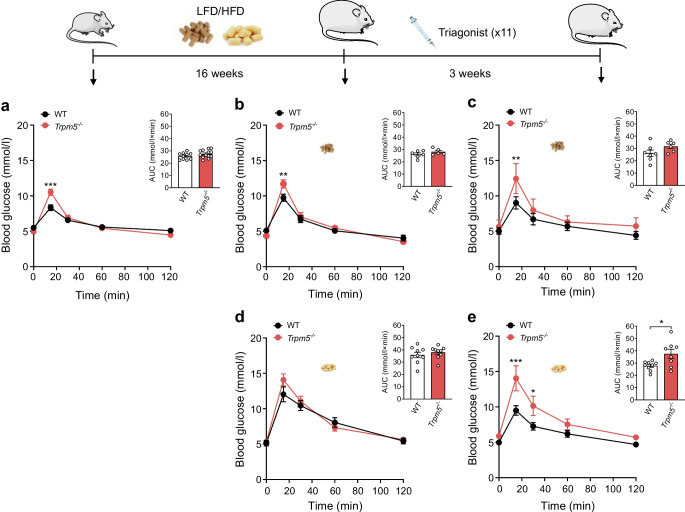
TRPM5 plays a crucial role in mediating the beneficial effects of triagonist on glucose metabolism in mice fed HFD. Ten- to twelve-week-old WT ormice were divided into two groups: one maintained on a normal chow (LFD) (≥6); and the other on D12451 (HFD) diet for 16 weeks (≥9). Following 16 weeks of the respective diets, both groups received an i.p. injection of 3 nmol/kg triagonist every other day for 3 weeks (11 injections); GTT was performed before () and after the LFD () or HFD () and after the triagonist treatment in the LFD () and HFD () groups. For the GTT, mice were fasted overnight. Blood glucose levels before and within 2 h after i.p. injection of glucose (2 g/kg of body weight) in WT (black) andmice (red) are shown, together with the corresponding AUC. Data show means ± SEM, and statistical differences were assessed by two-way ANOVA (blood glucose) or unpaired two-tailed Student'stest (glucose AUC). Circles in bar graphs represent single values. *<0.05, **<0.01, ***<0.001 Trpm5 n n Trpm5 t p p p −/− −/− a b d c e
![Triagonist improves glycaemic management in a TRPM5-dependent manner. () Blood glucose (mmol/l) in fasted (≥7 mice per genotype) or freely fed (≥12 mice per genotype) mice. (,) Plasma insulin levels (≥12 mice per genotype,) and plasma GCG levels (≥6 mice per genotype,) in freely fed male and femalemice and control littermates after 16 weeks of HFD and 3 weeks of treatment with triagonist. () Insulin secretion (ng mlh[8 islets]) was assessed in isolated islets ofand control littermate mice on HFD (≥5 mice, measured in duplicate). After 1 h pre-incubation in KRB with 2.8 mmol/l glucose, islets were stimulated with 20 mmol/l glucose supplemented with mono- or multi-agonist (1 nmol/l each). Insulin content was determined by ELISA in supernatant fractions collected 60 min after stimulation. () Intact WT mouse islets (≥40 cells per condition, isolated from at least four mice) andislets (≥30 cells per condition, isolated from at least four mice) after 16 weeks of HFD and 3 weeks of treatment with triagonist were loaded with 3 µmol/l Fluo-4-AM and alterations in [Ca]of individual cells were monitored by confocal microscopy after increasing the extracellular glucose concentration from 2.8 to 20 mmol/l in the presence of triagonist (1 nmol/l). KCl (30 mmol/l) was used as a positive control. Fwas calculated as the mean fluorescence intensity during the final 2 min prior to stimulation with 20 mmol/l glucose + agonist. () AUC was assessed only during agonist application. The data are presented as means ± SEM (circles in bar graphs represent single values) and statistical differences were assessed by unpaired two-tailed Student'stest (–,,). *<0.05, ***<0.001. a.u., arbitrary units; G, glucose a b c b c d e f a c d f n n n n Trpm5 Trpm5 n n Trpm5 n t p p −/− −1 −1 −1 −/− −/− 2+ i](https://europepmc.org/articles/PMC12534261/bin/125_2025_6525_Fig6_HTML.jpg "Click to view full size")
Triagonist improves glycaemic management in a TRPM5-dependent manner. () Blood glucose (mmol/l) in fasted (≥7 mice per genotype) or freely fed (≥12 mice per genotype) mice. (,) Plasma insulin levels (≥12 mice per genotype,) and plasma GCG levels (≥6 mice per genotype,) in freely fed male and femalemice and control littermates after 16 weeks of HFD and 3 weeks of treatment with triagonist. () Insulin secretion (ng mlh[8 islets]) was assessed in isolated islets ofand control littermate mice on HFD (≥5 mice, measured in duplicate). After 1 h pre-incubation in KRB with 2.8 mmol/l glucose, islets were stimulated with 20 mmol/l glucose supplemented with mono- or multi-agonist (1 nmol/l each). Insulin content was determined by ELISA in supernatant fractions collected 60 min after stimulation. () Intact WT mouse islets (≥40 cells per condition, isolated from at least four mice) andislets (≥30 cells per condition, isolated from at least four mice) after 16 weeks of HFD and 3 weeks of treatment with triagonist were loaded with 3 µmol/l Fluo-4-AM and alterations in [Ca]of individual cells were monitored by confocal microscopy after increasing the extracellular glucose concentration from 2.8 to 20 mmol/l in the presence of triagonist (1 nmol/l). KCl (30 mmol/l) was used as a positive control. Fwas calculated as the mean fluorescence intensity during the final 2 min prior to stimulation with 20 mmol/l glucose + agonist. () AUC was assessed only during agonist application. The data are presented as means ± SEM (circles in bar graphs represent single values) and statistical differences were assessed by unpaired two-tailed Student'stest (–,,). *<0.05, ***<0.001. a.u., arbitrary units; G, glucose a b c b c d e f a c d f n n n n Trpm5 Trpm5 n n Trpm5 n t p p −/− −1 −1 −1 −/− −/− 2+ i
Discussion
GLP-1, GIP and GCG are required to maintain normoglycaemic dynamics in healthy individuals. It is known that all three peptides enhance insulin secretion in WT mice, through mechanisms likely involving Gαs activation and cAMP production [19, 20]. However, a recent study demonstrated that in a mouse model of diabetes, GLP-1 exhibits preserved insulin secretion through a Gαq-dependent manner [13]. The shift from Gαs to Gαq effective coupling in persistently depolarised beta cells may hint at therapeutic and pathophysiological significance.
The triagonist IUB447 has shown superior efficacy compared with existing dual co-agonists and best-in-class mono-agonists in reducing body weight and improving glycaemic management in relevant rodent models. The enhanced insulin secretion induced by the triagonist is attributed to the simultaneous activation of all three receptors [1]. In the current study, we evaluated the significance of the GIPR and GCGR in triagonist-induced responses by employing Gipr−/− and Gcgr−/− mice. The results show that the triagonist functions independently of GIPR, as evidenced by fully intact triagonist enhancement of insulin secretion in Gipr−/− mouse islets. The modest reduction in triagonist-induced insulin secretion observed in Gcgr−/− mouse islets was mirrored by comparable reductions in insulin secretion observed with other secretagogues. Although we initially attributed this to impaired beta cell function, as reported in Gcgr−/− mice [21], normalisation to protein content largely eliminated this effect. Additionally, pharmacological inhibition with LY2409021 indicated minimal involvement of GCGR in triagonist responses. Thus, we suggest that GIPR and GCGR are unlikely to be responsible for the enhanced effect of the triagonist on insulin secretion. These findings prompted us to hypothesise that GLP-1R may play a central role as the primary mediator of triagonist-induced responses in pancreatic islets. To test this, we employed a mouse model with a double Glp-1r and Gipr KO and a pharmacological approach using the specific GLP-1R antagonist exendin-3. Our data clearly demonstrate that the triagonist fails to enhance insulin secretion in the absence of functional GLP-1R activity. It is worth noting that the variability in agonist responses observed across different KO models may stem from differences in assay sensitivity, islet responsiveness and the physiological status of the mice, which can influence hormone responsiveness.
There is growing evidence indicating that GLP-1 activates both Gαq and Gαs signalling pathways, whereas the effects of GIP and GCG are mediated exclusively through Gαs [13]. Here, we report that the triagonist IUB447 did not enhance cAMP accumulation in pancreatic islets and blocking of the adenylate cyclase had a minimal impact on triagonist-induced insulin secretion. However, inhibition of Gαq signalling markedly suppressed the triagonist-induced enhancement of GSIS in WT mouse islets. A previous study showed that insulin secretion stimulated via the Gαq signalling pathway is enhanced in persistently depolarised beta cells. The Gαq agonist MK-2305 drastically improves glucose tolerance and insulin secretion in the KK-Ay mouse model of type 2 diabetes [13].
Our results attribute the triagonist-induced enhancement of GSIS to increased intracellular Ca2+ levels in beta cells. These elevations may also contribute to enhanced downstream signalling of Gαq through activation of phospholipase C (PLC), as has been reported in INS-1 cells [22]. This possibility is consistent with our previous observation in which the triagonist enhanced Ca2+ influx in the human pancreatic beta cell line 1.1B4, and inhibition of PLC activity with U73122 significantly attenuated the triagonist-induced increases in intracellular Ca2+ concentration [9]. Previous studies demonstrated that activation of PKC occurs downstream of Gαq-dependent activation of PLC in beta cells. It has been shown that the stimulatory effect of GLP-1 on insulin secretion is, to some extent, dependent on PKC, as evidenced by the ability of the PKC activator phorbol 12-myristate 13-acetate to mimic the effects of GLP-1 on electrical activity. Additionally, PKC inhibition completely abolishes the stimulatory effect of GLP-1 on insulin secretion [23]. Here, we show that PKC inhibition with calphostin C markedly reduces triagonist-induced GSIS enhancement in WT islets. Previous studies suggested that both PKC activation and increased intracellular Ca2+ levels are required for TRPM5 activation [24]. Thus, we explored the possible involvement of transient receptor potential channels in triagonist-induced insulin secretion. We previously reported that La3+ and Ruthenium Red, non-selective TRP channel blockers, strongly inhibited triagonist-enhanced GSIS and significantly suppressed triagonist-induced Ca2+ influx in 1.1B4 cells [9]. Here, we obtained responses similar to those caused by selective inhibition of TRPM5 with TPPO.
Modulation of TRPM5 activity plays a key role in regulating beta cell function and insulin secretion [25, 26]. TRPM5 SNPs are often associated with disrupted insulin secretion, elevated plasma glucose levels and lower GLP-1 levels [27]. Previous studies suggested that TRPM5 activation and the subsequent increases in Na+-influx play a crucial role in GLP-1-induced increases in beta cell electrical activity [28]. Although GLP-1 increases the amplitude of the voltage-gated Ca2+ current, closure of KATP channels is not the sole mechanism by which GLP-1 stimulates beta cell electrical activity. In both mouse and human beta cells, the ability of GLP-1 to induce membrane depolarisation and initiate action potential firing depend on extracellular Na+ and TRPM5 activity [23, 29, 30]. Importantly, the GLP-1-activated Na+ current cannot initiate electrical activity and insulin secretion unless the KATP channels are almost fully inhibited [23]. This is crucial for ensuring the safety of GLP-1-based drug therapy, as the stimulatory effect of such agents is glucose-dependent, and clarifies the rationale behind the minimal impact of the triagonist, even at significantly elevated concentrations, on insulin secretion under condition of low glucose.
In the current study, we showed that Trpm5−/− mice fed HFD display glucose intolerance and impaired insulin response to GLP-1. This finding is consistent with a previous study in which mice lacking TRPM5 function exhibited a decline in glucose tolerance and an impaired GSIS [31, 32]. Given our ex vivo findings that triagonist-induced insulin secretion is impaired by TRPM5 inhibition, we examined the effects of triagonist on glycaemic management in vivo in the absence of this channel. Here, we showed that triagonist treatment failed to reverse the impaired glucose tolerance in Trpm5−/− mice. Furthermore, fasted and fed blood glucose levels were considerably higher in Trpm5−/− mice than in their WT counterparts after triagonist treatment. This observation suggests the importance of TRPM5 function in mediating triagonist-induced increases in insulin secretion and overall normoglycaemia.
In this study, we report that the insulinotropic effect of the triagonist IUB447 is mainly due to its direct binding to the GLP-1R, leading to an increase in both Gαq signalling and TRPM5 activity. This observation agrees with our previously reported homology model, which indicated that the triagonist binds to the GLP-1R in the same binding pocket, in a very similar fashion to its native peptide agonist, GLP-1 [9]. A closer look into this model reveals several putative hydrogen bonds and a salt bridge that the triagonist forms in addition to those that are already present when GLP-1 binds in that pocket (see PDB ID 5VAI [33]). These additional bonds likely result in a stronger and longer binding of the triagonist to the GLP-1R when compared with GLP-1. These putative additional triagonist-specific bonds, beyond those that are identical to those formed when GLP-1 binds, include a possible salt bridge formation between Glu139 in the receptor and Arg23 of the triagonist (Gln23 in GLP-1) as well as hydrogen bonds between Arg190 in the receptor and Gln9 of the triagonist (Glu9 in GLP-1) and also between Arg121 in the receptor and Asp34 of the triagonist (Lys34 in GLP-1). Such a feature could affect the spatial adjustments of other elements during GLP-1R activation, potentially leading to improved therapeutic outcomes, as suggested by others [34]. Although our findings indicate that GLP-1R is the primary mediator of the insulinotropic effect of the triagonist in murine islets, receptor engagement may differ in human islets. Given that species-specific differences have been reported for other multi-agonists such as tirzepatide [35], further studies using human islets are warranted to confirm the involvement of GLP-1R and the Gαq–TRPM5 signalling axis in humans. Furthermore, it is important to note that our findings here specifically reflect the pharmacological profile of the triagonist IUB447, characterised by Finan et al. [1], and should not be extrapolated to structurally distinct triagonists such as SAR441255 [36] or LY3437943 [37], which may differ in receptor bias, potency and in vivo efficacy.
Supplementary Information
Below is the link to the electronic supplementary material. ESM (PDF 901 KB)