
What this is
- (AS) is a genetic kidney disease that leads to early kidney failure.
- Current treatments like renin-angiotensin system inhibitors (RASi) are insufficient for many patients.
- Glucagon-like peptide-1 receptor agonists (GLP-1 RAs) show promise for nephroprotection and cardiovascular benefits.
- This review discusses the potential of GLP-1 RAs in treating AS and calls for further research.
Essence
- may offer new therapeutic options for by targeting inflammation and fibrosis, which are central to the disease's progression.
Key takeaways
- GLP-1 RAs have demonstrated cardiovascular and nephroprotective effects in chronic kidney disease (CKD) and type 2 diabetes (T2D) patients, suggesting potential benefits for AS.
- The mechanisms of GLP-1 RAs include anti-inflammatory and anti-fibrotic actions, which may directly address the unique pathological processes in .
- Inclusion of AS patients in future clinical trials for GLP-1 RAs is essential to evaluate their specific impacts on disease progression and patient outcomes.
Caveats
- The safety profile of GLP-1 RAs includes gastrointestinal side effects and potential risks like pancreatitis, which must be considered in treatment.
- Many clinical trials have excluded AS patients, limiting the applicability of findings to this specific population.
- Further research is needed to clarify the direct effects of GLP-1 RAs on the glomerular basement membrane and their overall efficacy in AS.
Definitions
- Alport syndrome: A genetic kidney disease characterized by progressive kidney failure, hearing loss, and ocular abnormalities.
- GLP-1 receptor agonists: Medications that mimic the action of glucagon-like peptide-1, enhancing insulin secretion and providing cardiovascular and renal benefits.
Simplified
Introduction
For decades, patients with chronic kidney disease (CKD) had no pharmacological options to slow disease progression besides renin-angiotensin system (RASi) blockade, which were introduced into clinical practice in the early 1980s. In recent years, many new therapeutic options are being tested in clinical trials for patients with CKD. Alport syndrome (AS), a specific cause of progressive CKD, is the most common monogenetic glomerular kidney disease [1, 2]. Patients with AS can often develop kidney failure (KF) early in life. AS is characterised by glomerular proteinuria, progressive decline in kidney function, sensorineural hearing loss, and ocular lesions. Variants in the collagen IV genes (COL4A3, COL4A4, or COL4A5), encoding critical components of the glomerular basement membrane (GBM), cause Alport syndrome [3, 4]. These variants disrupt the structure and function of type IV collagen within the GBM, leading to impaired filtration and albuminuria, ultimately posing a high risk of KF [5]. Ocular lesions and progressive sensorineural hearing loss frequently accompany KF [6 –9].
While RASi (angiotensin-converting–enzyme [ACE] inhibitors or angiotensin-receptor blockers [ARB]) demonstrably improved kidney function prognosis in AS, many patients still reach KF at a relatively young age [10 –13]. This necessitates exploration of novel therapeutic options to delay the onset of KF.
The discovery of glucagon-like peptide-1 (GLP-1) receptor agonists has an intriguing biological origin linked to the venom of the Gila monster (Heloderma suspectum), a species of lizard native to the southwestern United States and Mexico [14]. The evolutionary advantage of GLP-1 in animals such as the Gila monster is thought to be linked to its role in metabolic regulation and energy efficiency, particularly in response to the harsh desert environment where prolonged fasting is common. GLP-1, through its enhancement of insulin secretion and delayed gastric emptying, allows the Gila monster to optimise nutrient absorption and regulate blood glucose levels during periods of food scarcity. Furthermore, the presence of exendin-4 in the lizard's venom may serve to impair prey metabolism, potentially causing lethargy or hypoglycemia, thereby aiding in prey capture. This dual functionality underscores the adaptive value of GLP-1 in both metabolic management and survival in challenging ecological conditions [14]. Early research into the physiological functions of GLP-1 revealed its critical role in glucose metabolism, leading to its therapeutic potential in treating diabetes and obesity. However, it was in the saliva of the Gila monster that exendin-4, a GLP-1 receptor agonist, was identified. Exendin-4 mimics the effects of human GLP-1, but with greater stability and longer duration of action, laying the groundwork for the development of GLP-1 receptor-based drugs [15]. The identification of this peptide in lizard venom emphasises the diverse biochemical pathways evolutionarily adapted by organisms and highlights the translational potential of natural compounds in modern medicine.
Therefore, the 2022 KDIGO guidelines recommend long-acting GLP-1 RAs with established cardiovascular (CV) benefits as the preferred second-line therapy for glycemic control and CV risk reduction in adults with type 2 diabetes with established cardiovascular disease (CVD) or a high CV risk profile. This applies to patients who fail to achieve individualised glycemic targets despite receiving metformin and an SGLT2 inhibitor (SGLT2i) or who have a contraindication to these medications [16].
Some of the most well-known drugs include liraglutide, semaglutide, and dulaglutide. These drugs mimic the action of GLP-1 by stimulating insulin secretion, inhibiting glucagon release, and slowing gastric emptying, all of which contribute to improved glycemic control and weight loss. Other agents, such as exenatide and its extended-release version, are also commonly prescribed. These medications differ in their pharmacokinetics, dosing regimens, and delivery mechanisms, but they all offer significant benefits in managing hyperglycemia and reducing body weight in patients with metabolic disorders [17].
While GLP-1 receptor agonists (GLP-1 RAs) have demonstrated broad nephroprotective effects in diabetic kidney disease, the specific focus of this review is on their potential application in Alport syndrome (AS). AS, as a genetically distinct condition characterised by mutations in collagen IV genes, involves unique pathological mechanisms, including early-onset kidney fibrosis, oxidative stress, and inflammation, which GLP-1 RAs may address through their pleiotropic effects. This review provides a foundational overview of GLP-1 RAs to contextualise their mechanisms of action before exploring their targeted relevance in AS.
| Trial | Year | Objective | Design | Population | Primary outcome | Results |
|---|---|---|---|---|---|---|
| SUSTAIN-6 | 2016 | Investigate semaglutide's effect on CVD risk in T2D patients | Randomized, double-blind, placebo-controlled | Patients aged 50 + with T2D, established CVD, heart failure, or CKD (stage III +), or aged 60 + with CVD risk factors | Composite of CV death, non-fatal MI, or non-fatal stroke | Semaglutide reduced the composite outcome significantly (6.6% vs. 8.9% in placebo; HR 0.74, CI 0.58–0.95; < 0.001). Fewer serious adverse events occurred, but more patients discontinued due to gastrointestinal side effectsp |
| AMPLITUDE-O | 2021 | Investigate efpeglenatide's effect on CV and CKD outcomes in T2D patients | Randomized, double-blind, placebo-controlled | Patients with T2D and history of CVD or eGFR 25.0–59.9 ml/min/1.73 m2 | CV events and composite renal outcomes | Efpeglenatide reduced CV events and renal outcomes (13.0% vs. 18.4% in placebo). Gastrointestinal side effects were higher with efpeglenatide |
| REWIND | 2019 | Investigate dulaglutide's effect on major CV events in T2D patients | Randomized, double-blind, placebo-controlled | Patients aged 50 + with T2D, with prior CV event or risk factors | First occurrence of non-fatal MI, non-fatal stroke, or CV death | Dulaglutide reduced major CV events (12.0% vs. 13.4% in placebo; HR 0.88, CI 0.79–0.99; = 0.026). Gastrointestinal events more frequent with dulaglutidep |
| Harmony Outcomes | 2018 | Investigate albiglutide's effect on CV outcomes in T2D patients | Randomized, double-blind, placebo-controlled | Patients aged 40 + with T2D and established CVD | Composite of CV death, MI, or stroke | Albiglutide reduced CV events (7% vs. 9% in placebo; HR 0.78, CI 0.68–0.90; < 0.0001)p |
| LEADER | 2016 | Investigate liraglutide's effect on CV outcomes in T2D patients | Randomized, double-blind, placebo-controlled | Patients with T2D and high CV risk | Composite of death from cardiovascular causes, non-fatal MI, or non-fatal stroke | Liraglutide reduced CV events (13.0% vs. 14.9% in placebo; HR 0.87, CI 0.78–0.97; < 0.001 for non-inferiority; = 0.01 for superiority)pp |
| SELECT | 2023 | Investigate semaglutide's effect on CV outcomes in overweight/obese individuals without diabetes | Randomized, double-blind, placebo-controlled | Overweight/obese patients aged 45 + with established CVD | Composite of CV death, non-fatal MI, or non-fatal stroke | Semaglutide reduced CV events (6.5% vs. 8.0% in placebo; HR 0.80, CI 0.72–0.90; < 0.001). More discontinuation in semaglutide group due to side effectsp |
| AWARD-PEDS | 2022 | Investigate dulaglutide's efficacy and safety in adolescents with T2D | Randomized, double-blind, placebo-controlled | Adolescents aged 10–18 with BMI above the 85th percentile | Change in HbA1c | Dulaglutide reduced HbA1c levels significantly compared to placebo (− 0.6 to − 0.9%). Higher incidence of gastrointestinal adverse events in dulaglutide group |
| Flow study | 2023 | Investigate semaglutide's effect on kidney outcomes in CKD patients with T2D | Randomized, double-blind, multinational phase 3b trial | Patients with CKD and T2D | Composite of eGFR decline, kidney failure, or death from kidney/CV causes | Semaglutide reduced primary outcome events by 24% (95% CI: 0.66–0.88; = 0.0003). Slower eGFR decline observed, but more frequent discontinuation due to gastrointestinal side effectsp |
GLP-1 receptor agonists—what does the evidence say?
GLP1-RAs are hypothesized to be a promising therapy for slowing the progression of diabetic CKD [18]. Some GLP-1 RAs (albiglutide, efpeglenatide, dulaglutide, liraglutide, and once-weekly semaglutide) reduce the risk of major adverse cardiovascular events (MACE) in people with type 2 diabetes (T2D) with established CVD or at high risk of CVD [19 –23]. A summary of GLP-1 RA trials is featured in Table 1.
The SUSTAIN-6 trial investigated whether once-weekly semaglutide (0.5 mg or 1.0 mg) could reduce CVD risk in patients aged 50 or older with T2D. Participants had established CVD (including prior heart attack, stroke, or peripheral arterial disease), chronic heart failure or CKD (stage III or higher) or were aged 60 or older with at least one CVD risk factor. The primary outcome was the first occurrence of CV death, non-fatal myocardial infarction, or non-fatal stroke. The rate of the primary composite outcome was significantly lower in the semaglutide group (6.6%) compared to placebo (8.9%) (hazard ratio [HR], 0.74; 95% confidence interval [CI], 0.58 to 0.95; p< 0.001 for non-inferiority). While fewer serious adverse events occurred in the semaglutide group, more patients discontinued treatment due to side effects, primarily gastrointestinal issues [19].
The AMPLITUDE-O trial investigated the effect of efpeglenatide, an exendin-based GLP-1 RA, on CV and CKD outcomes in T2D patients. Patients with T2D and glycated hemoglobin > 7%, ≥ 18 years old with previous CVD, or ≥ 50 years old with an eGFR of 25–59.9 ml/min/1.73 m2, and one or more additional CVD risk factors were recruited. Participants were randomly assigned in a 1:1:1 ratio to receive weekly subcutaneous injections of efpeglenatide (4 mg or 6 mg) or placebo. Compared to placebo, efpeglenatide significantly reduced the risk of major adverse cardiovascular event. Additionally, a composite renal outcome event (kidney function decline or macroalbuminuria) occurred less frequently in the efpeglenatide groups (13.0%) compared to placebo (18.4%). However, efpeglenatide was associated with a higher incidence of gastrointestinal side effects such as diarrhoea and nausea compared to placebo [20].
The REWIND trial assessed the effect of the GLP-1 RA dulaglutide on major adverse CV events in patients with T2D, regardless of prior CVD. This multicenter, randomized, double-blind, placebo-controlled trial included patients aged at least 50 years with T2D who had either a previous CV event or risk factors. Participants were randomly assigned (1:1) to either subcutaneous injection of dulaglutide (1.5 mg/week) or placebo. The primary outcome was the first occurrence of non-fatal myocardial infarction, non-fatal stroke, or cardiovascular death. During a median follow-up of 5.4 years, the primary composite endpoint occurred in 12.0% of the dulaglutide group compared to 13.4% of the placebo group (HR 0.88, 95% CI 0.79–0.99; p = 0.026). Gastrointestinal adverse events were more frequent in the dulaglutide group (47.4%) compared to placebo (34.1%) (p< 0.0001) [21].
The Harmony Outcomes trial investigated the cardiovascular effects of once weekly albiglutide in patients aged 40 years with T2D and established CVD. This double-blind, randomized, placebo-controlled trial assigned participants to receive either a subcutaneous injection of albiglutide (30–50 mg) or placebo weekly, on top of their standard care. The primary outcome was the first occurrence of CV death, myocardial infarction, or stroke. The rate of the primary composite outcome was lower in the albiglutide group (7%) compared to placebo (9%). Albiglutide demonstrated both non-inferiority and superiority to placebo in reducing CV events (HR 0.78; 95% CI 0.68–0.90; p< 0.0001 for non-inferiority) [22].
The LEADER trial investigated whether liraglutide could reduce CV risk in patients with T2D and high CV risk. In this double-blind trial, participants were randomly assigned to receive liraglutide or placebo. The primary outcome, a composite of death from cardiovascular causes, non-fatal myocardial infarction, or non-fatal stroke, occurred significantly less frequently in the liraglutide group (13.0%) compared to placebo (14.9%) (HR, 0.87; 95% CI, 0.78 to 0.97; p < 0.001 for non-inferiority; p= 0.01 for superiority). Gastrointestinal events were the most common reason for discontinuing liraglutide [24].
The SELECT trial investigated whether semaglutide could reduce CV risk in overweight and obese individuals without diabetes. This multicenter, double-blind, randomized, placebo-controlled trial enrolled patients aged 45 or older with established CVD and a body mass index (BMI) of 27 or higher. Participants were randomly assigned to receive subcutaneous semaglutide (2.4 mg/week) or placebo. The primary endpoint, a composite of CV death, non-fatal myocardial infarction, or non-fatal stroke, occurred significantly less frequently in the semaglutide group (6.5%) compared to placebo (8.0%) (HR, 0.80; 95% CI, 0.72 to 0.90; p< 0.001). Notably, discontinuation due to adverse events was more common in the semaglutide group (16.6%) compared to placebo (8.2%) [25].
The AWARD-PEDS trial investigated the efficacy and safety of once-weekly dulaglutide in adolescents with T2D. Youths aged 10 to less than 18 years with a body mass index (BMI) above the 85th percentile were included. This double-blind, placebo-controlled trial employed a 1:1:1 randomization scheme. Participants received either lifestyle modifications, or a combination with metformin, with or without basal insulin. They were further randomized to receive once-weekly subcutaneous injections of placebo or dulaglutide (0.75 mg or 1.5 mg). The study included a 26-week open-label extension. At 26 weeks, mean glycated hemoglobin (HbA1c) levels increased in the placebo group (0.6%) while decreasing in the dulaglutide groups (− 0.6% in the 0.75 mg group and − 0.9% in the 1.5 mg group; both comparisons vs. placebo, p< 0.001). Dulaglutide therapy was associated with a higher incidence of gastrointestinal adverse events compared to placebo. The authors reported the safety profile of dulaglutide to be consistent with observations in adult populations [26].
Recently, the Flow study investigated the effects of once weekly semaglutide on kidney outcomes in patients with CKD and T2D. This randomized, double-blind, multinational, phase 3b trial included patients with an eGFR ≥ 50‒ ≤ 75 ml/min/1.73 m2 and urine albumin to creatinine ratio (UACR) > 300‒ < 5000 mg/g or eGFR ≥ 25‒ < 50 ml/min/1.73 m2and UACR > 100‒ < 5000 mg/g. Patients were randomized 1:1 to 1.0 mg once weekly semaglutide or placebo [27]. The composite primary endpoint was defined as KF (persistent eGFR < 15 ml/min/1.73 m2 or initiation of chronic kidney replacement therapy), persistent ≥ 50% reduction in eGFR or death from kidney-related or CV causes. An independent data and safety monitoring committee recommended early completion of the trial for efficacy. The reduction of primary-outcome events resulted in a 24% lower relative risk of the primary outcome in the semaglutide group (95% CI: 0.66–0.88; p = 0.0003, number needed to treat = 20, 95% CI 14 to 40). At 104 weeks, UACR was reduced by 12% in the placebo group and by 40% in the semaglutide group. While patients with semaglutide treatment had a slower eGFR decline (− 2.19 vs. − 3.36 ml/min/m2per year), it led to more frequent discontinuation mainly due to gastrointestinal side effects [28].
A pooled analysis of SUSTAIN 6 and LEADER trials demonstrated that semaglutide and liraglutide, significantly reduced albuminuria from baseline to 2 years after randomization by 24% versus placebo in patients with T2D [29]. This finding is particularly relevant because changes in albuminuria have been consistently linked to subsequent risk of KF [30]. A pre-specified analysis of SELECT trial, showed a clinically relevant reduction in albuminuria with a net treatment benefit of − 10.7% (95% CI − 13.2, − 8.2) in patients with albuminuria at baseline suggesting a beneficial kidney effect of once-weekly subcutaneous semaglutide 2.4 mg in patients with overweight/obesity and established CVD, without diabetes [31].
Consistent, a post hoc analysis of the LEADER trial investigated the association between changes in albuminuria within the first year and subsequent cardiovascular and renal events. This analysis demonstrated that patients who achieved a reduction in albuminuria within the first year experienced fewer cardiovascular and renal outcomes [32]. Moreover, UACR may have broader implications, potentially serving as a strong predictor of CV risk [33].
While the nephroprotective effects of GLP-1 RAs—such as reductions in albuminuria, oxidative stress, and inflammation—are well-documented in CKD, AS presents unique challenges and opportunities for these agents. The genetic basis of AS leads to structural and functional disruptions of the glomerular basement membrane (GBM), driving early-onset fibrosis and inflammation. These processes are amplified in AS compared to other glomerulopathies, making anti-fibrotic and antioxidative strategies like those offered by GLP-1 RAs particularly relevant. By targeting these shared but exacerbated pathways, GLP-1 RAs hold potential for modifying the disease trajectory in AS.
Nephroprotection—what is the mechanism?
Studies that combined results from multiple clinical trials investigating CV outcomes suggest that GLP-1 RAs might also have nephroprotective potential in T2D. In particular, semaglutide, efpeglenatide, dulaglutide, and liraglutide were linked to a lower risk of developing combined kidney problems (macroalbuminuria, significant decline in kidney function, KF, and death from kidney disease). However, it is important to note that, until the FLOW trial, this benefit seemed mainly due to a reduced risk of persistently high level macroalbuminuria [34, 35].
The precise mechanisms by which GLP-1 RAs exert kidney-protective effects remain under investigation. While mediation analyses suggest that improved glycemic control, weight loss, and reduced blood pressure contribute to these benefits, they likely do not fully explain the observed renoprotection [36 –38]. This implies involvement of additional, yet to be fully elucidated, mechanisms. Experimental studies to elucidate the beneficial effects of GLP-1 RA have mainly implicated the induction of natriuresis and the inhibition of oxidative stress, inflammation, and fibrosis [39 –41]. In ApoE−/− and LDLr−/−mice, GLP-1 RA significantly reduced arterial plaque formation, at least in part independent of weight or cholesterol changes. Studies on semaglutide further supported this mechanism by not only reversing aortic artery gene expression linked to atherosclerotic pathways in mice fed a Western diet, but also by decreasing plasma markers of systemic inflammation in an acute lipopolysaccharide model. Analysis of aortic atherosclerotic tissue revealed that multiple inflammatory pathways were downregulated by semaglutide, further solidifying its potential anti-inflammatory mechanism [42]. Correspondingly, GLP-1 receptor agonists have been shown to decrease inflammatory markers like C-reactive protein (CRP) and interleukin-6 (IL-6) [43, 44]. Advanced glycation end products (AGEs) accumulate with age, diabetes, and renal failure, promoting vascular inflammation through the AGE-RAGE axis. GLP-1 may mitigate this inflammation by downregulating RAGE expression via cyclic AMP signaling [45]. In addition, GLP-1 and its analogs have been shown to exert immunomodulatory effects by influencing macrophage polarization. While inflammatory M1 macrophages contribute to tissue injury and fibrosis, M2 macrophages exhibit anti-inflammatory properties and promote tissue repair and regeneration. By promoting an M2 phenotype, GLP-1 may contribute to reduced inflammation [46, 47]. Murine studies also showed that GLP-1 RA might be protective against renal oxidative stress by inhibition of NAD(P)H oxidase and by activation of the cAMP-protein kinase A pathway [48]. GLP-1 receptor expression in endothelial cells, vascular smooth muscle cells, macrophages, and monocytes suggests a potential anti-atherosclerotic effect of GLP-1 RAs [49 –51]. Supporting this notion, GLP-1 RAs are reported to decrease reactive oxygen species production in endothelial cells, reduce circulating markers of inflammation, and slow atherosclerotic plaque formation by inhibiting the expression of adhesion molecules [43, 52]. Furthermore, GLP-1 RAs might promote a decreasing of endothelin levels, a potent vasoconstrictor, which is also involved in inflammatory and fibrotic processes [53, 54].
GLP-1 RAs have been shown to lower plasma angiotensin II levels, suggesting a link between the GLP-1 and RAAS pathways [55, 56]. This interaction may occur through two mechanisms: First, GLP-1 RA may decrease sodium reabsorption in the proximal tubule, leading to increased delivery of sodium chloride to the macula densa and subsequent activation of the tubuloglomerular feedback mechanism, which inhibits renin secretion [57]. Alternatively, GLP-1 RA might directly act on renin-producing cells within the juxtaglomerular apparatus, where GLP-1 receptors have been identified or might directly protect podocytes from apoptosis [58 –60]. To further increase knowledge about the potential protective mechanism of GLP-1 RA, the mechanistic REMODEL trial (NCT04865770) is underway to further investigate these potential pathways [61].
Emerging evidence suggests a bidirectional relationship between leptin and GLP-1 signaling, with leptin potentially modulating GLP-1 release and action [62]. This interaction may influence inflammation, oxidative stress, and metabolic homeostasis, which are critical in CKD progression.
The mechanisms of kidney injury in AS, while overlapping with those in other CKD etiologies, are uniquely influenced by the collagen IV network's structural integrity within the GBM. This distinguishes AS as a disease characterised by progressive glomerular sclerosis, tubulointerstitial fibrosis, and inflammation, driven by the downstream effects of GBM dysfunction. GLP-1 RAs, through their ability to inhibit oxidative stress and fibrosis while modulating inflammatory responses, could directly target these pathological processes. Unlike general CKD, where albuminuria is often the predominant driver of progression, the role of collagen IV mutations in AS creates a unique therapeutic target for GLP-1 RAs.
What does this mean for Alport syndrome?
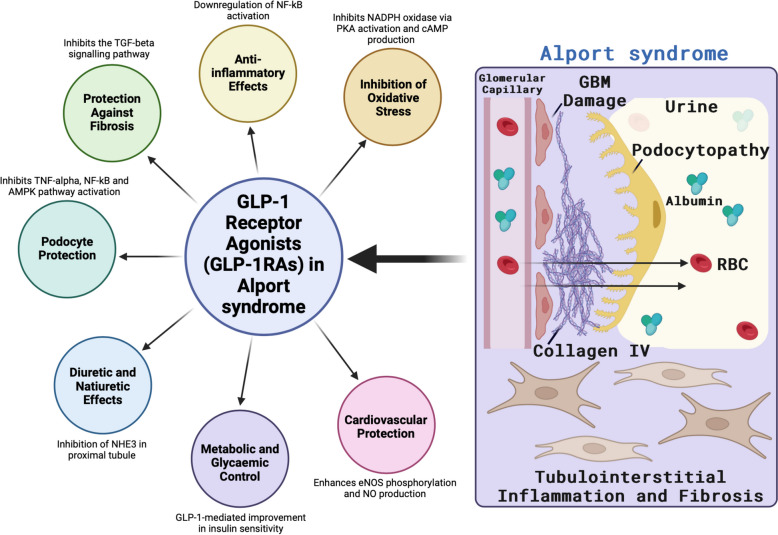
Podocyte injury is a key contributor to glomerular dysfunction in Alport syndrome, driven by oxidative stress and inflammation. GLP-1 RAs have shown potential to protect podocytes by reducing TNF-α expression, inhibiting NF-κB activation, and preserving mitochondrial function, which collectively support glomerular barrier integrity [70]. Although direct effects of GLP-1 RAs on the GBM have not been fully elucidated, their anti-inflammatory, anti-fibrotic, and antioxidative properties may indirectly support GBM integrity. These mechanisms could help mitigate the structural and functional disruptions caused by collagen IV mutations in Alport syndrome.
Further research is warranted to elucidate the full therapeutic potential of GLP-1 RAs in AS but like many genetic kidney diseases, Alport syndrome patients have been excluded from important clinical trials exploring therapeutics that slow the progression of CKD. Including patients with Alport syndrome in general CKD treatment trials offers benefits such as larger sample sizes, cost-efficiency, and faster access to results, given shared disease mechanisms with many of the CKD etiologies. However, the heterogeneity of CKD may obscure disease-specific drug effects, underrepresent Alport patients, and delay the discovery of targeted therapies. Conversely, independent Alport syndrome trials provide tailored study designs and greater insights into disease-specific mechanisms, but face challenges with smaller sample sizes, higher costs, and longer trial durations. Thus, the choice between these approaches hinges on balancing the need for generalisibility with the specificity required for rare disease research.
Although the therapeutic benefits of GLP-1 RAs have been extensively studied in diabetic CKD, their application in AS requires further exploration. The genetic basis and early-onset nature of AS make it a distinct entity within CKD, with inflammation and fibrosis playing central roles from an early stage. GLP-1 RAs' capacity to reduce inflammatory cytokines, promote podocyte health, and modulate oxidative stress pathways could have particular relevance in addressing the progressive decline seen in AS patients. This highlights the need for dedicated clinical trials to evaluate GLP-1 RAs in AS, where these pleiotropic mechanisms may have a large impact.
![Potential protective mechanisms of GLP-1 RAs in Alport syndrome. Adapted from "Explaining Alport syndrome – lessons from the adult nephrology clinic" []. This figure summarises the key potential renoprotective effects of GLP-1 receptor agonists (GLP-1 RAs) in the context of Alport syndrome. Kidney-focused pathological sequelae in Alport syndrome include disruption of the collagen IV network which compromises the structural integrity of the glomerular basement membrane (GBM), subsequent albuminuria/proteinuria, hematuria, podocytopathy, progressive glomerular inflammation and sclerosis, tubulointerstitial inflammation, oxidative stress, and fibrosis. GLP-1 RAs inhibit oxidative stress by reducing NADPH oxidase activity through PKA activation and cAMP production, resulting in lower reactive oxygen species (ROS) levels in glomeruli and tubules []. GLP-1 RAs activate the Nrf2 signaling pathway to promote antioxidant defenses []. GLP-1 RAs inhibit fibrotic responses by suppressing the TGF-β pathway, reducing fibronectin and collagen deposition in the kidneys []. Podocyte protection is achieved through inhibition of TNF-α, NF-κB, and AMPK pathway activation, preserving glomerular filtration barrier integrity and reducing albuminuria []. Additionally, GLP-1 RAs promote diuresis and natriuresis by inhibiting the Na + /H + exchanger (NHE3) in proximal tubules, leading to enhanced sodium excretion and reduced fluid retention []. Red blood cell (RBC); glomerular basement membrane (GBM). Image created using BioRender [66] [48] [67] [68] [69] [57]](https://europepmc.org/articles/PMC11870915/bin/44162_2024_65_Fig1_HTML.jpg "Click to view full size")
Potential protective mechanisms of GLP-1 RAs in Alport syndrome. Adapted from "Explaining Alport syndrome – lessons from the adult nephrology clinic" []. This figure summarises the key potential renoprotective effects of GLP-1 receptor agonists (GLP-1 RAs) in the context of Alport syndrome. Kidney-focused pathological sequelae in Alport syndrome include disruption of the collagen IV network which compromises the structural integrity of the glomerular basement membrane (GBM), subsequent albuminuria/proteinuria, hematuria, podocytopathy, progressive glomerular inflammation and sclerosis, tubulointerstitial inflammation, oxidative stress, and fibrosis. GLP-1 RAs inhibit oxidative stress by reducing NADPH oxidase activity through PKA activation and cAMP production, resulting in lower reactive oxygen species (ROS) levels in glomeruli and tubules []. GLP-1 RAs activate the Nrf2 signaling pathway to promote antioxidant defenses []. GLP-1 RAs inhibit fibrotic responses by suppressing the TGF-β pathway, reducing fibronectin and collagen deposition in the kidneys []. Podocyte protection is achieved through inhibition of TNF-α, NF-κB, and AMPK pathway activation, preserving glomerular filtration barrier integrity and reducing albuminuria []. Additionally, GLP-1 RAs promote diuresis and natriuresis by inhibiting the Na + /H + exchanger (NHE3) in proximal tubules, leading to enhanced sodium excretion and reduced fluid retention []. Red blood cell (RBC); glomerular basement membrane (GBM). Image created using BioRender [66] [48] [67] [68] [69] [57]
Considering the risks
GLP-1 RA drugs, while generally considered effective and safe for the treatment of T2D and obesity, are associated with certain risks and side effects, as documented in the literature which must not be completely overlooked. Common adverse effects include gastrointestinal disturbances, such as nausea, vomiting, and diarrhoea, which often subside with continued use [19]. More serious, though less frequent, risks include pancreatitis and, in rare cases, pancreatic cancer, although the causal relationship remains debated [71]. Thyroid C-cell hyperplasia and an increased risk of medullary thyroid carcinoma have been observed in rodent studies, but these findings have not been definitively replicated in humans [72]. Other concerns include hypoglycemia, particularly when GLP-1 RA are used in combination with insulin or sulfonylureas, as well as potential CV effects [73]. Overall, while GLP-1 RA present several potential risks, the benefit-risk profile remains favorable in most patients when prescribed appropriately.
Conclusion
The potential for GLP-1 RAs to serve as a therapeutic option in AS presents an exciting avenue for further exploration, particularly given the unmet need for treatments that slow the progression of kidney function decline in this patient population. The pleiotropic effects of GLP-1 RAs, including their anti-inflammatory, anti-fibrotic, and renoprotective mechanisms, hold promise for modifying disease progression in AS, which is driven by defects in collagen IV and associated inflammation, fibrosis, and oxidative stress in the glomerular basement membrane. Evidence from clinical trials in diabetic CKD suggests that GLP-1 RAs improve both cardiovascular and renal outcomes by reducing albuminuria and slowing the decline in kidney function. These beneficial effects, in addition to metabolic improvements in glycemic control and weight reduction, provide a compelling rationale for the further study of GLP-1 RAs in non-diabetic kidney diseases like AS. However, careful consideration must be given to the safety profile of GLP-1 RAs, particularly their gastrointestinal side effects and rare risks, such as pancreatitis and thyroid-related complications [19, 71]. Future research should focus on understanding the molecular mechanisms through which GLP-1 RAs exert their renoprotective effects in AS and other monogenic kidney diseases, with an emphasis on translating these findings into clinical practice. Further research is also needed to determine whether GLP-1 RAs have direct effects on the GBM, such as modulating collagen IV assembly or repair. Exploring these pathways could clarify their specific benefits in Alport syndrome compared to other forms of CKD. If proven effective, GLP-1 RAs could represent a novel and impactful treatment strategy for delaying or preventing kidney failure in patients with AS and other causes of CKD, thereby significantly improving their long-term prognosis and quality of life.