
Glucagon-like-peptide-1 (GLP-1) receptor agonist use and the risk of pulmonary aspiration in patients undergoing surgery

🥉 Top 5% JournalMay 13, 2025International journal of surgery (London, England)

Use of GLP-1 receptor drugs and the risk of lung inhalation during surgery

AI simplified

Abstract

Among 392,065 patients undergoing elective surgery, 4.0% used GLP-1 receptor agonists.

  • The rate of pulmonary aspiration was 0.8% in patients using GLP-1 receptor agonists compared to 0.7% in those who did not.
  • Statistical analysis showed no significant association between GLP-1 receptor agonist use and pulmonary aspiration risk (OR = 1.07; 95% CI, 0.85-1.34).
  • The study highlights a potential concern regarding gastric emptying in patients on GLP-1 receptor agonists during surgery.

AI simplified

Key numbers

0.8%
Aspiration Rate
Rate of in GLP-1 receptor agonist users
0.7%
Aspiration Rate Comparison
Rate of in non-users of GLP-1 receptor agonists
1.07
for Aspiration
for after adjusting for risk factors

Key figures

Figure 1.
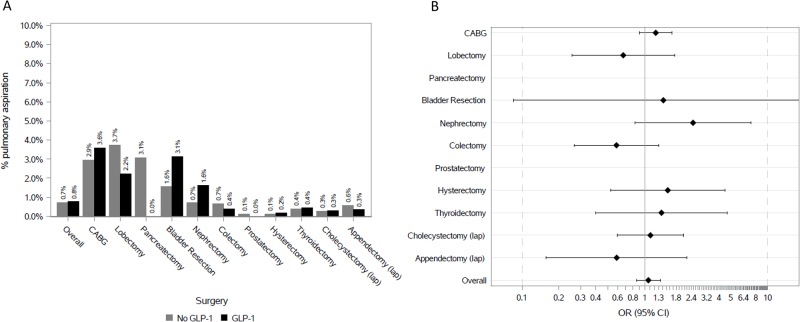
rates and odds ratios by use in surgical patients
Highlights similar pulmonary aspiration risk with without GLP-1 agonist use across various surgeries after risk adjustment.
js9-111-4090-g001
  • Panel A
    Absolute rates of pulmonary aspiration (%) for each surgery type comparing no GLP-1 agonist (black bars) versus GLP-1 agonist use (gray bars); GLP-1 agonist group appears to have slightly higher aspiration rates in CABG, lobectomy, and bladder resection.
  • Panel B
    Odds ratios (OR) with 95% confidence intervals for pulmonary aspiration by surgery type and overall, adjusted for multiple risk factors; most ORs cross 1.0 indicating no clear increased risk with GLP-1 agonist use.

Full Text

What this is

  • This research examines the relationship between GLP-1 receptor agonist use and pulmonary aspiration risk in surgical patients.
  • GLP-1 receptor agonists, used for type II diabetes and obesity, slow gastric emptying.
  • Concerns exist that these agents could increase aspiration risk during elective surgeries.
  • The study analyzes data from over 392,000 patients to assess this potential risk.

Essence

  • GLP-1 receptor agonist use does not increase the risk of pulmonary aspiration in surgical patients. The aspiration rate was 0.8% in users vs. 0.7% in non-users, with no significant association found.

Key takeaways

  • No increased risk of pulmonary aspiration was found in patients using GLP-1 receptor agonists undergoing surgery. The aspiration rates were similar at 0.8% for users and 0.7% for non-users.
  • After adjusting for risk factors, the odds ratio for aspiration in GLP-1 users was 1.07 (95% CI, 0.85–1.34), indicating no significant association.
  • GLP-1 agonist usage among surgical patients rose from 2.3% in 2015 to 7.7% in 2022, reflecting increased adoption of these medications.

Caveats

  • The study cannot completely rule out a very small increased risk of aspiration due to GLP-1 agonists. There may also be underreporting of GLP-1 use or aspiration events.
  • Clinical guidelines recommending the discontinuation of GLP-1 agonists before surgery may lead to delays and changes in diabetes management.

AI simplified