
What this is
- This study investigates the causal relationship between glucagon-like peptide-1 receptor agonists (GLP-1RAs) and arrhythmias.
- Using () analysis, it assesses the impact of genetically proxied GLP-1RAs on atrial fibrillation (AF), cardiac arrest, and ventricular fibrillation.
- Findings suggest that GLP-1RAs are associated with a reduced risk of these arrhythmias, although further research is needed.
Essence
- Genetically proxied GLP-1RAs are associated with a reduced risk of atrial fibrillation, cardiac arrest, and ventricular fibrillation, according to analysis.
Key takeaways
- Genetically proxied GLP-1RAs are linked to a lower risk of atrial fibrillation (AF) with an () of 0.78. This indicates a significant protective effect against AF.
- There is also a reduced risk of cardiac arrest and ventricular fibrillation, with an of 0.60. This finding highlights the potential antiarrhythmic benefits of GLP-1RAs.
- However, multivariable analysis showed no significant effect of GLP-1RAs on arrhythmias when adjusted for body mass index and type 2 diabetes mellitus.
Caveats
- The analysis was limited to individuals of European ancestry, which may restrict the generalizability of the findings to other populations.
- The study did not explicitly assess coronary artery disease as a mediator, which could influence the relationship between GLP-1RAs and arrhythmia risk.
- Further research is necessary to validate these findings and explore the underlying biological mechanisms.
Definitions
- Mendelian randomization (MR): A method using genetic variants as instrumental variables to assess causal relationships between exposures and outcomes.
- Odds ratio (OR): A measure of association between an exposure and an outcome, indicating the odds of the outcome occurring in the exposed group compared to the unexposed group.
Simplified
Introduction
Cardiovascular disease is the leading cause of mortality among patients with type 2 diabetes mellitus (T2DM) and remains one of the most prevalent health concerns worldwide [1]. Individuals with T2DM face a heightened risk of developing atrial fibrillation (AF), ventricular arrhythmias, and sudden cardiac arrest [2, 3]. Moreover, prediabetes alone is a risk factor for AF, and patients with AF combined with prediabetes are at increased risk for major adverse cardiac and cerebrovascular events [4, 5]. Glucagon-like peptide-1 receptor agonists (GLP-1RAs), which are widely used for the treatment of T2DM and promote weight loss in individuals with obesity, have demonstrated significant cardiovascular benefits. Clinical trials have shown that GLP-1RAs reduce the incidence of major adverse cardiovascular events in patients with T2DM [6].
In addition to their role as hypoglycemic agents, emerging evidence suggests that GLP-1RAs may also offer protection against AF. Evidence from clinical and animal studies has demonstrated that GLP-1RAs might improve myocardial metabolism and reduce the incidence of AF [7]. A preclinical study conducted in diabetic mice revealed that liraglutide reduced AF and prevented atrial remodeling in T2DM model mice [8]. In human studies, a real-world study involving adults with diabetes in the United States found that the use of GLP-1RAs was associated with a reduced risk of AF, highlighting their potential cardiovascular benefits beyond glycemic control [9].
In addition, GLP-1RAs exert pleiotropic effects by promoting weight loss, activating GLP-1 receptors on neurons and T cells, and targeting receptors in multiple organs. These actions contribute to reduced systemic and local inflammation, improved endothelial function, and decreased oxidative stress [10]. Furthermore, GLP-1RAs have shown enhanced efficacy in improving hepatic steatosis, reducing fibrosis, and modulating inflammation, suggesting promising therapeutic potential in metabolic dysfunction-associated steatohepatitis and cardiovascular comorbidities [11].
GLP-1RAs appear to be neutral regarding the risk of ventricular arrhythmias and sudden cardiac death [3]. A meta-analysis of 5 randomized clinical trials (RCTs) found no significantly increased risk of ventricular arrhythmias or sudden cardiac death associated with GLP-1RAs in T2DM patients [12]. Similarly, another meta-analysis of 5 cardiovascular outcome trials reported no significant effect of GLP-1RAs treatment on ventricular fibrillation in T2DM patients [13]. Given these inconsistent findings, the causal relationship between GLP-1RAs and arrhythmias remains uncertain. Mendelian randomization (MR) analysis is a powerful method that examines potential causal relationships between exposure and outcome at the genetic level. Therefore, we conducted MR analysis to investigate the causal association between genetically proxied GLP-1RAs and the risk of AF, cardiac arrest, and ventricular fibrillation.
Methods
Study design
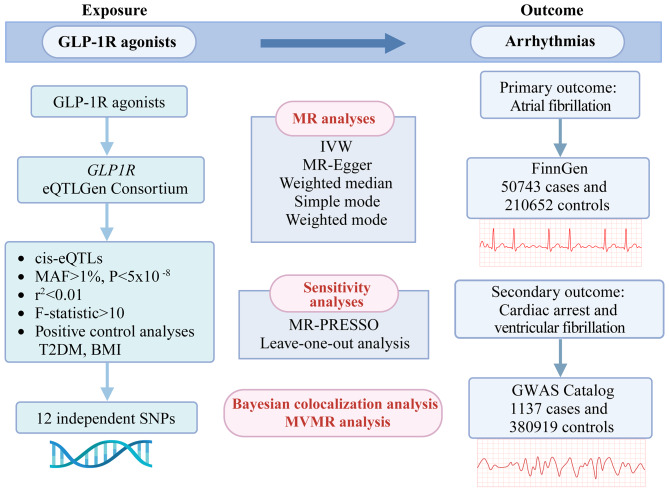
We conducted a two-sample MR analysis to evaluate the causal relationship between genetically proxied GLP-1RAs and arrhythmias. AF was the primary outcome, whereas cardiac arrest and ventricular fibrillation were the secondary outcomes (Fig. 1). MR analysis relies on three core assumptions: (1) genetic instruments must be strongly associated with the exposure; (2) they should not be influenced by confounding factors; and (3) they should affect outcomes only through the exposure [14]. The study was reported in accordance with the STROBE-MR (Strengthening the Reporting of Observational Studies in Epidemiology using Mendelian Randomization) guidelines [15] (Supplementary Table S1).

Study design overview. The flowchart of evaluating the effects of genetically proxied glucagon-like peptide-1 receptor (GLP-1R) agonists on arrhythmias. eQTL: expression quantitative trait locus; MAF: minor allele frequency; SNPs: single nucleotide polymorphisms; T2DM: type 2 diabetes mellitus; BMI: body mass index; MR: Mendelian randomization; IVW: inverse-variance weighted; MR-PRESSO: Mendelian Randomization Pleiotropy RESidual Sum and Outlier. MVMR: multivariable Mendelian randomization (Created in BioRender. Zhang, Y. (2025)). https://BioRender.com/m93p747
Genetic instruments for GLP-1RAs
Genetic instruments for GLP-1RAs were identified on the basis of previous research [16]. We used cis-expression quantitative trait loci (cis-eQTLs) of the GLP1R gene as proxies for GLP-1RAs exposure. Initially, 235 single nucleotide polymorphisms (SNPs) from cis-eQTLs were obtained from the eQTLGen Consortium (Supplementary Table S2). Blood-derived expression data from 31,684 European individuals were analyzed via the eQTLGen consortium for cis- and trans-expression quantitative trait loci [17]. Second, SNPs significantly associated with GLP1R gene expression in blood were identified, applying a p-value threshold of 5 × 10⁻⁸ and a minor allele frequency criterion of 1%. In the next step, we performed clumping to reduce the impact of strong linkage disequilibrium, including only SNPs with weak linkage disequilibrium (r² < 0.01) (Supplementary Table S3). We further filtered out SNPs with potential pleiotropic effects on confounding factors via the LDlink tool. To validate these instruments, we conducted positive control MR analyses using T2DM and body mass index (BMI) as outcomes. The results were considered positive with a p-value < 0.05. Summary statistics for T2DM were sourced from the FinnGen12. FinnGen conducts genome-wide association study (GWAS) across a wide range of phenotypes using nationwide registries, including hospital discharge data and prescription records, and links them to genetic information [18]. The BMI data used in this study were sourced from the GIANT (Genetic Investigation of Anthropometric Traits) consortium, a large-scale international collaboration aimed at identifying genetic variants associated with BMI [19]. Lastly, F-statistics were calculated to ensure instrument strength, with values greater than 10 indicating robustness.
Study outcomes
GWAS summary data for AF were obtained from FinnGen10. In this study, we utilized AF and atrial flutter data comprising 50,743 cases and 210,652 controls from the r10 dataset. International Classification of Diseases (ICD-10) coding is strictly followed in the diagnosis of AF (ICD codes: I48), covering paroxysmal AF, persistent AF, chronic AF, typical atrial flutter, atypical atrial flutter, and AF and atrial flutter, which are unspecified. Data for cardiac arrest and ventricular fibrillation (ICD codes: I46.0, I46.9, and I49.0) were retrieved from the GWAS Catalog database (GCST90436118), which included 1,137 cases and 380,919 controls [20]. The GWAS Catalog database, managed by the National Human Genome Research Institute and the European Bioinformatics Institute, aggregates GWAS from published research, systematically curating genetic variants associated with various traits and diseases [21].
Mendelian randomization analysis
Genetic instruments were harmonized with exposure and outcome data to align effect alleles and remove palindromic variants (rs6458073). Two-sample MR analysis was conducted via the TwoSampleMR package (version 0.6.7) in R (version 4.3.2). We employed multiple methods, including inverse-variance weighted (IVW), MR-Egger, weighted median, simple mode, and weighted mode, considering results significant with a p-value < 0.05. The IVW method was the primary analysis method due to its robustness in the absence of horizontal pleiotropy, combining variant effects for enhanced statistical power and precision [22]. The results were visualized via scatter, funnel, and forest plots. Heterogeneity among instruments was assessed with Cochran's Q statistics, and the MR-Egger intercept test was used to detect horizontal pleiotropy. Finally, to ensure adequate statistical power, we conducted power calculations via the online sample size and power calculator for MR developed by Stephen Burgess [23].
Sensitivity analyses
The sensitivity analyses included the Mendelian Randomization Pleiotropy RESidual Sum and Outlier (MR-PRESSO) and leave-one-out analysis. MR-PRESSO consists of three main steps: (a) identifying horizontal pleiotropy, (b) correcting for horizontal pleiotropy by removing outliers, and (c) assessing the significance of differences in causal estimates before and after outlier removal [24]. The leave-one-out analysis was used to assess the robustness of the MR results by determining the influence of individual SNPs on the overall effect estimate.
Bayesian colocalization analysis
Bayesian colocalization analysis was performed via the coloc.abf algorithm from the 'coloc' package (https://github.com/chr1swallace/coloc↗) to calculate the posterior probability of colocalization and ascertain whether the traits share a common genetic basis. For each locus, the Bayesian colocalization analysis evaluated five hypotheses (H0-4) regarding trait associations: H0) neither trait is associated with the locus; H1) only trait 1 is associated with the locus; H2) only trait 2 is associated with the locus; H3) both traits are associated, but with different causal variants; and H4) both traits are associated and share the same causal variant [25]. We obtained eQTL data related to the GLP1R gene from the eQTLGen consortium, which is cataloged in the Integrative Epidemiology Unit Open GWAS database. The eQTL data were used as trait 1 data in the colocalization analysis. The GWAS data for AF and cardiac arrest and ventricular fibrillation served as trait 2.
Following the guidelines of the "coloc" package, the SNP with the lowest p-value in the raw GLP1R gene eQTL data (rs9283907) was chosen as the lead SNP for the subsequent colocalization analysis. A posterior probability of hypothesis 4 (PP.H4) greater than 0.7 was generally considered strong evidence of shared causal variants [26].
Multivariable Mendelian randomization analysis
To assess whether the association between GLP1-RAs and arrhythmias is independent of BMI and T2DM, we performed multivariable Mendelian randomization (MVMR) analysis using the IVW method [27]. The instrumental variables for GLP1-RAs were selected on the basis of the criteria outlined for univariable MR analysis. The SNPs associated with BMI and T2DM at genome-wide significance (p < 5 × 10− 8) were chosen as instrumental variables, and clumping (r² < 0.01) was performed to remove linkage disequilibrium. The SNPs associated with GLP1-RAs, BMI, and T2DM were extracted as 12, 91, and 230 SNPs, respectively. These SNPs were subsequently combined across the respective exposures, and the relevant information for these SNPs was extracted from each exposure dataset. After filtering for SNPs associated with all three exposures, a total of 25 SNPs were included in the MVMR analysis.
Results
Primary results
We identified 12 independent SNPs as genetic instruments for the GLP1R gene, each with an F-statistic exceeding 40 (Table 1). Positive control analysis demonstrated that genetic instruments for the GLP1R gene were significantly associated with a reduced risk of T2DM (odds ratio [OR] = 0.90, 95% confidence interval [CI] = 0.86–0.96, p = 0.0004) and BMI (OR = 0.94, 95% CI = 0.92–0.96, p = 9.78E-08), validating their use as proxies for GLP-1RAs exposure (Table 2). MR analysis revealed that genetically proxied GLP-1RAs were significantly associated with a lower risk of AF (OR = 0.78, 95% CI = 0.71–0.85, p = 4.45E-08) (Table 3 & Supplementary Figure S1-2). Similarly, genetically proxied GLP-1RAs were linked to a reduced risk of cardiac arrest and ventricular fibrillation (OR = 0.60, 95% CI = 0.42–0.85, p = 0.0039) (Table 3 & Supplementary Figure S1-2). The power analysis estimated that the study had 100% power to detect associations with AF and 85.8% power to detect associations with cardiac arrest and ventricular fibrillation at a significance threshold of p < 0.05. No evidence of heterogeneity or horizontal pleiotropy was detected in the analysis (all p > 0.05) (Table 3). Funnel plots showed a symmetrical distribution of most SNPs around the central estimate, indicating the absence of significant directional pleiotropy or bias (Supplementary Figure S3).
| SNP | P | Effectallele | Other allele | Sample size | Eaf | Beta | Se | R2 | F |
|---|---|---|---|---|---|---|---|---|---|
| rs1018437 | 2.02e-13 | C | T | 29,621 | 0.563498328 | -0.06081376 | 0.008277 | 0.001819 | 53.98505 |
| rs1678717 | 2.48e-13 | G | A | 29,623 | 0.566443684 | -0.06062841 | 0.008283 | 0.001805 | 53.57585 |
| rs1678701 | 3.45e-13 | A | G | 29,498 | 0.423519861 | -0.06056411 | 0.008325 | 0.001791 | 52.92495 |
| rs9380795 | 4.41e-13 | A | G | 29,623 | 0.569675674 | -0.06003978 | 0.00829 | 0.001767 | 52.44447 |
| rs9380787 | 7.07e-13 | G | T | 29,616 | 0.557232539 | -0.05932389 | 0.008265 | 0.001737 | 51.51733 |
| rs1738199 | 7.61e-13 | A | G | 29,505 | 0.565059832 | -0.05946882 | 0.008297 | 0.001738 | 51.37531 |
| rs9394550 | 1.06e-12 | A | G | 29,622 | 0.568907847 | -0.05903318 | 0.008289 | 0.001709 | 50.71804 |
| rs6931736 | 1.61e-12 | A | G | 29,508 | 0.571695478 | -0.05871795 | 0.008312 | 0.001688 | 49.90378 |
| rs4714193 | 6.26e-12 | T | G | 29,497 | 0.569478533 | -0.05710797 | 0.008308 | 0.001599 | 47.24317 |
| rs1678682 | 6.45e-12 | G | A | 29,508 | 0.565618631 | -0.05700026 | 0.008298 | 0.001597 | 47.18271 |
| rs1738241 | 7.73e-12 | T | C | 29,623 | 0.560280356 | -0.056599 | 0.008271 | 0.001578 | 46.82896 |
| rs114977861 | 2.07e-10 | C | T | 3243 | 0.012950971 | 0.693723719 | 0.109145 | 0.012304 | 40.37382 |
| Outcome | Method | OR (95%CI) | P | Q statistics | -heterogeneityP | Egger intercept | interceptP |
|---|---|---|---|---|---|---|---|
| T2DM | IVW | 0.90 (0.86,0.96) | 0.0004 | 1.4829 | 0.9996 | ||
| MR-Egger | 0.99 (0.84,1.16) | 0.9116 | 0.0604 | 1 | -0.0062 | 0.2605 | |
| Weighted median | 0.89 (0.83,0.96) | 0.0022 | |||||
| Simple mode | 0.89 (0.80,1.00) | 0.0688 | |||||
| Weighted mode | 0.89 (0.80,1.00) | 0.0616 | |||||
| MR-PRESSO | 0.90 (0.89,0.92) | 2.07e-7 | 1.9559 | 0.9993 | |||
| BMI | IVW | 0.94 (0.92,0.96) | 9.78e-8 | 0.5469 | 1 | ||
| MR-Egger | 0.96 (0.90,1.03) | 0.2453 | 0.1218 | 1 | -0.0014 | 0.5291 | |
| Weighted median | 0.94 (0,91,0.97) | 0.0000378 | |||||
| Simple mode | 0.94 (0.90,0.98) | 0.0205 | |||||
| Weighted mode | 0.94 (0.90,0.98) | 0,0138 | |||||
| MR-PRESSO | 0.94 (0,93,0.94) | 6.98e-12 | 0.6936 | 1 |
| Outcome | Method | OR (95%CI) | P | Q statistics | -heterogeneityP | Egger intercept | interceptP |
|---|---|---|---|---|---|---|---|
| Atrial fibrillation | IVW | 0.78 (0.71,0.85) | 4.45e-8 | 1.5541 | 0.9995 | ||
| MR-Egger | 0.90 (0.69,1.17) | 0.4407 | 0.2957 | 1 | -0.0097 | 0.2882 | |
| Weighted median | 0.76 (0.67,0.85) | 0.00000598 | |||||
| Simple mode | 0.75 (0.63,0.90) | 0.0105 | |||||
| Weighted mode | 0.75 (0.62,0.91) | 0.0156 | |||||
| MR-PRESSO | 0.77 (0.75,0.80) | 2.49e-9 | 2.0889 | 0.9997 | |||
| Cardiac arrest and ventricular fibrillation | IVW | 0.60 (0.42,0.85) | 0.0039 | 2.7257 | 0.9939 | ||
| MR-Egger | 0.87 (0.45,1.70) | 0.6914 | 1.0695 | 0.9998 | -0.0315 | 0.2271 | |
| Weighted median | 0.49 (0.31,0.78) | 0.0027 | |||||
| Simple mode | 0.47 (0.21,1.04) | 0.0888 | |||||
| Weighted mode | 0.83 (0.47,1.48) | 0.5427 | |||||
| MR-PRESSO | 0.59 (0.50,0.70) | 0.0000391 | 4.3376 | 0.9895 |
Sensitivity, colocalization and multivariable Mendelian randomization analyses
The MR-PRESSO analysis identified no outliers, confirming that no SNP had a disproportionately large effect on the outcomes. The causal estimate was consistent with the IVW model (Table 3). Additionally, the leave-one-out analysis revealed that removing individual SNPs did not substantially alter the overall causal effect estimates (Supplementary Figure S4).
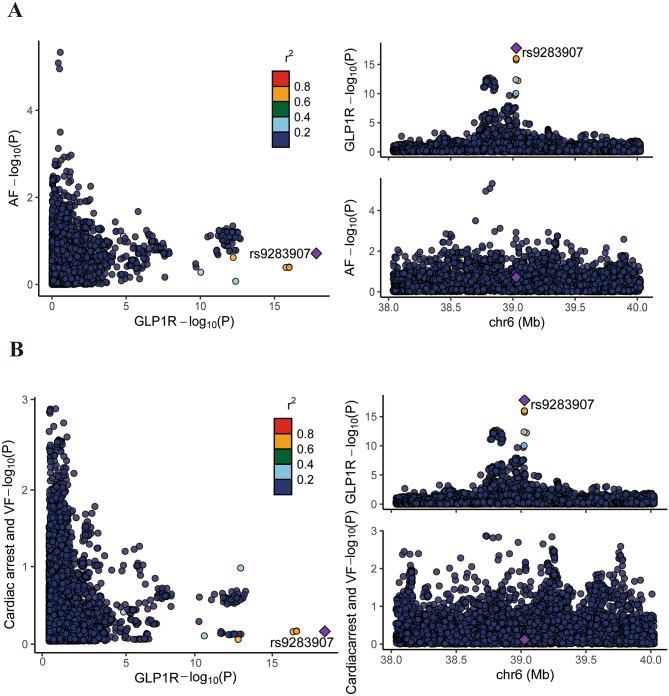
Colocalization analysis showed no shared causal variants between genetically proxied GLP-1RAs and arrhythmias, with PP.H4 values of 0.007 for AF and 0.018 for cardiac arrest and ventricular fibrillation (Fig. 2).
MVMR analysis revealed that, after adjusting for BMI and T2DM, genetically proxied GLP-1RAs did not have a significant effect on the risk of AF (OR = 1.06, 95% CI = 0.60–1.89, p = 0.848) or cardiac arrest and ventricular fibrillation (OR = 1.28, 95% CI = 0.36–4.52, p = 0.705) (Supplementary Table S4).

The colocalization of genetically proxied glucagon-like peptide-1 receptor agonists and arrhythmias. () Atrial fibrillation (AF); () Cardiac arrest and ventricular fibrillation (VF). Scatter plots (left) depict − log10(P) values for associations between genetic variants andexpression versus AF and cardiac arrest and VF, highlighting the variant rs9283907. Regional association plots (right) show the locus around rs9283907 on chromosome 6, illustrating genetic signals for bothexpression and arrhythmias A B GLP1R GLP1R
Discussion
Major findings
Our MR analysis demonstrated that genetically proxied GLP-1RAs are causally associated with a reduced risk of AF, cardiac arrest, and ventricular fibrillation. Colocalization analysis suggested that these associations are not driven by shared genetic variants. This is the first study to establish a causal relationship between genetically proxied GLP-1RAs and arrhythmias using MR analysis.
Comparison with previous studies
Previous post-hoc analyses of clinical trials and meta-analyses have investigated the effects of GLP-1RAs on AF. Several meta-analyses of RCTs have indicated that GLP-1RAs exert a neutral or potentially protective effect on AF. For example, a meta-analysis of several global multicenter clinical trials involving 12,651 patients found that semaglutide reduced AF episodes by 42% in individuals at high cardiovascular risk [28]. Another meta-analysis of 21 RCTs involving 25,957 patients with T2DM, obesity, or overweight showed that semaglutide was associated with a lower risk of AF occurrence [29]. Our findings align with these studies, reinforcing the association between GLP-1RAs and a reduced AF risk. A global retrospective cohort study utilizing data from the TriNetX global network similarly reported a significant association between GLP-1RAs treatment and a lower AF and arrhythmias risk in individuals with obesity and without T2DM [30]. However, another meta-analysis including 13 RCTs found that GLP-1RAs had a neutral effect on the occurrence of AF in populations with obesity or overweight and without diabetes [31]. Differences in study design, statistical methods, and population characteristics may explain these inconsistencies. Broader inclusion criteria in meta-analyses may dilute the observed benefits of GLP-1RAs on AF. Notably, GLP-1RAs may be more effective in patients at high risk for AF, such as those with T2DM. This hypothesis may be supported by recent findings on relationship between GLP-1RAs use and lower perioperative AF. For example, a meta-analysis demonstrated that GLP-1RAs reduced the risk of recurrent AF over a 12-month follow-up in patients undergoing AF catheter ablation, on the basis of data primarily from United States cohorts [32]. These findings suggest that the antiarrhythmic effects of GLP-1RAs may vary depending on population risk profiles. Future studies should include a broader range of high-risk populations to better define the scope of GLP-1RAs' antiarrhythmic benefits.
The evidence linking GLP-1RAs to ventricular fibrillation and cardiac arrest is limited. A meta-analysis of 5 RCTs reported no significant impact of GLP-1RAs on ventricular arrhythmias and cardiac arrest in patients with T2DM and myocardial infarction [33]. Similarly, a nested case-control study showed no association between GLP-1RAs use and a reduced risk of out-of-hospital cardiac arrest in T2DM patients. However, stratification by sex showed a significant reduction in out-of-hospital cardiac arrest risk for women which may be related to the weight loss effect of GLP-1RAs [34]. This MR analysis identified a protective effect of genetically proxied GLP-1RAs against cardiac arrest and ventricular fibrillation, providing novel insights into the antiarrhythmic potential of GLP-1RAs. Nevertheless, further research is needed to elucidate the complex relationship between GLP-1RAs and these outcomes.
Potential biological mechanisms
Although the colocalization analysis did not identify shared genetic variants between genetically proxied GLP-1RAs and arrhythmias, several factors may explain this finding. First, the power of colocalization analysis depends on the resolution of available GWAS datasets and the magnitude of genetic effects. Second, arrhythmias are complex polygenic traits, and the observed associations may reflect indirect pathways rather than a single shared causal variant. Additionally, GLP-1RAs exhibit pleiotropic effects on metabolic and cardiovascular pathways, which could influence arrhythmia risk through mechanisms such as glucose homeostasis, blood pressure regulation, and autonomic modulation. These alternative pathways highlight the need for further functional studies to delineate the exact mechanisms underlying the observed associations.
Previous studies have shown that GLP-1RAs improve cardiac metabolism and provide cardiovascular protection by mitigating atrial electrical and structural remodeling. GLP-1RAs have shown benefits in managing hypertension, diabetes, obesity, heart failure, atherosclerosis, and obstructive sleep apnea, which collectively lower AF risk [7]. Furthermore, GLP-1RAs enhance mitochondrial function in cardiomyocytes, reducing oxidative stress and cellular damage, thus alleviating the heart's metabolic burden [35]. A large nationwide study of hospitalized patients has demonstrated that AF is associated with an increased risk of ventricular arrhythmias and cardiac arrest [36]. The critical role of underlying coronary artery disease (CAD) in the pathogenesis of AF and ventricular fibrillation should not be overlooked. CAD adversely affects AF progression by promoting re-entry and increasing atrial tissue excitability due to ischemia and electrical inhomogeneity. The beneficial effects of GLP-1RAs on arrhythmias may be primarily mediated through their impact on CAD [37, 38]. These mechanisms underscore the potential antiarrhythmic properties of GLP-1RAs, warranting further investigation.
Clinical implications
Patients with T2DM and AF have higher mortality rates and cardiovascular complications than those in sinus rhythm, with thromboembolism being the most significant risk factor [2]. Therefore, the prevention of AF in diabetic patients is of clinical importance. Additionally, concerns have been raised about GLP-1RAs potentially increasing heart rate and arrhythmias [39]. Moreover, emerging evidence suggests that GLP-1RAs offer protection against AF. Our study indicates that genetically proxied GLP-1RAs have antiarrhythmic effects, which aligns with the growing body of evidence. The potential antiarrhythmic effects of GLP-1RAs provide new perspectives on the management of T2DM and its complications. The American Diabetes Association's Standards of Care in Diabetes—2025 have recommended the use of GLP-1RAs in patients with T2DM, symptomatic heart failure with preserved ejection fraction, and obesity [40]. According to the 2024 European Society of Cardiology Guidelines for the Management of AF, hypertension, heart failure, T2DM, and obesity are recognized as risk factors contributing to both the onset and progression of AF [41]. Additionally, GLP-1RAs are recommended for patients with T2DM and chronic kidney disease, and individuals with a history of cardiovascular disease or myocardial infarction may also benefit from GLP-1RAs. Therefore, clinicians may consider prioritizing GLP-1RAs for individuals at high risk of AF, particularly those with T2DM, along with concomitant hypertension, CAD, heart failure, and obesity.
Strengths and limitations
This is the first study to investigate the causal relationship between GLP-1RAs and arrhythmias using MR analysis, effectively addressing confounding factors and reverse causality. The use of large GWAS datasets from independent populations enhances the statistical power and robustness of the findings. However, several limitations exist. The analysis was restricted to individuals of European ancestry, limiting its generalizability to other populations. Future studies incorporating multi-ancestry genetic datasets are warranted to validate our findings and improve their external validity. The wide age range and lack of stratification by sex or AF subtypes further constrain detailed investigations. Additionally, the antiarrhythmic effects of GLP-1RAs may vary among different drug classes, a factor not examined in this study. Another limitation of this study is the lack of an explicit assessment of CAD as a mediator in the relationship between GLP-1RAs and arrhythmia risk. However, we mitigated the potential confounding effect of CAD through the use of MR analysis and by rigorously selecting genetic instruments that were strongly associated with GLP-1RAs, while excluding SNPs associated with CAD and other pleiotropic pathways. Additionally, colocalization analysis did not identify shared genetic variants, necessitating further research to uncover the underlying mechanisms involved.
Although MVMR was conducted to account for potential confounding by BMI and T2DM, several methodological limitations precluded its reliable interpretation. First, the number of shared instrumental variables was significantly reduced, leading to potential weak instrument bias and decreased statistical power. Second, GLP-1RAs instruments were derived from eQTLGen, which are inherently localized to a specific chromosomal region, whereas BMI and T2DM variants are genome-wide, limiting the availability of valid instruments for MVMR. Third, collinearity between BMI and T2DM may introduce instability into the model, further complicating interpretation. Therefore, we prioritized univariable MR analysis, which demonstrated a robust association between GLP-1RAs and arrhythmias.
Conclusion
In summary, this MR analysis demonstrated that genetically proxied GLP-1RAs are causally associated with a reduced risk of AF, cardiac arrest, and ventricular fibrillation. These findings provide novel insights into the potential antiarrhythmic effects of GLP-1RAs. However, further large-scale RCTs are warranted to validate these results and elucidate the underlying biological mechanisms.
Electronic supplementary material
Below is the link to the electronic supplementary material.
Supplementary Material 1