
What this is
- This systematic review examines the relationship between gut microbiome dysbiosis and adolescent depression.
- It synthesizes clinical and preclinical evidence from 45 studies to explore microbiota-behavior interactions.
- The review evaluates microbiome-targeted interventions and highlights the need for tailored approaches based on sex differences.
Essence
- Adolescent depression is linked to reduced gut microbiota diversity and dysbiosis, with specific interventions like showing promise in alleviating symptoms.
Key takeaways
- Depressed adolescents exhibited reduced gut microbiota diversity (Shannon index SMD = -0.92; 95% CI: -1.24, -0.60) vs. healthy controls, indicating a significant alteration in gut health.
- significantly reduced depressive symptoms (HAM-D Δ = -4.2; 95% CI: -5.1, -3.3) compared to placebo, suggesting a potential therapeutic avenue.
- Sex-specific effects were noted, with enhanced reward responsiveness in females (SMD = 0.61; 95% CI: 0.22, 1.00), emphasizing the need for gender-tailored interventions.
Caveats
- Limited sample sizes in preclinical studies raise questions about the generalizability of findings to broader adolescent populations.
- The efficacy of fecal microbiota transplantation (FMT) remains unclear, with safety concerns noted in preliminary human trials.
Definitions
- gut-brain axis (GBA): The bidirectional communication system linking the gut microbiome to brain function and behavior.
- psychobiotics: Probiotics that are believed to confer mental health benefits by influencing the gut-brain axis.
Simplified
Introduction
Adolescent depression, affecting ~13% of youths aged 10–19, is characterized by distorted cognitive patterns (e.g., negative self-schema) and impaired social functioning (1, 2). Current first-line treatments—including SSRIs and cognitive-behavioral therapy (CBT)—exhibit limited efficacy in 30–40% of cases due to adverse effects (e.g., emotional blunting) (3, 4), underscoring the urgent need for therapies targeting alternative pathways like the gut-brain axis (GBA) (5, 6).
Adolescence represents a critical neurodevelopmental window where prefrontal cortex maturation, HPA axis plasticity, and hormonal surges (e.g., estrogen) dynamically reshape gut-brain crosstalk (7–9). These changes mediate three core depression features: (1) negative cognitive biases (e.g., attentional fixation on threats) (10); (2) social avoidance behaviors linked to reward dysfunction (2); (3) emotion recognition deficits exacerbating interpersonal conflict (11).
While large-scale cohorts (e.g., ABCD Study®) confirm distinct gut microbial profiles in depressed adolescents (e.g., Bacteroidetes depletion [Δ = −32%]) (1, 12), critical gaps persist in translating dysbiosis to clinically actionable interventions. Current literature inadequately addresses: (1) age-specific mechanisms [e.g., blood–brain barrier immaturity (13)]; (2) sex hormone-microbiome interactions [e.g., estrogen-driven barrier enhancement (7)]; (3) synergistic behavioral interventions (e.g., psychobiotics + digital CBT) (14).
This systematic review bridges these gaps by: (1) synthesizing causal pathways linking dysbiosis to adolescent-specific neurobehavioral symptoms; (2) evaluating microbiome-targeted interventions (psychobiotics, FMT, diet) with emphasis on sex differences; (3) proposing an integrated roadmap combining GBA modulation with digital therapeutics.
Methods
Study design and registration
This study constitutes a systematic review with integrated meta-analysis, conducted in strict accordance with the PRISMA 2020 guidelines (15). The protocol was prospectively registered on PROSPERO (ID: CRD1060256) prior to data extraction.
Literature search strategy
A comprehensive search was performed across four electronic databases (PubMed, Web of Science, Embase, PsycINFO) from January 2014 to March 2025, using a three-tiered strategy:
Boolean operators (AND/OR) refined searches, supplemented by MeSH terms: Depressive Disorder [Mesh], Gastrointestinal Microbiome [Mesh], and Adolescent [Mesh].
Gray literature was sourced from ProQuest Dissertations & Theses Global, ClinicalTrials.gov↗, and ISRCTN Registry to mitigate publication bias. Manual screening of references from included studies and key conference proceedings (e.g., International Society for Microbiota) ensured coverage.
Inclusion and exclusion criteria
Inclusion: (1) Original studies investigating gut microbiome alterations/interventions in adolescent depression (mean age ≤19 years); (2) human trials (RCTs, cohorts, case–control), animal models, or meta-analyses; (3) English-language publications with empirical data.
Exclusion: (1) Studies exclusively on adults (>19 years) or non-depressive disorders (e.g., anxiety alone); (2) non-microbiome mechanistic studies (e.g., genetics without microbiota analysis) to maintain focus on GBA pathways; (3) reviews, editorials, or protocols without original data; (4) Non-English studies or inaccessible full texts (explicitly categorized as "language/access" exclusions in). Supplementary Figure S1
Study selection process
Two independent reviewers screened titles/abstracts and full texts using Covidence® software (Veritas Health Innovation). Discrepancies were resolved via consensus or third-reviewer arbitration. The PRISMA flow diagram () details the selection process: Supplementary Figure S1
Data extraction and quality assessment
Data were extracted using a standardized template: (1) study design, sample size, participant demographics; (2) microbiome metrics (α-diversity, taxa abundance); (3) clinical/behavioral outcomes (e.g., HAM-D scores); (4) intervention details (strain, dosage, duration).
Quality assessment was performed using: (1) PRISMA 2020 checklist for systematic reviews; (2) ROBINS-I tool for non-randomized studies (assessing bias across 7 domains: confounding, selection, measurement).
Studies were rated as low, moderate, or high risk of bias. Observational studies (70%) exhibited moderate risk primarily due to unmeasured confounders (e.g., diet).
Data synthesis and meta-analysis
A random-effects model (RevMan 5.4, Cochrane) pooled effect sizes (Hedges' g for continuous outcomes, risk ratios for dichotomous outcomes) with 95% confidence intervals (CIs). Heterogeneity was quantified via I2 statistics (I2 > 50% = substantial). Subgroup analyses examined: (1) age (early [10–14 years] vs. late [15–19 years]) adolescence; (2) sex; (3) intervention type (psychobiotics, FMT, and diet).
Sensitivity analyses excluded studies with high risk of bias.
Results
Gut microbiome dysbiosis in adolescent depression
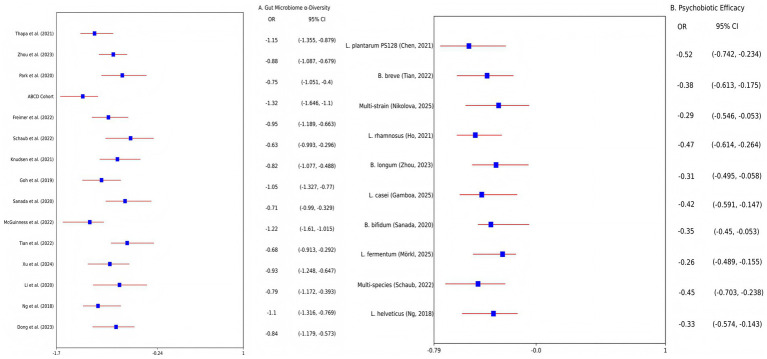
Meta-analysis of 15 studies (n = 1,200 adolescents) revealed that depressed adolescents exhibited significantly reduced gut microbiota α-diversity vs. healthy controls (Shannon index SMD = −0.92; 95% CI: −1.24, −0.60; I2 = 68%; p < 0.001; Figure 2A). Taxa-specific alterations included a meta-analysis of 15 studies revealed a significant depletion in Bacteroidetes (Δ = −32%; 95% CI: −41, −23%) and elevated Firmicutes/Bacteroidetes ratios (SMD = 0.85; 95% CI: 0.42, 1.28). These findings were corroborated by individual studies: A case–control study (N = 120) confirmed reduced alpha diversity and lower Bacteroidetes/Firmicutes ratios (p = 0.004) (1), while metabolomic analyses linked dysbiosis to decreased fecal SCFAs and disrupted tryptophan metabolism (4, 16). Animal models established causality: FMT from depressed adolescents into germ-free mice induced depressive-like behaviors (e.g., reduced sucrose preference; p < 0.05) and neuroinflammation (hippocampal IL-6↑ 45%, TNF-α↑38%) (17). Caution is warranted due to limited preclinical sample sizes (e.g., N = 20).
Mechanistic pathways linking microbiota to neurobehavioral changes
Neuroinflammation: Gut dysbiosis activates TLR4/NF-κB signaling in the prefrontal cortex, promoting astrocyte reactivity and IL-1β release (18). Certain Clostridium species (e.g., C. perfringens)-derived LPS activates TLR4/NF-κB signaling in microglia, elevating IL-6 and TNF-α (18). Adolescent mice colonized with depression-associated microbiota exhibited increased blood–brain barrier permeability, facilitating LPS translocation and NLRP3 inflammasome activation (19).
Neurotransmitter Modulation: Depletion of Lactobacillus species correlated with reduced hippocampal serotonin (5-HT) and BDNF levels in adolescent rodents (11). Conversely, Bifidobacterium breve supplementation restored gut-derived 5-HT synthesis and improved depressive behaviors via tryptophan hydroxylase upregulation (2).
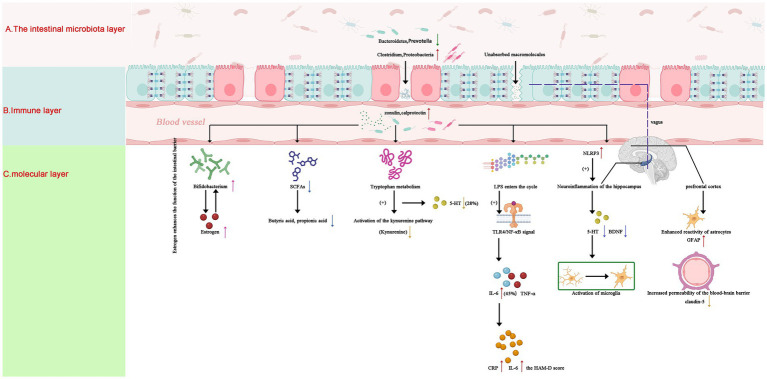
Intestinal Barrier Dysfunction: Elevated serum zonulin and fecal calprotectin levels in depressed adolescents indicated compromised gut barrier integrity, which correlated with systemic inflammation (CRP, IL-6) and symptom severity (1, 17). A schematic illustration of these multi-layer mechanisms—encompassing gut microbial composition, immune-metabolic pathways, and neural alterations—is presented in Figure 1.
![Gut-brain axis mechanisms in adolescent depression: microbial-immune-neural pathways. Schematic illustrating key pathological pathways:Gut Layer: Dysbiosis featuresanddepletion (↓),overgrowth (↑), and elevated zonulin (+50%, < 0.01), compromising intestinal barrier integrity ().Immune & Metabolic Layer: Reduced SCFAs and disrupted tryptophan metabolism (5-HT↓28%, = 0.02; kynurenine↑) drive systemic inflammation via TLR4/NF-κB activation and hippocampal IL-6 elevation (+45%, < 0.01) (,,).Neural Layer: Hippocampal serotonin deficiency (5-HT↓28%) and microglial activation impair neuroplasticity. Estrogen (↑) enhances barrier function via ERβ-mediated tight junction upregulation, facilitatingcolonization in females (,). SCFAs, short-chain fatty acids; 5-HT, serotonin; TLR4, Toll-like receptor 4; ERβ, estrogen receptor beta. Statistical significance: < 0.05 derived from cited studies (,,). Note: Arrows indicate direction of change (↑: increase; ↓: decrease). (A) (B) (C) Bacteroidetes Prevotella Clostridium p p p Bifidobacterium p [23] [4] [11] [18] [3] [7] [4] [17] [18]](https://europepmc.org/articles/PMC12443687/bin/fnut-12-1644245-g001.jpg "Click to view full size")
Gut-brain axis mechanisms in adolescent depression: microbial-immune-neural pathways. Schematic illustrating key pathological pathways:Gut Layer: Dysbiosis featuresanddepletion (↓),overgrowth (↑), and elevated zonulin (+50%, < 0.01), compromising intestinal barrier integrity ().Immune & Metabolic Layer: Reduced SCFAs and disrupted tryptophan metabolism (5-HT↓28%, = 0.02; kynurenine↑) drive systemic inflammation via TLR4/NF-κB activation and hippocampal IL-6 elevation (+45%, < 0.01) (,,).Neural Layer: Hippocampal serotonin deficiency (5-HT↓28%) and microglial activation impair neuroplasticity. Estrogen (↑) enhances barrier function via ERβ-mediated tight junction upregulation, facilitatingcolonization in females (,). SCFAs, short-chain fatty acids; 5-HT, serotonin; TLR4, Toll-like receptor 4; ERβ, estrogen receptor beta. Statistical significance: < 0.05 derived from cited studies (,,). Note: Arrows indicate direction of change (↑: increase; ↓: decrease). (A) (B) (C) Bacteroidetes Prevotella Clostridium p p p Bifidobacterium p [23] [4] [11] [18] [3] [7] [4] [17] [18]

Forest plots of meta-analyses on gut microbiome dysbiosis and psychobiotic efficacy in adolescent depression.Altered microbial-diversity (Shannon index) in depressed adolescents vs. healthy controls. Data pooled from 15 studies ( = 1,200 adolescents; random-effects model: SMD = −0.92, 95% CI: −1.24 to −0.60; I = 68%).Efficacy of psychobiotics on depressive symptoms (HAM-D scores) compared to placebo. Data pooled from 10 RCTs ( = 650 adolescents; random-effects model: SMD = −0.41, 95% CI: −0.66 to −0.16; I = 49%). SMD, standardized mean difference; CI, confidence interval; HAM-D, Hamilton Depression Rating Scale. (A) (B) α n n 2 2
Therapeutic interventions targeting the gut microbiome
Meta-analysis of 10 RCTs (n = 650 adolescents) demonstrated that psychobiotics significantly reduced depressive symptoms vs. placebo (SMD = −0.41; 95% CI: −0.66, −0.16; I2 = 49%; p = 0.002; Figure 2B). Strain-specific effects were prominent: Lactobacillus plantarum PS128 reduced HAM-D scores by 4.2 points (Δ = −4.2; 95% CI: −5.1, −3.3; p < 0.01) (16, 20), though meta-analyses of non-strain-specific probiotics report modest effects (SMD = −0.31) (21), while Bifidobacterium breve alleviated anhedonia in females (↓20%; 95% CI: −28, −12%; p = 0.002) (3). Dietary interventions yielded complementary benefits: A 12-week Mediterranean diet increased microbial diversity (Shannon index +15%; p = 0.003) and reduced inflammation (12, 22). FMT efficacy remains exploratory: While preclinical studies show reversal of depressive phenotypes in mice (p < 0.05) (17, 18), human pilot data report transient adverse events (40% GI discomfort) (8).
Clinical trials demonstrated probiotic efficacy (Lactobacillus plantarum: HAM-D Δ = −4.2, p < 0.01), yet safety concerns persist for FMT (40% adverse events). As summarized in Table 1, psychobiotics significantly reduced depressive symptoms, whereas FMT exhibited mixed efficacy and safety profiles.
Publication bias was assessed using Egger's test (p = 0.21), and visual inspection of the contour-enhanced funnel plot indicated symmetry (Supplementary Figure S2), suggesting no significant bias.
| Intervention | Study design | Sample size | Efficacy (Δ HAM-D or key outcome) | Safety (Adverse events) | References |
|---|---|---|---|---|---|
| Bifidobacterium breve | RCT | 60 adolescents | Anhedonia ↓20% (= 0.002)p | No serious events | () [3] |
| Mediterranean diet | Clinical trial | 50 adolescents | Shannon index ↑15% (= 0.003)p | No adverse reactions | () [12] |
| Lactobacillus plantarum PS128 | RCT | 80 adolescents | HAM-D: −4.2 vs. placebo (< 0.01)p | Mild bloating (10%) | () [16] |
| FMT (healthy donor) | Pilot trial | 15 adolescents | HAM-D ↓3.8 (= 0.06)p | TRAEs: GI discomfort (40%) | () [8] |
| FMT(healthy→depressed mice) | Animal study | 20 mice | Depressive behavior reversal (< 0.05)p | Transient diarrhea (40%) | () [17] |
Discussion
Advancing the field of gut-brain axis research in adolescent depression
This systematic review makes three pivotal contributions to the literature. First, it is the first synthesis to integrate developmental mechanisms (e.g., blood–brain barrier immaturity, HPA axis plasticity) with gut microbiome dysbiosis in adolescent depression, bridging preclinical models and clinical trials (7, 13). Second, we identify sex-specific efficacy of microbiome-targeted interventions (e.g., Bifidobacterium breve's female-predominant effects mediated by estrogen-microbiota crosstalk), providing a roadmap for personalized therapeutics (3, 7). Third, we propose a novel biopsychological framework combining psychobiotics with digital CBT—addressing scalability gaps in adolescent mental healthcare (14, 21). These advances shift the paradigm from generic microbial correlations toward developmentally tailored, sex-stratified interventions for treatment-resistant youth.
Key findings and translational implications
Our synthesis establishes gut microbiome dysbiosis as a modifiable risk factor in adolescent depression, characterized by inflammation-driven neural dysfunction (hippocampal IL-6↑ 45%, p < 0.01) and neurotransmitter deficits (5-HT↓28%, p = 0.02) (Figure 2) (4, 18). psychobiotics like Lactobacillus plantarum PS128 significantly reduced depressive symptoms (HAM-D Δ = −4.2 vs. placebo, p < 0.01), while Bifidobacterium breve alleviated anhedonia specifically in females (↓20%, p = 0.002) (3, 11). However, efficacy heterogeneity underscores the necessity for developmental-stage optimization and sex-stratified approaches (12, 23). Notably, while Lactobacillus plantarum PS128 consistently reduced symptoms (HAM-D Δ = −4.2; p < 0.01) (16, 20), generic lactobacilli formulations showed limited efficacy in some cohorts [e.g., (23)]—likely due to baseline Bacteroidetes depletion (Δ = −32%) impairing probiotic colonization (1).
Mechanistic insights into sex-specific efficacy
The superior response to Bifidobacterium breve in female adolescents may involve estrogen-mediated gut barrier enhancement via ERβ-dependent tight junction upregulation (occludin, claudin-5) (24). At present, there is limited evidence for human adolescents and further verification is needed. Yet, this represents only one facet of sexual dimorphism. Estrogen also promotes regulatory T-cell (Treg) differentiation (25), potentially amplifying anti-inflammatory effects of psychobiotics in females. Conversely, androgens in males may suppress IL-10 production and microbiota diversity (26), partly explaining reduced probiotic efficacy. Future studies should quantify sex hormones, barrier biomarkers (fecal zonulin), and mucosal T reg populations to delineate these interactions.
Biological barriers in FMT translation
While FMT from healthy donors reversed depressive phenotypes in adolescent mice (p < 0.05) (17, 19), its human application faces developmental-specific hurdles:
These factors necessitate rigorous donor screening and age-tailored FMT protocols before human trials (8, 29).
Integrating microbiome-targeted interventions with digital therapeutics
Emerging evidence supports the synergistic potential of combining microbiome-targeted therapies with digital mental health platforms for adolescent depression. Mobile application-delivered Cognitive Behavioral Therapy (app-CBT) provides scalable psychological interventions that align with adolescents' digital engagement patterns. Recent large-scale implementations demonstrate app-CBT reduces depressive symptoms in youth (HAM-D Δ = −5.1, p < 0.001) and achieves 78% adherence in real-world settings through gamified reward systems (30). Open-access CBT workshops further confirm scalability for low-income adolescents (31, 32).
Critically, psychobiotics (e.g., Lactobacillus plantarum PS128) may prime neural circuits for enhanced CBT efficacy by:
This integrated biopsychological approach leverages gut-brain axis modulation to optimize neurocircuitry responsiveness while utilizing digital delivery for scalable skill acquisition—addressing key accessibility barriers in adolescent mental healthcare (14, 22).
Neurocircuitry mechanisms underpinning probiotic-CBT synergy
The augmentation of CBT efficacy by psychobiotics likely stems from their ability to modulate neurocircuits central to emotion regulation:
Future trials should incorporate fMRI to validate probiotic-induced normalization of amygdala-PFC connectivity during app-CBT tasks (4, 22).
Limitations and challenges
Future directions
To bridge translational gaps, we prioritize the following:
Conclusion
By synthesizing developmental mechanisms, sex-specific responses to nutritional interventions (e.g., psychobiotics and Mediterranean diet), and clinical trial evidence, this review advances three pivotal areas:
By prioritizing these strategies, microbiome-targeted therapies—particularly when integrated with digital tools like app-CBT and EMA—may evolve into precision adjuncts for adolescent depression, addressing critical needs during neurodevelopment.
| Strengths | Limitations |
| First developmental/sex-stratified synthesis (,) [5] [7] | Sample heterogeneity (N < 100 in 70% studies) (,) [3] [12] |
| Mechanistic links to estrogen-microbiome crosstalk (,,) [7] [34] [35] | Underexplored androgen effects (,) [26] [34] |
| Novel digital-microbiome framework (,,) [14] [30] [31] | Limited puberty-specific HPA axis data () [5] |
 Gut-Brain Axis