
What this is
- This research investigates the relationship between major depressive disorder (MDD) and irritable bowel syndrome (IBS) using multi-omics approaches.
- It analyzes gut microbiota and serum metabolites in 120 MDD patients (47 with IBS, 73 without) and 70 healthy controls.
- Findings reveal that MDD patients with IBS have higher depression and anxiety scores, alongside significant alterations in gut microbiota and metabolites.
Essence
- MDD patients with IBS exhibit greater depression and anxiety symptoms compared to those without IBS, alongside distinct gut microbiota and serum metabolite profiles. This suggests a potential link between gut microbiota dysregulation and the severity of depressive symptoms in the presence of IBS.
Key takeaways
- MDD with IBS patients scored higher on depression and anxiety scales compared to MDD-only patients, indicating more severe emotional distress.
- Alterations in gut microbiota were observed, with increased alpha diversity in both MDD groups compared to healthy controls, suggesting a dysbiotic state.
- Serum metabolomics revealed specific changes in bile acids and glyceric acid levels in MDD with IBS patients, implicating metabolic disruptions linked to gut microbiota.
Caveats
- The study's observational design limits causal inferences about the relationship between gut microbiota, metabolites, and depressive symptoms.
- Sample size for each group may restrict the generalizability of findings, particularly regarding the specific microbial taxa identified.
Definitions
- gut-brain axis: The bidirectional communication network linking the gut microbiota and the brain, influencing mood and behavior.
Simplified
INTRODUCTION
Major depressive disorder (MDD), a mental illness characterized by persistent low mood, anhedonia or loss of interest, and significant fatigue or excessive tiredness, affects approximately 300 million individuals worldwide (1). It is currently ranked as the third leading cause of global disease burden according to the World Health Organization (2008), with projections suggesting it will become the primary contributor by 2030. Irritable bowel syndrome (IBS) is a chronic gastrointestinal disorder characterized by abdominal pain or discomfort along with alterations in stool frequency or consistency (2). The comorbidity rate between MDD/anxiety disorders and IBS ranges from 44% to 84% (3). Notably, patients with comorbid MDD and IBS often suffer from poorer quality of life, suboptimal treatment outcomes, and more severe symptoms (4). Moreover, individuals with IBS face an elevated risk for subsequent development of MDD, anxiety disorders, sleep disturbances, and bipolar disorder (5).
One potential explanation for the association between MDD and IBS is their shared etiology, such as psychological stress, which has been implicated in the onset and severity of both MDD (6) and IBS (7). Previous studies have primarily focused on the psychological health in the IBS population without considering psychiatric diagnoses (8, 9), thereby potentially introducing bias due to a lack of a control group of MDD alone without IBS.
Recently, there has been a growing body of research focusing on the alterations in intestinal microbiota observed in patients with MDD or IBS (10–13). For instance, studies have highlighted changes in the abundance of Actinobacteria and Bacteroidota among individuals with MDD (14, 15), as well as variations in the levels of Firmicutes and Bacteroidota among those with IBS (11, 16). Notably, one study discovered similarities between the fecal microbiota composition of MDD and IBS patients (11). However, limited research has been conducted to investigate the gut microbiota in patients with comorbid MDD and IBS using metagenomic sequencing and associated function. Given that intestinal microorganisms play crucial roles in vital physiological processes such as nutrient absorption, substance metabolism, and immune defense mechanisms, they are closely linked to various disease occurrences (17–19). One contributing factor is their impact on metabolites that enter systemic circulation. The interactions between gut microbiota and their hosts encompass a diverse array of crucial metabolites, including microbial metabolites generated through bacterial fermentation of dietary substances, host molecules modified by bacteria, or products directly synthesized by bacteria (20). For instance, altering the composition of the microbial community may influence the occurrence of diseases by regulating the composition of bile acids (BAs) (21). Short-chain fatty acids (SCFAs) (such as acetic acid, propionic acid, and butyric acid) are formed through the bacterial fermentation of dietary fibers, and different bacteria (such as Lactobacilli and Bacteroides) produce specific SCFAs to regulate energy metabolism and intestinal barrier function (22). Moreover, carnitine has multiple microbial metabolic pathways, while indole derived from tryptophan mediates communication between the intestine and the brain (23). In summary, these metabolites emphasize the importance of the gut-microbiota-brain axis. Hence, an increasing number of studies have now focused on alterations in the gut microbiota composition among patients with MDD, leading to changes in the microbial metabolomes that contribute to the pathogenesis of MDD (24–26).
Therefore, to elucidate how IBS comorbidity influences MDD progression through microbial and metabolic pathways, we conducted a comprehensive multi-omics analysis. We integrated psychological assessments, metagenomic sequencing of gut microbiota, and serum metabolomic profiling in rigorously diagnosed MDD patients with and without IBS. We aim to (i) identify comorbid-specific microbial and metabolic signatures, (ii) uncover functional links between gut microbiota dysbiosis and host metabolite dysregulation, and (iii) provide mechanistic insights for developing gut-targeted therapies to alleviate both gastrointestinal and psychiatric symptoms.
MATERIALS AND METHODS
Subjects
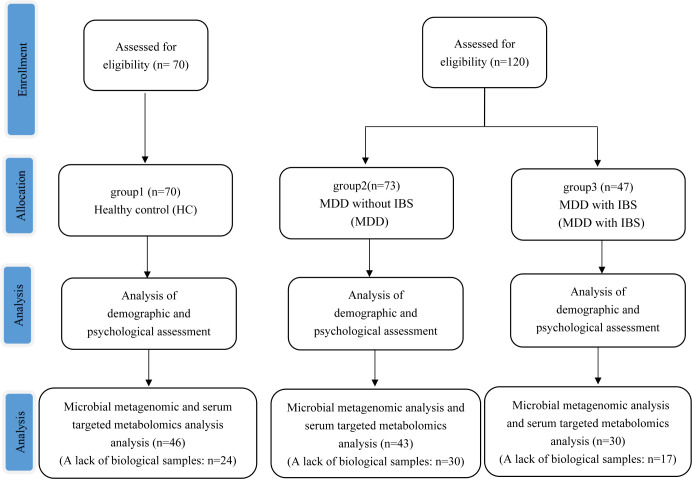
From October 2021 to August 2023 at the Mental Health Center of West China Hospital, Sichuan University, we enrolled 120 patients diagnosed with MDD using the Mini International Neuropsychiatric Interview (27), assessed by senior psychiatrists. In addition, we recruited 70 healthy subjects without MDD and IBS as the control group (healthy control [HC]). To be eligible for participation in this study, participants had to meet the following criteria: (i) age between 18 and 65 years (inclusive), (ii) education level of primary school or higher with a sufficient understanding of the study content, (iii) voluntary consent to participate in the study after being informed about its purpose and procedures, and finally, (iv) no medication use for more than 2 weeks or intermittent medication use for less than 3 days within a 2-week period. However, individuals were excluded if they presented with severe physical illness, organic brain disease, neurological disorder, or cognitive impairment. Moreover, individuals with comorbid mental illnesses such as schizophrenia and bipolar disorder were also excluded. Furthermore, individuals who consumed probiotics daily prior to their arrival at our center were also excluded from participating in this study (Fig. 1).

Flow chart diagram of subject enrollment and analysis.
Assessment and biological sample collection
After arrival at our center, all subjects completed the following battery of tests: IBS Severity Scoring System (IBS-SSS) (28), Hamilton Depression Scale (HAMD-17) (29), Hamilton Anxiety Scale (HAMA-14) (30), Screening Depression Questionnaire (PHQ-9) (31), and Generalized Anxiety Disorder Scale (GAD-7) (32). The four scales used in this study (HAMA-14, GAD-7, PHQ-9, and HAMD-17) collectively constituted the participants' emotional state.
The IBS-SSS employs a questionnaire to assess the severity of abdominal pain, frequency of abdominal pain, degree of abdominal distension, defecation patterns, and impact on patients' quality of life. Scores are assigned using a visual scoring method ranging from 0 to 500, with higher scores indicating more severe symptoms. Based on test scores, participants were categorized into three levels: mild (75–175 points), moderate (176–300 points), and severe (301–500 points). MDD patients with an IBS-SSS score <75 were classified as the MDD without IBS group (MDD); conversely, those with an IBS score ≥75 were classified as the MDD with IBS group (MDD with IBS).
Demographic data were also collected for all subjects, including age, sex, smoking, drinking, body mass index (BMI), religion, civil status, employment status, and monthly household income. Meanwhile, stool and serum samples were also collected on the day of subject enrollment. Among them, 71 participants lacked a biological sample (Fig. 1).
Metagenomic sequencing and data processing
DNA was extracted from fecal samples, and the purity and integrity of the extracted DNA were assessed by agarose gel electrophoresis. DNA concentration was accurately quantified using a Qubit fluorometer (Thermo Fisher Scientific). Subsequently, library preparation was performed, which included DNA fragmentation, end repair, A-tailing, adapter ligation, purification, and PCR amplification. After library construction, library quality and fragment size distribution were evaluated using an Agilent 2100 Bioanalyzer and quantitative PCR (qPCR). High-throughput sequencing was conducted on the Illumina NovaSeq 6000 platform using a paired-end 150 bp (PE150) mode.
Raw sequencing data underwent quality control with fastp (v0.19.3), including removal of adapter contamination, low-quality reads, and reads shorter than the threshold, resulting in high-quality clean reads. Clean reads were then aligned to the human reference genome GRCh38 (RefSeq: GCF_000001405.40↗) using Bowtie2 (v2.3.4) to filter out host-derived contamination. The remaining non-host reads were assembled both individually and in a combined manner using MEGAHIT (v1.2.9). Assembly quality was assessed with QUAST, considering metrics such as N50, total number of contigs, and total assembly length. Contigs of length ≥ 500 bp were subjected to open reading frame prediction using MetaGeneMark (v3.38). Predicted genes were filtered, standardized in naming, and clustered at 95% sequence similarity using CD-HIT (v4.8.1) to generate a non-redundant gene catalog (Unigenes). Clean reads from each sample were mapped back to the Unigene sequences using Bowtie2 to obtain read counts per gene. Unigenes with mapped reads ≤2 across all samples were removed to produce a high-quality gene set for downstream analysis. For taxonomic annotation, the protein sequences corresponding to Unigenes were aligned against bacterial, fungal, archaeal, and viral protein sequences extracted from the NCBI NR database (version 2022.05) using DIAMOND (v6.24.20). Taxonomic classification was performed based on the lowest common ancestor algorithm implemented in MEGAN (v0.9.24), generating species abundance profiles from kingdom to species levels. For functional annotation, DIAMOND was used to align Unigene protein sequences against the Kyoto Encyclopedia of Genes and Genomes (KEGG) database (version 2022.05). For each sequence, the annotation with the highest bit score >60 was retained for subsequent KEGG pathway annotation and functional analyses.
Targeted metabolomics analysis and data processing
All of the standards of targeted metabolites were obtained from Sigma-Aldrich (St. Louis, MO, USA), Steraloids Inc. (Newport, RI, USA), and TRC Chemicals (Toronto, ON, Canada). All the standards were accurately weighed and prepared in water, methanol, sodium hydroxide solution, or hydrochloric acid solution to obtain individual stock solution at a concentration of 5.0 mg/mL. An appropriate amount of each stock solution was mixed to create stock calibration solutions. Formic acid was of Optima grade and obtained from Sigma-Aldrich (St. Louis, MO, USA). Methanol (Optima LC-MS), acetonitrile (Optima LC-MS), and isopropanol (Optima LC-MS) were purchased from Thermo-Fisher Scientific (Fair Lawn, NJ, USA). Ultrapure water was produced by a Mill-Q Reference system equipped with an LC-MS Pak filter (Millipore, Billerica, MA, USA).
Serum samples were thawed in an ice bath to minimize degradation. A 20 µL aliquot of plasma was transferred into a 96-well plate, followed by the addition of 120 µL of ice-cold methanol solution containing partial internal standards. After vigorous vortexing for 5 min, the mixture was centrifuged at 4,000 × g for 30 min. The plate was then transferred to an Eppendorf epMotion Workstation (Eppendorf Inc., Hamburg, Germany). Subsequently, 30 µL of the supernatant was transferred to a new 96-well plate, and 20 µL of freshly prepared derivatization reagent (200 mM 3-NPH in 75% aqueous methanol and 96 mM EDC-6% pyridine solution in methanol) was added to each well. The plate was sealed and incubated at 30°C for 60 min to allow derivatization. After the reaction, 330 µL of ice-cold 50% methanol solution was added to each well for dilution. The plate was then placed at −20°C for 20 min, followed by centrifugation at 4,000 × g for 30 min at 4°C. Subsequently, 135 µL of the supernatant was transferred to a new 96-well plate preloaded with 10 µL of internal standard solution. Calibration was performed using derivatized standard mixtures of varying concentrations added to the wells on the left side of the plate. Quality control samples were prepared by pooling equal volumes from each individual sample. All samples were stored at −80°C until analysis. Quantitative analysis of all target metabolites was conducted using an ultra-performance liquid chromatography–tandem mass spectrometry (UPLC-MS/MS) system (Acquity UPLC-Xevo TQ-S, Waters Corp., Milford, MA, USA). Raw data generated from the UPLC-MS/MS were processed using TMBQ software (v1.0, Metabo-Profile, Shanghai, China) for peak integration, calibration, and quantification of each metabolite. Metabolite concentrations in unknown samples were determined by comparison with a series of standards of known concentrations via calibration curves. These calibration curves characterize the relationship between the analytical signal and analyte concentration. For most metabolites, the instrument response (e.g., peak height or peak area) exhibits a linear relationship with concentration, which can be described by the equation y = ax + b, where y represents the instrument response, a is the slope reflecting the method's sensitivity, b accounts for the background signal, and x denotes the analyte concentration in the unknown sample. Using this model, metabolite concentrations in unknown samples were calculated from the measured instrument responses, enabling accurate and reproducible quantification.
In this study, we employed the Q300 kit (Metabo-Profile, Shanghai, China), an automated high-throughput metabolite array technology that enables quantitative detection of multiple metabolites across different concentration ranges within a single microtiter plate. This platform allows for absolute quantification as well as differential screening of diverse classes of metabolites, including amino acids, phenols, phenyl-derivatives or benzyl-derivatives, indoles, organic acids, fatty acids, carbohydrates, and bile acids. The kit incorporates isotope-labeled internal standards (e.g., L-arginine-15N2, hippuric acid-D5, TCDCA-D9, D-glucose-D7, carnitine-D3, C5:0-D9, and citric acid-D4), together with matched external standards, to ensure accurate qualitative and quantitative analyses (33). Of the more than 300 targeted metabolites, a total of 201 were successfully detected in our samples. The Q300 method provides broad coverage of disease-relevant metabolites, including those implicated in MDD and IBS, while offering high analytical accuracy, stability, and reproducibility.
Statistical analysis
All analyses in this study were performed within the R software environment. Clinical data were statistically analyzed using the R package tableone (v0.13.2) (34) . Categorical variables were analyzed using the chi-square test, and continuous variables were compared between the two groups using the t-test. Multiple hypothesis testing was adjusted using the Benjamini–Hochberg (BH) method to control the false discovery rate. Microbial community composition analysis was conducted using the R package vegan (v2.6-10) (35). Community structure differences were assessed by calculating Bray–Curtis distance matrices, and significance testing was performed via permutation-based multivariate analysis of variance (PERMANOVA) implemented by the adonis2 function. Alpha diversity indices were also calculated using the same package. Differential species analysis was conducted with the R package microeco (v1.9.1) in conjunction with the linear discriminant analysis effect size (LEfSe) method to identify characteristic taxa, with selection criteria of linear discriminant analysis (LDA) score >2 and P value <0.05 (36). Pathway enrichment analysis based on KEGG Orthology (KO) relative abundances was performed using the R package ReporterScore (v0.1.9), combining Wilcoxon and Kruskal–Wallis tests with 999 permutations. Significantly enriched pathways were selected based on absolute Reporter scores >1.96 and visualized accordingly (37). Correlations between variables were assessed using Spearman's rank correlation coefficients, with significance determined by corresponding P values.
To explore the co-variation among microbiome, serum metabolome, and psychological phenotypes, pairwise data sets were subjected to co-inertia analysis (CIA) using the R package made4 (v1.76.0) (38). After dimensionality reduction by principal component analysis (PCA), co-inertia structures were computed, and their significance was evaluated by permutation testing of the RV coefficient with 999 permutations. The results were visualized as arrow plots, illustrating sample trajectories across the two omics projection spaces, indicating synergistic variation. In the metabolomics analysis, the Wilcoxon rank-sum test was used to assess the significance between the two groups. PCA and orthogonal partial least squares discriminant analysis (OPLS-DA) were conducted for sample classification and modeling. Variable importance in projection (VIP) scores were subsequently calculated to evaluate the contribution of each metabolite to the model classification. Differential metabolites were identified based on the criteria of P value <0.05 and VIP > 1.
RESULTS
A total of 190 participants were included for scale assessment and demographic analysis after screening. Among them, 70 patients belonged to the HC group, 73 patients belonged to the MDD group, and 47 patients belonged to the MDD with IBS group. Subsequently, due to insufficient biological samples from 71 patients, a total of 119 patients were finally included for further gut metagenomic analysis and serum targeted metabolomics analysis (HC: 46 participants; MDD: 43 patients; and MDD with IBS: 30 patients) (Fig. 1).
Comorbid IBS aggravates anxiety and depression in patients with MDD
Among the 190 subjects, there were no statistically significant differences in age, sex, smoking status, alcohol consumption, BMI, religious affiliation, marital status, employment status, and monthly household income among the three groups (Table 1). The MDD group exhibited significantly higher scores on the IBS-SSS compared to the HC group. Furthermore, the MDD with IBS group demonstrated significantly elevated scores on the IBS-SSS as well as HAMD-17 and HAMA-14 scales when compared to the MDD group (Table 1). These findings suggest that our sampled MDD patients, those with comorbid IBS, had more pronounced levels of anxiety and depression.
| Characteristic | HC (= 70)n | MDD (= 73)n | MDD with IBS (= 47)n | P | AdjustPA-B | AdjustPA-C | AdjustPB-C |
|---|---|---|---|---|---|---|---|
| Men | 40 (57.14) | 27 (36.99) | 10 (21.28) | 0.0526 | |||
| Age, yr | 32.93 ± 10.36 | 35.30 ± 12.16 | 37.62 ± 14.70 | 0.1253 | |||
| Body mass index, kg/m2 | 22.87 ± 4.63 | 22.01 ± 4.05 | 21.75 ± 3.81 | 0.3029 | |||
| Self-reported religious beliefs | 1 (1.43) | 6 (8.22) | 4 (8.51) | 0.1445 | |||
| Civil status | 0.142 | ||||||
| Unmarried | 42 (60.00) | 32 (43.84) | 20 (42.55) | ||||
| Married | 27 (38.57) | 37 (50.68) | 23 (48.94) | ||||
| Divorced/widowed | 1 (1.43) | 4 (5.48) | 4 (8.51) | ||||
| Employment | 0.1093 | ||||||
| Unemployed | 1 (1.43) | 12 (16.44) | 5 (10.64) | ||||
| Working full-time | 41 (58.57) | 33 (45.20) | 22 (46.81) | ||||
| Working part-time | 21 (30.00) | 17 (23.29) | 10 (21.28) | ||||
| Student | 3 (4.29) | 6 (8.22) | 5 (10.64) | ||||
| Retired | 4 (5.71) | 3 (4.11) | 3 (6.38) | ||||
| Housewife | 0 (0.00) | 2 (2.74) | 2 (4.25) | ||||
| Monthly household income, USD 1 | 0.4729 | ||||||
| <419.58 | 8 (11.43) | 8 (10.96) | 5 (10.64) | ||||
| 419.58–839.16 | 18 (25.71) | 13 (17.81) | 6 (12.77) | ||||
| 839.16–1,258.74 | 16 (22.86) | 19 (26.03) | 11 (23.40) | ||||
| 1,258.74–1,678.32 | 8 (11.43) | 11 (15.07) | 13 (27.66) | ||||
| >1,678.32 | 20 (28.57) | 22 (30.14) | 12 (25.53) | ||||
| Current smoking | 0.3314 | ||||||
| No | 52 (74.28) | 55 (75.34) | 38 (80.85) | ||||
| Yes | 17 (24.29) | 14 (19.18) | 9 (19.15) | ||||
| Previous smoking | 1 (1.43) | 4 (5.48) | 0 (0.00) | ||||
| Current drinking | 0.3035 | ||||||
| No | 31 (44.28) | 41 (56.16) | 30 (63.83) | ||||
| Yes | 37 (52.86) | 31 (42.47) | 16 (34.04) | ||||
| Previous drinking | 2 (2.86) | 1 (1.37) | 1 (2.13) | ||||
| Psychological assessments | |||||||
| IBS-SSS | 18.04 ± 19.83 | 28.68 ± 20.48 | 145.4 ± 79.31 | <0.0001 | 0.0095 | <0.0001 | <0.0001 |
| HAMD-17 | 2.49 ± 2.13 | 17.67 ± 4.48 | 19.47 ± 4.60 | <0.0001 | <0.0001 | <0.0001 | 0.0127 |
| HAMA-14 | 1.80 ± 3.11 | 20.39 ± 6.69 | 23.64 ± 8.07 | <0.0001 | <0.0001 | <0.0001 | 0.0048 |
| PHQ-9 | 2.29 ± 3.17 | 17.28 ± 5.82 | 17.98 ± 4.88 | <0.0001 | <0.0001 | <0.0001 | 0.718 |
| GAD-7 | 2.16 ± 3.28 | 12.47 ± 5.22 | 13.37 ± 5.00 | <0.0001 | <0.0001 | <0.0001 | 0.5412 |
Metagenomic analysis reveals alterations in gut microbiota in patients with MDD comorbid with IBS
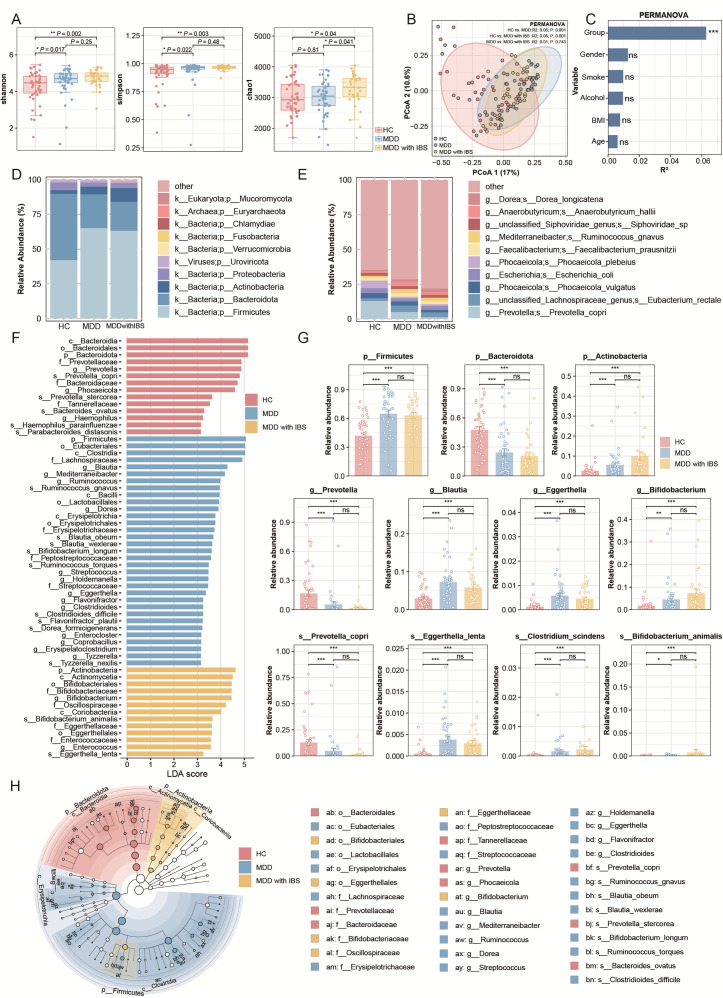
One-hundred nineteen subjects were included for gut metagenomic sequencing and analysis, including 46 HC, 43 MDD, and 30 MDD with IBS. The total sequencing data for each sample and the proportion of reads classified as microbial are summarized in Table S1. Alpha diversity, assessed by Shannon and Simpson indices, was significantly higher in both MDD and MDD with IBS groups compared to HC. The Chao1 index was further elevated in the MDD with IBS group, indicating increased microbial richness under comorbid conditions (P < 0.05) (Fig. 2A). Principal coordinates analysis and PERMANOVA showed significant differences in microbial community structure between the disease groups and the HC group (P < 0.05), while no significant differences were observed between the MDD and MDD with IBS groups (Fig. 2B). Further PERMANOVA at the species level showed that group status significantly affected gut microbial beta diversity (R² = 0.0627, P < 0.001) while sex, age, BMI, smoking, and alcohol consumption showed no significant effects (P > 0.05) (Fig. 2C). At the phylum level, Firmicutes, Bacteroidota, and Actinobacteria were dominant across all samples, with Firmicutes most enriched in the disease groups (Fig. 2D). At the species level, the top 10 dominant species included Prevotella copri, Eubacterium rectale, and Phocaeicola vulgatus, with the HC group showing the highest total relative abundance of these species (Fig. 2E). LEfSe analysis identified numerous significantly different microbial taxa across taxonomic levels (from phylum to species) between groups (Fig. 2F). At the phylum level, Firmicutes were enriched in the MDD group, Bacteroidota in HC, and Actinobacteriota in the MDD with IBS group. At another level, several signature microbes were differentially enriched in each group. For instance, Prevotella copri was enriched in HC, while Clostridium scindens and Bifidobacterium animalis were enriched in the MDD with IBS group (Fig. 2G). Figure 2H illustrates the phylogenetic relationships of significantly enriched taxa with relatively high abundance across groups. Pairwise LEfSe analyses revealed significant microbial differences between disease groups and HC, but not between MDD and MDD with IBS (Table S2).

Metagenomic taxonomic profiling and microbial community differences among HC, MDD, and MDD with IBS groups. () Box plots of alpha diversity indices (Shannon, Simpson, and Chao1) at the species level, comparing microbial richness and evenness among groups. () Principal coordinates analysis (PCoA) based on Bray–Curtis distances of species-level microbial composition. Group differences were evaluated using PERMANOVA (adonis), with² andvalues shown for pairwise comparisons: HC vs MDD, HC vs MDD with IBS, and MDD vs MDD with IBS. () PERMANOVA of potential confounding factors. The-axis represents the proportion of variance explained (²), and the-axis lists different confounders. Statistical significance:> 0.05 (ns); *,< 0.05; **,< 0.01; ***,< 0.001. () Stacked bar chart showing the average relative abundance of the top 10 bacterial phyla in each group, illustrating phylum-level microbial composition across HC, MDD, and MDD with IBS. () Stacked bar chart showing the average relative abundance of the top 10 bacterial species in each group, reflecting species-level differences in microbiota composition. () LEfSe analysis showing the top 60 discriminative taxa ranked by LDA score (LDA score > 2,< 0.05). () LEfSe results highlighting representative phyla, genera, and species enriched in different groups, presented as bar plots with overlaid dots. Statistical significance:> 0.05 (ns); *,< 0.05; **,< 0.01; ***,< 0.001. () Radial cladogram illustrating the phylogenetic distribution of significantly enriched taxa identified by LEfSe, from phylum to species. Colors indicate the groups in which taxa are enriched (HC, MDD, or MDD with IBS), and concentric rings represent successive taxonomic ranks from phylum (innermost) to species (outermost). The letter labels correspond to the names shown within the concentric rings. A B C D E F G H R P x R y P P P P P P P P P
Functional gene and KEGG pathway analysis of fecal metagenomes reveals distinct differences between MDD and MDD with IBS groups
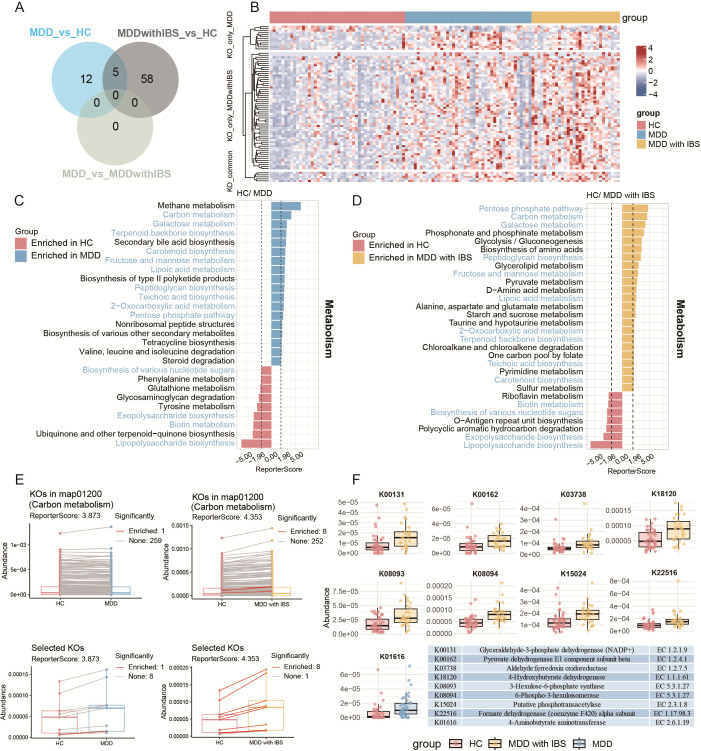
At the KO level, more differential KOs were identified between the MDD with IBS and HC groups (n = 63) than between the MDD and HC groups (n = 17). There were five shared upregulated KOs in both disease groups compared to HC (Fig. 3A). Most KOs uniquely altered in the MDD with IBS group also showed an upward trend in MDD, though to a lesser extent (Fig. 3B). KEGG pathway enrichment analysis revealed significant enrichment in multiple pathways in both MDD and MDD with IBS groups (|ReporterScore| > 1.96). Specifically, 47 pathways were enriched in MDD vs HC and 83 pathways in MDD with IBS vs HC (Fig. S1). In metabolism pathways, shared pathways primarily included those involved in carbon metabolism (map01200), pentose phosphate pathway (map00030), and 2-oxocarboxylic acid metabolism (map01210), among others. The MDD with IBS group uniquely enriched pathways, including D-amino acid metabolism (map00470), glycerolipid metabolism (map00561), and others (Fig. 3C and D). Further analysis showed stronger upregulation of functional genes in shared pathways in the MDD with IBS group. For example, only the multifunctional 2-oxoglutarate metabolism enzyme (K01616) was significantly upregulated in MDD, while eight KOs were upregulated in MDD with IBS (Fig. 3E and F). Notably, most enriched pathways were significantly correlated with emotional state and IBS-SSS score (Fig. S2). Although pathway enrichment analysis showed significant results between the two disease groups, no significant KO-level differences were observed, and no further pathway analysis was performed. These results suggest the necessity of integrating metabolomics to better understand the impact of gut microbiota on metabolic processes.

Functional differences in the gut microbiome between MDD and MDD with IBS at the KO and pathway levels. () Venn diagram showing the number of significantly different KOs among comparison groups. KO abundance was analyzed using the Wilcoxon rank-sum test with 999 permutations, andvalues were adjusted by the BH method (< 0.05). () Heatmap of significantly altered KOs across individual samples. () KEGG pathway enrichment analysis between HC and MDD groups based on reporter score (|ReporterScore| > 1.96). Shared pathways in panels C and D are highlighted in blue. () KEGG pathway enrichment analysis between HC and MDD with IBS groups based on reporter score (|ReporterScore| > 1.96). Pathway enrichment was conducted using the Generalized Reporter Score Analysis method. Only metabolic pathway enrichment results are shown here, while comprehensive enrichment results including other pathways are provided in the. () Summary abundance box plots of all significantly enriched KOs involved in the carbon metabolism pathway (map01200) in HC vs MDD (left) and HC vs MDD with IBS (right). The lower panels show the abundance of nine differential KOs (one in HC vs MDD; eight in HC vs MDD with IBS) involved in the carbon metabolism pathway (map01200) in HC vs MDD (left) and HC vs MDD with IBS (right). () Box plots with overlaid dot plots displaying the distribution of the nine differential KOs among HC vs MDD and HC vs MDD with IBS groups. A table in the figure lists the enzyme names and EC numbers for each KO. A B C D E F P P supplemental figures
Serum targeted metabolomics has revealed the metabolic characteristics of the MDD with IBS group
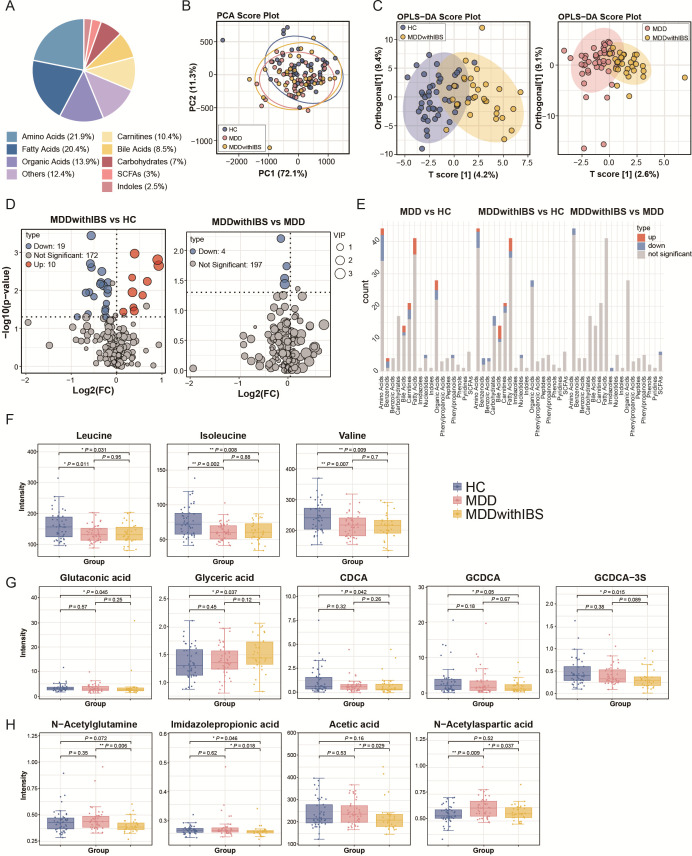
A total of 201 metabolites were detected across 119 serum samples (Table S3), and their classification is presented in Fig. 4A. PCA showed a significant difference between the MDD and HC groups (P = 0.044), whereas no significant differences were observed between the MDD with IBS and HC groups (P = 0.193) or between the MDD with IBS and MDD groups (P = 0.804) (Fig. 4B). Further analysis using an OPLS-DA model showed distinct clustering patterns among the groups (MDD with IBS vs HC: R²X = 0.136, R²Y = 0.62, Q² = 0.109; MDD with IBS vs MDD: R²X = 0.116, R²Y = 0.594, Q² = −0.647) (Fig. 4C). Based on the differential screening criteria (P < 0.05 and VIP > 1), multiple differential metabolites were identified. In the MDD with IBS group compared to the HC group, 10 metabolites were significantly upregulated and 19 were downregulated. Compared to the MDD group, only four metabolites were significantly downregulated in the MDD with IBS group (Fig. 4D). In addition, a total of nine metabolites showed significant differences exclusively in the MDD with IBS group.
We classified and analyzed the differential metabolites. The metabolite classification bar plot showed that most differential metabolites in the MDD with IBS group were derived from amino acids, fatty acids, carbohydrates, and bile acids (Fig. 4E). Analysis of the differential metabolites revealed that leucine, isoleucine, and valine were significantly downregulated in both the MDD vs HC and MDD with IBS vs HC comparisons. Meanwhile, glutaconic acid, glyceric acid, CDCA, GCDCA, and GCDCA-3S showed significant alterations only in the MDD with IBS vs HC comparison. Furthermore, four metabolites—N-acetylglutamine (NAG), imidazolepropionic acid, acetic acid, and N-acetylaspartic acid (NAA)—were significantly downregulated in the MDD with IBS vs MDD comparison. The box plots illustrate the relative abundance changes of these metabolites across the different groups (Fig. 4F through H).

Multivariate statistical analysis and identification of differential metabolites across HC, MDD, and MDD with IBS groups. () Pie chart of detected metabolites by class. () PCA score plot of HC, MDD, and MDD with IBS groups. () OPLS-DA score plots: MDD with IBS vs HC (= 0.136,= 0.62,= 0.109) and MDD with IBS vs MDD (= 0.116,= 0.594,= −0.647). () Volcano plots of differential metabolites between MDD with IBS vs HC and MDD with IBS vs MDD. Metabolites with< 0.05 and VIP > 1.0 are highlighted. Blue dots indicate downregulated metabolites, and red dots indicate upregulated metabolites. () Bar plot of metabolite classification. Blue bars represent downregulated metabolites, and red bars represent upregulated metabolites. () Box plots of metabolites significantly downregulated in both the MDD vs HC and MDD with IBS vs HC comparisons (leucine, isoleucine, and valine). Statistical significance: *,< 0.05; **,< 0.01; ***,< 0.001. () Box plots of metabolites showing significant differences only in the MDD with IBS vs HC comparison (glutaconic acid, glyceric acid, CDCA, GCDCA, and GCDCA-3S). Statistical significance: *,< 0.05; **,< 0.01; ***,< 0.001. () Box plots of metabolites significantly altered between the MDD with IBS and MDD groups (N-acetylglutamine, imidazolepropionic acid, acetic acid, and N-acetylaspartic acid). Statistical significance: *,< 0.05; **,< 0.01; ***,< 0.001. A B C D E F G H R X R Y Q R X R Y Q P P P P P P P P P P 2 2 2 2 2 2
Correlation between gut microbiota and metabolites in the MDD with IBS group
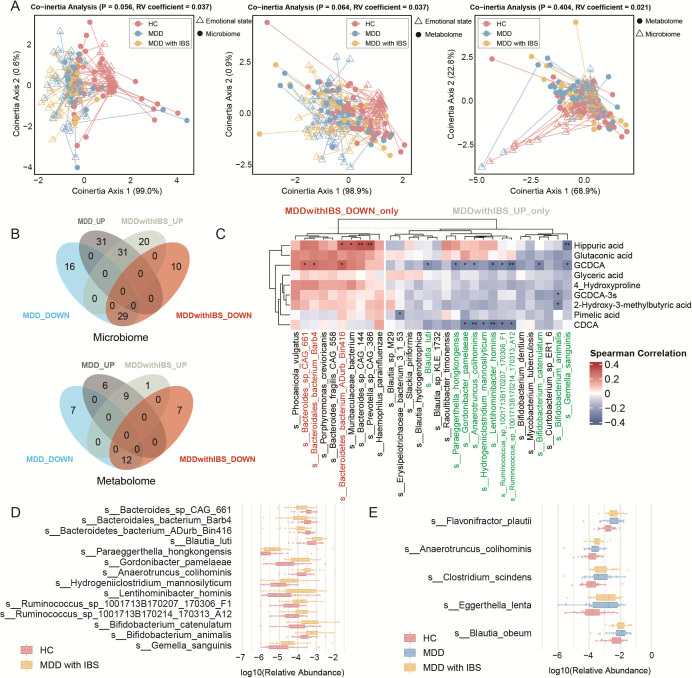
Using CIA across all samples, we examined the influence of emotional state on gut microbiota composition and serum metabolite levels, as well as their interaction. Emotional state showed a marginal effect on both data sets, but the overall covariation between microbiota and metabolites was not statistically significant (Fig. 5A). MDD with IBS-specific differential microbes was identified, including 20 enriched and 10 depleted taxa, while the specific differential metabolites included only one enriched metabolite (glyceric acid) and seven depleted metabolites (Fig. 5B; Tables S2 and S4). Spearman correlation analysis revealed significant associations between several altered species and bile acid levels. Upregulated taxa such as Anaerotruncus colihominis, Lentihominibacter hominis, and Gordonibacter pamelaeae were positively correlated with CDCA and GCDCA levels. Additionally, Paraeggerthella hongkongensis and Blautia luti were negatively correlated with GCDCA. Conversely, downregulated species like Bacteroidetes bacterium ADurb Bin416 and Bacteroidales bacterium Barb4 showed positive correlations with GCDCA. No significant correlations were observed between glyceric acid and the altered microbiota (Fig. 5C). The abundances of bile acid–associated taxa are shown in Fig. 5D. Notably, shared differentially abundant taxa in both the MDD and MDD with IBS groups, such as Blautia obeum, Eggerthella lenta, and Clostridium scindens, are known to be involved in bile acid metabolism (Fig. 5E).

Correlation analysis between gut microbiota and serum metabolites in the MDD with IBS group. () CIA of pairwise relationships among cognitive status, gut microbiota composition, and serum metabolite profiles. Lines connect the two datasets from the same individual. () Venn diagrams showing differentially abundant features among groups. The top panel depicts microbial species identified by LEfSe analysis comparing HC vs MDD and HC vs MDD with IBS groups, with 20 enriched and 10 depleted taxa specific to the MDD with IBS group. The bottom panel shows differentially abundant metabolites in the same comparisons, with one enriched and seven depleted metabolites specific to the MDD with IBS group, highlighting features uniquely associated with comorbid IBS in MDD patients. () Spearman correlation heatmap between MDD with IBS-specific microbial species and differential metabolites. Statistical significance: *,< 0.05; **,< 0.01; ***,< 0.001. Microbial species significantly associated with bile acid levels are highlighted in red and green. Red indicates species specifically downregulated in MDD with IBS, while green indicates species specifically upregulated in MDD with IBS. () Box plots with overlaid dot plots showing the logrelative abundance of microbial species significantly associated with bile acid levels in the HC and MDD with IBS groups. () Box plots with overlaid dot plots showing the logrelative abundance of representative bile acid–associated taxa that were differentially abundant in both HC vs MDD and HC vs MDD with IBS comparisons, and that have been previously reported to be involved in bile acid metabolism. A B C D E P P P 10 10
Functional annotation and differential metabolite analysis in the MDD with IBS group
To further investigate the potential impact of microbial functional alterations on host metabolism, we performed integrative functional annotation and metabolite analysis in the MDD with IBS group. The differential metabolite glyceric acid was found to be involved in several key KO-enriched pathways, including the pentose phosphate pathway (map00030), glycerolipid metabolism (map00561), and carbon metabolism (map01200). The pentose phosphate pathway is a part of carbon metabolism, and glyceric acid is regulated by several enzymes, such as EC1.2.1.98, EC1.2.99.8, and EC1.2.7.5. The KO gene K03738, which encodes aldehyde ferredoxin oxidoreductase that catalyzes the EC1.2.7.5 reaction, was significantly upregulated in the MDD with IBS group (Fig. 6A). Taxonomic AOR (K03738) revealed that its primary microbial sources were the phyla Firmicutes and Actinobacteria, with some sequences only annotated at the other level, including Eggerthella and Oscillospiraceae. These taxa exhibited significant differential abundance in the MDD with IBS group (Fig. 6B). Further analysis of other key differentially expressed KO genes within this pathway (K08093 and K08094) indicated that they were predominantly derived from Firmicutes (Fig. 6C), notably from the families Eggerthellaceae, Enterococcaceae, and Lachnospiraceae, which also showed significant shifts in abundance (Fig. 6D). Collectively, these findings suggest that multiple functionally relevant genes implicated in glyceric acid-associated metabolic pathways originate from gut microbial taxa that differ significantly in abundance in MDD with IBS.
Lastly, an integrated network was constructed to explore the correlations among the top 20 significantly altered microbes, clinical indicators (emotional state and IBS-SSS scores), and key metabolites (including four bile acids and glyceric acid) in the MDD with IBS group. Several differential microbes showed significant correlations with bile acid levels and clinical scores, whereas glyceric acid exhibited generally weak correlations with these variables (Fig. 6E).

Functional annotation and differential metabolite analysis in the MDD with IBS group. () Schematic representation of glyceric acid metabolism in the KEGG pentose phosphate pathway (map00030) and glycerolipid metabolism pathway (map00561). In the pentose phosphate pathway, reaction EC1.2.7.5 is catalyzed by aldehyde ferredoxin oxidoreductase (AOR), encoded by KO gene K03738, with the reaction number R08571 and the reaction equation shown at the bottom left. () Bar plot showing the top 20 species contributing to KO gene K03738 across groups by mean absolute contribution. () Bar plot showing the top 10 species contributing to KO genes K08093 and K08094 across groups by mean absolute contribution. () Differential KO genes K08093, K08094, and others specific to the MDD with IBS group in the pentose phosphate pathway (map00030) are primarily derived from thefamilies,, and. Their relative abundances are displayed as bar plots with overlaid dot plots. () Integrated correlation network among the top 20 significantly altered microbes, clinical indicators (emotional state and IBS-SSS scores), and key differential metabolites (including four bile acids and glyceric acid) in the MDD with IBS group. Statistical significance: ns,> 0.05; *,< 0.05; **,< 0.01; ***,< 0.001. A B C D E Firmicutes Eggerthellaceae Enterococcaceae Lachnospiraceae P P P P
DISCUSSION
In this study, multi-omics analyses revealed that, compared to patients with MDD alone, those with MDD with IBS exhibited more severe anxiety and depressive symptoms, accompanied by alterations in gut microbiota composition, activation of functional pathways, and disturbances in serum metabolites. These findings support the critical role of the "gut-brain axis" in the comorbidity of MDD and IBS and suggest that IBS may exacerbate the progression of MDD via microbiota-metabolite mediated pathways.
Our research findings show that patients with MDD with IBS are more anxious and depressed than those with MDD alone. The HAMD-17 and HAMA-14 scores of patients with MDD with IBS are higher, but there are no significant differences in PHQ-9 and GAD-7 between the two groups. This might be due to the fact that the former is a clinical rating scale, while the latter is a concise self-assessment scale. It is common for the severity of depression, as assessed by physician rating and self-rating, to be inconsistent (39), and self-assessment scales rely on the patient's self-awareness and honesty. Additionally, PHQ-9 is more comprehensive in assessing cognitive symptoms, such as a sense of worthlessness, while HAMD-17 is more detailed in evaluating physical symptoms, such as sleep and behavioral manifestations.
Our results showed that, relative to HC, both MDD and MDD with IBS groups demonstrated significantly increased Shannon and Chao1 indices, indicating enhanced species richness and diversity. However, the elevated Simpson index suggested a reduction in community evenness with a dominance of certain taxa. Beta diversity analysis revealed no significant difference in overall gut microbial structure between the two disease groups, indicating a broadly similar microbial community composition in MDD and MDD with IBS patients. This phenomenon implies that disease states may induce abnormal increases in microbial richness alongside decreased evenness, reflecting a dysbiotic rather than a healthy diversity state.
Further analysis demonstrated that both MDD and MDD with IBS groups had a significantly higher abundance of the phylum Firmicutes compared to HC, in which Bacteroidota predominated. As two key phyla maintaining intestinal homeostasis and metabolic balance, an altered Firmicutes-to-Bacteroidota ratio is often regarded as a hallmark of gut ecosystem disruption (40–43). Previous investigations have established associations between these two bacterial phyla and various disorders, including autoimmune diseases (17), metabolic diseases (2), as well as psychiatric diseases (44). Some studies have reported upregulation of these phyla in patients with MDD and functional gastrointestinal disorders (45, 46). Notably, the phylum Actinobacteria was significantly enriched in the MDD with IBS group. This phylum is closely associated with immune regulation and bile acid metabolism. For instance, Eggerthella was found to be increased in depression and anxiety cases across multiple studies, consistent with our findings (15, 47). Eggerthella may contribute to mood regulation by influencing host tryptophan metabolism or the synthesis of neuroactive compounds such as γ-aminobutyric acid (GABA) (48, 49). Additionally, earlier research identified gut bacterial taxa, including Subdoligranulum, Coprococcus, and Ruminococcaceae, as linked to major depressive disorder (47).
Although the gut microbial structures of the MDD and MDD with IBS groups were similar, functional gene and KEGG pathway analyses revealed more pronounced metabolic abnormalities under the comorbid condition, particularly exhibiting stronger functional activity in key pathways such as carbon, lipid, and amino acid metabolism. These alterations were significantly associated with patients' emotional function and gastrointestinal symptom scores, suggesting that gut microbial metabolic function may mediate the interaction between emotional and somatic symptoms through the gut-brain axis, highlighting its importance in MDD and its comorbid states.
Through targeted metabolomics analysis, we identified several metabolites that exhibited significant differences in the MDD with IBS group. Firstly, we observed a marked decrease in branched-chain amino acids (BCAAs) in both the MDD and MDD with IBS groups. As precursors of key neurotransmitters, BCAAs compete with aromatic amino acids for blood-brain barrier transport, potentially limiting neurotransmitter synthesis (50, 51). While lower BCAA levels have been linked to MDD and proposed as biomarkers (52), a bidirectional Mendelian randomization study suggests that elevated BCAAs may actually increase MDD risk, indicating a complex relationship (53). Secondly, among the metabolites that showed significant differences only in the comparison between the MDD with IBS and HC groups, glutaconic acid and glyceric acid were significantly upregulated in the MDD with IBS group, while the three bile acids were significantly downregulated. At sufficiently high concentrations, both glutaconic acid and glyceric acid can act as metabolic toxins. Additionally, glutaconic acid exhibits excitotoxicity, which can damage neurons and induce apoptosis in immature oligodendrocytes (54). Several studies have demonstrated that a reciprocal regulation exists between microorganisms and BAs, with the bile acid-gut microbiota axis playing a crucial role in the pathogenesis and progression of IBS (16, 55–57). Among the serum metabolites identified, significant changes in BA levels were observed exclusively in the MDD with IBS group, suggesting that alterations in serum BA levels in MDD with IBS patients may result from interactions with the gut microbiota. Recent studies have also discovered neurotransmitters conjugated to BAs, like GABA and tyrosine conjugated BAs. In patients with ulcerative colitis pouchitis, their levels change, as seen in metabolomic analysis of J-pouch contents during pouchitis (58, 59). And changes in GABA-conjugated BAs were also detected in the brain. Given GABA and tyrosine's neuroactive nature, their conjugated BAs may impact mood regulation via the gut-brain axis, highlighting the complexity and importance of this axis in disease mechanisms. Finally, we also observed a significant downregulation of N-acetylglutamine, imidazolepropionic acid, acetic acid, and N-acetylaspartic acid in the MDD with IBS group compared to the MDD group. NAG is an acetylated derivative of glutamine (60). Previous studies have demonstrated that glutamine possesses clinical significance in immune regulation and gastrointestinal disorder treatment (61). Early studies reported that patients with intestinal disorders excrete imidazolepropionic acid (62); however, in our study, its serum levels were decreased, suggesting that the in vivo circulation mechanism of this metabolite requires further investigation. In line with this, Wu et al. reported decreased fecal acetate levels in mice exhibiting depressive symptoms (63). Furthermore, numerous clinical investigations have consistently reported decreased NAA content in the brains of depressed patients (64, 65), suggesting potential neuronal damage. Collectively, our research results indicate that the differential metabolites identified in patients with MDD with IBS are closely related to the gut-microbiome-brain axis. These metabolites act as key "messengers" connecting the intestinal microbial activity with the central nervous system function. This emphasizes that targeting this axis and its associated metabolic pathways for intervention may be crucial in unraveling the pathogenesis of the comorbidity of MDD and IBS and in developing novel therapeutic strategies.
Emotional state may influence both the blood metabolome and gut microbiota. Previous studies have reported associations between emotional function and gut microbial composition as well as metabolites (66, 67). In this study, no significant covariate effects were detected in separate analyses, possibly limited by the metabolite detection coverage, which encompassed only approximately 200 metabolites and thus could not comprehensively reflect the complexity of the blood metabolome (68). We further conducted correlation analyses between significantly altered metabolites and microbiota in the MDD with IBS group, identifying significant associations between primary bile acids such as CDCA and GCDCA and multiple differential taxa. Among negatively correlated taxa, Gordonibacter pamelaeae can produce specific bile acid derivatives that regulate TH17 cells (69). Three positively correlated taxa belonged to unnamed Bacteroides, many members of which, such as Bacteroides fragilis and Bacteroides thetaiotaomicron, possess bile salt hydrolase activity and participate in bile acid metabolism (70–72). These findings suggest that the comorbid state may trigger specific metabolite–microbiota interaction patterns. Moreover, among differential taxa shared by both disease groups, several strains previously reported to be directly involved in bile acid metabolism were identified. For example, Eggerthella lenta modifies bile acid structures via oxidoreductases and decarboxylases, while Clostridium scindens harbors the 7α-dehydroxylase-encoding gene cluster, enabling conversion of primary to secondary bile acids (70). These results further support the hypothesis that bile acids act as potential key mediators in the gut-brain axis. Recent studies have further revealed that the BAs driven by the gut microbiome exhibit diversity. For instance, Nie et al. identified several bile acids produced by microorganisms (73). This study has certain limitations in covering the entire panorama of the interaction between BAs and the microbiome, and it is also suggested that in-depth exploration of the mechanism by which the microbiome regulates the diversity of BAs will be the core direction for future research on the role of the intestinal-microbiome-BAs axis in MDD with IBS. Additionally, glyceric acid was significantly elevated in the MDD with IBS group and was involved in multiple significantly enriched metabolic pathways. Source-tracking analysis revealed that key KO genes related to glyceric acid synthesis were significantly upregulated in this comorbid group, primarily derived from specific taxa within the phyla Actinobacteria and Firmicutes, such as Eggerthella and Oscillospiraceae. These bacterial communities mainly participate in the glycerol acid production process through their own metabolic activities, jointly providing microbial-level support for the elevated glycerol acid levels in the MDD with IBS group. Network analysis revealed generally weak associations between major differential taxa and both clinical indicators and glyceric acid levels, suggesting that the alteration in glyceric acid may not be directly driven by a single microbial species but rather by functional changes resulting from broader shifts in the gut microbial community structure.
This study identifies a concurrent dysregulation of bile acids and glyceric acid as a potential metabolic hallmark of MDD with IBS. On one hand, strains such as Eggerthella lenta and Clostridium scindens may promote the metabolism and depletion of primary bile acids. This may reduce the activation of TGR5/FXR, which may affect the integrity of the intestinal barrier, lead to the translocation of bacteria, and result in the occurrence of chronic inflammation (74). On the other hand, the accumulation of glyceric acid, potentially driven by gut microbial activity, may modulate the host oxidative stress response and GABAergic system indirectly by influencing NADPH production and competing for metabolic substrates. This is based on the proposed link between glyceric acid metabolism and NADPH homeostasis (75–78). Further experimental studies are required to validate these mechanisms.
It is worth noting that although we observed distinct differences between the MDD and MDD with IBS groups at both metagenomic and metabolomic levels, the differences in beta diversity and differential microbial taxa were relatively modest. This may suggest that IBS exerts its impact on MDD primarily through functional disruptions of the gut microbiota, rather than through large-scale changes in microbial composition. Alternatively, the weak group-level differences may be attributable to limited sample size or heterogeneity among IBS subtypes.
In conclusion, our findings highlight the potential role of gut microbiota and their metabolites in the pathophysiology of MDD with IBS and suggest that gut-targeted therapies—such as probiotics, prebiotics, or fecal microbiota transplantation—may hold promise for this patient population. Moreover, the present study provides novel multi-omics evidence that may contribute to the future classification of MDD subtypes and development of individualized therapeutic strategies.
 Gut-Brain Axis