
What this is
- This examines global research trends on during pregnancy from 1991 to 2025.
- It identifies key contributors, collaboration networks, and thematic evolution in this interdisciplinary field.
- The study reveals a significant increase in publications and highlights the importance of maternal in health outcomes.
Essence
- Research on during pregnancy has surged, with over 5,000 publications identified. Key themes include the microbiota's role in pregnancy complications and offspring health, reflecting a growing academic focus on this area.
Key takeaways
- Global publications on during pregnancy exceeded 5,432 in the WoSCC and 5,542 in Scopus, with annual growth rates over 15%. This indicates a rapidly expanding research interest in maternal and infant health.
- China and the United States are the top contributors, with China leading in publication count and the U.S. in total citations. This highlights significant international collaboration and differing strengths in research output.
- The thematic evolution shows a shift from descriptive studies to mechanistic investigations, particularly focusing on the gut-brain axis and the impact of maternal microbiota on offspring neurodevelopment.
Caveats
- The analysis primarily includes journal articles and reviews, excluding other types of literature, which may overlook emerging perspectives.
- The predominance of English literature in both databases may introduce linguistic and geographical biases, potentially underrepresenting contributions from non-English-speaking regions.
Definitions
- gut microbiota: The community of microorganisms residing in the gastrointestinal tract, crucial for digestion and immune function.
- bibliometric analysis: A quantitative analysis of academic literature to assess research trends, collaborations, and thematic developments.
Simplified
Introduction
Pregnancy is a distinct phase in a woman's life characterized by dynamic physiological and metabolic adaptations (Gangakhedkar and Kulkarni, 2021). During this phase, the maternal body undergoes extensive immune, hormonal, and metabolic transformations to maintain pregnancy and ensure the fetus develops optimally (Miko et al., 2022). In recent years, advances in microbiome research technologies, particularly the widespread adoption of high-throughput sequencing and integrated multi-omics analytical approaches (Liu et al., 2024; Tang et al., 2024), have positioned the gut microbiota as a focal point of interdisciplinary research bridging life sciences and clinical medicine. Its critical role in pregnancy-related health and disease has garnered increasing attention.
Substantial evidence demonstrates that the structural composition, diversity, and functional dynamics of the maternal gut microbiota evolve significantly throughout gestation (Di Simone et al., 2020; Liu X. et al., 2022; Liu Z. et al., 2022). These shifts are intricately linked to key physiological processes, including immune modulation at the maternal-fetal interface (Adamczak et al., 2024; Faas and Smink, 2025), nutrient metabolism and energy homeostasis (Fu et al., 2024). Notably, gut microbiota dysbiosis has been implicated in the pathogenesis of various pregnancy complications, such as gestational diabetes mellitus (GDM) (Gupta et al., 2024; Li H. et al., 2024; Li Y. et al., 2024; Li J. et al., 2024; Li S. et al., 2024; Sohrabi et al., 2025; Wang et al., 2018), preeclampsia (Jin et al., 2022; Tang et al., 2022; Wang W. et al., 2020; Wang J. et al., 2020), and preterm birth (Kim and Youn, 2024; Uchida et al., 2025). Furthermore, maternal gut microbiota influences offspring health through vertical transmission and microbial metabolites, profoundly shaping the maturation of the infant's immune system (Cheng et al., 2021; Thompson et al., 2022) metabolic programming (Thompson et al., 2022; Xue et al., 2022), and neurocognitive developmental trajectories (Di Gesu et al., 2022; Liu et al., 2025; Zhao et al., 2021). These findings underscore its pivotal role in determining long-term offspring health outcomes.
As research on gut microbiota during pregnancy intensifies, global scientific output has surged exponentially. Investigations have expanded from foundational descriptions of microbial composition to mechanistic explorations, clinical translation, and the development of targeted intervention strategies, reflecting broad recognition of this field's academic and clinical significance. However, the sheer volume of literature presents challenges for researchers. Conventional review methodologies, constrained by subjectivity, limited scope, and inadequate capacity to process large-scale data, struggle to comprehensively map the field's intrinsic developmental patterns. Bibliometrics, an interdisciplinary framework integrating mathematics, statistics, and computational science, enables quantitative and visual analysis of scholarly data to delineate domain-specific productivity, collaboration networks, knowledge foundations, and thematic evolution (Lazarides et al., 2025). By identifying high-impact contributors, mapping global collaborations, and detecting emerging trends, bibliometric analysis provides an evidence-driven foundation for optimizing research priorities and fostering innovation.
Although prior studies have examined bibliometric features of gut microbiota in specific diseases or life stages, no systematic investigation has yet elucidated the knowledge architecture and developmental trajectory of "gut microbiota during pregnancy" as a cross-disciplinary domain. This study addresses this gap by employing multidimensional bibliometric techniques. By applying bibliometric techniques and leveraging the bibliometrix software package, CiteSpace, and VOSviewer visualization tools, it conducts a systematic analysis of the literature related to the intestinal microbiota during pregnancy, which is indexed in the Web of Science Core Collection (WoSCC) and Scopus databases from 1991 to 2025. WoSCC and Scopus are globally recognized as high-quality academic databases, with all included literature undergoing rigorous peer review and screening processes. Empirical research by Zhu and Liu (2020) demonstrates that both databases exhibit high usage frequencies in academic publications, reflecting their practical utility as research tools. Furthermore, a longitudinal comparison reveals that while each database demonstrates distinct advantages in disciplinary coverage, both adequately fulfill the requirements for bibliometric analysis (Harzing and Alakangas, 2016). Our analysis encompasses: (1) temporal trends in annual publication output; (2) distributions of productivity and influence across countries/regions, institutions, and authors; (3) topology of collaborative networks; (4) interdisciplinary convergence patterns; and (5) thematic evolution revealed through keyword co-occurrence networks, burst term detection, and temporal mapping of research frontiers. By elucidating the developmental landscape of this field, our findings offer actionable insights for researchers to navigate evolving hotspots, identify emerging opportunities, and guide clinical practice, thereby contributing to the optimization of scientific and translational priorities.
Methods
Data collection and retrieval strategy
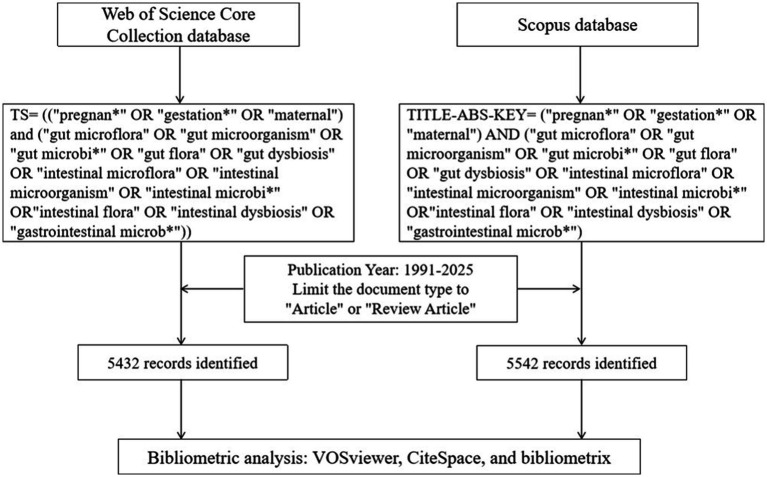
To ensure comprehensive coverage and data accessibility, a systematic literature search was conducted on September 10, 2025, in the WoSCC and Scopus databases. The specific search strategy is illustrated in Figure 1. The search query for WoSCC was constructed using the "Topic" (TS) field, which includes title, abstract, author keywords, and Keywords Plus: TS = (("pregnan*" OR "gestation*" OR "maternal") and ("gut microflora" OR "gut microorganism" OR "gut microbi*" OR "gut flora" OR "gut dysbiosis" OR "intestinal microflora" OR "intestinal microorganism" OR "intestinal microbi*" OR"intestinal flora" OR "intestinal dysbiosis" OR "gastrointestinal microb*")).
For Scopus, the search was built using the "TITLE-ABS-KEY" (title, abstract, keywords) field: TITLE-ABS-KEY = ("pregnan*" OR "gestation*" OR "maternal") AND ("gut microflora" OR "gut microorganism" OR "gut microbi*" OR "gut flora" OR "gut dysbiosis" OR "intestinal microflora" OR "intestinal microorganism" OR "intestinal microbi*" OR"intestinal flora" OR "intestinal dysbiosis" OR "gastrointestinal microb*").
The literature types were limited to "Articles" and "Review Articles" published between 1991 and 2025, with no language restrictions. During the data screening process, 5,432 and 5,542 topic-relevant records were identified from WoSCC and Scopus, respectively. The following data were extracted and exported separately from each database for independent analysis: publication year, authors, subject categories, affiliations, journal names, countries/regions, keywords, and references. Additionally, 3,837 overlapping publications were identified between the two databases.

Data retrieval and analysis process.
Data analysis
Bibliometric analysis was performed using the bibliometrix package (version 5.1.1) within the R programming environment (version 4.5.1), supplemented by VOSviewer (v1.6.19) and CiteSpace (v6.2. R3). Initial analyses utilized the built-in database statistics and the bibliometrix package to examine publication distributions, countries/regions collaborations, authors, and the top 10 highly cited and co-cited references. VOSviewer was further employed to extract and visualize institutional and keyword clustering networks. CiteSpace was used to perform country co-occurrence analysis, reference co-citation clustering analysis, and to generate a keyword timeline map. Additionally, a burst detection analysis was conducted for the top 30 keywords with the strongest citation bursts.
Results
Annual global publication outputs on "gut microbiota during pregnancy"
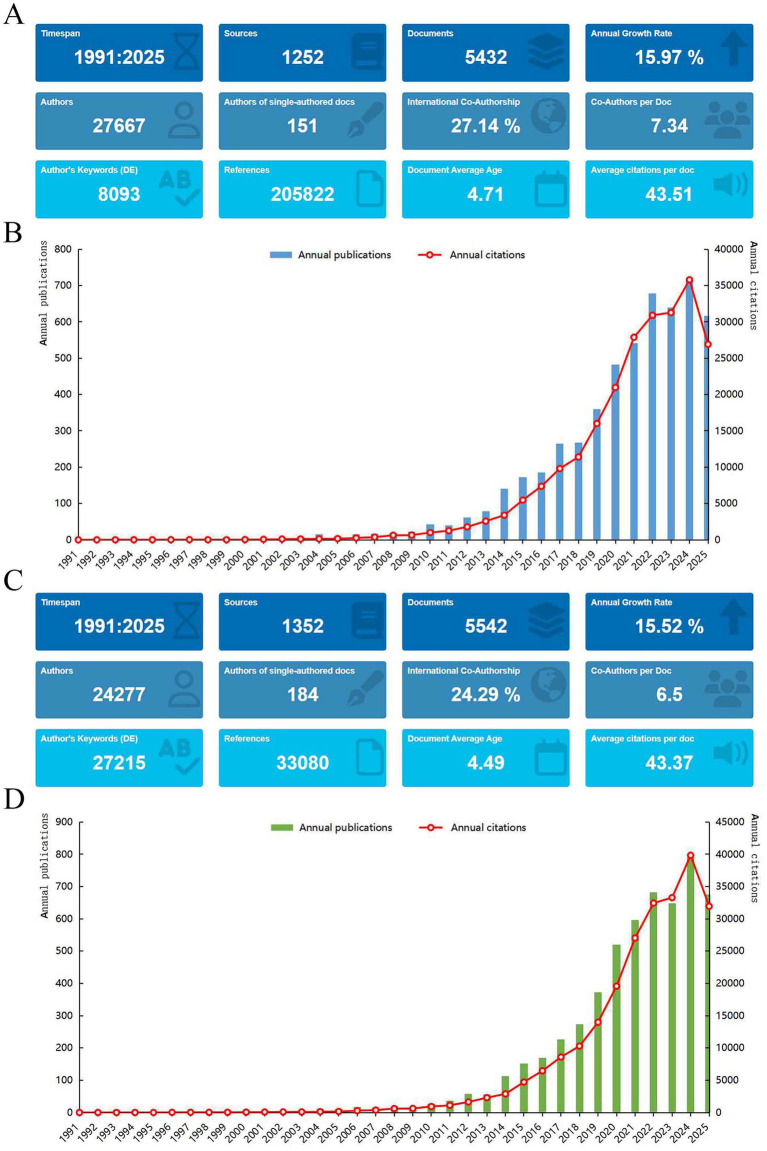
Analysis of the WoSCC and Scopus databases identified 5,432 and 5,542 publications, respectively (Figures 2A,C). There were 3,837 overlapping publications between the two databases. Figures 2B,D illustrate the annual publication trends, which show a high degree of consistency between the two databases, with annual growth rates of 15.97 and 15.52%, respectively. During the early stage (1991–2006), the annual publication count was generally below 20, and annual citations were fewer than 300. A phase of steady development occurred between 2007 and 2013, with a gradual increase in annual publications. Exponential growth has been observed since 2014, with both databases recording over 700 publications in 2024, reflecting the sustained high impact and growing academic interest in maternal and infant health research.

Publication metrics and temporal trends.Bibliometric overview from WoSCC database;annual publication distribution in WoSCC database;bibliometric overview from Scopus database;annual publication distribution in Scopus database. (A) (B) (C) (D)
Distribution and co-authorship of countries/regions
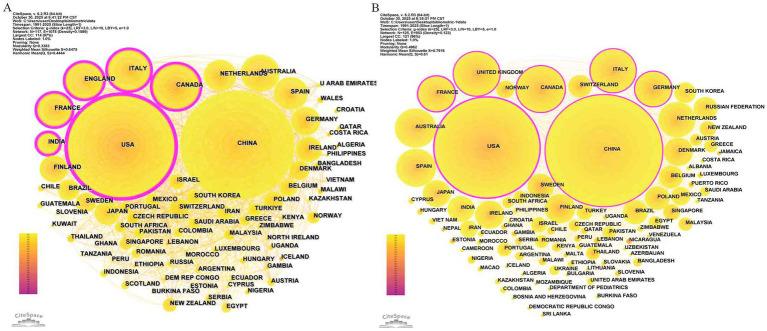
From 1991 to 2025, research on "gut microbiota during pregnancy" has garnered widespread global attention. In the WoSCC database (Table 1), China took the lead, with 1,561 publications (accounting for 21.67%), a total of 33,826 citations (average of 21.67 citations per article), an H-index of 80, a total link strength of 443 in the VOSviewer collaboration strength analysis, and a betweenness centrality of 0.06 in the CiteSpace collaboration network analysis (Figure 3A). The United States ranked second, with 1,511 publications (accounting for 27.82%), a total of 96,109 citations (average of 63.61 per article), an H-index of 144, a total link strength of 1,018, and a betweenness centrality of 0.3 in the CiteSpace collaboration network analysis, highlighting its advantages in the quality of basic research. Canada ranked third with 342 publications (6.3%), a total of 22,126 citations (average of 64.7 per article), an H-index of 75, a total link strength of 352, and a betweenness centrality of 0.14, indicating its role as a bridge in high-quality research and regional collaboration. England (total link strength 511, betweenness centrality 0.18) and France (betweenness centrality 0.2) emerged as key nodes in global scientific collaboration due to their high collaboration strength.
In the Scopus database (Table 1), China surpassed the United States with 1,729 publications (31.20%) compared to 1,436 (25.91%), a total of 36,944 citations (average of 21.37 per article), an H-index of 90, a total link strength of 428, and a betweenness centrality of 0.12 (Figure 3B), reflecting its leading output volume and high activity in open-access journals. The United States maintained a total of 101,868 citations (average of 70.94 per article), an H-index of 149, a total link strength of 996, and a betweenness centrality of 0.5, underscoring its leading position in high-quality research and collaborative networks. The United Kingdom (total link strength 469, betweenness centrality 0.17) and Germany (betweenness centrality 0.16) served as core nodal countries in Scopus due to their strong interdisciplinary collaboration.
Both WoSCC and Scopus identified the United States, China, and Canada as the top three most productive countries. The United States consistently ranked in the top two across both databases, demonstrating stable research quality and collaboration. China led in output volume in Scopus but still requires improvement in average citations and H-index. Canada ranked in the top three in both databases, reflecting its sustained research investment.

International collaboration patterns.Countries/regions network from WoSCC database;Countries/regions network from Scopus database. (A) (B)
| Rank | Country | Publications(%)n | Total citations | Average citations | H-Index | Total link strength | Centrality |
|---|---|---|---|---|---|---|---|
| Web of Science Core Collection database | |||||||
| 1 | China | 1,561 (28.7) | 33,826 | 21.67 | 80 | 443 | 0.06 |
| 2 | USA | 1,511 (27.82) | 96,109 | 63.61 | 144 | 1,018 | 0.3 |
| 3 | Canada | 342 (6.3) | 22,126 | 64.7 | 75 | 352 | 0.14 |
| 4 | Australia | 295 (5.43) | 14,482 | 49.09 | 61 | 313 | 0.06 |
| 5 | England | 276 (5.08) | 16,823 | 60.95 | 61 | 511 | 0.18 |
| 6 | Italy | 268 (4.93) | 14,476 | 54.01 | 57 | 302 | 0.1 |
| 7 | Spain | 246 (4.53) | 14,655 | 59.57 | 57 | 314 | 0.06 |
| 8 | Netherlands | 242 (4.46) | 14,703 | 60.76 | 58 | 397 | 0.08 |
| 9 | France | 236 (4.34) | 9,739 | 41.27 | 53 | 233 | 0.2 |
| 10 | Germany | 197 (3.63) | 11,437 | 58.06 | 52 | 311 | 0.08 |
| Scopus database | |||||||
| 1 | China | 1729 (31.20) | 36,944 | 21.37 | 90 | 428 | 0.12 |
| 2 | USA | 1,436 (25.91) | 101,868 | 70.94 | 149 | 996 | 0.5 |
| 3 | Canada | 324 (5.85) | 19,282 | 59.51 | 70 | 329 | 0.13 |
| 4 | United Kingdom | 306 (5.52) | 20,643 | 67.46 | 72 | 469 | 0.17 |
| 5 | Italy | 300 (5.41) | 19,825 | 66.08 | 64 | 292 | 0.13 |
| 6 | Australia | 265 (4.78) | 13,932 | 52.57 | 59 | 252 | 0.04 |
| 7 | Spain | 240 (4.33) | 15,628 | 65.12 | 59 | 256 | 0.08 |
| 8 | France | 234 (4.22) | 12,730 | 54.4 | 56 | 250 | 0.21 |
| 9 | Netherlands | 230 (4.15) | 18,773 | 81.62 | 66 | 332 | 0.04 |
| 10 | Germany | 198 (3.57) | 14,602 | 73.75 | 56 | 327 | 0.16 |
Distribution of research institutions and authors
Institutional distribution
The distribution of institutions and the cooperation network were analyzed using VOSviewer. As shown in Table 2, in the WoSCC database, the University of Turku ranked first with 100 publications (1.84%), a total of 10,515 citations (average of 105.15 per article), and a total link strength of 115. The Chinese Academy of Sciences (86 publications, 2,316 total citations) and University College Cork (86 publications, 6,623 total citations) tied for second place. The University of Colorado ranked fourth with 82 publications and an average of 114.02 citations per article, reflecting its high per-article quality. The University of Toronto (78 publications, total link strength 161) stood out for its extensive international collaboration network.
In the Scopus database, APC Microbiome Ireland led with 105 publications (1.89%), a total of 10,593 citations (average of 100.89 per article), and a total link strength of 173. University College Cork (79 publications, average of 101.19 citations per article) ranked third. Turun Yliopisto (69 publications) ranked fourth, with a notably high average of 137.33 citations per article. A cross-database comparison revealed that University College Cork ranked among the top three in both databases. Overall, the field has formed a collaborative research landscape centered on institutions in North America, Europe, and East Asia, with broad participation from multiple regions.
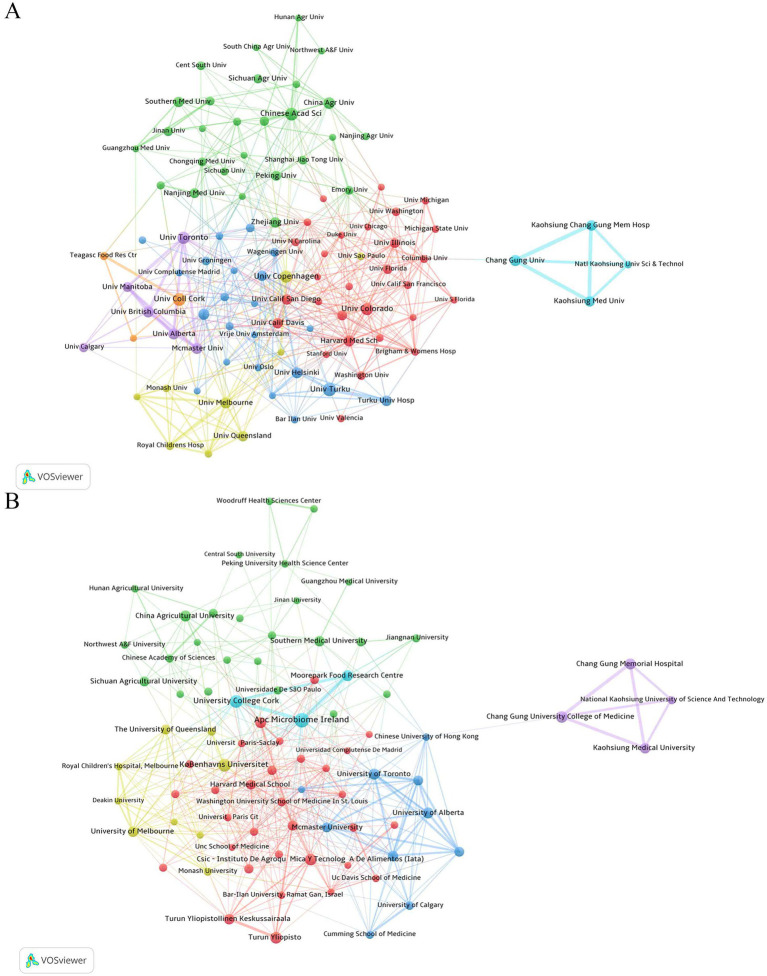
As shown in Figure 4A, the top publishing institutions in the WoSCC database were grouped into seven distinct clusters. The red cluster primarily consisted of institutions from the United States, Denmark, and Sweden, including the University of Colorado, the University of Copenhagen, and Harvard Medical School. The green cluster was mainly composed of institutions from China and Ireland, such as the Chinese Academy of Sciences, University College Cork, China Agricultural University, and Zhejiang University. The yellow cluster included Australian institutions like the University of Melbourne and the University of Western Australia. The purple cluster comprised Canadian institutions, including the University of Toronto and the University of Alberta. The blue cluster consisted mainly of institutions from Finland, the Netherlands, and Spain, such as the University of Turku, the University of Helsinki, and Turku University Hospital. The light blue cluster was represented by Chang Gung University, and the orange cluster by Bar-Ilan University.
Based on the Scopus database (Figure 4B), the institutional collaboration network was divided into six clusters. The red cluster exhibited multinational collaboration, including institutions from the United States (e.g., Harvard Medical School; Karolinska Institutet), Sweden, Finland, Spain, and Israel (Bar-Ilan University). The green cluster was concentrated in Chinese institutions, including China Agricultural University, the Chinese Academy of Sciences, and Sichuan Agricultural University. The blue cluster was dominated by Canadian institutions, such as the University of Toronto, McMaster University, and the University of Alberta. The yellow cluster integrated Australian (University of Melbourne, Monash University) and Danish (Københavns Universitet; Det Sundhedsvidenskabelige Fakultet) institutions. The light blue cluster was centered in Ireland, including APC Microbiome Ireland, University College Cork, and Moorepark Food Research Centre. The purple cluster was represented by Chang Gung University College of Medicine.

Institutional collaboration networks.WoSCC database;Scopus database. (A) (B)
| Rank | Institution | Countries/regions | Publications(%)n | Total citations | Average citations | Total link strength |
|---|---|---|---|---|---|---|
| Web of Science Core Collection database | ||||||
| 1 | University of Turku | Finland | 100 (1.84) | 10,515 | 105.15 | 115 |
| 2 | Chinese Academy of Sciences | China | 86 (1.58) | 2,316 | 26.93 | 86 |
| 3 | University College Cork | Ireland | 86 (1.58) | 6,623 | 77.01 | 80 |
| 4 | University of Colorado | USA | 82 (1.51) | 9,350 | 114.02 | 62 |
| 5 | University of Copenhagen | Denmark | 80 (1.47) | 3,301 | 41.26 | 74 |
| 6 | University of Toronto | Canada | 78 (1.44) | 5,411 | 69.37 | 161 |
| 7 | China Agricultural University | China | 71 (1.31) | 1,475 | 20.77 | 29 |
| 8 | Chang Gung University | China (Taiwan) | 68 (1.25) | 1,618 | 23.79 | 147 |
| 9 | Harvard Medical School | USA | 67 (1.23) | 2,979 | 44.46 | 107 |
| 10 | University of Melbourne | Australia | 67 (1.23) | 2,925 | 43.66 | 133 |
| Scopus database | ||||||
| 1 | Apc Microbiome Ireland | Ireland | 105 (1.89) | 10,593 | 100.89 | 173 |
| 2 | Københavns Universitet | Denmark | 80 (1.44) | 5,020 | 62.75 | 53 |
| 3 | University College Cork | Ireland | 79 (1.43) | 7,994 | 101.19 | 147 |
| 4 | Turun Yliopisto | Finland | 69 (1.25) | 9,476 | 137.33 | 71 |
| 5 | Chang Gung University College of Medicine | China (Taiwan) | 66 (1.19) | 1,640 | 24.85 | 143 |
| 6 | Csic – Instituto De Agroquímica Y Tecnología De Alimentos (Iata) | Spain | 66 (1.19) | 5,530 | 83.79 | 45 |
| 7 | Wageningen University & Research | Netherlands | 62 (1.12) | 6,481 | 104.53 | 58 |
| 8 | Chang Gung Memorial Hospital | China (Taiwan) | 61 (1.1) | 1,328 | 21.77 | 139 |
| 9 | Moorepark Food Research Centre | Ireland | 61 (1.1) | 4,898 | 80.3 | 119 |
| 10 | University of Alberta | Canada | 61 (1.1) | 5,698 | 93.41 | 137 |
Author distribution
Analysis of author distribution using the bibliometrix package in R revealed that in the WoSCC database, the most prolific author was Collado, Maria Carmen from the Instituto de Agroquímica y Tecnología de Alimentos, with 75 publications (1.38% of total publications), followed by Tain, You-Lin from Kaohsiung Chang Gung Memorial Hospital with 61 publications (1.12%), and Chien-Ning Hsu from Kaohsiung Municipal Ta-Tung Hospital with 53 publications (0.98%) (Table 3). Among the top 10 most productive authors, the highest average citations were achieved by Dinan, Timothy G. and Cryan, John F. The H-index, a comprehensive metric evaluating the quantity and impact of scholarly output, was highest for Collado, Maria Carmen and Cryan, John F.
Results from the Scopus database showed partial overlap with WoSCC but with some differences: Tain, You-Lin (58 publications, 1,505 total citations) and Collado, Maria Carmen (53 publications, 5,355 total citations) remained the top two, but Cryan, John F. dropped to ninth place (26 publications, 3,698 total citations), reflecting differences in database coverage. Notably, Ross Paul from Université Paris Saclay (30 publications, 2,959 total citations) and Nitert, Marloes Dekker from the University of Queensland (25 publications, 1,880 total citations) appeared in the top 10 only in Scopus, highlighting the database's broader coverage of European and Australasian institutions.
A cross-database comparison showed that authors such as Collado, Maria Carmen; Tain, You-Lin; Isolauri, Erika; and Stanton, Catherine consistently ranked in the top 10 across both databases, confirming the stability and international influence of their research output. At the institutional level, the University of Turku, University College Cork, and Kaohsiung Chang Gung Memorial Hospital formed multi-institutional high-productivity clusters. High H-index and average citation values (e.g., Cryan, John F.) further validated the central role of prolific authors in advancing the field. These findings provide data support for identifying key scholars and optimizing international collaboration networks, while also highlighting the need to consider database differences when assessing author influence.
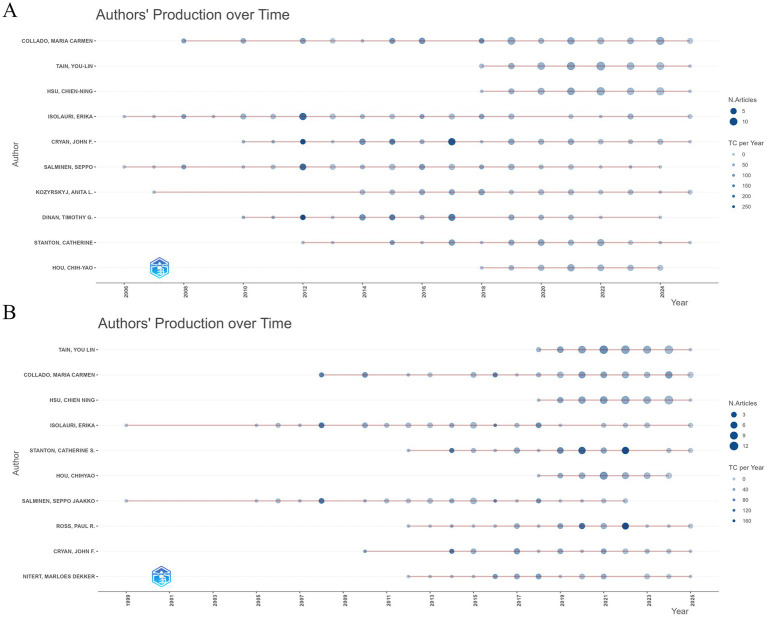
Further analysis of the annual publication output of authors aimed to explore changes in research productivity over time and identify authors who were particularly active during specific periods. Results from the WoSCC (Figure 5A) and Scopus (Figure 5B) databases showed that Isolauri, Erika; Salminen, Seppo; Kozyrskyj, Anita L.; and Collado, Maria Carmen have consistently published research in the "gut microbiota during pregnancy" field over the past three decades, demonstrating their long-standing research foundation and sustained interest. In contrast, Tain, You-Lin; Hsu, Chien-Ning; and Hou, Chih-Yao have significantly increased their research activity in recent years, suggesting important advancements in specific research directions.

Temporal publication patterns of leading authors:WoSCC database;Scopus database. (A) (B)
| Rank | Author | Institution | Countries/regions | Representative papers | Publications(%)n | Total citations | Average citations | H-index |
|---|---|---|---|---|---|---|---|---|
| Web of Science Core Collection database | ||||||||
| 1 | Collado, Maria Carmen | Instituto de Agroquímica y Tecnología de Alimentos (IATA-CSIC) | Spain | Mother-to-Infant Microbial Transmission from Different Body Sites Shapes the Developing Infant Gut Microbiome | 75 (1.38) | 8,322 | 110.96 | 37 |
| 2 | Tain, You-Lin | Kaohsiung Chang Gung Memorial Hospital | China (Taiwan) | Hypertension Programmed by Perinatal High-Fat Diet: Effect of Maternal Gut Microbiota-Targeted Therapy | 61 (1.12) | 1,546 | 25.34 | 24 |
| 3 | Hsu, Chien-Ning | Kaohsiung Municipal Ta-Tung Hospital Kaohsiung Medical University | China (Taiwan) | Targeting on Gut Microbial Metabolite Trimethylamine-N-Oxide and Short-Chain Fatty Acid to Prevent Maternal High-Fructose-Diet-Induced Developmental Programming of Hypertension in Adult Male Offspring | 53 (0.98) | 1,276 | 24.08 | 22 |
| 4 | Isolauri, Erika | University of Turku | Finland | Human gut colonization may be initiated in utero by distinct microbial communities in the placenta and amniotic fluid | 51 (0.94) | 8,186 | 160.51 | 33 |
| 5 | Cryan, John F. | University College Cork | Ireland | The Microbiome-Gut-Brain Axis in Health and Disease | 50 (0.92) | 12,093 | 241.86 | 37 |
| 6 | Salminen, Seppo | University of Turku | Finland | Maternal gut and breast milk microbiota affect infant gut antibiotic resistome and mobile genetic elements | 48 (0.88) | 7,797 | 162.44 | 32 |
| 7 | Kozyrskyj, Anita L. | University of Alberta | Canada | Roles of Birth Mode and Infant Gut Microbiota in Intergenerational Transmission of Overweight and Obesity From Mother to Offspring | 38 (0.7) | 3,025 | 79.61 | 25 |
| 8 | Dinan, Timothy G. | University College Cork | Ireland | The Microbiome-Gut-Brain Axis in Health and Disease | 36 (0.66) | 10,940 | 303.89 | 32 |
| 9 | Stanton, Catherine | University College Cork | Ireland | Evolution of gut microbiota composition from birth to 24 weeks in the INFANTMET Cohort | 36 (0.66) | 3,318 | 92.17 | 24 |
| 10 | Hou, Chih-Yao | National Kaohsiung University of Science and Technology | China (Taiwan) | Maternal Garlic Oil Supplementation Prevents High-Fat Diet-Induced Hypertension in Adult Rat Offspring: Implications of H2S-Generating Pathway in the Gut and Kidneys | 32 (0.59) | 895 | 27.97 | 19 |
| Scopus database | ||||||||
| 1 | Tain, You-Lin | Kaohsiung Chang Gung Memorial Hospital | China (Taiwan) | Hypertension Programmed by Perinatal High-Fat Diet: Effect of Maternal Gut Microbiota-Targeted Therapy | 58 (1.05) | 1,505 | 25.95 | 23 |
| 2 | Collado, Maria Carmen | Instituto de Agroquímica y Tecnología de Alimentos (IATA-CSIC) | Spain | Mother-to-Infant Microbial Transmission from Different Body Sites Shapes the Developing Infant Gut Microbiome | 53 (0.96) | 5,355 | 101.04 | 27 |
| 3 | Hsu, Chien-Ning | Kaohsiung Municipal Ta-Tung HospitalKaohsiung Medical University | China (Taiwan) | Targeting on Gut Microbial Metabolite Trimethylamine-N-Oxide and Short-Chain Fatty Acid to Prevent Maternal High-Fructose-Diet-Induced Developmental Programming of Hypertension in Adult Male Offspring | 51 (0.92) | 1,222 | 23.96 | 21 |
| 4 | Isolauri, Erika | University of Turku | Finland | Human gut colonization may be initiated in utero by distinct microbial communities in the placenta and amniotic fluid | 42 (0.76) | 6,042 | 143.86 | 27 |
| 5 | Stanton, Catherine | University College Cork | Ireland | Evolution of gut microbiota composition from birth to 24 weeks in the INFANTMET Cohort | 38 (0.69) | 4,514 | 118.79 | 26 |
| 6 | Salminen, Seppo | University of Turku | Finland | Maternal gut and breast milk microbiota affect infant gut antibiotic resistome and mobile genetic elements | 33 (0.6) | 5,651 | 171.24 | 26 |
| 7 | Hou, Chih-Yao | National Kaohsiung University of Science and Technology | China (Taiwan) | Maternal Garlic Oil Supplementation Prevents High-Fat Diet-Induced Hypertension in Adult Rat Offspring: Implications of H2S-Generating Pathway in the Gut and Kidneys | 33 (0.6) | 983 | 29.79 | 20 |
| 8 | Ross Paul | Universite Paris Saclay | France | The composition of the gut microbiota throughout life, with an emphasis on early life | 30 (0.54) | 2,959 | 98.63 | 21 |
| 9 | Cryan, John F. | University College Cork | Ireland | The Microbiome-Gut-Brain Axis in Health and Disease | 26 (0.47) | 3,698 | 142.23 | 19 |
| 10 | Nitert, Marloes Dekker | The University of Queensland | Australia | Increased Systolic and Diastolic Blood Pressure Is Associated With Altered Gut Microbiota Composition and Butyrate Production in Early Pregnancy | 25 (0.45) | 1880 | 75.2 | 16 |
Discipline and journal distribution
Disciplines
In terms of disciplinary publication, as shown in Table 4, based on the WoSCC database, Microbiology (16.99%) was the most concentrated discipline, aligning with the field's focus on microbiota composition, function, and dynamics. Nutrition (13.44%) and Immunology (9.19%) ranked second and third, respectively, reflecting the emphasis on dietary interventions, metabolic regulation, and maternal–infant immune adaptation. Notably, Multidisciplinary Sciences (6.44%) appeared in the top 10, confirming the trend toward interdisciplinary integration. In the Scopus database, Medicine (58.88%) dominated, followed by Immunology and Microbiology (23.57%) and Biochemistry, Genetics, and Molecular Biology (22.45%).
| Rank | Web of science categories | Publications(%)n | Scopus subject area | Publications(%)n |
|---|---|---|---|---|
| 1 | Microbiology | 923 (16.99) | Medicine | 3,263 (58.88) |
| 2 | Nutrition Dietetics | 730 (13.44) | Immunology and Microbiology | 1,306 (23.57) |
| 3 | Immunology | 499 (9.19) | Biochemistry, Genetics and Molecular Biology | 1,244 (22.45) |
| 4 | Pediatrics | 443 (8.16) | Agricultural and Biological Sciences | 979 (17.67) |
| 5 | Biochemistry Molecular Biology | 409 (7.53) | Nursing | 689 (12.43) |
| 6 | Multidisciplinary Sciences | 350 (6.44) | Pharmacology, Toxicology and Pharmaceutics | 303 (5.47) |
| 7 | Gastroenterology Hepatology | 297 (5.47) | Multidisciplinary | 296 (5.34) |
| 8 | Endocrinology Metabolism | 282 (5.19) | Neuroscience | 277 (5) |
| 9 | Neurosciences | 260 (4.79) | Environmental Science | 262 (4.73) |
| 10 | Food Science Technology | 241 (4.44) | Chemistry | 202 (3.64) |
Journal distribution
Analysis of journal sources using the bibliometrix package in R revealed a concentration of research output in this field. As shown in Table 5, the top 10 journals in the WoSCC database contributed over 20% of the publications, forming a core journal group that dominates knowledge dissemination. Nutrients led with 244 publications (4.49%), highlighting the key role of nutrition journals in this interdisciplinary field. Frontiers in Microbiology (164 publications, 3.02%) and Scientific Reports (135 publications, 2.49%) ranked second and third, respectively. Notably, Plos One, although ranking fourth with 105 publications (1.93%), showed strong impact with 6,417 total citations and an average of 61.11 citations per article. Microbiome, despite having fewer publications (69, 1.27%), had a high average of 89.78 citations per article and the highest journal impact factor (12.7), indicating broad academic recognition of its published research.
Results from the Scopus database were highly consistent with WoSCC. The top 10 journals were distributed in JCR Q1/Q2 quartiles, covering microbiology, nutrition, immunology, and multidisciplinary sciences, fully affirming the interdisciplinary nature of research on gut microbiota during pregnancy.
| Rank | Journal | Publications(%)n | Total citations | Average citations | H-index | JCR category | Category quartile | Journal impact factor (2024) |
|---|---|---|---|---|---|---|---|---|
| Web of Science Core Collection database | ||||||||
| 1 | Nutrients | 244 (4.49) | 6,390 | 26.19 | 40 | Nutrition and Dietetics | Q1 | 5 |
| 2 | Frontiers in Microbiology | 164 (3.02) | 4,570 | 27.87 | 34 | Microbiology | Q1 | 4.5 |
| 3 | Scientific Reports | 135 (2.49) | 5,102 | 37.79 | 39 | Multidisciplinary Sciences | Q1 | 3.9 |
| 4 | Plos One | 105 (1.93) | 6,417 | 61.11 | 42 | Multidisciplinary Sciences | Q2 | 2.6 |
| 5 | Gut Microbes | 104 (1.91) | 3,914 | 37.63 | 35 | Microbiology | Q1 | 11 |
| 6 | International Journal of Molecular Sciences | 90 (1.66) | 2,145 | 23.83 | 27 | Biochemistry and Molecular Biology | Q1 | 4.9 |
| 7 | Microorganisms | 79 (1.45) | 3,283 | 41.56 | 18 | Microbiology | Q2 | 4.2 |
| 8 | Frontiers in Cellular and Infection Microbiology | 75 (1.38) | 1,665 | 22.2 | 23 | Microbiology | Q1 | 4.8 |
| 9 | Frontiers in Immunology | 69 (1.27) | 3,513 | 50.91 | 28 | Immunology | Q1 | 5.9 |
| 10 | Microbiome | 69 (1.27) | 6,172 | 89.45 | 39 | Microbiology | Q1 | 12.7 |
| Scopus database | ||||||||
| 1 | Nutrients | 257 (4.64) | 9,017 | 48 | Nutrition and Dietetics | Q1 | 5 | |
| 2 | Frontiers in Microbiology | 176 (3.18) | 4,621 | 35 | Microbiology | Q1 | 4.5 | |
| 3 | Gut Microbes | 140 (2.53) | 5,714 | 41 | Microbiology | Q1 | 11 | |
| 4 | Scientific Reports | 115 (2.08) | 5,220 | 38 | Multidisciplinary Sciences | Q1 | 3.9 | |
| 5 | Plos One | 102 (1.84) | 6,159 | 43 | Multidisciplinary Sciences | Q2 | 2.6 | |
| 6 | Frontiers in Cellular and Infection Microbiology | 98 (1.77) | 2,813 | 27 | Microbiology | Q1 | 4.8 | |
| 7 | International Journal of Molecular Sciences | 85 (1.53) | 2003 | 27 | Biochemistry and Molecular Biology | Q1 | 4.9 | |
| 8 | Microbiome | 77 (1.39) | 7,101 | 39 | Microbiology | Q1 | 12.7 | |
| 9 | Microorganisms | 65 (1.17) | 3,458 | 17 | Microbiology | Q2 | 4.2 | |
| 10 | Frontiers in Immunology | 62 (1.12) | 3,165 | 27 | Microbiology | Q1 | 4.5 | |
Top 10 highly cited references and co-cited references
In-depth analysis of cited references and co-cited references was conducted using the bibliometrix package in R. The top 10 highly cited articles in the "gut microbiota during pregnancy" field showed consistency between the WoSCC (Figure 6A) and Scopus (Figure 6B) databases. Five articles appeared in the top 10 of both databases (Table 6), forming the knowledge foundation of the field. These included: Hsiao et al. (2013) on microbiota modulation of neurodevelopmental abnormalities; Rinninella et al. (2019) reviewing the definition of a healthy gut microbiota; Penders et al. (2006) exploring factors influencing infant gut microbiota; Koren et al. (2012) on host-microbiome interactions during pregnancy; and Braniste et al. (2014) demonstrating microbiota influence on blood–brain barrier permeability. The shared highly cited articles focused on early-life microbiota colonization, the gut-brain axis, and host-microbiome interactions during pregnancy, highlighting the foundational importance of these directions.
Analysis of highly co-cited references revealed the core knowledge base and key methodological frameworks in the field. The top 10 most frequently co-cited references are listed in Table 7. Four foundational studies appeared prominently in both databases: (1) Koren et al. (2012) on host and microbiome remodeling during pregnancy, ranked first in WoSCC, establishing pregnancy as a key driver of microbial succession; (2) Dominguez-Bello et al. (2010) on the impact of delivery mode on neonatal microbiota colonization; (3) Backhed et al. (2015) on the longitudinal dynamics and stabilization of the infant gut microbiome in the first year of life; and (4) Aagaard et al. (2014) proposing the concept of a placental microbiome, which, despite controversy, demonstrated significant influence through its co-citation strength. Additionally, two key methodological papers were included: Caporaso et al. (2010) on the QIIME pipeline and Callahan et al. (2016) on the DADA2 analysis pipeline, highlighting the indispensable role of high-throughput sequencing data analysis methods. Yatsunenko et al. (2012) on human gut microbiome variations across age and geography was also co-cited, providing an important comparative framework for subsequent research.
To further analyze co-citation relationships, we performed a visualization analysis of co-cited references in the WoSCC database using CiteSpace (Figure 6C). CiteSpace parameters were set as follows: time slicing (1991–2025), years per slice (1), node type (keyword), selection criteria (g-index, k = 25), no pruning. Eight major clusters were identified: Birth mode, dietary counseling, GDM, preterm birth, postnatal environment, gut-brain axis, neurodevelopmental disorder, and human milk.

Citation analysis of core reference.Top 10 most cited references in WoSCC;Top 10 most cited references in Scopus;Co-citation reference clusters in WoSCC. (A) (B) (C)
| Rank | Author | Title | Journal | DOI | Year of publication | Total citations | Normalized global citations |
|---|---|---|---|---|---|---|---|
| Web of Science Core Collection database | |||||||
| 1 | Dominguez-Bello, Maria Gloria | Delivery mode shapes the acquisition and structure of the initial microbiota across multiple body habitats in newborns | Proceedings of The National Academy of Sciences of The United States of America | 10.1073/pnas.1002601107 | 2010 | 3,315 | 15.74 |
| 2 | Cryan, John F. | Mind-altering microorganisms: the impact of the gut microbiota on brain and behavior | Nature Reviews Neuroscience | 10.1038/nrn3346 | 2012 | 3,178 | 15.64 |
| 3 | Hsiao, Elaine | Microbiota Modulate Behavioral and Physiological Abnormalities Associated with Neurodevelopmental Disorders | Cell | 10.1016/j.cell.2013.11.024 | 2013 | 2,431 | 20.87 |
| 4 | Rinninella, Emanuele | What is the Healthy Gut Microbiota Composition? A Changing Ecosystem across Age, Environment, Diet, and Diseases | Microorganisms | 10.3390/microorganisms7010014 | 2019 | 2,249 | 37.76 |
| 5 | Sudo, Nobuyuki | Postnatal microbial colonization programs the hypothalamic–pituitary–adrenal system for stress response in mice | Journal of Physiology-London | 10.1113/jphysiol.2004.063388 | 2004 | 1961 | 9.59 |
| 6 | Braniste, Viorica | The gut microbiota influences blood–brain barrier permeability in mice | Science Translational Medicine | 10.1126/scitranslmed.3009759 | 2014 | 1767 | 13.72 |
| 7 | Penders, John | Factors influencing the composition of the intestinal microbiota in early infancy | Pediatrics | 10.1542/peds.2005-2824 | 2006 | 1,665 | 9.36 |
| 8 | Koren, Omry | Host Remodeling of the Gut Microbiome and Metabolic Changes during Pregnancy | Cell | 10.1016/j.cell.2012.07.008 | 2012 | 1,525 | 7.51 |
| 9 | O'Mahony, Siobhain M. | Serotonin, tryptophan metabolism and the brain-gut-microbiome axis | Behavioral Brain Research | 10.1016/j.bbr.2014.07.027 | 2015 | 1,366 | 11.09 |
| 10 | Morais, Livia | The gut microbiota-brain axis in behavior and brain disorders | Nature Reviews Microbiology | 10.1038/s41579-020-00460-0 | 2021 | 1,338 | 42.81 |
| Scopus database | |||||||
| 1 | Ley, Ruth | Obesity alters gut microbial ecology | Proceedings of The National Academy of Sciences of The United States of America | 10.1073/pnas.0504978102 | 2005 | 5,190 | 9.04 |
| 2 | Hsiao, Elaine | Microbiota Modulate Behavioral and Physiological Abnormalities Associated with Neurodevelopmental Disorders | Cell | 10.1016/j.cell.2013.11.024 | 2013 | 2,692 | 20.08 |
| 3 | Rinninella, Emanuele | What is the Healthy Gut Microbiota Composition? A Changing Ecosystem across Age, Environment, Diet, and Diseases | Microorganisms | 10.3390/microorganisms7010014 | 2019 | 2,556 | 37.27 |
| 4 | Bäckhed, Fredrik | Dynamics and Stabilization of the Human Gut Microbiome during the First Year of Life | Cell Host and Microbe | 10.1016/j.chom.2015.05.012 | 2015 | 2,360 | 21.1 |
| 5 | Aagaard, Kjersti | The placenta harbors a unique microbiome | Science Translational Medicine | 10.1126/scitranslmed.3008599 | 2014 | 2073 | 11.62 |
| 6 | Braniste, Viorica | The gut microbiota influences blood–brain barrier permeability in mice | Science Translational Medicine | 10.1126/scitranslmed.3009759 | 2014 | 1961 | 10.99 |
| 7 | Penders, John | Factors influencing the composition of the intestinal microbiota in early infancy | Pediatrics | 10.1542/peds.2005-2824 | 2006 | 1834 | 11.24 |
| 8 | Koren, Omry | Host Remodeling of the Gut Microbiome and Metabolic Changes during Pregnancy | Cell | 10.1016/j.cell.2012.07.008 | 2012 | 1701 | 13.03 |
| 9 | Bäckhed, Fredrik | Bile acid-microbiota crosstalk in gastrointestinal inflammation and carcinogenesis | Nature Reviews Gastroenterology and Hepatology | 10.1038/nrgastro.2017.119 | 2018 | 1,479 | 17.2 |
| 10 | Milani, Christian | The First Microbial Colonizers of the Human Gut: Composition, Activities, and Health Implications of the Infant Gut Microbiota | Microbiology and molecular biology reviews | 10.1128/MMBR.00036-17 | 2017 | 1,450 | 14.65 |
| Rank | Author | Title | Journal | DOI | Year of publication | Number of references co-cited |
|---|---|---|---|---|---|---|
| Web of Science Core Collection database | ||||||
| 1 | Koren, Omry | Host remodeling of the gut microbiome and metabolic changes during pregnancy | Cell | 10.1016/j.cell.2012.07.008 | 2012 | 790 |
| 2 | Dominguez-Bello, Maria Gloria | Delivery mode shapes the acquisition and structure of the initial microbiota across multiple body habitats in newborns | Proceedings of The National Academy of Sciences of The United States of America | 10.1073/pnas.1002601107 | 2010 | 621 |
| 3 | Bäckhed, Fredrik | Dynamics and Stabilization of the Human Gut Microbiome during the First Year of Life | Cell Host and Microbe | 10.1016/j.chom.2015.04.004 | 2015 | 552 |
| 4 | Aagaard, Kjersti | The placenta harbors a unique microbiome | Science Translational Medicine | 10.1126/scitranslmed.3008599 | 2014 | 447 |
| 5 | Caporaso, J Gregory | QIIME allows analysis of high-throughput community sequencing data | Nature Methods | 10.1038/nmeth.f.303 | 2010 | 432 |
| 6 | Yatsunenko, Tanya | Human gut microbiome viewed across age and geography | Nature | 10.1038/nature11053 | 2012 | 429 |
| 7 | Turnbaugh, Peter James | An obesity-associated gut microbiome with increased capacity for energy harvest | Nature | 10.1038/nature05414 | 2006 | 371 |
| 8 | Callahan, Benjamin John | DADA2: High-resolution sample inference from Illumina amplicon data | Nature Methods | 10.1038/NMETH.3869 | 2016 | 364 |
| 9 | Penders, John | Factors influencing the composition of the intestinal microbiota in early infancy | Pediatrics | 10.1542/peds.2005-2824 | 2006 | 337 |
| 10 | Ferretti, Pamela | Mother-to-Infant Microbial Transmission from Different Body Sites Shapes the Developing Infant Gut Microbiome | Cell Host and Microbe | 10.1016/j.chom.2018.06.005 | 2018 | 322 |
| Scopus database | ||||||
| 1 | Bäckhed, Fredrik | Dynamics and Stabilization of the Human Gut Microbiome during the First Year of Life | Cell Host and Microbe | 10.1016/j.chom.2015.04.004 | 2015 | 205 |
| 2 | Aagaard, Kjersti | The placenta harbors a unique microbiome | Science Translational Medicine | 10.1126/scitranslmed.3008599 | 2014 | 178 |
| 3 | Koren, Omry | Host remodeling of the gut microbiome and metabolic changes during pregnancy | Cell | 10.1016/j.cell.2012.07.008 | 2012 | 154 |
| 4 | Dominguez-Bello, Maria Gloria | Delivery mode shapes the acquisition and structure of the initial microbiota across multiple body habitats in newborns | Proceedings of The National Academy of Sciences of The United States of America | 10.1073/pnas.1002601107 | 2010 | 141 |
| 5 | Caporaso, J Gregory | QIIME allows analysis of high-throughput community sequencing data | Nature Methods | 10.1038/nmeth.f.303 | 2010 | 106 |
| 6 | Yatsunenko, Tanya | Human gut microbiome viewed across age and geography | Nature | 10.1038/nature11053 | 2012 | 94 |
| 7 | Milani, Christian | The first microbial colonizers of the human gut: composition, activities, and health implications of the infant gut microbiota | Microbiology and molecular biology reviews | 10.1128/MMBR.00036-17 | 2017 | 82 |
| 8 | Callahan, Benjamin John | DADA2: High-resolution sample inference from Illumina amplicon data | Nature Methods | 10.1038/NMETH.3869 | 2016 | 73 |
| 9 | Azad, Meghan B | Gut microbiota of healthy canadian infants: profiles by mode of delivery and infant diet at 4 months | Canadian Medical Association Journal | 10.1503/cmaj.121189 | 2013 | 72 |
| 10 | Arrieta, Marie-Claire | Early infancy microbial and metabolic alterations affect risk of childhood asthma | Science Translational Medicine | 10.1126/scitranslmed.aab2271 | 2015 | 69 |
Keyword analysis
Keyword analysis to elucidate the knowledge structure and research hotspots in this field, we employed VOSviewer to perform a co-occurrence network analysis of literature keywords. To ensure clustering accuracy and representativeness, we excluded core search terms and their synonyms, while merging synonymous terms in the database. This step effectively mitigated clustering distortion and centralization bias caused by terminological diversity. In the co-occurrence network, line thickness visually represents the frequency of keyword co-occurrence in the same literature, with thicker lines indicating higher co-occurrence rates.
Results from the WoSCC database (Figure 7A) reveal that "Obesity" (607 occurrences) is the most frequent keyword, underscoring its central role in current research. "Risk" (572 occurrences) and "Probiotic" (555 occurrences) rank second and third. The co-occurrence network is clearly divided into four main clusters, each representing a distinct and concentrated research direction.
The green cluster centers on "Obesity" and focuses on the pathophysiological mechanisms of obesity and metabolic syndrome. It traces a research trajectory from phenotypic markers (e.g., "Overweight," "Body-Mass Index," "Gestational Diabetes Mellitus," "Preeclampsia," "Hypertension") to molecular mechanisms, emphasizing inflammation ("Inflammation," "Oxidative Stress," "Activation") and metabolic regulation ("Metabolism," "Insulin-Resistance," "Glucose"). Studies investigate how dietary factors ("Diet," "High-Fat Diet," "Dietary Fiber") influence gut microbiota metabolites ("Short-Chain Fatty Acids," "Butyrate," "Metabolites"), triggering host epigenetic changes ("Epigenetics," "DNA Methylation") and gene expression alterations ("Gene-Expression," "Expression"), ultimately impacting maternal-fetal health ("Maternal Obesity," "Maternal Diet," "Offspring," "Placenta"). This cluster integrates multi-level evidence from animal models ("Mice," "Cells") to human studies, unraveling the complex network of obesity-related metabolic diseases.
The blue cluster, led by "Risk" and "Probiotic," addresses early-life microbiota interventions and their long-term health outcomes, particularly allergic and immune diseases. This direction is characterized by clinical intervention and epidemiological features, as evidenced by keywords like "Double-Blind," "Supplementation," "Meta-analysis," and "Prevalence." Research focuses on early-life interventions ("Early-Life," "1st Year," "Children") using probiotics ("Probiotic," "Lactobacillus"), prebiotics ("Prebiotics"), or avoiding disruptors like antibiotics ("Antibiotics") and cesarean section (CS) ("Cesarean-Section") to modulate the immune system ("Regulatory T-Cells") and prevent diseases such as "Asthma," "Allergy," "Atopic-Dermatitis," "Eczema," "Food Allergy," and "Inflammatory-Bowel-Disease."
The red cluster revolves around "Health," "Infant," and "Breast-Milk," emphasizing the establishment and transmission of maternal–infant microbiota and its impact on infant health. Research threads begin with delivery and feeding modes ("Delivery," "Mode," "Breastfeeding," "Lactation"), exploring their effects on neonatal gut microbiota colonization ("Colonization") and diversity ("Diversity"). Studies link early microbiota establishment to infant growth ("Growth," "Birth-Weight"), immune responses ("Immune," "Responses"), and disease risks ("Necrotizing Enterocolitis," "Infection"). A highlight is the in-depth investigation of breast milk components ("Breast-Milk," "Milk," "Oligosaccharides," "Human-Milk Oligosaccharides"), revealing mechanisms by which breast milk shapes neonatal gut microbiota ("Bifidobacteria") to promote health. Keywords like "Sequences" and "Identification" reflect heavy reliance on high-throughput sequencing technologies.
The smaller yellow cluster, centered on "Dysbiosis" and "Brain," represents the rapidly growing "gut-brain axis" field. It explores links between gut microbiota and central nervous system function, as well as psychiatric and behavioral disorders. Research spans clinical conditions ("Autism," "Depression," "Anxiety," "Irritable-Bowel-Syndrome") and animal models ("Model," "Maternal Separation," "Maternal Immune Activation," "Prenatal Stress"). Keywords like "Stress," "Behavior," and "Neurodevelopment" highlight the focus: early-life (including prenatal) stress and immune activation induce dysbiosis, impacting brain development and behavior, potentially leading to neuropsychiatric disorders.
To validate and comprehensively examine the knowledge structure of the research field, this study further conducted a keyword co-occurrence analysis on the literature in the Scopus database. As shown in Figure 7B, its network structure shares commonalities with that of the WoSCC database while also exhibiting unique emphases.
In the Scopus database, "Controlled Study" (2,116 occurrences) emerged as the most frequently mentioned keyword. It was followed by "Animal" (1,944 occurrences) and "Infant" (1,778 occurrences). Through cluster analysis, the keywords were divided into three clusters.
The red cluster, the largest and most content-rich, was dominated by "Controlled Study" and "Animal," clearly pointing to mechanism-based explorations through animal experiments. This direction delved into the role of "Dysbiosis" under specific pathophysiological conditions, with core models including "Obesity," "Gestational Diabetes Mellitus," and "Inflammation." Research utilized interventions such as "Probiotic Agent," "Prebiotic Agent," "Diet Supplementation," "Fecal Microbiota Transplantation," and "High-Fat Diet" to observe their effects on the "Metabolism" and "Immunity" of "Progeny" or adult individuals. Mechanistic studies extended to the molecular level, employing techniques like "Real Time Polymerase Chain Reaction," "Enzyme Linked Immunosorbent Assay," and "Metabolomics" to investigate changes in "Gene Expression," "Protein Expression," "Signal Transduction," and "Metabolites" such as "Short Chain Fatty Acid," as well as the roles of key inflammatory factors like "Interleukin 6" and "Tumor Necrosis Factor." This cluster systematically revealed how interventions from "Prenatal Exposure" to the "Perinatal Period" influence host pathophysiology through molecular pathways.
The green cluster, centered around "Infant," "Newborn," and "Adult," primarily represented population-based clinical and translational medical research. Its research focus centered on the early life stages, encompassing the growth and development process from "Prematurity" and "Birth Weight" to "Child" ("Growth, Development and Aging"). Classic clinical research methods such as "Cohort Analysis," "Prospective Study," and "Randomized Controlled Trial" were employed to explore key exposure factors affecting infant health, including "Cesarean Section," "Vaginal Delivery," "Breast Feeding," and the use of "Antibiotic Agent." Health outcomes were closely tied to specific clinical issues like "Necrotizing Enterocolitis" and "Body Mass," with microbiome analysis conducted through "Feces" samples. This cluster overall embodied a longitudinal observational research paradigm from "Mother" to "Progeny."
The blue cluster featured distinct methodological characteristics, with "RNA 16S" (16S rRNA gene sequencing) and "Metagenomics" at its core. This cluster encompassed the key technical processes of gut microbiome research, from "Dna Extraction" to "Polymerase Chain Reaction," then to "High Throughput Sequencing" and "RNA Sequencing," culminating in "Population Abundance" analysis and "Classification." Correspondingly, the keywords in this cluster also listed in detail the core gut microbial phyla and genera identified through these methods, such as "Bacteroides," "Bifidobacterium," "Lactobacillus," "Firmicutes," and "Proteobacteria." This cluster essentially served as the technical and analytical foundation supporting the entire research field, providing data sources and research tools for the other two clusters.
To identify research hotspots with high burst strength and distinct temporal characteristics in the "gut microbiota during pregnancy" field, this study detected the top 30 keywords with the strongest citation bursts in the WoSCC and Scopus databases using CiteSpace (Figures 7C,D) and generated a timeline view of the field over the past 35 years (Figures 8A,B) to reveal thematic evolution and development dynamics. CiteSpace parameters were set as follows: time slicing (1991–2025), years per slice (1), node type (keyword), selection criteria (g-index, k = 25), no pruning.
The two databases revealed differentiated characteristics of the research frontiers. The WoSCC database timeline viewer showed the top five clusters as insulin resistance, gut-brain axis, allergy, vaginal microbiome, and necrotizing enterocolitis (Figure 8A). Keywords clearly displayed a three-stage evolutionary path from descriptive research to mechanistic and systemic studies (Figure 7C): the early stage (before 2010) was dominated by terms such as "intestinal microflora," "flora," and "atopic disease," reflecting the initial focus on microbial composition and its association with allergic diseases. Between 2010 and 2018, keywords such as "irritable bowel syndrome," and "anxiety like behavior" indicated a shift toward mechanistic exploration, particularly focusing on the gut-brain axis and immune regulation mechanisms. Recently (2023–2025), the emergence of "cesarean born infants" and "preeclampsia" showed an extension of research to delivery modes and associations with pregnancy complications.
In contrast, the Scopus database exhibited a more detailed cluster structure (Figure 8B), with the top seven clusters being feces; infant; animal experiment; blood glucose; adaptive immunity; brain; pregnane x receptor. The burst word list in Scopus included more general medical or methodological keywords (Figure 7D), such as "article," "priority journal" and "drug effects," which had high burst strength but weaker direct research relevance. Nevertheless, Scopus also captured biologically significant keywords with strong bursts, such as "bacterial colonization," "probiotics," and "gastrointestinal tract." Notably, "gestational diabetes" and "Shannon index" showed high burst strength between 2023 and 2025, indicating current research frontiers focused on the association between gestational diabetes and microbiota, as well as quantitative analysis of microbial diversity.
In summary, both databases indicate that the field has moved beyond mere description of microbiota composition toward exploring underlying mechanisms and multi-omics integration. Mechanistic research on pregnancy complications, especially GDM and preeclampsia, constitutes the current clinical frontier. The microbiota-gut-brain axis and its impact on maternal and infant neuropsychiatric health (e.g., anxiety, depression, autism spectrum disorder) form another key direction of shared interest.


Discussion
This study provides a systematic bibliometric analysis of the global research landscape concerning the gut microbiota during pregnancy, utilizing a dual-database approach incorporating the WoSCC and Scopus. The primary methodological contribution of this study is the comparative analysis enabled by this dual-strategy. Recognizing that different bibliographic databases have distinct coverage policies and inherent biases, the use of both WoSCC and Scopus was intended to mitigate the risk of a skewed or incomplete representation of the field. WoSCC is often recognized for its selective journal inclusion, particularly of high-impact English-language publications, which can lend a certain prestige to its indexed content. In contrast, Scopus offers broader coverage, including a more extensive array of journals from regions like Europe and the Asia-Pacific. This difference was observable in our results; for instance, China's publication output appeared more prominent in Scopus, while the United States maintained a leadership position in citation-based impact metrics within WoSCC. Therefore, this approach allows for a more comprehensive and balanced mapping of the academic terrain than would be feasible with a single database, constructing a more robust and three-dimensional global perspective on the field's development.
The analysis reveals that research on the gut microbiota during pregnancy has experienced a phase of exponential growth since approximately 2014, with annual publication output showing a consistent upward trajectory. This trend reflects a widespread and deepening academic recognition of the critical role played by maternal microbial communities in shaping both immediate and long-term maternal and infant health outcomes, solidifying this area as a globally significant frontier in biomedical science. The rapid maturation of this field is intrinsically linked to the deep integration of multidisciplinary methodologies. Advancements in high-throughput sequencing technologies, the refinement of metagenomic analysis pipelines (Asnicar et al., 2017; Liu et al., 2023; Vaishampayan et al., 2010; van de Wijgert et al., 2020), and the widespread application of sophisticated bioinformatics tools (Caporaso et al., 2010; Callahan et al., 2016) have been fundamental drivers, a fact corroborated by both keyword burst analysis and the content of highly co-cited references. Concurrently, the cross-disciplinary fusion of insights from nutrition, immunology, microbiology, and neuroscience has progressively shifted the research perspective from initial descriptions of microbial composition toward a more mechanistic exploration of microbiota-host interactions, metabolic pathway regulation, and ultimate clinical translation. The significant representation of microbiology, nutrition, and immunology in the disciplinary distribution, alongside the prominent role of comprehensive journals (e.g., PLOS ONE, Scientific Reports) and high-impact specialized journals (e.g., Microbiome, Gut Microbes) as primary publication venues, collectively confirms the highly interdisciplinary nature of this scientific endeavor.
Synthesis of research hotspots and evolving themes
A synthesis of the bibliometric data, including keyword co-occurrence, citation analysis, and the review of seminal publications, allows for the identification of several dominant and interconnected research hotspots that define the current intellectual structure of the field.
Maternal metabolic health and gestational complications
A primary research cluster focuses on the intricate interplay between the maternal gut microbiome and metabolic health during gestation, particularly in the context of specific pregnancy complications. Core themes within this cluster include obesity, GDM, insulin resistance, and preeclampsia. Research has consistently demonstrated that maternal pre-pregnancy overweight/obesity and excessive gestational weight gain are associated with a state of microbial dysbiosis, characterized by reduced microbial diversity, an elevated Firmicutes/Bacteroidetes ratio, and taxonomic shifts such as a decreased abundance of beneficial Bifidobacterium and Akkermansia alongside an increase in pro-inflammatory microbes (Houttu et al., 2018; Zacarias et al., 2018). In GDM, this dysbiosis is often more pronounced, synergistically exacerbating metabolic dysfunction and systemic inflammation (Li J. et al., 2024; Mei et al., 2025). The investigation into underlying mechanisms is heavily centered on host-microbiota crosstalk, with a strong emphasis on microbial metabolites and metabolomics. Short-chain fatty acids (SCFAs) have emerged as central regulators. For instance, in high-fat-diet-induced GDM models, reduced SCFA production has been shown to activate intestinal CD36-mediated lipid absorption via the HDAC3-H3K27ac-PPARγ axis, thereby promoting systemic insulin resistance (Chen et al., 2024). Human studies corroborate these findings, showing that women with GDM exhibit decreased circulating levels of acetate, propionate, and butyrate, which correlate with altered expression of SCFA receptors (GPR41/43) and metabolic markers in placental tissue (Wang et al., 2022), affirming SCFAs as pivotal modulators of the gut-islet axis in pregnancy. Nutrition is recognized as a key modulator linking the microbiota to these metabolic outcomes. Different dietary patterns elicit divergent microbial metabolic functions; for example, high-complex-carbohydrate diets can increase the abundance of beneficial bacteria and enhance carbohydrate metabolism, whereas regular or high-fat diets may activate pro-inflammatory pathways (Sugino et al., 2024). This research, while focused on maternal health, is ultimately directed toward understanding how optimizing the gestational metabolic environment can confer long-term health benefits to the offspring.
Early-life microbial colonization and determinants
A second major research axis is dedicated to understanding the origins, colonization, and establishment of the gut microbiota in early life and its profound implications for infant health and development. This cluster emphasizes the neonatal period as a critical window for microbial acquisition and assembly. Two major determinants are extensively studied: delivery mode and feeding practices. CS delivery consistently demonstrates profound effects on neonatal microbiota acquisition compared to vaginal delivery. Infants born via CS exhibit reduced microbial diversity, depletion of beneficial genera such as Bifidobacterium and Bacteroides, and an enrichment of potential pathogens (Kim et al., 2020; Madan et al., 2016; Reznik et al., 2024). These compositional alterations coincide with functional shifts in intestinal metabolism, including modified bile acid oxidation and disrupted carbohydrate and amino acid pathways (Hoen et al., 2021; Wang W. et al., 2020), suggesting a mechanistic link between CS-associated dysbiosis and long-term health risks. The second key factor is feeding mode, with breast milk being regarded not only as a nutritional source but also as a complex vehicle for bioactive molecules and microorganisms crucial for driving microbiota maturation (Chen et al., 2019; Merter and Altay, 2024), immune development (Li Y. et al., 2024; Wang et al., 2024; Zhou et al., 2020), and growth (Ajeeb et al., 2024; Rendina et al., 2019). Even minimal formula supplementation can shift the infant microbiota toward a profile more typical of formula-fed infants, attenuating the protective effects of exclusive breastfeeding (Madan et al., 2016). A significant sub-theme within this cluster concerns the vulnerable population of preterm infants, where aberrant microbial colonization is strongly associated with necrotizing enterocolitis (NEC). Pre-NEC microbial signatures feature increased Proteobacteria (especially Gammaproteobacteria and Enterobacteriaceae) and decreased beneficial taxa (Firmicutes, Bacteroidetes, Bifidobacterium, Lactobacillus) (Chae et al., 2024; He et al., 2021; Heida et al., 2016; Lindberg et al., 2020). These patterns are detectable in meconium, highlighting the predictive value of very early colonization (Chae et al., 2024; Heida et al., 2016; Kang et al., 2022). Concomitant metabolic alterations include reduced SCFA (especially butyrate) production (He et al., 2021; Liu X. et al., 2022; Liu Z. et al., 2022) and accumulation of amino acid metabolites and TCA intermediates (e.g., succinate and L-malate) (Chapman et al., 2024; Du et al., 2023). Butyrate deficiency impairs regulatory T-cell induction, disrupting immune homeostasis and exacerbating inflammation (He et al., 2021).
The microbiota-gut-brain axis in the perinatal period
A rapidly expanding area of investigation explores the mechanisms underlying the microbiota-gut-brain axis, particularly during pregnancy and early life. This research posits that microbial disturbances can induce low-grade inflammation and alter immune cell activity, thereby affecting neural circuit development and contributing to behavioral phenotypes such as anxiety, depression, and autism spectrum disorder (ASD). For example, in prenatal depression, reduced Intestinibacter and Escherichia_Shigella correlate with elevated IL-1β and IL-17A, implying immune mediated neural effects (Fang et al., 2023; Yang et al., 2022). Prenatal stress (Gur et al., 2017) and high fat diet (Bruce-Keller et al., 2017) induce offspring anxiety and cognitive dysfunction via maternal microbiota alterations. Maternal anxiety (Chi et al., 2024) and alcohol exposure (Wong et al., 2025) reduce microbial diversity and beneficial Bifidobacterium, potentially affecting neurodevelopment through IL-6/IL-10 pathways (Galley et al., 2023). Prenatal exposure to valproic acid, LPS, or herbicides induces maternal and offspring dysbiosis alongside ASD-like behaviors, often with sex specific effects (Li H. et al., 2024; Li Y. et al., 2024; Li J. et al., 2024; Li S. et al., 2024; Salia et al., 2025), likely mediated through hormone-immune-microbiome interactions. The vertical transmission of maternal microbiota is a key mechanism, as evidenced by studies showing that infants of mothers with postpartum depression exhibit distinct microbial profiles and poorer neurodevelopmental outcomes (Zhou et al., 2024). Intervention studies, including fecal microbiota transplantation (FMT), have been used to directly demonstrate the microbial contribution to brain development and behavior. Maternal FMT in CS born infants safely restores vaginal delivery like microbiota (Korpela et al., 2020), while FMT from ASD children to mice recapitulates behavioral and neuroinflammatory phenotypes (Avolio et al., 2022). FMT also enhances gut barrier function (e.g., upregulating ZO-1, Occludin) (Zhou et al., 2021) and reduces systemic and neuroinflammation-e.g., by inhibiting LPS-TLR4/NF-κB in arsenic exposure models (Zhao et al., 2023). For instance, in an arsenic exposure model, maternal FMT alleviated offspring neuroinflammation and behavioral deficits by inhibiting the LPS-TLR4/NF-κB pathway (Zhao et al., 2023). The role of microbial metabolites, particularly SCFAs like butyrate, is underscored as a critical signaling pathway facilitating gut-brain communication, immune regulation, and energy metabolism (Chen et al., 2025; Cheng et al., 2019). This cluster represents a paradigm shift toward understanding how the maternal microbial status serves as a modifiable factor in offspring neurodevelopmental programming.
Microecological interventions and translational applications
A highly translational research cluster emphasizes microecological interventions, such as probiotics and prebiotics, for preventing early-life allergic and immune diseases. This area is characterized by a focus on interventional studies, including randomized controlled trials. Evidence suggests that specific probiotic strains can significantly reduce the incidence of NEC in preterm infants (Alfaleh et al., 2010; Chang et al., 2017; Yang et al., 2014) and lower the risk of infant eczema and atopic sensitization when administered to high-risk pregnant women (Barthow et al., 2016). The mechanisms are thought to involve competitive exclusion of pathogens, immune modulation (e.g., restoring Th1/Th2 balance), and enhancement of gut barrier function. Maternal dietary interventions, such as fermentable fiber intake, have also been shown to enrich SCFA-producing bacteria in the offspring and upregulate SCFA receptors (GPR41/43), thereby suppressing allergic airway inflammation (Thorburn et al., 2015; Yuan et al., 2023). This body of work spans a continuous intervention window from pregnancy through early childhood, embodying a preventive medicine approach aimed at shaping the early-life microbiota to reduce long-term disease susceptibility.
Analysis of intellectual foundation and temporal evolution
Analysis of the highly cited and co-cited literature provides insight into the intellectual foundation of the field. Seminal works, such as Koren et al.'s (2012) study demonstrating trimester-specific microbial changes (Koren et al., 2012), and research by Dominguez-Bello et al. (2010) and Backhed et al. (2015) on how delivery mode and feeding practices shape neonatal colonization, form cornerstone references. The frequent co-citation of methodological papers introducing tools like QIIME (Caporaso et al., 2010) and DADA2 (Callahan et al., 2016) underscores the indispensable role of bioinformatic advancements in propelling the field forward. The temporal evolution of research hotspots, as revealed by keyword burst analysis, indicates a clear trajectory. Early research (pre-2010) primarily focused on exploring associations between microbial composition and allergic diseases. As the field matured, themes expanded toward mechanistic investigations of the gut-brain axis, metabolic syndromes, and immune regulation. In recent years, the research frontier has sharpened its focus on specific pregnancy complications (e.g., GDM, preeclampsia), the detailed impact of delivery modes, and the rigorous evaluation of probiotic, prebiotic, and dietary intervention strategies. This evolution signifies a collective shift from initial correlational observations toward a deeper exploration of causal mechanisms and clinical translation.
Global collaboration and key contributors
Research in this field is characterized by robust international collaboration. The China, United States, and Canada lead in terms of publication volume. The United States' leadership in metrics such as total citations, H-index, and betweenness centrality demonstrates its substantial research accumulation, high-quality output, and central role in coordinating international collaborative networks. While China leads in publication count, its relatively lower average citation rates suggests a future focus on enhancing the international impact of its research output. European nations and Canada also play key hub roles in international collaboration, as evidenced by their advantages in betweenness centrality. Institutional collaboration clustering reveals that the field has formed several efficient collaborative networks centered around regions or research themes, such as North American, European, and Asia-Pacific clusters. This structured collaborative model facilitates resource integration and accelerates knowledge innovation.
A relatively stable and highly productive community of authors has emerged, with several research teams establishing distinctive and influential lines of inquiry. The work of these teams often aligns with and has helped define the major research clusters identified above.
For instance, the team associated with Collado, Maria Carmen; Isolauri, Erika; and Salminen, Seppo has systematically investigated the multifaceted impacts of gut microbiota during pregnancy on maternal and offspring health. Their research has elucidated mechanisms spanning microbial vertical transmission, metabolic-immune regulation, and nutritional interventions. They have confirmed that microbial communities from the maternal gut and breast milk are directly transferred to the newborn, a process influenced by delivery mode and feeding type (Flores Ventura et al., 2025; Saez-Fuertes et al., 2024a; Saez-Fuertes et al., 2024c). Their work has also linked maternal metabolic states, such as overweight/obesity, to gut dysbiosis and systemic inflammation (Zacarias et al., 2018), and explored the potential of probiotic (e.g., Bifidobacterium breve M-16V) and synbiotic supplementation (e.g., scGOS/lcFOS) to enhance maternal gut barrier integrity, immune status, and offspring health outcomes (Saez-Fuertes et al., 2024b; Saez-Fuertes et al., 2024c).
The collaborative work of Cryan, John F. and Dinan, Timothy G. has been pivotal in advancing the microbiota-gut-brain axis within the perinatal context. Their research investigates how early-life environmental factors (e.g., stress, antibiotic exposure, diet) affect neurodevelopment via the gut microbiota (Nuzum et al., 2024). Using animal models, they have demonstrated that maternal separation stress induces sex-specific changes in microbiota and leads to long-term visceral hypersensitivity and affective disorders (Wilmes et al., 2024). They have also shown that maternal high-fat diet impacts offspring brain development through microbial-metabolite pathways, such as the kynurenine pathway (Ratsika et al., 2024). Their interventional studies provide experimental support for nutritional and microbial strategies to ameliorate early-life stress-induced behavioral abnormalities (Donoso et al., 2020; McVey Neufeld et al., 2019; O'Mahony et al., 2020; Pusceddu et al., 2015).
Another illustrative example is the team led by Tain, You-Lin; Hsu, Chien-Ning; and Hou, Chih-Yao, which has expounded on how maternal factors (e.g., sweetener intake, chronic kidney disease, high-fat diets) can program offspring hypertension through mechanisms involving oxidative stress, aberrant renin-angiotensin system activity, and gut dysbiosis (Tain et al., 2024a,b; Tain et al., 2024d; Tain and Hsu, 2025). Their research demonstrates the potential of interventions like resveratrol butyrate esters (Tain et al., 2024d), chondroitin sulfate (Tain et al., 2024c), and specific probiotics to reshape microbial structure and prevent hypertensive programming in offspring through pathways involving hydrogen sulfide and nitric oxide signaling (Tain et al., 2023a, 2023b; Tain et al., 2024a,b,c,d).
Strengths, limitations, and future directions
The main methodological contribution of this study is its comparative analysis using both the WoSCC and Scopus databases, which provides valuable insights for bibliometric research practices. The high consistency in annual publication trends between the two databases validates the objective trajectory of the field's rapid development. However, discrepancies in rankings at the countries/regions, institution, and author levels reflect the different inclusion policies and biases of each database, as previously discussed. Therefore, utilizing both databases allows for a more comprehensive and equitable academic landscape.
Despite these insights, this study has several limitations. Firstly, it primarily focused on journal articles and reviews, excluding conference proceedings, book chapters, or preprints, which might omit some emerging perspectives or data. Secondly, although no formal language restriction was applied, the inherent predominance of English literature in both WoSCC and Scopus means that significant contributions from non-English-speaking regions may not be fully captured, potentially introducing a linguistic and geographical bias. Furthermore, bibliometrics is inherently a quantitative science; it can reveal macro-trends and structural patterns but cannot replace in-depth qualitative assessment of specific research findings or judgments on scientific rigor and validity.
Based on the synthesized research landscape, future directions are likely to focus on several key areas. First, there will be a continued push toward utilizing integrated multi-omics analyses (metatranscriptomics, metabolomics, and proteomics) to move beyond correlation and deeply elucidate the specific molecular pathways through which the gut microbiota influences pregnancy outcomes and offspring health. Second, promoting large-scale, well-designed randomized controlled trials based on existing mechanistic evidence will be crucial to verifying the efficacy and safety of probiotics, prebiotics, or dietary interventions in preventing pregnancy complications and improving long-term offspring health. Third, investigating microbiota characteristics across diverse geographical, ethnic, and socioeconomic populations is essential to ensure that findings are globally applicable and to promote health equity. Finally, exploring the use of microbiota-derived signatures as biomarkers for the early diagnosis and risk prediction of pregnancy complications represents a promising avenue for developing personalized microecological modulation strategies.
The future prospects of maternal and infant microbiome research are profoundly significant. This field holds the potential to fundamentally reshape preventive medicine in the perinatal period. By elucidating the critical role of microbial ecosystems in programming health and disease, it paves the way for novel, non-invasive strategies to improve pregnancy outcomes, optimize infant development, and reduce the long-term burden of non-communicable diseases across the lifespan. As research transitions from observation to intervention, the focus will increasingly be on translating this knowledge into actionable clinical guidelines and public health initiatives that support the microbial health of mothers and their children from pregnancy through the first critical years of life.
Conclusion
This study demonstrates that database selection significantly influences research assessment outcomes, underscoring the necessity of cross-database analysis for comprehensive evaluation. Through bibliometric analysis of the "gut microbiota during pregnancy" field, we identified its evolution from descriptive studies to mechanistic investigations and clinical applications. Current research focuses on microbial structure, disease mechanisms affecting maternal–infant health, and clinical implications, particularly regarding allergic and metabolic disorders. The mother-infant microbial transmission and gut-brain axis regulation have emerged as crucial areas, highlighting microbiome-host interactions in lifelong health. Emerging frontiers include pregnancy complications (e.g., GDM, preeclampsia), delivery mode impacts, and probiotic/prebiotic interventions. These advancements deepen our understanding of microbial functions during gestation and provide a theoretical foundation for precision nutrition and early-life interventions.