
What this is
- This study evaluates the variability in responses to GLP-1 receptor agonists (GLP-1 RAs) among adults with type 2 diabetes in real-world settings.
- It analyzes data from 4467 participants in the Diabetes Patient Follow-up (DPV) registry over a 6-month period after starting treatment.
- Key outcomes include changes in and body weight, with a focus on identifying factors influencing treatment responses.
Essence
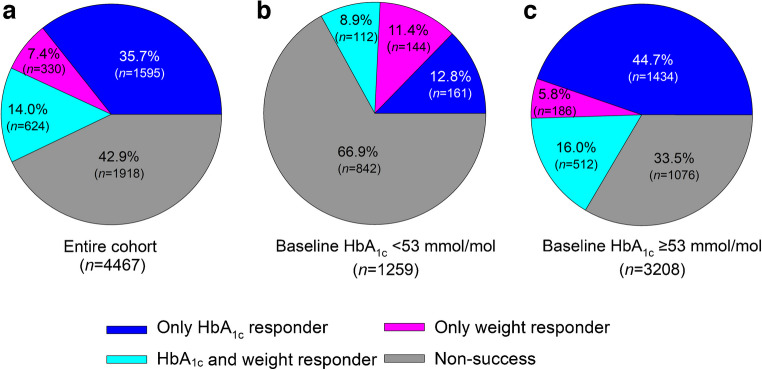
- Responses to GLP-1 RAs in type 2 diabetes show significant variability, with only 14% of participants achieving both meaningful and body weight reductions in 6 months.
Key takeaways
- Only 14% of participants achieved reductions in both and body weight, indicating a substantial gap in treatment effectiveness.
- Men and individuals with higher baseline were more likely to show -only responses, while older adults tended to respond with weight loss only.
- Higher baseline body weight and lower eGFR correlated with greater weight reduction, while lower baseline and longer diabetes duration were linked to smaller reductions.
Caveats
- The observational design limits control over variables like treatment adherence, which may affect response variability.
- The study's findings may not fully represent the broader population due to the specific characteristics of participants in the DPV registry.
Definitions
- HbA: A measure of blood glucose levels over time, indicating long-term glycaemic control.
Simplified
Introduction
Glucagon-like peptide-1 receptor agonists (GLP-1 RAs) are a cornerstone in type 2 diabetes management, improving glucose-stimulated insulin secretion, slowing gastric emptying and reducing blood glucose levels [1, 2]. Besides these well-established effects, they promote weight loss, mainly through their action in the brain [1, 2], and are therefore also approved for weight management, even in those with normal glucose regulation. In addition to reducing HbA1c and body weight, accumulating evidence underscores their role in reducing risk for diabetes complications and even mortality [2]. GLP-1 RAs show promise in other conditions linked to diabetes, including hypertension, hyperlipidaemia, liver steatosis and subclinical inflammation [2].
However, despite their efficacy, individual responses to GLP-1 RAs vary significantly, particularly in terms of glycaemic and weight management [3 –6], and this variability in real-world clinical practice, as well as clinical features linked to this, still represent a critical gap in our knowledge. Gaining insights into the heterogeneity could contribute to precision medicine strategies in diabetes care. Currently, precision medicine in diabetes emphasises patient-specific phenotypic data and distinct diabetes endotypes [7]. Incorporating treatment response variability, such as responses to GLP-1 RAs, could further refine and enhance these personalised treatment approaches. In this study, we analysed HbA1c and body weight changes in the large Diabetes Patient Follow-up (DPV) dataset, focusing on the first 6 months after initiation of a long-acting GLP-1 RA. Success was clinically defined as a 5% relative body weight reduction and a 5.5 mmol/mol (approx. 0.5%) absolute HbA1c reduction. The analysis was part of the IMI-Stratification of Obesity Phenotypes to Optimize Future Obesity Therapy (IMI-SOPHIA) project.
Methods
The DPV registry is a long-term, prospective registry collecting real-world data on diabetes diagnoses, management and outcomes across four European countries (Germany, Austria, Switzerland and Luxembourg) [8, 9]. It aggregates anonymised data from currently 521 centres on nearly 700,000 individuals with diabetes, allowing multicentre analyses and benchmarking of diabetes care. Data are pseudonymised and transferred biannually to Ulm University, Germany, where incomplete or implausible data are verified with the respective centres [8, 9]. The DPV registry is representative of pediatric diabetes care and adults with diabetes treated in diabetes-specialised practices in the four participating European countries [10]. Race and ethnicity are not well documented in the DPV registry for the participant group included and were therefore not analysed in this study. The DPV initiative and pseudonymised data analysis are approved by the ethics committee of Ulm University, Germany (314/21), and by local ethics boards of participating centres.
Study population
In the current analysis, participants had to be diagnosed with type 2 diabetes and be aged ≥18 years when starting a GLP-1 RA (a flow-chart of the selection of the study cohort is provided in electronic supplementary material [ESM] Fig. 1). We focused on long-acting GLP-1 RAs and therefore excluded individuals receiving lixisenatide (n=69) and exenatide (n=667). The final cohort included 4467 individuals, categorised into four subgroups depending on their change in weight and HbA1c within the first 6 months after GLP-1 RA initiation: individuals reducing one response variable only (either absolute HbA1c reduction ≥5.5 mmol/mol [≥0.5%] or relative body weight reduction ≥5%), individuals reducing both variables or individuals reducing neither variable.
The distribution of GLP-1 RAs among participants is shown in ESM Fig.. Sex was self-reported. 2
Variables
Glycaemic control was assessed using HbA1c, standardised to the DCCT reference [11]. Hypertension and dyslipidaemia were defined as described previously [8, 9]. History of stroke, myocardial infarction, heart failure, ischaemic heart disease, angina pectoris, peripheral artery disease, diabetic foot syndrome and neuropathy was assessed via ICD-10 diagnostic codes (https://icd.who.int/browse10/2019/en↗), foot examinations or neuropathy screens. Nephropathy was defined as a history of eGFR <60 ml/min per 1.73 m2 (calculated using the Chronic Kidney Disease Epidemiology Collaboration [CKD-EPI] formula [12]), micro- or macroalbuminuria, kidney transplant or dialysis. Microalbuminuria and retinopathy were identified through routine screening [8]. Macrovascular complications consisted of myocardial infarction, stroke, heart failure, angina pectoris, peripheral artery disease, ischaemic heart disease and diabetic foot syndrome. Microvascular complications encompassed microalbuminuria, retinopathy and neuropathy. Smoking was self-reported and documented if recorded at least once.
Statistical analysis
Analyses were performed using SAS (version 9.4, TS1M7, SAS Institute). Participant characteristics were compared between subgroups using Kruskal–Wallis and χ2 tests, with results presented as medians with IQRs or as proportions and absolute numbers.
Multinomial logistic regression was used to assess subgroup membership likelihood based on baseline parameters, with separate models for sex, age, diabetes duration, BMI, HbA1c and eGFR. A basic model adjusted for sex, age and diabetes duration at GLP-1RA initiation was further refined by adding BMI, HbA1c, additional glucose-lowering medication, vascular complications, hypertension, dyslipidaemia and smoking status, each separately. The subgroup with both HbA1c and weight reduction was used as a reference. Additionally, multinomial logistic analyses were repeated comparing the only weight reduction vs only-HbA1c reduction response groups. Results are presented as ORs with 95% CIs.
Linear regression analyses were used to evaluate the impact of baseline characteristics on weight or HbA1c change, with results presented as standardised β-coefficients with 95% CIs. For continuous parameters, the coefficient was interpreted as the number of SDs of change in the outcome variable for 1 SD change in the explanatory variable, holding the other variables constant.
A two-tailed p value <0.05 was considered significant. Bonferroni–Holm correction was applied for multiple comparisons.
Results
The study cohort had a median age at GLP-1RA initiation of 60.0 years (IQR 52.1, 68.1), with a median BMI of 34.9 kg/m2 (31.0, 40.0) and a median HbA1c of 60 mmol/mol (52, 72) (7.7% [6.9, 8.7]). Full baseline characteristics of the study cohort are provided in ESM Table 1. In total, 1890 of 4467 participants changed co-medication within the follow-up period. Aside from a decrease in additional dipeptidyl-peptidase 4 inhibitor (DPP-4i) use from 31.5% to 14.3% of participants, rates for other co-medications were relatively stable, with <5% of participants changing other co-medications (insulin, +1%; metformin, −0.1%; sodium–glucose cotransporter 2 inhibitors [SGLT-2is], +1.5%; sulfonylureas/glinides, −1.8%; thiazolidines, −0.4%).
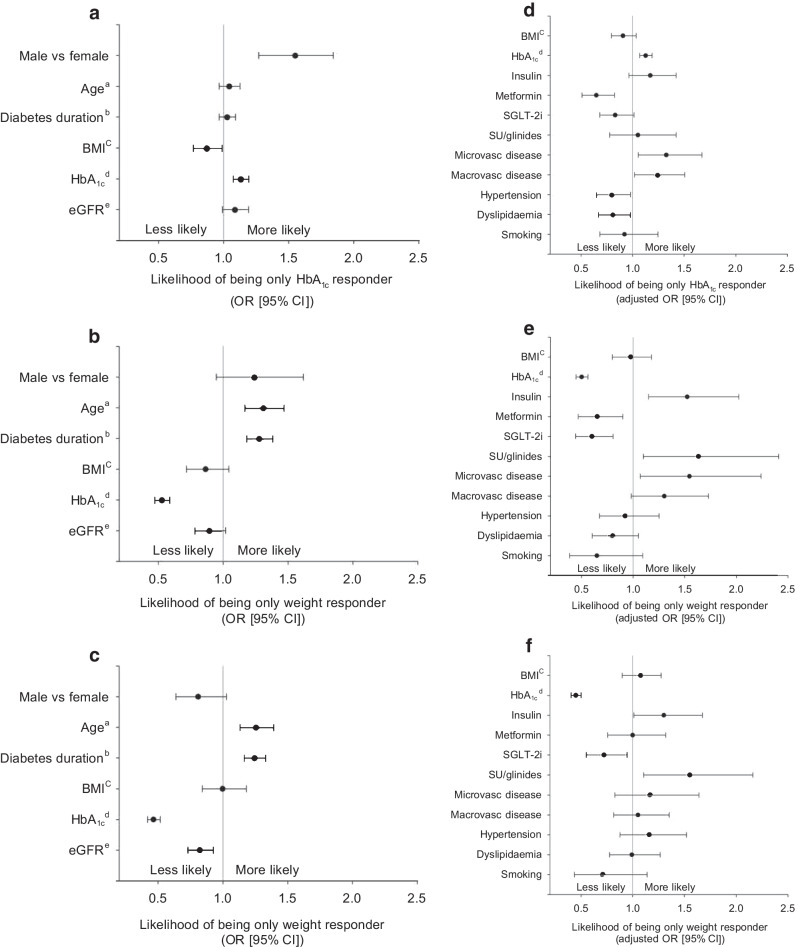
The likelihood of belonging to the only weight responder group compared with the HbA1c and weight responder group was similar between sexes (p=0.12) but increased with age (1.31 [1.17, 1.47], p<0.001) and longer diabetes duration (1.28 [1.18, 1.38], p<0.001). Higher baseline HbA1c reduced the likelihood of belonging to this group (0.52 [0.47, 0.59], p<0.001) (Fig. 3b). The presence of microvascular complications was linked to a higher likelihood of membership of the only weight responder group (Fig. 3e, p=0.02).
When comparing the only HbA1c responder and only weight responder groups, older people and those with a longer diabetes duration were more likely to belong to the only weight responder group (1.31 [1.17, 1.47] and 1.24 [1.16, 1.33], respectively; both p<0.001). Conversely, higher baseline HbA1c and eGFR were linked to membership in the only HbA1c responder group (2.15 [1.94, 2.39], p<0.001, and 1.32 [1.16, 1.51], p=0.001, respectively) (Fig. 3c). Complications and comorbidities had no impact on group membership (Fig. 3f).
We next analysed the associations between baseline characteristics and overall weight or HbA1c changes across all groups using linear regression. Standardised β-coefficients (with 95% CIs) are presented in ESM Fig. 4. Weight reduction was most strongly associated with sex, with female participants showing greater reductions. Additionally, higher baseline body weight and lower eGFR were associated with greater weight loss (all p<0.05). Higher baseline HbA1c was associated with greater HbA1c reductions, while longer diabetes duration was associated with smaller HbA1c reductions (both p<0.001).
![Heterogeneous responses to GLP-1RAs in the entire cohort () and stratified by baseline HbA(<53 mmol/mol []; ≥53 mmol/mol []) a b c 1c](https://europepmc.org/articles/PMC12245949/bin/125_2025_6448_Fig1_HTML.jpg "Click to view full size")
Heterogeneous responses to GLP-1RAs in the entire cohort () and stratified by baseline HbA(<53 mmol/mol []; ≥53 mmol/mol []) a b c 1c

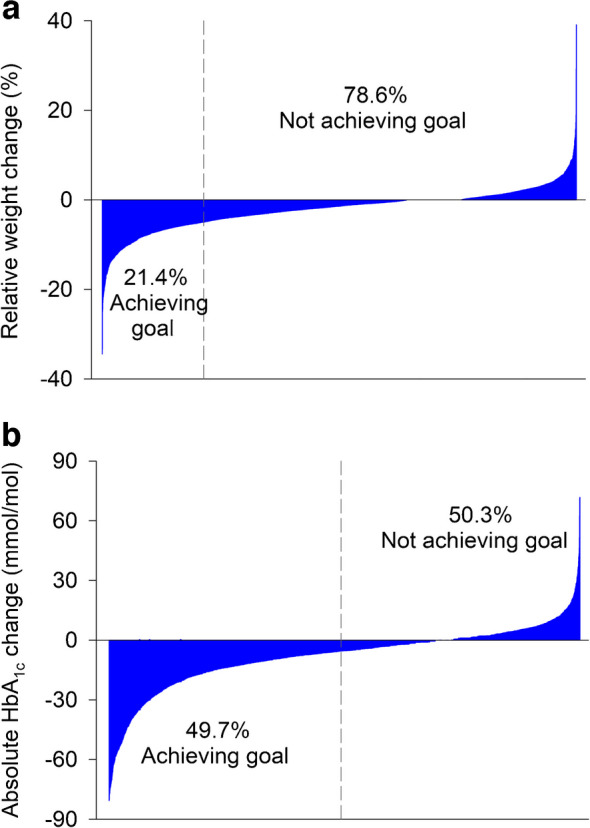
Waterfall plots for individuals' relative change in body weight () and absolute change in HbA() up to 6 months after initiation of liraglutide, semaglutide or dulaglutide (=4467). The grey dashed lines represent cut-offs for the proportions of individuals achieving a successful reduction in either body weight (relative reduction ≥5%) or HbA(absolute reduction ≥5.5 mmol/mol or 0.5%) a b 1c 1c n

Likelihood of group membership. (,) Likelihood of belonging to the only HbAresponder group vs the HbAand weight responder group, (,) likelihood of belonging to the only weight responder group vs the HbAand weight responder group and (,) likelihood of belonging to the only weight responder group vs the only HbAresponder group. (–) show results from univariate logistic regression analyses and (–) show results from separate multivariate logistic regression models, each adjusted for sex, age and diabetes duration at the time of GLP-1 RA initiation.per 10 year increase;per 5 year increase;per 10 kg/mincrease;per 10 mmol/mol increase;per 0.1 mg/min per 1.73mincrease (all other variables are yes vs no). Macrovasc, macrovascular; microvasc, microvascular; SU, sulfonylurea a d b e c f a c d f 1c 1c 1c 1c a b c 2 d e 2
Discussion
We detected marked heterogeneity in glycaemic and weight responses on GLP-1 RA initiation in adult participants with type 2 diabetes under real-world conditions. As the long-acting (more potent) GLP-1 RAs liraglutide, semaglutide and dulaglutide [1, 2] are becoming the standard in treatment, we focused on these agents. A surprising finding was that only 14% of participants achieved marked reductions in both HbA1c and body weight, with many responding primarily in one area only. Factors such as sex, age, HbA1c, BMI and diabetes duration at treatment initiation were linked to the likelihood of response.
It is possible that participants in the group with neither weight loss nor glucose reduction discontinued or only sporadically used the drug, so we focused on those who achieved a reduction in either outcome, as it is more likely that these individuals used the drug as prescribed. Among those achieving reductions, the proportion showing meaningful responses in both areas was lower than in clinical trials, which often involve highly selected, motivated populations that might therefore not be representative of the wide spectrum of individuals with type 2 diabetes in routine clinical practice [3]. In addition, the stricter management in trials may explain some of the discrepancy with findings from real-world settings, a common observation in studies of different drug classes [13]. Our data provide some insights into factors influencing treatment response, but developing robust biomarkers may be necessary for precision medicine approaches at the individual level. Although higher baseline HbA1c predictably associates with greater glycaemic reductions, the marked heterogeneity in response (as visualised in Fig. 1) highlights that baseline HbA1c alone does not fully capture treatment variability. This underscores the importance of identifying additional clinical or biological factors that can better predict glycaemic response to GLP-1 RA treatment.
Consistent with most previous trials, participants with higher pretreatment weight were more likely to lose more weight on GLP-1 RA initiation, with women achieving greater weight reductions than men [14 –16]. However, despite assumptions that women experience more side effects from GLP-1 RAs than men [15], they were not over-represented in the non-success group in our analysis. Unexpectedly, we found an association between reduced kidney function at baseline and greater weight reduction, which warrants further investigation.
Individuals with diabetes generally experience less weight reduction with GLP-1 RAs than those without diabetes [2, 6]. We found that higher HbA1c was associated with a lower likelihood of marked weight reduction, consistent with a recent meta-analysis suggesting that hyperglycaemia may impact weight management [17]. Further research is needed to explore how high glucose levels might reduce the weight loss response to GLP-1 RAs.
Our findings confirm that longer diabetes duration is associated with a lower glycaemic response to GLP-1 RAs [3, 6, 16], probably due to declining beta cell function, as intact insulin secretion is necessary for a robust glycaemic response to this drug class [1, 3]. Genetic factors may also influence the glycaemic response to GLP-1 RAs, although their impact is uncertain, while a genome-wide study did not find a link between genetic variants and weight loss response to this drug class [3], suggesting that different mechanisms are involved in the glycaemic and weight loss effects of GLP-1 RAs.
One strength of our analysis is its focus on individuals newly initiated on GLP-1 RAs, minimising prescription bias. However, the observational nature of our study limits the availability of variables such as treatment adherence or lifestyle factors, which may contribute to response heterogeneity. In future studies, it will be interesting to explore the heterogeneity in response to new co-agonist drugs, which may have even greater glycaemic and weight loss effects [2].
In conclusion, our analysis reveals substantial variability in GLP-1 RA responses in individuals with type 2 diabetes in routine clinical practice, with only a minority of individuals achieving both glycaemic and weight reductions in the first 6 months of treatment. The real-world disparities compared with clinical trials underscore the need for broader studies to better predict response and guide individualised treatment strategies in type 2 diabetes.
Supplementary Information
Below is the link to the electronic supplementary material. ESM (PDF 524 KB)