
What this is
- has potential medicinal uses but is difficult to extract sustainably from plants.
- This research focuses on enhancing the biosynthesis of in Escherichia coli using engineered enzymes.
- The study explores different tyrosine ammonia lyases and redox partners to improve production efficiency.
Essence
- De novo synthesis of from glucose in E. coli was achieved, yielding over 300 µM or 47 mg/L. The choice of and redox partners significantly influenced production efficiency.
Key takeaways
- Final titers of reached more than 300 µM or 47 mg/L in E. coli using glucose as the sole carbon source.
- The study demonstrated that the choice and gene dose of redox systems strongly influenced catalysis, enhancing overall production.
- Applying a tethering strategy to improved productivity, even with previously unproductive enzyme combinations.
Caveats
- The metabolic burden from expressing additional tethering domains may offset the benefits of enhanced enzymatic activity.
- Further optimization of gene arrangements and expression levels may be required for improved production.
Definitions
- Caffeic acid: A phenolic compound with antioxidant properties, used in various medicinal applications.
- Tyrosine ammonia lyase (TAL): An enzyme that catalyzes the conversion of L-tyrosine into other compounds in biosynthetic pathways.
- Cytochrome P450: A family of enzymes involved in the oxidation of organic substances, crucial for various metabolic processes.
Simplified
Background
Caffeic acid is widely recognized for its medicinal potential due to its antidepressive [1], antihyperglycemic [2], anti-inflammatory [3], antioxidant [2, 4], anti-coagulatory [3], anticancer [5] and antiviral [6] properties. It is readily produced in plants as a key intermediate in phenylpropanoid biosynthesis. In this pathway, phenylalanine is diverted from primary metabolism by a phenylalanine ammonia lyase associated with the endoplasmatic reticulum and transformed into trans-cinnamic acid. Cinnamic acid is then hydroxylated by the membrane-anchored Cytochrome P450 enzymes cinnamate 4-hydroxylase (C4H) and p-coumarate 3-hydroxylase to p-coumarate and caffeic acid, respectively [7, 8]. From there a range of molecules can be produced that serve as lignin building blocks or precursors for secondary metabolites such as tannins, (iso)flavonoids, anthocyanins, stilbenes and coumarins [9]. All of these compounds have high market value but are difficult to isolate because they are of low natural abundance (e.g. stilbenes and coumarins), or challenging to extract (e.g. lignin-derived aromatics) [10]. Therefore, over the last decade various strategies have been developed to implement biosynthetic pathways in microbial cell factories that promise their tailored biosynthesis in a sustainable manner. Recent examples are the production of stilbenoids and flavonoids in Corynebacterium glutamicum [11, 12], and curcumin [13, 14] and caffeic acid [14 –24] in Escherichia coli. For the biosynthesis of p-coumaric acid in E. coli, it was found that using l-tyrosine as a pathway precursor was superior over phenylalanine [25], since activity of the plant Cytochrome P450 enzyme C4H could not be reconstituted as of recently [26]. Based on this finding, two major strategies have been devised to produce caffeic acid that employ microbial tyrosine ammonia lyases (TAL) to generate p-coumaric acid followed by either (1) a flavin-dependent HpaBC-type oxidoreductase complex (4-hydroxyphenylacetate 3-hydroxylase, PFAM PF03241) from Saccharothrix espanaensis [14 –18], E. coli [19 –21], Thermus thermophilus HB8 [20] or Pseudomonas aeruginosa [22, 23], or (2) a bacterial cytochrome P450 enzyme CYP199A2 F185L from Rhodopseudomonas palustris [14, 18, 24]. In all of these studies it became evident that the caffeic titers are rather low unless l-tyrosine or p-coumaric acid are added to the growth media, or the aromatic amino acid pathway is engineered to increase intracellular l-tyrosine levels. For the pathways utilizing HpaBC-type oxidoreductases, the highest titer reported for de novo synthesis in wild-type E. coli to date is 42 mg/L (S. espanaensis TAL and HpaBC) [17]. However, to our knowledge no de novo synthesis has been reported for pathways utilizing CYP199A2 F185L.
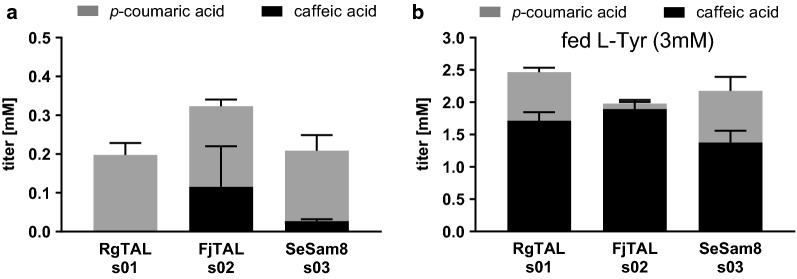
In this study, we established de novo biosynthesis of caffeic acid from glucose through the actions of TAL and CYP199A2 F185L N∆7. In order to achieve this goal, we tested TALs from three different organisms and explored strategies to enhance the activity of CYP199A2 F185L N∆7. We found that driving the binding equilibrium of the electron-donating redox partners to CYP199A2 F185L N∆7 towards the bound state improves pathway titers and enabled us to produce ~ 47 mg/L caffeic acid from glucose in wildtype E. coli MG1655(DE3). This titer is slightly higher than the titers reported for the HpaBC-based pathways in wildtype E. coli with glucose as the only carbon source [17, 19].
Results
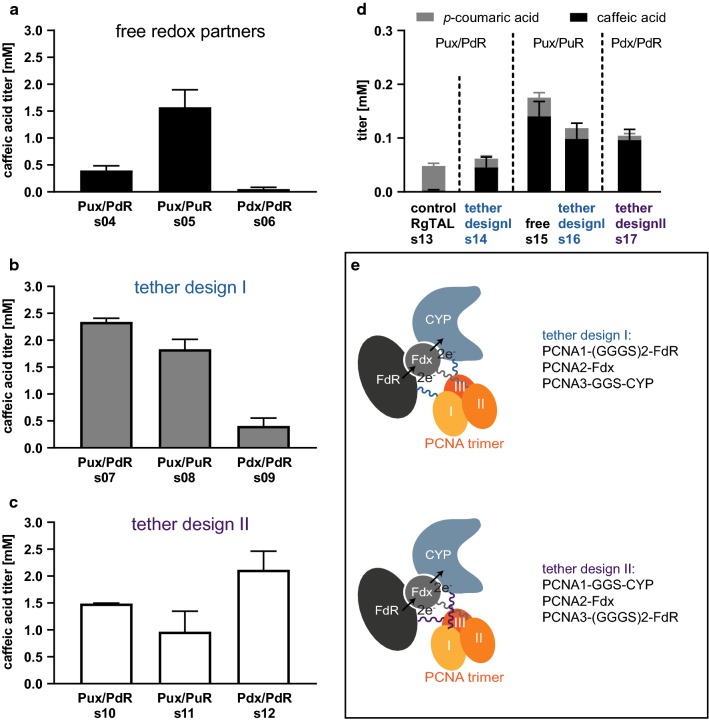
With our second strategy, we sought to further improve these redox systems by generating genetic fusions of the enzymes with the subunits of the heterotrimeric DNA sliding clamp PCNA (Proliferating Cell Nuclear Antigen) of Sulfolobus solfataricus P2 [34]. This PCNA complex has been shown to tolerate the fusion of other genes to the '3 ends (C-termini) [35] of its three subunits, while maintaining their high binding affinity towards each other: the PCNA1/PCNA2 dimer has a dissociation constant in the low picomolar range and the PCNA1/PCNA2/PCNA3 trimer in the high nanomolar range [34]. This fusion strategy has been shown to be highly efficient for the in vitro reconstitution of Cytochrome P450 activity and was termed PUPPET by the inventors (PCNA-utilized protein complex of P450 and its two electron transfer-related proteins) [35 –40]. To our knowledge, this strategy hasn't been used in whole-cell catalysis to date. Initially, we tested fusion proteins analogous to the previously described PUPPET fusions with FdR fused to the C-terminus of PCNA domain 1, Fdx to PCNA2 and the Cytochrome P450 to PCNA3 (tether design I, Fig. 3e). When feeding 3 mM p-coumaric acid, we observed higher titers of caffeic acid for all tethered redox systems than compared to the respective free enzymes (Fig. 3b). The effect was more pronounced with the hybrid and surrogate systems, where a sixfold increase in titer was observed for Pux/PdR (s07) and an eightfold increase for Pdx/PdR (s09). Overall, the highest titer was observed with the tethered version of Pux/PdR (s07, titer: 2.3 ± 0.07 mM). Next, we investigated whether these titers could be further improved by generating a new arrangement of the fusion partners. Based on the published dissociation constants for the well-studied Cytochrome P450 CYP101A1 and its redox partners [41, 42], we assumed that the affinity of Fdx to FdR is about 100-fold higher than the affinity of Fdx to the Cytochrome P450. We hypothesized that the high affinity interaction between PCNA1 and PCNA2 might be even more beneficial to the low affinity interaction between the Cytochrome P450 and Fdx than between Fdx and FdR. Therefore, we generated a second set of fusion genes (tether design II, Fig. 3e), where CYP199A2 F185L N∆7 is fused to PCNA1, Fdx to PCNA2 and FdR to PCNA3, while maintaining the linker arrangements that had previously been optimized for the respective elements of the redox complex [39]. With these alternative tethering constructs, the highest final caffeic acid titers were obtained with the surrogate Pdx/PdR redox system (s10, titer: 2.1 ± 0.35 mM), while the titers obtained with the other redox systems were lower than in the previous experiments (Fig. 3c). This indicates that the domain arrangements in the second tether design supports the weaker protein–protein interactions in the surrogate redox complex better than the other tether design, whereas it disturbs catalysis with the two redox systems that already led to high titers with free redox partners and tether design I.
Next, we tested the best redox partner constructs in the context of the full pathway with FjTAL as the first pathway enzyme (Fig. 3d). We observed the highest caffeic acid titers with the untethered, natural redox partners (Pux/PuR, s15, titer: 0.14 ± 0.028 mM). Although strains s07, s08 and s12 had slightly outperformed s05 in the one-step conversion, the corresponding strains expressing FjTAL (s14, s16, s17, respectively) yielded lower caffeic acid titers in the two-step recombinant pathway. The cost for expressing the additional tethering domains may offset the positive effects of the enhanced enzymatic activity. In all of the fermentations, lower final titers of p-coumaric acid are measured than in the initial test of FjTAL (s02), which indicates that the changes made to the second pathway step allow for an almost complete conversion to the final product.

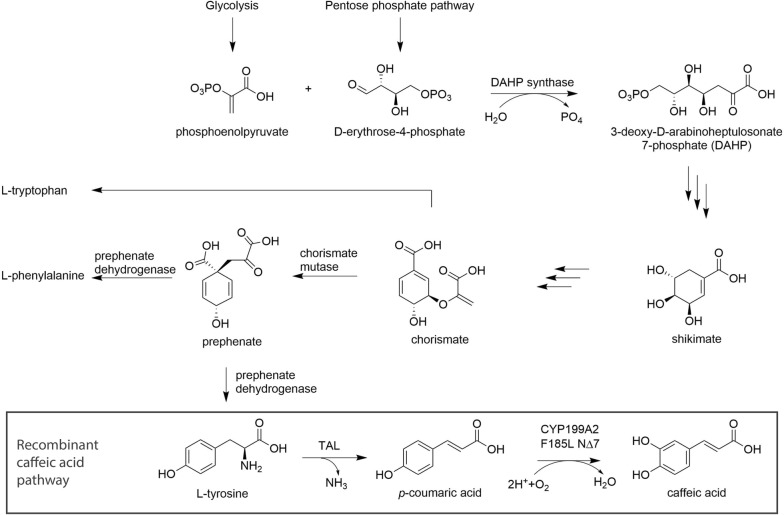
Aromatic amino acid anabolism and recombinant caffeic acid pathway with-tyrosine as a branchpoint, and TAL and CYP199A2 F185L N∆7 catalyzing the two pathway steps l

Titers of-coumaric acid and caffeic acid produced from glucose without () and with () L-Tyr supplementation in selected strains (stacked histograms, error bars = standard deviation of biological replicates, n ≥ 3) p a b
![The choice of redox partners and tethering strategies for redox partners leads to higher caffeic acid titers from-coumaric acid (–) and from glucose (). Pictograms of tether design I and tether design II ().–caffeic acid titers from 3 mM-coumaric acid 72 h p. i.: untethered/free redox partners (), tether design I analogous to PUPPET [] (), tether design II ().Stacked histograms of-coumaric and caffeic acid titers after 72 h of fermentation for select strains expressing the two-step pathway. (Error bars = standard deviation of biological replicates, n ≥ 3; Pictograms of tether designs:cytochrome P450 enzyme (CYP199A2 F185L N∆7),ferredoxin (Pux or Pdx),ferredoxin reductase (PuR or PdR)) p p p CYP Fdx FdR a c d e a c a b c d [35]](https://europepmc.org/articles/PMC7011507/bin/12934_2020_1300_Fig3_HTML.jpg "Click to view full size")
The choice of redox partners and tethering strategies for redox partners leads to higher caffeic acid titers from-coumaric acid (–) and from glucose (). Pictograms of tether design I and tether design II ().–caffeic acid titers from 3 mM-coumaric acid 72 h p. i.: untethered/free redox partners (), tether design I analogous to PUPPET [] (), tether design II ().Stacked histograms of-coumaric and caffeic acid titers after 72 h of fermentation for select strains expressing the two-step pathway. (Error bars = standard deviation of biological replicates, n ≥ 3; Pictograms of tether designs:cytochrome P450 enzyme (CYP199A2 F185L N∆7),ferredoxin (Pux or Pdx),ferredoxin reductase (PuR or PdR)) p p p CYP Fdx FdR a c d e a c a b c d [35]

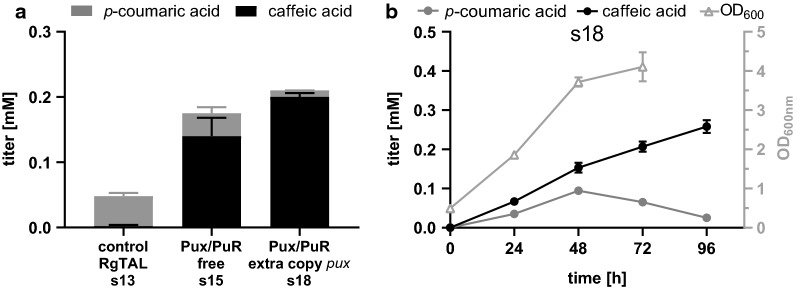
Duplication of thegene copy number further increases caffeic acid titers. Stacked histograms of-coumaric and caffeic acid titers after 72 h of fermentation with glucose as the only carbon source for select strains expressing the two-step pathway (). Titers plotted over time of a 96 h fermentation of s18 (). (Error bars = standard deviation of biological replicates, n ≥ 3.) pux p a b
| Plasmid name | Backbone | Enzyme encoded in MCSI | Enzyme encoded in MCSII | Source |
|---|---|---|---|---|
| IR54 | pKVS45 | PdR-Pux operon | n.a. | [] [18] |
| IR64 | pCDFduet | / | 6His-CYP199A2 F185L N∆7 | [] [18] |
| c22 | pRSFduet | 6His-RgTAL | / | This study |
| c25 | pCDFduet | / | PCNA3-CYP199A2 F185L N∆7 | This study |
| c28 | pETduet | 6His-PCNA2-Pux | PCNA1-PdR (opt) | This study |
| c50 | pETduet | 6His-Pux | PdR (opt) | This study |
| c62 | pETduet | 6His-Pux | PuR | This study |
| c63 | pETduet | 6His-PCNA2-Pux | PCNA1-(GGGS)2-PuR | This study |
| c71 | pRSFduet | 6His-FjTAL | / | This study |
| c72 | pRSFduet | 6His-SeSam8 | / | This study |
| c84 | pCDFduet | 6His-Pux | 6His-CYP199A2F185L N∆7 | This study |
| c86 | pETduet | 6His-Pdx | PdR (opt) | This study |
| c88 | pETduet | 6His-PCNA2-Pdx | PCNA1-(GGGS)2-PdR(opt) | This study |
| c96 | pCDFduet | / | PCNA1-GGS-CYP199A2 F185L N∆7 | This study |
| c97 | pETduet | 6His-PCNA2-Pux | PCNA3-(GGGS)2-PdR (opt) | This study |
| c98 | pETduet | 6His-PCNA2-Pux | PCNA3-(GGGS)2-PuR | This study |
| c106 | pETduet | 6His-PCNA2-Pdx | PCNA3-GGS-PdR (opt) | This study |
| c185 | pRSFduet | 6His-FjTAL | Pux | This study |
| Plasmid backbones | ||||
| Backbone | Antibiotic resistance | Copy number | Origin of replication | |
| pKVS45 | carbenicillin | ~ 10 | p15A | |
| pCDFduet | spectinomycin | 20–40 | CloDF13 | |
| pRSFduet | kanamycin | > 100 | RSF1030 | |
| pETduet | carbenicillin | ~ 40 | ColE1 | |
| Identifier | Plasmid name | Enzymes expressed | Source |
|---|---|---|---|
| s01 | IR64 | 6His-CYP199A2 F185L N∆7 | This study |
| IR54 | PdR, Pux | ||
| c22 | 6His-RgTAL | ||
| s02 | IR64 | 6His-CYP199A2 F185L N∆7 | This study |
| IR54 | PdR, Pux | ||
| c71 | 6His-FjTAL | ||
| s03 | IR64 | 6His-CYP199A2 F185L N∆7 | This study |
| IR54 | PdR, Pux | ||
| c72 | SeSam8 | ||
| s04 | IR64 | 6His-CYP199A2 F185L N∆7 | This study |
| c50 | 6His-Pux, PdR | ||
| s05 | IR64 | 6His-CYP199A2 F185L N∆7 | This study |
| c62 | 6His-Pux, PuR | ||
| s06 | IR64 | 6His-CYP199A2 F185L N∆7 | This study |
| c86 | 6His-Pdx, PdR | ||
| s07 | c25 | PCNA3-CYP199A2 F185L N∆7 | This study |
| c28 | 6His-PCNA2-Pux, PCNA1-PdR | ||
| s08 | c25 | PCNA3-CYP199A2 F185L N∆7 | This study |
| c63 | 6His-PCNA2-Pux_PCNA1-PuR | ||
| s09 | c25 | PCNA3-CYP199A2 F185L N∆7 | This study |
| c88 | 6His-PCNA2-Pdx, PCNA1-PdR | ||
| s10 | c96 | PCNA1-GGS-CYP199A2 F185L N∆7 | This study |
| c97 | 6His-PCNA2-Pux, PCNA3-(GGGS)2-PdR | ||
| s11 | c96 | PCNA1-GGS-CYP199A2 F185L N∆7 | This study |
| c98 | 6His-PCNA2-Pux, PCNA3-(GGGS)2-PuR | ||
| s12 | c96 | PCNA1-GGS-CYP199A2 F185L N∆7 | This study |
| c106 | 6His-PCNA2-Pdx, PCNA3-GGS-PdR | ||
| s13 | IR64 | 6His-CYP199A2 F185L N∆7 | This study |
| c50 | 6His-Pux, PdR | ||
| c22 | 6His-RgTAL | ||
| s14 | c25 | PCNA3-CYP199A2 F185L N∆7 | This study |
| c28 | 6His-PCNA2-Pux, PCNA1-PdR | ||
| c71 | 6His-FjTAL | ||
| s15 | IR64 | CYP199A2 F185L N∆7 | This study |
| c62 | 6His-Pux, PuR | ||
| c71 | 6His-FjTAL | ||
| s16 | c25 | PCNA3-CYP199A2 F185L N∆7 | This study |
| c63 | 6His-PCNA2-Pux, PCNA1-PuR | ||
| c71 | 6His-FjTAL | ||
| s17 | c96 | PCNA1-GGS-CYP199A2 F185L N∆7 | This study |
| c106 | 6His-PCNA2-Pdx, PCNA3-GGS-PdR | ||
| c71 | 6His-FjTAL | ||
| s18 | c84 | 6His-Pux, 6His-CYP199A2F185L N∆7 | This study |
| c62 | 6His-Pux, PuR | ||
| c71 | 6His-FjTAL | ||
| s19 | IR64 | 6His-CYP199A2 F185L N∆7 | This study |
| c62 | 6His-Pux, PuR | ||
| c185 | 6His-FjTAL, Pux |
Discussion
Building microbial cell factories for the production of plant polyphenols has been a major goal for metabolic engineers over the last decade [43, 44]. The low abundance of these compounds and their occurrence in complex mixtures of variable composition in plants, makes recombinant microbial cell factories an attractive source for industrial applications. However, the strict regulation of the aromatic amino acid metabolism, which provides precursors to most recombinant polyphenol-producing pathways, limits the overall pathway efficiency. For recombinant polyphenol-producing pathways in E. coli, it has been observed that overcoming the precursor bottleneck by metabolic engineering of the aromatic amino acid pathway, often reveals bottlenecks further down the recombinant pathway [45 –47]. Therefore, it is crucial to optimize the recombinant pathway itself before moving into a microbial chassis with deregulated aromatic amino acid production. In this study, we optimized the two-step conversion of l-tyrosine to caffeic acid. Here it is important to ensure high efficiency of the second pathway step to avoid accumulation of p-coumaric acid, which has been shown to severely inhibit the activity of the first pathway enzyme, TAL [27]. The three strategies we tested focused on the electron-donating redox partners rather than the Cytochrome P450 enzyme itself. Previous in vitro studies of this particular Cytochrome P450 and others have shown that the right choice of redox system, in particular the ferredoxin, is crucial for efficient electron transfer and enzyme catalysis [29, 33]. As expected, we observed the highest caffeic acid titers with the natural redox system composed of Pux and PuR in the one-step conversion with untethered redox partners. However, when we applied tethering strategies to increase the affinity of the Cytochrome P450 and the redox partners towards each other, we observed higher titers with the non-natural redox partners. Tethering strategies have previously been applied to several Cytochrome P450 enzymes, both in vitro [35, 42, 48 –51] and in vivo [42, 48]. The in vitro studies showed that tethered redox complexes are able to overcome the need to use an excess of redox partners over the Cytochrome P450 enzyme, to compensate for low protein–protein affinities (typically a five- to 20-fold molar excess of ferredoxin is used in vitro). Furthermore, kinetic studies showed that at low enzyme concentrations, the tethered complexes outperform the 1:1:1 mixtures of free enzymes. These reports and our findings for our versions of the PUPPET tether indicate that tethering strategies in whole-cell catalysis may be particularly useful in two scenarios: (A) if the expression levels of the Cytochrome P450 and redox partners are low (poor protein expression, expression from genomic gene copies or as part of a multi-enzyme recombinant pathway), or (B) if the natural redox partners are unknown and surrogate systems are used to reconstitute the Cytochrome P450 activity.
To our knowledge, this study is the first one to use the PUPPET tether in whole-cell catalysis and also the first one to use any of the known Cytochrome P450 tethers in the context of a recombinant pathway. In the caffeic acid pathway, the tethered Cytochrome P450 complexes were slightly outperformed by the free, natural redox complex, in particular in the presence of extra copies of the pux gene (s18). This may indicate that the metabolic burden of expressing the PCNA subunits in addition to the pathway enzymes and the three resistance genes required for plasmid maintenance represents a disadvantage of the strains expressing the tethered Cytochrome P450 complexes compared to the ones expressing the free, natural redox complex (s15 and s18). The fact that s18 outperforms s15 indicates that the availability of Pux is limiting in s15, and is in good agreement with observations made in other whole-cell conversions [52, 53]. In our hands, further increasing the number of pux gene copies, did not increase caffeic acid titers (strain s19, Additional file 1: Figure S2). It is possible that rearranging the genes in the vector system could lead to even better results than described herein; however, exploring the combinatorial space of enzyme expression levels in this pathway is beyond the scope of this study. Our optimization efforts of the second pathway step in combination with the use of FjTAL for the first pathway step, enabled us to demonstrate the de novo production of caffeic acid in an otherwise wild type E. coli background. FjTAL had previously been seen to be beneficial for the production of p-coumaric acid and its derivatives in other microbes [11, 54, 55], however, to our knowledge it has not been used in E. coli. It appears that this enzyme allows for a more efficient routing of l-tyrosine into the caffeic acid pathway than RgTAL at low l-tyrosine concentrations. Under high l-tyrosine conditions, at levels that we would expect in tyrosine producer strains [56], our fermentation strains expressing FjTAL achieve slightly higher caffeic acid titers than the strains expressing RgTAL and lower titers of p-coumaric acid. This indicates that the optimized pathway is more balanced so that less p-coumaric acid accumulates but overall less l-tyrosine is converted into p-coumaric acid. To further improve these results, it is necessary to investigate the stability and activity of the FjTAL enzyme over time, since it appears to be inactive after 48 h of fermentation.
Conclusions
In this study we established de novo synthesis of caffeic acid by expressing tyrosine ammonia lyase from Flavobacterium johnsoniae and CYP199A2 F185L N∆7 from Rhodopseudomonas palustris with its redox partners palustrisredoxin and palustrisredoxin reductase. We found that compared to earlier versions of this pathway, changes made to the redox partners, namely the use of palustrisredoxin reductase instead of putidaredoxin reductase and the duplication of the palustrisredoxin gene dose, as well as the use of FjTAL instead of RgTAL, enhanced the pathway performance under low l-tyrosine conditions as encountered in otherwise wild type E. coli. Furthermore, we observed that applying a tethering strategy to the Cytochrome P450-catalyzed pathway step based on the PUPPET system [35] increases caffeic acid titers in strains expressing non-natural redox systems. This indicates that this strategy can be useful for pathways containing orphan bacterial Cytochromes P450. The optimized caffeic acid pathway could now be transferred into a tyrosine-producer E. coli strain for more in-depth characterization or process engineering.
Materials and methods
Bacterial strains and plasmids
All molecular cloning and plasmid propagation steps were performed in chemically competent Escherichia coli E. cloni® 10G (F- mcrA ∆(mrr-hsdRMS-mcrBC) endA1 recA1 Φ80dlacZ∆M15 ∆lacX74 araD139 ∆(ara,leu)7697galU galK rpsL nupG λ- tonA) produced by Lucigen (Middleton, WI, USA). Gene expression under the control of T7 promoters was performed in E. coli K-12 MG1655(DE3) [57]. Plasmids were constructed with a range of strategies summarized in Additional file 1: Table S2. All genes in the final constructs were fully sequenced (Eton Bioscience, Charlestown, MA). The FjTAL, SeSam8 and PCNA1-PdR genes were codon optimized for E. coli and synthesized as gblocks® gene fragments by Integrated DNA Technologies (Coralville, IA, USA) (sequence provided in SI). Plasmids pHSG-PCNA2 and pHSG-PCNA3 were a gift from Teruyuki Nagamune obtained through Addgene (Cambridge, MA, USA) (Addgene plasmid # 66126; http://n2t.net/addgene:66126↗; RRID:Addgene_66126) and (Addgene plasmid # 66127; http://n2t.net/addgene:66127↗; RRID:Addgene_66127) [35]. Plasmid pACYCDuet-PuR/Pux was a gift from Dr. Stephen G. Bell (University of Adelaide, Australia). The construction of plasmids IR54 and IR64 is described in Rodrigues et al. [18].
The peptide linkers connecting the PCNA subunits with the respective enzymes were designed based on the optimized linkers described in Haga et al. [39] (tether design I: PCNA1-(GGGS)2-FdR, PCNA2-GGGSP20G-Fdx, PCNA3-GGS-Cytochrome P450; tether design II: PCNA1-GGS-Cytochrome P450, PCNA2-GGGSP20G-Fdx, PCNA3-(GGGS)2-FdR).
Fermentation
Plasmids and strains used in fermentations are described in Tables 1 and 2, respectively. E. coli K-12 MG1655(DE3) made chemically competent according to the protocol by Inoue et al. [58] was sequentially transformed with appropriate plasmids. The correct identity of strains was confirmed by colony PCR. Starter cultures were prepared from three individual colonies of the final strains in 5 mL Lysogeny broth (LB) supplemented with carbenicillin (100 µg/mL), spectinomycin (50 µg/mL) and kanamycin (50 µg/mL, only s01–s03 and s13–s18) in round-bottom polystyrene tubes, incubated over night at 37 °C with agitation and used to inoculate the main cultures (7 mL LB with antibiotics; round-bottom polystyrene tubes). After 4 h of growth at 37 °C, 250 rpm, OD600 was measured and the appropriate volume of each culture pelleted and resuspended in modified, selective M9 including substrates and 4% glucose to obtain 15 mL cultures at OD600 of 0.7 or 20 mL cultures at OD600 of 0.5 to 0.7 (time course experiment) in sterile glass tubes. These cultures were incubated at 26 °C, 160 rpm for 72 h or 96 h (time course experiment). For the time course experiment samples of 1000 µL were taken every 24 h, for all other experiments samples of 2000 µL were taken after 72 h and either stored at − 20 °C until further processing or extracted with ethyl acetate immediately.
M9 medium composition (1x) prepared from sterile stocks: M9 salts (Millipore-Sigma, used as 5× stock), Trace Mineral Supplement (ATCC® MD-TMS™, used as 200× stock), vitamin mix (from 100x stock; final: riboflavin 0.84 mg/L, folic acid 0.084 mg/L, nicotinic acid 12.2 mg/L, pyridoxine 2.8 mg/L, and pantothenic acid 10.8 mg/L), biotin (from 1000× stock; final: 0.24 mg/L), thiamine (from 1470× stock; final: 340 mg/L), ∆-Aminolevulinic acid (from 1000× stock in MeOH, final: 7.5 µg/mL), IPTG (from 1000× stock, final: 1 mM), aTc (from 1000× stock, final: 100 ng/mL; only included in fermentations of s01–s03), carbenicillin (from 1000× stock, final: 100 µg/mL), spectinomycin (from 1000× stock, final: 50 µg/mL), kanamycin (from 1000× stock, final: 50 µg/mL, only strains s01–s03 and s13–s18), 4% (w/v) glucose (from 50% w/v stock). Optional: p-coumaric acid (from fresh 100× stock in MeOH, final 3 mM) or l-tyrosine (from fresh 100x stock in 1 M HCl).
Product extraction
The samples were acidified with 6 N HCl (pH < 3) and split into two tubes as technical duplicates. Samples were extracted twice with equal volumes of ethylacetate. The organic phases of both extraction steps were combined and evaporated under a stream of air or nitrogen. The dried material was resuspended in 100 µL Acetonitrile with 0.1% Trifluoracetic acid (10x concentrated compared to culture) or 80 µL Acetonitrile with 0.1% Trifluoracetic acid (5x concentrated compared to culture) for the time course experiment. Samples were transferred into HPLC vials with conical glass inserts and analyzed by HPLC.
HLPC analysis
10 µL of the samples were analyzed by reversed-phase HPLC (instrument: Agilent 1100, column: Agilent Zorbax Eclipse XDB-C18 80Å, 4.6 × 150 mm, 5 µm; detector: Agilent diode array detector G1315B, λ = 310 nm, gradient: 10% to 20% Acetonitrile with 0.1% Trifluoracetic acid over 17 min. The p-coumaric acid and caffeic acid peaks were identified by comparing the retention times to authentic standards and by mass spectrometry (Agilent G6120, quadrupole MS). The integrated peak areas were converted to concentrations in mM based on calibration curves generated with authentic standards.
Supplementary information
Additional file 1. DNA sequences of synthetic genes used in this study, two additional tables and two additional data figures.