
What this is
- This research investigates the therapeutic potential of human induced pluripotent stem cell (hiPSC)-derived pericytes in Alzheimer's disease (AD) models.
- APOE4/4 mice, a model for late-onset AD, received multiple intravenous injections of pericytes derived from APOE3/3 hiPSCs.
- The study assesses cognitive function, AD-related pathologies, and blood-brain barrier (BBB) integrity following treatment.
Essence
- Transplantation of APOE3/3 hiPSC-derived pericytes significantly improved cognitive function and reduced AD pathologies in APOE4/4 mice. The therapeutic effects were mediated by rich in IGF2.
Key takeaways
- Multiple transplantations of APOE3/3 pericytes rescued cognitive decline in aged APOE4/4 mice. Behavioral tests showed improved performance in tasks assessing memory and learning.
- Transplanted pericytes preserved BBB integrity and reduced neuron loss, Aβ accumulation, and microglial activation in APOE4/4 mice. This indicates a potential mechanism for therapeutic intervention in AD.
- derived from APOE3/3 pericytes were found to be crucial for therapeutic effects. They promoted functional recovery in endogenous pericytes and improved BBB function through IGF2.
Caveats
- The study primarily focuses on a mouse model, which may not fully replicate human AD pathology and responses to treatment. Further research is needed to validate findings in human subjects.
- The exact mechanisms by which IGF2 influences pericyte function and AD pathology require additional investigation to clarify its role in therapeutic efficacy.
Definitions
- apolipoprotein E (APOE): A protein involved in lipid metabolism, with the APOE4 allele being a major genetic risk factor for Alzheimer's disease.
- apoptotic vesicles (ApoVs): Membrane-bound vesicles released from apoptotic cells that can carry signaling molecules, such as IGF2, influencing neighboring cells.
Simplified
Background
Alzheimer's disease (AD), characterized by neuronal loss and cognitive decline, is the most common type of dementia [1]. Globally, over 50 million individuals suffer from AD, and the number doubles every 20 years [2]. Since description of the first case in 1906, abnormal extracellular deposition of amyloid-β (Aβ) and intracellular accumulation of hyperphosphorylated tau (p-tau) in neuronal cells remain the leading theory of AD-related pathologies [3]. Thus, therapeutic strategies targeting Αβ have been considered as the prime choice for AD drug development. Two monoclonal antibodies for Αβ, lecanemab and donanemab, have been approved by US Food and Drug Administration for clearing Αβ plaques and decelerating cognitive decline of AD patients in the early stages [4]. However, the clinical benefits of Αβ-targeting treatments remain modest, with other limitations of high cost and side effects. Therefore, it is still urgent to unravel the pathophysiological mechanisms underlying AD and develop new therapeutic choices for the treatment of AD.
While the specific causes of AD are not fully understood, the apolipoprotein E allele 4 (APOE4) has been recognized as the strongest genetic risk factor for late-onset AD, accounting for almost 50% of AD patients in the United States [5]. People carrying two copies of the APOE ε4 allele have a higher risk of AD and earlier disease onset than heterozygous individuals. The APOE gene product, ApoE, is a plasma lipoprotein which plays a key role in lipid circulation and metabolism [6]. There are three ApoE isoforms: ApoE2 (Cys112/Cys158), ApoE3 (Cys112/Arg158), and ApoE4 (Arg112/Arg158), which differ only by a single amino acid change between Cys and Arg [7]. Compared with the most common APOE ε3 allele, APOE ε4 increases, while APOE ε2 decreases the risk of AD [8]. From age 55, almost all APOE4 homozygotes have higher levels of AD biomarkers compared to APOE3 homozygotes [9]. Nevertheless, effective therapies for APOE4-related AD have not yet been reported. Even lecanemab is carefully recommended for APOE4-carriers due to the higher risk of amyloid-related imaging abnormalities with edema or effusions [10].
The blood–brain barrier (BBB) separates circulating blood from neural tissues through a selective semi-permeable membrane, preventing neurotoxic plasma components, blood cells, pathogens and other neurotoxic substances from the brain [11]. Nevertheless, studies indicate that APOE4 accelerates BBB breakdown and causes degeneration of brain capillary pericytes, contributing to cognitive decline independently of Aβ and phosphorylated tau (p-tau) in the cerebrospinal fluid [12, 13]. In APOE4 mice, increased BBB permeability was also observed as early as 8–12 weeks of age, prior to occurrence of neuronal changes [14]. Brain pericytes, originating from cranial neural crest (CNC) cells during embryonic development, are critical in the establishment and maintenance of the BBB integrity [15]. Experimental ablation of pericytes leads to BBB breakdown, blood-flow reduction, white matter dysfunction and neuronal loss, while implantation of pericytes differentiated from C3H/10T1/2 mouse embryo fibroblasts in the brain cortex enhances cerebral blood flow and reduces Aβ pathology in APP/PS1 mouse model of AD [16, 17]. Thus, pericyte transplantation may be a promising therapeutic strategy for APOE4-related AD.
In our previous research, we successfully derived pericyte-like cells (PCs) from human induced pluripotent stem cells (hiPSCs) through the CNC stage, and demonstrated that intravenous injection of hiPSCs-CNC PCs could efficiently restore BBB integrity in the transient middle cerebral artery occlusion (tMCAO) mouse model [18]. However, whether hiPSCs-CNC PCs could improve BBB barrier function and cognition of APOE4 carriers remains to be explored. In the current study, we aimed to investigate the effects of transplantation of APOE3/3-PCs on behavioral performance, AD-related pathological features, and BBB function in APOE4/4 mice. Additionally, the spatial and temporal distribution characteristics of transplanted cells and the underlying mechanisms were investigated.
Materials and methods
Animals
Female C57BL/6 (wild-type, WT) mice aged 8–12 weeks (weight 18–25 g) were purchased from GemPharmatech Co., Ltd (Nanjing, China). Homozygous APOE4/4 mice were from Cyagen Biosciences Inc. (Suzhou, China) and bred under standard specific-pathogen-free (SPF) conditions. All mice were housed in a temperature-, humidity- and light cycle-controlled facility (20 ± 2 °C; 50% ± 10%; 12-h light/dark cycle) with free access to food and water. For the single injection project, aged (18 months old) APOE4/4 mice were intravenously injected with 1 × 10⁶APOE3/3-PCs, human dermal fibroblasts (HDFs; Cat. #2320, ScienCell Research Laboratories, Carlsbad, CA) or an equal volume of phosphate buffered saline (PBS). For the multiple injection project, mice of 2–3 months old were intravenously injected with 1 × 10⁶APOE3/3-PCs, HDFs or an equal volume of PBS once a month for 8 consecutive months. For apoptotic vesicle (ApoV) treatment, APOE4/4 mice aged 2–3 months were intravenously injected with 2 × 10⁷ ApoVs−PCs, ApoVs−HDFs or an equal volume of PBS every 21 days for 10 times. All animal experimental procedures were approved by the Sun Yat-Sen University Animal Use and Care Committee (2020-000305).
Generation of hiPSCs
Peripheral blood mononuclear cells (PBMCs) from APOE3/3 or APOE4/4 carriers were obtained at the Third Affiliated Hospital of Sun Yat-Sen University following the standards of Ethics Committee of the hospital (Approval number: 2020-02-148-01) and the 1964 Helsinki Declaration and its later amendments or comparable ethical standards. APOE3/3 and APOE4/4 hiPSCs were generated by transduction of human PBMCs with Sendai viral vectors (Cat. #A16517, Thermo Fisher Scientific, Rutherford, NJ) according to the manufacturer's instructions [19]. The hiPSCs were maintained at feeder-free conditions using mTeSR™ Plus medium (Cat. #100–0274, Stem Cell Technologies, Vancouver, Canada) on pre-coated Matrigel (Cat. #354277, BD Bioscience, San Diego, CA). Cells were passaged every 4–5 days with 0.5 mmol/L EDTA (Cat. # 15575020, Invitrogen, Carlsbad, CA). APOE genotyping was performed using a PCR-restriction fragment length polymorphism approach [20]. The APOE3/3 and APOE4/4 genotypes were confirmed by Sanger sequencing. Information of APOE3/3 and APOE4/4 carriers is listed in Table S1.
Pericyte-like cell differentiation from hiPSCs
Pericyte-like cells were differentiated as described in our previous study [18]. In brief, hiPSCs were harvested using Accutase (Cat. # 00-4555-56, Invitrogen) and plated onto a Matrigel-coated T75 cell culture flask at a density of 104 cells/cm2. A chemically defined N2B27 medium (N2B27-CDM) containing 95% DMEM/F12 medium, 1% N2 supplement, 2% B27 supplement, 1% Glutamax, 1% MEM nonessential amino acids, 55 μmol/L 2-mercaptoethanol (all from Invitrogen), 10 μmol/L Y27632 (Cat. #72304, Stem Cell Technologies), and 20 ng/ml basic fibroblast growth factor (bFGF) (Cat. #100-18C, Peprotech, Rocky Hill, NJ) was used. Twenty-four hours later, the N2B27-CDM medium was replaced with NCN2 medium containing N2 supplement, CHIR99021 (1 μmol/L), and SB431542 (2.0 μmol/L) and cultured for 6 days. Then the cells were dissociated to single cells using Accutase and labeled with antibodies for CD57 (Cat. #558619, BD Bioscience) and low-affinity nerve growth factor receptor p75 (Cat. #560326, BD Bioscience) for fluorescence-activated cell sorting (FACS). p75brightHNK1+ CNC stem cells were sorted and replated onto poly-L-ornithine (PO; 15 mg/ml, Cat. #P4957, Sigma-Aldrich, St. Louis, MO)- and fibronectin (FN; 10 mg/ml, Cat. #FC010, Millipore, Temecula, CA)-coated dishes for adherent culture with neural crest culture medium (NCCM) containing 1% N2 supplement, 2% B27 supplement, 20 ng/ml bFGF, and 20 ng/ml epidermal growth factor (EGF; Cat. #AF-100-15, Peprotech). CNCs were dissociated using Accutase and plated onto the PO/FN-coated dishes at a density of 105 cells/cm2 in NCCM supplemented with 10 μmol/L Y27632. When differentiation was initiated, the culture was switched to commercial Pericyte Medium (Cat. #1201, ScienCell Research Laboratories) containing 10 ng/ml bFGF and 50 ng/ml platelet derived growth factor BB (Cat. #100-14B, Peprotech) for 7–14 days. The first confluent culture at this time point was denoted as passage 1. Cells were dissociated by Accutase solution, split at 1:3 in Pericyte Medium, and cultured on PO/FN-coated plates.
Behavior tests
Open field test (OFT)
Animals were moved to the testing room at least 3 h prior to the test. OFT was performed in a cubic open field chamber (50 cm × 50 cm × 50 cm), with bottom area divided into a central field (25 cm × 25 cm) and a peripheral field. Mouse behaviors were captured using a SONY HDRCX405 video camera for 10 min and analyzed by a behavioral analysis software (TopScanLite, Clever System, Reston, VA). The total distance, center distance, number of entries in the center and the time spent in the central field were recorded for analysis.
Morris water maze (MWM)
MWM was conducted in a circular tank (diameter, 120 cm) filled with opaque water at a temperature of 24 °C. Four visual cues with different shapes were placed around the tank to assist recognition of orientation. The water was made opaque with a non-toxic chemical titanium dioxide (food-grade titanium dioxide). The platform was submerged ~ 1.0 cm below the water surface. During the training phase, mice were trained once a day for 5 consecutive days. During training, each mouse was given 60 s to find the platform. If it failed to find the platform within 60 s, it would be guided to the platform and stayed there for 15 s. In the spatial probing test on day 6, the platform was removed and each mouse was allowed to swim for 60 s. The time and the number of crossings in the platform quadrant were recorded. Mouse behavior was recorded by a SONY HDRCX405 video camera and analyzed using the TopScanLite software (TopScanLite, Clever System, Reston, VA).
New object recognition (NOR)
NOR was conducted in a cubic open field chamber (50 cm × 50 cm × 50 cm). Briefly, mice were placed in the chamber and allowed for free exploration for 10 min on day 1 (habituation period). Twenty-four hours later, two familiar objects were placed in the chamber and mice were allowed to explore for 10 min (learning period). After another 24-h interval, one familiar (F) object was replaced by a novel object (N), and mice were allowed to explore the two objects for 10 min (testing period). The time spent exploring the familiar and novel objects and animal movement were recorded using the TopScanLite software. Recognition index of exploration was calculated as follows: recognition index = time spent on the new object/total exploration time of the two objects.
Spontaneous alternation T-maze
Spontaneous alternation T-maze test was used to assess the spatial working memory of mice. The T-maze was a T-shaped apparatus featuring a start arm and two goal arms. Each arm was endowed with a guillotine door. Each mouse was transferred to the testing room at least 3 h prior to the test. During each trial, the animal was first placed in the start arm for 30 s. Then the guillotine door of the start arm was opened. When the mouse entered a goal arm, the guillotine door behind it was closed. Then, the mouse was placed back to the start arm again for 30 s, and then the guillotine door of the start arm was opened to allow the mouse to make a choice between the two goal arms. Trials were marked as successful if the mouse chose different goal arms on each run. Alternation rate was defined as the total proportion of successful trials for each animal during 10 consecutive trials.
Establishment of tdTomatoPCs and mCherryEGFPPCs + + +
Early passage of PCs was transduced with hU6-MCS-Ubiquitin-tdTomato-IRES-puromycin control lentivirus (GeneChem, Shanghai, China). Forty-eight hours later, puromycin was used to select stable tdTomato+ cells for cell tracing in vivo. mCherry+EGFP+ lentivirus was kindly provided by Xiaoran Zhang's lab (Zhongshan School of Medicine, Sun Yat-sen University) synthesized according to the methods published previously [21]. Briefly, the sLP-mCherry sequence and the EGFP sequence were cloned into a pRRL lentiviral backbone. A soluble peptide and a modified TAT peptide were cloned upstream of the mCherry cDNA (sLP-mCherry), in which sLP–mCherry is used to label phospholipid bilayer and EGFP represents cell contents. PCs were stably infected with lentiviral particles. mCherry+EGFP+ PCs were used for tracing PC-released EVs in vivo.
Multiphoton microscopic analysis
Multiphoton microscopy was performed to detect BBB leakage in vivo. In brief, mice were anesthetized with isoflurane and a cranial window (~ 0.5 cm in diameter) was made. Fluorescein isothiocyanate (FITC)-conjugated dextran (Cat. #46944, Sigma-Aldrich) was injected via tail vein (1.5 mg per mouse). In vivo time-lapse images were acquired for a total of 30 min using an FVMPE-RS confocal microscope (Olympus, Tokyo, Japan). The fluorescence intensity of dextran was quantified by Image J software (https://imagej.nih.gov/ij/↗). To observe ApoV release from the lung of APOE4/4 mice, fresh dissected lung was placed in a 6-well plate and perfused with PBS. ApoVs released from lung were observed under the FVMPE-RS confocal microscope, and time-lapse images were acquired every 5 min for 1 h.
Isolation and characterization of ApoVs
ApoVs were induced as previously reported [22]. When PCs or HDFs reached full confluency, the culture medium was removed and replaced with a basal medium containing 500 nmol/L staurosporine (STS) (Cat. #SB17469, Macklin, Shanghai, China) without FBS. After induction of apoptosis for 12 h, ApoV-containing supernatant was isolated and ApoVs were purified using sequential centrifugation. Briefly, cells and cell debris were removed by 800 × g centrifugation for 10 min and 2000 × g centrifugation for another 10 min. Next, the supernatant was centrifuged at 15,000 × g for 30 min to pellet the ApoVs. Cleaved-caspase-3 assay and flow cytometry analysis with annexin V and PI staining were used to evaluate the apoptotic rate of cells. The morphology of ApoVs was observed with transmission electron microscopy (TEM) (HT7800, Hitachi High-Technologies Corporation, Tokyo, Japan). ApoV surface markers CD9, CD63, and CD81 were assessed by flow cytometry.
Dextran leakage and Aβtranscytosis assay 1-40
To test the barrier function of PCs and the treatment effect of ApoVs, PCs were cocultured with primary human brain microvascular endothelial cells (HBMECs) in 24-well transwell inserts (Cat. #3413, Corning Life Sciences, Topsfield, MA) pre-coated with collagen (1 μg/ml) and FN (10 μg/ml) for at least 4 h at 37 °C. PCs (10,000 cells per insert) and HBMECs (20,000 cells per insert) were seeded on the top side of the inserts and cocultured for 48 h. For ApoVs treatment, 2 × 10⁵ ApoVs derived from APOE3/3-PCs or HDFs were added to the upper chamber of the transwell.
To assess permeability, 4-kD dextran labeled with FITC was added to the upper chamber of the transwell and placed on a shaker in an incubator. Two hours later, medium in the bottom well was collected for analysis. For Aβ1-40 transcytosis assay, FITC-labeled Aβ1-40 was added into the lower chamber. The medium in the upper compartment was collected after 24 h. Fluorescent intensity was then analyzed with a fluorometric plate reader (Infinite F200 Pro, Tecan Life Sciences, Männedorf, Switzerland) at 488 nm excitation and 525 ± 20 nm emission.
Immunohistochemistry (IHC) and immunofluorescence (IF) analysis
For IF analysis, mouse brain samples were fixed in 4% paraformaldehyde (PFA) overnight at 4 °C, washed with PBS and then immersed in 30% sucrose solution overnight at 4 °C. Samples were embedded in optimal cutting temperature compound (OCT, Cat. #4583, Sakura Finetek, Torrance, CA) and cut into 35 μm-thick sections. The sections were blocked in blocking buffer (5% donkey serum in 0.3% Triton X-100 in PBS) for 1 h at room temperature, incubated with primary antibodies overnight at 4 °C and then secondary antibodies for 2–4 h at room temperature. For cell tracing experiments, brain samples were sliced at 50 μm thickness to better trace and identify the complete cellular structures. For in vitro samples, cells were fixed with 4% PFA at room temperature for 20 min and washed three times with PBS. Then, cells were permeabilized with 0.3% Triton X-100 in PBS and incubated overnight at 4 °C with primary antibodies and with secondary antibodies for 1–2 h at room temperature.
The following antibodies were used: NeuN (Abcam, Cat. #ab177487, 1:200, Cambridge, UK), Iba1 (Genetex, Cat. #GTX100042, 1:100, Irvine, CA), Fibrinogen (Abcam, Cat. #ab43269, 1:100), Albumin (Abcam, Cat. #ab207327, 1:100), ZO1 (Thermo Fisher Scientific, Cat. #40-2200, 1:100, Waltham, MA), Occludin (Thermo Fisher Scientific, Cat. #71-1500, 1:100, Waltham, MA), Lectin (Vector, Cat. #DL-1178-1, 1:100, San Ramon, CA), Pfgfrβ (Cell Signaling Technology, Cat. #3169, 1:100, Danvers, MA), cleaved-caspase3 (Abcam, Cat. #ab2302, 1:100), and CD206 (Biolegend, Cat. #141708, 1:50, San Diego, CA). DAPI (Roche, Cat. #1023627001, Basel, Switzerland) was used as a counterstain for the nucleus.
Images of NeuN/Iba1 staining, fibrinogen/albumin leakage, pericyte coverage and ZO1/Occludin coverage were reconstructed as maximum projections of 10-μm-thick Z-stack images using Imaris Viewer (Oxford, Oxford, UK), and subsequent analyses were performed using ImageJ software (NIH, Bethesda, MA). For each animal, 5 sections corresponding to the plane of maximum coronal surface area were collected. For quantification, five randomly selected views of either the cortex or hippocampus were captured from each section, and the statistical values were derived based on the average of 25 views (5 sections × 5 images per section). The experiments were repeated three times to ensure reproducibility.
For IHC analysis, mouse brain samples were embedded in paraffin and cut into 5 µm-thick coronal sections. Tissue sections were incubated overnight with primary antibodies: anti-Aβ40 Rabbit pAb (Servicebio, Cat. #GB111197-100, 1:100, Wuhan, China), and phospho-Tau-T181 Rabbit mAb (ABclonal, Cat. #AP1387, 1:100). Staining was revealed using biotinylated secondary antibodies (Servicebio, Cat. #GB1302) and the ABC-HRP kit (Cat. #PK-4000, Vector, San Ramon, CA). Aβ burden (refers to the proportion of Aβ-positive area to the captured area) and the number of p-tau-positive cells per unit area (mm2) were quantified. For each animal, five coronal sections were collected. For each section, five images were randomly acquired from either the cortex or the hippocampus. Thus, for each animal, a total of 25 images (5 sections × 5 images per section) were analyzed, and statistical values were calculated based on the average across these 25 images.
Flow cytometry
Flow cytometry was performed using the CytoFLEX flow cytometer, and results were analyzed with the CytExpert (Beckman, Brea, CA). The following antibodies were used: FITC anti-human CD9 antibody (1:100; Cat. #312103, Biolegend), PE/Cyanine7 anti-human CD63 antibody (1:100; Cat. #353009, Biolegend), APC anti-human CD81 antibody (1:100; Cat. #349509, Biolegend), and BD Pharmingen™ FITC Annexin V Apoptosis Detection Kit I (Cat. #556547, BD Biosciences).
RNA sequencing (RNA-seq)
RNA-seq was performed as previously reported [18]. Total mRNA was isolated from ApoVs−HDFs or ApoVs−PCs for bulk RNA-seq analysis. RNA-seq libraries were constructed using the Illumina mRNA-seq Prep Kit (Cat. #20020594, Illumina, San Diego, CA) according to the instructions of the manufacturer. The fragmented and randomly primed 150 bp paired-end libraries were sequenced using Illumina Novaseq 6000 (Illumina). Sequencing data were processed using Consensus Assessment of Sequence and Variation (CASAVA, version 1.8.2; Illumina) using the default settings. The TPM values were used to evaluate the expression levels of genes. Pearson's correlation coefficients were calculated (R2) to measure the similarities of the global gene expression profiles between ApoVs−HDFs and ApoVs−PCs. Finally, the RNA-Seq data were analyzed using the Ingenuity Pathways Analysis software (Ingenuity Systems Inc., Redwood City, CA) to categorize the differentially regulated genes. RNA-seq data have been deposited at the NGDC database (https://ngdc.cncb.ac.cn/gsa-human/↗) under accession number HRA009346.
Proteomic analysis
4D label-free quantitative proteomics analysis was supported by Jingjie PTM BioLabs (Hangzhou, China), including protein extraction, trypsin digestion, HPLC fractionation and LC-MS/MS analysis. Proteins were identified by comparing against the Uniprot database with a false discovery rate (FDR) set at 0.01 for both peptides and proteins. Proteins with differential expression between ApoVs−HDFs and ApoVs−PCs were included for further functional analysis. The details of all the identified proteins are listed in Additional file 2, Table S2.
IGF2 knockout in3/3-PCs APOE
Gene knockout was performed using the CRISPR–Cas9 system. pLenti-IGF2-sgRNA (Cat. #L27870) and pLenti-Control-sgRNA (Cat. #L00011) were purchased from Beyotime Biotechnology (Shanghai, China).
To improve transfection efficiency of the cells, the plasmid together with packaging plasmids (psPAX2 and pMD2.G) were co-transfected into HEK293FT cells for lentivirus packaging at a ratio of 3:2:1 using Lipofectamine 3000 transfection reagent (Cat. #L3000008, Thermo Fisher Scientific, Waltham, MA) according to the manufacturer's protocol. Briefly, the HEK293FT cells were seeded in complete DMEM medium (Cat. #C11995500BT, Gibco, Grand Island, NY) to reach 70%–80% confluence at the time of transfection. The plasmid DNA was diluted in Opti-MEM medium and mixed with the Lipofectamine 3000 reagent. Subsequently, the DNA mixture was added dropwise to the cell culture medium. The virus-containing supernatant was collected at 48 and 72 h post-transfection, filtered through a 0.22-μm PVDF membrane (Cat. #SLGV033RB, Millipore, Temecula, CA) and enriched by centrifuging at ~ 50,000 × g for 2 h. Finally, early passage of APOE3/3-PCs were infected, and the knockout efficiency of each sgRNA-containing lentivirus was assessed by western blot.
Quantitative PCR analysis
Total RNA was extracted from ApoVs−HDFs and ApoVs−PCs using TRIzol Reagent (Invitrogen) according to the manufacturer's instructions. RNA concentrations were determined using the NanoDrop ND-1000 spectrophotometer (NanoDrop Technologies, Wilmington, DE). Total RNA (1 μg) was converted to cDNA using a Quantitect Reverse Transcription kit (Qiagen, Valencia, CA). Quantitative real-time PCR (qPCR) analysis was performed using the DyNAmo ColorFlash SYBR Green qPCR kit (Cat. #F416-L, Thermo Fisher Scientific, Waltham, MA) and the LightCycler 480 Detection System (Roche Diagnostics, Branchburg, NJ). The expression levels were normalized to glyceraldehyde-3-phosphate dehydrogenase (GAPDH), and changes in gene expression were calculated as fold changes using the ΔΔCt method. Primer used in this study were: IGF2 forward CGCTTCAGTTTGTCTGTTCG, reverse GCAGCACTCTTCCACGATG; GAPDH: forward GAACATCATCCCTGCATCCA, reverse CCAGTGAGCTTCCCGTTCA.
Western blotting analysis
For western blot analysis, half mouse brain or cell samples were washed with cold PBS, lysed in 1 × RIPA buffer and then centrifuged at 15,000 × g for 10 min at 4 °C. Protein concentration was measured using the Pierce BCA Protein Assay Kit (Cat. #23225, ThermoFisher Scientific, Waltham, MA). Equal amounts of protein were separated by sodium dodecyl sulfate polyacrylamide gel electrophoresis and then electrotransferred to 0.45-μm pore-sized polyvinylidene difluoride membranes (Cat. #HVLP04700, Millipore, Burlington, MA). Each membrane was blocked in 0.1% (v/v) Tween 20/TBS (TBS/T) containing 5% (w/v) nonfat milk powder for 1 h at room temperature, incubated with appropriate primary antibodies overnight at 4 °C and then with peroxidase-coupled secondary antibodies. Proteins were detected with ECL substrate Kit (Cat. #JY01054, Jiangyuan Bio, Nanjing, China). All Western blot experiments were performed in triplicate. The primary antibodies were anti-Aβ40 (Servicebio, Cat. #GB111197-100, 1:1000), Aβ1-42 Rabbit mAb (ABclonal, Cat. #A24422, 1:1000), phospho-tau-T181 rabbit mAb (ABclonal, Cat. #AP1387, 1:1000, Wuhan, China), and IGF2 (Signalway Antibody, Cat. #32592-2, 1:1000, Frederick, MA). The secondary antibody was Goat Anti-Rabbit IgG H&L (HRP) (Abcam, Cat. #ab205718, 1:5000, Cambridge, UK).
ELISA for Aβ 40
WT or APOE4/4 mouse brain tissues were homogenized in cold PBS containing a protease inhibitor cocktail and centrifuged at 15,000 × g for 20 min at 4 °C. Aβ40 levels were analyzed using a mouse Aβ40 ELISA kit (Cat. #ML00185996T, MIbio, Shanghai, China) according to the manufacturer's instructions.
Statistical analysis
GraphPad Prism 8.0 (GraphPad Software) was used for statistical analysis. All data are presented as the mean ± SD. For two-group comparisons, significance was assessed by Student's t test. For multiple group comparisons, significance was assessed by one-way ANOVA with Tukey's multiple comparison test. P < 0.05 was considered statistically significant.
Results
Early, multiple intravenous injection of3/3-PCs rescues learning and memory decline in aged4/4 mice APOE APOE
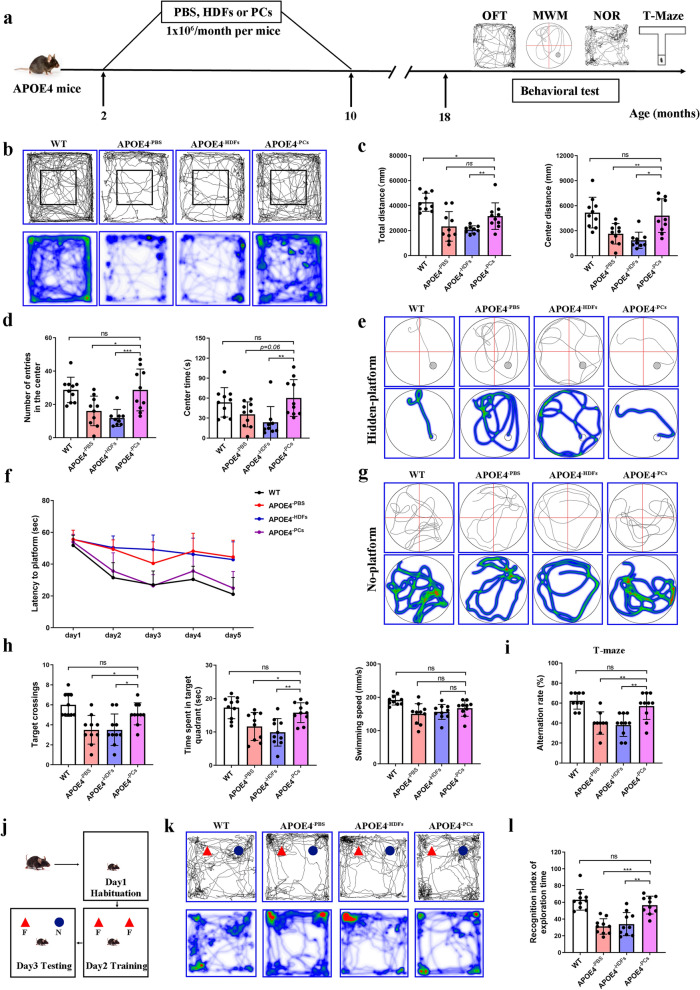
APOE3/3 hiPSCs were generated from PBMCs of two healthy donors using Sendai viral vectors and then induced to differentiate into pericytes (APOE3/3-PCs) of neural crest origin as previously reported [18, 19]. To investigate the potential therapeutic benefit of pericyte transplantation, a total of 1 × 10⁶ HDFs, APOE3/3-PCs, or an equal volume of PBS was intravenously injected to 18-month-old APOE4 homozygote mice. One month later, OFT and NOR were performed to evaluate cognition (Fig. S1a). However, no significant change was observed among the PBS, HDFs and PCs groups, with all APOE4/4 mice showing poor performance compared to age-matched WT mice (Fig. S1b–h). These findings suggest that a single transplantation of PCs may not rescue the cognitive decline in aged APOE4/4 mice, possibly because the pathological damage had already occurred and cannot be apparently rescued.
Altogether, these results demonstrate that early and multiple APOE3/3-PC transplantation improves cognition in aged APOE4/4 mice.

Early, multiple intravenous transplantation of3/3-PCs rescued learning and memory decline in aged4/4 mice.Schematic illustrating the timeline of the study.–Mouse tracing images and heat maps (), as well as behavioral analysis (, ) in the open field test.–Swimming trajectories on day 5 with a hidden-platform (), escape latencies from day 1 to day 5 (), and swimming trajectories in the probing test on day 6 () in the Morris water maze (MWM).Time spent and number of crossings in the target quadrant in the MWM. No difference was observed for the average swimming speed among PBS, HDF and PC groups.T-Maze test results.Schematic of the new object recognition (NOR) test (new object, N; familiar object, F).Exploration trajectory of each group in the NOR test.Recognition index of exploration in the NOR test. = 9–10 mice per group, means ± SD. One-way ANOVA with Tukey's multiple comparison test; ns, non-significant, * < 0.05; ** < 0.01; *** < 0.001 APOE APOE n P P P a b d b c d e g e f g h i j k l
3/3-PC transplantation ameliorates AD pathologies in aged4/4 mice APOE APOE
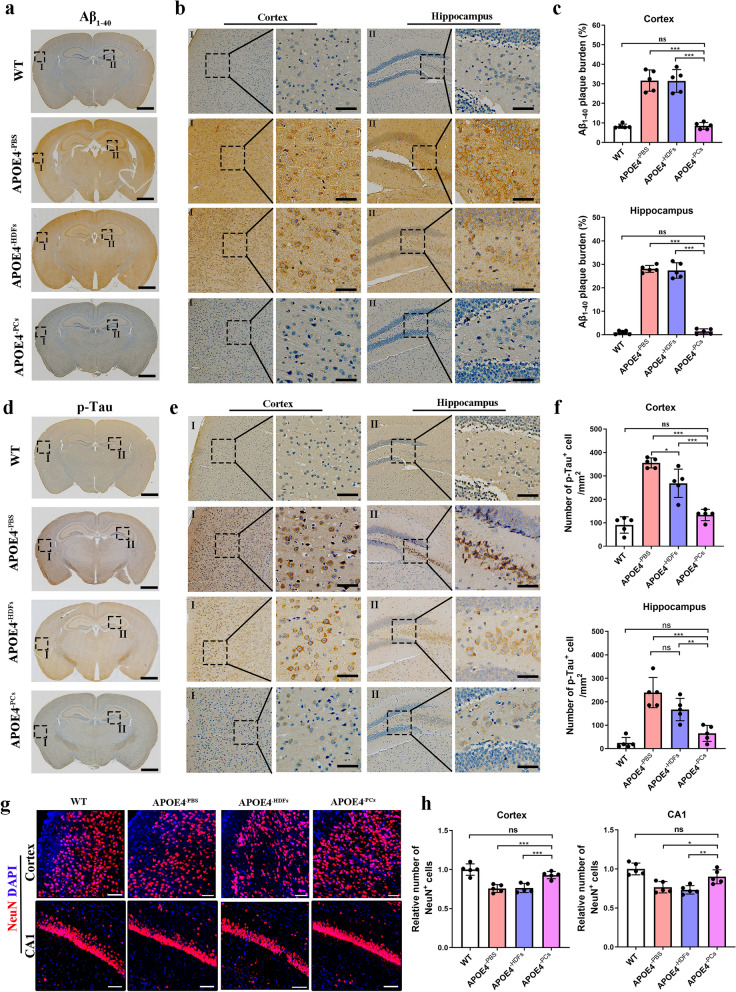
Neuron loss is a prominent pathological feature of AD, caused by excessive deposition of Aβ and p-tau [23]. We measured NeuN+ neuronal cells among the four groups, and found that the numbers of NeuN+ cells in the cortex and CA1 area were comparable between the HDFs group and the PBS group (Fig. 2g, h). In contrast, PCs transplantation significantly increased the number of NeuN+ cells compared with PBS or HDFs (Fig. 2g, h). Microglia, the innate immune cells of the central nervous system (CNS), play a multifaceted role in AD, contributing to neuroinflammation and neurodegeneration [24]. Increased number and activation of microglia have been observed in the brains of AD patients or mouse models [25]. Remarkably, our results revealed that transplantation of PCs not only significantly reduced the number of Iba1+ microglial cells, but also shifted the morphology of microglia toward the homeostatic form compared with PBS or HDFs (Fig. S2e, f).
In summary, these results demonstrated that early and multiple transplantation of APOE3/3-PCs can reduce Aβ deposition, p-tau accumulation, neuron loss and microglial activation in aged APOE4/4 mice.

3/3-PCs transplantation ameliorated AD pathologies in aged4/4 mice.Immunohistochemistry using anti-Aβantibody.Zoomed areas I (cortex) and II (hippocampus) from. Scale bars, 1 mm () and 50 μm ().Statistics of Aβ burden (%) in the cortex and hippocampus.Immunohistochemistry using anti-p-tau (Thr181) antibody.Zoomed areas I (cortex) and II (hippocampus) from. Scale bars, 1 mm () and 50 μm ().Number of p-taucell per mmin the cortex and hippocampus., Representative images () and quantification () of NeuNneurons in the cortex and CA1 area in the WT, PBS, HDF and PCs groups. Scale bars, 50 μm. = 5 mice per group, means ± SD. One-way ANOVA with Tukey's multiple comparison test; ns, non-significant, * < 0.05; ** < 0.01; *** < 0.001 APOE APOE n P P P a b a a b c d e d d e f g h g f 1-40 + 2 +
3/3-PCs preserve BBB integrity in4/4 mice APOE APOE
In our previous study, we demonstrated that intravenous injection of hiPSCs-CNC PCs could efficiently restore BBB properties in the tMCAO mouse model [18]. Thus, we evaluated the changes of BBB permeability in APOE4/4 mice after APOE3/3-PC transplantation.
Compared to WT mice, APOE4/4 mice exhibited a moderate loss of capillary density in the cortex and hippocampus, which was well preserved following PC transplantation (Fig. S3a, b). Next, we evaluated the integrity of BBB using antibodies against tight junction proteins ZO1 and Occludin, which are associated with BBB breakdown in APOE4/4 mice [27, 28]. Immunofluorescence staining indicated a significant loss of ZO1 and Occludin in the PBS group and no obvious improvement after HDFs transplantation, while PCs drastically protected ZO1 and Occludin from degradation (Fig. 3f, g). Given the role of perivascular pericytes in the maintenance of the BBB, we asked whether PC transplantation could prevent pericyte loss in APOE4/4 mice. To our surprise, mice in the PC and WT groups displayed similar percentages of pericyte coverage and comparable numbers of Pdgfrβ+ pericytes, while dramatic loss of pericyte coverage and decreased cell number were detected in the PBS and HDF groups (Fig. 3h, i). Furthermore, we observed a significant reduction in CD206+ perivascular macrophages in APOE4/4 mice, which was partially rescued by PC transplantation (Fig. S3c, d). GFAP staining revealed a significant decrease in GFAP+ endfeet coverage on blood vessels in the PBS and HDF groups, while PC transplantation partially increased the GFAP+ endfeet coverage (Fig. S3e, f). Besides, the number of GFAP+ astrocytes in the cortical region was significantly increased in the PBS and HDF groups, while a partial decrease was observed in the PCs transplantation group (Fig. S3g).
Altogether, these results demonstrated that transplantation of APOE3/3-PCs could preserve BBB integrity and reverse intrinsic pericyte loss in APOE4/4 mice.

3/3-PC transplantation preserved BBB integrity in4/4 mice.Design for dextran leakage detection in vivo using multiphoton microscopy.Images of FITC-dextran leakage in WT, PBS, HDF and PC mice in vivo. Scale bar, 50 μm (upper), 20 μm (lower).Relative density of dextran.,Representative confocal images and quantification of fibrinogen and albumin leakage around lectin-labeled capillaries. Scale bars, 50 μm.,Confocal images and quantification of lectin-labeled capillaries covered by tight junction proteins ZO1 and Occludin. Scale bars, 50 μm.Immunofluorescence staining of pdgfrβpericytes in mouse brain. Scale bars, 50 μm.Quantification of the percentage of Lectincapillaries covered by pdgfrβpericytes and the relative number of pdgfrβpericytes. All data are shown as means ± SD. = 5 mice per group, one-way ANOVA with Tukey's multiple comparison test; ns, non-significant, * < 0.05; ** < 0.01; *** < 0.001 APOE APOE n P P P a b c d e f g h i + + + +
ApoVs generated from the transplanted3/3-PCs were phagocytosed by endogenous pericytes in4/4 mice APOE APOE
Next, we tried to trace the source of tdTomato+ ApoVs. Given that the majority of transplanted pericytes accumulated in the lungs of APOE4/4 mice, we subsequently performed further analyses of the pulmonary tissue and observed that some tdTomato+ cells exhibited signs of lysis and vesicle formation (Fig. S5d). To further confirm that the tdTomato+ ApoVs were released from the lungs, we harvested lung tissues from APOE4/4 mice on day 3 after cell injection and observed real-time ApoV release ex-vivo with multiphoton microscopy. We found time-dependent release of ApoVs from mouse lungs after pericyte transplantation (Fig. S5e, f). Due to their small size (1–5 μm), ApoVs can readily pass through pulmonary capillaries (8–10 μm diameter), enter systemic circulation, and reach the mouse brain [30]. Furthermore, we asked which cell type can uptake the PCs-derived ApoVs in APOE4/4 mice brain. We found that the tdTomato+ ApoVs were engulfed by pericytes, neurons and microglia, but not by astrocytes (Fig. 4k and Fig. S5g).
In summary, we demonstrated that transplanted APOE3/3-PCs generate huge numbers of ApoVs in the lung or other tissues in vivo, which could circulate to the mouse brain and be engulfed by multiple cell types including pericytes in the brains of APOE4/4 mice.

ApoVs were generated from3/3-PCs and phagocytosed by endogenous pericytes in4/4 miceStrategies to generate tdTomatoPCs for cell tracing.Representative images showing distribution of tdTomato signals in4/4 mouse brain at 3 days post-transplantation. Scale bar, 200 μm. Zoomed areas of cortex (I), superior colliculus (II), hippocampus (III) and hypothalamus (IV). Scale bars, 50 μm.Number of tdTomatosignals per mmin the cortex at different time points.Size analysis of tdTomatosignals in the cortex at 3 days post-transplantation.Strategies to harvest tdTomatoparticles from4/4 mouse brain.Representative images showing the percentage of tdTomatoparticles by flow cytometry.,Flow cytometry analysis for the expression of CD9, CD63 and CD81 on tdTomatoparticles.Confocal microscopy images () and quantification analysis () of cleaved-caspase3 signals colocalized with tdTomatosignals at 3 days post-transplantation. Scale bars, 50 μm.Confocal images showing that tdTomatoApoVs were engulfed by pdgfrβpericytes in4/4 mice. Scale bars, 50 μm. Student'stest was used for comparisons between two groups; ns, non-significant, * < 0.05; ** < 0.01; *** < 0.001 APOE APOE . APOE APOE APOE t P P P a b c d e f g h i, j i j k + + 2 + + + + + + +
3/3-PCs-derived ApoVs improve physiological functions of4/4-PCs in vitro APOE APOE
We observed increased pdgfrβ+ pericyte number and pericyte coverage in APOE4/4 mice after PCs transplantation (Fig. 3h, i). Additionally, the transplanted APOE3/3-PCs released huge numbers of ApoVs, which were then engulfed by endogenous pericytes (Fig. 4k). Thus, we inferred that ApoVs engulfed by pericytes may prevent APOE4-related pericyte degeneration.
BBB restricts neurotoxic plasma components from entering the brain and regulates the removal of metabolic waste products from the brain to the systemic circulation, including Aβ [31, 32]. We then first evaluated BBB stability by co-culture of HBMECs with APOE3/3- or APOE4/4-PCs on transwell inserts followed by addition of FITC-Dextran in the upper well. The APOE4/4-PC group showed increased dextran leakage, while ApoVs−PCs, rather than ApoVs derived from HDFs (ApoVs−HDFs), significantly reduced the permeability in the APOE4/4-PCs co-culture system (Fig. 5k). Aβ transport by pericytes is one of the primary mechanisms for Aβ clearance across the brain to the blood [33]. We found weakening of the transport capacity of APOE4/4-PCs, which was significantly improved by ApoVs−PCs treatment (Fig. 5l). Since pericytes have been shown to capture Aβ through LRP1 (low-density lipoprotein receptor related protein-1) [34, 35], PCs were co-cultured with FITC-labeled Aβ1-40 for 48 h. We found more Aβ1-40 attachment or swallowing by APOE3/3-PCs than by APOE4/4-PCs, and ApoVs−PCs treatment greatly improved the capture capacity of APOE4/4-PCs for Aβ1-40 (Fig. 5m).
To further validate that the therapeutic effect is uniquely attributable to ApoVs, we cultured APOE4/4-PCs with same quantity of exosomes or ApoVs from APOE3/3-PCs. Our results demonstrated that ApoVs, but not exosomes, could rescue APOE4/4-PCs viability and improve the pseudo-BBB integrity (Fig. S7a–d).
Altogether, we successfully generated ApoVs from APOE3/3-PCs by STS induction and found ApoVs−PCs treatment could promote functional recovery of APOE4/4-PCs in vitro.

3/3-PCs-derived ApoVs improved physiological functions of4/4-PCs in vitro.Illustration of ApoV production and collection.3/3-PCs or HDFs were treated with 500 nmol/L STS for 12 h and apoptotic cell suspensions were isolated using a sequential centrifugation system.Morphological change of3/3-PCs before and after 12 h treatment with STS. Scale bar, 50 μm.,Flow cytometry analysis and quantification of3/3-PCs apoptosis rate using AnnexinV/PI staining after STS induction ( = 3 biological repeats for each group).Cleaved-caspase 3 assay showing the apoptotic cells or ApoVs after STS induction. Scale bar, 30 μm.TEM image of the morphology of ApoVs derived from3/3-PCs. Scale bar, 100 nm.Flow cytometry analysis showing expression of CD9, CD63 and CD81 on the surface of3/3-PC-derived ApoVs.Schematic of the generation of3/3-PCs and4/4-PCs from hiPSCs for in vitro studies.ApoVs derived from3/3-PCs were engulfed by4/4-PCs in vitro. Scale bars, 50 μm.AnnexinV/PI staining showing the cell death rate in3/3-PCs,4/4-PCs,4/4-PCs + ApoVsand4/4-PCs + ApoVsgroups ( = 3 biological repeats for each group).Dextran leakage assay was performed in3/3-PCs,4/4-PCs,4/4-PCs + ApoVsand4/4-PCs + ApoVsgroups ( = 3 biological repeats for each group).Aβ transcytosis assay was performed in3/3-PCs,4/4-PCs,4/4-PCs + ApoVsand4/4-PCs + ApoVsgroups ( = 3 biological repeats for each group).Representative images of Aβuptake and statistical result between the3/3-PCs,4/4-PCs,4/4-PCs + ApoVsand4/4-PCs + ApoVsgroups. Scale bars, 50 μm ( = 3 biological repeats for each group). One-way ANOVA with Tukey's multiple comparison test; ns, non-significant, * < 0.05; ** < 0.01; *** < 0.001 APOE APOE APOE APOE APOE n APOE APOE APOE APOE APOE APOE APOE APOE APOE APOE n APOE APOE APOE APOE n APOE APOE APOE APOE n APOE APOE APOE APOE n P P P a b c d e f g h i j k l m −HDFs −PCs −HDFs −PCs −HDFs −PCs −HDFs −PCs 1-40
IGF2 in ApoVs plays a vital role in functional recovery of4/4-PCs in vitro APOE
We then focused on whether IGF2 is involved in the reparative effects of ApoVs−PCs. We constructed IGF2-knockout APOE3/3-PCs using CRISPR-Cas9 system, which was confirmed by western blot analysis (Fig. 6m, n and Fig. S8a). Then, ApoVs of IGF2-knockout APOE3/3-PCs (ApoVs−PCs−IGF2KO) and non-targeting control APOE3/3-PCs (ApoVs−PCs−IGF2NC) were generated as described above, and cultured with APOE4/4-PCs. We found that IGF2 deletion largely abolished the therapeutic effects of ApoVs−PCs, as exhibited by increased cell death, dextran transcytosis, and reduced Aβ transport ability (Fig. 6o–r). Besides, we observed dramatic cell death and function weakness of APOE3/3-PCs when IGF2 was knocked out (Fig. S8b–e).
Together, the ApoVs−PCs contain higher levels of IGF2 protein and mRNA compared with ApoVs−HDFs, which may play vital roles in the protective effect of ApoVs−PCs.

IGF2 in ApoVs plays a vital role in functional recovery of4/4-PCs in vitro.ApoVs derived from3/3-PCs or HDFs were subjected to transcriptomic analysis and proteomic analysis.Principal component analysis (PCA) evaluating the similarities of gene expression profiles between ApoVsand ApoVs.Volcano plot and heatmap of differential gene expression analysis between ApoVsand ApoVs.–The differentially expressed genes were subjected to GO enrichment analysis. The GO terms related to neuron protection and cognition (), blood–brain barrier maintenance (), DNA replication and transcription () and cell growth and metabolic () were significantly enriched in ApoVs.Volcano plot () and heatmap () of protein expression between ApoVsand ApoVs.qPCR and western blot analysis of IGF2 mRNA expression and protein level in ApoVsand ApoVs.IGF2 knockout in3/3-PCs using the CRISPR-Cas9 system. IGF2 expression was confirmed by western blot analysis.Flow cytometry analysis with annexin V and PI staining revealed cell death rate in3/3-PCs,4/4-PCs,4/4-PCs + ApoVsand4/4-PCs + ApoVsgroups ( = 3 biological repeats for each group).Representative dextran leakage in3/3-PCs,4/4-PCs,4/4-PCs + ApoVsand4/4-PCs + ApoVsgroups ( = 3 biological repeats for each group).Representative Aβ transcytosis in3/3-PCs,4/4-PCs,4/4-PCs + ApoVsand4/4-PCs + ApoVsgroups ( = 3 biological repeats for each group). One-way ANOVA with Tukey's multiple comparison test; ns, non-significant, * < 0.05; ** < 0.01; *** < 0.001 APOE APOE APOE APOE APOE APOE APOE n APOE APOE APOE APOE n APOE APOE APOE APOE n P P P a b c, d e h e f g h i, j i j k, l m, n o, p q r −HDFs −PCs −HDFs −PCs −PCs −HDFs −PCs −HDFs −PCs −PCs−IGF2KO −PCs−IGF2NC −PCs−IGF2KO −PCs−IGF2NC −PCs−IGF2KO −PCs−IGF2NC
ApoVs from3/3-PCs achieved significant therapeutic effects in4/4 mice APOE APOE
At the end of experiment, MWM, NOR, T-maze, and OFT were performed to evaluate cognition recovery of APOE4/4 mice at 18 months old. In the WMW test, the latency to the platform was shorter in the ApoVs−PCs−IGF2NC group compared with the ApoVs−IGF2KO group on day 5 of training, with no difference between the ApoVs−HDFs and the ApoVs−PCs−IGF2KO groups (Fig. 7e, f). In the probing test, the number of crossings and the total time spent in the target quadrant were higher in the ApoVs−PCs−IGF2NC group than in the ApoVs−PCs−IGF2KO group, and comparable between ApoVs−HDFs and ApoVs−PCs−IGF2KO groups (Fig. 7h, i). Similarly, the ApoVs−PCs−IGF2NC group showed better performance compared with the ApoVs−IGF2KO group, while ApoVs−HDFs and ApoVs−IGF2KO groups showed no significant difference in the performance in T-maze test, NOR test, or the OFT (Fig. 7j–l and Fig. S9b, c). Taken together, these data indicate that transplantation of ApoVs derived from APOE3/3-PCs improved cognitive function in APOE4/4 mice, whereas IGF2 depletion largely abolished the treatment effect of ApoVs. This suggests an important role of IGF2 in the therapeutic capacity of ApoVs in APOE4/4 mice.
We further explored whether the APOE3/3-PCs-derived ApoVs can ameliorate AD pathologies and improve BBB function in APOE4/4 mice. The ApoVs−PCs−IGF2NC group showed less Aβ and p-tau compared with the ApoVs−HDFs group, while IGF2 depletion largely weakened this effect (Fig. S10a, b). In addition, the numbers of NeuN+ cells in the cortex and CA1 region were higher in the ApoVs−PCs−IGF2NC group compared with the ApoVs−HDFs group, while no increase of NeuN+ cells was observed in the ApoVs−PCs−IGF2KO group (Fig. S10c, d). Next, BBB permeability was evaluated by immunostaining. We observed significant recovery of BBB integrity in ApoVs−PCs−IGF2NC, but not in the ApoVs−HDFs or ApoVs−PCs−IGF2KO group (Fig. S11a, b). The level of tight junction protein ZO-1 was drastically improved in the ApoVs−PCs−IGF2NC group (Fig. S11c). ApoVs−IGF2NC also prevented pericyte loss in APOE4/4 mice (Fig. S11d).
In summary, transplantation of ApoVs generated from APOE3/3-PCs achieved significant therapeutic effects in APOE4/4 mice, but these effects were reversed by IGF2 knockout.

ApoVs from3/3-PCs achieved significant therapeutic effects in4/4 mice.Strategies to generate tdTomatoApoVs for in vivo tracing.Representative images showing distribution of tdTomato-labeled ApoVs in4/4 mouse brain at 48 h post-transplantation. Scale bar, 100 μm (left), 50 μm (right).Number of tdTomatoApoVs per mmin the cortex at different time points.Timeline of experiments.–Results of Morris water maze test, including swimming trajectories on day 5 with a hidden platform (), latencies to find the platform on days 1–5 (), swimming speed (), swimming trajectories on day 6 in the probing trial (), and the time spent and number of crossings in the target quadrant ().Results of the T-maze.Exploration trajectory and heat maps in the new object recognition (NOR) test. New object, blue; familiar object, red.Recognition index of exploration. All data are shown as means ± SD. = 9–10 mice per group. One-way ANOVA with Tukey's multiple comparison test; ns, non-significant, * < 0.05; ** < 0.01; *** < 0.001 APOE APOE APOE n P P P a b c d e i e f g h i j k l + + + 2
Discussion
In the past several decades, mice bearing genetic mutations linked to autosomal-dominant AD (ADAD), such as 5 × FAD mice, were widely used for AD-related research and therapy development. However, ADAD is estimated to account for only ~ 1% of AD cases [38, 39]. On the contrary, late-onset AD (LOAD) accounts for more than 95% of AD cases [40]. The APOE ε4 allele is the strongest genetic risk factor for LOAD, with three-to-four-fold increased risk for heterozygotes and a nearly 12-fold increased risk for homozygotes compared to the APOE3 homozygotes, the most common genotype [41, 42]. APOE4/4 mice exhibit cognitive deficits at 15 months or older [43]. Here, we observed increased BBB leakage and pericyte degeneration in 2-month-old APOE4/4 mice (data not shown), and impaired behavior performance accompanied by AD typical pathologies (including abnormal deposition of Aβ and p-tau, neuron loss and microglial activation) in 18-month-old APOE4/4 mice. These results highlight the possibility that APOE4-induced pericyte/BBB impairment is a driver of LOAD. Indeed, it has been reported that APOE4 leads to BBB breakdown by activating the CypA–NFκB–MMP9 pathway in pericytes, which in turn initiates neurodegenerative changes. Suppressing this pathway could reverse BBB breakdown and neuronal dysfunction [14]. Another study has demonstrated that the calcineurin nuclear factor of activated T cells (NFAT) signaling is selectively dysregulated in APOE4 pericytes, which further induces cerebral amyloid angiopathy (CAA). Inhibition of the calcineurin–NFAT signaling reduces APOE4-associated CAA pathology in vitro and in vivo [44]. Collectively, the above evidence suggests that pericyte/BBB impairment is a potential therapeutic target for LOAD.
Brain pericytes, originating from neural crest during development, regulate blood flow, BBB stability and inflammation, and promote long-term memory [15, 45, 46]. Tachibana et al. reported that implantation of pericytes differentiated from mouse fibroblasts reduced AD pathology in APP/PS1 mice [16]. Thus, pericyte transplantation may have the potential to rescue AD-related cognitive deficits in APOE4/4 mice. Previous studies reported that a single dose transplantation of human embryonic stem cell (hESC)-derived MSCs or hESC-derived immunity-and-matrix regulatory cells can improve cognition of AD animals [47, 48]. We first tested whether a single injection of APOE3/3-PCs can rescue memory decline in aged APOE4/4 mice. However, no significant behavior change was observed between PBS, HDF and PC groups. Since AD pathologies in humans develop slowly in a course of 20–30 years or even longer, this brings the question of whether the brain can be rescued by the time of dementia, or whether treatments before the onset of dementia can prevent AD process [49]. Indeed, animal studies revealed that multiple transplantations of human umbilical cord-derived MSCs into 4-month-old SAMP8 mice (once a week for 8 weeks) greatly improved cognitive performance at 8 months, indicating that early treatment before AD onset is feasible [50, 51]. Moreover, a recent study also demonstrated that early inhibition of Ca2+ channels in pericytes could enhance brain energy supply and possibly cognitive function in AD mice [52]. Thus, in the present study, we treated APOE4/4 mice from 2–3 months old when the BBB damage begins to occur. We observed for the first time, that early and multiple transplantations of hiPSC-derived PCs could rescue AD phenotypes in aged APOE4/4 mice by preventing neuron loss, Aβ accumulation and p-tau formation, and improving BBB integrity. These data clearly support the notion that early intervention before the onset of dementia could effectively delay the progression of AD pathology.
In this study, we found rare intact APOE3/3-PCs in the brain after intravenous injection, but wide distribution of a huge number of ApoVs derived from APOE3/3-PCs in the brain as well as in the spleen, liver, kidneys and skin (data not shown). Our results also revealed that the in vivo distribution of ApoVs was not tissue- or organ-specific, although more ApoVs were observed in the brain than other tissues (data not shown). Interestingly, previous studies also demonstrated that ApoVs derived from MSCs are involved in the efficacy of MSC-based therapeutics [53, 54]. MSC-derived ApoVs have shown therapeutic effects in immune disorders, osteoporosis, skin injuries, hair regeneration and multiple myeloma [55 –57]. However, whether ApoVs show therapeutic promise in AD treatment was unknown. Here, we found that the transplanted APOE3/3-PCs were primarily retained in the lungs of APOE4/4 mice and continuously released ApoVs. These ApoVs subsequently entered circulation, crossed the BBB and could be ingested by endogenous pericytes in APOE4/4 mouse brain. In vitro experiments also revealed that ApoVs derived from APOE3/3-PCs could efficiently prevent degeneration of APOE4/4 pericytes, and promote BBB function and Aβ transport. These results directly demonstrate the effectiveness of ApoVs−PCs treatment. The functional recovery of endogenous pericytes and delayed progression of AD pathology in APOE4/4 mice may be primarily mediated by APOE3/3-PC-derived ApoVs.
Next, using transcriptomic and proteomic analysis, we identified IGF2 as a key effector molecule enriched in ApoVs−PCs, and found that IGF2 depletion substantially diminished the therapeutic effects of ApoVs−PCs in vitro. IGF2 is a hormone that has a similar structure with insulin. It is highly expressed in mouse and human embryos, but the level declines dramatically after birth [58]. However, IGF2 is abundantly expressed in the CNS throughout life. IGF2 deficiency is associated with certain brain diseases, including AD, Parkinson's disease, Huntington's disease, and amyotrophic lateral sclerosis [59]. IGF2 can prevent dopaminergic neuronal loss and microglial over-activation [60, 61]. More recently, Pandey et al. reported that IGF2 is required for long-term memory and its level in hippocampal pericytes increases with learning [46]. The pericytes, choroid plexus and meninges are major sources of IGF2 in the brain. Selective knockout of IGF2 in pericytes leads to significant BBB permeability and impaired long-term memory [46, 62, 63]. Here, our results showed that the APOE3/3-PC-derived ApoVs contained high levels of IGF2 mRNA and protein and could circulate to the brain and be engulfed by neurons, pericytes and microglia. The IGF2 protein could provide immediate effects through direct signaling, while IGF2 mRNA may support sustained action via ongoing translation. This "dual cargo" model enables ApoVs to exert both rapid and lasting effects. These results could partly explain why APOE3/3-PC transplantation prevented neuron loss and microglia activation. Notably, we found that IGF2 depletion in ApoVs largely abolished the therapeutic effects on APOE4/4-PCs in vitro, indicating IGF2 as a key regulator for pericyte homeostasis. Moreover, we also discovered that APOE3/3-PCs exhibited increased cell death, impaired BBB stability and Aβ clearance in vitro by IGF2 deletion. All these results above indicated that pericyte degeneration in APOE4/4 carriers may result from IGF2 decline. However, further studies are needed to uncover how IGF2 regulates pericyte homeostasis. In addition, previous studies demonstrated that IGF2 receptors are abundantly expressed on neurons, where they can directly bind recombinant IGF2 (r-IGF2), activate key neuroprotective pathways, thus preventing the loss of neurons and enhancing long-term memory formation [46, 60, 64]. Intracranial or stereotactic bilateral r-IGF2 administration significantly reduced the number of hippocampal Aβ plaques and improved memory in APP/PS1 mice [65, 66]. Interestingly, we found that neither r-IGF2 alone nor in combination with HDF-derived ApoVs could rescue APOE4/4-associated pericyte dysfunction in our co-culture system (data not shown). In contrast, IGF2 protein- and mRNA-enriched ApoVs derived from APOE3/3-pericytes could greatly improve APOE4/4-pericyte survival, barrier function and Aβ transport ability. These results underscore the importance of vesicle origin and cargo specificity in successful pericyte-targeted therapy. The discrepancy between our findings and previous reports may stem from differences in cell type (neuron vs pericyte) and experimental model (APOE4 vs APP/PS1).
Conclusion
Taken together, we demonstrated that early and multiple transplantations of APOE3/3-PCs or APOE3/3-PC-derived IGF2-rich ApoVs could prevent pericyte degeneration and BBB damage, and rescue cognitive decline and AD pathologies in aged APOE4/4 mice, which may represent a promising therapy strategy for APOE4-related AD and other pericyte-degeneration disease.
Supplementary Information
Additional file 1. Table S1 Information for APOE3/3 or APOE4/4 carriers. Figure S1. Single APOE3/3-PCs injection did not rescue memory decline in aged APOE4/4 mice. Figure S2. APOE3/3-PCs transplantation rescued AD-related phenotypes in APOE4/4 mice. Figure S3. Assessments of microvascular length, perivascular macrophages and astrocytes after APOE3/3-PC transplantation. Figure S4. Distribution of pericytes in the lungs, liver, and spleen. Figure S5. APOE3/3-PCs generated huge number of ApoVs in APOE4/4 mice. Figure S6. Identification and pluripotency verification of hiPSCs in vitro. Figure S7. Comparison of the therapeutic effects of exosomes versus ApoVs on APOE4/4 PCs. Figure S8. IGF2 knockout promoted degeneration of APOE3/3 pericytes. Figure S9. Transplantation of ApoVs derived from APOE3/3-PCs rescued the cognitive decline in APOE4/4 mice, which was partially mediated by IGF2. Figure S10. Transplantation of ApoVs derived from APOE3/3-PCs alleviated the AD-related pathologies in APOE4/4 mice, which was partially mediated by IGF2. Figure S11. Transplantation of ApoVs derived from APOE3/3-PCs preserved BBB integrity inAPOE4/4 mice, which was partially mediated by IGF2.Additional file 2. Table S2 Identified proteins in proteomics analysis.Additional file 3. Uncropped Gels and Blots images.