
What this is
- This research evaluates the effects of (HY) on growth performance and fecal dry matter (DM) in weanling pigs.
- The study involved 360 pigs assigned to different dietary treatments, including varying levels of HY and carbadox.
- Key outcomes measured included average daily gain (ADG), average daily feed intake (ADFI), and stress-related blood antioxidant criteria.
Essence
- improved (G:F) and fecal dry matter (DM) in nursery pigs, but did not enhance overall growth performance. Carbadox increased average daily gain (ADG) and fecal DM.
Key takeaways
- Adding 0.04% improved the (G:F) in nursery pigs. This suggests that while growth performance remained unchanged, feed efficiency was enhanced.
- Pigs fed diets containing carbadox showed increased average daily gain (ADG) and fecal DM. This indicates that carbadox effectively supports growth and gut health.
- Increasing inclusion improved fecal DM, indicating firmer stools, but did not lead to better growth performance overall.
Caveats
- Increasing levels did not result in improved growth performance, suggesting that other factors may influence growth beyond dietary composition.
- The study's reliance on a specific product limits the generalizability of the findings to other yeast products or formulations.
Definitions
- Hydrolyzed yeast: A yeast product processed to release soluble nutrients and metabolites, potentially improving gut health and nutrient utilization.
- Gain-to-feed ratio (G:F): A measure of feed efficiency, calculated as the weight gain of an animal divided by the amount of feed consumed.
Simplified
Introduction
Weaned pigs often experience reduced growth performance and increased prevalence of diarrhea due to the transition from a milk-based diet to a dry, cereal-based diet (;). At weaning, beneficialpopulations are reduced, which compromises gut barrier integrity and allows pathogenic bacteria, like, to proliferate (). The proliferation of thepathotype, enterotoxigenic(ETEC), is a significant contributor to postweaning diarrhea which can adversely affect intestinal integrity and growth performance (). To help overcome these challenges and maintain weanling pig health, in-feed antibiotics have been widely utilized to maintain gut microbiota and improve growth performance. [Kluess et al., 2010] [Campbell et al., 2013] [Fairbrother et al., 2005] [Yan et al., 2024] Lactobacillus Escherichia coli E. coli E. coli
Carbadox, a quinoxaline class of antimicrobials, is used to control and prevent enteric health challenges and improve growth performance in pigs (). It inhibits bacterial growth by intercalating into DNA, leading to mutations that hinder replication (). At low doses, carbadox can be used to improve feed efficiency (). Due to concerns of antibiotic resistance, the U.S. Food and Drug Administration prohibited the use of certain in-feed antibiotics important for human medicine as growth promoters in livestock in 2017 (). This ban on antibiotic growth promoters (AGP) has driven interest in finding alternatives with similar health benefits. [Dasenaki et al., 2023] [Chen et al., 2009] [Dritz et al., 2002] [FDA; Food and Drug Administration), 2013]
Nutritional strategies that may act as a substitute for AGP such as probiotics, prebiotics, phytogenic additives, and organic acids have been extensively explored. Yeast-based feed additives, specifically, have been of interest due to their potential to improve gut health, nutrient digestibility, and growth performance (;). There are different kinds of yeast products such as yeast extracts, yeast cultures, yeast cell walls, yeast cell wall components, and live yeast cells. Previous literature has shown improvements in intestinal morphology, diarrhea prevalence, and intestinal inflammation when utilizing dietary yeast products during the nursery phase (;;). However, studies measuring growth performance have been variable.andobserved improvements in growth performance when yeast culture was utilized in the diet, while others using live yeast have shown no benefit (;). These inconsistent findings could stem from variations in the types of yeast products used, the inclusion and duration of supplementation, diet composition, and health status of the pigs. Saccharomyces cerevisiae [Schiavone et al., 2015] [Sampath et al., 2023] [Shen et al., 2009] [Zanello et al., 2011] [Trckova et al., 2014] [Van Der Peet-Schwering et al. (2007)] [Shen et al. (2009)] [van Heugten et al., 2003] [Chance et al., 2021]
A novel hydrolyzed yeast product (HY; Ceretide S, Boon Lay Way, Singapore) is derived from cultivatedyeast cells, which undergo enzymatic hydrolysis using exogenous enzymes. This process results in a product that contains the whole-cell components of yeast resulting in a composition that also contains metabolic by-products such as enzymes, oligopeptides, vitamins, saccharides, organic acids, and other fermentation metabolites. Hydrolyzed yeast is thought to combine the beneficial aspects of yeast extract including various soluble nutrients and yeast cell walls containing mannan-oligosaccharides (MOS) and β-glucans. Because these components in HY act as immunomodulators, they can alter cytokine production reducing pro-inflammatory responses (). This may enhance gut health and nutrition utilization, leading to improvements in growth performance (). S. cerevisiae [Zanello et al., 2011] [Boontiam et al., 2022]
Given the wide variety of yeast products available, it is important to evaluate the efficacy of new products. Therefore, the objective of this study was to evaluate the effects of HY with or without carbadox on growth performance, fecal dry matter (DM), stress-related blood antioxidant criteria, and serum cytokine concentrations in nursery pigs. It was hypothesized that the addition of HY would improve nursery pig growth performance and fecal DM.
Materials and Methods
The Kansas State University Institutional Animal Care and Use Committee approved the protocols used in this experiment (IACUC #4942).
This study was conducted at the Kansas State University Swine Research and Teaching Center in Manhattan, KS. A total of 360 weanling pigs (241600 DNA; initially 5.4 ± 0.01 kg) were used in a 45-d growth trial. Pigs were weaned at approximately 18 d of age and blocked by initial body weight. Pens of pigs were randomly allotted to one of six dietary treatments in a generalized randomized block design. There were five pigs per pen, and within each block, there were four pens per weight group [light (4.3 ± 0.01 kg), medium (5.4 ± 0.01 kg), and heavy (6.5 ± 0.01 kg)] for a total of 12 replications per treatment. Diets were corn-soybean meal-based and consisted of a negative control (NC) diet, a positive control (PC) diet which was the NC diet + 55 mg/kg carbadox (Mecadox 2.5, Phibro; Teaneck, NJ), the PC diet with 0.04% HY, and the NC diet with either 0.04%, 0.08%, or 0.12% HY (). All diets were formulated to 1.35% standardized ileal digestible (SID) Lys in phases 1 and 2 and 1.30% SID Lys in phase 3. All diets met or exceeded the nutrient requirement estimates of other amino acids as a ratio to Lys (). Pigs were fed treatment diets in three phases from day 0 to 10 (phase 1), day 10 to 24 (phase 2), and day 24 to 45 (phase 3). Treatment diets were manufactured at the Kansas State University O.H. Kruse Feed Technology Innovation Center in Manhattan, KS and fed in meal form for all phases. Each pen contained a 3-hole, dry self-feeder and a nipple waterer foraccess to feed and water. × (BW) Table 1 [NRC, 2012] ad libitum
Pig weights and feed disappearance were measured on day 0, 10, 24, and 45 to determine average daily gain (ADG), average daily feed intake (ADFI), and gain:feed ratio (G:F). On day 10 and 24, fecal samples were collected from the same three initially randomly selected pigs in each pen to determine fecal DM and fecal score. Fecal samples were dried at 55°C in a forced air oven for 48 h, and the ratio of dried to wet fecal weight determined the percentage fecal DM. The average of the three samples from each pen was then used for statistical analysis. Fecal samples were also scored in the bag by three observers on day 10 and 24 using a 0 to 4 scoring system: 0 = hard, pellet-like lumps; 1 = firm, formed feces; 2 = normal feces; 3 = mild looseness; and 4 = diarrhea.
Blood samples were collected on day 10 and 45 from the same median-weight pig in each pen for total antioxidant capacity (TAC), superoxide dismutase (SOD), and serum cytokine concentrations. Blood samples were collected with blood collection tubes (Covidien Monoject blood collection tubes, silicone-coated tubes with red stoppers, no additive, 10 mL; Medtronic, Minneapolis, MN). The clotted samples were centrifuged at 1,500 × for 30 min, after which the resulting serum supernatants were divided into 4 polypropylene tubes (PR1MA microcentrifuge tubes, natural boil-proof; Midwest Scientific, St Louis, MO) and stored as aliquots at −80°C until use. Serum cytokine panel analyses (GM-CSF, IFNγ, IL-1α, IL-1ra, IL-1β, IL-2, IL-4, IL-6, IL-8, IL-10, IL-12, IL-18, and TNFα) were conducted at Eve Technologies (Calgary, AB, Canada). Serum TAC and SOD analyses were conducted at the Kansas State University Swine Nutrition Laboratory (Manhattan, KS). Both serum SOD and TAC samples were analyzed in duplicate in 96-well microplates with an intra-assay CV ≤ 5.0%. Assay kits for SOD and TAC were from Cayman Chemical Company (Ann Arbor, MI; # 706002) and Cell Biolabs Inc. (San Diego, CA; # STA-360), respectively. Superoxide dismutase activity is assessed by measuring the dismutation of superoxide radicals generated by xanthine oxidase and hypoxanthine. Total antioxidant capacity is based on the reduction of copper(II) and copper(I). Both assays were read on a BioTek Epoch2 microplate spectrophotometer. g
| Phase 1 | Phase 2 | Phase 3 | ||||
|---|---|---|---|---|---|---|
| Ingredient, % Carbadox: | Yes | No | Yes | No | Yes | No |
| Corn | 45.45 | 46.34 | 56.95 | 57.84 | 65.34 | 66.24 |
| Soybean meal (47% CP) | 16.13 | 16.07 | 23.92 | 23.86 | 29.81 | 29.75 |
| 2 | 5 | 5 | 4.5 | 4.5 | --- | --- |
| Whey powder | 20 | 20 | 10 | 10 | --- | --- |
| Fish meal | 4.5 | 4.5 | --- | --- | --- | --- |
| Lactose | 4.5 | 4.5 | --- | --- | --- | --- |
| Soybean oil | 1 | 1 | --- | --- | --- | --- |
| Calcium carbonate | 0.2 | 0.37 | 0.53 | 0.7 | 0.68 | 0.85 |
| Monocalcium P (21% P) | 0.45 | 0.45 | 1 | 1 | 1.05 | 1.05 |
| Salt | 0.33 | 0.33 | 0.55 | 0.55 | 0.6 | 0.6 |
| L-Lys-HCl, 78.8% | 0.43 | 0.43 | 0.5 | 0.5 | 0.5 | 0.5 |
| DL-Met, 98.5% | 0.22 | 0.22 | 0.23 | 0.23 | 0.2 | 0.2 |
| L-Thr, 98.5% | 0.21 | 0.21 | 0.23 | 0.23 | 0.23 | 0.23 |
| L-Trp, 98.0% | 0.04 | 0.04 | 0.03 | 0.03 | 0.03 | 0.03 |
| L-Val, 96.5 % | 0.14 | 0.14 | 0.14 | 0.14 | 0.14 | 0.14 |
| Trace mineral premix | 0.15 | 0.15 | 0.15 | 0.15 | 0.15 | 0.15 |
| Vitamin premix | 0.25 | 0.25 | 0.25 | 0.25 | 0.25 | 0.25 |
| 3 | 0.03 | 0.03 | 0.03 | 0.03 | 0.03 | 0.03 |
| 4 | 1 | --- | 1 | --- | 1 | --- |
| 5 | ± | ± | ± | ± | ± | ± |
| Total | 100 | 100 | 100 | 100 | 100 | 100 |
| Calculated analysis | ||||||
| 6 | 1.35 | 1.35 | 1.35 | 1.35 | 1.3 | 1.3 |
| Net energy, kcal/kg | 2,555 | 2,576 | 2,434 | 2,455 | 2,407 | 2,428 |
| Crude protein, % | 20.2 | 20.2 | 20.7 | 20.7 | 20.5 | 20.5 |
| Ca, % | 0.71 | 0.71 | 0.71 | 0.71 | 0.72 | 0.72 |
| 7 | 0.44 | 0.44 | 0.41 | 0.41 | 0.36 | 0.36 |
| Ca:P | 1.11 | 1.11 | 1.11 | 1.11 | 1.18 | 1.18 |
Statistical analysis
Growth performance, fecal DM, and cytokine panel data were analyzed as a generalized randomized block design as a one-way ANOVA using the lmer function from the lme4 package in R studio (Version 4.3.1, R Core Team. Vienna, Austria) with pen serving as the experimental unit and dietary treatment and weight block as fixed effects. Linear and quadratic contrasts were tested within increasing levels of HY in diets without carbadox. Additionally, the main effect of HY was evaluated plus the interaction of HY and carbadox. The main effect of carbadox was evaluated by comparing the average of 0% and 0.04% HY in the presence and absence of carbadox. Additionally, a comparison was made between carbadox with 0.04% HY and carbadox without HY. Fecal DM and serum samples were analyzed using the fixed effects of day, treatment, block, and the associated interactions accounting for repeated measures over time.
For serum cytokine data, the data were analyzed with the raw fluorescence intensity value based onwith a log10 transformation for statistical analysis, which was transformed back for reporting of treatment means. For serum TAC and SOD assays, data were analyzed using the GLIMMIX procedure of SAS OnDemand for Academics (SAS Institute Inc., Cary, NC) with microtiter plate used in the model as a random intercept. Fecal scores were summarized using the FREQ procedure of SAS OnDemand for Academics and reported as a percentage of observations within each score category by treatment. Fecal scores are reported using descriptive statistics due to a lack of model fit. When treatment was a significant source of variation, differences were determined by pairwise comparison using the Tukey-Kramer multiplicity adjustment to control for Type I error. Results were considered significant with≤ 0.05 and marginally significant with 0.05 < ≤ 0.10. [Breen et al. (2015)] P P
Results
There were no BW block interactions for growth performance, fecal DM, or serum antioxidant data, therefore, interpretation is based on the main effect of dietary treatment. There were no carbadox by HY interactions observed.
Growth performance
For growth performance criteria, there were no linear or quadratic effects of increasing HY observed. From day 0 to 10 (phase 1), there was a main effect of carbadox, where pigs fed diets containing carbadox had increased (≤ 0.025) ADG and day 10 BW compared to those not fed carbadox with either none or 0.04% HY (). From day 10 to 24 (phase 2), an increase in G:F was observed (= 0.041) when 0.04% HY was added, regardless of carbadox inclusion. Also, day 24 BW was greater (= 0.048) in pigs fed diets containing carbadox compared to pigs fed diets without carbadox. From day 24 to 45 (phase 3), ADFI increased (= 0.041) for pigs fed diets containing carbadox compared to pigs not fed carbadox, which led to a tendency (= 0.087) for increased ADG due to carbadox. Also, pigs fed 0.04% HY and carbadox tended to increase (= 0.072) G:F compared to pigs fed carbadox without HY. P P P P P P Table 2
Overall (day 0 to 45), final BW increased (= 0.026) and ADG and ADFI tended to increase (≤ 0.089) for pigs fed diets containing carbadox compared to pigs fed diets without carbadox with either none or 0.04% HY. Gain-to-feed ratio increased (= 0.017) when 0.04% HY was added, regardless of carbadox inclusion. The combination of 0.04% HY and carbadox increased (< 0.05) G:F compared to pigs fed carbadox alone. P P P P
| 9 | |||||||||||
|---|---|---|---|---|---|---|---|---|---|---|---|
| Carbadox: 10 | Yes | No | HY in No Carbadox 11 | ||||||||
| HY, %: | 0 | 0.04 | 0 | 0.04 | 0.08 | 0.12 | SEM | Linear | Quadratic | 0.04% HY 12 | Carbadox 13 |
| Body weight, kg | |||||||||||
| day 0 | 5.4 | 5.4 | 5.4 | 5.4 | 5.4 | 5.4 | 0.01 | 0.224 | 0.379 | 0.282 | 0.232 |
| day 10 | 6.3 | 6.4 | 6.1 | 6 | 6.1 | 6 | 0.11 | 0.878 | 0.88 | 0.905 | 0.018 |
| day 24 | 11.9 | 12.3 | 11.5 | 11.4 | 11.2 | 11.4 | 0.32 | 0.657 | 0.616 | 0.749 | 0.048 |
| day 45 | 27.2 | 28.2 | 26.5 | 26.5 | 26 | 26.1 | 0.5 | 0.388 | 0.909 | 0.375 | 0.026 |
| Phase 1 (day 0 to 10) | |||||||||||
| ADG, g 14 | 92 | 96 | 71 | 67 | 71 | 65 | 11.4 | 0.773 | 0.958 | 0.999 | 0.025 |
| ADFI, g 15 | 132 | 121 | 122 | 113 | 112 | 105 | 9.8 | 0.234 | 0.901 | 0.295 | 0.353 |
| G:F, g/kg 16 | 676 | 687 | 573 | 552 | 503 | 582 | 99.6 | 0.959 | 0.604 | 0.96 | 0.223 |
| Phase 2 (day 10 to 24) | |||||||||||
| ADG, g | 399 | 408 | 375 | 380 | 350 | 371 | 18.3 | 0.618 | 0.652 | 0.697 | 0.141 |
| ADFI, g | 543 | 546 | 522 | 507 | 494 | 511 | 24 | 0.66 | 0.492 | 0.79 | 0.204 |
| G:F, g/kg | 732 | 750 | 716 | 754 | 710 | 724 | 14.2 | 0.772 | 0.389 | 0.041 | 0.654 |
| Phase 3 (day 24 to 45) | |||||||||||
| ADG, g | 728 | 751 | 714 | 721 | 703 | 699 | 12.9 | 0.269 | 0.686 | 0.248 | 0.087 |
| ADFI, g | 1,072 | 1,073 | 1,022 | 1,028 | 1,012 | 1,004 | 23.6 | 0.502 | 0.734 | 0.877 | 0.041 |
| G:F, g/kg 17 | 680 | 702 | 699 | 705 | 698 | 699 | 8.9 | 0.85 | 0.827 | 0.122 | 0.213 |
| Overall (day 0 to 45) | |||||||||||
| ADG, g | 482 | 490 | 458 | 469 | 444 | 451 | 12 | 0.359 | 0.854 | 0.43 | 0.058 |
| ADFI, g | 696 | 685 | 656 | 663 | 639 | 643 | 18.7 | 0.435 | 0.932 | 0.906 | 0.089 |
| G:F, g/kg 17 | 694 | 717 | 699 | 711 | 697 | 703 | 7.7 | 0.937 | 0.645 | 0.017 | 0.943 |
| Fecal DM, % 18 | |||||||||||
| day 10 | 17.6 | 17.3 | 12.3 | 15 | 16.3 | 17.3 | 1.29 | 0.005 | 0.493 | 0.335 | 0.003 |
| day 24 | 20.6 | 18.8 | 16.2 | 16.7 | 18.3 | 18.2 | 1.29 | 0.177 | 0.831 | 0.578 | 0.009 |
Fecal DM and scoring
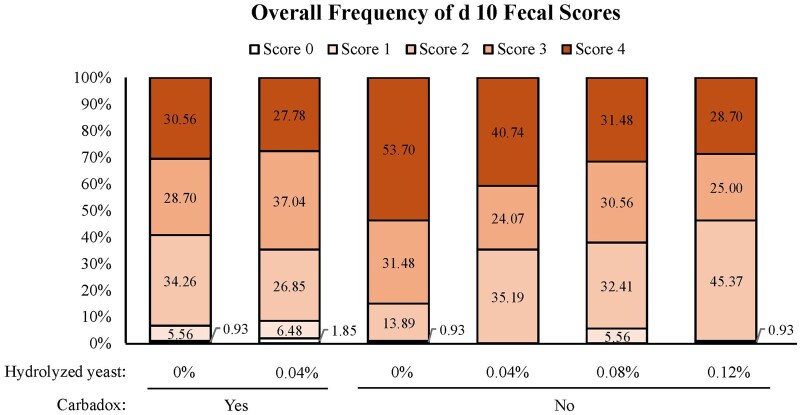
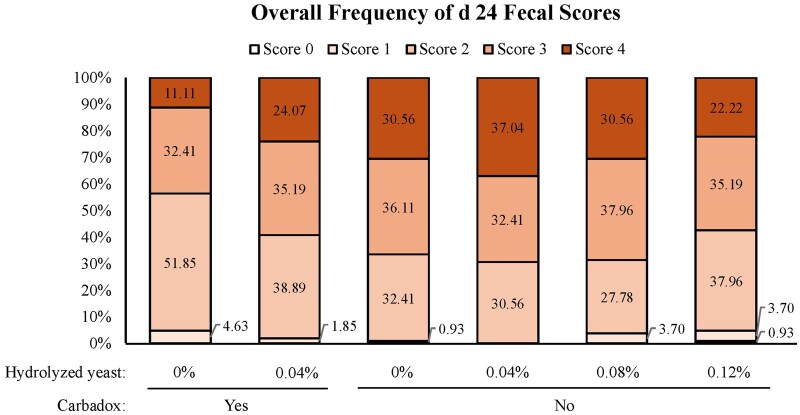
On day 10, increasing HY in diets without carbadox increased (linear,= 0.005) fecal DM. Additionally, pigs fed carbadox had increased ( 0.009) fecal DM on day 10 and 24 compared to pigs not fed carbadox. Fecal scores are reported using descriptive statistics due to a lack of model fit. For fecal scoring on day 10, the pigs fed the negative control had a higher numerical incidence of diarrhea than pigs fed the other dietary treatments (). The frequency of diarrhea (score of 4) decreased as HY increased in pigs fed diets either with or without carbadox. On day 24, pigs fed 0.04% HY numerically had the highest frequency of diarrhea with the frequency decreasing as the level of HY increased (). Pigs fed the diet with carbadox alone had the lowest frequency of diarrhea. P P ≤ Figure 1 Figure 2

Day 10 overall frequency of fecal scores. Fecal scores are presented on a 4-point scale: 0 = hard, pellet-like lumps; 1 = firm, formed feces; 2 = normal feces; 3 = mild looseness; and 4 = diarrhea as the mean determined by three observers. Fecal scores are reported using descriptive statistics due to a lack of model fit.

Day 24 overall frequency of fecal scores. Fecal scores are presented on a 4-point scale: 0 = hard, pellet-like lumps; 1 = firm, formed feces; 2 = normal feces; 3 = mild looseness; and 4 = diarrhea as the mean determined by three observers. Fecal scores are reported using descriptive statistics due to a lack of model fit.
Serum cytokines
On day 10, pigs fed 0.04% HY in diets containing carbadox tended to have decreased (< 0.10) cytokines IFNγ, IL-1α, IL-2, IL-4, IL-6, IL-10, and IL-18 compared to pigs fed carbadox alone (). Cytokines GM-CSF, IL-2, IL-4, and TNFα decreased then increased (quadratic,< 0.05) on day 10 and IL-1α, IL-1β, IL-6, and IL-10 tended to decrease then increase (quadratic,< 0.10) as HY increased in diets without carbadox with the lowest concentration observed at an inclusion level of 0.08% HY or 0.04% for GM-CSF. IFNγ increased (linear,= 0.015) as HY increased on day 10 although a tendency for a quadratic response (quadratic,= 0.065) was also observed. Cytokines IL-8 and IL-10 tended to decrease (≤ 0.097) when 0.04% HY was added to the diet, regardless of carbadox inclusion. On day 45, no treatment differences were observed. P P P P P P Table 3
| P 23 | |||||||||||
|---|---|---|---|---|---|---|---|---|---|---|---|
| Carbadox: 22 | Yes | No | HY in No Carbadox 24 | ||||||||
| HY, %: | 0 | 0.04 | 0 | 0.04 | 0.08 | 0.12 | SEM | Linear | Quadratic | 0.04% HY7 | Carbadox 26 |
| GM-CSF 27 | |||||||||||
| day 10 | 32.2 | 17.2 | 20.4 | 17.4 | 17.6 | 105.4 | 1.4 | 0.001 | 0.003 | 0.231 | 0.491 |
| day 45 | 9.5 | 9.1 | 8.1 | 8.4 | 9.8 | 11.4 | 1.4 | 0.428 | 0.846 | 0.981 | 0.707 |
| IFNγ | |||||||||||
| day 10 28 | 229.5 | 107.2 | 103.6 | 98.1 | 106 | 330 | 1.39 | 0.015 | 0.065 | 0.205 | 0.17 |
| day 45 | 21 | 20.5 | 19.9 | 29 | 27.9 | 36.2 | 1.39 | 0.226 | 0.862 | 0.582 | 0.647 |
| IL-1α | |||||||||||
| day 10 28 | 262.4 | 87.8 | 241.3 | 196.1 | 88.7 | 321.7 | 1.51 | 0.97 | 0.064 | 0.107 | 0.371 |
| day 45 | 72.3 | 44.5 | 57.5 | 75.1 | 43.3 | 91.8 | 1.51 | 0.637 | 0.546 | 0.786 | 0.714 |
| IL-1β | |||||||||||
| day 10 | 262.7 | 113.6 | 236.4 | 193.8 | 105.2 | 338.3 | 1.47 | 0.784 | 0.071 | 0.17 | 0.57 |
| day 45 | 62.5 | 35.6 | 36.8 | 45.2 | 28.9 | 59.2 | 1.47 | 0.563 | 0.496 | 0.636 | 0.697 |
| IL-1ra | |||||||||||
| day 10 | 541.3 | 331.2 | 480.1 | 401.7 | 348.2 | 629.4 | 1.32 | 0.586 | 0.159 | 0.22 | 0.894 |
| day 45 | 83 | 66.8 | 76.3 | 81.5 | 60.6 | 113.6 | 1.32 | 0.466 | 0.303 | 0.783 | 0.833 |
| IL-2 | |||||||||||
| day 10 28 | 246.7 | 82.4 | 233.1 | 168.2 | 72.3 | 292.2 | 1.56 | 0.932 | 0.049 | 0.103 | 0.45 |
| day 45 | 50.9 | 32.8 | 41.6 | 57.3 | 32.7 | 66.5 | 1.56 | 0.666 | 0.651 | 0.888 | 0.681 |
| IL-4 | |||||||||||
| day 10 28 | 268.6 | 102.3 | 249 | 191.3 | 90.3 | 356.7 | 1.51 | 0.855 | 0.041 | 0.123 | 0.488 |
| day 45 | 54.3 | 39.4 | 42.8 | 65.6 | 42.9 | 77.9 | 1.51 | 0.443 | 0.831 | 0.893 | 0.732 |
| IL-6 | |||||||||||
| day 10 28 | 255.5 | 98.2 | 244.7 | 177.4 | 94.8 | 313.8 | 1.49 | 0.946 | 0.053 | 0.102 | 0.481 |
| day 45 | 50.2 | 29.7 | 40.8 | 43.4 | 27.8 | 59.5 | 1.49 | 0.698 | 0.369 | 0.551 | 0.823 |
| IL-8 | |||||||||||
| day 10 | 767.8 | 430 | 867.2 | 564.1 | 797.9 | 698.6 | 1.34 | 0.812 | 0.597 | 0.074 | 0.485 |
| day 45 | 138.5 | 91.5 | 97.4 | 117.2 | 146.8 | 96.9 | 1.34 | 0.869 | 0.287 | 0.683 | 0.854 |
| IL-10 | |||||||||||
| day 10 28 | 267.4 | 98.7 | 259.8 | 182.4 | 95.2 | 303.6 | 1.52 | 0.921 | 0.063 | 0.097 | 0.471 |
| day 45 | 44.5 | 27.1 | 33.7 | 41 | 29.3 | 49.5 | 1.52 | 0.655 | 0.686 | 0.711 | 0.864 |
Antioxidant status
No treatment differences were observed on day 10 for TAC. Total antioxidant capacity decreased (linear,= 0.008) on day 45 as HY increased. Increasing HY tended to decrease (linear,= 0.095) serum SOD activity on day 10. Also, there was a tendency for an increase (< 0.10) in serum SOD activity in pigs fed 0.04% HY with carbadox compared to pigs fed carbadox without HY. No treatment differences were observed on day 45. P P P
Discussion
yeast products are available in various forms, including live yeast (probiotic), yeast cultures (prebiotic), yeast extracts (postbiotic), yeast cell walls, and hydrolyzed yeast. Research on yeast-based products primarily focus on nursery pigs, as they are highly susceptible to gut pathogens and diarrhea due to dietary transitions, immature gut health, and social stressors (;). Studies have reported benefits of yeast supplementation on immune function and gut morphology (;). Additionally, yeast products contain nucleotides, free amino acids, and vitamins (), which can support intestinal development and may contribute to improved nutrient digestibility. However, these positive effects do not always translate into improved growth performance, likely due to the variability in yeast composition due to differences in manufacturing processes, culture conditions, and preparation techniques (). Saccharomyces cerevisiae [Chance et al., 2021] [Long et al., 2021] [Shen et al., 2009] [Namted et al., 2022] [Demirgul et al., 2022] [Aguilar-Uscanga & Francois, 2003]
Some studies have demonstrated positive effects of added yeast products on weanling pig growth performance. For instance,observed a linear increase in BW and ADG with increasing hydrolyzed yeast (0%, 5%, and 10% of the diet). These improvements can be attributed to enhanced crude protein digestibility, and improved intestinal morphology (). Similarly,reported improvements in growth performance with added yeast extract complex (0.1% and 0.2%) from a mixture ofandcontaining β-glucan, mannan, nucleotide protease, and α-amylase, noting increased overall ADG and a tendency for increased ADFI, along with a tendency for increased G:F when pigs were approximately 25 kg. In contrast, the present study observed no differences in ADG or ADFI, despite containing similar components of β-glucan, mannan, and enzymes, potentially due to the considerably lower inclusion rates of HY (0.04%, 0.08%, and 0.12%).also did not observe differences in growth performance when supplementing 0.2% of a different hydrolyzedyeast derivative. However, they observed a tendency for increased G:F, which is comparable to the increased G:F in the present study with 0.04% added HY. Similarly,observed increased G:F when supplementingcell wall extract at 0.5% and 1.0% of the diet. These findings illustrate the potential of-derived products to improve G:F, although responses may vary depending on the specific form and inclusion level. [Boontiam et al. (2022)] [Boontiam et al., 2022] [Shi and Kim (2019)] [Molist et al. (2014)] [Liu et al. (2017)] Kluyveromyces maxianus S. cerevisiae S. cerevisiae S. cerevisiae S. cerevisiae
Carbadox is used in swine production due to its ability to regulate gut microbiota (), promote growth and enhance G:F (), as well as its capacity to reduce inflammation (). By suppressing the proliferation of gram-negative bacteria in the small intestine such as ETEC, carbadox can improve digestion and nutrient absorption by reducing microbial competition, ultimately improving growth performance (). Althoughenumeration was not evaluated in the current study, the addition of carbadox increased fecal DM and decreased the frequency of diarrhea. Although HY is being explored as a potential alternative for carbadox, it does not have the same immediate antimicrobial potency. Yeast products work mainly through immunomodulation and prebiotic effects, indirectly changing the microbiota (). [Looft et al., 2014] [Yen et al., 1985] [He et al., 2020] [Gaskins et al., 2002] [Zanello et al., 2011] E coli
Research on the effects of carbadox dating back to the late 1960s supports its ability to improve growth performance in nursery pigs (;;). The findings from the present study demonstrate that added carbadox improved overall ADG, ADFI, and BW gain compared to pigs fed diets without carbadox. Notably, the increase in BW gain occurred without a proportional improvement in G:F, suggesting that the enhanced growth performance was primarily driven by greater feed intake. This observation aligns with, who observed that pigs fed carbadox at 55 mg/kg exhibited greater BW and a tendency for an increased feed intake without changes in G:F. [Thrasher et al., 1969] [Roof and Mahan, 1982] [Nabuurs et al., 1990] [Yen and Pond (1993)]
Oxidative stress in weanling pigs can result from various factors like environmental stressors, disease, and dysbiosis in the gut microbiome (). Total antioxidant capacity measures the overall antioxidant potential in a biological sample, while SOD specifically quantifies the activity of an enzyme crucial to the antioxidant defense system (). While there are no established reference values for optimal TAC and SOD levels, higher concentrations generally indicate improved antioxidant status. Previous research has shown that including yeast-based products like cell wall extract at either 0.05%, 0.10%, or 0.15% () and live yeast at 0.2% () in nursery pig diets can enhance SOD activity, suggesting an increase in antioxidative capacity. In contrast, the present study observed no differences in SOD activity or TAC levels between pigs fed the control diet and 0.04% added HY. However, an unexpected decrease in both TAC and SOD were observed with increasing HY, indicating a reduction in antioxidant capacity. A possible explanation is that higher inclusions of HY may have been potentially acting as a physiological stressor rather than providing a beneficial effect on oxidative status, as indicated by the elevated cytokines observed with this diet. [Lykkesfeldt and Svendsen, 2007] [Bafana et al., 2011] [Liu et al., 2017] [Long et al., 2021]
Cytokines are signaling proteins that mediate communication between immune cells and regulate inflammation, tissue repair, and immune responses. A decrease in pro-inflammatory cytokine levels such as interferon gamma (IFNγ), interleukins (IL-1β, IL-2, IL-6, IL-8, IL-12, and IL-18), and tumor necrosis factor alpha (TNFα) indicate improved inflammation status, suggesting that pigs may allocate less energy and AA toward immune overexpression, potentially enhancing overall energy and AA utilization (). Anti-inflammatory cytokines such as IL-4 and IL-10 reduce inflammation and regulate the immune response by reducing the pro-inflammatory cytokine response.observed no differences in cytokines IL-6, IL-10, or TNFα in pigs fed diets with enzymatically treated yeast compared with pigs fed the control diet.observed no differences in cytokines IL-1β or TNFα, but an increase in IL-10 in pigs fed a diet with yeast hydrolysates compared with those fed a control diet. Interleukins are a group of cytokines that act as chemical signals between white blood cells while IFN help resist viral infections and regulate innate and adaptive immune responses.observed that yeast culture reduced the intestinal inflammation caused by pathogens through the inhibition of pro-inflammatory cytokine expression (TNFα, IL-1α, IL-6, and IL-8) induced by ETEC. In the present study, 0.04% HY inclusion with carbadox tended to decrease IFNγ, IL-1α, IL-2, IL-4, IL-6, IL-10, and IL-18 compared to feeding carbadox without HY supplementation, suggesting that these pigs had less inflammation or immune activation, which indicates an additive effect of the two products. Granulocyte-macrophage colony-stimulating factor (GM-CSF) is produced by activated T lymphocytes and other immune cells to control the differentiation and functional activation of hematopoietic cells following infection. Cytokines GM-CSF, IL-2, IL-4, and TNFα decreased then increased on day 10 and IL-1α, IL-1β, IL-6, and IL-10 tended to decrease then increase with increasing HY in diets without carbadox, again suggesting that higher inclusions of HY may have caused a physiological stressor as the cytokine levels were high. The observed increase in cytokines levels may be attributed to the yeast components, specifically β-glucans, which are recognized by receptors like dectin-1 on immune cells such as macrophages and neutrophils (). The binding of β-glucans can trigger the production of pro-inflammatory cytokines such as TNF-α and IL-1β (). In the present study, carbadox had no effect on cytokine concentrations. However, previous literature has shown that carbadox can reduce pro-inflammatory cytokines like TNFα () and IL-1β (). [Dinarello, 2000] [Christensen et al. (2022)] [Fu et al. (2019)] [Zanello et al. (2011)] [Goodridge et al., 2009] [Fu et al., 2023] [He et al., 2020] [Hung et al., 2020]
Complex carbohydrates, such as β-glucans and MOS, impact the gut microbiota of the pig by binding pathogenic bacteria likeand Salmonella, decreasing their ability to adhere to intestinal walls (). These components are found in products like hydrolyzed yeast that contain components of the yeast cell wall.observed that an inclusion of 0.05% yeast cell wall tended to decrease the frequency of diarrhea compared to the control diet during the first 2 wk post-weaning. A similar finding was observed in the present study, where pigs fed diets containing HY had higher fecal DM (indicating lower diarrhea) than those fed the control diet. Due to their ability to bind pathogenic bacteria, yeast-products containing β-glucans and MOS have been widely studied for their effects in challenge models.found that pigs fed live yeastat 0.5% had a lower daily diarrhea score, indicating less diarrhea, as well as a shorter duration of diarrhea compared to the control group when the pigs are orally challenged with ETEC K88. Although pigs were not inoculated within the present study,can still be present under non-challenge conditions. Through diagnostic testing of a representative fecal sample for this group of pigs, F18was identified via polymerase chain reaction analysis with genes for heat stable toxin 1a (st1a), heat stable toxin 1b (st1b), and heat labile toxin (lt) along with rotavirus group A. A similar response in a non-challenge setting was observed bywho noted lower diarrhea rate with increasing hydrolyzed yeast of a different yeast product, aligning with the findings from the present study where there was an increase in fecal DM as HY inclusion increased. E. coli S. cerevisiae E. coli E. coli E. coli [Moreira dos Anjos et al., 2019] [Lee et al. (2021)] [Trckova et al. (2014)] [Boontiam et al. (2020)]
Additionally, pigs fed diets containing carbadox had a higher fecal DM. Carbadox inhibits the growth of enteric pathogens and alters the gut microbial composition, which can lead to decreased prevenance of diarrhea. Because of this, more research has been done evaluating its effect in pathogen challenges.observed that ETEC F18 challenged pigs fed diets containing carbadox had lower average diarrhea scores and frequency of diarrhea, like observed in pigs fed carbadox in the present study. In the present study, there was a correlation between diarrhea occurrence, as measured by fecal scoring, and fecal DM. As HY inclusion increased, the frequency of diarrhea decreased and fecal DM increased, indicating firmer stools. Although increased stool consistency may indicate improved gut health, the effect may be insufficient to result in improved growth performance (). Growth performance is multifactorial, being influenced by factors such as nutrient digestibility, while immune system activation can divert nutrients away from growth. [Kim et al. (2021)] [Lee et al., 2021]
In conclusion, 0.04% HY improved G:F and increasing HY improved fecal DM in the early nursery phase. However, increasing HY inclusion did not result in improved growth performance. Pigs fed carbadox had increased final BW and firmer stools compared with those fed no carbadox and the same HY inclusion. Addition of 0.04% HY with carbadox tended to reduce serum cytokine concentrations (IFNγ, IL-1α, IL-2, IL-4, IL-6, IL-10, and IL-18) compared to carbadox alone. Additionally, serum cytokine concentrations (TNFα, IL-1α, IL-1β, IL-2, IL-4, IL-6, and IL-10) tended to decrease then increase as HY increased with the lowest concentration observed at an inclusion level of 0.08%. The combination of HY with carbadox showed potential immunomodulatory effects by reducing cytokine concentrations, suggesting HY may support immune regulation, but benefits on growth were limited.