
What this is
- Roux-en-Y gastric bypass (RYGB) surgery effectively treats obesity but may lead to hypoglycemia in non-diabetic patients.
- This study analyzes the incidence of hypoglycemia post-surgery using a large cohort from the TriNetX database.
- It includes 15,085 patients who underwent RYGB and compares them to over 3 million non-surgical controls.
Essence
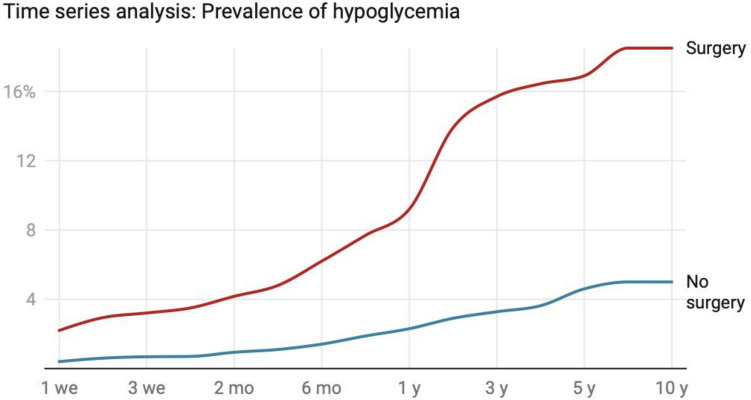
- RYGB surgery significantly increases the risk of hypoglycemia in patients with obesity without diabetes. The incidence is notably higher both immediately and over a 10-year follow-up.
Key takeaways
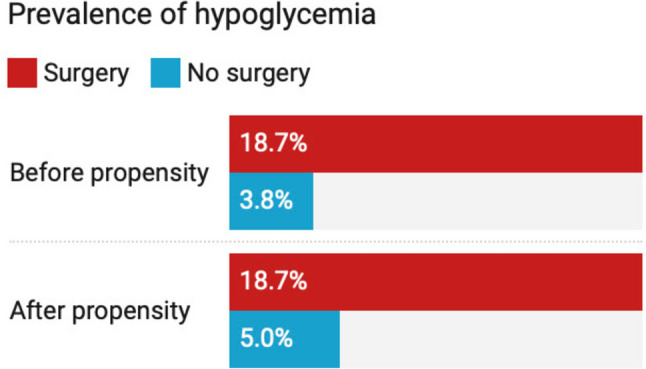
- The incidence of hypoglycemia was 18.70% in RYGB patients vs. 3.80% in controls. This indicates a substantial increase in risk associated with the surgery.
- After propensity score matching, the hypoglycemia risk remained elevated at 18.70% for RYGB patients compared to 5.0% for matched controls. This underscores the persistent risk even after controlling for confounding factors.
- Subgroup analysis revealed that 21.3% of RYGB patients who experienced hypoglycemia were hospitalized within 30 days, highlighting the clinical significance of this complication.
Caveats
- The retrospective nature of the study may introduce bias due to unmeasured confounding factors. This limits the ability to draw definitive conclusions about causality.
- The definition of hypoglycemia may not capture all cases, potentially underestimating the true incidence. This could affect the overall understanding of the risk.
- The use of aggregated data from the TriNetX database limits the ability to assess individual patient characteristics and specific reasons for hospitalization.
Simplified
Introduction
Obesity is a worldwide health issue linked to several additional health problems, such as type 2 diabetes, cardiovascular disease, and specific types of cancer [1 –3]. It is a global epidemic resulting from genetic susceptibility, increased availability of high-energy foods, and decreased physical activity, threatening global well-being [4]. Medical care, lifestyle modifications, food, and exercise are all available forms of treatment for obesity as well as Bariatric surgery which is considered an increasingly popular and highly successful option [5].
Roux-en-Y gastric bypass (RYGB) was first reported by Alan Wittgrove and Wesley Clark in 1994 [6], It combines restrictive and malabsorptive elements and is one of the most frequently performed surgical procedures for obesity in the USA [7, 8]. RYGB surgery has proven effective in treating severe obesity by causing substantial weight loss and enhancing related health issues [9, 10]. Nevertheless, the effects of RYGB surgery on the incidence of hypoglycemia, especially in individuals without diabetes, are still uncertain.
Hypoglycemia is a potentially serious complication that can occur after RYGB surgery, even in patients without a history of diabetes [11]. The reasons behind this may include changes in glucose metabolism, improved insulin sensitivity, and increased secretion of glucagon-like peptide-1 (GLP-1) after surgery [12, 13]. Despite the acknowledgment of this complication, the long-term risk of hypoglycemia following RYGB surgery in patients with obesity and without diabetes has not been thoroughly researched.
The aim of this study was to investigate the risk of hypoglycemia following RYGB surgery in patients with obesity and without a history of diabetes or GLP-1 receptor agonist use.
Methods
Data Source
This retrospective cohort study utilized the TriNetX database (TriNetX LLC, Cambridge, MA, USA), a global federated health research network providing access to electronic health records (EHRs). The TriNetX Global Collaborative network encompasses more than 275 million individuals across over 120 health care organizations (HCOs) worldwide, with established data usage and publication agreements. It offers comprehensive datasets including patient demographics, diagnoses, procedures, medications, and laboratory results, primarily collected from HCOs' EHRs. This extensive data collection ensures a holistic view of patient health and related outcomes, contributing to the robustness of our analyses. However, as with any EHR-based dataset, it may face typical data quality challenges such as incomplete or inaccurate entries, under-reporting of certain conditions, limited granularity, and potential data exclusions. To mitigate these issues, TriNetX employs rigorous data validation processes, including regular quality checks to identify and correct discrepancies, validation against external benchmarks for consistency and accuracy, and collaboration with data contributors to resolve issues and continuously improve data quality. The database provides continuous, comprehensive, up-to-the-month data, ensuring the most current information is available for analysis. For this study, the database was last accessed on September 22, 2024.
Study Population
The study included patients aged 18 years or older with a body mass index (BMI) of 30 kg/m2 or higher. Patients who underwent RYGB surgery were identified using Current Procedural Terminology (CPT) codes 43,644 and 43,846. The non-surgical control group included patients with obesity who did not undergo bariatric surgery. Patients with a history of diabetes (ICD-10-CM codes E08-E13), GLP-1 receptor agonist use prior to the index date, or chromosomal and genetic disorders were excluded, Supplementary Table S1. The index date was defined as the date of RYGB surgery for the surgical group and a randomly assigned date for the non-surgical group.
Study Variables
Baseline characteristics, including age, sex, race, and ethnicity, were extracted from the EHRs. Associated medical problems and medication use were assessed based on ICD-10-CM diagnosis codes and RxNorm medication codes, respectively.
Procedural Characteristics
The study included patients who underwent two specific types of Roux-en-Y gastric bypass (RYGB) procedures: Laparoscopic gastric restrictive surgery combined with gastric bypass and a Roux-en-Y gastroenterostomy, where the Roux limb measures 150 cm or less. Gastric restrictive surgery with gastric bypass specifically for morbid obesity, also utilizing a short Roux-en-Y gastroenterostomy, defined as 150 cm or less.
This approach allows for a comprehensive understanding of the impact of surgical variations on patient results.
Propensity Score Matching
To adjust for potential confounding factors, propensity score matching was performed using a 1:1 nearest-neighbor matching algorithm without replacement. Propensity scores were calculated using logistic regression, with treatment assignment (RYGB surgery vs. non-surgical control) as the dependent variable. Demographic factors included age, sex, race, and ethnicity. Socioeconomic determinants were represented by problems related to medical facilities and other health care, employment and unemployment, and housing and economic circumstances. Lifestyle factors comprised lack of physical exercise, problems related to sleep, overweight and obesity, dietary counseling, and smoking status. A range of associated medical problems were considered, including alcohol-related disorders, hypertensive diseases, metabolic disorders, malnutrition, vitamin deficiencies, acute and chronic kidney disease, hepatic failure, and neoplasms. Specific risk factors for hypoglycemia were also included: fibrosis and cirrhosis of liver, alcoholic liver disease, primary adrenocortical insufficiency, Addisonian crisis, hypopituitarism, severe sepsis with septic shock, and disorders of pyruvate metabolism and gluconeogenesis. Finally, the matching process accounted for medication use, specifically quinolones, glucagon, ACE inhibitors, and beta blockers. The matched cohorts were used for subsequent analyses.
Outcomes of Interest
The primary outcome was the incidence of hypoglycemia, defined by the presence of ICD-10-CM diagnosis codes (E16.1, E16.2) or laboratory values (glucose ≤ 70 mg/dL) during the follow-up period. The time-to-event analysis was conducted for overall incidence and at various time points to assess both short-term and long-term risk. Short-term risk was evaluated at 1 week, 1 month, 3 months, and 6 months after the index date, while long-term risk was assessed at 5 years and 10 years after the index date.
Subgroup Analysis
A subgroup analysis was conducted on 2,810 individuals from the surgery cohort who developed hypoglycemia. This analysis evaluated the impact on hospitalization rates and mortality within 30 days following a hypoglycemic event, as well as the length of stay for the first hospital admission. The aim was to quantify the acute clinical outcomes associated with hypoglycemic events in post-RYGB patients.
Statistical Analysis
Baseline characteristics were compared between the RYGB surgery and non-surgical control groups using chi-square tests for categorical variables and t-tests for continuous variables. The prevalence of hypoglycemia was calculated in each group. Cox regression analysis was employed, and hazards ratio (HR) and 95% confidence intervals (CI) were reported. For the subgroup analysis, descriptive statistics were used to present hospitalization rates, length of hospital stay, and mortality in the surgery group. A two-sided p-value < 0.05 was considered statistically significant. All analyses were performed using the TriNetX platform.
Results
Characteristics of the Study Population
| Characteristics | Surgery( = 15,085)n | Non-surgery( = 3,200,074)n | -valuep | Surgery( = 14,916)n | Non-surgery( = 14,916)n | -valuep |
|---|---|---|---|---|---|---|
| Demographics | ||||||
| Age at Index | 42.4 ± 11.3 | 47.9 ± 17.1 | < 0.001 | 42.5 ± 11.3 | 42.2 ± 13.3 | 0.33 |
| Female | 11,930 (79.2%) | 1,736,423 (54.6%) | < 0.001 | 11,793 (79.1%) | 11,946 (80.1%) | 0.28 |
| Male | 2038 (13.5%) | 1,095,300 (34.4%) | 2038 (13.7%) | 1913 (12.8%) | ||
| White | 11,011 (73.1%) | 1,986,875 (62.5%) | < 0.001 | 10,877 (72.9%) | 10,833 (72.6%) | 0.56 |
| Black or African American | 1738 (11.5%) | 434,843 (13.7%) | 1737 (11.6%) | 1795 (12%) | ||
| Asian | 52 (0.3%) | 53,698 (1.7%) | 52 (0.3%) | 49 (0.3%) | ||
| American Indian/Alaska Native | 35 (0.2%) | 12,734 (0.4%) | 35 (0.2%) | 45 (0.3%) | ||
| Native Hawaiian/Pacific Islander | 29 (0.2%) | 38,159 (1.2%) | 29 (0.2%) | 102 (0.7%) | ||
| Other race | 393 (2.6%) | 118,626 (3.7%) | 390 (2.6%) | 345 (2.3%) | ||
| Unknown race | 1810 (12%) | 536,027 (16.9%) | 1796 (12%) | 1747 (11.7%) | ||
| Not Hispanic or Latino | 11,102 (73.7%) | 2,040,241 (64.1%) | < 0.001 | 11,020 (73.9%) | 9815 (65.8%) | 0.38 |
| Hispanic or Latino | 1804 (12%) | 338,014 (10.6%) | 1754 (11.8%) | 2763 (18.5%) | ||
| Socioeconomic determinants | ||||||
| Problems related to medical facilities and other health care | 10 (0.1%) | 2785 (0.1%) | 0.38 | 10 (0.1%) | 11 (0.1%) | 0.82 |
| Problems related to employment and unemployment | 65 (0.4%) | 9533 (0.3%) | 0.003 | 64 (0.4%) | 81 (0.5%) | 0.15 |
| Problems related to housing and economic circumstances | 140 (0.9%) | 18,349 (0.6%) | < 0.001 | 139 (0.9%) | 154 (1%) | 0.37 |
| Lifestyle factors | ||||||
| Lack of physical exercise | 46 (0.3%) | 1314 (0.0%) | < 0.001 | 45 (0.3%) | 48 (0.3%) | 0.75 |
| Problems related to sleep | 117 (0.8%) | 6728 (0.2%) | < 0.001 | 117 (0.8%) | 98 (0.7%) | 0.19 |
| Dietary counseling | 5927 (39.3%) | 42,780 (1.3%) | < 0.001 | 5775 (38.7%) | 5734 (38.4%) | 0.62 |
| Smoking | 606 (4%) | 89,848 (2.8%) | < 0.001 | 602 (4%) | 583 (3.9%) | 0.57 |
| Associated medical problems | ||||||
| Alcohol related disorders | 277 (1.8%) | 71,052 (2.2%) | 0.001 | 276 (1.9%) | 219 (1.5%) | 0.11 |
| Hypertensive diseases | 7142 (47.4%) | 822,051 (25.8%) | < 0.001 | 7010 (47%) | 7031 (47.1%) | 0.8 |
| Metabolic disorders | 6264 (41.6%) | 785,294 (24.7%) | < 0.001 | 6202 (41.6%) | 6157 (41.3%) | 0.59 |
| Malnutrition | 212 (1.4%) | 13,264 (0.4%) | < 0.001 | 187 (1.3%) | 198 (1.3%) | 0.57 |
| Vitamin deficiencies | 5509 (36.6%) | 290,107 (9.1%) | < 0.001 | 5368 (36%) | 5248 (35.2%) | 0.14 |
| Acute & chronic kidney disease | 355 (2.4%) | 114,291 (3.6%) | < 0.001 | 355 (2.4%) | 288 (1.9%) | 0.08 |
| Hepatic failure | 15 (0.1%) | 7353 (0.2%) | 0.001 | 15 (0.1%) | 13 (0.1%) | 0.7 |
| Neoplasms | 3205 (21.3%) | 567,055 (17.8%) | < 0.001 | 3198 (21.4%) | 3129 (21%) | 0.33 |
| Risk factors for hypoglycemia | ||||||
| Fibrosis and cirrhosis of liver | 98 (0.7%) | 20,971 (0.7%) | 0.89 | 97 (0.7%) | 83 (0.6%) | 0.29 |
| Alcoholic liver disease | 11 (0.1%) | 9957 (0.3%) | < 0.001 | 11 (0.1%) | 22 (0.1%) | 0.06 |
| Primary adrenocortical insufficiency | 15 (0.1%) | 2186 (0.1%) | 0.15 | 15 (0.1%) | 18 (0.1%) | 0.6 |
| Addisonian crisis | 13 (0.1%) | 1754 (0.1%) | 0.1 | 13 (0.1%) | 14 (0.1%) | 0.84 |
| Hypopituitarism | 17 (0.1%) | 3557 (0.1%) | 0.97 | 17 (0.1%) | 11 (0.1%) | 0.25 |
| Severe sepsis with septic shock | 14 (0.1%) | 4721 (0.1%) | 0.07 | 14 (0.1%) | 22 (0.1%) | 0.18 |
| Disorders of pyruvate metabolism and gluconeogenesis | 10 (0.1%) | 270 (0%) | < 0.001 | 10 (0.1%) | 10 (0.1%) | 1 |
| Medications | ||||||
| Quinolones | 2122 (14.1%) | 318,633 (10%) | < 0.001 | 2117 (14.2%) | 2123 (14.2%) | 0.92 |
| Glucagon | 197 (1.3%) | 39,902 (1.3%) | 0.56 | 197 (1.3%) | 166 (1.1%) | 0.1 |
| ACE inhibitors | 1592 (10.6%) | 286,625 (9%) | < 0.001 | 1589 (10.7%) | 1546 (10.4%) | 0.41 |
| Beta blockers | 3065 (20.3%) | 438,226 (13.8%) | < 0.001 | 3030 (20.3%) | 2829 (19%) | 0.3 |
Risk of Hypoglycemia in the Overall Study Population

Prevalence of hypoglycemia in the overall study population before and after propensity score matching. The risk of hypoglycemia was significantly higher in the RYGB surgery group compared to the non-surgical control group, both before and after propensity score matching ( < 0.001) p
Time-Series Analysis

Time-series follow-up of propensity score-matched cohorts.Incidence of hypoglycemia at various time points following RYGB surgery compared to non-surgical controls. The incidence of hypoglycemia remained significantly elevated in the RYGB surgery group throughout the 10-year follow-up period (all < 0.001) A p

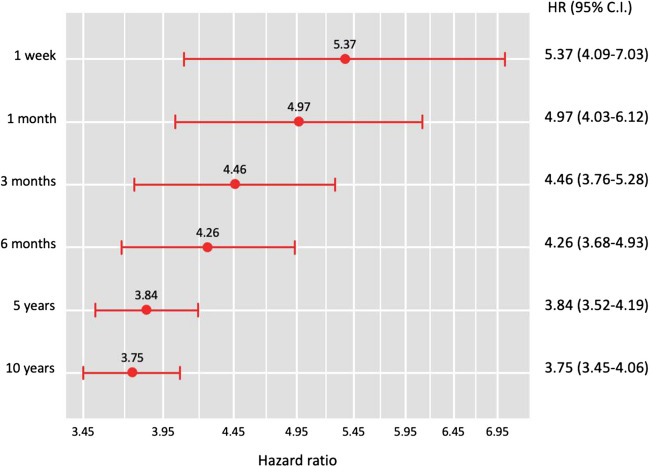
Risk of hypoglycemia at each time point following RYGB or obesity diagnosis. Cox regression analysis was employed, and hazards ratio (HR) and 95% confidence intervals (CI) are reported. The risk of hypoglycemia remained significantly elevated in the RYGB surgery group throughout the 10-year follow-up period (all < 0.001) p
Subgroup Analysis
A subgroup analysis was conducted on the 2,810 individuals from the RYGB cohort who developed hypoglycemia to quantify the acute clinical outcomes associated with hypoglycemic events. Within 30 days of a hypoglycemic event, 21.3% (n = 598) of these patients were hospitalized. The median length of stay for the first hospital admission was 1.5 days (IQR: 1–3 days). The 30-day mortality rate following a hypoglycemic event was 0.71% (n = 20).
Discussion
In this large-scale, propensity score-matched analysis, we found that RYGB surgery is associated with a significantly increased risk of hypoglycemia in patients with obesity and without diabetes. The risk was observed as early as 1-week post-surgery and persisted throughout the 10-year follow-up period, with hazard ratios ranging from 5.37 at 1 week to 3.75 at 10 years post-surgery.
These findings build on the pre-existing knowledge that RYGB does in fact increase the risk of post-surgical hypoglycemia among patients with obesity significantly. Our results show an approximately 3.7-fold increase in risk among the propensity-score matched cohort, which although lower than some previous estimates, is still consistent with other studies showing increased risk of hypoglycemia postoperative [14].
The increased risk of hypoglycemia following RYGB may be attributed to several factors, including increased glycemic variability, altered glucose metabolism, increased insulin sensitivity, and enhanced glucagon-like peptide-1 (GLP-1) response which are particularly evident at 1 and 2 year time points [15, 16]. Another potential cause may be delayed improvement in pancreatic β-cell sensitivity to changes in circulating glucose, which was evidently observed in patients who had a higher decrease in BMI during the first 12 months post-surgery [17].
Among all potential complications of RYGB, incidence of hypoglycemia, considered low in some studies [18, 19], might be slightly misleading. This is due to the desired effects of hypoglycemia among patients with diabetes who undergo RYGB. However, our results show an 18.70% prevalence of hypoglycemia in the RYGB group compared to 5.0% in the matched control group. Our subgroup analysis further revealed that among RYGB patients who experienced hypoglycemia, 21.3% were hospitalized within 30 days of the event, with a median hospital stay of 1.5 days. Moreover, the 30-day mortality rate following a hypoglycemic event was 0.71%, underscoring the potential severity of this complication. Despite the lack of literature supporting this, Vaurs et. al [20] have recognized the risk of hypoglycemia post-surgery and the longer duration patients spend under 3.3 mmol/L. This was attributed to a certain patients' phenotype which generally leads to increased susceptibility to hypoglycemia. These patients should be carefully monitored post-RYGB.
Appropriate management of hypoglycemia post-RYGB should be given further consideration in the future to prevent multiple secondary complications. This can include changes in brain responses to hypoglycemia that may exacerbate hypoglycemia due to reduced insulin-antagonistic reactions. Neural activation in critical brain regions, including the hypothalamus, plays a key role in coordinating glucose regulation [21]. Furthermore, hypoglycemia is associated with dementia, macrovascular complications, falls and fractures, and cardiovascular death particularly in older patients and most importantly may ultimately increase mortality [22].
Well-illustrated treatment strategies targeting appropriate management for post-RYGB hypoglycemia in patients without diabetes are still missing in the literature. However, several proposed dietary, pharmacologic and even surgical approaches can be considered [23]. Surgical interventions such as reversal of RYGB and pancreatectomy have reported success rates, with trends leaning towards higher effectiveness with reversal surgery [24]. A clear outline for the most optimal treatment strategy is yet to be defined.
Future Directions
These findings highlight the importance of long-term monitoring and management of hypoglycemia in patients undergoing RYGB surgery, especially in the absence of preexisting diabetes. The consistently elevated risk of hypoglycemia throughout the 10-year follow-up period emphasizes the need for ongoing vigilance. Pre-operative assessment for patients' liability to hypoglycemia should also be essential along with proper patient education about the possibility of such a complication. Furthermore, the significant rate of hospitalization and mortality associated with hypoglycemic events in our subgroup analysis underscores the need for prompt recognition and management of this complication.
Strengths and Limitations
The study's strengths include the large sample size, long-term follow-up, and use of propensity score matching to control for potential confounding factors. Additionally, our subgroup analysis provides valuable insights into the acute clinical outcomes associated with hypoglycemic events in post-RYGB patients. However, the study also has some limitations. First, the retrospective nature of the study may introduce bias due to unmeasured confounding factors. Second, the definition of hypoglycemia based on ICD-10-CM codes and laboratory values may not capture all cases, potentially underestimating the true incidence of hypoglycemia. Moreover, due to the nature of the TriNetX database, which provides aggregated data rather than individual patient information, our ability to investigate specific reasons for each hospitalization along with directly assessing missing or incomplete data at the individual patient level was limited. Finally, while our subgroup analysis provides some insight into the clinical impact of hypoglycemic events, we were unable to assess the full spectrum of severity and long-term consequences of these events.
Conclusion
In conclusion, while RYGB surgery remains an effective treatment for severe obesity, the increased risk of hypoglycemia should be carefully considered in the decision-making process and post-operative care of patients with obesity and without diabetes. Balancing the benefits of weight loss and metabolic improvements with the potential risk of hypoglycemia is crucial for optimizing patient outcomes and ensuring the long-term success of bariatric surgery.
Supplementary Information
Below is the link to the electronic supplementary material. Supplementary file1 (DOCX 16 KB)