
What this is
- This systematic review and meta-analysis evaluate the efficacy and safety of (GLP-1RAs) for weight management in individuals with psychiatric disorders.
- The study includes 10 randomized controlled trials focusing on weight and metabolic outcomes.
- Findings indicate that GLP-1RAs lead to significant reductions in body weight, BMI, waist circumference, and fasting glucose.
Essence
- GLP-1RAs effectively reduce body weight and improve metabolic outcomes in individuals with psychiatric disorders. They are generally well-tolerated, with mild gastrointestinal side effects.
Key takeaways
- GLP-1RAs resulted in a mean weight loss of 5.03 kg compared to controls. This weight reduction is clinically significant, addressing obesity in psychiatric populations.
- Secondary outcomes showed reductions in BMI by 1.59 kg/m² and waist circumference by 3.4 cm. These improvements suggest beneficial metabolic effects beyond just weight loss.
- While gastrointestinal side effects were more frequent, they were typically mild and did not lead to increased discontinuation rates, indicating a favorable safety profile.
Caveats
- The heterogeneity of psychiatric conditions among studies may limit the validity of comparisons. Each disorder has unique treatment responses and protocols.
- Only 10 studies were included, which restricts the strength of evidence. More research is needed, particularly on newer agents like tirzepatide.
Definitions
- GLP-1 receptor agonists (GLP-1RAs): Medications that mimic the action of the glucagon-like peptide-1 hormone, promoting insulin secretion and reducing appetite.
Simplified
Methods
The protocol for this review is available on PROSPERO (CRD42023418437).
We searched the literature in the US National Library of Medicine (PubMed), Latin American and Caribbean Literature in Health Sciences, Embase, Cochrane Library, Web of Science, Scopus, and the registry of multiple trials, including ClinicalTrials.gov↗, from the National Institutes of Health. We used a combination of text words (tw) and MeSH headings (mh), including Glucagon-Like Peptide 1[mh] OR GLP-1[tw] AND Mental Disorders[mh] OR Mental Disorder*[tw] OR Behavior Disorder*[tw] OR Mental Illness[tw] OR Psychiatric Diagnosis*[tw] OR Psychiatric Disease*[tw] OR Psychiatric Disorder* AND Overweight[mh] OR Overweight[tw] OR Weight Gain. The search strategies for this review were developed with the assistance of an experienced librarian. Additionally, we manually searched the references of the included articles published in English.
Trial Selection
The PRISMA guidelines were followed [20]. Two investigators (K.M.A. and M.T.S.) examined the titles and abstracts and independently examined the full-text reports and abstracts. The inclusion criteria were as follows: (1) adults aged ≥18 years and (2) diagnosis of any psychiatric disorder as stated in the papers, (3) people with obesity or overweight [body mass index (BMI) > 25.0 kg/m²]; (4) use of any GLP-1 agonist as an intervention, (5) randomized controlled trials or observational studies, (6) participants were allocated to a GLP-1RA intervention or control group (placebo or other medications). The exclusion criteria were as follows: (1) case series, case studies, and conference/congress abstracts with insufficient data and (2) full content access was not possible. Only studies published between January 1, 2000, and May 6, 2025, were selected for review. This time frame was selected because of the emergence of GLP-1RAs in clinical research in the early 2000s. Any disagreements were resolved by consensus with L.V.V.
Outcomes
The outcomes were (1) changes in body weight and (2) BMI. Secondary outcomes were (1) cardiometabolic risk factors such as fasting glucose, total cholesterol, high-density lipoprotein, systolic blood pressure, triglycerides, and waist circumference and (2) adverse effects.
Data Extraction
Data were extracted independently by K.M.A. and M.T.S. using a structured and pretested form. L.V.V. provided assistance as an adjudicator in cases of disagreements. Data extraction included changes in the outcomes; incidence of adverse events and information regarding sample description, such as age, sex, race, comorbidities, psychiatric diagnosis, medications in use, and sample size; and study characteristics, such as study design, duration of intervention, type of GLP-1RA used as intervention, percentage of loss to follow-up, the year it occurred, and where it took place.
Risk of Bias Assessment
Two researchers (K.M.A. and M.T.S.) independently assessed the methodological quality of the included studies. The risk of bias in intervention studies was assessed using methods developed by the Cochrane Group, the RoB 2.0 (Revised Cochrane Risk-of-Bias) tool [21]. The following bias domains were evaluated as high risk, low risk, or having some concerns: (1) random sequence generation (selection bias), (2) allocation concealment (selection bias), (3) blinding of participants and personnel (performance bias), (4) blinding of outcome assessment (detection bias), (5) incomplete outcome data (attrition bias), (6) selective reporting (reporting bias), and (7) other possible sources of bias. For a trial to be classified as "low risk," all domains needed to be assessed as low risk, with the exception of participant blinding. The Newcastle–Ottawa Quality Assessment Scale was used for observational studies. A funnel plot was used to assess publication bias in the case of a sufficient number of studies (n ≥ 10).
Statistical Analyses
We examined the effect of GLP-1RAs on changes in weight and all other outcomes compared with those in the control arm. Our meta-analysis used a random-effects model to calculate the standardized mean differences (MD) with SD for continuous outcomes and relative risk for categorical variables. Certain unit adjustments and central tendency measure conversions were necessary to ensure data comparability according to Cochrane's Handbook [22]. Results were considered significant when P < .05 and were reported with 95% confidence intervals (CIs). In addition, the chi-square test (Cochrane Q test) was used to assess the statistical heterogeneity of the included studies. I2 represents the percentage of variation across studies due to heterogeneity rather than chance. Significant heterogeneity was reflected by I2 > 50% and a P-value < .1. Data details are available as supplemental material [23].
A network meta-analysis was conducted to draw direct and indirect comparisons between the treatment groups. The analysis was performed using a frequentist graph-based approach, which enabled both direct and indirect comparisons between the treatments. Common-effect and random-effects models were adjusted using the Der Simonian-Laird estimator to estimate the between-study variance. All analyses were performed using R (version 4.3.3).
Results
Results of Study Selection and Characteristics
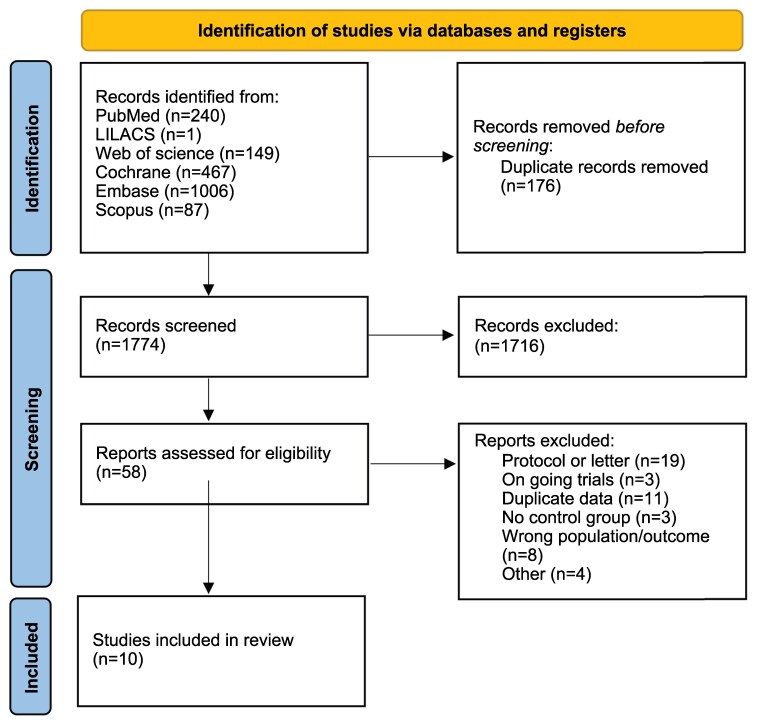
Of the 1950 records identified, 1716 were excluded based on title and abstract, leaving 58 studies for full-text evaluation; ultimately, 10 RCTs were included in this systematic review (Fig. 1).
Table 1 shows the characteristics of the 10 studies included in this systematic review.
Five randomized controlled trials compared liraglutide with usual care [24, 26, 29-31], 3 RCTs compared exenatide with usual care [25, 27, 33], 1 compared oral semaglutide [32] with usual care, and the remaining trial compared dulaglutide with gliclazide 60 mg + metformin 2-3 g/day [28]. The dulaglutide trial, which involved participants with obesity and diabetes, was excluded from the meta-analysis because the control group received active medication rather than a placebo.
The psychiatric disorders diagnosed in the studies were schizophrenia or schizoaffective disorder (n = 4), bipolar disorder (n = 2), psychosis (n = 1), major depressive disorder (n = 2), and binge-eating disorder (n = 3). Some trials included participants with multiple psychiatric conditions (n = 2). Type 2 diabetes was the most common nonpsychiatric comorbidity (∼15%), although 4 RCTs excluded individuals with diabetes mellitus. The most frequently used psychiatric medications among the participants included mood stabilizers (eg, carbamazepine, lamotrigine, lithium, and valproate), antipsychotics (first and second generation), antidepressants, and anxiolytics (eg, benzodiazepines, gabapentin, pregabalin, and buspirone).
The trials were conducted in America (n = 4), Europe (n = 4), Asia (n = 1), and Australia (n = 1), providing data from 543 individuals. Approximately 52.8% of participants were women. The mean age ranged from 34.4 to 55.1 years. Baseline body weight averaged 103.8 ± 18.4 kg in the intervention group and 103.2 ± 19.0 kg in the control group. Baseline BMI was 36.0 ± 6.1 kg/m² in the intervention group and 36.3 ± 5.1 kg/m² in the control group. The mean study duration was 17.7 weeks (12-24 weeks).

Flow diagram of literature search to identify randomized controlled trials of glucagon-like peptide-1 receptor agonists for weight loss in psychiatric patients.
| Author, year | Country | Number ofrandomized subjects | Study design | Pathology | GLP-1RA | Psychiatric medication | Intervention/expousure | Control/Comparator | Study duration |
|---|---|---|---|---|---|---|---|---|---|
| Robert et al, 2015 [] [24] | Malaysia | 42 | RCT | Binge eating | Liraglutide | Not reported | Liraglutide 1.8 mg/d + diet + exercise | Diet + exercise | 12 weeks |
| Ishøy et al, 2017 [] [25] | Denmark | 40 | RCT | Schizophrenia | Exenatide | Antipsychotics | Exenatide 2 mg/week | Placebo | 16 weeks |
| Larsen et al, 2017 [] [26] | Denmark | 103 | RCT | Schizophrenia | Liraglutide | Clozapine, olanzapine | Liraglutide 1.8 mg/day | Placebo | 16 weeks |
| Siskind et al, 2018 [] [27] | Australia | 28 | RCT | Schizophrenia | Exenatide | Clozapine | Exenatide 2 mg/week + usual care | Placebo | 24 weeks |
| Da Porto et al, 2020 [] [28] | Italy | 60 | RCT | Binge eating | Dulaglutide | Not reported | Dulaglutide 150 mg/week | Gliclazida 60 mg + metformin 2-3 g/day | 12 weeks |
| Whicher et al, 2021 [] [29] | United Kingdom | 47 | RCT | Schizophrenia andpsychosis | Liraglutide | Antipsychotics | Liraglutide 3 mg/day + orientations | Standardized written information about healthy eating, physical activity, and smoking | 24 weeks |
| Allison et al, 2022 [] [30] | United States | 37 | RCT | Binge eating | Liraglutide | Not reported | Liraglutide 3 mg/day | Placebo | 17 weeks |
| McElroy et al, 2024 [] [31] | United States | 60 | RCT | Bipolar disorder | Liraglutide | Mood stabilizers, antipsychotics, antidepressants and anxiolytics | Liraglutide 3 mg/day + nutrition and lifestyle modification | Nutrition and lifestyle modification counseling following the 2015-2020 Dietary Guidelines for Americans | 24 weeks |
| Badulescu et al, 2025 [] [32] | Canada | 72 | RCT | Major depressive disorder | Oral semaglutide | Benzodiazepines, antipsychotics, antidepressants, psychostimulants, bupropion. | Oral semaglutide 14 mg/day | Placebo | 16 weeks |
| Patino et al, 2025 [] [33] | United States | 54 | RCT | Schizophrenia, bipolar disorder, and severe depression | Exenatide | Olanzapine | Exenatide 10 mcg/2xday | Placebo | 16 weeks |
Outcomes
Weight loss
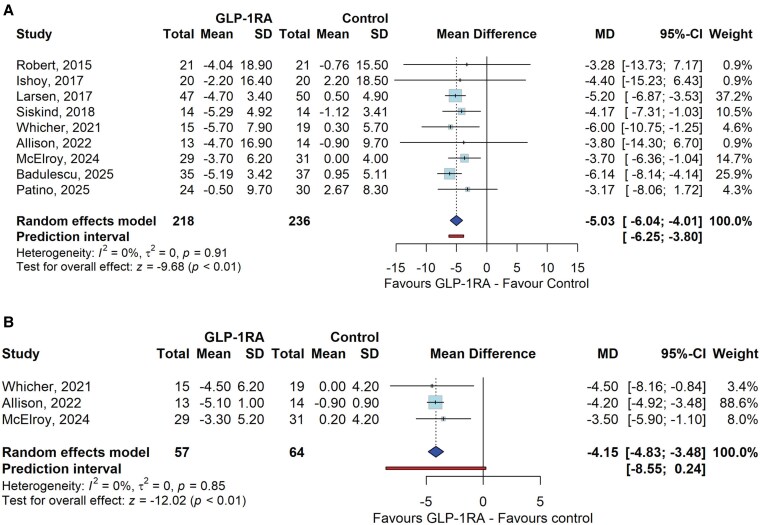
Pooling of the data from the 9 RCTs showed that the use of GLP-1RAs compared to control induced weight reduction of 5.03 kg (95% CI: −6.04, −4.01, I² = 0%), as shown in Fig. 2. Similarly, the percentage of weight loss was greater in the GLP-1RA group (MD = −4.15%, 95% CI: −4.83 to −3.48; I² = 0%) (Fig. 2).
BMI reduction was also significant in the GLP-1RA group, with a mean decrease of −1.59 kg/m² (95% CI: −2.00 to −1.18; I² = 0%) (Fig. S2.3) [23].
Subanalysis by type of administered GLP-1RA showed that liraglutide promoted a weight loss of 4.83 kg (95% CI: −6.17 to −3.50, I² = 0%) and a BMI improvement of −1.30 kg/m² (95% CI: −1.92 to −0.69, I² = 0%). Exenatide promoted 3.91 kg of weight loss (95% CI: −6.47 to −1.34, I² = 0%) and a −1.25 kg/m² improvement in BMI (95% CI: −2.12 to −0.37, I² = 0%). Semaglutide promoted a weight loss of 6.14 kg (95% CI: −8.14 to −4.14) and a BMI improvement of −2.16 kg/m² (95% CI: −2.85 to −1.47) (Fig. S3.1 A and B) [23].
In a subgroup analysis of patients with schizophrenia, GLP-1RA led to weight loss −5.05 kg (95% CI: −6.45 to −3.66, I² = 0%) and BMI −1.43 kg/m² (95% CI: −2.25 to −0.62, I² = 0%) (Fig. S3.2 A and B) [23].
A network meta-analysis confirmed that semaglutide showed the greatest mean reduction in body weight compared with placebo, with a mean difference of −6.14 kg (95% CI: −8.18 to −4.10; P < .001). Liraglutide was also significantly superior to placebo, with a mean difference of −5.01 kg (95% CI: −6.32 to −3.70; P < .001). Although exenatide demonstrated a reduction in weight compared with placebo (MD = −4.03 kg; 95% CI: −8.65 to 0.60), the result was not statistically significant (P = .088). Pairwise comparisons between the active treatments revealed no significant difference. The global inconsistency test yielded a P-value of .99, indicating no inconsistency and high reliability of the results (League Table) [23].

Effect of GLP-1RAs compared to control on body weight (A) and percent of weight loss (B) among individuals with psychiatric disorders and obesity. The findings of each study are represented by a single square. The diamond represents the overall effect estimate of the meta-analysis. Abbreviations: CI, confidence interval; GLP-1RA, glucagon-like peptide-1 receptor Agonist; MD, mean difference.
Secondary outcomes
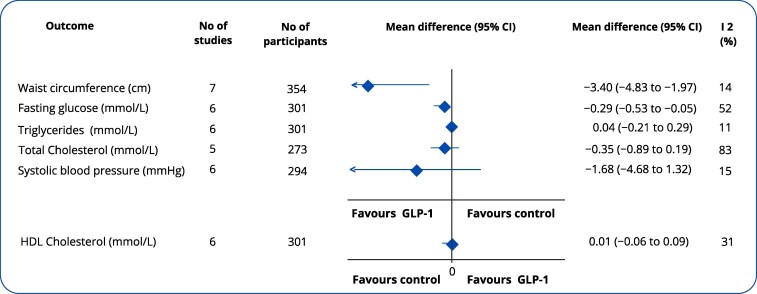
GLP-1RA treatment, compared to usual care, led to a significant reduction in waist circumference (MD = −3.40 cm, 95% CI: −4.83 to −1.97, I² = 14%) and fasting glucose (MD = −0.29 mmol/L, 95% CI: −0.53 to −0.05, I² = 52%) (Fig. 3). A subanalysis by type of administered GLP-1RA showed that liraglutide led to a fasting glucose decrease of 0.33 mmol/L (95% CI: −0.54 to −0.12, I² = 26%) reduction, while exenatide resulted in a 0.26 mmol/L (95% CI: −1.09 to 0.56, I² = 80%) reduction (Fig. S3.1 D) [23].
Treatment with GLP-1RA compared to the control did not result in a significant decrease in total cholesterol (MD = −0.35, 95% CI: −0.89 to 0.19, I² = 83%; P = .20), systolic blood pressure (MD = −1.68, 95% CI: −4.68, 1.32, I² = 15%; P = .27), and triglycerides (MD = 0.04, 95% CI: −0.21 to 0.29, I² = 11%; P = .74) or an increase in high-density lipoprotein cholesterol (MD = 0.01, 95% CI: −0.06 to 0.09, I² = 31%; P = .71) (Fig. 3).

Effect of glucagon-like peptide-1 receptor agonists compared to control on waist circumference, fasting glucose, triglycerides, total cholesterol, systolic blood pressure, and high-density lipoprotein cholesterol among individuals with psychiatric disorders and obesity. The diamond represents the overall effect estimate of the meta-analysis. Abbreviation: CI, confidence interval.
Adverse events
Data from 374 individuals were available for adverse events. The evaluation of these events in the trials was primarily based on individual reports. Gastrointestinal tract side effects were the most frequent. Meta-analyses indicated that GLP-1RA treatment was associated with a relative risk of 1.84 for diarrhea (95% CI: 1.11-3.07), 2.01 for nausea (95% CI: 1.41-2.88), 2.46 for vomiting (95% CI: 1.28-4.72), and 2.69 for constipation (95% CI: 1.34-5.42) (Table 2).
| Adverse effect | Intervention | No. studies | n | Incidence % | 95% CI | I² (%) |
|---|---|---|---|---|---|---|
| Diarrhea | GLP-1RA | 7 | 184 | 24.32 | 0.16-0.39 | 65.4 |
| Placebo | 6 | 175 | 10.85 | 0.07-0.16 | 0 | |
| Nausea | GLP-1RA | 8 | 205 | 50.24 | 0.31-0.61 | 70.6 |
| Placebo | 7 | 196 | 23.46 | 0.11-0.32 | 40.9 | |
| Vomiting | GLP-1RA | 6 | 155 | 29.67 | 0.20-0.39 | 34.1 |
| Placebo | 5 | 144 | 10.41 | 0.04-0.18 | 0 | |
| Constipation | GLP-1RA | 4 | 131 | 32.06 | 0.24-0.40 | 15.3 |
| Placebo | 4 | 138 | 10.4 | 0.04-0.21 | 49.9 |
Risk of bias assessment
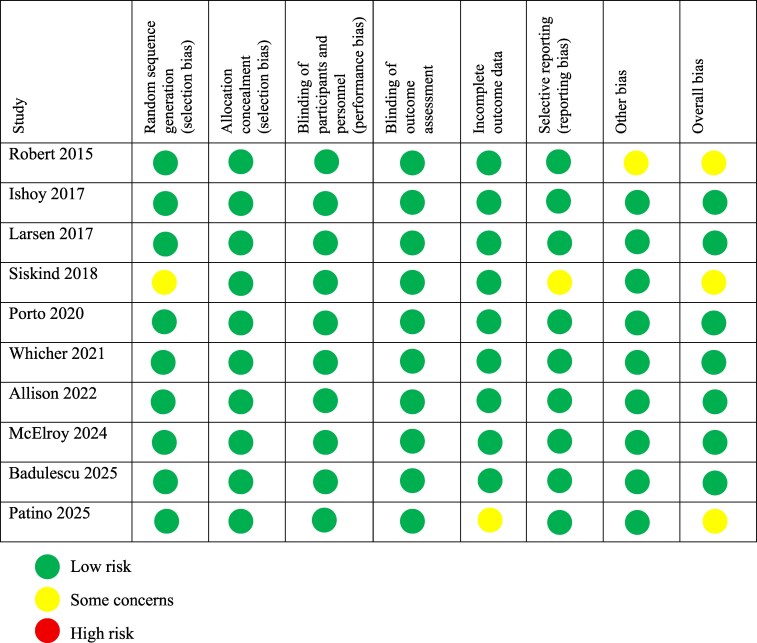
The revised Cochrane tool for assessing the risk of bias in RCTs [20] identified a low risk of bias in 7 studies [24, 26, 27, 29, 30, 32, 33], while 3 [23, 25, 31] presented some concerns of bias, particularly due to incomplete outcome data and selective reporting. Overall, the included RCTs presented a low risk of bias, supporting the reliability of the findings (Fig. 4).

Risk of bias assessment of all randomized controlled trials.
Discussion
In the present study, GLP-1RAs were associated with a mean weight loss of 5.03 kg, corresponding to a 4.15% reduction in body weight; additional metabolic benefits included reductions in BMI (−1.59 kg/m²), waist circumference (−3.40 cm), and fasting glucose levels (−0.29 mmol/L), compared to individuals not receiving GLP-1RAs among patients with mood disorders, schizophrenia, and binge-eating disorder. The use of GLP-1RAs is associated with a higher incidence of gastrointestinal side effects, although no serious adverse events have been reported.
Recent systematic reviews [34-39] have evaluated the use of GLP-1RAs in various psychiatric conditions. Menon et al reported positive outcomes in addressing psychotropic-induced weight gain, suggesting that GLP-1RAs may directly modulate the metabolic pathways and neural circuits involved in hunger and satiety. Similarly, Vasiliu's review, which encompassed both clinical and preclinical studies, further supports the metabolic benefits of these agents. Our findings align with those of Khaity et al, who examined GLP-1RA effects in patients with schizophrenia, and Radkhah et al, who reported similar benefits in individuals with eating disorders.
GLP-1RAs appear to exert metabolic effects through multiple mechanisms. They slow gastric emptying and promote satiety through gastrointestinal actions. In addition, there is growing evidence that GLP-1RAs modulate the mesolimbic dopamine system, a neural circuit involved in reward processing, leading to decreased responsiveness to highly palatable, ultraprocessed foods and reduced food-related impulsivity and addiction-like behaviors [40, 41]. These mechanisms may also underlie the reported reductions in alcohol consumption among individuals with alcohol use disorder [42-44]. Supporting this broader neuropsychiatric impact, the findings of Pierret et al's review and meta-analysis indicate that treatment with GLP-1 receptor agonists in obesity/overweight is linked to enhanced mental well-being and quality of life, along with established benefits for physical health [45].
Prior to the advent of GLP-1RAs, other pharmacological agents such as topiramate [46-48], topiramate/phentermine [49], and naltrexone/bupropion [50-52] had been investigated for weight management in psychiatric populations. While these agents demonstrate modest weight reduction, their adverse effect profiles limit their widespread clinical use. Adjunctive metformin has been the most extensively studied pharmacotherapy and is recommended as a level 1 treatment for mitigating weight gain in patients with psychiatric disorders receiving antipsychotic therapy, as it has demonstrated efficacy in preventing and reducing weight gain, BMI increases, and insulin resistance in both antipsychotic-in-use individuals and those with established weight and metabolic disturbances [53-55]. Metformin may exert these effects through its action on the incretin axis, upregulating GLP-1 receptor expression and increasing circulating GLP-1 levels, which further supports GLP-1RAs role as a promising adjunctive therapy for psychotropic medication–induced metabolic disturbances [56].
Given the favorable outcomes of GLP-1RAs—including weight loss, glycemic control, and additional cardiovascular and renal benefits in patients with obesity [57-59]—these agents should be prioritized for weight management in psychiatric populations. The dual challenges of obesity and psychiatric illnesses necessitate comprehensive treatment strategies. Initiating GLP-1RA therapy in high-risk individuals, particularly those taking antipsychotic or antidepressant medications associated with weight gain, may be an effective preventive approach that warrants further investigation, as suggested in previous guidelines [60].
Importantly, the weight loss observed in our systematic review was less pronounced than that reported in populations with obesity but without psychiatric comorbidities [14, 16, 18, 61, 62]. This discrepancy may be attributed to shorter trial durations and concurrent use of medications, such as clozapine or olanzapine, which are known to promote weight gain, and the influence of antidepressants. For example, a retrospective study found that GLP-1RA-induced weight loss was attenuated in patients concurrently using antidepressants, such as citalopram, escitalopram, and bupropion [63]. Similar findings have been observed in patients with type 2 diabetes, in whom underlying psychiatric illnesses may reduce the weight-lowering efficacy of GLP-1RAs [64].
This meta-analysis has some limitations. The heterogeneity of the included psychiatric conditions may limit the validity of indirect comparisons, as these disorders differ in terms of severity, treatment protocols, and levels of care required. Additionally, the limited number of studies available on this population constrains the strength of evidence. To date, only 1 RCT has evaluated oral semaglutide [32], and none have assessed tirzepatide, the most potent dual intestinal peptide agonist currently available for weight reduction. The results from 3 ongoing RCTs investigating subcutaneous semaglutide in psychiatric populations are awaited and may provide more definitive insights [65, 66] (NCT05333003).
Conclusion
In summary, our findings demonstrate that GLP-1RAs significantly reduce body weight, BMI, waist circumference, and fasting glucose levels in patients with psychiatric disorders. Given their metabolic and potential neurobehavioral benefits, GLP-1RAs represent a promising therapeutic strategy, particularly in patients at high risk for metabolic complications. Future studies should explore their preventive use alongside psychotropic medications and investigate newer agents, such as tirzepatide, in this population, ideally through well-powered, long-term RCTs employing standardized protocols and rigorous adverse event reporting.