
What this is
- This research investigates the role of mesenchymal stem cell-derived (MSC-EXOs) in mitigating liver fibrosis.
- The study identifies miR-148a as a key molecule in MSC-EXOs that influences .
- By targeting the KLF6/STAT3 pathway, miR-148a enhances anti-inflammatory responses in macrophages, offering a potential therapeutic strategy for liver fibrosis.
Essence
- MSC-EXOs alleviate liver fibrosis by delivering miR-148a, which modulates through the KLF6/STAT3 pathway. This mechanism suggests a novel therapeutic target for liver fibrosis.
Key takeaways
- MSC-EXOs significantly reduce liver fibrosis in a carbon tetrachloride-induced mouse model. The treatment enhances from pro-inflammatory (M1) to anti-inflammatory (M2) phenotypes.
- miR-148a, enriched in MSC-EXOs, directly targets KLF6, inhibiting the STAT3 pathway. This action promotes a shift in macrophage function, contributing to the therapeutic effects observed.
- Administration of miR-148a-enriched MSC-EXOs or miR-148a agomir demonstrates potent effects in ameliorating liver fibrosis, indicating the translational potential of this approach.
Caveats
- The study primarily uses a mouse model, which may limit the direct applicability of findings to human liver fibrosis. Further clinical studies are needed to validate these results.
- While miR-148a is identified as a critical mediator, it is only one component of MSC-EXOs, and the full range of active molecules and their interactions require further exploration.
Definitions
- exosomes: Small membrane particles (40-150 nm) that facilitate intercellular communication by transferring bioactive molecules between cells.
- macrophage polarization: The process by which macrophages adopt different functional states (M1 or M2) in response to environmental signals, influencing inflammation and tissue repair.
Simplified
Background
Liver fibrosis is chronic liver damage characterized by excessive accumulation of extracellular matrix [1]. It is a global health problem that affects millions of people annually worldwide [2]. Without proper treatment, many patients will suffer from the compensation stage to the decompensation stage, which increases morbidity and mortality caused by portal hypertension, hepatic insufficiency, and other complications [3]. Various therapies have been explored to treat patients with end-stage liver diseases aiming at promoting liver regeneration and alleviating liver injury.
Recently, mesenchymal stem cells (MSCs) have attracted much attention for potential treatment due to their differentiation ability and immunomodulatory effect. Emerging research and clinical trials are ongoing for the application of MSCs as a regenerative solution for many diseases including spinal cord injury [4], organ fibrosis [5], inflammatory bowel disease [6] and graft-versus-host disease [7]. Now, paracrine actions of MSCs are thought to be an important therapeutic way. For example, application of MSC-conditioned medium (MSC-CM) can improve liver cirrhosis via Milk Fat Globule-EGF Factor 8 to downregulate expression of TGFβ type I receptor by binding to αβ integrin on hepatic stellate cells [8]. Our previous study also illustrated that tumor necrosis factor-α-stimulated gene 6 (TSG-6) derived from MSCs can improve liver fibrosis by modulating M2 macrophages and increasing matrix metalloproteinase 12 (MMP12) expression [9]. Moreover, several molecules derived from MSC-CM showed immunoregulatory role, such as indoleamine-2,3-dioxygenase (IDO), prostaglandin E2 (PGE2) and human leukocyte antigen (HLA)-G [10]. Although these studies provide inspiring evidence for the potential role of MSC-secreted molecules in tissue regeneration, the detailed mechanisms through which MSCs act in a paracrine way are not fully understood.
Over the past years, in addition to soluble factors, extracellular vesicles especially exosomes (EXOs) have been demonstrated to be essential paracrine components of MSCs [11]. EXOs are small membrane particles ranging from 40 to 150 nm in size, which are regarded as a crucial factor in communication between cells or organs [12]. EXOs contain numerous bioactive molecules including proteins, mRNAs and non-coding RNAs like microRNAs, which can be functionally delivered between cell types, even across species [13]. Exosomal miR-192-5p derived from hepatocyte was found to play a critical role in the activation of pro-inflammatory macrophages and disease progression through modulating Rictor/Akt/FoxO1 signaling [14]. Moreover, hypoxia-preconditioned MSCs prevented ischemic disease by promoting angiogenesis via miR-612 transfer [15]. It has also been shown that exosomes derived from MSCs possess comparably therapeutic effect and offer an alternative for cell-based therapy [16, 17].
In this study, we demonstrated that MSCs-derived exosomes (MSC-EXOs) alleviated carbon tetrachloride (CCL4)-induced liver fibrosis in mice. By employing high-throughput sequencing, miR-148a was identified to be a pivotal factor of MSC-EXOs, which was also proved to participate in liver regeneration in our previous research [18]. Here, miR-148a was verified to reshape macrophage polarization and alleviate liver fibrosis. Then, mechanistic studies showed that miR-148a acted by downregulating Kruppel-like factor 6 (KLF6) to inhibit the signal transducer and activator of transcription 3 (STAT3) pathway. Afterward, we administered miR-148a-enriched MSC-EXOs or miR-148a agomir to reveal its therapeutic effects on liver fibrosis, which indicated the translational potential for the management of liver diseases.
Methods
Patients and clinical samples
Serum samples were collected from 24 patients with liver cirrhosis and 12 healthy controls at the Xijing Hospital of Digestive Disease. The diagnosis of cirrhosis followed the American Association for the Study of Liver Disease (AASLD) guideline [19]. The aspartate aminotransferase (AST)- to platelet ratio index (APRI) score [20] and Fibrosis-4 (FIB-4) score [21] were calculated according to relevant formulas. Informed consent was obtained from all participants, and the study protocol was approved by the Ethics Committee of Xijing Hospital. The detail information of patients is listed in Additional file 1: Table S1.
Experimental animal models
The male C57BL/6 J mice (6–8 weeks) were brought from and cared in animal center of The Fourth Military Medical University. The animal study protocol was approved by the Animal Welfare and Ethics Committee of the Fourth Military Medical University and performed according to the "Guidelines for the Care and Use of Laboratory Animals". The liver fibrosis model was established via intraperitoneal injection of 0.2 ml/20 g 20% (v/v) of CCL4 for 8 weeks twice a week. After then, the fibrotic mice were randomly into groups (n = 4–6) which received treatments as mentioned below via tail vein injection. The mice were continually injected with CCL4 during the observation period. After 2 weeks, mice were killed, and samples were collected for further analyses.
To investigate the role of MSC-EXOs in the liver fibrosis, MSC were pre-treated with 10 μM GW4869 (Sigma Aldrich) for 24 h to inhibit exosomes release. Mice were then randomly assigned to different groups which received PBS, 1 × 10⁶ MSCs or pre-treated MSCs (PBS group, MSC group and MSC + GW4869 group). For exosome treatment, 150 μg of EXOs diluted in 150μL PBS was injected intravenously to mice via tail vein as a single dose. The control group was injected with an equal volume of PBS. In addition, we further expanded the treatment groups, that is, the fibrotic mice were treated with EXOs derived from MSCs transfected with miR-148a-3p mimics (EXO-148 m group) or inhibitors (EXO-148i group). For miRNA agomir injection, mice were injected with negative control (NC) agomir (NC-agomir) or miR-148a agomir (148a-agomir group) via tail vein injection at a dose of 5 nmol for 2 weeks, once per week.
Cell culture
Human umbilical cord-derived MSCs (hUC-MSCs) were provided by the National Engineering Research Center (Tianjin AmCellGene Engineering Co., Ltd, China). The isolated MSCs were cultured with mesenchymal basal medium (Dakewe Biotech Co., Ltd. China) supplemented with a serum-free replacement at 37 °C in a 5% CO2 incubator. Cells in passage 4–7 were used for subsequent experiments. The positive (CD29, CD44, CD90 and CD105) and negative (CD34, CD45) cell surface markers of MSCs were identified by flow cytometer. Meanwhile, the multilineage differentiation potential of MSCs was tested in vitro for adipogenesis, osteogenesis as well as chondrogenesis (HUXUC-90021, HUXUC-90031, HUXUC-9004, Guangzhou, China).
RAW264.7 cells purchased from American Type Culture Collection (ATCC) were cultured in Dulbecco's modified Eagle's medium (DMEM, Gibco, NY) containing 10% fetal bovine serum (FBS, Gibco, NY) and 1% penicillin–streptomycin. Bone morrow-derived macrophages (BMDM) were generated from C57 BL/6 mice (6–8 week) as previously described [22]. In brief, bone marrow cells were harvested from the femur and tibia. Then, these cells were seeded at a density of 2 × 10⁶ cells/mL and cultured in DMEM supplemented with 10% fetal bovine serum and 1% penicillin–streptomycin plus 20 ng/mL macrophage colony-stimulating factor (M-CSF, PeproTech Inc. USA) for 7 days.
Exosomes' isolation and characterization
EXOs of hUC-MSCs were isolated and purified by differential centrifugation as previously described [23]. Briefly, when the cells have reached 70–80% confluence, the medium was replaced with the exosome-depleted medium (Umibio, Shanghai, China), and the cell supernatant was collected after additional 48 h. The cells and apoptotic bodies were removed after centrifugation at 300 g for 10 min and 2000 g for 20 min, respectively. The sample was then centrifuged at 10,000 g for 30 min to remove cell debris. Finally, the supernatant was centrifuged at 100,000 g at 4 °C for 70 min and additionally washed with PBS at 100,000 × g for 70 min to obtain exosome pellets. The EXOs were characterized by transmission electron microscopy (TEM), and their morphology was observed. Nanoparticle tracking analysis (NTA) was used to analyze the size distribution of EXOs and the concentration of nanoparticles. Flow cytometry was employed to detect exosome surface markers CD9 and CD81 (BioLegend, San Diego). Specific exosome markers (CD9, CD81 and TSG101) were used as a positive control, whereas GM130 was used as a negative control for western blot.
Exosome labeling and tracking in vivo and ex vivo
To detect the uptake of MSC-EXOs by macrophages, EXOs were incubated with 1 μM PKH26 (Sigma-Aldrich, MA, USA) for 10 min at 37 °C followed by centrifuged at 100,000 g for 70 min to remove unbounded dye. The labeled EXOs were then co-cultured with RAW 264.7 or BMDM for 6 h. After treatment, cells were washed twice with PBS and fixed with 4% paraformaldehyde. Following DAPI staining, the cells were observed under a fluorescence microscope.
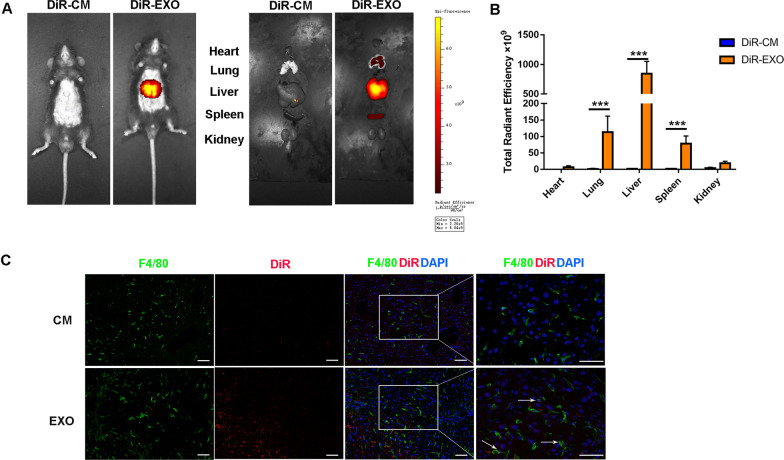
For in vivo exosome tracking, 1 μM DiR (Invitrogen, MA, USA) solution was used to label EXOs at 37 °C for 30 min. Free dyes were removed by ultracentrifugation as mentioned above. The supernatant was collected as the control. Mice that received labeled EXOs or supernatant via tail-vein injection were killed at 24 h. The distribution of fluorescence in the whole body and relative organs (heart, liver, spleen, lungs and kidneys) was detected using small animal imaging system (IVIS Kinetics, Caliper Life Science). Signal intensity was quantified and processed using the Living Image software (V5.0, Caliper Life Science).
Cell treatment
For phenotype induction, the M1 (classically activated) and M2 (alternatively activated) phenotypes were established by stimulating RAW 264.7 cells or BMDMs with LPS (100 ng/mL)/IFN-γ (20 ng/mL) and IL-4 (20 ng/mL) for 24 h, respectively. To investigate the effects of hUC-MSC-derived EXOs on macrophage polarization, macrophages were treated with PBS or EXOs for 30 min prior to the M1 induction. Then, the cells were collected for western blot, real-time PCR or flow cytometry analysis.
Cell transfection and luciferase report assay
The mimics and inhibitors of miR-148a-3p, NC mimics or inhibitor were purchased from Guangzhou RiboBio Co., Ltd. KLF6 siRNA and its NC siRNA were purchased from Sangon Biotech Co., Ltd. Cells were transfected using the riboFECT CP Transfection Kit (RiboBio) according to the manufacturer's protocol. For the luciferase reporter assay, the 3′-UTR sequence of KLF6 (wild type) containing the possible sites binding with miR-148a-3p and the corresponding mutated 3′-UTR sequence were cloned and inserted into the pMIR-REPORT vector to generate luciferase reporter constructs. RAW264.7 cells were co-transfected with wild-type or mutated luciferase vector together with miR-148a-3p mimics and negative controls. The luciferase activity was measured using a luciferase reporter assay system (Promega, WI, USA).
RNA-sequencing and bioinformatics analysis
The RNA-sequencing technology was provided by LC-Bio Co., Ltd. In brief, total RNA was extracted from MSC-EXOs using the TRIzol reagent. The purity and quantity of RNA were checked using a Bioanalyzer 2100 (Agilent, CA, USA). Small-RNA libraries were constructed using the TruSeq Small RNA Sample Prep Kits (Illumina, San Diego, CA USA) and sequenced on the Illumina HiSeq 2500 platform. Then, we downloaded the public data (GSE159814) from Gene Expression Omnibus (GEO) database and obtained the intersections with our sequencing data for further analysis. The potential target genes of miR-148a-3p were obtained through examination of the overlapped intersection from four databases (miRanda [24], miRDB [25], TargetScan [26] and CLIP [27]). In addition, to further investigate the signaling pathways that KLF6 was involved in, we performed pathway analysis using gene set enrichment analysis (GSEA) and gene set variation analysis (GSVA). Data were retrieved from GSE13476 in the GEO platform. A P value < 0.05 was considered statistically significant.
Flow cytometric analysis of cell phenotypes
For quantification of macrophage infiltration, single-cell suspensions from liver tissues were treated with anti-mouse FcR blocking reagent and stained with mixed fluorescence-conjugated antibodies. The detail information of antibodies for flow cytometric is listed in Additional file: Table S2. Flow cytometric data were acquired on a FACSVerse flow cytometer (BD Bioscience, CA, USA) and analyzed with FlowJo software (TreeStar, Ashland, OR, US). Gating strategies are depicted in Additional file: Fig. S1. 1 1
Biochemical analysis and histological staining
The serum of mice was obtained at each time point. The levels of alanine aminotransferase (ALT), aspartate aminotransferase (AST) and albumin (ALB) were analyzed on an automatic biochemistry analyzer in Xijing Hospital. Tissue samples were prepared as paraffin-embedded sections by YiKE Biotechnology, China. Then, sections were stained with hematoxylin and eosin (HE) for routine histological examination or with Sirius Red and Masson for fibrosis evaluation. Further quantification and analysis of collagen fiber were assessed using Image-Pro Plus software (v6.0, Media Cybernetics Inc.).
Immunohistochemistry staining
For immunohistochemical analyses, the sections were dewaxed and rehydrated by xylol and alcohol, respectively. Antigen retrieval was conducted by sodium citrate in microwave condition. After then, 1% H2O2 was used to block endogenous peroxidase activity. The slides were further blocked with goat serum for 30 min. The antibodies of anti-iNOS (AB15323, 1:1000, Abcam, MA) and anti-CD206 (AB64693, 1:1000; Abcam, MA) were incubated with the slides at 4 °C overnight. On the next day, after washing with PBS, the secondary antibody was added and diaminobenzidine (DAB) was applied to visualize the image. Further quantification and analysis of positive area were assessed using Image-Pro Plus software. (v6.0, Media Cybernetics Inc.)
Immunofluorescent staining
Liver tissue samples were fixed with 4% paraformaldehyde for 30 min and washed with PBS. After antigen retrieval with sodium citrate in microwave condition, the sections were blocked with goat serum for 30 min. Then, primary anti-iNOS antibody (AB15323, 1:200, Abcam), anti-CD206 antibody (AB64693, 1:200, Abcam), anti-F4/80 antibody (AB6640,1:100, Abcam), anti-αSMA antibody (A2547, 1:500, Sigma) and anti-Col1a1 (AB270993,1:100, Abcam) were added and incubated with tissue sections at 4 °C overnight. On the next day, the sections were washed three times with PBS and incubated with secondary antibody labeled with Alexa Fluor 488 or Alexa Fluor 647 (Invitrogen Inc.) at room temperature for 1 h. After DAPI staining of cell nucleus, sections were mounted using anti-fade solution. Later, images were acquired by a laser scanning confocal microscope. Further analysis of positive percentage cells was conducted by Image-Pro Plus software (v6.0, Media Cybernetics Inc, Bethesda, MD).
RNA isolation and real-time PCR analysis
Total RNA was extracted by RNAeasy Plus kit (TaKaRa Biotechnology Co., Ltd., Dalian, China), and reverse transcription was performed using PrimeScript™ RT Master Mix (RR036A, Takara, Tokyo). Then, amplification was conducted by TB Green Premix Ex Taq II (DRR820A, Takara, Tokyo) on a CFX96 Touch™ real-time PCR System (Bio-Rad, CA). PCR primers are shown in Additional file: Table S3. 1
Western blot analysis
Proteins of cells or tissue samples were obtained by RIPA lysis buffer (Beyotime biotechnology, China), which was added in proteinase inhibitors and phosphatase inhibitors (Roche, Basel, Switzerland). The Bradford method was applied to quantify the protein samples. After then, 30 μg of protein was loaded to SDS-PAGE before transferring to nitrocellulose membranes (Bio-Rad Biotechnology, America). The membranes were blocked by TBST buffer containing 2.5% skim milk for 30 min. Then, the membranes were incubated with primary antibody at 4 °C overnight. Next day, the peroxidase-conjugated secondary antibody was added to incubate the membrane, and blot images were acquired by an enhanced chemiluminescence kit.
Statistical analysis
The data were in the expression of mean values ± standard deviation. One-way analysis of variance and t-test were performed to identify the significant differences. A P value < 0.05 was considered significant. Statistical analysis was plotted by GraphPad Prism 7.0 (GraphPad Software, CA, USA).
Results
Characterization of hUC-MSCs and EXOs

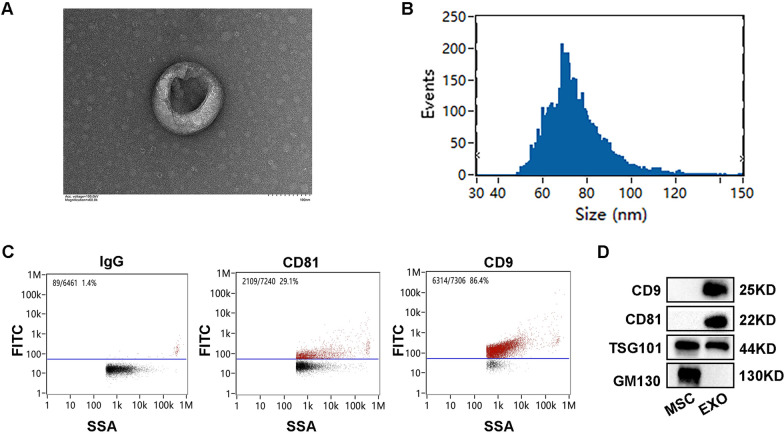
Identification of exosomes (EXOs) isolated from MSCs supernatant.Representative TEM images showing cup-shaped morphology of MSC-EXOs.Particle size distribution of MSC-EXOs was measured by NTA.Representative plots of flow cytometry showing MSC-EXOs positive expression of the markers CD81 and CD9.Western blot analysis showing the protein expression of CD9, CD81, TSG 101 and GM130 A B C D
Exosomes mediated therapeutic effects of MSCs on liver fibrosis

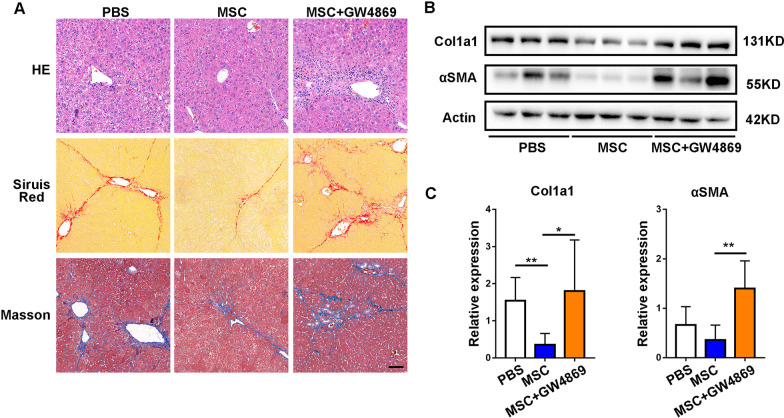
Blockade of exosomal generation of MSCs impaired the therapy for liver fibrosis.Representative histological images of 2 weeks after PBS, MSC and MSC + GW4869 treatment. The top is HE staining, the middle is Sirius red staining and the bottom is Masson staining. Scale bars, 200 μm.Western blot was used to measure the protein level of fibrotic Col1a1 and αSMA.The mRNA levels of Col1a1 and αSMA were analyzed by RT-PCR assay A B C

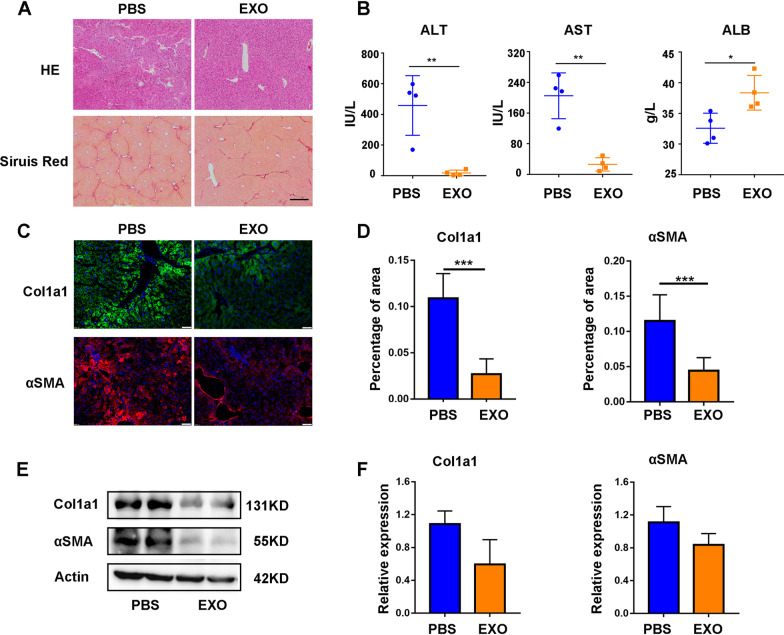
MSC-EXO treatment ameliorated liver fibrosis.Representative histological images of PBS and EXO treatment by HE and Sirius red staining, 2 weeks after injection.Changes of serum parameters including ALT, AST and ALB in different groups.Representative images showed the Col1a1 + and αSMA + cells in each group. The nuclei were stained with DAPI. Scale bar, 50 μm.Quantification of Col1a1 + and αSMA + areas by Image-Pro Plus.The protein levels of Col1a1 and αSMA were measured by western blot.The mRNA levels of Col1a1 and αSMA were measured by RT-PCR A B C D E F
MSC-EXOs ameliorated the inflammatory response by the remodeling of macrophage phenotypes in vivo

MSC-EXO circulated into the liver and co-located with macrophages.Imaging of DiR-labeled exosomes from different tissues at 24 h after tail vein injection.Quantification of the relative fluorescence intensity of the infiltrated exosomes in the tissues in different groups.DiR-labeled exosome (red) localization in the liver as detected by fluorescence microscopy. Macrophages were F4/80 positive (green). Nuclei were counterstained with DAPI A B C

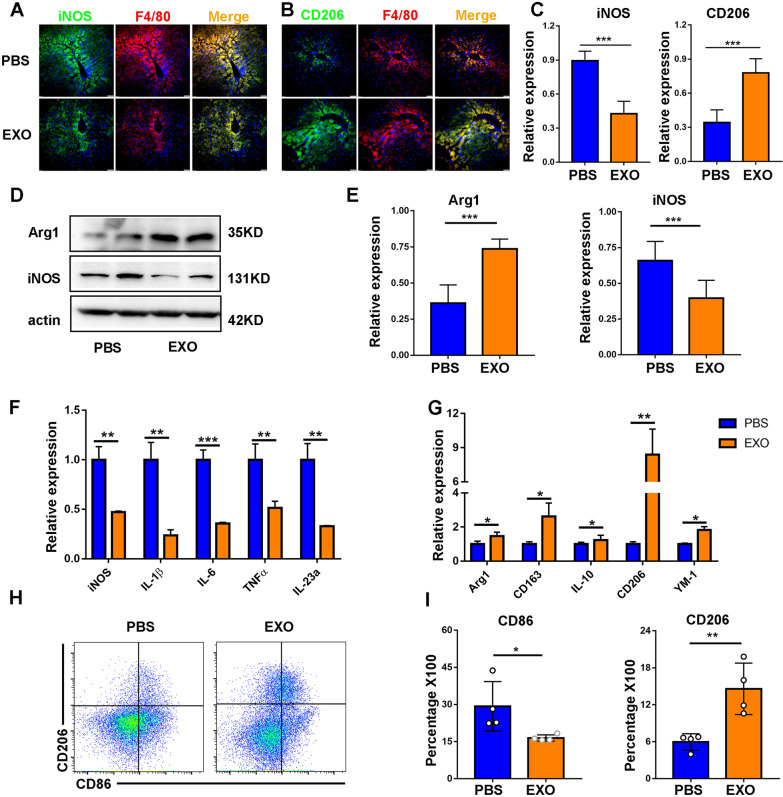
MSC-EXO inhibited pro-inflammatory macrophages and promoted anti-inflammatory macrophages in liver.,Representative images showed the iNOS + pro-inflammatory macrophages (green) and CD206 + anti-inflammatory macrophages (green) in each group. The nuclei were stained with DAPI (blue), and macrophages were stained with F4/80 (red). Scale bar, 100 μm.The percentage of iNOS + or CD206 + cells was calculated by Image-Pro Plus.,The protein level of iNOS and Arg1 was measured by western blot, and quantification of the relative expression in the bands in different groups was calculated by Image-Pro Plus.,The mRNA levels of pro-inflammatory and anti-inflammatory macrophage markers were measured by RT-PCR.,Flow cytometry plots showing CD86 (M1 marker) and CD206 (M2 marker) changed in different groups and the percentage of CD86 + or CD206 + cells were analyzed by Flow Jo software A B C D E F G H I
MSC-EXOs promoted the transition from M1 inflammatory phenotype to M2 anti-inflammatory phenotype in vitro

MSC-EXO induced the remodeling of macrophage phenotype in vitro.Reparative confocal microscopy images showing colocalization of PKH26-labelled EXO with macrophage cell line RAW264.7. Scale bar = 50 μm.RT-PCR analyzed the mRNA level of M1 and M2 markers of M1 + PBS (RAW264.7 + LPS/IFNγ + PBS) and M1 + EXO (RAW264.7 + LPS/IFNγ + EXO) groups.–The protein level of iNOS and Arg1 was measured by western blot, and quantification of the relative expression in the bands in different groups was calculated by Image-Pro Plus.,Reparative flow cytometry plots showing the percentage of CD86 (M1 marker) and CD206 (M2 marker) in different groups and the percentage of CD86 + or CD206 + cells was analyzed by GraphPad Prism ( = 4).Reparative confocal microscopy images showing colocalization of PKH26-labelled EXO with BMDM. Scale bar = 20 μm.,The protein level of iNOS and Arg1 was measured by western blot and quantification of the relative expression in the bands in different groups was calculated by Image-Pro Plus.RT-PCR analyzed the mRNA level of M1 and M2 markers of B1 + PBS (BMDM + LPS/IFNγ + PBS) and B1 + EXO (BMDM + LPS/IFNγ + EXO) groups A B C D E F G H I J n
miR-148a functioned as a critical effector in MSC-EXOs mediated macrophage polarization
Finally, to test whether miR-148a is essential for MSC-EXOs to regulate macrophage polarization, we treated M1 macrophages with MSC-EXOs or miR-148a inhibitor MSC-EXOs and then detected relevant markers of macrophage polarization. The results showed that MSC-EXOs treatment led to the downregulation of M1 markers (iNOS, TNF-α, IL-6) and upregulation of M2 markers (IL-10, CD206, Arg-1). However, these beneficial effects could be partially negated by miR-148a inhibitor MSC-EXOs (Additional file: Fig. S4). From these results, we could conclude that miR-148a, serving as an important effector in MSC-EXOs, plays a key role in the immunomodulation of macrophage phenotype. 1

Exosomal miRNA profiling of MSCs and identification of miR-148a as an important content of MSC-EXO.Heatmap showing the top 100 MSC exosomal miRNAs of RNA-seq and GSE159814 based on their expression value.Selection of miRNAs related to liver repair and regeneration.Comparison of six liver regeneration-related exosomal miRNAs: miR-30a-5p, 26a-5p, 148a-3p, 125b-5p, 196b-5p, and 29a-3p between MSC and MSC-EXO by RT-PCR.Serum miR-148a mRNA levels in healthy controls and patients with liver cirrhosis were measured by RT-PCR and normalized using U6 ( = 24).,The correlation of serum miR-148a levels with FIB-4 and APRI score in patients with liver cirrhosis A B C D E F n

Overexpression of miR-148a suppressed M1 and promoted M2 macrophage polarization.The miRNA level of miR-148a in different groups: M0 (RAW264.7), M1 (RAW264.7 + LPS/IFNγ) and M2 (RAW264.7 + IL-4) was measured by RT-PCR.,The mRNA level of miR-148a of each group was measured by RT-PCR.RT-PCR was applied to measure the mRNA level pro-inflammatory and anti-inflammatory makers in RAW264.7 with miR-148a overexpression.–iNOS and Arg1 protein expression of RAW264.7 cell line with miR-148a overexpression were detected by Western blot. β-Actin protein levels were determined in parallel for loading control purposes. Densitometric analysis for the protein expression of iNOS and Arg1.Reparative flow cytometry plots showing the percentage of CD86 (M1 marker) and CD206 (M2 marker) in different groups and the percentage of CD86 + or CD206 + cells were analyzed by GraphPad Prism ( = 4).,iNOS and Arg1 protein expression of BMDM with miR-148a overexpression were detected by Western blot. β-actin protein levels were determined in parallel for loading control purposes. Densitometric analysis for the protein expression of iNOS and Arg1.RT-PCR was applied to measure the mRNA level pro-inflammatory and anti-inflammatory makers in BMDM with miR-148a overexpression A B C D E G H I J K n
miR-148a directly targeted KLF6 to modulate macrophage polarization
To further define the molecular mechanism underlying the induction of inflammatory response by KLF6, we mined a GEO dataset containing two sets of sequencing data of BMDMs from Lyz2cre and Klf6fl/fl:Lyz2cre mice. The heatmap showed the gene expression pattern of two groups (Additional file 1: Fig. S5A). GSEA and GSVA were conducted to reveal significant differential gene sets between two groups in response to inflammatory agent stimuli (Additional file 1: Fig. S5B and C). We then identified a total of 16 significantly enriched pathways commonly overlapping in both GSEA and GSVA (Additional file 1: Fig. S5D). Previous studies have reported that JAK/STAT3 and PI3K/AKT signaling pathways were associated with the macrophage polarization. So, the protein expression levels of p-STAT3 and p-AKT were detected by western blot in M1 macrophages. As shown in Fig. 9M, overexpression of miR-148a or knockdown of KLF6 reduced the expression of p-STAT3 but did not affect p-AKT. Together, these findings suggested that miR-148a modulated the polarization of macrophage by directly targeting KLF6 to regulate JAK/STAT3 signaling pathways.

MiR-148a targetedly suppressed the expression of Kruppel-like factor 6 (KLF6).The potential binding sites of human miR-148a on KLF6 3′UTR.Luciferase reporter assay was performed to determine the interaction between miR-148a and KLF6.–The protein level of KLF6 and quantification of KLF6 were calculated by Image-Pro Plus.,The protein level of KLF6, iNOS and Arg1 was measured by western blot, and quantification of KLF6, iNOS and Arg1 was calculated by Image-Pro Plus.RT-PCR was applied to measure the mRNA level pro-inflammatory and anti-inflammatory makers in RAW264.7 transfected with KLF6 siRNA.,The protein level of iNOS and Arg1 of BMDM was measured by western blot, and quantification of iNOS and Arg1 was calculated by Image-Pro Plus.RT-PCR was applied to measure the mRNA level pro-inflammatory and anti-inflammatory makers in BMDM transfected with KLF6 siRNA.,Western blot was employed to measure the expression of pathway-related proteins. Quantification of p-AKT/AKT and p-STAT3/STAT3 was calculated by Image-Pro Plus A B C F G H I J K L M N
miR-148a agomir infusion attenuated liver fibrosis in mice

MiR-148a agomir infusion attenuated liver fibrosis in mice.The level of miR-148a in liver was detected by RT-PCR assay.Reparative histological images of PBS, NC-agomir and miR-148a agomir infusion by HE, Sirius red staining and Masson staining, two weeks after injection.Quantification of fibrotic area (Sirius red and Masson).Representative images showed the Col1a1 + and αSMA + cells in each group. The nuclei were stained with DAPI. Quantification of Col1a1 + and αSMA + areas was calculated by Image-Pro Plus.,The protein level of Col1a1, αSMA and quantification of Col1a1, αSMA bands related to actin was calculated by Image-Pro Plus A B C D E F
Discussion
Liver fibrosis is a result of chronic liver injury and ultimately leads to cirrhosis and end-stage liver failure. For patients with end-stage liver disease, liver transplantation is the only definitive treatment. However, lack of donors, postoperative complications and high cost limit its application in clinical practice. In recent years, results from clinical trials and animal models show that stem cell therapy holds exciting therapeutic promise for hepatic fibrosis [33, 34]. Nevertheless, the precise mechanism is not exact clear and remains to be further elucidated. In this study, we discovered MSCs transplantation ameliorated liver fibrosis in mice, which was largely mediated by EXOs via transferring their components to macrophages for intercellular communication. We further confirmed miR-148a was the critical effector in MSC-EXO-mediated therapeutic effects. Mechanistically, miR-148a directly targets KLF6 to modulate the polarization of macrophages via JAK/STAT3 pathways. Our findings confirmed EXOs as the potent paracrine mediators of MSCs in anti-fibrotic effects and proposed miR-148a as a potential therapeutic target for liver fibrosis.
Currently, MSCs have been one of the major hot topics in the field of regenerative medicine owing to their self-renewable capacities and multipotential differentiation. Previous studies have reported that MSCs could exert therapeutic effects by replacing damaged hepatocytes through transdifferentiation in vivo [35]. Promoting the hepatic differentiation of MSCs may contribute to the repair of liver injuries. However, increasing evidence indicated the efficiency of MSCs transplantation largely depended on the tissue microenvironment during the liver injury, which may be the key determinant of treatment efficacy [36]. MSCs, also known as "drug store", could secret a variety of soluble factors including growth factors, chemokine and cytokines [37]. We previously reported that MSC released TSG-6 in a paracrine manner, participating in the remodeling of macrophage phenotype and promoting collagen fibers degradation [9]. In addition to these mediators above, EXOs have generated tremendous interest as the paracrine signals. Several studies have reported that MSC-EXOs are as effective as their parental cells in promoting liver repair or regeneration, by alleviating liver inflammation, inhibiting the activation of hepatic stellate cells and reducing the collagen deposition [38, 39]. Nevertheless, the studies of how MSC-EXOs affect the immune microenvironment during liver fibrosis are limited. In the present study, we found both MSCs and MSC-EXOs could ameliorate liver fibrosis in vivo. Notably, however, the efficacy of MSC treatment was significantly impaired by blocking exosome generation, demonstrating the indispensable role of EXOs in attenuating liver fibrosis. Further experiments confirmed the injected MSC-EXOs were primarily distributed in the liver and taken up by the macrophages. The clues suggested a possible communication between macrophages in the hepatic microenvironment and EXOs released by MSCs. Thus, in the following experiments, we focused on the interaction between MSC-EXOs and macrophages and sought to define the regulatory mechanism.
The activation of HSC is a pivotal event of liver fibrosis, but immune cells, especially macrophages, are the key modulators of HSC activation [31]. Duffield JS et al. [40] reported that removal of mouse macrophages during the progressive phase of liver fibrosis reduced the formation of liver scar, whereas depletion of macrophages during the recovery phase inhibited tissue repair. Macrophages are critically involved in the progression of liver injures and targeting macrophages represents an emerging anti-fibrotic therapeutic strategy. Furthermore, it's widely accepted that macrophages are highly plastic and functionally divided into two major subsets, classically activated macrophages (M1) and alternatively activated macrophages (M2). M1 macrophages release proinflammatory cytokines to promote inflammation and exacerbate liver injuries. By contrast, M2 macrophages exert immunosuppressive effects and regulate tissue remodeling and repair [41]. Our work confirmed that MSC-EXOs effectively converted the polarization state of macrophages from M1 to M2 phenotype, not only in vitro but also in liver fibrosis models.
miRNAs have been implicated as one of the most abundant cargos of EXOs and largely determine the biological functions on their target cells. Phinney et al. [42] reported that EXOs derived from DicerKO MSCs had no significant effects on the macrophage activation, indicating the essential role of miRNAs in the MSC-EXOs. To identify exosomal miRNAs responsible for the biological effects, we performed RNA-sequencing of MSC-EXOs and aligned the data to the public database. We found miR-148a was highly expressed and acted as a critical effector in MSC-EXO-mediated macrophage polarization. Regarding the regulation of miR-148a on macrophages, Zheng et al. [43] reported that miR-148a overexpression could target CaMKII to inhibit inflammation of liver Kupffer cells during liver ischemia–reperfusion injury. It has also been suggested that miR-148a promotes the polarization of tumor macrophages to M2 phenotype and thus inhibits the migration of tumor cells [44]. Our previous studies unveiled miR-148a as an important molecule promoting the differentiation of MSCs into hepatocytes [18]. Here, in this study, we found miR-148a was poorly expressed in mouse models of liver fibrosis but markedly upregulated after MSC-EXOs treatment (data not shown). Furthermore, the injection of MSC-EXOs with miR-148a overexpression significantly attenuated liver fibrosis in mice. However, it is worth noting that miR-148a is just one component of MSC-EXOs. The treatment of MSC-EXOs might amplify the biological effects of miR-148a. To test the actual therapeutic effects of miR-148a, we also applied miR-148a agomir injection in vivo studies. The therapeutic outcomes were also satisfactory. All these observations suggested that miR-148a might be a promising therapeutic target. We also identified the potential mechanism underlying miR-148a-mediated macrophage polarization by modulating KLF6.
KLF6 is a zinc finger DNA-binding transcription factor that regulates gene expression, belonging to zinc finger domain family [45]. Zhang et al. [46] reported that KLF6 could act as NF-κB co-activator to promote the transcription of its downstream genes in renal tubular epithelial cells. Moreover, KLF6 has been shown to regulate macrophage functions by promoting inflammatory gene expression [47]. Overexpression of KLF6 led to the promotion of miR-223 expression, enhancing the proinflammatory macrophage activation [48]. There is also evidence suggesting that KLF6 facilitates the inflammatory response in macrophages by suppressing the PPARγ pathways [49]. In our study, KLF6 was predicted as the target gene of miR-148a and verified by a luciferase reporter assay. We also confirmed targeting KLF6 could modulate the phenotype switch of macrophages. Furthermore, results from GSEA and GSVA analysis identified two signaling pathways associated with macrophage polarization [31]. Following verification, we finally came to the conclusion that KLF6 modulated the polarization of macrophage through JAK/STAT3 pathways. However, the specific regulatory mechanisms require further investigation.
Conclusion

Schematic diagram of MSC-EXOs to attenuate liver fibrosis in the fibrotic mice model. Liver fibrosis can be ameliorated by the infusion of MSC-EXOs, which deliver miR-148a to intrahepatic macrophages targeting KLF6 to inhibit the STAT3 signaling pathway
Supplementary Information
Additional file 1. Supplementary figures and tables.