
What this is
- The () is crucial for brain health, influencing neurodevelopment and neurodegenerative disorders.
- Disruptions in gut microbiota, or , are linked to various neurological and psychiatric conditions.
- This review synthesizes evidence on microbiota alterations in disorders like Alzheimer's, Parkinson's, and depression, and explores strategies for intervention.
Essence
- The is integral to brain health, with gut implicated in neurodegenerative and psychiatric disorders. Restoring gut health through dietary interventions and probiotics offers potential therapeutic avenues.
Key takeaways
- , characterized by reduced microbial diversity and altered taxa, is common across multiple neurological disorders, including Alzheimer's and Parkinson's disease.
- Microbial interventions, such as probiotics and dietary changes, show promise in alleviating symptoms and potentially slowing disease progression in conditions like Alzheimer's and depression.
- The 's bidirectional nature suggests that not only does gut health influence brain function, but brain states can also affect gut microbiota composition.
Caveats
- Current evidence linking gut microbiota to neurological disorders is largely correlational, necessitating further mechanistic studies to establish causation.
- Clinical applications of microbiota-targeted therapies remain in early stages, with many interventions lacking robust validation in larger human trials.
Definitions
- microbiota-gut-brain axis (MGBA): A bidirectional communication system between the gut microbiota and the brain, involving neural, immune, and metabolic pathways.
- dysbiosis: An imbalance in the gut microbiota, often characterized by reduced diversity and shifts in microbial composition, linked to various health conditions.
Simplified
1 Introduction
The human gut microbiota, a vast, dynamic community of microorganisms inhabiting the gastrointestinal (GI) tract, has emerged as a key modulator of brain development, function, and health. Unlike the brain, the gut microbiota is directly accessible to external influences, including dietary changes, prebiotics, probiotics, antibiotics, and other lifestyle-related interventions. This accessibility opens a promising avenue for preventive and therapeutic strategies targeting the central nervous system (CNS). The concept of the MGBA stems from extensive evidence highlighting intricate communication between the gut and the brain (Rhee et al., 2009; Cryan and O'Mahony, 2011; De Palma et al., 2014; Yassin et al., 2025; Nakhal et al., 2024). This bidirectional axis integrates neural, immune, endocrine, and metabolic pathways, enabling gut microbes to influence mood, cognition, and behavior. In turn, brain function and emotional states can modulate gut physiology and microbiota composition.
Compelling findings from germ-free (GF) animal studies have demonstrated that the absence of microbiota leads to substantial neurodevelopmental abnormalities and altered behavior (Sudo et al., 2004; Gareau et al., 2011; Heijtz et al., 2011; Neufeld et al., 2011; Clarke et al., 2013). Moreover, specific strains of bacteria have been shown to modulate behavior when administered to animals, suggesting a causal role for certain microbial populations in emotional and cognitive processes (Bercik et al., 2011; Bravo et al., 2011; Savignac et al., 2014; Desbonnet et al., 2015). In particular, microbial exposure has been shown to mitigate stress-induced behaviors and modulate immune responses, reinforcing the potential of microbial interventions in managing stress-related conditions (Bharwani et al., 2017). Even subclinical infections can induce behavioral changes in animal models without triggering classic immune activation, further supporting the functional sensitivity of the brain to microbial cues (Lyte et al., 1998). Additionally, external and iatrogenic factors such as radiation and xenobiotics are increasingly recognized as disruptors of gut–brain homeostasis, contributing to neurotoxicity and immune dysregulation.
Disruption of the gut microbiota early in life, for instance via antibiotic exposure, can result in long-lasting changes to visceral pain sensitivity and stress responsiveness, as demonstrated in rodent models (O'Mahony et al., 2014; Aleksic et al., 2023; Hamad et al., 2024a; Nakhal et al., 2025b). These findings underscore the developmental importance of early microbial signals in shaping neural circuits and behavior, processes modulated by molecules such as reelin, which controls dendritic growth and synaptic receptor function in post-natal entorhinal cortex neurons (Hamad et al., 2021b,a, 2024b,a; Leifeld et al., 2022). Mechanistically, the MGBA operates through a network of interconnected signaling systems. These include immune-mediated cytokine release, hormonal modulation through the hypothalamic–pituitary–adrenal (HPA) axis, and neural pathways involving both the enteric nervous system (ENS) and the vagus nerve (Guzzetta et al., 2022; Kasarello et al., 2023). Recent evidence demonstrates that genetic disruptions such as MECP2 loss in Rett syndrome lead to distinct, cell-type-specific alterations in dendritic architecture. These include alterations in MEC II pyramidal cell projections to the hippocampal CA1 and cortical areas, as well as stellate cells targeting the dentate gyrus and CA3 regions, both of which are involved in memory and spatial navigation (Krishnan et al., 2025). Additionally, molecular signals such as pathogen- and damage-associated molecular patterns (PAMPs and DAMPs) can cross into the circulation, potentially impacting both the microbiota and CNS function. While vagus nerve signaling has been strongly implicated in microbiota–brain communication, the full scope of neuronal networks involved remains incompletely understood. Moreover, diverse extracellular molecular signals, including neurotransmitters, neurotrophins, extracellular matrix proteins, contact-mediated ligands, and secreted diffusible cues, shape neural circuit development and modulate brain connectivity during early life (Hamad et al., 2023). These molecular signals may likewise influence gut–brain communication in adulthood.
There is increasing recognition that imbalances in the gut microbial community, referred to as dysbiosis, are associated with a range of neurological disorders. These include developmental disorders, neurodegenerative diseases, neuroimmune and metabolic conditions, as well as affective and behavioral syndromes (Zhang et al., 2021d; Góralczyk-Bińkowska et al., 2022; Loh et al., 2024). A balanced microbiome appears to be essential for healthy brain function, while microbial perturbations can contribute to cognitive deficits, mood disturbances, and neuroinflammation (Sorboni et al., 2022). Recent findings demonstrate that antibiotic-induced gut dysbiosis can also reshape dendritic architecture in adult cortical interneurons (Nakhal et al., 2025a) and stellate cells in the medial entorhinal cortex (Mydeen et al., 2025). The bidirectional nature of the MGBA further implies that not only can the brain influence gut health, but gut-targeted interventions may offer tangible neuroprotective benefits. In this review, we synthesize recent advances in our understanding of gut–brain communication with a focus on prevention and intervention strategies. We examine how microbial, environmental, and host factors interact to influence brain health across various neurological disease categories. This review explores gut dysbiosis across a broad spectrum of conditions, including neurodegenerative diseases (e.g., AD, PD, ALS), psychiatric disorders (e.g., MDD, BD, PTSD, anxiety), autoimmune syndromes (e.g., MS), and neuroinflammatory or toxic exposures (e.g., radiation, xenobiotics). Special attention is given to the translational potential of microbiome-based approaches, including dietary modification, psychobiotics, and FMT, to prevent or mitigate CNS disorders.
2 Neurodegenerative disorders
2.1 Alzheimer's disease (AD)
Evidence indicates that gut microbiota composition is altered in AD, with a trend toward reduced diversity and specific bacterial taxa linked to disease severity. The effect of MGBA arises primarily through neuroinflammatory pathways, microbial metabolites, and the modulation of systemic immune responses, influencing the brain pathology (;). Probiotic and dietary interventions for the restoration of microbiota balance have shown promising results in animal models and initial human trials, with some signs of cognitive improvement and reduced inflammatory markers (;). While consistent microbial alterations and mechanism pathways are emerging, evidence is preliminary; microbiome-targeted therapies are promising but require robust clinical validation. [Mulak, 2021] [Thakur et al., 2023] [Kang and Zivkovic, 2021] [Kesika et al., 2021]
2.1.1 Background
AD is a progressive loss of memory, cognitive capabilities, speech, executive abilities, and language (). There are also changes in personality and behavior with the disease. AD decreases life span; the median survival rate of a person with AD is 5–9.3 years (;). Many common neuropathological factors are linked with progressive AD. Neurofibrillary tangles are pathological, entangled structures in the cytoplasm of neuron cell bodies, dendrites, and axons (). Neuritic plaques are microscopic lesions in dendrites and terminal portions of axons. Neuritic plaques are also called senile plaques. Granulovacuolar degeneration (GVD) is a state where cells create microscopic vacuoles with granulated protoplasm (). GVD lesions, found in regions such as the neocortex and amygdala, align with areas involved in stress and sleep regulation (). In AD, GVD increases with disease severity, correlating with neurofibrillary lesions and memory decline, similar to β-amyloid plaques and tangles. However, the exact mechanism and the connection to Tau remain unclear (). Reduced dendritic connections hinder neuron impulse transmission. Dopamine and cholinergic neurotransmitter deficiencies are common with all types of AD. Both white and gray matter are lost, best observed in the frontal and temporal lobes of the brain (;). Increased ventricles and sulcal dilatation are a consequence of neuron degeneration within the brain. Reduced cerebral metabolism is a sign of pathological changes at the neuronal level (). When neurofibrillary tangles, neuritic plaques, and other injury occur in neurons within the brain, metabolic function is reduced (). Numerous clinical trials focusing on amyloid-beta (Aβ) and Tau proteins of AD within recent decades have been ineffective (). Existing drugs achieve little cognitive improvement and cannot halt disease progression (). Because of the enigma of AD molecular mechanisms, there is an urgent need for alternative therapies acting on multiple biological pathways (). [Bayles et al., 2018] [Hegde et al., 2022] [Kao et al., 2018] [Metaxas and Kempf, 2016] [Funk et al., 2011] [Thal et al., 2011] [Funk et al., 2011] [Hegde et al., 2022] [Kao et al., 2018] [Wang Z. et al., 2025] [Wang Z. et al., 2025] [Asher and Priefer, 2022] [Bazzari et al., 2019] [Wu et al., 2024]
2.1.2 Molecular and cellular mechanisms underlying the pathogenesis of AD
Amyloid plaques arise from the aggregation of Aβ peptides, particularly Aβ4, which is harmful due to its tendency to form plaques and resist dissolving (). The peptides are generated when the amyloid precursor protein (APP) is cleaved by BACE1 and γ-secretase (). The amyloid cascade hypothesis, which came into being as a result of the work of Hardy and Higgins in 1992, has almost since then been the dominant purview in the field of AD. According to the hypothesis, accumulation of Aβ resulting from APP triggers tau hyperphosphorylation and consequent neurodegeneration (). Tau, which is normally a microtubule-stabilizing protein, becomes pathogenic after being hyperphosphorylated, thereby compromising neuronal transport systems. The hypothesis has expanded to include vascular dysfunction, oxidative stress, microglial activation, and impaired proteolysis (). Nevertheless, one singular hypothesis cannot fully justify the complex etiology or mechanisms underlying AD (). Toxic Aβ oligomers activate microglia and encourage the release of pro-inflammatory cytokines (). Moreover, the deposit of Aβ in the vascular system may lead to the development of cerebral amyloid angiopathy, which is frequently observed in AD and involves cerebrovascular pathology (). 2 [Jarrett et al., 1993] [Ashe, 2020] [Ma et al., 2022] [Roda et al., 2022] [Joe and Ringman, 2019] [De Felice et al., 2022] [Glenner and Wong, 1984]
Insulin, a hormone produced by the pancreas β-cells, regulates glucose metabolism. When the body's tissues become less responsive to insulin, a condition known as insulin resistance, it increases the risk of type 2 diabetes mellitus (T2DM), metabolic syndrome, fatty liver disease, and atherosclerosis (;). Aging often worsens this resistance through chronic high insulin levels. Emerging research links insulin resistance to AD; for instance, diabetic rats induced with streptozotocin show AD-like brain changes, including Aβ and neuroinflammation (). While the exact connection between AD and T2DM remains unclear, insulin resistance contributes to cognitive decline. Enhancing insulin signaling in the hippocampus has shown promise in improving memory and cognition in AD models (). Tau hyperphosphorylation and Aβ accumulation are promoted by microglial and astrocytic actions. Aβ deposits give rise to microglia-mediated neuroinflammation (). While the BBB tries to limit systemic inflammation, it can be compromised by cytokines such as tumor necrosis factor (TNF-α) and IL-1β. Sustained glial activation drives neuroinflammation in a vicious cycle via reactive oxygen species (ROS), cytokines, and chemokines (). Astrocytes, key modulators of neuroinflammation, congregate around Aβ plaques, as described in both human and mouse models. They affect amyloidosis through their role in the synthesis and disposal of Aβ, as well as through interactions with other CNS cells (). In reaction to AD, astrocytes experience a shift in profile, one that is reactive and pro-inflammatory while losing homeostatic roles thus disrupting BBB integrity, ion and neurotransmitter buffering, and energy metabolism (;). Reactive astrocytes also release neurotoxic saturated lipids through the APOJ and the C3 complement component, thus affecting neuronal network activity via C3aR signaling (;). Importantly, as the chief brain source of APOE, astrocytes, especially those expressing the APOE4 allele, promote Aβ aggregation, tau pathologies, BBB breakdown, and cerebrovascular dysfunctions (). [Arnold et al., 2018] [Lee et al., 2022] [Clark et al., 2012] [Biessels and Reagan, 2015] [Thakur et al., 2023] [Thakur et al., 2023] [Frost and Li, 2017] [Liddelow et al., 2017] [Escartin et al., 2021] [Lian et al., 2015] [Liddelow et al., 2017] [Wang M. et al., 2021]
There are still important questions concerning the role of the gut microbiome in astrocyte function in AD that have yet to be studied. Of interest are which species of microbes mediate MGBA-astrocyte signaling; which astrocytic molecular pathways are modulated by the MGBA; how the MGBA-regulated astrocytic pathways contribute to AD pathology; and whether the MGBA-astrocyte could be therapeutically targeted for our benefit. On the immune front, gut microbiota can increase systemic inflammation by releasing lipopolysaccharides (LPS) and proinflammatory cytokines, and they also produce amyloids, which may stimulate neural amyloid production via immune priming. Recognition of bacterial amyloids by toll-like receptor-2 (TLR2) activates immune cells, escalating inflammation (). In the gut, T cells maintain immune balance, differentiating into proinflammatory (Th1, Th17) or anti-inflammatory [Th2, regulatory T cells (Tregs)] subsets (). [Mulak, 2021] [Dressman and Elyaman, 2022]
2.1.3 The link between gut microbiome and AD
AD, based on emerging research over the past two decades, may be associated with chronic stress, where prolonged exposure to adverse life events (such as MDD and anxiety) increases the risk of developing the disease (). The HPA axis plays a key role in this connection; it is the central component that regulates the stress response by stimulating the release of glucocorticoids from the adrenal cortex (). Elevated glucocorticoid levels, along with decreased glucocorticoid receptor (GR) function in early AD, are linked to Aβ production and abnormal tau phosphorylation (). Additionally, GR dysregulation impacts dyslipidemia and insulin resistance. Therefore, chronic stress-induced dysregulation of the HPA axis, potentially mediated by imbalances in gut microbiota, might be a crucial link between dysbiosis and the progression of AD (). [Huang et al., 2024] [Mulak, 2021] [Canet et al., 2019] Figure 1

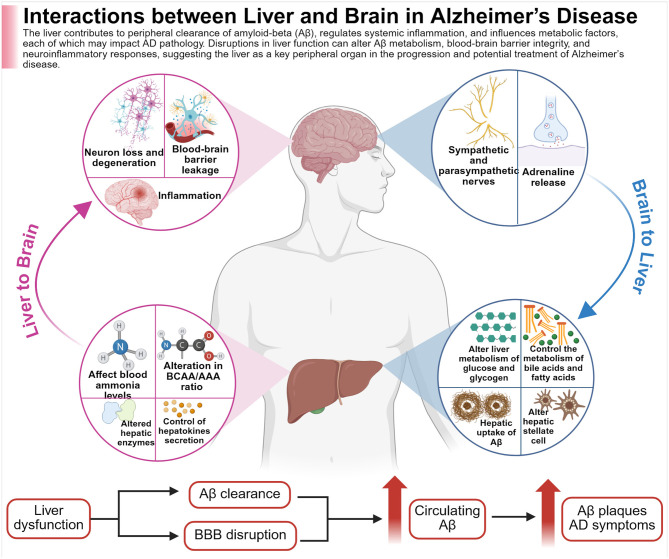
The figure illustrates the bidirectional nature of liver function, altogether with brain health, in relation to AD. The liver is involved in the clearance of circulating amyloid-beta (Aβ), the regulation of systemic inflammation, and the modulation of key metabolic processes. Disruptions in liver function may interfere with Aβ metabolism and clearance, increase BBB permeability, and trigger neuroinflammatory responses; all factors that may contribute to accelerated pathology of AD. Created with. BioRender.com
2.1.4 Bile acids (BAs) as modulators in Alzheimer's brain-gut axis
A potential therapeutic approach for AD consists of the BAs, which are produced in the liver (). Although their largest involvement is in nutrient and metabolic regulation, around 10% of them might cross the BBB, as shown in animal studies with mechanistic details (). A comparison of 119 patients suffering from AD with 267 controls found that alterations in serum BAs correlate with cerebrospinal fluid (CSF) Aβ1–42, tau, and p-tau. Higher concentrations of glycochenodeoxycholic acid, glycodeoxycholic acid, hyodeoxycholic acid, and certain bile acid ratios were associated with patient CSF tau and p-tau. Higher hyodeoxycholic acid and certain ratios were associated with lower CSF Aβ1–42. While these associations suggest a link between serum bile acids and AD pathology, a causal relationship has yet to be established (). BAs act in the brain by interacting with key receptors on neurons and glial cells-Farnesoid X receptor (FXR), Takeda G protein receptor 5 (TGR5), GR, and sphingosine-1-phosphate receptor 2 (S1PR2;;). BAs may modulate gut microbiota through antimicrobial properties, with deconjugated BAs produced by bacterial bile salt hydrolases being much less toxic to gut bacteria. In animal models of neurodegenerative disease, activation of TGR5 receptor was neuroprotective, decreasing neuronal death and inflammatory response (). S1PR2, located both in the liver and in the brain, activates the ERK and AKT pathways that regulate cell survival, inflammation, and stress response in the CNS. In the liver, S1PR2 activates pro-insulin signaling through enhancing insulin-degrading enzyme (IDE), thereby potentially alleviating insulin resistance associated with T2DM and AD based on animal mechanistic studies (;). Beyond directly influencing pathological changes in the AD brain, BAs may provide neuroprotective benefits by modulating the microbiota–gut–brain (MGB) axis, which supports memory function. GM also regulates BA synthesis; both antibiotic use and germ-free conditions suppress the expression of CYP7A1 and CYP27A1, key enzymes involved in BA production based on animal mechanistic studies (). Deconjugated BAs, which are less toxic to gut microbes, are reduced in AD, likely due to decreased BSH-secreting bacteria likeand, as observed in human associative studies (). While these findings support the hypothesis that restoring BA–microbiota interactions could influence AD symptoms, causal evidence in humans remains limited and warrants further investigation. Studies consistently show altered MGBA composition in AD patients, suggesting a possible role in disease onset and progression, as shown in. Confounding variables, such as diet and environmental exposures, complicate comparisons. [Grant and DeMorrow, 2020] [Monteiro-Cardoso et al., 2021] [Nabizadeh et al., 2024] [Kiriyama and Nochi, 2019] Figure 2 [Monteiro-Cardoso et al., 2021] [Vettorazzi et al., 2017] [Zangerolamo et al., 2022] [Chiang and Ferrell, 2019] [Mulak, 2021] Table 1 Clostridium Bifidobacterium

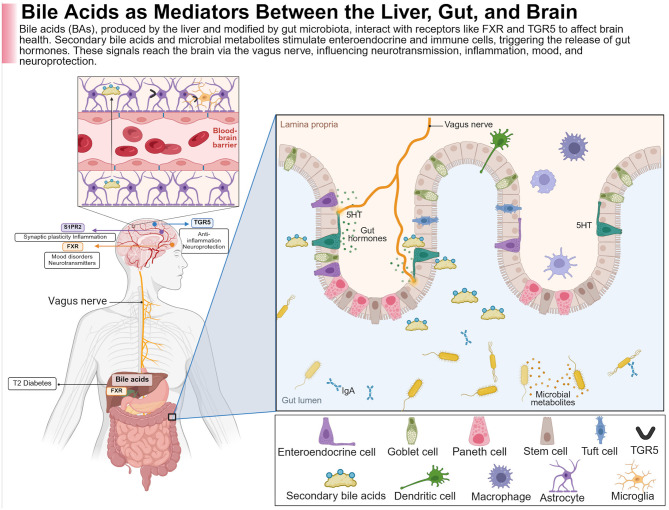
BAs provide neuroprotection through a complex system of physiological mechanisms. This figure illustrates how BAs are derived from the liver, transformed by gut microbiota, and interact with receptors such as the Farnesoid X receptor (FXR) and G protein-coupled bile acid receptor (TGR5) along the intestinal and brain axis. The modulation of microbial metabolites and secondary BAs within the gut lumen affects enteroendocrine and immune cells (e.g., dendritic cells, macrophages), leading to the secretion of gut hormones, with serotonin (5-HT) being the most prominent. These signals then travel via the vagus nerve to the CNS, where they influence processes such as synaptic plasticity, neurotransmission, inflammation, and neuroprotection. Regarding FXR, which interacts with BAs in the liver, it acts as a mediator of metabolic diseases like type 2 diabetes along the liver–gut–brain axis. In the brain, BA signaling through receptors like TGR5 and S1PR2 plays a role in mood regulation, cognition, anti-inflammatory responses, and neuroprotection, all of which are vital in neurodegenerative diseases such as Alzheimer's. Created with. BioRender.com
| Experimental subject | Main findings | References |
|---|---|---|
| APP/PS1 mice | ↑Proteobacteria, ↑Erysipelotrichaceae, and ↑Firmicutes | [Bäuerl et al., 2018] |
| Altered gut microbial diversity with ↑Proteobacteria and Verrucomicrobia; and ↓SCFA | [Zhang et al., 2017] | |
| ↓Microbial diversity, ↓spatial memory, ↑and(genus level), and ↓OdoribacterHelicobacterPrevotella | [Shen et al., 2017] | |
| ↓Aβ plaques, ↓plaque-localized glial reactivity, and significantly altered microglial morphology | , [Minter et al., 2016] [2017] | |
| AD is associated with shifts of the gut microbiome toward profiles that resemble those seen in inflammatory disorders | [Bäuerl et al., 2018] | |
| Altered peripheral inflammatory mediators in antibiotic-treated Tg mice | [Minter et al., 2016] | |
| C57BL/6 mice | Infection with the pathogenic bacteriaresulted in stress-induced memory disturbancesCitrobacter rodentium | [Gareau et al., 2011] |
| Symptomatic Tg2576 mice | ↑Firmicutes, ↑Bacteroidetes, and ↑Lactobacillus | [Honarpisheh et al., 2020] |
| Post-mortem AD brains | LPS andK99 colocalize with Aβ in plaques and perivascular aggregatesEscherichia coli | [Zhan et al., 2016] |
| LPS accumulates in neocortical neurons in AD | [Zhao et al., 2017] | |
| 16S rRNA sequencing shows increased bacterial populations | [Emery et al., 2017] | |
| Living AD human participants | ↑Pro-inflammatory, abundance of anti-inflammatory; ↓in ADEscherichia/ShigellaEubacterium rectaleBacteroides fragilis | [Cattaneo et al., 2017] |
| ↓Microbial diversity; ↓Firmicutes, ↓; and ↑Bacteroidetes in ADBifidobacterium | [Vogt et al., 2017] | |
| ↑Actinobacteria; ↑Enterococcaceae; ↑Lactobacillaceae, ↑Ruminococcaceae; ↓Bacteroidetes, ↓Lachnospiraceae, ↓Veillonellaceae | [Zhuang et al., 2018] | |
| Compared to controls, individuals with AD showed ↓Clostridia, ↓Lachnospiraceae, and ↓Ruminococcaceae, along with ↑Proteobacteria and ↑Enterobacteriaceae | [Liu et al., 2019] | |
| AD patients exhibited ↑, and, while showing ↓, andcompared to controlsBifidobacterium, ↑Blautia, ↑Dorea, ↑Escherichia, ↑Lactobacillus↑StreptococcusAlistipes, ↓Bacteroides, ↓ParaBacteroides, ↓Paraprevotella↓Sutterella | [Li et al., 2019] | |
| AD patients showed ↑; and, andcompared to controlsAlistipes, ↑Bacteroides, ↑Barnesiella, ↑Collinsella, ↑Odoribacter↓Eubacterium, ↓Lachnospiraceae Clostridium↓Roseburia | [Haran et al., 2019] | |
| CSF TMAO levels are ↑ in AD and positively correlate with CSF biomarkers of amyloid accumulation, tau pathology, and neuronal damage | [Vogt et al., 2018] | |
| Significant difference in the gut microbial genotypes between the AD and control human populations | [Paley et al., 2018] |
2.1.5 Therapeutic interventions
2.1.5.1 Probiotics
Probiotics are supplements made of live, helpful bacteria, mainlyand, that support gut health. They are used to correct imbalances in the MGBA and may help slow disease progression (). Animal studies suggest that strains like, andcan improve memory and cognitive function in AD models (), as shown in. Similarly,A1 has been shown to reduce brain inflammation and suppress harmful immune responses triggered by amyloid buildup in the hippocampus (). Lactobacillus Bifidobacterium Lactobacillus helveticus, L. plantarum L. fermentum Bifidobacterium breve [Kesika et al., 2021] [Kesika et al., 2021] Table 2 [Kobayashi et al., 2017]
| Probiotic | Duration | Sample size | Results | References |
|---|---|---|---|---|
| Akkermansia muciniphila | 6–7 months | 6–7 months old wild-type zebrafish (= 100)n | Improving glucose levels and diabetes markers in diabetic-AD zebrafish, while also easing AD symptoms and enhancing memory, mood, and social behavior | [Qu et al., 2023] |
| Bifidobacterium breve | 12 weeks | 16-weeks old male APPswe/PS1dE 9 mice (= 8)n | Strengthening the gut barrier, reduced neuroinflammation and synaptic dysfunction, improved gut microbiota, and alleviated cognitive decline in APP/PS1 mice | [Zhu G. et al., 2023] |
| Bifidobacterium breve strain A1 | 6 days | 10-week-old male ddY mice (= 11/12)n | This probiotic reversed behavioral impairments in memory tests, and its non-living components or metabolite acetate partially improved cognitive decline in AD mice | [Kobayashi et al., 2017] |
| Bifidobacterium breve | 6 weeks | 8-weeks old male C57BL/6J mice (= 8)n | Enhancing synaptic plasticity and increasing BDNF, thereby slowing AD progression | [Zhu et al., 2021] |
| Bifidobacterium longum | 4 and 8 weeks | 6-months, 18 months old male C57BL/6 and 5 × FAD-Tg mice (= 6)n | Modifying the gut microbiota in 5 × FAD-Tg and aged mice reduced fecal and blood LPS, suppressed NF-κB and TNF-α, boosted colon tight junction proteins, and decreased Aβ production, related enzymes, and accumulation in the hippocampus | [Lee et al., 2019b] |
| andBifidobacterium bifidumBifidobacterium longum | 30 days | 3-months old C57BI/6 and 5 × FAD mice (= 10)n | Inhibiting amyloidosis and apoptotic processes by improving neuroinflammatory responses and ameliorating cognitive and memory deficits in AD mice | [Kim H. et al., 2021] |
| and exerciseBifidobacterum bifidum, Lactobacillus plantarum | 8 weeks | 8-weeks old male Wistar rat (= 5)n | Improving Aβ plaque deposition and reducing brain cell death in the brains of AD mice | [Shamsipour et al., 2021] |
| Bifidobacterium lactis | 45 days | 4-months old APP/PS1 mice (= 11/12)n | Reducing the deposition of Aβ plaque in the whole brain, preventing the imbalance of intestinal flora, and alleviating the cognitive impairment of APP/PS1 mice | [Cao et al., 2021] |
| Lactobacillus plantarum | 12 weeks | 8-week-old male C57BL/6J, 6-month-old male wild-type, and PrP hAβPPswe/PS1Δ E9 transgenic mice (= 15/30)n | Improving cognitive deterioration, reducing the level of Aβ in the hippocampus, protecting the integrity and plasticity of neurons, and inhibiting the synthesis of TMAO | [Wang Q.-J. et al., 2020] |
| Lactobacillus plantarum | 12 weeks | 6-weeks old SPF grade Wistar male rats (= 8)n | Improving cognitive impairment and anxiety-like behavior in AD rats, reducing neuronal degeneration and Aβ buildup, and suppressing microglial activation and neuroinflammation | [Wang Y. et al., 2022] |
2.1.5.2 Prebiotics
Prebiotics are non-digestible fibers like oligosaccharides and polysaccharides that feed good gut bacteria. These compounds not only help beneficial microbes survive but also support the production of gut-derived metabolites important for brain and gut health (). For instance, lactulose encourages the growth of healthy gut bacteria and may protect brain function in AD models (). Dietary fibers such as fructo-oligosaccharides (FOS) and galacto-oligosaccharides (GOS) can enhance the gut's production of secondary BAs and SCFAs, both of which support intestinal integrity and may reduce neuroinflammation (). FOS, found in fruits and vegetables, is especially effective in promotingandgrowth. In AD animal models, FOS helped preserve gut microbial balance, reduced brain cell death, and decreased the buildup of harmful proteins, such as tau and Aβ1–42 (). These protective effects are thought to involve the MGBA, including modulation of the glucagon-like peptide-1 (GLP-1) receptor pathway, which influences both brain and metabolic health (). While human trials show more modest effects, prebiotic intake has been associated with subtle improvements in gut microbiota composition and immune-related gene expression, especially in older adults. [Kang and Zivkovic, 2021] [Lee H. J. et al., 2021] [Salminen et al., 2021] [Chen et al., 2017] [Sun et al., 2019a] Bifidobacterium Lactobacillus
2.1.5.3 FMT
FMT is performed by transferring stool from healthy donors into a recipient's GI tract to restore microbial diversity (). Currently, FMT is officially approved only for the treatment of recurrentinfection. However, the feasibility of using it to treat metabolic disorders and neurodegenerative diseases is currently under investigation in clinical trials (). FMT induces cognitive improvement while lessening the accumulation of Aβ in the brain, as shown in animal models of AD, as shown in. However, there are several issues with FMT as follows: biological mechanisms remain undescribed, donor stool will not always be available, risks and side effects remain unclear, and long-term safety data are extremely limited (). Future research will have to focus on developing areas such as formalizing procedures, ensuring safety protocols, and establishing reliable stool banks. Therefore, recommendations for incorporating FMT into standard care for AD cannot yet be made. [Allegretti et al., 2018] [Liu Y. et al., 2020] Table 3 [Liu Y. et al., 2020] Clostridium difficile
| References | Sample size | Donor | Recipient | Results |
|---|---|---|---|---|
| [Hazan (2020)] | Case study (= 1)n | 85-year-old woman | 82-year-old man with recurrent AD | ↑Cognitive function↑Memory↑Mood |
| [Park et al. (2021)] | Case study (= 1)n | 27-year-old healthy man | 90-year-old woman with AD | ↑Cognitive function↑Microbiota α Diversity↑Microbiota β diversity |
| [Kim N. et al. (2021)] | Mice (= 8)n | 5 × FADmice | C57BL/6 mice | ↓Adult hippocampal neurogenesis and BDNF expression↑Microglia activation |
| [Sun et al. (2019b)] | Mice (= 8)n | WT mice | APPswe/PS1dE9 transgenic (Tg) mouse model | ↓Amyloid brain deposition (Aβ 40 and Aβ 42)↓Tau protein phosphorylation ↑Synaptic plasticity↑SCFA and microbiota composition |
| [Dodiya et al. (2019)] | Mice (= 9)n | Age-matched APPPS1-21 | ABX-treated APPPS1-21 male | ↓Aβ pathology ↑Microglial physiology |
| [Valeri et al. (2021)] | Mice (= 10)n | Either 4 months old or 1 year old wild type mice | 5 × FAD mice (4-month old) | ↑Enterobacteriaceae, Lactobacillaceae, ↓Firmicutes↑Plaques in the dentate gyrus and prefrontal cortex |
2.1.5.4 Dietary intervention
Diet strongly influences gut microbiota composition and activity, depending primarily on the nutrients we eat. The Mediterranean diet (MeDi), rich in fruits, vegetables, legumes, and whole grains, has been shown to lower the likelihood of cognitive decline and delay the onset of AD by 1.5–3.5 years (). This diet alters gut microbiota profiles, such as higher population levels of Clostridium cluster XIVa, Lactobacilli, and Bifidobacteria, and lower levels of Firmicutes and Proteobacteria. MeDi can further influence gut bacterial diversity and functionality, generating healthy metabolites, like SFCAs, which offer multifaceted benefits for the intestinal, metabolic, and immune health of the host organism (). A high fiber diet further aids in better blood glucose control among T2DM and AD subjects, possibly mediated through impacts on hemoglobin A1c and gut hormone GLP-1 levels (). Omega-3 fatty acids ingested from foods like sardines, walnuts, seaweed oil, and deep-sea fish provide neuroprotective effects by supporting neuronal development and synaptic activity while reducing inflammation over the gut–brain axis (). [Lourida et al., 2013] [Nagpal et al., 2019] [Zhao et al., 2018] [Latifi et al., 2016]
2.1.5.5 Exercise
Research in humans shows that regular physical exercise helps protect the brain from age-related cognitive decline and reduces the risk of AD (). This protection is likely due to increased growth of new neurons in the hippocampus, improved signaling of brain-derived neurotrophic factor (BDNF), better synaptic function, and reduced brain inflammation (). Emerging evidence suggests that the MGBA might also play a key role in these effects. Both human and animal studies have shown that exercise changes the diversity and composition of gut bacteria. Microbiota changes in people, however, are heterogeneous, with food intake being one major determinant of gut microbial composition that might confound the apparent exercise-related effects (). In a key study by Masumoto and colleagues, 5 weeks of exercise in mice changed their gut microbiome and increased levels of butyrate (). Because exercise improves brain function and gut microbiome composition, its brain-protective effects in AD may be partly mediated through the microbiome. To better understand this relationship, future studies should compare AD mice models with disrupted gut microbiomes to those with healthy microbiomes during exercise interventions (). If the microbiome is confirmed as a key link, therapies that mimic an "exercise-enhanced" gut microbiome might offer a new strategy to alleviate AD symptoms. [Meng et al., 2020] [Nichol et al., 2008] [Zhou et al., 2024] [Matsumoto et al., 2008] [Chandra et al., 2023]
2.1.5.6 Sleep
Sleep and circadian rhythm disturbances are among the hallmark features associated with AD (). Almost all AD patients exhibit erratic sleep patterns, nocturnal staying awake, and daytime sleepiness (). Notably, adults without cognitive impairment reporting a bad night's sleep are more likely to show signs of amyloid buildup in their brains observed by PET scans (). Research has shown that Aβ levels vary with sleep-wake cycles. For example, during wakefulness, Aβ levels increase and decrease during sleep in mice, and this phenomenon is similar in humans with AD (;). Reducing Aβ plaque counts in mice elicits an improvement in sleep cycle restoration, as well as natural fluctuations in Aβ levels, thereby implying that sleep may be disturbed directly by Aβ deposition (). Sleep deprivation is associated with increased brain activity, thereby leading to increased production of Aβ and subsequently worsening the already existing AD pathology (). Sleep disruption changes the microbiome, as is shown in experiments where alterations in gut bacterial profiles were found in mice with circadian rhythm mutations or rats with chronic sleep deprivation (). [Musiek et al., 2015] [Hatfield, 2004] [Spira et al., 2013] [Kang et al., 2009] [Huang, 2012] [Roh et al., 2012] [Lim et al., 2013] [Chandra et al., 2023]
Several probiotics and prebiotics have been shown to have positive effects on sleep, which could be interpreted to mean that sleep health can be managed by supporting the MGBA (). Additionally, propionate, a known SCFA, may play a role together with other microbial metabolites, while greater levels of propionate have been correlated with promising infant sleep patterns (). These empirical findings support the notion that modulating microbial communities could positively influence sleep regulation and overall health. [Thompson et al., 2020] [Heath et al., 2020]
Building on these current empirical findings, future hypotheses suggest that the precise manipulation of microbial communities to boost propionate production may improve sleep patterns, decrease Aβ accumulation, and slow cognitive decline. To empirically test this future hypothesis, long-term controlled trials may need to standardize the intervention by assigning either a probiotic or prebiotic regimen aimed at propionate enhancement to subjects with mild cognitive impairment. These impending studies should incorporate objective assessments of sleep quality, utilizing polysomnography, concurrently with measurements of gut-derived metabolites, amyloid/tau biomarkers, and cognitive trajectories over time. By simultaneously targeting gut function and sleep, future research has the potential to uncover synergistic mechanisms and provide a new therapeutic strategy to slow AD progression.
Preclinical studies indicate that microbiota modulation via diet or probiotics can reduce neuroinflammation and amyloid burden, with some animal models showing improved cognitive outcomes. Human trials show that probiotic and dietary interventions may support GBA health, but clinical evidence remains preliminary pending further validation.
2.2 Parkinson's disease (PD)
PD patients show exhaustive gut microbiome dysbiosis, such as reduced Prevotella and increased Enterobacteriaceae, which can be related to GI symptoms such as constipation (). It seems that the direction of effect is consistently spread among studies, usually implicating early gut changes occurring prior to the manifestation of motor symptoms (). The changes in the microbial metabolites, immune activation, and gut permeability constituting the pathways identified. Initial studies with probiotics, dietary modifications, and FMT have shown benefits in GI symptoms and, in some instances, motor and non-motor symptoms (;;). Controlled studies are ongoing, but present data do favor microbiome modulation as an adjunct therapy. Many consistent alterations in the microbiome lead toward a causative or contributory role, and early interventions of microbiota could influence the progression of the disease and the severity of its symptoms. [Hashish and Salama, 2023] [Aho et al., 2019] [Georgescu et al., 2016] [Huang et al., 2019] [Wang Q. et al., 2021]
2.2.1 Background
PD is the second-most common neurodegenerative disorder after AD. It acts from a lack of equilibrium between two neurotransmitters in the basal ganglia: dopamine (inhibitory) and acetylcholine (excitatory). In typical basal ganglia function, the actions of these neurotransmitters counterbalance each other to refine voluntary movement; however, in PD, the neurons producing dopamine slowly die out, causing an excess of acetylcholine to overstimulate the basal ganglia (). This leads to the major motor symptoms of tremor, bradykinesia, and rigidity, along with postural difficulties, which are classical for PD (). Affected individuals may show other non-motor symptoms, with some being GI-oriented and emerging years before the classical motor features (). Cognitive manifestations include depression, irritability, and anxiety, while GI manifestations encompass constipation, dysphagia, nausea, and prolonged intestinal transit time (;). Most non-motor symptoms go unrecognized when this neurodegenerative disease begins in his prodromal form. Diagnosis and treatment usually begin after the disease shows motor symptoms. It has a complicated pathogenesis associated with environmental modifications, genetic predispositions, deregulated dopamine metabolism, neuroinflammation, oxidative stress, and mitochondrial dysfunction (;). However, the leading theory behind PD pathogenesis is the accumulation of alpha-synuclein aggregates within cells, which trigger neuroinflammation and neuronal apoptosis (). Gut findings of alpha-synuclein abnormalities in early-stage PD are documented in patients having PD. Imaging studies further corroborate that PD may arise from the gut and subsequently spread into the brain (,). Through the spinal cord, the brain communicates with all other body systems, including the endocrine system, which regulates body functions such as stress and mood via hormone secretion, and the immune system, which defends the body from pathogenic infection and promotes healing. These systems share signals through the vagus nerve, which carries information from the body's organs to the brain regions (;;). Some epidemiological studies carried out in Denmark and Sweden have indicated that people who had undergone complete truncal vagotomies decades ago had a lower risk of developing PD later in life (;). This points to the possibility of some disturbances in gut microbial position, thereby predisposing to PD. [Wang Q. et al., 2021] [Obeso et al., 2017] [Cersosimo et al., 2013] [Pfeiffer, 2003] [Li et al., 2023] [Gökçe Çokal et al., 2017] [Wang T. et al., 2020] [Kim et al., 2019] [Horsager et al., 2021] 2022 [Jackson et al., 2019] [Li et al., 2023] Figure 3 [Svensson et al., 2015] [Liu et al., 2017]

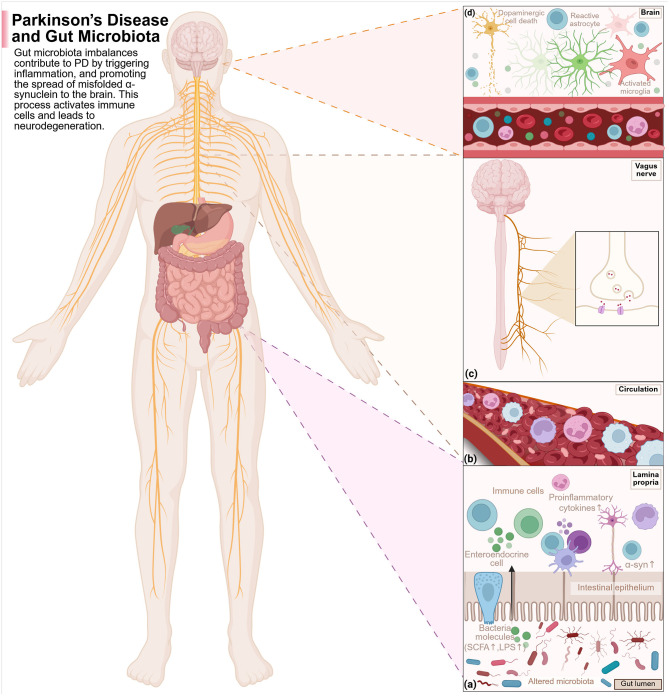
The disruptions of the gut microbiota work together with the immune, endocrine, and nervous systems in PD pathogenesis as follows:Disruptions of the gut microbials and their metabolites' composition are able to induce inflammation of the gut. The metabolites can cross the compromised intestinal wall, reach the immune activation of the gut lining, stimulate pro-inflammatory cytokine secretion, and enable α-syn misfolding and aggregation.Increased permeability of the gut wall will enable more microbial metabolites and immune signaling molecules to enter into the circulation to induce inflammation in the body.The misfolded α-syn of the gut could then enter the brain through the vagus nerve in a cell-cell transmission-like manner that would also be reversible.These pathological proteins enter the brain via BBB disruption and vagal channels, activating microglia and astrocytes and leading to neuroinflammation and dopaminergic neuronal degeneration, thus advancing PD. Created with. (a) (b) (c) (d) BioRender.com
2.2.2 Vagotomy and insights into the microbiota–gut–brain axis in Parkinson's
The vagus nerve is the tenth cranial nerve. It has been so named from the Latin word meaning "wandering," because it wanders widely through the body. It originates from either side of the medulla oblongata, exits through the jugular foramen, and descends the neck, chest, and abdomen (). Along the way, the vagus nerve sends off branches to innervate and regulate almost all the visceral organs. Functionally, it is vital for the control of immune responses via neural signaling. Containing both motor and sensory fibers, the vagus nerve is also the main afferent pathway from the abdominal organs, lungs, liver, stomach, pancreas, and intestines to the brain. Sensory information from the abdominal organs traverses the vagus nerve to the nucleus of the solitary tract in the brainstem, with projections to several other areas of the CNS, including the cerebral cortex and medulla oblongata (). At present, vagotomy is considered only for those patients who are resistant to pharmacological treatment or who are severely ill with complications, such as perforations or gastric outlet obstruction. In the past, it has also been employed in the treatment of biliary dyskinesia and chronic abdominal pain in neurological conditions (;). [Liu and Forsythe, 2021] [Liu and Forsythe, 2021] [Crile, 1951] [Liu and Forsythe, 2021]
In PD, the spread of the pathological alpha-synuclein from the gut to the brain is mediated along the vagus nerve. There are two major forms of vagotomy: truncal vagotomy, which severs all connections, and selective vagotomy, which maintains intestinal innervation (). Studies have noted that vagotomy can inhibit the misfolding of alpha-synuclein in enteric neurons and reduce the appearance of PD symptoms in animal models (;). [Wang Q. et al., 2021] [Uemura et al., 2018] [Kim et al., 2019]
The total vagotomy can be beneficial in reducing the chances of developing secondary PD, according to a cohort study done in Denmark (). On the other hand, there is a separate study in Sweden that has followed patients after vagotomy and pointed out no relation between vagotomy and PD risk (). However, 5 years of follow-up indicated that within that period, after vagotomy, there is a reduced risk of PD, and very similar results were obtained in the 10-year follow-up. These findings provoke interesting primary questions as to the possible origins of PD-associated alpha-synuclein misfolding from within autonomic nerve fibers of the gut. [Svensson et al., 2015] [Liu et al., 2017]
Selective or highly selective vagotomy may permit α-synuclein pathology from elsewhere in the GI tract to still reach the vagus nerve and, thereafter, the brainstem. Vagotomy in animal studies is said to disrupt the transfer of α-synuclein derived from the gut to the CNS, but human observational evidence is inconsistent, with some studies indicating no change in PD incidence and others suggesting a reduced risk following truncal vagotomy (). Currently, there is too immature an understanding of PD pathophysiology to make vagotomy a potential treatment method, and clarification through research is needed regarding the vagotomy-PD relationship. Therefore, no clinical role for vagotomy exists at present. [Elfil et al., 2020]
2.2.3 Duration of disease, motor symptoms, non-motor symptoms, and associated microbiota
The composition of gut microbiota might vary whether PD has an early or late onset. In a study, Pasteurellaceae, Alcaligenaceae, and Fusobacteria were more common in early prodromal PD stages vs.and, which were commonly detected in late-onset PD cases (). Some gut pathogens, such as, and, have been associated with motor complications in PD (). Comamonas Anaerotruncus Aquabacterium, Peptococcus Sphingomonas [Lin et al., 2018] [Qian et al., 2018]
examined the impact of PD medications (levodopa and entacapone) on gut microbiota, finding marked changes in, and. For other drugs such as MAO inhibitors, amantadine, and dopamine agonists, no indication was found for an effect on taxa abundance or microbial functions ().reported lowergroup IV in PD as well as no strongly associated taxa with levodopa (L-DOPA) use, although preliminary data suggestcluster IV may be linked to short-term motor-symptom response to L-DOPA, which deserves a thorough controlled validation. Other studies have shown that the other PD drugs acted independently to shape different microbial profiles, which strengthens the rationale for disentangling drug effects from disease signatures (). [Weis et al. (2019)] [Horsager et al., 2020] [Palacios et al. (2021)] [Hashish and Salama, 2023] Peptoniphilus, Finegoldia, Faecalibacterium, Fusicatenibacter, Anaerococcus, Bifidobacterium, Enterococcus Ruminococcus Clostridium Clostridium
distinguished PD patients who are stable and those with rapid progression, with inconsistent taxa throughout methods and times but uniquely exiting enterotypes, accompanied by a decline infor the rapid-progression cases. Group differences between PD and controls stayed after the removal of confounds such as deep-brain stimulation (DBS), but differed across studies. In general, replications of the PD-microbiome instances are often poorly developed, presumably as a result of confounding by usage of medication, geographical differences, sequencing methods, and analytical pipelines. Nevertheless, some microbial changes were reported consistently: decrease in Prevotellaceae,, and(;;), and increase in/Verrucomicrobiaceae (;;). [Aho et al. (2019)] [Scheperjans et al., 2015] [Unger et al., 2016] [Hopfner et al., 2017] [Keshavarzian et al., 2015] [Heintz-Buschart et al., 2018] [Lin et al., 2018] Prevotella Prevotella P. copri Akkermansia
The most important GI symptom is constipation, which impacts almost 60% of people suffering with PD (). Research indicates that the severity of PD-related constipation helps diagnose the PD stage, with 67% sensitivity and 90% specificity (). References state that the dysbiosis is likely to be responsible for early stage PD GI-related problems, including constipation, with a notable increase in bacterial families that include Lactobacillaceae, Verrucomicrobiaceae, Bradyrhizobiaceae,, and(;). Among these groups, through greater severity of constipation, longer transit times, and harder stool,has been related to constipation (;). Patients suffering from PD and characterized by slowed transit of the intestine may consequently need to receive higher amounts of L-DOPA (;). Such patients lack in terms of absorption of medicines, thus translating into efficacy problems because of the delays in transit. Constipation may also predispose bacteria to reach excessive populations, particularlyspecies that can execute tyrosine decarboxylation, L-DOPA by converting it into dopamine in the gut hence limiting its release into the bloodstream and causing motor fluctuations (). More doses of L-DOPA combined with decarboxylase inhibitors have to be repeated under this scenario, thus denoting a complicated interaction of PD medications with GI tract-related symptoms. [Pavan et al., 2022] [Hashish and Salama, 2023] [Baldini et al., 2020] [Hashish and Salama, 2023] [Lubomski et al., 2022b] [Hashish and Salama, 2023] [Fasano et al., 2013] [Weis et al., 2019] [Menozzi and Schapira, 2024] Bifidobacterium Akkermansia Akkermansia Lactobacillus
Most people who suffer from PD, may have experienced either the condition of small intestinal bacterial overgrowth (SIBO) or colonization by(;;). SIBO could lead to symptoms like bloating, excessive gas, or impaired absorption of nutrients. A relationship between PD and SIBO was first established in 2021 by the symptom of constipation, indicating that aggravation in the severity of constipation might correlate with an increased risk for SIBO (.,). Relief from SIBO not only alleviates the GI discomfort, but it also helps in the amelioration of the motor fluctuations experienced by PD patients (;). Patients with PD and comorbid SIBO—as opposed to those without it—showed more severe dyskinesia which included prolonged rest time, delayed on-time and off-time. Another proof of this was that motor fluctuations in PD patients improved after SIBO eradication, hence providing more support of the association between SIBO and motor fluctuations (). Interestingly, studies show multiple symptoms of PD improve withantibiotic therapy due to increased absorption and bioavailability of L-DOPA (). A trial, double-blind, placebo-controlled study pronounced that motor symptoms do improve from hypokinesia over the year since the eradication ofbut worsen from flexor rigidity (). Although the mechanisms remain unknown, researchers present their theory claiming that the thickening rigidity coexists with SIBO because of overgrowth by certain bacterial strains already present (). The increasing evidence that altered gut microbiota correlate with non-motor features of PD rests on the premise of the need for more evidence to be generated for possible therapeutic strategies to be unveiled. Helicobacter pylori H. pylori H. pylori H. pylori [Gabrielli et al., 2011] [Felice et al., 2016] [Dănău et al] 2021 [Gabrielli et al., 2011] [Fasano et al., 2013] [Lubomski et al., 2020] [Pierantozzi et al., 2001] [Dobbs et al., 2010] [Felice et al., 2016]
2.2.4 Interactions between the gut microbiome and device-assisted therapies
Evidence consistently points toward the role of gut microbiota in the persistent interaction upon L-DOPA treatment response. It has been seen that the efficacy of L-DOPA in antibiotic therapy was improved as gut microorganism influences drug metabolism and action (;;). As one of the most important dopamine-replacement therapies for PD, L-DOPA is commonly given with carbidopa to improve bioavailability and avoid early conversion into dopamine before penetration into the brain (). Thus, an increasing amount of evidence suggested that the gut microbiome has taken a rather complex interest in influencing the response of the body to L-DOPA treatment. Such studies have shown that antibiotic administration might increase the effectiveness of L-DOPA therapy, indicating that gut microorganisms affect metabolism and the effectiveness of the drug (). Another important fact is that this L-DOPA is co-administered with carbidopa, another important dopamine-replacement therapy for PD, aiming to increase the bioavailability of the substance and prevent early conversion into dopamine prior to entering the brain (). [Hashim et al., 2014] [Hashish and Salama, 2023] [Hey et al., 2023] [Gandhi and Saadabadi, 2025] [Hashim et al., 2014] [Gandhi and Saadabadi, 2025]
The research bylooked at how the administration of levodopa-carbidopa intestinal gel (LCIG) has effects on the gut microbiome in PD. The LCIG treatment involves a continuous infusion of a carboxymethylcellulose aqueous gel directly into the proximal jejunum via a percutaneous gastrojejunostomy tube, with delivery by a portable infusion pump (). When assessing alpha diversity (the diversity and evenness of microbial species within a single sample, representative of microbial richness and community balance), they found no marked changes attributable to LCIG. The LCIG application caused changes in the beta diversity (which assesses the differences in microbial community composition between samples, indicating how similar or dissimilar microbial communities are across individuals or time points). Changes in beta diversity reveal that while overall species richness and evenness among the individuals were stable, LCIG can redistribute the abundance of different taxa, thereby altering cohabitation structure and interrelations among microbial species. This pattern holds biological significance in PD in that it suggests that disease- or treatment-related effects may exert selective pressure on the microbial network in the gut without necessarily lowering the overall number of microbial species present, thereby exerting an influence on GBA signaling and L-DOPA metabolism. The acidic condition of LCIG may alter the chemical situation in the gut, which, finally, leads to hypergrowth of, being acid-tolerant bacteria (). This observation of microbial shift may contribute to the excessive gut inflammation. Research is scarce on the effect of LCIG on the gut microbiota in PD individuals, and more studies are needed to substantiate findings on gut homeostasis. [Lubomski et al. (2022b)] [Olanow et al., 2014] [Lubomski et al., 2022b] Escherichia/shigella
Previously reported changes in the abundance of this family Prevotellaceae in advanced PD seem to have been expanded upon by Bedarf and associates, who have shown a dramatic decrease in the numbers ofin patients with early-stage PD (). Since these species ofproduce SCFAs like butyrate, their decrease may affect intestinal barrier function and immune health and thus be involved in the pathogenesis of PD (). Notably, neither MAO inhibitors nor dopamine agonists appear to affect the composition and function of gut microbiota (). However, emerging data suggest that different PD therapies exert differential effects on gut microbiota, as shown in. Since PD patients are frequently on multiple therapies, it will be important for future studies to determine the independent effect of these therapies on the gut microbiome and their potential roles in the progression and management of the disease. Prevotella copri Prevotella [Bedarf et al., 2017] [Hey et al., 2023] [Bedarf et al., 2017] Table 4
| References | Intervention | Sample size | Results |
|---|---|---|---|
| [Lubomski et al. (2022b)] | 4 weeks DBS | PD: 21DBS: 10LCIG: 11HC: 10 | Notable differences in alpha and beta diversity relative to LCIG therapy |
| Excessandmay aid post-surgical healing by reducing inflammationParaBacteroidesClostridium | |||
| Elevatedlevels may be due to LCIG's acidic propertiesEscherichia/Shigella | |||
| [Lubomski et al. (2022a)] | 12 months DBS | PD: 74DBS: 9LCIG: 10HC: 74 | Increased microbial diversity may result from time-dependent GM changes after DBS and/or LCIG |
| [Melis et al. (2021)] | LCIG | PD: 107LCIG: 38Naïve group: 23 | LCIG therapy increases Enterobacteriaceae,, andmore than levodopa aloneEscherichiaSerratia |
| Higher Enterobacteriaceae levels after LCIG may contribute to gut inflammation |
2.2.5 Gut microbiota-based therapeutic interventions
2.2.5.1 Probiotics
The results of human clinical trials (see) suggest that probiotics may be beneficial as a supportive therapy for PD.Shirota is found in milk, which, in one randomized clinical trial, relieved abdominal discomfort while improving stool consistency and bowel movements. The improvement of gut health in patients suffering from PD may be attributable to other probiotic strains, includingand(). More recently, another randomized clinical trial demonstrated that co-administering Probio-M8 (subsp.Probio-M8) with dopamine agonists improved non-motor symptoms such as cognitive function, bowel regularity, and overall gut health (). Their findings match existing clinical data, supporting the notion that probiotics can influence the MGBA, perhaps as a complementary method of intervention against the advancing PD phenotypes. Table 5 [Georgescu et al., 2016] [Sun et al., 2021] Lactobacillus casei Lactobacillus acidophilus Bifidobacterium infantis Bifidobacterium animalis lactis
| References | Study subjects | Probiotic | Prebiotic | Duration | Results |
|---|---|---|---|---|---|
| [Cassani et al. (2011)] | 40 PD patients | Lactobacillus casei Shirota | No | 5 weeks | Improved stool consistency, and reduction in abdominal pain, while other motor-symptoms were not tested |
| [Georgescu et al. (2016)] | 40 PD patients | andLactobacillus acidophilusBifidobacterium infantis | No | 12 weeks | Improved abdominal pain and bloating, no changes in constipation, while other motor-symptoms were not tested |
| [Borzabadi et al. (2018)] | 50 PD patients | , andLactobacillus acidophilus, Bifidobacterium bifidum, L. reuteriL. fermentum | No | 12 weeks | Improved markers of inflammation, while constipation and motor symptoms were not tested |
| [Tamtaji et al. (2019)] | 60 PD patients | , andLactobacillus acidophilus, Bifidobacterium bifidum, L. reuteriL. fermentum | No | 12 weeks | Improved motor symptoms, and insulin-related measures, while constipation was not tested |
| [Ibrahim et al. (2020)] | 48 PD patients | The multi-strain probiotic Hexbio consists of, andLactobacillus acidophilus, L. casei, L. lactis, Bifidobacterium infantisB. longum | Yes (FOS) | 8 weeks | Improved constipation and gut motility, while no changes found in motor symptoms |
| [Tan et al. (2021)] | 72 PD patients | , andLactobacillus acidophilus, L. reuteri, L. gasseri, L. rhamnosus, Bifidobacterium bifidum, B. longum, Enterococcus faecalisE. faecium | No | 4 weeks | Improved constipation, while motor symptoms were not tested |
| [Sun et al. (2021)] | 82 PD patients | subsp.Probio-M8Bifidobacterium animalislactis | No | 12 weeks | Improved constipation, motor symptoms, and cognitive functions, and increased serum acetate and dopamine |
2.2.5.2 Prebiotics
Prebiotics could be helpful in the management of PD, even if only limited studies have been done on human PD patients to find out how prebiotic supplementation affects them (). According to a study conducted recently byit was identified that polymannuronic acid, when given as a prebiotic, might protect dopaminergic neurons from SCFA-mediated anti-inflammatory and anti-apoptotic pathways. A more recent study showed that butyrate levels in PD patients increased due to the production of SCFA after being treated orally with resistant starch, along with improvements in non-motor symptoms (). More human trials are essential for a full understanding of the long-term impact of prebiotics in PD pathologies. Table 5 [Liu et al. (2022)] [Becker et al., 2022]
2.2.5.3 FMT
were the first to demonstrate that transplanting fecal matter from PD patients into mice genetically engineered to overexpress alpha-synuclein significantly worsened their motor symptoms compared to mice receiving transplants from healthy human donors. In one event where a 71-year-old PD subject was subjected to FMT, improvement in bowel regularity was noted, and tremors disappeared for 2 months after the process (). Reduced striatal dopamine, serotonin levels, and their metabolites were also reported. On the contrary, studies have proven that the fecal microbiota transferred from healthy donors into PD-model mice mitigates their motor impairments and their gut microbiota changes, which were shown byand. [Sampson et al. (2016)] [Huang et al., 2019] [Zhang et al. (2021d)] [Zhao et al. (2021)]
Various studies have positively linked the use of FMT with a healthy gut microbiome through a decrease in pathogenic microbes like, and Proteobacteria and an increase in beneficial groups like Bacteroidetes and Actinobacteria, especially includingandspecies (). Beyond the gut, FMT provides many improvements in the brain, including reversing cognitive decline, neuroprotective mechanisms by reducing alpha-synuclein accumulation, and restoring striatal levels of dopamine and serotonin (). Desulfovibrio, Akkermansia Blautia Prevotella [Sun et al., 2021] [Hashish and Salama, 2023]
Improvement in bowel function and reduction of tremor has been reported () but such studies are tentative and do not prove efficacy. The use of FMT in routine care of patients with Parkinson's cannot be recommended at this stage. [Huang et al., 2019]
Animal models show microbiota changes prior to motor symptoms, and probiotic interventions have improved GI and non-motor symptoms in clinical trials. Different PD therapies may influence gut microbiota composition, emphasizing the need to clarify therapy-specific effects.
2.3 Amyotrophic lateral sclerosis (ALS)
Recent human studies demonstrate that ALS patients have gut dysbiosis, defined primarily by decreased microbial diversity, such as lower populations of beneficial bacteria like, and increased levels of potentially harmful species like(). These changes are associated with increased systemic inflammation markers, and some investigations have made correlations of microbial imbalance with faster disease progression (). However, the evidence for causality remains limited, and the findings across studies have rather conflicting outcomes. Still, gut microbiota profiles may be considered as biomarkers or therapeutic targets. Faecalibacterium E. coli [Brenner et al., 2018] [Obrenovich et al., 2020]
2.3.1 Background
ALS is a serious and progressive disease that damages both the upper and lower motor neurons, which are the nerve cells that control voluntary muscle movement. It usually begins between the ages of 50 and 70 and is slightly more common in men than women, with a male-to-female ratio of about 1.5–1 (). Worldwide, ALS affects about 1–2.6 people out of every 100,000 each year, and at any given time, around 4–8 out of every 100,000 people, especially those of Caucasian descent are living with the disease (;). Roughly 90% of ALS cases happen without a family history (sporadic ALS), while the remaining 10% are inherited (familial ALS). More than 50 genes have been linked to ALS, with the most common being C9ORF72, which causes up to 50% of inherited cases and 5–10% of sporadic ones. Other key genes include SOD1, TARDBP (which codes for TDP-43), and FUS (). Interestingly, ALS and frontotemporal dementia (FTD) are closely related conditions and often share both genetic and disease mechanisms, especially in people with C9ORF72 mutations suggesting they may be part of the same disease spectrum (). In addition to genetics, certain environmental exposures may increase the risk of developing ALS. These include smoking, military service, pesticide exposure, and heavy metals, with smoking raising the risk by about 40% (). [Chiò et al., 2013] [Al-Chalabi and Hardiman, 2013] [Chiò et al., 2013] [Renton et al., 2011] [Parobkova and Matej, 2021] [Al-Chalabi and Hardiman, 2013]
2.3.2 Clinical presentation and diagnostic challenges
ALS can look very different from person to person in how it begins and how quickly it progresses. In about 70% of people, the first symptoms appear in the limbs usually starting with hand weakness (60%) or leg weakness (40%). Around 30% of patients start with bulbar symptoms, which affect the muscles used for speaking and swallowing, leading to problems like slurred speech (dysarthria), trouble swallowing (dysphagia), and twitching of the tongue muscles (). A small number (less than 5%) have respiratory-onset ALS, where breathing muscles weaken early, and these cases tend to be more severe. [Chiò et al., 2013]
The disease usually begins in one part of the body and spreads gradually, leading to increasing muscle weakness. On average, there's a delay of 10–16 months between the first symptoms and the official diagnosis (). Once diagnosed, median survival is between 2 and 5 years, although patients with bulbar-onset ALS tend to decline more quickly. [van den Bos et al., 2019]
ALS is mostly diagnosed based on clinical signs, using the revised El Escorial criteria, which require signs of both upper motor neuron (e.g., spasticity, brisk reflexes) and lower motor neuron damage (e.g., muscle wasting, twitching) in multiple body regions (). Electromyography (EMG) tests are crucial to show nerve damage and muscle denervation, while nerve conduction studies are used to rule out other diseases. MRI scans are also done to make sure there isn't another condition, such as a structural issue in the brain or spine (). Despite all this, about 10–15% of ALS cases are initially misdiagnosed. Conditions that are often mistaken for ALS include multifocal motor neuropathy, cervical spine disorders, and inclusion body myositis (). [Brotman et al., 2025] [Kwan and Vullaganti, 2022] [Kwan and Vullaganti, 2022]
2.3.3 Molecular pathogenesis and disease mechanisms
The development of ALS is driven by several overlapping biological mechanisms that together cause motor neuron degeneration. One key process is glutamate excitotoxicity, where a buildup of glutamate at the synapse due to reduced function of the transporter EAAT2 (also known as GLT-1) leads to overstimulation of N-methyl-D-aspartate (NMDA) receptors. This causes excessive calcium to enter neurons, damaging mitochondria and triggering cell death (). Another central feature is the loss of protein balance, especially involving TDP-43, a protein that is abnormally located in the cytoplasm instead of the nucleus in about 97% of ALS cases. In this mislocated state, TDP-43 forms toxic clumps that interfere with RNA processing and disrupt essential cellular functions (). In patients with mutations in the C9ORF72 gene, the production of harmful dipeptide repeat proteins further disrupts communication between the nucleus and cytoplasm, impairing cell function. Neuroinflammation also plays a major role, with microglial cells releasing inflammatory molecules such as TNF-α, IL-6, and IL-1β, along with ROS, all of which intensify neuronal damage (). In addition, astrocytes, which normally support neurons, become dysfunctional through a process called astrogliosis, which worsens glutamate imbalance and reduces neuronal support (). Other contributors include faulty axonal transport, resulting in buildup of neurofilaments and synaptic breakdown (), and genetic mutations—such as SOD1 (causing harmful protein accumulation), FUS (interfering with RNA handling), and TBK1 or OPTN (which impair the cell's waste disposal system known as autophagy;;). Together, these processes create a toxic environment that progressively destroys motor neurons in ALS. [Arnold et al., 2024] [Prasad et al., 2019] [Liu and Wang, 2017] [Boillée et al., 2006] [Taylor et al., 2016] [Goutman et al., 2022] Figure 4

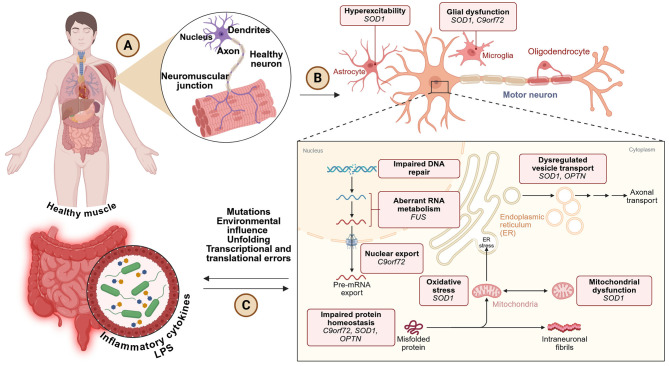
ALS starts in the neuromuscular system, composed of normal neurons and muscle fibers.Progression of the disease includes neuronal hyperexcitability, glial dysfunction, and neurodegeneration of the lower motor neuron generated by several gene mutations (i.e., SOD1, C9orf72, FUS, OPTN).Other contributory causes include defective RNA processing, protein misfolding, mitochondrial dysfunction, ER stress, and inflammation, mostly dependent on environmental and genetic factors, and perhaps gut-derived cytokines. Created with. (A) (B) (C) BioRender.com
2.3.4 The gut microbiome in ALS pathogenesis
Recent studies have shown that the gut microbiome, the community of bacteria living in our digestive system may play an important role in the development and progression of ALS. People with ALS often have an imbalance in their gut bacteria, known as dysbiosis, with fewer helpful bacteria likeprausnitzii and Bifidobacterium, and more potentially harmful ones such asand Dorea species (). This imbalance may speed up the disease in several ways. For example, reduced levels of SCFAs (like butyrate, which is normally made by good bacteria) can weaken the BBB, making the brain more vulnerable to harmful substances. At the same time, increased levels of inflammatory molecules, such as LPS from harmful bacteria, can lead to systemic-wide inflammation (). The gut microbiome also affects the immune system, with ALS patients showing increased Th17 immune cells and higher levels of IL-17, an inflammatory cytokine that may worsen the disease (). Together, these findings support a strong connection between gut health and brain health in ALS. Faecalibacterium E. coli [Brenner et al., 2018] [Obrenovich et al., 2020] [Zang et al., 2023]
2.3.5 Gut microbiota-based therapeutic interventions
2.3.5.1 FMT
There is growing interest in using FMT as a possible treatment for ALS, based on encouraging early research. In one recent case report, an ALS patient showed clinical improvement after receiving FMT, with better scores on the ALS Functional Rating Scale and lower levels of inflammation-related markers like CRP and IL-6 (). It is important to emphasize that evidence from these early reports is limited, and the efficacy and safety of FMT for ALS have not yet been established. Additionally, an ongoing clinical study known as the FETR-ALS trial (a phase II randomized controlled trial) has reported that around 40% of participants experienced a slowing or stabilization of their disease following FMT. Thus far, preliminary clinical observations, mostly from case reports and Phase II studies, seem to indicate that FMT causes changes in gut microbiota composition and inflammatory markers in ALS. However, these are merely early signals, and robust finding regarding efficacy cannot be made until the results of larger randomized controlled trials with determining endpoints come about. Mechanistically, alterations in gut microbial metabolites such as SCFAs could affect the integrity of the BBB, induce systemic endotoxemia, and activate microglia so as to impact disease progression; further studies are required to clarify these pathways. These mechanistic perspectives provide potential explanations for some of the clinical improvements seen and illustrate the various pathways through which FMT might exert its effects on disease processes. Scientists believe that these benefits may be due to several effects of FMT, including the restoration of healthy gut bacteria such as, improved gut barrier function, and reduced brain inflammation by calming overactive microglial cells in the CNS (). Despite these promising early findings, there is insufficient evidence to support the inclusion of FMT in standard ALS treatment. [Yan et al., 2024] [Niccolai et al., 2024] Faecalibacterium prausnitzii
2.3.5.2 Dietary interventions
Nutrition plays a vital role in the care of ALS patients because the disease causes major metabolic challenges. As ALS progresses, over 80% of patients develop difficulty swallowing (dysphagia), and many also experience increased metabolism, which raises their calorie needs by about 15–20% more normal (). Losing more than 10% of body weight is linked to a worse outcome, making early and aggressive nutritional support essential. Experts recommend high-calorie diets (around 35–40 kcal per kilogram of body weight per day), often with a high-fat content, which might offer some protective effects on nerve cells (). Ketogenic diets which are low in carbs and high in fats have shown potential benefits in small studies, possibly by lowering oxidative stress and improving energy use in cells. However, more research is needed. For patients who can't eat enough due to swallowing or breathing problems, a feeding tube (PEG tube) is usually advised while their lung function is still fairly good (when their forced vital capacity is above 50%). Studies suggest that using a PEG tube at the right time may extend life by 3–6 months (). Even with these strategies, it can still be difficult to ensure ALS patients get enough nutrition, especially as their condition worsens and metabolism continues to change. [Dupuis and Chio, 2023] [Guillemin et al., 2022] [Guillemin et al., 2022]
Preclinical models indicate microbiota manipulation could modulate inflammation, but human data are scarce. Interventions targeting microbiota are a prospective avenue for slowing disease progression.
2.4 Multiple sclerosis (MS)
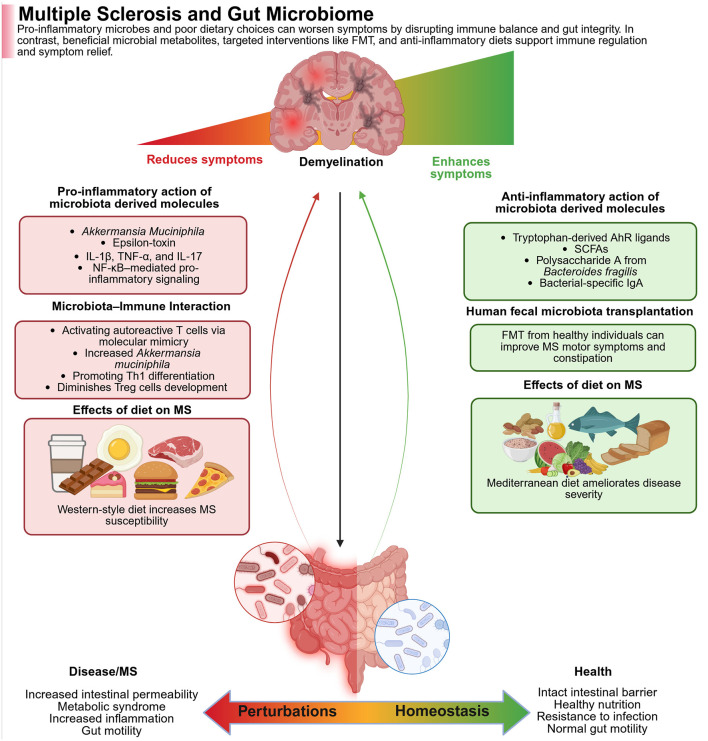
Gut dysbiosis is seen in MS patients as marked by decreased microbial diversity and shifts among specific taxa, like increasedand reduced SCFA-producers (). The changes are rather inconsistent but trend toward correlation with disease activity and relapse risk (). Regulation on the responses of the immune system is the way through which gut microbiota influence MS. It also modulates the permeability of gut which may facilitate neuroinflammation. The approaches of FMT and probiotics are in their early stages; some case reports and preliminary studies indicate promise in reducing inflammation and relapse rates (;). There are clinical trials ongoing to evaluate the efficacy of microbiota-targeted therapies. Evidence supports the role of dysbiosis in MS, particularly on immune regulatory pathways; interventions to restore microbiota are promising but require more definitive trials. Akkermansia [Jangi et al., 2016] [Tremlett et al., 2016] [Borody et al., 2014] [Lavasani et al., 2010]
2.4.1 Background
MS is an autoimmune disease of the CNS, whose hallmark is the demyelination and consequent damage to the demyelinated axons. Demyelination causes a multitude of neurological symptoms, including loss of coordination of movement, ataxia, visual impairments, psychiatric abnormalities such as depression, and cognitive decline (). MS likely results from a combination of genetic and environmental factors (). It is normally diagnosed based on clinical symptomatology complemented by MRI with lesions of various stages, combined with biomarkers of immunologic activity in CSF, namely oligoclonal bands and elevated IgG index (). The experimental autoimmune encephalomyelitis (EAE) animal model of MS has proven the pathogenic function of myelin-reactive T cells in MS pathogenesis (). The triggers of activating self-reactive clones are still to be determined, but may be common infections, molecular mimicry, or inflammation signals from gut microbiota (). Histological evidence has shown that the activated T cells cross the BBB, invade the CNS, and congregate around small venules to trigger localized inflammation (). Over the decades, the EAE model, focused primarily on T cells, has been the model for MS pathogenesis and treatment studies (). Current treatments are largely the primary application of disease-modifying treatments, immunosuppressants, immunomodulators, and immune-reconstitution therapies, in addition to symptomatic treatments such as anticholinergics for urinary incontinence and pain medication for neuropathic pain (). Patient-dependent conditions affecting the effectiveness of treatment or, quite possibly, affecting outcomes through the gut microbiota, however, are still to be established. [Preiningerova et al., 2022] [Preiningerova et al., 2022] [Thompson et al., 2018] [Laaker et al., 2021] [Westall, 2006] [Kuhlmann et al., 2017] [Preiningerova et al., 2022] [Dobson and Giovannoni, 2019]
2.4.2 Dysbiosis of gut microbiota in MS
In patients with MS, it was found that the composition of their microbiota was relatively reduced from that of healthy individuals. Studies are not entirely consistent, but they mostly report an increase in Akkermansiaceae and Methanobacteriaceae, and a decrease in SCFA-producing Bacteroidetes and Clostridia clusters (;;). While EAE models have offered valuable insight into adaptive immune responses, demyelination, and axonal damage in MS, they fall short in replicating the full spectrum of human MS pathology, particularly the disease's onset and heterogeneity (). [Atarashi et al., 2011] [Palm et al., 2015] [Wang et al., 2019] Figure 5
GI symptoms, including anorectal dysfunction such as constipation and fecal incontinence, are commonly reported in MS, affecting approximately 40% of patients (). Additionally,have even reported familial clustering of Inflammatory Bowel Disease (IBD) and MS, suggesting that they have genetic or environmental risk factors in common. In the past few years, several studies have explored the differences in fecal gut microbiota between MS patients and healthy controls, revealing that gut microbial dysbiosis with both depletion and enrichment of certain gut microbiota in MS patients, as shown in. For example,reported increased levels of, and, and reductions in, andin RRMS patients. Whether these changes are a cause or a consequence of the disease remains unclear. Increased levels ofandare increased, whereas those ofdecreased in RRMS patients (). [Nusrat et al., 2012] [Minuk and Lewkonia (1986)] Table 6 [Chen et al. (2016)] [Jangi et al., 2016] Pseudomonas, Mycoplasma, Haemophilus, Blautia Dorea ParaBacteroides, Adlercreutzia Prevotella Methanobrevibacter Akkermansia Butyricimonas
In addition, differences in corresponding changes in expression levels of genes associated with dendritic cell maturation, interferon signaling, and NF-κB signaling pathways in circulating T cells and monocytes have been noted (). The relation between the variation in gut microbiota diversity and relapse risk in children with MS was found with testing by; thus, the depletion ofcorrelated with the relapse risk of pediatric MS. Nevertheless, all those discoveries were performed on gut microbiota obtained from stool samples of MS patients in remission. A recent study has been done on changes in microbiota within small intestinal tissues from MS patients in the active phase. The authors reported an increased Firmicutes/Bacteroidetes ratio andabundance, with a reduction instrains in patients with active MS when compared with healthy controls and patients with MS in remission (). Moreover, the relative presence ofstrains was inversely associated with Th17 cells in the small intestine, while positively related to disease activity (). Although changes in gut microbiota have been reported, it remains uncertain whether these changes are a cause or a consequence of the disease. [Jangi et al., 2016] [Tremlett et al. (2016)] [Cosorich et al., 2017] [Cosorich et al., 2017] Fusobacteria Streptococcus Prevotella Prevotella

The figure shows how gut microbes and diet impact the course of multiple sclerosis (MS). Whereas, pathogenic microbes and a Western diet trigger gut inflammation, both of which are detrimental in MS, while beneficial microbes, anti-inflammatory metabolites, and a MeDi are all gut-healthy and alleviate symptoms. In the left panel (Red—Worse MS), the pro-inflammatory microbes likeand their toxins activate immune pathways (e.g., NF-κB), trigger autoimmune responses, and damage gut integrity. Poor diet further increases inflammation and disease risk. In the right panel (Green—alleviation of MS), the beneficial metabolites (e.g., SCFAs, tryptophan ligands), as well as polysaccharides from, activate the immune system. Fecal transplants combined with healthy diets reduce inflammation, improve gut barrier function, and ease MS symptoms. Created with. Akkermansia muciniphila Bacteroides fragilis BioRender.com
| Sample size | Sample sources | Changes of gut microbiota | Associated functions and pathways | References |
|---|---|---|---|---|
| MS group:= 31; HC group:= 36nn | Stool samples from RRMS patients (active/remission) vs. HCs | ↑Pseudomonas, ↑Pedobacter, ↑Blautia, ↑Dorea, ↑Mycoplana, ↓Adlercreutzia, ↓Collinsella, ↓Lactobacillus, ↓ParaBacteroides | Signal transduction Lipid transport and metabolism Immune defense mechanisms Fatty acid biosynthesis Membrane transport systems | [Chen et al., 2016] |
| MS group:= 60; HC group:= 43nn | Stool samples from RRMS patients (remission) vs. HCs | ↑Methanobrevibacter, ↑Akkermansia, ↓Butyricimonas | Inflammatory cells recruitment Barrier function disruption | [Jangi et al., 2016] |
| MS group:= 7; HC group:= 8nn | Stool samples from RRMS patients (remission) vs. HCs | Moraxellaceae↑Akkermansia, ↑Faecalibacterium, ↑Coprococcus, ↓ | Not addressed | [Cantarel et al., 2015] |
| MS group:= 20; HC group:= 40nn | Stool samples from RRMS patients (remission) vs. HCs | ↑Bifidobacterium, ↑Streptococcus, ↓Bacteroides, ↓Faecalibacterium, ↓Prevotella, ↓Anaerostipes | Systemic inflammation | [Miyake et al., 2015] |
| MS group:= 19; HC group:= 17nn | Small intestinal mucosa from active RRMS vs. HCs and inactive MS | ↑FirmicutesBacteroidetes/ratio, ↑Streptococcus, ↓Prevotella | Differentiation and an increase in the Th17 cell population | [Cosorich et al., 2017] |
| MS group:= 71; HC group:= 71nn | Stool samples from RRMS patients (remission) vs. HCs | ↑Acinetobacter, ↑Akkermansia, ↓ParaBacteroides | The differentiation of Treg cells and Th1 cells | [Cekanaviciute et al., 2017] |
2.4.3 Treatment strategies
2.4.3.1 Probiotics
Synergistic therapeutic effects may be exerted by the different strains in probiotic cocktails; therefore, three strains of, each shown alone to have a protective effect against the development of EAE when administered before disease onset, were shown to inhibit established disease when administered as a therapeutic mixture. In MS patients, administering a mixture of probiotics (enriched with, and) switched the peripheral immune response to an anti-inflammatory one and reversed the microbiota composition changes associated with MS (). In this short-term study, it was not assessed whether these changes were associated with clinical improvement; however, data from randomized double-blind placebo-controlled clinical trials lasting 3–4 months with a similar probiotic mixture (and) suggest that a daily probiotic may improve clinical symptoms in MS (). Lactobacillus Lactobacillus, Streptococcus Bifidobacterium Lactobacilli Bifidobacteria [Lavasani et al., 2010] [Tankou et al., 2018b]
Despite some studies suggesting a positive impact of probiotics, recent meta-analyses on EAE have been quite disappointing (). One of the outcomes observed from meta-analysis prescribed administration of probiotics to be associated with a considerable decline in risk of mortality, although this observation holds only for female animals. Furthermore, the meta-analysis confirmed promising effects of probiotics on the prevention as well as management of EAE (lower incidence, delayed expression of symptoms, and less severe symptoms). Usingbacteria rendered the most hopeful results. Hence, the authors are concluding that it's worth it to conduct trials in humans (). A recent meta-analysis in relapsing-remitting MS patients stated four trials that included 213 patients (106 under intervention) and summarized that there was improvement in disability and depression, as well as general health in patients to whom probiotics were administered (). Such results should be interpreted with caution. Another study of nine MS patients reveals some correlation with microbiome composition changes and an inflammatory cytokine shift in the blood during the weeks of treatment via probiotics (). [Valizadeh et al., 2021] [Valizadeh et al., 2021] [Mirashrafi et al., 2021] [Tankou et al., 2018a] Enterococci
2.4.3.2 Antibiotics
According to observations, a combination of broad-spectrum antibiotics inhibited the development of EAE and altered the clinical course during the progressive phase of EAE (;). Human trials showed that in people with high-risk features, treatment with minocycline reduced in 6 months the risk of conversion to MS, decreased lesion volume, and showed the absence of new enhancing lesions, but this effect did not last beyond 24 months of study (). In SJL mice with EAE, a 7-day oral antibiotic regimen (ampicillin, vancomycin, neomycin, metronidazole) before disease induction led to amelioration of the disease through an accumulation of Tregs in the peripheral lymph nodes (). Antibiotic mixture administered in NOD/ShiLt mice pre-EAE improved the disease course, correlated with enhanced Tregs and altered gut microbiota in Peyer's patches (). Following this pattern, TMEV-infected SJL/J mice treated orally with this same antibiotic mixture showed protection against motor dysfunction, axonal damage, and CNS immune infiltration, likely through enhanced CD4CD39T cells, CD5CD1dB cells, and downregulated IL-17 in the periphery (). [Ochoa-Repáraz et al., 2009] [Colpitts et al., 2017] [Preiningerova et al., 2022] [Ochoa-Repáraz et al., 2009] [Colpitts et al., 2017] [Mestre et al., 2019] + + + +
2.4.3.3 FMT
The striking effects of FMT in MS patients have always found their way into case reports in scientific literature. One fortunate report is that of 3 patients diagnosed with MS who were dependent on wheelchairs yet improved neurologically after FMT for constipation to the point that they could walk without assistance (;). Rebuilding the gut microbiota represents an exciting new approach to the management of MS, but it will need well-constructed controlled studies to be scientifically validated. FMT in animal models has been found to reduce the abundance of thegenus (in phylum Verrucomicrobia) and increase the abundance of thegenus (in phylum Bacteroidetes) in gut microbiota (), which is in line with findings of decreased gutafter probiotic interventions and increased gutafter first-line disease-modifying treatments and time-restricted eating in MS patients (;). An in-depth investigation including metagenomics in a single MS patient following FMT not only showed altered composition of gut microbiome with a highly sustained production of SCFAs, improved gait, and no relapse during a year of follow up, but also showed a sustained increase in serum levels of BDNF known to be low in MS (). [Borody et al., 2014] [Vendrik et al., 2020] [Tankou et al., 2018b] [Jangi et al., 2016] [Barati et al., 2023] [Engen et al., 2020] Akkermansia Prevotella Akkermansia Prevotella
A recent proof-of-concept single-subject longitudinal study investigating the putative impact of FMT on relapsing-remitting MS was conducted. The patient underwent FMT infusion with material from five healthy donors and was followed for 12 months for clinical assessments, detailed descriptions of fecal microbiome composition, fecal SCFA concentration measures, and serum levels of inflammatory and neuroprotective biomarkers (). The treatment given to this patient resulted in an improved microbiome with an increase in bacterial diversity, partly due to an increase in the relative abundance of butyrate-producing bacterial species, which were paralleled by an increase in butyrate concentration, an anti-inflammatory SCFA (). The microbiota-altered state correlated with lower levels of inflammatory cytokines associated with increased serum levels of the neuroprotective factor, brain-derived growth factor. The patient improved clinically in gait, and throughout the study, improvements were seen in walking and balancing metrics. However, it is important to note that these findings are preliminary, and the evidence supporting FMT as a treatment for MS remains limited. In like fashion, a case report suggested that FMT treatment of a patient with secondary progressive MS forenterocolitis correlated with disease stabilization (). More rigorous, controlled trials are needed to confirm the potential benefits and safety of FMT as a strategy for MS. These observations call for renewed clinical efforts to investigate the merits of restoring the microbiota through FMT as a complementary strategy to MS treatment, and clinical trials are ongoing. [Engen et al., 2020] [Engen et al., 2020] [Makkawi et al., 2018] Clostridium difficile
While detailed human studies are limited, MS involves gut dysbiosis that influences immune regulation, with preclinical data suggesting certain bacterial taxa may modulate neuroinflammatory responses. Microbiome-targeted interventions like probiotics and diet have shown potential to modulate immune activity and may reduce disease activity, though more robust clinical evidence is needed.
3 Mood and anxiety disorders
3.1 Major depressive disorder (MDD)
The microbiota of patients suffering from MDD represents much less diversity and altered abundances of taxonomies involved in neurotransmitter synthesis and immune modulation, both mainly consistent in terms of pointing toward dysbiosis (;). The GBA effects its influence on depression through neuroinflammatory pathways alteration of neurotransmitter precursors and the secondary dysregulation of HPA axis. Probiotics have been used in connection with dietary interventions leading to improvements in mood and inflammation in human trials (). Even though the application of FMT remains experimental, some studies show small benefits toward lowering depressive symptoms (). Studies continue to accumulate evidence that correlate microbiome alterations with depression, promising microbiota-based approaches pending further validation. [Barandouzi et al., 2020] [Valles-Colomer et al., 2019] [Kazemi et al., 2019] [Green et al., 2023]
3.1.1 Background
MDD is characterized by constant depressed mood, anhedonia, altered sleep and appetite, fatigue, guilt, hopelessness, and suicidal tendencies (). Over the years, a rising trend has been seen in the prevalence of depression since the time of observation (). In 2018, MDD disease burden ranked third in the world according to the WHO, and by 2030, it is supposed to rise to the first (). A psychiatric disorder is formed due to the complex interplay of environmental factors and genetic vulnerability (). The risks of developing several physical comorbidities like cardiovascular diseases, stroke, diabetes, and obesity along with social stigma are quite higher for MDD persons (). Some of these revolve around education, work, and relationships (). In case antidepressants are used in conjunction with psychotherapy, some patients can get better. Unfortunately, not all respond to treatment. As many as 30–50% of depressed patients respond only partially to antidepressants, leaving them with substantial residual symptoms (). Additionally, 10–30% of patients of those who are resistant to the effects of antidepressants and thus non-responders to treatment. Differences in treatment response may be indicative of differences in etiologies and mechanisms, like neuroinflammation, changes in the neuroendocrine system, or alterations in the gut microbiome (). This greatly simplifies a complex process, but a map of the human microbiome may offer new opportunities for tracking therapeutic responses in depression. [Arnaud et al., 2022] [Cui et al., 2024] [Malhi and Mann, 2018] [Souza et al., 2023] [Penninx et al., 2013] [Campbell et al., 2022] [Davis et al., 2021] [Mousten et al., 2022]
Another study showed that both psychosocial as well as physical stressors influence the body's response through the HPA axis (). The HPA axis initiates a response in times of stress, stopping the activity through negative feedback, engaging the hippocampus and the paraventricular nucleus of the hypothalamus. A properly perceived stress situation calls for a rapid and vigorous response, along with a timely cessation of that response (). Dysfunction of the HPA axis is common in individuals with MDD and is capable of activating the axis that would alter gut microbiota and increase gut permeability (). [Godoy et al., 2018] [McEwen and Akil, 2020] [De Punder and Pruimboom, 2015]
MDD is also marked by systemic inflammation with high cytokines IL-6, TNF-α, and IL-1β (). The increased level of inflammatory cytokines is perhaps a result of dysbiosis of the gut microbiota, which may further weaken the integrity of the gut barrier. These stimuli will also stimulate brain microglia and trigger the NLRP3 inflammasome to release IL-1β and IL-18 (). The released mediators would also support neuroinflammation. Inflammation also shifts tryptophan metabolism away from serotonin to neurotoxic kynurenine pathway metabolites, like quinolinic acid, and disturbs neurotransmission and thus plays a role in depressive symptoms (;). Major depression is treated by various pharmacological and non-pharmacological interventions. Exercise and lifestyle modification exert substantial antidepressant effects, especially for mild MDD (). Therefore, modulation of gut microbiota mechanisms might be the key to symptom relief of MDD. [Troubat et al., 2021] [Troubat et al., 2021] [Chen et al., 2021] [Liang et al., 2024] [Marx et al., 2023]
3.1.2 Microbiota dysbiosis and depressive behaviors
andproduce serotonin, whileandsynthesize GABA (). Microbes likeandalso produce acetate, butyrate, and propionate, which are known to affect the immune, endocrine, and nervous systems (). Gut SCFAs promote serotonin synthesis in the gut and further communicate with the brain via the vagus nerve. Although SCFAs can cross the BBB, serotonin and GABA generally do not, unless barrier integrity is compromised, as seen in stress and depression models (). A translation from gut microbiota research to clinical settings is undermined by the complexity surrounding individual microbial profiles (). Investigative efforts so far concerning enterotypes, such as alpha diversity, the Firmicutes-to-Bacteroidetes ratio, aim at the identification of an MDD-specific fecal signature (). Reduced Firmicutes proportion in MDD patients, as a suggestion for the establishment of an MDD biomarker, was reported by. This, however, was followed by systematic reviews showing inconsistent results and hence raised questions on replicability (). Most studies have shown that the GM of MDD patients differs from that of controls at the phylum, class, order, family, and genus levels, but with a particular emphasis on differences at the phylum, family, and genus levels (). Escherichia Enterococcus Bifidobacterium Lactobacillus Coprococcus Faecalibacterium [Socała et al., 2021] [Valles-Colomer et al., 2019] [Margolis et al., 2021] [Galland, 2014] [Valles-Colomer et al., 2019] [Jiang et al. (2015)] [Barandouzi et al., 2020] Table 7
Higher relative abundance of proinflammatory bacteria likewas found to be increased, and decreased relative abundance ofin the subjects with MDD (). Similarly, patients with MDD also had decreased relative abundance of the generaandcompared to non-depressed individuals in a meta-analysis by. The meta-analytical study shows decreased abundance in the MDD patients when compared to controls in the bacterial families Veillonellaceae, Prevotellaceae, and Sutterellaceae, genera, and shows an increase in abundance in Actinomycetaceae family andgenus (). Interestingly,served as a primary butyrate-producing bacterium in the gut, being crucial for gut homeostasis and possibly alleviating depressive symptoms at least in animal models (). Eggerthella, Atopobium Faecalibacterium Coprococcus Faecalibacterium Coprococcus, Faecalibacterium, Ruminococcus, Bifidobacterium, Escherichia Paraprevotella Faecalibacterium [Knudsen et al., 2021] [Sanada et al. (2020)] [Sanada et al., 2020] [Stilling et al., 2016]
| Sample | Age | Phylum | Family | Genus | References |
|---|---|---|---|---|---|
| MDD (= 63)HC (= 30)NN | MDD: 28 years,HC: 29 years | Actinobacteria↑ | Bifidobacteriaceae↑, Lactobacillaceae↓ | Agathobacter↑, Bifidobacterium↑, Blautia↑ | [Dong et al., 2022] |
| MDD (= 43)HC (= 47)NN | MDD: 21 years,HC: 22 years | Bacteroidetes↑, Firmicutes↓ | Ruminococcaceae↓ | Flavonifractor↑, Ruminococcus↓, Faecalibacterium↓ | [Liu R. T. et al., 2020] |
| MDD (= 62)HC (= 46)NN | MDD: 39 years,HC: 36 years | Bacteroidetes↑, Proteobaeteria↑, Fusobacteria↑, Firmicutes↓, Actinobacteria↓ | Rikenellaceae↑, Porphyromonadaceae↑, Oscillospiraceae↑, Corynebacteriaceae↑, Ruminococcaceae↓, Lachnospiraceae↓, Eubacteriaceae↓, Lactobacillaceae↓ | Eggerthella↑, Streptococcus↑, Oscillibacter↑, Bacteroides↓ | [Chen et al., 2021] |
| MDD (= 36)HC (= 37)NN | MDD: 45 years,HC: 41 years | Actinobacteria↑, Firmicutes↑, Bacteroidetes↓ | Bifidobacteriaceae↑, Lachnospiraceae↑, Prevotellaceae↓ | Bifidobacterium↑, Blautia↑, Eggerthella↑, ParaBacteroides↑, Streptococcus↑, Prevotella↓ | [Chung et al., 2019] |
| MDD (= 27)HC (N =27)N | MDD: 48 years,HC: 42 years | Firmicutes↓ | Lachnospiraceae↓, Ruminococcaceae↓ | Prevotella↓, Faecalibacterium↓ | [Huang et al., 2018] |
| MDD (= 37)HC (= 18)NN | MDD: 42 years,HC 46 years | Bacteroidetes↓ | Lachnospiraceae↓ | ↑Alistipes↑, Oscillibactergenus | [Naseribafrouei et al., 2014] |
3.1.3 Gut microbiota-based therapeutic interventions
3.1.3.1 Probiotics
A double-blind study showed the results ofHN001 from mid-pregnancy to 6 months postpartum, which decreased the signs of postpartum depression and anxiety symptoms (). They saw improved psycho-emotional scoring in patients receiving a probiotic as compared to those on placebo. However, clinically significant anxiety seemed to have been reduced; the findings, however, were not statistically conclusive for the effects of this clinical trial on the incidence of postpartum depression (). In an 8-week open-label trial, a group of researchers evaluated the effect ofMIYAIRI 588 (CBM588) in patients with treatment-resistant MMD in an open-label study (). Improvements were seen in clinician—and self-rate measures of depression and anxiety. It was well-tolerated, with only mild and short-lived effects being reported. The findings imply that there could be possible therapeutic benefits from CBM588, although confirmation is needed from larger, placebo-controlled trials (). Lactobacillus rhamnosus Clostridium butyricum [Slykerman et al., 2017] [Slykerman et al., 2017] [Miyaoka et al., 2018] [Miyaoka et al., 2018]
According to, increased BDNF levels, greater populations of butyrate-producing bacteria, and modulation of the HPA-axis were noticed in mice administered thesubspeciesstrain CCFM687 and developing depressive-like behavior as a consequence of stress. In fact, treatment with the bacteriumdiminished the inducement of a depression-like behavior caused by chronic stress, where the regulation of this metabolic profile stands on such variables as acute corticosterone, dopamine, and BDNF (). During another clinical trial, a probiotic/magnesium spirulina complex with, andwas used with an adjunctive effect on current SSRIs for drug-resistant MDD patients. Overall, remarkable improvements in depressive symptoms and quality of life were observed; unfortunately, when the supplemental probiotics were taken away, relapsed into depression followed (). Those findings suggest that probiotics also may provide a further powerful adjunctive agent in improving resistance to antidepressant drugs and in averting the recurrence of depression, besides improving depressive symptoms through multiple means. [Tian et al. (2019b)] [Ding et al., 2021] [Bambling et al., 2017] Bifidobacterium longum infantis Akkermansia muciniphila Lactobacillus acidophilus, Bifidobacterium bifidum Streptococcus thermophilus
3.1.3.2 Prebiotics
Among the long-term supplementation with prebiotics, FOS, GOS, or their combination, promising results appear in demonstrating significant antidepressant and anxiolytic activities in mice (). Indeed, these behavioral improvements are clear indicators of gut microbiota modulation in whichmay increase along with beneficial SCFAs such as acetate and propionate, and the decrease of isobutyrate and stable n-butyrate levels in the gut. The most prominent effects of this combination, FOS+GOS, include diminished baseline and stress-induced corticosterone and a decrease in splenic IL-6 and TNF-α levels under chronic stress (). Evidencing changes indicate the possibility of prebiotics having neuroprotective, stress-buffering effects through the modulation of the MGBA by restoring microbial homeostasis, changing neuroendocrine responses, or affecting gene expression in stress-related brain regions (). [Burokas et al., 2017] [Burokas et al., 2017] [Burokas et al., 2017] Akkermansia
3.1.3.3 FMT
According to, the clinical trial with oral administration of FMT capsules in depressed irritable bowel syndrome (IBS) patients enhanced bacterial alpha diversity and increased the abundance of bacterial communities predominantlyand, as well as an attestation to significant improvement in depressive symptoms. [Doll et al. (2022)] Bacteroides immitis Bacteroides thicketi
A pilot 8-week double-blind trial delved into the feasibility and safety of FMT in adults with moderate to severe MDD (). Participants were assigned to active or placebo groups receiving enemas prepared with donor stool and saline. No serious adverse events were reported, and mild-to-moderate effects occurred similarly across groups. An effective blinding procedure was utilized. Initial outcomes improve GI symptoms along with possible improvements in quality of life (). These findings point toward the possibility of providing FMT as an acceptable intervention requiring further investigation in larger controlled trials. However, FMT's mechanism of action in psychiatric disorders remains uncertain, donor screening and long-term safety require further clarification, and at present, no recommendations can be made for its routine use outside of clinical research. [Green et al., 2023] [Green et al., 2023]
Animal studies show that probiotics can reduce depressive-like behaviors through anti-inflammatory pathways. Human trials with psychobiotics demonstrate improvements in mood and stress markers, supporting microbiota modulation as a promising adjunct therapy.
3.2 Bipolar disorder (BD)
Research has shown that people suffering from BD have an altered gut microbiome with much reduced amounts of useful organisms, such as, and increased amounts of potentially harmful taxa, such as Actinobacteria, which is featured as one of the alterations (). More relevant, microbiota profiles are related to the illness phase, severity of the condition, and with some inflammatory markers such as IL-6; this means that the changes in microbiota shifts may affect neuroinflammatory pathways that are involved in mood regulation. While these associations are robust, interventional evidence remains preliminary, mainly from small-scale probiotic or dietary modification studies. Faecalibacterium [Painold et al., 2019]
3.2.1 Background
BD is a chronic psychiatric condition characterized by alternating episodes of depression and elevated mood states, which may manifest as mania or hypomania. These episodes often alternate with periods of euthymia but can also occur in rapid succession or with mixed features. The disorder is classified into two main subtypes: bipolar I disorder (BP-I), defined by the presence of at least one full manic episode, and bipolar II disorder (BP-II), characterized by hypomanic episodes without progression to full mania (). Longitudinal studies highlight the persistent and fluctuating nature of BD. Research indicates that individuals with BP-I remain symptomatic for nearly half of their illness course, with depressive symptoms being the most frequent and persistent, significantly outweighing manic/hypomanic and mixed episodes (). Subsyndromal symptoms are more prevalent than full-threshold episodes, while psychotic features occur infrequently and primarily during manic states. The illness trajectory is highly variable, marked by frequent shifts in symptom polarity, underscoring the chronic and recurrent nature of BD (). Epidemiological data further demonstrate that over 90% of individuals with BD experience recurrent episodes, which contribute to progressive neurobiological changes, cognitive decline, and increased medical and psychiatric comorbidities (). Manic episodes are defined by at least 1 week of persistently elevated, expansive, or irritable mood accompanied by increased activity or energy, whereas hypomanic episodes present similar features without marked functional impairment or hospitalization. The presence of psychotic features necessitates classification as mania. The global burden of BD is substantial. The World Mental Health (WMH) survey, using the WHO Composite International Diagnostic Interview (CIDI 3.0), identified BD as one of the most disabling psychiatric conditions, with affected individuals averaging 41.2 days of role impairment per year 36.5 of which were directly attributed to BD (). These findings emphasize the critical need for early intervention, personalized treatment strategies, and ongoing research into the disorder's pathophysiology and long-term management (;). [Grande et al., 2016] [Nierenberg et al., 2023] [Grande et al., 2016] [Nierenberg et al., 2023] [Alonso et al., 2011] [Grande et al., 2016] [Nierenberg et al., 2023]
3.2.2 Gut microbiota alterations in BD
Biologically, people with BD, especially those who haven't started treatment, show noticeable changes in their gut microbiome. A study byfound that these untreated patients had significantly less diverse gut bacteria (lower α-diversity) compared to healthy individuals. They also had unique bacterial compositions (). These changes were found not only in untreated individuals but also in those who were being treated with the medication quetiapine. The study also looked closely at quetiapine, which was used to treat depressive episodes in BD. It was given on its own (monotherapy) at a dose of 200–300 mg daily for 4 weeks. All participants were confirmed to be experiencing a depressive episode using structured psychiatric interviews and rating scales like the HDRS-17 and MADRS. After treatment, there was a clear improvement in symptoms. Although quetiapine is not directly labeled as an antipsychotic in this study, the effects it had both metabolically and on gut bacteria are consistent with what is known about that class of drugs. Importantly, the study only explored quetiapine's use in bipolar depression and did not extend its findings to other mental health conditions (). [Hu et al. (2019)] [Hu et al., 2019] [Hu et al., 2019]
On the genetic side, research byshowed that BP-II may be genetically different from BP-I and unipolar depression. In their family-based study, relatives of people with BP-II had a higher risk of also having BP-II, suggesting it tends to run specifically in families (). In contrast, less severe mood disorders did not show this familial pattern, supporting the idea that BP-II is a distinct and genetically separate condition. Moreover, the pilot study byobserved that patients with BD had lower gut microbial α-diversity compared to healthy individuals, indicating a less varied gut microbiome. They also found a higher presence ofbacteria in BD patients, with Collinsella specifically enriched in individuals with BD-II compared to those with BD-I, suggesting that different BD subtypes may have distinct microbiome patterns (). However, due to the study's small sample size and lack of consistent grouping based on diagnosis or diet, the results need further investigation. Similarly,reported notable changes in gut microbiota among BD patients. They found that microbial α-diversity decreased as the duration of illness increased, meaning that the variety of gut bacteria reduced over time in individuals with BD (). Compared to healthy controls, BD patients had higher levels of Actinobacteria and, while healthy individuals had moreand, which are generally considered beneficial. Among BD patients with elevated levels of the inflammatory marker IL-6, there were increases inand, suggesting a connection between inflammation and gut microbiota changes. The study also linked specific bacterial groups to metabolic issues in BD. For instance,were more abundant in patients with high cholesterol, andwas associated with markers of oxidative stress. Additionally, more severe depressive symptoms were correlated with an increased presence of, while comparatively healthier BD patients had moreand. These findings support the relevance of MGBA mechanisms in BD pathophysiology, implicating both immune and metabolic pathways as shown in, and are conceptually illustrated through the microbiota–immune–metabolic–brain axis model (;). [Heun and Maier (1993)] [Heun and Maier, 1993] [McIntyre et al. (2021)] [McIntyre et al., 2021] [Painold et al. (2019)] [Painold et al., 2019] Table 8 Figure 6 [Painold et al., 2019] Clostridiaceae Coriobacteria Ruminococcaceae Faecalibacterium Lactobacillales Streptococcaceae Clostridiaceae Eubacterium Enterobacteriaceae Clostridiaceae Roseburia

This schematic illustrates the microbiota–immune–metabolic–brain axis in BD. Gut dysbiosis, characterized by reduced microbial α-diversity and increased Clostridiaceae, is associated with immune activation. Elevated pro-inflammatory cytokines, particularly IL-6 and TNF-α, contribute to neuroinflammation, which is implicated in mood symptoms such as depression and mania. IL-6 also drives metabolic disturbances, including increased cholesterol and oxidative stress. These metabolic changes may, in turn, influence gut microbial composition, suggesting a bidirectional feedback loop. Together, these pathways highlight the integrated role of the gut–immune–metabolic axis in BD pathophysiology. Created with. BioRender.com
| Study | Observation | Microbial taxa | Implication |
|---|---|---|---|
| [McIntyre et al. (2021)] | ↓Alpha-diversity in BD vs. healthy controls | – | Indicates reduced microbial diversity in BD |
| ↑Abundance in BD (overall) | Clostridiaceae | Potential microbial signature of BD | |
| ↑Abundance in BD-II vs. BD-I | Collinsella | Suggests subtype-specific microbiome differences | |
| [Painold et al. (2019)] | ↓Alpha-diversity with increasing illness duration | – | Suggests progressive gut dysbiosis in BD |
| ↑Abundance in BD | Actinobacteria | Reflects altered gut microbial composition | |
| ↑Abundance in BD | Coriobacteria | Reflects altered gut microbial composition | |
| ↑Abundance in healthy controls | Ruminococcaceae | Indicates reduction of beneficial taxa in BD | |
| ↑Abundance in healthy controls | Faecalibacterium | Indicates reduction of beneficial taxa in BD | |
| ↑In BD with elevated IL-6 | Lactobacillales | Suggests link between microbiota changes and inflammation | |
| ↑In BD with elevated IL-6 | Streptococcaceae | Suggests link between microbiota changes and inflammation | |
| ↑In BD with high cholesterol | Clostridiaceae | Associated with metabolic disturbance in BD | |
| ↑In BD with oxidative stress markers | Eubacterium | Associated with oxidative stress in BD | |
| ↑In BD with depressive symptoms | Enterobacteriaceae | Linked to greater symptom severity | |
| ↑In comparatively healthier BD patients | Clostridiaceae, Roseburia | May reflect relative microbial resilience |
3.2.3 Microbial markers and therapeutic correlates
A cross-sectional study has found that taking atypical antipsychotics (AAPs) led to an increase in a group of gut bacteria calledand a decrease in Akkermansia, which is often linked to gut health (). While there was also an initial drop in Sutterella, this result was no longer significant after adjusting for age, body mass index (BMI), and gender. AAP use was also linked to a general decrease in gut microbial diversity, especially in women. In a related finding, A related study reported that people with BD had lower levels of, a beneficial bacterium known for producing butyrate a short-chain fatty acid important for gut health. Higher levels of this bacterium were associated with better physical wellbeing, mood, sleep quality, and lower anxiety (). Moreover, another study also highlighted the important role ofin producing butyrate (). Independently,tested the effects of small amounts of prebiotic fibers like indigestible dextrin, α-cyclodextrin, and dextran using a lab-based colon model and a small human trial. They found that these supplements increased the production of beneficial SCFAs like acetate and propionate without changing the overall diversity or makeup of gut bacteria. This suggests that low-dose prebiotics can boost gut health without disrupting the balance of the microbiome. Another study found that patients hospitalized for acute mania were 5.5 times more likely to have used systemic antibiotics in the preceding 3 days than controls (). This association suggests that bacterial infections, as evidenced by antibiotic use, may contribute to manic episodes through immune activation, highlighting infection prevention and treatment as potential targets. Complementary findings demonstrated that systemic immune activation via LPS in mice produced sustained reductions in novel object exploration for up to 24 h (). These effects were independent of acute sickness and linked to impaired cognition and motivation, particularly continuous attention and curiosity, through prolonged central amygdala activation. Although not directly tied to BD prevention, the study illustrates how transient inflammation may result in lasting behavioral changes. Lachnospiraceae Faecalibacterium Faecalibacterium [Flowers et al., 2017] [Evans et al., 2017] [Tanca et al., 2017] [Sasaki et al. (2018)] [Yolken et al., 2016] [Haba et al., 2012]
3.2.4 Developmental and drug-induced microbiome disruption
Disruptions to the gut microbiome during early development or the initial phases of psychiatric illness may influence the trajectory of mental disorders () reported that early-life antibiotic exposure is linked to modestly increased risks for several childhood psychiatric disorders, including mood disorders, suggesting sensitive developmental windows for microbiome perturbations (). In first-episode psychosis,identified a distinct microbial signature with elevatedand decreased, correlating with greater symptom severity and poorer 12-month remission. These findings support the use of microbiome-targeted interventions early in life or illness to potentially mitigate progression of severe psychiatric conditions. Changes in the gut microbiome caused by antipsychotic medications particularly risperidone have been linked to weight gain and metabolic effects. In children receiving long-term risperidone, the ratio of Bacteroidetes to Firmicutes (two major bacterial groups in the gut) dropped significantly from 1.24 in psychiatric controls to just 0.20 in those who gained a lot of weight. This shift came with an increase in certain Firmicutes bacteria, especiallyspecies and. On the other hand, children whose weight stayed stable had higher levels of Collinsella aerofaciens (). Supporting this,found that risperidone causes weight gain not only by affecting appetite but also by altering the gut microbiome in ways that reduce the body's ability to burn energy. In mice, risperidone treatment led to gut bacterial changes similar to those seen in obesity more Firmicutes, fewer Bacteroidetes and a 16% drop in resting energy expenditure, especially from anaerobic (non-oxygen-requiring) metabolism. Remarkably, this effect was transferable: when gut microbes or even just viral particles (phages) from risperidone-treated mice were transplanted into healthy mice, the recipients also experienced slower metabolism and weight gain. This suggests that risperidone's metabolic side effects are largely driven by changes in gut microbes, opening up the possibility of targeting the microbiome to prevent or reduce weight gain in patients taking this medication. [Lavebratt et al., 2019] [Lavebratt et al., 2019] [Schwarz et al. (2018)] [Bahr et al., 2015] [Bahr et al. (2015)] Lactobacillus Veillonellaceae Clostridium Erysipelotrichaceae
3.2.5 Gut microbiota-based therapeutic interventions
3.2.5.1 Probiotics
In a randomized trial,randomized 66 patients following hospitalization for acute mania to receive 24 weeks of adjunct treatment withGG plussubsp.Bb12 or placebo after discharge from hospital for acute mania. Fewer rehospitalizations for psychiatric illness over the balance of the year were reported by the probiotic group than were reported by the placebo group, as well as a longer time elapsed before rehospitalization. This protective benefit was strongest among participants whose baseline systemic inflammation was at or above the fiftieth percentile. In sharp contrast,carried out an 8-week double-blind trial in which patients were administered a multi-strain probiotic () with a diagnosis of bipolar I disorder and no significant differences on mania or depression rating scales were found, emphasizing that pinpointing strains and duration for treatments needs refinement. As a whole, these studies underpin further inquiry into the use of probiotic strategies as preventative and adjunctive dependent modalities for bipolar disorder, whereas further studies in humans are required to ascertain efficacy and achieve protocol optimization. [Dickerson et al. (2018)] [Eslami Shahrbabaki et al. (2020)] Lactobacillus rhamnosus Bifidobacterium animalis lactis B. bifidum, B. lactis, B. longum, L. acidophilus
3.2.5.2 Prebiotics
According to a preclinical study,, on whether the prebiotic (B-GOS) could ameliorate olanzapine-evoked weight gain while sustaining the antispychotic effects of the drug, B-GOSwas found to prevent the typical olanzapine-induced weight gain in female rats. The specific metabolic benefit appears to result from gut bacteria modifications, increased Bifidobacterium and decreased Firmicutes species. B-GOSalone raised blood acetate levels (a short-chain fatty acid), but when it was combined with olanzapine, acetate levels returned to normal, while fat tissue metabolism improved through restored GPR43 receptor expression. Besides, B-GOSsupplementations elevated NMDA receptor components (GluN1 protein and GluN2A mRNA) of the brain essential for cognitive functions besides raising the inflammatory marker TNFα in combination with olanzapine as a factor toward weight gain reduction. B-GOSdid not, however, compromise the main olanzapine antipsychotic mechanism, which is mediated through blockage of serotonin 5-HT2A receptors. The results seem to show that B-GOSmay be an effective adjunct treatment aimed at preventing metabolic side effects of antipsychotics; however, the precise role attributed to acetate in this regard still remains to be clarified. [Kao et al. (2018)] ® ® ® ® ® ®
Limited but emerging evidence suggests gut microbiota alterations in BD may affect immune and neuroinflammatory pathways influencing mood swings. Preliminary human studies associate specific microbial signatures with mood states, and probiotic interventions are under investigation for mood stabilization by reducing systemic inflammation.
3.3 Anxiety disorders
Gut microbiota alterations in anxiety disorders are increasingly evident in human studies, with beta-diversity consistently shifted, while alpha-diversity and taxa level changes remain heterogeneous across disorder subtypes and sex (;;). Preclinical models converge on immune–inflammatory signaling, HPA axis dysregulation and neurotransmitter alterations as recurrent mechanistic pathways (;;), with probiotic and prebiotic supplementation showing anxiolytic effects in randomized controlled trials via MGBA modulation (;). [Jiang et al., 2018] [Butler et al., 2023] [Kim et al., 2023] [Ravi et al., 2021] [Jia et al., 2024] [Tyagi et al., 2025] [Johnstone et al., 2021] [Zhu R. et al., 2023]
3.3.1 Background
Anxiety disorders represent a group of persistent neuropsychiatric conditions affecting approximately 4.05% of the global population, with prevalence rising by over 55% since 1990 (). Despite the widespread use of serotonergic medications, benzodiazepines and cognitive behavioral therapy (CBT), therapeutic outcomes remain limited with less than 50% of patients reaching full remission and nearly one-third do not respond to conventional treatments (). Clinically, anxiety disorders encompass disorders such as generalized anxiety disorder (GAD), panic disorder, specific phobias, and social anxiety disorder (SAD), all marked by fear responses, behavioral avoidance, and heightened nervous arousal in perceived threatening situations (). Yet, symptomatology is highly variable across individuals, shaped by underlying neurobiological factors. Evidence suggests a widely distributed neural circuit underpinning anxiety disorders, involving interconnected regions such as the amygdala, hippocampus, bed nucleus of the stria terminalis, insula, hypothalamus, anterior cingulate cortex and prefrontal cortex (). Not all individuals exposed to stress or adversity go on to develop anxiety disorders (). Vulnerability factors include early life trauma, poor social support, co-existing medical conditions, genetic predisposition and sex-based differences (). [Javaid et al., 2023] [De Vries et al., 2016] [Wu et al., 2025] [Drzewiecki and Fox, 2024] [Charney, 2003] [Lai and Xiong, 2025]
Women are nearly twice as likely to develop anxiety disorders, potentially due to enhanced HPA axis activation under stress and modulatory effects of sex hormones on GABAergic and glucocorticoid signaling (). There is a high comorbidity between the anxiety disorders and MDD (). Heritability estimates range between 30 and 50%, although genome-wide study results have been inconclusive (). From a systems perspective, anxiety disorders is characterized by abnormalities in neurotransmitter functions, neurotrophic signaling, the endocannabinoid system and HPA axis function and these alterations are further compounded by chronic inflammation and maladaptive immune responses (). Interestingly, elevated baseline levels of inflammatory markers such as CRP and IL-6 have been linked to both increased risk and severity of anxiety (), while epidemiological data show that individuals with inflammatory autoimmune diseases like psoriasis have increased risks of experiencing developing anxiety disorders (). [Jaggar et al., 2020] [Bobo et al., 2022] [Meier et al., 2019] [Cai et al., 2025] [Mac Giollabhui et al., 2025] [Lee et al., 2025]
3.3.2 MGBA and anxiety disorders
Emerging evidence highlights the MGBA as a critical contributor to anxiety pathophysiology (). Genetic studies further showed that several loci associated with GI disorder such as IBS, namely, andalso correlate with anxiety and mood disorders (). Moreover, Mendelian randomization analyses support a causal role for specific gut microbes: Actinobacteria andtaxa appear protective, whileincrease anxiety risk (). Animal research and scarce human studies confirm these findings, showing that disruptions in microbiota composition or metabolite profiles can induce anxiety-like behaviors via MGBA (). [Abautret-Daly et al., 2018] [Eijsbouts et al., 2021] [Lai and Xiong, 2025] [Cai et al., 2025] NCAM1, CADM2 PHF2/FAM120A Bifidobacterium Lactobacillaceae
Gut microbiota alterations are constantly found in individuals with anxiety disorders (). For instance, whilst beta diversity (reflecting differences in microbial community composition) is consistently altered across anxiety disorders, alpha diversity patterns show disorder type and sex-specific patterns (;;). Sex-dependent effects emerged specifically in a large Korean study with anxious population, where men exhibited reduced alpha diversity while women showed no changes (). However, self-reported anxiety symptoms may limit the generalizability of the findings. Furthermore, a small study with GAD diagnosed patients showed reduced microbial richness among males and females () while SAD patients maintained normal diversity (). One hypothesis for these observed differences is that biological sex influences gut microbial composition through hormone-regulated immune and metabolic pathways, with sex steroid hormones and sex-linked genetic factors shaping the immune environment and selectively supporting the growth of certain microbial taxa (). [Chen et al., 2019] [Jiang et al., 2018] [Butler et al., 2023] [Kim et al., 2023] [Kim et al., 2023] [Jiang et al., 2018] [Butler et al., 2023] [Jaggar et al., 2020]
3.3.3 MGBA mechanisms in anxiety
SCFA producing taxa is depleted in anxiety disorders (), mirroring patterns observed in other psychiatric conditions (). Anxious men showed reduced abundance of butyrate-producing(), which is essential for epithelial barrier integrity and microglial regulation (). GAD patients demonstrated broader SCFA depletion, with decreased levels of, and, bacteria integral to maintaining mucosal homeostasis and modulating host-microbiota immune interactions. Interestingly, in the remission state, increased levels ofandwere observed (). Similarly, SAD control group showed an abundance of—a symbiont that supports intestinal mucosal stability with a potential protective role in anxiety (;). [Burton et al., 2023] [Bruun et al., 2024] [Kim et al., 2023] [Erny et al., 2015] [Jiang et al., 2018] [Butler et al., 2023] [Yao et al., 2023] Lachnospiraceae_NK4A136 Faecalibacterium, Eubacterium rectale, Butyricicoccus Lachnospira Faecalibacterium Eubacterium rectale Parasutterella
Pro-inflammatory and pathobiont taxa showed disorder-specific enrichment patterns. GAD patients exhibited increased, and(), with the latter linked to epithelial disruption, gut inflammation and IBS pathogenesis (). Interestingly, about one third of people with IBS have anxiety symptoms, suggesting a potential shared gut–brain inflammatory axis between GAD and IBS (). SAD patients showed enrichment of novel generaand, whereaswas linked to autism spectrum disorder—a condition with high SAD comorbidity (). Interestingly, the gut metabolic module aspartate degradation I, which converts L-aspartate to oxaloacetate by aspartate aminotransferase, was elevated in SAD patients and the authors hypothesized that bacterial aspartate aminotransferase enzyme activity may represent a link between gut microbiome function and the tryptophan-kynurenine pathway, a key physiological system in psychiatric disorders (). The tryptophan-kynurenine pathway functions as a stress-activated metabolic system that diverts tryptophan from serotonin synthesis toward kynurenic acid production, which acts as a glutamate receptor antagonist and may contribute to anxiety pathophysiology through altered glutamatergic neurotransmission (). Despite consistent patterns of SCFA depletion, the heterogeneity in microbial signatures across anxiety subtypes suggests disorder-specific pathophysiological mechanisms. Small sample sizes and different anxiety types limit clinical translation. Future studies should standardize methodological approaches across populations and increase sample sizes. Bacteroides, Ruminococcus gnavus Fusobacterium Anaeromassilibacillus Gordonibacter Anaeromassilibacillus [Jiang et al., 2018] [Zhou, 2016] [Grover et al., 2021] [Butler et al., 2023] [Butler et al., 2023] [Butler et al., 2022]
3.3.4 MGBA alterations and pathophysiological mechanisms in anxiety
Rodent models of anxiety disorders provide causal evidence that stress exposure disrupts the MGBA, leading to microbiota alterations, compromised gut barrier integrity, immune activation and neurotransmitter imbalance (). Alterations in the Firmicutes and Bacteroidetes (F/B) ratio—a key marker of gut dysbiosis—have been reported in male mice exposed to chronic mild stress (CMS;) and humid heat environment stress models () Enrichment of the phylum Proteobacteria was observed across multiple stress paradigms (;). Proteobacteria enrichment in the gut serves as a dysbiosis marker (). Moreover, 6 weeks of chronic stress also revealed decreased relative abundance of Bacteroidetes and(). [Bear et al., 2021] [Tyagi et al., 2025] [Weng et al., 2024] [Jia et al., 2024] [Tyagi et al., 2025] [Shin et al., 2015] [Jia et al., 2024] Deferribacteres
Across preclinical anxiety models, there was a consistent enrichment of pathogenic or dysbiosis-associated bacteria. Male mice exposed to CMS for 2 weeks showed increased pathogenic bacteria including, and(). Similarly, chronic stress elevatedandcompared to controls (). Similarly, a systematic depletion of beneficial and anti-inflammatory taxa, many of which are involved in SCFA production, was observed in stress-exposed animals., and()., and() as well as, and(). These losses occurred irrespective of stress model or duration. These microbial alterations were accompanied by functional impairments, with CMS significantly reducing SCFA production, particularly acetic and propionic acid concentrations (). Acinetobacter, Proteus Enterococcus Kineothrix alysoides Helicobacter bilis Lactobacillus murinus, L. intestinalis, L. reuteri Akkermansia muciniphila Oscillibacter, Muribaculum, Roseburia Alistipes Muribaculum intestinale, Ligilactobacillus murinus, Duncaniella Prevotella [Tyagi et al., 2025] [Jia et al., 2024] [Weng et al., 2024] [Tyagi et al., 2025] [Jia et al., 2024] [Tyagi et al., 2025]
Anxiety involves MGBA alterations that create cascading pathophysiological changes (). Chronic stress activates the HPA axis, resulting in increased cortisol production (). Mice exposed to chronic unpredictable mild stress (CUMS) for 6 weeks showed increased hypothalamic corticotropin-releasing hormone concentrations, elevated corticosterone levels and increased blood ammonia, which corresponded with anxiety-like behaviors, demonstrating HPA axis involvement in anxiety pathogenesis (). Interestingly, Ammonia (a neurotoxic by-product) can impair the nervous system even at low levels and it has been associated with anxiety disorders—potentially serving as a biomarker (). Furthermore, chronic stress impairs inhibitory neurotransmitter systems. Both GABA and serotonin availability declined with reduced receptor expression for GABAα2 and GABAB1β in prefrontal cortex in the 2 week CMS (). Dysregulation in these receptors is linked to anxiety behaviors and it may be considered as a potential therapeutic pathway in anxiety treatment (). Moreover, 6 week exposure to CUMS showed further GABA level reductions in tissues such as hippocampus, blood and feces, suggesting that more widespread neurotransmitter depletion may be stress type and duration dependant (). Furthemore, an increased serotonin metabolism was demonstrated by diminished hypothalamic serotonin levels, lowered 5-hydroxytryptamine (5-HT)/tryptophan ratios and elevated 5-hydroxyindoleacetic acid/5-HT ratios, indicating dysregulated serotonergic system (). Altered serotonergic signaling is considered a hallmark neurochemical feature of anxiety disorders (). [Rogers et al., 2016] [Faravelli, 2012] [Jia et al., 2024] [Duan et al., 2015] [Tyagi et al., 2025] [Solati et al., 2013] [Jia et al., 2024] [Jia et al., 2024] [Yohn et al., 2017] A
Moreover, chronic stress exposure triggers systemic inflammatory activation through upregulation of pro-inflammatory cytokine cascades (). Elevated IL-6 and TNF-α concentrations in CMS exposed mice demonstrate stress-induced inflammatory signaling contribution toward anxiety-like behaviors (). Similarly, mice exposed to CUMS for 6 weeks showed an increased interferon-gamma (IFN-γ) and decreased anti-inflammatory IL-10 levels, demonstrating anti-inflammatory suppression with further pro-inflammatory activation (). Intriguingly, correlation analyses linked microbiota changes to alterations in stress hormones, neurotransmitters, inflammatory markers and anxiety-like behaviors, suggesting a gut–brain contribution to the observed behavioral manifestations in anxiety pathology (;;). [Ravi et al., 2021] [Tyagi et al., 2025] [Jia et al., 2024] [Jia et al., 2024] [Tyagi et al., 2025] Figure 7

Summarizes the known risk factors in anxiety disorders. It demonstrates the various microbiome–gut–brain signaling pathways that encompass those physiological systems involved in the pathogenesis of anxiety and stress-related conditions (5-HT, 5-hydroxytryptamine; GABA, gamma-aminobutyric acid; SCFA, short-chain fatty acids; HPA, hypothalamic–pituitary–adrenal axis; FMT, fecal microbiota transplantation; SSRIs, selective serotonin reuptake inhibitors; SNRIs, serotonin and norepinephrine reuptake inhibitors). Created with. BioRender.com
3.3.5 Microbiota-based interventions
3.3.5.1 Psychobiotics
Psychobiotic interventions targeting the MGBA show promise for reversing stress-induced behavioral and physiological dysfunctions. A 4 week treatment with GABA-producing psychobioticreversed anxiety-like behaviors and MGBA disruption in male mice (). The treatment normalized serum corticosterone levels, enhanced central GABA and serotonin concentrations and reduced peripheral inflammation and gut microbiota profiling revealed a reduction in potentially pathogenic genera () and increased abundance of beneficial taxa (), indicating the therapeutic potential of targeted psychobiotic intervention for stress-related disorders (). Interestingly, the treatment demonstrated dose-dependent therapeutic effects, with moderate dosages proving more effective than high doses (1,000 mg/kg), possibly due to pharmacodynamic principles, where excessive concentrations saturate biological pathways and diminish therapeutic outcomes (;). However, it is not clear whether the effects were long lasting. In a randomized trial, psychobioticadministered for 3 weeks reduced anxiety, depression and insomnia symptoms in test-stressed college students (). 16S rRNA profiling revealed enrichment of SCFA-producing generaand, supporting microbiota-mediated MGBA modulation (). However, the short intervention period and reliance on self-reported outcomes limit translational strength. Limosilactobacillus reuteri Acinetobacter, Enterococcus, Bacillus Muribaculum, Alistipes, Lactobacillus Lactobacillus plantarum JYLP-326 Bifidobacterium Prevotella [Tyagi et al., 2025] [Tyagi et al., 2025] [Tyagi et al., 2025] Figure 7 [Zhu R. et al., 2023] [Zhu R. et al., 2023]
3.3.5.2 Probiotics
In mice model of humid heat–induced anxiety, oral administration of probioticfor 14 days significantly reduced anxiety-like behaviors by restoring gut microbiota composition, which further downregulated neuroinflammatory markers (). Similarly, mice treated with probioticD-9 for 14 days showed reversed anxiety-like behaviors (). The probiotic restored gut microbial diversity, increasingand OTU richness. It has also regulated tryptophan–serotonin metabolism, modulated the HPA axis and shifted inflammatory markers (reduced IL-6, IFN-γ and increased IL-10), supporting the effect of probiotic on reducing anxiety-like behavior via MGBA regulation (). Lactobacillus murinus Lactiplantibacillus plantarum L. murinus, L. johnsonii [Weng et al., 2024] [Jia et al., 2024] [Jia et al., 2024]
3.3.5.3 Dietary interventions
Dietary strategies such as tryptophan supplementation may exert anxiolytic effects through gut brain axis. A tryptophan-rich diet for 35 days reduced anxiety-like behaviors in CUMS through gut–brain axis modulation (). Tryptophan is an essential amino acid obtained solely from the diet and serves as a precursor for serotonin synthesis and it can produce seratonin via tryptophan hydroxylase 1 activity in the intestinal enterochromaffin cells (). Treatment restructured gut microbiota by increasing beneficial, andwhile reducing pathogenic. Tryptophan increased serum 5-HT levels, enhanced brain BDNF expression, reduced neuroinflammation, improved mitochondrial energy metabolism and restored gut barrier integrity by upregulating tight junction proteins (;). Evidence for gut microbiota involvement in anxiety disorders is consistent across human studies and strongly supported by preclinical mechanistic data, with therapeutic interventions showing early promise in randomized controlled trials, yet still requiring a large-scale validation. [Weng et al., 2024] [Jenkins et al., 2016] [Weng et al., 2024] Figure 7 Lachnospiracea, Clostridium, Lactobacillus Bifidobacterium Escherichia
3.4 Post-traumatic stress disorder (PTSD)
Gut microbiota alterations in PTSD are increasingly evident in human cohorts, with consistent depletion of SCFA-producing taxa and enrichment of inflammatory pathobionts, while taxa level signatures vary across geography and trauma type (;;;). Preclinical PTSD models consistently implicate gut barrier dysfunction, immune–inflammatory activation, HPA axis dysregulation and neurotransmitter imbalance as key mechanistic through-lines (;;). Prebiotic supplementation has shown sex-specific improvement in PTSD symptoms, linked to enhanced SCFA production and gut microbiota modulation in males (). [Bajaj et al., 2019] [Ke et al., 2023] [Yirmiya et al., 2024] [Li Y. I. et al., 2025] [Sherin and Nemeroff, 2011] [Tanelian et al., 2023] [Yadav et al., 2023] [Voigt et al., 2025]
3.4.1 Background
PTSD is a chronic neuropsychiatric condition affecting 1.3–12.2% of the global population (). PTSD is triggered by exposure to a traumatic event involving actual or threatened death, injury or sexual violence (). Remission is achieved by less than 30% of patients and pharmacological interventions remain slow-acting and lack effectiveness (). Core symptoms span intrusive memories, hyperarousal, avoidance and negative shifts in mood and cognition (), yet clinical presentation is highly heterogeneous—shaped by trauma type and individual neurobiology (). Structural and functional abnormalities in the amygdala, hippocampus and medial prefrontal cortex underlie persistent, overgeneralized fear responses (). Not everyone exposed to trauma would develop PTSD. Risk of developing PTSD is influenced by adverse childhood experiences, younger age and socioeconomic disadvantage () with prevalence rates twice as high in females than in males (). Furthermore, heritability estimates range from 30 to 40% () with genome-wide studies implicating immune-linked loci such asamong others (;). At the systems level, PTSD is characterized by heightened peripheral inflammation, impaired regulatory T cell function (), dysregulation of the HPA axis, neurotransmitter systems and neuroinflammation (;). Elevated pre-existing inflammation has emerged as a predictive factor for PTSD onset. Individuals with high baseline CRP are more likely to develop PTSD symptoms following trauma exposure (). [Hu et al., 2024] [Al Jowf et al., 2023] [Kelmendi et al., 2016] [Petakh et al., 2024] [Huckins et al., 2020] [Harnett et al., 2020] [Xue et al., 2015] [Perrin et al., 2014] [Girgenti et al., 2021] [Stein et al., 2016] [Ugidos et al., 2019] [Jergović et al., 2014] [Michopoulos et al., 2015] [Aliev et al., 2020] [Eraly et al., 2014] ANKRD55
3.4.2 Microbiome alterations in PTSD patients
A growing body of evidence implicates the MGBA as a key modulator of PTSD vulnerability. Given that gut microbiota regulate immune function and inflammation, both key features of PTSD pathophysiology, this axis represents a promising therapeutic target. Early-life gut microbiota imbalances may predispose individuals to PTSD susceptibility after trauma exposure (). Supporting this hypothesis, PTSD is more prevalent in individuals with GI inflammatory disorders including, IBD and Crohn's disease (;). Recent Mendelian randomization findings further validate this framework:andappear protective, whereasandare associated with increased PTSD risk (). Multiple clinical studies have characterized the gut microbiome in PTSD patients, revealing patterns of microbial dysbiosis (;;;;). An early study found decreased abundance of Actinobacteriaand Verrucomicrobia in PTSD patients vs. trauma-exposed controls (). Decreased Verrucomicrobia (which includes the beneficial bacterium, important for gut barrier function) correlated with greater PTSD symptom severity in 26 Iraq/Afghanistan War Veterans from different ethnic backgrounds, though findings were based on self-reported behavioral symptoms (). [Leclercq et al., 2016] [Katrinli et al., 2022] [Kent, 2024] [He et al., 2024] [Hemmings et al., 2017] [Bajaj et al., 2019] [O'Hare et al., 2024] [Yirmiya et al., 2024] [Li Y. I. et al., 2025] [Hemmings et al., 2017] [Li Y. I. et al., 2025] Dorea Sellimonas Phascolarctobacterium Ruminococcaceae UCG-004 , Lentisphaerae Akkermansia muciniphila
SCFA-producing bacteria are consistently depleted among PTSD patients along with increased pathobionts indicate a shift toward inflammatory environment. SCFA producingandwere reduced in US combat veterans with cirrhosis and PTSD compared to those without PTSD, together with increased pathobiontsand(), suggesting these microbial changes may reflect or even exacerbate inflammation-driven psychiatric vulnerability. Moreover, a longitudinal study following war-exposed Israeli children for over 15 years found that clinically diagnosed PTSD youth exhibited significantly lower α-diversity, decreased SCFA-producing bacteria () and increased pro-inflammatory pathobionts () compared to controls, along with increased nitrate reductase-associated metabolites linked to nitrogen metabolism pathways. Fecal microbiome transplantation from PTSD adolescents into germ-free mice induced significant anxiety behaviors, confirming functional contribution of gut microbiota to psychiatric symptomatology (). However, the study used only one behavioral test (Elevated Plus Maze). Future studies should employ multiple paradigms to capture the broader spectrum of PTSD-related phenotypes. These findings collectively highlight that PTSD is associated with reproducible patterns of gut dysbiosis, characterized by reduced SCFA-producing taxa and increased inflammatory pathobionts, supporting a functional link between microbial imbalance and psychiatric vulnerability. Lachnospiraceae Ruminococcaceae Enterococcus Escherichia/Shigella Dialister, Eubacterium Collinsella, Veillonella [Bajaj et al., 2019] [Yirmiya et al., 2024]
Bacteria changes may be linked to geographic location where the study was carried. PTSD-diagnosed South African individuals showed higher levels of, andcompared to controls, positively correlating with childhood trauma severity. Intriguingly, these four genera are found in oral microbiota of patients with periodontitis. The authors hypothesized that early life adversity may alter oral microbiome composition, which can shift to gut via saliva, potentially creating a pro-inflammatory state that increases vulnerability to PTSD following subsequent trauma exposure ().was also identified in another South African study with self-assessed PTSD symptoms (), indicating potential geographic location-specific associations (). Higher levels of, andalso correlated with higher symptom severity (). These bacteria produce lactic acid. Lactate (the ionized active form of lactic acid) has been linked to PTSD through unclear mechanisms. One proposed mechanism is that lactate enhances hippocampal neuronal firing, potentially contributing to panic symptoms (). Moreover, elevatedhas been associated with reduced right amygdala and hippocampal volumes () brain regions consistently reduced in PTSD individuals (). Future functional studies should assess whether associations between these bacteria concentrations and brain volumes reflect causal relationships. Together, these findings suggest that microbiome shifts associated with trauma exposure and geography may influence PTSD risk by modulating brain structure and neuroinflammatory signaling. Mitsuokella, Odoribacter, Olsenella Catenibacterium Catenibacterium Catenibacterium, Collinsella Holdemanella Holdemanella [Malan-Muller et al., 2022] [O'Hare et al., 2024] [Parizadeh and Arrieta, 2023] [O'Hare et al., 2024] [Bergold et al., 2009] [Wanapaisan et al., 2022] [Ben-Zion et al., 2023]
Additional population studies have expanded these findings. Whole-genome sequencing of 191 American nurses identified specific bacterial alterations in self-reported PTSD: increased, andunclassified, decreasedand(). ParaBacteroides goldsteinii, Barnesiella intestinihominis Paraprevotella Eubacterium eligens Akkermansia muciniphila [Ke et al., 2023]
Differences in findings could be attributed to the fact that participants were from different geographic locations, which are known to influence gut microbiota composition through factors such as diet, environment, and lifestyle-potentially contributing to the observed variation. Furthermore, small sample sizes, different trauma types and symptom assessment methods limit clinical translation. Future studies should standardize methodological approaches across populations and increase sample sizes in order to distinguish between geographic and pathological microbiome variations.
3.4.3 Mechanistic insights from preclinical models—barrier, immune, and neurotransmitter changes
Rodent models of PTSD provide causal evidence that psychological trauma disrupts the MGBA, leading to microbiota alterations, compromised gut barrier integrity, immune activation and neurotransmitter imbalance. Alterations in the Firmicutes and Bacteroidetes (F/B) ratio—a key marker of gut dysbiosis, have been reported in PTSD model rodents, exposed to psychological trauma using Repeated Social Defeat Stress and Single Prolonged Stress (SPS;;). [Zhou et al., 2020] [Yadav et al., 2023]
Across preclinical PTSD models, there is consistent enrichment of pathogenic or dysbiosis-associated bacteria. For instance,reported elevated levels ofand Proteobacteria in SPS exposed male rats. Similarly, female rats exposed to trauma exhibited increased abundance ofand, latter being associated with GABA disruption (). In male mice,observed elevatedandfamilies—taxa known to influence dopaminergic signaling and myelination via production of the neurotoxic metabolite-cresol, a compound implicated in PTSD related neuropathology (;). Similarly, a systematic depletion of beneficial and anti-inflammatory taxa was observed in trauma exposed animals. In female rats, trauma led to reduced abundance of, and—genera some of which are involved in short-chain fatty acid (SCFA) production and serotonergic () regulation (;) reported reduced levels of Actinobacteria, Proteobacteria, Verrucomicrobia andin male mice with PTSD-like behaviors, consistent with findings from human studies linking similar depletions to PTSD symptomatology (). Interestingly, protective baseline microbiome signatures were identified in stress-resilient rodents. Females resilient to trauma exhibited higher pre-trauma levels of, and, suggesting that baseline enrichment of SCFA-producing bacteria may confer resistance to PTSD onset (). [Zhou et al. (2020)] [Tanelian et al., 2023] [Laudani et al. (2023)] [Torrisi et al., 2019] [Jak et al., 2020] [Laudani et al., 2023] [Tanelian et al., 2023] [Hemmings et al., 2017] [Tanelian et al., 2023] Cyanobacteria Anaerovorax Flavonifractor Ruminococcaceae Lachnospiraceae p Bifidobacterium, Clostridium sensu stricto, Turicibacter Barnesiella Turicibacter Bacteroides Roseburia, Oscillibacter Lachnospiraceae
PTSD involves gut–brain axis alterations that create cascading pathophysiological effects. Altered regulation of the HPA axis has been observed in PTSD pathology. Female rats exposed to predator-based psychosocial stress exhibited significantly reduced baseline corticosterone levels and enhanced dexamethasone suppression compared to controls, demonstrating that PTSD is characterized by altered HPA axis function (). Furthermore, gut microbiota regulates HPA axis responsiveness. Germ-free mice exhibited exaggerated plasma corticosterone responses compared to specific pathogen-free controls, demonstrating that microbiota regulates HPA axis function (). Moreover, psychological trauma compromises gut barrier function and increases inflammation through stress hormone signaling (). In PTSD mice models, trauma exposure increased tyrosine hydroxylase expression (the rate-limiting enzyme in catecholamine biosynthesis), elevating stress hormones epinephrine and norepinephrine in serum and colon, which upregulated claudin-2 expression, confirming gut barrier dysfunction (). Trauma exposure also induces intestinal inflammation (increased CD45leukocytes, CD68macrophages, and CD3T cells and upregulated phosphorylated Stat3 and NF-κB) signaling. This shows the causal pathway whereby psychological trauma compromises gut barrier function and intestinal inflammation through stress hormone signaling. The study hypothesized that pro-inflammatory gut environment further promotes changes in microbiota (). Furthermore, significantly elevated branch-chain fatty acids (BCFA), which are metabolic products of protein breakdown have been hypothesized to induce epithelium inflammation (). [Zoladz et al., 2021] [Vagnerová et al., 2019] [Sherin and Nemeroff, 2011] [Yadav et al., 2023] [Yadav et al., 2023] [Aguirre et al., 2016] + + +
These microbial alterations coincided with PTSD symptomatology, BBB dysfunction and hippocampal neuroinflammation, which was confirmed by increased proinflammatory cytokine levels IL-1β and IL-6 (). Collectively, these studies confirm that PTSD involves gut–brain axis disruption. [Tanelian et al., 2023]
Alterations in gut microbiota can disrupt neurotransmitter homeostasis, particularly affecting serotonin (5-HT), norepinephrine (NE), and dopamine (DA) systems that are dysregulated in PTSD (). Microbial shifts in a PTSD male rat study coincided with a significant decrease in brain 5-HT and increases in DA and NE, indicating a potential hyperaroused state. Spearman correlation analysis linked the microbiota changes to fear- and anxiety-like behaviors, suggesting a gut–brain contribution to the observed neurotransmitter imbalance in PTSD rat models (). Intriguingly, serotonin regulation may be particular sensitive to the decreased levels of(particularly) as this genus influences gut-derived serotonin (), which is partly controlled by the microbiota () and is known contributor to PTSD symptoms (). Similarly, trauma induced increasedmay potentially compromise GABA availability, since these bacteria primarily utilize GABA for metabolism () potentially affecting this key inhibitory neurotransmitter and contributing to anxiety symptoms observed in PTSD (). Similarly, dopaminergic dysfunction was observed. Male rats with PTSD-like behaviors showed elevated-cresol (a neurotoxic metabolite linked to overgrowth ofand) in prefrontal cortex, leading to dopaminergic dysfunction with increased DA, increased dopamine metabolite 3,4-dihydroxyphenylacetic acid (DOPAC), and significantly elevated DA D3 receptor expression compared to controls (). The prefrontal cortex is highly sensitive to DA and even minor fluctuations can impair prefrontal cortex-dependent functions, making it particularly relevant in PTSD, as it plays a central role in suppressing fear responses, regulating stress reactivity, and enabling emotional control (). Collectively, these findings demonstrate that psychological trauma initiates a cascade of interconnected MGBA disruptions in PTSD, encompassing HPA axis dysregulation, microbial dysbiosis, compromised gut barrier integrity, chronic inflammation and neurotransmitter imbalances across serotonergic, dopaminergic, and GABAergic systems. Collectively, these findings demonstrate that PTSD arises through a complex interplay of gut dysbiosis, neuroendocrine disruption, immune activation, and altered neurotransmission, firmly implicating the microbiota–MGBA in the pathophysiology of trauma-related disorders. [Zhou et al., 2020] [Zhou et al., 2020] [Tanelian et al., 2023] [Fung et al., 2017] [Tanelian et al., 2023] [Tanelian et al., 2023] [Strandwitz et al., 2018] [Laudani et al., 2023] [Cools and D'Esposito, 2011] Turicibacter T. sanguinis Flavonifractor p Ruminococcaceae Lachnospiraceae
3.4.4 Gut microbiota-based therapeutic interventions
3.4.4.1 Probiotics
Therapeutic targeting of the gut–brain axis shows promise for PTSD treatment across multiple intervention modalities. A multi-strain probiotic formulation containing, and, administered for 14 days reversed PTSD-like behaviors via MGBA restoration in mice (). Treatment increased beneficialand reduced pathogenicand Proteobacteria. It also normalized intestinal permeability, restored cortical BDNF to control levels and significantly improved behavioral parameters in PTSD-model male mice, confirming probiotic efficacy via MGBA modulation. However, the durability of these neuroprotective effects remains unclear, as the study did not evaluate whether benefits persisted after probiotic discontinuation. Future work should adopt longitudinal designs to assess therapeutic effects across temporal windows. Furthermore, an anti-inflammatory probiotic, administered over 8 weeks reduced CRP and stress-induced heart rate in Veterans with PTSD and mild traumatic brain injury compared to placebo (). Given that elevated CRP is a putative predictor of PTSD development () reductions observed may reflect therapeutic potential. However, no significant changes in gut microbiota composition were detected (). Streptococcus faecalis, Clostridium butyricum, Bacillus mesentericus Lactobacillus sporogenes Bacteroides acidifaciens Clostridiales bacterium Lactobacillus reuteri [Khan et al., 2025] [Brenner et al., 2020] [Eraly et al., 2014] [Brenner et al., 2020]
3.4.4.2 Prebiotics
In a male rat model of PTSD-like symptoms induced via amygdala hyperactivation (a key pathophysiological mechanism of PTSD)−3 weeks of treatment with the prebiotic GOS restored microbial homeostasis by enriching beneficialand, while eliminating harmful(). This was accompanied by reduced TNF-α and elevated IL-10, indicating suppressed inflammation and corresponding reductions in anxiety-like behavior. Intriguingly, GOS upregulated IL-10 more effectively than Citalopram, a selective serotonin reuptake inhibitor () highlighting its therapeutic promise via the MGBA pathway. However, sex differences were not assessed, and prebiotic efficacy may vary by sex. Such gender differences were observed in a 12-week clinical trial combining prebiotic supplementation (20 g/day fiber) with CBT, where only men PTSD veterans exhibited increased abundance of SCFA-producing taxa such asand, with no microbiota changes observed in female participants (). Notably, symptom improvements in prebiotic-treated males persisted at weeks 2 and 12, contrasting with transient effects in placebo-treated males (). This sustained benefit aligned withenrichment in prebiotic recipients, vs. reductions in the placebo group, suggesting that prebiotics may serve as a sex-specific adjunct therapy in PTSD, particularly for males (). Bifidobacterium animalis Limosilactobacillus reuteri Enterococcus casseliflavus Bifidobacterium Faecalibacterium Bifidobacterium [Ruciński et al., 2025] [Miranda et al., 2025] [Voigt et al., 2025] [Voigt et al., 2025] [Voigt et al., 2025]
3.4.4.3 Dietary interventions
MeDi interventions also demonstrate efficacy in PTSD management (). A 10-week MeDi intervention in World Trade Center responders with PTSD significantly reduced inflammatory markers such as CRP and lessened PTSD symptom severity compared to standard nutritional advice (). Similarly, women with higher adherence to the MeDi exhibited greater abundance of the PTSD-protective bacterium, a short-chain fatty acid producer from dietary fiber, coinciding with lower PTSD severity, indicating that Mediterranean dietary patterns may support gut-mediated neuroprotection (). Collectively, evidence for MGBA involvement in PTSD is consistent across human and preclinical studies, with strong mechanistic convergence, while interventional findings, despite early promise, remain preliminary and require validation in larger, controlled trials. Figure 8 [Arcan et al., 2024] [Ke et al., 2023] Eubacterium eligens

PTSD severity is linked to gut microbiota imbalances, with increased harmful bacteria and reduced beneficial SCFA producers, influenced by dietary patterns. Created with. BioRender.com
3.5 Chronic fatigue syndrome (CFS)
A growing body of clinical evidence shows that the gut microbiota plays a critical role in CFS, with consistently observed reductions in butyrate-producing bacteria and enrichment of, together with frequent depletion of anti-inflammatory taxa such as(;). Enterobacteriaceae Faecalibacterium [König et al., 2021] [Xiong R. et al., 2023]
3.5.1 Background
CFS, also known as Myalgic Encephalomyelitis (CFS/ME), is a complex disorder marked by persistent fatigue, cognitive impairment, and a range of physical symptoms that are not alleviated by rest (;). The underlying mechanisms are multifactorial and not fully understood, but increasing evidence highlights the gut–brain axis and the intestinal microbiome as critical contributors to disease onset and progression (;). Recent advances in microbiome research have opened new avenues for prevention and intervention, focusing on how gut microbial communities influence immune, metabolic, and neural pathways relevant to CFS/ME. Taken together, these studies underscore the potential of gut-targeted therapies in managing the multi-systemic symptoms of CFS/ME. [König et al., 2021] [Wang J.-H. et al., 2024] [He et al., 2023] [El-Sehrawy et al., 2025]
3.5.2 Microbiome alterations and the gut–brain axis in CFS/ME
Multiple studies have established that individuals with CFS/ME exhibit significant alterations in their gut microbiome composition compared to healthy controls. Dysbiosis in CFS/ME is characterized by reduced microbial diversity and a shift in the abundance of specific bacterial taxa. For example, patients often have lower levels of anti-inflammatory bacteria such asand higher proportions of pro-inflammatory species, which may contribute to systemic inflammation and symptom severity (;). A recent meta-analysis confirmed that CFS/ME is associated with distinct gut microbial signatures, including reduced levels of butyrate-producing bacteria and increased abundance of(). These alterations are thought to impact gut barrier integrity and immune function, both of which are implicated in CFS/ME pathophysiology. In CFS/ME, disruptions in this axis are believed to play a central role in the manifestation of fatigue, cognitive dysfunction, and mood disturbances (). Microbial metabolites such as SCFAs and tryptophan catabolites can influence brain function directly or via modulation of systemic inflammation. For instance, butyrate, an SCFA produced by certain gut bacteria, supports the integrity of the intestinal barrier and exerts anti-inflammatory effects (;). Reduced butyrate levels in CFS/ME patients may contribute to increased gut permeability ("leaky gut"), allowing microbial products like LPS to enter the circulation and trigger systemic immune activation (). This immune activation may, in turn, affect the CNS, exacerbating fatigue and cognitive symptoms. This highlights the complexity of host–microbe interactions in CFS/ME and underscores the importance of personalized medicine approaches. Faecalibacterium Enterobacteriaceae [König et al., 2021] [Xiong R. et al., 2023] [Jurek and Castro-Marrero, 2024] [König et al., 2021] [Guo et al., 2023] [Jurek and Castro-Marrero, 2024] [Wang J.-H. et al., 2024]
3.5.3 Microbial metabolites, immune modulation, and disease progression
Altered microbial metabolism in CFS/ME extends beyond SCFAs. Dysbiosis can affect the kynurenine pathway of tryptophan metabolism, leading to an imbalance in neuroactive metabolites that influence mood, cognition, and pain perception (). The gut microbiome modulates the balance of pro- and anti-inflammatory immune responses, which is crucial in light of the chronic low-grade inflammation observed in many CFS/ME patients (). Recent multi-omics studies have revealed that patients with CFS/ME, especially in early disease stages, display pronounced disruptions in both gut microbial composition and metabolic profiles (). These disruptions include a reduction in SCFA producers and an increase in bacteria associated with inflammation and metabolic endotoxemia, which may serve as potential biomarkers for disease progression and severity. As the disease progresses, some patients may experience a partial restoration of microbial balance (eubiosis); however, this restoration does not consistently correlate with clinical improvement, highlighting the importance of early intervention (). Moreover, GI comorbidities such as IBS are frequently observed in CFS/ME, further supporting the hypothesis that gut microbiota imbalances are not merely a consequence of illness but may actively contribute to its pathogenesis (). In addition, emerging data suggest that specific microbial taxa may be causally linked to CFS/ME risk. For example, reductions inand increases inhave been associated with greater disease severity (). Notably, animal models have demonstrated that transferring dysbiotic microbiota from CFS/ME patients to germ-free mice can induce fatigue-like behaviors, supporting a causal role for the microbiome in disease pathogenesis (). Taken together, these studies demonstrate that alterations in the gut microbiome and its metabolic products are consistently associated with immune dysregulation and symptom severity in CFS/ME, suggesting that targeting the microbiome may offer promising new avenues for diagnosis and treatment. [He et al., 2023] [Seton et al., 2023] [Wang J.-H. et al., 2024] [Seton et al., 2023] [He et al., 2023] [Guo et al., 2023] [Bansal et al., 2025] Ruminococcaceae Paraprevotella
3.5.4 Gut microbiota-based therapeutic interventions
3.5.4.1 Probiotics
Given these findings, probiotic supplementation, particularly with strains ofand, has shown potential to restore microbial balance, enhance SCFA production, and reduce inflammation in CFS/ME patients (;). Furthermore, multistrain protocols, includingand, have demonstrated reductions in fatigue and improvements in cognition and mood (;). Synbiotics, combinations of probiotics and prebiotics, are also promising. For instance, randomized controlled trial using a synbiotic formulation containing, fructo-oligosaccharides, and zinc showed significant reductions in post-exertional malaise and increased brain metabolites in post-COVID-19 CFS patients (;). Lactobacillus Bifidobacterium Saccharomyces boulardii Lactobacillus acidophilus Lacticaseibacillus rhamnosus, Lactiplantibacillus plantarum, Bifidobacterium lactis, Bifidobacterium longum [Carrasco-Querol et al., 2024] [Skjevling et al., 2024] [Bourgonje et al., 2024] [Stallmach et al., 2024] [Varesi et al., 2021] [Hsu et al., 2025]
3.5.4.2 Dietary intervention
Dietary patterns rich in plant-based fibers, polyphenols, and fermented foods support a diverse and resilient microbiome. Several studies have reported symptomatic improvements in CFS/ME patients who adopt Mediterranean-style diets or increase their intake of prebiotic-rich foods (;). Conversely, high-fat, low-fiber diets are associated with worsened dysbiosis and increased inflammation. [Kitami et al., 2020] [Lupo et al., 2021]
3.5.4.3 Prevention and intervention
A key consideration is that overuse of antibiotics, particularly in childhood, can disrupt the developing microbiome and may increase susceptibility to CFS/ME later in life. Preventive strategies should emphasize prudent antibiotic use (). Additionally, therapeutic approaches targeting microbial metabolites, such as SCFA supplementation or modulation of tryptophan metabolism, are under investigation and may offer novel preventive or therapeutic options (;). Thus, harnessing these microbial interventions could significantly shift the paradigm of CFS/ME prevention and management. Despite robust associations between the microbiome and CFS/ME, causality is difficult to establish due to confounding factors such as diet, medication use, and reduced physical activity. The heterogeneity of CFS/ME, encompassing genetic, environmental, and microbial influences, necessitates a multidisciplinary and individualized approach to therapy (;). There is a pressing need for standardized diagnostics and longitudinal studies to clarify the temporal relationship between microbiome changes and disease onset, as well as to identify reliable microbial or metabolic biomarkers for early detection and targeted intervention (;). Looking ahead, the MGBA represents a promising frontier in both the prevention and management of CFS/ME. Ongoing research into the specific microbial and metabolic pathways involved will be crucial for developing effective, evidence-based interventions that can improve the quality of life for individuals affected by this challenging disorder (;;). [Ranisavljev et al., 2024] [Bourgonje et al., 2024] [Stallmach et al., 2024] [Sampson, 2023] [Uhde et al., 2023] [Dai et al., 2024] [Liu T. et al., 2024] [Vogl et al., 2022] [El-Sehrawy et al., 2025] [Iqbal et al., 2025]
3.6 Stroke and post-stroke cognitive impairment (PSCI)
Post-stroke patients show gut dysbiosis with reduced microbial diversity, increased pro-inflammatory bacteria, and decreased levels of SCFA-producing bacteria such as(). Changes are quite likely more related to increased systemic inflammation, BBB disruption, and cognitive outcome deterioration (). Gut microbiota changes are linked to stroke outcomes, with mechanisms involving immune and inflammatory pathways; though interventions are in early stages, they represent a promising future direction. Faecalibacterium [Yin et al., 2015] [Silva et al., 2020]
3.6.1 Background
Stroke is a leading cause of adult-onset neuropsychiatric and neurodegenerative disability, with substantial global prevalence and profound long-term consequences (). PSCI affects a significant proportion of survivors, manifesting as deficits in memory, executive function, and attention that markedly diminish quality of life and functional independence. In addition to well-established cerebrovascular and inflammatory mechanisms, emerging research highlights the gut microbiota's role in shaping stroke outcomes through the MGBA, influencing neuroinflammation, BBB integrity, and neuronal recovery (). This chapter will examine how stroke and PSCI are increasingly understood within the context of gut–brain interactions, and explore potential opportunities for intervention by targeting gut dysbiosis to improve neurological recovery and cognitive health. [Elendu et al., 2023] [Wang et al., 2023a]
3.6.2 Gut–brain axis alterations in stroke
Growing evidence reveals that stroke not only disrupts CNS homeostasis but also profoundly alters the MGBA, leading to bidirectional interactions that can exacerbate neuroinflammation and hinder recovery. A systematic review of 18 studies highlighted the critical role of aging, inflammation, and shifts in gut microbiota, particularly involving Firmicutes, Bacteroidetes, SCFAs, and TMAO, in the pathogenesis and outcomes of ischemic stroke. This underscores how microbiome alterations may both predispose individuals to stroke and influence recovery (). These findings collectively suggest that restoring gut microbial balance could become an integral component of stroke prevention and recovery strategies. In a mouse model of ischemic stroke,demonstrated that antibiotic-induced alterations of the gut microbiota significantly reduced brain infarct size. This neuroprotection was associated with increased intestinal regulatory T cells and reduced IL-17–producing γδ T cells, ultimately suppressing the trafficking of pro-inflammatory T cells from the gut to the leptomeninges after stroke. Their findings highlight a crucial MGBA in which intestinal immune modulation directly influences the severity of ischemic brain injury ().demonstrated in mouse models of middle cerebral artery occlusion that large ischemic strokes induce gut dysbiosis characterized by reduced diversity and Bacteroidetes overgrowth, leading to intestinal barrier dysfunction. Transplanting this dysbiotic microbiota into germ-free mice worsened stroke outcomes by driving proinflammatory T-cell responses and promoting lymphocyte migration to the injured brain. These findings underscore a bidirectional brain–gut–immune axis in stroke pathology (). These mechanistic studies emphasize that targeting gut-driven immune responses could modulate neuroinflammation and improve stroke outcomes. Dysbiosis-driven disruptions of the MGBA have been implicated in both the development of common stroke risk factors, such as obesity, diabetes, and atherosclerosis, and in poorer recovery post-stroke, with age-related changes further compounding MGBA dysfunction (). Recent research underscores that stroke-induced gut dysbiosis not only increases intestinal permeability and triggers systemic inflammation, but also facilitates translocation of microbes and immune cells across a compromised BBB, exacerbating neural injury; paradoxically, certain gut-derived metabolites may help limit post-stroke inflammation and support neurorepair (). This highlights the complex bidirectional relationship between the gut microbiota and stroke pathology. Gut microbiota-derived metabolites, particularly SCFAs like butyrate and acetate, play critical roles in maintaining metabolic and immune homeostasis, with dysbiosis-linked alterations implicated in the pathophysiology of numerous neurological disorders including stroke, AD, and PD (). Emerging evidence suggests that modulation of SCFA production may offer therapeutic avenues for neuroinflammatory and neurodegenerative conditions. Together, these insights point toward microbiota-centered interventions—including strategies to enhance SCFA production—as promising approaches to mitigate neuroinflammation and promote brain recovery. In summary, growing evidence underscores that gut microbiota dysbiosis plays a pivotal role in both the development and outcome of ischemic stroke through immune, barrier, and metabolic pathways, suggesting that restoring gut microbial balance could become an essential strategy for stroke prevention and recovery. [Lee Y. T. et al., 2021] [Benakis et al. (2016)] [Benakis et al., 2016] [Singh et al. (2016)] [Singh et al., 2016] [Honarpisheh et al., 2022] [Hu et al., 2022] [Mirzaei et al., 2021]
3.6.3 Mechanisms linking gut dysbiosis to PSCI
3.6.3.1 Neuroinflammation
Gut dysbiosis and increased intestinal permeability following ischemic stroke (IS) have been linked to systemic endotoxemia and altered microbial metabolite signaling, potentially exacerbating neuroinflammation and injury ().demonstrated that patients with large-artery atherosclerotic ischemic stroke and transient ischemic attack (TIA) exhibited significant gut dysbiosis, characterized by increased opportunistic pathogens (e.g.,) and reduced beneficial genera likeand. Despite clear microbial shifts correlating with disease severity, these patients had lower plasma TMAO levels than asymptomatic controls, suggesting a complex interplay between gut microbiota composition and metabolic risk pathways. These findings highlight that gut microbial alterations, beyond just TMAO elevation, may contribute to cerebrovascular disease progression (). Recent insights into the gut–brain and lung–brain axes highlight how abnormal intestinal microbiota, altered mucosal immunity, and even lung complications can exacerbate neuroinflammation and worsen outcomes after ischemic stroke (). This underscores the complex bidirectional interplay between peripheral organs and the brain following stroke, mediated through immune and barrier mechanisms. For instance, it has been demonstrated in a mouse model of ischemic stroke that gut-derived bacteria can translocate to the lungs, leading to post-stroke infections. Using high-throughput 16S rRNA sequencing,showed that stroke-induced gut barrier dysfunction preceded the dissemination of specific intestinal bacteria to peripheral tissues, highlighting a novel gut–lung axis in stroke pathology. These findings collectively emphasize that gut dysbiosis, increased intestinal permeability, and even gut–lung microbial translocation can amplify neuroinflammation and worsen ischemic stroke outcomes, underscoring the need to consider the gut–brain–lung axis as a potential target for improving stroke prognosis. [Zhang W. et al., 2023] [Yin et al. (2015)] [Yin et al., 2015] [Xie et al., 2024] [Stanley et al. (2016)] Enterobacter, Megasphaera, Desulfovibrio Bacteroides Faecalibacterium
3.6.3.2 Microbial metabolites
A substantial body of research highlights the role of gut microbiota and their metabolites, particularly SCFAs, in regulating metabolic, endocrine, and immune functions, with emerging evidence pointing to their involvement in neuro-immunoendocrine pathways through the MGBA (). However, the precise mechanisms by which SCFAs influence brain physiology and behavior remain to be fully clarified, underscoring a promising avenue for developing novel CNS therapies. Longitudinal studies in spontaneously hypertensive stroke-prone have demonstrated that gut dysbiosis precedes the onset of hypertension and is marked by shifts in bacterial community structure and altered tryptophan-kynurenine metabolism, implicating microbial pathways in the early development of hypertension and related neurovascular complications (). These findings suggest a potential mechanistic link between gut microbiota, systemic inflammation, and BBB vulnerability in stroke models. [Silva et al., 2020] [Shi et al., 2022]
3.6.3.3 Immune modulation
Long-term use of proton pump inhibitors (PPI), while effective for acid-related disorders, has been shown to alter gut microbiota composition and increase the risk of infections such as SIBO and C. difficile, with emerging evidence suggesting that probiotic supplementation may help mitigate these adverse effects (). Emerging evidence suggests that microglia, as key neuroimmune modulators within the CNS, influence the incidence and progression of cardiovascular diseases, including hypertension, myocardial infarction, and ischemia/reperfusion injury, through mechanisms potentially linked to altered autonomic nervous system activity (). These findings highlight microglia as promising therapeutic targets at the intersection of neuroinflammation and cardiovascular pathology. This highlights the need to consider gut microbial balance when evaluating prolonged PPI therapy. Recent experimental studies demonstrate that stabilizing mast cells with cromolyn after ischemic stroke reduces peripheral and central inflammation, preserves gut barrier integrity, mitigates dysbiosis, and improves functional outcomes, underscoring the pivotal role of gut-derived mast cells and histamine in post-stroke neuroinflammation (). These findings highlight an emerging gut–immune–brain pathway that may be targeted to improve stroke recovery. [Kiecka and Szczepanik, 2023] [Wang M. et al., 2022] [Conesa et al., 2023]
3.6.4 Interventions
3.6.4.1 Probiotics
Gut dysbiosis has been increasingly recognized as a contributor to cardiovascular disease (CVD) pathogenesis through mechanisms involving systemic inflammation and metabolic disruption, with probiotics and prebiotics emerging as promising strategies to restore microbiota balance and improve cardiovascular markers such as LDL cholesterol and high-sensitivity C-reactive protein (hs-CRP;). This highlights the potential of microbiota-targeted interventions to mitigate CVD risk by maintaining immune and metabolic homeostasis. In a randomized, double-blind, placebo-controlled trial, daily supplementation withECGC 13110402 for 12 weeks in adults with moderate hypercholesterolemia resulted in a significant reduction in LDL cholesterol and hs-CRP compared to placebo, suggesting a direct benefit of probiotics on cardiovascular risk markers in humans (). Additionally, in a mouse model of ischemic stroke, administration of the prebiotic Puerariae Lobatae Radix-resistant starch (PLR-RS) improved neurological outcomes by restoring gut microbiota balance, enhancing gut barrier function, and increasing melatonin production. FMT from PLR-RS–treated mice to stroke mice reproduced these protective effects, highlighting a gut microbiota–melatonin axis as a therapeutic mechanism (). The gut microbiome, shaped by genetic, environmental, and lifestyle factors, plays a crucial role in immune, metabolic, and neural development, with dysbiosis increasingly implicated in the pathogenesis of neurological disorders such as stroke, PD, and AD (). In a mouse model of AD, probiotic treatment with Lactobacillus and Bifidobacterium strains improved cognitive function and reduced amyloid-beta deposition, supporting a neuroprotective role of gut microbiota modulation (). Growing evidence also supports microbiota-targeted interventions—including probiotics, prebiotics, synbiotics, and FMT—as promising therapeutic and diagnostic avenues in these conditions. [Wu and Chiou, 2021] [Costabile et al., 2017] [Zhou et al., 2023] [Sorboni et al., 2022] [Bonfili et al., 2020] Lactobacillus plantarum
3.6.4.2 Dietary interventions
Stroke not only causes direct brain injury but also induces systemic changes including gut dysbiosis and impaired intestinal barrier function, which can contribute to infection risk and influence stroke severity and recovery. Clinical and experimental studies reveal altered gut microbial diversity and metabolite profiles—such as elevated trimethylamine N-oxide and reduced short-chain fatty acids—highlighting the gut microbiota as a promising therapeutic target in stroke prevention and treatment (). A cross-sectional analysis found that MeDi adherence was associated with increased gut microbial diversity and higher levels of short-chain fatty acids, metabolites linked to reduced inflammation and improved vascular health (). Numerous studies have demonstrated that adherence to a MeDi, rich in diverse nutrients and phytochemicals, exerts anti-inflammatory, antioxidant, and anti-atherosclerotic effects, thereby lowering cardiovascular and cerebrovascular risk (). Growing evidence indicates that dietary herbs can modulate gut microbiota composition and generate bioactive metabolites that mitigate inflammation, oxidative stress, and apoptosis following stroke, underscoring a promising gut-mediated mechanism for herbal interventions (). This highlights the potential of gut microbiota–herb interactions in developing novel therapeutic and preventive strategies for stroke. In a rat model of ischemic stroke, administration of the herbal compound Salvia miltiorrhiza extract modulated gut microbiota composition, reduced infarct size, and decreased markers of inflammation and oxidative stress, indicating a gut-mediated neuroprotective effect (). Polyphenols, widely consumed plant-derived compounds, have demonstrated protective effects on the cardiovascular and cerebrovascular systems, with emerging evidence from preclinical stroke models highlighting their neuroprotective potential, even when administered post-stroke (). These findings support the exploration of polyphenols not only in stroke prevention but also as adjuncts to enhance post-stroke recovery. [Peh et al., 2022] [De Filippis et al., 2016] [Tuttolomondo et al., 2019] [Li X. et al., 2025] [Wu J. et al., 2022] [Parrella et al., 2020]
Animal models show microbiota modulation improves neuroinflammatory responses and functional outcomes. Human data are exploratory, but microbiota-targeted therapies like probiotics or dietary interventions could potentially support post-stroke recovery and cognitive health.
3.7 Radiation-induced neurotoxicity and MGBA disruption
3.7.1 Background
Radiation therapy (RT) has redefined the management principles of several types of cancer at various stages, whether a primary neoplasm or metastatic lesion. Although it is effective in targeting cancer cells, it can alter many other tissues like CNS and GI tissue (). The MGBA represents the mutual communication system between the GI tract and the CNS, using various mediators like neural and endocrine signals (). Recent evidence shows that gut microbiota plays a significant role in maintaining homeostasis and regulating the MGBA, which influences the neural and GI responses to RT (). This review focuses on the relationship between gut microbiota, MGBA, and RT, highlighting the microbiota's potential to influence RT-induced neural and intestinal side effects. [Bai et al., 2021] [Yang Q. et al., 2023] [Bai et al., 2021]
3.7.2 MGBA disruption by RT
Using RT in the abdomino-pelvic region can cause gut dysbiosis, due to the reduction of Firmicutes and Bacteroidetes species accompanied by the surge in Proteobacteria species. This imbalance is strongly linked to the breakdown of the mucosal barrier and high systemic LPS levels (). The microbial translocation through the disrupted tight junctions of GI cells promotes systemic inflammation and can alter the BBB or cause other direct CNS effects via the Vagus nerve. Clinically, RT patients often report neuropsychological symptoms such as depression and fatigue, which may be mediated by microbiota-induced BBB dysfunction (). [Wang L. et al., 2021] [Liu X. et al., 2024]
did a pivotal experiment on rats using a 6 Gy pelvic irradiation causing a significant decrease in the microbiota's diversity, impaired GI morphology, neuroinflammation, and neuronal cell death. Moreover, they documented reduced hippocampal plasticity genes—alongside a change in the rodents behavior (). This study showed that pelvic irradiation can substantially promote pyknosis in the neurons of DG and CA2 regions of the hippocampus, which strongly supports that pelvic irradiation can cause memory and cognitive effects indirectly. Similarly, another study conducted by suggest that the use of antibiotics before cranial irradiation can be a contraindication. The study shows that applying cranial RT to mice after the administration of antibiotics reduced cytokine expression, especially IL-1β and TNF-α in the hippocampus and preserved cognitive functions (). The authors believe that the transmigration of some of the SCFA bacteria, like the Firmicutes and Bacteroidetes species across the damaged tight junctions may exacerbate radiation-induced neurotoxicity (). [Venkidesh et al. (2023)] [Venkidesh et al., 2023] [Luo et al., 2022] [Luo et al., 2022]
3.7.3 The role of microbiota in gut–brain communication
The gut microbiota produces key metabolites, such as SCFAs, neurotransmitter precursors, and tryptophan catabolites, which all influence the CNS. Butyrate and propionate, subtypes of SCFAs, are produced by anabolic commensals, such asand, when they ferment dietary fiber (). Butyrate has anti-inflammatory properties and serves as an epigenetic regulator by activating G-protein coupled receptors (GPR41 and GPR43) and inhibiting histone deacetylase activity (). Moreover, an experiment on rodents found that providing Butyrate supplementation effectively reduced hippocampus inflammation and preserved hippocampal neurogenesis following RT exposure (). Furthermore, species likehave been shown to produce tryptophan metabolites that influence serotonergic signaling (), whereasSpp. synthesize Gamma-aminobutyric acid (GABA), a crucial inhibitory neurotransmitter (). This suggests that any disruption of the microbial functions following RT may contribute to some neuropsychological symptoms like fatigue, depression, and cognitive dysfunction (). Faecelibacterium Roseburia Bifidobacterium longum Lactobacillus [Wang L. et al., 2021] [Du et al., 2024] [Lee et al., 2019a] [Tian et al., 2019a] [Zheng et al., 2023] [Zhang Y. et al., 2023]
The MGBA can be influenced by many other microbial-derived metabolites, not only SCFAs (). One example is indole-3-propionic acid (IPA), which is one of the iodole derivatives produced by the gut bacteria during tryptophan catabolism. IPA exhibits neuroprotective effects via activation of the aryl hydrocarbon receptor (AhR;). In preclinical models, IPA has been shown to enhance the expression of tight junction proteins in the BBB, reduce the severity of neuroinflammation, and preserve cognitive performance after CNS injury (). In the radiation setting, any depletion in the IPA-producing species (e.g.,Spp. and) strongly links to behavioral defects and the rise in pro-inflammatory cytokines in the CNS (;). Other microbial metabolites, like lactate and secondary bile, have the ability to modulate the neuroinflammatory response and influence synaptic plasticity, even though their roles in the post-radiation pathologies are still unspecified. Overall, microbially produced metabolites act as potent CNS regulators, either by modulating the vagus signaling and systemic immunity or by directly crossing the BBB (). Understanding these complex interactions will open the gates to more promising therapeutic venues to enhance the overall quality of life of patients undergoing RT. [Deng et al., 2024] [Xiao et al., 2020] [Deng et al., 2024] [Wlodarska et al., 2017] [Xiao et al., 2020] [Deng et al., 2024] Clostridium Peptostreptococcus
3.7.4 Radiation-induced injuries and microbial mediation
Radiation-induced injuries initiate local and systemic responses, which are closely related to the gut microbiome's integrity.found that the relation between gut microbiota and radiation-induced injuries could be direct and indirect. Direct interactions are related primarily to gut radiation and microbiota homeostasis, while indirect interactions are more related to other axes, like the MGBA. Pre-clinical studies done on C57BL/6J mice using total body irradiation (9 Gy) found that radiation reduced α-diversity of gut microbiota, while urolithin A (UroA), a gut microbial metabolite, helps in alleviating radiation-induced apoptosis in intestinal cells by suppressing P53 signaling pathway (;). This explains that the direct relationship between the gut microbiota and radiation-induced injuries is based on microbial homeostasis (). Also, clinical studies done on patients with cervical cancer using pelvic radiation explained that Firmicutes-Proteobacteria ratio (F/P) reflects the severity of radiation toxicity, where it showed that patients with chronic radiation enteritis exhibited a reduction in Firmicutes and an increase in Proteobacteria. Moreover, the same study found that patients with severe enteritis showed high abundance ofand. This supports a direct interaction, although their underlying mechanisms are still in the early stages of investigation and further studies with larger sample sizes or validation are required (). [Wang Q. et al. (2025)] [Zhang et al., 2021c] [Wang Q. et al., 2025] Figure 9 [Wang Q. et al., 2025] Shigella Lachnospiraceae Clostridium
Several pre-clinical studies illustrated the indirect interactions between gut microbiota and radiation injuries, especially brain injuries via the MGBA. A preclinical study used C57BL/6 J mice exposed to head radiation found that the predominet components of the subjects' gut microbiota following radiation were, and. Gut microbiota-derived metabolites, like SCFAs, were shown to play a pivotal role in the MGBA by elevating pro-inflammatory cytokines in the subjects' blood, worsening radiation-induced brain injury (;;). Another pre-clinical study done on C57BL/6J mice using abdominal irradiation (10 Gy) found that the expression level of miR-34a-5p in the small intestine tissue and peripheral blood significantly increased, which mediated distant cognition impairment. Cognitive functions can be maintained by intravenous administration of miR-34a-5p antagomic immediately post-radiation, which blocks miR-34a-5p upregulation in peripheral blood, resulting in restoring the hippocampal expression of BDNF (;). Bacteroidales, Muribaculaceae, Erysipelotrichales Ruminococcus [Luo et al., 2022] [Hu et al., 2023] [Wang Q. et al., 2025] [Cui et al., 2017a] [Wang Q. et al., 2025]

Ionizing radiation disrupts gut microbiota balance by decreasing beneficial bacteria and increasing harmful species, which damages the gut barrier and triggers inflammation and immune activation. This disturbance in the gut–brain axis leads to neural cell death and cognitive impairments. Interventions such as probiotics and FMT can help restore microbial balance and support gut and brain health. Created with. BioRender.com
3.7.5 Host-microbiota immune crosstalk during radiation exposure
The communication between microbial dynamics and the host's immune system play a major role in determining the strength of the systemic inflammation during RT. Ionizing radiation has been proven to increase the expression of TLR on intestinal epithelial and immune cells, making them more sensitive to microbial ligands like LPS ad flagellins. In radiation settings, upregulated expression of TLR4 enhances the sensitivity and response to Proteobacteria-derived ligands, amplifying downstream NF-κB signaling and cytokine secretion (). Recent experiments showed a surge in IL-6, IL-1β, and TNF-α levels within irradiated mice serum, which is revoked in MyD88-deficient animals. This highlights the importance of the innate immune system responses in driving systemic inflammation following RT. Simultaneously, the upregulation of co-stimulatory molecules (CD80/86) of dendritic cells conditioned in the irradiated gut mucosa suggests a pro-inflammatory antigen-presenting phenotype. The previous interactions contribute to the activation of the peripheral immune system and primes CNS microglia, creating a neuroinflammatory environment that aggravate behavioral deficits (;). Notably, certain commensals, likecluster XIVa and segmented filamentous bacteria, have the ability to push the host immune system toward regulatory responses via regulatory Treg expansion and IL-10 production (). Deficiency in these taxa following RT is significantly connected with prolong tissue injury and impaired mucosal tolerance (). These findings show that microbial-immune interactions have dual role, mediators and potential modulators of radiation toxicity, along the MGBA. [Lu et al., 2020] [Manda et al., 2012] [Wolff et al., 2021] [Atarashi et al., 2011] [Touchefeu et al., 2014] Clostridium
3.7.6 Preventive measures and microbiota-preserving strategies
Given the importance of gut microbiota and its mitigate radiation-induced toxicity., implementing preventative strategies focusing on preserving the microbial diversity and barrier quality is crucial. In murine models, FMT has shown therapeutic benefits by restoring Firmicutes species and attenuating systemic inflammation post-RT. Timing is pivotal; administering FMT pre-RT has been shown to provide more benefits compared to post-RT (). FMT is beginning to move toward clinical application. Pilot clinical trials found that FMT might be a safe and effective approach for patients that suffer from post-RT enteritis, although it can alter the patients' gut microbiota composition (). Dietary interventions enrich with microbial substrates, such as polyphenols and dietary fiber, may enhance endogenous synthesis of beneficial metabolites like SCFAs and IPA. Recent studies done on animals found that high fiber diets helped in mitigating hippocampal inflammation following abdominal radiation, while preserving goblet cell integrity and tight junction protein expression (;). Stress management techniques and exercising regularly have been shown to promote microbial diversity and cognitive resilience, potentially leading to improved neurocognitive outcomes following RT (). Limiting non-indicated use of antibiotics during RT is crucial to prevent excessive loss of microbiota (). Personalized multimodal strategies—integrating lifestyle, nutrition, and targeted therapies—require further development and validation in clinical trials. [Cui et al., 2017b] [Ding et al., 2020] [Church et al., 2023] [Lu et al., 2024] [Matei et al., 2023] [Poonacha et al., 2022]
3.7.7 Scientific gaps
Although pre-clinical studies are promising, several gaps remain in understanding the exact microbial species and metabolites responsible for reducing RT side effects on the gut and brain. Many clinical studies fail to incorporate longitudinal assessments of both microbiome and neurocognitive data. The limited incorporation of advanced 'omics platforms, like metabolomics and metatranscriptomics has yet to reliably identify biomarkers of RT response and toxicity (). Fourth industrial revolution tools, such as artificial intelligence and machine learning, are crucial in linking all the variables and further understand their mechanism of action. This is accomplished by developing generalized robust models, that minimize bias, along with explained machine learning techniques for multifactorial longitudinal data to analyze in more accurate manner and ensure future research success. Using these tools will aid the precision of radiation therapy, minimizing the risks of radiation-induced toxicities and injuries, and making medical care more personalized (). Moreover, most of the existing preclinical studies have relied on male rodents, neglecting sex-specific variants in gut microbiota compositions and neuroinflammatory responses (). The field currently lacks the application of standardized approaches for microbiota modulation, like FMT and precision nutrition, which further hinder reproducibility and clinical application (). Subsequent research must further clarify the role of the MGBA axis across varying malignancies, radiation site, and dose parameters (). Cross-disciplinary collaboration will be the key in achieving applicable realistic progress in personalized radiation oncology intervention (). [Liu et al., 2021] [Herrera-Quintana et al., 2024] [Chakraborty et al., 2025] [Lu et al., 2024] [Li et al., 2022] [Yi et al., 2023]
The MGBA represents a dynamic modulator, where microbiota can influence the host's pathophysiological responses to RT. Preclinical evidence shows the significance of microbial metabolites and immune signaling in driving these effects, and recent clinical studies further supports these findings (;). Implementing strategies that targets the MGBA axis can significantly reduce RT-associated morbidities. A clear Interdisciplinary approach containing microbiology, neuroimmunology, and behavioral sciences is needed to turn these theoretical data into realistic therapies. As we refine our knowledge about microbiota-RT interactions, microbiome modulation strategies are poised to play a key role in personalized oncology radiation treatments. [Touchefeu et al., 2014] [Wang et al., 2015]
3.8 Xenobiotics and neurotoxicity
3.8.1 Background
Xenobiotics are chemical substances foreign to the human body, commonly found in pharmaceuticals, food additives, pesticides and environmental pollutants—making exposure unavoidable (). These compounds enter via ingestion, inhalation or dermal absorption and primarily accumulate in the GI tract (). The gut microbiota, comprising diverse bacterial species, plays a central role in metabolizing xenobiotics through detoxification, bio activation or conversion into excretable forms (). Given the vast number and variety of xenobiotics encountered by the gut microbiota—over 25,000 compounds, understanding these interactions is critical (). Xenobiotics can reshape microbial communities, alter spatial organization, and disrupt host–microbiota signaling (;). These disruptions have been found to impair communication in the MGBA, a pathway increasingly linked to psychiatric symptoms (). [Jin et al., 2023] [Hawkins et al., 2020] [Catron et al., 2019] [Lindell et al., 2022] [Sutherland et al., 2020] Figure 10 [De Filippis et al., 2024]
Although emerging evidence links xenobiotics, such as antibiotics (most commonly prescribed pharmaceuticals), glyphosate (most widely used herbicide), and microplastics (MPs)—(ubiquitous emerging environmental contaminant) with anxiety and depression, studies remain limited and mechanisms of action are poorly understood (;;). Given that these mental health conditions are projected to become the leading contributor to the global disease burden by 2030 (), understanding how xenobiotics disrupt gut–brain communication is urgently needed. This review examines how these three major xenobiotic classes disrupt gut–brain axis communication, potentially contributing to anxiety and depression-like symptoms. [Zhang et al., 2021a] [Hsiao et al., 2023] [Luo and Lin, 2025] [Liu J. et al., 2024]

A diagram showing how xenobiotics may disrupt gut microbiota and contribute to adverse health outcomes. Created with. BioRender.com
3.8.2 Microplastics
Plastic manufacturing has undergone a rapid expansion since 1950. In 2022, global production reached 400 million tons, and it is expected to double by 2050 (). These materials degrade slowly, fragmenting into MPs (<5 mm) and nanoplastics (NPs; 1–100 nm), which have emerged as widespread environmental pollutants and a potential threat to human health (). MPs/NPs are either directly used in cosmetics, detergents, lotions, shampoos, synthetic textiles, and industrial processes, or formed secondarily through the degradation of larger plastic items such as packaging or tire (). Common polymers include polyethylene (PE), polypropylene (PP), polystyrene (PS), and polyvinyl chloride, often combined with additives such as plasticisers or flame retardants (). MPs/NPs have been detected across aquatic species including molluscs, fish, and crustaceans, raising concern about bioaccumulation in humans, with estimated intake ranging from 0.1 to 5 g/week via contaminated food, water and air (;). This exposure concern has been validated by direct tissue analysis. Postmortem human study demonstrated MPs/NPs were 7–30 times higher in frontal cortex than kidney or liver, with 75% of particles identified as PE (). Frontal cortex concentrations increased by 50% from 2016 to 2024, with dementia cases exhibiting higher accumulation than controls (). [Houssini et al., 2025] [Zheng et al., 2024] [Zheng et al., 2024] [Zheng et al., 2024] [Li G. et al., 2024] [Zheng et al., 2024] [Nihart et al., 2025] [Nihart et al., 2025]
Furthermore, a preclinical study demonstrated that circulating MPs may impair brain function via immune-mediated vascular occlusion (). Following MP phagocytosis, immune cells obstructed cortical capillaries, producing neurological deficits that persisted for 4 weeks (). The authors demonstrated that larger particles (5 μm) caused more severe obstruction than smaller ones (2 μm, 80 nm), suggesting size-dependent neurovascular toxicity. Interestingly, while maternal PE MPs/NPs exposure increased umbilical flow by 43% in mice, it did not affect fetal growth or brain circulation—suggesting effective compensatory mechanisms (). Collectively, these studies suggest MPs/NPs potentially exhibiting neurotoxic effects on cerebral tissue and vascular integrity, while negative effects during fetal exposure may be mitigated by placental adaptation. [Huang et al., 2025] [Huang et al., 2025] [Hanrahan et al., 2024]
Human exposure to microplastics can occur via respiratory inhalation, transdermal absorption and oral ingestion via food and plastic packaging () with the gut being a primary site of accumulation (). MPs were found in every stomach examined at autopsy, averaging 9.4 particles per person, with an estimated daily intake of 32.2 particles (). Recent preclinical studies found that gut microbiota participates in MPs and NPs induced anxiety and depression-like behaviors by modulating the gut–brain axis. MPs disrupt the Firmicutes/Bacteroidetes (F/B) ratio—a key marker of microbial balance in mice (;;) and zebrafish () suggesting a conserved disruption of dominant phyla across species in response to MPs exposure. This was often accompanied by enrichment of pro-inflammatory Proteobacteria and depletion of protective phyla such as Verrucomicrobia, indicating a shift toward inflammation and barrier dysfunction (). Furthermore, MPs induce gut dysbiosis by decreasing probiotic bacteria and increasing pro-inflammatory. In male mice even low-dose exposure to PS-MPs and PS-NPs (0.5 mg/day for 60 days) reduced, a genus important for epithelial maintenance (). Similar reductions followed in male mice study exposed to low-density polyethylene MPs (LDPE-MPs) and oxidized low-density polyethylene MPs (Ox-LDPE-MPs) for 28 days (;) suggesting microbial vulnerability across polymer types. Similarly, SCFA-producing genera were consistently depleted in male rodent models exposed to PS-MPs and PS-NPs includingand()and(), and(). These losses occurred irrespective of dose, duration, or particle size. Moreover, an overgrowth of pro-inflammatory gut bacteria was shown across rodent models and doses. This included(),, and(). Moreover, gut barrier dysfunction was consistently observed in rodent models following microplastics exposure, marked by reduced expression of tight junction proteins—ZO-1, Occludin, Claudin-1, and Claudin-5 (;;). This epithelial disruption was linked to elevated serum LPS, confirming increased intestinal permeability and microbial translocation. Increased levels of IL-1β, IL-6, and TNF-α further demonstrated systemic immune activation (;). Interestingly, Ox-LDPE-MPs showed greater inflammatory responses and intestinal damage compared to LDPE-MPs which was hypothesized to result from their easier cellular accumulation (). [Wu P. et al., 2022] [Sun et al., 2025] [Özsoy et al., 2024] [Chen et al., 2023] [Yang J.-Z. et al., 2023] [Wang J. et al., 2024] [Qian et al., 2025] [Stolfi et al., 2022] [Chen et al., 2023] [Wang et al., 2023b] [Wang J. et al., 2024] [Yang J.-Z. et al., 2023] [Jiang et al., 2023] [Chen et al., 2023] [Chen et al., 2023] [Yang J.-Z. et al., 2023] [Jiang et al., 2023] [Yang J.-Z. et al., 2023] [Wang J. et al., 2024] [Yang J.-Z. et al., 2023] [Wang J. et al., 2024] [Wang et al., 2023b] Lactobacillus Faecalibaculum Akkermansia , Oscillibacter Ruminococcus Lachno Clostridium Desulfovibrio Mucispirillum, Helicobacter, Paraprevotella Tuzzerella
Furthermore, peripheral immune changes were associated with neuroinflammatory responses in mood-related brain regions. Hippocampal TLR4/MyD88/NF-κB signaling was activated () the cAMP/PKA/p-CREB pathway was altered in the amygdala alongside neuronal apoptosis (), and cortical cytokines—including IL-1β, IL-6, and TNF-α were elevated (), each coinciding with anxiety- and depression-like behaviors. Exposure to MPs consistently disrupted monoaminergic and cholinergic signaling. In rats, long-term low-dose PS-NPs exposure reduced amygdalar metabolites-N-acetylserotonin, N-acetyl-L-tyrosine, and 4-aminobutyric acid, suggesting impaired neurotransmitter metabolism (). In mice, 28-day exposure to LDPE and Ox-LDPE MPs reduced acetylcholine levels in the cortex and hippocampus (). In zebrafish, 90-day exposure to Polyactic Acid (PLA) and Aged Polyactic Acid (APLA) MPs (1–20 mg/L) suppressed 5-HT and DA, decreased acetylcholinesterase activity in the brain and gut and downregulated BDNF/TrkB signaling, coinciding with neuronal apoptosis. Interestingly, these effects were more pronounced in the high-dose APLA group compared to PLA, suggesting dose- and type-dependent neurotoxicity (). Behavioral alterations from MPs exposure demonstrated clear dose-response and particle-specific patterns () reported no alteration in neuropsychiatric symptoms at 12 weeks but observed clear effects after 24 weeks of exposure, supporting cumulative neurotoxicity. There were greater impairments with higher-dose APLA vs. PLA, suggesting dose- and polymer-specific toxic effects on neuropsychiatric symptoms (). Furthermore, Ox-LDPE caused more pronounced anxiety-like behaviors compared to LDPE, with oxidized particles producing more severe behavioral impairments (). MPs caused more pronounced anxiety-like behaviors compared to NPs after 30 days of exposure, hypothesizing that NPs are more easily absorbed and removed due to their smaller size, resulting in less neurotoxicity than MPs (). The behavioral toxicity threshold of MPs remains to be defined. Future studies should investigate the effects across polymer types, doses and exposure durations. Several interventions have reversed MPs-induced neurotoxicity by targeting the gut microbiota, supporting a causal role of the MGBA (). A treatment with epigallocatechin gallate (EGCG), a polyphenol from green tea, restored microbial composition, preserved tight junction expression, and reduced systemic inflammation (). Moreover, rats treated with 1% neohesperidin dihydrochalcone for 1 month showed reduced amygdala neuroinflammation via suppression of cAMP/PKA pathway activity, restoration of cortical 5-HT, DA, and NE levels, and reversal of anxiety- and depression-like behaviors (). Similarly, bile acid treatment rescued microbial diversity and restored 5-HT, DA, acetylcholine, BDNF, and tropomyosin receptor kinase B levels in both brain and gut of zebrafish, alleviating behavioral symptoms (). Moreover, supplementation with(DP189) and GOS restored gut microbial composition, improved gut and BBB integrity, reduced cortical inflammation and elevated acetylcholinesterase activity, reversing anxiety and depression-like behaviors in mice (). [Yang J.-Z. et al., 2023] [Jiang et al., 2023] [Wang J. et al., 2024] [Jiang et al., 2023] [Wang J. et al., 2024] [Qian et al., 2025] [Jiang et al., 2023] [Qian et al., 2025] [Wang J. et al., 2024] [Chen et al., 2023] [Yang J.-Z. et al., 2023] [Yang J.-Z. et al., 2023] [Jiang et al., 2023] [Qian et al., 2025] [Wang J. et al., 2024] Lactobacillus plantarum
While human studies remain scarce, emergingmodels simulating human gut conditions reveal variable microbiota responses to MPs, ranging from dysbiosis and inflammatory metabolite production to probiotic enrichment and metabolic adaptation (;). In the M-ARCOL model (Mucosal Artificial Colon, an advancedsystem using microbiota from healthy donors), daily exposure to PE—MPs for 14 days increased pathobiont(). Elevated levels may contribute to the development of depression by promoting hydrogen sulfide–mediated inflammation (). Furthermore, donor-dependent rises in, alongside reductions in protective taxaandwere found ().exhibits a capacity to influence the HPA axis, a central regulator of the body's stress response () and depleted levels have been found in individuals with MDD, supporting their proposed role as protective taxa within the MGBA (). in vitro in vitro Desulfovibrionaceae Enterobacteriaceae Christensenellaceae Akkermansiaceae Christensenellaceae [Fournier et al., 2023] [Jiménez-Arroyo et al., 2023] [Fournier et al., 2023] [Yang et al., 2017] [Fournier et al., 2023] [Agusti et al., 2024] [Liu R. T. et al., 2020]
Moreover, skatole, a tryptophan-derived metabolite typically low in healthy individuals, was also elevated, suggesting disruption of gut homeostasis (). However, biodegradable plastics show contrasting effects. Interestingly, certain MPs may be metabolically processed by the human gut microbiota without causing detrimental alterations. In the SIMGImodel (ansimulator of human digestion), a single dose of 0.166 g of PLA—a widely used biodegradable plastic was followed by 72-h colonic fermentation. An increase in probioticwas detected in all donors (). During this process, PLA particles were colonized by gut microbes, forming surface biofilms and increasing pullulanase activity—an enzyme that degrades branched polysaccharides—the authors suggested this may have broken down PLA into smaller carbon-rich molecules, potentially supportinggrowth, without triggering pathogenic overgrowth or inflammatory responses (). These findings were challenged by a more recentstudy, using fecal microbiota from healthy donors (). Biodegradable MPs such as PLA and Poly(ε-caprolactone) underwent degradation and oligomerization while significantly depleting beneficial bacteria including, and(). These play a significant role in neurotransmitter production, inflammation control and barrier regulation and their depletion is frequently observed in individuals with depression and anxiety further suggesting their relevance to mental health (;). Moreover, biodegradable MPs increased potentially harmfulandwith SCFA production impairment, authors hypothesizing that biodegradable plastics may cause greater harm than conventional plastics because their degradation creates oligomers—smaller breakdown products that can more easily penetrate biological barriers and further exhibit detrimental effects on gut microbiota (). However, small donor sample sizes limit generalizability, as they may not capture donor-dependent shifts or reflect broader diversity in age, diet, or health. Moreover, these models used adult microbiota, despite evidence that infants are found to contain higher levels of MPs in fecal samples (). Future studies should include larger, diverse cohorts and age-relevant microbiota. [Fournier et al., 2023] [Jiménez-Arroyo et al., 2023] [Jiménez-Arroyo et al., 2023] [Peng et al., 2024] [Peng et al., 2024] [Borkent et al., 2022] [Xiong R.-G. et al., 2023] [Peng et al., 2024] [Zhang et al., 2021b] ® in vitro Bifidobacterium Bifidobacterium in vitro Bifidobacterium, Lactobacillus, Faecalibacterium, Blautia Ruminococcus Megamonas Prevotella
3.8.3 Glyphosate
Glyphosate is a widely used herbicide acting via inhibition of the enzyme 5-enolpyruvylshikimate-3-phosphate synthase, which blocks the shikimate pathway responsible for synthesizing aromatic amino acids including phenylalanine, tyrosine and tryptophan (). These are known precursors to neurotransmitters that modulate mood, behavior and cognition. The shikimate pathway is absent in mammals; therefore, glyphosate has been considered safe for human health, however, this pathway is present in plants and many microorganisms, including members of the gut microbiota (). As some gut bacteria rely on the shikimate pathway for nutrient synthesis or metabolic cross-feeding, glyphosate exposure may alter microbial composition, as 12–26% of human gut bacterial species may be sensitive to glyphosate (;). Therefore, GBA may be proposed as a potential mediator of glyphosate-associated neuropsychiatric effects in humans (). Although glyphosate has been classified as a potentially carcinogenic substance () and has been linked to psychiatric symptoms and neurotoxicity () the debate on glyphosate's detrimental effects on human health continuously persists in the scientific community with scarce number of studies and inconsistent findings. [Chiantia et al., 2025] [Mesnage et al., 2021] [Leino et al., 2021] [Puigbò et al., 2022] [Lehman et al., 2023] [Guyton et al., 2015] [Costas-Ferreira et al., 2022]
Preclinical studies found that glyphosate exposure can induce anxiety and depression-like behaviors by disrupting gut microbiome composition, impairing neurotransmitter levels and increasing neuroinflammation (). Adult mice exposed to low-dose glyphosate exposure at environmentally relevant levels (10 μg/ml) for 90 days showed reduced levels of beneficial bacteriaand(). These bacteria are found to exhibit a greater sensitivity to glyphosate exposure () and are often found at reduced levels in individuals with MDD and may play a role in the development of mood disorders (). Moreover, detrimental effects of glyphosate on gut–brain axis exhibit transgenerational effects. Reduced beneficial bacteriaandand overgrowth of Alistipes and Blautia were found in offspring of mice exposed to glyphosate during pregnancy and lactation (). This microbial shift disrupts multiple gut–brain pathways simultaneously: these shifts coincided with gut barrier disruption (elevated serum endotoxin), triggering elevated hippocampal cytokines (IL-6, TNF-α), which in turn suppress Tph2 expression and induce Tph2 hypermethylation (suggesting neuroinflammation and serotonergic suppression), ultimately manifesting as anxiety and depression-like behaviors (). These effects were dose-dependent, emerging only at 50 mg/kg/day—a level still classified as safe in animals by regulatory standards. Furthermore, the effects were sex-dependant—recorded in female offspring only. The selective vulnerability in females led the authors to hypothesize a role for estrogen-linked mechanisms, although this was not tested. Future studies should determine whether hormonal factors mediate this sex-specific sensitivity (). Moreover, exposing mice to a low dose which reflects a typical American diet (0.01 mg/kg/day), caused gut microbiota alterations across two generations-consistent with earlier findings,was depleted, whileandwere elevated in the second generation (). Interestingly,responses appear to vary between studies, asobserveddepletion rather than enrichment, suggesting exposure timing or generation-dependent effects. Whilst these microbial shifts coincided with gut barrier disruption (loss of ZO-2 tight junction protein and goblet cell depletion), colonic immune activation (elevated pro-inflammatory cytokines), and altered levels of gut-derived metabolites relevant to neuropsychiatric function (reduced GLP-1 and serum kynurenine), affective symptoms were not detected at the time of testing (), possibly due to delayed onset of behavioral abnormalities (). Future studies should employ longitudinal study designs to clarify the delayed effects of glyphosate on gut–brain interactions. [Aitbali et al., 2018] [Lehman et al., 2023] [Shehata et al., 2013] [Aizawa et al., 2019] [Buchenauer et al., 2023] [Buchenauer et al., 2023] [Buchenauer et al., 2023] [Barnett et al., 2024] [Buchenauer et al. (2023)] [Barnett et al., 2024] [Del Castilo et al., 2022] Lactobacillus Bifidobacterium Akkermansia ParaBacteroides Akkermansia muciniphila ParaBacteroides distasonis Christensenellaceae ParaBacteroides ParaBacteroides
3.8.4 Antibiotics
Antibiotics are commonly prescribed medications in clinical settings and may represent one of the most powerful disruptors of the MGBA (). Antibiotic-induced depression followed by an attempt to suicide was first reported in 2010 (). Since then, large human cohort studies have linked antibiotic exposure to increased risk of depression and anxiety, with disruption of the MGBA proposed as a key mechanism (;). This proposed mechanism has been directly validated in animal models where the surgically severed vagus nerve attenuated anxiety- and depression-like behaviors in mice after oral antibiotic administration, providing direct evidence for neuropsychiatric effects induced by antibiotics through the gut–brain axis (). Preclinical studies have demonstrated that antibiotic treatment induces gut dysbiosis-marked by reduced alpha diversity, a decreased Firmicutes/Bacteroidetes ratio, depletion of beneficial genera, and enrichment of pro-inflammatory taxa (;). These microbial shifts trigger cascading gut–brain disruption by impairing neurotransmitter signaling, suppressing SCFA production, weakening epithelial barrier integrity, and activating neuroimmune pathways, ultimately resulting in anxiety- and depression-like behaviors in rodent models (;;). In mice treated with amoxicillin or ciprofloxacin, depletion of(Firmicutes) led to reduced brain and serum GABA, downregulation of GABA-A receptors, and diminished 5-HT and DA, neurochemical changes that coincided with anxiety- and depression-like behaviors (). Intergenerational exposure to vancomycin and streptomycin resulted in progressive microbial loss, with the most pronounced shifts observed in third-generation offspring (). Depletion of beneficial taxa such as(Bacteroidetes) and(Firmicutes), along with increased abundance of pro-inflammatory taxa includingand, was associated with reduced SCFA gene expression, downregulation of tight junction proteins (occludin and claudin-1), and microglial activation in the amygdala and arcuate nucleus, indicating gut barrier disruption and neuroinflammation that coincided with anxiety-like behavior. Soil microbiota restoration reversed anxiety-like behavior, attenuated microgliosis, and restored gut microbial composition in affected mice (). However, findings remain inconsistent across studies. A recent two-hit rat model study found that antibiotic-induced dysbiosis, including increasedand reduced, failed to amplify anxiety-like behaviors in immune-primed rodents, contradicting prior evidence and highlighting the complexity of gut–brain interactions (). Future studies should clarify the role of immune priming in modulating behavioral responses to antibiotic-induced gut–brain effects. [Hao et al., 2021] [Ahmed et al., 2011] [Gudnadottir et al., 2024] [Lee et al., 2024] [Joo et al., 2023] [Tejkalová et al., 2023] [Thabet et al., 2024] [Tejkalová et al., 2023] [Li N. et al., 2024] [Bibi et al., 2025] [Bibi et al., 2025] [Li N. et al., 2024] [Li N. et al., 2024] [Tejkalová et al., 2023] Lactobacillus reuteri Odoribacter Lachno Clostridium Ileibacterium Olsenella Proteobacteria Bacteroidetes
4 Conclusion and future perspectives
Increasing information has pointed out the importance of MGBA in all stages of neurodevelopment and progression in a wide variety of neuropsychotic diseases and neurodegenerative disorders, as well as their treatment. Dysbiosis is common among conditions like AD, PD, MS, MDD, BD, anxiety, PTSD, and stroke. Gut microbiota disruption has the potential to provoke a number of processes, including neuroinflammation, BBB dysfunction, dysregulation in immunity, and new patterns in neurotransmitter metabolism. These pathologies are mediated by microbial metabolites, such as SCFAs, microbial endotoxins, and others, that neurologically act on human brain health directly and indirectly. This review demonstrates various roles of MGBA in different disease process mechanisms. For example, in both neurodegenerative diseases like Alzheimer's and Parkinson's, the presence of fewer bacteria generating SCFA and the increased density of proinflammatory microbes lead to neuroinflammation and cognitive decline. In affective disorders such as depression, BD, and PTSD, alterations in serotonergic, dopaminergic, and GABAergic signaling often regulated by microbial misbalanced signaling render gut microbiome as strongly connected to emotional and behavioral aptness. Gut-derived immune activation exacerbates central pathology in stroke and in autoimmune diseases like MS, while there is evidence that dietary interventions and probiotics can also attenuate disease severity and improve functional outcome. While pre- and probiotics are currently limited to being functional foods for promoting health, the future of live biotherapeutic products (LBPs) holds much promise for the prevention and management of neuropsychiatric and neurodegenerative disorders. The rigorous characterization, safety evaluation, and standardization of pre- and probiotics are instrumental in developing them as LBPs such that therapeutic effects can be reliably obtained. This approach could offer precision in modulating the specific microbial taxa or metabolic activities involved in the disease processes, paving the way for personalized therapeutic strategies. However, these are some of the converging themes despite the nuances posed by each specific disease. First, it would appear that gut dysbiosis is a cause and consequence of CNS pathology and hence creates self-propelling loops among inflammation, immune activation, and barrier dysfunction. Second, the MGBA is bidirectional and the gut highly modulates, as much as the brain influences, state of gut physiology. Thirdly, among interventions that target the microbiome are probiotics, prebiotics, SCFA supplementation, dietary modifications (e.g., Mediterranean diets or those rich in fibers), FMT, and emerging LBPs, all of which combine toward what could be considered a promising frontier in therapeutic potential. Still in its infancy, preclinical and clinical investigations have indicated that these therapies can change the course of diseases, relieve or ameliorate symptoms, or even change treatment response to a certain extent. Going forward, future research should address the following gaps that need to be filled. First, they need to be well-detailed mechanistic studies that disentangle causal relationships between specific microbes and neurological outcomes rather than mere correlational evidence that would lead to therapeutic targets. Additionally, appropriate human longitudinal studies and standardized protocols for measuring durability and safety of microbiota-based interventions among different patient populations will be important. Finally, it is envisaged that personalized approaches integrating individual microbiome profiles, genetic background, and lifestyle factors will be critical in using this knowledge to develop effective, tailored therapies. Such LBPs may also help transform microbiome-targeted therapies from adjuncts to scientifically validated, medical-grade modalities in preventing or slowing neurodegenerative and neuropsychiatric disease progression. The gut microbiota is, thus, modifiable as well as a clinically actionable component. In moving toward a systems level understanding of the MGBA and leveraging advances in microbiome science-the LBPs-it is all possible to usher in a new era of preventive and therapeutic agendas toward complex neuropsychiatric and neurodegenerative disorders.