
What this is
- This research investigates the neuroprotective effects of bone marrow-derived mesenchymal stem cells (BMSCs) in rats after cardiac arrest (CA).
- It focuses on mitochondrial homeostasis and the role of the protein Miro1 in enhancing the efficacy of BMSCs.
- The study employs a rat model of global cerebral ischemia-reperfusion injury to assess the impact of BMSC transplantation on neuronal function and survival.
Essence
- BMSC transplantation significantly improves mitochondrial function and reduces neuronal apoptosis after cardiac arrest in rats. Miro1 enhances the efficacy of BMSCs in protecting hippocampal neurons.
Key takeaways
- BMSCs facilitate healthy to hippocampal neurons, improving mitochondrial quality and reducing neuronal apoptosis after CPR.
- Miro1 overexpression in BMSCs enhances efficiency and promotes , further improving neuroprotection in hippocampal neurons.
- Transplantation of BMSCs leads to better neurological function recovery, as indicated by higher Neurological Deficit Scores (NDS) in treated rats compared to controls.
Caveats
- The study does not address the potential effects of BMSCs on other organs affected by ischemia-reperfusion injury during CPR.
- Further research is needed to explore the impact of BMSC transplantation on mitochondrial homeostasis in brain regions outside the hippocampus.
Definitions
- Mitochondrial transfer: The process of transferring functional mitochondria from one cell to another to replace damaged mitochondria.
- Mitophagy: The selective degradation of damaged mitochondria through autophagy, crucial for maintaining mitochondrial quality.
Simplified
Introduction
Cardiac arrest (CA) poses a persistent threat to human well-being due to its high incidence rate and mortality [1]. The prompt initiation of high-quality cardiopulmonary resuscitation (CPR) by professionals is essential for saving individuals experiencing CA [2]. With advancements in medicine and the broad dissemination of emergency medical knowledge, the rates of CPR initiation and success have markedly improved. Nevertheless, only 20% to 40% of patients achieve restoration of spontaneous circulation (ROSC) [3]. Most deaths following ROSC are attributed to brain damage [4]. ROSC cerebral anoxia syndrome, which is characterized by injury caused by global cerebral ischemia/reperfusion (I/R), has an unfavorable prognosis. Transient global ischemia prompted by CA can lead to the targeted demise of delicate neurons, including hippocampal neurons [5]. Reperfusion injury after CPR has been identified as the predominant contributor to mortality in 68% of out-of-hospital CA cases and 23% of in-hospital CA cases due to brain damage [6]. Even in instances where ROSC is successfully achieved following CPR, individuals may experience a spectrum of neurological sequelae, consequently influencing their future quality of life.
Prior studies in rat model systems have revealed that the apoptosis and necrosis of hippocampal neurons are fundamental mechanisms contributing to neurological damage post-CPR. Mitochondria are particularly susceptible organelles during hypoxia [7]. Following CPR, damaged neuronal mitochondria [8]. These pathological alterations culminate in compromised mitochondrial function and the activation of the mitochondrial-mediated intrinsic apoptotic pathway, ultimately inducing significant neuronal apoptosis within the brain [9]. Therefore, enhancing neuronal mitochondrial function and mitigating neuronal apoptosis after CPR are pivotal strategies for bolstering post-CPR neuroprotection [10].
Mesenchymal stem cell (MSC) transplantation is an evolving protective strategy that can be employed following CPR and associated global cerebral ischemia/reperfusion in rats [11]. Bone marrow MSCs (BMSCs) are extensively used for the treatment of diverse degenerative conditions, including cardiovascular diseases and neurological complications due to their capacity for pluripotent differentiation and efficient preparation in vitro [12]. Recent research has verified that when neurons are exposed to stress, injury, ischemia, or hypoxia, local microenvironmental cellular damage can facilitate the one-way transmission of healthy mitochondria from various MSCs, including BMSCs, to damaged neurons [13]. Moreover, MSCs can induce mitophagy, raise mitochondrial membrane potential (MMP), decrease intracellular ROS levels, and enhance the viability and quality of target cell mitochondria, thereby improving cellular outcomes [14]. Nevertheless, the efficacy of conventional BMSC-mediated mitochondrial transfer remains suboptimal, and the enhancement of mitophagy intensity is constrained. As the pivotal protein for the process of mitochondrial transfer, Miro1 effectively controls the efficacy of intercellular mitochondrial transfer and governs the microtubule-assisted transport of mitochondria along axons and dendrites, thereby facilitating long-range mitochondrial movement and meeting diverse cellular metabolic demands [15]. Miro1 also plays a critical role in the regulation of mitophagy [16]. Augmenting the expression of Miro1 can substantially improve the efficiency with which impaired neuronal mitochondria are cleared, thereby enhancing the intracellular environment [17]. Therefore, in order to further optimize the efficacy, in this study, we used lentiviral vectors to induce Miro1 overexpression in BMSCs, and then detected the neuroprotective effects of these virus-transfected BMSCs on brain injury and neurological deficits after CPR in rats. These BMSCs were ultimately found to have neuroprotective effects on CA-induced global cerebral ischemia through mitochondrial transfer and mitophagy. Moreover, Miro1 was able to improve the efficiency of mitochondrial transfer, strengthen the intensity of mitophagy, and enhance the neuroprotective effect of BMSCs on CA-induced global cerebral ischemia.
Materials and methods
Animals
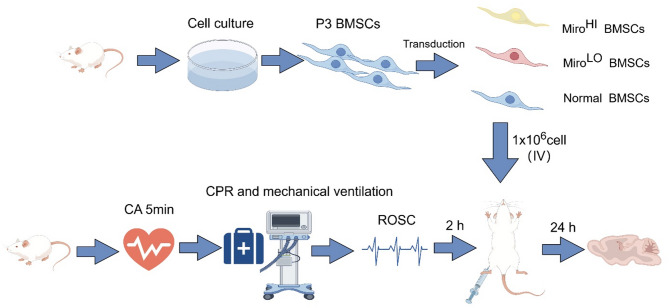
The work has been reported in line with the ARRIVE guidelines 2.0. Immature male Sprague-Dawley (SD) rats (4 to 5 weeks old, 100–150 g) and adult naive male SD rats (10 weeks old, 280–330 g) of SPF (specific pathogen-free) grade were obtained from the Hunan Silaikejingda Experimental Animal Company Ltd. (NO.430727231102711675, Changsha, China). The rats were housed in controlled conditions with temperatures ranging from 22 to 25 °C, humidity between 60% and 80%, and a 12-h light-dark cycle. The rats received proper care as per NIH guidelines. The experimental procedures for BMSC therapy are detailed in a flowchart (Fig. 1).
The study was divided into two parts. In the first, 60 rats were randomly assigned to the following three groups using a computer-based random number method (n = 20/group): a sham group in which rats underwent surgery without CA/CPR, a CPR-vehicle group in which rats were given 1 mL phosphate-buffered saline (PBS) via the femoral vein 2 h after ROSC, and a CPR-BMSCs group (n = 20) in which 1 × 10⁶ BMSCs in 1 mL were administered through the femoral vein 2 h after ROSC. In the second part of the study, 60 rats were randomly assigned to the following three groups as above (n = 20/group): BMSCs, BMSCs-mirohi, and BMSCs-mirolo groups in which rats were respectively administered 1 × 10⁶ BMSCs, BMSCs overexpressing Miro1 (BMSCs-mirohi), or BMSCs in which Miro1 had been knocked down (BMSCs-mirolo) in 1 mL via the femoral vein 2 h after ROSC. Every effort was made to minimize animal discomfort and usage during the study. At 24 h after ROSC, 10 rats were euthanized under deep anesthesia to obtain their brains, 10 rats euthanized after assessing neurological function within a week.

A schematic overview of the experimental approach
Model of asphyxial CA
The protocol for establishing the rat model of asphyxial CA was performed in accordance with the modified Utstein-style guidelines [18] and as described previously [9]. The rats received general anesthesia via an intraperitoneal injection of pentobarbital sodium (40 mg/kg). Anaesthesia was maintained by giving additional pentobarbital (10 mg/kg) as needed. After the rat's righting reflex has diminished, the right femoral artery and vein were exposed via a skin incision along the right groin. Blood pressure, electrocardiography, heart rate, and rectal temperature were monitored throughout the surgical procedure. Briefly, Blood pressure was measured with a pressure changer connected to a venous indwelling needle (24G) that was placed in the femoral artery. PowerLab 16/30 (AD-Instruments, Australia) was used to continuously monitor arterial blood pressure and the electrocardiogram. The 24G vein indwelling needle was placed in the right femoral vein for the continuous infusion of normal saline via a micro-perfusion pump at a velocity of 2 mL/h. After orotracheal intubation using a Teleflex 16G venous indwelling needle, a cervical median incision was made, and a firm ligature was placed on the main bronchi during mechanical ventilation in order to prevent air leakage.
After 10 min of mechanical ventilation, asphyxia was induced in the rats by stopping this mechanical ventilation. CA was defined as a drop in systolic blood pressure (SBP) to < 25 mmHg. Five minutes after CA (SBP < 25 mmHg), CPR was initiated. Adrenaline was injected (4 µg/100 g) through the right femoral venous indwelling needle together with external chest compression (200 bpm) and mechanical ventilation (tidal volume 0.65 mL/100 g, respiratory rate 80 bpm). ROSC was defined as a return of spontaneous sinus rhythm and the maintenance of a SBP > 60 mmHg for at least 10 min, as per the Utstein-style guidelines. If resuscitation failed, animals were excluded from the study. The orotracheal tube was removed after the return of spontaneous respiration. The catheters were removed and wounds stitched, with local infiltration using 1% lidocaine. At 24 h after ROSC, the rats were euthanized using an intraperitoneal injection of excess pentobarbital sodium(150 mg/kg). Subsequently, brain tissue was collected for further experiments.
Preparation of BMSCs, lentiviral constructs, and transduction
Preparation of BMSCs
Isolation and cultivation of BMSCs were conducted as previously described with slight modifications [19]. Young SD rats weighing 100–120 g were euthanized, and their femurs and tibias were aseptically extracted in a laminar flow cabinet (Antai Airtech Co Suzhou, China). The bone cavities were thoroughly rinsed with Dulbecco's Modified Eagle's Medium/Ham's F12 (DMEM/F12) without fetal bovine serum (FBS) (both sourced from Servicebio, Wuhan, China). This solution was collected in centrifuge tubes and centrifuged at 1000 rpm for 5 min. The supernatant was then removed. The pellet was resuspended in 6 mL of DMEM/F12 with 10% FBS, aliquoted into 25 cm2 tissue culture flasks, and cultured in a Tri-Gas incubator (Servicebio). Half of the medium was replaced after 24 h, the medium was fully changed after 48 h, and subsequent medium changes were performed every other day. The cells were detached using 2 mL of 0.25% pancreatin (Servicebio) containing 0.1 mM ethylenediaminetetraacetic acid (EDTA) for 2 min. Cell passaging (1:2) and subculturing were performed when cells were 90% confluent. P3 generation cells were utilized for further experimentation and transplantation. BMSCs were measured by flow cytometry (BD Bioscience) to analyze surface expression of CD29 (12594-1-AP, Proteintech), CD44 (GB113500, google), CD90 (30-H12, Proteintech), CD45 (60287-1-Ig, Proteintech), CD34 (SC-74499, Santa), CD11b (A1581, ABclonal). After the purity of BMSCs was confirmed to meet international standards through flow cytometry [20], the cells were adjusted to 1 × 10⁶ cells/mL for use in subsequent experiments.
Lentiviral constructs
The mRNA sequence of the rat Rhot1 gene, identified as Rattus norvegicus ras homologous family member T1 (Rhot1) (NM_001107026.2), was obtained from NCBI. Primer sequences for the overexpression vector were designed following the Gibson reaction principle: forward 5′-TTGATAAGGTAACAAGCGATG-3′ and reverse 5′-TTTTGCTGAACACTCCACA-3′. Three pairs of shRNA sequences were designed using Vector Builder's shRNA target design tool to target the Rhot1 gene specifically: RHOT1 shRNA (1) - CGATGGATTCCTCTACTAAAT, RHOT1 shRNA (2) - CGATGAACTCAAAGATTAT, and RHOT1 shRNA (3) - GGAGACCATCCTTCCAATTAT. The synthesized sequences were provided to Yunzhou Biotechnology Co., Ltd. for vector construction and lentivirus packaging, generating the overexpression lentivirus pLV [Exp]-EGFP: T2A: Uro-EF1A > rRhot1[NM_001107026.2] (rRHOT1) and the control overexpression lentivirus pLV [Exp]-EGFP: T2A: Uro-EF1A > mCherry (vector1). Lentiviruses for silencing included pLV [shRNA]-EGFP: T2A: Puro-U6 > rRhot1 [shRNA#1] (sh1), pLV [shRNA]-EGFP: T2A: Puro-U6 > rRhot1[shRNA#2] (sh2), pLV [shRNA]-EGFP: T2A: Puro-U6 > rRhot1 [shRNA#3] (sh3), and the empty vector sh lentivirus pLV [shRNA]-EGFP: T2A: Puro-U6 > Scramble_shRNA (vector2). All designed lentiviruses included an EGFP fluorescent reporter gene and a puromycin resistance gene.
RT-qPCR
Total RNA was extracted from the cells in each group using TRIzol (G3013, Servicebio), and the concentration of the total RNA was determined by measuring the OD260/OD280 ratio with an ultramicrospectrophotometer. Following the manufacturer's instructions, the Revert Aid First Strand cDNA synthesis kit was utilized for cDNA synthesis. Each qPCR reaction mixture included a total volume of 20 µL, containing 5 µL of DNA template, 0.5 µL of forward primer (10 µmol/L), 0.5 µL of reverse primer (10 µmol/L), 10 µL of 2× SYBR Green qPCR SuperMix, and 4 µL of Nuclease-Free Water. The amplification reaction consisted of 95°C for 5 min followed by 40 cycles of denaturation at 95 °C for 30 s, annealing at 60 °C for 30 s, and extension at 72 °C for 30 s. The relative expression levels of genes in each group were calculated using 2−ΔΔCt with Gapdh as the internal reference. The primer sequences for qRT-PCR were as follows: Gapdh—forward primer: 5′-GACAGCCGCATCTTCTTGT-3′, reverse primer: 5′-CTTGCGTGTGTAGATTCAT-3′; Rhot1—forward primer: 5′-CGCTCAAGCCTTCACTTGT-3′, reverse primer: 5′-GTGTTCACGTGGGTACAT-3′.
CCK-8 assay
BMSCs in the logarithmic growth phase were divided into the BMSCs, BMSCs-mirohi, and BMSCs-mirosh3 groups. These cells were dissociated using trypsin and prepared as cell suspensions which were then plated in 96-well plates at 6000 cells/well, with 3 replicate wells per group (adding 150 µL of PBS to the outer wells to prevent evaporation). The cells were then incubated in a 37 °C in a 5% CO2 environment for 24, 48, or 72 h. At the appropriate time points, the original culture medium was aspirated from each well, and a 10% CCK-8-supplemented culture medium was added. Subsequently, 100 µL of the 10% CCK-8 culture medium was dispensed into each well and incubated for 2 h. Absorbance at 450 nm was measured using an ELISA reader. The proliferation rate was calculated as the percentage ratio of the absorbance of the experimental group to that of the control group, while the inhibition rate was computed as the percentage difference between 1 and the ratio of the absorbance of the experimental group to that of the control group.
Brain tissue injury-related analyses
Flow cytometry analyses of apoptosis
The hippocampal tissue was digested with a trypsin cell digestion solution at 37 °C to prepare a single-cell suspension. Subsequently, the rat hippocampal neurons were washed three times with PBS, resuspended in PBS, and then stained following the protocol of the Annexin-V PI cell double-staining apoptosis detection kit (A211-02, Vazyme). Flow cytometry was utilized for the detection of cellular apoptosis.
Flow cytometry analyses of ROS
The hippocampal tissue was treated with a trypsin cell digestion solution at 37 °C to prepare a single-cell suspension. Following three PBS washes, rat hippocampal neurons were resuspended in PBS and stained as per the guidelines included in the reactive oxygen species detection kit (S0033S, Beyotime). Flow cytometry was employed to measure the cellular oxidative stress level.
H&E staining
The brain tissue was fixed in 4% paraformaldehyde for 24 h, subsequently dehydrated, treated with a clearing agent, and then embedded in paraffin blocks. These blocks were later sectioned into thin slices. The sections underwent dewaxing, rehydration, and staining with hematoxylin and eosin (H&E), after which they were sealed. Observations of the staining were conducted under a microscope, and photographs of these sections were collected.
Elisa
The hippocampal tissues were collected at 24 h post-ROSC to assess the levels of tumor necrosis factor α (TNF-α), interleukin 6 (IL-6), neuron-specific enolase (NSE), and IL-10. The tissues were rinsed with precooled PBS and subsequently homogenized. The homogenate was then centrifuged at 5000×g for 5 min, and the resulting supernatant was retained for further analyses. Detection of TNF-α, IL-6, and IL-10 levels was performed using Rat TNF-α, IL-6 and IL-10 ELISA kits (MM-0180R1, MM-0190R1, MM-0195R1; Meimian) in accordance with the manufacturer's instructions. Optical density measurements were conducted using a microplate reader.
Morris water maze
Spatial learning and memory were assessed using the Morris water maze (MWM) trial, which began 24 h post-ROSC. The MWM trial consisted of two parts: the hidden platform test (days 1 to 4) and the spatial exploration test (day 5). In the hidden platform test, a circular pool was divided into four quadrants, with a platform located 1 cm below the water surface in one quadrant. Rats were placed in the water from different starting points and tasked with finding the hidden platform. Each trial lasted 120 s, with rats placed on the platform for 15 s at the conclusion of the trial. Escape latency, the time taken by the rats to locate the platform and stay on it for 5 s, was recorded. If the rats failed to find the platform within 120 s, a maximum value of 120 s was assigned. On day 5, the spatial exploration test was conducted in the same pool but without the hidden platform. Frequency of crosses to the platform were recorded.
Detection of mitochondrial transfer
Immunofluorescence analyses of BMSC mitochondria and hippocampal neuron co-localization
To label the mitochondria in BMSCs, the cells were incubated with MitoTracker Red CMXRos in a 37 °C incubator for 20 min. Subsequently, the cytoskeleton with these BMSCs was labeled with Phalloidin (C2201S, Beyotime), followed by three washes with PBS. The samples were then sealed using an anti-fluorescence quenching sealing solution containing DAPI (P0131-5 ml, Beyotime). Images were captured using a fluorescence microscope (BX53, Olympus).
The brains were fixed with 4% paraformaldehyde for 24 h. The fixed specimens underwent sequential sucrose gradient dehydration, OCT embedding, and were then sectioned at a thickness of 8 μm to prepare frozen sections. Following thawing, permeabilization, and sealing of these sections, they were incubated overnight with the primary anti-NeuN (AG5317, Beyotime) at 4 °C. The next day, the sections were washed with PBS and then incubated with an Alexa Fluor 488-conjugated secondary antibody (HZ0176, Huzhen) at room temperature for 1 h. After another round of washing with PBS, staining with DAPI-containing sealing agent (P0131, Beyotime) was conducted for 5 min, followed by sealing of these sections. The sections were observed under a fluorescence microscope, and images were captured.
Immunofluorescence detection of TOMM20 expression in hippocampal neurons
Sections were incubated with the primary anti-Tomm20 (AF5206, Affinity), followed by the 488-conjugated secondary antibody (B100805, Baiqiandu) and the CY3-conjugated secondary antibody (B100802, Baiqiandu). Subsequently, the slices were sealed with a DAPI-containing sealing agent, observed, and photographed under a fluorescence microscope.
Mitophagy-related analyses
Electron microscopy
The fixed hippocampal tissues were washed with PBS for 45 min, followed by fixation with 1% osmium tetroxide for 2 h. Subsequently, the tissue was subjected to gradient ethanol dehydration, epoxy resin infiltration, embedding, and ultra-thin sectioning (60–80 nm) with uranium and lead staining to visualize the cellular structures. The number of autophagosomes inside the cells was then photographed and recorded under a transmission electron microscope (HT7800, Hitachi).
Western blotting
To assess protein expression, rat hippocampal tissues were lysed in RIPA buffer (BL504A, Biosharp) containing 1% PMSF (G2008-1ML, Servicebio) on ice. Total protein concentrations for each group were measured using the BCA (G2026-1000T, Servicebio) method. Samples were boiled in a water bath for 10 min, followed by separation via 12% SDS-PAGE (P0012A, Beyotime) and transfer onto a polyvinylidene fluoride membrane (FFP70, Beyotime). Blocking was performed with 5% skim milk at room temperature for 2 h. Blots were then incubated for 12 h at 4 °C with gentle shaking with the following antibodies: anti-LC3 (14600-1-AP, proteintech), anti-P62 (ab56416, abcam), anti-PINK1 (A11435, ABclonal), anti-parkin (A11172, ABclonal), anti-Tomm20 (ab186735, abcam), anti-ATG5 (39202, SAB), anti-Miro1 (A22469, ABclonal), and anti-β-actin (BS-0061R, BIOSS). Samples were then incubated with a horseradish peroxidase-labeled secondary antibody (5220-0341, Seracare) at room temperature for 2 h, and developed using an electrochemiluminescence (MA0186, meilunbio) method.
Mitochondrial quality-related analyses
Measurement of mitochondrial membrane potential
The hippocampal tissue was digested with a trypsin cell digestion solution at 37 °C to prepare a single-cell suspension. Subsequently, the rat hippocampal neurons were washed three times with PBS, followed by resuspension in PBS and staining based on the protocol provided with the JC-1 kit (C2006, Beyotime). Analyses of the mitochondrial membrane potential of these cells were conducted using flow cytometry.
Flow cytometry analyses of MtROS levels
Hippocampal tissue was digested with a trypsin cell digestion solution at 37 °C to prepare a single-cell suspension, which was subsequently rinsed three times with PBS. A suitable amount of diluted Mito sox Red (M36008, Invitrogen) was then added. After a 20-min incubation at 37 °C, the sample was centrifuged and washed three times with serum-free medium to eliminate any unabsorbed Mito sox Red. Fluorescence intensity was assessed using a flow cytometer.
Determination of ATP content
ATP levels in each group were assessed as per the protocol and calculation formula provided with the ATP content test kit (A095-1-1, Jiancheng).
Neurological functional scores
Neurological function was evaluated as per the established literature [21], employing the Neurological Deficit Score (NDS) to appraise the condition of post-ROSC rats at 6, 12, 24, 72, and 168 h. Two proficient evaluators, blinded to the group assignments for these rats, independently performed the evaluations, and the mean scores from their assessments were recorded. Evaluation criteria comprised parameters such as consciousness, basic reflexes, motor function, and sensory perception, among others. In total, 7 scoring components were considered, for a maximum possible score of 80 points. A score of 80 was indicative of normal health, while a score of 0 signified death.
Statistical analyses
Statistical analyses were performed using GraphPad Prism 9.0, and the results are displayed as means ± standard deviation (SD). Each dataset included a minimum of three biological replicates. The NDS scores were assessed using repeated measures analyses of variance (ANOVAs) while the other data were compared through one-way ANOVAs followed by Tukey's HSD (honestly significant difference) test. A significance level of P < 0.05 was employed to determine statistical significance.
Results
Rat physiological parameters during cardiopulmonary resuscitation
There were no notable variations in the baseline data among the rats in different experimental groups before the induction of asphyxia (P > 0.05). Additionally, there were no statistically significant differences in the duration of asphyxia, time to spontaneous restoration of cardiac rhythm, and adrenaline dosage when comparing the CPR-PBS group with the CPR-BMSCs group (P > 0.05). Similarly, prior to the initiation of asphyxia, there were no apparent variations in the baseline data, duration of asphyxia, time to spontaneous cardiac rhythm recovery, or adrenaline dosages among the BMSCs, BMSCs-mirohi, and BMSCs mirolo groups (P > 0.05) (Table 1).
| Group | Body weight (g) | Heart rate, (bpm) | Mean atrial pressure, (mmHg) | Time before cardiac arrest, (s) | ROSC time, (s) | Heart rate after ROSC, (bpm) | Mean atrial pressure after ROSC, (mmHg) | Adrenaline dose, (µg) |
|---|---|---|---|---|---|---|---|---|
| Sham | 307 ± 15.8 | 355 ± 13.3 | 96.8 ± 5.7 | – | – | – | – | |
| CA/CPR | 310 ± 15.7 | 352 ± 17.2 | 94.3 ± 4.05 | 213.1 ± 17.8 | 98.8 ± 13.1 | 70.9 ± 8.4 | 255 ± 18.2 | 12.45 ± 0.598 |
| BMSCs | 308 ± 15.1 | 359 ± 16.4 | 97.9 ± 6.08 | 216.5 ± 24.9 | 90.3 ± 7.6 | 72 ± 5.2 | 263 ± 16.3 | 12.3 ± 0.632 |
| BMSCS-miro1hi | 313 ± 16.8 | 353 ± 14.5 | 95.5 ± 5.10 | 211.6 ± 20.1 | 89.3 ± 14.4 | 73 ± 4.9 | 257 ± 12.8 | 12.55 ± 0.598 |
| BMSCS-miro1°l | 305 ± 15.7 | 364 ± 20.3 | 94.7 ± 5.85 | 218.1 ± 12.7 | 93.0 ± 11.6 | 75 ± 2.4 | 254 ± 15.5 | 12.25 ± 0.634 |
| F值 | 0.347 | 0.909 | 0.763 | 0.238 | 1.408 | 1.082 | 0.691 | 0.499 |
| 值P | 0.845 | 0.467 | 0.555 | 0.869 | 0.256 | 0.369 | 0.564 | 0.685 |
Lentivirus-mediated preparation of rat BMSCs with Miro1 overexpression or Silencing
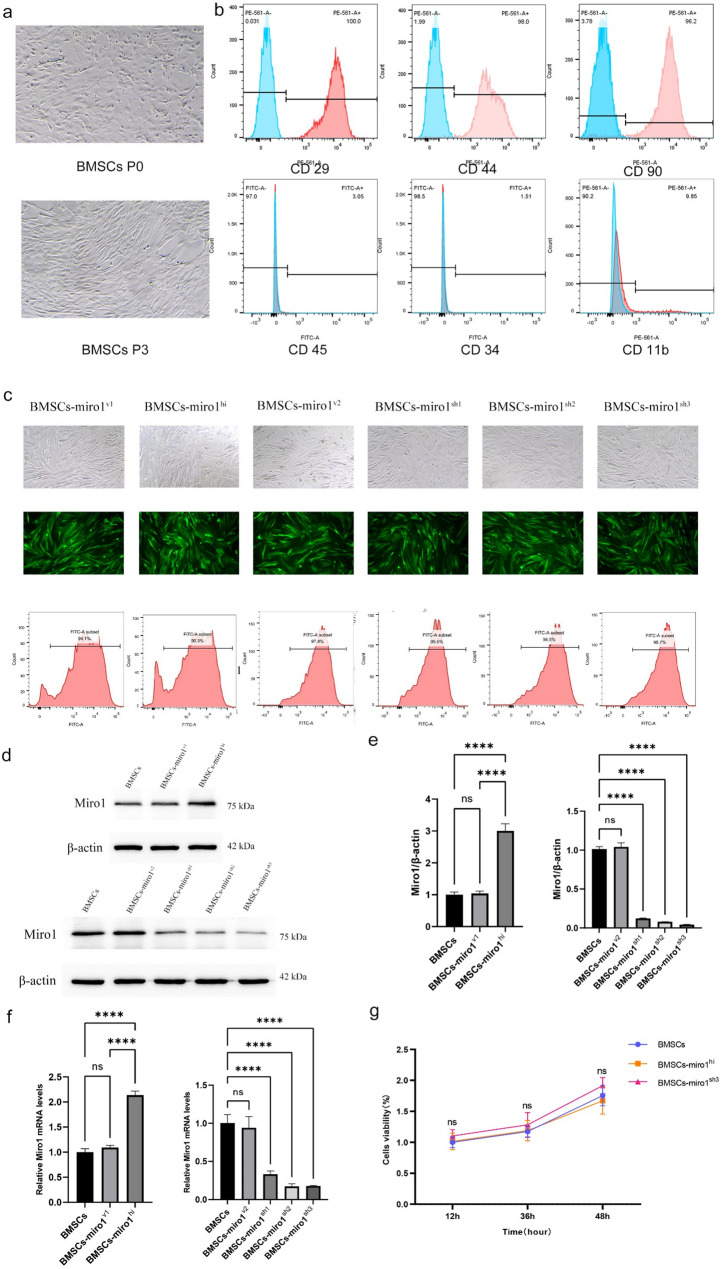
After isolating P3 rat BMSCs in vitro, their morphology was examined using an inverted microscope. This observation revealed that the adherent cells displayed uniform star-shaped or polygonal morphology and exhibited rapid growth, signifying successful cell purification for subsequent experiments (Fig. 2a). Flow cytometry was used to detect surface markers on these cultured P3 rat BMSCs as an indicator of cell purity. This analysis demonstrated strong positive expression levels of CD29 (100%), CD44 (98%), and CD90 (96.2%), while CD45 (3.05%), CD34 (1.51%), and CD11b (9.85%) were found to be consistently negatively expressed (Fig. 2b). In addition, in vitro differentiation of BMSCs were conducted:Osteogenic differentiation (supplement material 1).
The efficiency of lentiviral transfection in BMSCs was evaluated using fluorescence microscopy, flow cytometry, western blotting, and RT-qPCR to detect Green Fluorescent Protein (EGFP), Miro1, and mRNA expression. Following lentiviral infection at a multiplicity of infection (MOI) of 100, EGFP fluorescence indicative of transfection was observed in all BMSC groups (BMSCs-mirov1, BMSCs-mirohi, BMSCs-mirov2, BMSCS-mirosh1, BMSCs-mirosh2, and BMSCs-mirosh3) under a fluorescent inverted microscope, with positive transduction rates ranging from 90.3 to 98.7% (Fig. 2c). The western blotting analysis demonstrated the protein-level expression of Miro1 across all cell groups, Significantly increased Miro1 protein levels were observed in the BMSCs-mirohi group compared to BMSCs, while no substantial differences were noted between BMSCs and BMSCs-mirov1. Conversely, reduced Miro1 protein expression was observed in the BMSCs-mirosh1, BMSCs-mirosh2, and BMSCs-mirosh3 groups, with BMSCs-mirosh3 exhibiting the most pronounced decrease (Fig. 2d, e). The Real-time PCR results aligned with the western blotting results, confirming the efficient lentiviral transfection of BMSCs (Fig. 2f). Cell proliferation, assessed via the CCK-8 method, revealed no significant differences among BMSCs, BMSCs-mirohi, and BMSCs-mirosh3 (Fig. 2g), indicating stable proliferation following lentiviral transfection. The BMSCs-mirosh3 group was redesignated as BMSCs-mirolo, demonstrating the successful generation of normal BMSCs, Miro1-overexpressing BMSCs (BMSCs-mirohi), and Miro1-knockdown BMSCs (BMSCs-mirolo).

Characteristics of cultured rat BMSCs and confirmation of lentivirus-mediated overexpression and knockdown of Miro1.Representative images of cells from passages 0 (P0) and 3 (P3).Flow cytometry results indicating that BMSCs from P3 were positive for CD29, CD44, and CD90, and were negative for CD11b, CD34, and CD45. () Fluorescence images showing that transduced BMSCs co-express Green Fluorescent Protein (EGFP) with corresponding quantification of transduction rates in the BMSCs, BMSCs-miro, BMSCs-miro, BMSCs-miro, BMSCs-miro, BMSCs-miro, and BMSCs-mirogroups.,Western blotting results showing the relative abundance of Miro1 in the BMSCs, BMSCs-miro, BMSCs-miro, BMSCs-miro, BMSCs-miro, BMSCs-miro, and BMSCs-mirogroups.RT-qPCR results showing the relative expression ofin the BMSCs, BMSCs-miro, BMSCs-miro, BMSCs-miro, BMSCs-miro, BMSCs-miro, and BMSCs-mirogroups.Cell Counting Kit-8 (CCK-8) analysis results showing the viability of cells in the BMSCs, BMSCS-miro, and BMSCS-mirogroups ( = 3). All data are presented as the means ± SD. ***** < 0.0001. ns > 0.05 a b d e f g v1 hi v2 sh1 sh2 sh3 v1 hi v2 sh1 sh2 sh3 v1 hi v2 sh1 sh2 sh3 hi sh3 Miro1 n P P
BMSC transplantation restores mitochondrial quality through A dual mechanism involving mitochondrial transfer and mitophagy
BMSC transplantation provides healthy mitochondria to hippocampal neurons of CPR model rats
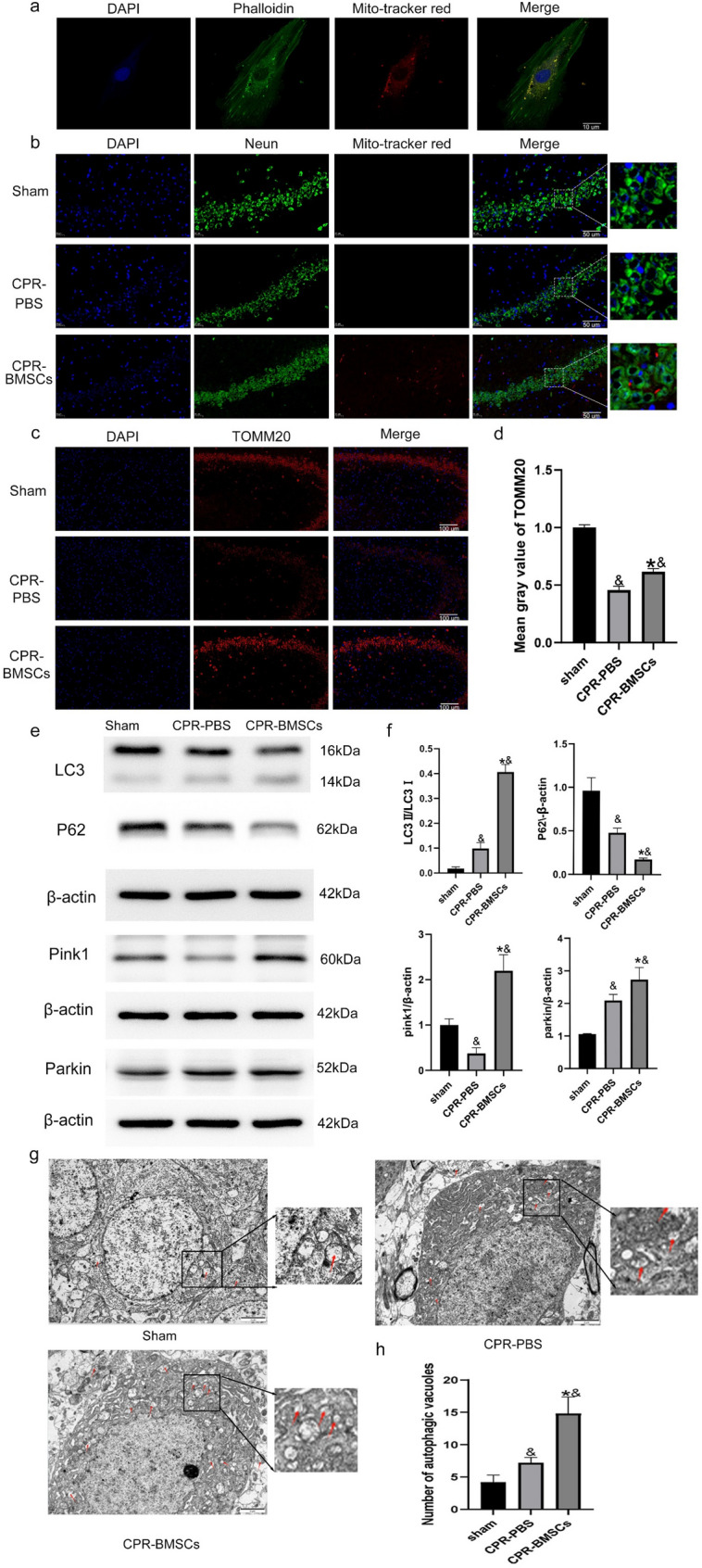
The successful transplantation of BMSCs to deliver healthy mitochondria to hippocampal neurons of rats after CPR was achieved. Briefly, mitochondria within the isolated BMSCs were labeled using MitoTracker Red CMXRos, with the cytoskeleton having additionally been labeled using Phalloidin to evaluate MitoTracker Red CMXRos labeling effectiveness. Fluorescence microscopy visualization confirmed that labeling was successful, (Fig. 3a). Hippocampal neurons were marked with NeuN to assess the capability of exogenous BMSCs to traverse the blood-brain barrier and provide healthy mitochondria to damaged hippocampal neurons. Immunofluorescence analyses revealed that 24 h post-ROSC, mitochondria originating from exogenous BMSCs were internalized by and incorporated into hippocampal neurons within the hippocampus (Fig. 3b). Further immunofluorescence analyses using TOMM20 were conducted across the sham, CPR-PBS, and CPR-BMSCs groups, demonstrating a notable rise in the overall mitochondrial content in hippocampus of the CPR-BMSCs group compared to the CPR-PBS group within 24 h after ROSC (Fig. 3c, d). In addition, the relative mtDNA content between the Sham group and the CPR-BMSCs group were determined (supplement material 1). Together, these findings suggest that the administration of exogenous BMSCs via the femoral vein effectively transports healthy mitochondria to hippocampal neurons in CPR model rats, enriching the mitochondrial population within the hippocampus.

BMSC transplantation can provide healthy mitochondria and mediate Pink1 Parkin mitophagy pathway to hippocampal neurons.Mitochondrial BMSCs were pre-labeled with MitoTracker.Immunofluorescence analyses showing the presence of BMSC-derived mitochondrial pre-labeled with MitoTracker in vitro in hippocampal neurons of rats after CPR.,Immunofluorescence analyses of TOMM20 in hippocampal neurons of rats after CPR ( = 3).,Western blotting results showing expression of LC3, P62, Pink1, and Parkin in post-resuscitation rats ( = 3).,Ultrastructural images of autophagic vacuoles (red arrows) in rat hippocampal neurons ( = 5). All data are presented as means ± SD. * < 0.05 vs. the CPR-PBS group; & < 0.05 vs. the Sham group a b c d e f. g h n n n P P
BMSCs mediate the activation of the Pink1 parkin mitophagy pathway
Western blotting analyses of hippocampal neurons revealed that at 24 h after ROSC, the expression of LC3-II/ LC3-I, PINK1, and Parkin, which are positively correlated with mitophagy, was significantly increased in the CPR-BMSCs group compared to the CPR-PBS group (P < 0.05), while the expression of p62 (a protein negatively correlated with mitophagy) was significantly decreased (P < 0.05) (Fig. 3e, f). Transmission electron microscopy analyses of the number of autophagosomes in hippocampal neurons yielded consistent results. Specifically, relatively few autophagosomes with a bilayer membrane structure were observed in the hippocampal neurons of the Sham group, while significantly more were evident in the CPR-PBS group relative to the Sham group (P < 0.05), and significantly more autophagosomes were observed in the CPR-BMSCs group relative to the Sham and CPR-PBS groups (P < 0.05). Based on these results, exogenous BMSCs were transplanted via femoral vein injection to enhance mitophagy in rat hippocampal neurons after CPR (Fig. 3g).
Transplantation of BMSCs improves mitochondrial mass of hippocampal neurons in rats after CPR
The above results suggest that transplantation of BMSCs following CPR in rats plays a significant role in improving mitochondrial function in hippocampal neurons. Moreover, compared to the Sham group, the CPR-PBS group exhibited significantly reduced ATP content in hippocampal neurons, while the CPR-BMSCs group also exhibited reduced ATP content, albeit with a significant increase in ATP content in neuronal cells in the CPR-BMSCs group compared to the CPR-PBS group. (Fig. 4a). Mitochondrial membrane potential and mitochondrial oxidative stress levels were next examined in these assays, revealing that both were increased in the CPR-PBS group relative to the Sham group, whereas the transplantation of BMSCs led to a reduction in both mitochondrial membrane potential and oxidative stress levels in hippocampal neurons (Fig. 4b, c, d, e). Overall, these findings demonstrate that injecting exogenous BMSCs via the femoral vein can help alleviate mitochondrial damage resulting from global cerebral ischemia after CPR and contribute to the restoration of mitochondrial quality in hippocampal neurons.

BMSC transplantation can improve mitochondrial quality and alleviate hippocampal neuron injury after CPR.ATP levels were quantified in hippocampal neurons ( = 5).,mtROS levels were measured by flow cytometry in hippocampal neurons ( = 5).,Mitochondrial membrane potential was detected using JC-1 staining ( = 5).BMSCs ameliorated pathological injury in the cerebral hippocampus in rats following global cerebral I/R. Scale bar = 50 μm ( = 5),Hippocampal neuron apoptosis was detected via Annexin-V‐FITC/PI staining, and cellular apoptosis was detected by flow cytometry. ( = 5–6).,BMSCs reduced ROS levels in hippocampal neurons after cardiopulmonary resuscitation as measured by flow cytometry ( = 5). Data are means ± SD.Neurological deficit scores showing that BMSCs improved the recovery of neurologic function after resuscitation ( = 10).–Levels of, IL-6, IL-10, and TNF-α in hippocampal tissue. ( = 3)Escape latency during the hidden platform test from day 1 to day 4.,Frequency of crosses to the platform and representative track plots of each group during the space exploration test. All data are presented as means ± SD. * < 0.05 vs. the CPR-PBS group; & < 0.05 vs. the Sham group a b c d e f g h i j k l n o p q n n n n n n n n P P
Transplanting BMSCs alleviates hippocampal neuronal damage in rats after CPR
Histological analyses using H&E staining were next performed to examine the pathological conditions of the hippocampus. (Fig. 4f). These results revealed that rats in the Sham group exhibited an orderly arrangement of neurons with shallow cytoplasmic staining, round nuclei, and no significant pathological damage. In contrast, the CPR-PBS group showed disordered neuron arrangement, reduced cell numbers, and deep staining of the cell nuclei, consistent with significant pathological damage. However, the CPR-BMSCs group demonstrated increased hippocampal neuron density, minimal disorder in terms of cell arrangement, and only a small number of apoptotic damaged cells. Flow cytometry was further used to evaluate hippocampal neuronal apoptosis and levels of ROS to assess brain tissue damage (Fig. 4g–j). The CPR-BMSCs group exhibited a significant decrease in neuronal apoptosis rate and ROS levels compared to the CPR-PBS group. Additionally, neurological function was assessed at 6, 12, 24, 72, and 168 h post-ROSC to reflect neurological deficits (Fig. 4k). No significant differences in NDS were observed among the three groups at 6 and 12 h post-ROSC. However, at 24, 72, and 168 h post-ROSC, the NDS scores of rats in the CPR-BMSCs group were higher than those of rats in the CPR-PBS group. We found that proinflammatory cytokines TNF-α and IL-6 were decreased (Fig. 4l, n), while IL-10 were increased (Fig. 4m) significantly in the CPR-BMSCs group. In the MWM assessment, the CPR-BMSCs group exhibited a faster reduction in escape latency in the hidden platform test (Fig. 4o) and frequency of crosses to the platform during the spatial exploration test (Fig. 4p, q) in comparison to the CPR-PBS group. The above results indicate that the transplantation of exogenous BMSCs through the femoral vein could mitigate damage to rat neurons following CPR.
Miro1 optimizes the BMSC-mediated restoration of mitochondrial homeostasis
Miro1 enhances the efficiency of mitochondrial transfer from BMSCs
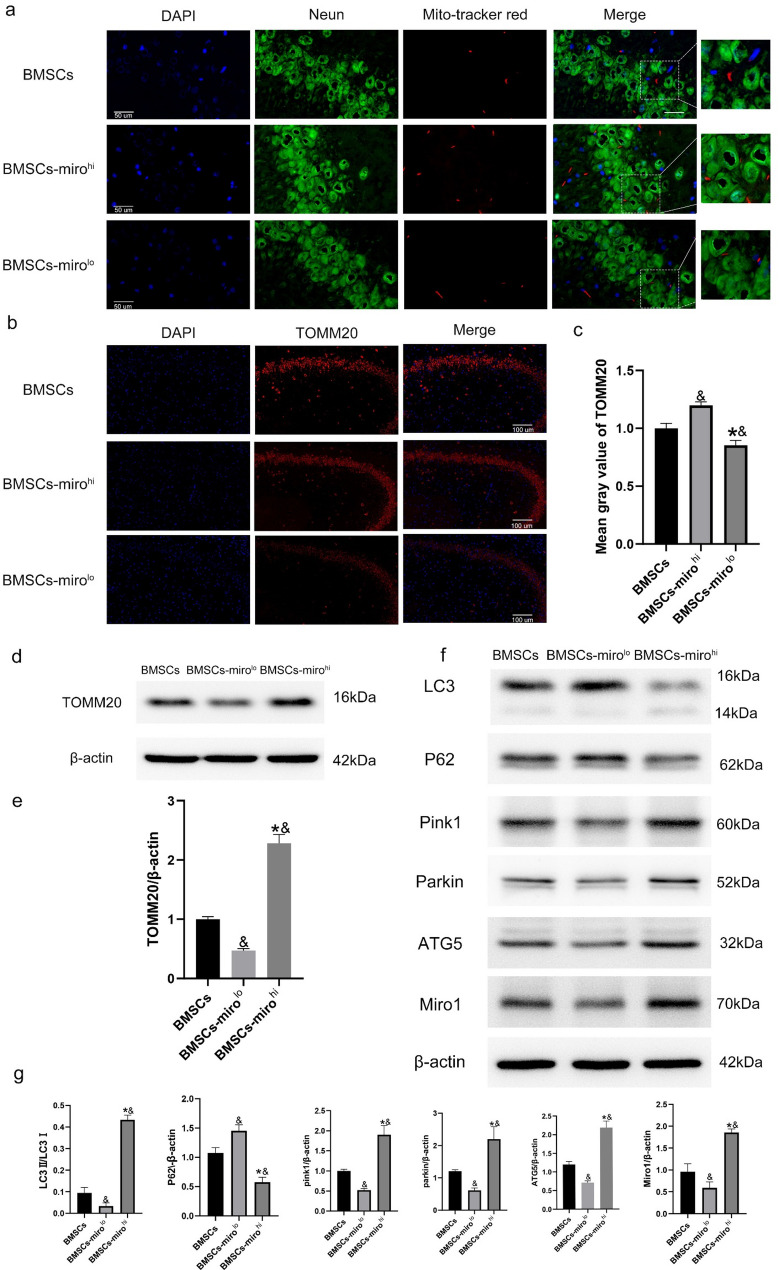
Immunofluorescence analyses were conducted for samples from rats in the BMSCs, BMSCs-mirohi, and BMSCs-mirolo groups as the Sham, CPR-PBS, and CPR-BMSCs group. At 24 h after ROSC, the BMSCs-mirohi group exhibited a considerable increase in the internalization of mitochondria within the hippocampus compared to the other BMSCs groups. Conversely, the number of internalized mitochondria in the BMSCs-mirolo group, in which Miro1 had been knocked down in BMSCs, was significantly reduced (Fig. 5a). These findings were corroborated by the results obtained from immunoblotting and immunofluorescence analyses of TOMM20 content in the hippocampus. Notably, at 24 h post-ROSC, a marked increase in the total number of healthy mitochondria within the hippocampus was observed in the BMSCs-mirohi group in contrast to the BMSCs group, with a significant decrease in the total healthy mitochondria count in the hippocampus of the BMSCs-mirolo group (P < 0.05) (Fig. 5b, c, d, e). These results suggest a potential role for Miro1 as a driver of more efficient mitochondrial transfer by BMSCs.

Miro1 enhances BMSC-mediated mitochondrial transfer and mitophagy.Immunofluorescence results showing the presence of mitochondria from BMSCs-mirocells that had been pre-labeled with MitoTracker in vitro in hippocampal neurons of rats after CPR.,Immunofluorescence staining of TOMM20 in hippocampal neurons of rats after CPR ( = 3).,Western blotting results showing the expression of TOMM20 in post-resuscitation rats ( = 3). * < 0.05 vs. the BMSCs-mirogroup. & < 0.05 vs. the BMSCs group.,Western blotting results showing the expression of LC3, P62, Pink1, Parkin, ATG5, and Miro1 in post-resuscitation rats ( = 3). All data are presented as the means ± SD. * < 0.05 vs. the BMSCs-mirogroup. & < 0.05 vs. the BMSCs group a b c d e f g hi hi lo n n P P n P P
Miro1 enhances BMSCs-mediated activation of the Pink1-parkin mitophagy pathway
Western blotting analyses of hippocampal neurons revealed that at 24 h after ROSC, the expression of LC3-II, PINK1, Parkin, and ATG5 was significantly increased in the BMSCs-mirohi group compared to the BMSCs group (P < 0.05), while the expression of p62 was significantly decreased compared to the BMSCs group (P < 0.05) (Fig. 5f, g). Miro1 thus enhances BMSC-mediated activation of the Pink1-Parkin mitophagy pathway.
Miro1 facilitates further improvements in mitochondrial quality
Analyses of ATP levels in the hippocampal neurons from these three groups revealed a significant increase in ATP content in hippocampal neurons compared to the BMSCs group (P < 0.05), whereas the BMSCs-mirolo group exhibited a marked decrease in ATP content in neurons (P < 0.05) (Fig. 6a). Moreover, the BMSCs-mirohi group exhibited substantially reduced mtROS levels in hippocampal neurons relative to the BMSCs group (P < 0.05), while the BMSCs-mirolo group exhibited a slight increase in mtROS content and mitochondrial membrane potential levels (P < 0.05) (Fig. 6b–e). These results suggest that Miro1 contributes to the enhancement of recovery from mitochondrial damage following global cerebral ischemia-reperfusion after CPR.

Miro1 enhances the therapeutic effects of BMSCs and reduces brain injury.ATP levels were quantified in hippocampal neurons ( = 3),mtROS levels were determined by flow cytometry in hippocampal neurons. ( = 3).,Mitochondrial membrane potential was detected via JC-1 staining ( = 3).BMSCs-mirotreatment ameliorated pathological injury in the cerebral hippocampus in rats with global cerebral I/R. Scale bar = 50 μm ( = 5).,BMSCs-mirowere able to reduce neuronal cell apoptosis in rats after CPR as measured via flow cytometry ( = 5).,BMSCs-mirotreatment reduced ROS levels in hippocampal neurons after CPR as measured via flow cytometry ( = 5).Neurological deficit scores showing that BMSCs-miroimproved the recovery of neurologic function after resuscitation ( = 10). All data are presented as the means ± SD. * < 0.05 vs. the BMSCs-mirogroup. & < 0.05 vs. the BMSCs group a b c d e f g h i j k n n n n n n n P P hi hi hi hi hi
Miro1 enhances the ability of BMSCs to protect against brain injury
H&E staining was utilized to assess the pathological conditions of the hippocampus in experimental rats (Fig. 6f). Despite exhibiting signs of CA/CPR damage, the BMSCs-mirohi group displayed a relatively more organized hippocampal cell morphology compared to the BMSCs group. In contrast, the therapeutic impact of BMSC administration in the BMSCs-mirolo group was not as pronounced. BMSCs-mirohi treatment led to decreased production of abnormal hippocampal neurons, resulting in reduced cell damage at 24 h post-injection. Flow cytometry was employed to analyze hippocampal neuronal apoptosis and ROS levels, reflecting the extent of brain tissue damage (Fig. 6g–j). In contrast with the BMSCs group, the BMSCs-mirohi group exhibited a pronounced reduction in neuronal apoptosis rates and ROS levels (P < 0.05), whereas the BMSCs-mirolo group exhibited an increase in both parameters (P < 0.05). Furthermore, analyses of NDS scores at 24 h post-transplantation indicated that the BMSCs-mirohi group achieved superior neural function scores as compared to the BMSCs group (P < 0.05). Similarly, the BMSCs group exhibited significantly enhanced neurological function compared to the BMSCs-mirolo group (Fig. 6k). The findings suggest that BMSCs-mirohi transplantation exerts a protective effect against cerebral ischemia-reperfusion injury following resuscitation that surpasses the neuroprotective benefits of unmodified BMSC transplantation.
Discussion
In this study, we investigated the feasibility of BMSC transplantation via femoral vein injection as a potential treatment for I/R injury following CA. Our investigation revealed several key findings. First, CPR-induced global brain I/R injury in rats resulted in a significant increase in neuronal cell apoptosis, the disruption of mitochondrial homeostasis, and the impairment of neurological function. Second, BMSCs demonstrated a dual protective mechanism by facilitating the transfer of healthy mitochondria from exogenous sources and enhancing the autophagy of damaged mitochondria post-CPR, leading to improved mitochondrial function in hippocampal neurons and reduced neuronal apoptosis. Third, the overexpression of Miro1 in BMSCs was found to enhance mitochondrial transfer efficacy and promote mitophagy in BMSCs, thereby enhancing the therapeutic potential of BMSCs.
In 2008, researchers first conducted the right atrial injection of BMSCs to investigate their neuroprotective impact on CPR in rats [22]. This study revealed that the transplanted BMSCs penetrated the blood-brain barrier, dispersed across various brain regions, mitigated brain damage resulting from CPR, and restored neurological function. However, the precise underlying mechanisms remain elusive. Although the direct lateral ventricular administration of BMSCs offers superior efficacy as a means of delivering cells to the injured brain and maximizing therapeutic benefits [23], the invasiveness of this procedure poses risks of increased rat mortality and may impede future clinical applications. A significant proportion of intravenously injected BMSCs can effectively migrate to the damaged brain areas following CPR, particularly in the hippocampus and cortex [11]. Consequently, the choice was made to continue BMSC transplantation via the femoral vein in the present study.
Mitochondrial transfer involves the translocation of fully functional mitochondria through diverse pathways to the site of ischemic injury. This process replaces damaged mitochondria and mtDNA [24], amplifying neuronal activity and self-healing capacity, thus averting the cascading effects of mitochondrial damage in situ and mitigating I/R injury [25]. Mitochondrial transfer is a pivotal mechanism through which BMSCs can help repair tissue cell damage [26]. Both in vivo [27] and in vitro experiments [28] have confirmed that MSCs can transfer their mitochondria to impaired cells, exerting protective effects through methods such as intravenous injection or co-culture. High levels of expression of Miro1 enhance mitochondrial motility, effectively boosting the efficiency of healthy mitochondria transfer to damaged cells, ultimately reducing neuronal apoptosis and playing a protective role in neurological disorders like traumatic brain injury [29] and Parkinson's disease [30]. The immunofluorescence analyses performed herein confirmed that following the intravenous administration of BMSCs, some mitochondria from these BMSCs were internalized by hippocampal neurons, resulting in the augmented presence of healthy mitochondria in hippocampal cells after CPR. Moreover, Miro1, as a key protein essential for mitochondrial transfer, localizes on the outer membrane of eukaryotic mitochondria. Miro1 plays a vital role in bolstering the efficacy of BMSCs-mediated mitochondrial transfer, facilitating the translocation of healthy mitochondria from BMSCs to impaired neuronal cells. It is hypothesized that the I/R injury that occurs during CA and CPR disrupts the blood-brain barrier, potentially allowing exogenous BMSCs to traverse the barrier and gain entry into the hippocampus, thereby delivering beneficial mitochondria to dysfunctional hippocampal neurons. In essence, the transplanted BMSCs contribute healthy mitochondria to hippocampal neurons through mitochondrial transfer, with Miro1 substantially enhancing the transfer process efficiency, consequently elevating the healthy mitochondrial count in the hippocampus.
The process of mitophagy involves the selective recognition and clearance of damaged mitochondria through autophagy, serving as a crucial mechanism for maintaining mitochondrial quality and normal cellular physiological function [31]. Moderate mitophagy acts as a neuroprotective mechanism by efficiently clearing damaged mitochondria, mitigating ROS production through negative feedback, and attenuating oxidative stress-associated damage [32]. Normally, PINK1 (PTEN-induced kinase 1) is transported to the inner mitochondrial membrane (IMM) and undergoes hydrolysis by specific proteases in a membrane potential-dependent manner [33]. PINK1 is then degraded through the ubiquitin protease system and maintained at a low level. Changes in mitochondrial membrane potential impede the effective entry of PINK1 into the IMM, leading to its accumulation on the outer mitochondrial membrane (OMM) [34]. PINK1 accumulation on the OMM leads to its autophosphorylation, activating PINK1, which in turn phosphorylates and activates Parkin. This activation recruits Parkin to induce mitochondrial depolarization. Subsequently, Parkin ubiquitinates the mitochondrial protein Miro1, segregating damaged mitochondria and facilitating their entry into the proteasome for degradation [35]. After transplanting BMSCs through the femoral vein, our study demonstrated an increase in CA-induced PINK1/Parkin expression and a significant rise in the number of autophagosomes observed under electron microscopy, indicating heightened mitophagy. Additionally, the PINK1/Parkin expression in BMSCs transfected with Miro1 was further augmented post-transplantation. These findings suggest that BMSC transplantation may facilitate the removal of damaged mitochondria in hippocampal cells through PINK1/Parkin-mediated mitophagy, thereby exerting a neuroprotective effect. Furthermore, Miro1 can enhance the efficacy of BMSC-mediated PINK1/Parkin mitophagy, potentially boosting its therapeutic impact.
Neuronal apoptosis is a key mechanism underlying neuronal damage and compromised neural function following cerebral ischemia and hypoxia [35]. During ischemia-reperfusion injury, mitochondria serve as the primary source of uncontrolled ROS production, leading to alterations in mitochondrial membrane potential via the disruption of the mitochondrial permeability transition pore [36]. Mitochondrial dysfunction, in turn, is a primary consequence of unrestrained ROS [37, 38]. These interconnected characteristics create a detrimental cycle in which oxidative stress-induced damage triggers heightened ROS production within mitochondria, leading to further mitochondrial damage and degradation of the intracellular environment [39]. Cerebral blood flow interruption-induced ischemia and reperfusion can induce cellular damage responses such as energy disturbances, acidosis, enhanced release of excitatory amino acids, generation of free radicals, and upregulation of apoptotic gene expression, culminating in apoptosis and necrosis [40]. Thus, preserving a robust mitochondrial functional network is imperative for responding to physiological adaptation and oxidative stress. In this study, the transplantation of BMSCs via femoral vein injection was shown to restore mitochondrial membrane potential levels, decrease mitochondrial oxidative stress content, increase ATP levels, and enhance mitochondrial quality in hippocampal neurons. These effects ultimately lead to a reduction in the apoptosis rate of hippocampal neurons. Moreover, the presence of Miro1 was found to augment the therapeutic impact of BMSCs in this experimental context, thereby mitigating brain injury post-CPR. These findings suggest that the transplantation of BMSCs could potentially alleviate tissue damage in the central nervous system by ameliorating oxidative stress-related damage and restoring mitochondrial quality following CA.
Limitations of this study include the fact that BMSCs can also enhance neurological function post-CPR through the secretion of neurotrophic factor [41] and exosome [42]. BMSCs overexpressing brain-derived neurotrophic factor (BDNF) and vascular endothelial growth factor (VEGF) demonstrate substantial therapeutic efficacy in mitigating brain damage following CA [43]. These experiments could not preclude the potential interference of these BMSC-derived factors on mitochondrial homeostasis due to technical constraints. Second, during CPR, all organs can experience ischemia-reperfusion injury, and transplanted BMSCs delivered via the veins may become trapped in the pulmonary circulation. Additionally, BMSCs can ameliorate the effects of ischemia-reperfusion injury on the lungs [44] and liver [45]. It is plausible that BMSCs may initiate a cascading effect through which they restore neurological function by treating other organs. Third, the hippocampus, known for being highly vulnerable to hypoxia/ischemic damage, was selected as the focal region to assess the therapeutic capabilities of transplanted BMSCs. Although the transplantation of BMSCs can mitigate cortical cell pyroptosis following CPR, its influence on mitochondrial homeostasis remains undetermined [46]. Further research is thus required to explore the impact of BMSC transplantation on mitochondrial homeostasis in brain regions outside the hippocampus. Considering the absence of supporting cell-based experiments, our forthcoming studies will illustrate the neuroprotective potential of transplanted BMSCs on rat CPR outcomes using glucose-oxygen deprivation and oxidative stress model systems.
Conclusion
In summary, the results of this study demonstrate that the neuroprotective mechanisms through which BMSCs function after CPR involve the maintenance of mitochondrial homeostasis and reductions in neuronal apoptosis through the dual regulatory effects of mitophagy and exogenous mitochondrial transfer. The core protein Miro1 optimizes the neuroprotective effects of BMSCs in this context by regulating mitochondrial transfer and autophagy.
Supplementary Information
Below is the link to the electronic supplementary material.
Supplementary Material 1. In vitro differentiation of BMSCs and mtDNA level.
Supplementary Material 2.