
What this is
- This study investigates the molecular circadian clock in leukocytes of individuals with type 2 diabetes and overweight.
- It explores how disruptions in may contribute to increased cardiovascular risk.
- The research highlights the relationship between circadian gene expression and .
Essence
- Disruption of the molecular circadian clock in leukocytes from type 2 diabetes patients correlates with increased cardiovascular risk factors. Specifically, lower levels of core clock proteins were observed, alongside elevated inflammatory markers.
Key takeaways
- Circadian clock proteins CLOCK, CRY1, p-BMAL1, and PER2 were significantly lower in leukocytes from type 2 diabetes patients compared to healthy participants. This reduction may contribute to the inflammatory profile and cardiovascular risk associated with type 2 diabetes.
- Altered were observed in type 2 diabetes participants, suggesting that disruptions in enhance these interactions, potentially leading to atherogenesis.
- The study established that inhibiting the CLOCK/BMAL1 complex increased in vitro, indicating a mechanistic role for circadian disruption in promoting inflammation and cardiovascular risk.
Caveats
- The study faced limitations regarding the number of leukocytes available for analysis, which affected the ability to perform all experiments for each participant. This may impact the robustness of the findings.
- A lack of age-matched controls may limit the interpretation of the results regarding circadian gene expression differences between diabetic and healthy participants.
Definitions
- Circadian rhythms: Biological processes that display an endogenous, entrainable oscillation of about 24 hours, influencing various physiological functions.
- Leukocyte-endothelial interactions: The interactions between leukocytes and endothelial cells, crucial for immune response and inflammation, particularly in the context of vascular health.
Simplified
Introduction
The prevalence of type 2 diabetes is increasing globally and is reducing life expectancy, making it a significant health concern. In 2021, it was projected that 537 million adults were living with diabetes, accounting for approximately 10.5% of the world's population [1].
CVD remains the major determinant of premature mortality in patients with type 2 diabetes [2]. Type 2 diabetes presents systemic inflammation that arises as a result of chronic hyperglycaemia [3]. In addition, diabetes-associated dyslipidaemia and oxidative stress promote development of atherosclerosis, as LDL-cholesterol particles are targets of oxidation and are a key factor in the process. Under these conditions, cytotoxic damage occurs to endothelial cells, promoting the release of proinflammatory cytokines and the recruitment of innate and adaptive immune cell populations into atherosclerotic lesions. Finally, migration of monocytes into the sub-endothelial space and uptake of oxidised LDL leads to foam cell formation [4].
An unhealthy diet and sedentary lifestyle are major risk factors for the development of type 2 diabetes and CVD [5]. In recent years, alterations in daily rhythms, such as those suffered by shift workers, have been shown to be related to a greater risk of developing obesity, type 2 diabetes and the metabolic syndrome [6 –8]. Recent evidence also suggests that circadian alignment of food intake provides metabolic benefit in terms of reduced glycaemic parameters [9]. The mammalian circadian rhythm is controlled by a central clock in the hypothalamus and a multitude of peripheral clocks in other areas of the brain and peripheral tissues [10, 11]. The molecular basis of the mammalian circadian clock consists of a transcriptional/translational autoregulatory feedback loop that involves several clock genes, including CLOCK, BMAL1, PER1/2/3 and CRY1/2, among others. Circadian rhythms are essential for the maintenance of physiological functions such as glucose metabolism, and their alteration has been shown to be associated with the development of insulin resistance [12], although the precise mechanism involved is unknown.
There is circadian rhythmicity in gene expression profiles in human peripheral blood mononuclear cells (PBMCs), and the transcript levels of core clock genes in PBMCs of healthy participants follow a 24h cyclical pattern [13, 14]. Indeed, clock gene expression profiles in human PBMCs have been proposed as a tool for assessing circadian rhythm in humans [15]. Circulating PBMCs are sensors of metabolic stress and bioenergetic markers [16]. These cells play a key role in the onset of diabetes, as they are the precursors of the adipose-resident immune cells that promote inflammation during obesity, which eventually leads to type 2 diabetes [17]. Moreover, their interaction with and adherence to the endothelium is an indicator of subclinical atherosclerosis and precedes the onset of CVD [18]. Leukocyte–endothelial interactions are enhanced in type 2 diabetes patients [19, 20], but the underlying molecular pathways that trigger these interactions are only partially understood [20 –22].
On this basis, we aimed to study whether there are alterations in the expression of circadian rhythm genes in the PBMCs of patients with type 2 diabetes, and to explore the mechanism by which these genes participate in the pathophysiology of type 2 diabetes. We specifically evaluated whether this disruption affects the interaction between leukocytes and endothelial cells that, together with chronic low-grade inflammation, underlies the pathophysiology of type 2 diabetes.
Methods
Participant recruitment and measurement of clinical parameters
This is an observational cross-sectional study. Participants with type 2 diabetes (n=25) and healthy control volunteers (e.g. health workers' family members, friends and acquaintances; n=28) were recruited at the Endocrinology and Nutrition Service of the Hospital Universitario Doctor Peset (Valencia, Spain). Self-reported sex and ethnicity data were collected. Eligibility criteria for participants were as follows: adults up to 70 years of age; for participants in the type 2 diabetes group, diagnosis of type 2 diabetes was based on the ADA guidelines [23] and known time of evolution of the disease greater than 5 years was required, which is representative of the disease population in our setting. The exclusion criteria included the presence of other diseases, such as morbid obesity, or any autoimmune, malignant, organic, haematological, inflammatory or infectious disease. The protocol was approved by the hospital's clinical research ethics committee (ID: 131.22), and was performed according to the ethical principles of the Declaration of Helsinki. Participants provided written, informed consent and biochemical determinations of blood samples were performed by the hospital's clinical analysis service.
Leukocyte extraction and isolation
A blood sample was extracted from participants under fasting conditions between 08:00 and 09:00 hours using EDTA-coated tubes. PBMCs were isolated using MACSprep kits (130-115-169; Miltenyi Biotec, Germany) according to the manufacturer's instructions, and cell density was measured using a LUNA-FL cell counter (Logos Biosystems, Korea). Cells were immediately used for in vivo experiments (leukocyte–endothelium assays) or frozen at −80°C until use for RNA and protein extraction. Due to the limited amount of blood and the number of leukocytes extracted, it was not always possible to perform all experiments for every participant. Participants' leukocytes were randomly assigned to at least one of the techniques involving leukocyte samples. Masking was carried out for all the experiments involving leukocyte samples, by identifying samples with a number.
Cell lines and cell culture
THP-1 (TIB-202; ATCC, USA), a human monocyte cell line isolated from peripheral blood, was used for in vitro studies with the circadian rhythm inhibitor CLK8 (3224; Axon Medchem, the Netherlands). Cells were cultured in RPMI medium (pH 6.8–7.2: L0500–509; Biowest, France) supplemented with 10% FBS (S1400; Biowest), 1% penicillin/streptomycin and 1% fungizone for expansion. The cell line was regularly verified to be free of mycoplasma. They were incubated at 3×10⁵cells/ml with 20 µmol/l CLK8 for 48h. A vehicle control with DMSO was also included in the protocol. After this incubation period, cells were collected by centrifugation (200 g, 5 min, 23°C) and resuspended in RPMI medium supplemented with 10% vol./vol. FBS, 1% penicillin/streptomycin, 1% glutamine and 1% sodium pyruvate at a density of 106cells/ml. Interactions of the THP-1 cells with an endothelial monolayer were studied as described below.
Evaluation of adhesion and inflammatory molecules
Levels of TNF-α, intercellular adhesion molecule 1 (ICAM-1) and myeloperoxidase (MPO) were measured in serum obtained by centrifuging blood collected in gel serum separator tubes (1500 g, 10 min, 4°C). A Luminex 200 analyser (Luminex, USA) was used to determine the serum levels according to the procedures provided by the MILLIPLEX kit manufacturer (Millipore, USA). Samples below the detection threshold were excluded from the analysis.
RNA extraction and reverse transcription quantitative PCR (RT-qPCR)
RNA was extracted from PBMCs (2.5×10⁶ cells) preserved at −80°C in RNAlater stabilisation solution (AM7020; Thermo Fisher, USA) and previously obtained from participants with and without type 2 diabetes using Ribospin RNA extraction kits (304-150; GeneAll, Korea). A Nanodrop 2000 spectrophotometer (Thermo Fisher) was used to evaluate RNA quantity and quality (A260/A280≈2). RNA samples (1000 ng) were converted to cDNA using RevertAid first-strand cDNA synthesis kits (K1622; Thermo Fisher) in three steps (5 min at 25°C, 60 min at 42°C, 5 min at 70°C) (V=20 µl). The genes in which we were interested (CLOCK, CRY1, BMAL1, CRY2, NR1D1 and PER2) were further amplified and quantified using a 7500 fast real-time PCR system thermocycler (Thermo Fisher) and FastStart Universal SYBR Green (491385001; Sigma-Aldrich, USA) (10 min at 95°C, 40 cycles of 10 s at 95°C and 30 s at 60°C, melting curve: 15 s at 95°C and then temperature is incrementally increased 1°C per cycle starting at 60°C and reaching 95°C in approximately 30 min; volume=10 µl). Samples were analysed in duplicate. The primer sequences were designed using NCBI BlastN and are shown in electronic supplementary material (ESM) Table 1. Results were normalised to the expression of the housekeeping gene 18S RNA, and are expressed as ΔΔCt values. RNAseAway (Thermo Fisher) was used during all procedures to avoid DNase and RNase activity, and 'no template' controls were added during the qPCR process.
Western blot
Protein detection was performed by western blot. Due to the limited amount of participants' leukocytes available, leukocytes from at least six participants per group were included in western blots. The characteristics of these subgroups of participants are shown in ESM Table. Isolated PBMCs were mechanically and chemically lysed, and protein was extracted using Pierce RIPA buffer (89900; Thermo Fisher) combined with a protease inhibitor cocktail (1861284; Thermo Fisher). After protein quantification using a Pierce BCA protein kit (23255; Thermo Fisher), 25µg of protein was separated on a Novex WedgeWell 8% Tris-glycine gel (XP00085BOX; Thermo Fisher) at 150 V for 1h. The proteins were transferred to a nitrocellulose membrane (1620167; Bio-Rad, USA) at 400 mA for 1h. An immunochemiluminescent approach was used to detect the proteins of interest. Primary antibodies against circadian locomotor output cycles kaput (CLOCK; 1:500 dilution, rabbit polyclonal, Abcam cat. no. ab3517, RRID: AB_303866), cryptochrome 1 (CRY1; 1:500 dilution mouse monoclonal, Abcam cat. no. ab54649, RRID: AB_2276575), phosphorylated basic helix-loop-helix ARNT like 1 (p-BMAL1; 1:1000 dilution, rabbit, Cell Signaling Technology cat. no. 13936, RRID: AB_2798348), BMAL1 (1:2000 dilution, rabbit polyclonal, Abcam cat. no. ab3350, RRID: AB_303729), nuclear receptor subfamily 1 group D member 1 (NR1D1; 1:2000 dilution rabbit polyclonal, Proteintech cat. no. 14506-1-AP, RRID:AB_11182604), CRY2 (1:2000 dilution rabbit polyclonal, Abcam cat. no. ab93802, RRID: AB_2083986), period circadian protein homologue 2 (PER2; 1:500 dilution, rabbit monoclonal, Abcam cat. no. ab179813) and actin (1:2000 dilution, rabbit polyclonal, Sigma-Aldrich cat. no. A5060, RRID: AB_476738) were used together with goat anti-mouse IgG (1:200 dilution, Thermo Fisher Scientific cat. no. 31430, RRID: AB_228307) or goat anti-rabbit IgG (1:2000 dilution, Vector Laboratories cat. no. PI-1000-1, RRID: AB_2916034) horseradish peroxidase-conjugated secondary antibodies. All antibodies, primary and secondary, were diluted in 5% milk in TBS with Tween 20 (TBST), except p-BMAL which was diluted in 5% BSA in TBST. All antibodies had been validated previously as stated in their datasheet. The chemiluminescent signal was developed using either SuperSignal West Pico or SuperSignal West Femto (34580 and 34095; Thermo Fisher). Images were obtained using a Fusion FX system (Vilber Lourmat, France) and processed using Bio1D software (Vilber Lourmat, France). All results were normalised to actin protein expression, except that of p-BMAL1, which was normalised to BMAL1 expression. 2
Due to the limited number of leukocytes in the blood samples, lysates from each patient's leukocyte pellet achieved very limited protein concentration. Therefore, we tried to maximise the number of proteins detected for each sample by blotting each gel with two different antibodies sequentially. The two targets were always clearly differentiated by size, and stripping of the membrane was performed between the two incubations to avoid cross-reaction. For this reason, the same control was used to normalise the protein signal in some cases; this is indicated in the figure legend.
Leukocyte–endothelium interaction assays
HUVEC/TERT2 cells (CRL-4053; ATCC) were cultured until confluence in 35 mm ×10 mm culture dishes (430165; Corning) with RPMI medium (pH 6.8–7.2) supplemented with 10% vol./vol. FBS. Additionally, HUVECs were treated (or not) with 1.25 ng/ml TNF-α for 4 h before the experiment was initiated. Interactions between participants' leukocytes or THP-1 cells and endothelial cells were studied in a parallel flow chamber by means of a dynamic adhesion system. Following leukocyte isolation or THP-1 collection, 106cells/ml were resuspended in adhesion medium containing 10% vol./vol. FBS, 1% penicillin/streptomycin, 1% glutamine and 1% sodium pyruvate. Cells were then perfused over the endothelial monolayer at 0.3 ml/min for 5 min inside the flux chamber, and recorded using a Nikon Eclipse Ts2R microscope (Nikon, Japan). Rolling velocity, rolling flux and adhesion parameters were calculated using Tracker (free software from physlets.org/tracker/↗; access date: 23 October 2022).
Statistical analysis
Statistical analysis was performed using SPSS version 27.0 (SPSS Statistics, USA) and GraphPad (www.graphpad.com↗). p values <0.05 were considered statistically significant. Normally distributed data were compared using Student's t test, and the Mann–Whitney U test was applied to non-normally distributed data. Two-way ANOVA was used to compare the mean differences in the presence of two factors. All tests were unpaired except those applied to leukocyte–endothelium interaction assays using THP-1 cells. The χ2 test was used to compare proportions, and the influence of age and BMI was tested and corrected using a general linear model. Spearman's r was used for correlation studies comparing clinical parameters and protein expression levels.
Results
Individuals with type 2 diabetes have an altered metabolic profile
| Parameter | Healthy participants | Type 2 diabetes group | valuep | Age- and BMI-correctedvaluep |
|---|---|---|---|---|
| n | 28 | 25 | – | – |
| Sex (% women) | 63 | 41 | NS | – |
| Age (years) | 47 ± 10 | 54 ± 7 | <0.001 | – |
| BMI (kg/m)2 | 23.6 (20.5–26.1) | 28.4 (26.4–30.5) | <0.01 | – |
| FG (mmol/l) | 4.88 (4.55–5.27) | 6.66 (5.22–7.88) | <0.001 | <0.05 |
| HbA(mmol/mol)1c | 34 (32–38) | 46 (40–58) | <0.001 | <0.001 |
| HbA-DCCT (%)1c | 5.28 (5.07–5.59) | 6.36 (5.78–7.42) | <0.001 | <0.001 |
| Insulin (pmol/l) | 39.59 (30.56–68.76) | 74.31 (49.31–100.01) | <0.01 | NS |
| HOMA-IR | 1.22 (0.86–2.24) | 2.69 (2.10–4.96) | <0.001 | <0.05 |
| Total cholesterol (mmol/l) | 4.82 (4.66–5.80) | 3.86 (3.32–5.13) | <0.001 | <0.05 |
| HDL-c (mmol/l) | 1.53 (1.17–1.84) | 1.19 (1.04–1.50) | <0.01 | <0.01 |
| LDL-c (mmol/l) | 3.06 (2.56–3.86) | 1.86 (1.29–2.62) | <0.001 | <0.001 |
| Triacylglycerols (mmol/l) | 0.89 (0.62–1.50) | 1.13 (0.79–2.17) | <0.05 | NS |
| hsCRP (mg/l) | 0.73 (0.40–2.88) | 1.85 (0.72–4.39) | <0.05 | <0.05 |
| Leukocyte count (×10/l)9 | 6.4 (5.3–6.9) | 7.4 (6.1–8.9) | <0.01 | <0.05 |
| Neutrophil count (×10/l)9 | 3.3 (2.8–4.3) | 4.3 (3.6–5.8) | <0.01 | <0.05 |
| Lymphocyte count (×10/l)9 | 1.9 (1.6–2.4) | 2.1 (1.7–2.5) | NS | NS |
| Monocyte count (×10/l)9 | 0.5 (0.4–0.7) | 0.5 (0.4–0.6) | NS | NS |
| Eosinophil count (×10/l)9 | 0.2 (0.1–0.2) | 0.2 (0.1–0.2) | NS | NS |
Circadian rhythm markers are altered in leukocytes from individuals with type 2 diabetes

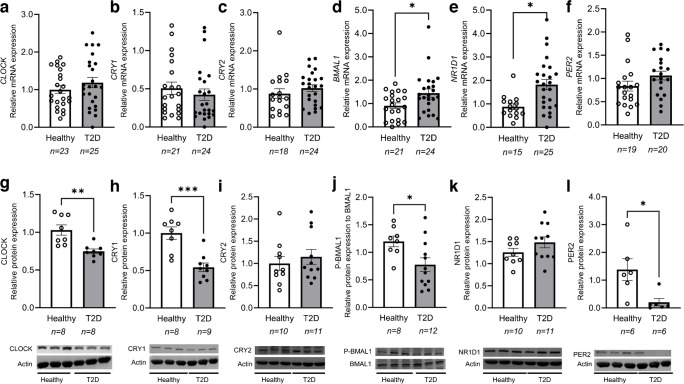
Circadian clock alterations in leukocytes from participants with type 2 diabetes (T2D) compared with healthy participants. (–) Relative mRNA expression in leukocytes from healthy participants and T2D participants: mRNA levels were normalised to 18S expression and to the healthy group levels: (), (), (), (), (), (). (–) Protein expression analysis by western blot for () CLOCK, () CRY1, () CRY2, () p-BMAL1, () NR1D1 and () PER2. Data were normalised to actin expression (or to BMAL1 for p-BMAL1) and to the healthy group protein levels. The same controls were used to normalise the protein signal in () and () and in () and (), due to the limited amount of sample (see details insection). Age-adjustedvalues are shown: *<0.05, **<0.01 and ***<0.001 a f a b c d e f g l g h i j k l h l i k CLOCK CRY1 CRY2 BMAL1 NR1D1 PER2 p p p p Methods
mRNA/protein levels for circadian rhythm markers are associated with changes in metabolic profile
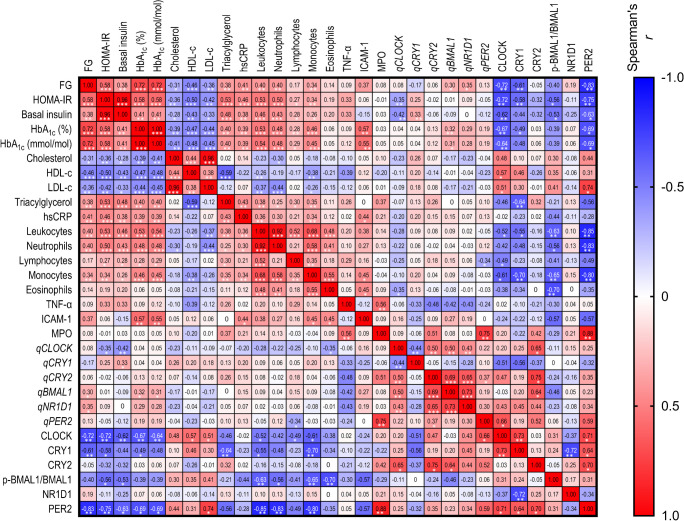
The total numbers of leukocytes and monocytes correlated negatively with CLOCK, CRY1, p-BMAL1 and PER2 (p<0.05). Neutrophil numbers correlated negatively with the circadian proteins p-BMAL1 (r=−0.56, p<0.05) and PER2 (r=−0.83, p<0.01), whereas lymphocytes correlated negatively only with CLOCK (r=−0.49; p<0.05) and eosinophils only with p-BMAL (r=−0.70; p<0.01). When analysing circadian mRNA–protein correlations, the CRY1 protein correlated positively with CLOCK (r=0.73, p<0.01) and PER2 (r=0.64; p<0.05) and negatively with NR1D1 (r=−0.72, p<0.01). CLOCK also correlated positively with PER2 mRNA and protein levels (r=0.66 and r=0.71, respectively; p<0.05). A negative correlation was observed between triacylglycerols and CRY1 (r=−0.64; p<0.01) and positive correlations were observed between CLOCK and HDL-cholesterol (r=0.57; p<0.01) and LDL-cholesterol (r=0.51; p<0.05). However, given the lipid-lowering effect of the statin treatments received by some type 2 diabetes participants, these findings for lipid parameters may not reflect the underlying pathophysiology of the disease.

Correlation of clinical parameters and inflammatory markers and gene/protein expression levels for diabetic and healthy participants (total=53). Numbers show the exact Spearmanresult, while colours represent negative correlations (blue) and positive correlations (red). Asterisks indicate statistically significant differences: *<0.05, **<0.01 and ***<0.001. HDL-c/LDL-c, HDL-cholesterol/LDL-cholesterol; the 'q' prefix corresponds to RT-qPCR data (mRNA levels) n r p p p
Type 2 diabetes impairs leukocyte–endothelial interactions

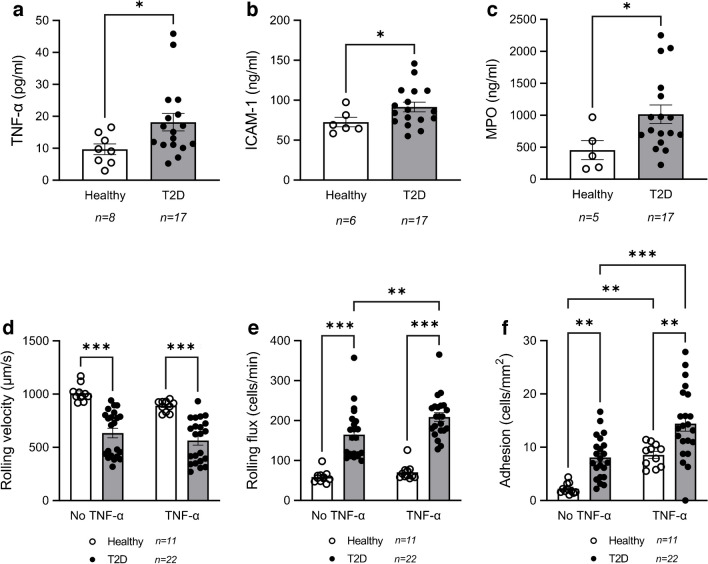
Inflammatory marker levels and leukocyte–endothelium interactions in the absence or presence of TNF-α in participants with type 2 diabetes (T2D) and healthy participants. (–) Inflammatory marker levels: () TNF-α, () ICAM-1, () MPO. (–) Leukocyte–endothelium interactions: () rolling velocity, () rolling flux, () adhesion. Asterisks indicate statistically significant differences: *<0.05, **<0.01, ***<0.001 a c a b c d f d e f p p p
The circadian rhythm inhibitor CLK8 increases leukocyte–endothelium interactions

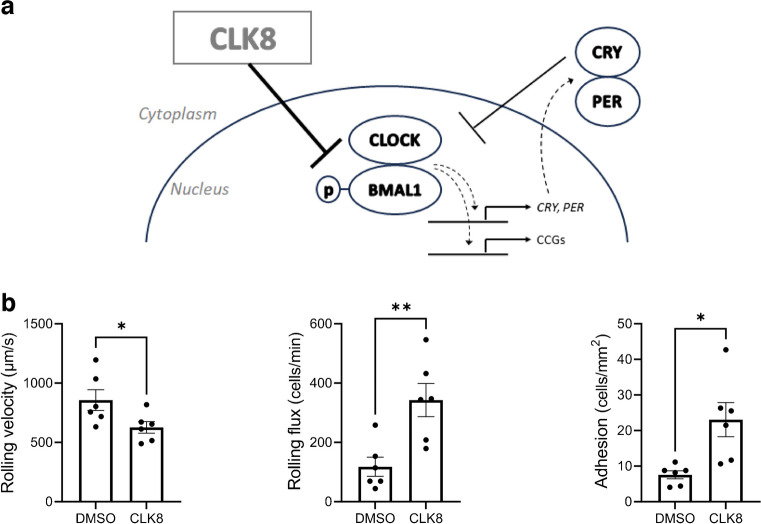
Effects of the CLOCK inhibitor CLK8. () Mechanism of action of CLK8 on the circadian rhythm modulators. CLOCK/BMAL1 promote andtranscription, creating a negative loop, as CRY and PER inhibit CLOCK/BMAL1 activity. CLK8 inhibits the interaction between CLOCK and p-BMAL1, thus reducing the transcription of CCGs (clock-controlled genes) and and, ultimately disrupting the normal negative feedback of the pathway. () Leukocyte–endothelium interactions in THP-1 cells treated with or without 20 µmol/l CLK8 for 48 h (=6). Asterisks indicate statistically significant differences: *<0.05, **<0.01 a b CRY PER CRY PER n p p
Discussion
Our data demonstrate a dysregulation of the molecular clock system in PBMCs from participants with type 2 diabetes, manifested by a decrease in CLOCK, CRY1, p-BMAL1 and PER2 protein levels and an increase in BMAL1 and NR1D1 mRNA levels. Our type 2 diabetes cohort displayed classic alterations in metabolic profile, including elevated FG, HbA1c and HOMA-IR levels and dyslipidaemia compared with healthy participants. Markers of inflammation, such as counts of various leukocyte types, were elevated in participants with type 2 diabetes. Interestingly, we found several negative correlations between the increases in these parameters and circadian clock protein levels, suggesting crosstalk between circadian clock molecular alterations and metabolic impairment and chronic inflammation. In addition, our type 2 diabetes participants displayed altered subclinical atherosclerotic markers (leukocyte rolling velocity, flux and adhesion), with a pro-atherosclerotic pattern. Alterations in leukocyte–endothelial interactions were mimicked by using a CLOCK/BMAL1 inhibitor (CLK8), which allowed us to demonstrate that circadian clock alterations in immune cells promote enhanced interaction of these cells with the endothelium, a mechanism that may underlie the high atherosclerotic risk associated with type 2 diabetes.
Altered daily rhythms are related to the development of type 2 diabetes and affect heart health, thereby increasing the chances of developing a CVD such as CHD [24 –26]. In addition to the central clock, peripheral clocks play important roles in regulating circadian rhythms in various metabolic tissues, e.g. gut, muscle or pancreas, where they regulate whole-body glucose homeostasis [27 –29]. Rhythmicity in gene expression has also been described in PBMCs [15].
Previous research suggests that chronic activation of the immune system and a high leukocyte count play a role in type 2 diabetes [30 –32]. Increased leukocyte numbers are correlated with the incidence of cardiovascular events by enhancing acute thrombosis and atherosclerosis [33]. Interestingly, the numbers of leukocytes in blood peak during the night, a phenomenon that is driven by circadian control of leukocyte trafficking [34]. Local leukocyte migration is regulated by sympathetic nerves and mediated by rhythmic expression of endothelial cell adhesion molecules and chemokines [35]. Furthermore, the levels of circulating proinflammatory cytokines peak during nocturnal sleep, whereas anti-inflammatory cytokines are preferentially secreted during the daytime [36]. In addition, cytokine secretion from activated macrophages follows circadian oscillations [34]. Circadian variation in susceptibility to myocardial infarction or ischaemic stroke has been described, with a peak in the morning [37, 38]. Therefore, one may speculate that immune cell numbers and inflammatory signalling must be properly regulated in a circadian manner for cardiovascular health to be preserved. Our findings indicate that the molecular clock system in immune cells is altered in participants with type 2 diabetes, and that these alterations occur mainly at the protein level. Previous studies have shown that leukocyte mRNA levels for core clock genes are downregulated in diabetic vs control participants [39, 40]. Importantly, ageing is a relevant factor when studying circadian gene expression levels. Indeed, in a study by Ando et al [39], when individuals with diabetes were compared with younger non-diabetic individuals, the expression levels of CLOCK, BMAL1, PER2, PER3 and CRY1 did not differ in the morning (at 09:00 hours), and only PER1 was significantly decreased in those with diabetes. In contrast, when an age-matched non-diabetes group was used for comparisons, diabetes patients displayed significant reductions in BMAL1, PER1 and PER3. As our study did not include an age-matched control group, we subdivided participants both with and without diabetes into a younger group (<50 years) and an older group (>50 years) to analyse mRNA levels. BMAL1 mRNA levels increased in the younger diabetes participants but not in the older ones compared with the corresponding healthy participants. In contrast, NR1D1 mRNA levels increased specifically in the older diabetic group, who also exhibited significantly reduced CRY1 mRNA levels. A study by Yu et al [40] also reported decreased mRNA levels for clock genes in the peripheral blood cells of individuals with diabetes, which correlated with poorer glycaemic control and increased levels of proinflammatory cytokines. However, none of these studies measured circadian protein levels: to our knowledge, our study is the first to assess post-transcriptional changes in the leukocyte molecular clock system. Regulation of clock protein levels would control the cell's circadian phase more effectively than transcript levels, as non-transcriptional mechanisms are sufficient to sustain circadian timekeeping in eukaryotes [41]. Levels of the core clock proteins assessed in our study – CRY1, CLOCK, PER2 and p-BMAL1 (the active form of BMAL1) – were significantly lower in type 2 diabetic participants than in healthy participants. This reduction was independent of age, as statistical differences remained after adjusting for this confounding factor. However, the transcript levels of these genes were unchanged in the type 2 diabetes group vs healthy participants, except for BMAL1, whose levels were higher in the former group. Differences between the mRNA levels and protein levels of these circadian genes may suggest post-transcriptional or post-translational regulation. Upregulated BMAL1 expression may be influenced by a secondary loop involving receptor-related orphan receptor (ROR) and NR1D1, whose expression is controlled by CLOCK/BMAL1 and which themselves regulate BMAL1 expression levels [42]. However, we did not observe significant changes in the protein levels of NR1D1. Several factors may have influenced our results. First, protein synthesis is altered under many conditions and by ageing [43], and the reduced translation of circadian gene peaks has been proposed as one of the mechanisms underlying the loss of circadian rhythm in ageing. Second, glucose has been proven to alter mRNA translation [44]. However, the differences found in the molecular clock between our diabetic participants and healthy participants were maintained after adjustments for age and BMI.
Intriguingly, we found several associations between downregulated clock protein levels and the altered metabolic and inflammatory profile in type 2 diabetes participants, in accordance with the results obtained by Yu et al [40], which suggests that the molecular clock is a key player in the pathophysiology of diabetes and its comorbidities. In particular, downregulation of CLOCK, p-BMAL and CRY1 protein levels is associated with poorer glucose control and increased inflammatory parameters. Given that these are only associations, we sought to clarify the direct mechanism by which alterations in the leukocyte intrinsic clock system lead to a process of increased inflammation that may ultimately precipitate the onset of CVD during diabetes. Specifically, in the present study, we established causality by inhibiting the action of the CLOCK/BMAL1 complex, having observed that leukocyte–endothelial interactions were enhanced in a similar way to that seen in type 2 diabetes participants. Future studies should investigate whether genes that regulate leukocyte capture, rolling and extravasation are clock-controlled genes under the control of the CLOCK/BMAL1 complex. Increasing our knowledge about the molecular mechanisms underlying these processes may lead to the discovery of potential targets, applications and therapeutic strategies to prevent or delay the onset of CVD in susceptible populations such as type 2 diabetes patients.
The present study has some limitations, such as the limited number of leukocytes, which meant it was not always possible to perform all the experiments for every participant. In the case of the mRNA/protein studies, mRNA was obtained for all participants, but it was not always possible to obtain proteins. However, all the participants included in the protein studies were also included in the mRNA analysis. Another limitation is that a cell-specific protein/mRNA analysis was not performed. The lack of variation in some of the circadian mRNA expression analyses between type 2 diabetic participants and healthy participants may have been a consequence of these factors.
In summary, the present study is relevant in that we demonstrate a decrease in core clock proteins in the leukocytes of participants with type 2 diabetes and overweight, and a correlation of this decrease with the impaired metabolic and proinflammatory profile seen in type 2 diabetes. CLOCK/BMAL1 inhibition increases leukocyte–endothelial interactions in THP-1 cells, suggesting a role for this machinery in acceleration of the inflammatory process. Altogether, our results help to understand the underlying mechanisms of onset of CVD in type 2 diabetes, and thus represent a step towards the development of new targets and therapeutic strategies to address this pathology.
Supplementary Information
Below is the link to the electronic supplementary material. Supplementary file1 (PDF 1.15 MB)