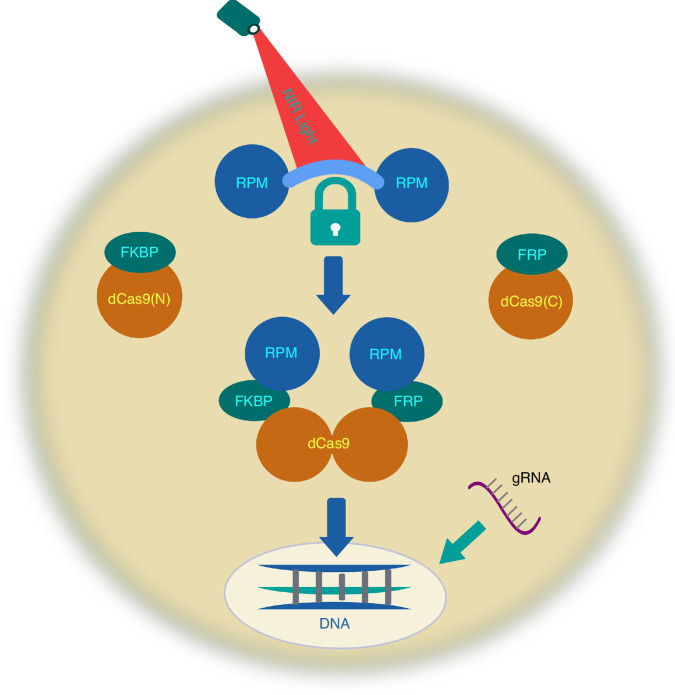
CRISPR (Clustered Regularly Interspaced Short Palindromic Repeats) technology for studying gene function and uncovering mechanisms1, in the hands of biologists, has fundamentally reshaped modern biology. This method enabled the creation of thousands of cells and animal models with precisely engineered features. The work that once required years of trial-and-error experiments now, with CRISPR, can be performed within weeks rapidly and reproducibly, transforming the pace of discovery in biology and promising to change the future medicine.
But in the hands of biomedical engineers and imaging scientists, CRISPR takes on a new height. It is no longer just a tool for editing the genome, but also a part of the optical toolbox, together with other optical instruments such as lasers, lenses, and detectors. This new tool adds another dimension by enabling researchers to control gene expression and its functions by optical means through the tissue. This expanded toolbox is especially powerful when applied to small animals, where the longstanding challenge of inducing these changes non-invasively deep inside of living animals, in an exact location and in real time, has long been considered the "holy grail" of modern biology.
The study by Zhang et al.2, led by the scientists from the Center for Advanced Biomedical Imaging and Photonics at Harvard University and RNA Institute from the University at Albany recently published in Light: Science & Applications, addresses this high-bar challenge by introducing a CRISPR system that can be activated deep within tissues using light. Their innovative platform combines clever synthetic chemistry, gene editing, and optical engineering to produce a system that not only edits genes but does so on demand, with light, and with unprecedented spatial control.
Photoactivatable CRISPR systems, which only function upon illumination, have shown great promise in a number of cell studies over the last decade3–5. These systems have been shown to achieve robust OFF-ON switching with minimal background activity, rapid activation upon light exposure, and high editing efficiency in mammalian cells, as well as in model organisms such as zebrafish embryos6. Efforts to regulate CRISPR activity using light have taken many creative forms. Blue-light-inducible systems, such as those employing CRY2-CIB1 or Magnet-based heterodimerization domains3, allow for reversible control of Cas9 or dCas9 activity. Other strategies rely on caged guide RNAs or photocaged amino acids to block CRISPR function until uncaged by ultraviolet (UV) light6,7. However, these technologies face significant translational obstacles.
Most of such systems rely on UV or blue light, which suffer from limited tissue penetration due to the high scattering of these high energy photons by the tissue (recall why sky is blue). There are also the concerns about high absorption of these photons by tissue components, and phototoxicity resulting in producing strong radicals and damaging DNA (recall why we need sunscreen). These drawbacks make the use photoactivatable CRISPR systems in any in vivo applications impractical. To overcome these issues, Zhang et al. introduce an elegant solution based on a near-infrared (NIR) light-activatable CRISPR system.
NIR photons can travel relatively deep into the tissue without much scattering or being absorbed by the tissue components (i.e. blood, and other tissues are relatively transparent in the NIR range) and their energy is too low to cause unwanted biochemical reactions. For that reason, NIR is widely used approach in the imaging of small animals8,9, but not that much in gene editing.
The approach developed represents a paradigm shift in CRISPR control: it introduces a two-component activation system that merges light-triggered chemistry with conditional protein assembly. At its core is a specially engineered rapamycin dimer linked via a photocleavable NIR dye, which makes the contract biologically inert until exposed to light. The usage of the dye is itself an innovation. Most of the efforts were to design NIR dye photostable, weak photostability has been considered to be detrimental in bioimaging applications. The authors of the paper exploit dye's vulnerability to photobleaching as an asset. Upon irradiation, IR780 (extensively chemically modified to bind rapamycin) undergoes a regioselective photooxidative cleavage that disrupts the caged structure, rapidly freeing rapamycin in its active form. The released rapamycin retained its ability to reconstitute split Cas9/dCas9 with high efficiency, while the overall construct remained stable, cell-permeable, and biocompatible. This reaction occurs within seconds and is robust under biologically relevant conditions. This highly creative molecular engineering feat enabled rapid, reversible, and highly specific gene activation using light.
Looking into the future, the chemically induced, NIR-responsive CRISPR system developed by Zhang et al. offers a powerful new tool for fast and reproducible genome engineering in vivo. While this method has not been applied to the live animals yet, the creative combination of photochemistry with synthetic chemistry and biology, brings this platform closer to the long-sought goal of safe gene therapy in humans.