
What this is
- This research investigates the relationship between (GLP-1RAs) and () with the risk of developing () in patients with type 2 diabetes (T2D).
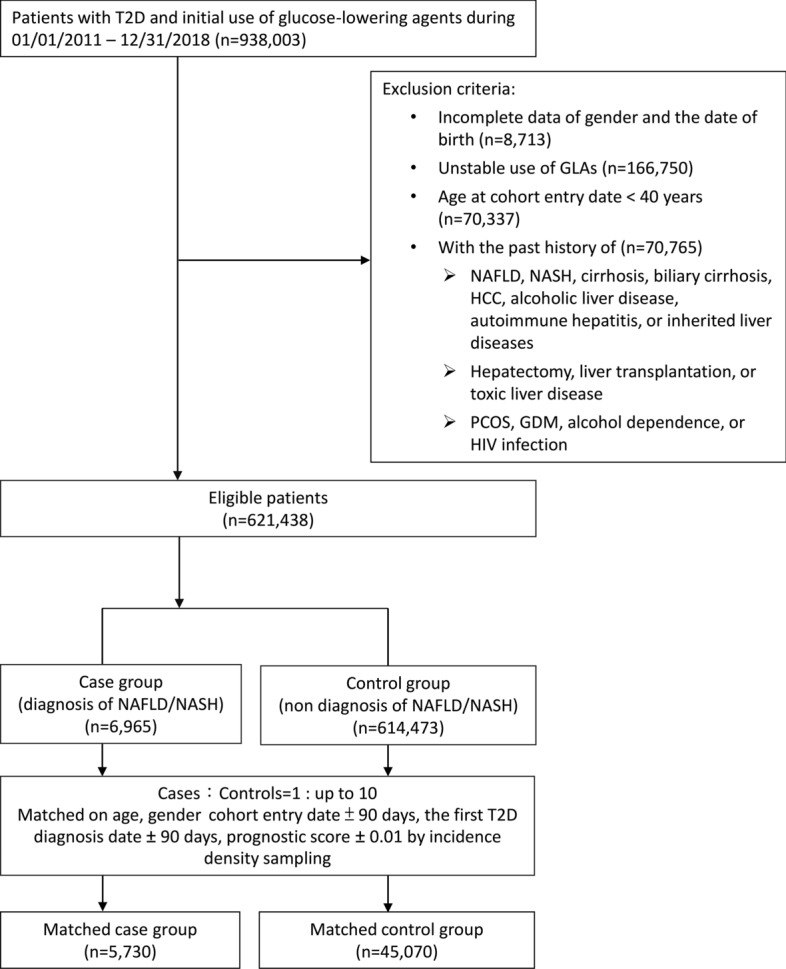
- Using a nationwide cohort from Taiwan, the study included 621,438 patients over a median follow-up of 1.8 years.
- Findings suggest that higher cumulative doses of are associated with a reduced risk of /NASH, while GLP-1RAs show an insignificantly lower risk.
Essence
- GLP-1RAs and may lower the risk of developing /NASH in T2D patients, particularly with increased SGLT2i exposure. The study highlights the potential hepatoprotective effects of these glucose-lowering agents.
Key takeaways
- Use of is linked to a significantly lower risk of /NASH with a cumulative dose greater than 143 defined daily doses (0.61 [0.38–0.97]). This indicates that higher doses may provide protective benefits against liver disease.
- GLP-1RA therapy is associated with an insignificantly lower risk of /NASH events (adjusted OR: 0.84 [0.46–1.52]). Although not statistically significant, this trend suggests potential benefits worth further investigation.
- The study captures 5,730 /NASH cases among a large cohort, emphasizing the relevance of monitoring liver health in T2D patients treated with these newer glucose-lowering agents.
Caveats
- The study's power may be limited due to the low number of SGLT2i and GLP-1RA users during the study period, affecting the ability to detect significant differences.
- Results may not be generalizable beyond the Taiwanese population, as the findings are based on ethnic Chinese patients, which could limit broader applicability.
- The nested case-control design may restrict causal inferences compared to cohort studies, suggesting that future research should include active comparators for more robust conclusions.
Definitions
- Non-alcoholic fatty liver disease (NAFLD): A condition characterized by excess fat accumulation in the liver not due to alcohol consumption, often associated with obesity and diabetes.
- SGLT-2 inhibitors (SGLT2is): A class of medications that help lower blood sugar by preventing glucose reabsorption in the kidneys.
- GLP-1 receptor agonists (GLP-1RAs): Medications that mimic the action of the glucagon-like peptide-1 hormone, enhancing insulin secretion and reducing appetite.
Simplified
Background
Type 2 diabetes (T2D) shares several cardiometabolic and prognostic factors that are highly correlated with the development of non-alcoholic fatty liver disease (NAFLD) [1, 2]. About 60–80% of T2D patients have NAFLD or advanced liver diseases (i.e., non-alcoholic steatohepatitis [NASH], cirrhosis, hepatocellular carcinoma [HCC]) [3]. NAFLD will become the major etiology of HCC given the increasing coverage of the hepatitis B vaccine and rapid development of anti-viral drugs for hepatitis C virus (HCV) [4].
Although the U.S. Food and Drug Administration recently approved resmetirom for the treatment of adults with noncirrhotic NASH [5], lifestyle modification or alone, including smoking cessation, diet control, weight management, and exercise, remains essential [6 –8]. For T2D patients with biopsy-proven NASH, thiazolidinediones (TZDs) might be a suitable treatment for steatohepatitis [9]. A systematic review of eight randomized trials showed that pioglitazone was associated with fibrosis improvement (odds ratio [OR]: 1.66, 95% confidence interval [CI]: 1.12–2.47) [10]. Recently, novel glucose-lowering agents (GLAs), namely glucagon-like peptide-1 receptor agonists (GLP-1RAs) [11 –13] and sodium-glucose cotransporter 2 inhibitors (SGLT2is) [14, 15], were shown to improve liver fibrosis-related biomarkers such as alanine aminotransferase (ALT), visceral adipose tissue volume, and liver fat content. Unfortunately, a phase 2 study of semaglutide for NASH-related cirrhosis failed to achieve its primary goal (i.e., fibrosis improvement or NASH resolution) [16]; the pivotal phase 3 trial is still ongoing [17].
Despite the lack of trial evidence supporting the efficacy of GLP-1RAs or SGLT2is on the primary prevention of NAFLD, few real-world studies had evaluated the effects of GLP-1RAs and SGLT2is on incident NAFLD events [18 –20]. Specifically, the UK Clinical Practice Research Datalink (CPRD) study found that use of SGLT2is was significantly associated with a lower risk of incident NAFLD events compared to that for use of dipeptidyl peptidase 4 inhibitors (DPP4is) [19]. An insignificantly reduced risk was also reported in a recent study of Korea populations [20]. Use of GLP-1RAs had an insignificantly reduced lower NAFLD risk compared to that for use of insulin [18] or DPP4i [19] based on the CPRD database. However, caution should be taken when interpreting these results due to short follow-up periods (i.e., 1.1–1.4 years [18 –20]), the possibility of confounding bias caused by the inclusion of advanced T2D cases (i.e., requiring intensive insulin therapy [18]), uncertain liver effects (e.g., incident NAFLD) of active comparators (i.e., DPP4is [19, 20] and insulin [18]), lack of dose-response analysis, and limited generalizability to other ethnic populations.
The rapid increase of the prevalence of NAFLD among T2D patients has highlighted urgency for corroborating the hepatoprotective effects of newer GLA therapies. Therefore, we sought to investigate the risk of incident NAFLD associated with the use of GLP-1RAs and SGLT2is in a Chinese population with T2D.
Methods
Study design and database
We conducted a nested case–control study utilizing a nationwide cohort of patients with T2D derived from Taiwan's National Health Insurance Research Database (NHIRD), which contains healthcare records for > 99% of Taiwan's population of 23 million [21]. This database comprises comprehensive information at the individual level, including demographic data, diagnostic codes, procedure codes, and detailed prescriptions records. The nested case–control study design was chosen because it (1) enhances statistical efficiency (i.e., no need to classify treatment exposure for each person-moment of follow-up), (2) allows homogenous populations to be utilized, reducing the potential selection bias in conventional case–control study design, (3) minimize the concern of immortal time bias under a variety of cohort study designs [22 –24], (4) accommodates rare events (i.e., incident NAFLD/NASH events according to previous UK and US studies), and (5) allows treatment dose–response analysis [25, 26]. This study was approved by the Institutional Review Board of National Cheng Kung University Hospital (A-EX-109-035).
Cohort population

Cohort selection flow chart
Definition of study outcomes
The main outcomes of interest were incident NAFLD/NASH events, which were ascertained when a patient had three consecutive outpatient diagnoses of NAFLD/NASH within 1 year or at least one inpatient diagnosis of NAFLD/NASH. We adopted a valid diagnosis coding system for NAFLD/NASH, namely code 571.8 in the International Classification of Diseases, Ninth Revision, Clinical Modification (ICD-9-CM), and code K75.81 in the ICD-10-CM, which had a positive predictive value of 92.0% in a previous study [27]. The first date of NAFLD/NASH diagnosis was defined as the index date. Of note, the term "NAFLD", instead of "metabolic dysfunction-associated steatotic liver disease" (MASLD) defined by the latest American Association for the Study of Liver Diseases (AASLD) guidelines [28], was used in this study considering the high prevalence of hepatitis B virus (HBV) and HCV infections in Taiwan. [29, 30] Each study subject was followed from the cohort entry date (i.e., GLA initiation) until the occurrence of a study event of interest (i.e., incident NAFLD/NASH event), withdrawal from the National Health Insurance program, death, or the end of the study database (December 31, 2018), whichever came first.
Case and control subject selection
| GLAs | No. (%) of cases (n = 5,730) | No. (%) of controls (n = 45,070) | Crude odds ratio (95% CI) | Adjusted odds ratio (95% CI) | ||||
|---|---|---|---|---|---|---|---|---|
| GLP-1 RAs as exposure (main analysis) | ||||||||
| No exposure | 5,715 | (99.74) | 44,978 | (99.80) | 1 | Ref. | 1 | |
| Ever use | 15 | (0.26) | 92 | (0.20) | 1.11 | (0.62–1.97) | 0.84 | (0.46–1.52) |
| Cumulative duration (days)a | ||||||||
| ≤ 183 | 11 | (0.19) | 49 | (0.11) | 1.41 | (0.70–2.84) | 1.05 | (0.51–2.17) |
| > 183 | 4 | (0.07) | 43 | (0.10) | 0.72 | (0.25–2.07) | 0.56 | (0.19–1.64) |
| Cumulative dose (DDD)a | ||||||||
| ≤ 180 | 10 | (0.17) | 47 | (0.10) | 1.35 | (0.65–2.79) | 1.04 | (0.48–2.22) |
| > 180 | 5 | (0.09) | 45 | (0.10) | 0.83 | (0.32–2.14) | 0.62 | (0.23–1.62) |
| SGLT-2 inhibitors as exposure (main analysis) | ||||||||
| No exposure | 5,672 | (98.99) | 44,606 | (98.97) | 1 | Ref. | 1 | Ref. |
| Ever use | 58 | (1.01) | 464 | (1.03) | 0.99 | (0.74–1.33) | 0.85 | (0.63–1.15) |
| Cumulative duration (days)a | ||||||||
| ≤ 183 | 36 | (0.63) | 252 | (0.56) | 1.23 | (0.85–1.78) | 1.02 | (0.70–1.49) |
| > 183 | 22 | (0.38) | 212 | (0.47) | 0.75 | (0.48–1.19) | 0.67 | (0.42–1.06) |
| Cumulative dose (DDD)a | ||||||||
| ≤ 143 | 36 | (0.63) | 232 | (0.51) | 1.37 | (0.94–1.98) | 1.13 | (0.77–1.66) |
| > 143 | 22 | (0.38) | 232 | (0.51) | 0.68 | (0.43–1.08) | 0.61 | (0.38–0.97) |
| Other regimen exposure (secondary analyses) | ||||||||
| TZDs | 367 | (6.40) | 2,973 | (6.60) | 0.98 | (0.87–1.10) | 0.87 | (0.77–0.98) |
| DPP-4 inhibitors | 1,393 | (24.31) | 9,605 | (21.31) | 1.17 | (1.10–1.26) | 1.07 | (1.00–1.15) |
| Incretin-basedb | 1,397 | (24.38) | 9,635 | (21.38) | 1.17 | (1.09–1.26) | 1.07 | (1.00–1.15) |
| Weight-loss effectc | 72 | (1.26) | 542 | (1.20) | 1.03 | (0.79–1.35) | 0.86 | (0.65–1.12) |
| Newer GLAsd | 1,418 | (24.75) | 9,836 | (21.82) | 1.17 | (1.09–1.25) | 1.06 | (0.99–1.13) |
Exposure measurement
Use of GLA were measured according to the World Health Organization Anatomical Therapeutic Chemical Classification System (Supplemental Table 2). The primary exposure was the ever use of GLP-1RAs or SGLT2is, defined as the presence of at least one prescription between the date of cohort entry and the year before the index date. Among ever users, we further defined long-term users as those who had a cumulative defined daily dose or a duration of GLA use higher than the median values. Additional analyses categorized the exposure of GLAs into incretin-based agents (i.e., DPP4is and GLP-1RAs), weight-loss effect agents (i.e., GLP-1RAs and SGLT2is), and newer GLAs (i.e., DPP4is, GLP-1RAs, and SGLT2is) (Supplemental Table 2). Patients without exposure to GLP-1RAs or SGLT2is were placed into the reference group for the analyses.
Measurement of covariates
Patient clinical characteristics and associated prescriptions were measured during the year before the cohort entry date. They included diabetes-related complications (i.e., nephropathy, neuropathy, retinopathy, peripheral vascular diseases, hypertension, myocardial infarction, cardiac arrhythmia, heart failure, and stroke), NAFLD/NASH-associated comorbidities (i.e., chronic hepatitis B virus [HBV], HCV infection, HBV carrier, obesity, dyslipidemia, hypothyroidism, obstructive sleep apnea, psoriasis, and gout), and drugs (e.g., amiodarone, methotrexate, systemic corticosteroids, valproate, carbamazepine, tamoxifen, tocopherol, and antiviral agents) that may be associated with increased risk of steatohepatitis. To minimize potential unmeasured confounding caused by a lack of data regarding patients' body mass index (BMI), glycated hemoglobin (HbA1c), lipid profile, and frailty, we also measured the receipt of bariatric surgery (as a proxy for a person having BMI ≥ 35 kg/m2 in a Taiwanese setting), diabetes complications severity index (DCSI), numbers of HbA1c and low-density lipoprotein (LDL) tests, and hospital admissions as surrogate indicators. The above variables are detailed in Supplemental Table 1. To address potential time-dependent bias, we also measured the above variables in the year before the index date, except for primary exposures (i.e., GLP-1RAs and SGLT2is), to estimate the DRS using a logistic regression analysis [31] and adjusted the score in the analyses (i.e., NAFLD/NASH events) (Supplemental Fig. 1).
Statistical analysis
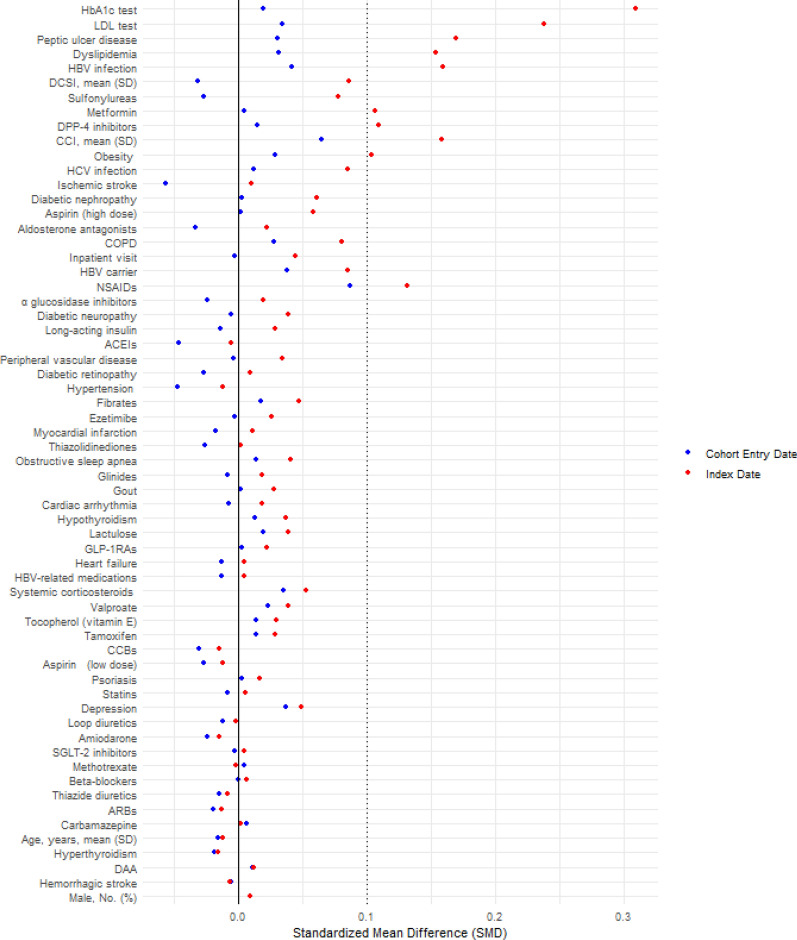
The crude incidence rate of NAFLD events was estimated as the number of events per 1,000 person-years. The difference between cases and the control in patient characteristics was tested using the standardized mean difference (SMD), with a value greater than 0.1 indicating a statistically significant difference. Multivariable conditional logistic regression was used to estimate ORs and associated 95% CIs of events with treatment exposure. All analyses were performed using the statistical software SAS 9.4 (SAS Institute Inc.).
Sensitivity and subgroup analyses
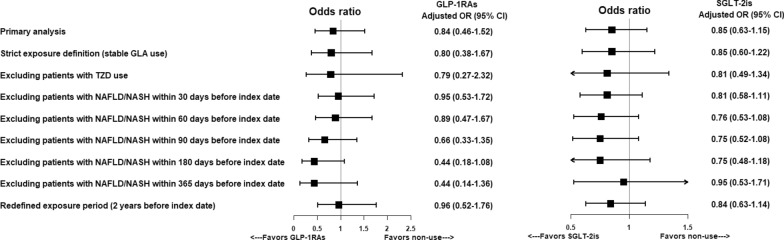
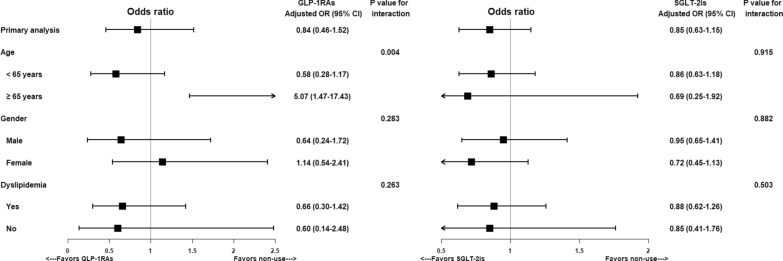
We conducted several sensitivity and subgroup analyses to test the robustness of our findings. First, to minimize misclassification bias, ever users were re-defined and restricted to patients with stable use of GLAs (i.e., GLP-1RA or SGLT2i) in the analyses (defined as at least three GLA prescriptions with any gaps between two consecutive refills of less than 30 days). Second, we excluded patients who had any TZD records during follow-up from the cohort entry date (i.e., GLA initiation) to the index date (i.e., liver event occurrence), given its potential liver benefit. Third, we used a lag-time approach to address protopathic bias. [32, 33] That is, we excluded patients who had NAFLD/NASH events within 30, 60, 90, 180, and 365 days following cohort entry because these subjects were considered as high-risk patients for liver events. Fourth, instead of total follow-up for treatment exposure in the primary analyses, we only assessed the exposure of GLAs in the 2 years prior to the index date (i.e., liver event occurrence) to strength the relationship between the study event and exposure. Fifth, we used a positive control exposure to rule out potential confounding bias, thereby validating our study protocol and affirming database quality. That is, we estimated the risk of NAFLD/NASH with TZD use given the compelling liver benefit of TZD therapy [9]. Sixth, we also applied an array approach to estimate the impact of unmeasured confounding (i.e., BMI) [34]. Lastly, we conducted a series of subgroup analyses stratified by age (< 65 and ≥ 65 years) at cohort entry, gender, and the presence of dyslipidemia in the year before/at the cohort entry date.
Results
Use of GLP-1RAs was associated with an insignificantly lower risk of NAFLD/NASH events (adjusted OR [aOR]: 0.84 [95% CI: 0.46–1.52]). A longer duration (> 183 days) and a higher cumulative dose (> 180 defined daily dose) of GLP-1RA therapy were associated with an insignificantly reduced risk of NAFLD/NASH events (i.e., 0.56 [0.19–1.64] and 0.62 [0.23–1.62], respectively; Table 1).
Similarly, SGLT2i users had an insignificantly lower risk of NAFLD/NASH events (aOR: 0.85 [95 CI%: 0.63–1.15]) compared to non-users. A statistically significantly lower risk among those with a cumulative SGLT-2i dose of more than 143 defined daily dose (0.61 [0.38–0.97]) was observed. Furthermore, TZD use, as a positive control exposure in our study, was associated with a lower risk of NAFLD/NASH events (aOR: 0.87 [95% CI: 0.77–0.98]). Similar findings were observed in GLA regimens with a weight-loss effect (i.e., GLP-1RAs and SGLT2is) (i.e., 0.86 [0.65–1.12]; Table 1).

Absolute standardized mean differences of baseline characteristics between cases and controls at cohort entry date and index date

Risk of development of NAFLD events associated with use of GLP-1RAs or SGLT2is as compared to non-use (primary and sensitivity analyses)

Risk of development of NAFLD associated with use of GLP-1RAs or SGLT2is as compared to non-use (primary and subgroup analyses)
Discussion
This study is the first to assess the effect of newer GLAs (i.e., GLP-1RAs and SGLT2is) on the development of NAFLD/NASH in an ethnic Chinese population. By utilizing 8 years of longitudinal data from a nationwide population with T2D, we captured more NAFLD/NASH events (i.e., 5,730) that developed in the study period compared to those reported in previous studies (i.e., 1,998–2,526 [18 –20]). A trend of a lower risk of incident NAFLD/NASH events associated with GLP-RA and SGLT2i use was observed, with a significantly reduced risk related to increased exposure to SGLT2i treatment. Hence, these GLAs, which have a weight-loss effect, might alleviate the risk of developing NAFLD/NASH for patients with T2D. Consistent results across several sensitivity and subgroup analyses not only support the validity of our findings but also enhance their applicability to real-world patients with T2D.
SGLT2is and NAFLD/NASH risk
Although the exact mechanisms of the hepatic effect of SGLT2i therapy remain unclear, several possible hypotheses have been proposed to support the decreased risk of NAFLD following this treatment. First, SGLT2is have a weight-loss effect, which is essential for the management of NALFD/NASH. Second, SGLT2is have pleiotropic effects on metabolic diseases, including anti-inflammation [35], blood pressure reduction, lipid profile improvement, and a lowering of the risk of cardiovascular diseases and chronic kidney diseases, of which NAFLD is considered to be the hepatic manifestation. Beyond the biological evidence, existing systematic reviews suggest the potential hepatic benefits of SGLT2i therapy for T2D patients [36 –38]. That is, compared to placebo (non-use) or active comparators (i.e., metformin, TZD, and insulin), use of SGLT2is significantly decreased visceral adipose tissue volume and liver enzymes (i.e., alanine aminotransferase [ALT], aspartate aminotransferase [AST]). Of note, this review evidence [36 –38] only included patients with established NAFLD/NASH. Only two previous observational studies, one from UK [19] and one from Korea [20], investigated the effect of SGLT2i therapy for preventing the development of NAFLD/NASH in T2D patients. They showed marginally significantly reduced risks of incident NAFLD/NASH events following use of SGLT2is (i.e., aORs [95% CIs]: 0.79 [0.64–0.96] [19] and 0.93 [0.80–1.08] [20], respectively). However, caution should be taken when interpreting these results because the primary analyses in these studies [19, 20] were based on the as-treated scenario, which may limit the applicability of these results to patients with optimal treatment adherence. In addition, these analyses are prone to informative censoring (when adherence was estimated on censored data), thereby causing potential bias in the efficacy analysis and masking the true treatment differences in real-world settings, where suboptimal adherence or treatment discontinuation is common.
In contrast, our primary analysis was based on the intention-to-treat scenario, which acknowledges the complexity of drug therapies in managing T2D and thus does not censor (stop the observation of) a patient when the treatment pattern changes, thereby enhancing the applicability of our results to real-world populations. In addition, our analysis findings revealed high persistence rates in the use of SGLT2is [medication possession ratio (MPR): 93.1%] and GLP-1RAs (MPR: 88.8%) among our study patients, thereby minimizing the potential of misclassification bias caused by the intention-to-treat scenario in a study with a long-term observational period. Similarly, our study found that use of SGLT2is was associated with a lower but insignificant risk of incident NAFLD/NASH events (i.e., aOR [95% CI]: 0.85 [0.63–1.15]). In addition, patients with a higher cumulative dose of SGLT2i had a significantly decreased incidence of NAFLD/NASH (i.e., aOR [95% CI]: 0.61 [0.38–0.97]). This result is supported by a previous animal study that showed a reduction in liver enzymes and insulin resistance associated with increased dapagliflozin dose [39]. Hence, a longer exposure or higher dose of SGLT2i therapy is suggested for T2D patients at high risk for the development of NAFLD/NASH.
GLP-1RAs and NAFLD/NASH risk
The potential mechanisms of GLP-1RAs for preventing NAFLD/NASH events are similar to those of SGLT2is (i.e., weight-loss and metabolic effects). Previous studies investigated the effect of current GLP-1RA use on incident NAFLD/NASH events in relatively short follow-ups (i.e., 26 weeks [18] and 1.4 year [19]) and found that the results depended on the active comparator [18, 19]. Specifically, GLP-1RA users were associated with a higher risk of the development of NAFLD/NASH compared to current insulin users (aHR [95% CI]: 1.22 [0.91–1.63]) [18] but a decreased risk compared to current users of sulfonylureas (0.85 [0.64–1.13]) [18] or DPP4i (0.83 [0.66–1.63]) [19]. Of note, insulin users, as active comparators, represented more advanced T2D patients (i.e., requiring intensive glycemic control), and thus confounding by indication in these selective patients cannot be ruled out; such confounding could mask the beneficial liver effect of GLP-1RAs [18]. For example, for patients with obesity or high BMI levels, physicians might not prescribe insulin considering its potential weight gain effect.
The present study also found that GLP-1RA use reduced the risk of NAFLD/NASH despite insignificant results (i.e., aOR [95% CI]: 0.84 [0.46–1.52]). In addition, our dose–response results were consistent with the findings of a phase 2 trial of semaglutide among patients with NASH [40], showing dose-dependent reductions in liver-related biomarkers (i.e., ALT, AST, and cytokeratin-18 fragments). Hence, GLP-1RAs may also be recommended to patients with T2D, especially those with obesity, at the maximum tolerated dose for its adverse events (e.g., gastrointestinal side effects) as a preventive strategy against NAFLD/NASH.
Potential limitations
First, the low number of SGLT2i users (given its listing in Taiwan's National Health Insurance program since 2016) or GLP-1RA users (due to restricted reimbursement criteria by Taiwan's National Health Insurance program) in our study period (i.e., 2007–2018) may affect the study's power to detect statistical significance. Second, this study of a Taiwanese population might only be generalizable to ethnic Chinese populations. Third, while a nested case–control design is effective for evaluating associations, it may have a limited ability to infer causality compared with a cohort design. This is particularly true when assessing drug effects, where cohort studies with active comparators can offer more robust causal insights. So, future studies using a cohort design with active comparators, such as metformin or DPP4i, would help validate our findings. Fourth, potential unmeasured confounding effects (e.g., HbA1c and BMI) on the study results may exist. However, we mitigated potential unmeasured confounding effects by employing proxy variables, (e.g., DCSI was used for diabetes severity and obesity surgery was used to identify morbidly obese patients). In addition, we implemented a rule-in approach (i.e., array approach) to estimate the impact of BMI on GLP-1RA effectiveness. The results indicate that when BMI is adjusted for in the analyses, GLP-1RAs exhibit greater efficacy in preventing NAFLD/NASH. Further large-scale multi-country studies based on the target trial emulation approach, which can eliminate the biases and confounding effects commonly seen in observational studies, using real-world data are warranted to confirm our findings. Fifth, the recent AASLD guidelines redefined the diagnostic criteria of metabolic liver diseases, namely MASLD [28]. Most of our study patients would meet the criteria for MASLD, since they were T2D patients experiencing steatotic liver disease events. However, approximately 5% of study patients also had co-existing viral hepatitis (i.e., HBV and HCV), which could not be fully excluded in our study setting (i.e., Taiwan [29, 30]). Future studies based on the MASLD definition for study outcomes remain warranted to corroborate our findings.
Conclusions
Use of SGLT2is or GLP-RAs might be associated with decreased risks of incident NAFLD/NASH events, especially longer exposure or higher dose of SGLT-2i therapy. These treatments should thus be prioritized for patients with T2D at risk for the development of NAFLD/NASH (e.g., obesity).
Supplementary Information
Supplementary Material 1.