
What this is
- This systematic review and meta-analysis evaluates the efficacy and safety of , an oral GLP-1 receptor agonist, in obese adults with or without type 2 diabetes mellitus (T2DM).
- The analysis included five randomized controlled trials (RCTs) involving 4410 participants.
- demonstrated significant weight loss and improvements in glycemic and lipid parameters, but was associated with increased gastrointestinal adverse events.
Essence
- effectively reduces body weight, , and lipid levels in obese adults, with maximal benefits at higher doses. Gastrointestinal side effects are a notable limitation.
Key takeaways
- reduced body weight by −6.67% compared to placebo, with greater reductions in non-diabetic patients (−8.5%) vs. diabetic patients (−4.87%).
- Significant reductions in (−0.75%) and fasting plasma glucose (−25.01 mg/dL) were observed, particularly in diabetic patients (: −1.09%; fasting glucose: −30.75 mg/dL).
- Adverse events were more frequent with doses ≥ 12 mg, leading to higher treatment discontinuation rates, particularly at 24 mg (RR: 4.61) and 36 mg (RR: 3.68).
Caveats
- The number of included RCTs was small, limiting the ability to draw long-term conclusions about efficacy and safety.
- Most trials had short durations, which may not reflect the long-term effects of .
- All studies were sponsored by the drug manufacturer, raising concerns about potential bias.
Definitions
- Orforglipron: An oral, non-peptide GLP-1 receptor agonist used for weight management and glycemic control.
- HbA1c: A measure of average blood glucose levels over the past 2-3 months, used to assess diabetes control.
Simplified
Introduction
Obesity is defined as abnormal or excessive fat accumulation that poses a significant health risk, primarily characterised by a body mass index (BMI) of 30 kg/m2 or higher [1]. This progressive multifactorial disease has reached epidemic proportions worldwide, affecting both developed and developing nations. Current epidemiological evidence suggests that globally there are over 600 million adults classified as obese, representing a nearly three‐fold increase since 1975 [2]. According to the World Health Organization (WHO) estimates, in 2022 approximately 2.5 billion adults (43% of the global adult population) aged 18 years or older were overweight, with 890 million individuals (16%) meeting the criteria for obesity [3].
Obesity is linked to numerous health consequences such as type 2 diabetes mellitus (T2DM), cardiovascular diseases (CVD), hypertension, dyslipidemias, certain cancers, fatty liver disease, osteoarthritis, and obstructive sleep apnea [4, 5]. These comorbidities substantially compromise quality of life (QoL), increase disability, and result in higher all‐cause mortality, marking obesity as a major public health concern that contributes to a greater disease burden and economic costs [4]. The economic impact of obesity extends beyond direct healthcare expenditures such as medical care, hospitalizations, medications as well as indirect costs like less productivity, absenteeism, and premature mortality. Obesity is estimated to account for approximately 2%–3% of global GDP in healthcare and productivity losses, with forecasts suggesting this figure could exceed 3% by 2060 if current trends continue [6, 7].
The management of obesity requires a multifaceted approach that includes lifestyle modification, pharmacotherapy, and bariatric surgery [8, 9]. Bariatric surgery is effective in achieving substantial and lasting weight loss (up to 25%); however, its invasive nature, high cost, surgical risks, and restrictive eligibility criteria significantly limit accessibility. Additional barriers include potential complications, long‐term nutritional deficiencies, and the requirement for lifelong medical surveillance [9]. Pharmacotherapy offers an intermediate strategy with GLP‐1 receptor agonists (mainly injectables), orlistat, and combination therapies such as naltrexone‐bupropion and phentermine‐topiramate [8, 10]. GLP‐1 receptor agonists, including liraglutide, semaglutide, and tirzepatide (dual GIP/GLP agonists), have revolutionised the field of obesity pharmacotherapy by facilitating substantial weight loss, achieving an average reduction of 9% with liraglutide, up to 15% with semaglutide, and 18% with tirzepatide [11, 12]. In the context of emerging dual GIP/GLP 1 receptor agonists, the development of orforglipron represents an important advancement. As a potent oral GLP 1 receptor agonist, orforglipron offers the potential to enhance accessibility, simplify administration, and improve long‐term adherence in the management of obesity [13, 14]. Nevertheless, its use is constrained by the subcutaneous administration route, high costs, side effects, and adherence difficulties [11, 15].
The emergence of oral semaglutide provided an alternative to injectable GLP‐1 RAs. Yet, its adoption is restricted by a complicated dosing protocol that necessitates administration while fasting with water, as well as the avoidance of food or medications for a minimum of 30 min afterward. Such requirements reduce convenience and compromise adherence in routine practice [11, 16]. Oral semaglutide co‐formulation with sodium N‐(8‐[2‐hydroxybenzoyl] amino) caprylate (SNAC), a pharmaceutical absorption enhancer facilitates peptide absorption through three distinct mechanisms: (1) neutralisation of the local gastric pH microenvironment, thereby protecting semaglutide from enzymatic degradation; (2) reduction of semaglutide oligomerization; and (3) transient, reversible enhancement of gastric epithelial membrane permeability to enable transcellular drug absorption. Despite the transient nature of SNAC‐mediated permeability changes, clinical studies have demonstrated that oral semaglutide increases levothyroxine systemic exposure by 33%. This clinically significant drug interaction necessitates careful monitoring of thyroid function parameters in patients receiving concurrent thyroid hormone replacement therapy [17].
Orforglipron (LY3502970), first‐in‐class oral, non‐peptide partial agonist of the GLP‐1 receptor that favors activation of G protein over β‐arrestin recruitment. Unlike oral semaglutide, orforglipron allows for once‐daily oral dosage without fasting or water intake restrictions, potentially enhancing both adherence and accessibility [18]. Orforglipron exerts GLP‐1 mediated effects by suppressing appetite, delaying gastric emptying, and improving glycemic control [18]. Phase 2 Randomised Clinical Trials(RCTs) have reported significant weight reduction of up to 14.7% at 36 weeks, alongside improvements in cardiometabolic markers in patients with obesity and type 2 diabetes, demonstrating an efficacy and safety profile comparable to injectable liraglutide and superior to oral semaglutide at standard doses [18, 19].
Given its promising weight loss efficacy and favourable cardiometabolic profile, orforglipron may offer a transformative therapeutic option for obesity management. However, the evidence is currently scattered among individual RCTs. Therefore, this systematic review and meta‐analysis aims to evaluate the safety and efficacy of orforglipron in obese patients with and without diabetes mellitus.
Methods
This study‐level meta‐analysis was carried out in compliance with the Cochrane Handbook for Systematic Reviews of Interventions guidelines and reported according to the PRISMA checklist (Preferred Reporting Items for Systematic Reviews and Meta‐Analyses) [20, 21]. The protocol for this study was registered with PROSPERO under registration number CRD420251151562. The PRISMA checklist is given in Table S1.
Literature Search and Search Strategy
A comprehensive systematic literature search was conducted on PubMed, Embase, Cochrane, and ClinicalTrials.gov↗ from inception to October 2025, using appropriate keywords and their Medical Subject Headings (MeSH) terms: "orforglipron" and "LY3502970". The detailed search strategy, incorporating Medical Subject Headings (MeSH) terms, and keywords is outlined in Table S2.
Eligibility Criteria
Studies were included if they met the following criteria: (1) were randomised controlled trials (RCTs); (2) evaluated the efficacy or safety of orforglipron in obese patients (≥ 18 years) with or without diabetes; (3) involved administration of orforglipron at doses of 3, 12, 24, 36 or 45 mg; (4) compared orforglipron with placebo; and (5) reported at least one relevant outcome of interest.
Studies were excluded if they (1) were not RCTs; (2) did not provide sufficient data for analysis; (3) were animal‐based; or (4) were not published in English.
Study Selection Process and Data Extraction
All records were imported into Rayyan where duplicates were removed. Two authors (R.K.P. and M.J.) independently screened the articles based on title, and abstracts, excluding irrelevant studies. Full texts of the remaining articles were subsequently reviewed based on predefined inclusion criteria. Any disagreements or conflicts were resolved through discussion with a third independent reviewer (MS).
Three independent reviewers (K.A.J., A.B.A., and S.A.) extracted data from the included studies, focusing on study characteristics (authorship, publication year, study design, trial type, and follow‐up duration), population details (age and gender), interventions, comparators, and efficacy and safety outcomes. The data were entered into a standardised Excel sheet. Any discrepancies were resolved by a fourth independent reviewer (M.S.). Data presented in graphical formats were digitised using WebPlotDigitizer, a web‐based tool [22].
Quality Assessment
The revised Cochrane Risk of Bias tool for randomised trials (RoB 2.0) [23], outlined in the Cochrane Handbook was used to assess risk of bias among included studies. Each study was independently evaluated across five domains, including: (1) the randomization process, (2) deviations from intended interventions, (3) missing outcome data, (4) outcome measurement, and (5) selection of reported results. Studies were categorised as having a low risk of bias, high risk of bias, or some concerns. A visual summary of the risk of bias assessment was generated using the Robvis tool.
Outcomes and Statistical Analysis
The efficacy outcomes included change in HbA1c %, fasting serum glucose mg/dl, percentage body weight change, body weight change in kg, change in BMI (kg/m2), waist circumference in cm, % change in serum total cholesterol, % change in LDL total cholesterol, % change in HDL cholesterol, and % change in triglycerides. Safety outcomes were any TEAE (treatment‐emergent adverse events), serious adverse events, adverse events resulting in discontinuation, and death.
Statistical analyses were performed using Review Manager (RevMan, version 5.4; The Cochrane Collaboration, Copenhagen, Denmark). When studies reported medians with interquartile ranges (IQRs) or 95% CI, these values were transformed to means and standard deviations (SDs) utilizing the Meta‐Converter web‐based application [24]. Pooled outcome estimates were expressed as mean differences (MD) and risk ratios (RR), along with 95% CI. Quantitative synthesis was performed using random‐effects modeling with the inverse variance weighting method for continuous and Mantel–Haenszel method (M‐H) for dichotomous variables. Higgins I2 statistics were used to evaluate study heterogeneity. I2 values < 50% indicate low heterogeneity, I2 values of 50%–75% indicate moderate heterogeneity, and I2 values > 75% indicate significant heterogeneity. A p‐value of < 0.05 represented statistical significance.
For overall pooled effect, we combined multiple arms given in one study into a single group to prevent overestimation of pooled estimates due to double counting of placebo (unit of analysis error). Subgroup analyses were performed to explore the effects of 3, 12, 24, 36 and 45 mg orforglipron on clinical outcomes separately. Funnel plots were not used for assessing publication bias, as the recommended minimum of 10 studies per outcome was not met.
Results
Study Selection
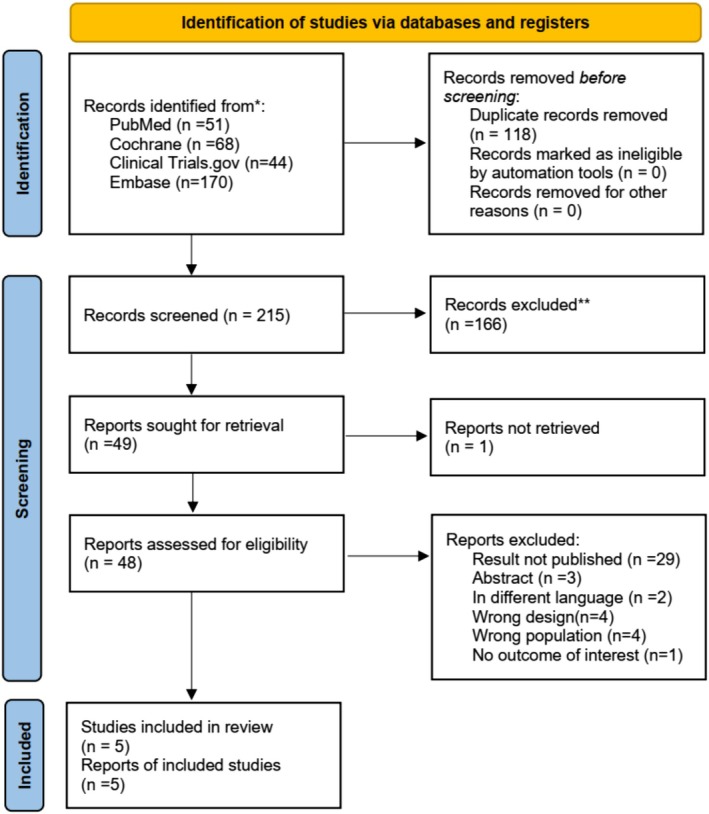
A total of 333 studies were identified, out of which 118 were removed as duplicates. The remaining 215 studies were screened based on their titles and abstracts, resulting in the exclusion of 166 studies. The remaining 49 full‐text articles were assessed for eligibility, and five [19, 25, 26, 27, 28] met the inclusion criteria and were included in the analysis. The detailed study selection process is depicted in the PRISMA flow diagram (Figure 1).

PRISMA flowchart.
Baseline Characteristics and Patient Demographics
Five randomised controlled trials (RCTs) comprising 4410 patients were included. The mean age across the studies was 48 ± 12.6 years, with 61.6% of the participants female. The mean Body Mass Index (BMI) across studies was 36.3 ± 6.8 kg/m2, with a mean body weight of 100.8 ± 22.4 kg and a mean waist circumference of 112.1 ± 15.9 cm. The duration of follow‐up ranged from 12 to 72 weeks. Characteristics of the included studies are summarised in Table 1 and baseline values are given in Table S3.
| Study ID | Country | Arms Evaluated | Sample size ()n | White(%)n | Black(%)n | Asian(%)n | Age, years (mean ± SD) | Female(%)n | Duration |
|---|---|---|---|---|---|---|---|---|---|
| Frias et al. 2023 | United States, Hungary, Poland, Slovakia | 3 mg | 51 | 47 (92) | 2 (4) | 1 (2) | 59 9.43± | 25 (49%) | 28 weeks |
| 12 mg | 56 | 49 (88) | 5 (9) | 1 (2) | 57.4 9.23± | 20 (36%) | |||
| 24 mg | 47 | 43 (91) | 2 (4) | 1 (2) | 60.50 9.11± | 17 (36%) | |||
| 36 mg | 61 | 58 (95) | 0 | 1 (2) | 59.7 9.2± | 25 (41%) | |||
| 45 mg | 63 | 57 (90) | 5 (8) | 0 | 58.5 9.4± | 23 (37%) | |||
| Placebo | 55 | 50 (91) | 4 (7) | 0 | 58.3 9.52± | 27 (49%) | |||
| Rosenstock et al. 2025 | India, Mexico, Japan, United States | 3 mg | 143 | 37 (25.9) | 8 (5.6) | 63 (44.1) | 53.3 ± 11.3 | 63 (44.1) | 42 weeks |
| 12 mg | 137 | 30 (21.9) | 9 (6.6) | 59 (43.1) | 54.1 ± 11.8 | 71 (51.8) | |||
| 24 mg | 141 | 40 (28.4) | 4 (2.8) | 62 (44.0) | 52.8 ± 11.8 | 72 (51.1) | |||
| Placebo | 138 | 38 (27.5) | 3 (2.2) | 61 (44.2) | 53.3 ± 12.5 | 63 (45.7) | |||
| Pratt et al. 2023 | United States, Germany | 9 mg | 9 | NR | NR | NR | 57.7 ± 6.4 | 5 (55.6) | 12 weeks |
| 15 mg | 10 | NR | NR | NR | 59.6 ± 4.6 | 3 (30.0) | |||
| 21 mg | 14 | NR | NR | NR | 55.3 ± 8.0 | 4 (28.6) | |||
| 27 mg | 9 | NR | NR | NR | 58.8 ± 4.6 | 2 (22.2) | |||
| 45 mg | 9 | NR | NR | NR | 62.8 ± 4.4 | ||||
| Placebo | 17 | NR | NR | NR | 56 ± 6.0 | 7 (41.2) | |||
| Wharton et al. 2023 | United States, China, Japan, India, Mexico | 12 mg | 50 | 47 (94) | 3 (6) | 0 | 49.8 ± 10.5 | 31 (62) | 40 weeks |
| 24 mg | 53 | 46 (87) | 6 (11) | 0 | 57 ± 9.1 | 30 (57) | |||
| 36 mg | 58 | 50 (86) | 8 (14) | 0 | 55.8 ± 11.3 | 36 (62) | |||
| 45 mg | 61 | 59 (97) | 1 (1) | 0 | 53.7 ± 11.9 | 35 (57) | |||
| Placebo | 50 | 45 (90) | 1 (2) | 2 (4) | 54 ± 8.8 | 29 (58) | |||
| Wharton et al. 2025 | Brazil, China, India, Japan, Korea, Slovakia, Spain, Taiwan, United States | 6 mg | 723 | 408 (57) | 68 (9) | 202 (28) | 44.9 ± 12.1 | 469 (64.9) | 72 weeks |
| 12 mg | 725 | 405 (56) | 60 (8) | 201 (28) | 45.4 ± 12.6 | 467 (64.4) | |||
| 36 mg | 730 | 394 (54) | 67 (9) | 214 (29) | 44.9 ± 11.9 | 465 (63.7) | |||
| Placebo | 949 | 539 (57) | 72 (7) | 267 (28) | 45.1 ± 11.9 | 608 (64.1) |
Risk of Bias Assessment
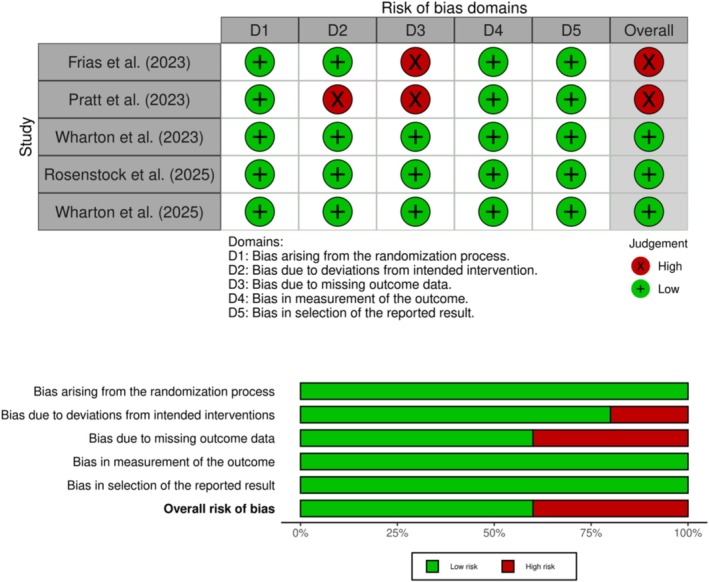
Among the five trials, three were assessed to be of low risk of bias, while two studies were of high risk of bias (Frias et al. 2023 and Pratt et al. 2023). The main sources of bias were deviation from intended interventions (Pratt et al. 2023) and bias due to missing outcome data (Frias et al. 2023 and Pratt et al. 2023). The detailed quality evaluation of the selected studies is shown in Figure 2.

Summary of risk of bias of included studies.
Efficacy Outcomes
Change in Waist Circumference (Cm)
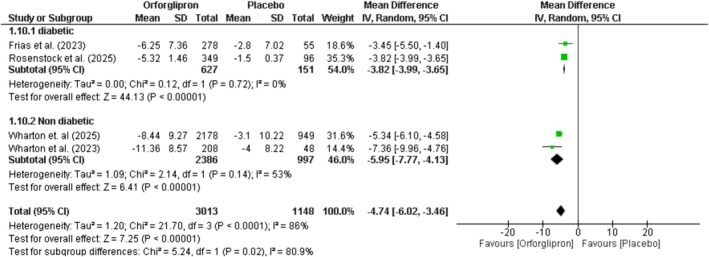
Orforglipron significantly reduced waist circumference compared to placebo by −4.74 cm (95% CI: −6.02 to −3.46; p < 0.00001; I2 = 86%) (Figure 3). Subgroup analysis showed greater reductions in non‐diabetic patients (−5.95 cm; 95% CI: −7.77 to −4.13; p < 0.00001) compared to diabetic patients (−3.82 cm; 95% CI: −3.99 to −3.65; p < 00001), with significant between‐group differences (p = 0.02). Dose–response analysis revealed non‐significant effects at 3 mg (−1.57 cm; p = 0.27), but significant reductions at higher doses: 12 mg (−3.94 cm), 24 mg (−6.44 cm), 36 mg (−6.03 cm), and 45 mg (−6.9 cm), demonstrating a dose‐dependent effect (p = 0.008) (Figure S1).

Effect of orforglipron versus placebo on waist circumference.
Percentage Change in Body Weight
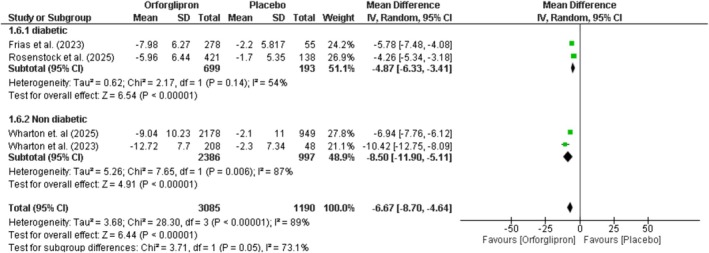
Orforglipron significantly reduced body weight compared to placebo by −6.67% (95% CI: −8.7 to −4.64; p < 0.00001; I2 = 89%) (Figure 4). Subgroup analysis showed reductions of −4.87% (95% CI: −6.33 to −3.41; p < 0.00001) in diabetic patients and −8.5% (95% CI: −11.9 to −5.11; p < 0.00001) in non‐diabetic patients, with significant between‐group differences (p = 0.05). Dose–response analysis demonstrated significant reductions across all doses: 3 mg (−2.48%; 95% CI: −3.58 to −1.38), 12 mg (−5.36%; 95% CI: −6.78 to −3.93), 24 mg (−8.81%; 95% CI: −11.13 to −6.49), 36 mg (−8.24%; 95% CI: −10.28 to −6.2), and 45 mg (−9.8%; 95% CI: −14.7 to −4.91) (Figure S2).

Effect of orforglipron versus placebo on body weight.
Change in BMI (Kg/m) 2
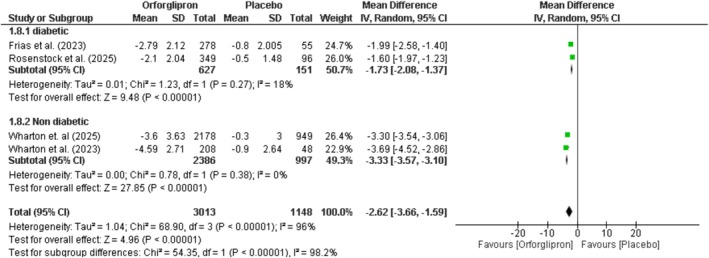
Orforglipron significantly reduced BMI compared to placebo by −2.62 kg/m2 (95% CI: −3.66 to −1.59; p < 0.00001; I2 = 96%) (Figure 5). Subgroup analysis showed reductions of −1.73 kg/m2 (95% CI: −2.08 to −1.37; p < 0.00001) in diabetic obese patients and −3.33 kg/m2 (95% CI: −3.57 to −3.10) in non‐diabetic obese patients, with significant between‐group differences (p < 0.00001). Dose–response analysis demonstrated significant reductions across all doses: 3 mg (−0.89 kg/m2), 12 mg (−2.15 kg/m2), 24 mg (−3.15 kg/m2), 36 mg (−3.24 kg/m2), and 45 mg (−3.62 kg/m2) (Figure S3).

Effect of orforglipron versus placebo on BMI.
Change in HbA1c
Orforglipron significantly reduced HbA1c compared to placebo by −0.75% (95% CI: −1.16 to −0.34; p = 0.0003; I2 = 94%) (Figure 6). Subgroup analysis showed a substantial reduction of −1.09% (95% CI: −1.27 to −0.9; p < 0.00001) in diabetic patients, while non‐diabetic patients showed a minimal reduction of −0.30% (95% CI: −0.32 to −0.28; p < 0.00001), with significant between‐group differences (p < 0.00001). Dose–response analysis revealed reductions across all doses: 3 mg (−0.81%), 12 mg (−0.76%), 24 mg (−0.82%), 36 mg (−0.81%), and 45 mg (−1.04%) (Figure S4).

Effect of orforglipron versus placebo HbA1c.
Change in Fasting Serum Glucose in Mg/dL
Orforglipron significantly reduced fasting plasma glucose compared to placebo by −25.01 mg/dL (95% CI: −39.75 to −10.34; p = 0.0008; I2 = 93%) (Figure S5a). Subgroup analysis showed a substantial reduction of −30.75 mg/dL (95% CI: −41.44 to −20.06; p < 0.00001) in diabetic patients, while non‐diabetic patients showed a smaller reduction of −8.84 mg/dL (95% CI: −9.74 to −7.94; p < 0.00001), with significant between‐group differences (p < 0.0001). Dose–response analysis revealed significant reductions at 3 mg (−20.22 mg/dL), 12 mg (−15.37 mg/dL), 24 mg (−52.20 mg/dL), 36 mg (−24.27 mg/dL), and 45 mg (−41.73 mg/dL) (Figure S5b).
Percentage Change in Total Serum Cholesterol
Orforglipron significantly reduced total serum cholesterol compared to placebo by −4.51 (95% CI: −6.91 to −2.11; p = 0.0002; I2 = 47%) (Figure S6a). Subgroup analysis showed a substantial reduction of −6.56 (95% CI: −13.91 to 0.8; p = 0.08) in diabetic participants, while non‐diabetic participants showed a smaller reduction of −3.5 (95% CI: −9.74 to −7.94; p < 0.00001), with significant between‐group differences (p = 0.42). Dose–response analysis demonstrated significant reductions at 3 mg (−6.46), 12 mg (−4.11), 24 mg (−7.73), 36 mg (−5.19), and 45 mg (−7.98) (Figure S6b).
Percentage Change in LDL Cholesterol
Orforglipron significantly reduced LDL cholesterol compared to placebo by −5.34% (95% CI: −7.10 to −3.58; p < 0.00001; I2 = 0%). Low heterogeneity (I2 = 0%) was observed, indicating consistency across trials. Subgroup analysis showed reductions of −7.72% (95% CI: −14.85 to −0.58; p = 0.03) in diabetic patients and −5.12% (95% CI: −7 to −3.23; p < 0.00001) in non‐diabetic patients, with no significant between‐group differences (p = 0.49) (Figure S7a). Dose–response analysis revealed variable effects across doses: 3 mg (−10.27%), 12 mg (−6.15%), 24 mg (−9.34%), 36 mg (−5.34%), and 45 mg (−8.35%) (Figure S7b).
Percentage Change in HDL Cholesterol
Orforglipron significantly increased HDL cholesterol compared to placebo by 2.94% (95% CI: 1.38 to 4.49; p = 0.0002; I2 = 20%). Subgroup analysis showed a smaller, non‐significant increase of 1.45% (95% CI: −2.49 to 5.39; p = 0.47) in diabetics, while non‐diabetics showed a significant increase of 3.55% (95% CI: 2.20 to 4.89; p < 0.00001), with no significant between‐group differences (p = 0.32) (Figure S8a). Dose–response analysis revealed variable effects: 3 mg (−0.59%), 12 mg (2.90%), 24 mg (1.86%), 36 mg (4.03%), and 45 mg (1.28%) (Figure S8b).
Percentage Change in Triglycerides Level
Orforglipron significantly reduced triglycerides compared to placebo by −10.07% (95% CI: −12.33 to −7.80; p < 0.00001; I2 = 0%). Low heterogeneity (I2 = 0%) was observed, indicating consistency across trials. Subgroup analysis showed reductions of −9.89% (95% CI: −15.99 to −3.79; p = 0.001) in diabetic patients and −10.09% (95% CI: −12.54 to −7.65; p < 0.00001) in non‐diabetic patients, with no significant between‐group differences (p = 0.95) (Figure S9a). Dose–response analysis revealed variable but generally consistent reductions: 3 mg (−8.30%), 12 mg (−10.66%), 24 mg (−13.60%), 36 mg (−15.91%), and 45 mg (−14.46%) (Figure S9b).
Safety Outcomes
Any Treatment Emergent Adverse Events
Compared to placebo, the occurrence of TEAE (treatment‐emergent adverse events) was significantly higher with orforglipron 12 mg (RR 1.08;95% CI: 1.04 to 1.13; p < 0.0001), 24 mg (RR 1.16; 95% CI: 1.00, 1.36; p = 0.05), 36 mg (RR 1.08; 95% CI: 1.03 to 1.13; p = 0.0009), and 45 mg (RR 1.35; 95% CI: 1.05 to 1.74; p = 0.02) daily doses, with the highest rates observed with orforglipron 45 mg. The 3 mg dose showed no significant increase in TEAEs (RR 1.01; 95% CI: 0.87 to 1.16; p = 0.92) (Table 2).
| Outcome variables | Orforglipron arm | No of participants (trials) | Pooled effect RR (95% CI) | p | (%)I2 |
|---|---|---|---|---|---|
| Any TEAE | 3 mg | 387 (2 RCTs) | 1.01 (0.87 to 1.16) | 0.92 | 13 |
| 12 mg | 2158 (4 RCTs) | 1.08 (1.04 to 1.13) | < 0.0001 | 0 | |
| 24 mg | 205 (2 RCTs) | 1.16 (1 to 1.36) | 0.05 | 0 | |
| 36 mg | 2179 (4 RCTs) | 1.08 (1.03 to 1.13) | 0.0009 | 5 | |
| 45 mg | 255 (3 RCTs) | 1.35 (1.05 to 1.74) | 0.02 | 59 | |
| Serious adverse event | 3 mg | 387 (2 RCTs) | 1.37 (0.56 to 3.35) | 0.49 | 0 |
| 12 mg | 2058 (3 RCTs) | 1.1 (0.75 to 1.62) | 0.62 | 0 | |
| 24 mg | 205 (2 RCTs) | 2.27 (0.65 to 7.95) | 0.2 | 0 | |
| 36 mg | 2197 (4 RCTs) | 0.81 (0.54 to 1.23) | 0.33 | 0 | |
| 45 mg | 255 (3 RCTs) | 0.71 (0.15 to 3.34) | 0.66 | 0 | |
| Adverse events leading to discontinuation | 3 mg | 387 (2 RCTs) | 2.77 (1.01 to 7.57) | 0.05 | 0 |
| 12 mg | 2158 (4 RCTs) | 2.95 (1.97 to 4.43) | < 0.00001 | 0 | |
| 24 mg | 205 (2 RCTs) | 4.61 (1.6 to 13.33) | 0.005 | 0 | |
| 36 mg | 2179 (4 RCTs) | 3.68 (2.48 to 5.44) | < 0.00001 | 0 | |
| 45 mg | 255 (3 RCTs) | 1.42 (0.25 to 8.23) | 0.69 | 55 | |
| Death | 3 mg | 387 (2 RCTs) | 1.05 (0.16 to 7.1) | 0.96 | 0 |
| 12 mg | 2058 (3 RCTs) | 0.81 (0.15 to 4.3) | 0.81 | 0 | |
| 24 mg | 102 (1 RCT) | 0.39 (0.02 to 9.33) | 0.56 | — | |
| 36 mg | 2071 (3 RCTs) | 0.35 (0.06 to 2.2) | 0.26 | 0 | |
| 45 mg | 144 (2 RCTs) | 0.29 (0.01 to 7.02) | 0.45 | — | |
| Nausea | 3 mg | 387 (2 RCTs) | 5 (2.14 to 11.71) | 0.0002 | 0 |
| 12 mg | 486 (3 RCTs) | 6.24 (3.43 to 11.36) | < 0.00001 | 0 | |
| 24 mg | 205 (2 RCTs) | 5.98 (2.99 to 11.98) | < 0.00001 | 0 | |
| 36 mg | 503 (3 RCTs) | 5.47 (3 to 10) | < 0.00001 | 0 | |
| 45 mg | 255 (3 RCTs) | 4.06 (2.06 to 8) | < 0.0001 | 0 | |
| Vomiting | 3 mg | 387 (2 RCTs) | 3.33 (0.93 to 11.92) | 0.06 | 0 |
| 12 mg | 486 (3 RCTs) | 5.26 (2.25 to 12.29) | 0.0001 | 0 | |
| 24 mg | 205 (2 RCTs) | 6.97 (2.55 to 19.07) | 0.0002 | 0 | |
| 36 mg | 503 (3 RCTs) | 6.41 (2.71 to 15.18) | < 0.0001 | 5 | |
| 45 mg | 255 (3 RCTs) | 7.25 (2.81 to 18.7) | < 0.0001 | 0 | |
| Constipation | 3 mg | 387 (2 RCTs) | 2.96 (1.14 to 7.68) | 0.03 | 4 |
| 12 mg | 486 (3 RCTs) | 4.61 (2.3 to 9.26) | < 0.0001 | 0 | |
| 24 mg | 205 (2 RCTs) | 5.71 (2.06 to 15.77) | 0.0008 | 0 | |
| 36 mg | 503 (3 RCTs) | 4.16 (2.07 to 8.38) | < 0.0001 | 0 | |
| 45 mg | 229 (2 RCTs) | 3.08 (1.06 to 8.94) | 0.04 | 0 | |
| Diarrhoea | 3 mg | 387 (2 RCTs) | 2.35 (1.36 to 4.08) | 0.002 | 0 |
| 12 mg | 486 (3 RCTs) | 3.01 (1.69 to 5.36) | 0.0002 | 0 | |
| 24 mg | 205 (2 RCTs) | 2.9 (1.42 to 5.94) | 0.004 | 0 | |
| 36 mg | 503 (3 RCTs) | 1.97 (0.86 to 4.55) | 0.11 | 44 | |
| 45 mg | 255 (3 RCTs) | 2.55 (1.22 to 5.35) | 0.01 | 16 |
Serious Adverse Event
Serious adverse events were comparable between orforglipron and placebo across all doses: 3 mg (RR 1.37; 95% CI: 0.56 to 3.35; p = 0.49), 12 mg (RR 1.10; 95% CI: 0.75 to 1.62; p = 0.62), 24 mg (RR 2.27; 95% CI: 0.65 to 7.95; p = 0.20), 36 mg (RR 0.81; 95% CI: 0.54 to 1.23; p = 0.33), and 45 mg (RR 0.71; 95% CI: 0.15 to 3.34; p = 0.66), with no significant subgroup differences (p = 0.48) (Table 2).
Adverse Events Leading to Discontinuation
Treatment discontinuation due to adverse events was significantly higher with orforglipron compared to placebo across multiple doses (except 45 mg): 3 mg (RR 2.77; 95% CI: 1.01 to 7.57; p = 0.05), 12 mg (RR 2.95; 95% CI: 1.97 to 4.43; p < 0.00001), 24 mg (RR 4.61; 95% CI: 1.60 to 13.33; p = 0.005), and 36 mg (RR 3.68; 95% CI: 2.48 to 5.44; p < 0.00001) (Table 2).
Death
Mortality events were rare and comparable between orforglipron and placebo across all doses: 3 mg (RR 1.05; 95% CI: 0.16 to 7.10; p = 0.96), 12 mg (RR 0.81; 95% CI: 0.15 to 4.30; p = 0.81), 24 mg (RR 0.39; 95% CI: 0.02 to 9.33; p = 0.56), 36 mg (RR 0.35; 95% CI: 0.06 to 2.20; p = 0.26), and 45 mg (RR 0.29; 95% CI: 0.01 to 7.02; p = 0.45) (Table 2).
Gastrointestinal Adverse Events
Compared to placebo, orforglipron was associated with a higher occurrence of nausea, vomiting, and constipation at all doses. A higher risk of diarrhoea was observed with all doses except 36 mg (Table 2).
Long Term Versus Short Term Treatment Duration
Subgroup analysis by treatment duration revealed that for body weight, reductions were numerically greater in trials > 28 weeks duration compared to ≤ 28 weeks, though subgroup differences were not statistically significant (p = 0.45). Similarly, BMI reduction showed a greater effect in longer trials (−2.84 vs. −1.99 kg/m2). In contrast, HbA1c reduction was significantly greater in shorter‐duration trials (−1.22% vs. −0.51%) (Figure S10).
Sensitivity Analysis
Sensitivity analyses demonstrated that excluding any single study did not substantially change the pooled results, confirming the robustness and reliability of our findings (Table ). S4
Discussion
This study‐level meta‐analysis of five randomised controlled trials aimed to provide comprehensive evidence on the efficacy and safety of orforglipron, a novel non‐peptide oral GLP‐1 receptor agonist, in obese patients with or without type 2 diabetes mellitus (T2DM). Our pooled findings demonstrated that orforglipron induced significant and dose‐dependent reductions in waist circumference, body weight, BMI, HbA1c, fasting plasma glucose and lipid parameters, supporting its potential role in obesity and metabolic management. However, it was also associated with a higher risk of gastrointestinal adverse events and treatment discontinuation, particularly at higher doses.
Orforglipron achieved substantial reductions in body weight (−6.67%), BMI (−2.62 kg/m2) and waist circumference (−4.74 cm) compared to placebo. These reductions are lower than the effects seen with injectable GLP‐1 receptor agonists such as semaglutide (15%–17% weight loss) and tirzepatide (15%–22% weight loss) but clinically meaningful and comparable to those observed with other oral anti‐obesity agents [14, 29]. The dose–response relationship was observed in our analysis, with maximal effects at 45 mg daily (9.8% weight reduction). Notably, non‐diabetic patients demonstrated greater weight loss (−8.5%) compared to diabetic patients (−4.87%), a finding consistent with previous GLP‐1 agonist studies [29, 30, 31, 32]. The absence of significant duration‐based differences in weight reduction aligns with prior trials. In the STEP‐1 trial, semaglutide 2.4 mg achieved 14.9% weight loss at week 68, with only a modest additional 0.3% (−15.2%) reduction observed at week 104 in STEP‐5, despite nearly doubling treatment duration [29, 33].
The waist circumference reduction of −4.74 cm is particularly noteworthy, as central adiposity is strongly associated with cardiovascular risk, insulin resistance, and metabolic syndrome [34]. Studies have demonstrated that each 1 cm reduction in waist circumference is associated with a 2% decrease in cardiovascular disease risk [35]. This suggests that orforglipron may offer benefits beyond weight reduction, potentially through preferential targeting of visceral adipose tissue deposition. Recent phase 2 data [13] have further demonstrated favorable effects of orforglipron on multiple cardiovascular risk markers, including reductions in systolic blood pressure, LDL cholesterol, triglycerides, apolipoprotein B, and inflammatory biomarkers such as hsCRP and IL‐6. These findings support the potential role of orforglipron in improving cardiometabolic outcomes, consistent with the effects observed in large cardiovascular outcome trials of injectable GLP‐1 receptor agonists, including LEADER (liraglutide) [36], SUSTAIN 6 (semaglutide) [37], and REWIND (dulaglutide) [38], which have demonstrated significant reductions in major adverse cardiovascular events. Although long‐term cardiovascular outcome data for orforglipron are not yet available, future large‐scale investigations are expected to determine whether these improvements in metabolic and inflammatory parameters translate into sustained cardiovascular protection comparable to that of established GLP‐1 receptor agonists.
Orforglipron demonstrated significant HbA1c reduction (−0.75%) and fasting glucose lowering (−25.01 mg/dL) compared to placebo. As expected, these effects were substantially more pronounced in diabetic patients (HbA1c: −1.09%; fasting glucose: −30.75 mg/dL) compared to non‐diabetic individuals (HbA1c: −0.30%; fasting glucose: −8.84 mg/dL). The HbA1c reduction of approximately 1% in diabetic patients is clinically significant and meets established thresholds for meaningful glycemic improvement, as each 1% reduction in HbA1c is associated with a 37% reduction in microvascular complications [39].
The glycemic benefits of orforglipron are comparable to those reported with oral semaglutide (HbA1c reduction of 0.9%–1.4%) and other GLP‐1 receptor agonists [40]. The glucose‐lowering effects are mediated through multiple mechanisms, including enhanced glucose‐dependent insulin secretion, suppression of inappropriate glucagon secretion, delayed gastric emptying, and increased insulin sensitivity [41]. Interestingly, the dose–response relationship for HbA1c was relatively flat across doses (ranging from −0.76% to −1.04%), suggesting that even lower doses may be effective for glycemic control, while higher doses may be reserved for patients requiring greater weight loss. This observation has important clinical implications for dose titration strategies and allows for individualised treatment approaches based on patient‐specific goals.
Orforglipron produced favorable changes across multiple lipid parameters, including reductions in total cholesterol (−4.51%), LDL cholesterol (−5.34%), and triglycerides (−10.07%), alongside a modest increase in HDL cholesterol (2.94%). These lipid modifications are consistent with the known pleiotropic effects of GLP‐1 receptor agonists and may contribute to cardiovascular risk reduction beyond glucose control [42]. The 10% reduction in triglycerides is particularly impressive and consistent across doses. This magnitude of triglyceride reduction is comparable to that achieved with fibrates and may be mediated through improved insulin sensitivity, reduced hepatic lipogenesis, and enhanced lipid oxidation. Although elevated triglycerides are recognized as an independent cardiovascular risk factor, their reduction alone has not consistently translated into meaningful cardiovascular event reduction. For instance, lipid‐modifying agents such as fenofibrate and pemafibrate primarily lower triglycerides but have shown limited cardiovascular benefit, with only a non‐significant trend toward risk reduction in large outcome trials [43, 44]. Thus, the cardiovascular advantages of GLP‐1 receptor agonists are more plausibly explained by their broad metabolic effects, including improvements in glycemic control, body weight, blood pressure, and inflammation, rather than isolated triglyceride lowering. The LDL cholesterol reduction of 5.34% is modest but clinically relevant, as each 1 mmol/L (approximately 38.7 mg/dL) reduction in LDL cholesterol is associated with a 22% reduction in major vascular events [45].
The safety analysis revealed dose‐dependent increases in treatment‐emergent adverse events at doses ≥ 12 mg (RR 1.08–1.35), while 3 mg showed no significant increase (RR 1.01), suggesting this is an appropriate starting dose. Gastrointestinal adverse events (nausea, vomiting, diarrhoea, constipation) were increased across all doses, consistent with the GLP‐1 receptor agonist class effect reflecting delayed gastric emptying and altered gastrointestinal motility [46]. These symptoms typically peak with dose escalation and diminish with continued treatment; this pattern is consistent across all GLP‐1 receptor agonists [19, 47]. Discontinuation rates were significantly elevated (RR 2.77–4.61 across most doses), representing a clinically important limitation. Approximately 2–5 times more patients discontinued orforglipron versus placebo due to adverse events, comparable to other GLP‐1 receptor agonists where 5%–15% discontinue in clinical trials [48]. Real‐world discontinuation rates may be higher, emphasising the need for mitigation strategies including gradual dose titration, antiemetic prophylaxis, patient education, and dietary modifications. The oral route eliminates barriers associated with injectable therapies including needle phobia and injection site reactions.
Strengths and Limitations
This meta‐analysis represents the first comprehensive synthesis of randomised controlled trials evaluating the safety and efficacy of orforglipron in obese adults, with and without diabetes. In our study, the substantial heterogeneity was appropriately explored through subgroup analyses, revealing clinically meaningful differences between diabetic and non‐diabetic populations. Nevertheless, certain limitations should be acknowledged. The number of available RCTs was relatively small, and most trials were of short duration, limiting conclusions on long‐term safety and sustainability of efficacy. Significant heterogeneity was observed in some outcomes, likely reflecting differences in study populations, baseline characteristics, and intervention durations. Moreover, data conversions were performed using the Meta‐Converter tool. While this method allows for data harmonisation across studies, it introduces a degree of estimation that may have contributed to the high heterogeneity observed. Furthermore, all included trials were sponsored by the drug manufacturer, introducing a potential risk of sponsorship bias. An additional limitation is the reliance on aggregate data rather than individual patient‐level data (IPD), which limits the ability to account for confounders. Notably, data on gallstone formation and biliary adverse events were not systematically reported across the included trials. This represents a limitation of the current evidence, as rapid weight loss with GLP‐1 receptor agonists has been associated with an increased risk of cholelithiasis in prior studies [49]. Another limitation is that trial durations varied from 12 to 72 weeks. Subgroup analysis revealed no significant differences in weight reduction between shorter (≤ 28 weeks) and longer (> 28 weeks) trials (p = 0.21), despite greater numerical values for weight loss with longer treatment. However, HbA1c reduction was significantly greater in shorter trials (−1.22% vs. −0.51%; p = 0.004). This pattern is likely confounded by diabetic status as shorter trials predominantly enrolled diabetic patients (Frias 28 weeks, Pratt 12 weeks) while longer trials enrolled non‐diabetic patients (Wharton 40 and 72 weeks).
Future research should focus on (1) long‐term studies to evaluate the durability of therapeutic benefits and identify rare adverse events; (2) cardiovascular outcome trials to determine whether metabolic improvements translate into reduced cardiovascular morbidity and mortality, as observed with certain injectable GLP‐1 receptor agonists [35, 45]; (3) comparative effectiveness trials to assess relative efficacy and safety, particularly with SGLT‐2 inhibitors, to optimize outcomes; and (4) real‐world effectiveness studies.
Conclusion
Orforglipron, an oral GLP‐1 receptor agonist, shows promising efficacy in weight reduction, glycemic control, and lipid improvement. While gastrointestinal adverse events and discontinuation rates are elevated, serious adverse events and mortality remain comparable to placebo, indicating acceptable safety. The oral formulation may enhance patient uptake compared to injectables. Future extensive studies confirming long‐term efficacy and safety outcomes are warranted to confirm these observations and determine their applicability in routine practice.
Author Contributions
R.K.P.: Conceptualization, methodology, software, data curation, writing – original draft preparation. M.J.: Data curation, writing – original draft preparation. A.M.: Visualisation, investigation, data curation. K.A.J.: Software, validation, data curation. M.N.: Data curation, manuscript writing. M.A.A.: Data curation, manuscript writing. A.B.A.: Writing – original draft preparation. S.A.: Visualisation, investigation, data curation. M.S.: Writing – reviewing and editing, supervision. M.I.B.: Validation, writing – reviewing and editing. S.I.: Writing – reviewing and editing. M.N.S.: Writing – reviewing and editing. H.A.D.: Data curation, writing – original draft preparation. W.A.: Data curation, manuscript writing. R.M.O.: Writing – reviewing and editing.
Ethics Statement
This study is a secondary analysis of published data and did not require ethical approval.
Consent
The authors have nothing to report.
Conflicts of Interest
The authors declare no conflicts of interest.