
What this is
- This research investigates the effectiveness of plasma biomarkers in detecting amyloid positivity in non-demented elderly individuals.
- The focus is on the combination of plasma Aβ and for predicting abnormal Aβ-PET results.
- Findings are based on two cohorts: a Japanese cohort (J-TRC) and a Caucasian cohort (BioFINDER).
Essence
- The combination of plasma Aβ42/40 ratio and effectively predicts brain amyloid positivity in non-demented elderly individuals, demonstrating high accuracy across different populations.
Key takeaways
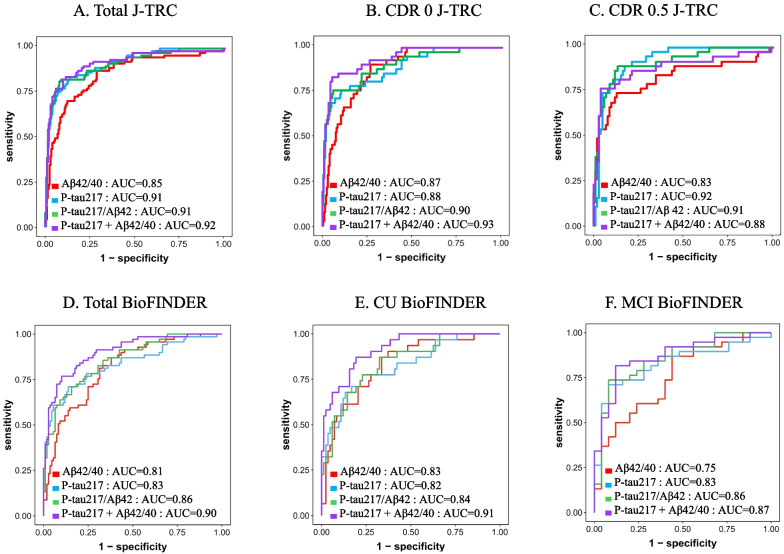
- The plasma Aβ42/40 ratio and show high discriminative values for detecting , with an area under the curve (AUC) of ~0.93 in the Japanese cohort.
- The optimal combination of biomarkers differs between cognitive stages, with and Aβ42/40 ratio performing best in CDR 0 and CDR 0.5 populations respectively.
- The study indicates that these blood-based biomarkers can facilitate participant screening in clinical trials, potentially improving early detection of Alzheimer's disease.
Caveats
- The study's population sizes for CDR 0.5 and MCI are relatively small, which may limit generalizability.
- Ethnic differences in allele frequency might affect biomarker performance, necessitating further validation in diverse populations.
Definitions
- Aβ-PET positivity: The presence of amyloid plaques in the brain as detected by positron emission tomography imaging.
- p-tau217: A phosphorylated tau protein variant that serves as a biomarker for Alzheimer's disease.
Simplified
Background
Alzheimer's disease (AD) is the most common neurodegenerative disorder and the leading cause of dementia worldwide, threatening aging societies with a vastly increasing number of patients with dementia, and its economic and social burden. Two disease-modifying therapies (DMTs) targeting amyloid-β (Aβ) pathology, aducanumab and lecanemab, have recently been approved by the FDA for use in the early symptomatic stage of AD [1 –4]. Another anti-Aβ drug, donanemab, has met the primary and secondary cognitive endpoints in its phase 3 clinical trial [5]. While the slowing of cognitive decline in response to these therapies was modest, results from the donanemab and lecanemab trials [6, 7] suggest that Aβ-targeting DMTs may be more effective in the earliest stages of AD[3, 4, 6, 7]. This will most likely lead to a shift in the target population of future clinical trials of DMTs to preclinical and prodromal AD. However, recruitment of participants in the earliest stages of AD is challenging due to the low prevalence of preclinical AD in cognitively normal individuals and those with subjective cognitive decline [8] and the invasiveness and high cost of the current gold standard markers, i.e., amyloid positron emission tomography (PET) scans and cerebrospinal fluid (CSF) biomarkers. The use of emerging blood-based biomarkers in the screening of potential trial participants has been highlighted as an efficient approach to overcome these limitations [9, 10]. Although promising results on plasma biomarkers, e.g., Aβ(1–42) (Aβ42) reductions [11 –13] or increases in phosphorylated tau [14] have recently been reported, the accuracy of the combination of plasma biomarkers in predicting amyloid status in individuals at the preclinical or prodromal stages of AD has not been fully investigated. In addition, the effect of ethnic differences on the predictive power of plasma biomarkers has not been well characterized [15, 16]. In this study, we demonstrated the very high performance of the combination of plasma Aβ and p-tau217 to detect brain Aβ-PET positivity in people with early-stage AD in the Japanese J-TRC cohort, which was replicated in the second Caucasian BioFINDER cohort.
Methods
Subjects
Participants were recruited from the J-TRC in-person cohort (J-TRC onsite study), which consists of web-based registry participants (J-TRC webstudy), existing local cohort participants (ORANGE registry)[17], and outpatients from J-TRC organizing institutions (the University of Tokyo Hospital, National Center for Geriatrics and Gerontology, National Center of Neurology and Psychiatry, Tohoku University Hospital, Tokyo Metropolitan Institute for Geriatrics and Gerontology, Osaka University Hospital, Kobe University Hospital). Webstudy participants were invited to a face to face study according to the previously reported algorithm [18]. Individuals with a diagnosis of dementia at enrollment were excluded. Participants were assessed for cognitive and clinical impairment, including the Cognitive Function Instrument (CFI) [19], the Preclinical Alzheimer's Cognitive Composite (PACC) [20], and the Clinical Dementia Rating (CDR) scales. PACC includes MMSE (Mini-Mental State Examination), WMS (Wechsler Memory Scale) Delayed Recall, WAIS-R (Wechsler Adult Intelligence Scale-Revised) Digit Symbol, and FCSRT (Free and Cued Selective Reminding Test). Participants also underwent blood biomarker testing for Aβ(1–40) (Aβ40) and Aβ(1–42) (Aβ42) (Shimadzu), plasma p-tau217 (Eli Lilly), APOE genotyping, and amyloid PET with either [18F]-florbetapir (FBP) or [18F]-flutemetamol (FMM). Participants diagnosed with preclinical or prodromal AD are followed annually until they are referred to appropriate clinical trials. As of December 2023, ~ 14,000 subjects have consented to participate in the webstudy, and 630 have been invited for in-person assessment. In this study, we evaluated 474 subjects enrolled in the J-TRC onsite study from July 2020 to November 2022. From the BioFINDER cohort [21], we examined 177 participants, all of whom underwent evaluation of Aβ40 and Aβ42 (Shimadzu) and p-tau217 (Eli Lilly) in plasma and Aβ PET imaging with FMM.
Sample collection and plasma biomarker measurements
On the first day of the J-TRC in-person study, 14 mL of blood was collected from each participant and was placed in two 7 mL vacuum tubes containing 10.5 mg of EDTA.2Na and centrifuged (2000 × g, 5 min, 4 ℃) to obtain plasma samples. Aliquots of 3 ml plasma were immediately frozen at -80 °C and transferred to and stored at the Brain Research Institute, Niigata University. Plasma levels of Aβ42 and Aβ40 were measured by Shimadzu Techno-Research Inc (Kyoto, Japan) using an Immunoprecipitation-Mass Spectrometry (IP-MS)-based method as previously described [11, 22]. Analysis of plasma p-tau217 was performed using the Meso Scale Discovery (MSD) platform at Eli Lilly and Company [21, 23]. In the BioFINDER, plasma levels of Aβ42, Aβ40 and p-tau217 were measured using the same assays as in the J-TRC at Shimadzu Techno-Research (Aβ42 and Aβ40) and Lund University (p-tau217). Details of plasma sampling and biomarker analysis in the BioFINDER are described in previous reports [22, 24].
Aβ PET imaging
PET scans using 370 ± 74 MBq of FBP or 185 ± 37 MBq of FMM were performed at baseline in all the J-TRC onsite study participants. Acquisition times were 20 min for FBP and 30 min for FMM, starting 50 min (FBP) or 90 min (FMM) after injection of each tracer, followed by image reconstruction using the parameters determined for each PET camera [25]. Aβ PET scan results were interpreted visually by two independent nuclear medicine specialists qualified to read amyloid PET scans in accordance with Japanese guidelines and manufacturers' instructions, and then by a third rater (adjudicator) if the two raters disagreed. We calculated the centiloid scale using the CapAIBL software package for reference only [26]. In the BioFINDER cohort, scans were acquired 90–110 min after injection of ~ 185 MBq FMM and global standard uptake value ratio (SUVR) values were calculated using the entire cerebellum as the reference region. Aβ PET status was determined by applying a Gaussian mixture model-based threshold of 1.138 to neocortical SUVR values determined in a sample of all BioFINDER 1 participants (N = 445) who underwent FMM PET.
Statistics
R (version 4.1.0), an open-source software environment, was used for statistical analyses. The chi-square test was used to compare sex, CDR, and the presence of APOE ε4 allele status between groups. The Shapiro–Wilk test was used to test the distribution of numerical variables. The Wilcoxon rank-sum test was used to compare variables with non-normal distributions, and Student's t-test was used to compare variables with normal and equal distributions between groups. Receiver operator characteristic (ROC) analysis was used to assess the ability of each biomarker to predict Aβ-PET positivity. Cutoff values were determined using a Youden index. The DeLong test was used to compare area under the curve (AUC) metrics from two ROC evaluations. To investigate the improvement in accuracy for predicting Aβ-PET positivity by combining plasma biomarkers with age, sex, and APOE, we applied a logistic regression model. The Akaike Information Criterion (AIC) was calculated to assess model fit. Statistical significance was set at p < 0.05. The Benjamini–Hochberg correction was applied for multiple comparisons.
Results
The J-TRC cohort
Participants
| a) Participants' demographics by brain amyloid PET result | |||||||
| J-TRC | BioFINDER | ||||||
| Aβ-PET negative | Aβ-PET positive | p-value | Aβ-PET negative | Aβ-PET positive | p-value | ||
| N, (%) | 393(83) | 81(17) | 108(61) | 69(39) | |||
| PET tracer; FBP/FMM, (%) | 180(46)/213(54) | 22(27)/59(73) | 0/108 | 0/69 | |||
| Age (mean ± SD, years) | 71.2 ± 6.5 | 73.5 ± 6.3 | 0.0015 | 71.5 ± 5.9 | 73.5 ± 4.9 | 0.023 | |
| Male/Female, (%) | 224(57)/169(43) | 44(54)/37(46) | N.S | 49(45)/59(55) | 34(49)/35(51) | N.S | |
| Education (mean ± SD, years) | 14.4 ± 2.4 | 14.1 ± 2.8 | N.S | 11.9 ± 3.5 | 11.0 ± 3.0 | N.S | |
| ε4 +/- , (%)APOE | 61(16)/332(84) | 35(43)/46(57) | < 0.001 | 22(21)/84(79) | 50(72)/19(28) | < 0.001 | |
| CDR 0/CDR 0.5 (J-TRC), (%) CU/MCI (BioFINDER), (%) | 289(74)/104(26) | 42(52)/39(48) | < 0.001 | 83(77)/25(23) | 31(45)/38(55) | < 0.001 | |
| MMSE (mean ± SD) | 28.2 ± 1.9 | 27.4 ± 2.6 | 0.029 | 28.4 ± 1.6 | 27.6 ± 1.7 | 0.001 | |
| WMS Logical Memory IIa; Delayed Recall (mean ± SD) | 8.6 ± 4.2 | 6.2 ± 4.9 | < 0.001 | N.A | N.A | ||
| WAIS-R; Digit Symbol Substitution Test (mean ± SD) | 49.6 ± 12.2 | 43.9 ± 11.2 | < 0.001 | N.A | N.A | ||
| FCSRT (mean ± SD) | 46.7 ± 3.2 | 43.7 ± 6.9 | < 0.001 | N.A | N.A | ||
| CFI (mean ± SD) | Self | 3.4 ± 2.4 | 4.7 ± 3.0 | < 0.001 | N.A | N.A | |
| Study partner | 1.6 ± 1.7 | 2.7 ± 2.6 | < 0.001 | N.A | N.A | ||
| Plasma Aβ42/40 (mean ± SD) | 0.043 ± 0.009 | 0.034 ± 0.006 | < 0.001 | 0.053 ± 0.006 | 0.046 ± 0.004 | < 0.001 | |
| Plasma p-tau217 (mean ± SD, pg/ml) | 0.16 ± 0.08 | 0.33 ± 0.17 | < 0.001 | 0.17 ± 0.06 | 0.32 ± 0.14 | < 0.001 | |
| PET Centiloid Scale (mean ± SD) | -0.19 ± 11.46 | 52.02 ± 31.14 | < 0.001 | N.A | N.A | ||
| b) Participants' demographics by cognitive assessment | |||||||
| J-TRC | BioFINDER | ||||||
| CDR 0 | CDR 0.5 | p-value | CU | MCI | p-value | ||
| N, (%) | 331(70) | 143(30) | 114(64) | 63(36) | |||
| Age (mean ± SD, years) | 70.7 ± 6.4 | 73.8 ± 6.3 | < 0.001 | 72.9 ± 5.4 | 71.1 ± 5.8 | 0.036 | |
| Male/Female, (%) | 191(58)/140(42) | 77(54)/66(46) | N.S | 43(38)/71(62) | 40(63)/23(37) | 0.001 | |
| Education (mean ± SD, years) | 14.5 ± 2.5 | 13.8 ± 2.5 | 0.0075 | 12.1 ± 3.2 | 10.6 ± 3.4 | 0.004 | |
| ε4 +/- , (%)APOE | 59(18)/272(82) | 37(26)/106(74) | N.S | 42(38)/70(64) | 30(48)/33(52) | N.S | |
| Aβ-PET -/+ , (%) | 289(87)/42(13) | 104(73)/39(27) | < 0.001 | 83(73)/31(27) | 25(40)/38(60) | < 0.001 | |
| MMSE (mean ± SD) | 28.5 ± 1.7 | 27 ± 2.4 | < 0.001 | 28.7 ± 1.3 | 27.0 ± 1.7 | < 0.001 | |
| WMS Logical Memory IIa; Delayed Recall (mean ± SD) | 9.2 ± 4.1 | 5.8 ± 4.3 | < 0.001 | N.A | N.A | ||
| WAIS-R; Digit Symbol Substitution Test (mean ± SD) | 50.8 ± 11.8 | 43.7 ± 11.8 | < 0.001 | N.A | N.A | ||
| FCSRT (mean ± SD) | 47.1 ± 1.5 | 44.1 ± 7.0 | < 0.001 | N.A | N.A | ||
| CFI (mean ± SD) | Self | 3.1 ± 2.2 | 4.8 ± 2.9 | < 0.001 | N.A | N.A | |
| Study partner | 1.3 ± 1.4 | 2.8 ± 2.4 | < 0.001 | N.A | N.A | ||
| Plasma Aβ42/40 (mean ± SD) | 0.043 ± 0.009 | 0.041 ± 0.012 | 0.0023 | 0.051 ± 0.006 | 0.048 ± 0.005 | < 0.001 | |
| Plasma p-tau217 (mean ± SD, pg/ml) | 0.17 ± 0.08 | 0.24 ± 0.18 | < 0.001 | 0.20 ± 0.09 | 0.28 ± 0.15 | < 0.001 | |
Prediction of Aβ PET status using plasma biomarkers

ROC curve analysis for the detection of amyloid PET positivity. ROC curve analysis in the total participants from the J-TRC cohort (n = 474) (), in the CDR 0 participants from the J-TRC cohort ( = 331) (), and in the CDR 0.5 participants from the J-TRC cohort (n = 143) (), in the total participants from the BioFINDER cohort ( = 177) (), in the CU participants from the BioFINDER cohort ( = 114) () and in the MCI participants from the BioFINDER cohort ( = 63) (). CDR: clinical dementia rating (global score), CU: cognitively unimpaired, MCI: mild cognitive impairment A B C D E F n n n n
| p-tau217 | p-tau217/Aβ42 | p-tau217 + Aβ42/40 | Aβ42/40 + CI | p-tau217 + CI | p-tau217/Aβ42 + CI | p-tau217 + Aβ42/40 + CI | ||
|---|---|---|---|---|---|---|---|---|
| ALL | Aβ42/40 | N.S | N.S | < 0.001 | N.S | N.S | 0.0092 | < 0.001 |
| p-tau217 | N.S | N.S | N.S | N.S | N.S | N.S | ||
| p-tau217/Aβ42 | N.S | N.S | N.S | N.S | N.S | |||
| p-tau217 + Aβ42/40 | 0.001 | N.S | N.S | N.S | ||||
| Aβ42/40 + CI | N.S | 0.014 | < 0.001 | |||||
| p-tau217 + CI | N.S | N.S | ||||||
| p-tau217/Aβ42 + CI | N.S | |||||||
| CDR 0 | Aβ42/40 | N.S | N.S | 0.013 | N.S | N.S | N.S | 0.016 |
| p-tau217 | N.S | 0.012 | N.S | N.S | 0.034 | 0.012 | ||
| p-tau217/Aβ42 | 0.049 | N.S | N.S | N.S | N.S | |||
| p-tau217 + Aβ42/40 | 0.032 | N.S | N.S | N.S | ||||
| Aβ42/40 + CI | N.S | N.S | 0.093 | |||||
| p-tau217 + CI | N.S | 0.035 | ||||||
| p-tau217/Aβ42 + CI | N.S | |||||||
| CDR 0.5 | Aβ42/40 | N.S | N.S | N.S | N.S | N.S | N.S | N.S |
| p-tau217 | N.S | N.S | N.S | N.S | N.S | N.S | ||
| p-tau217/Aβ42 | N.S | N.S | N.S | N.S | N.S | |||
| p-tau217 + Aβ42/40 | N.S | N.S | N.S | N.S | ||||
| Aβ42/40 + CI | N.S | N.S | N.S | |||||
| p-tau217 + CI | N.S | N.S | ||||||
| p-tau217/Aβ42 + CI | N.S |
Prediction of Aβ PET status using plasma biomarkers and age, sex, and APOE

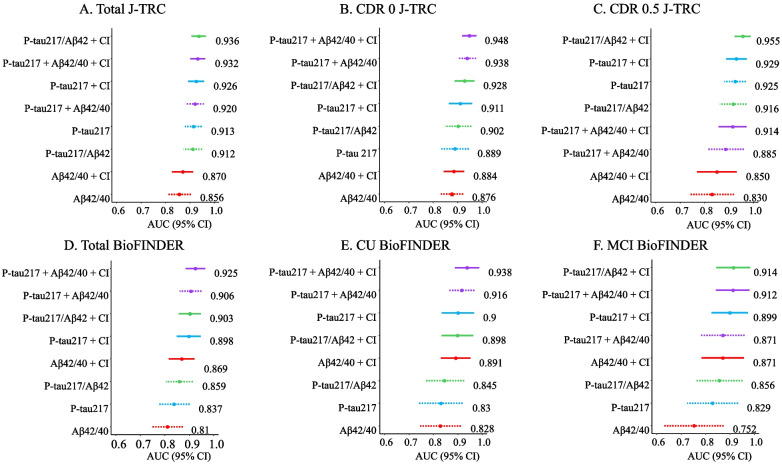
Ranking of different biomarker combination models sorted by the AUC. AUC (95% CI) ranking in the total participants from the J-TRC cohort ( = 474) (), in the CDR 0 participants from the J-TRC cohort ( = 331) (), in the CDR 0.5 participants from the J-TRC cohort ( = 143) (), in the total participants from the BioFINDER cohort ( = 177) (), in the CU participants from the BioFINDER cohort ( = 114) (), in the MCI participants form the BioFINDER cohort ( = 63) (). Dotted lines represent the results for biomarkers, while solid lines represent the results for biomarkers with clinical information. AUC values are shown in the right side of each line. CI: clinical information including age, sex, and, CDR: clinical dementia rating (global score), CU: cognitively unimpaired, MCI: mild cognitive impairment n n n n n n APOE A B C D E F
| AUC (95% CI) | sensitivity | specificity | PPV | NPV | AIC | ||
| a) | Total (N = 474) | ||||||
| Aβ42/40 | 0.856 (0.808–0.904) | 0.876 | 0.712 | 0.385 | 0.965 | 322.07 | |
| Aβ42/40 + Age + Sex + APOE | 0.870 (0.827–0.913) | 0.851 | 0.743 | 0.405 | 0.96 | 311.73 | |
| p-tau217 | 0.913 (0.879–0.948) | 0.839 | 0.865 | 0.561 | 0.963 | 299.84 | |
| p-tau217 + Age + Sex + APOE | 0.926 (0.893–0.959) | 0.901 | 0.862 | 0.574 | 0.976 | 276.36 | |
| p-tau217/Aβ42 | 0.912 (0.874–0.950) | 0.814 | 0.923 | 0.687 | 0.96 | 247.6 | |
| p-tau217/Aβ42 + Age + Sex + APOE | 0.936 (0.906–0.965) | 0.827 | 0.921 | 0.683 | 0.962 | 218.26 | |
| p-tau217 + Aβ42/40 | 0.920 (0.884–0.957) | 0.827 | 0.9 | 0.632 | 0.961 | 250.51 | |
| p-tau217 + Aβ42/40 + Age + Sex + APOE | 0.932 (0.901–0.963) | 0.975 | 0.737 | 0.434 | 0.993 | 237.99 | |
| b) | CDR 0 group (N = 331) | ||||||
| Aβ42/40 | 0.876 (0.831–0.922) | 0.904 | 0.733 | 0.33 | 0.981 | 185.67 | |
| Aβ42/40 + Age + Sex + APOE | 0.884 (0.842–0.927) | 0.976 | 0.657 | 0.292 | 0.994 | 183.43 | |
| p-tau217 | 0.889 (0.832–0.945) | 0.761 | 0.896 | 0.516 | 0.962 | 153.01 | |
| p-tau217 + Age + Sex + APOE | 0.911 (0.863–0.96) | 0.857 | 0.837 | 0.433 | 0.975 | 147.68 | |
| p-tau217/Aβ42 | 0.902 (0.847–0.956) | 0.761 | 0.941 | 0.653 | 0.964 | 146.24 | |
| p-tau217/Aβ42 + Age + Sex + APOE | 0.928 (0.888–0.968) | 0.809 | 0.896 | 0.531 | 0.97 | 140.11 | |
| p-tau217 + Aβ42/40 | 0.938 (0.902–0.975) | 0.833 | 0.944 | 0.686 | 0.975 | 129.83 | |
| p-tau217 + Aβ42/40 + Age + Sex + APOE | 0.948 (0.919–0.977) | 0.952 | 0.813 | 0.425 | 0.991 | 130.35 | |
| c) | CDR 0.5 group (N = 143) | ||||||
| Aβ42/40 | 0.830 (0.74–0.920) | 0.743 | 0.875 | 0.69 | 0.9 | 133.86 | |
| Aβ42/40 + Age + Sex + APOE | 0.850 (0.768–0.931) | 0.82 | 0.826 | 0.64 | 0.924 | 132.74 | |
| p-tau217 | 0.925 (0.881–0.969) | 0.897 | 0.826 | 0.66 | 0.955 | 129.55 | |
| p-tau217 + Age + Sex + APOE | 0.929 (0.887–0.972) | 0.846 | 0.903 | 0.767 | 0.94 | 117.24 | |
| p-tau217/Aβ42 | 0.916 (0.862–0.970) | 0.897 | 0.865 | 0.714 | 0.957 | 100.44 | |
| p-tau217/Aβ42 + Age + Sex + APOE | 0.955 (0.922–0.989) | 0.923 | 0.913 | 0.8 | 0.999 | 80.93 | |
| p-tau217 + Aβ42/40 | 0.885 (0.810–0.960) | 0.769 | 0.961 | 0.882 | 0.917 | 109.99 | |
| p-tau217 + Aβ42/40 + Age + Sex + APOE | 0.914 (0.856–0.971) | 0.846 | 0.884 | 0.733 | 0.938 | 103.13 | |
Validation in the BioFINDER cohort
| p-tau217 | p-tau217/Aβ42 | p-tau217 + Aβ42/40 | Aβ42/40 + CI | p-tau217 + CI | p-tau217/Aβ42 + CI | p-tau217 + Aβ42/40 + CI | ||
|---|---|---|---|---|---|---|---|---|
| ALL | Aβ42/40 | N.S | N.S | 0.003 | 0.025 | 0.04 | 0.024 | 0.002 |
| p-tau217 | N.S | 0.016 | N.S | 0.019 | 0.022 | 0.003 | ||
| p-tau217/Aβ42 | 0.03 | N.S | N.S | 0.036 | 0.01 | |||
| p-tau217 + Aβ42/40 | N.S | N.S | N.S | N.S | ||||
| Aβ42/40 + CI | N.S | N.S | 0.022 | |||||
| p-tau217 + CI | N.S | 0.035 | ||||||
| p-tau217/Aβ42 + CI | N.S | |||||||
| CU | Aβ42/40 | N.S | N.S | N.S | N.S | N.S | N.S | 0.045 |
| p-tau217 | N.S | 0.045 | N.S | N.S | N.S | 0.033 | ||
| p-tau217/Aβ42 | 0.045 | N.S | N.S | N.S | 0.033 | |||
| p-tau217 + Aβ42/40 | N.S | N.S | N.S | N.S | ||||
| Aβ42/40 + CI | N.S | N.S | N.S | |||||
| p-tau217 + CI | N.S | N.S | ||||||
| p-tau217/Aβ42 + CI | N.S | |||||||
| MCI | Aβ42/40 | N.S | N.S | N.S | N.S | N.S | N.S | N.S |
| p-tau217 | N.S | N.S | N.S | N.S | N.S | N.S | ||
| p-tau217/Aβ42 | N.S | N.S | N.S | N.S | N.S | |||
| p-tau217 + Aβ42/40 | N.S | N.S | N.S | N.S | ||||
| Aβ42/40 + CI | N.S | N.S | N.S | |||||
| p-tau217 + CI | N.S | N.S | ||||||
| p-tau217/Aβ42 + CI | N.S |
| AUC (95% CI) | sensitivity | specificity | PPV | NPV | AIC | ||
|---|---|---|---|---|---|---|---|
| a) | Total (N = 175)a | ||||||
| Aβ42/40 | 0.810 (0.746–0.874) | 0.826 | 0.67 | 0.62 | 0.855 | 184.47 | |
| Aβ42/40 + Age + Sex + APOE | 0.869 (0.816–0.921) | 0.797 | 0.792 | 0.714 | 0.857 | 165.09 | |
| p-tau217 | 0.837 (0.773–0.902) | 0.71 | 0.868 | 0.778 | 0.821 | 164.45 | |
| p-tau217 + Age + Sex + APOE | 0.898 (0.849–0.947) | 0.826 | 0.84 | 0.77 | 0.881 | 144.57 | |
| p-tau217/Aβ42 | 0.859 (0.804–0.915) | 0.71 | 0.849 | 0.754 | 0.818 | 162.24 | |
| p-tau217/Aβ42 + Age + Sex + APOE | 0.903 (0.857–0.948) | 0.841 | 0.821 | 0.753 | 0.888 | 142.97 | |
| p-tau217 + Aβ42/40 | 0.906 (0.861–0.950) | 0.768 | 0.896 | 0.828 | 0.856 | 138.4 | |
| p-tau217 + Aβ42/40 + Age + Sex + APOE | 0.925 (0.886–0.965) | 0.87 | 0.887 | 0.833 | 0.913 | 129.28 | |
| b) | CU group (N = 112) | ||||||
| Aβ42/40 | 0.828 (0.744–0.912) | 0.871 | 0.667 | 0.5 | 0.931 | 103.1 | |
| Aβ42/40 + Age + Sex + APOE | 0.891 (0.830–0.952) | 0.871 | 0.778 | 0.6 | 0.94 | 91.23 | |
| p-tau217 | 0.830 (0.740–0.919) | 0.677 | 0.877 | 0.677 | 0.877 | 96.34 | |
| p-tau217 + Age + Sex + APOE | 0.900 (0.833–0.967) | 0.839 | 0.827 | 0.65 | 0.931 | 86.23 | |
| p-tau217/Aβ42 | 0.845 (0.765–0.926) | 0.774 | 0.778 | 0.571 | 0.9 | 96.73 | |
| p-tau217/Aβ42 + Age + Sex + APOE | 0.898 (0.834–0.963) | 0.839 | 0.827 | 0.65 | 0.931 | 86.59 | |
| p-tau217 + Aβ42/40 | 0.916 (0.864–0.968) | 0.903 | 0.765 | 0.596 | 0.954 | 78.36 | |
| p-tau217 + Aβ42/40 + Age + Sex + APOE | 0.938 (0.888–0.987) | 0.839 | 0.926 | 0.813 | 0.938 | 73.06 | |
| c) | MCI group (N = 63) | ||||||
| Aβ42/40 | 0.752 (0.629–0.874) | 0.868 | 0.56 | 0.75 | 0.737 | 75.6 | |
| Aβ42/40 + Age + Sex + APOE | 0.871 (0.784–0.957) | 0.868 | 0.76 | 0.846 | 0.792 | 67.26 | |
| p-tau217 | 0.829 (0.725–0.934) | 0.711 | 0.92 | 0.931 | 0.676 | 65.91 | |
| p-tau217 + Age + Sex + APOE | 0.899 (0.824–0.974) | 0.895 | 0.8 | 0.872 | 0.833 | 59.35 | |
| p-tau217/ Aβ42 | 0.856 (0.759–0.952) | 0.737 | 0.92 | 0.933 | 0.697 | 64.05 | |
| p-tau217/ Aβ42 + Age + Sex + APOE | 0.914 (0.844–0.983) | 0.895 | 0.8 | 0.872 | 0.833 | 57.54 | |
| p-tau217 + Aβ42/40 | 0.871 (0.781–0.960) | 0.816 | 0.88 | 0.912 | 0.759 | 61.84 | |
| p-tau217 + Aβ42/40 + Age + Sex + APOE | 0.912 (0.843–0.980) | 0.921 | 0.76 | 0.854 | 0.864 | 59.83 | |
Discussion
In this study, we have shown that the plasma Aβ42/40 ratio determined by IP/MS and plasma p-tau217 measured by MSD immunoassay are biomarkers that predict brain Aβ PET positivity in the Japanese population of non-demented individuals, and that a combination of these Aβ42 and p-tau217 markers showed unprecedented high discriminative values with an AUC of ~ 0.93, which was reproduced in the European BioFINDER cohort. Emerging evidence supports the importance of newer blood-based markers in the detection of cerebral Aβ pathology [10, 22]. In a head-to-head comparison study of several plasma Aβ assays, MS-based plasma Aβ biomarkers were reported to be generally superior to immunoassays in detecting abnormal brain amyloid status: IP-MS method developed by Washington University showed the highest AUC of 0.852 for CSF Aβ42/40 status in cognitively unimpaired and MCI subjects, which was improved to 0.882 by the addition of APOE genotype [22]. Here we showed that the plasma Aβ42/40 ratio, as determined by the Shimadzu-developed IP-MS assay, predicted brain Aβ PET positivity in the J-TRC cohort, which enrolled non-demented elderly individuals by consecutive recruitment through web-based participation and local cohort or memory clinic, thus reflecting the characteristics of elderly individuals in the general population. Plasma Aβ42/40 measures have been shown to be highly discriminative of CSF Aβ42/40 and Aβ PET status, as well as predictive of cognitive decline and progression from cognitively unimpaired to MCI and from MCI to AD [11, 12, 27]. Changes in the plasma Aβ42/40 ratio precede elevated amyloid levels detected by PET scans, similar to those in CSF [9, 28]. Notably, plasma Aβ42/40 showed moderate accuracy in both the cognitively unimpaired (CDR 0) and the MCI (CDR 0.5) subjects, while the accuracy of the plasma p-tau217 was higher, and in the CDR 0.5 group, p-tau217 showed high accuracy (AUC 0.925). It has been well documented that high levels of plasma p-tau, especially p-tau217, are associated with abnormal Aβ PET and CSF Aβ42/40 in different stages of AD [9, 21, 28, 29]. Elevated plasma p-tau levels have been shown to be highly specific for brain amyloid deposition, allowing the differentiation of AD from non-AD dementia [21, 23, 30 –32]. Furthermore, a recent study suggests that plasma p-tau has a strong surrogacy in preclinical and prodromal AD compared to Aβ42/40 ratio or p-tau231 [33]. The superiority of p-tau217 over Aβ42/40 ratio, especially in the prodromal population, is confirmed in BioFINDER. Furthermore, our study suggested an interesting difference in the predictive ability between Aβ42/40 ratio and p-tau217. As shown in Table 3, Aβ42/40 ratio showed relatively higher sensitivity (0.904) and lower specificity (0.733) in the CDR 0 group, while the results were opposite in the CDR 0.5 group (0.743, 0.875, respectively). P-tau217 showed the opposite result (sensitivity 0.761, specificity 0.896 in the CDR 0 group while 0.897 and 0.826, respectively, in the CDR 0.5 group). These results indicate that when blood biomarker is used as a pre-screen for amyloid PET, p-tau217 reduces false positive compared to Aβ42/40 ratio in the CDR 0 group, while Aβ42/40 ratio may be better compared to p-tau217 in the CDR 0.5 group. These results are not replicated in the BioFINDER cohort, where p-tau217 showed higher specificity compared to Aβ42/40 ratio regardless of group. This difference may be due to the difference in disease progression between CDR 0.5 in J-TRC and MCI in BioFINDER, as shown by the plasma p-tau217 level being higher in MCI in BioFINDER (0.28 ± 0.15) compared to CDR 0.5 group in J-TRC (0.24 ± 0.18).
Our results also suggest an intriguing difference in the optimal combination of plasma Aβ42, Aβ42/40, p-tau217 and clinical information in detecting abnormal Aβ PET between the CDR 0 and 0.5 populations. The combination of p-tau217 and Aβ42/40 ratio showed the best performance in the CDR 0 population, while the p-tau217/Aβ42 ratio performed best in the CDR 0.5 group. These results were reproduced in BioFINDER. One interpretation of these findings would be that the plasma Aβ42/40 ratio and p-tau217 gradually change with the progression of brain amyloid accumulation before the threshold of Aβ-PET positivity is reached; the optimal combination of Aβ and p-tau markers may change with disease progression. The benefit of combining plasma Aβ and p-tau biomarkers has not been extensively studied. The superiority of the combination of high performance plasma p-tau217 and Aβ42/40 assays to identify brain Aβ positivity, predict the presence of AD neuropathologic changes [34], Aβ PET centiloid metric [35], and future development of AD dementia has only been reported [36]. Our study demonstrated that the combination of p-tau217 and Aβ42/40 ratio, and these with age, sex, and APOE genotype, is a useful tool for predicting Aβ-PET positivity in the cognitively unimpaired or preclinical population. The contribution of each variable to the modeling is shown by a nomogram in Supplementary Figs. 1 and 2.
In many of the previous studies, participants recruited from regional or clinical cohorts included individuals at high-risk for AD with a higher prevalence of the APOE ε4 allele (e.g., 45.2% in AHEAD 3–45 study [35], 47.5% in the BioFINDER study [23], 53.9% in the ALFA + cohort [32] and 47.8% in the Wisconsin Registry for Alzheimer's Prevention cohort [31]), whereas the APOE ε4 positivity in the J-TRC cohort was 20.2%, which is close to that of the general population in Japan and Asia [37]. Our study used Aβ-PET positivity as the standard of truth, which was determined by visual interpretation in J-TRC and rated with quantitative measures in BioFINDER. While quantitative methods are popular in Europe, visual assessment is the standard in Japan, as indicated by Japanese guidelines and regulations. As a result, there is variation in amyloid PET interpretation criteria depending on the research protocol. This study examined the reproducibility in two cohorts, each with its own protocol including Aβ-PET rating method. In general, visual and quantitative ratings are known to provide comparable results, allowing for error in borderline cases and taking into account possible differences in case of localized uptake. In this study, the inter-rater variability of the visual reading of the J-TRC was low; the two independent raters agreed in 94% of cases. Also, quantitative measures are not free from variation due to bias, e.g., selection of a software program and a cutoff level. Therefore, the difference in PET rating method between the two cohorts would not substantially affect the conclusions of our study.
Our results may be relevant to the use of plasma biomarkers for prescreening in clinical trials of preclinical AD populations in the real world. Our study also addresses the potential impact of ethnic factors on the usability of plasma biomarkers [15, 38]. Our results showed high performance of the combination of plasma Aβ42, Aβ42/40 ratio, and p-tau217 in non-demented elderly individuals in Asian-Japanese as well as Western populations. Thus, these biomarkers could greatly facilitate the prescreening of participants in global preclinical AD trials that require the enrollment of participants from diverse ethnicities. In addition, these blood-based biomarkers may play an important role in the early detection of individuals at high risk of developing AD and for the early and appropriate diagnosis of cognitive decline or dementia due to AD.
This study has several limitations. Other promising plasma biomarkers such as other phosphorylated tau species (e.g., p-tau231), phosphorylated/non-phosphorylated tau ratio, GFAP, NFL should also be investigated. Our study population of CDR 0.5 in J-TRC and MCI in BioFINDER is relatively small. The rate of APOE ε4 allele carriers is not the same in the two cohorts. Thus, the generalizability of our findings, e.g., the difference of optimal combination for cognitively impaired or MCI population in the real-world setting, should be verified in future studies.
Conclusions
This study demonstrated a high accuracy of the combination of plasma Aβ markers and p-tau217 to detect Aβ-PET positivity in preclinical and prodromal AD in the Japanese trial-ready cohort, which was replicated in the Swedish BioFINDER cohort. These results provide us with optimal indices to identify potential participants and minimize the financial and physical burden of clinical trials of DMTs in the very early stages of AD.
Supplementary Information
Supplementary Material 1. Supplemental Figure 1 Nomograms for the logistic regression analysis to detect Aβ-PET positivity in the J-TRC cohort. CI: clinical information including age, sex, and APOE, CDR: clinical dementia rating (global score). Supplemental Figure 2 Nomograms for the logistic regression analysis to detect Aβ-PET positivity in the BioFINDER cohort. CI: clinical information including age, sex, and APOE, CU: cognitively unimpaired, MCI: mild cognitive impairment.