
What this is
- This research proposes a portable birdcage antenna design for treating Alzheimer's disease (AD) via repeated electromagnetic field stimulation (REMFS).
- The device aims to lower toxic beta-amyloid levels in the brain, potentially improving memory function in AD patients.
- The design focuses on delivering electromagnetic energy uniformly across brain regions while adhering to safety standards.
Essence
- The portable birdcage antenna design targets the reduction of beta-amyloid levels in Alzheimer's disease through REMFS. It aims to provide effective treatment while ensuring safety and comfort for patients.
Key takeaways
- The proposed device achieves a () of 0.4-0.9 W/kg, which is crucial for effective treatment without adverse effects.
- REMFS at 64 MHz has demonstrated a 46% reduction in beta-amyloid levels in neuronal cultures, indicating potential efficacy in treating Alzheimer's disease.
- The design allows for personalized adjustments to fit individual patient characteristics, enhancing treatment effectiveness and comfort.
Caveats
- The transition from preclinical studies to human trials poses challenges in accurately translating RF power deposition and frequency settings.
- Future studies must validate the device's effectiveness and safety in real-world clinical settings before widespread application.
Definitions
- Specific Absorption Rate (SAR): The rate at which energy is absorbed per unit mass of tissue, crucial for assessing safety in RF exposure.
Simplified
Introduction
Alzheimer's disease (AD) is the most common neurodegenerative dementia worldwide. In 2022, AD cost the nation \documentclass[12pt]{minimal} \usepackage{amsmath} \usepackage{wasysym} \usepackage{amsfonts} \usepackage{amssymb} \usepackage{amsbsy} \usepackage{upgreek} \usepackage{mathrsfs} \setlength{\oddsidemargin}{-69pt} \begin{document} ${\$}$\end{document}321 billion, including \documentclass[12pt]{minimal} \usepackage{amsmath} \usepackage{wasysym} \usepackage{amsfonts} \usepackage{amssymb} \usepackage{amsbsy} \usepackage{upgreek} \usepackage{mathrsfs} \setlength{\oddsidemargin}{-69pt} \begin{document} ${\$}$\end{document}206 billion in Medicare and Medicaid. Unless we develop an effective treatment, costs will increase by nearly \documentclass[12pt]{minimal} \usepackage{amsmath} \usepackage{wasysym} \usepackage{amsfonts} \usepackage{amssymb} \usepackage{amsbsy} \usepackage{upgreek} \usepackage{mathrsfs} \setlength{\oddsidemargin}{-69pt} \begin{document} ${\$}$\end{document}1 trillion by 2050 [1]. AD is characterized by the accumulation of the toxic \documentclass[12pt]{minimal} \usepackage{amsmath} \usepackage{wasysym} \usepackage{amsfonts} \usepackage{amssymb} \usepackage{amsbsy} \usepackage{upgreek} \usepackage{mathrsfs} \setlength{\oddsidemargin}{-69pt} \begin{document} $\beta $\end{document}-amyloid \documentclass[12pt]{minimal} \usepackage{amsmath} \usepackage{wasysym} \usepackage{amsfonts} \usepackage{amssymb} \usepackage{amsbsy} \usepackage{upgreek} \usepackage{mathrsfs} \setlength{\oddsidemargin}{-69pt} \begin{document} $(A\beta)$\end{document} in the brain, a key factor in AD pathology [2], [3]. No effective therapy for AD currently exists due to the difficulties of reducing the levels of the toxic beta-amyloid \documentclass[12pt]{minimal} \usepackage{amsmath} \usepackage{wasysym} \usepackage{amsfonts} \usepackage{amssymb} \usepackage{amsbsy} \usepackage{upgreek} \usepackage{mathrsfs} \setlength{\oddsidemargin}{-69pt} \begin{document} $(A\beta)$\end{document} proteins in the brain without triggering brain swelling or microhemorrhages associated with monoclonal antibody therapy for this condition.
The standard of care for AD treatment includes cholinesterase inhibitors, NMDA receptor antagonists, and monoclonal antibodies (mAbs). However, these treatments are ineffective in improving cognition, unable to change disease progression [4], limited in number of therapeutic targets [5], [6], cause severe side effects (brain swelling, microhemorrhages with mAb) [7], lack of understanding of the aging effects on AD [8], and unable to cross the blood-brain-barrier (BBB) effectively [9] to reach all affected brain areas in AD [10]. mAbs are available to lower \documentclass[12pt]{minimal} \usepackage{amsmath} \usepackage{wasysym} \usepackage{amsfonts} \usepackage{amssymb} \usepackage{amsbsy} \usepackage{upgreek} \usepackage{mathrsfs} \setlength{\oddsidemargin}{-69pt} \begin{document} $(A\beta)$\end{document}, but their severe side effects make the risk-benefit profile of mAbs unclear [11], [12]. There is an urgent need to develop a safe and effective therapy to cross the BBB, reach the multiple therapeutic targets in the brain, and act on both the aging and AD pathways to lower \documentclass[12pt]{minimal} \usepackage{amsmath} \usepackage{wasysym} \usepackage{amsfonts} \usepackage{amssymb} \usepackage{amsbsy} \usepackage{upgreek} \usepackage{mathrsfs} \setlength{\oddsidemargin}{-69pt} \begin{document} $(A\beta)$\end{document} and stop disease progression. A novel and safe non-invasive multitarget strategy utilizing repeated electromagnetic field stimulation (REMFS) lower \documentclass[12pt]{minimal} \usepackage{amsmath} \usepackage{wasysym} \usepackage{amsfonts} \usepackage{amssymb} \usepackage{amsbsy} \usepackage{upgreek} \usepackage{mathrsfs} \setlength{\oddsidemargin}{-69pt} \begin{document} $(A\beta)$\end{document} levels, stop disease progression [13] and act both on the aging [14] and AD pathway [15], [16] in all memory areas, prevent neuronal death, and improve memory without brain swelling in AD mice [13]. This treatment has not been developed for humans because current EMF devices have poor penetration depth and SAR distribution in the human brain. Thus, it is ineffective in reaching deep memory areas affected early in AD.
Previous REMFS studies at high RF power deposition (900-2000 MHz) with a specific absorption rate (SAR) of 0.25 to 5 Wkg [17], [18] stopped AD progression [19] by lowering \documentclass[12pt]{minimal} \usepackage{amsmath} \usepackage{wasysym} \usepackage{amsfonts} \usepackage{amssymb} \usepackage{amsbsy} \usepackage{upgreek} \usepackage{mathrsfs} \setlength{\oddsidemargin}{-69pt} \begin{document} $(A\beta)$\end{document} levels [2], without causing brain swelling or hemorrhages in numerous AD rodent studies [2], [19], [20], [21], [22], [23], [24], [25], [26], [27], [28], [29]. REMFS not only prevents cognitive impairment but also reverses it [13], [30]. These exposures did not cause any cancer after two years of treatment [13], the main side effect was a body temperature rise (TR) of 1.3° in the AD mice [21], since RF heat can cause tissue injury, it must be kept to a safe level of less than 0.5° per regulatory agencies. Our biological team found that PHB cultures (DIV7) treated at 64 MHz, for one or two hours for 14 days also produced significantly lower \documentclass[12pt]{minimal} \usepackage{amsmath} \usepackage{wasysym} \usepackage{amsfonts} \usepackage{amssymb} \usepackage{amsbsy} \usepackage{upgreek} \usepackage{mathrsfs} \setlength{\oddsidemargin}{-69pt} \begin{document} $(A\beta)$\end{document} levels. Also PHB cultures (DIV28) treated with 64 MHz one hour/day during 4 or 8 days produced a similar significant reduction in \documentclass[12pt]{minimal} \usepackage{amsmath} \usepackage{wasysym} \usepackage{amsfonts} \usepackage{amssymb} \usepackage{amsbsy} \usepackage{upgreek} \usepackage{mathrsfs} \setlength{\oddsidemargin}{-69pt} \begin{document} $(A\beta)40$\end{document} levels. We found that 0.4 W/Kg was the minimum SAR required to produce a biological effect (MSBE), this exposure did not result in cellular toxicity. An RF power deposition with a specific absorption rate (SAR) of 0.4-0.9 WKg) was the minimal effective dose that activates autophagy to degrade and lower \documentclass[12pt]{minimal} \usepackage{amsmath} \usepackage{wasysym} \usepackage{amsfonts} \usepackage{amssymb} \usepackage{amsbsy} \usepackage{upgreek} \usepackage{mathrsfs} \setlength{\oddsidemargin}{-69pt} \begin{document} $(A\beta)$\end{document} in primary human brain cultures. These findings led us to design a prototype device that will homogeneously deliver the same SAR level to all memory areas of a human brain, lower \documentclass[12pt]{minimal} \usepackage{amsmath} \usepackage{wasysym} \usepackage{amsfonts} \usepackage{amssymb} \usepackage{amsbsy} \usepackage{upgreek} \usepackage{mathrsfs} \setlength{\oddsidemargin}{-69pt} \begin{document} $(A\beta)$\end{document} levels, and potentially improve memory in human AD. This study is highly significant because here we designed the first safe and effective portable/wearable birdcage with sixteen meander line antenna legs for Alzheimer's disease treatments with a frequency that homogeneously reaches deep memory areas with the required SAR level with a temperature rise less than 0.5 degree Celsius per ICNIRP [31], [32]. The next phase will manufacture a device prototype with personalized AI treatments and temperature control and determine its feasibility, safety, and user acceptability for AD. The paper details the design and simulation results leading to the specific SAR, frequency, and linearity required for optimal EMF exposure. It also shows that the 64 MHz frequency has excellent skin depth penetration, allowing it to effectively penetrate multiple head tissue layers, such as hair, skin, fat, dura, cerebrospinal fluid (CSF), and grey matter, reaching deep into the brain areas [33].
The article offers a comprehensive study of the proposed device, providing detailed insights into its modeling, encompassing dimensions, port configurations, power levels, and tuning capacitor values. We utilized a sophisticated multi-layer human body model to validate the device's field distribution in a human head, accounting for specific electrical and thermal properties across brain and body layers. The study conducts a rigorous series of electromagnetic simulations leveraging Ansys HFSS, Q3D Extractor, Circuits and IcePak. These simulations are crucial in evaluating and refining the proposed design, ensuring its efficacy and suitability within the intricate geometry and dynamics of the human anatomy and physiology.
Following this introduction, the article is organized into several key sections to provide a comprehensive overview of the study.describes the electromagnetic field exposures and treatment conditions used for human neuronal cultures.outlines the methods for preparing primary human brain (PHB) cell cultures.presents the results of neuronal exposures to repetitive electromagnetic field stimulation (REMFS).introduces the proposed birdcage coil model, followed by, which details the human body and brain models used in the simulation.discusses the simulation results and key findings.provides a comparison between the proposed antenna design and both two-port and eight-port configurations.focuses on temperature estimation based on the proposed MRI coil, whileaddresses the limitations of the study and suggests directions for future work. Finally, the conclusion summarizes the overall contributions and implications of the study. An appendix is included to provide additional clarification on the definition and relevance of Specific Absorption Rate (SAR) within the context of this research. Section II Section III Section IV Section V Section VI Section VII Section VIII Section IX Section X

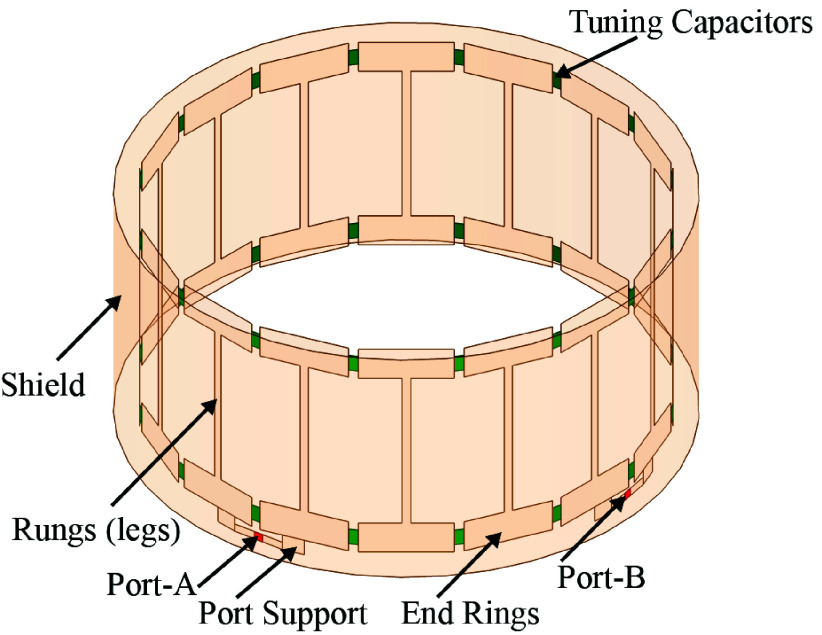
Typical MRI Birdcage coil in high-pass configuration includes 16 rungs and 32 tuning capacitors, with two ports positioned at a 90° displacement from each other.
Electromagnetic Field Exposures and Treatment Conditions of Human Neuronal Cultures
We performed the Electromagnetic field exposures using a vertically-mounted IFI TEM Cell (Transversal Electromagnetic Cell, model CC110-SPEC, DC to 1,000 MHz, Test Equipment Corporation, Mountain View, CA, IFI Ronkonkoma NY) [16]. This chamber is an expanded coaxial transmission line operating in the TEM mode, consisting of a main rectangular waveguide that contains a flat-metal-strip center conductor located in the middle between the top and bottom walls. The wall and center conductor are tapered at both ends to provide 50-Ohm impedance along the entire length of the chamber. One port was connected to the RF source (HP 8656B/57A/57B synthesized signal generator) via coaxial cable and the other end to a matched load impedance of 50-ohms (provided by an oscilloscope), which is the characteristic impedance to mimic free space or plane wave irradiation. The complete array was mounted on a compact and portable cart. The wave impedance throughout the chamber is the 377-ohms intrinsic impedance of free space.
Methods for Primary Human Brain (PHB) Cell Cultures
The protocol was approved by the Indiana University School of Medicine Institutional Review Board (IRB) [16]. Primary cultures of mixed human fetal brain (HFB) cells were prepared from the brain parenchyma of aborted fetuses (80-110 days gestational age), as described previously [37]. The meninges and blood vessels were removed; the brain tissue was washed in minimum essential medium and enzymatically dissociated by incubation in 0.05% Trypsin- 0.53 mM EDTA solution at \documentclass[12pt]{minimal} \usepackage{amsmath} \usepackage{wasysym} \usepackage{amsfonts} \usepackage{amssymb} \usepackage{amsbsy} \usepackage{upgreek} \usepackage{mathrsfs} \setlength{\oddsidemargin}{-69pt} \begin{document} $37^{\circ }C$\end{document} in a shaking water bath set to 150 RPM. Tissue was subsequently mechanically dissociated by trituration through a siliconized (Sigma-Cote; Sigma-Aldrich, St Louis, MO), fire-polished Pasteur pipette. Cells were then centrifuged at 800 x g for 10 min, resuspended and seeded at an initial density of \documentclass[12pt]{minimal} \usepackage{amsmath} \usepackage{wasysym} \usepackage{amsfonts} \usepackage{amssymb} \usepackage{amsbsy} \usepackage{upgreek} \usepackage{mathrsfs} \setlength{\oddsidemargin}{-69pt} \begin{document} $2.2\times 105$\end{document} cells/cm2 in Neurobasal (plus GlutaMAX, B27, antibiotic cocktail, normocin, bFGF) and allowed to attach overnight in poly-D-lysine coated 24-well tissue culture plates. The following day, media and non-cellular debris were aspirated from the plate and media replaced with Neurobasal medium (Invitrogen), supplemented with 1x B27, 0.5 mM GlutaMAX, 5 ng/ml basic FGF (Invitrogen), and antibiotic/antimycotic mixture. Half-media changes were performed every 3rd day of culture. Primary human brain cultures have been shown previously to comprise approximately 60 to 70% neurons with 30 to 40% mixed glial cells [38].
Results of Neuronal Exposures to REMFS
Results in CM samples revealed a 46% reduction of \documentclass[12pt]{minimal} \usepackage{amsmath} \usepackage{wasysym} \usepackage{amsfonts} \usepackage{amssymb} \usepackage{amsbsy} \usepackage{upgreek} \usepackage{mathrsfs} \setlength{\oddsidemargin}{-69pt} \begin{document} $(A\beta)40$\end{document} levels when cultures were subjected to REMFS at 64 MHz with a SAR of 0.6 W/Kg daily for one hour for 14 days and a corresponding 36% reduction in \documentclass[12pt]{minimal} \usepackage{amsmath} \usepackage{wasysym} \usepackage{amsfonts} \usepackage{amssymb} \usepackage{amsbsy} \usepackage{upgreek} \usepackage{mathrsfs} \setlength{\oddsidemargin}{-69pt} \begin{document} $(A\beta)42$\end{document}. Additional modifiable variables, such as exposure time and frequency were also considered, and the impact of these different EMF settings was studied relative to the reduction in \documentclass[12pt]{minimal} \usepackage{amsmath} \usepackage{wasysym} \usepackage{amsfonts} \usepackage{amssymb} \usepackage{amsbsy} \usepackage{upgreek} \usepackage{mathrsfs} \setlength{\oddsidemargin}{-69pt} \begin{document} $(A\beta)40$\end{document} and \documentclass[12pt]{minimal} \usepackage{amsmath} \usepackage{wasysym} \usepackage{amsfonts} \usepackage{amssymb} \usepackage{amsbsy} \usepackage{upgreek} \usepackage{mathrsfs} \setlength{\oddsidemargin}{-69pt} \begin{document} $(A\beta)42$\end{document} levels [16]. We also treated PHB cultures differentiated for 28 days to determine if REMFS also reduced \documentclass[12pt]{minimal} \usepackage{amsmath} \usepackage{wasysym} \usepackage{amsfonts} \usepackage{amssymb} \usepackage{amsbsy} \usepackage{upgreek} \usepackage{mathrsfs} \setlength{\oddsidemargin}{-69pt} \begin{document} $(A\beta)$\end{document} levels in cells near the end of primary culture lifespan [38]. Results revealed REMFS at 64 MHz with SAR of 0.9 W/Kg daily for 1 hour after 4 and 8 days produced a significant reduction of \documentclass[12pt]{minimal} \usepackage{amsmath} \usepackage{wasysym} \usepackage{amsfonts} \usepackage{amssymb} \usepackage{amsbsy} \usepackage{upgreek} \usepackage{mathrsfs} \setlength{\oddsidemargin}{-69pt} \begin{document} $(A\beta)40$\end{document} levels in the media cultures. Interestingly, a SAR of 0.4 W/kg produced similar results, although a significant reduction of the \documentclass[12pt]{minimal} \usepackage{amsmath} \usepackage{wasysym} \usepackage{amsfonts} \usepackage{amssymb} \usepackage{amsbsy} \usepackage{upgreek} \usepackage{mathrsfs} \setlength{\oddsidemargin}{-69pt} \begin{document} $(A\beta)42$\end{document} levels was only noted at day 8. Nevertheless, an overall shorter treatment duration also reduced \documentclass[12pt]{minimal} \usepackage{amsmath} \usepackage{wasysym} \usepackage{amsfonts} \usepackage{amssymb} \usepackage{amsbsy} \usepackage{upgreek} \usepackage{mathrsfs} \setlength{\oddsidemargin}{-69pt} \begin{document} $(A\beta)$\end{document} levels (4 or 8 vs. 14 or 21 days). This is an advance from our prior results following 21 days of exposure, leading us to believe that through additional fine tuning of REMFS settings, the desired biological effects of REMFS may ultimately be achieved after only a few treatments. REMFS studies with SAR of 0.25-1.05 W/kg similar to our study with SAR values of 0.4-0.9 EMF frequency and power used in our work were used in AD mouse studies with improvement in memory and Ad brain pathology, thus suggesting REMFS can be further developed in clinical settings to modulate \documentclass[12pt]{minimal} \usepackage{amsmath} \usepackage{wasysym} \usepackage{amsfonts} \usepackage{amssymb} \usepackage{amsbsy} \usepackage{upgreek} \usepackage{mathrsfs} \setlength{\oddsidemargin}{-69pt} \begin{document} $(A\beta)$\end{document} deposition.
Proposed Birdcage Coil Model
RF birdcage coils typically comprise two circular conductive loops known as end rings, N conductive straight elements called rungs (or legs), and capacitors positioned on either the rungs, end rings, or both. The placement of these capacitors within the coil geometry categorizes birdcage coils into three types: low-pass, high-pass, and band-pass configurations, each tailored to specific frequency filtering characteristics [36]. For instance Figure 1 shows a typical MRI Birdcage coil in high-pass configuration includes 16 rungs and 32 tuning capacitors, with two ports positioned at a 90° displacement from each other.
Within an RF birdcage coil featuring N legs and capacitors of uniform values, there emerge N/2 distinct resonant modes [36]. Among these modes, the \documentclass[12pt]{minimal} \usepackage{amsmath} \usepackage{wasysym} \usepackage{amsfonts} \usepackage{amssymb} \usepackage{amsbsy} \usepackage{upgreek} \usepackage{mathrsfs} \setlength{\oddsidemargin}{-69pt} \begin{document} $m=1$\end{document} state signifies either the lowest frequency mode in low-pass birdcage coils or the highest frequency resonant mode in high-pass configurations [36]. This particular \documentclass[12pt]{minimal} \usepackage{amsmath} \usepackage{wasysym} \usepackage{amsfonts} \usepackage{amssymb} \usepackage{amsbsy} \usepackage{upgreek} \usepackage{mathrsfs} \setlength{\oddsidemargin}{-69pt} \begin{document} $ m=1$\end{document} mode holds paramount importance in MRI applications as it generates a highly uniform \documentclass[12pt]{minimal} \usepackage{amsmath} \usepackage{wasysym} \usepackage{amsfonts} \usepackage{amssymb} \usepackage{amsbsy} \usepackage{upgreek} \usepackage{mathrsfs} \setlength{\oddsidemargin}{-69pt} \begin{document} $B1$\end{document} field within the coil, indispensable for achieving precise and reliable imaging outcomes [36]. The inductance matrix given below is derived using Ansys Q3D Extractor, and it represents the self and mutual inductances of the proposed coil.\documentclass[12pt]{minimal} \usepackage{amsmath} \usepackage{wasysym} \usepackage{amsfonts} \usepackage{amssymb} \usepackage{amsbsy} \usepackage{upgreek} \usepackage{mathrsfs} \setlength{\oddsidemargin}{-69pt} \begin{document} \begin{align*}&\mathbf{L}_{\mathrm{ij}}[\mathrm{pH}]=\\ &\qquad\qquad~~\begin{array}{ccccc}Rung_1 & \ldots & Rung_8 &\hspace{-0.2pc} \ldots & Rung_{16}\end{array}\\ &\hspace{0.5pc}\begin{array}{c}Rung_1 \\\ldots \\ Rung_8 \\ \ldots \\ Rung_{16}\end{array}\left(\begin{array}{ccccc} 3.57 & \ldots & -0.09 & \ldots & 0.09 \\ \vdots & \vdots & \vdots & \vdots & \vdots \\ -0.09 & \ldots & 3.57 & \ldots & -0.09 \\ \vdots & \vdots & \vdots & \vdots & \vdots \\ 0.09 & \ldots & -0.09 & \ldots & 3.57 \end{array}\right) \end{align*}\end{document}
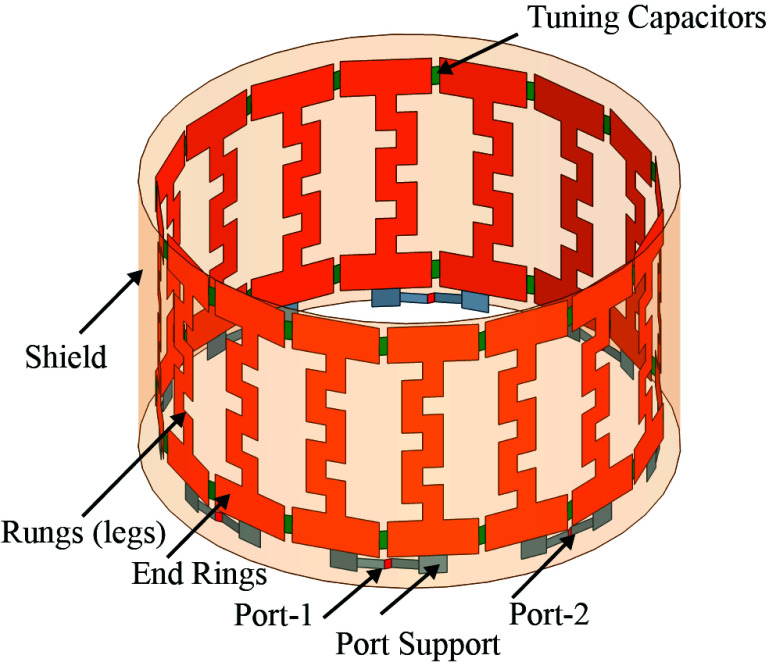
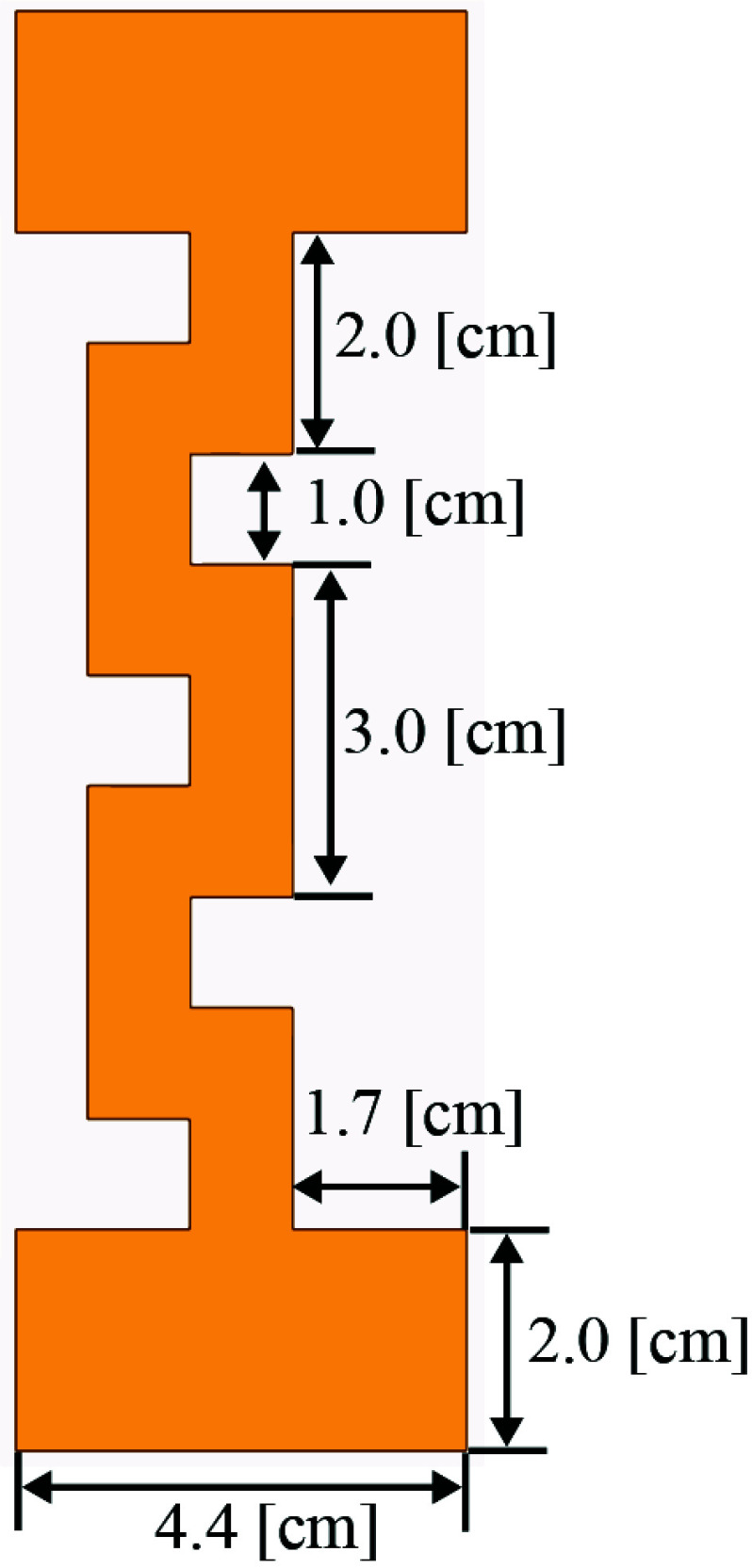
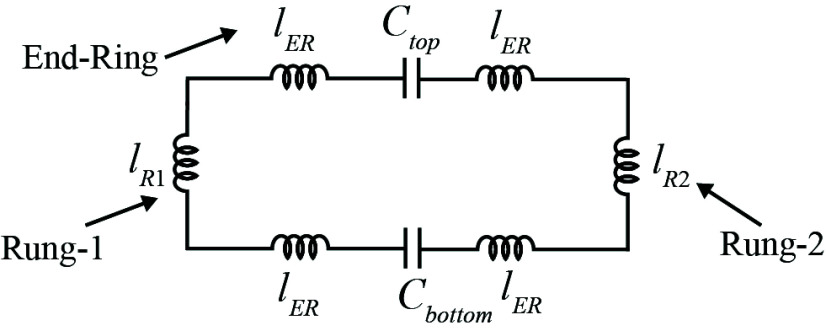
This article introduces an innovative Birdcage coil design that incorporates meander line antennas. Figure 2 illustrates the configuration of the proposed coil, which comprises eight ports and utilizes 32 tuning capacitors arranged in a high-pass configuration. Notably, each of the 16 rungs forming the coil is designed as a meander line antenna. Detailed dimensions of these rungs are provided in Figure 3, offering specific insights into their structure and dimensions. The straight length of this coil is 13 cm including the end rings on the top and bottom of the antenna. The antenna's RLCG circuit, represented in Figure 4, is analyzed using Ansys Q3D Extractor. This software computes matrix entries by individually exciting conductor nets or defined source terminals. Each excitation generates column entries in the matrix, calculating capacitance, inductance, or resistance for the specific conductor concerning the reference ground and other conductors [39]. The resistance and inductance matrices contain rows corresponding to each source terminal [39]. Meanwhile, the capacitance and conductance matrices have rows representing individual nets, illustrating the precise electromagnetic interactions between components in the antenna setup. In Figure 4\documentclass[12pt]{minimal} \usepackage{amsmath} \usepackage{wasysym} \usepackage{amsfonts} \usepackage{amssymb} \usepackage{amsbsy} \usepackage{upgreek} \usepackage{mathrsfs} \setlength{\oddsidemargin}{-69pt} \begin{document} $l_{R}$\end{document} refers to the equivalent inductance of the antenna's rung, and \documentclass[12pt]{minimal} \usepackage{amsmath} \usepackage{wasysym} \usepackage{amsfonts} \usepackage{amssymb} \usepackage{amsbsy} \usepackage{upgreek} \usepackage{mathrsfs} \setlength{\oddsidemargin}{-69pt} \begin{document} $l_{ER}$\end{document} is the equivalent inductance of the end rings of the antenna. Inductance L directly correlates to the energy stored within a magnetic field and it is proportional to the energy stored \documentclass[12pt]{minimal} \usepackage{amsmath} \usepackage{wasysym} \usepackage{amsfonts} \usepackage{amssymb} \usepackage{amsbsy} \usepackage{upgreek} \usepackage{mathrsfs} \setlength{\oddsidemargin}{-69pt} \begin{document} $E_{s}$\end{document} in the magnetic field when current i flows.\documentclass[12pt]{minimal} \usepackage{amsmath} \usepackage{wasysym} \usepackage{amsfonts} \usepackage{amssymb} \usepackage{amsbsy} \usepackage{upgreek} \usepackage{mathrsfs} \setlength{\oddsidemargin}{-69pt} \begin{document} \begin{equation*} E_{s}=\frac {1}{2}Li^{2} \tag {1}\end{equation*}\end{document}
To calculate inductance using Ansys Q3D Extractor a current of 1 ampere is directed through a single conductor, while no current is permitted to flow through any other conductor. Then the energy contained within the magnetic field, specifically associated with the inductance between two conductors, is mathematically expressed by the following relationship:\documentclass[12pt]{minimal} \usepackage{amsmath} \usepackage{wasysym} \usepackage{amsfonts} \usepackage{amssymb} \usepackage{amsbsy} \usepackage{upgreek} \usepackage{mathrsfs} \setlength{\oddsidemargin}{-69pt} \begin{document} \begin{equation*} E_{s_{ij}}=\frac {1}{2}\int (B_{i}H_{j})dl \tag {2}\end{equation*}\end{document}The equation defines \documentclass[12pt]{minimal} \usepackage{amsmath} \usepackage{wasysym} \usepackage{amsfonts} \usepackage{amssymb} \usepackage{amsbsy} \usepackage{upgreek} \usepackage{mathrsfs} \setlength{\oddsidemargin}{-69pt} \begin{document} $E_{s_{ij}}$\end{document} as the energy stored within the magnetic field connecting rung i to rung j. \documentclass[12pt]{minimal} \usepackage{amsmath} \usepackage{wasysym} \usepackage{amsfonts} \usepackage{amssymb} \usepackage{amsbsy} \usepackage{upgreek} \usepackage{mathrsfs} \setlength{\oddsidemargin}{-69pt} \begin{document} $B_{i}$\end{document} represents the magnetic flux density and \documentclass[12pt]{minimal} \usepackage{amsmath} \usepackage{wasysym} \usepackage{amsfonts} \usepackage{amssymb} \usepackage{amsbsy} \usepackage{upgreek} \usepackage{mathrsfs} \setlength{\oddsidemargin}{-69pt} \begin{document} $H_{i}$\end{document} denotes the magnetic field intensity. This relationship establishes the stored energy within the magnetic field, specifically capturing the interaction between these designated conductors in the system. The complete inductance matrix in \documentclass[12pt]{minimal} \usepackage{amsmath} \usepackage{wasysym} \usepackage{amsfonts} \usepackage{amssymb} \usepackage{amsbsy} \usepackage{upgreek} \usepackage{mathrsfs} \setlength{\oddsidemargin}{-69pt} \begin{document} $(pH)$\end{document} is given above. The diagonal entries of this matrix signify the self-inductance of each rung, whereas the off-diagonal elements indicate the mutual inductances between the rungs. The positive and negative signs in the off-diagonal elements of the matrix signify additive or subtractive coupling between the rungs.

The proposed Birdcage coil in high-pass configuration includes 16 meander line coils and 32 tuning capacitors, with eight ports positioned at a 45° displacement from each other.
![The proposed Birdcage based meander line a single coil with dimensions in []. cm](https://europepmc.org/articles/PMC12251030/bin/perez3-3559693.jpg "Click to view full size")
The proposed Birdcage based meander line a single coil with dimensions in []. cm

The equivalent circuit of the proposed birdcage based meander line antenna.
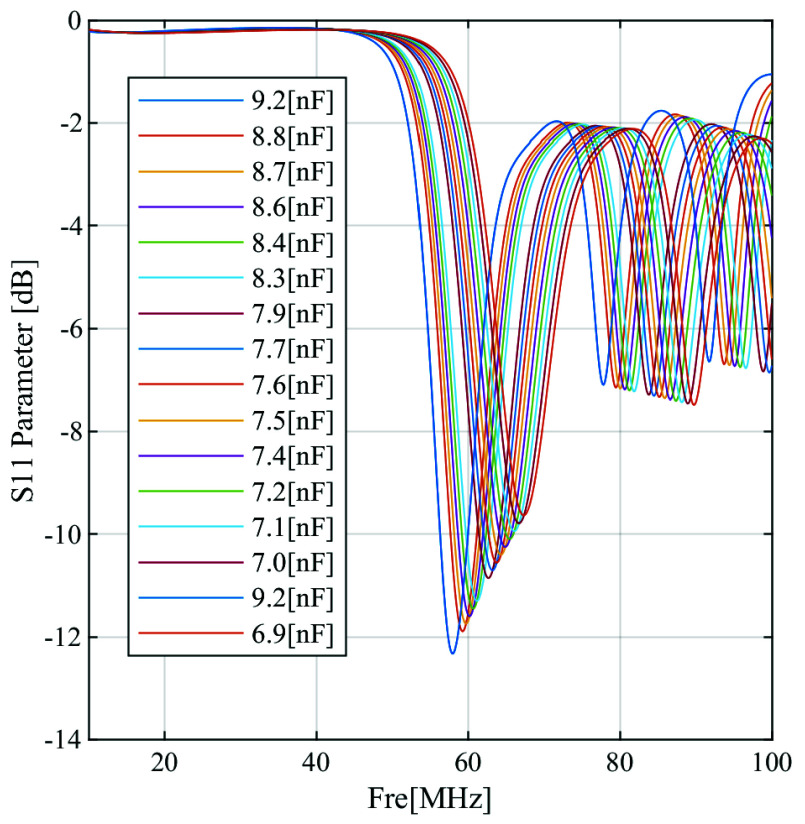
![Theparameter in (dB) at different tuning capacitors in. \documentclass[12pt]{minimal}
\usepackage{amsmath}
\usepackage{wasysym}
\usepackage{amsfonts}
\usepackage{amssymb}
\usepackage{amsbsy}
\usepackage{upgreek}
\usepackage{mathrsfs}
\setlength{\oddsidemargin}{-69pt}
\begin{document}
$S_{11}$\end{document} \documentclass[12pt]{minimal}
\usepackage{amsmath}
\usepackage{wasysym}
\usepackage{amsfonts}
\usepackage{amssymb}
\usepackage{amsbsy}
\usepackage{upgreek}
\usepackage{mathrsfs}
\setlength{\oddsidemargin}{-69pt}
\begin{document}
$(nF)$\end{document}](https://europepmc.org/articles/PMC12251030/bin/perez5-3559693.jpg "Click to view full size")
Theparameter in (dB) at different tuning capacitors in. \documentclass[12pt]{minimal} \usepackage{amsmath} \usepackage{wasysym} \usepackage{amsfonts} \usepackage{amssymb} \usepackage{amsbsy} \usepackage{upgreek} \usepackage{mathrsfs} \setlength{\oddsidemargin}{-69pt} \begin{document} $S_{11}$\end{document} \documentclass[12pt]{minimal} \usepackage{amsmath} \usepackage{wasysym} \usepackage{amsfonts} \usepackage{amssymb} \usepackage{amsbsy} \usepackage{upgreek} \usepackage{mathrsfs} \setlength{\oddsidemargin}{-69pt} \begin{document} $(nF)$\end{document}
![Theparameter in (dB) (from top to bottom):,,,,,,,. Theparameter was measured with the human head model in place. This should help to better illustrate the antenna's behavior in a loaded state, which is a key factor for evaluating its real-world performance. \documentclass[12pt]{minimal}
\usepackage{amsmath}
\usepackage{wasysym}
\usepackage{amsfonts}
\usepackage{amssymb}
\usepackage{amsbsy}
\usepackage{upgreek}
\usepackage{mathrsfs}
\setlength{\oddsidemargin}{-69pt}
\begin{document}
$S_{ii}$\end{document} \documentclass[12pt]{minimal}
\usepackage{amsmath}
\usepackage{wasysym}
\usepackage{amsfonts}
\usepackage{amssymb}
\usepackage{amsbsy}
\usepackage{upgreek}
\usepackage{mathrsfs}
\setlength{\oddsidemargin}{-69pt}
\begin{document}
$S_{11}$\end{document} \documentclass[12pt]{minimal}
\usepackage{amsmath}
\usepackage{wasysym}
\usepackage{amsfonts}
\usepackage{amssymb}
\usepackage{amsbsy}
\usepackage{upgreek}
\usepackage{mathrsfs}
\setlength{\oddsidemargin}{-69pt}
\begin{document}
$S_{22}$\end{document} \documentclass[12pt]{minimal}
\usepackage{amsmath}
\usepackage{wasysym}
\usepackage{amsfonts}
\usepackage{amssymb}
\usepackage{amsbsy}
\usepackage{upgreek}
\usepackage{mathrsfs}
\setlength{\oddsidemargin}{-69pt}
\begin{document}
$S_{33}$\end{document} \documentclass[12pt]{minimal}
\usepackage{amsmath}
\usepackage{wasysym}
\usepackage{amsfonts}
\usepackage{amssymb}
\usepackage{amsbsy}
\usepackage{upgreek}
\usepackage{mathrsfs}
\setlength{\oddsidemargin}{-69pt}
\begin{document}
$S_{44}$\end{document} \documentclass[12pt]{minimal}
\usepackage{amsmath}
\usepackage{wasysym}
\usepackage{amsfonts}
\usepackage{amssymb}
\usepackage{amsbsy}
\usepackage{upgreek}
\usepackage{mathrsfs}
\setlength{\oddsidemargin}{-69pt}
\begin{document}
$S_{55}$\end{document} \documentclass[12pt]{minimal}
\usepackage{amsmath}
\usepackage{wasysym}
\usepackage{amsfonts}
\usepackage{amssymb}
\usepackage{amsbsy}
\usepackage{upgreek}
\usepackage{mathrsfs}
\setlength{\oddsidemargin}{-69pt}
\begin{document}
$S_{66}$\end{document} \documentclass[12pt]{minimal}
\usepackage{amsmath}
\usepackage{wasysym}
\usepackage{amsfonts}
\usepackage{amssymb}
\usepackage{amsbsy}
\usepackage{upgreek}
\usepackage{mathrsfs}
\setlength{\oddsidemargin}{-69pt}
\begin{document}
$S_{77}$\end{document} \documentclass[12pt]{minimal}
\usepackage{amsmath}
\usepackage{wasysym}
\usepackage{amsfonts}
\usepackage{amssymb}
\usepackage{amsbsy}
\usepackage{upgreek}
\usepackage{mathrsfs}
\setlength{\oddsidemargin}{-69pt}
\begin{document}
$S_{88}$\end{document} \documentclass[12pt]{minimal}
\usepackage{amsmath}
\usepackage{wasysym}
\usepackage{amsfonts}
\usepackage{amssymb}
\usepackage{amsbsy}
\usepackage{upgreek}
\usepackage{mathrsfs}
\setlength{\oddsidemargin}{-69pt}
\begin{document}
$S_{ii}$\end{document}](https://europepmc.org/articles/PMC12251030/bin/perez6-3559693.jpg "Click to view full size")
Theparameter in (dB) (from top to bottom):,,,,,,,. Theparameter was measured with the human head model in place. This should help to better illustrate the antenna's behavior in a loaded state, which is a key factor for evaluating its real-world performance. \documentclass[12pt]{minimal} \usepackage{amsmath} \usepackage{wasysym} \usepackage{amsfonts} \usepackage{amssymb} \usepackage{amsbsy} \usepackage{upgreek} \usepackage{mathrsfs} \setlength{\oddsidemargin}{-69pt} \begin{document} $S_{ii}$\end{document} \documentclass[12pt]{minimal} \usepackage{amsmath} \usepackage{wasysym} \usepackage{amsfonts} \usepackage{amssymb} \usepackage{amsbsy} \usepackage{upgreek} \usepackage{mathrsfs} \setlength{\oddsidemargin}{-69pt} \begin{document} $S_{11}$\end{document} \documentclass[12pt]{minimal} \usepackage{amsmath} \usepackage{wasysym} \usepackage{amsfonts} \usepackage{amssymb} \usepackage{amsbsy} \usepackage{upgreek} \usepackage{mathrsfs} \setlength{\oddsidemargin}{-69pt} \begin{document} $S_{22}$\end{document} \documentclass[12pt]{minimal} \usepackage{amsmath} \usepackage{wasysym} \usepackage{amsfonts} \usepackage{amssymb} \usepackage{amsbsy} \usepackage{upgreek} \usepackage{mathrsfs} \setlength{\oddsidemargin}{-69pt} \begin{document} $S_{33}$\end{document} \documentclass[12pt]{minimal} \usepackage{amsmath} \usepackage{wasysym} \usepackage{amsfonts} \usepackage{amssymb} \usepackage{amsbsy} \usepackage{upgreek} \usepackage{mathrsfs} \setlength{\oddsidemargin}{-69pt} \begin{document} $S_{44}$\end{document} \documentclass[12pt]{minimal} \usepackage{amsmath} \usepackage{wasysym} \usepackage{amsfonts} \usepackage{amssymb} \usepackage{amsbsy} \usepackage{upgreek} \usepackage{mathrsfs} \setlength{\oddsidemargin}{-69pt} \begin{document} $S_{55}$\end{document} \documentclass[12pt]{minimal} \usepackage{amsmath} \usepackage{wasysym} \usepackage{amsfonts} \usepackage{amssymb} \usepackage{amsbsy} \usepackage{upgreek} \usepackage{mathrsfs} \setlength{\oddsidemargin}{-69pt} \begin{document} $S_{66}$\end{document} \documentclass[12pt]{minimal} \usepackage{amsmath} \usepackage{wasysym} \usepackage{amsfonts} \usepackage{amssymb} \usepackage{amsbsy} \usepackage{upgreek} \usepackage{mathrsfs} \setlength{\oddsidemargin}{-69pt} \begin{document} $S_{77}$\end{document} \documentclass[12pt]{minimal} \usepackage{amsmath} \usepackage{wasysym} \usepackage{amsfonts} \usepackage{amssymb} \usepackage{amsbsy} \usepackage{upgreek} \usepackage{mathrsfs} \setlength{\oddsidemargin}{-69pt} \begin{document} $S_{88}$\end{document} \documentclass[12pt]{minimal} \usepackage{amsmath} \usepackage{wasysym} \usepackage{amsfonts} \usepackage{amssymb} \usepackage{amsbsy} \usepackage{upgreek} \usepackage{mathrsfs} \setlength{\oddsidemargin}{-69pt} \begin{document} $S_{ii}$\end{document}
Human Body and Brain Model
The human body adopted in this article is the NEVA human body simulation model. The NEVA-Female v.3.0, is a platform-independent full-body computational human model, is constructed from 26 distinct tissues and 233 separate tissue parts [40], [41]. These components are presented as 3D CAD objects in the form of triangular surface meshes, totaling around 160,000 facets. Its accuracy is marked by a surface deviation error of 0.5-3 mm within the cranium and up to 7 mm across the main body, ensuring a highly detailed representation of human anatomy [41].

The NEVA human body model incorporates the proposed antenna affixed to the head.

(a) Near electric field in (dB). (b) Near magnetic field in (dB) of the proposed design.
| Tissue | Relative Permittivity | Electrical Conductivity(S/m) |
|---|---|---|
| trachea sinus (air) | 1 | 0 |
| Arteries (blood) | 86.4 | 1.21 |
| Skin | 92.2 | 0.436 |
| Bone cortical | 16.7 | 0.0595 |
| Brain white matter | 67.8 | 0.292 |
| Brain grey matter | 97.4 | 0.511 |
| Cerebellum | 116 | 0.719 |
| Cerebrospinal fluid | 97.3 | 2.07 |
| Eye vitreous humor | 69.1 | 1.5 |
| Body Fat | 13.6 | 0.0662 |
Results and Discussion
In this section, we delve into the examination of both local and average Specific Absorption Rate (SAR) in accordance with the standards outlined in IEC/IEEE 62704-4. The averaging process is conducted across a mass of 1 gram of tissue. The average SAR values ranging from 0.4 to 0.9 W/kg achieved within the simulated brain tissues using the proposed 8-ports antenna, as depicted in Figure 9, comply with safety guidelines by FDA. The local SAR for 1 gm of tissues was assessed across various brain regions and documented from different cross-sectional planes. First, Figure 10 displays the spatial distribution of specific absorption rate (SAR) in [W/kg] as observed from the xz-plane. Second, Figure 11 depicts the local specific absorption rate (SAR) in [W/kg] as observed from the yz-plane. The third representation in Figure 12 illustrates the local specific absorption rate (SAR) observed within the xy-plane.
![Average SAR distribution across the brain in [] using the 8-port antenna. \documentclass[12pt]{minimal}
\usepackage{amsmath}
\usepackage{wasysym}
\usepackage{amsfonts}
\usepackage{amssymb}
\usepackage{amsbsy}
\usepackage{upgreek}
\usepackage{mathrsfs}
\setlength{\oddsidemargin}{-69pt}
\begin{document}
$W/Kg$\end{document}](https://europepmc.org/articles/PMC12251030/bin/perez9-3559693.jpg "Click to view full size")
Average SAR distribution across the brain in [] using the 8-port antenna. \documentclass[12pt]{minimal} \usepackage{amsmath} \usepackage{wasysym} \usepackage{amsfonts} \usepackage{amssymb} \usepackage{amsbsy} \usepackage{upgreek} \usepackage{mathrsfs} \setlength{\oddsidemargin}{-69pt} \begin{document} $W/Kg$\end{document}
![Local SAR distribution across the brain in [] using the 8-port antenna (xz plane view). \documentclass[12pt]{minimal}
\usepackage{amsmath}
\usepackage{wasysym}
\usepackage{amsfonts}
\usepackage{amssymb}
\usepackage{amsbsy}
\usepackage{upgreek}
\usepackage{mathrsfs}
\setlength{\oddsidemargin}{-69pt}
\begin{document}
$W/Kg$\end{document}](https://europepmc.org/articles/PMC12251030/bin/perez10-3559693.jpg "Click to view full size")
Local SAR distribution across the brain in [] using the 8-port antenna (xz plane view). \documentclass[12pt]{minimal} \usepackage{amsmath} \usepackage{wasysym} \usepackage{amsfonts} \usepackage{amssymb} \usepackage{amsbsy} \usepackage{upgreek} \usepackage{mathrsfs} \setlength{\oddsidemargin}{-69pt} \begin{document} $W/Kg$\end{document}
![Local SAR distribution across the brain in [] using the 8-port antenna (yz plane view). \documentclass[12pt]{minimal}
\usepackage{amsmath}
\usepackage{wasysym}
\usepackage{amsfonts}
\usepackage{amssymb}
\usepackage{amsbsy}
\usepackage{upgreek}
\usepackage{mathrsfs}
\setlength{\oddsidemargin}{-69pt}
\begin{document}
$W/Kg$\end{document}](https://europepmc.org/articles/PMC12251030/bin/perez11-3559693.jpg "Click to view full size")
Local SAR distribution across the brain in [] using the 8-port antenna (yz plane view). \documentclass[12pt]{minimal} \usepackage{amsmath} \usepackage{wasysym} \usepackage{amsfonts} \usepackage{amssymb} \usepackage{amsbsy} \usepackage{upgreek} \usepackage{mathrsfs} \setlength{\oddsidemargin}{-69pt} \begin{document} $W/Kg$\end{document}
![Local SAR distribution across the brain in [] using the 8-port antenna (xy plane view). \documentclass[12pt]{minimal}
\usepackage{amsmath}
\usepackage{wasysym}
\usepackage{amsfonts}
\usepackage{amssymb}
\usepackage{amsbsy}
\usepackage{upgreek}
\usepackage{mathrsfs}
\setlength{\oddsidemargin}{-69pt}
\begin{document}
$W/Kg$\end{document}](https://europepmc.org/articles/PMC12251030/bin/perez12-3559693.jpg "Click to view full size")
Local SAR distribution across the brain in [] using the 8-port antenna (xy plane view). \documentclass[12pt]{minimal} \usepackage{amsmath} \usepackage{wasysym} \usepackage{amsfonts} \usepackage{amssymb} \usepackage{amsbsy} \usepackage{upgreek} \usepackage{mathrsfs} \setlength{\oddsidemargin}{-69pt} \begin{document} $W/Kg$\end{document}
![Average SAR [W/kg] for the two-ports antenna.](https://europepmc.org/articles/PMC12251030/bin/perez13-3559693.jpg "Click to view full size")
Average SAR [W/kg] for the two-ports antenna.
![Average SAR [W/kg] for the eight-ports antenna.](https://europepmc.org/articles/PMC12251030/bin/perez14-3559693.jpg "Click to view full size")
Average SAR [W/kg] for the eight-ports antenna.
![Local SAR [W/kg] recorded at brain grey matter tissues for the two-port antenna.](https://europepmc.org/articles/PMC12251030/bin/perez15-3559693.jpg "Click to view full size")
Local SAR [W/kg] recorded at brain grey matter tissues for the two-port antenna.
![Local SAR [W/kg] found at brain grey matter tissues using eight ports antenna.](https://europepmc.org/articles/PMC12251030/bin/perez16-3559693.jpg "Click to view full size")
Local SAR [W/kg] found at brain grey matter tissues using eight ports antenna.

Local SAR measured at the brain white matter for two-port antenna.

SAR measured at the brain white matter for eight-port antenna.

Local SAR at Cerebellum tissues for two-ports case.

Local SAR at Cerebellum tissues for eight-ports case.

Local SAR at the CSF shell using two port case.

Local SAR at the CSF shell using eight ports case.

To ensure a Specific Absorption Rate (SAR) of 0.4 W/kg and 0.6W/kg, the maximum required magnetic field strengths is 0.001 Tesla underloaded condition.
Comparison Between the Proposed Antenna with Two and Eight Ports Designs
Local and average Specific Absorption Rate (SAR) are investigated in this section. To achieve the most homogeneous (SAR),the proposed antenna models were excited with two distinct phase shifts between the RF signals at the feed ports: 1) Coil with two ports at a phase shift of 90°, and 2) Coil with eight ports excited at 45°. The average and local Specific Absorption Rate (SAR) in [W/kg] were simulated and recorded at various regions of the human body for both configurations: the two-port and eight-port setups, the results are illustrated in Figure 13 to Figure 22. Figure 13 shows the average SAR [W/kg] for the 90° phase shift. while Figure 14 illustrates the average SAR [W/kg] for the eight-ports antenna. Figure 15 depicts the local SAR [W/kg] simulated at brain grey matter tissues for the two-port antenna and Figure 16 shows the local SAR [W/kg] recorded at brain grey matter tissues using eight ports antenna. Figure 17 illustrates the local SAR simulated and found at the brain white matter tissues using the two-port antenna. Figure 18 shows the local SAR at the brain white matter tissues using the eight-port antenna. While Figure 19 depects the Local SAR at Cerebellum tissues using the two-ports case and Figure 20 shows the local SAR at Cerebellum tissues using the eight-ports case. Lastly Figure 21 illustrates the local SAR at the CSF shell using two port case and Figure 22 is the local SAR at the CSF shell using eight ports antenna. The eight-port coil demonstrates improved SAR homogeneity, maintaining values ranging from 0.6 to 0.9 [W/kg] within brain tissues compared to the two-ports case.
Temperature Estimation Based on the Proposed MRI Coil
Previous research has investigated the relationship in humans between RF exposure, and the resulting SAR and temperature elevation, with the goal of monitoring the temperature increase to remain within human safety guidelines. With out proposed novel birdcage coil operating at 64 MHz with the goal of 0.6 W/Kg SAR throughout the human head, other research can be examined for a baseline of where the temperature rise for such a device might lie. Christopher M., et al concluded that there isn't a straightforward relationship between SAR and temperature increase within human issues, and found through calculation using the FDTD method, that a birdcage coil at 64 MHz achieving a head average SAR of 3.0 W/kg resulted in a maximum 2.1 degree Celsius increase in the head, and maximum 0.9 degree Celsius increase in the brain. Reference [44] Collins et al. also using numerical methods, found that when using birdcage coils from 64 to 400 MHz causing a head average SAR of 3.0W/kg, that a maximum temperature increase of 0.87 degrees Celsius occurred in the brain [45]. They had also concluded however that the relationship between SAR and temperature increase is not straightforward and should be better understood. Reference [45] Hirata et al. used numerical simulations on male and female human body models, using various models with different number of tissues, and exposing them to a 123 MHz 16 rung coil until a whole body averaged SAR of 2 W/kg was reached [46]. Under these conditions, the full male body model reached a head average SAR of 3.58 W/kg and an average head temperature increase of 1.05 degrees Celsius, while the female model reached a head-average sar of 2.25 W/kg with an average head temperature increase of 0.72 degrees Celsius [46]. Also using FDTD methods for 1 hour simulations of RF exposure for male and female body models, Hironori Sugiyama, et al found ¡1 degree core-temperature increase for the body as a whole, when at 4 W/kg whole-body average SAR [45]. They had concluded that estimates for a temperature and SAR relationship could be made using a proposed novel formula when considering whole-body average SAR and core-temperature, however for our usage a relationship for more granular information would be necessary [45]. Finally, in a study using a dipole antenna operating in the range between 800MHz and 3GHz and using FDTD numerical methods, Hirata et al. found a less than 0.1 degree Celsius temperature increase within brain tissue for 10g average SAR of less than 1 W/kg [47]. It was also found that there was difficulty in establishing a consistent SAR and temperature elevation relationship across different tissue types, SAR measurements and operating frequencies [47]. Since the thermal response is considered an important element towards the system stability, the NEVA head model was simulated via HFSS with seven layers of the brain tissue. The simulation run for an hour to track the temperature change with the 0.6 SAR power. The change in milli kelvin suggests good stability and flexibility for patient therapy in medical settings.

Maximum and minimum brain temperature.
Limitations and Future Work
The future direction of this work lies in taking the success seen in numerous preclinical studies of cell cultures, AD animal models, and one clinical trial and applying it to human clinical scenarios. The challenge comes in the translation of these results to human characteristics. Because we cannot transpose the RF power deposition and frequency in cell cultures and animal models 1:1 to human studies, our objective was to find the frequency and input power of the RF source that would generate an RF power deposition with a specific absorption rate (SAR) of 0.4–0.9 W/kg in a numerical human brain phantom using mathematical models, computer simulations, and practical validation experiments considering the different human head tissues and their electrical properties. To determine the cause or functional dependence of RF-induced biological effects, regulatory agencies have recommended measuring the energy absorbed or power deposition with a SAR value by tissues and cells.
Sar Use
SAR is an important safety guardrail for humans when using RF exposures. The biological effects of RF exposures cannot be determined by measuring power density unless the amount of energy absorbed is also known [48], [49]. SAR measures the rate of the energy absorbed or power deposition in the tissues relevant to specific biological effects and is, therefore, a central consideration for the envisioned work. Given that we found that a power deposition with a SAR of 0.4–0.9 W/kg lowers A\documentclass[12pt]{minimal} \usepackage{amsmath} \usepackage{wasysym} \usepackage{amsfonts} \usepackage{amssymb} \usepackage{amsbsy} \usepackage{upgreek} \usepackage{mathrsfs} \setlength{\oddsidemargin}{-69pt} \begin{document} $\beta $\end{document} levels in mice and human brain cultures, we must determine the EMF parameters of the external RF source that will produce the RF power deposition with a SAR of 0.4–0.9 W/kg in a numerical human head with all its tissue layers before we use it in humans. SAR determination will be obtained by numerical field calculations with suitable coils and patient models using the finite-difference time-domain (FDTD) technique and adjusting the EMF parameters of the external RF field source to produce an RF power deposition with a SAR of 0.4–0.9 W/kg and to allow visualization of a homogeneous power distribution.
Sar Framework
To find a SAR framework, we reviewed the negative or positive actions of REMFS treatments on memory [50] and in AD pathology in multiple studies. For this purpose, we used the inverted U-shaped dose-effect curve (IUSDEC). Initially, we reviewed the literature [15], [51], [52] from cell culture [16], [53], [54], [55], [56], [57], [58], [59], animal [13], [17], [20], [21], [22], [23], [24], [25], [26], [27], [28], [30], [60], [61], [62], [63], and human [64], [65], [66], [67], [68] studies before we performed our human brain culture studies. We found that an RF power deposition that results in a SAR between 0.25–5 W/kg improves AD pathology and memory. On the contrary, when the SAR was lower than 0.25 W/kg [69], [70], [71], [72], [73], [74], [75], [76], [77], [78], [79], [80], [81], [82], [83] or higher than 5 W/kg [84], [85], [86], [87], [88], [89], [90], [91], [92], [93], [94], [95], [96], [97], [98], it had no effects or was detrimental to AD pathology and cognition, suggesting an IUSDEC.
Frequency Range
The penetration depth of EM radiation in tissues increases as frequency is reduced [99]. Thus, RF below 400 MHz is best suited for human exposure to tissues lying 1–20 cm deep in the body, such as the head. We chose 64 MHz for our studies for several reasons: 1)Ideal penetration depth (13.5 cm) [100] and homogeneous field distribution.2)Previous studies on human cells and mouse cultures did not find toxicity [101].3)It is in the range 30–200 MHz [102] at whole human body resonance, so less power is needed to obtain SAR with a lower temperature rise (TR) [103].4)It has been used by MRI systems for 40 years, thus, providing an established and safe framework for human exposure.
Future Experimental Validation

Perspective view of an EMF generation system (REMFS) with a head-mounted antenna, including control system and coupling unit.
Clinical Settings
A future general implementation strategy to integrate REMFS into existing AD treatment workflows will consist of the following: 1) The inclusion criteria will be patients with Amnestic mild cognitive impairment due to AD diagnosed by Neuropsychological testing. 2) The required diagnostic tests will be Brain MRI, FTDG PET scan, and Amyloid PET to determine the brain (\documentclass[12pt]{minimal} \usepackage{amsmath} \usepackage{wasysym} \usepackage{amsfonts} \usepackage{amssymb} \usepackage{amsbsy} \usepackage{upgreek} \usepackage{mathrsfs} \setlength{\oddsidemargin}{-69pt} \begin{document} $A\beta $\end{document}) load and the degree of neurodegeneration. 3) The treatment plan will include daily REMFS exposures in combination with Cholinesterase inhibitors and Memantine. 4) Treatment administration will ensure the correct RF power deposition with a SAR of 0.4-0.9 W/kg daily for one hour, provided by a birdcage antenna. 5) During the exposure, SAR and temperature will be monitored and controlled. 6) The follow-up care will include appointments, medication refills, and lifestyle recommendations. The REMFS portable size will allow us to provide treatments to patients at hospitals, neurology clinics, psychiatry clinics, geriatric clinics, nursing homes, and out-of-pocket home consumers in the USA and later in the world. In the clinical setting, another area of interest lies in how to determine the real-time effectiveness of REMFS for patients. New blood and spinal fluid biomarkers such as phosphorylated tau 217 (p-tau 217) and A\documentclass[12pt]{minimal} \usepackage{amsmath} \usepackage{wasysym} \usepackage{amsfonts} \usepackage{amssymb} \usepackage{amsbsy} \usepackage{upgreek} \usepackage{mathrsfs} \setlength{\oddsidemargin}{-69pt} \begin{document} $\beta _{42}$\end{document}:A\documentclass[12pt]{minimal} \usepackage{amsmath} \usepackage{wasysym} \usepackage{amsfonts} \usepackage{amssymb} \usepackage{amsbsy} \usepackage{upgreek} \usepackage{mathrsfs} \setlength{\oddsidemargin}{-69pt} \begin{document} $\beta _{40}$\end{document} hold promise as future markers that can be monitored pre and post-REMFS treatment. Temperature monitoring remains an utmost safety concern as well. Since RF heat can cause tissue injury, it must be kept to a safe level of less than 0.5°C per regulatory agencies [31]. Before investigating human trials, there must be clearly defined parameters for a safe SAR level that does not exceed this threshold in all patients. AI deep learning (convolutional neural networks) holds potential for simulating personalized treatment with the appropriate temperature and SAR levels while accounting for unique patient characteristics based on the patient's MRI sequences. Preclinical data suggest that the optimal treatment time is one hour once a day of RF exposures, and clinical trials also need to determine the exposure time and schedule. Given the circadian production and clearance of amyloid-\documentclass[12pt]{minimal} \usepackage{amsmath} \usepackage{wasysym} \usepackage{amsfonts} \usepackage{amssymb} \usepackage{amsbsy} \usepackage{upgreek} \usepackage{mathrsfs} \setlength{\oddsidemargin}{-69pt} \begin{document} $\beta $\end{document} (A\documentclass[12pt]{minimal} \usepackage{amsmath} \usepackage{wasysym} \usepackage{amsfonts} \usepackage{amssymb} \usepackage{amsbsy} \usepackage{upgreek} \usepackage{mathrsfs} \setlength{\oddsidemargin}{-69pt} \begin{document} $\beta $\end{document}) [107], especially early in the disease course, this might affect the duration and timing of treatment.
While the birdcage-based MLA design demonstrated improved SAR homogeneity in simulations, future clinical studies and phantom testing are required to verify uniformity under real physiological loading conditions. Integration into current Alzheimer's care will be supported through modular use with existing MRI tools, as well as biomarker monitoring frameworks. The SAR levels of 0.4-0.9 W/kg at 64 MHz are comparable to routine MRI scans, which have been safely used in patients for over four decades. Additionally, minimaltemperature elevation in simulated tissue during one-hour exposures. \documentclass[12pt]{minimal} \usepackage{amsmath} \usepackage{wasysym} \usepackage{amsfonts} \usepackage{amssymb} \usepackage{amsbsy} \usepackage{upgreek} \usepackage{mathrsfs} \setlength{\oddsidemargin}{-69pt} \begin{document} $(< 0.5^{\circ })$\end{document}
Compared to Transcranial Magnetic Stimulation (TMS), which primarily affects superficial cortical areas, and transcranial photobiomodulation (tPBM), which suffers from limited penetration depth due to light scattering, REMFS delivers uniform energy to deep brain regions. The selected 64 MHz frequency yields a skin depth of approximately 13.5 cm in brain tissue, reaching key memory regions such as the hippocampus. Furthermore, SAR levels can be dynamically regulated in real-time, providing a tunable and safer alternative to more invasive approaches [108].
Another REMFS advantage is that it showed minimal long-term side effects in preclinical studies and clinical trials. A REMFS clinical trial at 915 MHz only caused mild discomfort after two years and a half of RF exposure, but there was no increased cancer risk or thermal injuries [65]. Transcranial Electromagnetic Treatment Stops Alzheimer's Disease Cognitive Decline over a \documentclass[12pt]{minimal} \usepackage{amsmath} \usepackage{wasysym} \usepackage{amsfonts} \usepackage{amssymb} \usepackage{amsbsy} \usepackage{upgreek} \usepackage{mathrsfs} \setlength{\oddsidemargin}{-69pt} \begin{document} $2\frac {1}{2}$\end{document}-Year Period: A Pilot Study. Medicines, 9(8), 42). Additionally, 64 MHz has been used for decades in routine RF MRIs without adverse long-term side effects other than acute thermal effects. For this reason, in 2003, the FDA declared "nonsignificant risk status" for MRI clinical systems generating static fields up to 8T or 340 MHz [109].
Conclusion
This article introduces a new design of a portable Birdcage based meander line antenna for Azheimer's disease treatments. The design achieves a specific absorption rate (SAR) ranging from 0.4 to 0.9 W/kg within the simulated human brain, focusing on near-field distribution. The HFSS simulations indicate a scattering parameter S11 at 64 MHz while maintaining the antenna size within the portable range. The NEVA head simulation model is employed to compute SAR distribution for the eight-port designs. The SAR values demonstrate greater SAR homogeneity using the proposed design with a 45° phase shift, showcasing potential applications to lower beta amyloid peptide in Alzheimer's disease treatments. Since the thermal response is considered an important element towards the system stability and patient safety, the numerical NEVA head model was simulated via HFSS with the seven tissue layers of the human head, the simulation ran for an hour to track the temperature change generated by the RF power deposition with a SAR of 0.6 W/kg. The temperature change in millikelvin suggests a future safe exposure during patient treatments in medical settings. Also, given that REMFS mechanism of action is the lowering of Aprotein levels by activation protein degradation systems, REMFS will become a potential treatment for other protein-associated diseases such as Lewy Body Dementia and Frontal Lobe Dementia. \documentclass[12pt]{minimal} \usepackage{amsmath} \usepackage{wasysym} \usepackage{amsfonts} \usepackage{amssymb} \usepackage{amsbsy} \usepackage{upgreek} \usepackage{mathrsfs} \setlength{\oddsidemargin}{-69pt} \begin{document} $\beta $\end{document}