
What this is
- This research investigates the composition and formation mechanisms of in blood.
- are pathological structures associated with inflammatory responses and exhibit amyloid-like properties.
- The study reveals that proteins within these microclots are not merely trapped but are integrated through mechanisms.
Essence
- contain proteins that are integrated through rather than simple entrapment. These proteins exhibit high amyloidogenic potential, indicating a complex formation mechanism.
Key takeaways
- show no significant overlap with the normal plasma proteome. This lack of correlation indicates selective incorporation of proteins into microclots, suggesting that only proteins capable of forming amyloid structures are included.
- All proteins identified in the microclots are highly amyloidogenic, with scores exceeding 0.8. This finding supports the idea that plays a critical role in their formation.
- The study emphasizes the need for further exploration of the structural properties and implications of in thrombotic and amyloid diseases.
Caveats
- The study primarily relies on proteomic data, which may not capture all relevant interactions or structural details of the microclots. Future research is needed to clarify the specific mechanisms of protein integration.
- The absence of certain abundant plasma proteins in microclots raises questions about the selection criteria for protein incorporation, which remain unclear.
Definitions
- fibrinaloid microclots: Pathological blood clots formed under inflammatory conditions, exhibiting amyloid-like properties and unique proteomic profiles.
- cross-seeding: A process where proteins aggregate together, facilitating the formation of amyloid structures by incorporating multiple protein types.
Simplified
1. Introduction
Blood homeostasis is a finely tuned process involving a complex series of reactions known as the blood clotting cascade. Central to this process is the conversion of fibrinogen to fibrin, catalysed by the serine protease thrombin, resulting in the formation of polymeric fibrin clots. Fibrinogen, a major plasma protein, is pivotal in this cascade, undergoing a remarkable transformation from a soluble protein to an insoluble fibrin matrix. While the mechanisms of normal clot formation are well understood, recent studies have unveiled the formation of pathological clot structures, termed fibrinaloid microclots, in the presence of inflammatory molecules, including those with viral and bacterial origins. These fibrinaloid microclots display unique proteomic profiles and amyloid-like properties, suggesting a complex interplay between protein misfolding and aggregation beyond simple entrapment. This paper explores the proteomic characteristics of fibrinaloid microclots, investigates the mechanisms of their formation, and highlights their potential implications in thrombotic and amyloid diseases.
An important part of blood homeostasis involves the blood clotting cascade. This is well known (Figure 1A) and our focus is on the catalysis by the serine protease thrombin of the conversion of fibrinogen to make polymeric fibrin. Fibrinogen is one of the most abundant plasma proteins, present at some 2–4 g.L−1 (e.g., [1,2,3,4]). It is a cigar-shaped molecule of ca 5 × 45 nm, and consists of several chains (e.g., [5,6,7,8]). The action of thrombin leads to the serial removal of two fibrinopeptides, which sets in motion a remarkable self-organisation by which the fibrinogen molecules interact to form protofibrils, fibrils, and then fibres of some 50–100 nm diameter (Figure 1B), implying some hundreds of fibrinogen molecules in each length element of the typical fibrin fibre. In normal clots, the direction of the fibrinogen molecules and fibrin protofibrils is parallel to that of the fibres.
The pore sizes of typical clots are of the order 0.5–5 μm when fibrinogen is at its physiological concentrations (e.g., [9,10,11,12,13]) (the pore diameters can be far lower at massively extraphysiological fibrinogen concentrations [14]), so without specific binding of some kind they are clearly incapable of simply entrapping molecules of globular proteins (with diameters in the low nm range). A complex set of reactions also contribute to normal clot degradation (fibrinolysis) [15].
1.1. Proteins of Identical Sequence Can Adopt Alternative, Stable Macrostates
The famous 'unboiling an egg' experiment of Christian Anfinsen [16,17] involved the chemical denaturation of ribonuclease followed, upon removal by dialysis of the chemical denaturant, by its refolding into what was considered to be the same native form as the original made naturally following ribosomal synthesis. Importantly, this led to the conclusion that the information necessary for a protein's tertiary structure could be encoded solely in its primary amino acid sequence. Unfortunately, it was also widely assumed that this structure was thus the thermodynamically most stable under the conditions of interest. This latter assumption could only be just that (an assumption) because of the astronomical number of conformations that a string of n amino acids might adopt even as a single molecule [18,19], let alone when ensembles of a given protein form inclusion bodies. Indeed, we now know of many classes of example in which proteins can adopt very different conformations despite having the identical primary structure. Prions, amyloids, and prionoids are three such classes [20,21,22,23]. In fact, the existence of very different macrostates or folds, between which proteins can in fact switch physiologically, is surprisingly common [24,25,26,27]. Such proteins have been referred to as 'metamorphic' [28,29,30,31,32]. While the present versions of Alphafold cannot (and were not designed to) predict such a multiplicity of macroscopic conformations effectively [33,34] (though see their utility for isoenergetic microstates [35]), the primary sequences do in fact contain such information [36,37]. There is also evidence that proteins capable of adopting multiple macrostates were in fact selected adaptively [38,39,40,41] and can be designed accordingly [42].
Given the above, and that our focus here is on amyloidogenic proteins, it is of special interest that α-helix-to-β-sheet transitions are a noteworthy feature of such proteins [36], and particularly, for our present purposes, some in SARS-CoV-2 [43], where several proteins are amyloidogenic [44,45]. We note too that some alleles of the fibrinogen Aα chain may produce highly amyloidogenic proteolytic fragments [46], and that fibrinogen can bind to well-established amyloids such as Aβ [47,48,49,50].
1.2. Structure and Interconversion of Amyloid(ogenic) Proteins
In contrast to the expectations of the Anfinsen experiment, it has become well established that many (and maybe even most) proteins can fold into states that are considerably more stable than the one natively or most commonly adopted as they leave the ribosome, but that this thermodynamically favoured conformation (or, more accurately, the set of isoenergetic conformations) is normally kinetically inaccessible due to a massive energy barrier of some 36–38 kcal.mol−1 [21,51]. A particular class of these more stable conformations involve a cross(ed)-β-sheet motif [52,53,54,55,56,57,58], and they become insoluble because they tend to aggregate and self-assemble; following their discovery by Virchow in 1854 (reviewed by Sipe and Cohen [59]), they are referred to as amyloids (see, e.g., [60,61,62,63,64,65]). As is well known, they are intimately (if at best only partially) involved in a variety of diseases, including Alzheimer's [66] and Parkinson's. Such syndromes are collectively referred to as amyloidoses (e.g., [67,68,69,70,71,72,73]). As phrased by Burdukiewicz et al. [74], "Despite their diversity, all amyloid proteins can undergo aggregation initiated by short segments called hot spots". This is a massive field, so our focus is on those parts that most reflect the present core question, which is around their self-assembly. This—commonly the transition from an α-helix structure to a β-sheet one [75]—necessarily involves partial unfolding [76,77,78,79,80], and this plausibly underpins the mechanism of cross-seeding.
1.3. Rules for Amyloidogenesis and Cross-β Formation
In contrast to the classical secondary structure of β-sheets, where the rules for their formation in terms of amino acid sequence are broadly polar–apolar–polar–apolar–(etc.) [81], the sequence rules for amyloidogenic potential generally, and for cross-β sheet formation [82] in particular, are rather more obscure. This is not helped by the relative paucity of data on (sub)sequences that can encode amyloidogenicity, but experimental and computational progress is being made (e.g., [83,84,85] and Table 1) and databases of amyloidogenic hexapeptides [86] and amyloid–amyloid interactions exist [87]. It is indeed reasonable that the most predictive properties for residue amyloidogenicity are "hydrophobicity index [88], average flexibility indices (a normalized fluctuational displacement of an amino acid residue) [89], polarizability parameter [90] and thermodynamic β-sheet propensity [74,91].
Figure 2A shows a prediction from AmyloGram [74] of a well-established amyloidogenic protein in the form of the human prion protein PrPc, when a significant run of residues towards the C-terminus has an amyloidogenicity score (referred to as a 'probability of self-assembly') exceeding 0.75 (and see later). Figure 2B also shows the predictions for the fibrinogen A/α chain, which shares some of these features. Figure 2C shows the predictions for the fibrinogen A/α chain at AnuPP, giving a broadly similar picture.
1.4. Prevalence of Amyloidogenicity
As can be established by testing various sequences on the above servers (we focused on AmyloGram [74,99], see later), as well as the classical amyloidoses, a very great many [123,124,125] (and possibly most [126]) proteins can exhibit amyloid formation under certain conditions [65,127]. Examples include insulin [128,129,130], lysozyme [131,132,133,134,135,136,137,138,139], proteins providing structure/texture in various processed foods and other gels [140,141,142], and even certain yeast [143,144,145] and bacterial [146] proteins, including some that can be 'inherited'.
1.5. Amyloid Structures
Historically, establishing the structures of amyloid fibres formed even by single proteins or peptides was difficult because of their insoluble nature, but this is being changed by techniques such as solid-state NMR (e.g., [147,148,149,150,151]) and nowadays, in particular, cryoEM (e.g., [152,153,154,155,156,157]). These make it clear that amyloidogenic stretches of proteins can be responsible for cross-β fibril and fibre formation. An example is given in Figure 3, reproduced from an open-access paper [157].
1.6. Amyloid Detection with Thioflavin T and Other Stains
A continuing and historically important discovery is the fact that the dye thioflavin T (ThT; https://pubchem.ncbi.nlm.nih.gov/compound/Thioflavin-T↗, accessed on 1 October 2024) binds to a whole series of amyloids, with a concomitant increase in its fluorescence [158]. This occurs because rotation of the normally rotatable single bond between the benzothiazole and dimethylaniline rings allows for fluorescence from an excited state to be dissipated and hence quenched. When the ThT is bound appropriately to a macromolecule, no such rotation is possible, fluorescence occurs, and thus ThT is a fluorogenic stain for amyloids (e.g., [159,160,161,162,163,164,165,166]). Note too that in the absence of amyloid target, ThT forms micelles with a critical micelle concentration of some 4 μM [159]. As phrased by Biancalana and Koide [161], "ThT binds to diverse fibrils, despite their distinct amino acid sequences, strongly suggesting that ThT recognizes a structural feature common among fibrils. Because amyloid fibrils share the cross-β architecture, it is generally accepted that the surfaces of cross-β structures form the ThT-binding sites". Indeed, a number of such crystal structures have been solved, e.g., [167], or the relevant structures determined by other means (e.g., [168,169,170,171]), binding being seen as perpendicular to the cross-β elements and thus parallel to the fibrils themselves [52,147,169]. Figure 4 gives an example from an open-access publication [172].
Note, however, that there can be quite subtle differences in the binding modes of ThT to specific amyloids, leading to changes in fluorescence intensity [172,173,174]. All of this said, and noting that ThT can in some cases bind to non-amyloid structures (e.g., [175]), ThT certainly remains the most popular amyloidogenic dye (e.g., [21,160,161,164,165,176,177]).
This difference in the precise mode of binding of a given dye can be observed in the studies of oligothiophene dyes (marketed as 'Amytrackers') by Nilsson and colleagues, where spectral as well as intensity changes can be observed between different amyloid structures (e.g., [178,179,180,181,182,183]).
Many other fluorogenic dyes that bind amyloid also exist, some with desirable spectral properties. Examples include NIAD-4 [184] that has an enhanced Stokes shift [166,185,186,187,188,189], and others that excite and emit towards the (near infra)red end of the spectrum (e.g., [187,190,191,192,193]).
1.7. Alternative Blood Clotting
In the same way that many proteins can adopt an amyloid form, as described above, it was discovered [194,195] that fibrinogen can polymerise into an anomalous amyloid-like form, that stained very strongly with thioflavin T and indeed other stains such as Amytracker stains (see Figure 5 of confocal micrographs where ThT and Amytrackers were exposed to plasma from healthy participants and those with type 2 diabetes [196]. The typical size of these clots, which were termed microclots (e.g., [197,198,199,200,201]), is in the range 2–200 μm (e.g., [194,198,201,202,203,204,205]).
According to AmyPro [101], the most amyloidogenic region of fibrinogen α chain encompasses residues 148–160 (KRLEVDIDIKIRS), though Amylogram implies a second region nearer the C-terminus is even greater (Figure 2A).
It is interesting to note that fibrinogen is itself able to interact with other small amyloids, actually inhibiting their extension into larger fibrils [206,207,208], indicating that while it is well capable of binding amyloidogenic sequences, its own amyloidogenicity is only normally manifest during clotting itself, under the action of thrombin, though certain amyloidogenic alleles can lead to a fibrin amyloidosis (e.g., [209,210,211]). Other peptides can bind preferentially to (at least normal forms of) fibrin but not fibrinogen [212,213,214].
1.8. Size of Fibres in Classical Amyloidoses and in Normal and Fibrinaloid Clotting
To assist in understanding the nature of the fibres and how they may differ between 'normal' and fibrinaloid microclots, it is worth rehearsing the diameter of a typical monomer fibril of a cross-β element in a fibril. This depends, of course, on the length of the amyloidogenic run of amino acids that forms it, but is typically 1–2 nm or so. A protofibril consisting of 2–4 intertwined monomer fibrils may be 4–11 nm for molecules such as Aβ [215], 7 nm for tau [216], 11 nm for the prion protein in its amyloid PrPSc form [217], 6–15 nm for α-synuclein [218,219], and 7–13 nm for transthyretin [220].
By contrast (though cf. [99] for artificial super-amyloidogenic hexapeptides), the diameter of individual clot fibres is roughly 100 nm for amyloid clots (e.g., [194]) and is similar in many cases for normal ones [221], but can be as much as 400 nm or even more for normal, non-amyloid ones [222,223,224,225,226]. For normal non-amyloid clots, this would require several hundred elements, and for the amyloid version, very long runs of crossed-β features (that run in a criss-cross manner perpendicular to the long axis of the fibre), and many, many protofibrils intertwining around each other by lateral co-aggregation.
Normal clots are far better studied, and their diameter, for instance, depends on the fibrinogen concentration, consistent with general chemical kinetics. However, what the exact structures are, especially for the fibrinaloid ones, and what eventually stops them increasing in both length and diameter indefinitely, is not yet known. The ability of normal fibrinogen [227] and other proteins [228] to convert into a β-sheet-rich form is probably highly relevant. These observations also depend, of course, on a variety of factors such as the degree of hydration; initial fibrinogen [229] and thrombin [230] concentrations; levels of small molecules [194,231], of metal, and other ions [232,233,234,235]; and so on. However, the point of this paragraph is that these are clearly very much larger numbers for the fibre diameters in fibrinaloid microclots than are those seen in classical amyloidoses.
1.9. Inclusion Bodies, Compared with the Growth and Aggregation of Classical Amyloid Fibrils
Inclusion body formation is a well-known feature of recombinant protein expression (e.g., [236,237,238,239,240,241,242,243]) and is usually considered to occur due to the protein it is desired to fold being unable to keep up with the rates of its synthesis. Inclusion body formation largely involves a somewhat random or amorphous type of aggregation driven by interactions between hydrophobic residues of proteins that have failed to fold properly, even if they may sometimes contain or induce amyloid-like structures [127,244,245,246,247,248,249,250]. They mostly consist of the same polypeptide (so are sometimes considered a useful means of recombinant protein purification) but can certainly entrap other proteins via non-covalent interactions [248,251].
This contrasts with the type of ordered self-organisation seen in amyloid fibrils where multiple copies of the same protein also come together but into much more regular or structured shapes (e.g., [61,76,77,252,253,254,255,256,257]). The hallmark is one of various parallel or antiparallel cross-β sheet motifs [46,258,259,260,261] that run perpendicular to the fibril axis. They provide for a very characteristic X-ray diffraction peak reflecting a spacing of some 4.7 Å [262,263,264].
A given protein can even adopt various amyloid forms, known here as polymorphisms (e.g., [52,265,266,267,268,269,270,271,272,273,274,275,276,277,278]). The same is true of prions (e.g., [279,280,281,282,283]), arguably the most 'extreme' forms of amyloid(ogenic) proteins, and indeed the coinage of the term 'prionoid' (e.g., [284,285,286,287,288,289]) reflects this kind of overlap or continuum. In one sense [21], it is obvious that there must be parallels between the kinds of fibril formation that are seen in classical amyloidogenesis (commonly in the range 2–25 nm diameter [255,290,291,292,293]) and that seen in both normal and pathological blood clotting (although those fibrils are commonly at least 10x larger in diameter [198], see above), since in both cases fibrils are an observable result. Lengths of fibrils in classical amyloidoses can be 1 μm or so [294]. Consequently, in this section, we review what is known of amyloid fibril formation in the classical amyloidoses [255].
1.10. General Phases of Amyloid Fibril Formation
Extensive kinetic and imaging studies in vitro (e.g., [65,255,295,296,297,298,299,300,301,302,303]), often using ThT, have recognised several stages of amyloid fibre formation [263], starting with a lag [166,304] or nucleation phase creating oligomers (the most cytotoxic forms [305,306]); then an elongation phase in which protofibrils then fibrils are formed, the latter via protofibrils twisting round each other; and ending with a stationary phase in which fibril and plaque formation is complete (or, more accurately, any elongation and fragmentation or inhibition are occuring at the same rates [255,298,307,308]). Such sigmoidal curves are very similar to those of the batch growth of microbes [309]. It is the fibrils in which the cross-β structures are manifest, implying a structural transition whose detailed mechanism is far from clear.
1.11. Protein Entrapment in Microclots; Cross-Seeding
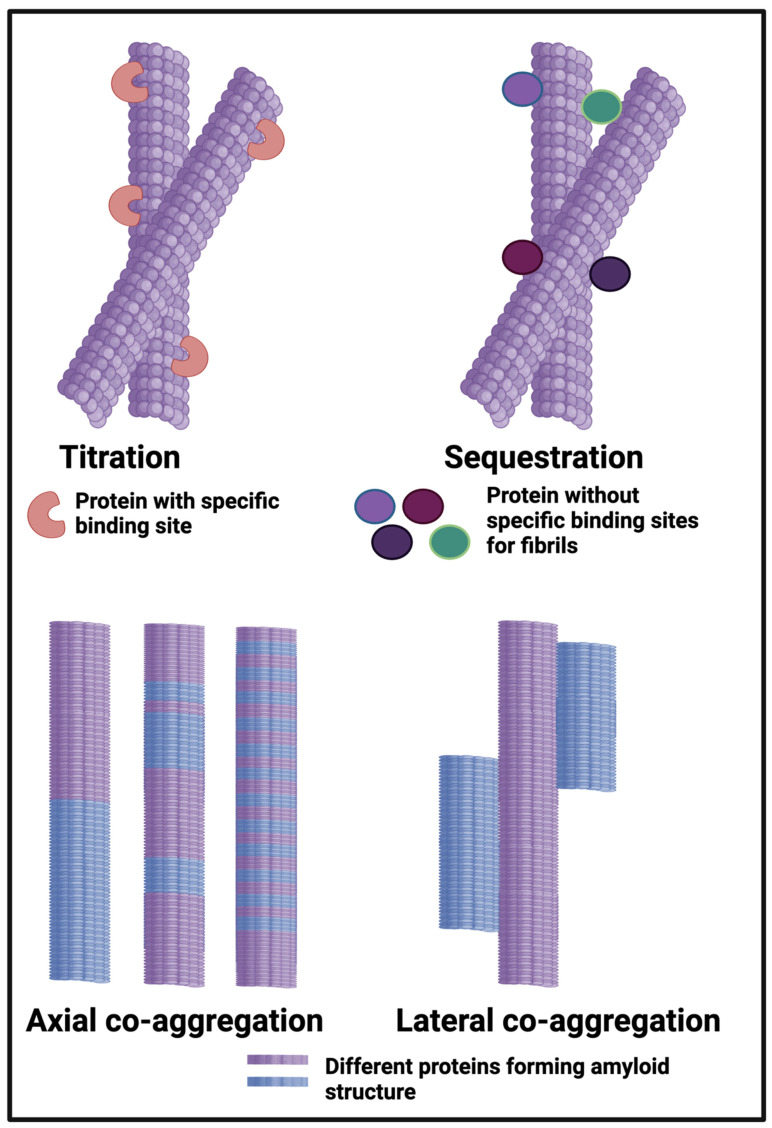
Our own work on the proteomics of fibrinaloid microclots has referred to 'entrapment' of non-fibrin proteins in the microclots. However, this cannot be a simple entrapment like a fish in a in a mesh net; the pores are far too big and in any case the centrifugation would have washed soluble proteins away from any weak binding or entrapment. Consequently, the 'entrapment' must actually be a forcing of the other proteins to become insoluble, likely by making cross-β sheets and thus joining the tightly-bound-but-noncovalent party and be incorporated into the growing amyloid fibrils. In the terminology of Bondarev and colleagues (Figure 6) and see below), these could be either or both of axial and lateral co-aggregation. Evidence for this includes the fact that there is no relationship between what is 'entrapped' in the fibrinaloid microclots and the normal plasma abundance of proteins (e.g., albumins and transferrin are pretty well the most abundant and mostly do not appear). Specifically, i there is an amyloidogenic transition such that different proteins line up to make the amyloids (axial co-aggregation in Figure 6), only those proteins capable of doing this will be entrapped, and others will be excluded. In some cases, anti-proteolytic substances such as antiplasmin [310] and α1 antitrypsin (SERPINA1) [205] may also be present in some abundance.
In a similar vein, many proteins besides α-synuclein are found in the Lewy bodies that can occur in dementia [311,312], while there is considerable experimental evidence for the co-incorporation of different amyloidogenic proteins into the same fibrils [87,313,314,315]. The same is true in transthyretin amyloidosis [316]. This is sometimes referred to as 'cross-talk' or 'cross-feeding', heterotypic interaction [317,318], and—perhaps most commonly—'cross-seeding' [79,172,319,320,321,322,323,324,325,326,327,328,329,330,331,332,333,334,335,336,337,338,339,340,341,342,343,344,345,346,347,348,349,350,351,352,353,354,355,356,357,358]. Note that even simple polyQ features (occurring as C-terminal 'tails' in various diseases) can do this [331,359,360,361,362,363], possibly also by incorporating transition metals [364]. Equally importantly, not all amyloids ('donors') can cross-seed other ones [142] ('acceptors') and hence be entrapped in the fibrils of the acceptors; there is significant selectivity, whose sequence/structural basis remains unknown.
The occurrence of multiple amyloid proteins within the same fibril is reviewed by Bondarev and colleagues [98,365], who refer to it as axial co-aggregation (Figure 6). The server AmyloComp [98] (Table 1) also predicts the likelihood of proteins forming axial co-aggregates; that for SERPINA1 and the fibrinogen alpha chain is especially high (unpublished). As phrased by them [98], "The core of these amyloid fibrils is a columnar structure [79,172,319,320,321,322,323,324,325,326,327,328,329,330,331,332,333,334,335,336,337,338,339,340,341,342,343,344,345,346,347,348,349,350,351,352,353,354,355,356,357,358] produced by axial stacking of β-strand-loop-β-strand motifs called 'β-arches' [366,367,368,369,370]". Well-established examples include RIP1/RIP3, which can induce necroptosis [371], and the HET-s protein, which also contains the Rip homotopic interaction motif (RHIM) [372]. Clearly, any protein capable of forming these β-arches can then do so, so as to make a hetero-fibril, which is what we suggest is the main means of 'entrapment' of other proteins in fibrinaloid microclots (provided the amyloidogenic regions are of sufficient length [373]). The idea we develop here, with considerable evidence, is that while normal clotting plausibly binds proteins by titration and sequestration in the terminology of [98,365] (Figure 6), the amyloid-containing fibrinaloid microclots involve axial and lateral co-aggregation. That fibrinogen can interact with a variety of known amyloidogenic proteins is beyond dispute [374,375]; causing them thereby to create new epitopes can even account for autoantibody generation [22]. A preprint has been lodged in bioRxiv [376].
![Different classes or types of protein co-aggregation: () Titration; () Sequestration; () Axial and () Lateral. Adapted from []. Different colours indicate different protein types. A B C D [365]](https://europepmc.org/articles/PMC11476703/bin/ijms-25-10809-g006.jpg "Click to view full size")
Different classes or types of protein co-aggregation: () Titration; () Sequestration; () Axial and () Lateral. Adapted from []. Different colours indicate different protein types. A B C D [365]
2. Results
2.1. Absence of Relationship between Microclot Proteome and Plasma Concentration
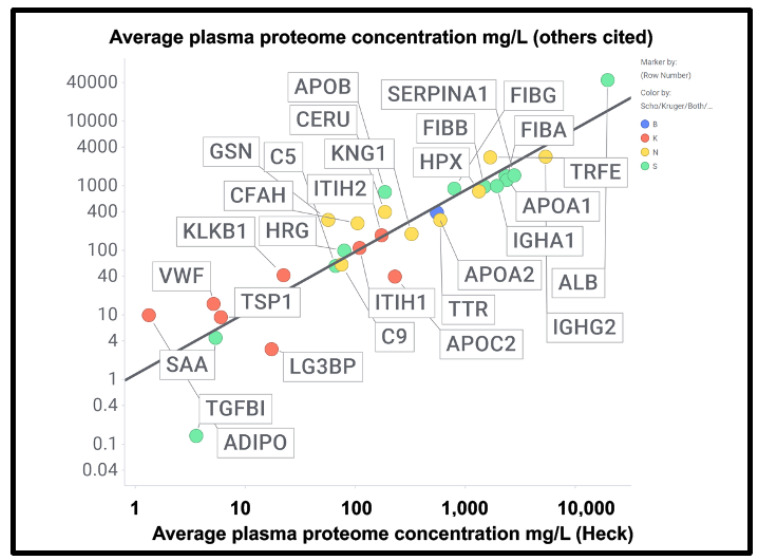
At least two lines of evidence indicate the lack of relationship between the amount of a protein in plasma and its appearance in fibrinaloid microclots. First, the only overlap between the proteomic data of Kruger and colleagues [377] (who did not report on fibrinogen) and those of Schofield et al. [205] was the protein apolipoprotein A2 (marked in blue in Figure 7). The data were taken from two quite different diseases (acute sepsis [205] vs. long COVID [377]), with 'normal' proteome levels spanning several orders of magnitude, and so while the content of these proteins in the average proteomes will not have differed by more than a factor of two at most, their appearance in the microclots differed massively. Secondly, we extracted the 'top 20' data from the pie chart representing the average of three individuals in Figure 3 of [205] and related those (where available) to the average plasma protein concentration [378], indicating that there was no such relation (r2 = 0.1 for the data in Figure 7). We also assessed some of the most abundant plasma proteins as tabulated in [379] for their presence or otherwise in the microclots in either study [205,377] (Figure 8); it is obvious that many of the most abundant proteins are not notably entrapped in the microclots, so those that are clearly selected, presumably by integration into the amyloid mixtures. (The data underpinning all these analyses are given in a spreadsheet in Supplementary Materials.)
A chief source of protein abundances in plasma is [378]. In addition, we used other sources for high-abundance and other detected proteins including C9 [382,383], complement factor H [384], thyroxine-binding globulin [385], retinol-binding protein [386], TGFβ1 [380], periostin [381], CXCL7 (PFA4) [387], (pre)kallikrein [388], galectin-3-binding protein (LG3BP) [389], thrombospondin-1 [390], and ITIH1/2 [391]. LG3BP is of interest, as it is substantially lowered in the plasma of those with mild cognitive impairment or Alzheimer's [392], arguably because it has been removed in amyloid microclots. Similarly, thrombospondin-1 also interacts with Aβ [393]. Reference [391] is very valuable in its own right, since while its coverage lacks some of the low-abundance proteins of interest here, it does list quantitative values for 197 plasma proteins; where both are available, the concentrations are well correlated (Figure 9) (slope = 1.06, r2 = 0.87), taking as the values for the Heck study [391] the averages of six data points for the controls of two patients at the first three time points. Consequently, we use the Heck dataset in most of what follows.
Using both sets of plasma proteome data (since some important markers do not appear in both), we again see large number of proteins that are high in abundance in the plasma proteome that nevertheless are not 'entrapped' in the fibrinaloid microclots, and similarly others in low abundance in the proteome nonetheless appear in the fibrinaloid microclots. The conclusion is very clear: there is a significant selectivity with regard to proteins that are entrapped within fibrinaloid microclots. We note too that atomic force microscopy [394] has provided evidence for both axial [395] and lateral [396] co-aggregation, and that cross-seeding can also explain the comorbidities seen with protein misfolding diseases [397].
What is not always clear is whether these heterotypic interactions tend to promote or to inhibit amyloidogenesis (or even both at different stages, as can occur with the curli protein CsgA and fibrinogen [398]; the same is true for fibrinogen and phenol-soluble modulins [399]).
SERPINA1 (α1 antitrypsin), as found by Schofield et al. [205] as a major constituent of microclots, contains four β-sheets and is also able to interact with the amyloidogenic transthyretin [400,401,402].
Some amyloidogenic proteins, such as apolipoprotein B-100, which contains a massive crossed-β ('β-belt') structure [403], were not detected; however, this is plausible because they were fully embedded within lipoproteins and thus not in plasma. (They are, however, capable of becoming embedded in neurofibrillary tangles [404].)
![Good correlation between the plasma proteome concentration data in [] by Heck and colleagues compared with other measurements of the proteome cited in the text and in. The slope of the line is 0.95 and the correlation coefficient 0.83. Colours encode the datasets in which fibrinaloid proteins were or were not observed, as inand, viz. blue both, green Schofield, red Kruger, and yellow neither. Abbreviations as in the list of abbreviations. [391] Supplementary Information Figure 7 Figure 9](https://europepmc.org/articles/PMC11476703/bin/ijms-25-10809-g008.jpg "Click to view full size")
Good correlation between the plasma proteome concentration data in [] by Heck and colleagues compared with other measurements of the proteome cited in the text and in. The slope of the line is 0.95 and the correlation coefficient 0.83. Colours encode the datasets in which fibrinaloid proteins were or were not observed, as inand, viz. blue both, green Schofield, red Kruger, and yellow neither. Abbreviations as in the list of abbreviations. [391] Supplementary Information Figure 7 Figure 9
Relationship between the standard plasma proteome concentrations (taken from []) and their detection in the Kruger (K), Schofield (S), both (B) studies, or neither (N). Size of symbol encodes protein length in residues. Abbreviations as in list of abbreviations. () protein concentrations from other studies delineated in the text and the. () Proteins from the study of Heck and colleagues []. [391] supplementary spreadsheet [391] A B
2.2. Amyloidogenicity of Proteins 'Entrapped' in Microclots
If axial or lateral co-aggregation is responsible for the 'entrapment' of proteins in fibrinaloid microclots, one would suppose that all the proteins involved would themselves be amyloidogenic. This can be tested using amyloidogenicity prediction programs of the type given in Table X. We chose AmyloGram [74], available at http://biongram.biotech.uni.wroc.pl/AmyloGram/↗ (accessed on 1 October 2024). For the proteins entrapped within microclots, we took the proteomics data from Table 2 from the long COVID study of Kruger and colleagues (who did not report on fibrinogen) and the Table 3 of the study of microclots in intensive care patients of Toh and colleagues [205]. The conclusion is very clear: every single one of the proteins detected in the microclots is highly amyloidogenic, and the microclots evidently involve cross-seeding. However, there was little correlation between amyloidogenicity and protein length (Figure 10) (r2 = 0.275). However, all but three of the Kruger proteins and all but four of the Schofield 'top 20' had an amyloidogenicity score exceeding 0.8 (Figure 10).
However, there was no correlation with the overall amyloidogenicity as calculated using AmyloGram and either the plasma proteome abundance or whether the proteins were in the fibrinaloid microclots (Figure 11) (r2 = 0.02):
The presence of von Willebrand factor and adiponectin in the fibrinaloid microclots is very interesting, despite their comparatively low plasma concentrations (Figure 11). The former is among the most amyloidogenic proteins in the list (Figure 11) and is notably entrapped and removed by microclots in SARS-CoV-2 infection [405], while the latter is correlated with amyloid Aβ deposition [406] and may be protective [407]. LPLC1 (Figure 10, so low in concentration it does not appear in Figure 11; the human protein atlas https://www.proteinatlas.org/ENSG00000125999-BPIFB1/blood+protein↗ (accessed on 1 October 2024 ) estimates its plasma concentration by mass spectrometry to be 2.7 μg/L) is also of interest. LPLC1 stands for "Long palate, lung and nasal epithelium carcinoma-associated protein 1" or also "BPI fold-containing family B member 1" (BNIB1), and to be clear, it is Uniprot Q8TDL5; again, it has a very high amyloidogenicity (~0.91). Finally, thrombospondin-1 is also very over-represented, and it too was neuroprotective against Aβ [393,408,409]. A clear pattern emerges.
The precise nature and extent of the amyloidogenicity necessary to induce or be entrapped in fibrinaloid microclots is as yet unclear, but inspection of the detailed data from the analyses at AmyloGram (unpublished) showed that each of the proteins involved possessed a segment of amyloidogenicity (referred to on its website and in the subset of figures displayed here as a 'probability of self-assembly') that exceed 0.75 in the data that could be acquired at the AmyloGram website. Figure 12, Figure 13, Figure 14 and Figure 15 show four examples of results from such an analysis at the Amylogram website: the first (Figure 12) is α-2-antiplasmin (prominent in the findings of [310]), where there is an initial run plus two further prominent peaks. α-2-antiplasmin is of course well known as an inhibitor of fibrinolysis [410].
The next (Figure 13) is SERPINA1 (α1-antitrypsin), where there is a long run at the beginning just exceeding 0.75. SERPINA1 is the most abundant anti-protease in plasma (see also Figure 11) and has several parallel–antiparallel β-sheets in its ground-state conformation [411,412,413,414,415], which, interestingly, is metastable [416,417,418]. It can also interact with amyloidogenic transthyretin [401] and is associated with the severity and progression of SARS-CoV-2 [419], consistent with its role in assisting fibrinaloid microclot formation. It is thus entirely plausible that it could participate in amyloid formation, and fragments of it certainly do [420,421].
The third is the inflammatory marker periostin, representing 1.17% of the 'top 20' proteins in Schofield et al. [205], and containing no fewer than eight regions of amyloidogenicity with a score exceeding 0.75. It features in these fibrinaloid microclots despite being one of the least abundant plasma proteins of those under consideration (372 ng/mL according to [381], 98 ng/mL in [422] and just 10 ng/mL according to [423,424]) (209 ng/mL is stated for serum [425]). Notably, however, as well as being among the most amyloidogenic of those surveyed (Figure 10), it is highly predictive of Aβ deposition [392,426] and is also involved in lung fibrosis [427,428].
Finally, the fourth is LPLC1 (also known as BPIB1 or BPIFB1). This protein has a very high amyloidogenic propensity of 0.9176, Figure 10) and no fewer than eight regions in which the amyloidogenicity score exceeds 0.75 (Figure 15), despite a minuscule concentration in normal plasma. Interestingly, it is involved in innate immunity [429], especially in mucosa [430], and bears similarities to lipopolysaccharide-binding protein (LPS being a molecule that can trigger fibrinaloid formation [194,195,431]). BPIB1 can also inhibit Epstein–Barr virus proliferation [432,433,434] (something of major potential relevance in long COVID [435,436,437]). Overall, the fact that it is so concentrated in fibrinaloid microclots in the case of long COVID is thus very notable.
2.3. Comparison with the Normal Clot Proteome
Undas and colleagues [438] provided (their Table 2) a quantitative list of protein-bound proteins in normal clots (that were presumably non-amyloid, though that was not in fact tested). Figure 16 compares the prevalence of proteins in their clots with that of plasma proteins, showing a reasonable correlation (slope = 0.67, r2 = 0.29) between the two. This contrasts with that for the fibrinaloid microclot proteome (Figure 7), where the value for r2 was just 0.1.
Figure 17 shows those that were also assessed in the Kruger and Schofield studies, along with their amyloidogenicity. There is no correlation whatsoever (r2 ~0.02), again showing how very different the composition of fibrinaloid microclots is from that of normal clots.
A particularly noteworthy observation here (Figure 17) is the relatively high amounts of fibronectin seen in normal clots (130 mg/g protein [438], fibronectin typically being present in plasma at 300–400 mg/L [439,440,441]), as it was not seen in the fibrinaloid microclots. While fibrin is highly amyloidogenic (Figure 10 and Figure 17) and in vivo can produce insoluble fibrillar components that may be incorporated in the extracellular matrix [442,443,444], fibronectin is somewhat unusual for two reasons: first, it is large (2477 residues). Secondly, it is relatively thermostable [445], especially in some of its domains [446]. Together, these features can plausibly account for the difficulty of unfolding and incorporating it into an amyloid clot compared to a normal one (see also the next paragraph for amyloidogenicity vs thermostability). Similar comments relate to α-2-macroglobulin (27 mg/g, 1474 residues, Figure 17) and to Factor XIII (12 mg/g, 732 residues), which is in fact inhibited by α-2-macroglobulin. Factor XIII is a transglutaminase (linking glutamate and lysine residues) that is responsible for stiffening normal clots by crosslinking them [447,448,449]—mainly via the γ but also partly the α chains [450]—yet does not appear in the fibrinaloid microclot proteomes. This would be entirely consistent with their completely different structures relative to that of normal clots. Lastly, complement factor 3 is fairly well represented in both plasma (Figure 16; 778 mg/L in the Heck study) and in normal clots (Figure 17; 12 mg/g) yet is not found in fibrinaloid microclots; consistent with the thrust of our arguments, its total amyloidogenic propensity at just 0.73 is among the lowest of those evinced in this study.
2.4. Amyloidogenicity vs. Thermostability
As noted, amyloidogenesis of a non-amyloid form of a protein necessarily requires a significant unfolding [76,77,78,79,80], and in general terms, the resistance to a protein unfolding is reflected in its thermostability. The point about the experimental lack of amyloidogenicity in a thermostable protein thus leads to the question of whether experimental amyloidogenic proteins are in fact normally relatively non-thermostable in their non-amyloid forms. This turns out to be strongly supported by substantial evidence [252,261,451,452,453,454,455,456,457].
3. Discussion
An important question about amyloid(ogenic) protein fibres in general, and fibrinaloid microclots (our main focus) in particular, is the nature and location of the proteins that they contain. A variety of studies have provided data on both normal clots and fibrinaloid microclots, as well as the normal plasma proteome. With occasional exceptions (such as C-reactive protein—not involved here) their concentrations are fairly constant, and since (i) they cover four orders of magnitude in the proteins considered here, and (ii) they were well correlated in two studies (Figure 8), we consider their standard concentrations to be a good guide as to the likelihood of non-fibrinogen proteins being entrapped in a clot if entrapment simply reflects their plasma concentrations. In normal clots, that expectation is broadly borne out (Figure 15). However, this is far from being the case with the fibrinaloid microclots that form in certain diseases, stain strongly with thioflavin T, and are far more resistant than are normal clots to fibrinolysis (Figure 18). Seemingly, as with prion proteins, the presence of a small amount of the thermodynamically stabler amyloid form is enough to trigger conversion of a very large number of monomers in the amyloid polymer form in almost an 'all-or-nothing' manner (Figure 19).
First, their proteome varies strongly with the disease (Figure 7), in a way that cannot reflect changes in the bulk plasma proteome. Secondly, their proteome constitution is far from being related to the concentrations of bulk plasma proteins, with some being excluded and others being highly concentrated (Figure 9, Figure 10, Figure 11, and Figure 16; twelve are summarised for convenience in Table 2). Clearly, there must be special mechanisms at work, the most obvious, given their strikingly high amyloidogenicity scores, being a cross-seeding where the various proteins are actually incorporated into the cross-β elements of the fibrils themselves. This said, there is a consonance in Table 2 between the proteins highlighted as being in fibrinaloid microclots and biological explanations based on their known roles. Most of those that are higher are in the Kruger [377] long COVID study (Table 2). Long COVID is of course a chronic disease, and very different from the acute conditions characterising individual in an ICU such as those in the Toh study [205]. Long COVID exhibits similarities with myalgic encephalopathy/chronic fatigue syndrome (ME/CFS), however [435,458,459,460,461,462,463,464], so it is of interest that thrombospondin and platelet factor 4 are both raised in the plasma of individuals with ME/CFS [463].
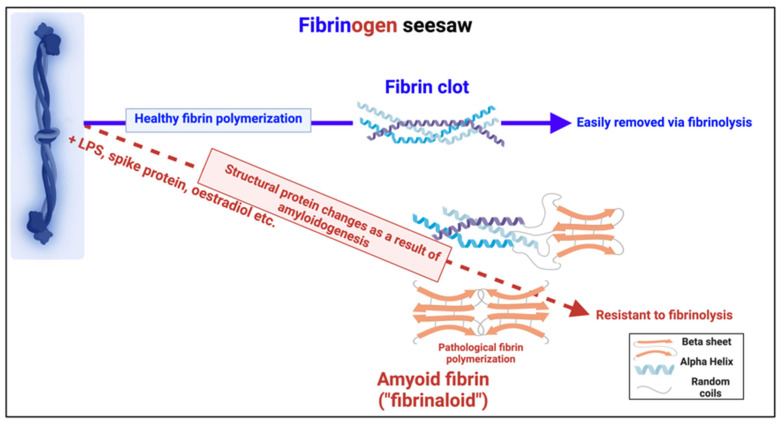
![Individual fibrinogen molecules upon polymerisation either polymerise into a normal clot form, which is relatively easily removed by fibrinolysis, or into an anomalous amyloid form or forms, which are not (Taken from []). Created with Biorender.com. [465]](https://europepmc.org/articles/PMC11476703/bin/ijms-25-10809-g019.jpg "Click to view full size")
Individual fibrinogen molecules upon polymerisation either polymerise into a normal clot form, which is relatively easily removed by fibrinolysis, or into an anomalous amyloid form or forms, which are not (Taken from []). Created with Biorender.com. [465]
Clot Fibrinaloids vs. Classical Amyloid Fibrils
Much is known about classical amyloids, and plausibly this knowledge will contribute to our emerging understanding of fibrinaloids, but there is one crucial difference, and that is the size of the fibres. A typical oligomer made up of a standard cross-β amyloid chain crisscrossing in a direction perpendicular to the fibril direction has a diameter in the range 2 to 5 nm [], and these can aggregate to make protofibrils in the range 4–11 nm diameter []. The amyloid fibrils themselves typically involve a few intertwined protofibrils per unit length [], and thus have a diameter of the order of 6 to 12 nm [,,], although in principle they could become larger []. This means that generally most fibrils consist of only a few intertwined protofibrils per unit length. By contrast, the fibrils observed in fibrinaloid microclots in plasma samples have a diameter that is often in the range 50 to 100 nm. This means that they must contain many more lateral fibres per unit length, likely of the order of 100–300. This ability to increase numbers laterally obviously bears strongly on the potential ability of microclots to aggregate further to become macroclots, and maybe ultimately to lead to the kinds of occlusions involved in stroke and myocardial infarctions. 466 467 276 468 469 470 276
It has been suggested [,] that at least some types of classical amyloidoses have a 'proteome signature' that would include serum amyloid P-component (SAP) and heparan sulphate proteoglycans (HSPG), as well as apolipoprotein A4, apolipoprotein E, and vitronectin (see also [,,,,]), consistent with some kind of cross-seeding; interestingly, none of these was reported in either the Schofield or Kruger studies, though the latter three proteins were easily observed in normal clots (). This adds to the evidence that while amyloid in character, the proteomic contents of fibrinaloid microclots are different in many other ways (besides diameter) from the amyloid fibrils in classical amyloidoses. 471 472 62 473 474 475 476 Figure 17
Another particular feature of the fibrinaloid microclots is their resistance to fibrinolysis (see [,,,,,]), most easily seen in our proteome studies, where a double trypsin digestion was required for successful peptide-based mass spectrometric proteome analysis [,]. The presence of molecules such as α-2-antiplasmin [] and SERPINA1 will certainly have contributed, but it is of course well known that amyloid forms of protein are far more resistant to proteolysis than their native unfolded or globular versions, especially among prion proteins where PrPis even resistant to proteolysis by proteinase K (e.g., [,,,,]). 21 22 198 310 477 478 310 377 310 479 480 481 482 483 Sc
Some molecules such as bacterial cell wall compounds can clearly serve as triggers for amyloidogenesis in both fibrinaloid microclots [,,,,,,,,] and other cases [,,]. What we propose here is that the massive changes in fibrinogen structure necessary for its conversion to an amyloid form, as also observed by others [,,], must then involve cross-seeding, as this provides a simple mechanism that at once accounts for (i) the proteomics, (ii) the resistance to proteolysis, and (iii) the amyloid nature of the mixed clots. At the same time, we recognise that while our analysis is both clear and robust, future studies would benefit from comparing the proteomes of fibrinaloid and normal clots at the same time on the same instrument. 194 195 196 431 484 485 486 487 488 489 490 491 204 205 492
Overall, however, while the present findings make it clear that cross-seeded proteins must be involved in fibrinaloid formation, we are far from knowing their specific locations and whether and how they co-aggregate axially and/or laterally (as per). Such studies would require the resolution of an atomic force microscope (e.g., [,,,]), which, on the basis of the present findings, it now seems worthwhile to pursue. Figure 6 226 394 493 494
4. Materials and Methods
Data were downloaded from the sources indicated and were not otherwise transformed save to average the first three timepoints and two individuals representing the controls in [391]. The values from Figure 3 of Schofield et al. [205] were determined digitally from the averaged pie chart therein. An Excel file provided as Supplementary Information summarises the data, that are commonly displayed in this paper using the Spotfire program (https://www.spotfire.com/↗ (accessed on 1 October 2024), version 12.0). Other methods run on websites for analysing the proteomic datasets for amyloidogenicity were as follows: Amylogram was run on its website http://biongram.biotech.uni.wroc.pl/AmyloGram/↗ (accessed on 1 October 2024) using the FASTA sequences of the relevant proteins obtained from Uniprot (addresses as set down in the Supplementary data). Fibrinogen α was also run on the AnuPP website https://web.iitm.ac.in/bioinfo2/ANuPP/homeseq1/↗ (accessed on 1 October 2024).