
What this is
- This research assesses the immunogenicity of heterologous booster vaccination with mRNA vaccines following primary vaccination with ChAdOx1.
- It compares antibody responses among vaccinated naïve individuals and those who were naturally infected with SARS-CoV-2.
- The study measures various antibody levels, including , , , and .
Essence
- Heterologous booster vaccination with mRNA vaccines significantly enhances antibody responses compared to homologous ChAdOx1 vaccination. The study shows that a heterologous booster can increase immune responses by approximately 12×.
Key takeaways
- Heterologous boosting with mRNA vaccines after ChAdOx1 vaccination increases by at least ~12×. This indicates a substantial enhancement in immune response compared to two doses of ChAdOx1.
- Homologous ChAdOx1 vaccination elicits weaker antibody responses compared to BNT162b2 or mRNA-1273. Specifically, responses were about 3× lower than those induced by natural infection.
- Among vaccinated naïve individuals, is a stronger contributor to virus neutralization than . This highlights the importance of specific antibody types in vaccine efficacy.
Caveats
- The study's NI group consisted mostly of asymptomatic individuals, which may not fully represent the immune responses in those with severe infections. This could limit the generalizability of the findings.
- Limited data on homologous mRNA vaccination responses and the absence of variant-specific antibody assessments may restrict the conclusions drawn regarding overall vaccine effectiveness.
Definitions
- Neutralizing antibodies (NTAbs): Antibodies that prevent viruses from infecting cells, indicating protective immunity.
- Total antibodies (TAbs): The overall level of antibodies in the blood, including IgG, IgA, and IgM.
- Anti-S-RBD IgG: Immunoglobulin G antibodies that target the receptor-binding domain of the SARS-CoV-2 spike protein.
- Anti-S1 IgA: Immunoglobulin A antibodies that target the S1 subunit of the SARS-CoV-2 spike protein.
Simplified
Introduction
SARS‐CoV‐2 virus has infected over 800 million individuals, resulting in more than 6.5 million COVID‐19‐related deaths, as of December 10, 2023 [1]. It is crucial to acknowledge that these statistics may underestimate the actual impact due to the absence of reported cases from self‐testing. In response, global mass vaccination campaigns have been initiated, with over 13.33 billion vaccine doses administered to date [2]. The Oxford–AstraZeneca vector‐based vaccine (ChAdOx1) and the mRNA vaccines Pfizer–BioNTech (BNT162b2) and Moderna (mRNA‐1273) are authorized for use in homologous dual‐dose regimens and are extensively used in Europe and the United States [3].
Since the introduction of these three vaccines, evidence has shown that their effectiveness declines over time, especially against milder disease [4, 5, 6, 7, 8]. They are also less effective against the omicron SARS‐CoV‐2 variant compared to earlier variants [9, 10], and a third (booster) dose restores high effectiveness against severe disease [9, 11, 12, 13]. Furthermore, intermittent supply shortages of vaccines, adverse events of vector‐based vaccines, and emerging SARS‐CoV‐2 variants have led to consideration of heterologous regimens (mix‐and‐match vaccination approach). Heterologous combination of vector vaccines followed by boosting with either of the two mRNA vaccines are recommended in some parts of Europe, including Germany [14].
Although limited data are available on the immunogenicity and efficacy of heterologous strategies, they have been used in previous vaccine studies, including experimental vaccines towards Ebola virus [15, 16, 17] and human immunodeficiency virus [18, 19]. This has led to the recommendation of a heterologous mRNA booster vaccination in ChAdOx1 vector‐primed individuals, particularly after the recognition of undesirable events, including cerebral venous thrombosis and thrombocytopenia [20, 21].
The COV‐BOOST study has demonstrated that mRNA vaccines provide a robust booster effect with low reactogenicity, regardless of the vaccination administered in the primary course. On the basis of these findings, the UK Joint Committee on Vaccination and Immunization recommended either BNT162b2 or mRNA‐1273 to be provided as a booster dose no sooner than 6 months after completion of the primary vaccine course [22, 23]. However, the evidence of effectiveness and immunogenicity to support the application of heterologous regimens remains insufficient. The relative degree of antibody response provided by boosted regimens in terms of neutralizing capacity compared to the immune responses induced by natural infection is still unclear. Therefore, this study aims to prospectively enroll two matched cohorts, comprising vaccinated naïve (VN) and naturally infected (NI) individuals, to study the immunogenicity of two mRNA‐heterologous vaccination regimens. We comprehensively assessed neutralizing, total, anti‐S‐RBD‐IgG, and anti‐S1 IgA antibody responses.
Materials and Methods
Ethical Approval
The Qatar University Institutional Review Board (QU‐IRB 1537‐FBA/21) examined and approved this study. Prior to sample collection, participants completed an informed consent form, which included questions about their demographics and any prior diseases they may have had, including COVID‐19 infection. All samples were obtained in an anonymous manner without the use of identifying information.
Study Design and Sample Collection
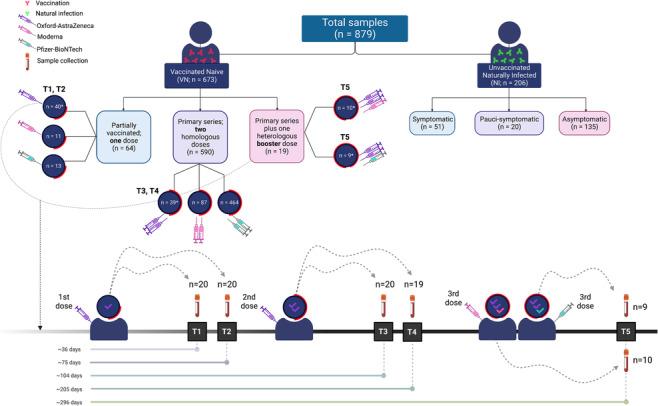
The study included a total of 879 samples (Figure 1). We classified study subjects into two main groups: (1) unvaccinated NI (n = 206) and (2) VN (n = 673).
The NI group (n = 206) included samples collected from individuals at median: 67 days post–SARS‐CoV‐2‐confirmed diagnosis. The NI group was further classified according to clinical manifestations into symptomatic (n = 51), pauci‐symptomatic (n = 20), and asymptomatic (n = 135) (Figure 1).
The VN group (n = 673) included samples collected from vaccinated subjects (~105 days from first dose) who had no previous history of infection and were confirmed to be anti‐N negative. The VN group (n = 673) was classified according to the number of doses administered, into three subgroups: partially vaccinated (n = 64), primary series (n = 590), and primary series plus one booster dose (n = 19) (Figure 1). Among each group, samples were further classified according to the type of vaccine received (Figure 1).
Among the 673 samples collected from VN individuals, 98 were paired samples collected from the same study subjects at five different time points (T1–T5). T1 and T2 samples were collected post–first dose (~36 and ~75 days from first dose, respectively), T3 and T4 samples were collected post–homologous second dose (~104 and ~205 days from first dose, respectively), and T5 samples were collected post–heterologous booster (third dose; ~296 days from first dose). Figure 1 illustrates the timeline of sampling.

Summary of the study cohort and timeline of sampling. The study included a total of 879 samples. We classified study subjects into two mutually exclusive groups: (1) vaccinated naïve (VN; = 673) and (2) unvaccinated naturally infected (NI; = 206). The VN group was further classified to three subgroups: (1) Partially vaccinated group included samples collected post‐one dose of either ChAdOx1, mRNA‐1273, or BNT162b2. (2) The primary series group included samples collected post–two homologous doses of either ChAdOx1, mRNA‐1273, or BNT162b2. (3) The primary series plus one booster dose group included samples collected post–two doses of ChAdOx1, followed by a heterologous booster shot of either mRNA‐1273 or BNT162b2. * denotes non–mutually exclusive groups, comprising a total of 98 samples collected from 20 VN subjects at five time points (T1–T5). T1 and T2, collected post–first dose, T3 and T4, collected post–homologous second dose, and T5, collected post–heterologous booster (third) dose. Initially, 20 samples from 20 study subjects were collected at each time point; however, two samples at T4 and T5 were excluded due to SARS‐CoV‐2 infection during the follow‐up period. The NI group was further classified to symptomatic, pauci‐symptomatic, and asymptomatic. n n
Serology Testing
After collection and centrifugation of whole blood, plasma samples were separated in order to test for (1) neutralizing antibodies (NTAbs), (2) total antibodies (tAbs), (3) anti‐S‐RBD IgG, and (4) Anti‐S1 IgA. All tests were performed against wild‐type (Wuhan/Washington/Victoria strain) SARS‐CoV‐2 virus.
NTAbs
NTAbs (CL‐900i®, Mindray, China) is a competitive binding chemiluminescent immunoassay for quantifying SARS‐CoV‐2 NTAb that disrupts the interaction between the enzyme‐conjugated ACE2 surface receptor and the receptor binding domain (RBD) (bound to magnetic beads) of the viral spike protein. The samples with values over the specified range were diluted with phosphate‐buffered saline (PBS). The WHO conversion factor for the test is 1 AU = 3.31 IU/mL, and the reference range is 10–400 AU/mL. We recently evaluated this new assay and reported that it has great specificity and sensitivity in comparison to two reference techniques [24].
TAbs Against SARS‐CoV‐2 S‐RBD of the SARS‐CoV‐2
The CL‐900i® assay (Catalog No. SARS‐CoV‐2 Total 91 Antibodies 122, Mindray, China) was used to quantify TAbs, comprising IgG, IgA, and IgM. The assay had a positive cutoff index of ≥10–2000 AU/mL. Samples with readings above the range were diluted using PBS.
Antibodies Against the RBD of the S1 Subunit of the Viral Spike Protein (Anti‐S‐RBD IgG)
Antibodies against the viral spike protein's RBD subunit (anti‐S‐RBD) were measured using the quantitative automated platform CL‐900i® (Mindray, China). This assay has a range of 3.0–1000.0 AU/mL, with results ≥10.0 AU/mL considered positive for S‐RBD IgG. Samples exceeding 1000.0 AU/mL were diluted and re‐analyzed. Results were standardized to 1.15 BAU/mL using WHO guidelines.
IgA Against a Recombinant S1 Domain of the SARS‐CoV‐2
The Euroimmun Anti‐SARS‐CoV‐2 IgA assay (Euroimmun, Germany; Cat. No. EI 2606‐9601 A) was performed as directed by the manufacturer. The assay identifies antibodies against the S1 subunit of the SARS‐CoV‐2 spike protein. The results were calculated as a ratio of the sample signal to the average signal of the calibrators. The computed ratios were interpreted in accordance with the manufacturer's recommendations. A ratio of < 0.8 was designated negative, ≥ 0.8 to < 1.1 was considered borderline, and ≥ 1.1 was considered positive [25].
IgG Antibodies Against SARS‐CoV‐2 Anti‐Nucleoprotein (Anti‐N)
Architect‐automated chemiluminescent assay (Abbott Laboratories, USA) and Euroimmun ELISA (El 2606‐9601‐2 G) were used to screen samples for past infection by measuring the SARS‐CoV‐2 anti‐N IgG antibodies, given that IgG antibodies generated against the RBD on the spike protein are distinct from IgG antibodies produced against the nucleoprotein of the virus. Therefore, positive anti‐N findings of SARS‐CoV‐2 anti‐N IgG antibodies imply prior exposure to the whole virus [26]; samples with prior infections were eliminated from the VN group.
Statistical Analysis
The statistical analysis was conducted using GraphPad Prism software (version 9.3.1, GraphPad Software, Inc., San Diego, CA, USA). Continuous variables were summarized by median (interquartile range [IQR]) and categorical variables by number (n) (percent). The gathered dataset was evaluated for normality using the Shapiro–Wilk normality test. Due to the lack of a normal distribution, nonparametric tests using the Friedman test for pairwise group comparisons and the Kruskal–Wallis test for the differences between independent samples were conducted. In the bar charts, the horizontal bar line represents the median titer and the error bars represent the IQR. Using the Spearman's rank correlation test, the correlation between NTAbs/anti‐S‐RBD IgG and NTAbs/Anti‐S1 IgA levels was analyzed. A scatterplot was used to illustrate the direction, form, and magnitude of correlation. The significance level was set at p < 0.05.
Results
Descriptive Statistics and Participant Characteristics
A total of 879 samples was included in this study, including samples collected from VN (n = 673) and NI (n = 206) individuals (Table 1 and Figure 1).
In the VN group, samples were collected at median: 105 days (~3.5 months) after receiving the first dose of either BNT162b2, mRNA‐1273, or ChAdOx1 vaccines. The VN group comprised 42.5% females, 53.2% males, and 4.3% of unspecified gender.
Among the VN group (n = 673), the partially vaccinated group (n = 64) included samples collected post–one dose of either ChAdOx1 (n = 40; 62.5%), mRNA‐1273 (n = 11; 17.2%), or BNT162b2 (n = 13; 20.3%), hereafter referred to as ChAdOx11, mRNA‐12731, and BNT162b21 VN subjects, respectively. The primary series group (n = 590) included samples collected post–two homologous doses of either ChAdOx1 (n = 39; 6.6%), mRNA‐1273 (n = 87; 14.8%), or BNT162b2 (n = 464; 78.6%), hereafter referred to as ChAdOx11,2, mRNA‐12731,2, and BNT162b21,2 VN subjects, respectively. The primary series plus one booster dose group (n = 19) included samples collected post–two homologous doses of ChAdOx1, followed by a heterologous booster shot of either mRNA‐1273 (n = 10; 52.6%) or BNT162b2 (n = 9; 47.4), hereafter referred to as ChAdOx11,2 + mRNA‐12733 and ChAdOx11,2 + BNT162b23 VN subjects, respectively.
Samples were collected from individuals in the NI group at a median of approximately 2.2 months (67 days) after SARS‐CoV‐2 infection. The NI group consisted of 86.4% males and 13.6% females, as indicated in Table 1. Out of the 206 individuals in the NI group, 51 were symptomatic (24.8%), 20 were pauci‐symptomatic (9.7%), and 135 were asymptomatic (65.5%) (Table 1 and Figure 1). The study groups' characteristics, including median age, sex, and median time of blood collection in days, are presented in Table 1.
| A. Vaccinated naïve (VN) ( = 673)n | ||||||||||||||||||
|---|---|---|---|---|---|---|---|---|---|---|---|---|---|---|---|---|---|---|
| Partially vaccinated ( = 64)n | Primary series ( = 590)n | Primary series plus one booster dose ( = 19)n | Total | |||||||||||||||
| ChAdOx1 1 13290 | mRNA‐12731 | BNT162b21 | ChAdOx1 1,2 13290 | mRNA‐12731,2 | BNT162b21,2 | ChAdOx1 + mRNA‐1273 1,2 3 13290 | ChAdOx1 + BNT162b2 1,2 3 13290 | |||||||||||
| ( = 40)n | ( = 11)n | ( = 13)n | ( = 39)n | ( = 87)n | ( = 464)n | ( = 10)n | ( = 9)n | ( = 673)n | ||||||||||
| Median age (IQR) | 57 | 55–59 | 22 | 20–38 | 25 | 21–40 | 56 | 54–59 | 23 | 20–34 | 34 | 22–45 | 55 | 53–56 | 59 | 57–60 | 36 | 22–49 |
| Gender | ||||||||||||||||||
| Male,(%)n | 10 | 25 | 5 | 45.5 | 1 | 7.7 | 10 | 25.6 | 40 | 46 | 216 | 46.6 | 3 | 30 | 1 | 11.1 | 286 | 42.5 |
| Female,(%)n | 30 | 75 | 6 | 54.5 | 9 | 69.2 | 29 | 74.4 | 47 | 54 | 222 | 47.8 | 7 | 70 | 8 | 88.9 | 358 | 53.2 |
| Unspecified,(%)n | 0 | 0 | 0 | 0 | 3 | 23.1 | 0 | 0 | 0 | 0 | 26 | 5.6 | 0 | 0 | 0 | 0 | 29 | 4.3 |
| No. of days after administration of 1st dose, median (IQR) | 46 | 36–75 | 19 | 16–24 | 19 | 15–37 | 111 | 104–205 | 89 | 60–165 | 124 | 68–190 | 311 | 282–321 | 286 | 279–296 | 105 | 61–186 |
| No. of months after administration of 1st dose, median (IQR) | 1.5 | 1.18–2.47 | 0.63 | 0.53–0.80 | 0.63 | 0.50–1.23 | 3.65 | 3.42–6.74 | 2.97 | 2.00–5.50 | 4.12 | 2.25–6.32 | 10.21 | 9.27–10.55 | 9.4 | 9.17–9.73 | 3.5 | 2.03–6.20 |
Heterologous mRNA Vaccine Booster Induced Strong Antibody Responses
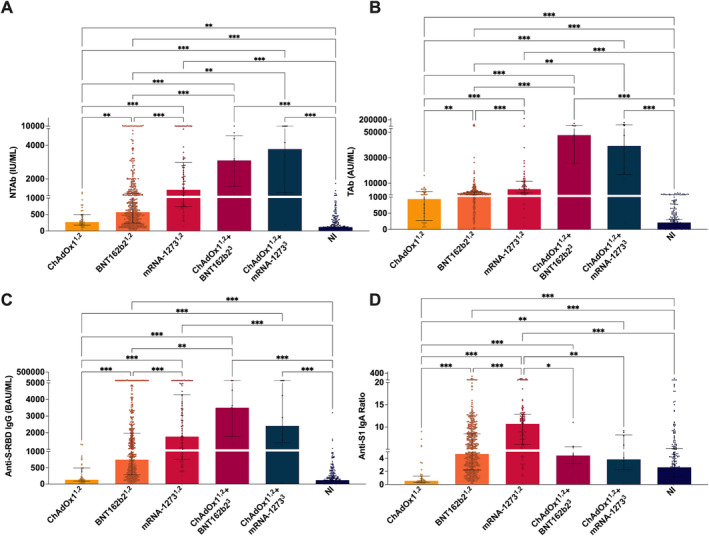
ChAdOx11,2 showed low NTAb, TAb, anti‐S‐RBD IgG, and anti‐S1 IgA immune responses compared to BNT162b21,2 and mRNA‐12731,2 (Figure 2A–D). The median age for ChAdOx11,2‐vaccinated individuals was 56 (IQR 54–59), while it was 23 (IQR 20–34) for mRNA‐12731,2 and 34 (IQR 22–45) for BNT162b21,2 (Table 1). The administration of a heterologous booster dose, of either mRNA‐1273 or BNT162b2, significantly boosted the humoral immune response elicited by ChAdOx1 vaccine by at least ~12, 42, 24, and 7 folds for NTAb, TAb, anti‐S‐RBD IgG, and anti‐S1 IgA, respectively (Figure 2A–D). Individuals who received mRNA‐12733 booster had a median age of 55 (IQR 53–56), while those who received BNT162b23 booster had a median age of 59 (IQR 57–60) (Table 1).
In the heterologous vaccination regimen, no significant difference was observed between ChAdOx11,2 + Pizer3 and ChAdOx11,2 + mRNA‐12733 in any of the assessed antibody isotypes (Figure 1). Nevertheless, NTAb antibodies were slightly higher among ChAdOx11,2 + mRNA‐12733 compared to ChAdOx11,2 + Pizer3 group (~1.2 folds), whereas TAb, anti‐S‐RBD IgG, and anti‐S1 IgA antibodies were slightly higher (~1.2, 1.5, and 1.1 folds, respectively) among ChAdOx11,2‐Pizer3 compared to ChAdOx11,2‐mRNA‐12733 (Figure 2A–D).

Assessment of vaccine‐induced immunity after heterologous booster with mRNA vaccines. (A) NTAb neutralizing total antibody levels measured by CL‐900i® (IU/mL). (B) TAb total antibody levels measured by CL‐900i. (C) Anti‐S‐RBD IgG antibody levels (BAU/mL) measured by CL‐900i®. (D) Anti‐S1 IgA ratios measured by Euroimmun. Each circle represents a single sample. Black bars indicate interquartile range (IQR). Statistical significance was determined using Kruskal–Wallis test.value asterisk denotes to * ≤ 0.05, ** ≤ 0.01, and *** ≤ 0.001. p p p p
Heterogenous Vaccination With Either BNT162b2 or mRNA‐1273 Boosted ChAdOx1 Humoral Immune Response
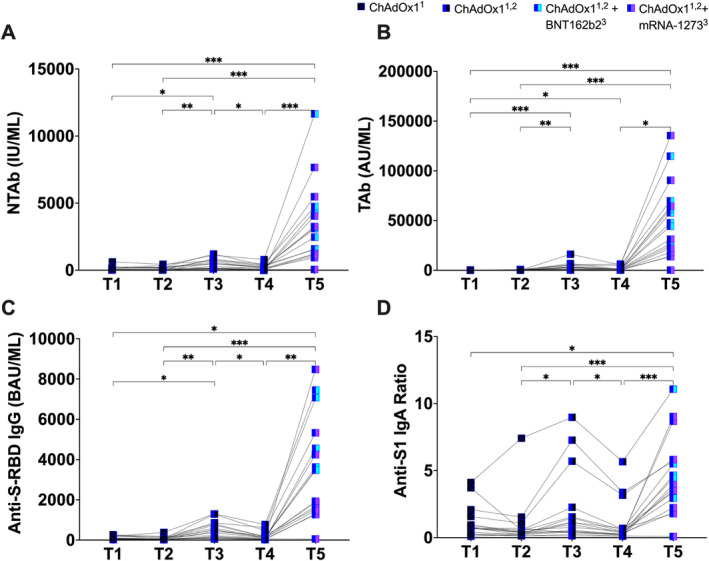
As shown in Figure 3, although a second dose of ChAdOx1 significantly increased antibody response, significant waning in immune responses post–second dose was observed in NTAbs, TAbs, anti‐S‐RBD IgG, and anti‐S1 IgA (Figure 3A–D). In addition, one or two doses of ChAdOx1 vaccine provided far less immune response than those paired with a heterologous BNT162b2 or mRNA‐1273 booster dose following primary series of ChAdOx1 (Figure 3A–D).

Longitudinal antibody response in VN individuals who received heterologous booster doses. (A) NTAb neutralizing total antibody levels measured by CL‐900i® (IU/mL). (B) TAb total antibody levels measured by CL‐900i. (C) Anti‐S‐RBD IgG antibody levels (BAU/mL) measured by CL‐900i®. (D) Anti‐S1 IgA ratios measured by Euroimmun. A total of 98 samples collected from 20 VN subjects at five time points (T1–T5). T1 and T2, collected post–first dose (~36 and ~75 days from first dose, respectively), T3 and T4, collected post–homologous second dose (~104 and ~205 days from first dose, respectively), and T5, collected post–heterologous booster (third) dose (~296 days from first dose). Initially, 20 samples from 20 study subjects were collected at each time point, however, two samples at T4 and T5 were excluded due to SARS‐CoV‐2 infection during the follow‐up period. The NI group was further classified to symptomatic, pauci‐symptomatic, and asymptomatic. Statistical significance of antibody levels among paired samples was assessed using Friedman test. Mann–Whitney test was conducted for comparisons between T5: ChAdOx1 + BNT162b2and ChAdOx1 + mRNA‐1273.value asterisk indicates * ≤ 0.05, ** ≤ 0.01, and *** ≤ 0.001. Only significant correlations are shown. 1,2 3 1,2 3 p p p p
Anti‐S‐RBD IgG Contributes More Than IgA to Virus Neutralization Among VN Individuals
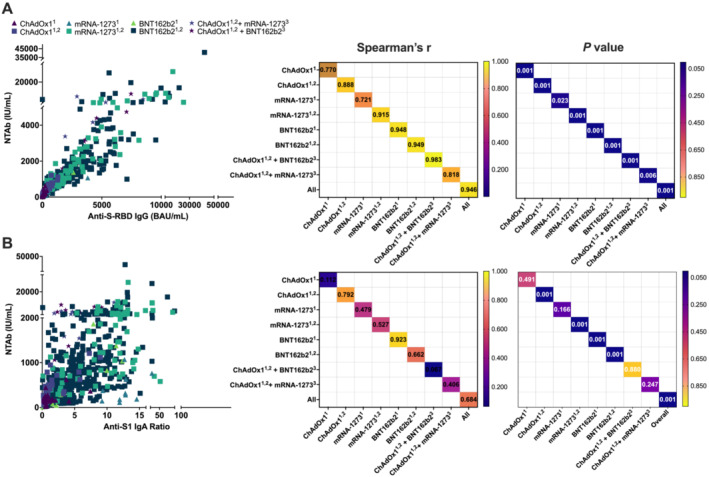
To assess the neutralizing potency and serological dynamics postvaccination, we investigated the correlation between NTAbs/anti‐S‐RBD IgG and NTAbs/anti‐S1 IgA among VN study subjects (Figure 4).
Among the VN group, NTAbs/anti‐S‐RBD IgG showed stronger correlation in comparison to NTAbs/anti‐S1 IgA (Figure 4A,B). The strongest significant correlation (higher Spearman's r) was observed for the primary ChAdOx1 series plus one BNT162b2 booster (r = 0.983, p < 0.001) for NTAbs/anti‐S‐RBD IgG (Figure 4A,B).
Strong to very strong significant correlations between NTAbs and anti‐S‐RBD IgG were observed among individuals of all VN groups (r > 0.79, p < 0.001) (Figure 4A). In addition, there was a strong significant overall correlation (r = 0.684, p < 0.001) between NTAbs and anti‐S1 IgA. Nevertheless, stratification by vaccine type and number of dose(s) administered revealed that only partial vaccination with BNT162b2 and primary vaccination with either ChAdOx1, mRNA‐1273, or BNT162b2 showed significant correlations between NTAb and anti‐S1 IgA levels (Figure 4B).

Pairwise correlation of neutralizing total antibody (NTAb) titers with anti‐S‐RBD IgG and anti‐S1 IgA levels among VN individuals. Scatter plots (left) and Spearman'sandvalues' correlation matrices (right) for (A) NTAbs/anti‐S‐RBD IgG and (B) NTAbs/anti‐S1 IgA were generated. Correlation coefficients in the range 0–0.39, 0.40–0.59, 0.6–0.79, and 0.8–1 suggest weak, moderate, high, and very strong correlations, respectively. Scatterplots were used to depict the direction, form, and strength of correlations. Allvalues were two sided at a significance level of 0.05.values < 0.001 is represented as 0.001. r p p p
Both Anti‐S‐RBD IgG and Anti‐S1 IgA Significantly Contribute to Virus Neutralization among NI Individuals
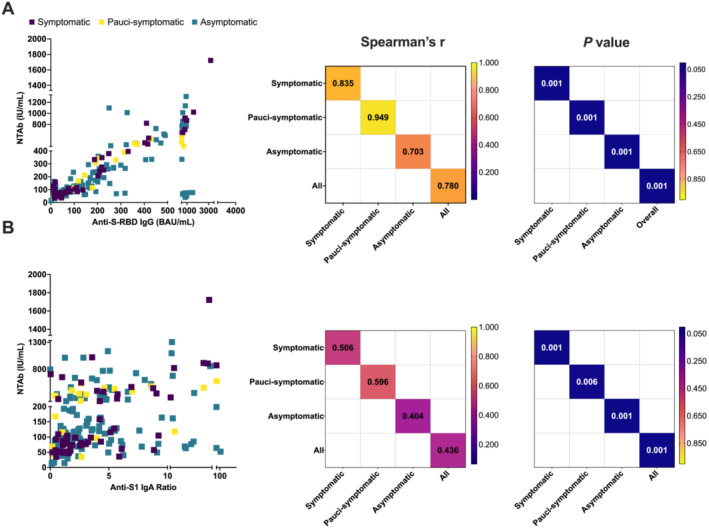
We further sought to assess the serological dynamics and neutralizing potency post–SARS‐CoV‐2 infection. We investigated the correlation between NTAbs/S‐RBD IgG and NTAbs‐IgA among NI (n = 206) study subjects (Figure 5A,B).
Interestingly, the NI group showed overall significant correlations between NTAbs and both S‐RBD IgG and anti‐S1 IgA (p < 0.001) (Figure 5A,B). However, NTAbs/anti‐S‐RBD IgG showed an overall stronger correlation (r = 0.780, p < 0.001) in comparison to NTAbs/anti‐S1 IgA, which showed significant but moderate correlations (r = 0.436, p < 0.001) (Figure 5A,B).
Stratification by clinical manifestations revealed significant correlation between NTAbs/S‐RBD IgG and NTAbs/anti‐S1 IgA among all three groups: symptomatic, asymptomatic, and pauci‐symptomatic (p < 0.001). However, the strongest significant correlation (higher Spearman's r) was observed for pauci‐symptomatic and symptomatic individuals (r = 0.949, p < 0.001, and r = 0.835, p < 0.001, respectively) for NTAbs/anti‐S‐RBD IgG (Figure 4A,B).

Pairwise correlation of neutralizing total antibody (NTAb) titers with anti‐S‐RBD IgG and anti‐S1 IgA levels among NI individuals. Scatter plots (left) and Spearman'sandvalues' correlation matrices (right) for (A) NTAbs/anti‐S‐RBD IgG and (B) NTAbs/anti‐S1 IgA were generated. Correlation coefficients of 0–0.39 indicate a weak, 0.40–0.59 a moderate, 0.6–0.79 a strong, and 0.8–1 a very strong correlation. Scatterplots were used to depict the direction, form, and strength of correlations. Allvalues were two‐sided at a significance level of 0.05.values < 0.001 is represented as 0.001. r p p p
Discussion
In the current study, we aimed to provide a detailed comparative analyses of immunogenicity among heterologous combinations of ChAdOx1 followed by either BNT162b2 or mRNA‐1273 boosting, in comparison to homologous COVID‐19 primary vaccination regimens of BNT162b2, mRNA‐1273, and ChAdOx1. In addition, we compared the observed vaccine‐induced antibody responses to SARS‐CoV‐2 infection‐induced antibody responses.
Our findings revealed considerable differences in the potency and extent of induced humoral immune responses among the assessed vaccination regimens. The most striking finding was that heterologous vaccination with ChAdOx1 followed by either BNT162b2 (n = 9, median age: 59, IQR: 57–60) or mRNA‐1273 (n = 10, median age: 55, IQR: 53–56) induced robust humoral responses against SARS‐CoV‐2 that are comparable and almost equal to those elicited by homologous BNT162b2 (n = 464, median age: 34, IQR: 22–45) and mRNA‐1273 (n = 87, median age: 23, IQR: 20–34) primary vaccination regimens alone, but superior to those elicited by homologous ChAdOx1 primary vaccination (n = 39, median age: 56, IQR: 54–59) (Table 1, Figure 2A–D). Not only that, but homologous ChAdOx1 vaccination elicited weak antibody responses, with S‐RBD IgG levels being almost equal to those elicited by unvaccinated naturally‐infected individuals (Figure 2C) and S‐RBD IgA being significantly higher among unvaccinated NI individuals compared to ChAdOx1 fully vaccinated individuals (Figure 2D). Furthermore, NTAb antibody responses post–homologous ChAdOx1 vaccination were far less potent compared to homologous BNT162b2 or mRNA‐1273 vaccination (Figure 2A). Similar findings were reported by other studies indicating an overall weaker anti‐spike and anti‐RBD IgG levels among ChAdOx1‐vaccinated individuals compared to mRNA‐1273 or BNT162b2‐vaccinated individuals [27], and that ChAdOx1 in conjunction with mRNA vaccines from Moderna or BioNTech elicited much greater antibody levels than a double dose of ChAdOx1, indicating that mRNA vaccines are the most potent vaccines overall [27].
Despite weak ChAdOx1 immunogenicity, a heterologous booster dose of either BNT162b2 or mRNA‐1273 post–homologous ChAdOx1 vaccination significantly boosted NTAbs, TAbs, anti‐S‐RBD IgG, and anti‐S1 IgA antibodies, by at least ~12, 42, 24, and 7 folds, respectively (Figure 2A–D). It should be highlighted that the profound humoral response elicited by heterologous booster regimens might be attributable to the extended interval between prime and booster dosages. Recent research revealed that with the homologous BNT162b2 vaccination, longer intervals provide greater immunogenicity than the typical 3–4 week interval [28, 29, 30]. Extended booster dosage intervals may result in increased neutralization effect and a broader range of immunologic responses [31]. This aspect may be assessed by comparing immune responses in heterologous immunization to BNT162b2 homologous vaccination at equally extended periods.
Despite the two mRNA heterologous boosters regimens being almost equally potent in inducing humoral antibody response (Figure 2), ChAdOx1/mRNA‐1273 showed higher neutralizing potency (Figure 2A). This is particularly important because the controversy over whether a vaccinated person may spread virus is believed to be influenced in part by their levels of NTAbs. NTAbs are used to prevent infection and to treat SARS‐CoV‐2‐infected patients [32]. In the current study, although a second dose of ChAdOx1 significantly increased NTAbs, that boost was relatively short‐lived, with an observed significant decline in NTAbs ~3 months post–second dose (Figure 3A). Because NTAb levels wane over time postvaccination [8], there is a greater chance that exposure to SARS‐CoV‐2 may result in infection and, thus, COVID‐19 transmission [33].
In this study, it was observed that NTAbs decreased after the second ChAdOx1 immunization (Figure 3), but an mRNA vaccine booster, particularly mRNA‐1273, significantly increased NTAbs by approximately 14 folds, surpassing the levels attained with two homologous ChAdOx1 immunizations. These findings suggest that booster vaccines may not be restricted to matching the vaccines used for the primary series and that vaccine boosters may efficiently raise NTAbs to levels that cannot be attained by primary vaccination regimens [34, 35]. Therefore, multiple‐dose regimen strategies are crucial to maintain high levels of peripheral NTAb, which can limit infection, asymptomatic viral replication, and potential transmission. Although healthcare policies may recommend a third COVID‐19 vaccine at a specific point in time, assessing NTAb levels in vaccine recipients on an individual basis is crucial to determine when an additional dose may be necessary and who may or may not require a third dose. This approach not only preserves vaccines but also avoids vaccinating individuals who already have high levels of NTAbs, as circulating NTAbs may eliminate spike protein as quickly as cells produce it [36].
Although both mRNA booster vaccines demonstrated strong and similar immunogenicity overall, it is important to note that the slight differences in their effectiveness in comparison to primary vaccination regimens could be attributed to several factors. While both vaccines are nucleoside‐modified mRNA vaccines that encode the prefusion stabilized SARS‐CoV‐2 Spike protein, there are differences in their vaccination regimens and formulations [37, 38]. BNT162b2 is given in 100‐μg/mL doses 21 days apart, while mRNA‐1273 is given in 200‐μg/mL doses 28 days apart. Assuming equivalent sized constructions, this means that each mRNA‐1273 dosage generates three times greater Spike protein mRNA copies than BNT162b2, potentially leading to stronger immunogenicity. In addition, certain side effects were more commonly reported after mRNA‐1273 vaccination compared to BNT162b2, and it is possible that this enhanced reactogenicity is accompanied by greater immunogenicity [39, 40]. Furthermore, the nanoparticles utilized to enclose the mRNA in each vaccination are formulated differently, with respect to their lipid content [41].
In the current study, we further determined the contribution of each of the anti‐S‐RBD IgG and anti‐S1 IgA isotypes to virus neutralization among VN (Figure 4) and NI individuals (Figure 5). Our findings revealed that both IgG and IgA significantly contributed to serum neutralization potential among all NI groups, with strongest correlations observed among symptomatic and pauci‐symptomatic compared to asymptomatic individuals (Figure 5). Contrastingly, among VN individuals, anti‐S‐RBD IgG seemed to have a more pronounced contribution more than IgA to serum neutralization potential (Figure 4A). The distinction in isotype contribution between NI and VN individuals may also provide insights into the mechanism of immune memory and protection following natural infection versus vaccination. The substantial role of IgA in NI individuals might reflect mucosal immunity, which is the first line of defense against respiratory pathogens [42], whereas the dominance of IgG in VN individuals could be indicative of the systemic immunity that vaccines aim to establish. This dichotomy underscores the importance of considering both systemic and mucosal immunity in the ongoing development of vaccines and therapeutic strategies.
This research had some limitations. First, the assessment of the antibody response following homologous mRNA vaccination was not feasible due to the absence of data on three doses of the same vaccine type. Additionally, the investigation of antibody responses against different variants was not feasible due to lack of sequencing data and limited sample number. Furthermore, it is important to note that the NI group included only 24.7% symptomatic individuals, which may have influenced the results. The observed antibody responses among the NI group, which predominantly consists of asymptomatic and pauci‐symptomatic individuals, may not fully represent the range of responses seen in individuals with more severe infections [43]. Additionally, the limited number of paired samples in our study poses challenges in establishing direct comparisons and performing in‐depth follow‐up analyses. Despite these limitations, we believe that our study contributes valuable insights into the humoral immune responses associated with different COVID‐19 vaccination regimens.
Despite these limitations, this research has a number of strengths worth consideration. First, the majority of published research has mostly focused on NTAb, IgG, or IgM, but studies on anti‐S1 IgA response are scarce, especially among unvaccinated, NI individuals. Second, in this research, we analyzed anti‐N antibodies, which are essential for identifying people who were infected to a virus but had no symptoms prior to immunization.
Conclusion
In light of the persistently low COVID‐19 vaccination rates, our study underscores the critical importance of addressing barriers to vaccine uptake. Primary vaccination alone appears to generate substantial antibody levels, but with a limited neutralizing capacity, emphasizing the importance of boosting to achieve robust immunologic responses and maximum protection against SARS‐CoV‐2. However, the declining vaccination rates complicate efforts to achieve the desired level of immunity. Our data demonstrates that administering a heterologous booster dose, of either mRNA‐1273 or BNT162b2, results in a substantial increase in antibody levels and neutralizing capacity. These results strongly support the advantages of administering a third vaccination dosage in containing the SARS‐CoV‐2 pandemic, particularly in light of current concerns regarding the ongoing reluctance to embrace COVID‐19 vaccination. Our study serves as a poignant reminder that, notwithstanding the decline in COVID‐19 cases, the threat endures, and vaccination remains crucial for upholding public health. The ongoing reluctance to vaccination, and the challenges presented by decreasing vaccination rates, highlight the need for targeted interventions and accessible vaccination initiatives. Elevating efforts to foster vaccine acceptance and uptake is a crucial strategy in managing the changing dynamics of the SARS‐CoV‐2 pandemic and averting future waves of infections.
Author Contributions
Salma Younes: Methodology; Writing – original draft; Writing – review and editing. Eleonora Nicolai: Data curation; Writing – review and editing. Massimo Pieri: Data curation; Writing – review and editing. Sergio Bernardini: Data curation; Writing – review and editing. Hanin I. Daas: Data curation; Writing – review and editing. Duaa W. Al‐Sadeq: Methodology; Writing – review and editing. Nadin Younes: Methodology; Writing – review and editing. Farah M. Shurrab: Methodology; Writing – review and editing. Parveen B. Nizamuddin: Methodology; Writing – review and editing. Fathima Humaira: Data curation; Methodology; Writing – review and editing. Nader Al‐Dewik: Writing – review and editing. Hadi M. Yassine: Writing ‐ review and editing. Laith J. Abu‐Raddad: Writing – review and editing. Ahmed Ismail: Data curation; Methodology. Gheyath K. Nasrallah: Resources; Supervision; Writing – original draft; Writing – review and editing.
Conflicts of Interest
We would like to declare that all kits used in this paper were provided as in‐kind support for GKN lab.
Peer Review
The peer review history for this article is available at https://www.webofscience.com/api/gateway/wos/peer‐review/10.1111/irv.13290↗.