
What this is
- This research investigates the effects of semaglutide on obesity-related heart failure with preserved ejection fraction (HFpEF) across different age groups.
- The STEP-HFpEF trials enrolled participants with obesity-related HFpEF and randomized them to semaglutide or placebo for 52 weeks.
- Key outcomes included changes in disease-specific symptoms, physical function, and body weight, evaluated across age strata.
Essence
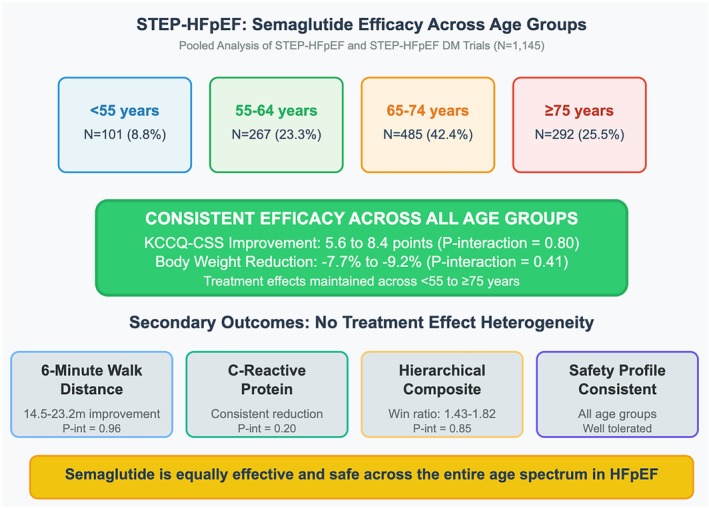
- Semaglutide improves disease-specific symptoms and reduces body weight in patients with obesity-related HFpEF, regardless of age. The treatment's safety profile remains consistent across different age groups.
Key takeaways
- Semaglutide consistently improved Kansas City Cardiomyopathy Questionnaire clinical summary scores across age groups, with no significant treatment effect heterogeneity.
- Body weight reductions ranged from −7.7% to −9.2% across all age categories, indicating effective weight management with semaglutide.
- The safety profile of semaglutide was similar across ages, with no significant increase in adverse events compared to placebo.
Caveats
- The study population may not represent the broader HFpEF patient population, particularly older patients with higher frailty.
- The trial was not powered to assess clinical outcomes, necessitating further studies for long-term efficacy and safety.
Simplified
Background
Obesity‐related heart failure (HF) with preserved ejection fraction (HFpEF) is characterized by worse quality of life, impaired physical function, and high cardiac filling pressures.1, 2, 3 Older patients with obesity‐related HFpEF have a high burden of sarcopenia and physical dysfunction and are at a higher risk of adverse clinical outcomes.4 Incretin‐based weight loss therapies have demonstrated efficacy in improving disease‐specific symptoms, physical function, and exercise capacity among patients with obesity‐related HFpEF.5, 6 However, their efficacy across the age spectrum in HFpEF is unknown. Additionally, there have been concerns that the use of weight loss therapies in older adults may worsen sarcopenia.7, 8, 9 We performed a pre‐specified, age‐stratified analysis of the pooled participant‐level data from the randomized, double‐blind, placebo‐controlled STEP‐HFpEF programme (STEP‐HFpEF and STEP‐HFpEF DM) to evaluate the efficacy of semaglutide in HFpEF across the age spectrum.
Methods
The design and primary results of the individual trials and the overall programme have been published previously.5, 6 Institutional review board or ethics committee approval was obtained at each study site, and all patients provided written informed consent.
Study population
The inclusion and exclusion criteria for both STEP‐HFpEF trials have been reported previously.5, 6 Briefly, the trial enrolled participants with symptomatic HF (left ventricular ejection fraction ≥45%) and obesity (body mass index [BMI] ≥30 kg/m2) with objective evidence of HFpEF based on elevated filling pressures or elevated natriuretic peptide levels and echocardiographic abnormalities, or HF hospitalization in the previous 12 months. Only patients with type 2 diabetes mellitus (T2DM) were included in the STEP‐HFpEF DM trial, in which semaglutide or placebo was added to background therapy for T2DM. Eligible participants were randomized 1:1 to receive once‐weekly semaglutide 2.4 mg or matching placebo in addition to standard care for 52 weeks.
Outcomes
The dual primary endpoints were: (1) change in Kansas City Cardiomyopathy Questionnaire clinical summary score (KCCQ‐CSS) and percentage change in body weight from baseline to 52 weeks. The confirmatory secondary endpoints were changes in 6‐min walk distance (6MWD) and C‐reactive protein (CRP), and a hierarchical composite endpoint (comprised of all‐cause death [from baseline to 57 weeks]). HF events (hospitalizations or urgent visits requiring intravenous therapy; an exploratory endpoint in both STEP‐HFpEF trials) were adjudicated by a blinded clinical events committee as previously described.5, 6 Change in N‐terminal pro‐B‐type natriuretic peptide (NT‐proBNP) concentrations from baseline to week 52 was also evaluated as an exploratory endpoint. Serious adverse events (SAEs), SAEs leading to permanent treatment discontinuation, and cardiac and gastrointestinal SAEs were also evaluated as safety endpoints. Finally, atrial fibrillation events and bone/joint injuries were also assessed as safety endpoints of interest for this analysis.
Statistical analysis
The study participants were stratified according to age into four categories: (i) <55 years, (ii) 55–64 years, (iii) 65–74 years, and (iv) ≥75 years. Baseline characteristics were compared across age strata using the Wilcoxon test and the Chi‐square test for continuous and categorical variables, respectively. The efficacy endpoints were examined according to the intention‐to‐treat principle. Analyses of continuous endpoints were performed using analysis of covariance models adjusted for the baseline value of the endpoint, treatment arm, trial, and BMI (<35 kg/m2 or ≥35 kg/m2) as fixed factors using 1000 imputations; analyses also included an interaction term between treatment arm and age category. Estimates were combined using Rubin's rule. For outcomes of change in KCCQ‐CSS and 6MWD, missing observations at week 52 caused by cardiovascular death or previous HF events (if not observed) were single‐imputed using the lowest observed value across both treatment arms and visits. Missing values caused by other reasons were imputed from retrieved participants in the same randomized treatment arm. For other endpoints, missing observations at week 52 were imputed irrespective of death or prior HF events using the same imputation method. Interaction p‐values were derived from an F‐test of equality between the treatment differences across the age subgroups.
Analyses of the hierarchical composite endpoint (win ratio) were performed stratified by age, based on direct comparisons of each participant in semaglutide versus placebo arms, as reported previously.5, 6 A two‐sided p‐value of <0.05 was considered statistically significant and no adjustment for multiplicity was performed. Results are presented as estimated changes from baseline to 52 weeks for continuous endpoints and a win ratio for the hierarchical composite endpoint with 95% confidence intervals (CI) and two‐sided p‐values. NT‐proBNP and CRP were log‐transformed; hence, the treatment ratio with the corresponding 95% CI is reported. Statistical analyses were performed using SAS version 9.4 (SAS/STAT version 15.1).
Results
Baseline characteristics by Age
The median age of participants was 69 years (interquartile range: 62–75). Participants in the older age subgroups (65–74 years and ≥75 years) had lower body weight but a higher prevalence of cardiovascular comorbidities than younger participants. Older participants had higher NT‐proBNP, while CRP was highest among younger participants. Older participants had lower 6MWD and had a larger proportion with New York Heart Association class III symptoms than younger participants. There were no differences in KCCQ‐CSS scores by age category at baseline. No differences were noted in the use of sodium‐glucose co‐transporter‐2 inhibitors and mineralocorticoid receptor antagonists by age category (Table 1).
| Characteristic | Age (years) | ‐valuep | |||
|---|---|---|---|---|---|
| <55 ( = 101)n | 55–64 ( = 267)n | 65–74 ( = 485)n | ≥75 ( = 292)n | ||
| Female sex | 53 (52.5) | 119 (44.6) | 243 (50.1) | 155 (53.1) | 0.2138 |
| Race 70049 | <0.0001 | ||||
| Asian | 16 (15.8) | 31 (11.6) | 22 (4.5) | 7 (2.4) | |
| Black or African American | 8 (7.9) | 13 (4.9) | 14 (2.9) | 4 (1.4) | |
| White | 76 (75.2) | 223 (83.5) | 446 (92.0) | 281 (96.2) | |
| Other | 1 (1.0) | 0 (0.0) | 3 (0.6) | 0 (0.0) | |
| Diabetes duration, years 70049 | 6.4 (2.4–13.3) | 7.6 (3.8–13.3) | 7.5 (3.9–14.9) | 10.2 (4.6–17.0) | 0.0793 |
| Body weight, kg | 117.2 (98.2–141.7) | 112.0 (94.2–132.0) | 103.5 (93.8–116.8) | 96.7 (87.5–107.4) | <0.0001 |
| BMI, kg/m2 | 39.5 (35.5–46.9) | 38.4 (34.6–43.6) | 36.8 (33.7–41.0) | 35.2 (32.5–38.8) | <0.0001 |
| Waist circumference, cm | 124.0 (114.3–139.0) | 124.0 (114.0–134.0) | 120.0 (111.0–128.2) | 116.8 (109.2–124.0) | <0.0001 |
| SBP, mmHg | 130.0 (117.0–140.0) | 134.0 (125.0–144.0) | 133.0 (123.0–144.0) | 135.5 (123.5–145.0) | 0.0086 |
| NYHA class | 0.0182 | ||||
| II | 75 (74.3) | 197 (73.8) | 331 (68.2) | 182 (62.3) | |
| III | 26 (25.7) | 70 (26.2) | 154 (31.8) | 108 (37.0) | |
| IV | 0 (0.0) | 0 (0.0) | 0 (0.0) | 2 (0.7) | |
| LVEF, % | 55.0 (49.0–60.0) | 56.0 (50.0–61.0) | 56.0 (50.0–60.0) | 58.0 (51.5–60.0) | 0.3453 |
| KCCQ‐CSS, points | 59.4 (50.0–71.9) | 59.6 (43.8–74.0) | 59.8 (44.8–72.9) | 57.3 (38.8–69.5) | 0.0782 |
| 6MWD, m | 346.2 (262.5–400.0) | 321.1 (240.0–380.8) | 297.3 (227.7–374.2) | 258.5 (183.1–327.5) | <0.0001 |
| CRP, mg/L | 7.9 (2.6–15.0) | 4.2 (2.1–9.0) | 3.4 (1.7–7.4) | 2.8 (1.4–6.4) | <0.0001 |
| NT‐proBNP, pg/ml | 231.3 (143.8–464.7) | 369.6 (186.9–771.3) | 500.7 (242.7–983.5) | 782.7 (369.1–1376.0) | <0.0001 |
| Medical history | |||||
| Hypertension | 71 (70.3) | 218 (81.6) | 420 (86.6) | 250 (85.6) | 0.0005 |
| Atrial fibrillation | 25 (24.8) | 95 (35.6) | 227 (46.8) | 171 (58.6) | <0.0001 |
| OSA | 9 (8.9) | 31 (11.6) | 50 (10.3) | 29 (9.9) | 0.8654 |
| CAD | 18 (17.8) | 43 (16.1) | 116 (23.9) | 69 (23.6) | 0.0486 |
| Medications | |||||
| Diuretics | 78 (77.2) | 202 (75.7) | 398 (82.1) | 247 (84.6) | 0.0355 |
| Loop diuretics | 61 (60.4) | 150 (56.2) | 285 (58.8) | 206 (70.5) | 0.002 |
| Thiazides | 16 (15.8) | 32 (12.0) | 81 (16.7) | 46 (15.8) | 0.3813 |
| Beta blockers | 79 (78.2) | 214 (80.1) | 395 (81.4) | 240 (82.2) | 0.8099 |
| SGLT2 inhibitors | 25 (24.8) | 58 (21.7) | 87 (17.9) | 51 (17.5) | 0.2469 |
| MRA | 40 (39.6) | 88 (33.0) | 167 (34.4) | 89 (30.5) | 0.3758 |
| ACE‐I/ARB/ARNI | 74 (73.3) | 208 (77.9) | 387 (79.8) | 230 (78.8) | 0.5344 |
| ARNI | 9 (8.9) | 16 (6.0) | 20 (4.1) | 13 (4.5) | 0.195 |
| Insulin and analogues | 13 (12.9) | 33 (12.4) | 51 (10.5) | 31 (10.6) | 0.8077 |
| Sulfonylureas | 11 (10.9) | 36 (13.5) | 41 (8.5) | 20 (6.8) | 0.0421 |
| DPP‐4 inhibitors | 12 (11.9) | 24 (9.0) | 35 (7.2) | 21 (7.2) | 0.3812 |
Efficacy of semaglutide versus placebo by Age
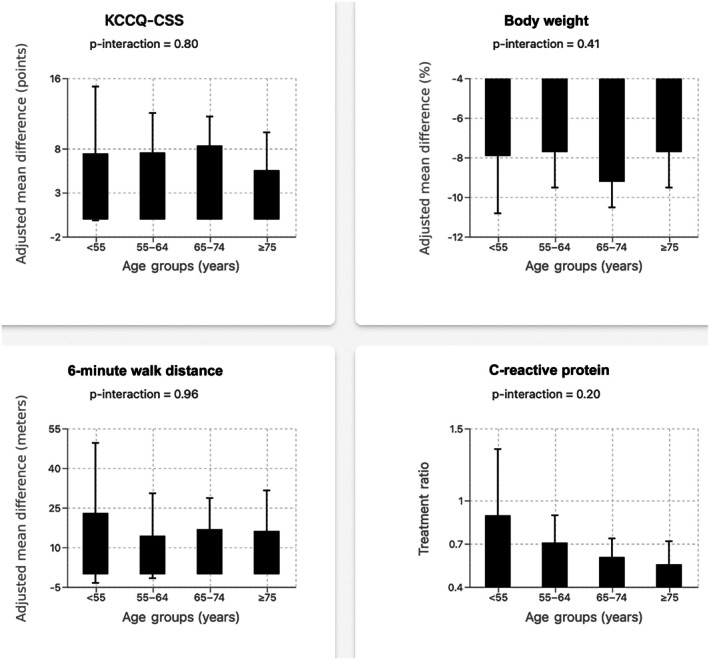
The effect of semaglutide on the dual primary endpoint of KCCQ‐CSS and body weight was consistent across age strata without any significant heterogeneity in the treatment effect by age (Figure 1, Table 2). For body weight, a significant reduction ranging from −7.7% to −9.2% was observed across all age groups (p‐interaction = 0.41). Similarly, semaglutide use resulted in 5.6‐point to 8.4‐point improvement of KCCQ‐CSS across the age groups (p‐interaction = 0.80). Among confirmatory secondary endpoints, semaglutide led to an increase in 6MWD (p‐interaction = 0.96) and a favourable win ratio for the hierarchical composite endpoint (p‐interaction = 0.85) in each age category without significant heterogeneity in treatment effect. Semaglutide was also associated with consistent reductions in CRP and NT‐proBNP across different age groups (p‐interaction: CRP = 0.20, NT‐proBNP = 0.78). In terms of safety, the proportion of participants with SAEs was higher in the older age groups, with a higher frequency noted in the placebo group versus the semaglutide arm (Table 3). Frequency of investigator‐reported atrial fibrillation events and bone/joint injuries on follow‐up was low, with no difference between the semaglutide and placebo arms across age strata (Table 3).
![Treatment effect of semaglutide (vs. placebo) on key primary and secondary outcomes among participants across different age strata. The bar plots show the adjusted mean difference between semaglutide (vs. placebo) in change in key outcomes (Kansas City Cardiomyopathy Questionnaire clinical summary score [KCCQ‐CSS], body weight, 6‐minute walk distance) from baseline to 52‐week follow‐up across different age strata. For C‐reactive protein, the plot shows the treatment ratio for semaglutide versus placebo.](https://europepmc.org/articles/PMC12765414/bin/EJHF-27-2537-g001.jpg "Click to view full size")
Treatment effect of semaglutide (vs. placebo) on key primary and secondary outcomes among participants across different age strata. The bar plots show the adjusted mean difference between semaglutide (vs. placebo) in change in key outcomes (Kansas City Cardiomyopathy Questionnaire clinical summary score [KCCQ‐CSS], body weight, 6‐minute walk distance) from baseline to 52‐week follow‐up across different age strata. For C‐reactive protein, the plot shows the treatment ratio for semaglutide versus placebo.
| Outcome 70049 | Age (years) | ‐interactionp | |||||||
|---|---|---|---|---|---|---|---|---|---|
| <55 ( = 101)n | 55–64 ( = 267)n | 65–74 ( = 485)n | ≥75 ( = 292)n | ||||||
| Semaglutide ( = 36)n | Placebo ( = 52)n | Semaglutide ( = 131)n | Placebo ( = 110)n | Semaglutide ( = 240)n | Placebo ( = 218)n | Semaglutide ( = 125)n | Placebo ( = 141)n | ||
| Dual primary endpoint | |||||||||
| Change in KCCQ‐CSS at 52 weeks, points | 14.9 | 7.4 | 16 | 8.4 | 16.5 | 8.1 | 11.3 | 5.8 | |
| Adjusted mean difference, points | 7.5 (−0.1, 15.1) | 7.6 (3.1, 12.1) | 8.4 (5.0, 11.7) | 5.6 (1.2, 9.9) | 0.7956 | ||||
| Change in body weight at 52 weeks, % | −10.5 | −2.6 | −10.2 | −2.5 | −12.1 | −2.9 | −11.5 | −3.8 | |
| Adjusted mean difference, % | −7.9 (−10.8, −4.9) | −7.7 (−9.5, −5.9) | −9.2 (−10.5, −7.9) | −7.7 (−9.5, −6.0) | 0.4127 | ||||
| Confirmatory secondary endpoints | |||||||||
| Change in 6MWD at 52 weeks, m | 26.1 | 3 | 20.8 | 6.2 | 18.9 | 1.8 | 6 | −10.3 | |
| Adjusted mean difference, m | 23.2 (−3.3, 49.7) | 14.5 (−1.5, 30.6) | 17.0 (5.2, 28.8) | 16.3 (0.9, 31.7) | 0.9588 | ||||
| Hierarchical composite endpoint, win ratio | 1.56 (0.94, 2.58) | 1.82 (1.32, 2.51) | 1.73 (1.37, 2.20) | 1.43 (1.08, 1.90) | 0.8511 | ||||
| CRP ratio at 52 weeks (follow‐up/baseline) | 0.76 | 0.84 | 0.62 | 0.88 | 0.54 | 0.88 | 0.53 | 0.95 | |
| Treatment ratio | 0.90 (0.59, 1.36) | 0.71 (0.55, 0.90) | 0.61 (0.51, 0.74) | 0.56 (0.44, 0.72) | 0.2036 | ||||
| NT‐proBNP ratio at 52 weeks | 0.72 | 0.81 | 0.65 | 0.85 | 0.79 | 0.98 | 0.94 | 1.07 | |
| Treatment ratio | 0.89 (0.62, 1.29) | 0.76 (0.61, 0.96) | 0.81 (0.69, 0.94) | 0.88 (0.71, 1.08) | 0.7817 | ||||
| Outcomes | Age (years) | |||||||
|---|---|---|---|---|---|---|---|---|
| <55 ( = 101)n | 55–64 ( = 267)n | 65–74 ( = 485)n | ≥75 ( = 292)n | |||||
| Semaglutide | Placebo | Semaglutide | Placebo | Semaglutide | Placebo | Semaglutide | Placebo | |
| Serious adverse events | 3 (7.5) | 11 (18.0) | 27 (19.0) | 28 (22.4) | 39 (15.3) | 65 (28.3) | 31 (22.8) | 61 (39.1) |
| Cardiac disorders | 1 (2.5) | 6 (9.8) | 12 (8.5) | 14 (11.2) | 7 (2.7) | 22 (9.6) | 12 (8.8) | 33 (21.2) |
| Atrial fibrillation/flutter | 0 | 2 (3.3) | 4 (2.8) | 2 (1.6) | 3 (1.2) | 10 (4.3) | 3 (2.2) | 5 (3.2) |
| Bone and joint injuries | 1 (2.5) | 0 | 0 | 1 (0.8) | 3 (1.2) | 2 (0.9) | 4 (2.9) | 3 (1.9) |
| Infection and infestations | 1 (2.5) | 3 (4.9) | 9 (6.3) | 2 (1.6) | 6 (2.4) | 20 (8.7) | 6 (4.4) | 19 (12.2) |
| Gastrointestinal disorders | 0 (0) | 0 (0) | 4 (2.8) | 1 (0.8) | 7 (2.7) | 5 (2.2) | 5 (3.7) | 6 (3.8) |
| Injury, poisoning, and procedural complications | 1 (2.5) | 0 (0) | 2 (1.4) | 2 (1.6) | 5 (2.0) | 4 (1.7) | 4 (2.9) | 4 (2.6) |
| Hepatobiliary disorders | 1 (2.5) | 0 (0) | 1 (0.7) | 0 (0) | 1 (0.4) | 1 (0.4) | 3 (2.2) | 3 (1.9) |
| Nervous system disorders | 1 (2.5) | 0 (0) | 3 (2.1) | 2 (1.6) | 6 (2.4) | 7 (3.0) | 7 (5.1) | 5 (3.2) |
| Renal and urinary disorders | 1 (2.5) | 2 (3.3) | 3 (2.1) | 1 (0.8) | 3 (1.2) | 5 (2.2) | 1 (0.7) | 5 (3.2) |
| Metabolism and nutrition disorders | 1 (2.5) | 0 (0) | 4 (2.8) | 0 (0) | 2 (0.8) | 3 (1.3) | 0 (0) | 5 (3.2) |
| Neoplasms benign, malignant, and unspecified (including cysts and polyps) | 0 (0) | 0 (0) | 1 (0.7) | 1 (0.8) | 6 (2.4) | 6 (2.6) | 4 (2.9) | 4 (2.6) |
| Blood and lymphatic system disorders | 0 (0) | 0 (0) | 1 (0.7) | 0 (0) | 0 (0) | 0 (0) | 2 (1.5) | 4 (2.6) |
| Vascular disorders | 0 (0) | 0 (0) | 0 (0) | 1 (0.8) | 5 (2.0) | 7 (3.0) | 2 (1.5) | 2 (1.3) |
| Respiratory, thoracic, and mediastinal disorders | 0 (0) | 1 (1.6) | 2 (1.4) | 3 (2.4) | 3 (1.2) | 7 (3.0) | 1 (0.7) | 7 (4.5) |
| Reproductive system and breast disorders | 0 (0) | 0 (0) | 0 (0) | 0 (0) | 1 (0.4) | 0 (0) | 1 (0.7) | 1 (0.6) |
| General disorders and administration site conditions | 0 (0) | 1 (1.6) | 1 (0.7) | 0 (0) | 0 (0) | 5 (2.2) | 1 (0.7) | 0 (0) |
| Musculoskeletal and connective tissue disorders | 0 (0) | 2 (3.3) | 4 (2.8) | 3 (2.4) | 5 (2.0) | 5 (2.2) | 0 (0) | 2 (1.3) |
| Eye disorders | 0 (0) | 0 (0) | 0 (0) | 1 (0.8) | 0 (0) | 1 (0.4) | 0 (0) | 1 (0.6) |
| Immune system disorders | 0 (0) | 1 (1.6) | 1 (0.7) | 1 (0.8) | 0 (0) | 0 (0) | 0 (0) | 0 (0) |
| Ear and labyrinth disorders | 0 (0) | 0 (0) | 0 (0) | 0 (0) | 0 (0) | 2 (0.9) | 2 (1.5) | 0 (0) |
| Investigations | 0 (0) | 0 (0) | 1 (0.7) | 1 (0.8) | 1 (0.4) | 0 (0) | 0 (0) | 1 (0.6) |
| Congenital, familial, and genetic disorders | 0 (0) | 0 (0) | 0 (0) | 1 (0.8) | 0 (0) | 5 (2.2) | 0 (0) | 0 (0) |
| Psychiatric disorders | 0 (0) | 0 (0) | 0 (0) | 0 (0) | 0 (0) | 1 (0.4) | 0 (0) | 0 (0) |
| Endocrine disorders | 0 (0) | 0 (0) | 0 (0) | 0 (0) | 0 (0) | 1 (0.4) | 0 (0) | 0 (0) |
| Skin and subcutaneous disorders | 0 (0) | 0 (0) | 0 (0) | 0 (0) | 0 (0) | 2 (0.9) | 0 (0) | 1 (0.6) |
| Surgical and medical procedures | 0 (0) | 0 (0) | 0 (0) | 0 (0) | 0 (0) | 1 (0.4) | 0 (0) | 1 (0.6) |
Discussion
In this pre‐specified, pooled, patient‐level, secondary analysis of the STEP‐HFpEF programme trials, we observed that older participants with obesity‐related HFpEF had a higher burden of comorbidities, lower functional status, lower exercise capacity, and higher NT‐proBNP levels. In contrast, younger patients had higher body weight and a greater burden of inflammation. The favourable effect of semaglutide was consistent across the age spectrum for the primary and key secondary outcomes with no significant treatment heterogeneity (Figure 2). Moreover, the lower rates of SAEs with semaglutide versus placebo was consistent across age categories.
HFpEF has emerged as a true geriatric syndrome with the highest prevalence among older adults who have sarcopenic obesity and a high burden of comorbidities, sarcopenia, frailty, and physical function impairment.4 As a result, there have been concerns about worsening malnutrition in these patients with the use of weight loss agents, like semaglutide, which may potentially worsen frailty and sarcopenia.7, 10 Our findings help to alleviate these concerns by demonstrating that adults with obesity‐related HFpEF derive similar treatment benefits from semaglutide regardless of age. We observed that semaglutide improved disease‐specific symptoms, physical function, and exercise capacity, even amongst the oldest participants. These findings support the use of semaglutide as an effective therapy for obesity‐related HFpEF, even amongst older patients for whom there may be greater therapeutic inertia due to concerns of side effects, higher frailty burden, and lower BMI. It is noteworthy that we do not have objective measures of lean body mass and frailty available in the study, limiting our ability to assess the effects of semaglutide on these meaningful parameters. This is particularly relevant considering the high burden of frailty in patients with HF, particularly HFpEF.11, 12 Furthermore, prior studies have demonstrated substantial loss of lean mass with the use of glucagon‐like peptide‐1 receptor agonists (GLP‐1RAs).8, 9 Future studies with objective assessment of body composition and frailty burden are needed to address these knowledge gaps. While a higher frequency of adverse events, including atrial fibrillation, was noted in older participants, the use of semaglutide was not associated with a meaningful increase in risk of adverse events in any age group, highlighting its safety and tolerability across the age spectrum. Specifically, we did not see increased bone fractures/joint injuries with semaglutide use in older participants, which is reassuring considering the prior reports of loss of bone mineral density with use of this therapy.13
Several limitations to our study are noteworthy. First, owing to the trial‐specific inclusion/exclusion criteria, the study population may not be generalizable to the broader population of HFpEF patients, which includes a larger proportion of older patients with a high burden of frailty.11 Second, the study is not powered to assess the efficacy of semaglutide on clinical outcomes, and future studies with longer‐term follow‐up are needed to establish the clinical efficacy of GLP‐1RAs in HFpEF, particularly among older patients. In conclusion, semaglutide is effective in treating obesity‐related HFpEF across the age spectrum. The safety profile of semaglutide was consistent across age groups. Future studies are required to characterize its impact on clinical events, long‐term outcomes, and safety.

Efficacy and safety of semaglutide across age groups in patients with obesity‐related HFpEF. KCCQ‐CSS, Kansas City Cardiomyopathy Questionnaire clinical summary score; HFpEF, heart failure with preserved ejection fraction.
 GLP-1 Therapies