
What this is
- This research investigates sex differences in Alzheimer's disease (AD) () biomarkers among cognitively unimpaired individuals.
- It examines how these differences relate to amyloid-beta (Aβ) pathology as measured by ().
- The study utilizes data from two large cohorts, ALFA+ and WRAP/WADRC, to assess biomarker levels and their diagnostic performance.
Essence
- Men show higher levels of neurodegeneration and glial reactivity biomarkers, while women have higher synaptic biomarkers. Despite these differences, the ability of core AD biomarkers to detect Aβ positivity is similar across sexes.
Key takeaways
- Men exhibit higher levels of neurofilament light (NfL), glial reactivity, and vascular dysregulation biomarkers compared to women. In contrast, women have higher levels of synaptic biomarkers like neurogranin.
- Core AD biomarkers did not show significant sex differences in their diagnostic performance for identifying Aβ positivity, indicating that sex-specific adjustments are unnecessary for this purpose.
- Sex differences influenced the associations between baseline biomarkers and Aβ uptake, with stronger associations observed in women, suggesting potential implications for monitoring and treatment strategies.
Caveats
- The study's findings may be limited by the higher frequency of APOE-ε4 carriers in men compared to women, potentially influencing biomarker levels. Additionally, the sample size of men was smaller, which could affect statistical power.
- The study does not account for hormonal factors like menopause status, which could influence biomarker levels and their associations with AD pathology.
Definitions
- Cerebrospinal fluid (CSF): A clear fluid surrounding the brain and spinal cord, used to measure biomarkers related to neurological conditions.
- Positron Emission Tomography (PET): An imaging technique that helps visualize metabolic processes in the body, often used to detect amyloid-beta deposits in Alzheimer's disease.
Simplified
Background
The preclinical stage of Alzheimer's disease (AD) is an optimal window for intervention, with the potential to delay or even prevent the progression to dementia [1, 2]. Biomarkers are crucial to identify this stage, and they also have a role in enriching preventive clinical trials with individuals at higher risk of progression. Core AD biomarkers include amyloid-beta (Aβ) and tau proteins measured in CSF or PET imaging. However, multiple other biomarkers can be measured in cerebrospinal fluid (CSF), including neuronal injury, synaptic, glial and vascular proteins, which can provide valuable insights into the disease's pathogenesis in this early stage [3 –5].
Sex differences have been reported in AD. Two out of three AD patients are women, with postmenopausal women contributing to over 60% of all those affected [6]. Women have a higher resilience to AD pathology in the early stages of the disease [7, 8], and experience a higher pathological burden and steeper decline at later stages [9, 10]. However, our understanding of how sex influences CSF biomarkers remains limited. AD biomarker studies usually correct their analyses by sex, hence treating sex as a confounding variable; as a consequence, sex has generally been neglected as a subject of study when analyzing either clinical or biological features of the disease or the effect of interventions [11, 12].
Most studies that reported the effect of sex did not find differences in the concentrations of CSF Aβ42, Aβ40 or in the CSF Aβ42/40 ratio along the AD continuum [13 –16], although one study reported lower levels of CSF Aβ42 in men [17]. In contrast, sex differences are more evident in relation to p-tau, with women showing greater CSF p-tau181 levels and subsequent decline for a given CSF Aβ42 level [14, 18, 19]. Other studies have found differences particularly when the APOE-ε4 status is considered, such that women APOE-ε4 carriers show higher CSF p-tau181 and t-tau [14, 15, 17, 20, 21]. Furthermore, sex differences in CSF p-tau181 have also been found to differ by both APOE-ε4 and disease stage, with differences being more evident in early disease stages in APOE-ε4 carriers, and in advanced stages in non-carriers [22].
CSF neurofilament light (NfL) is widely reported to be higher in men compared to women and, in fact, the need of sex-specific reference intervals for CSF NfL has been suggested [4, 23 –28]. Yet, evidence on sex differences in other AD-related CSF biomarkers is scarcer and more inconsistent. Interestingly, CSF neurogranin was found to be higher in women than in men in various study populations [4, 26, 27, 29, 30], however, others did not find sex differences [31 –33]. CSF IL-6 and MCP-1, along with CSF biomarkers related to vascular dysfunction such as CSF sVCAM-1 and sICAM-1 have been reported to be higher in men [16, 34, 35]. Finally, evidence of sex differences in CSF glial and vascular biomarkers is also conflicting. CSF YKL-40, along with several complement proteins, were found to be higher in men across the AD clinical spectrum and also in the preclinical stage [4, 36], while other studies did not find differences in CSF YKL-40 [35] or sTREM2 [37]. Notably, prior studies have shown that the relationship between AD pathology and neurodegeneration-related gliosis as measured with CSF biomarkers may be modified by sex [38, 39]. A recent study found that women with higher Aβ burden on PET showed stronger associations of CSF YKL-40 and GFAP with CSF p-tau181 than men, while in men with greater tau burden, CSF YKL-40 and hippocampal volume were more strongly associated than in women [39].
Overall, the potential effect of sex in AD CSF biomarkers has been generally underexplored, particularly in cognitively unimpaired individuals (CU), and the available results are inconsistent. Moreover, whether there is a sex effect not only in CSF biomarker levels but on their diagnostic and prognostic capacity, particularly important in early disease stages, remains unclear. Studying the effect of sex in AD-related CSF biomarkers will improve our understanding of the observed heterogeneity in AD pathogenesis, as well as inform about the accurate use and interpretation of biomarkers in AD prevention trials. Therefore, the main aim of this study was to investigate whether there are sex differences in AD CSF biomarkers, their performance to detect Aβ PET positivity, and their association with Aβ pathology in CU individuals. We investigated several CSF biomarkers, which reflect multiple pathophysiological mechanisms relevant in AD, in two independent cohorts of CU individuals. We performed sex-stratified analyses and tested interactions with sex to characterize its effect on CSF biomarker levels and their associations with Aβ pathology on PET cross-sectionally and longitudinally.
Methods
Study cohorts
The ALFA + cohort is a nested longitudinal study from the ALFA (for ALzheimer's and FAmilies) study [40], in which late middle aged (between 45 and 65 years old at baseline [i.e. at their inclusion in ALFA]) CU participants were invited to participate based on their specific AD risk profile and were comprehensively characterised, including CSF, magnetic resonance imaging (MRI), and positron emission tomography (PET) biomarker acquisition. The current study included data from 400 ALFA + participants with baseline CSF biomarkers. Among them, 340 also had an Aβ PET at baseline, and 204 had available Aβ PET at the follow-up visit (average follow-up of 3.25 years, range: 1.30 to 5.85 years). In ALFA +, 52% of Aβ PET visits occurred within 3 months of a lumbar punction procedure and 97% occurred within a year of lumbar punction procedure.
The Wisconsin Registry for Alzheimer's Prevention (WRAP) and Wisconsin Alzheimer's Disease Research Center (WADRC) at the University of Wisconsin (Wisconsin, USA) were included as a validation/replication cohort. WRAP is comprised of initially CU, middle-aged (between 40 and 65 years old) adults enriched for parental history of dementia presumed due to AD [41] followed-up every two years. At each visit, the participants undergo comprehensive medical and cognitive evaluations. The WADRC clinical core is comprised of participants across the AD spectrum who undergo cognitive testing and physical exams annually or biennially [42]. The present study included data from 548 WRAP/WADRC CU participants with available CSF biomarkers. 183 participants also had an Aβ PET imaging visit within 2 years of CSF sample collection and 143 had follow-up Aβ PET imaging data (average follow-up of 3.17 years, range: 1.78 to 12.7 years). In WRAP/WADRC, 48% of PET visits occurred on the same day as the lumbar puncture procedure and 75% occurred within 30 days of the lumbar puncture procedure. In this cohort, we selected the CSF sample and Aβ PET imaging that took place closest in time (within a maximum of two years) for cross-sectional analyses of CSF biomarker and Aβ PET Centiloid values. For analyses of change in Centiloid values, baseline CSF was defined as CSF closest to the participant's first Aβ PET imaging visit (within a maximum of two years).
In the two cohorts, sex was categorized based on self-report. Global cognitive performance was assessed with the Mini Mental State Examination (MMSE) [43] and the Preclinical Alzheimer Cognitive Composite (PACC) [44, 45].
Available baseline CSF biomarkers in both cohorts included core AD biomarkers (Aβ42, Aβ42/40, p-tau181, p-tau181/Aβ42), as well as neurodegeneration (t-tau, NfL), synaptic dysfunction (neurogranin, α-synuclein), glial reactivity (sTREM2, YKL-40, GFAP, S100B) and neuroinflammation (IL-6) biomarkers. In ALFA +, additional CSF biomarkers were available, including biomarkers for tau pathology (p-tau217, p-tau231), synaptic dysfunction (SNAP25, GAP-43, synaptotagmin-1), vascular dysregulation (sICAM-1, sVCAM-1), and neuroinflammation (MCP-1).
CSF sample acquisition, processing, and biomarker measurements
CSF procedures in the ALFA + and the WRAP/WADRC cohorts have been reported previously [4, 46]. All measurements, except for CSF p-tau217, were performed at the Clinical Neurochemistry Laboratory, Sahlgrenska University Hospital, Mölndal, Sweden.
In both cohorts, CSF t-tau and p-tau181 were measured using the electrochemiluminescence immunoassays Elecsys® Total-tau CSF and phospho-tau(181P) CSF on a fully automated cobas e601 instrument (Roche Diagnostics International Ltd.). CSF Aβ40, Aβ42, NfL, neurogranin, α-synuclein, sTREM2, YKL-40, GFAP, S100B and IL-6 were measured with the prototype NeuroToolKit (Roche Diagnostics International Ltd.) on a cobas e411 or e601 instrument as previously described in both cohorts [4, 47]. CSF Aβ42 measured with the Elecsys® β-Amyloid (1–42) CSF immunoassay was additionally available in ALFA +, and it was used as an individual biomarker as well as combined with CSF p-tau181 as the p-tau181/Aβ42 ratio.
In ALFA +, measurement of CSF p-tau231 was performed using a research ELISA assay using cis-conformational selective monoclonal antibody (ADx253, ADx NeuroSciences), which was described previously [48]. Eli Lilly and Company provided the measurements of the previously published in-house assay for CSF p-tau217 [49] using the Meso Scale Discovery platform (MSD). CSF SNAP25 and synaptotagmin-1 concentrations were measured by immunoprecipitation mass spectrometry following a previously established protocol [50]. In particular, the longer soluble forms of SNAP25 including at least amino acids 32 through 40 (SNAP 25aa40) were evaluated herein. CSF GAP-43 was measured by ELISA as previously described [51].
CSF sICAM-1 and sVCAM-1 were measured with the MSD Vascular Injury (human) Panel 2 kit #K15198D. MCP-1 was measured with the MSD V-Plex Chemokine (human) Panel 1 kit #K15047D.
Aβ PET acquisition, quantification, and Aβ status determination
In ALFA +, participants underwent [18F]flutemetamol Aβ PET scans after a cranial CT scan for attenuation correction on a Biograph mCT scanner (Siemens Healthcare, Erlangen, Germany) at Hospital Clínic, Barcelona, Spain. Participants received an IV bolus dose of 185 MBq (range 104.25–218.3 MBq, mean ± SD 191.75 ± 14.04 MBq), and 90 min after injection, PET data were acquired for 20 min (4 frames of 5 min each, mean ± SD 90.15 ± 7.36 min). PET images were reconstructed in 4 frames of 5 min using the 3-dimensional Ordered Subset Expectation Maximization algorithm by incorporating time of flight and point spread function modeling. Centiloid values were calculated from the mean values of the standard Centiloid target region (http://www.gaain.org/centiloid-project↗) using the transformation previously calibrated [52]. A nuclear medicine physician visually rated the scans as Aβ-positive or Aβ-negative using standard clinical criteria as specified in the Summary of Product Characteristics of the tracer (https://www.ema.europa.eu/en/documents/product-information/vizamyl-eparproduct-information_en.pdf↗).
Aβ PET acquisition and quantification in the WRAP/WADRC has been previously described [53]. Participants underwent [11C]PiB PET scans on a Siemens EXACT HR + scanner (Siemens Healthcare, Erlangen, Germany). Participants received an IV bolus of 555 [11C]PiB (mean ± SD 566.1 ± 33.3 MBq), at the start of a 70-min dynamic [11C]PiB PET acquisition. The PET data were reconstructed using a filtered back-projection algorithm (Direct inverse Fourier Transformation; DIFT) with sinogram trimming to a voxel size of 2.57 mm × 2.57 mm × 2.43 mm and matrix dimension of 128 × 128 × 63 and corrected for random events, attenuation of annihilation radiation, dead time, scanner normalization, and scatter radiation using the ECAT v7.2.2 software with segmented attenuation correction. The reconstructed time series were corrected for subject motion and a denoising algorithm was applied to the voxel-based time series. SUVR values were converted to Centiloids following Betthauser et al. [54]. Briefly, WRAP data were downloaded from the GAAIN website (https://www.gaain.org/centiloid-project↗) and processed locally to define the relationship between SUVR and Centiloids [55]. Visual rating of Aβ-positive or Aβ-negative status was achieved on the native space DVR images that were all scaled uniformly from 0.0 to 2.5, and displayed using a color map (the ACTC activation color map) that provided distinct shades of color for demarcating PiB positivity (which corresponds to a Centiloid of approximately 18 [56]).
Statistical analyses
We assessed the normality of CSF biomarker distributions using the Kolmogorov–Smirnov test and visual inspection of histograms. In ALFA +, all CSF biomarkers except for CSF Aβ42, the Aβ42/40 ratio, sTREM2 and MCP-1 were log10-transformed to approximate normality. In WRAP/WADRC, all CSF biomarkers were log10-transformed, except for CSF Aβ42 and the CSF Aβ42/40 and p-tau181/Aβ42 ratios.
Differences in age or education between sexes were evaluated using t-test, while differences in prevalence of APOE-ε4 or Aβ positivity were evaluated with Chi-squared (χ2) test. Cognitive performance or Aβ burden (Aβ PET Centiloid values) were compared between sexes using one-way analysis of covariance (ANCOVA) adjusting for age and APOE-ε4 status. Models testing differences in cognitive measures were further adjusted by years of education.
Differences in CSF biomarkers between men and women were tested in three different models: (1) unadjusted one-way analysis of variance (ANOVA), (2) with an ANCOVA adjusting for the effect of age, and (3) with an ANCOVA adjusting for both the effects of age and APOE-ε4 status. Additional models included the interaction term between sex and Aβ status as determined by CSF Aβ42/40. CSF Aβ42/40 status was defined using previously established in-house positivity thresholds for each cohort. In ALFA, the threshold (Aβ42/40 < 0.071) was derived using Gaussian Mixture Modelling [4], and in WRAP/WADRC, the threshold (Aβ42/40 < 0.046) was determined based on the Youden's index [47].
We performed sex-stratified receiver-operating characteristic (ROC) analyses to evaluate core AD CSF biomarkers' discrimination accuracy to detect Aβ PET-positive participants, as defined by visual reads. We calculated the biomarker's sensitivity, specificity and the area under the curve (AUC) values with their 95% confidence intervals (CI) in women and men, and the AUCs were compared using DeLong's tests.
Finally, we used linear regression models to study the associations between baseline CSF biomarkers, and both baseline and follow-up Aβ burden as measured with Aβ PET Centiloid values. Change in Aβ PET Centiloid values at follow-up was calculated subtracting the values at follow-up visit from the baseline values.
We ran independent linear regression models with Centiloid values (at baseline or its change) as the outcome, adjusting by age and APOE-ε4 status. We tested the modifying effect of sex by including the interaction term between sex and each CSF biomarker in these models. Additionally, we ran sex-stratified models to evaluate the sex-specific main effects of each baseline CSF biomarker on Aβ PET uptake. All models assessing effects of sex on Centiloid change included the time difference between the baseline and the follow-up visit as a covariate. Furthermore, given the non-linear association of Centiloid change with respect to baseline Centiloid values, we performed a sensitivity analysis by restricting models including Centiloid change to baseline Centiloid values below 30.
For all analyses, we applied a false discovery rate (FDR) correction for multiple comparisons across all biomarkers tested, following the Benjamini-Hochberg [57] procedure. All tests were 2-tailed, with a significance level of α = 0.05. Statistical analyses and figures were performed using R (version 4.2.2).
Results
Participants' characteristics
ALFA+ included 400 CU individuals (mean baseline MMSE = 29.1, mean baseline PACC = 0.01) and WRAP/WADRC included 548 CU individuals (mean baseline MMSE = 29.3, mean baseline PACC = −0.08). Both cohorts had a higher representation of women than men (61.5% in ALFA vs. 67.3% in WRAP/WADRC), and age range at baseline was also similar between the two cohorts (mean age of 61.1 years ALFA+; mean age of 61.4 years in WRAP/WADRC).
The frequency of APOE-ε4 carriers was higher in ALFA + (54.0%) than in WRAP/WADRC (36.6%). The percentage of participants who were CSF Aβ-positive was also higher in ALFA+ (33.8% vs. 17.2% in WRAP/WADRC. Nevertheless, the frequency of participants with a positive Aβ PET visual read was 12.4% in ALFA+ and 17.5% in WRAP/WADRC.
In relation to sex differences in cognitive performance at baseline, after adjusting by age, APOE-ε4 status and years of education, men had higher baseline MMSE scores compared to women in ALFA+ (29.3 vs 29.1, respectively; P = 0.01), but no differences were found in PACC scores. In contrast, in WRAP/WADRC, women outperformed men at both MMSE (29.1 vs 29.4 in men and women, respectively; P = 0.01) and PACC (−0.53 and 0.14 in men and women, respectively, P < 0.001).
| ALFA+ | WRAP/ADRC | |||||||
|---|---|---|---|---|---|---|---|---|
| All | Women | Men | P-value | All | Women | Men | P-value | |
| N = 400 | N = 246 | N = 154 | N = 548 | N = 369 | N = 179 | |||
| Age, years | 61.1 (4.73) | 60.8 (4.85) | 61.7 (4.51) | 0.06 | 61.4 (7.6) | 61.0 (7.53) | 62.3 (7.83) | 0.05 |
| APOE-ε4 carriers, n (%) | 216 (54.0) | 121 (49.2) | 95 (61.7) | 0.02 | 194 (36.6) | 133 (37.7) | 61 (35.4) | 0.69 |
| Education, years | 13.5 (3.55) | 13.0 (3.61) | 14.4 (3.30) | < 0.001 | 16.2 (2.46) | 15.9 (2.28) | 16.8 (2.66) | < 0.001 |
| Menopause status* (post-menopause), n (%) | - | 174 (95.6) | - | - | - | 106 (91.4) | - | - |
| MMSE | 29.1 (0.94) | 29.1 (0.97) | 29.3 (0.88) | 0.01 | 29.3 (0.94) | 29.4 (0.90) | 29.1 (0.99) | 0.01 |
| PACC | 0.01 (0.69) | −0.02 (0.71) | 0.03 (0.67) | 0.4 | −0.08 (1.04) | 0.14 (0.95) | −0.53 (1.07) | < 0.001 |
| Aβ PET Centiloid† | 2.81 (16.8) | 2.88 (18.1) | 2.70 (14.3) | 0.33 | 14.1 (26.4) | 15.2 (28.8) | 11.2 (20.1) | 0.3 |
| Aβ PET-positive†, n (%) | 42 (12.4) | 26 (12.3) | 16 (12.5) | 0.99 | 32 (17.5) | 23 (19.7) | 9 (16.7) | 0.79 |
| CSF Aβ-positive, n (%) | 135 (33.8) | 81 (32.9) | 54 (35.1) | 0.74 | 82 (17.2) | 51 (16.1) | 31 (19.8) | 0.36 |
Sex differences in CSF biomarker levels
In ALFA+, unadjusted models showed that CSF Aβ42 was lower in men (Cohen's d = 0.32; P < 0.05), while the neurodegeneration biomarker CSF NfL (Cohen's d = −0.37; P < 0.05), and the vascular biomarkers CSF sICAM-1 and sVCAM-1 (Cohen's d = −0.30 and Cohen's d = −0.39, respectively; P < 0.05) were higher in men. In contrast, the synaptic biomarker CSF neurogranin was higher in women (Cohen's d = 0.30; P < 0.05). Men also had higher levels of the astrocyte reactivity biomarkers CSF GFAP and S100B (Cohen's d = −0.23; P < 0.05, for both), and lower levels of synaptic biomarkers CSF synaptotagmin-1 and α-synuclein (Cohen's d = 0.24 and Cohen's d = 0.18, respectively; P < 0.05), although these differences did not survive multiple comparison correction. When adjusting for the effect of age, the sex differences in CSF Aβ42, NfL, neurogranin, synaptotagmin-1, GFAP, sICAM-1 and sVCAM-1 were maintained. In addition, CSF p-tau217 was found significantly higher in women (Cohen's d = 0.17; P < 0.05). When further adjusting for the effect of APOE-ε4 status, all differences were maintained except for CSF Aβ42 (Cohen's d =0.22; P = 0.06).
In the WRAP/WADRC cohort, the sex differences in CSF NfL, neurogranin, GFAP, and S100B were replicated, also when models were adjusted by age or by age and APOE-ε4 status (Table 2). In contrast, the difference in CSF Aβ42 was not replicated in WRAP/WADRC cohort, while CSF IL-6 was significantly higher in men in this cohort (Cohen's d = −0.19; P <0.05). CSF p-tau217, synaptotagmin-1, MCP-1, sVCAM-1 and sICAM-1 were not available in WRAP/WADRC.
Of note, in ALFA+ and WRAP/WADRC cohorts, there were no significant interactions between sex and CSF Aβ status on baseline CSF biomarker levels (Supplementary Table 1 in the Additional file 1), suggesting the observed differences exist regardless of CSF Aβ levels.
| ALFA+ | WRAP/WADRC | |||||||
|---|---|---|---|---|---|---|---|---|
| CSF biomarkers | All (N = 400) | Women (N = 246) | Men (N = 154) | Cohen'sd | All(N = 548) | Women (N = 369) | Men (N = 179) | Cohen'sd |
| Core AD CSF biomarkers | ||||||||
| βA42 (pg/ml) | 1085 (323) | 1124 (322) | 1023 (316) | 0.32*† | 938 (382) | 941 (391) | 936 (368) | 0.01 |
| βA42/40 | 0.08 (0.02) | 0.08 (0.02) | 0.07 (0.02) | 0.07 | 0.07 (0.02) | 0.07 (0.02) | 0.06 (0.02) | 0.05 |
| βp-tau181/A42 | 0.01 (0.01) | 0.02 (0.01) | 0.02 (0.01) | −0.10 | 0.02 (0.02) | 0.02 (0.02) | 0.02 (0.01) | 0.02 |
| p-tau181 (pg/ml) | 16.3 (7.57) | 16.7 (8.22) | 15.6 (6.35) | 0.15 | 17.3 (6.82) | 17.3 (6.90) | 17.4 (6.65) | −0.02 |
| p-tau217 (pg/ml) | 7.66 (6.10) | 8.05 (6.71) | 7.05 (4.94) | 0.17† ‡ | - | - | - | - |
| p-tau231 (pg/ml) | 8.41 (6.78) | 8.68 (7.44) | 7.97 (5.58) | 0.1 | - | - | - | - |
| Non-AD-specific CSF biomarkers | ||||||||
| t-tau (pg/ml) | 198 (73.1) | 202 (77.0) | 191 (65.9) | 0.16 | 198 (72.5) | 197 (72.5) | 200 (72.6) | −0.05 |
| NfL (pg/ml) | 83.8 (36.0) | 78.7 (37.1) | 92.1 (32.4) | −0.37*† ‡ | 90.5 (57.8) | 82.7 (40.7) | 101.9 (49.7) | −0.44*† ‡ |
| neurogranin (pg/ml) | 800 (331) | 836 (346) | 743 (297) | 0.3*† ‡ | 784 (319) | 806 (325) | 742 (305) | 0.19*† ‡ |
| GAP-43 (pg/ml) | 2844 (1198) | 2921 (1251) | 2722 (1101) | 0.17 | - | - | - | - |
| SNAP25 (pM) | 21.7 (3.15) | 21.8 (3.27) | 21.5 (2.96) | 0.08 | - | - | - | - |
| synaptotagmin-1 (pM) | 52.3 (14.0) | 53.6 (14.8) | 50.2 (12.2) | 0.24*† ‡ | - | - | - | - |
| α-synuclein (pg/ml) | 234 (254) | 252 (308) | 206 (125) | 0.18* | 159 (68.1) | 159 (68.8) | 161 (66.8) | −0.04 |
| GFAP (ng/ml) | 7.72 (2.64) | 7.49 (2.64) | 8.09 (2.60) | −0.23*† ‡ | 9.01 (3.28) | 8.78 (3.26) | 9.49 (3.29) | −0.22*† ‡ |
| S100B (ng/ml) | 1.02 (2.36) | 1.00 (2.18) | 1.06 (2.60) | −0.23* | 1.15 (0.30) | 1.11 (2.50) | 1.23 (0.37) | −0.39*† ‡ |
| sTREM2 (ng/ml) | 7.96 (2.23) | 7.95 (2.22) | 7.96 (2.33) | −0.01 | 7.91 (2.43) | 7.87 (2.45) | 8.00 (3.4) | −0.07 |
| YKL-40 (ng/ml) | 148 (54.1) | 150 (54.5) | 144 (53.4) | 0.1 | 143 (53.0) | 141 (53.7) | 149 (51.2) | −0.15 |
| IL-6 (pg/ml) | 4.04 (2.01) | 3.98 (2.16) | 4.15 (1.74) | −0.07 | 4.59 (3.04) | 4.39 (2.84) | 5.00 (3.4) | −0.19† ‡ |
| MCP-1 (pg/ml) | 391 (99.3) | 383 (99.0) | 403 (99.0) | −0.21 | - | - | - | - |
| sICAM-1 (pg/ml) | 2407 (683) | 2328 (669) | 2531 (689) | −0.30*† ‡ | - | - | - | - |
| sVCAM-1 (pg/ml) | 6623 (2007) | 6319 (1962) | 7096 (1990) | −0.39*† ‡ | - | - | - | - |
Sex-specific performance of core AD CSF biomarkers in detecting Aβ PET positivity
In the ALFA+ cohort, the best performing biomarkers at identifying Aβ PET-positive participants were CSF p-tau217, the ratio between p-tau181 and Aβ42 (p-tau181/Aβ42) and p-tau231 in both women and men. CSF p-tau217 and the p-tau181/Aβ42 ratio showed the highest AUCs in women (AUC of 93.0 for both) and were followed by CSF p-tau231 (AUC of 92.2) and Aβ42/40 (AUC of 91.0). Similar results were found in men, with the CSF p-tau181/Aβ42 ratio reaching an AUC of 88.4, closely followed by CSF p-tau217 (AUC of 87.1), p-tau231 (AUC of 85.2) and Aβ42/40 (AUC of 83.8). Although the classification performances were generally higher in women than in men, DeLong's tests showed no statistically significant differences in AUCs of any biomarker between sexes (all P-values > 0.05; Table 3).
Similarly, in the WRAP/WADRC cohort, CSF p-tau181/Aβ42 and Aβ42/Aβ40 had the best performance in both sexes, reaching AUCs of 96.3 and 96.2, respectively, in women, and AUCs of 93.7 and 93.0, respectively, in men, with no statistically significant differences between sexes (all P-values > 0.05; Table 3). CSF p-tau217 and p-tau231 were not available in WRAP/WADRC.
| ALFA+ | ||||||||||||
|---|---|---|---|---|---|---|---|---|---|---|---|---|
| Women | Men | P-value | ||||||||||
| AUC [95% CI] | Specificity | Sensitivity | Youden's index | AUC [95% CI] | Specificity | Sensitivity | Youden's index | |||||
| Aβ42 | 76.3 [66.4–86.3] | 62.3 | 80 | 142 | 70.6 [57.3–83.9] | 35.9 | 100 | 136 | 0.5 | |||
| Aβ42/40 | 91 [83.8–98.3] | 83.3 | 92.3 | 176 | 83.8 [72.3–95.3] | 75.9 | 93.8 | 170 | 0.35 | |||
| p-tau181/Aβ42 | 93 [86.2–99.8] | 89.3 | 92 | 181 | 88.4 [80.7–96.1] | 66.7 | 100 | 167 | 0.38 | |||
| p-tau181 | 84.1 [75.4–92.8] | 84.4 | 76.9 | 161 | 77.3 [66.4–88.3] | 58.7 | 87.5 | 146 | 0.34 | |||
| p-tau217 | 93 [87.7–98.3] | 74.2 | 80.8 | 155 | 87.1 [77.7–96.6] | 71.4 | 87.5 | 159 | 0.29 | |||
| p-tau231 | 92.2 [85.1–99.3] | 85 | 73.1 | 158 | 85.2 [74.3–96.1] | 76.6 | 81.3 | 158 | 0.29 | |||
| WRAP/WADRC | ||||||||||||
| Women | Men | P-value | ||||||||||
| AUC [95% CI] | Specificity | Sensitivity | Youden's index | AUC [95% CI] | Specificity | Sensitivity | Youden's index | |||||
| Aβ42 | 87.3 [80.1–94.6] | 74.7 | 92.3 | 167 | 79.3 [64.7–93.7] | 71.4 | 75 | 146 | 0.29 | |||
| Aβ42/40 | 96.2 [92.4–100] | 87.9 | 96.2 | 184 | 93 [86.5–99.5] | 85.7 | 91.7 | 177 | 0.13 | |||
| p-tau181/Aβ42 | 96.3 [92.3–100] | 87.9 | 96.1 | 184 | 93.7 [86.1–100] | 83.7 | 91.7 | 175 | 0.31 | |||
| p-tau181 | 81.4 [71.7–91.2] | 70.1 | 80.8 | 152 | 73.3 [57.7–88.9] | 40.8 | 100 | 141 | 0.44 | |||
Association of CSF biomarkers with Aβ pathology as measured by PET
We analysed whether sex modified the association between baseline CSF biomarkers and baseline and longitudinal changes in Aβ PET Centiloid values.
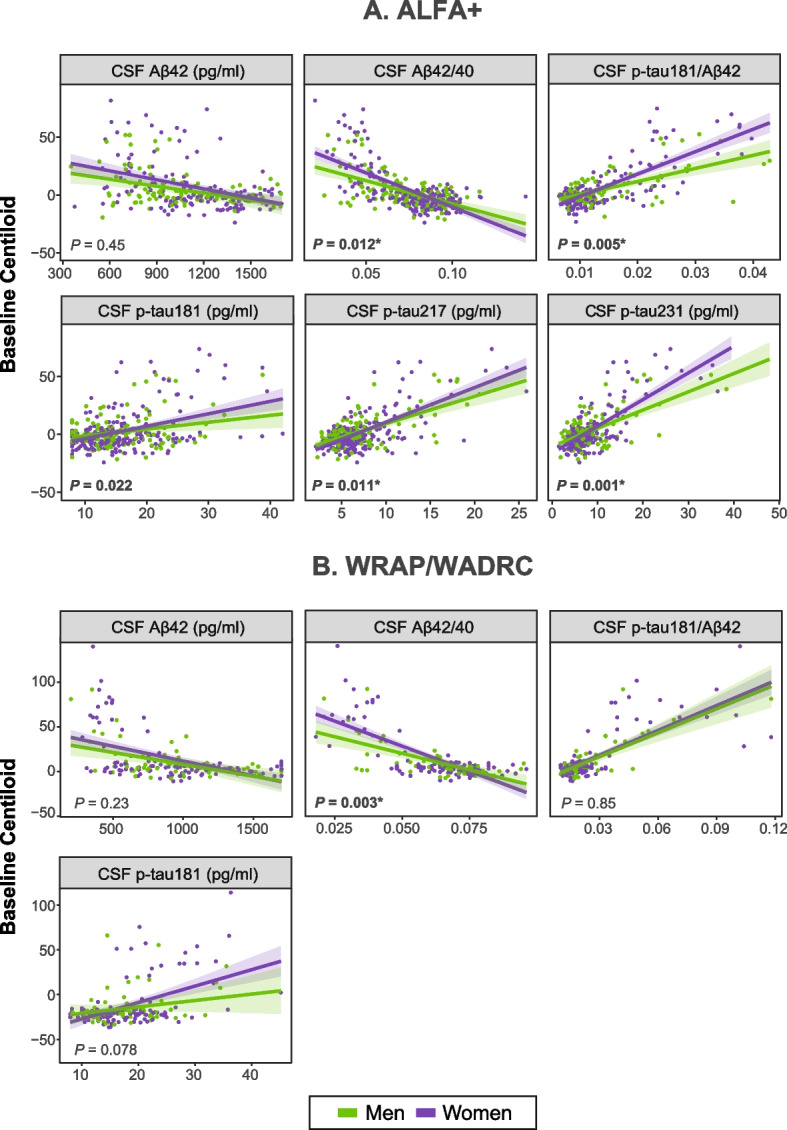
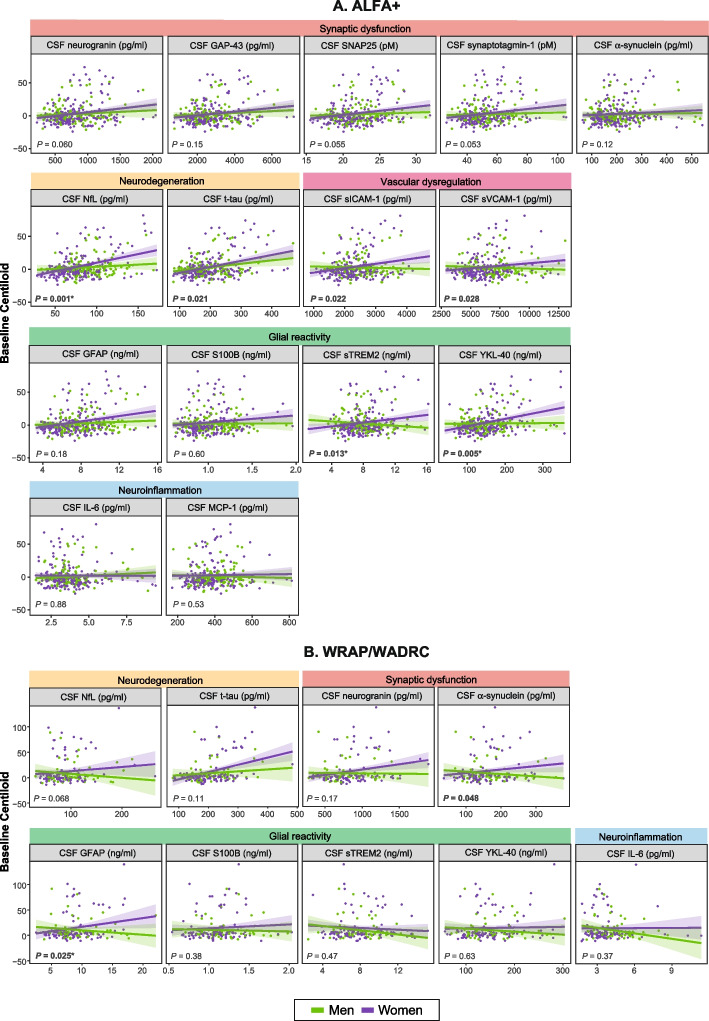
The stronger association of CSF Aβ42/40 with Aβ PET Centiloid values in women compared to men was replicated in the WRAP/WADRC cohort (CSF Aβ42/40 x sex interaction: β= 0.35, P = 0.003), and a non-significant trend in the same direction was found for CSF p-tau181 (CSF p-tau181 x sex interaction: β= −0.28, P = 0.078; Fig. 1, Supplementary Table 2 in the Additional file 1). In this cohort, sex also modified the cross-sectional associations of α-synuclein and GFAP with Aβ PET Centiloid values, these being stronger in women compared to men (CSF α-synuclein x sex interaction: β= −0.32, P = 0.048; and CSF GFAP x sex interaction: β= −0.36, P = 0.025; Fig. 2, Supplementary Table 2 in the Additional file 1). The interactions between sex and CSF Aβ42/40 and GFAP survived multiple comparison correction.
Finally, we tested whether sex modified the associations of baseline CSF biomarkers and longitudinal change in Aβ PET uptake. In ALFA+, a significant modifying effect of sex was found on the association between lower baseline CSF Aβ42/40 and increased Aβ PET uptake at follow-up (CSF Aβ42/40 x sex interaction: β=0.15, P = 0.008). Similarly, sex significantly modified the associations between higher baseline CSF p-tau181/Aβ42, p-tau217, p-tau231, and NfL with increased Aβ PET uptake at follow-up (CSF p-tau181/Aβ42 x sex interaction: β= −0.26, P = 0.006; CSF p-tau217 x sex interaction: β= −0.13, P = 0.033; CSF p-tau231 x sex interaction: β= −0.13, P = 0.035; and CSF NfL x sex interaction: β= −0.16 P = 0.031). Sex-stratified analyses showed stronger associations of all these biomarkers with longitudinal Aβ PET among women. However, the interaction analyses results did not survive multiple comparisons correction (Supplementary Figs. 1 and 2 in the Additional file 1; Supplementary Tables 4 and 5 in the Additional file 1).
In the WRAP/WADRC cohort we did not find any significant modifying effect of sex in the associations between baseline CSF biomarkers and longitudinal change in Aβ PET Centiloid values (Supplementary Figs. andin the Additional file 1; Supplementary Tables 4 and 5 in the Additional file 1). 1 2
For both ALFA+ and WRAP/WADRC, sensitivity analyses restricted to baseline Centiloid values below 30 yielded results similar to those observed in the full cohort (Supplementary Table 6 in the Additional file 1).

Scatter plots showing the associations between baseline core AD CSF biomarkers and Aβ PET Centiloid values, stratified by sex. Each point represents an individual's CSF biomarker value. Nominal-values refer to the interaction term between sex and each CSF biomarker, adjusted for age andε4 status. Significant-values are highlighted in bold.-values marked with an asterisk (*) remain significant after false discovery rate (FDR) correction for multiple comparisons P APOE- P P

Scatter plots showing the associations between baseline non-AD-specific CSF biomarkers and Aβ PET Centiloid values, stratified by sex. Each point represents an individual's CSF biomarker value. Nominal-values refer to the interaction term between sex and each CSF biomarker, adjusted for age andε4 status. Significant-values are highlighted in bold.-values marked with an asterisk (*) remain significant after false discovery rate (FDR) correction for multiple comparisons P APOE- P P
Discussion
In this study, we investigated sex differences in multiple AD-related CSF biomarkers, their performance at identifying Aβ PET positivity, and their association with Aβ pathology measured by PET in two well characterized cohorts of CU individuals. Our main findings are: 1) In both cohorts, we observed that the synaptic biomarker CSF neurogranin is higher in women, while the neurodegeneration marker CSF NfL and astrocytic markers CSF GFAP and S100B are increased in men; 2) The discrimination accuracy of core AD CSF biomarkers to identify CU Aβ PET-positive participants did not differ by sex; 3) Higher baseline levels of several CSF biomarkers, including core AD biomarkers, NfL and glial biomarkers, showed a stronger association with higher Aβ PET uptake in women than in men.
In line with previous studies [13 –16], we did not find sex differences in CSF Aβ42/40 ratio in either of the two cohorts included in this study. Although men had lower levels of CSF Aβ42 in ALFA+, this difference was not significant after accounting for APOE-ε4, suggesting that it was probably explained by the higher frequency of APOE-ε4 carriership in men than in women in this cohort. Importantly, CSF Aβ42/40, in contrast to CSF Aβ42, partly accounts for interindividual differences in Aβ production and is a more accurate biomarker of Aβ pathology [58]. Based on previous evidence supporting a higher vulnerability to tau pathology in women [14, 15, 18 –21], we hypothesized that tau CSF biomarkers would be elevated in women. In our study, only the sex difference in p-tau217, available in ALFA+, reached statistical significance. This result is in line with women showing a higher degree of downstream tau pathology already in preclinical AD, which would possibly become more evident in subsequent disease stages. However, it is important to note that p-tau levels in biofluids rise earlier than tau deposition detected by Tau PET imaging. As such, they are more closely associated with biomarkers of Aβ pathology and, accordingly to the new Alzheimer' Association criteria [59], are classified as phosphorylated and secreted AD tau (T1) biomarkers. This may help explain the lack of robust sex differences in CSF p-tau levels observed in our study [60 –63]. Of note, age at menopause or hormone therapy use have been suggested as modifying factors for increased tau vulnerability [64]. Interestingly, testosterone levels have also been found to influence tau levels [65]. Both ALFA+ and WRAP/WADRC cohort are comprised of mostly postmenopausal women with low frequency of hormone therapy use, but future studies should examine the potential modifying role of hormonal exposure on CSF tau biomarkers.
Besides the core AD CSF biomarkers, our study provides evidence of sex differences in several CSF biomarkers reflecting Aβ-downstream processes. The sex difference in the neurodegeneration biomarker CSF NfL was robustly found in both cohorts and it is aligned with previous studies [4, 23 –28]. It would be plausible to suggest that this difference is indicating a higher degree of neurodegeneration in men. However, other potential explanations could be physiological differences such as a higher axonal turnover or the higher proportion of brain white matter in men [66]. Men also showed elevated biomarkers of astrocyte reactivity (i.e. CSF GFAP and S100B) in both cohorts. Vascular dysregulation biomarkers CSF sICAM-1 and sVCAM-1 were available in ALFA+ and were also elevated in men. Higher levels of these biomarkers in men have been reported [16, 34, 35], although here we determined these differences specifically in CU participants. Other inflammatory markers such as CSF IL-6 or MCP-1 had been found elevated in men [35]. In WRAP/WADRC cohort, CSF IL-6 was significantly increased in men, and in ALFA+ a trend towards the same direction was observed for both CSF IL-6 and MCP-1. These results support a higher degree of neuroinflammation and vascular pathology in men than in women, even despite the fact both ALFA+ and WRAP/WADRC cohorts include participants with an overall low vascular risk and low frequency of comorbidities. Further studies are needed to determine whether the observed sex differences in the inflammatory profile persist in older ages or more advanced disease stages and whether they influence disease progression. Higher CSF neurogranin in women was a robust finding in both cohorts, and it is in line with previous literature [26, 27, 29, 30]. In ALFA+, we had measures for additional synaptic biomarkers, namely CSF SNAP25, GAP-43 and synaptotagmin-1, all of them presynaptic proteins. Of those, CSF synaptotagmin-1 was significantly higher in women with respect to men. We had previously reported that these synaptic proteins increase in preclinical AD, and are differentially associated with age or APOE-ε4 status [67]. Although we adjusted by these factors in our models, they could still be confounding the effects of sex to some extent.
Overall, we showed that women tend to have higher levels of CSF synaptic biomarkers, while men exhibit higher levels of CSF biomarkers associated with neurodegeneration, astrocyte reactivity, and vascular pathology. Importantly, most of the results were replicated in both cohorts and all observed sex differences, except for CSF Aβ42 in ALFA+, were maintained after adjustment for age and APOE-ε4 status. This fact, along with the lack of significant interactions with CSF Aβ status, suggests sex differences in the levels of CSF biomarkers reflecting AD-related processes are, at least partly, independent from the degree of Aβ pathology.
A novelty of our study is that we specifically evaluated whether the capacity of core AD CSF biomarkers to detect Aβ PET positivity in CU individuals differed by sex. Importantly, our results indicate that, despite the differences in some CSF biomarker levels between sexes, there are no significant effects of sex in their discrimination performance. This is a relevant finding given the current use of these core CSF biomarkers in AD prevention trials, as it implies that there is no need to tailor the use of this biomarkers for the identification of CU individuals with detectable Aβ accumulation in the brain and therefore, with preclinical AD.
When we examined the modifying role of sex in the association between CSF biomarkers and Aβ pathology in the brain as measured by PET, in ALFA+ we found that several CSF biomarkers (Aβ42/40, tau, NfL, glial biomarkers and a trend for synaptic biomarkers) had a greater association with higher Centiloid values in women than in men at baseline. Importantly, the sex effect on CSF Aβ42/40 was replicated in the WRAP/WADRC cohort. These findings suggest these biomarkers to be more indicative of Aβ pathology in the brain in women. As previous research has shown that women exhibit a higher pathological burden and faster disease progression during symptomatic stages [9, 10], it remains to be elucidated whether our findings reflect sex differences in the performance of biomarkers to accurately capture Aβ accumulation or, alternatively, they indicate a higher progression rate in CU women compared to men when initial pathophysiological changes are present. In addition, the stronger associations observed between glial biomarkers and Centiloid values in women compared to men (sTREM2, YKL-40 in ALFA+ and GFAP in WRAP/ADRC), further support a sex-specific glial response to AD pathology, in line with previous studies [38, 39]. Of note, although stratified analyses show stronger associations in women, the results of interactions between sex and CSF biomarkers on longitudinal change in Centiloid values did not reach significance after multiple comparison correction in ALFA+ and were not replicated in the WRAP/WADRC cohort. Further longitudinal studies with larger sample sizes and a longer follow-up period are warranted.
The results of this study have multiple implications on the accurate use of AD CSF biomarkers. First, they indicate that sex does not impact the use of core AD CSF biomarkers to identify Aβ PET-positive CU participants for preventive clinical trials. Second, if confirmed in further longitudinal studies, the stronger association of AD CSF biomarkers with Aβ burden measured by PET in women suggests that these biomarkers may be more effective in monitoring changes in Aβ deposition or treatment response to anti-Aβ therapies in women. Third, the knowledge of sex differences in the levels of CSF biomarkers for downstream processes contributes to our understanding of disease pathogenesis and can aid in the development of personalized treatment strategies, where the use of treatments targeting synaptic dysfunction might be more efficacious for women, while those targeting neurodegeneration and glial reactivity might be more efficacious for men.
Strenghts and limitations
A key strength of our study is the inclusion of two similar and well-characterized cohorts with CSF biomarkers measured using the same analytical platforms, enhancing their comparability and the reliability of our findings. We examined core AD CSF biomarkers along with a wide range of CSF biomarkers reflecting Aβ-downstream processes, allowing for a comprehensive analysis of sex differences in different AD-related pathways. Different from other studies using sex as a covariate, herein we focused on the effect of sex and performed sex-stratified and interaction analyses. Nevertheless, our study has several limitations. The frequency of APOE-ε4 was higher in ALFA+ compared to WRAP/WADRC, and in ALFA+ the frequency of APOE-ε4 carriers was higher in men than in women. Yet, we adjusted all models by APOE-ε4 genotype and most results were replicated despite these differences. Also, some CSF biomarkers were only available in ALFA+, so we could not replicate the results on those. Moreover, the higher number of women than men enrolled in both cohorts may have limited the statistical power to detect significant effects in men. Finally, the study results could be influenced by factors that are beyond the scope of this study, such as menopause status, hormonal exposure, genetics, or differences in blood brain barrier permeability between men and women [28, 68]. Further research is warranted to evaluate their potential effects on biomarker levels and performance. Amid the recent development of blood biomarkers for AD, similar studies should be performed exploring their sex differences.
Conclusions
Our study showed that, in two cohorts of CU individuals, there were no differences in the diagnostic accuracy of core AD CSF biomarkers. However, there were significant differences in the levels of CSF biomarkers reflecting Aβ-downstream processes, as well as how they were associated with disease pathophysiology as indicated by Aβ PET uptake. These findings highlight the importance of considering sex differences when using CSF biomarkers in preclinical AD.
Supplementary Information
Additional file 1.