
What this is
- This research investigates the role of ion channels in muscle satellite cells () and their impact on skeletal muscle remodelling.
- are crucial for muscle regeneration and hypertrophy, but the mechanisms behind their activation remain unclear.
- The study uses a MuSC-specific conditional knockout mouse model to demonstrate that is essential for MuSC function and muscle remodelling.
Essence
- channels are critical for muscle satellite cell function, influencing muscle regeneration and hypertrophy. deficiency impairs MuSC activation and proliferation, leading to reduced muscle remodelling.
Key takeaways
- deletion in significantly reduces Pax7 expression and impairs proliferation. This indicates that is a key regulator of early MuSC function.
- MuSC-specific knockout mice show drastically impaired muscle regeneration after injury, with a notable decrease in Pax7-positive . This underscores 's role in muscle repair.
- Mechanical loading does not induce hypertrophy in -deficient , suggesting that is necessary for muscle adaptation to mechanical stress.
Caveats
- deletion does not affect MuSC maintenance or muscle morphology under normal conditions, indicating its specific role in stress responses rather than general MuSC function.
- The study does not fully elucidate the downstream signaling pathways activated by , which may limit understanding of its mechanistic role in muscle remodelling.
Definitions
- MuSCs: Muscle satellite cells that are essential for muscle regeneration and hypertrophy.
- TRPV2: A transient receptor potential vanilloid 2 ion channel that responds to mechanical and chemical stimuli.
Simplified
Introduction
Skeletal muscles maintain homoeostasis by adapting their form and function in response to external stress [1, 2]. This plasticity is supported by mature myofibres and their associated resident muscle stem cells (MuSCs) [3 –6]. In adult skeletal muscle, MuSCs remain mitotically quiescent under resting conditions but become activated in response to muscle injury or exercise-induced mechanical loading. Upon activation, MuSCs provide essential myoblasts for muscle remodelling, including hypertrophy and regeneration [7, 8]. However, the mechanisms by which MuSCs detect and respond to muscle damage or stress remain unclear.
Ca2+ is a ubiquitous intracellular signal that regulates diverse cellular processes [9]. In skeletal muscle, Ca2+ signalling governs myogenesis, growth, regeneration, and the maintenance of contraction and plasticity [4]. Excitation–contraction coupling in muscle depends on intracellular Ca2+ dynamics mediated by interactions between ryanodine receptors and L-type voltage-gated Ca2+ channels, also known as dihydropyridine receptors [10]. The internal Ca2+ storage sensor stromal interaction molecule 1 (STIM1) and the store-operated calcium channel Orai1 regulate Ca2+ flux during muscle differentiation [11, 12]. Inositol trisphosphate (IP3) receptors mediate Ca2+ release during the early stages of muscle differentiation, whereas ryanodine receptors play a greater role as the sarcoplasmic reticulum matures [4]. Elucidation of Ca2+ signalling in MuSCs is needed to understand the processes that underlie muscle formation, growth, and regeneration.
Physical and chemical stimuli activate MuSCs and induce their proliferation. IGF-1 facilitates MuSC proliferation and promotes muscle growth via IP3 receptors and ryanodine receptors [4]. Additionally, physical stress triggers an extracellular Ca2+ response that enhances MuSC proliferation, suggesting the involvement of mechanosensor-mediated mechanotransduction pathways [13]. A recent study demonstrated delayed muscle regeneration in mice lacking the mechanosensitive channel Piezo1, indicating that Piezo1 regulates MuSC function [14].
In addition to Piezo1, members of the transient receptor potential (TRP) family of cation channels, which are candidate mechanosensors, are expressed in MuSCs [15]. However, whether TRP canonical family type 1 (TRPC1), which promotes MyoD expression through elevated intracellular Ca2+, exhibits mechanosensitivity remains controversial [16]. Previously, we reported that recombinant TRP vanilloid family type 2 (TRPV2) channels can be activated by hypotonicity- or stretch-induced mechanical loading in ectopic expression systems [17]. In skeletal muscle, TRPV2 is strongly localised at the sarcolemma of dystrophin-deficient mdx mice and δ-sarcoglycan-deficient BIO14.6 hamsters [18]. Although animal models expressing dominant-negative TRPV2 demonstrated amelioration of pathological features [19], the roles of TRPV2 in MuSC activation, proliferation, and fusion are unknown.
In this study, we generated MuSC-specific TRPV2 conditional knockout (cKO) mice to investigate the physiological function of TRPV2 in MuSCs. TRPV2-deficient MuSCs have reduced expression of Pax7 and impaired proliferation, suggesting that TRPV2 regulates an early stage of MuSCs function. Myotube formation in MuSCs was dependent on the expression level of TRPV2, suggesting that TRPV2 contributes to the promotion of myogenesis. MuSC-specific TRPV2 cKO mice also showed significantly attenuated muscle regeneration after cardiotoxin-induced injury and a reduced hypertrophic response to mechanical loading. Additionally, TRPV2 in MuSCs was essential for Ca2+ responses induced by mechanical loading. These findings indicate that TRPV2 in MuSCs is crucial for skeletal muscle remodelling.
Results
TRPV2 is expressed in mature muscle fibres and MuSCs

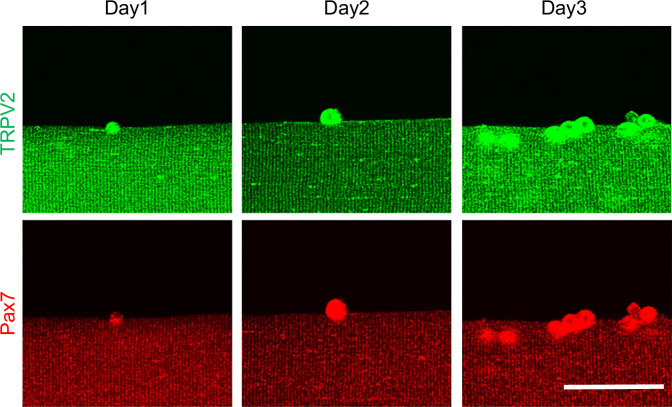
Expression of TRPV2 in cultured myofibres. Representative immunofluorescence staining of TRPV2 (green) and Pax7 (red) in cultured myofibres from floxed mice. Scale bar, 50 µm.
Generation of MuSC-specificcKO mice TRPV2
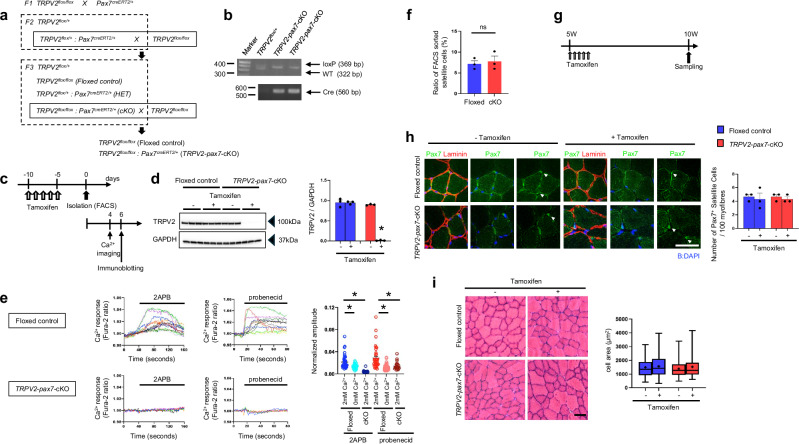
The number of fleshly isolated MuSCs by fluorescence-activated cell sorting (FACS) does not differ between the tamoxifen-treated Floxed and cKO models (Fig. 2f). To assess the impact of TRPV2 deletion on MuSC maintenance, tamoxifen was administered to 5-week-old mice, and muscles were analysed at adulthood (10 weeks old) (Fig. 2g). The results showed no difference in the number of Pax7-positive cells between floxed-TRPV2 mice and TRPV2-Pax7-cKO mice (Fig. 2h). No tissue damage or abnormalities were observed in TRPV2-deficient muscle, similar to the control group (Fig. 2i). These findings suggest that TRPV2 is not involved in the maintenance of MuSCs.

Generation of muscle satellite cell (MuSC)-specific TRPV2-deficient mice. Crossbreeding strategy for the generation of TRPV2 conditional knockout (cKO) mice. Littermates from generation F3 were used as controls and cKO mice in all experiments.Genotyping PCR of mouse genomic DNA. Upper panel: PCR fragments including theinsertion site within thelocus. The short fragment (322 bp) represents the wild-typegene, whereas the longer fragment (369 bp) corresponds to theinsertion. Lower panel: PCR fragments of therecombinase gene.Timeline for TRPV2-deficiency induction, myofibre isolation, FACS sorting of MuSCs, Caimaging, and sampling.Representative immunoblot of TRPV2 and GAPDH in cultured MuSCs from floxed or cKO mice, with or without tamoxifen treatment.Representative traces of Cafluctuations in MuSCs isolated from floxed (upper panels) or cKO mice (lower panels) in response to 2-aminoethoxydiphenyl borate (2-APB) and probenecid in the presence of 2 mM extracellular Ca( = 18–59 cells from three mice per group).The ratio of FACS-sorted satellite cells from tamoxifen-treated floxed and cKO myofibre.Timeline of TRPV2-deficiency induction and tissue sampling.Representative immunofluorescence images showing Pax7 (green), laminin (red), and 4′,6-diamidino-2-phenylindole (DAPI; blue) in MuSCs of the tibialis anterior (TA) muscle from 10-week-old mice. White arrowheads indicate Pax7MuSCs.Representative haematoxylin and eosin staining and quantification of myofibre cross-sectional area in TA muscle from floxed and cKO mice (lower panels, = 181–204 fibres from three mice per group). Centre line = median; + = mean; box limits = upper and lower quartiles; whiskers = minimum and maximum. Data are presented as mean ± s.e.m. * < 0.05 (Tukey–Kramer test for,). Scale bar, 50 µm. a b c d e f g h i d e loxP TRPV2 TRPV2 loxP Cre n n P 2+ 2+ 2+ +
Impairment of the early stages of myogenic progression in TRPV2-deficient MuSCs

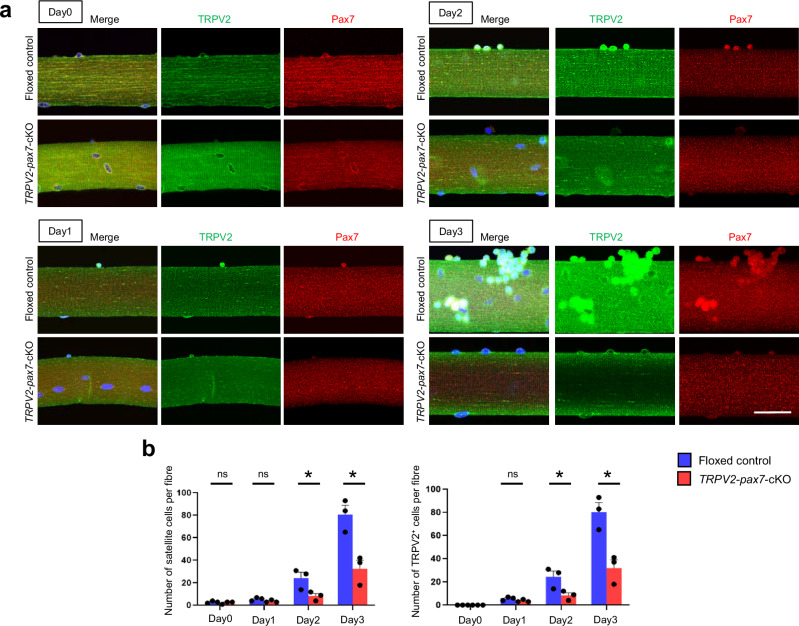
Decreased in Pax7-positive MuSC by TRPV2-deficiency. Representative immunofluorescence staining of TRPV2 (green), Pax7 (red), and DAPI (blue) in MuSCs derived from myofibres isolated from the extensor digitorum longus (EDL) muscle of tamoxifen-treated floxed and cKO mice after 3 days in culture.Quantification of satellite cell numbers (Pax7cells) and TRPV2cells in cultured floxed and TRPV2-deficient MuSCs. Data are presented as mean ± s.e.m. * < 0.05 between the indicated groups (Student's-test). Scale bar, 50 µm. a b + + P t
Decrease in the proliferative capacity of TRPV2-deficient MuSCs

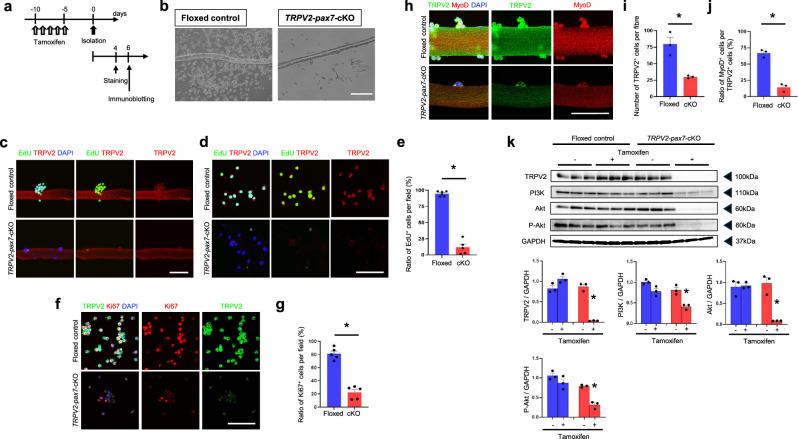
Impaired cell cycle entry in-cKO MuSCs. TRPV2-Pax7 Timeline for TRPV2-deficiency induction, cell isolation, and staining.Representative images of proliferating satellite cells derived from myofibres isolated from the EDL muscle of floxed and TRPV2 cKO mice after 4 days in culture.Representative EdU incorporation assay (green) in MuSCs locatedon myofibres andaround myofibres. TRPV2 (red) and DAPI (blue) staining were performed simultaneously.Representative immunofluorescence staining of EdU (green), TRPV2 (red), and DAPI (blue) in MuSCs derived from myofibres isolated from the EDL muscle of floxed and TRPV2 cKO mice after 4 days in culture.Ratio of EdUcells.Representative immunofluorescence staining of TRPV2 (green), Ki67 (red), and DAPI (blue) in MuSCs derived from myofibres isolated from the EDL muscle of floxed and TRPV2 cKO mice after 4 days in culture.Ratio of Ki67cells.Representative immunofluorescence staining of TRPV2 (green), MyoD (red), and DAPI (blue) in MuSCs derived from myofibres isolated from the EDL muscle of floxed and-cKO mice after 4 days in culture.Quantification of TRPV2cells per fibre.Ratio of MyoDcells among TRPV2cells.Representative immunoblot showing PI3K, Akt, and phosphorylated Akt (P-Akt) expression in cultured MuSCs from floxed and cKO mice, with or without tamoxifen treatment. Data are presented as mean ± s.e.m. * < 0.05 between the indicated groups (Student's-test for,,,). < 0.05 (Tukey–Kramer test for). Scale bar, 100 µm. a b c c d d e f g h i j k e g i j k + + + + + # TRPV2-Pax7 P t P
Impairment of myogenic fusion in TRPV2-deficient MuSCs

TRPV2 expression-dependent fusion of MuSCs. Timeline for TRPV2-deficiency induction, myofibre isolation, medium replacement with differentiation medium, and fixation.Representative immunofluorescence staining of TRPV2 (green), phalloidin (red), and DAPI (blue) in MuSCs derived from myofibres isolated from the EDL muscle of floxed and TRPV2 cKO mice after 4 days in culture.Quantification of the fusion index.Timeline for myofibre isolation, adenoviral infection, medium replacement, and fixation.,Representative immunoblots of TRPV2, PI3K, Akt, P-Akt, and GAPDH expression in MuSCs cultured in differentiation medium after infection with Ad-TRPV2 or Ad-Cre ( = 3 per group, = 3 mice).Representative immunofluorescence staining of TRPV2 (green), phalloidin (red), and DAPI (blue) in MuSCs infected with Ad-TRPV2 or Ad-Cre.Quantification of the number of nuclei per single myotube in MuSCs transfected with Ad-TRPV2 (red) or Ad-Cre (green).Quantification of the fusion index. Data are presented as mean ± s.e.m. * < 0.05 (Student's-test for; Tukey–Kramer test for,). Scale bar, 100 µm. a b c d e f g h i c f i n N P t
Impairment of muscle regeneration after cardiotoxin-induced injury in MuSC-specific TRPV2-deficient mice
To characterise satellite cells located between myofibres, we performed immunocytochemistry using anti-TRPV2, anti-Pax7, anti-MyoD, and anti-Myomaker antibodies (Fig. 6e–h). In floxed-control mice, a large number of TRPV2-positive cells were present within myofibre gaps (Fig. 6e, upper panels). These cells were Pax7-positive (Fig. 6f, upper panels). Additionally, MyoD- and Myomaker-positive cells were observed in floxed-control mice (Fig. 6g, h, upper panels). In contrast, the number of TRPV2-positive cells in myofibre gaps was significantly lower among TRPV2-Pax7-cKO mice (Fig. 6e, lower panels). The number of Pax7-, MyoD-, and Myomaker-positive MuSCs was also substantially reduced in TRPV2-Pax7-cKO mice (Fig. 6f–h, lower panels). These findings indicate that TRPV2 facilitates muscle regeneration by promoting MuSC activation, proliferation, and the early stages of myogenesis in response to cardiotoxin-induced injury.
To quantitatively assess the timing of TRPV2 mRNA expression, we performed real-time polymerase chain reaction (PCR) analysis using cardiotoxin-injected TA muscle isolated from floxed mice (Fig. 6i, original data-4). TRPV2 mRNA was highly expressed from Day 1, whereas MyoD, a marker of myogenic commitment and MuSC activation [6], peaked on Day 3 (Fig. 6i, left and middle panels). Myomaker, a muscle-specific membrane protein essential for myogenesis [25], also peaked on Days 3–5 (Fig. 6i, right panels). This finding supports the idea that TRPV2 in MuSCs regulates the early stages of myogenic progression during the muscle regeneration process in response to cardiotoxin.

Impaired regeneration after cardiotoxin-induced muscle injury in MuSC-specific TRPV2-deficient mice. Timeline for TRPV2-deficiency induction, cardiotoxin injection, and tissue sampling.Representative haematoxylin and eosin staining of TA muscle.Quantification of cross-sectional area from paraffin-embedded TA muscle sections ( = 412–463 cells from three mice per group). Centre line = median; + = mean; box limits = upper and lower quartiles; whiskers = minimum and maximum.Representative immunofluorescence staining of collagen I (green), laminin (red), and DAPI (blue) in TA muscle from floxed and cKO mice. Quantification of collagen I-positive area ( = 4 sections from four TA muscles per group).Representative immunofluorescence staining of TRPV2 (green), Pax7 (green), MyoD (green), or Myomaker (green), together with laminin (red) and DAPI (blue), in TA muscle from floxed and cKO mice. Quantification of TRPV2, Pax7, MyoD, or Myomakercells per field ( = 5 sections from three TA muscles per group).mRNA expression levels of,, andon days 0, 1, 3, 5, 7, and 14 of culture ( = 3 mice per group). Data are presented as mean ± s.e.m. * < 0.05 between the indicated groups (Student's-test for,; Tukey–Kramer test for,). Scale bar, 100 µm. a b c d e–h i f h c i n n n TRPV2 MyoD Myomaker n P t + + + +
Impairment of mechanical load-induced hypertrophy in TRPV2-deficient mice
In cardiomyocytes and smooth muscle cells, TRPV2 facilitates mechanical stimulus-dependent Ca2+ responses [17, 21]. To determine whether TRPV2 expression is upregulated during the early stages of the muscle hypertrophic response, we examined its expression in muscle tissue (Fig. 7a, f). At 5 days postoperatively, floxed-control mice exhibited strong TRPV2 expression in regions of MuSCs within myofibre gaps (Fig. 7f, white arrows). In TRPV2-Pax7-cKO mice, TRPV2 expression was absent within these regions, even under mechanical loading conditions (Fig. 7f, lower panels). Figure 7g shows that cells with high TRPV2 expression in cells attached to myofibre of mechanically loaded floxed-control mice were also Pax7-positive (Fig. 7g, upper panels). However, in TRPV2-Pax7-cKO mice, neither TRPV2- nor Pax7-positive cells were detected in myofibre gaps, even after mechanical loading (Fig. 7g, lower panels). Furthermore, in mechanically loaded myofibres of floxed-control mice, Pax7-positive cells were localised within MuSC regions inside the basement membrane (Fig. 7h). These findings suggest that TRPV2 promotes Pax7 expression in MuSCs in response to mechanical loading.

Impaired hypertrophic response in MuSC-specific TRPV2-deficient mice. Timeline for TRPV2-deficiency induction, surgical intervention, and tissue sampling.Representative haematoxylin and eosin staining of plantaris (PLT) muscle.Quantification of cross-sectional area from paraffin-embedded PLT muscle sections ( = 1331–1492 cells from three PLT muscles per group). Centre line = median; + = mean; box limits = upper and lower quartiles; whiskers = minimum and maximum.Representative DAPI staining in isolated myofibres from floxed and cKO PLT muscle.Quantification of the number of nuclei per myofibre.Representative immunofluorescence staining of TRPV2 (green) and DAPI (blue) in PLT muscle from floxed and cKO mice. Arrows indicate TRPV2cells.Representative immunofluorescence staining of TRPV2 (green), Pax7 (red), and DAPI (blue) in PLT muscle from floxed and cKO mice. Arrows indicate double-positive cells.Representative immunofluorescence staining of Pax7 (green), laminin (red), and DAPI (blue) in EDL muscle. Arrowheads indicate Pax7cells. Data are presented as mean ± s.e.m. * < 0.05 vs. vehicle-treated floxed MuSCs (Tukey–Kramer test). Scale bars: 20 µm (), 50 µm (,),100 µm (,). a b c d e f g h b g h d f n P + +
Mechanical stress-dependent Caresponse in MuSCs is TRPV2-dependent 2+

Increase in Pax7-positive MuSCs after AAV-TRPV2 treatment. Timeline for TRPV2-deficiency induction, cell isolation, and Caimaging.,Hypo-osmotic stimulation-induced Caresponse in floxed MuSCs with or without 500 μM tranilast.Hypo-osmotic stimulation-induced Caresponse in TRPV2-deficient MuSCs.Effects of TRPV2 inhibition or TRPV2 elimination ( = 17–35 cells from three mice). Data are presented as mean ± s.e.m. * < 0.05 vs. vehicle-treated floxed MuSCs (Tukey–Kramer test). a b c d e 2+ 2+ 2+ n P
Discussion
The morphological and functional remodelling of skeletal muscle in response to physical activity, ageing, and injury repair is supported by mature multinucleated myofibres and MuSCs residing around the myofibres [1, 2, 5, 6]. Although extensive research elucidated many molecular mechanisms governing the proliferation and activation of mitotically quiescent MuSCs during muscle remodelling [1, 2, 5, 6], the trigger mechanisms that induce MuSC activation remain unclear. This study revealed that TRPV2 in MuSCs is crucial for muscle remodelling, including muscle regeneration and mechanical loading-induced hypertrophy. In cultured MuSCs proliferating at the periphery of isolated myofibres, TRPV2 was expressed in Pax7-positive cells, and these cells displayed a TRPV2-dependent Ca2+ response. TRPV2-deficient MuSCs exhibited a substantial reduction in proliferative capacity, a lower number of Pax7-positive cells, and impaired myogenic fusion. MuSC-specific TRPV2-deficient mice demonstrated significantly impaired regeneration after cardiotoxin-induced muscle injury and reduced hypertrophic responses to mechanical loading. Furthermore, MuSCs showed a TRPV2-dependent Ca2+ response to mechanical stress. These findings indicate that TRPV2 in MuSCs is essential for promoting the early stage of MuSC function during muscle remodelling. TRPV2 is expressed in both mature myofibres and mitotic MuSCs (Figs. 1 and 3). In the present study, TRPV2 deletion in adult mouse MuSCs did not affect muscle tissue morphology (Fig. 2i) or mouse behaviour, suggesting that MuSC-expressed TRPV2 has a minimal role in muscle function under physiological conditions. In addition, the number of MuSCs sorted by FACS is at the same level in tamoxifen-treated flox and TRPV2-Pax7-cKO mice (Fig. 2f), indicating that TRPV2 does not contribute to the maintenance of MuSC numbers. These results are consistent with the observation that the number of Pax7-positive MuSCs in adult muscle (10 weeks old) treated with tamoxifen at the juvenile stage (5 weeks old) did not differ between the control and TRPV2-Pax7-cKO groups (Fig. 2g, h). Furthermore, TRPV2 expression was barely detectable in MuSCs in both groups (Supplementary Fig. S1). However, TRPV2 was strongly expressed in a subset of skeletal muscle cells undergoing fusion in postnatal Day 1 mice (Supplementary Fig. S2). Here, our study showed that TRPV2 in MuSCs is crucial for the early stage of myogenic progression. Tranilast-mediated inhibition of TRPV2 activity also suppressed muscle fusion (Supplementary Fig. S3). The elimination of TRPV2 during embryonic and early postnatal myogenesis may substantially impact muscle physiology by disrupting myogenesis and skeletal muscle differentiation. Systemic knockout mice lacking the functional domain of TRPV2 exhibit perinatal lethality, such that ~2.5% of offspring survive on a C57BL/6 background [26]. This outcome may partly reflect defects in myogenic progression. On a BL6129SF2/J background, the survival rate increases to ~15%, and no significant abnormalities in reproduction or external appearance are observed, other than a slight reduction in body weight [26]. These observations suggest the presence of compensatory mechanisms that mitigate the phenotypic effects of TRPV2 deficiency. Additional studies of TRPV2-deficient mice that strictly control targeted cells for depletion and timing are required to elucidate the roles of TRPV2 in skeletal muscle cell development, differentiation, muscle physiology, and pathology.
TRPV2 deletion in MuSCs significantly impaired both cardiotoxin-induced muscle regeneration and mechanical loading-induced hypertrophy (Figs. 6 and 7). The extent of myofibre damage differs between these models, and the niche environments for MuSCs are distinct [6]. Therefore, the mechanisms triggering activation of mitotically quiescent MuSCs likely differ between these models. In regenerating muscle, the loss of components of the MuSC niche, including myofibres, may partially contribute to quiescent MuSC activation [27, 28]. In contrast, the MuSC niche is preserved in overloaded muscle [29]. The activation and proliferation of MuSCs in this context would require either an increase in factors promoting MuSC function through myofibre-dependent mechanotransduction or the direct sensing of mechanical forces by MuSCs themselves. A novel aspect of this study is the finding that MuSCs directly sense mechanical stress, in a TRPV2-dependent manner (Fig. 8). Our experiments showed that skeletal muscle from MuSC-specific TRPV2 cKO mice exhibited a substantially reduced number of pax7-positive cells and proliferation of MuSCs in both cardiotoxin-induced muscle regeneration and mechanical loading-induced hypertrophy models (Figs. 6 and 7). A similar decrease in proliferation was observed in isolated myofibre cultures lacking direct contact with the basement membrane, where pax7-positive cells were greatly reduced (Figs. 3 and 4). These findings suggest that TRPV2 plays a central role in the early stage of MuSC function for myogenesis and proliferation, independent of myofibre integrity or niche status. In future studies, the role of TRPV2 in MuSC proliferation and fusion during muscle remodelling could be examined in greater detail by isolating and culturing MuSCs from damaged and hypertrophic muscle fibres via FACS. In this study, DAPI-positive cells lacking Pax7 expression were observed on Day 3 in the control EDL culture (Fig. 3a). To characterise these cells, double staining with anti-Pax7 and anti-MyoD antibodies revealed the presence of Pax7−/MyoD+ cells on Day 3, although they were absent on Day 2 (Supplementary Fig. S4). Thus, the number of MuSCs on fibres is considerably reduced after TRPV2 deletion. A small number of Pax7−/MyoD− cells were also detected; we aim to elucidate their identity in future studies.
Hepatocyte growth factor, basic fibroblast growth factor, and insulin-like growth factor-1 (IGF-1) are potential regulators of MuSC proliferation during muscle regeneration [30 –33]. IGF-1 promotes the translocation of TRPV2 to the plasma membrane [18, 34] and enhances its activity [34]. Because the MuSC-specific TRPV2-deficient mice used in this study retain intact myofibres, the levels of IGF-1 derived from damaged myofibres and the surrounding niche environment should be comparable to those in controls. TRPV2 elimination reportedly downregulates the IGF-1 receptor/phosphoinositide 3-kinase pathway in cardiomyocytes [21]. In this context, the impaired muscle regeneration we observed in TRPV2-deficient MuSCs may result from downregulation of IGF-1 receptor signalling in MuSCs. It is also possible that MuSCs regulate IGF-1 production in an autocrine manner, depending on muscle conditions. For example, in cardiomyocytes and ventricular fibroblasts, IGF-1 is secreted extracellularly in response to mechanical stimuli [35, 36]. We previously showed that the IGF-1 secretion of cardiomyocytes depends on TRPV2 [21]. Even during muscle regeneration not directly triggered by mechanical stress, the physical environment surrounding MuSCs is likely to be dynamically altered by myofibre degradation [37]. Although the specific source of IGF-1 during muscle regeneration remains unclear, TRPV2 elimination in MuSCs may lead to the impairment of the regeneration process mediated by IGF-1.
Serum response factor-dependent interleukin-6 paracrine signalling within myofibres activates MuSCs, leading to muscle hypertrophy [38]. Silent mating type information regulation 2 homologue 1 (Sirt1)-dependent humoral factors in myofibres may function as MuSC growth factors [39]. However, the mechanosensor molecules that activate serum response factor or Sirt1 in myofibres remain unknown. In the MuSC-specific TRPV2 cKO model used in this study, the production and secretion of interleukin-6 or Sirt1-dependent factors are expected to be similar to levels in control mice because myofibres remain intact. Thus, the absence of a mechanical load-dependent hypertrophic response in TRPV2-deficient MuSCs may result from a failure of MuSCs to respond to myofibre stimulation. Alternatively, mechanotransduction in MuSCs may play a pivotal role in the mechanical load-dependent hypertrophic response via TRPV2. These findings suggest that TRPV2 has a crucial function in regulating the myogenic function of MuSC in response to mechanical loading.
In this study, we showed that TRPV2 is involved in the Ca2+ response of MuSCs to mechanical stimulation. However, we cannot conclude that TRPV2 directly induces Pax7 expression because no data currently support its role as a primary transducer of mechanotransduction in vivo. Nonetheless, TRPV2 was expressed in Pax7-positive MuSCs under continuous mechanical loading (Fig. 7f–h). When mechanical loading induces TRPV2 expression in MuSCs, the PI3K/Akt pathway may be activated downstream of TRPV2-mediated Ca2+ signalling (Figs. 4k and 5e), promoting cell proliferation and contributing to muscle hypertrophy through enhanced MuSC fusion. Thus, TRPV2 may act as an amplifier of the muscle hypertrophy pathway triggered by mechanical loading.
Matrix elasticity reportedly directs stem cell lineage specification, as described by Engler et al. [40]. There is evidence that both biochemical and physical properties of the microenvironment play key roles in cell fate determination [41 –43]. However, the molecular identity of mechanosensors in MuSCs remains unclear. Piezo1 channels exert stage-dependent functions in myogenesis and promote MuSC function during muscle regeneration [14]. Additionally, experiments with C2C12 cells showed that PIEZO1-mediated Ca2+ influx activates RhoA/ROCK-mediated actomyosin assembly at the lateral cortex of myotubes [44]. Among the TRPV family members, TRPV2 and TRPV4 reportedly respond to hypotonic cell swelling, shear stress, and membrane stretching [15]. TRPV2 is expressed in human cancer stem cells [45 –47] and progenitor cells [48]; its overexpression is reported to suppress stemness [49]. Conversely, TRPV2 elimination substantially upregulates cancer stem cell markers while enhancing spheroid and hepatoma colony formation in human hepatoma HEpG2 cells [47]. These experimental results are consistent with our findings that TRPV2 promotes MuSC function and is essential for muscle remodelling in vivo. Considering that TRPV2 functions as a polymodal mechanosensor responding to both chemical and physical stimuli, it may interact with the dynamic microenvironment at various stages of MuSC function to integrate multiple biological signals. Further studies are warranted to identify specific stages at which TRPV2 interacts with other regulatory molecules.
Multiple mechanosensitive ion channels may play critical roles in the activation, proliferation, and differentiation of MuSCs [4, 14]. It is possible that these channels provide functional compensation in the absence of TRPV2. However, in our study, MuSCs lacking TRPV2 failed to exhibit a Ca2+ response to mechanical stimuli (Fig. 8d, e). This observation suggests that other channels are unlikely to compensate for the loss of TRPV2 in mediating mechanosensitive Ca2+ responses in TRPV2-Pax7-cKO MuSCs. Recently, the TRPM7 channel, a candidate mechanosensitive ion channel, has been reported to mediate Mg2+ influx that promotes MuSC activation [50]. Efforts to clarify the distinct roles of various mechanosensitive ion channels in MuSC activation, proliferation, and differentiation, as well as their potential functional interactions, remain important for future studies.
This study suggests that the number of Pax7-positive cells in muscle remodelling may be regulated by TRPV2. An increased number of Pax7-positive cells has also been observed in the muscle of patients with Duchenne muscular dystrophy and dystrophin-deficient mdx mice [51, 52]. However, functional defects in dystrophic satellite cells impair asymmetric cell division and myogenic commitment, leading to reduced muscle regeneration in Duchenne muscular dystrophy patients [53]. Because TRPV2 expression may be upregulated in MuSCs of mdx mice as a compensatory mechanism for functional deficits, further studies are necessary to elucidate the mechanisms that underlie TRPV2 upregulation in dystrophic muscle.
This study demonstrated that TRPV2 is essential for MuSC function in muscle remodelling and offered a therapeutic strategy targeting TRPV2 in MuSCs. Although the physiological role of TRPV2 in myogenesis and mature myofibres remains unclear, further functional analyses will clarify its potential as a therapeutic target in muscle pathology.
Materials and methods
Animals
The generation of TRPV2flox/flox;Pax7CreERT2/ (floxed-TRPV2) mice was previously described in detail [22]. To produce TRPV2flox/flox;PaxCreERT2/+ mice, we crossed mice carrying a TRPV2flox/flox allele with transgenic mice expressing tamoxifen-inducible MuSC-specific Cre recombinase (Pax7CreERT2/+ mice) [23, 24]. To induce Cre-mediated recombination, 10-week-old TRPV2-Pax7-cKO and floxed-TRPV2 male mice received intraperitoneal injections of tamoxifen (8 mg/kg; Sigma) once daily for 5 consecutive days. Littermates were used to randomise genetic variation. To examine muscle regeneration, cardiotoxin (50 μL of 10 μM) was injected into the TA muscle, and samples were collected after 7 days.
Synergist ablation surgery
Male mice (10 weeks old) were anaesthetised with a combination of 0.3 mg/kg medetomidine (Zenoaq), 4.0 mg/kg midazolam (Sandoz), and 5.0 mg/kg butorphanol (Meiji Seika Pharma). Mechanical overload of the plantaris muscle was induced by bilateral surgical ablation of the tendons of the gastrocnemius and soleus muscles. After a midline incision had been made in the skin of the hindlimb, the distal tendons of the gastrocnemius and soleus muscles were severed. The incision was then closed using a 7-0 silk suture (Matsuda Ika Kogyo). In the sham-operated group, identical skin incisions were made, but the tendons remained intact.
MuSC isolation via fluorescence-activated cell sorting
Mononuclear cells from uninjured limb muscles were isolated using 0.2% collagenase type II (Worthington Biochemical Corporation), as previously described [54]. These cells were then stained with fluorescein isothiocyanate-conjugated anti-CD31 (BD Pharmingen, 558738, 1:400), anti-CD45 (Ptprc; eBioscience, 11-0451-82, 1:800), and phycoerythrin-conjugated anti-Sca-1 (Ly6a) (BD Pharmingen, 553336, 1:400) antibodies, along with a biotinylated SM/C-2.6 antibody [55], in accordance with an established protocol [56]. Subsequently, cells were incubated with streptavidin-labelled allophycocyanin (BD Biosciences) on ice for 30 min and re-suspended in phosphate-buffered saline containing 2% foetal calf serum and 2 µg/ml propidium iodide. Cell sorting was performed using a FACS Aria II flow cytometer (BD Immunocytometry Systems). Debris and dead cells were excluded based on forward scatter, side scatter, and propidium iodide gating. Data were acquired using FACSDiva software (BD Biosciences).
Real-time PCR analysis
Total RNA was extracted from TA muscles using TRIzol LS and a QIAGEN RNeasy Micro Kit (QIAGEN), in accordance with the manufacturer's instructions. cDNA synthesis was performed using a QuantiTect Reverse Transcription Kit (QIAGEN), as previously described [57].
Single myofibre isolation and culture
Single myofibres were isolated from EDL muscles using an established protocol [30, 58]. The isolated myofibres were incubated in DMEM containing 0.5% collagenase type I (Worthington Biochemical Corporation) at 37 °C for 1 h. Myofibres were then mechanically separated from the muscle by gentle flushing and cultured in GlutaMAX™ (Gibco) supplemented with 30% foetal bovine serum, 1% chicken embryo extract (Life Sciences), 10 ng/mL basic fibroblast growth factor (ORIENTAL YEAST CO., Ltd.), and 1% penicillin–streptomycin (Fujifilm Wako Pure Chemical Corporation). To induce myogenic fusion, the culture medium was replaced on Day 5 with GlutaMAX™ containing 5% horse serum and 1% chicken embryo extract; cells were incubated for an additional 3 days at 37 °C. Adeno virus (Ad) vector encoding mouse TRPV2 under the CMV promoter was constructed by Vector Builder (Yokohama, Kanagawa, JAPAN). Ad vector encoding Cre-recombinase under the CMV promoter was purchased from SignaGen Laboratories (Frederick, MD, USA). Ad-TRPV2 (6.79 × 10⁸ IFU/ml), Ad-Cre (1 × 10⁶ IFU/ml), or 100 μM tranilast was added at the time of medium replacement. To obtain sufficient cell numbers for protein expression analysis, cells cultured for 6 days were subjected to immunoblotting. Because Ca2+ imaging experiments involve fluid exchange, proper cell adhesion to the culture dish was required; thus, cells cultured for 4 days were used for Ca2+ imaging.
Measurement of intracellular Cain MuSCs 2+
Changes in intracellular Ca2+ were assessed in cultured MuSCs loaded with 2 µM fura-2 acetoxymethyl ester (fura-2) for 30 min at 37 °C. Cells were maintained in standard Tyrode's solution under continuous flow using a microperfusion system, as previously described [59]. Fura-2-loaded cells were alternately excited at 340 and 380 nm using a Lambda DG-4 Ultra High-Speed Wavelength Switcher (Sutter Instruments) coupled to an inverted IX71 microscope equipped with a UApo ×20/0.75 objective lens (Olympus). Fura-2 fluorescence signals were recorded using an ORCA-Flash 2.8 camera (Hamamatsu Photonics) and analysed by ratiometric fluorescence imaging using MetaFluor software (version 7.7.5.0; Molecular Devices).
Antibodies
The following antibodies were used for immunostaining and immunoblotting analyses: anti-TRPV2 (Sigma; HPA044993, 1:1000 dilution), anti-Pax7 (Abcam; ab34360, 1:1000 dilution), anti-glyceraldehyde-3-phosphate dehydrogenase (GAPDH; Abcam; EPR16891, 1:1000 dilution), anti-laminin (Abcam; ab11576, 1:1000 dilution), Akt (Cell Signaling Technology; 9272, 1:1000 dilution), P-Akt (Cell Signaling Technology; 4060, 1:1000 dilution), PI3K (Cell Signaling Technology; 4249, 1:1000 dilution), myoD (DSHB; D7F2-c, 1:1000 dilution), and anti-Ki67 (Proteintech; 28074-1-AP, 1:600 dilution). Immunoreactive bands were detected using an enhanced chemiluminescence detection system (Amersham Biosciences Corp.) and a Luminescent Image Analyzer (LAS3000; Fujifilm).
Histological analysis
Skeletal muscles were excised, immediately fixed with buffered 4% paraformaldehyde, embedded in paraffin, and sectioned at 4 µm. Samples were stained with haematoxylin and eosin or processed for immunocytochemistry.
Immunocytochemistry
Five-micrometre frozen muscle sections embedded in OCT compound (Tissue-Tek) were permeabilised using 0.1% Triton X-100 and incubated with primary antibodies. Alternatively, cultured MuSCs immobilised on collagen-coated glass slides were fixed with 4% paraformaldehyde for 15 min at room temperature, permeabilised using 0.1% Triton X-100, and stained with primary antibodies. Samples were then incubated with Alexa Fluor 488-conjugated anti-rabbit IgG (A11008, Life Technologies) or Alexa Fluor 488-conjugated anti-mouse IgG (A11001, Life Technologies). Imaging was performed using a confocal microscope (Fluoview FV1000, Olympus) mounted on an Olympus IX81 epifluorescence microscope with a UPlanSApo ×60/1.35 oil immersion objective lens (Olympus).
Immunoblotting
Cultured MuSCs were homogenised using a Hiscotron homogeniser (NITI-ON) in RIPA buffer, as previously described [60]. Lysates were centrifuged at 12,000×g for 20 min. The supernatant was analysed by immunoblotting, in accordance with an established protocol [21]. Immunoreactive bands were visualised using a chemiluminescence detection system (PerkinElmer) and a LAS3000 Luminescent Image Analyzer (Fujifilm).
Data analysis
Data were analysed by individuals blinded to genotype, drug treatment, and surgical procedure. All data presented were reproducible in at least three independent experiments. Results are expressed as the mean ± standard error of the mean (s.e.m.). Paired data were evaluated via Student's t-test. For multiple comparisons, we performed analysis of variance followed by Tukey–Kramer tests where appropriate. Calculations were carried out using GraphPad Prism version 9. Image analysis and quantification were performed using ImageJ. The numerical source data are provided in the Original Data file. P-values < 0.05 were considered statistically significant.
Supplementary information
Supplemental data