
What this is
- This research investigates the connection between sleep loss and autophagic impairment in Alzheimer's disease (AD).
- Using a double knock-in mouse model, the study examines how sleep disruptions affect cognitive functions and autophagic processes.
- Findings indicate that sleep deficits occur early in AD and are linked to autophagic dysfunction in sleep-regulating neurons.
Essence
- Sleep loss in early Alzheimer's disease is associated with autophagic impairment in neurons responsible for sleep regulation. This relationship suggests a potential target for therapeutic intervention.
Key takeaways
- Disrupted sleep was observed in AppxMAPT mice from early stages, preceding cognitive decline. This highlights the importance of early sleep interventions in AD.
- Autophagic impairment in hypothalamic and locus coeruleus neurons was identified early in the disease, indicating a vulnerability that may contribute to sleep and cognitive deficits.
- Activating with trehalose improved sleep recovery after disruptions, suggesting a potential therapeutic approach for managing sleep-related issues in Alzheimer's disease.
Caveats
- The study's cross-sectional design limits the ability to establish causal relationships between sleep loss and autophagic impairment.
- Findings are based on a specific mouse model, which may not fully replicate human Alzheimer's disease pathology.
Definitions
- autophagy: A cellular process for degrading and recycling cellular components, crucial for maintaining cellular health.
- proteostasis: The regulation of cellular protein synthesis, folding, and degradation to maintain healthy protein levels.
Simplified
Introduction
At the core of Alzheimer's disease (AD) progression is proteinopathy. Classically this referred to accumulation of β-amyloid (Aβ) and tau pathologies, though recent evidence indicates the prevalence of other aggregate-prone proteins including α-synuclein and TDP-43 [1 –6]. Common to these neurodegenerative, aggregate-prone species is an overwhelming of cellular proteostasis, leading to failed protein degradation. Autophagy in particular is impacted in AD, with proteins targeted to the autophagosome failing to degrade and accumulating in neurons [7, 8]. Reduced axonal transport and lysosomal fusion leads to abundant uncleared protein, contributing to neurodegeneration and to pathological spread through the brain [9 –11]. There is an urgency to understand regional and neuronal vulnerabilities to autophagic impediment, and treatable modulators of these disease mechanisms.
One such factor is sleep impairment, a common occurrence in people with AD and seen in the majority of brain disorders. Prodromal sleep disruptions confer a 3.78 × risk for exhibiting preclinical AD biomarkers, and even a single night of sleep disruption can increase Aβ and tau levels [12 –15]. Loss in the quantity and quality of sleep, particularly slow wave sleep and rapid eye movement sleep (REM), associates with AD cognitive impairments and pathological development. There is an intimate connection between sleep and proteostasis, in which impairments in these processes accelerate the other and neurodegenerative proteinopathy in a positive-feedback-loop [11]. In particular, autophagic flux is related to sleep and circadian function [11], though the regions and neurons sensitive to autophagic impediments in the neurodegenerative environment and in relation to sleep and cognitive changes, remain to be elucidated.
In this study, we utilized a double knock-in (DKI) mouse model of AD bearing the human amyloid precursor protein (APP) and microtubule associated protein tau (MAPT) transgenes: AppNL−G−FxMAPT. AppNL−G−FxMAPT DKI mice generate pathology from 3 APP mutations (Swedish, Iberian, Arctic) to increase the cleavage to and pathogenicity of Aβ. Human MAPT is not mutated in the model, yet the presence of the 6 tau isoforms present in humans (vs. 3 in mice) better recapitulates Aβ-tau interactions and tauopathy in AD patients [16, 17]. Single knock-in MAPT mice were utilized as a control to model endogenous, non-pathological tau effects as a comparator to Aβ pathology and synergistic Aβ-tau effects in AppNL−G−FxMAPTs, as seen in this model and in AppNL−G−F mice crossed to the MAPT overexpression model P301S [16, 18]. Knock-in expression patterns is an additional advantage in AppNL−G−FxMAPTs to allow normal cellular proteostasis in early age without impeding these systems from transgene overexpression.
Three ages were chosen in the AppNL−G−FxMAPT model based on amyloid plaque staging resulting with the AppNL−G−F mutations, where plaque onset occurs between 2-to-4-months of age [17]. First, "early-stage" 4-months represents Thal phase 1–2 with significant cortical deposition, yet sparse and diffuse plaques in the hippocampus. Second, "mid-stage" 8-months represents Thal phase 2–3 with much greater plaque burden than 4-months, and subcortical deposition in the hypothalamus for example. Third, "late-stage" 12-months represents Thal phase 3–5 with the hippocampus approaching the cortical level especially with newer plaque formations, significant striatal and hypothalamic deposition, and the presence of brain stem Aβ plaques in locus coeruleus and adjacent regions [3, 17, 19]. Most reports indicate preservation of spatial and working memory until 8-to-12-months of age in these mice [20 –25], though there are indications of altered memory modalities as early as 6-months [17, 26].
In this study, we characterize sleep profiles and cognitive changes from early-to-late-stage AD pathology, and identify behavioral and electrophysiological changes that precede cognitive decline. Furthermore, we identify neurons and brain regions sensitive to autophagic impediments in relation to the behavioral phenotype, in order to elucidate the importance of the sleep-autophagy relationship in AD, and inform on potential therapeutic interventions. We then probe the sleep-to-autophagy interaction utilizing sleep disruption and autophagy activation to model effects of sleep loss on autophagy, and of activating autophagic flux on sleep.
Methods
Animals
All mouse experiments were conducted in accordance with the ethical standards of the Canadian Council on Animal Care guidelines and approved by the Animal Care Committee of CAMH (Protocol #850). Homozygous AppNL−G−FxMAPT DKI and MAPT single knock-in mice were bred in-house (original lines established, characterized and available through Dr. Takaomi Saido: [16, 17]), and housed in a 12-h light:dark-cycle with ad libitum access to chow and water. All mice were on a C57Bl6J background. Humanization of the MAPT gene in mice maintains physiological tau function, and therefore MAPT single knock-in mice were utilized as a control group in the present study, appropriate for the synergistic Aβ-tau effects in AppNL−G−FxMAPT DKI mice [16]. Six cohorts of mice were utilized in this study: 1) longitudinal cognitive and locomotor activity assessments (n = 43, 10–11/sex/genotype at 4-, 8- and 12-months); 2) longitudinal EEG/EMG (n = 20 total, 5/sex/genotype at 4- and 12-months); 3) pathology on brain tissue (n = 18, 3/sex/genotype/age); 4) hippocampal depth electrode (n = 17, 3–5/sex/genotype at 8-months); 5) MAPT Ctrl vs. 3-day sleep disruption (3DSD; n = 18, 4–5/sex/condition at 10-to-12-months of age); 6) MAPT-sucrose vs. MAPT-trehalose treated mice (n = 20, 5/sex/treatment at 12-months). Exact n per analysis is provided in figures, figure legends and results text.
Barnes maze
Barnes maze cognitive testing was conducted repeated at 4-, 8- and 12-months of age in the same cohort of mice, by similar methods as we have previously reported [27]. Briefly, a circular field was utilized with 20 holes (1 escape box) along the outside (92 cm diameter, Maze Engineers), and an overhead camera acquired trials in EthoVision XT (Noldus) software. After a habituation day, mice were tested twice per day for 4 days in learning trials (3 min trials, 2-h inter-trial interval) for memory of the escape box, with an aversive overhead light and spatial cues oriented around the testing room. The memory probe was conducted in one 3-min trial 2 days later, with the escape box blocked. Reversal trials were run starting the next day in the same manner as the learning trials except that the escape box location was rotated 180°. For learning and reversal trials, latency to the escape box (s) and number of errors were calculated in EthoVision per trial and the two trials were averaged per day. For trials in which the mouse did not find the escape box within 3 min, 20 errors were added. For the probe, the time spent in the target quadrant (%), and a search strategy score were calculated in EthoVision. Barnes maze data in Fig. 2 is presented as a pooled average across trial and reversal trial days to assess age*genotype*sex effects; trial day breakdowns are presented in Supplementary Fig. 4. The search strategy score involved assessment of direct and indirect zone transitions to the escape box, centre crossings, time spent searching target and non-target quadrants, and velocity to create a composite search strategy score, and then was binned in 30 s intervals and averaged across the trial. This analysis represents direct and corrected strategies (score range ~ 3–5), long correction and focused search (score range ~ 1–3), serial search (score range ~ 0–1) and random (score range < 0). Search strategy distinctions and weighting were determined based off of previous publications [28, 29].
PhenoTyper locomotor activity and ADLs
Approximately 1-week after finishing the Barnes maze at each age, the same mice were tested in PhenoTyper home-cages (Noldus) over a 24-h period with extended habituation and post-testing time for nesting time-points at 42-h, as we previously described [27]. Mice were placed in the cages (single-caged) 3-h before the start of the dark-cycle to allow habituation before data collection. Nest building was scored manually at 18-, 24- and 42-h as per [30], from untouched (score of 1), to a fully-formed nest (score of 5). Locomotor activity was recorded on an overhead camera and analyzed in EthoVision XT10. Data was split into 12-h dark- and light-cycle segments (or 2-h segments within the light-cycle), binned by 10-s intervals, and analyzed for locomotor velocity (cm/s). "Attempted sleep" states were quantified by 4 consecutive data points (40 s) with a velocity < 0.1 cm/s [27, 31], and the percentage of time spent sleeping was then calculated for the dark- and light-cycle.
Sleep disruption
For the 6-h or 3-day sleep disruption, mice were single-caged in PhenoTyper cages, and a tone (2,300 Hz, 80 dB) and white light were generated to disrupt sleep within each cage throughout the 6- (12 pm-6 pm, starting 5 h after the light-cycle onset) or 72-h period (starting 2 h after the light-cycle onset). Tone (length: 10–30 s, interval: 30–180 s) and light (length: 20–60 s, interval: 30–180 s) length and interval were randomized to prevent habituation, similar to our previous methods [27]. Locomotor activity was recorded during the 3-day period as described above. Activity patterns in control mice were simultaneously recorded in PhenoTypers in a separate testing room from the 3DSD mice. Control and 3DSD mice were immediately sacrificed at the end of the 3-day period at a consistent time in the light–dark-cycle: 2–4 h after the start of the light-cycle.
EEG and electrophysiology recordings, spectral analysis and sleep staging
For EEG/EMG analyses and hippocampal electrophysiology, prefabricated headcaps (Pinnacle Technology Inc.) were utilized and surgeries were performed as we previously described [27]. Briefly, mice were anesthetized with isoflurane (5% induction, 1–2% maintenance), provided analgesic (Metacam) and local anesthetic (Bupivacaine) to the incision site, and placed on a stereotaxic frame. An incision was made to expose the skull. For EEG/EMG headcaps (8201-SS, Pinnacle Technology Inc.) mice were approximately 3.5 months (Fig. 3) or 9 months (Fig. 10) of age at time of surgery: 4 electrode screws were implanted over the left and right Hemispheres with 2 anterior (Bregma –2–2.5 mm AP, 1.5 ML) and 2 posterior (Bregma 3.5–4 mm AP, 1.5 ML) screws. For the hippocampal depth electrode (Fig. 8; 8201-DEP-SS, Pinnacle Technology Inc.), mice were approximately 7.5 months at the time of surgery: a drill was utilized to make a small hole (Bregma −1.5 mm AP, 0.5 ML), the electrode was slowly inserted to a depth of 2 mm, and screws were utilized to secure the Headcap. Silver epoxy was used to adhere screws to the Headcaps, and dental acrylic to seal and protect the headcaps. Mice were allowed to recover for at least 1 week prior to recordings.
A wireless, battery-operated potentiostat was plugged into headcaps at the time of recording with data acquired, digitized and amplified at the potentiostat prior to being transferred to a computer via Bluetooth to Sirenia Acquisition v2.2 (Pinnacle Technology Inc) software. Recordings were sampled at 1024 Hz, 100 × gain, with a 0.5 Hz high-pass filter for EEG and 10 Hz high-pass filter for EMG; a 500 Hz low-pass filter was applied to all channels. An anterior EEG electrode was utilized for sleep-staging and was normalized to a posterior electrode to minimize noise. The EMG signal output was generated as the difference between the two wires. As previously shown, it is possible to do longitudinal recordings [27], EEG/EMG recordings were conducted at 4- and then at 12-months of age in PhenoTyper home-cages over a 24-h period. Sleep staging was conducted in Sirenia Sleep v2.2 (Pinnacle Technology Inc) similar to our previous methods [27]. Fast Fourier Transform (FFT) with a Hann windowing function was utilized to transform data from time to frequency. EEG spectral power (µV2/Hz; anterior electrode) was generated for delta (0.5–4 Hz), theta (4–8 Hz), alpha (8–13 Hz) and beta (13–30 Hz) bands, total power (0.5–500 Hz) as well as EMG power (50–150 Hz), in 4-s epochs. Each 4-s epoch within the 12-h dark- and light-cycles were scored as wake, REM and NREM using a semi-automatic method. Briefly, cluster scoring was utilized to define a sleep–wake threshold by EMG power (high EMG = wake), and within the sleep cluster, a REM-NREM threshold was defined using the theta:delta power ratio, with delta dominant sleep indicating NREM and theta dominant sleep indicating REM (see Morrone et al. [27]). Accuracy of the cluster scoring was validated manually for each mouse scored. This analysis leaves ~ 5–10% of the transitional epochs unscored which were then scored manually.
Hippocampal electrophysiological field recordings (1024 Hz sample rate, 100 × gain, 0.5 Hz high-pass, 500 Hz low-pass) were conducted at 8-months of age during an object investigation task. Hippocampal electrophysiological data was acquired, digitized and amplified at the potentiostat, then transferred to Sirenia software via Bluetooth. Potentiostats were plugged-in and mice were allowed to habituate to the testing arena (30 × 30 cm). One hour after habituation, two of the same object (cell culture flask filled with bedding (10.3 × 4.5x2.5 cm LxWxH) or Lego tower (10.5 × 4.7x4.7 cm LxWxH) [32]) were placed in the testing arena. Video and electrophysiological data were recorded concurrently on the same computer. FFT followed by hippocampal power generation in 4-s bands was conducted as described for the EEG, and time aligned by computer clock time to during "object investigation" or not (calculated in EthoVision XT10) in excel. Data alignment was with the time-stamped hippocampal power (generated in 4-s epochs) and mouse location relative to the object in the arena (average over 4-secs). Total power (0.5–500 Hz) was reported in the habituation (no objects). For the object investigation, delta (0.5–4 Hz), theta (4–8 Hz), alpha (8–13 Hz) and beta (13–30 Hz) power was expressed as a ratio of averaged epochs of "object investigation" vs. "non-object investigation" during the same trial, to detect electrophysiological changes during learning and exploratory behavior. Frequency spectra were generated in Sirenia Sleep in representative mice to delineate power averaged across "object investigation" and "non-object investigation" epochs.
Trehalose and sucrose treatment
Mice in cohort #6 (Fig. 10) underwent an oral treatment of 2% trehalose to activate autophagy, or 2% sucrose as a disaccharide control, both administered ad libitum in the drinking water; method adapted from previous work [33 –35]. Treatment onset was at 10-months of age and continued until and throughout the testing period at ~ 12-to-13-months of age, with treated water changed weekly. Mice of both cohorts drank at least 5 mL/mouse/day, in line with regular daily water intake.
Immunostaining
Mice were anesthetized with an overdose of avertin and transcardially perfused with Heparinized 1× phosphate buffered saline (PBS), then with 4% paraformaldehyde. Brains were incubated overnight in 4% paraformaldehyde, then washed and stored in 30% sucrose at 4 °C. Coronal sections were collected at 40 µm on a sliding microtome (Leica SM2000R) through PFC (~ Bregma 0 to −0.20 mm), hypothalamus (POA: ~ Bregma 0 to −0.20 mm; LH: ~ Bregma −1.30 to −1.50), hippocampus (~ Bregma −1.30 to −3.20), lateral EC (~ Bregma −3.10 to −3.40), and LC (~ Bregma −5.30 to −5.50), and stored at −20 °C in tissue cryoprotectant.
Immunohistochemistry was conducted for Aβ plaques with the 6F/3D antibody, adapted from previous methods [36]. Briefly, free-floating sections were washed in 1xPBS, incubated for 30 min in 1% hydrogen peroxide to block endogenous peroxidases, washed, underwent antigen retrieval with 70% formic acid for 5 min, were washed, then blocked (5% horse serum, 0.2% Triton-X100, 0.2% bovine serum albumin (BSA)) for 1 h. Following blocking, sections were incubated at room temperature overnight with the mouse anti-6F/3D antibody (1:400; Dako, M0872) in 1xPBS with 0.2% Triton-X100 and 0.2% BSA. The next day sections were washed then underwent a 1.5-h secondary incubation (biotinylated horse anti-mouse IgG, 1:400; ABC kit, Vector Laboratories, PK-4002) in 1xPBS with 0.2% Triton-X100 and 0.2% BSA. Following washes, sections were incubated for 1-h with reagent A and B from the ABC kit (both 1:200; PK-4002), washed again, and developed (~ 7 min) with a 3,3'-diaminobenzidine (DAB) horseradish peroxidase substrate kit using nickel chloride for a gray-black signal (Vector Laboratories, SK-4100). Sections were then washed, mounted on a microscope slide and dehydrated: 5-min 70% ethanol, 5-min 95% ethanol, 5-min 100% ethanol, 10-min xylene. Slides were then cover-slipped in Cytoseal mounting media (Epredia). Representative hippocampal images were captured at 10 × magnification using an Olympus VS200 slide scanner.
Immunofluorescence was conducted by standard methods similar to previous work from the authors [28, 37]. Primary antibodies for molecular markers included monoclonal rabbit anti-p62 (1:400; Abcam, ab109012), monoclonal rat anti-LAMP1 (1:500, Biolegend, 121,602), and polyclonal rabbit anti-CCP3 (1:100; Cell Signaling Technology, 9661). Primary antibodies for cellular markers included polyclonal guinea pig anti-NeuN (1:500; Millipore Sigma, ABN90), monoclonal mouse anti-NeuN (Supplementary Fig. 2 only; 1:500; Millipore Sigma, MAB377), monoclonal mouse anti-GAD67 (1:1000; Millipore Sigma, MAB5406), monoclonal mouse anti-Orexin A (1:200; Santa Cruz Biotechnology; sc-80263), and monoclonal mouse anti-MAP2 (1:500; Millipore Sigma, M1406). Primary antibodies for pathological markers included monoclonal mouse anti-β-amyloid (6F/3D, 1:200 for immunofluorescence; Dako, M0872), monoclonal mouse anti-PHF1 (1:250; courtesy of Dr. Peter Davies), and monoclonal mouse anti-CP13 (1:250; courtesy of Dr. Peter Davies). For stains that did not include 6F/3D or PHF1, sections were washed in 1xPBS, blocked (2% goat serum, 1% BSA, 0.1% Triton-X100 in 1xPBS), and incubated with primary antibody in the blocking solution, at 4 °C. Different blocking solutions were utilized for stains containing LAMP1 (5% goat serum, 1% BSA, 0.1% Triton-X100 in 1xPBS) and for CCP3 (10% goat serum, 1% BSA, 0.3% Triton-X100 in 1xPBS). The following day sections were washed and then incubated with appropriately targeted fluorescent secondary antibodies (all 1:200, see Supplementary Table 1 for specific antibodies) diluted in the blocking solution, at room temperature for 2-h. Three iterations of immunofluorescent staining were conducted for specific antibody probes.
Iteration 1
For 6F/3D staining, the same procedures were followed with addition of an antigen retrieval step prior to blocking: 70% formic acid for 5 min.
Iteration 2
PHF1 and CP13 immunostaining included washes and incubations using 1 × tris buffered saline (TBS). Sections were washed, blocked in 5% milk and 0.25% Triton-X100 in 1xTBS, then incubated with primary antibodies overnight at 4 °C in 5% milk in 1xTBS. On day 2, the washes were in 1xTBS containing Triton-X100 (0.05%) until just before mounting (or before Thioflavin-S if included) when sections were switched back to 1xTBS washes. Sections were washed then incubated for 2-h with secondary antibodies including biotinylated goat anti-mouse IgG1 (1:80; Invitrogen, A10519) to amplify the PHF1 or CP13 signal, and fluorescent secondary antibodies for any additional targets. Sections were washed then incubated with streptavidin Alexa Fluor 647 (1:200; Invitrogen S32357) for 2-h at room temperature.
Iteration 3
For Thioflavin-S (Sigma-Aldrich; T1892), incubations were after the secondary and prior to DAPI: 7 min in Thioflavin-S (1% wt/volume in ddH2O), followed by 2 × 5-min 70% ethanol washes before returning sections to the wash buffer. For each type of immunofluorescent stain, sections were then incubated with DAPI (1:5000) for 10 min, washed, then mounted and cover-slipped with ProLong™ Gold antifade mounting media (Invitrogen).
Immunofluorescence analysis
Analysis and representative images were collected at 10x (Fig. 1 (except B, C, E and F), Fig. 9D-F, Supplementary Fig. 1) or 20x (all others except Supplementary Fig. 8) magnification using an Olympus VS200 slide scanner; representative images in Supplementary Fig. 8 were collected at 40 × magnification on an Olympus Disk-Spinning Unit confocal microscope. Thioflavin-S images were binarized and analyzed for staining density (% area, # of plaques) and binned into plaque sizes (10–100, 100–200, 200–300 and > 300 µm2) for hippocampus, neocortex and EC (2 sections, both hemispheres, per region per mouse). Thioflavin-S + plaques were counted in the hypothalamus (normalized to area) and in the locus coeruleus (normalized to section); sampling: 1 section, both hemispheres, per mouse. PHF1 plaque-associated (visualized with Thioflavin-S positive plaques) and non-plaque associated inclusions were quantified in ImageJ for total hippocampus, DG, CA3 and CA1, normalized to regional or subregional area (2 sections spaced 1 in 14, both hemispheres, per mouse). Plaque-associated inclusions (neuritic) were also expressed as a ratio to non-plaque associated inclusions (cellular) and to total plaque count (including small Aβ + aggregates). Hippocampal NeuN images (3 sections spaced 1 in 14, both hemispheres, per mouse) were binarized and automatically analyzed for staining density ("Analyze Particles" function) in ImageJ for the total hippocampus. Area of NeuN + staining density in DG, CA3 and CA1 cell layers was normalized to the total hippocampal area. The remainder of the total hippocampal area minus the 3 cell layers calculated the non-cell layer portion.
Analysis for p62 in combination with NeuN, DAPI, PHF1, CP13, ThioS, 6F/3D, MAP2, Orexin A, LAMP1, and/or GAD67 was conducted in ImageJ. Hippocampal and PFC p62 analysis involved quantification of clusters (10 or more individual p62 aggregates within a 50–100 µm radius). Hippocampal p62 clusters were counted as plaque-associated (by surrounding PHF1 positivity) or non-plaque associated. EC p62 analysis involved quantification of NeuN + cells containing specifically p62 + punctate aggregates (not just diffuse p62 signal), specifically in EC layer II. Hypothalamic p62 analysis involved quantification of the percentage of neurons exhibiting p62 positivity (upregulation or puncta), as well as total NeuN + neurons (images were binarized and number of neurons quantified in ImageJ with the "Analyze Particles" function), per subregion (LH, mPOA, LPO). LC p62 analysis involved quantification of neurons that were PHF1 + and p62 + (upregulation or puncta). These analyses (1 section, both hemispheres, per region per mouse) were normalized to regional area or total neurons, when appropriate, as indicated in Y axes. LAMP1 +/p62 + and LAMP1-/p62 + inclusions were quantified in the LH (1 section, both hemispheres, per mouse) and expressed as a percentage of LAMP1 co-localization. LC LAMP1 images (1 section, both hemispheres, per mouse) were binarized and analyzed for staining density in ImageJ, as a percent area covered. For Fig. 9, analysis of hippocampal p62 was conducted as described above with different sampling: 3 sections spaced 1 in 14, both hemispheres, per mouse. For Fig. 9 hypothalamic p62 analysis, p62 + inclusions were quantified and normalized to region area.
Statistics
GraphPad Prism 10 was utilized for the generation of graphs and statistical analyses. When appropriate, two-sided statistical tests included t-tests, one-, two- or three-way ANOVAs (with or without repeated measures), linear regressions, and correlations. In cases with multiple comparisons (multiple t-tests, ANOVA post-hoc), the Holm-Šídák correction was utilized. Statistics (F, dF, P, r2, regression equation) and the utilized test are reported in Supplementary Tables 2 and 3 or in the results text. All biological replicates were mice. Data are expressed as mean ± SEM in the figures or results text. Two mice died in the longitudinal cognitive and locomotor activity cohort between the 8- and 12-month timepoints. One mouse was excluded from the hippocampal depth electrode experiment due to noisy signal from improper implantation. An additional 14 mice (8 males, 6 females) were utilized for optimization of depth electrode surgeries and for EEG longitudinal assessments, which were not included in final analyses. Supplementary Table 2 complements discussion of graphed data in Figs. 1, 2, 3, 4, 5, 6, 7, 8, 9, and 10 in the results section, with the statistical test, and F, t, dF and P values.
Results
Pathological characterization ofxmice App MAPT NL−G−F
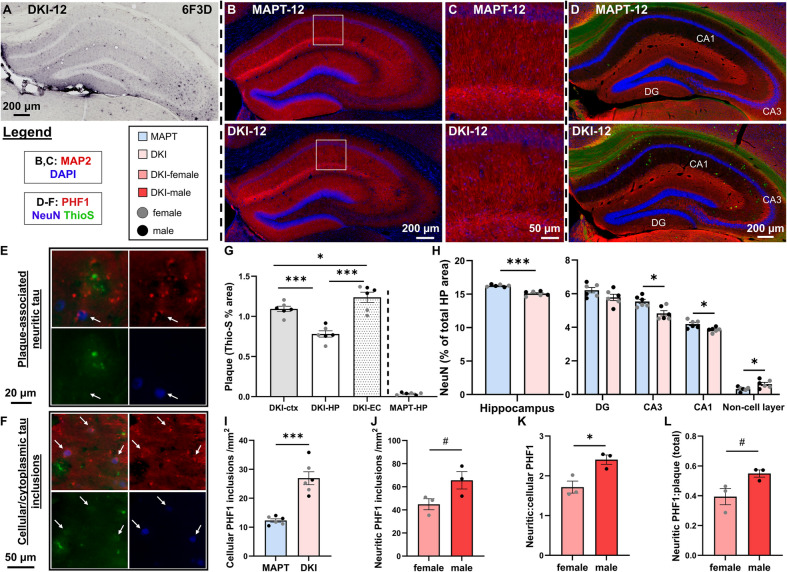
Hippocampal neuronal injury onset was observed in the 12-month cohort, with notable thinning in pyramidal layers compared to MAPT controls (Fig. 1D,H; Supplementary Fig. 1 for 4- and 8-month images). Quantification of NeuN + hippocampal neurons determined a significant loss of ~ 7.2% of NeuN signal in 12-month AppNL−G−FxMAPT mice, compared to age-matched MAPT mice (P = 0.0001) primarily from less excitatory pyramidal NeuN in the CA3 (P = 0.0263) and CA1 (P = 0.0339). Granular DG NeuN was less in AppNL−G−FxMAPT mice, but non-significant (P = 0.1127). Significantly more non-cell layer NeuN (P = 0.0439) were detected in AppNL−G−FxMAPT compared to MAPT mice, potentially due to ectopic neurons as PHF1 + cellular inclusions were often localized to molecular layers (Fig. 1D,F), or GABAergic compensation [37]. We did not observe association of cleaved caspase-3 (CCP3) with NeuN in any assessed region (Supplementary Fig. 2): NeuN loss therefore indicates neuronal injury and degeneration [37, 38] but not widespread neuronal apoptosis. These data highlight the vulnerability of excitatory neurons (Fig. 1H) and neuronal processes (Fig. 1B,C) within the hippocampus of 12-month-old AppNL−G−FxMAPT mice.
Cellular (non-plaque associated) and neuritic (plaque-associated) tau inclusions were quantified by PHF1 positivity in the hippocampus of 12-month AppNL−G−FxMAPT mice. Compared to MAPTs, AppNL−G−FxMAPT mice exhibited a significant > 2 × increase in p-tau + cells in total hippocampus (P < 0.0001; Fig. 1I). PHF1 tau phosphorylation was observed in MAPT mice in hippocampal processes and in the cytoplasm (Fig. 1D), yet was notably increased in AppNL−G−FxMAPTs, in line with previous characterization of these models [16]. PHF1 + dystrophic neurites were quantified in AppNL−G−FxMAPT mice and assessed for sex effects. Male AppNL−G−FxMAPT mice exhibit a trend to more neuritic tau pathology overall than females (P = 0.0810; Fig. 1J), a significantly greater ratio of neuritic:cellular PHF1 inclusions (P = 0.0224; Fig. 1K), and a trend to more PHF1 + neurites per plaque (P = 0.0601; Fig. 1L).

Hippocampal neurodegeneration in late-stagexmice, greater tau pathology in males.Representative hippocampal Aβ plaque (6F/3D, black) pathology in 12-month oldx(DKI) mice (DKI-12).,Relative to 12-month old MAPT (MAPT-12) mice,xmice exhibit degenerative hippocampal neuronal processes (MAP2, red), especially around plaque formations.Representative PHF1 (red), NeuN (blue) and ThioS (green) staining inandxmice demonstrating Aβ and tau pathologies and thinning of CA1 and CA3 pyramidal cell layers in the 12-monthxmice. No neuronal loss was observed at earlier ages (Supplementary Fig. 1).Aβ plaques (ThioS, green) have extensive tau + dystrophic neurites (PHF1, red).Cellular, non-plaque-associated tau inclusions (arrows) are also prevalent inxmice.Quantification of regional area covered by Aβ determined greater cortical (neocortex and entorhinal cortex – EC) vs. hippocampal area covered (HP), though the hippocampus has more frequent small, putatively new plaque formations (Supplementary Fig. 1).Quantification of hippocampal NeuN in 12-monthxmice determining significantly less NeuN signal in total hippocampus, primarily from CA1 and CA3 cell layers, no change in the dentate gyrus (DG), and more non-cell layer signal.Cellular PHF1 + aggregates were significantly increased inxvs.mice.Neuritic PHF1 + aggregates trended to an increase in males vs. females in late-stagexs.The ratio of neuritic:cellular PHF1 inclusions was significantly higher in males.Malexs also exhibit a trend to more PHF1 per plaque. Data are presented as mean ± SEM; = 3/sex/genotype. # < 0.10, * < 0.05, **< 0.01, *** < 0.001. Statistical analysis was conducted using a one-way ANOVA, Holm-Šídák post-hoc (), multiple unpaired t-tests, Holm-Šídák correction (), or unpaired t-test (-); see Supplementary Table 2 for complete statistics App MAPT App MAPT App MAPT MAPT App MAPT App MAPT App MAPT App MAPT App MAPT MAPT App MAPT App MAPT n P P P P NL−G−F NL−G−F NL−G−F NL−G−F NL−G−F NL−G−F NL−G−F NL−G−F NL−G.−F NL−G.−F A B C D E F G H I J K L G H I L
xcognitive decline aligns with late-stage hippocampal pathology App MAPT NL−G−F

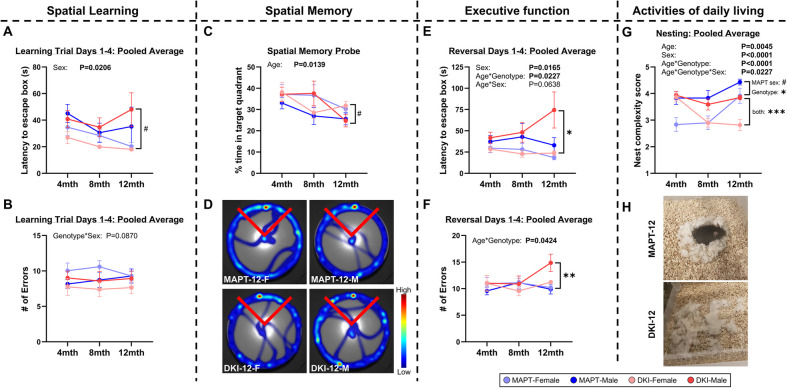
Cognitive decline onset at the late-stage inxmice; greater deficits in males.x(DKI) andmice underwent longitudinal behavioural testing in the Barnes maze (spatial learning, memory and executive function) and activities of daily living by nest building, at 4-, 8- and 12-months of age.,12-month male mice exhibit significantly slower latency to the escape box during learning trials, more so in the malexs (trending compared to femalexs), with no significant differences detected in errors made.Spatial memory performance decreased over age in all mice. Notably there was a trend to less time spent searching the target quadrant in male vs. femalex.Representative Heatmaps for 12-month male and femaleandxmice demonstrate less time in the target quadrant, more centre crossings and searches in non-target regions in 12-month malexmice; search strategy complexity was significantly impaired in 12-month malexmice (see Supplementary Fig. 3)., Impairments in latency to escape and number of errors made in reversal learning trials indicate the significant executive dysfunction in 12-month malexmice.,Nesting data highlights a significant deficit in all 12-monthxmice, which was more advanced in the females. See Supplementary Figs. 4 and 5 for trial-by-trial Barnes maze graphs and hour-by-hour nesting graphs at each age. Data are presented as mean ± SEM; = 10–11/sex/genotype/age. # < 0.10, * < 0.05, ** < 0.01, *** < 0.001. Statistical analysis was conducted using a three-way repeated measures ANOVA (age, genotype, sex effects; values reported above graphs), and with two-way ANOVA, Holm-Šídák post-hoc in the 12-month data (multiple comparisons indicated in the graphs); see Supplementary Tables 2 and 3 for complete statistics App MAPT App MAPT MAPT App MAPT App MAPT App MAPT MAPT App MAPT App MAPT App MAPT App MAPT App MAPT n P P P P NL−G−F NL−G−F NL−G−F NL−G−F NL−G−F NL−G−F NL−G−F NL−G−F NL−G−F NL−G−F A B C D E F G H
Sleep impairment begins in early-stagexs, precedes cognitive decline and is more prominent in females App MAPT NL−G−F
At late-stage pathology, AppNL−G−FxMAPT mice had significantly less attempted sleep in the dark-cycle with a large deficit in female AppNL−G−FxMAPTs (P = 0.0003) and a trend in males (P = 0.0886). Male mice attempted sleep significantly more in the dark-cycle than females (MAPT: P = 0.0144; AppNL−G−FxMAPT: P < 0.0001; Fig. 3E). AppNL−G−FxMAPTs also spend less time in attempted sleep states during the light-cycle at 12-months (P < 0.0001; females: P < 0.0001, males: P = 0.0007), with even less in female vs. male AppNL−G−FxMAPT (P = 0.0230), but no sex difference in MAPTs (Fig. 3F). To Further delineate activity changes during the light-cycle, we assessed 2-h bins. This elucidated a loss of attempted sleep time in 12-month AppNL−G−FxMAPTs primarily within the first 6-h of the light-cycle, indicating potential impairments in adjusting to the environmental cue (light change), and delayed sleep onset (Fig. 3G). These changes were not present at 4-months, and subtle at 8-months (Supplementary Fig. 6). Representative light-cycle heatmap (Fig. 3H) images demonstrate the severity of sleep activity changes in 12-month AppNL−G−FxMAPTs relative to MAPT mice.
To confirm sleep changes and stage REM and non-REM (NREM) sleep in AppNL−G−FxMAPTs, 24-h EEG/EMG recordings were conducted at the early- and late-stage. Representative raw traces demonstrate EEG and EMG activity during sleep and wake states (Fig. 3I). In the 4-month dark-cycle, MAPT and AppNL−G−FxMAPT mice spend ~ 18–19% of the time asleep and no genotype differences were detected for wake, NREM or REM stages (Fig. 3J). This contrasts with increased attempted dark-cycle sleep-time by activity observed in 4-month AppNL−G−FxMAPT mice (Fig. 3A), suggesting higher quiet wakefulness but not more true sleep. At 12-months, dark-cycle NREM and REM sleep time is lower by age, and significantly less in AppNL−G−FxMAPT mice compared to MAPTs (NREM: P = 0.0074; REM: P = 0.0081), with more wake time (P = 0.0074; Fig. 3J), consistent with sleep activity observations (Fig. 3E). It has been reported in Tg2576 AD mice that dark-cycle sleep is reduced at both 6- and 11-months [39], contradictions which are likely due to differences in disease staging and/or an overexpression (Tg2576) compared to physiological expression (AppNL−G−FxMAPT) of pathological species. In the 4-month light-cycle, REM sleep is ~ 50% less in the AppNL−G−FxMAPT mice (P = 0.0010), with no changes in wake or NREM. At 12-months AppNL−G−FxMAPT mice exhibit a ~ 50% reduction in REM (P < 0.0001), significantly more wake time (P = 0.0125), and a trend to less NREM sleep (P = 0.1113; Fig. 3K). These data demonstrate the sensitivity of REM sleep to AD pathology from early stages, consistent with previous reports in the AppNL−G−F genotype [40, 41], as well as changes in attempted sleep patterns and increased wakefulness over disease progression.
We detected significant sex differences in how male and female AppNL−G−FxMAPT mice respond to impaired sleep quality at the early-stage pathology. A significant effect of genotype (P < 0.0001) and sex (P = 0.0083) was detected on 4-month light-cycle REM sleep, with REM deficits in both sexes of AppNL−G−FxMAPT mice (both P = 0.0036) and generally less REM sleep in males (both P = 0.0861; Fig. 3L). Interestingly, a significant effect of sex was detected in light-cycle NREM time (P = 0.0261; trending effect of genotype: P = 0.0731) with more NREM sleep in AppNL−G−FxMAPT males compared to females (P = 0.0421), and unchanged in MAPTs (Fig. 3M). In dark-cycle REM sleep, significant genotype (P = 0.0362) and genotype*sex effects (P = 0.0047) were observed, with less REM sleep time in AppNL−G−FxMAPT females compared to MAPT females (P = 0.0023), no genotype differences in male mice, more REM sleep in MAPT females compared to males (P = 0.0434), and an increase in AppNL−G−FxMAPT males vs. females (P = 0.0511; Fig. 3N). These data demonstrate that males at early-stage AD pathology compensate to a loss of "night-time" REM sleep with more NREM sleep and more "day-time" REM sleep whereas female mice do not. Early-stage dark-cycle NREM sleep was not changed by sex or genotype, and trending in genotype*sex interaction (P = 0.1147; Fig. 3O). No sex differences in sleep staging were detected at 12-months (Supplementary Fig. 7).

Vulnerability of REM and sleep activity deficits inxmice from early-stage pathology; more rapid in female mice. Locomotor activity across 12-h dark- and light-cycles was utilized to measure attempted sleep time.4-monthx(DKI) mice had more attempted sleep in the dark-cycle, increased in males of both genotypes.No changes were observed in the 4-month light-cycle.No genotypes differences were detected in the 8-month dark-cycle, with higher attempted sleep time in males than females.An overall significant genotype effect was observed in the 8-month light-cycle, mainly driven by significantly less attempted sleep time in femalexmice.In the 12-month dark-cycle,xmice had less attempted sleep time thans, significant in femalexs and trending in males; higher in males overall.Both male and female 12-monthxmice had less attempted sleep time thans, with greater loss in female AD mice.Attempted sleep time separated by 2-h time-bins demonstrate lessxsleep throughout the light-cycle, with most of the loss in the first half (see Supplementary Fig. 6 for 4- and 8-month binning).Representative light-cycle Heatmaps demonstrate the loss of attempted sleep time in 12-monthx.Representative EEG and EMG trace demonstrating sleep (top) and wake (bottom) states.EEG/EMG recordings were utilized to stage wake, NREM and REM sleep in 12 h dark-cycle at 4- and 12-months inx(DKI-4; DKI-12) and age matchedmice (MAPT-4, MAPT-12), demonstrating no overt genotype differences at 4-months, and loss of NREM and REM with increased wake time in 12-monthxmice.Light-cycle sleep staging indicates a significant loss of REM sleep in 4-monthxmice, which is also observed at 12-months of age along with increased wakefulness.At 4-months, both male and femalexmice exhibit a loss of light-cycle REM with a trend to less REM time in general in males.Male 4-monthxmice spend significantly more of the light-cycle in NREM sleep than femalexs.When split by sex, 4-month dark-cycle REM sleep has a significant genotype deficit specifically in femalexmice; males had less REM time than females, yet malextrended to more REM sleep than femalexs.No sex or genotype differences were observed in 4-month dark-cycle NREM sleep. No sex differences were observed at 12-months (Supplementary Fig. 7). Data are presented as mean ± SEM; = 10–11/sex/genotype/age (-) = 5/sex/genotype/age (-). # < 0.10, * < 0.05, ** < 0.01, *** < 0.001. Statistical analysis was conducted using multiple unpaired t-tests, Holm-Šídák correction (, ) or two-way ANOVA, Holm-Šídák post-hoc when appropriate (-,-); see Supplementary Table 2 for complete statistics App MAPT App MAPT App MAPT App MAPT MAPT App MAPT App MAPT MAPT App MAPT App MAPT App MAPT MAPT App MAPT App MAPT App MAPT App MAPT App MAPT App MAPT MAPT MAPT App MAPT App MAPT n n P P P P NL−G−F NL−G−F NL−G−F NL−G−F NL−G−F NL−G−F NL−G−F NL−G−F NL−G−F NL−G−F NL−G−F NL−G−F NL−G−F NL−G−F NL−G−F NL−G−F NL−G−F A B C D E F G H I J K L M N O A G J O J K A F L O
Failed autophagic flux in memory-regulating regions linked to plaque progression
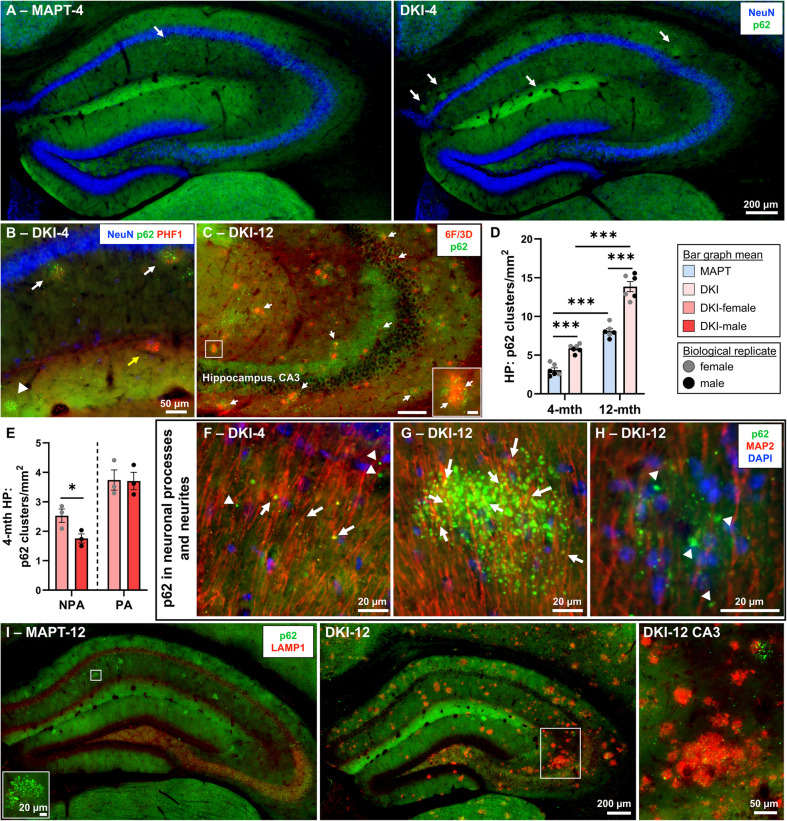
Within AppNL−G−FxMAPT mice, p62 clusters were defined as plaque-associated (PA) and non-plaque-associated (NPA). Female AppNL−G−FxMAPT mice at 4-months exhibit significantly more hippocampal non-plaque-associated p62 clusters than male AppNL−G−FxMAPT mice (P = 0.0485), yet no change in plaque-associated p62 clusters by sex (Fig. 4E). At 12-months, plaque-associated (unpaired t-test, n = 3/sex, mean ± SEM; female: 10.03 ± 0.5206, male: 11.72 ± 0.7280; t = 1.886(df = 4), P = 0.1324) and non-plaque-associated (female: 3.287 ± 0.7702, male: 2.666 ± 0.3350; t = 0.7391(df = 4), P = 0.5008) p62 clusters (per mm2 hippocampal area) did not differ by sex. Localization of p62 aggregates to neuronal processes was confirmed with MAP2 staining, indicating deposition of aggregates along axons (white arrows); visualized in CA1 inner molecular layer of a 4-month AppNL−G−FxMAPT mouse (Fig. 4F) and consistent in both genotypes and ages (n = 2/sex/genotype/age). Representative p62 cluster in the CA1 of a 12-month AppNL−G−FxMAPT mouse demonstrates prominence of aggregates within MAP2 + processes, and significant non-colocalized aggregates likely in synapses and dystrophic neurites (Fig. 4G). p62 + dystrophic neurites (white arrowheads) around putative Aβ plaques (visualized by contrast) are typically not co-localized with MAP2 (Fig. 4H). Hippocampal p62 clusters in MAPTs and non-plaque-associated p62 clusters in AppNL−G−FxMAPT mice typically do not co-localize with lysosomal associated membrane protein 1 (LAMP1), indicating impaired lysosomal flux of aggregated protein in these p62 accumulations (Fig. 4I and insets); however, a robust lysosomal accumulation was detected surrounding Aβ plaques including association with p62 (Fig. 4I and insets; Supplementary Fig. 12; n = 3/genotype/age).

xhippocampal autophagic impediment in neuronal processes and dystrophic neurites.p62 (green) and NeuN (blue) staining in 4-monthandx(DKI) mice demonstrating clustering of uncleared protein (white arrows) in the AD mice; see Supplementary Fig. 11 for 12-month pictures.p62 clusters in close proximity to tau + dystrophic neurites around putative plaques (PHF1, red, white arrows), though this relationship is not exclusive (p62 alone: white arrowhead; PHF1 alone: yellow arrow); see Supplementary Fig. 9 for close-up images of p62/6F/3D staining in 4-monthxmice.p62 associates with Aβ plaques (6F/3D, red) including co-localization of Aβ in p62 aggregates (scale bars represent 100 µm and 10 µm for the inset); see Supplementary Fig. 10.Hippocampal p62 clusters were quantified determining a significant increase inxmice at both early- and late-stage pathology, as well as an age-associated increase in both genotypes.At 4-months of age, femalexmice have significantly more non-plaque-associated (NPA) p62 clusters than the males, with no changes in plaque-associated (PA) clusters.–p62 aggregates were prominently found in neuronal processes (white arrows) by co-localization with MAP2 (red) and did not frequently appear in proximity to DAPI (blue; see Supplementary Fig. 8) indicating a predominant accumulation of hippocampal p62 in processes > cytoplasm; dystrophic neurites were often p62 +/MAP2- (white arrowheads).LAMP1 (red) staining inxand12-month mice demonstrates a robust lysosomal accumulation surrounding plaques (see Supplementary Fig. 12), and a non-exclusive association of LAMP1 with p62 aggregates in the plaque vicinity, but less so in non-plaque-associated p62 clusters or in thes. Data are presented as mean ± SEM; = 3/sex/genotype/age. * < 0.05, *** < 0.001. Statistical analysis was conducted using two-way ANOVA, Holm-Šídák post-hoc () or unpaired t-tests (); see Supplementary Table 2 for complete statistics App MAPT MAPT App MAPT App MAPT App MAPT App MAPT App MAPT MAPT MAPT n P P NL−G−F NL−G−F NL−G−F NL−G−F NL−G−F NL−G−F A B C D E F H I D E

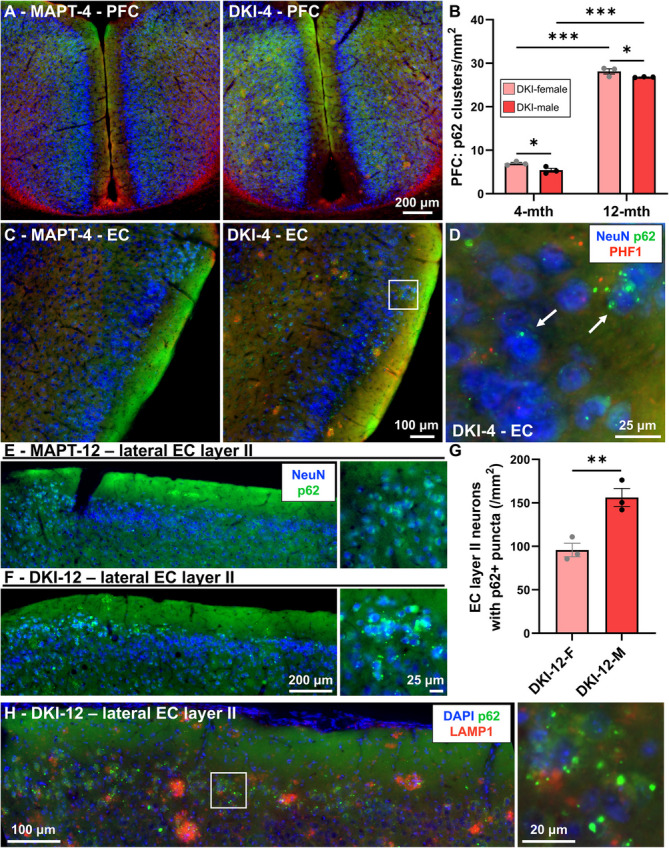
Cortical autophagic impediment follows plaque pathology inxmice, except for the vulnerability of entorhinal cortical layer II neurons.Representative p62 (green), NeuN (blue) and PHF1 (red) staining in the 4-month PFC demonstrating a specific association of p62 clusters with putative Aβ plaques inx(DKI) mice (surrounding PHF1 positivity), and no clusters ins.p62 clusters were quantified at 4- and 12-months inxmice demonstrating significantly more in females, and a large increase with disease progression.p62 follows plaque pathology in the EC as well.EC layer II neurons demonstrate sparse co-localization with p62 + puncta in the 4-monthx, but not, mice.12-months still do not develop p62 + puncta in EC layer II, though they do have p62 immunoreactivity in the cell layer.12-monthxs demonstrate robust accumulation of p62 + aggregates within EC layer II neurons.Quantification of p62 +/NeuN + neurons within the EC layer II of monthxmice, demonstrating a significantly greater burden in male mice.EC layer II puncta inxmice predominantly do not co-localize with LAMP1 (red). Data are presented as mean ± SEM; = 3/sex/genotype/age (for analysis and representative images-); = 3/genotype/age (). * < 0.05, ** < 0.01, *** < 0.001. Statistical analysis was conducted using two-way ANOVA, Holm-Šídák post-hoc () or unpaired t-test (); see Supplementary Table 2 for complete statistics App MAPT App MAPT MAPT App MAPT App MAPT MAPT MAPT App MAPT App MAPT App MAPT n n P P P NL−G−F NL−G−F NL−G−F NL−G−F NL−G−F NL−G−F NL−G−F A B C D E F G H A G H B G
p62 accumulations from the early-stage in sleep-regulating regions ofxs, precedes regional plaque pathology; autophagic flux is further impaired with disease progression App MAPT NL−G−F
AppNL−G−FxMAPT mice exhibit significantly less LH NeuN + cells at early- and late-stages, compared to MAPTs (4-month: P = 0.0252; 12-month: P = 0.0293). LH neuronal injury increases with age in both genotypes (AppNL−G−FxMAPT: P = 0.0380; MAPT: P = 0.0331; Fig. 6B). From 4-months, ~ 16% of LH neurons exhibit p62 inclusions in AppNL−G−FxMAPTs, significantly greater than MAPTs (4-month: P = 0.0011; 12-month: P < 0.0001), with no effect of age (Fig. 6C). In mPOA, AppNL−G−FxMAPT loss of NeuN signal occurred (4-month: P = 0.0256; 12-month: P = 0.0020; Fig. 6D) and p62 aggregated within neurons (4-month: P = 0.0028; 12-month: P = 0.0004; Fig. 6E), with no age effects. In LPO, AppNL−G−FxMAPT mice trended to a loss of NeuN (P = 0.1005; Fig. 6F), yet had a robust increase in neurons impacted by failed autophagic flux in 12-month AppNL−G−FxMAPT compared to 4-months, and to MAPTs (both P < 0.0001; Fig. 6G). These results indicate that the hypothalamus is sensitive to autophagic impediment and neuronal injury prior to significant plaque pathology, and although these changes were not specific to sleep-associated subregions, significant age and genotype*age effects (LH and LPO, respectively; statistics in Supplementary Table 2) suggest a mounting impairment in sleep circuitry.
Neurite and plaque-associated p62 clustering in the hypothalamus was quite rare at 4-months but common at 12-months in AppNL−G−FxMAPTs (Fig. 6H; representative images from n = 3/sex/age), coinciding with plaque counts. GABAergic (GAD67) and orexinergic (Orexin-A) neuronal co-localization with p62 was assessed to determine which hypothalamic neurons were vulnerable to autophagic impediment. No inhibitory neurons exhibited cytoplasmic or neurite depositions of p62 in the LPO (Fig. 6I; see Supplementary Fig. 13 for PFC; n = 2/genotype/age), despite GABAergic dystrophic neurite pathology, indicating an excitatory neuronal vulnerability to autophagic impediment. LH orexinergic neurons exhibit significant p62 inclusions at a similar rate as the NeuN +/p62 + quantification (Fig. 6J; n = 2/genotype/age). Representative images for orexinergic results are in 12-month AppNL−G−FxMAPT mice, though these results are consistent (to a lesser degree) at 4-months and in MAPTs. In sum, hypothalamic sleep–wake regulating neurons are sensitive to autophagic disruption.
Next, we assessed LH cytoplasmic p62 + inclusions for co-localization with LAMP1 as an additional indicator of autophagic flux. Nearly all (~ 90–93%) p62 inclusions were LAMP1 + in MAPT mice at both ages and 4-month AppNL−G−FxMAPT mice, yet a significant loss (P < 0.0001) of co-localization was observed in the 12-month AppNL−G−FxMAPT mice (~ 57% co-localization; Fig. 6K,L), indicating a mounting impediment in autophagic flux in sleep-regulating neurons in the AD mice. Representative LAMP1/ThioS/DAPI images in 4- and 12-month AppNL−G−FxMAPT mice demonstrate the sparsity of hypothalamic plaques at the early-stage, and that lysosomal accumulation precedes deposition of β-sheet plaques (Fig. 6M; see also Supplementary Fig. 12 for hippocampal and cortical images), further indicating the autophagic-lysosomal burden in the hypothalamus of the AD mice from early disease stages.

Cytoplasmic autophagic impediments and neuronal injury in the hypothalamus from early-stagexprogression.Representative images of p62 (green) and NeuN (blue) staining in the lateral hypothalamus (LH), demonstrating greater association of p62 and NeuN in the AD mice.NeuN + neurons were quantified in the LH with a loss inx(DKI) mice at both ages, and a significant age effect in both genotypes.4- and 12-monthxmice exhibit significantly more LH neurons with p62 immunoreactivity.Neuronal injury was also observed in the medial preoptic area (mPOA) of thexhypothalamus, at both ages.mPOA neurons ofxmice have significantly increased p62 immunoreactivity.No significant differences were detected in the number of NeuN + neurons in the lateral preoptic area (LPO); overall genotype effect was trending to axreduction.p62 +/NeuN + neurons in the LPO were significantly increased in 12-monthxmice, compared tos and to 4-monthxs.Hypothalamic p62 clusters were seen associating with plaques (PHF1 positivity, red; white arrows) at 12-months of age, and rarely at 4-months because hypothalamic plaque pathology was sparse at the early-stage (see also results text for plaque counts).LPO GABAergic neurons (GAD67, purple) did not co-localize with p62 at cell bodies (yellow arrows; visualized by co-localization with the blue DAPI signal) or processes (yellow arrowheads).LH orexinergic neurons (Orexin A, red) co-localize with p62 in both ages and genotypes, visualized in the 12-monthxs., LH neurons with p62 aggregates exhibit high co-localization with LAMP1 (blue arrows) in 4-month mice of both genotypes and 12-months. p62 +/LAMP1 + co-localization is significantly less frequent (blue arrowheads) in the 12-monthxs.Representative Aβ plaque pathology (ThioS, green) in 4- and 12-monthxs demonstrating low frequency of hypothalamic ThioS + plaques at 4-months. LAMP1 accumulation surrounding plaques precedes the formation of β-sheet structure detected by ThioS (white arrows indicate ThioS +/LAMP1 +; white arrowheads indicate ThioS-/LAMP1 +), further indicative of early-stage disruption in the autophagic-lysosomal system. Data are presented as mean ± SEM; = 3/sex/genotype/age (-) or = 3/genotype/age (-). * < 0.05, ** < 0.01, *** < 0.001. Statistical analysis was conducted using a two-way ANOVA, Holm-Šídák post-hoc when appropriate; see Supplementary Table 2 for complete statistics App MAPT App MAPT App MAPT App MAPT App MAPT App MAPT App MAPT MAPT App MAPT App MAPT MAPT App MAPT App MAPT n n P P P NL−G−F NL−G−F NL−G−F NL−G−F NL−G−F NL−G−F NL−G−F NL−G−F NL−G−F NL−G−F NL−G−F A B C D E F G H I J K L M B G K M

Vulnerability of locus coeruleus neurons to tau pathology and autophagic impediment from early-stagexpathology.Representative images of a 12-monthx(DKI) mice with immunostaining for p62 (green), NeuN (blue) and PHF1 (red) demonstrating the association and abundance of p62 +/PHF1 + neurons (white arrows).LC neurons exhibit high p62 immunoreactivity as well as p62 puncta aggregates (white arrowheads) inxmice.Significant increases in LC p62 +/PHF1 + neurons were observed in 4- and 12-monthxmice, compared tos, with a robust increase over disease inxs.LC neurons were predominantly also positive for phosphorylated CP13 (orange) tau (Ser202), including p62 co-localization. ThioS + (pink) plaques (blue arrows) were present, yet rare, at 12-months in close proximity to the LC (see results text for quantification).LC LAMP1 signal (red) is unchanged by genotype or age (see results text for quantification) despite the increase in p62 aggregates inxmice. Data are presented as mean ± SEM; = 3/sex/genotype/age (-); = 3/genotype/age (D, E). * < 0.05, *** < 0.001. Statistical analysis was conducted using a two-way ANOVA, Holm-Šídák post-hoc; see Supplementary Table 2 for complete statistics App MAPT App MAPT App MAPT App MAPT MAPT App MAPT App MAPT n n P P NL−G−F NL−G−F NL−G−F NL−G−F NL−G−F NL−G−F A B C D E A C
Sleep-to-cognition linkage: sleep-associated delta waves are prevalent during cognitive processing inxmice prior to cognitive decline App MAPT NL−G−F

Electrophysiological slowing during cognitive processing as an early sign of cognitive decline inxmice.x(DKI) andmice at the mid-stage (8-months) were implanted with a hippocampal electrode attached to a headcap, in the CA1 of the hippocampus.Mice were then recorded wirelessly at baseline and during the learning phase of an object recognition task.No differences were detected in time spent exploring/learning the objects; but we do note that female mice explored significantly more than males.xexhibit a significant loss of hippocampal power, primarily in females (see results text for sex statistics).Hippocampal beta power was expressed as the ratio of change from baseline to during active object recognition, demonstrating a significant deficit inxmice compared tos.Conversely, delta power inxmice was significantly higher thans during object learning. No changes were observed in theta or alpha power (see Supplementary Fig. 15).Representative frequency spectra forandxmice separated by baseline (gray line) and object investigation (red line) demonstrates greater delta waveforms (blue shading) inxmice, and higher beta waveforms (green shading) ins, including an increase during object investigation. Data are presented as mean ± SEM; = 7–9/genotype. * < 0.05. Statistical analysis was conducted using an unpaired t-test; see Supplementary Table 2 for complete statistics App MAPT App MAPT MAPT App MAPT App MAPT MAPT App MAPT MAPT MAPT App MAPT App MAPT MAPT n P NL−G−F NL−G−F NL−G−F NL−G−F NL−G−F NL−G−F NL−G−F A B C D E F G
Sleep-to-autophagy linkage: acute sleep disruption inmice impedes autophagy and mimics an Alzheimer's-like phenotype MAPT

Acute sleep disruption impedes autophagy in the hippocampus and hypothalamus ofcontrol mice.mice at 10–12-months of age underwent a 3-day sleep disruption (3DSD) compared to control conditions (Ctrl).,Locomotor activity was measured during the 3-day sleep disruption period demonstrating circadian arrhythmicity in attempted sleep time, and significantly more dark-cycle attempted sleep time, in 3DSDmice.Representative Heatmaps of dark-cycle locomotor activity demonstrate greater inactivity and attempted sleep time in 3DSDmice.p62 (green) clusters increase in the hippocampus of 3DSDmice.,p62 clusters of aggregates were quantified in the hippocampus demonstrating a significant increase in 3DSD vs. Ctrl, primarily in the female mice.Hypothalamic neurons (NeuN, blue) exhibit increased cytoplasmic p62 + inclusions (orange arrows) after sleep disruption.p62 associates with p-tau (PHF1, red, white arrowheads), though not exclusively (white arrows for p62 +/NeuN +/PHF1-).Hypothalamic p62 inclusions are significantly increased in 3DSDmice.Hypothalamic p62 inclusions significantly correlate with the attempted sleep time in the dark-cycle (black triangles = Ctrl; purple triangles = 3DSD). Data are presented as mean ± SEM; = 4–5/sex/condition. * < 0.05, *** < 0.001. Statistical analysis was conducted using a two-way ANOVA (), multiple unpaired t-tests, Holm-Šídák correction (), unpaired t-test (,,), or linear regression (); see Supplementary Table 2 for complete statistics MAPT MAPT MAPT MAPT MAPT MAPT n P P A B C D E F G H I J A B E F I J
Autophagy-to-sleep linkage: activating autophagy with trehalose inmice promotes NREM and REM sleep recovery following sleep disruption MAPT

Activating autophagy with trehalose improves sleep recovery.mice at 12-months of age were continuously treated with 2% trehalose (MAPT-tre), or 2% sucrose control (MAPT-suc), and underwent a 6-h sleep disruption (SD). The mice were then recorded with EEG for sleep staging in the immediate dark-cycle then light-cycle, in the 24 h following SD. SD reduced sleep time by ~ 60% in both treatment groups (see Supplementary Fig. 16).An hour before the onset of the first light-cycle following SD, trehalose treated mice exhibit increased sleep-associated EEG delta power than in the control treatment.,Wake, NREM and REM sleep was staged during the dark-cycle immediately post-SD determining greater sleep time (NREM + REM) in MAPT-tre mice, primarily in the 2-h leading up to the sleep-dominant light-cycle.No differences by treatment were detected in the light-cycle. For comparison, baselinedatapoints were re-graphed from the 12-months in Fig.. Data are presented as mean ± SEM; = 5/sex/condition. * < 0.05. Statistical analysis was conducted using an unpaired t-test (,) or two-way ANOVA, Holm-Šídák post-hoc (); see Supplementary Table 2 for complete statistics A B C D E C E D MAPT MAPT MAPT n P 3
| Analysis | Early-stage pathology(x)AppMAPT vs. MAPTNL−G−F | Late-stage pathology(x)AppMAPT vs. MAPTNL−G−F | Sleep-to-cognition effect (mid-stagex)AppMAPT vs. MAPTNL−G−F | Sleep-to-autophagy effect (−3DSD vs. -Ctrl)MAPT | Autophagy-to-sleep effect (-trehalose vs. -sucrose)MAPT |
|---|---|---|---|---|---|
| Cognition | No genotype changes in Barnes mazeActivities of daily living intact (↑ compared to)MAPT | ↔ spatial learning↓ spatial memory ()males only↓ executive function ()primarily in males↓ activities of daily living()greater deficit in females | ↔ in learning/exploration time of novel objects | N/A | N/A |
| Sleep | ↑ dark-cycle attempted sleep ↔ light-cycle attempted sleep↓ dark-cycle REM EEG()females only↓ light-cycle REM EEG | ↓ dark-cycle attempted sleep()females: significant; males: trending↓ light-cycle attempted sleep↓ REM and NREM EEG↑ wake EEG | N/A | ↑ dark-cycle attempted sleep ↔ light-cycle attempted sleep | SD impaired sleep similarly in both cohorts ↑ NREM and REM EEG recovery in the dark-cycle after sleep disruption ↔ light-cycle NREM and REM EEG after sleep disruption |
| Hippocampus | ↑ non-cytoplasmic and neuritic autophagic aggregates (> )in females ↔ neurons | ↑↑↑ non-cytoplasmic and neuritic autophagic aggregates↓ pyramidal NeuN↑ tau inmales vs. females | ↓ beta wave activity during cognitive processing ↑ delta wave activity during cognitive processing | ↑ non-cytoplasmic autophagic aggregates ()females only | N/A |
| Cortex | ↑ neuritic autophagic aggregates(PFC: > )in females | ↑↑↑ neuritic autophagic aggregates (PFC: > )in females↑ EC layer II cytoplasmic autophagic aggregates(> )in males | N/A | N/A | N/A |
| Hypothalamus | ↑ cytoplasmic autophagic aggregates – excitatory and orexinergic neurons()LH and mPOA only↓ NeuN()LH and mPOA only ↔ lysosomal targeting of p62 | ↑↑ cytoplasmic autophagic aggregates – excitatory and orexinergic neurons()higher in LPO with age↓ NeuN()LH and mPOA only↓ lysosomal targeting of p62↑ neuritic autophagic aggregates | N/A | ↑ cytoplasmic autophagic aggregates | N/A |
| Locus coeruleus | ↑ neurons with co-localized tau and autophagic pathologies ↔ cytoplasmic lysosomal signal despite ↑ p62 | ↑↑↑ neurons with co-localized tau and autophagic pathologies ↔ cytoplasmic lysosomal signal despite ↑↑↑ p62 | N/A | N/A | N/A |
Discussion
In this study, we utilized an AD pathology mouse model with physiological expression patterns of Aβ and tau, AppNL−G−FxMAPT mice, to investigate the relationship of sleep loss and autophagic impediment at early disease stages. We concurrently characterized the sleep and cognitive phenotype, demonstrating an earlier sensitivity to REM sleep and hippocampal neuronal impairments, with preservation of memory and executive function until late-stage pathology. Critically, the regional, neuronal and temporal vulnerabilities of failed autophagic flux were linked to the behavioral phenotype, in sleep- and memory-circuitry. In the cortex and hippocampus, aggregated uncleared protein was most abundant in neuronal processes, dendrites and dystrophic neurites – putatively in neuronal afferents to these regions – until the late-stage when hippocampal-projecting EC layer II neurons demonstrated impaired autophagic flux, as seen by the accumulation of protein aggregates and lack of lysosomal fusion. We also identified early pathological changes in the hypothalamus and locus coeruleus, from early-stage AD that preceded regional plaque pathology, with neuronal cell bodies exhibiting abundant autophagic aggregates, primarily in excitatory and neuromodulatory systems that promote wakefulness, arousal and regulate the sleep–wake balance. Critically, autophagic flux of sequestered protein to the lysosome could not fully compensate for an increasing abundance in sleep–wake neurons, especially in the late-stage.
We then probed the sleep-to-cognition, sleep-to-autophagy, and autophagy-to-sleep linkages demonstrating 1) electrophysiological signatures of sleepiness during cognitive processing preceding cognitive decline in the AD mice; 2) that an acute sleep disruption in MAPT mice lead to failed autophagic flux in the hippocampus and hypothalamus aligned to sleep activity impairments, akin to an early AD phenotype; and, finally, 3) that activation of autophagy with trehalose in MAPT mice improved sleep in the recovery period following a sleep disruption.
Sex differences in the Alzheimer's disease behavioral phenotype are linked to autophagic pathology in memory-regulating regions
Our findings indicate a sex difference where cognitive decline at the late-stage was greater in AD male mice than females, yet at early- and mid-stages of pathology sleep impairments were more rapid in female AD mice, notably less REM sleep recovery than males. Contrary to our expectations, we observed sex differences in classically cognition-regulating regions, PFC, EC and hippocampus, and not in the sleep–wake circuitry. Hippocampal and cortical impairments in AD are well documented and associated with memory impairments [1 –3]. Autophagic aggregates in the AppNL−G−FxMAPT hippocampus were observed in molecular layer neuronal processes (CA1, CA3 > DG) and were often negative for the LAMP1 lysosomal marker, suggesting autophagosome and autophagic vacuolar blockage in neuronal afferents, which may be contributing to electrophysiological impairments during information processing. Conversely, plaque-associated dystrophic neurites were commonly p62 +, often associating with LAMP1 accumulations around plaques, in the hippocampus, cortex and in later stages the hypothalamus, and, to a lesser degree in the locus coeruleus. Female AppNL−G−FxMAPTs at the early-stage exhibited an increased hippocampal proteostasis burden, observed by clustering of uncleared protein, compared to males. This increase was only in autophagic aggregates that were not dystrophic neurites (not associated with plaques), indicating a greater burden in females that was putatively from impaired hippocampal inputs.
One possible explanation is that increased activity of wake-active neurons with hippocampal inputs, such as in noradrenergic, orexinergic and cholinergic (wake and REM-active) systems during disrupted sleep and leads to a greater protein burden, which includes production and spread of Aβ and tau pathologies [50 –55], and is presenting in the female AppNL−G−FxMAPT mice as increased synaptic autophagic aggregates. Delorme et al. recently described increased activity of cholinergic and orexinergic inputs to the hippocampus after sleep deprivation, which increased somatostatin-mediated gating of the hippocampal circuits [56]. Also, noradrenergic neuronal activity drops significantly during sleep and to quiescence during specifically REM sleep [11, 57, 58], and therefore loss of REM sleep and reduced REM recovery in the female AD mice could lead to a greater vulnerability of noradrenergic circuitry to proteinopathy. Furthermore, female AppNL−G−FxMAPT mice exhibited higher plaque-associated autophagic clusters than males in the PFC from the early-stage, indicative of more advanced Aβ plaque pathology, supporting conclusions that earlier sleep disturbances in females are linked to more rapid proteinaceous production and deposition.
Another major source of hippocampal long-projecting afferents is lateral EC layer II neurons, which progressively accumulated uncleared protein in AppNL−G−FxMAPT mice and with notable p62 pathology in the late-stage pathology. This pathway is well known to contribute to the memory and cognitive domains we detected in the Barnes maze [28, 43 –45], and therefore is a strong correlate of the AppNL−G−FxMAPT cognitive decline. Notably, EC layer II proteostasis burden was significantly greater in male vs. female AppNL−G−FxMAPT mice, consistent with the loss vs. preservation of spatial memory impairments, respectively, and the greater executive function deficits in males. Late-stage male AppNL−G−FxMAPT mice also exhibited more hippocampal tau pathology in dystrophic neurites further signifying the greater cognitive phenotype in males, though whether the source of tau was from EC-hippocampus spread [59, 60] or other neuronal inputs was not determined.
Autophagic disruptions in sleep–wake neurons is a consequence of an early Alzheimer's disease phenotype
The present study in particular highlights the importance of failed autophagic flux in hypothalamic and LC sleep–wake neurons from the early AppNL−G−FxMAPT pathology and preceding significant regional plaque deposition. In particular, LH orexinergic and LPO excitatory neurons were impacted including LH neuronal injury, indicating disruptions in triggers for sleep–wake balance [11, 46]. Calafate et al. recently described melanin-concentrating hormone (MCH) neuronal activity deficits in sleep recovery but no changes in orexinergic neurons, and impaired morphology and plaque-associated dystrophy in hippocampal CA1-projecting MCH axons from 6-months in AppNL−G−F mice [41]. MCH neurons are sleep-active and increase transition to REM sleep contributing to REM deficits in the AD mice [41, 57]. We and others demonstrate the sensitivity of REM sleep in AppNL−G−FxMAPT AD mice [40, 41], though NREM and slow-wave activity as treatable factors in AD are important as well [61 –64].
In support of our results, wake-promoting neurons (WPN), including LH orexinergic and LC noradrenergic neurons are vulnerable to AD-related tau pathology in patients, with WPN loss and significant p-tau inclusions in remaining neurons [65]. This signifies the importance of tau and autophagic deficits in sleep–wake neurons. Our study highlights the tau-p62 relationship after sleep disruption in the hypothalamus, and in the LC over AppNL−G−FxMAPT disease progression. LC neurodegeneration has been described in the AppNL−G−F genotype including LC neuronal loss at 9- and 12-months of age, but not earlier [26]. Another study showed no LC neuronal loss at 24-months in AppNL−G−F mice, with noradrenergic axonal degeneration in the neocortex but not CA1 at 12-months of age, and widespread at 24-months [66]. Sakakibara et al. demonstrated no AT8 + tau in the LC of AppNL−G−F mice [66], indicating the importance of the human tau knock-in in AppNL−G−FxMAPT mice for modelling Aβ-tau-autophagy effects, as we demonstrate significant and progressive LC tau pathology at PHF1 and CP13 epitopes, and the validity to AD patients [65].
Disruption of the autophagic-lysosomal system in AppNL−G−F single knock-in mice has been described and is similar to our observations, including increased p62 and autophagosomes in the cortex and hippocampus at 12-months [67], and deposition of lysosomal markers from the earliest accumulation of cortical Aβ plaques [68]; which we also demonstrated with lysosomal deposition preceding β-sheet plaque detection. Autophagic impediment in sleep disrupted MAPT mice is supported by previous work showing overactivation of the autophagic-lysosomal system [69, 70] and circadian arrhythmicity of autophagic flux [71] in the mouse hippocampus after sleep disruption, and increased Aβ and tau after even one night of sleep loss in humans [11]. To our knowledge ours is the first report of the sleep-autophagy connection in hypothalamic sleep–wake neurons, aligning with the phenotype in AppNL−G−FxMAPT mice and in AD patients [65].
Finally, we show that therapeutically activating autophagy in MAPT mice improves their sleep recovery after sleep disruption. We propose this is protective against the autophagic impediments that occur during sleep disruption, promoting flux of uncleared p62 + protein through the autophagic-lysosomal pathway, and thereby exerting a behavioral effect on sleep recovery. Our data elucidates an intimate linkage between sleep loss, either by disruption or from AD pathology, and the autophagic-lysosomal system. Given that the sleep staging and electrophysiological impairments during cognitive processing preceded the cognitive phenotype in the AD mice, this work emphasizes the sleep-autophagy relationship as a modifiable disease mechanism in AD and potentially other neurodegenerative disorders.
Limitations and future directions
There are a few limitations of this study. Firstly, the pathological, autophagic and some of the behavioral observations were cross-sectional, and independent animal cohorts were utilized for many of the experiments precluding the usage of intraindividual comparisons across experiments. Secondly, the addition of non-transgenic mice and the single AppNL−G−F line as control groups would have benefited our conclusions; though it has been reported that MAPT mice have physiological tau structure and function, and that AppNL−G−F mice are behaviorally and pathologically (plaque level, tau + neurites) similar to the AppNL−G−FxMAPT mice we utilized [16, 19]. However, it is important to note that the present study cannot fully delineate Aβ vs. tau effects, and it is possible that the neuritic-tau and p62-tau pathologies in AppNL−G−FxMAPT mice are driven solely by the Aβ pathology and not a synergistic effect with tau humanization. Thirdly, dark-cycle NREM sleep time was lower in the present study (in MAPT and AppNL−G−FxMAPT mice) than has been previously reported in non-transgenic and other AD models [39, 41]. This is likely due to differences in behavioral handling relative to recording onset – the experiment in the present study began near the start of the dark-cycle which may have increased baseline activity levels during this phase – as well as differences in the testing facility and apparatus, and data analysis. Fourthly, it is difficult to disentangle the effect of stress during sleep disruption [72]; we utilized an aversive stimuli, yet stress effects could be reduced in future work with less invasive forms of sleep disruption (i.e., gentle handling) [73]. Fifthly, the sleep disruption experiment in Fig. 9 would have benefited from electrophysiological measurements of sleep to align to autophagic disruptions, especially given the role of slow waves, and enhancement of slow wave sleep with sodium oxybate, for clearing neurodegenerative proteinopathy (α-synuclein) potentially through improved glymphatic- and cellular proteostasis-mediated protein flux [74].
Future work can utilize single-cell omics as well as single-population induction of autophagic impediments, to investigate molecular factors underlying neuronal vulnerabilities (from genotype, age, sleep disruption, etc.) and to further align the timing and source of Aβ, tau and autophagic aggregates especially those in neuronal processes and neurites. Alignment of the behavioral, pathological and autophagic-lysosomal readouts to the circadian cycle and clock gene expression is another interesting future direction. Critical to our observations from this study and the future therapeutic implications are the impact on neuronal circuitry. Hypothalamic and locus coeruleus neuronal outputs, for example, are complex and have widespread, neuromodulatory effects to regions including the cortex, hippocampus, basal forebrain, thalamus, serotonergic and dopaminergic circuitry etc. [11], many of which are sensitive to AD pathology from early stages. The entorhinal cortex, basal forebrain and locus coeruleus are some of the earliest regions to exhibit tau pathology [2], along with emerging evidence for the sensitivity of hypothalamic WPNs to tau [65], signifying the importance of neuronal, circuitry and regional vulnerabilities to proteinopathy and failed proteostasis for understanding and treating AD.
Conclusions
Translational impact of the sleep-autophagy relationship in Alzheimer's disease
This report highlights the sleep-autophagy dynamics: notably, 1) the prodromal vulnerability of sleep–wake-regulating neurons to autophagic disruption was aligned to sleep impairments and preceded cognitive decline in the AppNL−G−FxMAPT AD mouse model, and 2) our observation that autophagic flux was dysfunctional after sleep disruption in control mice, and that sleep recovery can be improved with autophagy activation. Sleep is a treatable, modifiable risk factor for AD and most neurodegenerative diseases with a wide selection of therapeutic targets including orexinergic antagonism (suvorexant, lemborexant [75]), anti-depressants (trazodone), non-pharmacological interventions (sleep therapy, light/auditory stimulation, neuromodulation), with varying degrees of interaction with mechanisms of proteostasis (as we recently reviewed: [11]), including targeting autophagy with trehalose as we demonstrate herein. Sleep quality is intimately linked to cognitive function, in particular memory consolidation [11, 76, 77], underlining the promising effect of sleep therapies for AD. Suvorexant, for example, is approved for treating insomnia in mild-to-moderate AD patients [11, 78], has shown cognitive benefits in AD and tauopathy mouse models [79, 80], and reduces tau phosphorylation and Aβ in cognitively unimpaired participants [81], indicating potential preventative or disease modifying effects for AD. The Sleep Trial to Prevent Alzheimer's Disease (SToP-AD) is currently in the recruiting phase with a Suvorexant intervention (ClinicalTrials.gov ID: NCT04629547). Furthermore, beyond EEG measurements, digital wearable and plasma biomarkers may be critical to identify people under sleep stress and those with the greatest potential to benefit from a sleep-targeted therapy [11]. Understanding these neuronal, regional and temporal vulnerabilities to AD pathology and to autophagic disruptions, in alignment with the behavioral phenotype, will aid design of future therapeutic paradigms targeting sleep and autophagy for AD and other neurodegenerative proteinopathies.
Supplementary Information
Additional file 1. The supplementary file includes Supplementary Tables 1–3, and Supplementary Figs. 1–16