
What this is
- This research compares Cas12a and Cas9 genome editing systems in plants, focusing on their efficiency and mechanisms.
- It investigates various components affecting Cas12a's ability to create for gene deletion.
- The study aims to enhance Cas12a's effectiveness for generating site-specific mutations in different plant species.
Essence
- Cas12a shows higher editing efficiency than Cas9 for genome editing in plants when optimized with specific components. Key factors include promoter choice, nuclear localization signals, and intron incorporation.
Key takeaways
- Cas12a-based editing efficiency can be improved significantly by using specific combinations of promoters and terminators. The study found that a tandem terminator can enhance activity fivefold compared to single terminators.
- Incorporating introns into the coding region of Cas12a substantially increases editing efficiency. The intronized version led to a significant increase in activity compared to intron-free variants.
- Nuclear localization signals (NLSs) flanking Cas12a enhance its transport into the nucleus, with dual NLSs resulting in three- to sixfold higher editing efficiency compared to single NLSs.
Caveats
- The study only tested a limited number of variants for each feature, suggesting that even better-performing constructs may exist. Further exploration is needed to identify optimal combinations.
- The impact of different target sequences on editing efficiency was not statistically significant in this study, indicating that more research is needed to fully understand their role.
Definitions
- double-strand breaks (DSBs): A type of DNA damage where both strands of the DNA helix are severed, often used in genome editing to induce mutations.
- nuclear localization signal (NLS): A peptide sequence that directs proteins to the nucleus, crucial for the function of Cas proteins in eukaryotic cells.
Simplified
INTRODUCTION
To determine functional relevance of a gene of interest in plants, deletion of the entire open reading frame (ORF) by two independent double‐strand breaks (DSBs) mediated by cas‐based genome editing is a particularly attractive strategy to generate definitive loss‐of‐function mutants (Jinek et al., 2012). This strategy greatly benefits from high editing efficiency, which is strongly influenced by the cas system used, which comprises the genes encoding the Cas endonucleases, such as Cas9 and Cas12a to cut specific target sites, and synthetic sequence arrangements facilitating the production of RNA species that match the structural requirement to bind Cas9 or Cas12a and guide them to the specific target site by a guide sequence complementary to target sequence complement (Bernabé‐Orts et al., 2019; Jinek et al., 2012; Zetsche et al., 2015; Zhang et al., 2021). Despite this, comparative analyses remain rarely published (Develtere et al., 2024; Schindele et al., 2023; Schindele & Puchta, 2020; Zhang et al., 2021), suggesting that attempts to improve cas systems for their specific target organism or editing function are not standard in the field of plants.
Comparison of Cas12a with Cas9 endonuclease for plant genome editing
For reverse genetics approaches in plants, a frequently utilized genome editing strategy is the targeted induction of DSBs. While a commonly used endonuclease is Cas9 (Capdeville et al., 2021; Develtere et al., 2024), an alternative is Cas12a (Cpf1) (Bernabé‐Orts et al., 2019; Kim et al., 2017; Lee et al., 2019; Malzahn et al., 2019; Tang et al., 2017; Zetsche et al., 2015); Cas12a appears to be a particularly attractive alternative for plant genome editing because:In contrast to cas9 with a 5′‐NGG‐3′ protospacer‐adjacent motif (PAM) sequence, cas12a requires a T‐rich PAM sequence upstream of the protospacer (Yamano et al., 2016); increasing the number of potential target sites in plant genomes, which are typically AT‐rich.Nuclease activity of Cas12a is mediated by a single RuvC domain, which is successively cleaving both strands, leading to PAM‐distal DSBs with staggered 5′ overhangs (Yamano et al., 2016; Zetsche et al., 2015).Unlike Cas9, Cas12a exhibits ribonuclease activity to convert pre‐crRNA into mature crRNA by itself without requiring tracrRNA and RNase III for processing the mature crRNA. This results in a mature crRNA consisting of the 5′ handle of the direct repeat (DR) and a 20–23 bp spacer sequence binding to the target via complementary base pairing (Zetsche et al., 2015).Key advantages of Cas12a over Cas9 are a demonstrated higher target specificity in plants (Tang et al., 2018) and less reported off‐target effects, which are indistinguishable from spontaneous mutations caused during plant development (Bandyopadhyay et al., 2020; Bernabé‐Orts et al., 2019). Considering these arguments, we decided to explore the potential to improve cas12a‐based editing efficiency for the generation of DSBs.
A quantitative assay for fulldeletion efficiency ORF
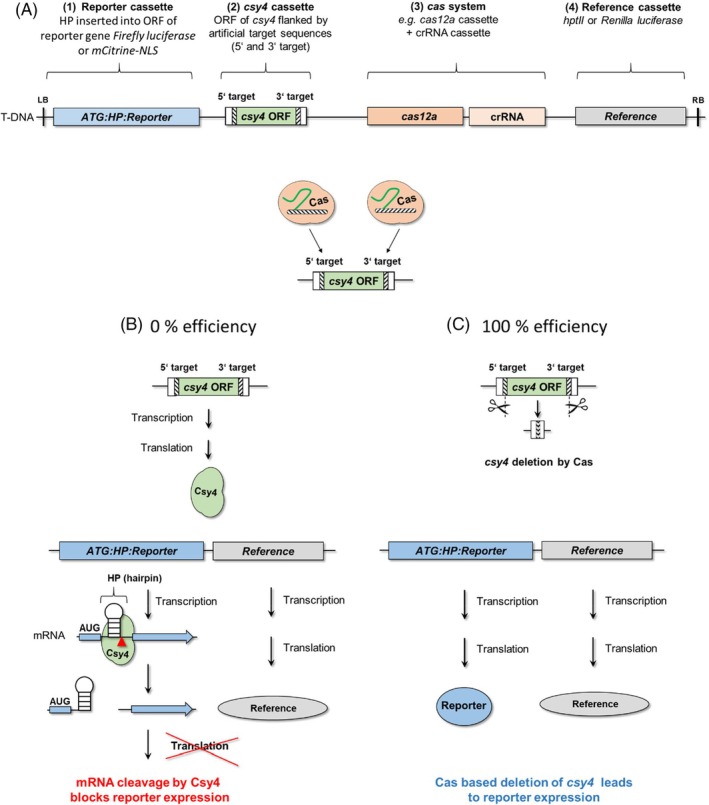
For the quantitative comparison of the efficiency of cas12a‐based genome editing systems in plants, we used two recently published reporter switch‐on assay systems that both facilitate quantitative side‐by‐side comparisons (Figure 1A and Bircheneder et al., 2024). Both assays are based on the endonuclease gene csy4 as target for Cas‐mediated deletion. To become a Cas‐deletion target, csy4 ORF was artificially flanked by target sequences addressed by the guide RNAs of the Cas endonucleases under study (Appendix S24 and S25). Csy4 abolishes the translation of the reporter, which was artificially turned into a Csy4 cleavage substrate (Figure 1B). Therefore, the successful loss‐of‐function of csy4 is detected via the consequential switch‐on activation of reporter gene expression, allowing indirect quantification of Cas‐mediated deletion events (Figure 1C). By using csy4 as target for deletion based on Cas, these assays can be used for comparative studies on various cas system components, independent of, and thus minimizing the impact of, any endogenous target gene. Here we used two variants of this quantitative assay system, based on two different reporter genes: (1) firefly luciferase, with Renilla luciferase as constitutively expressed reference gene for normalization (hereafter referred to as "Luciferase assay"). This combination was used in experiments based on transient transformation of Nicotiana leaves, Arabidopsis leaves and Lotus leaves (Figures 2, 3, 4, 5, 6 and 8; Figures S1 and S2). Firefly luciferase expression is sensitive to Csy4 activity, the ORF encoding it is deleted by Cas editing activity (Figure 1). (2) mCitrine encoding a fluorescent protein as reporter gene in combination with hygromycin phosphotransferase as reference gene in an assay based on the stable transformation of Lotus calli (hereafter called "Lotus callus assay") (Figure 3; Figure S1). By PCR analysis of the transformed plant tissue and Sanger sequencing of the PCR product it has been demonstrated that the loss‐of‐function effects observed are caused by full deletion (Figures S12 and S13; Bircheneder et al., 2024).
![Principle of the quantitative editing efficiency assay. (A) The assay, previously described by Bircheneder et al. (), is based on four components which are all located on the same T‐DNA: Reporter cassetteunder control of promoter,cassette targeting the reporter transcript,system fordeletion, and a reference gene for normalization or selection. The ORF ofis under control of promoterand is flanked by artificial target sequences (5′ and 3′ target). [2024] ATG:HP:Reporter LjUbi pro csy4 cas csy4 csy4 ACT2 pro (B) In the absence of Cas‐mediated editing, theORF is maintained and the endoribonuclease Csy4 is expressed. Csy4 recognizes a 28‐nucleotide repeat hairpin (HP) inserted between the start codon (ATG) and the remaining ORF of a reporter gene (). Csy4 cleaves the reporter mRNA at the inserted HP, thus preventing translation and therefore preventing reporter expression (Borchardt et al.,). csy4 ATG:HP:Reporter [2015] (C) Cas‐mediated deletion of(symbolised by scissors) stabilizes themRNA, enabling reporter expression. Thus, the reporter expression level can be taken as a proxy for the detection and quantification of Csy4 loss‐of‐function events. csy4 ATG:HP:Reporter](https://europepmc.org/articles/PMC12404786/bin/TPJ-123-0-g007.jpg "Click to view full size")
Principle of the quantitative editing efficiency assay. (A) The assay, previously described by Bircheneder et al. (), is based on four components which are all located on the same T‐DNA: Reporter cassetteunder control of promoter,cassette targeting the reporter transcript,system fordeletion, and a reference gene for normalization or selection. The ORF ofis under control of promoterand is flanked by artificial target sequences (5′ and 3′ target). [2024] ATG:HP:Reporter LjUbi pro csy4 cas csy4 csy4 ACT2 pro (B) In the absence of Cas‐mediated editing, theORF is maintained and the endoribonuclease Csy4 is expressed. Csy4 recognizes a 28‐nucleotide repeat hairpin (HP) inserted between the start codon (ATG) and the remaining ORF of a reporter gene (). Csy4 cleaves the reporter mRNA at the inserted HP, thus preventing translation and therefore preventing reporter expression (Borchardt et al.,). csy4 ATG:HP:Reporter [2015] (C) Cas‐mediated deletion of(symbolised by scissors) stabilizes themRNA, enabling reporter expression. Thus, the reporter expression level can be taken as a proxy for the detection and quantification of Csy4 loss‐of‐function events. csy4 ATG:HP:Reporter
Multiple components ofsystems influence editing efficiency cas
As expression‐enhancing effects could have a positive effect on editing efficiency, we tested and compared combinations of promoters and terminators (Ingelbrecht et al., 1989; Nagaya et al., 2010; Pérez‐González & Caro, 2018; Wang et al., 2015; Yang et al., 2009). Moreover, we tested the impact of introns, as in many eukaryotes, including plants, introns can increase the expression of transgenes (Shaul, 2017).
Cas‐induced DNA DSBs occur in the nucleus of eukaryotic cells, requiring Cas to be transported into the nucleus. As Cas proteins are of bacterial origin, they do not contain a nuclear localization signal (NLS). We therefore tested which NLSs and at what position attached to Cas12a affect the overall editing efficiency. We relied on a set of NLS variants which were investigated previously for their impact on the nuclear accumulation of NLS‐eGFP (Ray et al., 2015). Consequently, we evaluated the contribution of various components with regard to their influence on the genome editing efficiency of Cas12a systems.
RESULTS
Editing efficiency conferred by four re‐codedversions in,, and cas12a N. benthamiana A. thaliana L. japonicus ORF
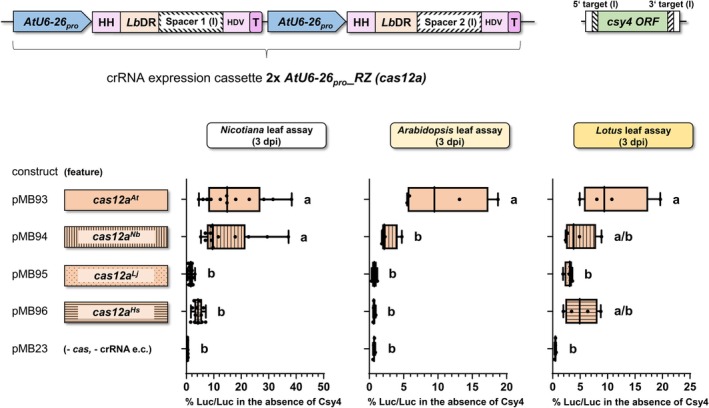
The cas12a gene is of eubacterial origin, but the Cas12a protein is frequently expressed in plant species for genome editing purposes. To improve expression in eukaryotes, cas12a is typically re‐coded using eukaryotic codon usage frequency tables. However, eukaryotes also differ in their codon usage frequencies. We therefore investigated whether re‐coding of cas12a adopting codon usage frequencies from four different eukaryotes has an effect on the editing efficiency in different plant species. We compared four versions of the cas12a gene with a re‐coded ORF based on the codon usage of Arabidopsis thaliana (At), Nicotiana benthamiana (Nb), Lotus japonicus (Lj), and human (Homo sapiens, Hs). For a quantitative comparison, the luciferase assay was performed in transiently transformed leaves of Nicotiana, Arabidopsis, or Lotus (Figure 2). To increase the comparability, we used the same promoter and terminator sequences for cas expression, as well as the same crRNA expression cassette (Figure S4). In all three transiently transformed plant species, the At re‐coded version performed best, with at least 50% higher efficiency than the next best version (Figure 2).

Influence of the codon usage inon editing efficiency. cas12a Efficiency ofsystems withre‐coded with adapted codon usage of(),(),(), and(). Quantification of firefly luciferase activity inleaf disc cells,leaf cells, andleaf cells, transformed with constructs including thecassette with Cas targets version (I). Note, the re‐codedwith adapted codon usage ofled to the highest relative firefly luciferase activity in all three plant species. For details of thesystems used see Figure . ORF, open reading frame;, expression cassette ofgene with() codon usage;,with() codon usage;,with() codon usage;,with human () codon usage; e.c., expression cassette; % Luc/Luc, firefly luciferase activity normalized toluciferase activity; one‐way ANOVA followed by Tukey test was performed for the whole data set; values with no significant difference to each other were grouped by letters (a, b). Values labeled with different letters are statistically significantly different. Values labeled with two letters are statistically not different to values with corresponding single letters. One‐way ANOVA: < 0.0001. cas12a cas12a Arabidopsis thaliana cas12a Nicotiana benthamiana cas12a Lotus japonicus cas12a Homo sapiens cas12a N. benthamiana A. thaliana L. japonicus csy4 cas12a A. thaliana cas cas12a cas12a A. thaliana At cas12a cas12a N. benthamiana Nb cas12a cas12a L. japonicus Lj cas12a cas12a Hs Renilla P At Nb Lj Hs At Nb Lj Hs S4
Editing efficiency of three differentexpression systems crRNA
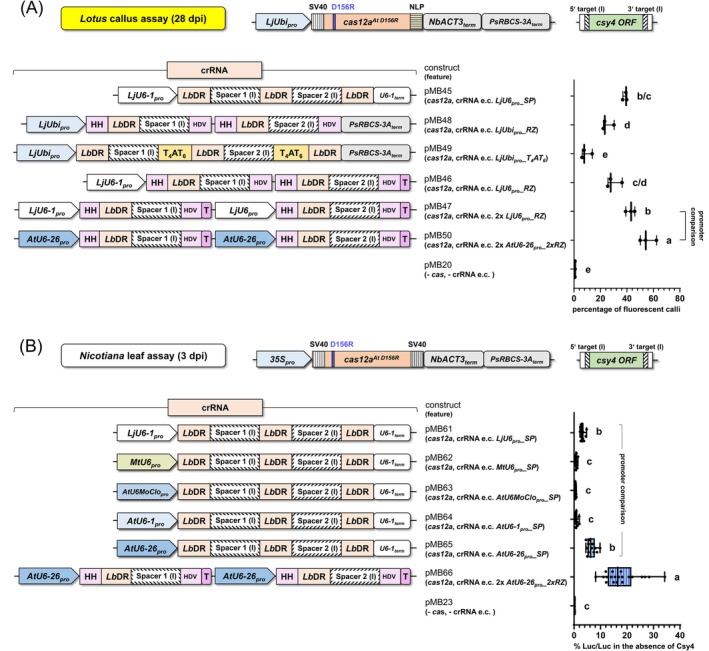
For full deletion of a gene of interest, Cas12a has to mediate two DSBs; therefore, requiring at least two crRNAs for two different target sequences. Three major systems for processing crRNA have been described (Bin Moon et al., 2018; Gao et al., 2018; Li et al., 2018; Tang et al., 2017; Wang et al., 2017, 2018; Zetsche et al., 2017; Zhang et al., 2021). First, a self‐processing (SP) crRNA expression cassette controlled by a RNA polymerase III promoter (Figure S3A) (Zetsche et al., 2017). Second, the T4AT6 crRNA expression cassette (Figure S3B), including an artificial T4AT6 overhang, is described to result in an increased editing efficiency (Bin Moon et al., 2018). The third crRNA processing system expresses a gRNA flanked by 2 distinct ribozymes (2xRZ) (Figure S3C), mediating precise intramolecular RNA cleavage (Ferré‐D'Amaré & Scott, 2010; Gao et al., 2018; Gao & Zhao, 2014; Tang et al., 2017). We investigated the influence of these three different crRNA expression systems and the impact of different RNA polymerase III promoters on the editing efficiency of a cas12a system (Figure 3A; Figures S1 and S6). We chose cas12a with A. thaliana codon usage carrying a D156R mutation, which is known to be temperature‐tolerant (cas12aAt D156R) (Schindele & Puchta, 2020). Although we did not observe a significant difference in editing efficiency (Figure S5), previous work has shown that this version can reduce the potential influence of the external factor temperature on editing efficiency in stable transgenic plant lines (Schindele & Puchta, 2020).
In the Lotus callus assay, the 2xRZ system 2x AtU6‐26pro_2xRZ (pMB50) led to a significantly higher editing efficiency (ratio of living fluorescent to non‐fluorescent calli; Figure 3A), revealing the potential of employing ribozymes for the preparation of the tailor‐made guide RNA.

Influence of different crRNA expression cassettes on editing efficiency. Efficiency of different crRNA expression cassettes (e.c.) in two different assay systems. (A) and (B) top line: Assay system andsystem components used. Expression ofwas driven byand the Cas12a protein was fused to a SV40 nuclear localization signal (NLS) at the N‐terminus and for (A) an NLP NLS and (B) an SV40 NLS at the C‐terminus. All constructs used carried the indicatedtarget sequence versions (I). For the comparison of these cassettes with the target sequence versions (II) see Figure . (A) Ratio of living fluorescent to non‐fluorescent calli after transformation ofhypocotyl cells. Note that the crRNA expression cassette in pMB50 led to the highest editing efficiency. (B) Quantification of firefly luciferase activity inleaf cells transformed with the indicated constructs. The SP crRNA expression system was used throughout this comparison. Note that in the single promoter set‐up ("promoter analysis") pMB65 featuring a singleled to the strongest relative firefly activity. Importantly, pMB66 in which two promoters in "2x" were utilized, led to a significantly higher editing efficiency than any of the single promoter crRNA cassettes. For a detailed description of the constructs see Figure ., Cauliflower mosaic virusgene promoter;,promoter; SV40, nuclear localization signal (NLS) of the Simian Virus 40; NLP, NLS from nucleoplasmin of;,() codon‐adaptedgene encoding the D156R replacement;expression cassettes (e.c.) with Spacer sequences (I) (Appendix ; Table );DR,bacterium () direct repeat; HH, hammerhead ribozyme; HDV, hepatitis delta virus ribozyme;,RNA polymerase III promoter;, RNA polymerase III promoter;, RNA polymerase III promoter;,RNA polymerase III promoter;,RNA polymerase III promoter; T, poly‐T; TAT, nucleotide sequence TTTTATTTTTT;,;,; % Luc/Luc, firefly luciferase activity normalized toluciferase activity; one‐way ANOVA followed by Tukey test was performed for the whole data set, and values with no significant difference to each other were grouped by letters (a–e). Values labeled with different letters are statistically significantly different. Values labeled with two letters are statistically not different to values with corresponding single letters. One‐way ANOVA: < 0.0001. cas cas12a LjUbi csy4 L. japonicus N. benthamiana AtU6‐26 AtU6‐26 _2xRZ (cas12a) 35S 35S RNA LjUbi Lotus japonicus polyubiquitin Xenopus laevis cas12a A. thaliana At cas12a crRNA Lb Lachnospiraceae Lb AtU6‐16 Arabidopsis thaliana (At) U6‐1 AtU6‐26 U6‐26 AtU6MoClo U6MoClo MtU6 Medicago truncatula (Mt) U6 LjU6‐1 Lotus japonicus (Lj) U6‐1 Ps Pisum sativum Nb Nicotiana benthamiana Renilla P pro pro pro pro pro pro pro pro pro pro 4 6 S1 S6 S1–S8 S4 At D156R
The impact of promoters drivingproduction crRNA
To further investigate the impact of different RNA polymerase III promoters on editing efficiency, we employed the luciferase assay in Nicotiana leaves (Figure 3B; Figure S6). By using the SP system, only AtU6‐26pro (pMB65; AtU6‐26pro_SP) led to a notable increase in editing efficiency. Furthermore, the activity could be nearly tripled by switching from this SP system with AtU6‐26pro to the 2xRZ system and using a double promoter system (pMB66; 2x AtU6‐26pro_2xRZ) (Figure 3B). Taken together, the highest editing efficiency could be achieved by using the A. thaliana RNA polymerase III promoter U6‐26 in a 2x AtU6‐26pro_2xRZ system (Figure 3A,B).
The influence of different Cas12a target sequence pairs
To evaluate whether the Cas12a target sequences have an additional influence on the editing efficiency, we compared two csy4 cassettes with different flanking target sequence pairs (I) or (II) (Figure 3A; Figure S1; Appendix S24 and S25). No statistically relevant difference could be detected (Figure S1) suggesting that the impact of the target sequences was below detection level in this particular set‐up.
The influence of different promoters and terminators controllingexpression cas12a
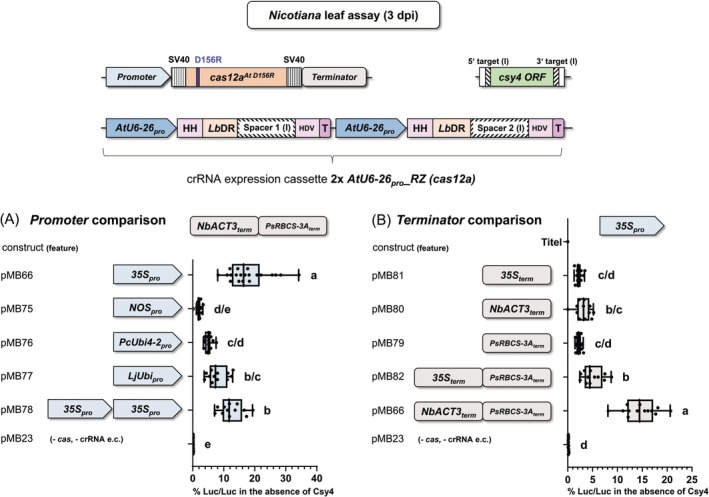
To investigate the influence of the expression level of the cas12a gene on editing efficiency, we compared different promoters and terminators using the Luciferase assay in Nicotiana leaves. For this, we used Cas12aAt D156R fused at both ends with a monopartite SV40 nuclear localization sequence of SV40 protein from simian virus (Kalderon et al., 1984). To increase the comparability, we used the same crRNA expression cassette (2x AtU6‐26pro_2xRZ (cas12a)) for all constructs (Figure S7); in the case of promoter comparison, the same tandem terminator (NbACT3term + PsRBCS‐3Aterm) for cas expression (Figure 4A) and the same promoter sequence (35Spro) for cas expression in the case of the terminator comparison (Figure 4B).
We compared the editing efficiency of cas systems controlled by promoters 35Spro, NOSpro, PcUbi4‐2pro, LjUbipro, and 2x 35Spro. The significantly highest activity was received with 35Spro, with approximately 50% more compared with the next best performing promoter, 2x 35Spro (Figure 4A).
A diverse set of terminators was utilized previously for cas12a expression, including 35Sterm (Bernabé‐Orts et al., 2019; Xu et al., 2017) and PsRBCS‐3Aterm (Schindele & Puchta, 2020), for which we compared their effect on cas12a‐based editing efficiency. Moreover, we included the terminator NbACT3term into the comparison. The activity observed for all these three systems was quite low. PsRBCS‐3Aterm and NbACT3term were not statistically different from 35Sterm (Figure 4B). However, when the single terminators were replaced by either of two alternative tandem terminator versions, the activity could be increased (Figure 4B). The by far strongest activity (fivefold higher than the 35Sterm) was obtained by using the tandem arrangement NbACT3term + PsRBCS‐3Aterm (pMB66). These results indicate that using a tandem terminator is more favorable for cas system improvement than a single terminator. This would align with prior studies showing that using a tandem terminator leads to significantly higher transgene expression, underscoring the critical role of transcription termination in gene regulation (Luo & Chen, 2007; Yamamoto et al., 2018). In summary, we conclude that the highest editing efficiency was achieved by expressing cas12a under the control of the 35Spro along with the tandem terminator NbACT3term + PsRBCS‐3Aterm.

Influence of different promoters and terminators on editing efficiency. (A, B) Comparison of a series of promoter and terminator combinations controlling the expression ofin the firefly luciferase assay inleaves. Quantification of firefly luciferase activity inleaf cells transformed with constructs including thecassette with Cas targets version (I). (A) Promoter comparison usingflanked by the promoters as indicated and the tandem terminators + . Relative firefly luciferase activity was strongest in the presence of(pMB66). (B) Terminator comparison usingflanked by the promoterand the terminator(s) as indicated. In combination with the, the tandem terminators + led to the highest editing efficiency. See Figure for additional details of the constructs used., Cauliflower mosaic virusgene promoter;,promoter;,promoter;promoter,terminator;,terminator; SV40, nuclear localization sequence (NLS) of the Simian Virus 40;,() codon‐usage‐adaptedgene encoding the D156R replacement; e.c., expression cassette; % Luc/Luc, firefly luciferase activity normalized toluciferase activity; one‐way ANOVA followed by Tukey test was performed for the whole data set, and values with no significant difference to each other were grouped by letters (a–e). Values labeled with different letters are statistically significantly different. Values labeled with two letters are statistically not different to values with corresponding single letters. One‐way ANOVA: < 0.0001. cas12a N. benthamiana N. benthamiana Csy4 cas12a NbACT3 PsRBCS‐3A 35S cas12a 35S 35Spro NbACT3 PsRBCS‐3A 35S 35S RNA LjUbi Lotus japonicus polyubiquitin NOS Nopaline synthase PcUbi4‐2 ; Petroselinum crispum Ubi4‐2 ; NbACT3 Nicotiana benthamiana (Nb) ACT3 PsRBCS‐3A Pisum sativum (Ps) RBCS‐3A cas12a A. thaliana At cas12a Renilla P At D156R At D156R At D156R At D156R term term pro pro term term pro pro pro pro term term S7
Two nuclear localization signals of SV40 flanking Cas12a are better than a single one
For editing of eukaryotic genomes, bacterial Cas endonucleases need to be transported to the nucleus. Therefore, NLSs fused to a Cas endonuclease have an impact on the transport of the systems into the nucleus and thus on the editing efficiency of the system (Grützner et al., 2021). To determine whether the position and number of NLS fusions to Cas12a have a quantitative impact on editing efficiency, we constructed cas12aAt D156R with no NLS fusion, with the monopartite NLS of SV40 fused only at the 5′ end, only at the 3′ end, or at both ends. By using SV40 NLSs flanking Cas12a at both termini (pMB28) we observed three‐ to sixfold higher activity than for a single SV40 NLS at either the N‐ or C‐terminus or no NLS (Figure S2), indicating that editing efficiency is highest when the Cas12a is flanked by NLSs on both ends. This is consistent with previous studies in which the highest editing efficiency in Arabidopsis (Develtere et al., 2024; Grützner et al., 2021) and delivery to the nuclei of mammalian cells (Cong et al., 2013) were obtained when Cas9 was flanked by NLSs at both ends.
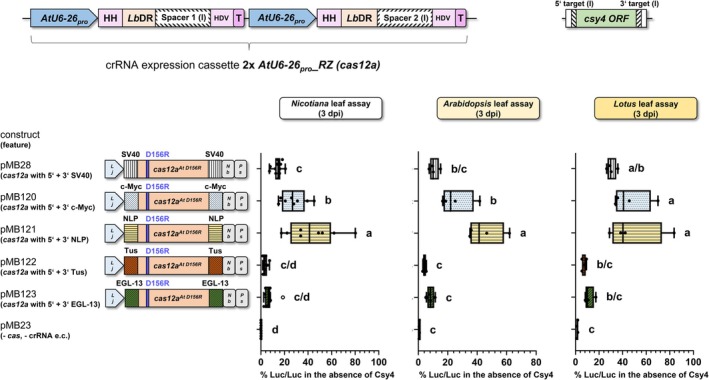
Nuclear localization signals: Highest editing efficiency achieved by flanking Cas12a withor c‐Myc NLP NLS NLS
We investigated the influence of different NLS variants flanking Cas12a on the editing efficiency of a Cas12a system. We compared the monopartite NLS of SV40 of the simian virus (Kalderon et al., 1984), the monopartite NLS of the human transcription factor c‐Myc (Dang & Lee, 1988) and the NLS of the replication terminator protein Tus of Escherichia coli, which despite being a bacterial protein was shown to function as an NLS in non‐bacterial systems (Kaczmarczyk et al., 2010). Moreover, the bipartite NLS of NLP, a nucleoplasmin of Xenopus laevis (Dingwall et al., 1988) and the putative bipartite NLS of the EGL‐13 protein of Caenorhabditis elegans (Lyssenko et al., 2007) were included in the comparison. NLP NLS and SV40 NLS were already used previously to localize Cas12a to the nucleus (Schindele & Puchta, 2020; Wang et al., 2017). For this quantitative analysis, the luciferase assay was utilized in leaves of Nicotiana, Arabidopsis, and Lotus (Figure 5). Usage of 5′ + 3′ NLP NLSs exhibits a significant increase in activity compared with 5′ + 3′ SV40 NLSs and 5′ + 3′ c‐Myc NLSs in Nicotiana and Arabidopsis, and a slight, non‐significant trend toward higher activity in Lotus (Figure 5). Taken together, nuclear localization signals of c‐Myc or NLP as nuclear localization signals flanking Cas12a at both ends can be chosen for improving Cas12a systems in Nicotiana, Arabidopsis, and Lotus. Our data are in line with Ray et al. (2015), demonstrating that the NLS of NLP and the NLS from c‐Myc led to the highest uptake of reporter‐cargo green fluorescent protein (GFP) in the nucleus of human cells.

Influence of NLS variants on editing efficiency. Impact of different nuclear localization signals (NLSs) flanking Cas12a on the firefly luciferase activity. Quantification of firefly luciferase activity in,, andleaf cells transformed with constructs including thecassette with Cas targets version (I). Note that relative firefly luciferase activity was highest when the open reading frame ofis fused to the NLSs of c‐Myc or NLP, at its 5′ and 3′ end, consistent with the nuclear localization mediated by these NLSs (Figure ). All constructs contained the same crRNA expression cassette () andexpression was controlled by the same promoter () and terminator ( ) sequences (Figures ,, and). A detailed description of thesystems used can be found in Figure . We adapted all NLSs tocodon usage; we used thesystem described above to compare SV40 NLS (Appendix ) with NLP NLS (Appendix ), c‐Myc NLS (Appendix ), Tus NLS (Appendix ), or EGL‐13 NLS (Appendix ).overon light gray background pentagon,promoter;,terminator;,terminator;,() codon‐adaptedgene encoding the D156R replacement; e.c., expression cassette; % Luc/Luc, firefly luciferase activity normalized toluciferase activity; one‐way ANOVA followed by Tukey test was performed for the whole data set; values with no significant difference to each other were grouped by letters (a–d). Values labeled with different letters are statistically significantly different. Values labeled with two letters are statistically not different to values with corresponding single letters. One‐way ANOVA: < 0.0001. N. benthamiana A. thaliana L. japonicus csy4 cas12a 2x AtU6‐26 _2xRZ (cas12a) cas12a LjUbi NbACT3 + PsRBCS‐3A cas12a Lotus japonicus cas L j Lotus japonicus polyubiquitin Nb Nicotiana benthamiana ACT3 Ps Pisum sativum RBCS‐3A cas12a A. thaliana At cas12a Renilla P At D156R At D156R 7 S2 S5 S8 S8 S19 S21 S20 S22 S23 pro pro term term
Editing efficiency was greatly enhanced by inserting introns into thetranscribed region cas12a
We generated the intronized variant cas12aAt D156R::introns by integrating 11 introns (i) from Arabidopsis genes in the coding region of cas12aAt D156R (Figure 6; Appendix S17). The intron sequences were based on cas9Zm::introns (Zea mays codon‐adapted cas9 gene from Streptococcus pyogenes) generated by Grützner et al. (2021) (Appendix S17 and S18). The introns were evenly spaced throughout the coding sequence (CDS) of cas12aAt D156R, with an average distance of 200–400 nucleotides. This version led to a drastic increase in editing efficiency compared with the intron‐free cas12aAt D156R both in Nicotiana and Arabidopsis leaves when Cas12a was fused with SV40 NLSs on the 5′ and 3′ end (Figure 6). This aligns with recent studies on cas12a intron variants, where 8 or 10 introns were introduced into the cas12aAt D156R sequence (Lawrenson et al., 2022; Schindele et al., 2023). These findings are generally consistent with those reported for intronized variants of cas9 (Grützner et al., 2021).

Influence of introns inon editing efficiency. cas12a Impact of intron presence inon genome editing efficiency determined by firefly luciferase activity. All constructs contained the same crRNA expression cassette (()) and the same promoter () and terminator ( ) sequences forexpression (Figure ; Figure ). Both encoded Cas12a versions were fused to SV40 (pMB66 and pMB103) nuclear localization sequences at their N‐ and C‐termini. Thecassette with Cas targets version (I) was used as the editing target. Firefly luciferase activity was quantified inorleaf cells. Relative firefly luciferase activity was highest withand the encoded Cas12afused to the nuclear localization signal of SV40 at its N‐ and C‐terminus. A detailed description of thesystems used can be found in Figure ., Cauliflower mosaic virusgene promoter; SV40, NLS of the Simian Virus 40; NLP, NLS from nucleoplasmin of,;,() codon‐adaptedgene encoding the D156R replacement, modifiedwith 11 introns; the added introns are represented by green bars; e.c., expression cassette; % Luc/Luc, firefly luciferase activity normalized toluciferase activity; one‐way ANOVA followed by Tukey test was performed for the whole data set, and values with no significant difference to each other were grouped by letters (a–c). Values labeled with different letters are statistically significantly different. Values labeled with two letters are statistically not different to values with corresponding single letters. One‐way ANOVA: < 0.0001. cas12a 2x AtU6‐26 _2xRZ cas12a 35S NbACT3 + PsRBCS‐3A cas csy4 N. benthamiana A. thaliana cas12a :: introns cas12a 35S 35S RNA Xenopus laevis; Ps Pisum sativum Nb, Nicotiana benthamiana; cas12a A. thaliana At cas12a ; cas12a ::introns cas12a Renilla P At D156R At D156R At D156R At D156R At D156R At D156R pro pro term term pro 6 S9 S9
NLS flanking the intron version ofgreatly increases the accumulation of Cas12a protein in the nucleus ofcells NLP cas12a Nicotiana
To investigate the influence of NLSs and introns on the nuclear accumulation of Cas12a proteins, we fused a series of Cas12aAt D156R variants flanked by different NLS versions (or as control flanked by none) with the green fluorescent protein (GFP) at the C‐terminus (Figure 7). Upon synthesis of these Cas12aAt D156R‐GFP fusions in N. benthamiana leaf cells, fluorescent nuclei were analyzed by confocal laser scanning microscopy (CLSM) (Figure 7). By using the intron‐free cas12a version without NLS (pMB135), no intranuclear GFP fluorescence could be detected, similar to the negative control lacking cas12a‐GFP (pMB131). A weak, perhaps intranuclear, GFP signal could be detected by using the intron version cas12aAt D156R::introns (pMB136), although fluorescence bleed‐through from the surrounding cytoplasm could not be excluded.
When the intron‐free cas12a version was flanked by sequences of SV40 NLSs, c‐Myc NLSs, or NLP NLSs, a slight increase in GFP fluorescence intensity could be observed, confirming the predicted role of NLSs for Cas12a uptake into the nucleus. When the intron‐free cas12a version was replaced by the intronized version cas12aAt D156R::introns, signal intensity could be further increased. The most intensive effect was achieved by flanking Cas12aAt D156R::introns at both the N‐ and the C‐terminus with NLP (pMB138), with a sevenfold fluorescence intensity increase compared with the intron‐free version with NLP (pMB134). When the localization of Cas12a‐GFP was examined in Nicotiana leaf cells, all versions of Cas12a with NLSs were observed in the karyoplasm, mainly accumulating in an intranuclear round structure that possibly represents the nucleolus (Figure 7B) indicating that the analysed fusion was primarily subjected to nucleolus‐ and not to nucleus‐localization. When using the intronized version of cas12a flanked by sequences of NLP NLSs (pMB138), a very high GFP fluorescence was measured (Figure 7A). Besides the accumulation in the potential nucleolus mentioned above (observed in 10 out of 12 nuclei), in approximately 16% of the analyzed nuclei (2 out of 12) the GFP fluorescence was additionally distributed over the entire karyoplasm with high intensity, so that the potential nucleolus was no longer recognizable as an accumulation site (Figure 7B). This signal distribution pattern was not observed in any other construct analyzed within this study. Taken together, we could confirm that NLSs flanking Cas12a at the N‐ and C‐terminus can mediate nuclear uptake of Cas12a and that the nucleolus appears to be the primary accumulation site for Cas12a:GFP fusions. In particular, NLP was key for achieving high Cas12a uptake. This effect could be further enhanced by using constructs with intronized cas12a variants.

Quantitative evaluation of nuclear localization of different versions of Cas12a‐GFP fusion protein. (A, B) GFP fluorescence intensity in nuclei ofleaf cells transformed with constructs includingfusions normalized to mCherry fluorescence intensity. Beside Cas12a‐GFP, all analyzed constructs contained SV40‐mCherry under control ofandon the same T‐DNA for normalization of GFP fluorescence. Three days after inoculation with, randomly selected fluorescent nuclei of leaf epidermal cells were imaged. Per construct, 12 randomly selected nuclei were analyzed. On T‐DNAs of used constructs,(pMB132, pMB133, pMB134, and pMB135) and the intronized version(pMB136, pMB137, and pMB138) are flanked with no or different nuclear localization sequences (NLSs). (B) Confocal laser scanning microscopy images of exemplary nuclei ofleaf cells 3 days post‐inoculation (dpi). GFP: Cas12a‐GFP variant indicated on top, mCherry: mCherry‐NLS as internal reference for nuclear localization and quantification. Note, Cas12a‐GFP, when detectable in the nucleus, accumulates mainly in a nuclear structure which could possibly be the nucleolus (n). Note that NLP‐Cas12a::i‐NLP‐GFP exhibited a very pronounced GFP fluorescence (a), which was in some cells (but not all) distributed over the entire karyoplasm, so that the potential nucleolus was no longer recognizable as an accumulation site. We adapted all NLSs tocodon usage as indicated by ();, Cauliflower mosaic virusgene promoter;,promoter;,() codon‐adaptedgene encoding the D156R replacement;, modifiedwith 11 introns (i), the added introns are represented by green bars; Ps,terminator;,;, gene of the green fluorescent protein; expression ofis controlled byand terminator; expression ofis controlled byand terminator; n, structure within nucleus, likely nucleolus; kp, karyoplasm; nm, nuclear membrane; scale bars represent 5 μm; one‐way ANOVA followed by Tukey test was performed for the whole data set, and values with no significant difference to each other were grouped by letters (a–c). Values labeled with different letters are statistically significantly different. Values labeled with two letters are statistically not different to values with corresponding single letters. One‐way ANOVA: < 0.0001. N. benthamiana cas12a‐GFP LjUbi NOS A. tumefaciens cas12a cas12a ::introns N. benthamiana Lotus japonicus Lj 35S 35S RNA LjUbi Lotus japonicus polyubiquitin cas12a A. thaliana At cas12a cas12a ::introns cas12a Pisum sativum RBCS‐3A NOS NOS GFP cas12a 35S PsRBCS‐3A mCherry LjUbi NOS P pro term pro pro term pro term pro term At D156R At D156R At D156R At D156R At D156R
can compete within terms of editing efficiency cas12a::introns cas9::introns
We compared the performance of intronized cas12aAt D156R::introns with a published cas9 intron variant (cas9Zm::introns) (Grützner et al., 2021). To increase the comparability, we used the same promoter and terminator sequences for cas expression and both Cas proteins were fused at both ends with a SV40 NLS (Figure 8; Figure S10). Furthermore, we could use the identical target cassette, as the artificial 5′ and 3′ target sequences flanking the ORF of csy4 both contained a cas9 PAM as well as a cas12a PAM (Bircheneder et al., 2024). The expression of the "2x AtU6‐26pro_2xRZ (cas12a)" crRNA expression cassette (Figure S10) and the cas9 sgRNA expression cassette (Figure S10; Appendix S9) was driven by the A. thaliana RNA polymerase III promoter U6‐26. However, two differences between the compared systems should be highlighted: (1) cas12aAt D156R::introns was re‐coded based on Arabidopsis codon usage, while cas9Zm::introns, employs Zea mays codon usage. (2) The sequences of cas9Zm::introns and cas12aAt D156R::introns contain 13 and 11 introns, respectively. We observed no significant difference in editing efficiency between these two cas systems (Figure 8).

Comparison of aand asystem. cas12a cas9 Efficiency of aand a comparablesystem in the firefly luciferase assay. Quantification of firefly luciferase activity inleaf disc cells transformed with constructs including thecassette with Cas targets version (I). % Luc/Luc, firefly luciferase activity normalized toluciferase activity. Significance of luciferase activity from pMB104 was tested against pMB103. Note, thesystem led to a slightly but not significantly higher firefly luciferase activity than thesystem. This difference may be bigger, as some of the pMB103 data points was already above the 100% mark. A detailed description of thesystems used can be found in Figure ., Cauliflower mosaic virusgene promoter; SV40, nuclear localization signal of the Simian Virus 40;,;,,() codon‐adaptedgene encoding the D156R replacement and 11 introns;,codon‐adaptedgene from() with added 13 introns (i); the added introns are represented by green bars,xpression of theversions used is controlled by the promoterand the tandem terminators + . One‐way ANOVA followed by Tukey test was performed for the whole data set; values with no significant difference to each other were grouped by letters (a, b). Values labeled with different letters are statistically significantly different. Values labeled with two letters are statistically not different to values with corresponding single letters. One‐way ANOVA: < 0.0001. cas12a cas9 N. benthamiana csy4 Renilla cas12a cas9 cas 35Spro 35S RNA Ps Pisum sativum Nb Nicotiana benthamiana; cas12a ::introns A. thaliana At cas12a cas9 ::introns Zea mays cas9 Streptococcus pyogenes Sp e cas 35S NbACT3 PsRBCS‐3A P S10 At D156R Zm pro term term
DISCUSSION
Multiple variables enable improvement of genome editing tools in plants
To improve the editing efficiency of cas12a‐based systems, we compared cas12a re‐coded versions, the impact of promoters and terminators controlling cas12a expression, and the addition of introns into the cas12a ORF. Importantly, we also investigated the influence of modifications of the crRNA expression cassette. Our results revealed significant effects across the features analyzed. The strongest differences were obtained by codon usage (with a difference of approximately sevenfold between strongest and weakest performer; Figure 2), by the cas12a promoter (difference of around eightfold between strongest 35Spro and weakest NOSpro; Figure 4A), by the terminator (difference of around fivefold between strongest tandem terminator NbACT3:PsRBC‐3Aterm and the weakest 35Sterm; Figure 4B), and by Cas12a fusions with eukaryotic NLS (difference of around 10‐fold between weakest NLS of Tus from E. coli and strongest NLS of NLP; Figure 5). Perhaps, the strongest increase was observed upon the addition of 11 introns into cas12a, leading to an approximately fivefold difference between otherwise identical constructs (pMB66 vs. pMB103; Figure 6). This effect is likely due to enhanced gene expression (Shaul, 2017). Additionally, the presence of introns may help to mitigate transgene silencing (Christie et al., 2011). Our data thus reveal a high potential for improving cas12a‐based editing efficiency by adjustments to all of these relevant features. However, as we could only test a small number of variants for each of the features, even better‐performing constructs are possible. So far, our construct designs have been used by three different laboratories to edit at least 14 Lotus genes, resulting in the successful production of corresponding L. japonicus mutant lines. Among these, we generated a line carrying a deletion of the entire coding region plus introns of the Lotus japonicus NIN (Nodule Inception) gene. NIN is a transcription factor essential for root nodule symbiosis (Schauser et al., 1999). While the genetic and phenotypic characterization of these lines is outside the scope of this work, their successful generation demonstrates that our cas12a systems are in principle applicable for the production of genome‐edited plants.
Impact of theexpression cassette crRNA
To maximize the editing efficiency of the cas12a system, it is crucial to ensure adequate expression of both cas genes and crRNA. Research on cas9 systems has demonstrated that maintaining an optimal ratio between Cas9 proteins and sgRNAs is vital for efficient genome editing (Dahlman et al., 2015). Higher Cas9 levels have been associated with diminished specificity and lower efficiency at target sites (Fu et al., 2013). An excess of Cas proteins without sufficient sgRNA can result in non‐productive or off‐target interactions, thereby diminishing editing efficiency (Dahlman et al., 2015). Overexpression of cas9 has been associated with cellular toxicity, largely due to increased DNA breaks and non‐specific interactions. The resulting stress response can activate repair mechanisms that interfere with the intended genetic modifications (Enache et al., 2020).
The original SP crRNA expression system described by Zetsche et al. (2015) for use with Cas12 has undergone extensive modifications in the scientific community (Gao et al., 2018; Tang et al., 2017; Wang et al., 2017; Zhang et al., 2021). These alterations primarily aim to allow the simultaneous expression of multiple crRNAs and enhance overall editing efficiency.
We observed that the promoters regulating the crRNA expression cassette and their arrangement are key factors. Editing efficiency in the ribozyme system 2xRZ was improved when each crRNA was controlled by individual promoters, rather than a single promoter driving both crRNAs (Figure 3A). However, using the RNA polymerase II promoter LjUbipro instead of the RNA polymerase III promoter LjU6pro led to no significant difference in editing efficiency (Figure 3A). This contrasts with previous findings, where a RNA polymerase II promoter, ZmUbipro, regulating a ribozyme system achieved the highest editing efficiency (Zhang et al., 2021). However, this variation may be attributed to the use of promoters of different plant systems. Additionally, in contrast to our work, Zhang et al. (2021) also incorporated a poly‐T sequence before the terminator of all compared constructs. The importance of promoter choice for editing efficiency was also underlined by our finding that significant improvement of the editing efficiency could be achieved by replacing different RNA polymerase III promoters with the RNA Polymerase III AtU6‐26pro (Figure 3A,B). The 2xRZ system was observed to be the best performing system when using the Lotus callus assay (Figure 3A) and the luciferase assay in N. benthamiana (Figure 3B).
We exclusively employed constitutively active promoters. Since it has been shown that germline‐specific promoters can increase the editing efficiency for Cas9‐based stable knockouts, it would be interesting to include germline‐specific promoters in attempts to increase Cas12a‐based genome editing efficiency even further (Ursache et al., 2021; Wang et al., 2015).
dependent Cas12a accumulation in the nucleus NLS
As genome editing is happening in the nucleus, we examined the nuclear accumulation of Cas12a‐GFP variants (Figure 7). We identified a correlation between the localization of Cas12a flanked by different NLSs in the nucleus and the editing efficiency of the associated cas system (Figures 5 and 7).
However, the condensed fluorescence in an intranuclear sub‐compartment (Figure 7B), potentially the nucleolus, needs attention, as it potentially removes a large percentage of the Cas12a from the location of the genomic DNA, the nucleoplasm. What drives this local accumulation remains to be determined. The intrinsic affinity of Cas12a to RNA might play a role, as ribosome assembly including ribosomal RNA is concentrated in the nucleolus. If this sequestration of Cas12a into a subcompartment of the nucleus is indeed a general phenomenon, it should be taken into account when aiming for balanced expression levels between Cas12a and the crRNAs in the nucleoplasm.
EXPERIMENTAL PROCEDURES
Constructs andvariants cas12a
A detailed description of constructs is provided in Table S2. Constructs were generated by the Golden Gate cloning system according to Binder et al. (2014) and per the procedure described in Bircheneder et al. (2024). The Cas12a protein sequence from Lachnospiraceae bacterium ND2006 (Zetsche et al., 2015) was used as a template for independent codon usage adaptations. A plasmid containing cas12aAt D156R sequence (Schindele & Puchta, 2020) was provided by H. Puchta, Botanical Institute, Karlsruhe Institute of Technology, Karlsruhe, Germany. cas12aAt was generated from cas12aAt D156R by removing the D156R mutation by PCR‐based cloning (for primers see Table S3). The cas9Zm::introns sequence (Grützner et al., 2021) was provided by S. Marillonnet and the cas12aNb sequence was provided by T. Schreiber, both Leibniz Institute of Plant Biochemistry, Halle (Saale), Germany. The cas12aHs sequence was derived from plasmid pY016 (pcDNA3.1‐hLbCpf1) (Addgene plasmid #69988, Zetsche et al., 2015). To generate cas12aLj, the cas12a gene sequence was adapted to the codon usage specific to Lotus japonicus based on the Cas12a amino acid sequence using the Eurofins MWG software. The sequence cas12aAt D156R::introns was designed following a similar approach to a recently described protocol creating cas9Zm::introns (Grützner et al., 2021). A total of 11 introns (Appendix S17 and S18) were integrated into the sequence cas12aAt D156R (for primers see Table S3). For optimizing the splicing efficiency, the NetGene2 intron splice site prediction tool (https://services.healthtech.dtu.dk/services/NetGene2‐2.42/↗) (Hebsgaard et al., 1996) was used to determine the order of the intron sequences used. Level III plasmids can be ordered from the European Plasmid Repository.
expression cassette assembly crRNA
To introduce spacer sequences (Table S4) into the crRNA and sgRNA expression cassettes (for annotated sequences see Appendix S1, S2, S3, S4, S5, S6, S7, S8, and S9), it was proceeded as described in Bircheneder et al. (2024). For the corresponding general oligonucleotide template, see Appendix S10, S11, S12, S13, S14, and S15. For constructs used, see Table S2.
Generation of transgeniccalli Lotus japonicus
For performance of the assay with fluorescent protein reporter, transgenic Lotus japonicus ecotype Gifu (wild‐type, accession B‐129) (Handberg & Stougaard, 1992) was used. The Agrobacterium tumefaciens‐mediated transformation of L. japonicus cells was based on a published procedure (Tirichine et al., 2005) with modifications as described in Bircheneder et al. (2024).
Cultivation and transient transformation of,, andleaf cells N. benthamiana A. thaliana L. japonicus
Cultivation of N. benthamiana and infiltration of leaves with A. tumefaciens AGL1 was performed as previously described (Cerri et al., 2012), but with modifications described in Bircheneder et al. (2024).
For direct comparison of the same cas system in different plants (Figures 2, 5, and 6) a uniform transformation protocol described by Zhang et al. (2020) was applied and tested (Figure S11) with minor modifications for Lotus japonicus ecotype Gifu (wild‐type, accession B‐129) (Handberg & Stougaard, 1992) and A. thaliana ecotype Columbia‐0 (Col‐0). Arabidopsis plants were grown in a greenhouse for 14 days under a 16‐h photoperiod. Preparation and cultivation of Lotus japonicus were performed as previously described (Gong et al., 2022) with the modification of transferring the seedlings after 5 days in the phytochamber to B5 medium with vitamins and sucrose (20 g/L) (Stiller et al., 1997), solidified with 0.8% Bacto™ agar (Becton Dickinson and Co.), followed by 7 days under the same light conditions.
For transient transformation of plant leaf cells, A. tumefaciens strain AGL1 (Lazo et al., 1991) was transformed with desired plasmids. Plant leaf cells were infiltrated with A. tumefaciens as previously described (Zhang et al., 2020). The same infiltration method was also applied for L. japonicus with minor modifications. Infiltration buffer contained Silwet L‐77 in different concentrations (A. thaliana: 0.005%; L. japonicus: 0.001%). For A. thaliana, the two largest leaves and for L. japonicus one leaf (comprising three leaflets each) per plant were chosen, and the infiltration solution was infiltrated into the underside of the plant leaves with a 1 mL plastic syringe. After infiltration, the leaves were dried in the light for 1 h and kept in the dark for 24 h at 22°C. Subsequently, the A. thaliana plants were moved to the greenhouse under a 16 h/8 h light/dark regime for 48 h, and the L. japonicus plants were transferred to square plates containing B5 medium with vitamins, solidified with 0.8% Bacto™ agar (Becton Dickinson and Co.). The plates were sealed with parafilm and placed in a climate chamber (MLR‐352H‐PE, Panasonic) at 22°C under a 16 h/8 h light/dark regime (50 μmol m−2 sec−1) for 48 h.
Quantification of luciferase activity
For the quantification of luciferase reporter gene expression and normalization against Renilla luciferase reference gene in Nicotiana leaves, the Dual‐Luciferase® Reporter Assay System (Promega, E1910, www.promega.de↗) was applied with modifications described in Bircheneder et al. (2024).
For the quantification of luciferase reporter gene expression in A. thaliana, four leaves of different plants were pooled (approximately 150 mg of tissue) and in the case of L. japonicus, eight leaves (comprising three leaflets each) of different plants were pooled (approximately 150 mg of tissue). In total, four samples of pooled leaves of L. japonicus and A. thaliana were analyzed in at least two independent experiments. The plant material was immediately frozen in liquid nitrogen after harvesting and kept frozen. The frozen samples were ground using a mortar and pestle.
Firefly luciferase activity in the complete absence of Csy4 (‐ csy4) represents the maximum value that can be achieved by deletion of csy4 mediated by Cas. Therefore, the median of the firefly luciferase activity normalized against reference gene Renilla luciferase in leaf cells transformed with control lacking a cas system and csy4 is set as 100% (pMB24; ‐ cas, ‐ csy4).
Quantification of fluorescence in thecallus assay Lotus
Quantification of fluorescence in the Lotus callus assay and selection against hygromycine phosphotransferase II was performed as described by Bircheneder et al. (2024).
Confirmation of full deletions ofby Cas csy4 ORF
To confirm full deletion of the ORF of csy4 (Δcsy4) by PCR, primer pair pro_FW/term_Rev (Table S3), flanking the 5′ and 3′ target sequences within the csy4 expression cassette (Appendix S24 and S25) was used with genomic DNA as template, as described in Bircheneder et al. (2024). Successful deletion was detected by the presence of bands equivalent in size to Δcsy4 bands (Figure S12). Constructs harboring csy4 but lacking a cas system (‐ cas; pMB20, pMB21, and pMB23) served as controls (Figure S12). Constructs pMB20 (with target sequence versions (I)) and pMB21 (with target sequence versions (II)) contain hptII reference gene and mCitrine reporter gene for Lotus callus assay. Construct pMB23 contains Renilla luciferase reference gene and Firefly luciferase reporter gene for Nicotiana leaf assay. To confirm that the bands derived from the loss of the ORF of csy4, they were cut out of the gel, purified from agarose and buffer, and ligated into Golden Gate backbone BB3. The plasmid was amplified in E. coli, and the insert was sequenced by Sanger sequencing using the primer pro_FW (Table S3; Figure S13).
Microscopy
For the quantification of Cas12a‐GFP in the nucleus of Nicotiana leaf cells, confocal laser scanning microscopy (CLSM) was performed with an upright Leica TCS SP5 confocal laser scanning microscope. Randomly selected fluorescent nuclei of N. benthamiana leaf epidermal cells were imaged with an HCX IRAPO L25x/0.95 water objective. For image acquisition, the resolution was set to 1024 × 1024 pixels at the speed of 400 Hz and the frame average to 4. Section thickness was 1.47 μm. Pinhole was 1 PAU. Using the argon laser at 20% power, GFP was excited with the 488 nm laser line and detected at 500–530 nm, and mCherry was excited with a diode‐pumped solid‐state (DPSS) laser at 561 nm and detected at 580–620 nm at 20% power. For multicolor imaging, the frame sequential scan mode was used. The region of interest for image analysis was fully located within the nucleus, including the structure probably representing the nucleolus. Images were processed, and the mean fluorescence level within a single ROI was determined with ImageJ (Schindelin et al., 2012; Schneider et al., 2012).
Data visualization and statistical analysis
Statistical analysis of data were performed using GraphPad Prism version 9.5.1 for Windows (GraphPad Software, San Diego, California USA, www.graphpad.com↗). The same software was used for data visualization. All data were visualized in a Tukey box plot. Bold black line, median; box, interquartile range (IQR); whiskers, lowest/highest data point within 1.5 times the IQR.
AUTHOR CONTRIBUTIONS
Plasmid design and construction, quantitative performance tests in plants as well as all other experimental work described were performed by Martin Bircheneder. Martin Parniske conceived the research project and edited the manuscript; which was written by Martin Bircheneder.
CONFLICT OF INTEREST
There are no financial conflicts of interest to disclose.