
What this is
- This research investigates the relationship between coffee consumption and () in individuals with ().
- It includes 436 participants diagnosed with schizophrenia spectrum disorders and affective disorders from the Norwegian TOP study.
- Findings reveal an inverted J-shape association between coffee intake and , suggesting moderate consumption may benefit cellular ageing.
Essence
- Moderate coffee consumption (3-4 cups/day) is linked to longer telomeres in patients with , equating to a biological age 5 years younger compared to non-drinkers.
Key takeaways
- An inverted J-shape association exists between coffee intake and , peaking at 3-4 cups/day. Beyond this, declines.
- Patients consuming coffee within the recommended limit show longer telomeres compared to non-drinkers, indicating potential protective effects against cellular ageing.
- The study underscores the importance of monitoring coffee consumption in individuals with to avoid exceeding the recommended daily intake.
Caveats
- Self-reported coffee consumption data may not accurately reflect actual intake, lacking details on coffee type and timing.
- The study's cross-sectional design limits the ability to infer causality between coffee consumption and .
- Only one biological ageing marker () was assessed, which may not fully capture the effects of coffee on ageing.
Definitions
- telomere length (TL): The length of telomeres, protective structures at the ends of chromosomes, which shorten with cellular division and are indicators of biological age.
- severe mental disorders (SMD): A category of mental health conditions, including schizophrenia and affective disorders, often associated with significant impairment and reduced lifespan.
Simplified
Introduction
Individuals with severe mental disorders (SMD) tend to have a lifespan 15 years shorter than their unaffected peers.1 This premature mortality is linked to a higher incidence of somatic diseases, such as cardiovascular diseases and certain forms of cancer,2 3 conditions often associated with advanced chronological age. To that end, researchers have proposed a potentially accelerated rate of ageing being present in patients with SMD, indexed throughout research by variations in telomere length (TL).4
Telomeres are structures located on the ends of human chromosomes, made of repeating TTAGGG nucleotides,5 whose role is to guard DNA during replication. Despite telomere attrition being universal, contemporary research has reported shorter TL in both patients with schizophrenia (SZ)6 7 and bipolar disorder,8 9 compared with unaffected age-matched peers. Despite reporting shorter telomeres in SMD, researchers still do not fully understand the aetiology of the cellular differences between these two groups. Due to telomeres being sensitive to environmental factors,10 one avenue of research has been exploring how diet may have an impact on telomere biology.11 This paper will focus on examining one widely consumed dietary component—coffee.
Coffee has become one of the most widely and frequently consumed beverages across many parts of the world. Epidemiological reviews have indicated that during the 2021/22 period, an estimated 10.56 billion kilograms of coffee were consumed worldwide.12 A review of coffee consumption using the UK Biobank indicated that of the 468 629 participants, 77.9% drank coffee, with 19.5% drinking upwards of three cups per day.13
Coffee has been suggested to confer several physiological health benefits, such as improving cognitive acuity,14 lowering the prevalence of neurodegenerative disease,15 reducing risk of obesity, metabolic syndrome or type 2 diabetes, lowering the prevalence of several types of cancer, as well as reducing the risk of all-cause mortality.16 However, despite these potentially positive physiological effects, according to several international health authorities, such as the US Food and Drug Administration and the UK National Health Service, it is recommended that individuals do not consume more than 400 mg of caffeine per day,17 18 equating to a maximum of approximately four cups of coffee. More than four cups per day may have negative effects on physical health. As shown in a review paper by Gardiner et al,19 coffee consumption may reduce sleep time by 45 min as well as reduce sleep efficiency, and the consumption of more than five cups a day has been linked to an increased risk of panic attacks in vulnerable individuals.20 Excessive coffee drinking has been noted as a risk factor for several physical health issues, with consumption above the recommended dose causing symptoms such as insomnia, increased urination, gastrointestinal disorders, muscle tremors, irritability, arrhythmia and flight of ideas.15 Individuals with hypertension, children, adolescents and the elderly may be more vulnerable to the side effects of caffeine consumption21 and are recommended to have lower daily doses than healthy adults.
Contemporary public health research has started to explore the impact coffee consumption may have on other biological processes, such as telomere shortening. Studies of coffee consumption and TL in the general population have provided mixed results, with some indicating a negative association, particularly for instant coffee.22 However, other studies have suggested a potential protective effect of coffee consumption on TL,23 largely stemming from the proposed antioxidant qualities that coffee may possess.24
There exists limited research on such behaviours in individuals with SMD; however, studies have indicated that individuals with psychiatric disorders ingest significantly higher caffeine levels compared with healthy controls.25 Further differences have been found between different disorders, with some studies noting that individuals with bipolar disorder were found to drink more coffee compared with those with SZ, with both psychiatric cohorts ingesting more coffee compared with healthy controls.26 Moreover, coffee drinking may be exacerbated by smoking, due to the increased metabolism of caffeine stimulated by nicotine,27 with higher rates of smoking being noted in individuals with SMD compared with unaffected controls.28
However, despite evidence suggesting a faster rate of telomere attrition in SMD, as well as overall higher reported rates of coffee consumption and smoking in psychiatric populations, there is a lack of literature examining such an association. To our knowledge, this is the first study in the literature to investigate the association between coffee consumption and TL in people with SZ or affective disorders. Considering previous research in the general population, we anticipate that moderate coffee consumption will be associated with having longer TL, adjusting for confounders.
Methods
Participants
The study encompassed 436 participants (schizophrenia spectrum (SZ; n=259) and affective disorders (bipolar type 1=114, type II=39, bipolar not otherwise specified (NOS)=8, and major depressive disorder with psychosis=16, n=177)), selected from the Norwegian Thematically Organised Psychosis (TOP) study, collected between 2007 and 2018.29 Participants were recruited from four psychiatric units across Oslo, Norway. Participants were excluded based on the following criteria: age outside the 18–65 range, not fluent in Norwegian, having a current or past organic psychosis, a history of moderate or severe head trauma, or a somatic disease interfering with brain functioning. All participants provided informed consent. The current study cohort is a subsample of the larger TOP cohort, excluding participants based on available telomere and coffee consumption data (for a further breakdown see online supplemental figure S1).
Clinical assessment
Patient diagnoses were assessed using the Structured Clinical Interview for DSM-IV (SCID-I, chapters A–E).30 The assessments were administered by trained physicians, psychiatrists and clinical psychologists, all of whom underwent clinical training based on the SCID 101 training programme from University of California Los Angeles (UCLA).31 Overall, the assessment team inter-rater reliability score was between 0.92 and 0.99, proving satisfactory.
Reviews of medical records provided information regarding the daily defined dose (DDD) of psychotropic medication participants were receiving at the time. Information regarding current coffee use was gathered through clinical interviews, by asking participants about how much coffee they currently consumed each day (eg, How much coffee do you currently drink per day?). Four response choices were available: zero, 1–2 cups, 3–4 cups, and ≥5 cups. Similarly, clinical interviews aimed to establish smoking habits by asking participants whether they smoked, and if yes, how many years they had been smoking.
Telomere length
Telomere length, collected from peripheral blood leucocytes, was assessed in all participants using a quantitative real-time polymerase chain reaction (qPCR).6 32 The analysis was carried out on a 384-well plate Applied Biosystems 7900HT Fast Real Time qPCR, beginning with 10 ng of extracted leucocyte DNA being combined with 5 µl of SYBRGreen JumpStart Taq Ready Mix and 0.25 µl of ROX reference dye. The primers used for the telomeric reaction included: 300 nM TelA (5′-CGG TTT GTT TGG GTT TGG GTT TGG GTT TGG GTT TGG GTT-3′) and 900 nM TelB (5′-GGC TTG CCT TAC CCT TAC CCT TAC CCT TAC CCT TAC CCT-3′). The primers used for the single copy gene (36B4) were: 200 nM 36B4F (5′- CAG CAA GTG GGA AGG TGT AAT CC 3′) and 400 nM 36B4R (5′-CCC ATT CTA TCA ACG GGT ACA A-3′). In addition, three pre-measured DNA samples (10.4 kb, 3.9 kb and 2 kb) were run alongside the study reaction as a control batch. Inconclusive samples as well as outliers (top and bottom 5%) were re-analysed. Analyses of variation coefficients in the study sample noted an intra-assay coefficient of 6.07% and an inter-assay coefficient of 6.08%. Overall, the qPCR provided researchers with a telomere to single copy gene ratio (T/S ratio). This was used to estimate mean telomere length, with smaller T/S ratios indicating shorter mean telomere length. All blood samples used in the study were stored in The Biobank, Oslo, Norway.
In addition to the qPCR analysis which yielded the T/S ratio, the authors estimated differences in base pair attrition. This was carried out using the suggested average of 70 base-pair reductions per year as a quantitative estimate of years of accelerated ageing.33 In order to estimate TL attrition, authors subtracted the base pair difference between different groups (eg, coffee drinkers − non-drinkers) and divided the difference by 70. This provided them with an estimate of years of accelerated ageing.
Statistical analysis
All statistical analyses were performed using IBM SPSS (Statistical Package for the Social Sciences) software, version 29 (SPSS Inc, Chicago, IL, USA). For categorical variables (sex, ethnicity, coffee consumption), χ2 tests were used to compare distribution between the coffee drinking groups. The remaining comparisons were performed using an analysis of covariance (ANCOVA). The study only included participants with complete datasets. Any missing data are highlighted in table 1.
To investigate differences in TL between groups (1 = 'no coffee consumption', n=44; 2 = 'one to two cups per day', n=117; 3 = 'three to four cups per day", n=110; or 4 = 'five cups or more per day', n=133), we performed ANCOVAs adjusting for age, sex, ethnicity, years of tobacco use and medication use (DDD of lithium, antidepressants, mood stabilisers and antipsychotics) with Bonferroni post hoc corrections. Due to a skewed distribution, TL values were log-transformed. Sensitivity analyses were performed, adjusting for diagnostic group status as well as comparing non-coffee drinkers and those drinking 1–4 cups per day, adjusted for confounders (see above).
Lastly, in order to assess whether the relationship between coffee consumption and telomere length differed by sex or diagnosis, an interaction analysis was conducted using ANCOVA. Coffee consumption and sex were included as fixed factors, while age, ethnicity, medication DDD, years of smoking and diagnosis were included as covariates. The same process was repeated for the diagnostic group, adjusting for age, sex, ethnicity, medication DDD and years of smoking. The models tested the main effects and the coffee×sex and coffee×diagnosis interactions.
| Variable | No coffee(n=51) | 1–2 cups/day(n=123) | 3–4 cups/day(n=118) | 5+ cups/day(n=144) | Statistics | Post hoc test |
|---|---|---|---|---|---|---|
| Age (years), mean (SD) | 26.35 (9.21) | 27.85 (8.72) | 30.44 (11.01) | 31.81 (9.87) | F=5.86, p<0.001 | 5+ cups > no coffee, 1–2 cups |
| Sex | ||||||
| Male, n (%) | 27 (52.9%) | 71 (57.7%) | 61 (51.7%) | 79 (54.8%) | χ= 0.95, p=0.812 | – |
| Ethnicity | ||||||
| European, n (%) | 39 (76.5%) | 88 (71.5%) | 97 (82.2%) | 134 (93.1%) | χ= 22.19, p<0.0012 | European < non-European |
| Psychiatric diagnosis | ||||||
| Schizophrenia, n (%)Affective disorder, n (%) | 22 (8.5)29 (16.4) | 74 (28.6)49 (27.7) | 69 (26.6)49 (27.7) | 94 (36.3)50 (28.2) | χ= 7.73, p=0.052 | Schizophrenia < affective disorder |
| Telomere length (T/S ratio), mean (SE) | 1.06 (0.04) | 1.09 (0.02) | 1.16 (0.02) | 1.15 (0.02) | F=3.02, p=0.03 | – |
| Duration of smoking, mean (SD) | 4.40 (6.29) | 7.05 (7.59) | 7.68 (8.06) | 13.30 (9.77) | F=20.99, p<0.001 | 5+ cups > no coffee, 1–2 cups, 3–4 cups |
| Lithium dose (mg/day), mean (SD) | 0.10 (0.32) | 0.10 (0.31) | 0.14 (0.42) | 0.05 (0.26) | F=1.19, p=0.31 | – |
| Antipsychotic dose (mg/day), mean (SD) | 0.49 (0.65) | 2.02 (6.45) | 1.24 (2.77) | 1.64 (3.41) | F=1.59, p=0.19 | – |
| Antidepressant dose (mg/day), mean (SD) | 0.29 (0.77) | 0.45 (1.05) | 0.45 (0.85) | 0.43 (0.89) | F=0.36, p=0.78 | – |
| Mood stabilisers dose (mg/day), mean (SD) | 0.23 (0.43) | 0.25 (0.47) | 0.27 (0.58) | 0.23 (0.44) | F=0.18, p=0.90 | – |
Results
Demographic overview
Table 1 provides the descriptive statistics for the study sample (n=436), distributed between the four coffee drinking groups. In summary, the group drinking 5+ cups was significantly older than the groups drinking no coffee and 1–2 cups per day (F=5.86, p<0.001). While there was no difference between the groups in terms of sex, all four groups were comprised of significantly more Europeans than non-Europeans (χ2=22.19, p<0.001). Moreover, individuals with SZ imbibed significantly more coffee than individuals with an affective disorder (χ2=7.73, p=0.05). There were no significant differences between the four groups in terms of psychotropic medication use. In total, 77.3% of the sample smoked (n=337), with the average duration of smoking use for the whole sample being 9 years (M=8.98, SD=8.93). Further post hoc analyses indicated that the 5+ cups group smoked for significantly longer than the other four groups (F=20.99, p<0.001).
Coffee intake and telomere length
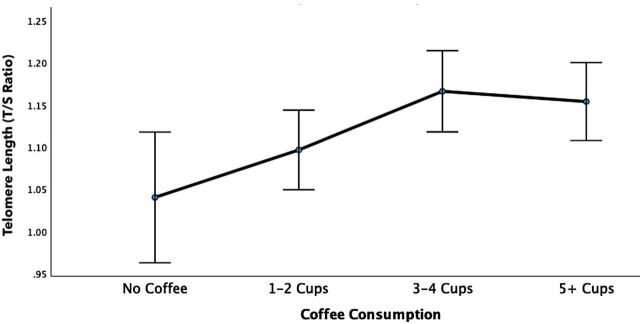
ANCOVA results indicated a significant difference in TL between different coffee consumption groups (F=3.29, p=0.02), with the distribution forming an inverted J-shape (see figure 1). Bonferroni adjusted post hoc tests revealed significant differences in TL between the group of no coffee consumption (n=44) and the group consuming 3–4 cups (n=110; p=0.04). Analyses were adjusted for age, sex, ethnicity, number of years of using tobacco and medication DDD. The association remained when sensitivity analyses were performed adjusting for diagnostic group status (F=3.21, p=0.02).
Individuals who reported no coffee consumption (n=44) had shorter TL than patients consuming coffee within the recommended number of cups per day (n=227; F=6.13, p=0.01). Based on an average of 70 base-pair reductions per year,33 this represents 5 years younger biological age in the coffee-drinking group, adjusted for confounders (for confounders, see above). Both interaction analyses for sex (F=0.84, p=0.47) and diagnosis (F=0.62, p=0.60) were not statistically significant, indicating that the effect of coffee consumption on telomere length did not significantly differ between males and females, or individuals with SZ and affective disorders.

Results of the ANCOVA analysis (F=3.29, p=0.02), comparing telomere length between the coffee consumption groups. The analysis was adjusted for age, sex, ethnicity, years of tobacco use and medication (daily defined dose of lithium, antipsychotics, antidepressants and mood stabilisers). The error bars indicate 95% confidence intervals. ANCOVA, analysis of covariance; T/S ratio, telomere to single copy ratio.
Discussion
Our findings indicate an inverted J-shape association between coffee consumption levels and cellular ageing as measured by TL in patients with a severe mental disorder, adjusted for age, sex, ethnicity, medication, tobacco use and group status. Specifically, coffee consumption up to the recommended limit of four cups per day was associated with longer telomere lengths that could represent up to 5 years younger biological age compared with non-coffee drinkers, adjusted for relevant confounders.
The positive association between coffee intake and TL observed in our study is in line with previous large scale studies conducted in individuals without a mental disorder. Specifically, both the UK Nurses' Health Study23 as well as the US National Health and Nutrition Examination Survey (NHANES)34 indicated longer telomeres in individuals who drank coffee, compared with those who abstained. However, as noted previously, adverse effects of coffee have also been noted, namely in a large scale UK Biobank study conducted by Wei et al,22 wherein coffee consumption was associated with decreases in TL. Moreover, the NHANES study further highlighted that while coffee intake overall was associated with longer TL, increased intake of caffeine specifically was associated with reductions in TL.34 Similar trends were noticed in our own study, particularly with individuals who exceeded the daily recommended intake of four cups/day, showing a decrease in TL.
There are multiple mechanistic pathways which could be underpinning the association highlighted in our study. First, coffee has been noted to contain several bioactive compounds such as chlorogenic acid (CGA), cafestol, kahweol, trigonelline and melanoidins,35 all of which possess potent antioxidant properties. In particular, CGA as well as trigonelline have been noted to play an important role in promoting the activity of the Nrf2 pathway, a crucial antioxidant pathway within the body.24 36 Interestingly, studies of patients with SZ have noted a downregulation of this specific pathway.37 38 Moreover, CGA and other bioactive compounds found in coffee have also been noted to reduce the formation of pro-inflammatory cytokines, helping reduce inflammation.39 Chronic and systemic inflammation is a common pathophysiological feature found in SMD,40 41 highlighting the potential protective effects that coffee could have in this population. In addition, telomeres are highly sensitive to both oxidative stress and inflammation,42 further highlighting how coffee intake could help preserve cellular ageing in a population whose pathophysiology may be predisposing them to an accelerated rate of ageing. However, despite the potential benefits of coffee, as noted in our study findings, consuming more than the daily recommended amount of coffee may also cause cellular damage and TL shortening through the formation of reactive oxygen species.43
Another key mechanistic pathway worth considering is the Akt/GSK3β/β-catenin pathway and the influence it has on the expression level of a key telomerase enzyme, TERT (telomerase reverse transcriptase). The Akt/GSK3β/β-catenin pathway is a regulatory pathway associated with cellular proliferation, survival and differentiation.44 Its cascade includes Akt (protein kinase B) phosphorylating and thereby deactivating GSK3β (glycogen synthase kinase 3 β), which allows for the accumulation of β-catenin.44 β-catenin is highly important for regulating gene expression, including TERT, a key subunit of the telomerase complex, that can extend telomere length and thus is crucial for telomere maintenance.45 In vitro studies of cancer cells have found that caffeine treatment downregulated GSK3β activity through phosphorylation.46 Similarly, in vivo animal studies have noted that chronic caffeine treatment upregulated phosphorylated Akt and downregulated GSK3β in mice.47 In addition to this particular pathway, in vitro studies have also noted that caffeine treatment has been found to increase TERT gene promoter activity, which consequently leads to increases in TERT mRNA and longer TL in caffeine-treated cells.48 These findings are highly relevant in the context of our previous research, wherein we noted both reduced TERT expression as well as shorter TL in individuals with SZ, compared with healthy controls.32 In effect, these findings suggest the potential cellular benefits that coffee consumption may have in promoting healthy ageing in individuals with SMD.
In addition, we have to take into consideration other previously highlighted behaviours found in SMD, which may be influencing coffee consumption patterns. Most notably, individuals with SMD have been noted to possess higher rates of smoking compared with unaffected controls.28 This is particularly relevant, as tobacco-associated chemicals such as nicotine may up-regulate the production of liver enzymes (eg, CYP1A2) associated with caffeine metabolism.27 Studies in the normative population have indicated higher serum levels of this enzyme,49 as well as a faster metabolism of caffeine50 in smokers compared with non-smokers. The significantly higher coffee consumption in smokers compared with non-smokers was also observed in our sample, suggesting that smoking may influence coffee drinking in SMD as well.
Study limitations
One of the main limitations of our study was the robust measurement of coffee consumption. The current self-report data inquired only about the number of cups of coffee ingested per day, and not the time of day consumed or instant versus filter coffee, which have been shown to influence the link between coffee consumption and health.16 22 We also did not have information on other sources of caffeine (eg, tea, energy drinks, soda) or the caffeine concentration of cups of coffee drunk, which could have provided different results.
Moreover, while it is our speculation that TL was increased due to potential conferred antioxidant/anti-inflammatory properties, we did not have data on peripheral antioxidant/inflammation levels. In addition, our study only included information on psychotropic medication use, and not alternative medication that participants may have been using for somatic illnesses (eg, β blockers, statins, metformin, etc).
In addition, the current study only comprises a psychiatric sample (affective disorder and SZ) without a healthy control comparison group, and is conducted cross-sectionally, limiting the ability to specify the directionality of our hypothesis.
Furthermore, TL was measured using qPCR, giving a mean TL measure and not a proportion or number of short telomeres within a sample.6 Although this is a validated measure of TL often used in the literature, we cannot rule out that measuring the number of critically short TL may have given additional information about the role of coffee relative to markers of biological ageing. We also included only one marker of biological ageing (TL), while ideally several markers should have been included (including epigenetic clock, brain age, etc).
Conclusion
To our knowledge, this study is the first to show an inverted J-shaped association between TL and coffee consumption in patients with a severe mental disorder, suggesting that, in moderation, coffee consumption might have a positive effect but has a reverse effect in large doses. Coffee consumption up to the limit of recommended cups per day was associated with a 5-year younger biological age compared with non-coffee drinkers, adjusted for confounders. This was not statistically significant in individuals consuming coffee above the recommended dose. Our study contributes to a new understanding of both the potential protective and detrimental effects of coffee consumption on TL in a psychiatric population, deserving further attention. As people with severe mental disorders tend to have high coffee consumption, our study suggests potential health benefits by monitoring coffee consumption to reduce intake above the recommended daily dose.