
What this is
- This research investigates the role of epigenetic factors Menin and SUZ12 in human embryonic development.
- Using CRISPR-Cas9 technology, the study identifies these factors as regulators of differentiation speed in stem cells.
- The findings suggest that Menin and SUZ12 modulate gene expression dynamics during neural differentiation, impacting developmental timing.
Essence
- Menin and SUZ12 regulate the speed of neuroectoderm differentiation in human embryonic stem cells by modulating . Their inhibition accelerates the expression of key developmental genes.
Key takeaways
- Menin and SUZ12 loss-of-function accelerates neuroectoderm differentiation. This effect is linked to changes in histone modifications at developmental gene promoters.
- The study demonstrates that the acceleration of differentiation is not limited to neuroectoderm but also extends to definitive endoderm and cardiac mesoderm lineages.
- Menin and SUZ12 act synergistically, suggesting a complex interplay in regulating developmental timing across different germ layers.
Caveats
- The study primarily focuses on human embryonic stem cells, and findings may not fully extrapolate to other species or cell types.
- While the genetic and pharmacological approaches yielded similar results, the potential for off-target effects in CRISPR experiments remains a concern.
Definitions
- chromatin bivalency: The presence of both active (H3K4me3) and repressive (H3K27me3) histone marks at developmental gene promoters, influencing gene activation timing.
Simplified
Main
Embryonic development is characterized by a series of events unfolding in a particular order and pace. While the order is evolutionarily conserved across mammalian species, the rate at which it proceeds varies. The slower pace of human development, compared with most other species, is evident from pre-implantation stage1, persists through embryogenesis2,3 and becomes progressively exaggerated during maturation1,3–5. This species-specific developmental timing is thought to be integral to the determination of organism size, lifespan and tissue complexity2,6–8.
In vitro differentiation of stem cells recapitulates the in vivo timing of many developmental processes9,10 and mirrors species differences11–13, suggesting the existence of an intrinsic clock for cells to track time. Recent studies using comparative stem cell-based in vitro models have identified biochemical reaction rates14,15 and metabolic activity16,17 as candidate factors contributing to species-specific developmental timing. In parallel, studies conducted primarily in either human or mouse systems have highlighted a role of the epigenetic landscape18–21. Notably, variations in the speed of early embryogenesis are predictive of their later developmental features, such as gestation length, brain and body size, age of sexual maturity, and lifespan7, raising the possibility that timing mechanisms during embryogenesis underlie a general scaling law that sets the pace of diverse developmental events.
Using our screening approach, we found that the loss-of-function of two epigenetic factors, Menin (encoded by MEN1) and SUZ12, accelerates neuroectoderm differentiation. To address whether they act as a general timing mechanism beyond neural induction, we explored their functions along two additional dimensions: across germ layer lineages (definitive endoderm and cardiac mesoderm), and during a later developmental stage (neurogenesis). These studies define Menin and SUZ12 as modulators of developmental pace that act synergistically across lineages and developmental stages and point to chromatin bivalency as a key regulator of human developmental timing.

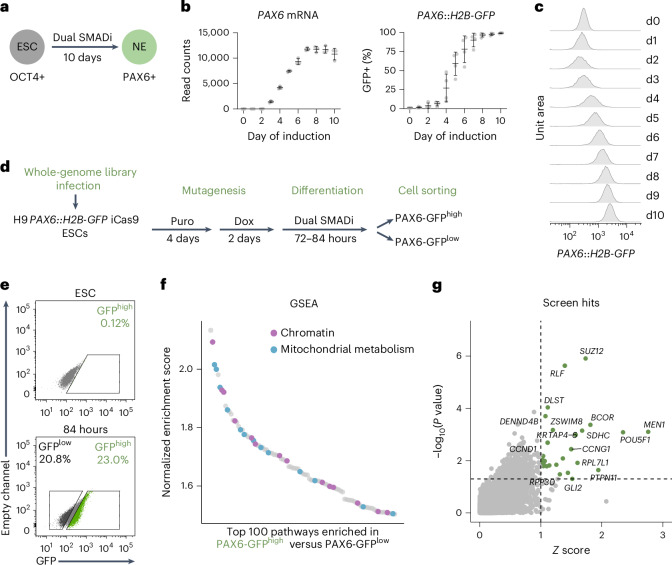
Genome-wide KO screens identify regulators of human neuroectoderm differentiation speed. , Schematic of the neuroectoderm differentiation. NE, neuroectoderm. Dual SMADi, inhibition of SMAD signalling by co-treatment of SB431542 and LDN193189., Temporal expression ofRNA from bulk RNA-seq experiment (left, = 3 independent differentiations) and quantification of GFP expression in thecell line from flow cytometry analysis (right, = 4 independent differentiations) during neuroectoderm differentiation. Data are the mean ± s.d., Representative histogram plots for live GFP expression in thecell line undergoing neuroectoderm differentiation. d0, day 0 of induction., Schematic of the whole-genome CRISPR screen., Representative flow cytometry gating strategy to isolate PAX6-GFPand PAX6-GFPpopulations., Waterfall plot of the top 100 GSEA enriched pathways from the ranked gene list, ordered by-score of PAX6-GFPversus PAX6-GFPcomparison (top ranks correspond to highly enriched genes in PAX6-GFPpopulation). Chromatin-related and mitochondrial metabolism-related pathways are highlighted in coloured dots., Scatter plot of the screen hits (value < 0.05;-score > 1) highlighted in green dots.values were calculated from edgeR's exact test. a b c d e f g PAX6 n PAX6::H2B-GFP n PAX6::H2B-GFP Z P- Z P- high low high low high Source data
Results
Genome-wide KO screens identify regulators of human neuroectoderm differentiation speed
To screen for PAX6 expression in live cells, we first integrated an inducible Cas9 gene, which expresses Cas9 following doxycycline treatment, into the AAVS1 locus in the H9 PAX6::H2B-GFP hESC reporter cell line23,25 (Extended Data Fig. 1a,b). Cas9 protein can be efficiently induced within two days upon doxycycline treatment, and the iCas9 integration does not affect PAX6 expression dynamics (Extended Data Fig. 1c–e). To screen for regulators of differentiation speed at a whole-genome scale, we infected PAX6::H2B-GFP iCas9 hESCs with a genome-scale, human CRISPR KO Brunello lentiviral pooled library26. hESCs were selected for stable gRNA integration with puromycin, and mutations were induced with doxycycline. We then started neuroectoderm differentiation using the dual SMADi method (Fig. 1d). Given that PAX6 expression starts to rapidly increase around day 3 to 4 (Fig. 1b and Extended Data Fig. 1e), and thus the acceleration effect of a mutation, if any, would be most pronounced during this time window, we isolated PAX6-GFPhigh and PAX6-GFPlow cells using fluorescence-activated cell sorting (FACS) at the timepoint when we observed the PAX6 level started to increase (Fig. 1e). One replicate was collected at 72 hours (3 days), and two replicates were collected at 84 hours (3.5 days). The gRNA representation in each population was determined by next-generation sequencing. We reasoned that if a gene KO accelerates the differentiation, the gRNA should be repeatedly enriched in the PAX6-GFPhigh population and depleted in the PAX6-GFPlow population. By contrast, if a gene KO has no effect on speed, the gRNA should be randomly distributed between the two populations.
The analysis workflow is illustrated in Extended Data Fig. 1f. First, we compared gRNAs enriched in PAX6-GFPhigh versus PAX6-GFPlow populations and ranked the genes by Z-score27. Gene-set enrichment analysis (GSEA)28 on the ranked gene list showed an enrichment for multiple chromatin remodelling complexes, such as ATAC, SET1C, npBAF and MLL complexes (Fig. 1f and Extended Data Fig. 1g,h), as well as for pathways associated with mitochondrial metabolism, particularly the tricarboxylic acid (TCA) cycle (Fig. 1f, Extended Data Fig. 1g,i and Supplementary Table 1). This is in line with previous studies highlighting both the chromatin landscape and metabolic activity as key regulators of developmental dynamics29,30. We then calculated Z-score and P-value using edgeR31 for each gene and defined 27 screen hits (Z-score > 1, P < 0.05) (Fig. 1g and Supplementary Table 2). To validate the screen hits and gain insights into the molecular pathways that affect differentiation speed, we adopted both genetic and pharmacological approaches. For the genetic validations, we followed up on the screen hits by infecting PAX6::H2B-GFP iCas9 hESCs with individual lentiviral gRNA targeting each candidate gene, followed by independent differentiation assays. PAX6 level was assessed by GFP live imaging. Among the 27 screen hits, SUZ12 and MEN1 KOs showed the highest fold change of PAX6 expression compared with non-targeting (NT) control (Extended Data Fig. 2a). For the pharmacological approaches, we performed co-essentiality mapping using DepMap database32,33 and clustered the screen hits based on their essentiality score correlation. The co-essentiality mapping allowed us to infer functional pathways shared by a subset of the screen hits. One prominent cluster emerged from the analysis that contained 5 out of 27 candidates, including members of Polycomb Repressive Complex (PRC) 1 and 2 (BCOR; SUZ12, EED), TCA cycle (DLST), and Menin–MLL complex (MEN1) (Extended Data Fig. 2b). Accordingly, we selected small molecule inhibitors targeting each pathway or interaction and treated hESCs undergoing differentiation (Supplementary Table 3). PAX6 level was assessed at day 4 by flow cytometry. Of all the pathways perturbed, inhibition of PRC1, PRC2 and Menin–MLL interaction showed the highest fold change of PAX6 expression compared to DMSO-treated cells (Extended Data Fig. 2c). Pairwise combinations of these three perturbations led to an additive effect on accelerating neural markers PAX6 and ZBTB16 (Extended Data Fig. 2d).
Taken together, genetic and pharmacological secondary validation experiments underscored MEN1 and SUZ12 as promising candidates for regulating the timing of neuroectoderm differentiation. Intriguingly, Menin and SUZ12 are postulated to have opposing functions on gene expression, namely, Menin/MLL1-mediated histone 3 lysine 4 trimethylation (H3K4me3), an active chromatin mark34,35, and PRC2-mediated histone 3 lysine 27 trimethylation (H3K27me3), a repressive chromatin mark36–38, yet both KOs led to accelerated PAX6 expression. Based on these results, we focused on MEN1 and SUZ12 for further investigation.
Menin or SUZ12 inhibition accelerates expression of neuroectodermal genes
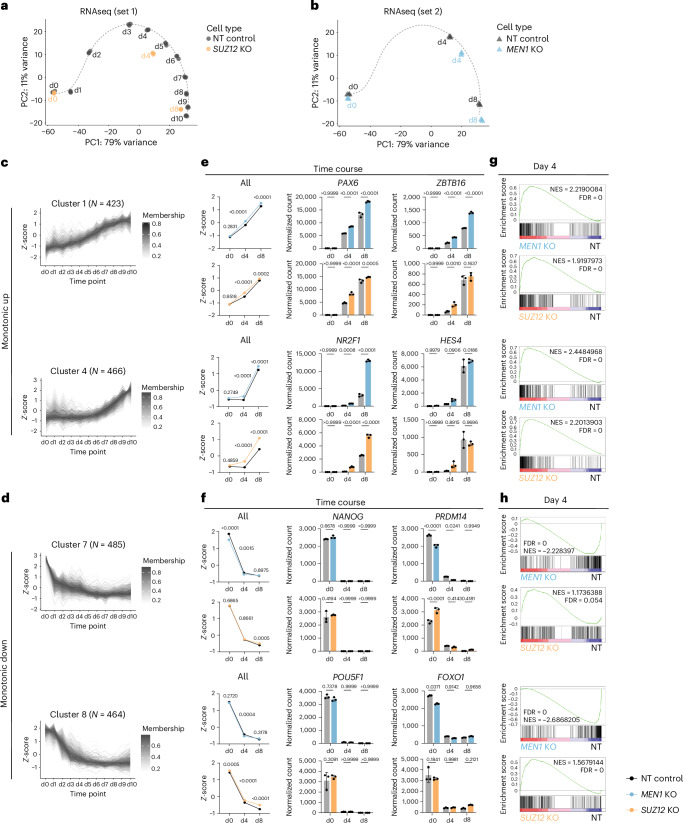
Based on this observation, we further examined the specificity and extent of transcriptional changes in MEN1 and SUZ12 KO cells. We first assessed dynamic patterns of transcriptional changes during the natural differentiation by performing TCseq40 using the temporal data of NT cells. This time-course analysis revealed eight distinct gene expression patterns (clusters) underlying neuroectoderm differentiation. Genes in cluster 1 and 4 showed a monotonic upregulated expression and were strongly enriched for forebrain development (Fig. 2c and Extended Data Fig. 3d). Genes in cluster 7 and 8 showed monotonic downregulated expression and were linked to ribosome and mitochondria-related cellular processes (Fig. 2d and Extended Data Fig. 3e). The remaining clusters showed transient expression patterns, with genes peaking at various timepoints during differentiation (Extended Data Fig. 3f). We then mapped the expression level of genes in each cluster in MEN1 and SUZ12 KO cells side-by-side with NT controls (Fig. 2e,f and Extended Data Fig. 4a). Both KOs accelerated the upregulation of cluster 1 and 4 genes at day 4 (Fig. 2g), whereas only MEN1 KO was also able to promote downregulation of cluster 7 and 8 genes (Fig. 2h). qRT-PCR analysis using a finer time course showed a similar trend to the RNA-seq data, indicating faster upregulation of neural genes in the KOs (Extended Data Fig. 4b). The degree of acceleration was similar between PAX6-bound41 versus non-PAX6-bound genes (Extended Data Fig. 4c), and PAX6 loss or gain of function did not alter the expression dynamics of other neural markers (Extended Data Fig. 4d–i).
Together, these findings indicate that loss of MEN1 or SUZ12 accelerates the progression of gene regulatory networks driving neuroectoderm differentiation, mostly through accelerating upregulation of forebrain development-associated genes. In the cases of monotonic down or transient expressions, we observed a reduced ability of SUZ12 KO to downregulate gene expression, but the directionality of changes and the overall patterns were preserved (Fig. 2f and Extended Data Fig. 3f).

Menin or SUZ12 inhibition accelerates expression of neuroectodermal genes. ,, PCA plots of the first set of RNA-seq experiment of NT andKO samples () and the second set of RNA-seq experiment of NT andKO samples (). Samples are distributed according to their day of differentiation based on top 500 differentially expressed transcript with variance stabilized normalization.,, Temporal expression patterns of monotonic up clusters 1 and 4 () and monotonic down clusters 7 and 8 () in the NT samples identified by TCseq.,,-score normalized expression of cluster 1 and 4 genes () and cluster 7 and 8 genes () inorKO versus NT control are shown in the line graphs (, number of genes in each cluster;,). Data are the mean ± s.e.m. Normalized counts of selected representative markers of cluster 1 and 4 () and cluster 7 and 8 () are shown in the bar graphs ( = 3 independent differentiations). Data are the mean ± s.d.-values were calculated from two-way ANOVA test with post-hoc Tukey's multiple comparisons test.,, GSEA enrichment plots of cluster 1 and 4 genes () and cluster 7 and 8 genes () inorKO versus NT comparisons at day 4. FDR, false discovery rate; NES, normalized enrichment score. a b a b c d c d e f e f c d c d g h g h SUZ12 MEN1 Z MEN1 SUZ12 n n P MEN1 SUZ12 Source data
Menin and SUZ12 maintain bivalency balance on developmental genes

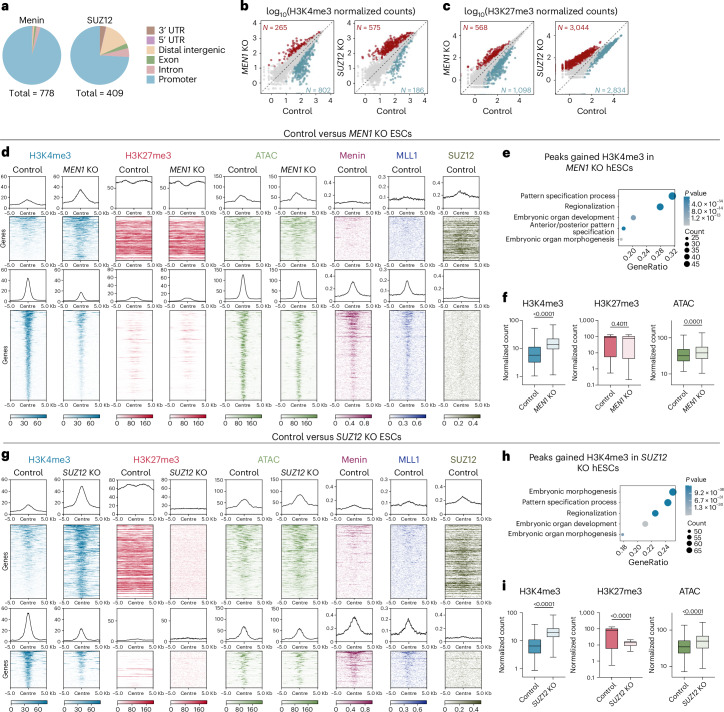
Menin and SUZ12 maintain bivalency balance on developmental genes. , Pie charts of Menin and SUZ12 peaks in the H9 control hESCs mapped to 3′UTR, 5′UTR, distal intergenic, exon, introns and promoter regions.,, Differential analysis for binding of H3K4me3 () and H3K27me3 () counts. Each dot represents one H3K4me3 or H3K27me3 peak. Peaks that are significantly enriched (red, < 0.05, logFC > 0) and peaks that are significantly depleted (blue, < 0.05, logFC < 0) in the KO hESCs, compared to H9 control, are indicated., Heatmaps show genomic regions with increased (top panel, each row corresponds to a red dot inleft panel) and decreased (bottom panel, each row corresponds to a blue dot inleft panel) H3K4me3 level inKO hESCs compared with control hESCs. NT hESCs were used as control for ATAC-seq, and unmodified H9 hESCs were used as control for CUT&RUN. The genomic regions are ordered according to the H3K4me3 level in the control sample., GO analysis on the genes annotated to the peaks with increased H3K4me3 level inKO hESCs. Top five GO terms are shown in the dot plot., Normalized counts for H3K4me3, H3K27me3 and ATAC peaks for the 265 regions with increased H3K4me3 level inKO hESCs., Heatmaps show genomic regions with increased (top panel, each row corresponds to a red dot inright panel) and decreased (bottom panel, each row corresponds to a blue dot inright panel) H3K4me3 level inKO ESCs compared with control hESCs. The genomic regions are ordered according to the H3K4me3 level in the control sample., GO analysis on the genes annotated to the peaks with increased H3K4me3 level inKO hESCs. Top five GO terms are shown in the dot plot., Normalized counts for H3K4me3, H3K27me3 and ATAC peaks for the 575 regions with increased H3K4me3 level inKO hESCs.,, Box-and-whisker plots: the whiskers represent the minima and maxima, the boxes represent the interquartile range and the centre line represents the median.values were calculated using two-tailed unpaired-test comparing KO to control. a b c b c d b b e f g b b h i f i P P MEN1 MEN1 MEN1 SUZ12 SUZ12 SUZ12 P t adj 2 adj 2 Source data

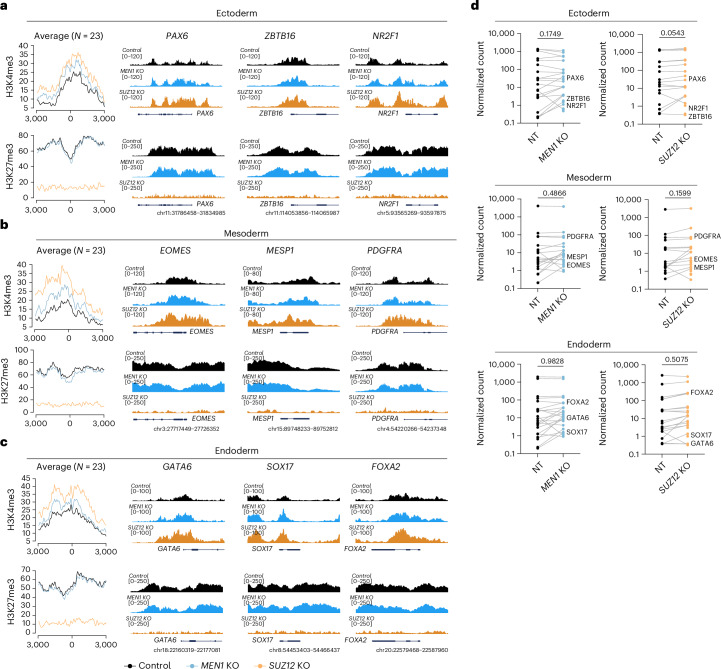
Loss of Menin or SUZ12 shifts the bivalency balance toward activation at lineage genes. –, Average profile plots and example track plots of H3K4me3 and H3K27me3 in control and KO hESCs for ectoderm (), mesoderm () and endoderm () lineage markers. For each lineage, the average profile plot of all 23 selected marker genes is shown on the left, with track plots of three representative markers shown on the right., Normalized expression of lineage genes in NT and KO hESCs from the RNA-seq. Each dot represents one gene. = 23 genes for each lineage. Representative genes for each lineage are labelled.values were calculated using two-tailed paired-test. a c a b c d n P t Source data
Targeting Menin or SUZ12 accelerates differentiations of other lineages and later stages
During DE differentiation, NT cells showed similar expression dynamics of the definitive endoderm markers GATA6 and CXCR4 (refs. 54,56), compared to the H9 Dendra2 control cells. MEN1, SUZ12 and double KO cells showed a marked increase in GATA6 at day 1 and CXCR4 at day 2 (Fig. 5c and Extended Data Fig. 7c,d). In addition to genetic KOs, we explored the functional relevance of Menin–MLL1 interaction and PRC2 by using two inhibitors validated in the neuroectoderm secondary screen (Extended Data Fig. 2c): VTP50469 (ref. 57), a Menin–MLL1/2 inhibitor (MEN1i), and Tazemetostat58, an EZH2 inhibitor functionally targeting PRC2 (EZH2i), respectively. In line with the genetic KOs, MEN1i and EZH2i treatment during differentiation accelerated expression of the endoderm markers GATA6 and CXCR4 (Fig. 5d and Extended Data Fig. 7f). EZH2i or SUZ12 KO also promoted SOX17 expression (Extended Data Fig. 7e,g). Notably, the combination of MEN1i and EZH2i resulted in a further increased expression of DE markers. qRT-PCR on DE markers (EOMES, GATA6, SOX17 and FOXA2) at the onset of gene induction recapitulated the trend of elevated expression in Menin- and SUZ12-targeted cells (Extended Data Fig. 7h).
For CM differentiation, qRT-PCR confirmed that cells progressed through the following differentiation stages: cardiac mesoderm (EOMES, MESP1), cardiac progenitor (PDGFRA, TBX5) and CM (TNNT2, MYH6)59. Cells treated with MEN1i or EZH2i appeared to move more quickly through those stages with a reduction in cardiac mesoderm markers by day 3 and increased expression of cardiac progenitor and CM markers from day 3 onwards (Extended Data Fig. 8a). To assess the functional property of CM, hESCs were seeded in a multi-well plate and treated with MEN1i and/or EZH2i for the duration of differentiation. CM contraction can typically be detected around days 7–9, so we examined the percentage of wells that exhibit contraction during this time window. While we observed contraction in all control wells around day 9, MEN1i or EZH2i treatment induced premature contraction by day 8, and the combined inhibition by day 7 (Fig. 5e). In line with the contraction phenotype, we detected a higher percentage of cells expressing CM-specific cell-surface marker, SIRPA (ref. 60), in KOs and drug-treated cells at day 7 (Fig. 5f). While drug treatment did not further increase the percentage of cells expressing cardiac troponin (cTnT, encoded by TNNT2) at day 7—which was already around 75%—the treatment did further elevate the cTnT expression level in the cTnT+ population (Extended Data Fig. 8b–d). Combined inhibition further enhanced the premature contraction and increased marker expression observed in single drug inhibition. These results indicate that, in addition to neuroectoderm, Menin and SUZ12 regulate the speed of transition from ESCs to endoderm and a mesoderm-derived lineage as well.
Next, we explored whether Menin and SUZ12 can further affect timing at a later developmental stage, independent of lineage specification from ESC stage. We focused on neurogenesis and induced genetic KO only after the differentiating cells have reached neuroectoderm stage. To this end, we infected iCas9 hESCs with gRNAs and did not induce Cas9 until day 10 (Extended Data Fig. 9a,b). For the pharmacological approach, MEN1i or EZH2i was applied starting at the neural progenitor stage (from day 20 onward). We probed neurogenesis speed by assessing the transition from SOX2+ neural progenitor to post-mitotic neuron, marked by HuC/D and MAP2. Both genetic and pharmacological manipulations led to a higher percentage of HuC/D+ or MAP2+ neurons and a further reduction of SOX2+ progenitors at day 25. Double KO or combined MEN1i and EZH2i treatment further enhanced this impact (Fig. 5g–i and Extended Data Fig. 9c–e).
Overall, chemical and genetic inhibition of Menin and SUZ12 produced similar phenotypes in all differentiation paradigms tested, suggesting that Menin–MLL interaction and EZH2–PRC2 play a crucial role in timing regulation across lineages and developmental stages. SUZ12 KO appears to achieve a higher degree of accelerated gene expression than EZH2i in neuroectoderm, DE and neuronal differentiation, which could be explained by incomplete depletion of H3K27me3 by EZH2i (Extended Data Fig. 9f,g) and potential EZH1-PRC2 activity61. In addition, MEN1i or EZH2i did not induce detectable cell fate changes, as evidenced by similar expression levels of markers at the differentiation endpoint compared to control (Extended Data Fig. 9h).
Finally, we explored whether the functions of Menin and SUZ12 are conserved in another species. We differentiated mouse epiblast stem cells (mEpiSCs) into neuroectoderm with MEN1i or EZH2i treatment. The dynamics of Pax6 and Zbtb16 remained largely unaffected, and the downregulation of E-cadherin was only mildly accelerated (Extended Data Fig. 9i). However, we observed both Pax6-negative non-neural cells and Map2-positive neurons in addition to Pax6-positive neuroectoderm, complicating direct timing comparison using mouse cells (Extended Data Fig. 9j). Furthermore, despite the broad overlap of H3K4me3 peaks between hESCs and mEpiSCs, Menin's binding partner, MLL1, exhibited distinct binding patterns (Extended Data Fig. 9k), raising the possibility that Menin's functional role differs between mouse and human cells during primed pluripotency.

Targeting Menin or SUZ12 accelerates differentiations of other lineages and later stages. , Schematics of differentiation paradigms. Letters on the arrows indicate the corresponding panels., Schematics of differentiation strategy, applicable toand, to test the KO effects. Briefly, H9 ESCs carry a fluorescent protein, Dendra2, was mixed in a 1:1 ratio with NT or KO ESCs. DE or CM differentiation was performed on mixed cells. During flow cytometry, Dendra2 control cells are separated from NT or KO cells based on GFP signal, and cellular marker expression was assessed in each population., Time course analysis of CXCR4+ cell percentage in control versus NT or KO cells during DE differentiation ( = 3 independent experiments).values for day 2 comparisons were calculated using two-tailed paired-test., Quantification of CXCR4+ cell percentage at day 2 ( = 6 independent experiments) and GATA6+ cell percentage at day 1 ( = 5 independent experiments) of DE differentiation with small molecule inhibitor treatment.values were calculated using one-way ANOVA test with post-hoc Dunnett's multiple comparisons test., Analysis of contraction phenotype during CM differentiation with small molecule inhibitor treatment ( = 3 independent experiments).values were calculated using one-way ANOVA test with post-hoc Dunnett's multiple comparisons test., Quantification of SIRPA+ cell percentage at day 7 of CM differentiation in NT and KOs (left, = 3 independent experiments), and small molecule inhibitors (right, = 3 independent experiments).values were calculated using two-tailed paired-test (left) and one-way ANOVA test with post-hoc Dunnett's multiple comparisons test (right)., Representative images of day 25 cells expressing neuronal markers HuC/D and MAP2., Quantification of HuC/D+ cell percentage at day 25 of neurogenesis in NT and KOs (left, = 3 independent experiments), and small molecule inhibitors (right, = 3 independent experiments).values were calculated using one-way ANOVA test with post-hoc Dunnett's multiple comparisons test., Quantification of SOX2+ cell percentage at day 25 of neurogenesis in NT and KOs (left, = 3 independent experiments), and small molecule inhibitors (right, = 3 independent experiments).values were calculated using one-way ANOVA test with post-hoc Dunnett's multiple comparisons test. All data are the mean ± s.d.values were indicated on the plots unless not significant (ns, > 0.05).created with. a b c f c d e f g h i a n P- t n n P n P- n n P- t n n P- n n P- P- P BioRender.com Source data
Discussion
CRISPR-Cas9 screening and stem cell technologies have enabled the systematic discovery of mechanisms underlying cell fate specifications. Here, we further exploit the potential of these technologies by establishing a genome-wide loss-of-function screen to identify molecular regulators of human neuroectoderm differentiation speed. By focusing on a quantitative cellular marker rather than a binary outcome, we demonstrate the broad utility of pooled genetic screens in not only identifying factors essential for fate specification, but in pinpointing temporal regulators as well.
Our screen highlighted Menin and SUZ12 as key regulators of neural induction speed. Although we focused on epigenetic factors in this study, we also uncovered genes involved in metabolic pathways (for example, SDHC and DLST), pathways which have been linked to species-specific developmental timing16,17,62. However, we were not able to validate these hits using an arrayed format. It is possible that the effects of perturbing metabolic genes are dependent on environmental conditions63, which could be different between the pooled format used in the screen and the arrayed format used in the validation. The perturbations may also influence cell growth and proliferation, the negative effect of which could be masked in a pooled setting64. Interestingly, we did not uncover genes known to be directly involved in protein synthesis and degradation processes, which have also been linked to timing regulation14,15. Given that these cellular pathways are orchestrated by multiprotein complexes, knocking out a single gene may not necessarily generate detectable phenotypic changes65–67. Finally, while our whole-genome screens allowed us to search for intrinsic mechanisms in an unbiased manner, we cannot rule out that additional, non-cell autonomous mechanisms might influence timing, although the degree to which non-autonomous factors affect timing remains unclear24,68. Future characterizations of the interplay between epigenetic and metabolic factors and how they are influenced by extrinsic factors may provide a more complete understanding of how developmental timing is regulated.
Mutations in PRC2 components have been associated with growth-related disorders, such as Weaver syndrome69,70 and Imagawa–Matsumoto syndrome71, reflecting PRC2's broad influence on growth and development. It will be interesting to assess whether the timing differences observed reported in the current study may help in explaining phenotypes characteristic to those neurodevelopmental disorders. On the other hand, Menin is known for its role in multiple endocrine neoplasia and in leukaemia, whereas its function in a normal developmental context remains largely unexplored. In this study, we uncovered a role of Menin in regulating developmental timing. MEN1 KO triggers H3K4me3 reduction at Menin-binding sites and an unexpected gain of H3K4me3 specifically at developmental genes. The specificity of H3K4me3 relocation to developmental genes could be achieved through MLL1/2 and their binding partners. Recent studies in lymphoblasts and lung adenocarcinoma cells suggested that upon Menin loss, MLL1 drives H3K4me3 relocation towards bivalent promoters and repetitive genomic regions, respectively72,73. However, it is still unclear what mediates MLL1 redistribution, a process that appears to be cell-type specific. In fact, MLL1/2 and their binding partners exhibit distinct chromatin localization and functions74–76. Thus, comprehensive chromatin profiling will be required to investigate the possibility that Menin competes with other MLL1 binding partners for MLL1 binding and H3K4me3 deposition. A functional interplay between Menin and PRC2 on gene regulation has been described in leukaemia and lymphoma cells77,78. Here, we found that Menin directly regulates gene expression of PRC2 components, particularly EZH2 and EED. Reduced expression of PRC2 components upon MEN1 KO could decrease PRC2 occupancy and alleviate repression on developmental genes, facilitating further H3K4me3 deposition. Taken together, our results support a model in which Menin limits the speed of unfolding developmental programmes via its dual functions, maintaining H3K4me3 on active chromatin and sustaining PRC2 repression on bivalent chromatin.
Our finding that Menin and SUZ12's functions converge on maintaining H3K4me3 and H3K27me3 balance on developmental gene promoters underscores a key role of chromatin bivalency in timing regulation. Recent studies have identified PRC2-mediated H3K27me3 on bivalent genes as a driver for maturation timing in human cortical neurons18 and mouse cerebellar granule cells20,21. Our data suggest that chromatin bivalency acts as a rate-limiting mechanism already during early embryonic development. Furthermore, we show that both repressive and activating histone modifications contribute to timing. In particular, increased H3K4me3 alone at bivalent sites upon MEN1 KO enables faster gene activation during differentiation, potentially through H3K4me3's role in promoting transcriptional elongation79. Further studies to test whether Menin loss also exerts an effect on neuronal maturation and how bivalency is dynamically remodelled from pluripotency to terminally differentiated state across the three germ layers will be important in further testing the general applicability of this model.
While we did not observe similar acceleration effect in the neuroectoderm differentiation of mEpiSCs in this study, the heterogeneity of the differentiated mouse cell population calls for a more robust mouse differentiation protocol to accurately assess whether the proposed mechanism is conserved across species. Nevertheless, the differential binding patterns of MLL1 between hESCs and mEpiSCs suggest that bivalency may be regulated by distinct epigenetic regulators across species.
In summary, our results suggest that Menin and SUZ12's role in timing regulation is conserved across germ layer specifications and developmental stages, highlighting bivalency balance as a driver for human-specific timing. The functional overlap between Menin and PRC2 and the additive effects of combined inhibition described in this study can be exploited for manipulating developmental time in vitro, with broad applications in stem cell therapy and disease modelling.
Methods
hPSC lines and cell culture
All work using human pluripotent stem cells (hPSCs) was approved by and conducted in compliance with the Tri-Institutional Stem Cell Initiative Embryonic Stem Cell Research Oversight Committee (Tri-SCI PSCRO) at Memorial Sloan Kettering Cancer Center, Rockefeller University and Weill Cornell Medicine. hPSC line WA09 (H9; 46XX) was from WiCell Stemcell Bank. The PAX6::H2B-GFP line was generated previously and derived from WA09 hPSCs23. The PAX6::H2B-GFP iCas9 line was derived from the PAX6::H2B-GFP line. hPSCs were maintained in Essential 8 media (E8; Life Technologies, #A1517001) in feeder-free conditions on vitronectin-coated plates (VTN-N; Thermo Fisher, #A14700). hPSCs were passaged as clumps every 3–4 days with EDTA (0.5 M EDTA/PBS) and routinely tested for mycoplasma contamination.
Cell line engineering
PAX6::H2B-GFP iCas9 knock-in hPSCs line was generated using CRISPR/Cas9-mediated homologous recombination by transfecting PAX6::H2B-GFP hPSCs with Hygro-Cas9 donor plasmid and AAVS1-Neo-M2rtTA (Extended Data Fig. 1a). NT, MEN1 KO, SUZ12 KO, and double KO hPSC lines were generated by transfecting PAX6::H2B-GFP iCas9 hPSCs with the following gRNAs: NT, AGCGCAGATAGCGCGTATCA; MEN1, CCAGGCATGATCCTCAGACA; SUZ12, TTCTCTATAACAACAATACA. For RNA-seq, polyclonal populations with stably integrated gRNAs were selected using puromycin and underwent doxycycline-induced mutations. For ATAC-seq, CUT&RUN and lineage differentiation assays, selected clones with gRNA integration were validated by genomic PCR and screened for Karyotype banding. To minimize variability due to long-term culture of edited cells, mutations were induced before each differentiation assay by 2-day treatment of 1 μg ml−1 doxycycline. Protein loss was confirmed by western blot. H9 Dendra2 line was generated by transfecting H9 hPSCs with Dendra2-Neo donor plasmid. Selected clones were validated by flow cytometry.
Neural differentiation
To induce neuroectodermal fate, hESCs were dissociated into single cells using Accutase (Innovative Cell Technologies, #AT104-500) and plated at 300,000 cells per cm2 onto Matrigel-coated wells (Corning, #354234) in E8 medium, supplemented with 10 μM Y-27632 (R&D, #1254) (day −1). On the following day (day 0), culture medium was replaced with Essential 6 medium (E6; Thermo Fisher Scientific, #A1516401) supplemented with 10 μM SB431542 (Tocris, #1614) and 100 nM LDN193189 (Stem Cell Technologies, #72142). Differentiation medium was changed daily from day 1 to 9.
Generation of neurons continues as following. From day 10 to 20, cells were cultured in 1:1 Neurobasal (Thermo Fisher, #21103049) and DMEM/F12 (Thermo Fisher, #11330-032) medium supplemented with 1X N2 (Thermo Fisher, #17502048), 1X B27 without vitamin A (Thermo Fisher, #12587010) and Penicillin Streptomycin (Pen/Strep; Thermo Fisher Scientific, #15140-122) to generate a neurogenic population of cortical NPCs. On day 20, cells were either cryopreserved in STEM-CELLBANKER freezing media (Amsbio #11924) at approximately ten million cells per vial, or induced for neurogenesis as following: NPCs were dissociated using Accutase for 30 min and replated at a density of 120,000 cells per cm2 in plates coated with poly-l-ornithine (PO; Sigma-Aldrich, #P3655), laminin (LAM; R&D, #3400-010-1) and fibronectin (FN; Thermo Fisher, #356008). After replating, cells were cultured in low-glucose neuronal culture medium, containing 1:9 Neurobasal and Neurobasal-A medium (Thermo Fisher, #A2477501) supplemented with 1X B27 without vitamin A, 1X GlutaMAX Supplement (Thermo Fisher, #35050061), Pen/Strep, 20 ng ml−1 BDNF (R&D, #248-BD), 20 ng ml−1 GDNF (PeproTech, #450-10), 200 µM cyclic monophosphate sodium salt (cAMP; Sigma-Aldrich, #D0627) and 200 µM ascorbic acid (AA; Sigma-Aldrich, #4034-100). During replating, 10 μM Y-27632 was added to increase cell viability. Half of the medium was replaced every other day.
For experiments in mouse, B6.129_4 mouse epiblast stem cells (mEpiSCs) were cultured on Mouse Embryonic Fibroblast feeders (Thermo, #A34181) in mouse N2B27 (ref. 80) supplemented with 12.5 ng ml−1 FGF2, 20 ng ml−1 Activin A and 175 nM NVP-TNKS656. mEpiSCs were differentiated to neuroectodermal fate as follows: on day 0 mEpiSC colonies were lifted from feeders using 0.5 U µl−1 collagenase IV in HBSS++, dissociated to single cells using Accutase, then plated at 400,000 cells per cm2 on Matrigel-coated plates in mouse N2B27 supplemented with CEPT cocktail (50 nM chroman I, 5 µM Emricasan, 1:1,000 Poly amines, 0.7 µM Trans-ISRIB), 100 nM LDN193189, 10 µM SB431542, 200 nM LGK-974 and 2 µM cyclopamine. On days 1–3, cells were fed daily with the same media as day 0, excluding the CEPT cocktail. On days 4–6, cells were fed with mouse N2B27 supplemented with 2 µM cyclopamine only.
Genome-wide CRISPR-Cas9 screens
The Brunello human CRISPR Knockout Pooled Library26 was used for this screen. Three hundred million PAX6::H2B-GFP iCas9 hESCs were infected with the lentiviral library at an MOI of 0.3 in a total of 31 × 100-mm plates for 20 hours. The infected cells were then selected by adding 0.4 μg ml−1 puromycin to the E8 medium for 4 days. After selection, one billion hESCs were dissociated with Accutase, pooled from all cultural plates, and cryopreserved in STEM-CELLBANKER freezing media (Amsbio #11924). To perform each replicate of the screen, two hundred million hESCs were thawed and plated at a density of 120,000–150,000 cells per cm2 in E8 medium with 10 μM Y-27632. To induce Cas9 expression, hESCs were treated with 1 μg ml−1 doxycycline for 48 hours. They were maintained in the E8 medium for another 24 hours before harvesting for differentiation. hESCs were differentiated as described in the 'Neural differentiation' subsection. After 72–84 hours of neural induction, cells were dissociated using Accutase and sorted using FACSAria according to GFP expression. PAX6-GFPhigh population gate was established based on day 0 ESC, and an equal number of PAX6-GFPlow cells were sorted for comparison. One replicate was collected at 72 hours (3 days) and two replicates were collected at 84 hours (3.5 days). Day 0 ESC, PAX6-GFPhigh and PAX6-GFPlow cells were pelleted and snap-frozen. Cell pellets were lysed, and genomic DNA was extracted (Qiagen) and quantified by Qubit (Thermo Scientific). A quantity of gDNA covering 1,000× representation of sgRNAs was PCR amplified to add Illumina adapters and multiplexing barcodes. Amplicons were quantified by Qubit and Bioanalyzer (Agilent) and sequenced on Illumina HiSeq 2500. Sequencing reads were aligned to the screened library and counts were obtained for each gRNA.
Data analysis for pooled CRISPR screen
Sequencing reads were aligned to the screened library and the CRISPR screen was analysed using the edgeR pipeline as previously described31. Z-score was calculated for each gene as previously described81. gRNA enrichment was calculated by comparing PAX6-GFPhigh to PAX6-GFPlow populations. To identify candidate hits, we removed essential genes and genes with only one gRNA recovered. Essential genes were defined as genes significantly (P-value < 0.05) depleted in both PAX6-GFPhigh versus day 0 and PAX6-GFPlow versus day 0 comparisons (Supplementary Table 2). Genes with a Z-score>1 and P-value < 0.05 were considered hits and followed up with secondary validation experiments.
DepMap analysis
We analysed the DepMap 22Q2 Public+Score, Chronos dataset that contains the genetic perturbation scores of 18,018 genes in 957 cancer cell lines82. We curated a list of top 27 screen hits and included top five correlates of each gene using Pearson correlation coefficients from DepMap gene essentiality scores above a minimum threshold (r > 0.25), resulting in a list of 96 genes. Correlation matrix heat map and network diagram were generated as previously described83. Gene cluster that includes the most candidate hits was shown.
Secondary validation
Top scoring gRNAs of the top 27 candidate genes from the pooled screen were selected for the genetic approach in the secondary validation. gRNAs were cloned into the lentiGuide-Puro plasmid (Addgene #52963) as described by the Zhang lab84. PAX6::H2B-GFP iCas9 hESCs were infected with the gRNAs individually, selected using puromycin for 4 days, and Cas9 expression was induced by doxycycline for 2 days. Cells were differentiated as described in the 'Neural differentiation' subsection in array in 96-well plates and continuously imaged every 6 hours for 10 days by an imaging reader (Agilent BioTek Cytation 7). In order to image GFP signal, E6 medium was replaced by a customized DMEM/F12 (without riboflavin, pyridoxine hydrochloride, and phenol red) made by the MSKCC Media Preparation Core, supplemented 10 mg ml−1 transferrin (Sigma-Aldrich, #T0665), 5 mg ml−1 insulin (Sigma-Aldrich, #91077 C), 500 μM sodium selenite (Sigma-Aldrich, #S5261), 221 mM l-Ascorbic acid 2-phosphate sesquimagnesium salt hydrate (Sigma-Aldrich, #A8960), and 54.3 mg ml−1 sodium bicarbonate (Sigma-Aldrich, #S5761). For pharmacological approach, each small molecule inhibitor was tested across a logarithmic dose range, and the highest concentration that did not induce toxicity was selected for use in the differentiation assays. Small-molecule inhibitors were added to culture medium starting from day 0 and maintained throughout the neuroectoderm differentiation. A list of small molecule inhibitors, their molecular targets and concentrations used is reported in Supplementary Table 3.
RNA-seq sample processing and analysis
Phase separation in cells lysed in TRIzol was induced with 200 µl chloroform. RNA was extracted from the aqueous phase using the MagMAX mirVana Total RNA Isolation (Thermo Fisher, #A27828↗) on the KingFisher Flex Magnetic Particle Processor (Thermo Scientific, #5400630) according to the manufacturer's protocol with 350 µl input. After RiboGreen quantification and quality control by Agilent BioAnalyzer, 500 ng of total RNA with RIN values of 9.3–10 underwent polyA selection and TruSeq library preparation according to instructions provided by Illumina (TruSeq Stranded mRNA LT Kit, #RS-122-2102), with eight cycles of PCR. Samples were barcoded and run on a NovaSeq 6000 in a PE100 run, using the NovaSeq 6000 S4 Reagent Kit (200 cycles) (Illumina). An average of 34 million paired reads was generated per sample. Ribosomal reads represented 0.17–0.52% of the total reads generated and the percentage of mRNA bases averaged 86%. The R package Rsubread85 was used to map reads to the human genome (GRCh38) using the align() function. Rsubread was also used to compute the expression count matrix from the mapped reads (BAM files) using the featureCounts() function. The R package DESeq286 used to normalize the raw counts (median of ratios method) and perform differential gene expression analysis. Data are presented on a gene-by-gene basis as normalized counts or after carrying out a variance-stabilizing transformation followed by PCA analysis using the top 500 variable features.
TCseq time course analysis
TCseq analysis was performed using the TCseq R package v1.28.0. RNA-seq normalized count table of NT day 0 to 10 data was used. Clustering was performed using c-means clustering by increasing cluster number until redundant clusters arose. To identify the effect of genotype in average time-variant signature, the averaged Z scores of selected timepoints were used as the aggregate gene expression signal as a function of time, then underwent nested, multivariate linear regression, contrasting the models with and without considering the effect of genetic KOs. The KO effects of MEN1 and SUZ12 were compared separately with the NT control. P-values were calculated from ANOVA of F tests.
Gene set enrichment analysis
GSEA was performed using GSEA software v4.3.3. For pathway analysis in the pooled screen, a ranked list of 18,897 genes recovered from the screen, ranked by their Z-scores, was used as input for GSEAPreranked. C5.go.v2024.1.Hs.symbols gene set database was used. Top 100 positive pathways were visualized using ggplot2. For enrichment analysis in the NT versus KO comparisons, normalized count table was used as the expression dataset. Gene clusters identified from TCseq were used as gene sets database. Comparisons were done on SUZ12 KO day 4 versus NT day 4 and MEN1 KO day 4 versus NT day 4.
ATAC-seq sample processing and analysis
Two clones were used for each KO line and two biological replicates were collected. Profiling of chromatin was performed by ATAC-Seq as previously described46. Briefly, 50,000–100,000 frozen hESC were thawed, washed in cold PBS and lysed. The transposition reaction containing TDE1 Tagment DNA Enzyme (Illumina, #20034198) was incubated at 37 °C for 30 minutes. The DNA was cleaned with the MinElute PCR Purification Kit (QIAGEN, #28004) and material was amplified for five cycles using NEBNext High-Fidelity 2X PCR Master Mix (New England Biolabs, #M0541L). After evaluation by real-time PCR, 1–3 additional PCR cycles were done. The final product was cleaned by aMPure XP beads (Beckman Coulter, #A63882) at a 1.0× ratio, and size selection was performed at a 1.5× ratio. Libraries were sequenced on a NovaSeq 6000 X in a PE100 run, using the NovaSeq 6000 S1 and S4 Reagent Kits (200 Cycles) (Illumina). An average of 52 million paired reads were generated per sample. Sequencing data were aligned to the hg38 reference genome using bowtie2 (v2.5.0)87. Ends of the aligned reads were shifted to remove Tn5 transposase artefacts as previously described46,88. Macs2 (v2.2.7.1)89 was used to remove duplicate reads and to call peaks, with the options extending the reads to both sides, and using a permissive P-value threshold (-p 1e-2–nomodel–shift −100–extsize 200–scale-to large–keep-dup all). If replicates were available, peaks were called at the combined level and the replicate level. They were then filtered using irreproducible discovery rate (IDR) (v2.0.4.2)90 using the replicates with the threshold of 0.01. If a sample was not prepared in replicates, peaks at the combined level were filtered where the RPKM quantification is above 1.85 in at least one sample. The signal intensity of the samples was first written in raw counts and normalized by library size factor defined by DESeq2's median normalization. Differentially accessible peaks were assigned using DESeq2 (v1.39)86 using the Padj threshold of 0.05.
CUT&RUN sample processing and analysis
One clone was used for each KO line and two biological replicates were collected. CUT&RUN was performed from 100,000 cells per condition using the following antibodies at 1:100 dilution: rabbit anti-H3K4me3 (Abcam, #ab8580); rabbit anti-H3K27me3 (Cell Signaling Technologies, #9733); rabbit anti-Menin (Cell Signaling Technologies, #6891); rabbit anti-MLL1 (Cell Signaling Technologies, #14689); rabbit anti-SUZ12 (Cell Signaling Technologies, #3737); normal rabbit IgG (Cell Signaling Technologies, #2729). In brief, cells were permeabilized with digitonin and the different antibodies were incubated overnight at 4 °C on a rotator. Cells were washed and incubated with pA-MN. Beads Ca2+-induced digestion occurred on ice for 30 min and stopped by chelation. DNA was isolated using an extraction method with phenol and chloroform as previously described47. Immunoprecipitated DNA was quantified by PicoGreen and the size was evaluated by Agilent BioAnalyzer. When possible, fragments between 100 and 600 bp were size selected using aMPure XP beads (Beckman Coulter, #A63882) and Illumina sequencing libraries were prepared using the KAPA HTP Library Preparation Kit (Kapa Biosystems KK8234) according to the manufacturer's instructions with 0.3–5 ng input DNA and 14 cycles of PCR. Barcoded libraries were run on the NovaSeq 6000 in a PE100 run, using the NovaSeq 6000 S4 Reagent Kit (200 Cycles) (Illumina). An average of 15 million paired reads were generated per sample. Sequencing data were aligned to the hg38 reference genome using bowtie2 (v2.5.1). Macs2 (v2.2.7.1) was executed to remove duplicate reads and to call peaks with the respective input control and using a permissive P-value threshold. Peaks were further filtered by IDR, with the threshold chosen as 0.01 for H3K4me3 and 0.05 for H3K27me3. The signal intensity of the samples was written during the peak calling (-B -p 1e-2–scale-to large–keep-dup all). It was then normalized by library size factor defined by DESeq2's median normalization and converted to bigWig format. Deeptools91 was used for heatmaps and gene-profile plots. Tracks of CUT&RUN peaks were visualized using Integrative Genomics Viewer v2.16.1 (IGV, Broad Institute) or trackplot92 R script. ChIP-seq data in mEpiSCs were downloaded from the ChIP-Atlas database93 with the threshold chosen as 100 or 500.
Definitive endoderm differentiation
Definitive endoderm differentiation was performed as previously described94. hESCs were dissociated into single cells using Accutase and plated at 125,000 cells per cm2 onto vitronectin-coated plates in E8 medium with 10 μM ROCK inhibitor Y-27632 (day −1). The next day (day 0), cells were washed with 1xDPBS once and culture medium was changed to Advanced RPMI (Thermo Fisher Scientific, #12633012) with penicillin streptomycin and 1X GlutaMAX, supplemented with 50 ng ml−1 Activin A (R&D systems, #338-AC-MTO) for 3 days (day 0–2) and 5 μM CHIR99021 (R&D systems, #4423/50) for the first day (day 0). Marker expression was assessed using flow cytometry and gating was established using hESCs as negative control.
Cardiomyocyte differentiation
Cardiomyocyte differentiation was performed as previously described55 with some modifications. hESCs were dissociated into single cells using Accutase and plated at 80,000 cells per cm2 onto matrigel-coated plates in E8 medium with 10 μM ROCK inhibitor Y-27632 (day −2). Cells were maintained in E8 medium for another day (day −1) before changing to base medium containing RPMI 1640 medium (Fisher Scientific, #MT10041CV) and 1X B27 supplement minus insulin (Fisher Scientific, #A1895601) or Advanced RPMI (Thermo Fisher Scientific, #12633012) with Penicillin Streptomycin and 1X GlutaMAX, supplemented with 5 μM CHIR99021 (day 0). On day 1, CHIR99021 was removed, and culture medium was changed into base medium. From day 2 to 3, cells were treated with IWP-2 (Stemgent, #04-0034) in the base medium for 48 hours. From day 4 onwards, IWP-2 was removed, and base medium was changed every other day. Marker expression was assessed using flow cytometry and gating was established using hESCs as negative control. Contraction was assessed in 96-well plates using an imaging reader (Agilent BioTek Cytation 7). A 5-second video with 20 fps acquisition speed and 1,390 × 1,390 μm field-of-view was recorded for each well and contraction phenotype was observed by eye and counted manually. The position of imaged area was kept constant across all wells and at least six wells were assessed for each condition.
Small-molecule treatments
The following small molecules targeting EZH2 and Menin–MLL interaction were used in the study: Tazemetostat (EPZ-6438) (Selleckchem, #S7128); VTP50469 (Selleckchem, #S8934). The following doses were used: for definitive endoderm differentiation and neurogenesis, 0.025% DMSO, 2.5 μM VTP50469, and 2.5 μM Tazemetostat; for cardiomyocyte differentiation and neuroectoderm differentiation of mEpiSCs, 0.0125% or 0.025% DMSO, 1.25 μM VTP50469, and 1.25 μM tazemetostat. For human neuroectoderm, definitive endoderm, cardiomyocyte and mouse neuroectoderm differentiation, small-molecule inhibitors were added to the culture medium starting from day 0 and maintained throughout the differentiation. For neurogenesis, small-molecule inhibitors were added to the culture media starting from day 20 and maintained throughout the differentiation.
Protein extraction and western blot
Cells were collected and lysed in RIPA buffer (Sigma) with 1:100 Halt Protease and Phosphatase Inhibitor Cocktail (Thermo Fisher Scientific) and then sonicated for 3 × 30 sec at 4 °C. Protein lysates were centrifugated for 15 min at more than 15,000g at 4 °C and supernatant was collected and quantified by Precision Red Advanced Protein Assay (Cytoskeleton). Protein (5–10 μg) was boiled in NuPAGE LDS sample buffer (Invitrogen) at 95 °C for 5 min and separated using NuPAGE 4–12% Bis-Tris Protein Gel (Invitrogen) in NuPAGE MES SDS Running Buffer (Invitrogen). Proteins were electrophoretically transferred to nitrocellulose membranes (Thermo Fisher Scientific) with NuPAGE Transfer Buffer (Invitrogen). Blots were blocked for 60 min at room temperature in TBS-T + 5% nonfat milk (Cell Signaling Technologies) and incubated overnight in the same solution with the respective primary antibodies at 4 °C. The following primary antibodies were used at 1:500 dilution: mouse anti-Cas9 (Cell Signaling Technologies, #14697S); rabbit anti-Menin (EpiCypher, #13-2021); rabbit anti-SUZ12 (Cell Signaling Technologies, #3737S); HRP-conjugated rabbit anti-GAPDH (Cell Signaling Technologies, #3683S). The following secondary antibodies were incubated for 1 h at room temperature at 1:1,000 dilution: anti-mouse IgG HRP-linked (Cell Signaling Technologies, #7076); anti-rabbit IgG HRP-linked (Cell Signaling Technologies, #7074). Blots were revealed using SuperSignalTM West Femto Chemiluminescent Substrate (Thermo Fisher Scientific) at ChemiDoc XRS+ system (Bio-Rad). Chemiluminescence was imaged and analysed using Image lab software version 6.1.0 (Bio-Rad).
RNA extraction and RT-qPCR
Cells were collected in Trizol and processed using Direct-zol RNA Miniprep kit (Zymo Research, # R2050). A total of 1 μg of RNA was used to generate cDNA using iScript (Bio-Rad). Real-time PCR was performed using SsoFAST EvaGreen Mix (Bio-Rad) in a Bio-Rad CFX96 Thermal Cycler. The manufacturers protocol was used for all steps. Samples in which the housekeeping gene had a cycle threshold (Ct) value above 30 were repeated. Primer sequences used in the study are listed in the Supplementary Table. 5
Immunofluorescence staining
Cultured cells were fixed with 4% PFA in PBS for 20 min at room temperature, washed three times with PBS, permeabilized for 30 min in 0.5% Triton X-100 in PBS and then blocked in a solution containing 5% Normal donkey serum, 2% BSA and 0.25% Triton X-100 for 1 hour at room temperature. Primary antibodies were incubated overnight at 4 °C in the same blocking solution. Secondary antibodies conjugated to either Alexa 488, Alexa 555 or Alexa 647 (Thermo) were incubated for 45 min at 1:400 dilution in blocking solution. Cell nuclei were stained with 5 μM 4′-6-diamidino-2-phenylindole (DAPI) in PBS. The following primary antibodies and dilutions were used: mouse anti-HuC/HuD 1:500 (Thermo Scientific, #A-21271); chicken anti-MAP2 1:2,000 (Abcam, # ab5392); rat anti-SOX2 1:500 (Thermo Scientific, #14-9811-82). To quantify the percentage of positive cells, images were converted to 8-bit and a threshold was set for DAPI to exclude bright cells. 'Analyse Particles' was used to quantify the total number of cells. A threshold was set for each marker, and cells with over 50% of DAPI area that met the threshold requirement were counted as positive. Thresholds were kept constant across all wells per replicate. 6–10 images of were taken from 3 individual wells for each condition and averaged.
Flow cytometry
Cells were dissociated to single cells using Accutase. For live cell staining, cells were incubated with conjugated antibodies in 3% fetal bovine serum (FBS) in PBS for 45 min at 4 °C. Cell nuclei were stained with DAPI in PBS, and live cells were gated based on negative DAPI signal. Fixed cell staining was performed using BD Cytofix/Cytoperm kit (BD Biosciences, #554714) according to manufacturer's instructions. The following antibodies were used at 1:100 dilution: Alexa 488 mouse anti-PAX6 (BD Biosciences, #561664); PE-CF594 mouse anti-PLZF (ZBTB16) (BD Biosciences, #565738); Alexa 647 mouse anti-CXCR4 (Biotechne, # FAB172R-100UG); PE rabbit anti-GATA6 (Cell Signaling Technologies, #26452S); APC goat anti-SOX17 (Biotechne, #IC1924A); PE mouse anti-SIRP alpha (R&D systems, #FAB4546P); APC rat anti-CD324 (E-Cadherin) (Biolegend, #147311); PE Mouse Anti-Cardiac Troponin T (BD Biosciences, #564767). Results were analysed using FlowJo. Mean fluorescence intensity (MFI) of markers assessed by flow cytometry is reported in the Supplementary Table. 6
Statistics and reproducibility
No statistical method was used to predetermine sample sizes, but our sample sizes are similar to those reported in the previous publications95,96. Data collection and analysis were not performed blind to the conditions of the experiments. For secondary validation experiments, samples were de-identified respect to the molecular or genetic target and a number code was assigned for each condition. No randomization was involved in the differentiation assays. No data were excluded from the analyses unless the differentiation experiment itself failed. Statistical analysis was carried out using GraphPad Prism 10. The details of statistical analyses and significance values are specified in the figures and figure legends. Data were reported as the mean ± s.d. or s.e.m, or independent replicates shown as individual data points. Data distribution was assumed to be normal, but this was not formally tested. For statistical analyses conducted using one-way ANOVA test with post-hoc Dunnett's multiple comparisons test, results from one-way ANOVA test with post-hoc Tukey's multiple comparisons test are provided in the Supplementary Table 7.
Reporting summary
Further information on research design is available in thelinked to this article. Nature Portfolio Reporting Summary
Online content
Any methods, additional references, Nature Portfolio reporting summaries, source data, extended data, supplementary information, acknowledgements, peer review information; details of author contributions and competing interests; and statements of data and code availability are available at 10.1038/s41556-025-01751-5.
Supplementary information
Reporting Summary Supplementary Tables Supplementary Tables 1–7.
Source data
Source Data Figs. 1–5 and Extended Data Figs. 1–9 Statistical source data. Source Data Extended Data Figs. 1 and 5 Unprocessed blots.
 CRISPR Gene Editing