
What this is
- This systematic review evaluates the use of for managing ().
- affects approximately 7% to 10% of pregnancies and poses risks for both mothers and infants.
- Traditional treatments have limitations, prompting interest in GLP-1 agonists like liraglutide, semaglutide, and exenatide.
- The review analyzes data from 8 clinical trials to assess efficacy and safety in management.
Essence
- improve glycemic control in gestational diabetes but raise concerns about fetal safety. Current evidence is limited, necessitating further research.
Key takeaways
- effectively manage blood glucose levels in , reducing associated pregnancy complications. However, common side effects include gastrointestinal discomfort and mild hypoglycemia.
- All GLP-1 medications are classified as pregnancy Category C, indicating potential risks for fetal health due to transplacental passage, which requires careful consideration in treatment.
- The review emphasizes the need for larger, long-term studies to establish safety protocols and assess the efficacy of GLP-1 in management.
Caveats
- The review lacks formal quality appraisal due to the nature of the included studies, which are primarily registry-based with limited outcome data.
- Heterogeneity and incomplete outcome data prevented a meta-analysis, limiting the ability to draw definitive conclusions.
Definitions
- Gestational diabetes mellitus (GDM): A form of diabetes that develops during pregnancy, characterized by glucose intolerance.
- GLP-1 receptor agonists: Medications that mimic the action of glucagon-like peptide-1, enhancing insulin secretion and lowering blood glucose.
Simplified
1. Introduction
Gestational diabetes mellitus (GDM) is one of the most common complications during pregnancy, affecting approximately 7% to 10% of pregnancies worldwide.GDM is characterized by glucose intolerance that first appears during pregnancy, with adverse implications for both maternal and fetal health.Women with GDM are at increased risk of developing type 2 diabetes postpartum, and offspring of mothers with GDM may face risks of obesity, metabolic disorders, and type 2 diabetes later in life.Therefore, effective management of blood glucose levels during pregnancy is crucial for both immediate and long-term health risks. [–] 1 3 [,] 4 5 [–] 6 9
Traditional treatment options for GDM include lifestyle modification, insulin therapy, and oral hypoglycemic agents such as metformin or glyburide.Although effective to some extent, these treatments can have limitations.Insulin, for instance, requires multiple daily injections, which can be challenging for patients,and while metformin is generally well-tolerated, its safety profile remains somewhat controversial, as it crosses the placenta.Therefore, there is a persistent need for alternative pharmacological treatment that can safely and effectively control hyperglycemia in pregnant women with GDM. [–] 10 12 [] 13 [] 14 [] 15
Glucagon-like peptide-1 (GLP-1) receptor agonists represent a newer class of antidiabetic medications originally approved for type 2 diabetes management.These medications function by activating GLP-1 receptors, which enhances glucose-dependent insulin secretion, suppresses glucagon release, and delays gastric emptying, resulting in improved glycemic control without a significant risk of hypoglycemia.Some GLP-1, such as liraglutide and exenatide, have shown potential outcomes in non-pregnant populations for improving blood glucose levels and promoting weight loss, making them a potentially appealing option for GDM.However, since GLP-1 were not initially developed with pregnancy, safety and efficacy data in pregnant remain limited. The mechanism of action of GLP-1 might benefit pregnant women by providing adequate glycemic control, while minimizing insulin resistance, which is often exacerbated during pregnancy due to hormonal changes. [,] 16 17 [,] 18 19 [,] 20 21
Recent clinical studies and trials have begun exploring the role of GLP-1 in managing GDM, specifically examining their impact on glycemic control, maternal outcomes, and fetal development.These studies vary in design and outcomes, with some indicating potential benefits and others raising concerns about possible adverse effects on pregnancy.GLP-1 receptor agonists are currently classified as Food and Drug Administration (FDA) pregnancy category C, indicating that while animal studies have shown adverse fetal effects, adequate and well-controlled studies in pregnant women are deficient, and these agents are not recommended for use during pregnancy. [–] 22 24 [,] 22 25 [,] 26 27
This systematic review aimed to analyze clinical trial data regarding the efficacy and safety of GLP-1 in the management of GDM and to assess the current evidence on the safety and efficacy of GLP-1 receptor agonists as pharmacologic options for managing GDM, based on available clinical trial data. By examining various studies, and assessed the extent to which GLP-1 can be integrated into GDM treatment protocols, considering critical parameters such as glucose control, maternal and fetal outcomes, adverse events, and overall patient acceptability. Therefore, enhancing therapeutic strategies for managing GDM and reducing its associated risks.
2. Methods
On October 2024, a systematic search was conducted on ClinicalTrials.gov to identify relevant studies exploring the use of GLP-1 for managing GDM. ClinicalTrials.gov was selected as it offers a comprehensive, publicly accessible registry of interventional trials. Given the limited published data on GLP-1 use in GDM, this platform provided the most relevant and up-to-date information, including ongoing studies with detailed protocols not yet available in peer-reviewed literature.
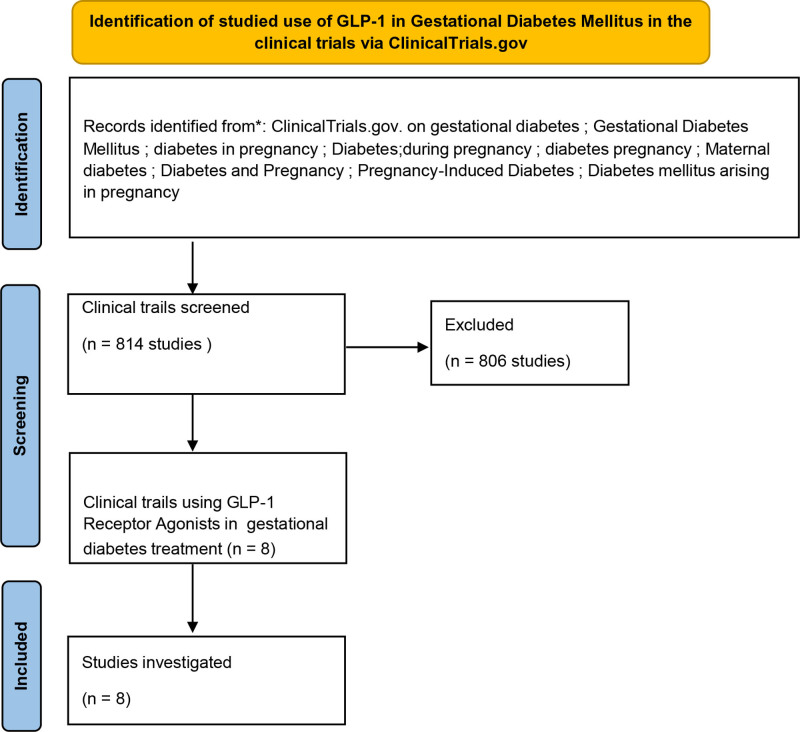
The search used terms such as "GDM," "diabetes in pregnancy," "pregnancy-induced diabetes," and similar terms associated with diabetes during pregnancy. The goal was studies focused on GLP-1 in GDM treatment. The search generated a total of 814 studies. Then, further screening process was applied, guided by inclusion criteria of all the clinical trials that were involved the use of GLP-1 as a primary intervention for GDM, where all other studies were excluded. Thus, following the screening, 806 studies were excluded, primarily due to their lack of focus on GLP-1 in GDM treatment, narrowing the selection to 8 studies as shown in Figure. 1

Methods used to identify studied use of glucagon-like peptide-1 in gestational diabetes mellitus.
2.1. Data extraction and analysis
Data extraction focused on collecting essential study attributes to enable a detailed comparison of GLP-1 interventions in GDM characteristics as shown in Table. Key extracted elements included, study title, condition, intervention, primary outcome measures locations and enrolment as shown in Table. Each study was systematically reviewed and categorized based on its design, outcomes, and interventions. Descriptive analyses were performed to summarize the findings across trials, and trends in outcome measures were identified to assess the efficacy and safety of GLP-1 for managing GDM. Ethical approval was not required for this systematic review, as it uses publicly available, de-identified data from ClinicalTrials.gov without direct patient interaction. 1 2
| Characteristics | N (percentage) |
|---|---|
| Conditions | |
| Gestational diabetes mellitus | 6 (75%) |
| Glucose intolerance after a recent history of gestational diabetes | 1 (12.5%) |
| Pre-diabetes Postpartum disorder | 1 (12.5%) |
| Phases | |
| Phase 1 | 0 |
| Phase 2 | 0 |
| Phase 3 | 2 (25%) |
| Phase 4 | 4 (50%) |
| Not available | 2 (25%) |
| Study type | |
| Interventional | 8 (100%) |
| Observational | 0 |
| Study design | |
| Randomized | 5 (62.5%) |
| Non-randomized | 2 (25%) |
| Not available | 1 (12.5%) |
| Interventions | |
| Liraglutide | 3 (37.5%) |
| Semaglutide | 2 (25%) |
| Exenatide | 2 (25%) |
| Other | 1 (12.55) |
| Location | |
| Europe | 4 (50%) |
| USA | 4 (50%) |
| Study title | Conditions | Interventions | Primary outcome measures | Enrolment |
|---|---|---|---|---|
| The Impact of Liraglutide on Glucose Tolerance and the Risk of Type 2 Diabetes in Women with Previous Pregnancy-induced Diabetes | Gestational diabetes mellitus | DRUG: Liraglutide DRUG: Placebo | Change in glucose tolerance, Changes in glucose is measured by area under the curve for the plasma glucose excursion following a 4-h 75 g oral glucose tolerance test (OGTT), from baseline to 52 wk, 53 wk, 260 wk, and 261 wk | 105 |
| Visualizing Beta Cells in Patients with a History of Gestational Diabetes | Gestational diabetes | RADIATION: 68Ga-NODAGA-exendin-4 PET/CT | Pancreatic uptake of 68Ga-NODAGA-exendin-4, pancreatic tracer uptake by quantitative analysis of PET images, 1 year | 24 |
| Combined Liraglutide and Metformin Therapy in Women with Previous Gestational Diabetes Mellitus (GDM) | Gestational diabetes mellitus Type 2 diabetes mellitus Metabolic syndrome Impaired glucose tolerance Disorder of glucose regulation | DRUG: Metformin XR plus placebo DRUG: Metformin XR plus liraglutide | Insulin secretion-sensitivity index (IS-SI), IS-SI in liraglutide-metformin (LIRA-MET) therapy compared to metformin alone (PLacebo-MET), 84 wk of treatment | 153 |
| Semaglutide for the Treatment of Glucose Intolerance in Women with Prior Gestational Diabetes | Glucose intolerance after a recent history of gestational diabetes | DRUG: Semaglutide pen injector DRUG: Semaglutide placebo | Type 2 diabetes, development of type 2 diabetes defined by fasting glycemia, oral glucose tolerance test and/or HbA1c according to the ADA criteria, by 160 wk | 252 |
| Liraglutide in the Prevention of Type 2 Diabetes After Gestational Diabetes | Gestational diabetes | DRUG: Liraglutide 6 MG/ML [Victoza] DRUG: Placebos | Incidence of type 2 diabetes, assessed by fasting P-glucose \>7 mmol/L and/ or 2 h \>11 mmol/L in oral glucose tolerance test (OGTT) 75 g, and/or HbA1c ≥ 6.5%, from year 1–5 | 80 |
| Exenatide Pharmacokinetics and Pharmacodynamics in Gestational Diabetes | Gestational diabetes | DRUG: Exenatide | Area under the plasma concentration vs time curve (AUC) of glucose, glucose concentration over the course of each study visit following mixed tolerance test, baseline and 1 wk later | 13 |
| Pilot Study of Exenatide Pharmacokinetics and Pharmacodynamics in Gestational Diabetes | Gestational diabetes | DRUG: Exenatide GENETIC: Buccal/blood sample collection | Glycemic control through insulin, glucose, c-peptide and glucagon assays, during testing days | 0 |
| Treatment to Regress to Normoglycemia in Women with a Recent History of GDM | Pre diabetes Postpartum disorder | DRUG: Semaglutide pen injector [Ozempic] DRUG: Placebo semaglutide pen injector | Regression to normoglycemia, glucose tolerance to be determined by glycemic response to a 75 g, 2-h oral glucose tolerance test (OGTT). Regression to normoglycemia is defined by fasting glucose \<100 mg/dL and 120 min glucose \<140 mg/dL, After 24 wk of full-dose treatment | 102 |
3. Results
3.1. Characteristics of included studies
A total of 8 studies were included in this review, each focusing on the use of GLP-1 in treating conditions associated with GDM and related glucose intolerance. The primary characteristics of these studies are summarized in Table. The majority of the studies (6 out of 8, 75%) specifically addressed GDM. Among the 8 trials, 2 studies (25%) were conducted in Phase 3, focusing on evaluating the efficacy and monitoring adverse effects of GLP-1 in a controlled environment. Four studies (50%) were Phase 4 trials, which typically emphasize safety surveillance post-market approval, indicating a focus on long-term safety and efficacy in real-world settings. The remaining 2 studies did not specify their phase, limiting interpretability regarding their progression in the clinical trial process. 1
All studies were interventional, meaning they actively tested GLP-1 as a treatment intervention rather than simply observing existing conditions. The majority of studies (5 out of 8, 62.5%) utilized a randomized design. Two studies (25%) employed non-randomized designs. The studies investigated a range of GLP-1 receptor agonists as shown in Table: Liraglutide: Used in 3 studies, making it the most frequently tested GLP-1 for GDM. Semaglutide: Investigated in 2 studies, indicating interest in newer GLP-1 for GDM. Exenatide: Also used in 2 studies, reflecting ongoing exploration of various GLP-1 options. The studies were evenly distributed between Europe and the USA, with 4 studies conducted in each region. 3
| Aspect | Liraglutide | Semaglutide | Exenatide |
|---|---|---|---|
| Mechanism of action | Enhances glucose-dependent insulin secretion, suppresses glucagon, delays gastric emptying, and promotes satiety to improve glycemic control and reduce postprandial glucose levels. | Promotes glucose-dependent insulin release, reduces glucagon secretion, delays gastric emptying, and increases satiety, supporting prolonged glycemic control and weight management. | Increases insulin secretion in response to glucose, inhibits glucagon release, slows gastric emptying, and reduces appetite, thereby aiding in postprandial glucose control. |
| Pharmacokinetics | Half-life: ~13 h; administered once daily via subcutaneous injection. | Half-life: ~1 wk (injectable); once-weekly injectable or daily oral formulation available. | Half-life: 2.4 h (immediate release) or ~1 wk (extended release); administered 2× daily or weekly. |
| Side effects | CommonNausea, vomiting, diarrhea; usually decrease over time. | CommonNausea, vomiting, diarrhea, often dose-dependent. | CommonNausea, vomiting, diarrhea; more frequent with immediate release. |
| RareHeadache, dizziness, mild hypoglycemia. | RareHeadache, potential mild hypoglycemia. | RareDizziness, mild hypoglycemia. | |
| Pregnancy category | Category C | Category C | Category C |
3.2. Efficacy and outcome measures
The 8 studies assessed the efficacy of GLP-1 in managing GDM, focusing on glycemic control, insulin sensitivity, and type 2 diabetes prevention. Six studies emphasized glycemic control, measuring hemoglobin A1c and glucose tolerance, crucial for reducing pregnancy complications such as fetal macrosomia and neonatal hypoglycemia. Three studies examined insulin sensitivity and secretion, and 2 tracked type 2 diabetes progression post-GDM. Sample sizes ranged from 24 to 252 participants, with larger studies often exploring long-term preventive effects of GLP-1. Safety monitoring revealed mild gastrointestinal side effects like nausea, but no severe adverse events or negative fetal outcomes were attributed to GLP-1 exposure.
4. Discussion
GDM is a condition marked by glucose intolerance that develops during pregnancy and can significantly affect maternal and fetal health.GDM increases the risk of complications like fetal macrosomia, preeclampsia, and type 2 diabetes postpartum.Traditional treatment approaches, including lifestyle interventions,insulin,and oral hypoglycemic agents.Recently, a new emerging interest in GLP-1 as therapeutic options for DM from their glucose-dependent mechanism of action, which enhances insulin secretion, reduces glucagon release, delays gastric emptying, and promotes satiety, ultimately helping control blood glucose without severe hypoglycemia.Furthermore, GLP-1 can assist in weight management, a valuable attribute for GDM patients as obesity exacerbates insulin resistance and glucose intolerance.Studies on agents such as liraglutide, semaglutide, and exenatide have shown potential for effective glycemic management in GDM, but their application is limited by concerns over fetal safety and the classification of these drugs as pregnancy category C. [] 28 [–] 29 31 [] 32 [] 33 [] 34 [,] 35 36 [,] 37 38 [,] 23 27
The pharmacokinetics of GLP-1 influence dosing regimens and suitability for GDM treatment. Therefore, liraglutide is administered as a once-daily subcutaneous injection, has a half-life of approximately 13 hours, which allows for steady blood concentration throughout the day and supports effective daily glycemic control.Semaglutide is weekly injectable and a daily oral form, has a particularly long half-life of about one week in its injectable form, permitting less frequent dosing.The oral version provides additional dosing flexibility,although its application in pregnancy has been limited.Exenatide is administered either twice daily or once weekly, with half-lives of around 2.4 hours for the immediate-release version and approximately one week for the extended-release form.However, the immediate-release formulation's frequent dosing may be less convenient, affecting patient compliance. This variation in pharmacokinetics across GLP-1 is critical when considering each drug's suitability for pregnancy, as it directly impacts blood glucose control, convenience, and potential adherence in GDM management. [,] 39 40 [] 41 [] 42 [] 27 [,] 43 44
On the other, the side effect profile of GLP-1 is relatively consistent across liraglutide, semaglutide, and exenatide.Gastrointestinal symptoms, including nausea, vomiting, and diarrhea, are the most commonly reported adverse effects.These side effects are generally dose-dependent and reduced over time. However, due to the nausea often associated with these drugs, initiating treatment at a lower dose and gradually increasing it can improve tolerability.Additional, side effects include headache, dizziness, and potential for mild hypoglycemia, particularly when combined with other glucose-lowering medications.GLP-1 are generally categorized as pregnancy category C by the FDA, indicating that animal studies have shown adverse effects on the fetus, but there are no well-controlled studies in pregnant women. liraglutide, semaglutide, and exenatide cross the placenta, which raises concerns about potential impacts on fetal development.Although these drugs might show promising results in managing GDM, they are not yet approved for use during pregnancy. [] 45 [] 46 [] 47 [,] 48 49 [,] 26 50
Recent findings on GLP-1 have raised concerns regarding their impact on fetal development, especially considering limited human studies and substantial reliance on animal models.According to Muller et al (2023), animal studies reveal that GLP-1 like exenatide and liraglutide are associated with reduced fetal growth, delayed skeletal ossification, and skeletal anomalies, primarily in species such as rats and rabbits.These effects are hypothesized to result from reduced maternal food intake and weight, which often accompany GLP-1 usage. Interestingly, studies examining placental passage of exenatide and liraglutide in human cases suggest minimal to no fetal exposure shortly after administration, indicating that maternal metabolic effects, rather than direct fetal exposure, may contribute to adverse outcomes.However, in inflammatory conditions, increased passage rates were observed in animal studies, suggesting that maternal comorbidities could potentially alter fetal exposure.While the transplacental transfer of GLP-1 appears limited, potential indirect impacts on fetal growth and development cannot be excluded. [–] 51 53 [] 54 [,] 55 56 [] 57
A key limitation of this review is the absence of formal quality appraisal using established tools such as the Cochrane Risk of Bias Tool or GRADE. This is due to the nature of the included studies, which were primarily registry-based and ongoing, with limited or unavailable outcome data. As a result, a full risk-of-bias assessment could not be performed. Future reviews incorporating completed and published trials could allow for comprehensive quality evaluation and critical appraisal. Additionally, due to the heterogeneity and incomplete outcome data of the included trials, a meta-analysis could not be performed. A quantitative synthesis will be applicable if more studies are completed and results are fully published.
5. Conclusion
The use of GLP-1 medications may be effective in managing GDM by improving glycemic control and insulin sensitivity. However, concerns about fetal safety and limited human data require caution. Current research underscores the need for larger, long-term studies to establish safe use in pregnancy, focusing on pharmacokinetics and fetal outcomes. If proven safe, GLP-1 receptor agonists could provide an effective alternative for GDM management, enhancing both maternal and fetal health outcomes.
Author contributions
Fahad S. Alshehri. Conceptualization:
Fahad S. Alshehri. Data curation:
Fahad S. Alshehri. Formal analysis:
Fahad S. Alshehri. Funding acquisition:
Fahad S. Alshehri. Investigation:
Fahad S. Alshehri. Methodology:
Fahad S. Alshehri. Project administration:
Fahad S. Alshehri. Resources:
Fahad S. Alshehri. Software:
Fahad S. Alshehri. Supervision:
Fahad S. Alshehri. Validation:
Fahad S. Alshehri. Visualization:
Fahad S. Alshehri. Writing – original draft:
Fahad S. Alshehri. Writing – review & editing: