
What this is
- This research examines the relationship between () alleles and (ME/CFS).
- It investigates how specific alleles influence the body's immune response to pathogens, particularly Human Herpes Viruses (HHVs).
- The study also explores the implications for similar post-infection conditions like Long COVID and ().
Essence
- ME/CFS risk correlates with weak binding affinity of specific alleles to viral antigens, while protective alleles show strong binding. This suggests that inadequate -antigen interaction may contribute to persistent symptoms in ME/CFS and related conditions.
Key takeaways
- Weak binding affinity of alleles C07:04 and DQB103:03 to HHV antigens correlates with increased ME/CFS risk. In contrast, protective alleles B08:01 and DPB102:01 exhibit strong binding affinities, potentially facilitating effective immune responses.
- The study found that 100% of HHV antigens showed weak binding to the risk alleles, while 78% of HHVs had strong binding to B08:01 and 67% to DPB102:01. This highlights the critical role of binding in immune response effectiveness.
- Similar weak binding affinities were observed for the risk alleles with SARS-CoV-2 and Borrelia burgdorferi proteins, suggesting a common mechanism of inadequate immune response across ME/CFS, Long COVID, and .
Caveats
- The analysis was limited to four specific alleles, which may not encompass all relevant genetic variations affecting ME/CFS risk. Other alleles could also play a role in immune response to pathogens.
- The study focused on HHVs, leaving open the possibility that other pathogens could also influence ME/CFS through different interactions. Further research is needed to explore these relationships.
Definitions
- Human Leukocyte Antigen (HLA): A group of genes that play a crucial role in the immune system by presenting foreign antigens to immune cells.
- Myalgic Encephalomyelitis/Chronic Fatigue Syndrome (ME/CFS): A debilitating condition characterized by extreme fatigue, cognitive dysfunction, and other symptoms that significantly impair daily functioning.
- Post-treatment Lyme disease syndrome (PTLDS): A condition where patients experience persistent symptoms like fatigue and pain after treatment for Lyme disease.
Simplified
Introduction
Myalgic encephalomyelitis/chronic fatigue syndrome (ME/CFS): clinical
ME/CFS is a chronic, debilitating condition that affects approximately 1% of the population1, probably an underestimate2. Although case definitions vary3,4, symptoms of ME/CFS include impairing fatigue, post-exertional malaise, cognitive dysfunction, and joint pain, among others. Dysregulation of multiple physiological processes has been reported, affecting immune, inflammation, metabolic, and mitochondrial function, among others5. Moreover, the presence of widespread neuroinflammation in cortical areas and subcortical nuclei has been documented using positron emission tomography6. Overall, ME/CFS has major impacts on quality of life, including significant social and occupational impairment and disability3,7. A comprehensive and detailed investigation and assessment of multiple clinical, behavioral, immunological and various biomarker aspects of post-infectious ME-CFS has been published recently8.
ME/CFS: etiology
The etiology of ME/CFS is uncertain; viral infections, including several human herpes viruses, have been prominently implicated as a potential trigger9,10, and there is evidence of genetic predisposition to ME/CFS11,12. In 2022, we13 proposed that ME/CFS may be, at least in part, due to persistent viral antigens (i.e., fragments of viral proteins) resulting from low binding affinity of those antigens to the Human Leukocyte Antigen (HLA) molecules carried by the patient. The HLA region, which is located on chromosome 6, is the most highly polymorphic region of the human genome14 and is aimed at host protection against viruses and other foreign antigens. Each individual carries 12 HLA alleles—two of each of the classic HLA Class I (HLA-I) genes (HLA-A, HLA-B, and HLA-C) and two of each of the HLA Class II (HLA-II) genes (HLA-DPB1, HLA-DQB1, HLA-DRB1)—that determine the repertoire of foreign antigens that can bind with sufficient affinity to HLA molecules to mount an immune response, namely killing the infected cell and production of suitable antibodies. Here, we formally test the hypothesized role of HLA-antigen binding with putative viral antigens in ME/CFS risk and protection.
ME/CFS: HLA
In a recent thorough and well-powered study12 of HLA and ME/CFS, two HLA alleles were identified that occurred in significantly higher frequency in the ME/CFS group (N = 426) than the control group (N = 4511 healthy and ethnically matched participants), namely C*07:04 and DQB1*03:03. In addition, 2 alleles with independent, significantly higher frequencies in the control group, presumably protective against ME/CFS were identified: B*08:01 and DPB1*02:01. Based on our proposal that ME/CFS is influenced by persistent viral antigens due to HLA-antigen mismatch13, we hypothesized that the latter alleles were effective in facilitating elimination of pathogenic viral persistent antigens, thus rendering exposed individuals less susceptible to ME/CFS whereas, in contrast, the risk alleles were hypothesized to have low binding affinity to virus antigens, hindering effective immune response to facilitate their elimination, thus allowing their persistence. Here we tested that hypothesis by determining in silico the predicted best binding affinity (PBBA) of the 4 alleles above to antigens of the 9 known Human Herpes Viruses (HHV), all of which have been implicated in ME/CFS10, with the expectation that the HLA molecules of the risk alleles (C*07:04, DQB1*03:03) would bind weakly to the viral antigens, in contrast to those of the protective alleles (B*08:01, DPB1*02:01) which would bind strongly.
Long COVID
The resemblance in symptomatology between Long COVID and ME/CFS (fatigue, neurocognitive problems, postexertional tiredness, etc.) was noted early on13–15. In 2022 we hypothesized that Long COVID might be due to persistent pathogenic SARS-CoV-2 fragments13, a hypothesis that has since been supported by the identification of SARS-CoV-2 RNA and viral fragments in long COVID16,17. In that paper13 we hypothesized that the persistence of pathogenic antigens is due to the inability of the patient's HLA to effectively bind and present these antigen fragments, and proposed this as a common mechanism underlying Long COVID, ME/CFS, and Gulf War Illness, a disorder with symptomatology highly similar to ME/CFS, that is linked to anthrax vaccine administration during the 1990–91 Gulf War18. The HLA-antigen persistence hypothesis was proposed in 201819. In this study we tested the hypothesis that the same HLA alleles that were identified as risk or protective for ME/CFS12 might also share this property for Long COVID by determining exhaustively their binding affinities to peptides of the SARS-CoV-2 spike glycoprotein.
Post treatment lyme disease syndrome (PTLDS)
Finally, here we applied the same rationale for another syndrome with symptomatology overlapping those of ME/CFS and Long COVID, namely the PTLDS. Lyme disease is a tick-born disease caused by the spirochete Borrelia burgdorferi with very similar symptomatology to ME/CFS20. In the large majority of cases, if treated early, recovery is complete. However, in a small fraction of patients, "The constellation of symptoms such as fatigue, cognitive dysfunction, and musculoskeletal pain that persist beyond 6 months and are associated with disability have been termed post-treatment Lyme disease syndrome (PTLDS)"21. A persistent antigen from B. burgdorferi associated with persistent post-Lyme arthritis is peptidoglycan, a major component of the B. burgdorferi envelope22. It is not known whether, or to what extent, additional antigens may exist and be involved in PTLDS, affecting the brain and other organs, besides the joints. In this study we tested the hypothesis that the ME/CFS-related HLA alleles identified by Lande et al.12 might also share this property for PTLDS by determining exhaustively their binding affinities to peptides of 5 B. burgdorferi proteins.
Results
HHV

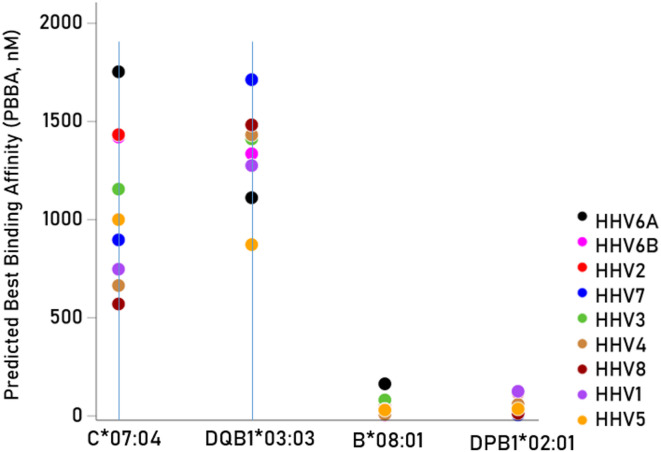
Predicted Best Binding Affinities (PBBA) for the 4 HLA alleles and 9 HHV tested. nM, nanomolar. Lower values indicate better (stronger) binding.

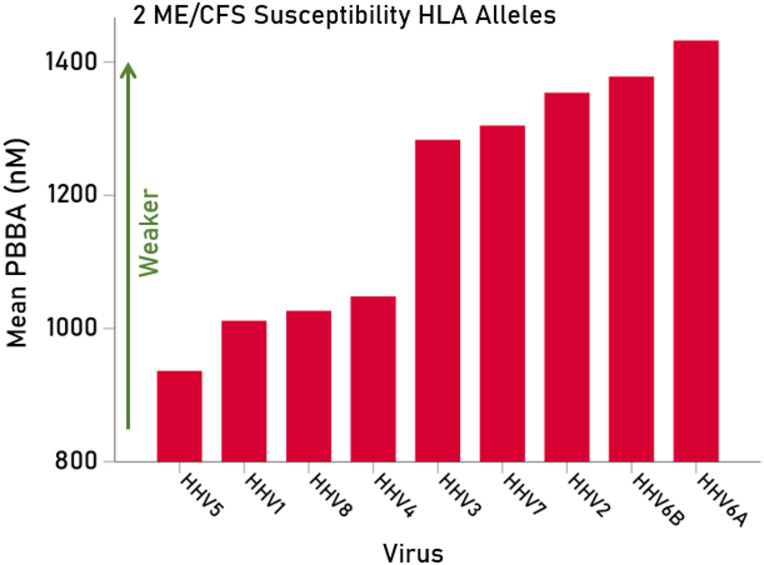
The average PBBAs of the 2 risk alleles (C*07:04, DQB1*03:03) for each HHV tested are plotted ranked from low to high PBBA; higher PBBAs indicated weaker binding.
| Pathogen | Protein | UniprotKB ID | AA | HLA-I | HLA-II | |
|---|---|---|---|---|---|---|
| ME/CFS (HHV) | ||||||
| 1 | HHV1 | Envelope glycoprotein D | Q69091 | 394 | 386 | 380 |
| 2 | HHV2 | Envelope glycoprotein D | P03172 | 393 | 385 | 379 |
| 3 | HHV3 | Envelope glycoprotein E | Q9J3M8 | 623 | 615 | 609 |
| 4 | HHV4 | Envelope glycoprotein B | P03188 | 897 | 889 | 883 |
| 5 | HHV5 | Envelope glycoprotein B | P06473 | 906 | 898 | 892 |
| 6 | HHV6A | Envelope glycoprotein Q2 | P0DOE0 | 214 | 206 | 200 |
| 7 | HHV6B | Envelope glycoprotein Q1 | Q9QJ11 | 516 | 508 | 502 |
| 8 | HHV7 | Envelope glycoprotein H | P52353 | 690 | 682 | 676 |
| 9 | HHV8 | Envelope glycoprotein H | F5HAK9 | 730 | 722 | 716 |
| Total | 5291 | 5237 | ||||
| Total peptides tested | 10,528 | |||||
| Total tested (× 4 HLA alleles) | 42,112 | |||||
| Long COVID (SARS-CoV-2) | ||||||
| SARS-CoV-2 | Spike glycoprotein | P0DTC2 | 1273 | 1265 | 1259 | |
| Total peptides tested | 2524 | |||||
| Total tested (× 4 HLA alleles) | 10,096 | |||||
| PTLDS ()B. burgdorferi | ||||||
| 1 | B. burgdorferi | Outer surface protein A | P0CL66 | 273 | 265 | 259 |
| 2 | B. burgdorferi | Outer surface protein C | Q07337 | 210 | 202 | 196 |
| 3 | B. burgdorferi | Decorin-binding protein A | O50917 | 191 | 183 | 177 |
| 4 | B. burgdorferi | OppA-2 | Q6RH12 | 107 | 99 | 93 |
| 5 | B. burgdorferi | Variable large protein | O06878 | 356 | 348 | 342 |
| Total | 1097 | 1067 | ||||
| Total peptides tested | 2164 | |||||
| Total tested (× 4 HLA alleles) | 8656 | |||||
| Grand total | 60,864 | |||||
| Virus | Risk | Protective | |||||||
|---|---|---|---|---|---|---|---|---|---|
| C*07:04 | DQB1*03:03 | B*08:01 | DPB1*02:01 | ||||||
| PBBA (nM) | S | PBBA (nM) | S | PBBA (nM) | S | PBBA (nM) | S | ||
| 1 | HHV1 | 747.6 | 0 | 1275.7 | 0 | 32.1 | 1 | 125.8 | 0 |
| 2 | HHV2 | 1432.7 | 0 | 1275.7 | 0 | 45.5 | 1 | 117.8 | 0 |
| 3 | HHV3 | 1155.4 | 0 | 1411.2 | 0 | 81.8 | 0 | 42.3 | 1 |
| 4 | HHV4 | 664.6 | 0 | 1431.9 | 0 | 9.2 | 1 | 59.3 | 0 |
| 5 | HHV5 | 1000.1 | 0 | 872.9 | 0 | 30.3 | 1 | 36.3 | 1 |
| 6 | HHV6A | 1753.1 | 0 | 1111.7 | 0 | 163.8 | 0 | 45 | 1 |
| 7 | HHV6B | 1421.1 | 0 | 1335.5 | 0 | 4.8 | 1 | 22.5 | 1 |
| 8 | HHV7 | 897 | 0 | 1712.9 | 0 | 24.2 | 1 | 5.6 | 1 |
| 9 | HHV8 | 570.5 | 0 | 1482.7 | 0 | 33.8 | 1 | 14.3 | 1 |
| Risk | Protective | |||
|---|---|---|---|---|
| C*07:04 | DQB1*03:03 | B*08:01 | DPB1*02:01 | |
| Mean | 1179.1 nM | 1333.7 nM | 65.3 nM | 42.7 nM |
| SD | 617.7 | 259.8 | 84.7 | 38.3 |
| SEM | 171.3 | 72 | 23.5 | 10.6 |
| Minimum | 570.5 | 872.9 | 4.8 | 5.6 |
| Maximum | 2862.6 | 1863.4 | 310.6 | 125.8 |
| Median | 1000.1 | 1275.7 | 32.1 | 35.5 |
| IQR | 720.8 | 306 | 55.2 | 38.7 |
| 25th Percentile | 706.1 | 1151.3 | 19.8 | 13.4 |
| 75th Percentile | 1426.9 | 1457.3 | 75 | 52.1 |
| Odds Ratio (OR)[7] | 2.03 | 1.46 | 0.7 | 0.7 |
| Allele | ln(Mean PBBA) | ln(OR) |
|---|---|---|
| C*07:04 | 6.977 nM | 0.7419 |
| DQB1*03:03 | 7.188 | 0.4055 |
| B*08:01 | 3.856 | − 0.3567 |
| DPB1*02:01 | 3.953 | − 0.3567 |
SARS-CoV-2
| Allele | SARS-CoV-2 | B. burgdorferi | |
|---|---|---|---|
| Risk | C*07:04 | 362.2 nM | 1410.7 nM |
| DQB1*03:03 | 614.1 | 1028.2 | |
| Protective | B*08:01 | 19.9 | 68.3 |
| DPB1*02:01 | 5.38 | 71.4 |
B. burgdorferi
Here we evaluated the PBBA of five B. burgdorferi antigens with the ME/CFS alleles by testing exhaustively 2164 peptides (Table 1). For HLA-I, the PBBA (across the 5 antigens) for the ME/CFS risk allele C*7:04 (1410.7 nM) was 20.7 × weaker than the protective B*08:01 allele (68.3 nM) (Table 5). For HLA-II, the PBBA for the ME/CFS risk allele DQB1*03:03 (1028.2 nM) was 14.4 × weaker than the protective allele DPB1*02:01 (71.4 nM).
Discussion
A recent study identified HLA alleles that are associated with ME/CFS risk or protection12. Here we tested the hypothesis that risk or protection conferred by those alleles would be associated to the strength in binding affinity to common viruses. As expected, the predicted binding affinities of previously identified ME/CFS HLA risk alleles (C*07:04, DQB1*03:03) to virus antigens are significantly weaker than the predicted binding affinities of protective HLA alleles (B*08:01, DPB1*02:01). Furthermore, we exhaustively tested the predicted binding affinity of 10,528 amino acid sequences (Table 1) of 9 HHV antigens to the HLA alleles implicated in ME/CFS risk and found that none of them met the threshold for strong binding affinity (IC50 < 50 nM)23. On average, the risk alleles were characterized by weak binding affinity to the viruses investigated; specifically, the predicted best binding affinity was weak for 100% of the HHVs with the risk alleles. In contrast, strong predicted best binding affinity was documented for 78% (7 of 9) of HHVs with B*08:01 and 67% (6 of 9) with DPB1*02:01, the two protective alleles. Notably, the mean binding affinity of the alleles with the 9 HHVs was significantly associated with the odds ratio of ME/CFS documented by previous researchers12. HHVs are nearly ubiquitous neurotropic viruses that establish latency after initial infection and are intermittently reactivated in contexts such as stress or immunosuppression24. With regard to ME/CFS, a recent meta-analysis documented that of the HHVs, the highest odds of ME/CFS were associated with HHV6 and HHV7 and particularly with their co-infection10. Similarly, here, HHV6a, HHV6b, and HHV7 were among those with the weakest binding affinities to the risk alleles, further supporting their influence on ME/CFS. Remarkably, SARS-CoV-2 and Borrelia burgdorferi antigens were similarly characterized by weak affinity to the ME/CFS risk alleles and substantially stronger affinity to the ME/CFS protective alleles. Taken together, these findings suggest that risk conferred by certain HLA alleles is likely attributed to limited binding with antigens of virus or bacterial pathogens, hindering the immune system response aimed at targeting the offending pathogen. We have hypothesized that absence of sufficient HLA-antigen binding permits foreign antigens to persist, contributing to chronic symptoms characteristic of ME/CFS and other chronic conditions such as long-COVID and Lyme disease13.
HLA molecules, which are cell-surface glycoproteins encoded by genes on the short arm of chromosome 6, play a critical role in adaptive immunity via presentation of foreign antigens to T lymphocytes to stimulate immune defense25. Both HLA Class I and Class II bind and present foreign antigen peptides to T cells, albeit via different mechanisms and with different outcomes. HLA Class I molecules, which are expressed on all nucleated cells, present endogenous antigens including virus-induced proteins to cytotoxic CD8 + T cells, signaling destruction of infected cells. HLA Class II molecules, which are restricted to antigen presenting cells, present endocytosed exogenous antigens to T cell receptors of CD4 + lymphocytes, stimulating antibody production and long-term immunity. The two main HLA classes work together to quickly eliminate pathogens and protect against future infection, assuming sufficient binding between HLA and a given peptide. HLA, however, is extremely polymorphic26, contributing to variations in the binding groove that impact binding affinity27 and disease risk28. Lande and colleagues12 previously documented HLA Class I and Class II alleles that were associated with risk to (and protection against) ME/CFS. The present finding that neither the Class I (C*07:04) nor Class II (DQB1*03:03) risk alleles have strong binding affinity to any of the common pathogens we evaluated points to limited effectiveness of both arms of adaptive immunity. This stands in stark contrast to the strong binding affinity of the protective alleles (B*08:01 and DPB1*02:01) with the same pathogens, likely promoting robust adaptive immune responses to eliminate and/or neutralize pathogens, thereby protecting against ME/CFS, long-COVID, and Lyme disease.
Although the present analyses focused primarily on HLA-HHV antigen binding affinity with regard to ME/CFS, the findings extend to other conditions, particularly chronic multisymptom illnesses that are characterized by similar symptoms as ME/CFS, such as long-COVID29–31 and PDLS21. Several previous studies have documented the influence of HLA on SARS-CoV-2 infection and on Lyme disease32–36; limited research has evaluated HLA with regard to Long-COVID [37; c.f., 38]. Binding of HLA with peptides from viral and bacterial antigens is a key initial step in initiating adaptive immunity against pathogens to facilitate their elimination. Without sufficient binding affinity, the pathogens may persist. Indeed, fragments of SARS-CoV-2 and Borrelia burgdorferi protein have been identified in patients suffering from Long-COVID or Lyme disease16,17,22. Based on the present findings, we would expect that persistence to be more likely in the alleles that were predicted to bind weakly (C*07:04; DQB1*03:03) with all of the pathogens investigated. Of note, previous research has shown that HLA-C*07:04 is among the weakest binders to the SARS‐Cov‐2 protein39. The finding that the same alleles that confer risk to ME/CFS12 are associated with weak affinity not only for HHVs implicated in ME/CFS, but also for SARS-CoV-2 and Borrelia burgdorferi proteins suggests that insufficient HLA-antigen binding is a possible common thread contributing to a range of chronic multisymptom illnesses. Indeed, the overlapping symptoms of ME/CFS, long-COVID, and PTLDS—namely, fatigue, pain, cognitive dysfunction, postexertional malaise—may reflect a common set of symptoms stemming from various infectious insults similar to the common symptoms of fever and malaise accompanying acute infections by diverse pathogens (viruses, bacteria, etc.).
Despite the broader implications of this study's novel findings, several limitations and future directions are worth noting. First, the analyses here were limited to 4 HLA alleles that were previously documented to be associated with ME/CFS risk or protection12. Given the extreme polymorphism12 and geographic variability40,41 of HLA, it possible that other HLA alleles not investigated here may also contribute to ME/CFS risk/protection based on their binding affinity with foreign pathogens. Similarly, it is certainly likely that weak HLA binding to pathogens beyond the HHVs studied here (e.g., enteroviruses, parvoviruses)9,10 may be involved in ME/CFS. Finally, the present analyses focused on the 4 ME/CFS alleles do not preclude influence of other HLA alleles on Long-COVID and PTLDS.
Materials and methods
Antigens
We tested a total of 15 protein antigens of pathogens (Table 1), including 9 antigens of human herpes viruses (HHV), the spike glycoprotein of SARS-CoV-2 virus, and 5 antigens of Borrelia burgdorferi (B. burgdorferi). The amino acid (AA) sequences of those proteins were obtained from the Uniprot website (https://www.uniprot.org/uniprotkb/↗)42 and are shown in Table S1 (Supplementary Material).
HLA alleles
We investigated 2 ME/CFS risk HLA alleles (C*07:04, DQB1*03:03) and 2 protective alleles (B*08:01, DPB1:02:01) reported by Lande et al.12.
In silico determination of predicted best binding affinities (PBBA) to pathogen antigens

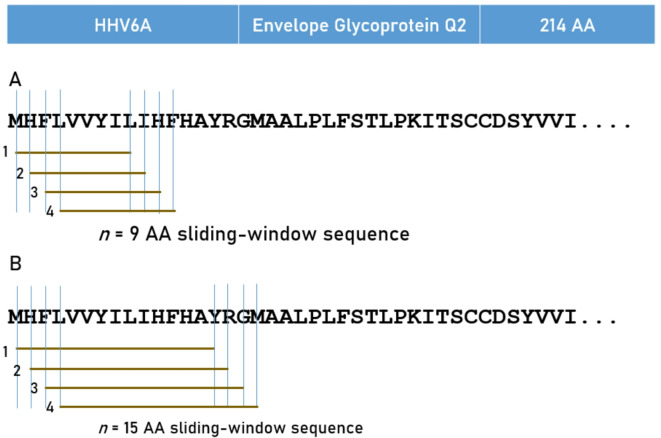
Schematic diagram to illustrate the sliding window approach to estimate in silico binding affinities of HLA alleles to one viral antigen (HHV6A).
Statistical analyses
The IBM-SPSS statistical package (version 30.0.0.0 172) was used for implementing statistical analyses. Standard statistical methods were used; all P-values reported are 2-sided,. \documentclass[12pt]{minimal} \usepackage{amsmath} \usepackage{wasysym} \usepackage{amsfonts} \usepackage{amssymb} \usepackage{amsbsy} \usepackage{mathrsfs} \usepackage{upgreek} \setlength{\oddsidemargin}{-69pt} \begin{document}$$a=0.05$$\end{document}
Supplementary Information
Below is the link to the electronic supplementary material.
Supplementary Material 1
 Long Covid