
What this is
- This phase 3 study evaluated the DS-5670d COVID-19 mRNA vaccine targeting the omicron XBB.1.5 variant.
- It assessed immunogenicity and safety in participants with varying histories of SARS-CoV-2 infection and vaccination.
- The study found DS-5670d to be non-inferior to the BNT162b2 vaccine in terms of immune response.
Essence
- A single dose of DS-5670d demonstrated non-inferior immunogenicity compared to BNT162b2 in a diverse population, with acceptable safety profiles.
Key takeaways
- DS-5670d achieved an adjusted GMT ratio of 1.218 vs. BNT162b2, indicating comparable neutralizing activity against the omicron variant.
- rates were 87.3% for DS-5670d and 82.9% for BNT162b2, with an adjusted difference of 4.5%, both surpassing non-inferiority margins.
- No major differences in adverse events were observed between the two vaccine groups, confirming the safety of DS-5670d.
Caveats
- The main limitation is the short follow-up duration, which restricts conclusions about long-term safety and efficacy.
- Inclusion of only Asian participants may limit the generalizability of the findings to other populations.
Definitions
- Seroresponse: A significant increase in blood neutralizing activity against a virus after vaccination, indicating immune response.
Simplified
Introduction
Although coronavirus disease 2019 (COVID-19) no longer constitutes a global emergency, it remains an ongoing threat to public health [1]. The emergence of novel escape variants of severe acute respiratory syndrome-coronavirus-2 (SARS-CoV-2), plus waning protective immunity over time, has led to a continuous need for the development, testing and authorization of updated vaccine compositions [2,3]. The initial roll-out of primary vaccination with monovalent messenger ribonucleic acid (mRNA)-based vaccines such as BNT162b2 (Comirnaty, Pfizer-BioNTech) and mRNA-1273 (Spikevax, Moderna) targeting the original Wuhan strain of SARS-CoV-2 [4] was initially followed by boosters with the same monovalent composition, and then by bivalent boosters targeting both the original strain and omicron BA.4−5 [5,6]. Immunization programs against COVID-19 have now moved away from emergency use towards seasonal vaccination, to boost protective immune responses against emerging variants of SARS-CoV-2 [1,7]. In addition, a single-dose regimen is now recommended for most recipients, as either a primary or booster vaccination [8,9]. For the 2023/24 season, monovalent vaccine compositions containing an antigen from the omicron XBB.1.5 strain were authorized [10], while for 2024/25, vaccines containing an antigen from the JN.1 lineage have been recommended [11,12].
DS-5670 is a vaccine platform formulation based on mRNA encapsulated in lipid nanoparticles (LNP-mRNA) [13], which can be applied to compositions containing antigens derived from different strains of SARS-CoV-2. To date, several different compositions of DS-5670, either monovalent or bivalent, have been clinically evaluated. DS-5670a, a monovalent vaccine containing an antigen from the original strain, demonstrated a clinically acceptable safety profile and favorable immune responses in adults [14], and was authorized in Japan for use as a booster vaccination. DS-5670a/b, a bivalent vaccine containing antigens from both the original strain and from omicron BA.4–5, was shown to be well-tolerated, induced broad neutralization activity across omicron sub-lineages, and was immunogenetically non-inferior to the bivalent composition of BNT162b2 containing corresponding original and omicron BA.4–5 antigens when administered as a booster vaccination in adults (Daiichi Sankyo Co., Ltd; data on file). DS-5670a/b also had a manageable safety profile and showed non-inferior immunogenicity to bivalent BNT162b2 when administered as a booster to children aged 5–11 years [15].
In November 2023, a monovalent DS-5670 vaccine containing an antigen derived from omicron XBB.1.5 (DS-5670d; Daichirona, Daiichi Sankyo Co., Ltd) was approved by the Japanese Ministry for Health, Labour and Welfare as a booster COVID-19 vaccination [16], and it was launched in December as part of the Japanese immunization program for the 2023/24 season. Herein, we report data from a phase 3 non-inferiority study conducted in adults and children aged ≥12 years which aimed to evaluate the safety and immunogenicity of a single dose of DS-5670d in those with or without history of prior infection and/or vaccination.
Methods
Study design and participants
This was a phase 3 randomized, active-comparator, observer-blind, non-inferiority study registered with the Japan Registry of Clinical Trials with the identifier jRCT2031230424. The study was conducted in accordance with the Declaration of Helsinki, Good Clinical Practice guidelines, and all national and regional ordinance, and was approved by the relevant ethical committees at each study site (). The study is reported as per CONSORT guidelines (CONSORT Checklist). S1 Table S1
The first participant was enrolled on 9 January 2024, the initial observation period lasted for 4 weeks post-vaccination, and the follow-up period was planned to continue up to 26 weeks post-vaccination. In the current manuscript, we report the results up to 4 weeks post-vaccination.
The study included adults and children aged ≥12 years enrolled from 15 sites across Japan (). Written informed consent was obtained from each participant or their legal representative prior to initiation of study procedures. Eligible participants were stratified into 4 subpopulations: (A) those with a history of both SARS-CoV-2 infection and COVID-19 vaccination, (B) those with a history of SARS-CoV-2 infection but without a history of COVID-19 vaccination, (C) those without a history of SARS-CoV-2 infection but with a history of COVID-19 vaccination, or (D) those without any history of SARS-CoV-2 infection or COVID-19 vaccination prior to the date of informed consent. Prior infection was defined as a positive test result for SARS-CoV-2 (either a reverse transcription-polymerase chain reaction test, other nucleic acid detection test, or SARS-CoV-2 antigen test), or a diagnosis of COVID-19. For participants in subpopulations A and B, the positive test result for SARS-CoV-2 was required to have been documented >3 months prior to enrolment, as persons who had tested positive for SARS-CoV-2 infection or were diagnosed with COVID-19 within 3 months before the date of informed consent, or had symptoms suggestive of SARS-CoV-2 infection at the time of informed consent, or who had a positive SARS-COV-2 test at the time of eligibility evaluation were deemed ineligible for the study. Participants in subpopulation D were categorized as non-immune based on an absence of vaccination history, plus an absence of self-reported infection history, plus a negative N-antibody test prior to administration of the study vaccine. S1 Table
Key exclusion criteria were the presence of serious cardiovascular, renal, hepatic, blood, neuropsychiatric or developmental disorder, thrombocytopenia, or coagulopathy; history of vaccine-related seizures or epilepsy, or history of anaphylaxis or severe allergy due to administration of food, drugs, cosmetics or vaccines; current or prior history of myocarditis or pericarditis; or a previous diagnosis of immunodeficiency or a close relative with congenital immunodeficiency.
Randomization and masking
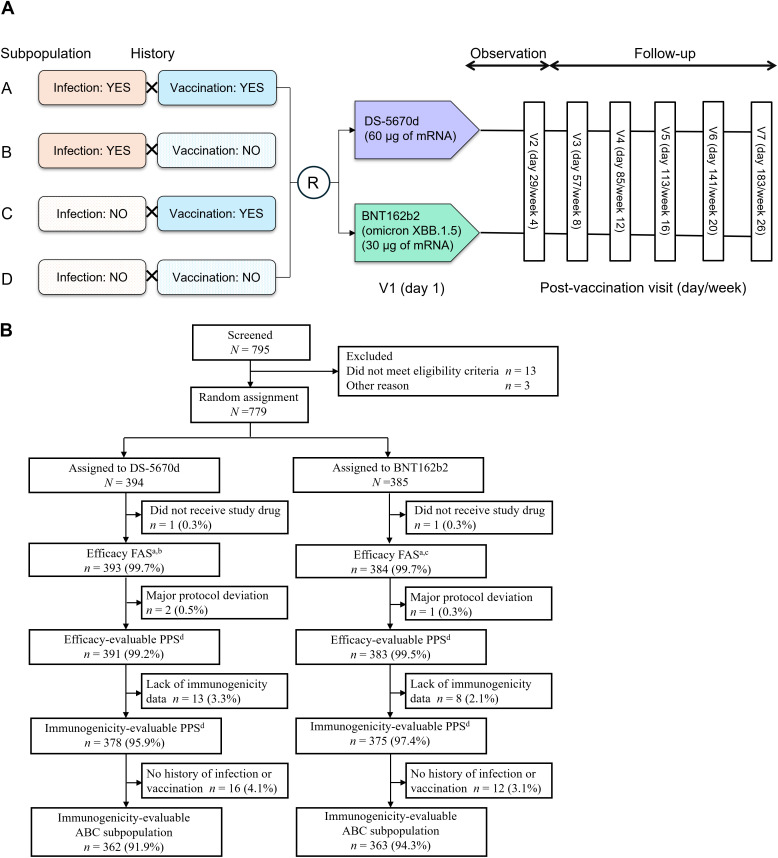
The study design is shown in Fig 1A. Participants were divided into subpopulations A–D according to their prior infection/vaccination status. Enrolled participants were then randomly assigned in a 1:1 ratio via stratified block randomization to receive either DS-5670d (60 µg of mRNA) or monovalent BNT162b2 (containing an antigen from omicron XBB.1.5, 30 µg of mRNA). There were four stratification factors: (i) study site; (ii) age (≥12 and <18 years, ≥ 18 and <65 years, ≥ 65 years); (iii) history of previous SARS-CoV-2 infection (present or absent); (iv) history of previous SARS-CoV-2 vaccination (present or absent). Random assignment was the responsibility of an independent statistician, and vaccines were dispensed and administered unblinded site personnel. Investigators were blinded to treatment, and uploaded participant data via an interactive web response system. Participants and their legal representatives, the study monitor and members of the study advisory board, sponsor and collaborators, and personnel performing antibody titer determination were also blinded to vaccine assignment.

(A) Study design and (B) CONSORT flow diagram of participant disposition through the study. aThe efficacy FAS and safety analysis sets were identical. bIncluded 147 (37.4%) in subpopulation A; 67 (17.0%) in subpopulation B; 163 (41.5%) in subpopulation C, and 16 (4.1%) in subpopulation D. cIncluded 139 (36.2%) in subpopulation A; 66 (17.2%) in subpopulation B; 167 (43.5%) in subpopulation C, and 12 (3.1%) in subpopulation D. dCombined ABCD subpopulation. FAS, full analysis set; PPS, per protocol set; R, random assignment.
Procedures
Participants received either DS-5670d (60 µg of mRNA) or monovalent BNT162b2; vaccines were dispensed and administered intramuscularly into the deltoid region of the upper arm on day 1.
Outcomes
The study objective was to verify the non-inferiority of DS-5670d to BNT162b2 in terms of immunogenicity, and to evaluate safety.
The primary efficacy endpoint was geometric mean titer (GMT) of blood neutralizing activity against SARS-CoV-2 (omicron variant XBB.1.5) and seroresponse rate at day 29 (4 weeks) after study vaccine administration in participants with any history of SARS-CoV-2 infection and/or vaccination (the combined ABC subpopulation). Seroresponse was defined as a ≥ 4-fold increase in the blood neutralizing activity against SARS-CoV-2 after study vaccine administration, compared with the value before administration. The key secondary efficacy endpoint was blood neutralizing activity GMT and seroresponse rate at day 29 after study vaccination in all study participants regardless of infection or vaccination history (the combined ABCD subpopulation). The incidence of COVID-19 (confirmed by the investigator based on a positive SARS-CoV-2 infection test plus any COVID-19 symptoms) up to one month (day 29) and six months after study vaccination was also evaluated. Exploratory efficacy endpoints (GMT of blood neutralizing activity and seroresponse rate at 8, 12, 16, 20, and 26 weeks after study vaccine administration) are not reported here.
Safety endpoints included the occurrence of solicited adverse events (AEs), unsolicited AEs, serious AEs (SAEs), and clinically relevant changes in laboratory values. AEs were coded using the Medical Dictionary for Regulatory Activities version 26.1. Health status was recorded in an electronic diary by participants or their representative. Solicited AEs (injection site events [redness, swelling, induration, pain, warmth, and pruritus] and systemic events [fever, malaise, headache, rash, and myalgia]) were collected up to day 8 post-administration, and unsolicited AEs and SAEs up to day 29. Laboratory tests were performed pre-vaccination and at day 29 post-vaccination.
Statistical analysis
To confirm non-inferiority of DS-5670d versus BNT162b2 at day 29, the lower limit of the two-sided 95% confidence interval (CI) of the GMT ratio was required to be above the non-inferiority margin of 0.67, and the lower limit of the two-sided 95% CI for the difference in the seroresponse rate was required to exceed −10% in favor of DS-5670d. Based on this, plus taking into account anticipated dropout rates (approximately 10% due to withdrawal or lack of data for analysis), the number of participants in the combined ABC subpopulations required to power the immunogenicity non-inferiority comparison was 690 (of whom 345 would receive DS-5670d and 345 would receive BNT162b2). With a sample size of 690, a study vaccine assignment ratio of 1:1, and a common standard deviation (SD) of neutralizing activity (common logarithmic value) of 0.533 (determined from prior studies in participants aged ≥18 years; Daiichi Sankyo Co., Ltd, data on file), the statistical power to detect the non-inferiority for GMT would be 98.2% at 1-sided significance level of 0.025, and the power to detect non-inferiority for the seroresponse rate would be 87.2% at 1-sided significance level of 0.025. Thus, the power for non-inferiority which simultaneously satisfied both primary endpoints was 85.6% (i.e., 98.2% × 87.2%) assuming that non-inferiority for GMT and seroresponse rate were independent.
Among the 690 planned participants for the combined ABC subpopulations, 100 participants (50 per vaccine group) were required to be vaccine-naïve (i.e., included in subpopulation B). No sample size requirement or limitation was set for subpopulation D as the number of eligible participants for this group (no prior infection, no prior vaccination) was considered likely to be small; however, as many eligible participants as possible were enrolled into this subpopulation. With a total combined ABCD sample size of 790 participants, and assuming that the GMT ratio (DS-5670d group/ BNT162b2 omicron XBB.1.5 group) for blood neutralizing activity against SARS-CoV-2 at 4 weeks after study vaccine administration was 1.0, and the seroresponse rate was 80.0%, the statistical power to detect non-inferiority for GMT would be 99.1% and for the seroresponse rate would be 91.2%, both at a 1-sided significance level of 0.025. The power for non-inferiority which simultaneously satisfied these key secondary endpoints was 90.4% (i.e., 99.1% × 91.2%) assuming that the two non-inferiority outcomes were independent.
A sequential procedure was followed for the immunogenicity analyses. First, non-inferiority was tested for the combined ABC subpopulations; only if non-inferiority was confirmed was testing continued for the combined ABCD subpopulation. Immunogenicity analyses were conducted based on the treatment group to which each participant was assigned; the primary analysis population was the immunogenicity-evaluable per protocol set (PPS), which included participants who received a dose of study drug, had a pre-administration and at least one post-administration immunogenicity measurement, and had no protocol violations that could affect the immunogenicity evaluations. Safety analyses were conducted based on the study drug that was actually administered. Unsolicited AEs were evaluated using the safety analysis set, which included all participants who received at least one dose of study drug; solicited AEs were evaluated in the solicited safety analysis set, which included all participants in the safety analysis set for whom information on the occurrence of at least one solicited AE was available.
Baseline participant characteristics were recorded descriptively as number (%), mean (SD), or median (range). Adjusted GMT and two-sided 95% CI were calculated using an analysis of covariance (ANCOVA) model, with blood neutralizing activity as the dependent variable, study vaccine administration group as an independent variable, and baseline value and subpopulation as covariates. The adjusted GMT ratio was also calculated based on the ANCOVA model. We evaluated the assumptions of the ANCOVA analysis in terms of multicollinearity of covariates, homogeneity of variance, and homogeneity of regression; none of the tests indicated a significant impact on the comparisons between DS-5670d and BNT162b2 omicron XBB.1.5 (). For the adjusted seroresponse rate, the between-group difference was calculated using the Mantel-Haenszel method, with subpopulation included as a stratum. The COVID-19 incidence rate was calculated, using the PPS, as the number of cases per 1,000 person-years; curves were generated using Kaplan-Meier methodology and 95% CIs were derived using the Clopper-Pearson exact method. Solicited AEs were recorded in an electronic diary by each participant or their legal representative; the presence or absence of solicited AEs and their severity were recorded up to 8 days post-vaccine administration, and any other (unsolicited) AEs were recorded up to day 29. The number (%) of participants with events were calculated according to the respective analysis set and tabulated. All statistical calculations were performed using SAS software version 9.4 or later (SAS Institute, Inc., Cary, NC, USA). S1 Text
Results
Population
A total of 779 participants were enrolled into the study, of whom 394 were assigned to receive DS-5670d and 385 to receive BNT162b2 omicron XBB.1.5. The disposition and analysis populations are presented in Fig 1B. One participant in each group did not receive study vaccination, so the safety analysis set included 393 participants in the DS-5670d group and 384 in the BNT162b2 group. Overall, the safety analysis set included 286 participants in subpopulation A, 133 in subpopulation B, 330 in subpopulation C, and 28 in subpopulation D.
Three participants were excluded due to major protocol deviations (two in the DS-5670d group had taken a concomitant medication prohibited by the protocol, and one in the BNT162b2 group had been mistakenly enrolled in the study despite meeting exclusion criteria). After additional exclusions due to a lack of immunogenicity data, the immunogenicity-evaluable PPS (combined subpopulations ABCD) included 378 participants in the DS-5670d group and 375 in the BNT162b2 group. For the primary efficacy endpoint, the 28 participants in subpopulation D were excluded; thus, the immunogenicity-evaluable ABC subpopulation comprised 362 in the DS-5670d group and 363 in the BNT162b2 group.
The demographics and baseline characteristics of participants are described in Table 1. The median age of participants was 46.0 years (range 12–90 years), with the majority aged between 18–65 years (644/777, 82.9%). Slightly more than half of participants were male (425/777, 54.7%), and had a history of SARS-CoV-2 infection (419/777, 53.9%). Many participants had received prior vaccination (616/777, 79.3%), with monovalent (original strain) vaccines in 313 (40.3%) of participants and bivalent (original strain/omicron BA.4–5) vaccines in 275 (35.4%). Characteristics were similar across the study vaccine groups, and there were no notable differences between the safety analysis set and the immunogenicity-evaluable PPS.
The randomization and stratification schedule implemented for the study aimed to overcome potential bias from factors such as age, location, and prior immune history. However, subpopulation B (those with a history of SARS-CoV-2 infection but without a history of COVID-19 vaccination) contained a slightly greater proportion of children, while subpopulation C (those without a history of SARS-CoV-2 infection but with a history of COVID-19 vaccination) contained a slightly greater proportion of elderly patients. This was not unexpected, and likely reflects real-world COVID-19 precautions and vaccine roll-out in Japan, where elderly people took measures to avoid infection and became eligible for vaccination prior to young adults and children who were more likely to have become infected at home or school. Other characteristics across the subpopulations were similar, except where specified in terms of immune status (). S2 Table
| DS-5670d( = 393)n | BNT162b2( = 384)n | All participants( = 777)N | |
|---|---|---|---|
| Age (years) | |||
| Median (range) | 47.0 (12, 90) | 45.5 (12, 77) | 46.0 (12, 90) |
| 12–17 | 35 (8.9) | 29 (7.6) | 64 (8.2) |
| 18–65 | 320 (81.4) | 324 (84.4) | 644 (82.9) |
| ≥65 | 38 (9.7) | 31 (8.1) | 69 (8.9) |
| Male sex | 214 (54.5) | 211 (54.9) | 425 (54.7) |
| Weight (kg), median (range) | 62.2 (31, 127) | 62.4 (35, 132) | 62.4 (31, 132) |
| Height (cm), median (range) | 165.2 (140, 185) | 164.1 (147, 190) | 164.6 (140, 190) |
| History of SARS-CoV-2 infection | 214 (54.5) | 205 (53.4) | 419 (53.9) |
| Self-reported prior infection | 181 (46.1) | 171 (44.5) | 352 (45.3) |
| Positive antibody test 001 | 91 (23.2) | 67 (17.4) | 158 (20.3) |
| History of COVID-19 vaccination | 310 (78.9) | 306 (79.7) | 616 (79.3) |
| Original strain | 158 (40.2) | 155 (40.4) | 313 (40.3) |
| Original/omicron bivalent | 141 (35.9) | 134 (34.9) | 275 (35.4) |
| Omicron strain XBB.1.5 | 11 (2.8) | 17 (4.4) | 28 (3.6) |
| Interval from last vaccination (months) | |||
| Median (range) | 15.7 (3, 34) | 15.4 (3, 30) | 15.6 (3, 34) |
| 3–11 | 48 (12.2) | 48 (12.5) | 96 (12.4) |
| ≥12 | 262 (66.7) | 257 (66.9) | 519 (66.8) |
| Subpopulation | |||
| A | 147 (37.4) | 139 (36.2) | 286 (36.8) |
| B | 67 (17.0) | 66 (17.2) | 133 (17.1) |
| C | 163 (41.5) | 167 (43.5) | 330 (42.5) |
| D | 16 (4.1) | 12 (3.1) | 28 (3.6) |
Immunogenicity/efficacy
In the primary analysis (combined ABC subpopulations), the adjusted GMT ratio of DS-5670d to BNT162b2 was 1.218 (95% CI, 1.059, 1.401). Seroresponse rates were 87.3% in the DS-5670d group and 82.9% in the BNT162b2 group; the adjusted difference was 4.5% (95% CI, –0.70, 9.71). Both of these results exceeded the prespecified non-inferiority margins (Table 2 and S1 Fig), and the study met the primary endpoint. Anonymized individual data underlying the neutralizing titer calculations are provided by sex in S3 Table and by age in S4 Table.
In the secondary analysis (combined ABCD subpopulations), the adjusted GMT ratio was 1.185 (95% CI, 1.025, 1.371), and the adjusted difference in seroresponse rate was 3.7% (95% CI, –1.39, 8.87). Again, both results exceeded the prespecified non-inferiority margins (Table 2).
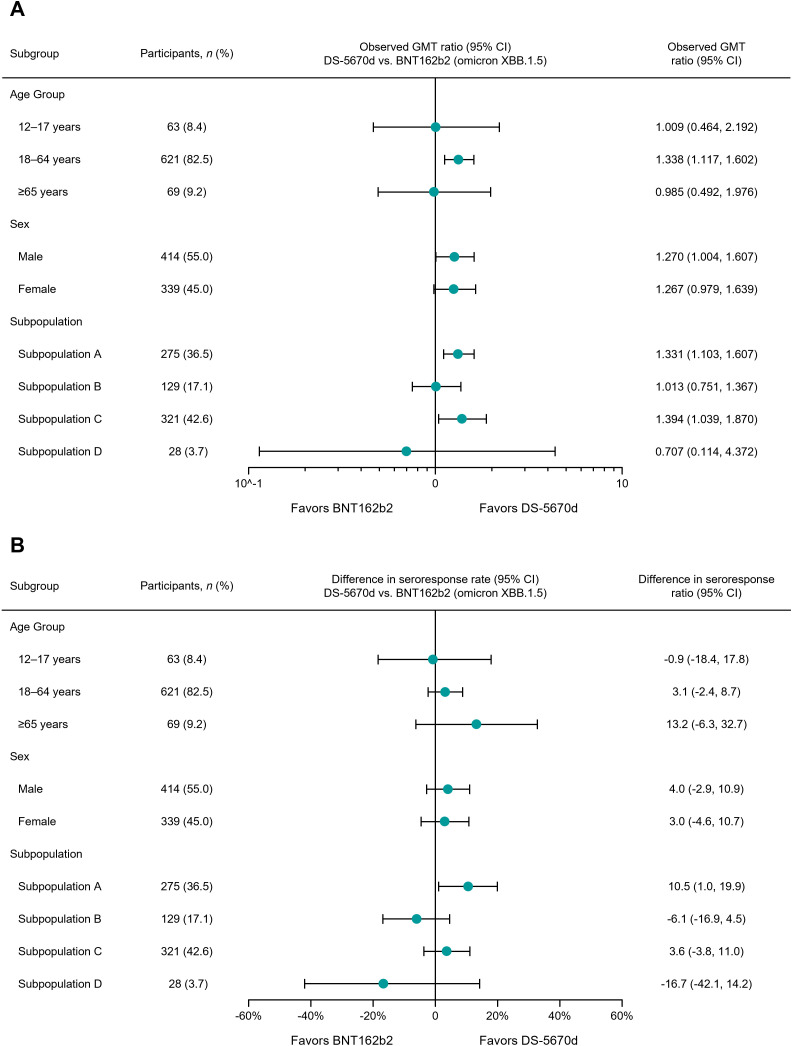
An analysis of blood neutralizing activity and seroresponse according to key subgroups (age group, sex, and subpopulation) is shown in Fig 2. The GMT ratio favored DS-5670d in patients with a history of vaccination, and also in those with infection history but without a history of vaccination. Violin plots illustrating immunogenicity according to study arm are provided as supplementary information, with the overall population shown in S2 Fig, by age category in S3 Fig, and by subpopulation in S4 Fig.
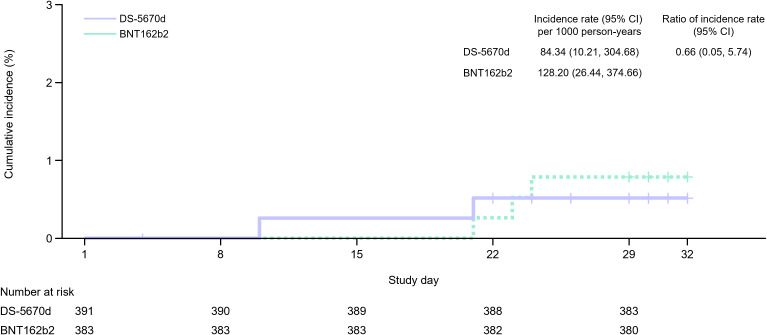
The incidence rate of COVID-19 to day 29 after study vaccination is presented in Fig 3. Both study vaccines appeared to be effective in preventing investigator-confirmed COVID-19 during this period, with two events reported in the DS-5670d group and three in the BNT162b2 group. The cumulative incidence at 6 months was < 5% in both groups, and no clear between-group difference in the incidence rate over the 6-month period following vaccine administration was observed (S5 Fig).

Forest plot of immunogenicity against SARS-CoV-2 (omicron XBB.1.5.6) at day 29 by subgroup for (A) observed GMT ratio of blood neutralizing activitya and (B) seroresponse rateb (immunogenicity-evaluable PPS). The observed GMT ratio (DS-5670d vs. BNT162b2 omicron XBB.1.5) and 95% CI were calculated based on the Student's distribution of the mean difference in the log-transformed values then back transformed to the original scale for presentation.The seroresponse rate observed difference (DS-5670d – BNT162b2 omicron XBB.1.5) and 95% CI were calculated based on the Newcombe-Wilson score method. CI, confidence interval; PPS, per protocol set; SARS-CoV-2, severe acute respiratory syndrome-coronavirus-2. a b

Incidence of investigator-confirmed COVID-19 (efficacy-evaluable PPS). CI, confidence interval; PPS, per protocol set.
| DS-5670d | BNT162b2 | |
|---|---|---|
| Primary analysis (immunogenicity-evaluable ABC subpopulation) | = 362N | = 363N |
| Adjusted GMT (95% CI) 002 | 1691.877 | 1388.927 |
| (1527.122, 1874.405) | (1253.021, 1539.573) | |
| Adjusted GMT ratio (95% CI) 002 | 1.218 (1.059, 1.401)* | |
| Non-inferiority criterion 002 | Met | |
| Seroresponse rate (95% CI) 002 | 87.3 (83.42, 90.54) | 82.9 (78.65, 86.65) |
| Adjusted difference (95% CI) 002 | 4.5 (–0.70, 9.71)* | |
| Non-inferiority criterion 002 | Met | |
| Secondary analysis (immunogenicity-evaluable ABCD population) | = 378N | = 375N |
| Adjusted GMT (95% CI) 002 | 1326.489 | 1119.097 |
| (1162.071, 1514.170) | (976.369, 1282.689) | |
| Adjusted GMT ratio (95% CI) 002 | 1.185 (1.025, 1.371) | |
| Non-inferiority criterion 002 | Met | |
| Seroresponse rate (95% CI) 002 | 86.8 (82.94, 90.02) | 83.2 (79.02, 86.84) |
| Adjusted difference (95% CI) 002 | 3.7 (–1.39, 8.87) | |
| Non-inferiority criterion 002 | Met | |
Safety
AEs occurring during the study are summarized in Table 3. The majority of participants experienced at least one AE, with most AEs judged by the investigator to be vaccine-related. There were very few serious AEs across the study vaccine groups; none of the serious AEs were judged to be study vaccine-related.
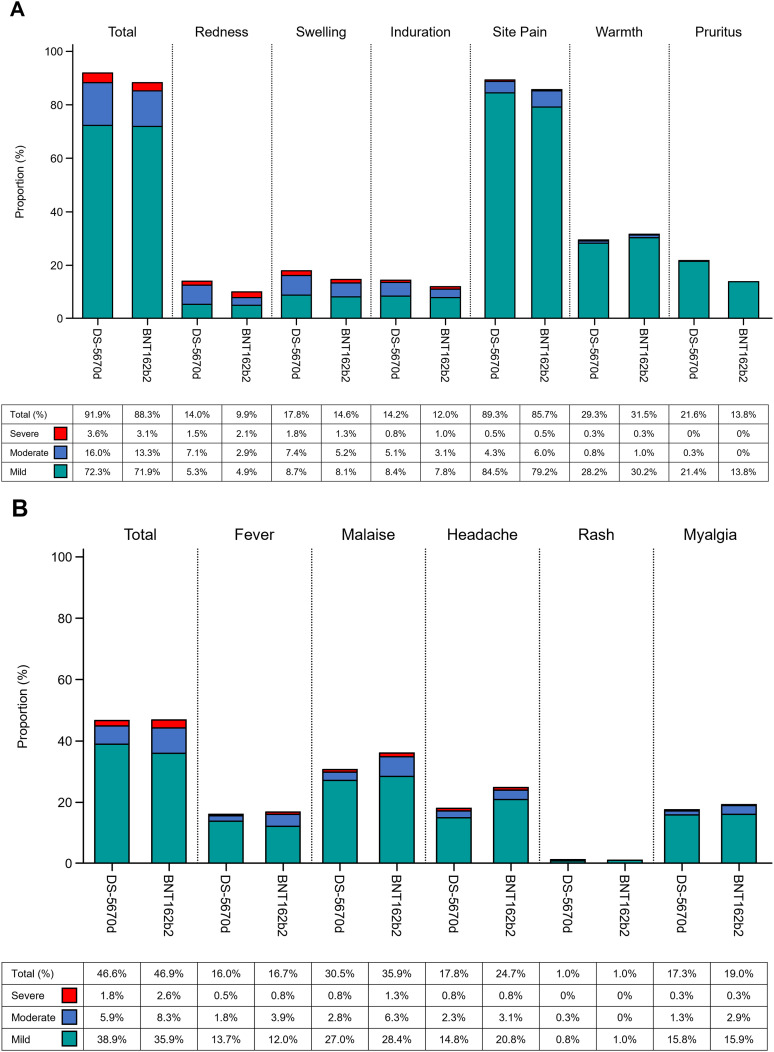
The majority of solicited AEs were mild or moderate in intensity (Fig 4). The most frequently reported solicited injection site AE across both study vaccine groups was mild pain. Unsolicited treatment-emergent AEs (all causality and study vaccine-related) are described in S5 Table. Overall, there were no major differences in the incidence or severity of solicited or unsolicited AEs between the study vaccine groups.

Solicited AEs (A) injection site AEs; (B) systemic AEs (safety analysis set). AE, adverse event.
| DS-5670d( = 393)N | BNT162b2( = 384)N | |
|---|---|---|
| Participants with ≥1 solicited AE | 365 (92.9) | 348 (90.6) |
| Participants with ≥1 severe solicited AE | 20 (5.1) | 20 (5.2) |
| Participants with ≥1 solicited injection site AE | 361 (91.9) | 339 (88.3) |
| Participants with ≥1 severe solicited injection site AE | 14 (3.6) | 12 (3.1) |
| Participants with ≥1 solicited systemic AE | 183 (46.6) | 180 (46.9) |
| Participants with ≥1 severe solicited systemic AE | 7 (1.8) | 10 (2.6) |
| Participants with ≥1 unsolicited TEAE | 77 (19.6) | 74 (19.3) |
| Participants with ≥1 study vaccine-related unsolicited TEAE | 32 (8.1) | 14 (3.6) |
| Participants with ≥1 severe unsolicited TEAE | 0 | 0 |
| Participants with ≥1 serious TEAE | 0 | 2 (0.5) |
| Participants with ≥1 study vaccine-related serious TEAE | 0 | 0 |
| Participants with TEAE leading to discontinuation | 0 | 0 |
| Participants with fatal TEAE | 0 | 0 |
Discussion
In this study, non-inferior immunogenicity of a single dose of monovalent DS-5670d to BNT162b2 omicron XBB.1.5 was confirmed in participants aged ≥12 years, regardless of infection or vaccination history. Both the primary and secondary efficacy endpoints were met, with the non-inferiority criteria being met in both the combined ABC population (with any history of prior infection and/or vaccination), and in the overall PPS including participants without any history of prior infection or vaccination. In the combined ABC subpopulation, the adjusted GMT ratio (DS-5670d versus BNT162b2) was 1.218 (95% CI, 1.059, 1.401), and the difference in the seroresponse rate was 4.5 (95% CI, –0.70, 9.71), both of which exceeded the non-inferiority margin.
In the analyses of immunogenicity by key demographic subgroups, there were no apparent differences in GMTs or seroresponse rates according to age group or sex. In addition to providing protective efficacy against severe COVID-19, infection-related death, and long COVID in high risk populations such as older adults [17,18], recent evidence clearly indicates the benefits of COVID-19 vaccination for children and younger adults in terms of both their mental and physical health [19]. In a country such as Japan, where adults aged ≥65 comprise almost 30% of the population [20], continued vaccine coverage and infection prevention and control measure remain essential to protect at-risk and frail individuals, and sustain medical and social systems [21]. It is also important to achieve good immunogenicity in males, who typically have lower antibody responses to vaccination compared with females [22,23], and which may impact the attainment of effective population immunity.
In the analyses of immunogenicity by subpopulation, the data suggested that even participants without any history of vaccination (subpopulation B) could achieve an adequate immune response with a single dose of DS-5670d. Such data emphasize the universality of DS-5670d immunogenicity regardless of prior vaccination history. In terms of participants without any history of infection or vaccination (subpopulation D), DS-5670d appears to be somewhat less immunogenic at first glance, but it is difficult to draw definitive conclusions due to the small number of participants available for evaluation. Overall, however, the participants enrolled in this study are a reasonably accurate reflection of the current real-world situation, where most people have now had a vaccination, or been infected, or both (i.e., comparable to the combined ABC population), and the number of those who have never been infected or vaccinated is dwindling. As such, the confirmation of non-inferiority of DS-5670d among both the ABC population and the ABCD population suggests that future seasonal DS-5670 vaccines will make a significant contribution to real-world public health in Japan.
The incidence of COVID-19 up to day 29 after study vaccination was low in both groups. However, the duration of observation was too short, and continued follow-up would be necessary before any inferences regarding the protective effects of DS-5670d can be made.
In terms of safety, there were no marked differences between the vaccine groups in the incidence or severity of solicited or unsolicited AEs. In line with results of previous studies evaluating different DS-5670 compositions, the most common solicited injection site AE was injection site pain, with most events being mild or moderate in severity [14,15]. The most common solicited systemic AE in this study was malaise. This differed from the previously published data for DS-5670a in adults, where myalgia was the most common solicited systemic AE [14]. However, malaise was also the most common solicited systemic AE in studies of DS-5670a/b in both adults (Daiichi Sankyo Co., Ltd., data on file) and children [15]. Both injection site pain and malaise (or fatigue) are among the most frequently reported AEs among persons receiving mRNA vaccines against COVID-19, and are not unique to DS-5670 vaccines [24,25]. There were no serious treatment-emergent unsolicited AEs which were judged to be related to study vaccine.
The main study limitation is the short duration of follow-up, which limits any conclusions relating to the long-term safety of DS-5670d, or the ongoing protection it may offer against COVID-19. In addition, the inclusion of only Asian patients may prevent generalization of the results to other locations and races.
In summary, the results of this phase 3 randomized, active-comparator, observer-blind study demonstrated the immunogenic non-inferiority of a single dose of DS-5670d regardless of history of prior infection or vaccination status and confirmed the clinically acceptable safety profile. Together with the data from previous DS-5670 clinical studies, these results contribute to the growing evidence that this LNP-mRNA vaccine platform technology can be harnessed to provide a significant contribution to public health via the production of COVID-19 vaccines in future seasons.
 mRNA Technology